INTRODUCTION
As the science regarding sports-concussion management continues to evolve, the need to consider individual differences as possible modifiers of outcome and recovery has remained salient (McCrory et al., Reference McCrory, Meeuwisse, Aubry, Cantu, Dvorak, Echemendia, Engebretsen, Johnston, Kutcher, Raftery, Sills, Benson, Davis, Ellenbogen, Guskiewicz, Herring, Iverson, Jordan, Kissick, McCrea, McIntosh, Maddocks, Makdissi, Purcell, Putukian, Schneider, Tator and Turner2013, Reference McCrory, Meeuwisse, Dvorak, Aubry, Bailes, Broglio, Cantu, Cassidy, Echemendia, Castellani, Davis, Ellenbogen, Emery, Engebretsen, Feddermann-Demont, Giza, Guskiewicz, Herring, Iverson, Johnston, Kissick, Kutcher, Leddy, Maddocks, Makdissi, Manley, McCrea, Meehan, Nagahiro, Patricios, Putukian, Schneider, Sills, Tator, Turner and Vos2017). A wide range of demographic, premorbid, and injury-specific variables have been evaluated in this context (Iverson et al., Reference Iverson, Gardner, Terry, Ponsford, Sills, Broshek and Solomon2017), with biological sex emerging as a primary variable of interest. Despite numerous studies examining sex and concussion outcome and recovery, the literature remains equivocal as to its significance (Iverson et al., Reference Iverson, Gardner, Terry, Ponsford, Sills, Broshek and Solomon2017). Further research is necessary to establish the extent to which males and females experience differential outcomes following sports-related concussion (SRC).
Neuropsychological compromise is perhaps the most well-known sequela of SRC. The broader neuropsychological literature has reported premorbid sex differences in cognition (Lezak, Howieson, Bigler, & Tranel, Reference Lezak, Howieson, Bigler and Tranel2012), and sex differences have also specifically been identified in athletes undergoing baseline neuropsychological testing (Merritt et al., Reference Merritt, Meyer, Cadden, Roman, Ukueberuwa, Shapiro and Arnett2017). Given these premorbid differences in cognition, it is imperative to consider the extent to which biological sex influences post-concussion cognitive functioning.
A number of studies have compared males and females on the Immediate Post-Concussion Assessment and Cognitive Testing (ImPACT) cognitive composites, with two recent reviews providing evidence that females tend to demonstrate greater impairment than males on measures of visual memory and reaction time in the acute period following concussion (Covassin, Savage, Bretzin, & Fox, Reference Covassin, Savage, Bretzin and Fox2018; Merritt, Padgett, & Jak, Reference Merritt, Padgett and Jak2019). Moreover, a meta-analysis by Dougan, Horswill, and Geffen (Reference Dougan, Horswill and Geffen2014) found that female sex was associated with greater neuropsychological deficits acutely following injury, though specific domains of cognitive functioning were not described. While the exact cause of these differences is not known, neuroanatomical, physiological, and/or hormonal differences between the sexes have been hypothesized as reasons for the performance discrepancies in males and females on cognitive testing following concussion (Covassin et al., Reference Covassin, Savage, Bretzin and Fox2018; Dougan et al., Reference Dougan, Horswill and Geffen2014; Merritt et al., Reference Merritt, Padgett and Jak2019).
Taken together, the above findings suggest that females may demonstrate greater neuropsychological compromise than males, at least acutely, following concussion. However, post-concussion sex differences in cognitive performance have not been consistently reported (Covassin et al., Reference Covassin, Savage, Bretzin and Fox2018; Merritt et al., Reference Merritt, Padgett and Jak2019), as other factors such as age, education, history of developmental disorders, preexisting mental health and/or neurobehavioral (i.e., “post-concussion” like) symptoms, number of lifetime concussions, and time since injury may also influence cognition (Dougan et al., Reference Dougan, Horswill and Geffen2014; Karr, Areshenkoff, & Garcia-Barrera, Reference Karr, Areshenkoff and Garcia-Barrera2014; Kontos, Sufrinko, Womble, & Kegel, Reference Kontos, Sufrinko, Womble and Kegel2016). For example, with respect to number of lifetime concussions, Covassin, Elbin, Kontos, and Larson (Reference Covassin, Elbin, Kontos and Larson2010) showed that males with a history of multiple concussions performed more poorly than females with a similar concussion history on the ImPACT visual and verbal memory composites.
With this in mind, the purpose of the present study was to increase understanding of sex differences in neuropsychological functioning following SRC. To minimize the impact of possible confounding variables, males and females were matched on important demographic variables with adjustments for time since injury and post-concussive symptoms. In addition to evaluating mean cognitive performance, we examined neurocognitive impairment (total number of impaired scores across the test battery) and measures of intraindividual variability (IIV) across a comprehensive neuropsychological assessment that included both computerized and paper-and-pencil measures. We hypothesized that females would show poorer neurocognitive performance and greater dispersion across the neurocognitive test battery relative to males.
METHOD
Participants and Procedures
Participants included 152 concussed college athletes who were enrolled in a clinically based sports-concussion management program at a large university. Team physicians are responsible for identifying and diagnosing concussions at the time of injury and referring athletes for neuropsychological evaluations post-concussion. Athletes who are referred to the sports-concussion management program undergo a post-concussion clinical interview and a comprehensive neuropsychological assessment for clinical purposes, and athletes simultaneously consent to having their clinical data be used for research purposes. (To date, no athletes have declined using their clinical data for research). During the clinical interview, athletes are asked about the current concussion (i.e., presence and duration of loss of consciousness [LOC] and retrograde/anterograde amnesia, mechanism of injury, date of injury, etc.) and any previous concussions. The clinical interview is conducted by a PhD-level clinical neuropsychologist or a trained doctoral student, and the neuropsychological assessment is administered by a trained doctoral student or an undergraduate research assistant under the supervision of a PhD-level clinical neuropsychologist. All athletes referred for post-concussion evaluations were seen individually, and assessment procedures (including completion of the clinical interview and neuropsychological tests) took approximately 2 hr.
For the purpose of this study, a concussion was defined using criteria set forth by Ruff et al. (Reference Ruff, Iverson, Barth, Bush and Broshek2009) (i.e., LOC less than or equal to 30 min, retrograde or anterograde amnesia lasting less than 24 hr, or an alteration in mental status at the time of injury). In order to be included in the present study, athletes must have (1) sustained a concussion according to the above criteria; (2) completed the post-concussion testing as soon as clinically indicated following their injury, but no greater than 3 months post-injury; and (3) passed performance validity testing (see “Measures” section for validity criteria). All participants included in the study provided informed consent, and the study was approved by the university’s institutional review board.
Measures
A comprehensive neuropsychological assessment, including traditional paper-and-pencil measures and computerized testing, was administered to all athletes. The Wechsler Test of Adult Reading (WTAR) was administered to assess premorbid functioning. Additional measures broadly assessing learning and memory, attention, processing speed, and executive functioning included the Brief Visuospatial Memory Test-Revised (BVMT-R), Comprehensive Trail-Making Test (CTMT), a modified version of the Digit Span subtest from the Wechsler Adult Intelligence Scale—Third Edition (WAIS-III), Hopkins Verbal Learning Test-Revised (HVLT-R), Penn State University (PSU) Cancellation Test, Stroop Color-Word Test (SCWT), Symbol-Digit Modalities Test (SDMT), and Vigil/W Continuous Performance Test. Finally, the ImPACT computerized program was administered, which generates five composite scores, including four core cognitive composites—Verbal Memory, Visual Memory, Visual Motor Speed, and Reaction Time—and a fifth composite, the Impulse Control Composite (ICC), which serves as a measure of effort or performance validity. For the purpose of the present study, invalid test performance was defined as scoring above 30 on the ImPACT ICC (Lovell, Reference Lovell2016). The ImPACT also includes the 22-item Post-Concussion Symptom Scale (PCSS), from which a total symptom score was computed.
Neuropsychological Data Transformations
Data transformations of the neurocognitive variables were carried out using procedures described previously (Merritt et al., Reference Merritt, Meyer, Cadden, Roman, Ukueberuwa, Shapiro and Arnett2017; Rabinowitz & Arnett, Reference Rabinowitz and Arnett2013). Briefly, 18 neurocognitive variables were selected from the above measures (see Table 2) and converted from raw scores to standard scores (M = 100, SD = 15) using sex-specific means and standard deviations from a large normative sample of college athletes at baseline (Merritt et al., Reference Merritt, Meyer, Cadden, Roman, Ukueberuwa, Shapiro and Arnett2017). All standard scores were calculated so that higher values reflect better performance.
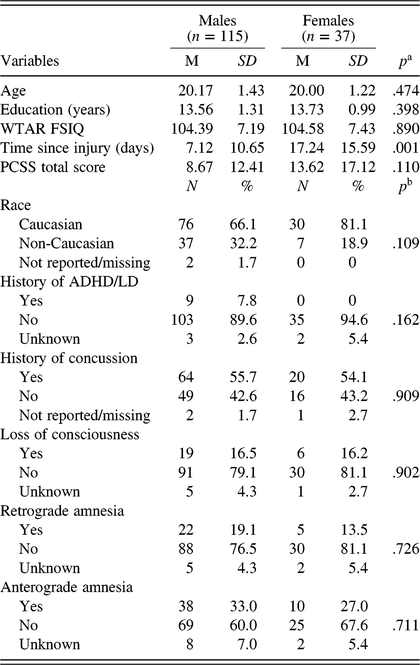
Participant demographic and injury characteristics

Note. WTAR = Wechsler Test of Adult Reading; FSIQ = Full-Scale IQ; PCSS = Post-Concussion Symptom Scale; ADHD = attention-deficit/hyperactivity disorder; LD = learning disability.
a Independent samples t tests were used to evaluate whether males and females differed with regard to age, years of education, premorbid intellectual functioning (as assessed by WTAR FSIQ), time since injury, and PCSS total score.
b Chi-square or Fisher’s exact tests were used to evaluate whether males and females differed with regard to race, presence of ADHD/LD, history of concussion, presence of loss of consciousness, retrograde amnesia, and anterograde amnesia.
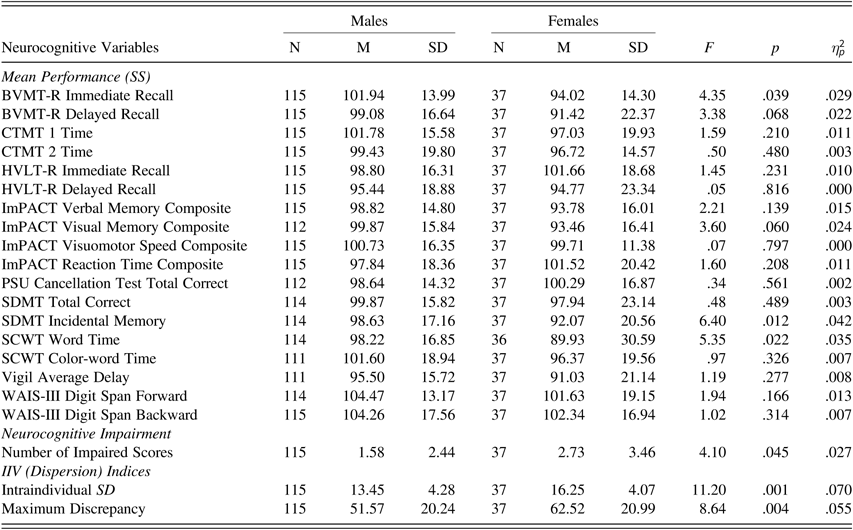
Neurocognitive variables: means and standard deviations by group, ANCOVA results, and effect sizes
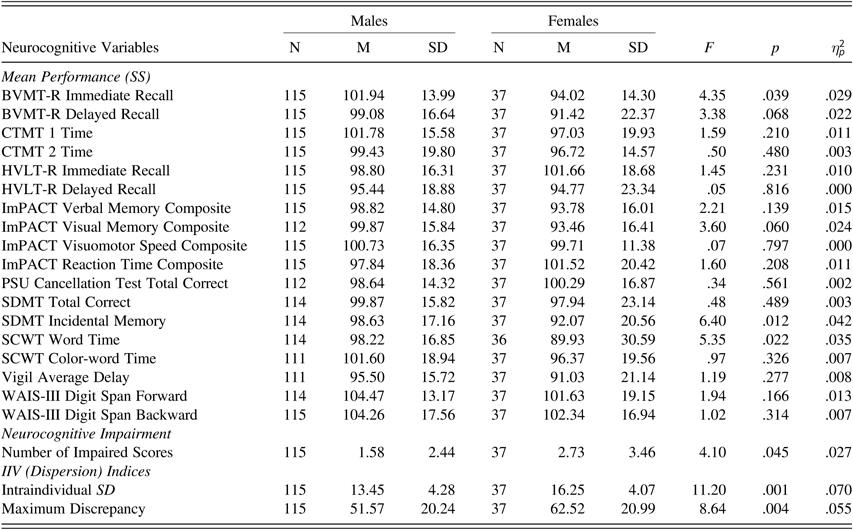
Notes: SS = standard score; BVMT-R = Brief Visuospatial Memory Test-Revised; CTMT = Comprehensive Trail-Making Test; HVLT-R = Hopkins Verbal Learning Test-Revised; ImPACT = Immediate Post-Concussion Assessment and Cognitive Testing; SDMT = Symbol-Digit Modalities Test; SCWT = Stroop Color-Word Test; WAIS-III = Wechsler Adult Intelligence Scale—Third Edition; IIV = intraindividual variability. ANCOVA results are presented above, adjusting for time since injury and post-concussive symptoms (PCSS total score).
 $\eta _p^2$
= effect size interpretation: small = .01, medium = .06, large = .14.
Neurocognitive performance was evaluated using three techniques: (1) mean performance, (2) number of impaired scores, and (3) IIV.
Mean neurocognitive performance was evaluated across the 18 individual neuropsychological variables. To determine the number of impaired scores across the neurocognitive test battery, the total number of scores falling below a designated impairment level (>1.5 SD below the mean) was counted for each participant (possible range: 0–18). Although there is no universally accepted definition of “impairment,” many prior studies have utilized >1.5 SD below the mean to reflect impaired performance (Iverson & Brooks, Reference Iverson, Brooks, Schoenberg and Scott2011). Moreover, prior research examining base rates of impairment in a sample similar to the present study (i.e., collegiate athletes) also utilized the >1.5 SD below the mean threshold to indicate impaired performance (Arnett et al., Reference Arnett, Rabinowitz, Vargas, Ukueberuwa, Merritt, Meyer, Slobounov and Sebastianelli2014). Finally, two measures of IIV were calculated: (1) an intraindividual standard deviation (ISD) score and (2) a maximum discrepancy (MD), or range, score. As per Merritt, Rabinowitz, and Arnett (Reference Merritt, Rabinowitz and Arnett2018), the ISD score was calculated for each athlete by taking the standard deviation of the standard scores across all 18 neuropsychological variables. The MD score was calculated by subtracting each athlete’s lowest cognitive test score from their highest test score. The MD score thus reflects the range of an athlete’s overall cognitive performance, accounting for their absolute highest score and lowest score in the test battery. For both IIV indices, higher scores represent greater IIV, or inconsistency in performance.
Data Analyses
Descriptive statistics were conducted on the overall sample, and males and females were compared on demographic and injury characteristics (independent samples t tests for continuous variables and chi-square or Fisher’s exact tests for categorical variables). Analyses of covariance (ANCOVAs) adjusting for time since injury and post-concussive symptoms were used to evaluate whether males and females differed across the 18 individual neurocognitive variables. Given the number of analyses proposed, we determined a priori that we would use p < .01 as our criterion for significance for all analyses pertaining to the individual cognitive variables to reduce the likelihood of Type 1 error. We chose this approach over the Bonferroni correction, which is recognized as overly conservative in many applications, and increases Type II error rates (Rothman, Reference Rothman1990). Finally, ANCOVAs adjusting for time since injury and post-concussive symptoms were conducted to compare males and females on the neurocognitive summary indices (i.e., number of impaired scores and the ISD and MD scores). Given the limited number of planned a priori analyses (three in total), we used p < .05 as our criterion for significance to interpret these latter findings. Effect sizes are listed as partial eta-squared values (
$\eta _p^2$
), interpreted as small = .01, medium = .06, and large = .14. All analyses were conducted using the Statistical Package for the Social Sciences (SPSS; Version 25).
RESULTS
Participant Demographic and Injury Characteristics
The overall sample (N = 152) was 75.7% male (n = 115) and 24.3% female (n = 37). On average, participants were 20.13 years of age (SD = 1.38) and had completed 13.60 years of education (SD = 1.24). Athletes included in the present study participated in the following sports: football (n = 46), lacrosse (n = 23), basketball (n = 21), ice hockey (n = 14), rugby (n = 14), soccer (n = 12), wrestling (n = 10), and other (n = 12). Participants were tested, on average, 9.59 days (SD = 12.75; Mdn = 4 days; Range = 0–72 days) following their concussion (66.4% of athletes were tested within 1 week post-injury; 80.9% were tested within 2 weeks post-injury). At the time of the post-concussion assessment, no athletes had returned to play.
Table 1 displays participant demographic and injury characteristics by sex. There were no significant differences between males and females with regard to age, years of education, premorbid IQ, and post-concussive symptoms. However, males and females differed with regard to the timing of their neuropsychological assessment, such that females were tested, on average, over 2 weeks post-injury whereas males were tested, on average, 1 week post-injury.
Neuropsychological Assessment: Individual Scores
There were no significant differences between males and females in mean performance on any of the individual neurocognitive variables after adjusting for time since injury and post-concussive symptoms (p = .012–.816; η p 2 = .00–.04, small effect sizes). See Table 2.
Neuropsychological Assessment: Summary Scores
A significant effect of sex was found for the number of impaired scores after adjusting for time since injury and post-concussive symptoms, such that females exhibited greater neurocognitive impairment than males (p = .045; η p 2 = .03, small effect size). Additionally, females demonstrated significantly greater IIV than males, as reflected by the ISD (p = .001; η p 2 = .07, medium effect size) and MD (p = .004; η p 2 = .06, medium effect size) scores, after adjusting for the same variables; see Table 2.
DISCUSSION
To improve the understanding of sex differences following SRC, the present study evaluated a wide range of neurocognitive outcomes, matching groups on important demographic variables and accounting for time since injury and post-concussive symptoms. This is the first study, to our knowledge, to examine sex differences in cognition using indices beyond mean performance, including neurocognitive impairment and measures of IIV, across a comprehensive neuropsychological battery. Results showed that, compared with males, females had significantly more impaired scores and showed greater cognitive variability across the neuropsychological test battery. However, no significant effects of sex were found when examining mean neuropsychological performance.
Existing literature regarding the influence of biological sex on neurocognitive outcomes following SRC is somewhat equivocal. While previous empirical research has demonstrated that females perform worse than males in the domains of visual memory and reaction time, not all studies have identified sex differences in cognitive functioning post-concussion (Covassin et al., Reference Covassin, Savage, Bretzin and Fox2018; Merritt et al., Reference Merritt, Padgett and Jak2019). Notably, past studies have focused exclusively on evaluating mean neuropsychological performance, and previous work has largely reported on findings pertaining to the ImPACT cognitive battery. Furthermore, potential confounding variables have been inconsistently reported and controlled for in past research.
In the present study, we administered a comprehensive neuropsychological assessment, spanning the domains of learning and memory, attention, processing speed, and executive functioning, and found that males and females demonstrated comparable mean performance across all tests, which is somewhat of a departure from previous studies (Covassin et al., Reference Covassin, Savage, Bretzin and Fox2018; Merritt et al., Reference Merritt, Padgett and Jak2019). This may be because groups were matched on variables known to influence cognitive functioning, such as age, education, preexisting developmental disorders, and history of concussion (Dougan et al., Reference Dougan, Horswill and Geffen2014; Karr et al., Reference Karr, Areshenkoff and Garcia-Barrera2014; Kontos et al., Reference Kontos, Sufrinko, Womble and Kegel2016). Furthermore, we adjusted for time since injury and post-concussive symptoms in our analyses, and excluded for poor effort, which has not always been the case in previous research. Finally, although some of the neurocognitive variables evaluated in the present study (i.e., BVMT-R immediate recall, SDMT incidental memory, SCWT word time) demonstrated a trend in the direction of females performing more poorly than males, the effect size comparisons were small, and not necessarily clinically meaningful.
In contrast to the above null findings, there were significant sex differences when evaluating the neurocognitive summary scores, such that females demonstrated greater impairment and larger inconsistencies in performance across the neuropsychological test battery. Although the effect size for greater impaired scores in females was small, it may be especially meaningful given that past research using a comparable sample of athletes on a similar test battery showed that males had a higher base rate of impairment at baseline than females (Arnett, Meyer, Merritt, & Guty, Reference Arnett, Meyer, Merritt and Guty2016). With regard to the variability findings, few studies are available for comparison. Among these, reaction time variability as opposed to cognitive dispersion has been examined, and results show greater IIV in adult females relative to males (Dykiert, Der, Starr, & Deary, Reference Dykiert, Der, Starr and Deary2012; Ghisletta, Renaud, Fagot, Lecerf, & De Ribaupierre, Reference Ghisletta, Renaud, Fagot, Lecerf and De Ribaupierre2018). Thus, our finding that females demonstrated greater cognitive dispersion relative to males is consistent with this prior work. In clinical populations outside of concussion, greater IIV has repeatedly been associated with neurobiological integrity (i.e., increased white matter hyperintensities), and could reflect underlying central nervous system dysfunction (Bunce et al., Reference Bunce, Bielak, Cherbuin, Batterham, Wen, Sachdev and Anstey2013; MacDonald, Nyberg, & Bäckman, Reference MacDonald, Nyberg and Bäckman2006). Moreover, there is accumulating evidence to suggest that, relative to mean cognitive performance, IIV may serve as a better predictor of cognitive outcome in a variety of clinical samples (Cole, Weinberger, & Dickinson, Reference Cole, Weinberger and Dickinson2011; Haynes, Bauermeister, & Bunce, Reference Haynes, Bauermeister and Bunce2017). Although more research is necessary to determine the significance of IIV in the context of SRC, our results highlight the importance of attending to these nuanced differences in males’ and females’ cognitive profiles following concussion. Though speculative, it is possible that increased IIV in the acute post-injury phase may serve as an early indicator of a more complicated recovery or greater CNS vulnerability following SRC.
When considering the clinical implications of this research, our findings support previous recommendations regarding the need to consider individual differences when making determinations about concussion management, and add to the growing body of evidence emphasizing the development of individually tailored treatments for concussed athletes. There are, however, limitations of the study that should be considered. First, the generalizability of our findings may be limited, as we focused exclusively on collegiate athletes with relatively acute concussions. Future research will need to examine cognitive sex differences in older and younger samples and in individuals in the chronic phase of injury to determine whether the findings hold in other populations. Second, it is important to recognize that females underwent post-concussion testing, on average, over 2 weeks following their injury whereas males were tested, on average, 1 week post-injury. It is thus possible that there may be sampling bias with regard to when athletes are referred for post-concussion evaluations, and that females who are referred for testing may be those with more complicated recoveries. Importantly though, time since injury was accounted for in our analyses. Another related limitation is the smaller proportion of females in the sample relative to males, which appears to be a common issue when examining sex differences in the context of SRC. Given this discrepancy, it is possible that we were underpowered to detect group differences; nonetheless, despite potential power limitations, the present study offers preliminary support for the importance of evaluating cognitive scores beyond just mean performance. A final limitation of this study is that pre-injury, or baseline, data were not available for all athletes and so we were unable make direct pre/post-injury comparisons. Nevertheless, we accounted for premorbid sex differences in cognitive functioning by utilizing sex-specific normative data.
In conclusion, our results suggest that measures of IIV and impairment scores may provide valuable information about neurological health and potentially aid in the identification of post-concussion cognitive dysfunction. Findings should be replicated in larger samples with more equal representation from both sexes, and ongoing research will need to continue evaluating the clinical significance of IIV and impairment scores and determine the extent to which they may influence, or guide, return-to-play decisions.
ACKNOWLEDGMENTS
The authors would like to thank Wayne Sebastianelli at Penn State Sports Medicine for his generous support of our research. We would also like to thank the athletes who participated in the sports-concussion management program.
CONFLICTS OF INTEREST
The authors have nothing to disclose.