The consequences of an aware and informed public for the quality of democratic governance has long been a point of scholarly debate (for example, Bentham Reference Bentham1816; Mill Reference Mill1838). On the one hand, an attentive citizenry is critical if voters are to ensure the responsiveness and accountability of their elected officials (for example, Dahl Reference Dahl1971; Powell Reference Powell2000). On the other hand, public awareness can lead to suboptimal decision making by creating an incentive for officials to engage in pandering and posturing (for example, Prat Reference Prat2005; Stasavage Reference Stasavage2007). Consequently, the impact of awareness on policy decisions can depend critically on how officials expect voters to perceive their actions (for example, Fox Reference Fox2007).
This article brings the debate over the impact of public awareness to the context of constitutional review. The significance of public awareness of decisions, and government actors’ responses to those decisions, is well established in the study of constitutional review. The power of a court to annul government actions that contradict constitutional and legal norms has become central to ensuring the quality of governance in both domestic and international political systems (Carrubba and Gabel Reference Carrubba and Gabel2014; Ginsburg and Versteeg Reference Ginsburg and Versteeg2014). Unable to directly enforce their rulings, however, courts’ efficacy generally relies on their ability to compel governments to implement judicial decisions, including those requiring officials to act against their own interests. A public that is both aware of government responses to court decisions and sympathetic to the courts provides electoral pressure on government officials to comply with adverse judicial decisions (for example, Carrubba Reference Carrubba2009; Gauri, Staton and Cullell Reference Gauri, Staton and Cullell2015; Staton Reference Staton2006; Vanberg Reference Vanberg2001). As a consequence, public awareness enhances the efficacy of a popular court's review by strengthening officials’ accountability to their constituents.
But as we see with democratic performance generally, high public awareness of politics is not unambiguously beneficial for the efficacy of constitutional review. Where voters hold the judiciary in low public esteem, public awareness can create an electoral incentive for governments to pander to public opinion by prioritizing the policy preferences of voters over compliance with unpopular court rulings.Footnote 1 With citizens' awareness of their government's response increasing the electoral cost of implementing an unpopular court's decision, officials can find themselves ultimately benefiting from noncompliance. If courts anticipate that officials' responses will side with an attentive public rather than the court, we would expect public awareness to limit the willingness of an unpopular court to invalidate government actions, even when those actions violate a government's constitutional obligations.
To develop this argument, I formalize the interaction between a government seeking the continued application of a policy and a court seeking to strike down that policy despite lacking public support. The formalization yields several empirical implications for when and how public awareness influences an unpopular court's decision making, which I take to data on rulings in preliminary references at the Court of Justice of the European Union (CJEU) from 1997 to 2008. I conclude by discussing the article's implications for the tradeoffs of an aware public, the role of the public in developing an effective judiciary and our understanding of the CJEU.
Legitimacy and The Efficacy of Constitutional Review
Understanding how a court can effectively constrain other government institutions has been one of the defining puzzles in the study of judicial politics. Following from the behavioral tradition, the judicial legitimacy approach attributes judicial efficacy to the level of diffuse public support for a court (for example, Gibson, Caldeira and Baird Reference Gibson, Caldeira and Baird1998). When citizens hold a court in high regard and expect officials to uphold the integrity of the judiciary by faithfully implementing judicial rulings, the threat of punishment at the ballot box for noncompliance can compel officials to comply with decisions, including those with which they disagree. This electoral threat, coupled with public awareness of a government's failure to comply, can exert considerable influence on the bounds of judicial authority (Staton Reference Staton2006; Vanberg Reference Vanberg2001).
By these accounts, a lack of public support can severely limit a court's effectiveness in exercising constitutional review. Unable to rely on citizens to pressure governments into compliance, courts lacking diffuse support, which I refer to here as ‘unpopular’ courts, can ‘find it difficult to serve as effective and consequential partners in governance’ (Gibson, Caldeira and Baird Reference Gibson, Caldeira and Baird1998, 343). This dilemma is not merely a theoretical one: numerous courts have found themselves lacking public trust. Gibson et al. (Reference Gibson, Caldeira and Baird1998), for example, report that in nine of their twenty cases ‘there are more opponents of the court than supporters’ (349). Similarly, Herron and Randazzo (Reference Herron and Randazzo2003) and Ginsburg (Reference Ginsburg2003) note the low regard citizens held for many post-communist and Asian courts. In Latin America, AmericasBarometer reports show that trust in supreme courts seldom surpasses 50 per cent, with many courts struggling to gain the trust of 35 per cent of the public. Prominent international courts like the International Criminal Court, the European Court of Human Rights and the CJEU have similarly struggled to develop a strong base of support (Caldeira and Gibson Reference Caldeira and Gibson1995; Gibson and Caldeira Reference Gibson and Caldeira1995; Voeten Reference Voeten2013). Across these contexts, scholars have noted the implication of low public trust for judicial efficacy by linking poor public standing with issues of noncompliance and government resistance to adverse rulings (for example, Caldeira and Gibson Reference Caldeira and Gibson1995; Helmke Reference Helmke2010).
Unpopular courts are not, however, entirely ineffective. While the public and its threat of electoral punishment is one source of pressure for government compliance, it is not the only enforcement mechanism available to courts. For one, a court can obtain compliance if the government faces pressure from an institutional stakeholder that shares the preference of the court (or at least opposes the preference of the government) and has some form of leverage over the government. For example, in federal systems a national government may be able to compel compliance from a subnational government by threatening to reduce or eliminate revenue (Vanberg Reference Vanberg2005). Similarly, the fragmentation of preferences resulting from separation-of-powers systems can provide courts with allies that will pressure compliance (for example, Epstein, Knight and Shvetsova Reference Epstein, Knight and Shvetsova2001), while in coalition governments the preferences of coalition members may limit the potential for noncompliance by raising the specter of bringing down the government. In addition, international institutions and actors (for example, the IMF, EU, neighboring states) can exert pressure on governments to comply. In lieu of the electorate, sources of political pressure such as these can serve as enforcement mechanisms.
The ultimate effectiveness of any such pressure for enforcement, however, depends in part on whether (and to what extent) compliance will affect the government's re-election fortunes. As such, public awareness can potentially create a problem for an unpopular court. Voters' discontent with a court creates an incentive for elected officials to engage in noncompliance or even outright defiance of the court (Clark Reference Clark2011).Footnote 2 This incentive is magnified by case salience: the more a case is in the public spotlight, the more votes there are to be gained from siding with constituents’ interests by refusing to comply with an adverse judicial decision. Furthermore, public awareness exacerbates the damage that noncompliance inflicts on a court's institutional support by making the judiciary appear weak and undermining its role in the policy-making process (Carrubba Reference Carrubba2009; Vanberg Reference Vanberg2005).
In what follows, I incorporate aspects of the public support and separation-of-powers literatures into a formal model investigating how public awareness affects interactions between a government and a court lacking public support. The modeling exercise serves two primary purposes. First, it clarifies the strategic environment in which an unpopular court operates. By incorporating both the potential benefits and costs of noncompliance, the model provides insights into when courts lacking public support are most likely to be constrained by political conditions and when they are most likely to effectively exercise constitutional review. Additionally, the model distinguishes between public awareness and the political benefits or costs of noncompliance to generate empirical implications differentiating my argument and empirical approach from alternative theoretical and empirical accounts. In particular, it identifies empirical predictions regarding the impact of public awareness on case disposition and the conditions under which that impact should be most prominent.
A Formal Model of Review by an Unpopular Court
The structure of the game follows the example of the key models in the comparative judicial politics literature by Vanberg (Reference Vanberg2001) and Staton (Reference Staton2006). Similar to those models, the game has three players: nature, a government (G) and a court (C). To focus the model on potentially conflictual interinstitutional interactions, I assume the court and government have divergent policy preferences: the government would like the policy upheld, while the court prefers to invalidate the challenged law. The model differs from those of Vanberg and Staton, however, with respect to the court's level of public support and the characterization of the public's reaction to observing noncompliance. First, the court is assumed to be held in low regard and distrusted by the public. While previous models have allowed public support to vary, when support is low in these models public awareness becomes inconsequential as noncompliance goes unpunished. Assuming the court is in poor standing with the public provides insights into instances in which public awareness can make voters more likely to reward noncompliance. Secondly, whereas in those previous models voters punish governments for noncompliance, focusing on courts held in low regard leads to the opposite assumption – that voters will side with their elected officials over the court and reward the government for noncompliance.Footnote 3 These departures from standard assumptions in the literature distinguish the model from extant theoretical models, which has important implications for the model's results and predictions.
The game begins with the government deciding whether or not to legislate. If the government does not legislate, the game ends. If the government legislates, the court receives a challenge of the legislation and decides whether to uphold or invalidate. If the court upholds, the game ends. If the court invalidates, the government can defy or comply. The game then ends with two moves by nature. First, nature chooses whether or not the case will garner public attention. This move captures the likelihood that the public will become aware of a decision.Footnote 4 Secondly, nature determines whether or not a third-party political institution, such as a non-litigating government or other political institution, will act to compel the government to comply with the court's decision. The players share common prior beliefs about the likelihood of public awareness, p ∈ (0, 1), and whether another institutional stakeholder will punish the government for noncompliance, denoted in the game as q ∈ (0, 1). To summarize:
(1) Government chooses to legislate (L) or not ( ~ L).
(2) Court chooses to invalidate (I) or uphold ( ~ I) the challenged law. If the court chooses ~I, the game ends.
(3) If the court vetoes, the government chooses to defy (D) or comply ( ~ D).
(4) Nature chooses whether the case will garner public attention (PA) or not ( ~ PA) and whether a third-party political institution will punish the government for noncompliance (T) or not ( ~ T).
(5) Game ends, payoffs are realized.
The court's utility function is composed of two parameters. First, a policy component A > 0 captures the importance of the challenged policy to the court. The court receives A if it invalidates the statute and obtains compliance, and 0 if it upholds the statute or the government successfully defies the court. Secondly, the court incurs harm to its institutional status when the public observes the government successfully engage in noncompliance, as previous work has linked successful noncompliance with an undermining of public confidence in the judiciary and its ability to effectively constrain the elected branches of government. This cost, R > 0, is similar to the institutional cost parameter used by extant models in that it incorporates judges' concerns for the institutional health of the judiciary and the consequences of public displays of defiance for the development of public support (Carrubba Reference Carrubba2009; Clark Reference Clark2011; Staton Reference Staton2006; Vanberg Reference Vanberg2005). The court's utility function can thus be summarized as:
 $$EU_C = {\rm I} [{{\rm A}( {\rm q} ) -{\rm R}( {\rm p} ) ( {1-{\rm q}} ) }] $$
The government's utility function has four components. The value the government places on the challenged policy is captured by α, where α > 0. The government gains α if either it successfully defies the court's ruling or the court upholds. The second component, β > 0, is the electoral benefit of catering to voters' interests over those of the court. The government receives β if the public observes noncompliance, regardless of whether or not a third-party institution punishes. The intuition is that when voters support their elected officials over the ruling of an unpopular court, they will reward the government for continuing its policy despite the court's ruling, even if the government is punished by an external actor for doing so. The third component, κ > 0, is the cost incurred by the government when a third-party political institution punishes noncompliance. The fourth component, ε > 0, represents the costs of legislating such as the use of limited legislative resources, the time and associated opportunity cost of writing, revising and passing a statute, and the associated expenditure of political capital in passing legislation (Vanberg Reference Vanberg2001).Footnote 5 To summarize:
 $$EU_G = L [{\alpha ( D ) ( {1-q} ) + \beta ( D ) ( p ) -\kappa ( D ) ( q ) -\epsilon }] $$
Results and Interpretation
The solution concept for the game is subgame perfect equilibria, which I limit to pure strategies. To discuss the results, I define six thresholds dictating the players' strategies.
Definition 1 Define the Public Legislating Threshold as:
 $$p_{G( L ) }^\ast{\equiv} \displaystyle{{\kappa q + \alpha q-\alpha + \epsilon } \over \beta }$$
Definition 2 Define the Punishable Legislating Threshold as:
 $$q_{G( L ) }^\ast{\equiv} \displaystyle{{\beta p + \alpha -\epsilon } \over {\kappa + \alpha }}$$
The first two thresholds identify the conditions necessary for the government to legislate. In the Public Legislating Threshold, denoted  $p_{G( L ) }^\ast $, the government does not legislate if the probability of public awareness (p) is below the threshold. To see the intuition behind this threshold, consider the tradeoffs faced by the government at the legislative stage. Legislating provides the government with policy benefits (α) and potentially a benefit for noncompliance (β), but at the cost of legislating (ε) and, potentially, the cost of punishment for noncompliance. If the likelihood of public awareness is low, the benefit of noncompliance decreases and legislating becomes less attractive. The second threshold, the Punishable Legislating Threshold, shows that the government does not legislate if it believes the probability of punishment is high, as legislating becomes an increasingly costly strategy as the likelihood increases that the statute will be struck down and the government will be forced into compliance by a third-party institution. Formally, the government will legislate only if q is below this threshold, denoted
 $q_{G( L ) }^\ast $.
Definition 3 Define the Public Judicial Review Threshold as:
 $$p_{C( I ) }^\ast{\equiv} \displaystyle{{Aq} \over {R-Rq}}$$
Definition 4 Define the Supported Judicial Review Threshold as:
 $$q_{C( I ) }^\ast{\equiv} \displaystyle{{Rp} \over {Rp + A}}$$
The third and fourth thresholds define the court's decision to invalidate or uphold the challenged statute. The Public Judicial Review Threshold defines the point at which public awareness becomes sufficiently unlikely for the court to invalidate the statute and so risk the public observing successful noncompliance. Thus, p must be less than this threshold, denoted  $p_{C( I ) }^\ast $, for the court to invalidate the law. The Supported Judicial Review Threshold speaks to the court's reliance on third-party institutions to enforce decisions. The court will only invalidate the statute if there is a sufficiently high probability that noncompliance will be punished. Formally, the court will invalidate only if q is greater than this threshold, denoted
 $q_{C( I ) }^\ast $
Definition 5 Define the Public Defiance Threshold as:
 $$p_{G( D ) }^\ast{\equiv} \displaystyle{{\kappa q + \alpha q-\alpha } \over \beta }$$
Definition 6 Define the Punished Defiance Threshold as:
 $$q_{G( D ) }^\ast{\equiv} \displaystyle{{\beta p + \alpha } \over {\kappa + \alpha }}$$
The fifth and sixth thresholds specify the necessary conditions for the government to defy the court. The Public Defiance Threshold defines the level above which p must be for the government to engage in noncompliance, while the Punished Defiance Threshold defines the upper limit of q such that the government defies. Since the model assumes the court prefers to invalidate the statute, these thresholds are simply subsets of the legislative thresholds defined above and are always met if the corresponding legislative threshold is satisfied. The intuition for this result is that the government will only legislate if it believes it can successfully evade a judicial veto or if the court will uphold. While not central to interpreting the equilibria, these thresholds identify the bounds of the government's actions. In total, the model predicts five subgame perfect equilibria (SPE), which I group into three distinct types.Footnote 6
Proposition 1 (Deferential Government) Equilibrium A: For p < p G(D) or q > q G(D), the following constitutes a SPE:
Government: S G = { ~ L, ~ D}
Court: S C = {I}
Equilibrium B: For p G(D) < p < p G(L) and q C(I) < q < q G(D), or p > p G(D) and q G(D) < q < q G(L), the following constitutes a SPE:
Government: S G = { ~ L, D}
Court: S C = {I}
Equilibrium C: For p G(D) < p < p G(L) and q < q C(I), the following constitutes a SPE:
Government: S G = { ~ L, D}
Court: S C = { ~ I}
Proposition 1 characterizes the ‘deferential government’ equilibrium in which the government avoids conflict with the court by opting not to legislate. Equilibrium A represents the traditional separation-of-powers-induced deference. In this instance, the court invalidates the statute, but one of the government's thresholds for defying is not met. Since the government will only legislate if conditions are such that noncompliance is the best response to such a ruling, the government foregoes legislating. Substantively, this equilibrium corresponds to the concept of ‘autolimitation’ in which governments moderate legislation to avoid adverse court decisions (for example, Stone Sweet Reference Stone Sweet2000). Similarly, the result here characterizes instances where the government does not legislate because it expects to be unable to successfully evade a court decision striking down the challenged policy. Equilibria B and C correspond to cases of government unwillingness to confront the court less because of the court's power and more because of the government's political calculation at the legislating stage. The former characterizes when the court will rule against the government, which in turn would defy the decision. The government, however, does not legislate because (1) the probability of public awareness is not high enough to make conflict with the court worthwhile and (2) the probability of punishment is too high to offset the cost of legislating. In equilibrium C the court will not invalidate the law if the government legislates, but the likelihood of public awareness is too low to create the electoral incentive necessary to offset the government's cost of legislating.
Proposition 2 (Deferential Judiciary) Equilibrium D: For q < q C(I) and p G(L) < p < p C(I), the following constitutes a SPE:
Government: S G = {L, D}
Court: S C = { ~ I}
Proposition 2 characterizes the ‘deferential judiciary’ equilibrium. In this equilibrium, the government legislates and will defy an adverse court decision. The court upholds the statute to avoid the confrontation, as the probability of third-party punishment for noncompliance is low. The likelihood of public awareness, however, is sufficient to make legislating and defiance of an adverse ruling the government's optimal strategy. As a result, the government legislates and the court, seeking to avoid conflict, upholds the statute.
Proposition 2a (Publicly Deferential Judiciary) Equilibrium E: For q < q G(L) and p > p C(I), the following constitutes a SPE:
Government: S G = {L, D}
Court: S C = { ~ I}
Proposition 2a characterizes a ‘publicly deferential judiciary’ equilibrium. The high probability of public awareness differentiates this equilibrium from the deferential judiciary equilibrium, as the players' beliefs about the likelihood of public awareness surpass both  $p_{C( I ) }^\ast $ and
 $p_{G( L ) }^\ast $. The government legislates and will defy the court's decision. The court, however, upholds because the public will observe the government successfully ignore its decision, regardless of the threat of third-party punishment. Faced with this possibility and the harm it would do to the court's public image, the court chooses to avoid conflict with the government by upholding even when the likelihood of a third-party institution punishing noncompliance would otherwise empower the court.
Proposition 3 (Executive–Judicial Conflict) Equilibrium F: For q C(I) < q < q G(D) and p G(L) < p < p C(I), the following constitutes a SPE:
Government: S G = {L, D}
Court: S C = {I}
Proposition 3 characterizes the ‘executive–judicial conflict’ equilibrium, in which the government legislates because the likelihood of public awareness is sufficiently high to offset the cost of legislating. The court, emboldened by its belief that a third-party institution will punish noncompliance, invalidates the legislation. The government responds by defying the court because it expects the public to observe the case and thus reward noncompliance. For this equilibrium to obtain, there must be a high probability that the government will be punished for noncompliance and a moderate probability of public awareness such that p is less than p C(I) but high enough to incentivize legislating. Observationally, this equilibrium characterizes instances of conflict between the court and government.
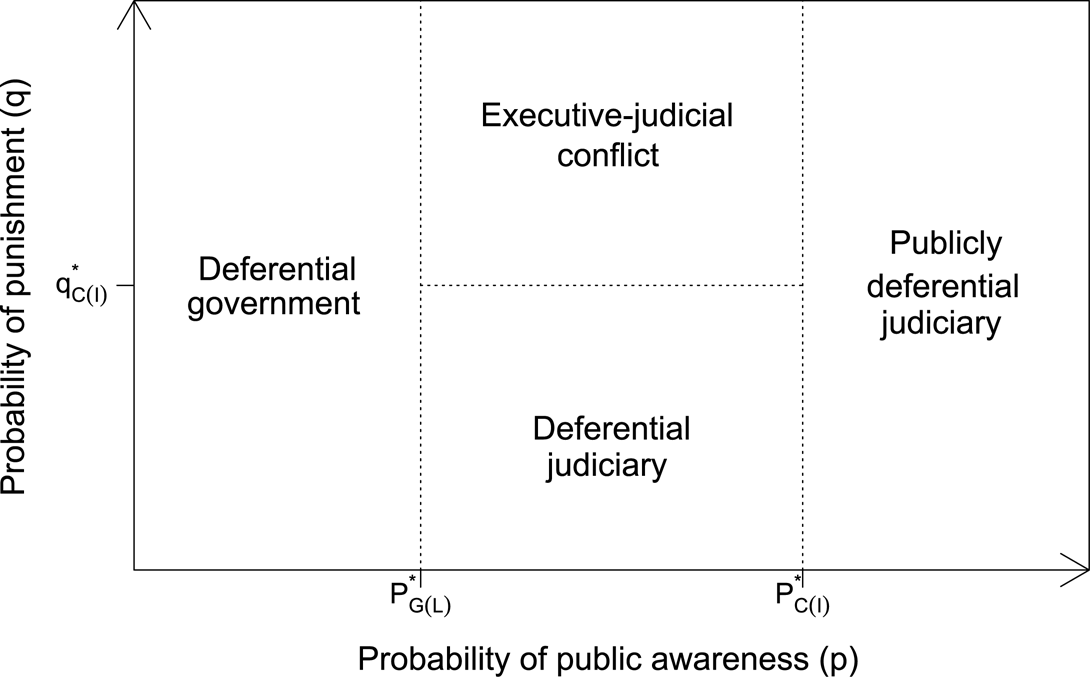
Figure 1 illustrates the equilibria when the court's public judicial review threshold  $( p_{C( I ) }^\ast ) $ is greater than the government's public legislating threshold
 $( p_{G( L ) }^\ast ) $. When p falls between the public judicial review and public legislating thresholds, the equilibrium depends on whether the probability of third-party punishment (q) meets the court's supported judicial review threshold
 $( q_{C( I ) }^\ast ) $. When q meets the threshold, the executive–judicial conflict equilibrium obtains; otherwise the judicial deference equilibrium obtains. Using the figure, I organize my discussion of the results around two key observations.
Observation 1: The court is less likely to rule against the government as the likelihood of public awareness increases.
Formally, as p increases, the court's supported judicial review threshold increases. Consequently, the conditions necessary for the executive–judicial conflict equilibrium to obtain become more stringent as the likelihood of public awareness increases. Substantively, this means that the court is more constrained in cases that are likely to garner public attention than in those that are unlikely to place the court in the public spotlight. This dynamic is apparent from Figure 1. When the likelihood of public awareness (p) is low, the court does not need to strike down the statute because the deferential government equilibrium obtains. As p increases, the government becomes willing to both legislate and defy an adverse decision. When p is between  $p_{G( L ) }^\ast $ and
 $p_{C( I ) }^\ast $, the court only rules against the government when the probability of third-party enforcement of the decision (q) surpasses the court's supported judicial review threshold. As p becomes increasingly high, however, the publicly deferential judiciary obtains. This suggests that judges concerned with faithful implementation of their decisions and the development of institutional legitimacy will seek to avoid the spotlight when confronting government officials.
Observation 2: As the likelihood of public awareness increases, the court's decision making is decreasingly influenced by the likelihood that third-party political institutions will punish noncompliance.
Conditional on the government legislating, increases in p shift the court's strategy from being determined by q to always upholding. Returning to Figure 1, when p is less than  $p_{C( I ) }^\ast $, one of two equilibria obtain: the executive–judicial conflict equilibrium or the deferential judiciary equilibrium. Which equilibrium obtains is determined by q. If q is below the threshold, the court upholds and the deferential judiciary equilibrium obtains; if q surpasses the threshold, the court invalidates the statute. Critically, this dynamic does not hold when q is greater than the court's public judicial review threshold. Once p increases beyond this level, the publicly deferential judiciary equilibrium obtains and the court always upholds, regardless of q. Substantively, this result suggests that the threat of punishment is limited by the electoral concerns of the government. Based on these observations, the model yields the following two empirical hypotheses.
Hypothesis 1 As the likelihood of public awareness of the decision increases, a court lacking public support is less likely to rule against a government.
Hypothesis 2 As the likelihood of public awareness increases, the threat that third-party institutions will punish noncompliance has a decreasing impact on the decision making of a court lacking public support.
These implications speak directly to, and in key respects depart from, the extant literature on the efficacy of judicial review. Whereas standard accounts of the public's role in judicial–executive interactions identify voters as a potential source of judicial power (for example, Gibson, Caldeira and Baird Reference Gibson, Caldeira and Baird1998; Staton Reference Staton2010; Vanberg Reference Vanberg2001), the model builds from an assumption of public disdain for a court to develop an alternative logic in which public awareness constrains a court's power. By linking this logic with the role of third-party enforcement of court decisions, a prominent feature in arguments regarding courts at both the national (for example, Epstein, Knight, and Shvetsova Reference Epstein, Knight and Shvetsova2001) and international (for example, Carrubba and Gabel Reference Carrubba and Gabel2014) levels, the model identifies how public awareness can be a potential constraint on this mechanism for obtaining compliance. In what follows, I assess these empirical implications by examining the behavior of the CJEU.
Equilibrium predictions
Note: equilibrium predictions when p > p G(D), q < q G(D), p G(L) > p C(I), and q C(I) < q G(L).

Empirical Analysis: The Court of Justice of the European Union
The CJEU, the European Union's highest judicial body, is one of the most active and emulated international courts (Alter Reference Alter2001; Carrubba and Gabel Reference Carrubba and Gabel2014). Seated in Luxembourg, the 28-judge CJEU ensures EU law is interpreted and applied uniformly and that member-state governments fulfill their treaty obligations.Footnote 7 Notably, the CJEU regularly uses this authority to pursue an agenda favoring greater integration and expansion of EU law even in the face of resistance from member states (Alter Reference Alter2001; Mattli and Slaughter Reference Mattli and Slaughter1998). Moreover, the court's jurisdictional power has allowed it to function similarly to a constitutional court (Stone Sweet and Brunell Reference Stone Sweet and Brunell1998). With its prominence and potency, the CJEU has garnered substantial attention from both scholars and designers of international institutions (Alter and Helfer Reference Alter and Helfer2010; Krehbiel, Gabel and Carrubba Reference Krehbiel, Gabel, Carrubba, Randazzo and Howard2018).
Although a supranational court, several characteristics of the CJEU correspond closely to the theoretical model.Footnote 8 With the means and motive to rule against member states' interests, the CJEU faces the potential for noncompliance (Carrubba and Gabel Reference Carrubba and Gabel2014; Conant Reference Conant2002).Footnote 9 When faced with an unfavorable ruling, member-state governments may attempt to evade, defy, ignore, or otherwise circumvent the court's decision.Footnote 10 Unable to directly enforce its decisions, the efficacy of CJEU rulings can depend on the likelihood of third-party member-state governments punishing noncompliance with indirect measures, sanctions and other informal pressures (Carrubba Reference Carrubba2005; Carrubba Reference Carrubba2009; Carrubba and Gabel Reference Carrubba and Gabel2014; Carrubba, Gabel and Hankla Reference Carrubba, Gabel and Hankla2008).Footnote 11 When the court can expect member-state governments to credibly threaten defendant governments with costly punishment for noncompliance, the impact of CJEU decisions can be most fully realized. If, however, no such punishment is likely, then the court must be conscious of the threat of noncompliance, something CJEU scholars have shown in the court's decision making (for example, Carrubba and Gabel Reference Carrubba and Gabel2014; Carrubba, Gabel and Hankla Reference Carrubba, Gabel and Hankla2008, Carrubba, Gabel and Hankla Reference Carrubba, Gabel and Hankla2012; Garrett, Kelemen and Schulz Reference Garrett, Kelemen and Schulz1998).
While the CJEU may be able to rely on third-party member-state governments to enforce its decisions through informal pressures and threats to a government's reputation, the same is not true of its ability to depend on public support to obtain compliance (Caldeira and Gibson Reference Caldeira and Gibson1995; Gibson and Caldeira Reference Gibson and Caldeira1995; Gibson and Caldeira Reference Gibson and Caldeira1998; Krehbiel, Gabel and Carrubba Reference Krehbiel, Gabel, Carrubba, Randazzo and Howard2018). Support for the CJEU has historically been both objectively low (below 50 per cent in the 2012 and 2013 Eurobarometer surveys) and low in comparison to support for major European courts (Gibson, Caldeira and Baird Reference Gibson, Caldeira and Baird1998). Indeed, trust in the CJEU was lower than trust in national high courts in all twelve EU member states included in Gibson, Caldeira and Baird (Reference Gibson, Caldeira and Baird1998). With such low public support, Gibson and Caldeira (Reference Gibson and Caldeira1995, 483) concluded that the CJEU faces a situation in which ‘not many citizens of the EU are willing to accept a Court [CJEU] decision to which they object’.
More recent studies, however, have challenged Gibson and Caldeira's characterization of the CJEU's level of public support. For example, Kelemen (Reference Kelemen2012) argues that the court enjoys public legitimacy because the level of trust in the CJEU is often higher than trust in national judicial systems and national institutions. This conclusion is problematic, however, because national justice systems comprise much more than national high courts (or courts in general), including citizens' relationships with the police, lawyers, prosecutors and access to legal aid.Footnote 12 Consequently, trust in the national legal system as a measure of legitimacy for national high courts tends to be lower than theoretically grounded measures of diffuse support. For example, in the fall 1997 Eurobarometer survey that asked about citizens' trust in their national legal systems (Eurobarometer 48), the support for high courts reported by Gibson and his coauthors was typically much higher than that for both the justice/legal system and the closest data on trust in the Court of Justice (ECJ) (Eurobarometer 50).
It is difficult to say, then, that the CJEU enjoys a large, stable base of support. Indeed, the level of distrust in the court among all EU respondents doubled from 1993 to 2013 (Pollack Reference Pollack, Cohen, Grossman, Follesdal and Ulfstein2018). It is perhaps unsurprising, then, that member-state governments frequently side with domestic political interests rather than willingly assent to the CJEU's policy prescriptions. While less common, politicians have gone so far as to openly criticize or defy the court in the pursuit of domestic electoral support (Dehousse Reference Dehousse1998). For example, the Hungarian government's highly public and explicit refusal to comply with the CJEU's salient 2017 decision regarding the EU's refugee relocation plan has been viewed as a tactic designed to harness anti-refugee sentiment for the benefit of Prime Minister Viktor Orban's 2018 re-election campaign.Footnote 13
With respect to public awareness of the CJEU and its decisions, the court's relationship with the European public corresponds well to the formal model's parameter regarding the probability of public awareness of a decision. Whereas much of the court's early years were spent in relative anonymity, an increased public presence has developed since the passage of the Masstricht Treaty in 1992 (see Caldeira and Gibson Reference Caldeira and Gibson1995; Gibson and Caldeira Reference Gibson and Caldeira1995; Gibson and Caldeira Reference Gibson and Caldeira1998). While awareness of the CJEU generally falls below that of other major EU institutions like the European Commission and the European Parliament, Eurobarometer surveys consistently show that upwards of 70 per cent of European citizens are familiar with the court.Footnote 14 Nonetheless, public awareness of the CJEU's decisions is far from assured in most cases. For example, an analysis of preliminary references from the United Kingdom between 1997 and 2008 finds that the country's newspaper of record, The Times, provided coverage of nearly half of the issues brought to the CJEU.Footnote 15 With such variation in both overall familiarity with the court and attention to its decisions in addition to the aforementioned features of the court, the CJEU provides an appropriate case for examining the formal model's empirical implications.
Data and Measures
The empirical analysis uses Larsson and Naurin's (Reference Larsson and Naurin2016) data set on CJEU rulings in preliminary references filed with the court between 1997 and 2008.Footnote 16 Similar to the data of Carrubba, Gabel and Hankla (Reference Carrubba, Gabel and Hankla2008) and Carrubba and Gabel (Reference Carrubba and Gabel2014), each legal issue brought to the CJEU is an observation. As a result, if a case involved only one legal issue, then the data contain one observation for that case. For cases involving multiple legal issues, each issue was coded as its own observation.Footnote 17 The data set contains a total of 1,599 cases involving 3,861 questions of EU law raised by national courts. The preliminary reference procedure allows national courts in the member states to request a ruling from the ECJ when facing a question over interpretation of EU law.Footnote 18 These cases, typically brought to domestic courts by private litigants, often involve challenges of national law on the basis of EU law.Footnote 19 The CJEU issues a ruling interpreting the aspects of EU law at issue in the case, and then returns the case to the originating court for final disposition.
Examining the CJEU's rulings in preliminary references is appealing for both theoretical and empirical reasons. From a theoretical perspective, the CJEU's role of interpreting treaty obligations resembles the model's formalization of review. Preliminary reference cases provide the CJEU with opportunities to interpret EU law and, critically, evaluate whether member-state governments are fulfilling their treaty obligations (Carrubba and Gabel Reference Carrubba and Gabel2014). Consequently, preliminary rulings favoring more European legal integration have the effect of placing constraints on member-state governments' discretion over policy choices. As scholars have noted, this system has amounted to a form of judicial review of national laws by the CJEU (for example, Alter Reference Alter2001; Stone Sweet and Brunell Reference Stone Sweet and Brunell1998). Empirically, preliminary references are attractive due to their prominent role in the CJEU's jurisprudence. The CJEU's workload is dominated by preliminary references, comprising 61 per cent of the court's caseload from 2011 to 2015. Moreover, the preliminary reference procedure has been the vehicle for developing two critical aspects of EU law, the direct effect and supremacy doctrines, which are central to the transformation of the CJEU's rulings into a form of EU-level judicial review of national laws. This key role of the preliminary reference procedure for the CJEU's role in European integration has made it arguably the most important source of cases for the court (Larsson and Naurin Reference Larsson and Naurin2016).
The outcome variable is the CJEU's disposition of each legal issue at stake in a case. The variable Pro-EU Integration Decision is coded 1 if the CJEU's ruling on a given issue implied that EU law restricts member-state autonomy to set policy and 0 if the ruling did not imply such a constraint on national policy making.Footnote 20 While plaintiffs may or may not be seeking the invalidation of national policy, member-state governments are generally expected to prefer the CJEU to preserve their sovereignty rather than rule in a manner that diminishes their discretion over policy making. In the context of the model, Pro EU Integration Decision corresponds to the court's choice to invalidate a challenged statute.
The key concept for the hypotheses is the likelihood of public awareness. As Vanberg (Reference Vanberg2005) notes, it is difficult to directly and systematically measure public awareness for a large number of cases. For one, surveys typically ask respondents about landmark cases, if any court decisions are addressed at all. For another, the temporal and geographic scope of the data limits the availability and reliability of media coverage sources. Moreover, as legal issues are the unit of observation, case-level measures can miss variation in the salience of the issues comprising a case. To address these challenges, I borrow from research in the comparative and American judicial politics literatures and use information provided in Larsson and Naurin's (Reference Larsson and Naurin2016) data regarding the number of member-state governments filing a brief on each legal issue (for example, Caldeira and Wright Reference Caldeira and Wright1990; McGuire and Caldeira Reference McGuire and Caldeira1993; Spriggs Reference Spriggs1997; Vanberg Reference Vanberg2001; Vanberg Reference Vanberg2005). These briefs, called observations in preliminary references, can be filed by any member-state government that wishes to state its opinion on a matter before the CJEU. Similar to the signal of case salience sent by amicus briefs, member-state government participation in a case can indicate the likelihood that it involves an issue of sufficient significance to garner public attention.Footnote 21 That is, issues generating substantial member-state government interest should be likely to similarly generate public and media interest.Footnote 22 To account for the growing size of the EU and thus the increased opportunity for observations, the variable Member-State Government Observations is calculated as the number of observations filed regarding a legal issue divided by the total number of possible observations, which is the size of the EU. Following the first hypothesis, this variable should be negatively associated with the probability that the CJEU will issue decisions favoring more EU integration.Footnote 23
For the second hypothesis, I require a measure of the probability that some non-litigating actor will punish the government for noncompliance. I borrow from recent research on the CJEU by viewing member-state governments' observations as signals to the CJEU regarding the likelihood that they will punish noncompliance (Carrubba and Gabel Reference Carrubba and Gabel2014; Carrubba, Gabel and Hankla Reference Carrubba, Gabel and Hankla2008; Larsson and Naurin Reference Larsson and Naurin2016). Using these briefs to indicate the revealed preferences of member-state governments, prior studies have used the relative number of briefs supporting a pro-EU integration ruling compared to the number of briefs opposed to such a position to proxy for the threat a member-state government faces if it fails to comply with a CJEU decision. Specifically, the threat of punishment increases as the number of member-state governments in favor of a ruling supporting more Europe increasingly outnumbers those member-state governments favoring a ruling protecting national sovereignty. As larger member states, such as Germany and France, likely have greater influence than smaller member states, such as Malta and Luxembourg, Larsson and Naurin (Reference Larsson and Naurin2016) weight briefs according to their voting power in the Council of Ministers.Footnote 24 This variable, Net Support for Pro-EU Integration Ruling, takes positive numbers to indicate a balance of briefs favoring more European integration, while a negative number indicates more support for preserving national sovereignty. If the hypothesis holds, we should find a positive relationship between observations and case disposition that decreases in magnitude as the number of observations increases.
I include a series of control variables to address potential omitted variable bias. First, I account for the legal merits of a case, which correlate with case disposition and may correspond to the number of observations filed by member-state governments. Moreover, the content of those observations may be related to case disposition simply because they reflect the quality of legal arguments. I borrow again from recent scholarship (Carrubba and Gabel Reference Carrubba and Gabel2014; Larsson and Naurin Reference Larsson and Naurin2016) and use the opinion of the CJEU's Advocates General (AG) as a proxy for the quality of the legal arguments for or against greater EU integration. Typically drawn from the ranks of national judiciaries and academics, AGs are widely seen as apolitical officers of the court who investigate the legal issues in a case and provide the CJEU with accurate, impartial legal analysis in written opinions (Carrubba and Gabel Reference Carrubba and Gabel2014; Dashwood Reference Dashwood1982). The variable Pro-EU Integration AG Opinion takes a value of 1 when the AG's opinion favors more European integration and 0 otherwise. Similarly, the variable Anti-EU Integration Opinion is coded 1 when the AG's opinion favors the preservation of national sovereignty and 0 otherwise.Footnote 25
Another potentially confounding factor is the importance of the challenged policy to the member-state government. To control for this, I include dummy variables provided by Larsson and Naurin (Reference Larsson and Naurin2016) for the following issue areas: free movement of goods, agriculture, free movement of workers, right to establishment, free movement of service, free movement of capital, transport policy, competition, taxation, social policy, environmental policy and consumer protections. In addition, I account for the level of political competition in a member state at the time of a decision, as we might expect the electoral benefit of noncompliance to be greatest when the governing party faces strong electoral competition. The variable Electoral Competition captures the level of competition by calculating the difference between the two largest political parties' seat shares at the time of the decision.Footnote 26 Additionally, I control for the level of public support for the EU using the Eurobarometer question ‘Generally speaking, do you think that (your country's) membership of the Common Market/European Community/EU is (1) a good thing; (2) a bad thing; (3) neither good nor bad.’ The variable EU Support is the difference at the time of a ruling between the percentage of respondents in a member state who believe membership in the EU is a good thing and those who view membership as a bad thing (Carrubba and Murrah Reference Carrubba and Murrah2005).
Finally, I control for the size of the EU at the time of each decision to address changes in the size and composition of the CJEU, which mirrors the size of the EU. It also accounts for the number of member-state observations that are possible for a given legal issue and the potential that EU expansion affected member-state government behavior. The variable EU Size is coded 1 for cases decided prior to 1 May 2004 when there were fifteen member states (EU-15), 2 for cases decided between 1 May 2004 and 1 January 2007 when there were twenty-five member states (EU-25), and 3 for cases decided after 1 January 2007 when there were 27 member states (EU-27).Footnote 27
Since the outcome variable Pro-EU Integration Decision is dichotomous, I estimate logistic regressions for each hypothesis with member-state fixed effects. For the first hypothesis, I expect a negative coefficient for Member-State Government Observations. As the second hypothesis predicts that the relationship between Pro-EU Integration Decision and the threat of punishment for noncompliance is conditional on Member-State Government Observations, I estimate a model interacting Member-State Government Observations with Net Support for Pro-EU Integration Ruling with the expectation of a negative interaction term. Following the example of previous work using legal issue level data on CJEU decisions (Carrubba and Gabel Reference Carrubba and Gabel2014; Larsson and Naurin Reference Larsson and Naurin2016), I estimate models with standard errors clustered by case to account for potential correlation of errors across legal issues in a case.
Results
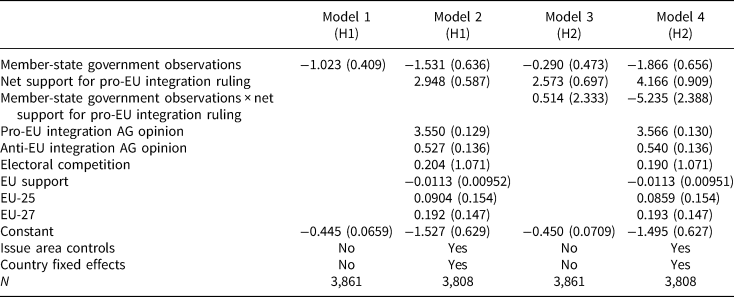
Table 1 presents the results of the logistic regressions used to evaluate Hypotheses 1 and 2. Models 1 and 2 test the first hypothesis, which predicts the likelihood of a pro-EU integration decision on a legal issue to decrease as the number of member-state governments filing observations increases. The results of these models are consistent with this expectation, as the coefficient for Member-State Government Observations is negative and statistically significant. While Model 1 provides the bivariate analysis of this relationship, Model 2 demonstrates that this result is robust to the inclusion of key control variables such as the AG's opinion and the issue area addressed by each legal issue. In short, the data yield clear evidence of the impact of public awareness on CJEU decision making.
Logit analyses of CJEU decisions

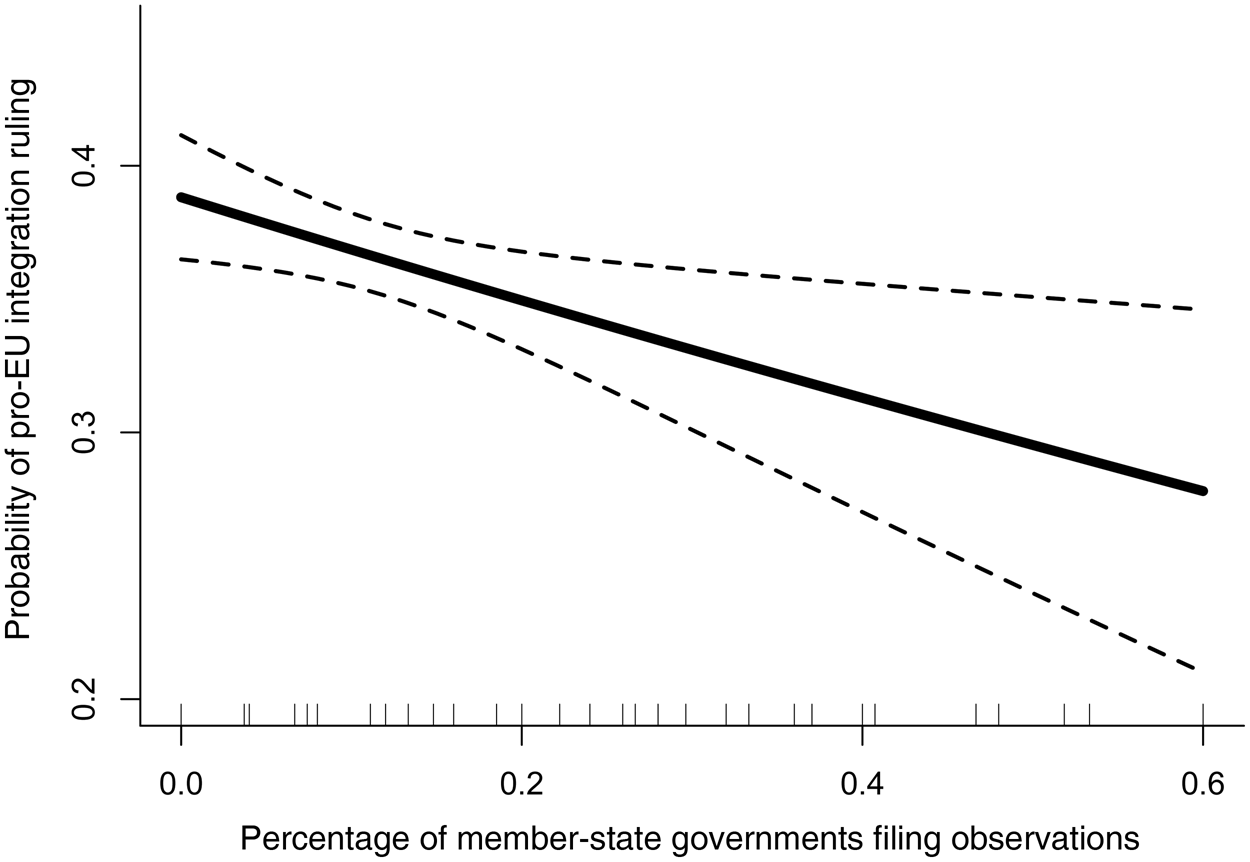
Importantly, the relationship between case disposition and Member-State Government Observations is substantively significant. Based on Model 2, Figure 2 provides the predicted probability that the CJEU will rule on a legal issue in a pro-EU integration direction according to the percentage of member-state governments filing an observation on the issue. As a baseline, consider that the predicted probability of a pro-EU integration ruling is 39 per cent when no member-state government files an observation. When one-fifth of member-state governments file an observation, which for example corresponds to three member states during the EU-15 period or five during the EU-25 period, this probability decreases to 35 per cent. Similarly, the likelihood of a pro-EU decision drops to 33 per cent for issues receiving observations from one-third of member-state governments (for example, five governments during the EU-15 period) and down to 29 per cent when just over half of the member-state governments file an observation (for example, eight governments during the EU-15, thirteen during the EU-25 or fourteen during the EU-27). Considering that these estimates control for key factors such as legal merits, policy area and political conditions in the member state from which cases originated, such decreases in the CJEU's willingness to decide legal issues in a pro-EU integration direction are far from trivial.
Effect of member-state government participation on CJEU decision making
Note: based on Model 2. Dashed lines indicate corresponding 95 per cent confidence intervals. Tick marks indicate observed values of Member-State Government Observations.

Models 3 and 4 in Table 1 present the results for the second hypothesis. As the hypothesis predicts the effect of Net Support for Pro-EU Integration Ruling on CJEU rulings to decrease as Member-State Government Observations increases, the key result of the models is the interaction between these two variables. While this coefficient fails to reach a standard level of statistical significance in Model 3, it is negative and statistically significant upon controlling for the legal merits of each issue by including the AG's opinion in Model 4.Footnote 28 This result is consistent with the second hypothesis, as it indicates that Net Support for Pro-EU Integration Ruling has a decreasing influence on the likelihood of a pro-EU integration decision as the number of member-state government observations increases. In the terms of the formal model, the result corresponds to the weakening effect of punishment for noncompliance on the court's willingness to rule against a government's interests as the probability of public awareness of the court's decision increases.
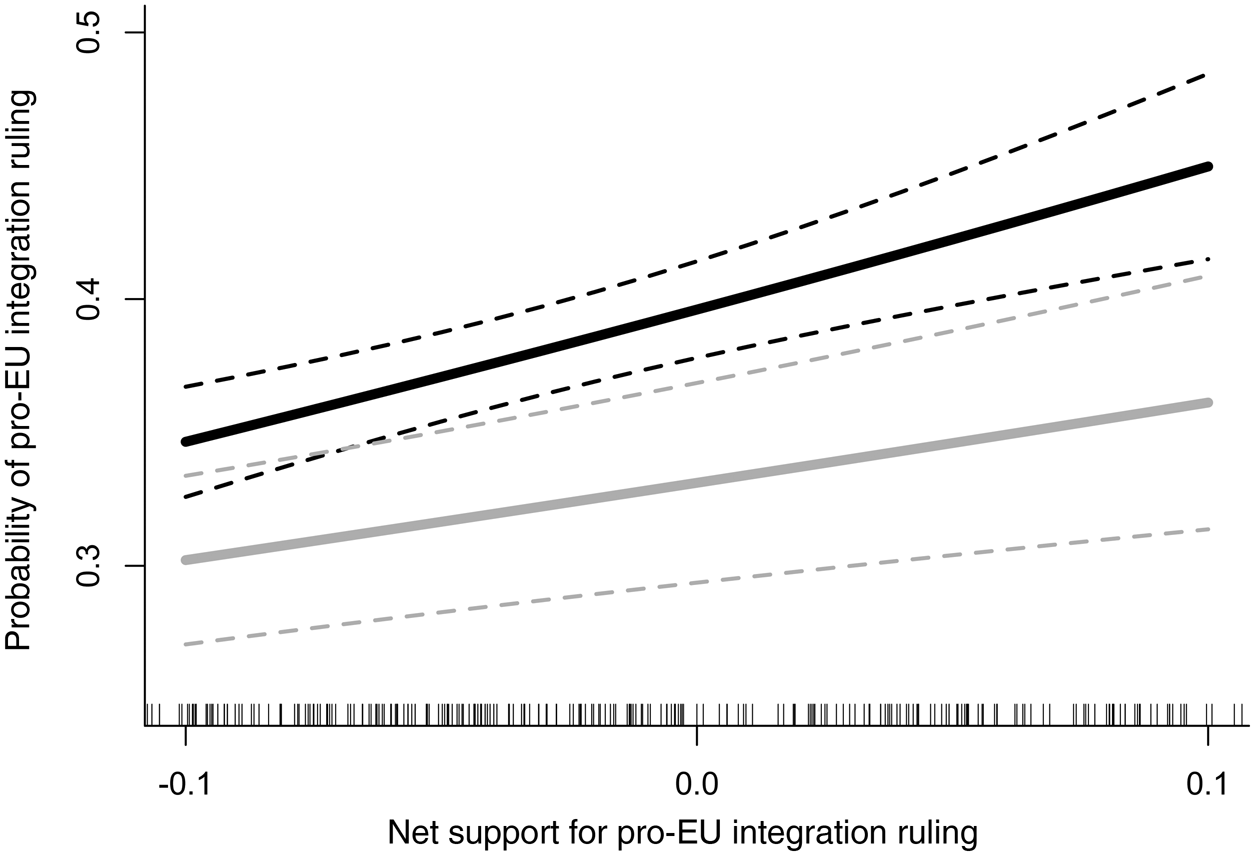
Figure 3 presents the predicted probability of a pro-EU integration ruling based on the results of Model 4. With Net Support for Pro-EU Integration Ruling on the x-axis, the figure displays the impact of this measure on case disposition for issues garnering observations from 6 per cent of member-state governments (for example, one member state in the EU-15 or approximately two in the EU-25 or EU-27 period) and one-third of members (for example, five member states in the EU-15, approximately eight in the EU-25, or nine in the EU-27).Footnote 29 Consider first a legal issue with a single member-state government observation, which is represented in the figure by the black line. For such issues, the threat of punishment for noncompliance has a powerful impact on the court's decision making. The probability of a pro-EU integration decision is 40 per cent when a large member-state such as Germany or France takes a neutral position on the issue before the court but decreases to 35 per cent when a large state opposes such a ruling. When such a member-state government supports a pro-EU integration ruling, however, this probability increases to 45 per cent. In contrast, the court's disposition of legal issues attracting observations from one-third of member states, represented by the gray line, do not appear to be influenced by the content of member-state governments' briefs.
Effect of member-state government participation on CJEU decision making
Note: predicted probabilities estimated using Model 4. Black lines represent issues with Member-State Government Observations equal to 0.06. Gray lines represent issues when this variable equals 0.33. Dashed lines indicate corresponding 95 per cent confidence intervals. Tick marks indicate observed values of Member-State Government Observations.

Moreover, the figure highlights that even when the threat of punishment for noncompliance is present (for example, with positive values for Net Support for Pro-EU Integration Ruling) the probability that the court will issue a pro-EU integration ruling is lower for more salient issues. For example, on issues for which Net Support for Pro-EU Integration Ruling is equal to 0.1 as a result of one pro-EU integration observation, the probability of such a ruling is 45 per cent. When it takes one-third of member-state governments filing observations for Net Support for Pro-EU Integration Ruling to reach that same value, however, the probability of a pro-EU integration ruling decreases to 36 per cent. That is, as anticipated by the theoretical model, likely public awareness of a CJEU decision decreases both the likelihood of a pro-EU integration decision and the influence of potential punishment for noncompliance.Footnote 30
Conclusion
An aware public is often cited as a key condition for the quality of liberal democratic governance. This is particularly true for a central component of liberal democracies, the development and maintenance of an effective judiciary. This study has shown that public awareness of judicial decisions is not unambiguously beneficial for courts, but rather can limit the effectiveness of constitutional review by creating an incentive for government officials to engage in noncompliance. In doing so, the article has several implications.
This article has implications for the study of compliance in judicial politics, particularly with respect to how the risk of noncompliance influences the behavior of both domestic and international courts (Carrubba, Gabel and Hankla Reference Carrubba, Gabel and Hankla2008; Staton Reference Staton2006; Staton and Moore Reference Staton and Moore2011; Vanberg Reference Vanberg2001). The results here provide further empirical evidence of the constraining effect of noncompliance on courts. Notably, this evidence comes from an analysis of the CJEU, one of the most widely emulated and studied courts. That threats of noncompliance influence such a court highlights the impact that compliance concerns can have on judicial decisions. This conclusion is all the more noteworthy with the focus of the analysis on the CJEU's most common proceeding, the preliminary reference.
The article similarly speaks to the development of public support for courts. Scholars point to the need for courts to raise their public profiles in order to gain citizens' trust (for example, Gibson and Caldeira Reference Gibson and Caldeira1998; Gibson, Caldeira, and Baird Reference Gibson, Caldeira and Baird1998); the conventional wisdom is that a lack of awareness hampers a court's ability to develop institutional legitimacy. The theoretical account presented here, however, suggests a more cautious consideration of the impact of public awareness. Rather than recommend that courts should seek public attention, this analysis indicates that courts might be well served by carefully weighing the political consequences of an attentive public for both themselves and the government officials they wish to constrain.
Thirdly, the article speaks to the ‘who guards the guardians’ debate in the political science and legal literatures. Third-party enforcement of court decisions may be the result of a variety of institutional structures and actors, such as ombudsmen, independent executives, federalism and bicameralism. While the empirical analysis in this study focused on the influence that non-litigating EU member-states can bring to bear in cases before the CJEU, it leaves open for future research empirical questions about the relative efficacy of other actors at ensuring the faithful implementation of judicial decisions. Moreover, one could imagine the potential for such third parties to have incentives similar to those of the court or the government as presented in the model here. As one example, the implications of public awareness for the behavior of ombudsmen in domestic settings may prove an interesting theoretical and empirical question for further work. Further empirical and theoretical analyses may yield additional insights into the relationship between the development of judicial power, the public and the incentives of elected officials.
The results also have implications for our understanding of decision making at the CJEU. The study contributes to the vigorous debate regarding the CJEU's sensitivity to noncompliance threats and the bounds of its authority (for example, Carrubba, Gabel and Hankla Reference Carrubba, Gabel and Hankla2008, Carrubba, Gabel and Hankla Reference Carrubba, Gabel and Hankla2012; Larsson and Naurin Reference Larsson and Naurin2016; Stone Sweet and Brunell Reference Stone Sweet and Brunell2012). The results depict a nuanced relationship between the CJEU and member-state governments conditioned by the court's relationship with the European public. Whereas previous studies of the CJEU's authority primarily focused on the EU's institutional structure or the court's limited public support, this study integrated aspects of both accounts to provide a novel account of the limits of the court's authority. In so doing, the article identifies a limiting factor on the court's ability to obtain compliance through the threat of third-party punishment and directs future research to consider other conditions that affect its efficacy.
Although the empirical application focused on an international court, the results have implications for our understanding of new and developing domestic constitutional courts. All courts, both international and domestic, face the fundamental challenge of ensuring the proper implementation of their decisions (Staton and Moore Reference Staton and Moore2011). As such, the theoretical account here could be examined in the context of unpopular domestic courts, such as those in Bulgaria and Mongolia. Indeed, such cases may be more likely than the CJEU to exhibit the behavior predicted by the theoretical model due to the greater authority of national governments to enact court-curbing legislation punishing domestic courts. The article suggests that future research on such courts might consider how (and under what conditions) unpopular constitutional courts choose to address their public image rather than pursue a strategy of calculated anonymity.
Supplementary material
Data replication sets are available in Harvard Dataverse at: https://doi.org/10.7910/DVN/BB6IFG and online appendices at: https://doi.org/10.1017/S0007123419000723.
Acknowledgements
I would like to thank Matthew Gabel, Dalston Ward and participants at the West Virginia University Comparative Politics Research Seminar along with the editor and anonymous reviewers for their insightful suggestions and comments.