1. Introduction
Agents’ abilities to collectively handle social dilemma situations have appeared to be highly relevant for economic activity and success, as they, in fact, represent a ubiquitous problem situation in decentralized economies. A game-theoretic (GT) approach may allow investigating mechanisms and factors that help improving the results for agents in such situations through the evolutionary emergence of institutions of cooperation. This contributes to the larger issues of evolutionary emergence of institutions (e.g., Hodgson, Reference Hodgson and Burlamaqui2000) and of why and how agents cooperate with strangers in large populations even in a one-shot interaction (e.g., Henrich, Reference Henrich2004).
It has been established from various perspectives and with varying focuses (e.g., multilevel/group selection, critical masses, network properties, neighborhood topologies, proximity and face-to-face communication, amongst others) that smaller size of relevant interaction systems may support the emergence of cooperation (with some advantage in socio-economic outcomes) and that informal institutions may be considered meso-sized entities (see, e.g., Dejean et al., Reference Dejean, Pénard and Suire2009; Dopfer et al., Reference Dopfer, Foster and Potts2004; Dunbar, Reference Dunbar2011; Field, Reference Field and Altman2006, Reference Field2007; Henrich, Reference Henrich2004; Henrich et al., Reference Henrich, Boyd, Bowles, Camerer, Fehr and Gintis2004; Marwell et al., Reference Marwell, Oliver and Prahl1988; Mengel, Reference Mengel2009; Olson, Reference Olson1965; Spiekermann, Reference Spiekermann2009; Traulsen and Nowak, Reference Traulsen and Nowak2006; Wells, Reference Wells2010; see more references in Elsner and Heinrich, Reference Elsner, Heinrich and Mann2011; also for older discussions in economics on country size, e.g., E.A.G. Robinson, Reference Robinson1960). We will argue that these are preconditions supporting the emergence of trust in a process of habituation of perceived trustworthiness in cooperating interactions.
Size has rarely been formally analyzed from a perspective integrating the emergence of institutions and trust. Focusing on the sizes of relevant interacting populations and emerging carrier groups of institutions, this paper explores that still under-investigated critical relation and integrates it with the existing state of the art in evolutionary institutional emergence. Emergent institutionalized cooperative behavior, as will be argued, will typically be carried by emergent groups (platforms) that are smaller than the initially given relevant population (arena).
The inner size structure of an economy, society, or nation, its overlapping interaction arenas and carrier platforms of institutions, then arises as a factor helping to explain high levels of interaction-contingent expectations and later generalized trust, important factors in macro-economic and macro-social performance. This might even become policy-relevant for shaping more effective system structures. The inclusion of group size into the evolutionary emergence of institutions also indicates that some meso-level representing such platforms may offer a general theoretical perspective for processes of institutional emergence (see, e.g., Dopfer et al., Reference Dopfer, Foster and Potts2004).
We aspire to contribute to this literature by providing a more formal angle, in which specific advantages for smaller groups result regarding trust and outcome. We will further add by integrating effects of agency mechanisms, particularly memory, monitoring, reputation chains, and preferential mixing, on institutional emergence.
We will continue with (Section 2) a short discussion of trust and size, and relevant approaches in the literature, and (Section 3) a brief presentation of principal factors supportive of the emergence of institutionalized cooperative behavior. Thereafter, we (Section 4) incorporate the basic mechanisms of the emergence of a cooperative environment, and of emerging platform sizes and institutionalized cooperation. The transfer of platform-specific (contextual, contingent, local) trust (Section 5) then extends the argument to the generalization of trust across platforms into new arenas and the whole society. The final section (Section 6) discusses the practical relevance of the findings in terms of an international comparison of general-trust levels, inner size structures, and macro-performance and offers some conclusions.
The primary hypotheses of this paper are that (1) based on some agency capabilities (namely preferential mixing), the platform that may emerge to carry the institution of cooperation will be smaller than the initial arena, and that (2) several and overlapping platforms will help developing contextual trust, which in turn may be transferred to new arenas and eventually into the general public of the whole society – in this way allowing for cooperation among strangers in a large society and in one-shot interactions and therefore (3) that investigations of societies’ inner size structures may offer interesting additional insights into questions related to differential socio-economic performance in even superficially similar countries, and to the literature on varieties of capitalism more in general.
2. Trust and size in the literature and the present approach
For real-world agents and real-world system performance, trust indeed matters (see, e.g., Arrow, Reference Arrow1972; for the field of more recent economic trust research, see, e.g., Bachmann and Zaheer, Reference Bachmann and Zaheer2006; Bijlsma-Frankema and Woolthuis Reference Bijlsma-Frankema and Klein Woolthuis2005; Coriat and Guennif, Reference Coriat, Guennif, Lazaric and Lorenz1998; Farrell, Reference Farrell2009; Khalil, Reference Khalil, Hodgson, Samuels and Tool1994, Reference Khalil2003; Lazaric and Lorenz, Reference Lazaric and Lorenz1998; McKnight and Chervany, Reference McKnight, Chervany, Bachmann and Zaheer2006; Möllering, Reference Möllering2006; Nooteboom, Reference Nooteboom2002; Six, Reference Six2005). General trust, in the present paper, will be referred back, through contextual trust and earlier contextual expectations, to calculative reciprocal cooperation in a GT analysis. We will argue that established and experienced cooperative behavior provides the foundation for the emergence of perceived trustworthiness and eventually for trust at a more general level. Overlapping emerged platforms may allow agents to experience cooperative behavior not only repeatedly but also in diverse contexts. Against this background, their behavioral repertoire may not only become habituated and become semi-consciously applied (for the original-institutionalist tradition on this, see, e.g., Bush, Reference Bush1987; Jensen, Reference Jensen1987) but also transferred from existing platforms to new arenas and generalized into a general public. At the same time, expectations regarding others’ behaviors may be shaped by these experiences as well and may likewise no longer be consciously formulated but eventually take a habitual, semi-conscious form.
The analysis draws on the well-known literature on the evolution of cooperation (EoC; e.g., Axelrod, Reference Axelrod1984/2006; Lindgren, Reference Lindgren, Arthur, Durlauf and Lane1997; Ostrom et al., Reference Ostrom, Walker and Gardner1994; also Schotter, Reference Schotter1981). In fact, both size and expectations/trust have been occasional albeit largely separate issues in EoC (and, of course, in broader and applied socio-economic and institutional research). And the EoC–GT approach has been a standard here (see, e.g., Binmore, Reference Binmore2006; Eckert et al., Reference Eckert, Koch, Mitloehner, Scotto and Succi2005; Elster, Reference Elster1989; Field, Reference Field and Altman2006; Friedman, Reference Friedman1971; Hargreaves Heap and Varoufakis, Reference Hargreaves Heap and Varoufakis2004: chapters 5–7; Hédoin, Reference Hédoin2010; Mailath and Samuelson, Reference Mailath and Samuelson2006; Mengel, Reference Mengel2009; Nowak and Sigmund, Reference Nowak and Sigmund1992; Pelligra, Reference Pelligra2011; Sugden, Reference Sugden1986; Traulsen and Nowak, Reference Traulsen and Nowak2006; Villena and Villena, Reference Villena and Villena2004; Watkins, Reference Watkins2010; Witt, Reference Witt2008; Yamagishi et al., Reference Yamagishi, Kanazawa, Mashimi and Terai2005; for a comparison, differences and possible bridges, between evolutionary economics and the particular approach of evolutionary game theory (EGT), see Hodgson and Huang, Reference Hodgson and Huang2012).
Representatives of the biological, anthropological and behavioral literatures dealing with group-based selection have argued against the EoC–GT approach that it can explain only small-scale cooperation based on long-run interaction, while in the real world humans do cooperate both in large-scale populations and one-shot interactions (see, e.g., Boyd and Richerson, Reference Boyd and Richerson2005; Henrich, Reference Henrich2004). Still, critical factors such as interaction density, information flow, experience cumulation, futurity and expectations, etc., appear apt to be rationally reconstructed in the EoC–GT perspective if properly embedded in an evolutionary-institutional interpretation (which goes beyond EGT; see, e.g., Dosi and Winter, Reference Dosi and Winter2000; Elsner, Reference Elsner2012; Grüne-Yanoff and Schweinzer, Reference Grüne-Yanoff and Schweinzer2008; Güth and Kliemt, Reference Güth and Kliemt2010; Hodgson and Huang, Reference Hodgson and Huang2012; Six, Reference Six2005). Overlapping platforms of institutionalized cooperation then also may provide a link between a larger population and its general institutional framework, which in turn may explain the diffusion of cooperative behavior with strangers in one-shot encounters.
The EoC literature generally employs only two-person games. N-person games are not well suited as a foundation for models in which a cooperative environment is likely to emerge (for overviews, see, e.g., Fehr and Fischbacher, Reference Fehr and Fischbacher2005; Henrich, Reference Henrich2004). We do, of course, not deny that interactions simultaneously involving a larger number of players can play an important role in social interactions. But the learning, habituation, and transmission of cooperative behavior patterns still will depend on agents’ ongoing experiences and expectations (Bogaert et al., Reference Bogaert, Boone and Decler2008), which can be sufficiently approached in two-person games, of which, in turn, every agent may play numerous ones, even simultaneously. At least, these games may sufficiently reflect learning in interactions also in larger groups.
Farrell (Reference Farrell2009: 13ff.) and many others (e.g., Khalil, Reference Khalil, Hodgson, Samuels and Tool1994; Lazaric and Lorenz, Reference Lazaric and Lorenz1998; Nooteboom, Reference Nooteboom2002) have rightly criticized that in rational choice and conventional GT approaches cooperative patterns must be interpreted as choices on a payoff-determined basis, whereas trust, in fact, entails expectations of agents going against their immediate payoff-based interests. The very nature of trustworthiness as the foundation of trust implies agents’ refraining from actions that would afford them a short-run, one-shot advantage to the disadvantage of others. With this, the habituation and generalization of a cooperative behavioral pattern as part of its institutionalization becomes crucial. A spillover into general trust cannot be explained solely in a formal and calculus-focused approach (see, e.g., Coriat and Guennif, Reference Coriat, Guennif, Lazaric and Lorenz1998; Ulsaner, Reference Ulsaner2002).
Once cooperative behavior has become institutionalized, the expectation effect is cumulatively strengthened (e.g., Mengel, Reference Mengel2009), just as trustful behavior may stimulate trustworthy responses (e.g., Igarashi et al., Reference Igarashi, Kashima, Kashima, Farsides, Kim, Strack, Werth and Yuki2008; Pelligra, Reference Pelligra2011), in this way additionally introducing notions of circular cumulative causation into the process. In fact, some cooperative behavior learned in specific arenas and practiced in specific platforms appears to be a necessary step toward the emergence of more general trust (see also, e.g., Acemoglu et al., Reference Acemoglu, Bimpikis and Ozdaglar2010; Binmore, Reference Binmore2006, Reference Binmore2011), a conjecture that finds support from empirical approaches showing a set of specific cooperative behaviors preceding more general trust (see, e.g., Inglehart and Baker, Reference Inglehart and Baker2000; Yamagishi et al., Reference Yamagishi, Kanazawa, Mashimi and Terai2005; in the naturalistic perspective: Henrich, Reference Henrich2004). Such repeatedly experienced cooperative behavior then does not only have to be habituated over time, but eventually needs also to be transferred to other particular arenas, generalized into the general public of the whole larger population (covering different overlapping arenas), and be reflected in the formation of related beliefs by agents (also, e.g., MacFayden, Reference MacFayden and Altman2006; McKnight and Chervany, Reference McKnight, Chervany, Bachmann and Zaheer2006).
Corresponding processes, thus, are by no means predetermined in their course. Cooperative behavior eventually spilling over into increasing levels of trust is only one of different possible directions that the emergence of behavioral patterns may take. Particularly, even if established in different smaller groups (bonding social capital, according to Putnam, Reference Putnam2000: 22–24), its transfer to other interaction arenas and into the larger population (the bridging social capital, see Putnam, ibid.) may or may not happen. This a priori openness would generally require expecting a whole variety of levels of institutionalized cooperation and related trust across different groups (see also, e.g., Aoki, Reference Aoki2001, Reference Aoki2007; Greif, Reference Greif2006; Henrich, Reference Henrich2004; Nooteboom, Reference Nooteboom2002; Pelligra, Reference Pelligra2011).
The empirical variety and divergence of levels of trust and cooperation among different countries (even among similar and neighboring ones), as documented by the World Value Surveys, can be accounted for in the framework we develop in this paper, not only due to those ex ante undetermined outcomes but also and especially through different levels of inner size (arena and platform) structures. The widely noted correlation between levels of trust and macro-economic and macro-social performance (see, e.g., Knack and Keefer, Reference Knack and Keefer1997; Malul et al., Reference Malul, Rosenboim and Shavit2010; Maskell, Reference Maskell, Cooke, Heidenreich and Braczyk2004; Rose, Reference Rose2011: 171–172) and the discussion of persisting Varieties of Capitalism, i.e. the continuing path-dependent distinct dynamics of national economic systems with their deep interaction structures, situate the topic explored in the present paper at the heart of a real-world economic research.
3. Priors to the present model: the role of shared knowledge, beliefs, and expectations, and the single-shot solution
The social dilemma is a ubiquitous and everyday problem structure of decentralized individualistic economies, and the more so the more individualistic and myopic the culture is at the outset. Transactions (including any market transaction) are more or less embedded in such a potential or tacit dilemma, with ubiquitous opportunities and incentives to free-ride and exploit others and their cooperative behaviors, whether cooperation has already been collectively institutionalized or not. But such defection would undermine expectations of cooperation and the potential joint (broader, collective) and long-run improvement that mutual cooperation would allow for (the instrumental problem-solving). Mechanisms supporting agents in realizing superior outcomes are thus of significant relevance for economic activity.
GT can help us identify mechanisms that support the emergence of cooperative behavior in dilemma situations. For GT agents, improving the outcome they can reach in a PD involves mechanisms that permit a transformation of the problem structure. A successful transformation adds at least one additional, and Pareto-superior, NE, and hence generates a coordination problem out of the dilemma. Typically the mechanisms for transforming the problem structure center on a longer time horizon of the individual agents (as to be learned, habituated, and acquired as a culture) and an increase in the number of (likely) interactions with a specific partner (also shown as being important in experiments, by, e.g., Andreoni and Miller, Reference Andreoni and Miller1993; Gächter and Falk, Reference Gaechter and Falk2002). Both increase the importance of future payoffs for today's decisions. For real-world agents, these results can be translated into a learning of the importance of the future. The repeated encountering of the same problem structure, and interaction partners in these, in turn, implies a somewhat stable environment (moderate change, turbulence, or mobility), which allows for a process that we may interpret as corresponding to a cumulative social learning process (see also, e.g., Glaeser et al., Reference Glaeser, Laibson and Sacerdote2002, on mobility and social capital).
Real-world agents continue facing dilemma situations, even if they may not recognize them as such any longer, due to their habituated and semi-conscious institutionalized cooperative behavior, or to their acceptance of such an institutional framework as natural or as a norm. But still, the mechanisms and factors that can be identified as supporting the emergence of institutionalized cooperation in a formal setting do help us understand the emergence of cooperation in real-world situations. This, as popularized by Axelrod, is presented in the Appendix. In the main body of the text, we will limit the exposition to a verbal sketch of the principal findings.
In the dilemma-based supergame, an infinite number of stable outcomes (strategy combinations) can exist that allow for an improvement of results above the outcome achievable when just sticking to the dominant strategy of the underlying one-shot game. There are well-known proofs for that, collected as the folk theorem (e.g., Friedman, Reference Friedman1971). In order to keep the analytical structure to a manageable magnitude, we draw on the results of Axelrod (Reference Axelrod1984/2006) and on some research on dilemma supergames in a population context (e.g., Lindgren, Reference Lindgren, Arthur, Durlauf and Lane1997; Mailath and Samuelson, Reference Mailath and Samuelson2006; Nowak and Sigmund, Reference Nowak and Sigmund1992), showing that there are some basic characteristics of strategies that have proved to lead to an overall rather successful performance, when compared in different and even evolving strategy environments. These characteristics include non-aggressiveness (not defecting first), and the willingness to retaliate against defection of others, coupled with forgiveness, the willingness to return to cooperation after having punished an opponent. They help guaranteeing a necessary prerequisite for emerging cooperative behavior, namely that its benefits fall predominantly on cooperative agents (see, in an experimental context, e.g., Fehr and Fischbacher, Reference Fehr and Fischbacher2005). The simplest practical representation of such a strategy has come to be called tit-for-tat (TFT): start cooperating (the strictly dominated strategy in the underlying one-shot game) and then mirror your opponent's prior move in all future decisions. Hence, the strategies considered are usually and pragmatically limited to TFT and All-D (always defect).
The existence of a Pareto-superior NE does not guarantee that agents will actually be coordinating on it. For instance, agents might not change their behavior of initially choosing the defection strategy, if they are sufficiently risk averse and want to protect themselves from other agents’ defections. The eventual outcomes of repeated interactions in games with more than one NE cannot generally be predicted; any one of the possible NEs may result, depending on initial conditions and/or on the resulting process. Specifically, in order to determine a particular NE, agents have to form expectations (beliefs), about which strategy choices of the other(s) seem most likely. Thus, if we want to make predictions in such a setting, we have to refer to some beliefs of agents about others’ behaviors.
Some social rules, thus, have to be assumed preexisting that allow agents to formulate such expectations (and, correspondingly, external observers to make forecasts). For analyses that have to deal with more than one unique and predetermined stable outcome, an embedding of the GT formalism into broader socio-economic settings becomes crucial in order to more thoroughly understand the subject [see, e.g., Schelling's focal points (Schelling, Reference Schelling1960); further see, e.g., Dosi and Winter, Reference Dosi and Winter2000; Hédoin, Reference Hédoin2012; Hodgson and Huang, Reference Hodgson and Huang2012].
An institution is to be considered a social rule for the decision/behavior of individual agents for the solution of PD supergames that has gained, through a process of social learning and semi-conscious habituation, a general approval so that it can inform agents about proper problem-solving behavior and mutually consistent expectations, particularly about the fact that with unilateral defection other agents will also deviate in the future, so that all will be worse off than with rule-conforming behavior. For agents in a population and in long-run processes, achieving a Pareto-superior result on a consistent basis will have to involve the emergence of an institution (rather than just a social rule) that enables cooperative behavior (despite the ubiquitous one-shot incentive to defect, to free-ride and exploit, which continues to be present, at least tacitly). The two distinct basic problem structures, coordination games and dilemma games, are related to a classical definition of social rules (to solve a coordination game) that work without a short-run sacrifice and therefore without an endogenous sanction, and social institutions (to solve a dilemma game) that require the sacrifice of the myopic maximum and therefore an endogenous sanction. The latter is reflected in any trigger strategy such as TFT (for the terminology, see, e.g., Schotter, Reference Schotter1981).
Repetition lends itself to a better understanding of processes of institutional emergence, either interpreted as the result of decision processes by agents revising and updating their individual game plans, i.e. interactive learning, or considered as the outcome of a replication process on a somehow diversified and diversifying population, in which certain types of behaviors may gain an advantage (possibly path-depending on the initial structure). Both perspectives eventually lead to stable outcomes that permit interpretations from an evolutionary-institutional perspective and can serve as the foundation for a broader view on social phenomena, if we leave the narrow analytical framework of a conventional GT representation, as has often been requested by evolutionary economists (most recently: Hodgson and Huang, Reference Hodgson and Huang2012).
If an instrumental (problem-solving) institution does not yet exist, its establishment may be difficult, given that in that case warranted prevalent expectations would point to others’ non-contribution. But even if such an institution of cooperation already existed, under certain conditions that favor myopic and overly individualistic behavior again, incentives to exploit others’ cooperative behaviors, and thus the institution as such, may return. In this way, institutional systems may become fragile and vulnerable to relapses and breakdowns.
The arguments by Henrich (Reference Henrich2004), Gintis (Reference Gintis2004) and others regarding a gene–culture coevolution referred to above can thus be amended here as well: Even if over time a predisposition toward cooperative behavior had been selected among groups, there still remains the possibility of a collapse, and hence the desirability of the reconstruction, of these patterns in social situations. And intensified contact among previously separated groups continues to enhance the relevance of the emergence of cooperative relations among them, if some common advantage is to be taken of the opportunities that such relations offer.
In all, expectations do not only play a crucial role in the process of institutional emergence but that they also are themselves subject to some complex process of emergence and adaptation.
4. Population perspective, arena size, and the critical minimum and maximum masses
Having explored some factors of the emergence of cooperative behavior between two agents, we can approach emerging cooperative behavior in a relevant population (arena) considering population size or the size of the arena in which interactions take place. Still, expectations and resulting expected payoffs, now integrating both population (arena) size n and the number of cooperators in the population (later forming an emerging platform) k, i.e. expectations (experienced or not) regarding the ratio k/n, remain the driver of the process.
Emerging cooperation in populations and the critical size dimension of the arena
The basic interaction still happens between two agents entering a supergame developed from a dilemma structure. These are randomly drawn from the population and matched in the game. Expected payoffs for the two strategies permitted then depend on the expected shares of TFT cooperators and All-D defectors in the population (again, for a brief formal representation, see the Appendix), i.e. expectations regarding the likelihood of the respective strategy choice by the opposing agent.
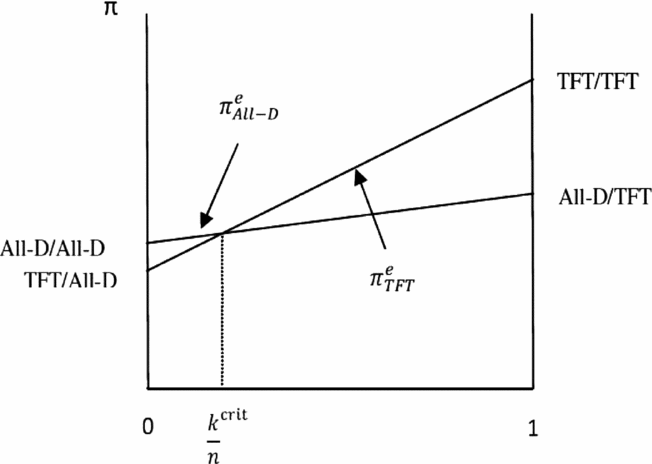
Figure 1 shows the graphical representation of expected payoffs πe, for a situation in which the dilemma structure has already been transformed into a coordination problem through a repetition of the interactions. Given this, a coordination game of the stag hunt type has come to existence and the realization of the superior NE will depend on the expectation of each that the other will cooperate as well. Note that distrusting agents would choose the maximin strategy (that maximizes the minimum one can get from a strategy) and thus would choose All-D (see Sen's assurance game, Sen, Reference Sen1967).
Payoff schedules of a PD supergame played pair-wise in a population.

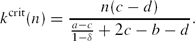
The intersection of the payoff schedules gives the share of cooperators in the population, for which TFTs’ expected payoffs are equal to those of All-Ds (k crit/n). This minimum critical mass of cooperators depends on the discount factor employed for discounting future payoffs and the expectations regarding the probability of a continuation of the interaction. The more important future payoffs are, the lower the share of cooperators required for TFT to become the superior strategy.
We may assume that agents are aware of the possibility of improvement above the results of repeated mutual defection, if a sufficient number of agents are willing to change behavior starting from an initial All-D equilibrium. For instance, they may begin diversifying their behavior motivated by frustration with the payoffs realized in the dilemma. Meeting repeatedly may allow for such a process to start. Even if they were not aware of the superior results from mutual cooperation, they might start experimenting, out of a general instrumental motivation to improve their conditions or simply curiosity (the instinct of workmanship or idle curiosity according to Veblen, e.g., Veblen, Reference Veblen1899, Reference Veblen1914). Such search, experimentation, and diversification may already generate the minimum critical mass necessary for establishing an environment in which cooperation eventually will become the superior choice for all.
But also, as said, a social contract or some other form of general assurance that other agents will indeed choose cooperation as well may support a change that alters the predominant choice in a population, if this assurance has an impact on the formulation of expectations. The belief has to emerge that the other player(s) will adopt a cooperative behavior pattern; or, in a population setting, that a sufficient number of other agents will adopt a cooperative behavior pattern, something that might be reflected by the metaphor of a contrât social (Rousseau, Reference Rousseau1762), explicit or tacit, or some related public (policy) assurance (Sen, Reference Sen1967). In all, evolving expectations are a crucial aspect in this set-up.
This shows that it is
• the agents’ expectations, and their learned, and then habituated, institutionalized perspective, futurity or time horizon, combined with
• the relative size of the initial carrier group of cooperation in the arena under consideration, the minimum critical mass, based upon
• some specific, enlarged agency capability for behavioral innovation (search, experimentation) (plus perhaps some credible public assurance, exogenous to the model)
that matter. The solution thus is shaped by prior assumptions and beliefs, interaction experiences, expectations, size, and a specific agency capability.
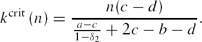
In smaller groups, in fact, interactions get more valuable, as repeated meetings are more likely, which is reflected in an again increasing value of these interactions (see the Appendix)Footnote 1. The required share of cooperators will fall more than proportionally when groups get smaller. Consequently, the intersection of the payoff schedules in Figure 1 shifts to the left when population size is decreasing, all else equal, when we integrate the possibility for repeated meetings into the discount factor.
Additional agency capabilities: partner selection and the critical maximum mass
Considering monitoring, memory, and the building and use of reputation chains as additional agency capacities will complement the first approach. These additional capacities would permit that agents exchange information regarding others’ earlier and expected behaviors, which becomes particularly useful when some partner selection is considered feasible (on such agency capacities in general, see, e.g., Davis, Reference Davis, Giacomin and Marcuzzo2007, Reference Davis, Hanappi and Elsner2008; Dolfsma and Verburg, Reference Dolfsma and Verburg2008; Leydesdorff, Reference Leydesdorff2007; for the value of reputation building, see, e.g., Dasgupta, Reference Dasgupta and Gambetta1988; Fehr and Fischbacher, Reference Fehr and Fischbacher2005; Mailath and Samuelson, Reference Mailath and Samuelson2006). In this case, agents may not just form an idea about the composition of the population in general but also about other agents’ earlier behavior. These capabilities enhance the system's capacity to establish a cooperative environment (also, e.g., Spiekermann, Reference Spiekermann2009).
Cooperative agents are able to identify, select, and interact with identified or identifiable individual agents of their kind with a higher probability, in a process of gaining interaction experience (through memorizing, monitoring, and using reputation chains) than they would under random matching. This will improve the results they can achieve beyond the results of random matching. Monitoring, memorizing, and using a reputation chain can be considered informational preconditions for selecting agents.
We assume, however, that agents cannot know every other agent in the whole population, and thus, with new and unknown upcoming interaction partners, the capacity to reject an interaction partner does not help with a view on selecting known cooperators all the time. Particularly, information may also get thinner, more unclear, uncertain, and fuzzy, especially if related through third actors, i.e. if ever longer reputation chains are deployed. Alternatively, even if they knew about every agent, we would have to assume that not every interaction can be refused, but only some of them, a limited partner selection capacity. In any case, meetings with All-D players cannot completely be avoided.
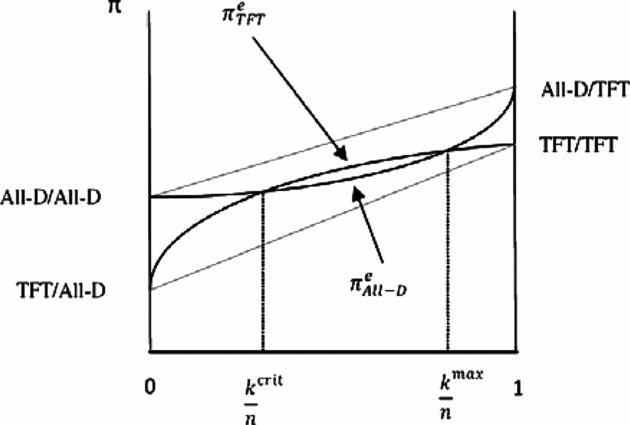
As illustrated in Figure 2, thus, two stable equilibria emerge, a pure All-D population as before and the mixed population at the second intersection (k max/n). In the example, the dilemma is not solved in the supergame (if it was, the intersection on the left would be shifted further, compared to the same case without partner selection, and the stable equilibrium on the right-hand side would be a complete TFT population), making partner selection a complementary solution mechanism for dilemma situations. The maximum share of cooperators, sustainable by the interaction rationality of the system under given parameters, can be conceived of as a meso-level carrier group for the institution in this case, the emerging final and stable platform of settled cooperative interaction below the initial relevant population (for the conception of a meso-economics of emergent structure, see, e.g., Elsner and Heinrich, Reference Elsner and Heinrich2009, Reference Elsner, Heinrich and Mann2011).
Population payoff schedules with partner selection (when the basic dilemma is not solved yet) – and the exhaustion of such capacity: the ‘maximum critical mass’.
In all, agency mechanisms such as monitoring, memory, and reputation, in connection with some limited partner selection, provide an additional mechanism permitting to achieve results that are superior to those of mutual defection. More information about others’ behaviors thus increases the chances for the establishment of a generally cooperative behavior in a relevant population. These agency capacities are working in equivalent ways as sanctioning in the earlier single-shot perspective, as also shown in laboratory experiments and behavioral economics even for n-person groups (see, e.g., the classic of Ostrom et al., Reference Ostrom, Walker and Gardner1994), simply (in our case) through the endogenous sanctioning mechanism that the withdrawal of the benefits of future cooperation signifies.
The mechanisms supporting emerging cooperative behavior that we can identify concur with those of earlier analyses. We can add to this by stepwise extending and integrating agency mechanisms into the model, which permits a clearer identification of the stages at which such mechanisms are in fact required to support said emergence. The two stages of the model as discussed so far are not strictly building upon each other. They are connected, however, by representing some continuous range of agency capabilities jointly contributing to the coevolution of trust and size. Only in the last module of the model (the partner-selection agency module) do we yield an explanation of meso size. In the next step, we extend the approach from contextual to emergent general trust.
5. Contextual trust in different and overlapping meso-sized platforms and their spillover into general trust: varying capitalisms explained
Contextual trust and size so far
As we have seen, cooperative behavior can emerge more easily, for a given incentive structure, when
• interaction arenas are smaller and required minimum critical masses therefore become relatively smaller and
• expectations to meet a cooperative agent next interaction or round become higher,
• and the culturally learned time horizon becomes longer;
• further agency mechanisms, particularly preferential mixing, additionally enhance agents’ ability to improve their results.
Beyond the rich literature referred to so far, further empirical studies and experiments corroborate these results (for overviews, see, e.g., Bogaert et al., Reference Bogaert, Boone and Decler2008; Igarashi et al., Reference Igarashi, Kashima, Kashima, Farsides, Kim, Strack, Werth and Yuki2008).
These results, as indicated, hold independently of whether we approach the question from a perspective of active choice of strategies or of a selection of behavioral traits through a replicator mechanism. For instance, it is conceivable that behavioral predispositions are emerging within the individual agents and thus are selectable, laying the foundation for later habituated cooperative behavior in other areas, a process that may be enhanced or accelerated by group selection processes that work in parallel (as argued, e.g., by Henrich, Reference Henrich2004). Such predispositions notwithstanding, human agency in decision-making still matters, of course, and individual experience will significantly shape future responses and the development of habituated behavior patterns. A breakdown of institutional structures of cooperation is always possible, and mechanisms for preventing such breakdown or facilitating their re-emergence thus matter greatly.
Trust transfer and trust generalization
Agents typically are interacting with others in different and overlapping arenas and relevant populations (possibly playing more than one game at a time) in one major whole population or society. Arenas may overlap in terms of interconnected thematic interdependence structures (spending leisure time with professional colleagues; a teacher having own children in school, etc.), geography (acting in local as well as national caucuses of the same association), and agents (interacting with the same persons in a corporate division, a union, a soccer team, and local school board) and different arenas may be characterized by different types of problem structures. Even the same two agents in the same interaction might be interacting in different incentive structures (in asymmetric payoff matrices). A major population can thus be conceived of as consisting of many different fields and arenas. The coemergence of favorable contextual trust in a particular arena, as discussed so far, then is only a first step toward a high generalized trust level. Agents in particular emerged platforms will have to form more general ideas about how others will behave when they choose their actions beyond the individual platform, i.e. in a new arena.
On top of the motivations and mechanisms of agency already discussed, and the requirement, and capability, of habituating the institution and applying it semi-consciously, some transfer/spillover and generalization is required to facilitate the process in real-world situations and will bring the formal argument for one arena closer to the real multi-arena world. The distinction between contextual trust and general trust (also, e.g., Yamagishi and Yamagishi, Reference Yamagishi and Yamagishi1994) is reflecting the difference between trust, developed toward agents with which one frequently interacts, or in a specific context, and a generally favorable, trusting outlook on any possible future interaction partner. From cooperative behavior and eventually trust confined to specific arenas, trust emergence on a general level can develop. People with higher levels of general trust indeed cooperate more with unknown agents (e.g., Igarashi et al., Reference Igarashi, Kashima, Kashima, Farsides, Kim, Strack, Werth and Yuki2008).
Once a particular cooperative environment and contextual trust level has been established in a critical minimum number of platforms, agents may follow a general learned behavior pattern. This may facilitate a transfer of institutionalized contextual trust into new arenas, or a generalization of contextual trust into a more general habit transferable into the broader setting of the whole larger population, society, or general public. The channels of such transfer and generalization may be manifold and will include intra-individual and inter-individual processes, local neighborhood interaction or long-distance migration. This all may result in an embedding of trustworthiness as a desirable trait into the general institutional (and even normative) structure of the society. Eventually, this may establish a generally trustworthy behavior and general trusting attitudes.
Such a process may rely partly on an internalization of norms that, for instance, Gintis (Reference Gintis2004) has identified as an ‘important prosocial psychological mechanism’ supporting the sustainability of cooperative behavior patterns (see also, e.g., Bogaert et al., Reference Bogaert, Boone and Decler2008). Modern psychology, anthropology, or, more generally, behavioral sciences are currently working on the details of such individual capacities of habituation/transfer/spillover/generalization – including mechanisms of conformism and respective behavioral selection, be it on an individual basis or as group selection. The possibility to distinguish agents with a stronger prosocial bend and those focused more on themselves (Bogaert et al., Reference Bogaert, Boone and Decler2008), or between agents for whom considering group interests in their decisions is a moral stance and those for whom this is less important, supports these arguments as well as the formal approach chosen above.
Fields of application and some empirical evidence on general trust in a variety of capitalisms
The emergence and relevance of cooperative behavior patterns has repeatedly been observed in the context of general development processes (e.g., Chang, Reference Chang2002; Inglehart and Baker, Reference Inglehart and Baker2000). Also, trust was found to have a positive effect on innovation (e.g., Dakhli and de Clercq, Reference Dakhli and de Clercq2004). Likewise, as Schneider (Reference Schneider2008) has argued, a coemergence approach to development has the advantage for agents to get involved with processes at the local level, and thus the possibility for them to establish cooperative links that can be transferred to higher levels eventually. There are no simple static relations implied and processes can best be characterized by circular and cumulative causation. As Igarashi et al. (Reference Igarashi, Kashima, Kashima, Farsides, Kim, Strack, Werth and Yuki2008) have argued, there are, in fact, significant differences between Eastern and Western cultures, but also within each (e.g., German against English-speaking countries), when it comes to observable levels of general trust. This confirms the relevance of long-term processes of cultural change, being in line with the predictions of the formal approach presented here about numerous possible states that social systems can end up in.
We have argued that phenomena of highly different and even diverging general trust levels, in turn highly correlated with likewise different and diverging macro-performance levels in various economic, technological, and social areas, may indicate considerable systemic differences in the tacit and disguised deep interaction structures (arenas and platforms) even among apparently similar countries. In particular, we have identified the different inner size structures of different developed capitalist countries as a new and additional critical variable (see Elsner and Heinrich, Reference Elsner and Heinrich2009, Reference Elsner, Heinrich and Mann2011; see also, e.g., Christoforou, Reference Christoforou2010; Dakhli and de Clercq, Reference Dakhli and de Clercq2004; Yamagishi and Mifune, Reference Yamagishi and Mifune2008). Our approach thus refers to the topical discussion of the persistence of a variety of capitalisms. Inner size structures may be indicated through empirical settlement structures, association, union, and network memberships of individuals and firms, informal participation, migration conditions, etc.
While conventional economics has mostly stressed the disadvantages and volatility of small countries, it has indeed been in the varieties of capitalism literature that it may particularly be smaller countries which display such high trust and performance (see, e.g., Kesting and Nielsen, Reference Kesting, Nielsen, Elsner and Hanappi2008; see also Fukuyama, Reference Fukuyama1995: chapters 3, 28, pp. 23ff., 335ff.). Many have argued in favor of advantages of smaller countries, particularly their superior adaptability, learning and cooperation conditions as dependent on proximity and interaction density.
When considering the critical factors in the deep structure of countries, such as futurity (expectations) and size, as investigated in this paper, then specifically small countries that are internally structured in staged and overlapping functional, spatial, professional, organizational, or jurisdictional communities, groups, networks, associations, etc., can be expected to display such favorable trust levels and performance. It appears that they have internally generalized the principle of smallness (through path-dependent cumulative historical process rather than deliberate political design, though), so that they can make use of meso-sized arenas and platforms. In this way, they may generate general trust and facilitate the emergence of institutionalized cooperation, related innovative action capabilities, and high macro performance.
This typically seems to apply to Scandinavian countries, given their overall sizes, residential structures, enterprise size structures, dominant interactive workplace organization, general organizational participation, informal networks structures, and related policy frame-setting (particularly safeguarding some level of social integration, stability and security, mirroring critical expectations in our model; see for instance the rich material on the Danish case in Edquist and Hommen, Reference Edquist and Hommen2008; Holm et al., Reference Holm, Lorenz, Lundvall and Valeyre2008; Jorgensen, Reference Jorgensen2002; Lundvall, Reference Lundvall2002). In this way, even a country with 5.4-million population might be sufficiently interconnected through meso-arenas and platforms to generate high levels of trust, institutionalized cooperation, and socio-economic performance.
Still, as the discussion of the mechanisms supporting emerging institutions of cooperation has allowed stressing, the argument cannot be that small countries have to be expected to generally show better socio-economic performances even if at first glance they may appear to be advantaged as the emergence of favorable structures and institutions seems easier there. That process is by no means predetermined so that small countries may just as well show relatively weak performance patterns. Additionally, and especially the view of large countries as homogeneous entities that would merit the unqualified contrasting of large and small countries here has obvious weaknesses. In fact, where large countries have seen the emergence of overlapping interaction arenas on regional levels that have eventually spread into a larger national culture, supportive inner size structures, so to say, they may even more strongly benefit from technological conditions and stability issues than smaller countries can. And where circular causations are running between performance, advantageous expectations, and reaffirmations of trusting behavior, the trust level may then easily be higher than in culturally similar small countries as long as turbulence related to larger groups, or groups getting too large, does not get too intense. An investigation of possible regional differences, in trust levels as well as in overall performance, in large countries may therefore offer valuable additional insights (for regional differences in the United States, for instance, see Porter, Reference Porter2003).
Comparisons between countries of similar size, and especially in comparable circumstances, may likewise prove to offer particularly interesting insights. Alouini (Reference Alouini2009), for instance, mentions the noticeable differences in performance among small European countries. Given the shared framework of EU rules and regulations, the formal framework for economic activity is relatively similar between them. Informal structures, and, as we hypothesize, the society's deep interaction structure, are apparently particularly relevant here. This also underlines the fact that a small population per se does not guarantee socio-economic success, and that small populations may well not enter processes resulting in emerging institutions of cooperation and the eventual transfer to contextual trust and general trust. Technological factors obviously also play a role, but especially interesting for us is the fact that the number of possible states for societies observed corresponds well to the open processes we have described above. In another comparable observation, Rose (Reference Rose2006) confirms that in a large sample of countries, overall size alone has not been found to have a distinguishable influence on performance.
General-trust polls, nowadays carried out regularly among representative household samples in most countries with some support of the World Bank and other major organizations (see, e.g., Keele and Stimson, Reference Keele and Stimson2002; Knack and Keefer, Reference Knack and Keefer1997), namely the World Value Survey, include general trust questions, such as ‘Do you think you can trust the next person you will encounter?’ Thereby, they offer material for relating inner size structures to outcomes and trust, first at the level of societal trust. Differences detected can then guide further research. Such polls, as said, have brought about interesting differences and even considerable divergence over time among neighboring and presumably similar and converging countries (leading OECD countries). Also pointing in the same direction as our analytical results, we can find in empirical studies that negative experience in the past, low perspectives for future improvements, and pronounced inequality (i.e. little recognized interdependence) coincide with lower levels of trust (e.g., Alesina and La Ferrara, Reference Alesina and La Ferrara2002; Wilkinson and Pickett, Reference Wilkinson and Pickett2009). In our approach, low expectations to meet again, or to meet a cooperative agent in general, low futurity, permanent high mobility and turbulence, and a pronounced and persistent exploitation structure in a social dilemma coincide with low levels of trust. Factors inhibiting cooperative emergence likewise coincide with low trust.
While the conventional story about the relative persistence and adaptability of the Scandinavian welfare state still holds to help explaining those phenomena, this paper suggests that the critical factors of (1) inner arena and platform size structures and (2) general trust levels need to be taken into account in future research as a relevant new issue of the deep interaction reality of populations and socio-economies. On top of the usual welfare state, social integration, and social-security story explaining the Scandinavian variety of capitalism, we would thus suggest empirically investigating the size dimension as working in the deep structure of the interaction systems of countries as a new critical factor in future applied evolutionary and institutional analyses. Of course, as developed above, this is valid beyond just Scandinavia and applies to differential performance in superficially similar countries more generally. We have drafted an empirical research setting elsewhere (see Elsner and Heinrich, Reference Elsner, Heinrich and Mann2011: 154ff.).
6. Conclusion
Given the importance of trust for economic activity, the question of the emergence of trust and possibilities for fostering this process is of particular interest. In a first step, we have attempted to contribute to this area of research by offering a formalization of processes of institutional emergence since institutions of cooperation appear to be a logical prerequisite to and coemergent factor of eventual general trust in a group. The setting helps to define minimal requirements for the emergence of cooperative behavior within groups. We have then referred to the semi-conscious habituation of such behavior, logically required for any institutionalization, as a pre-condition for its transfer to other arenas and for a generalized trustworthiness to facilitate elevated levels of general trust. Repeatedly experienced cooperative behavior can lead to a perceived trustworthiness of interaction partners. This, in turn, lays the foundation for contextual trust, in a habitual cooperative behavior pattern that is detached from particular underlying payoff considerations. Contextual trust in several, possibly overlapping, arenas can turn into general trust in a process of habituation that permits its transfer into new and different arenas, eventually, and possibly, fostering an overall trusting and trustworthy behavioral environment.
We have focused on trust in the context of the other critical dimension, size. Trust then eventually reflects a most basic real-world interrelation, namely the inner size structure of arenas and platforms of real socio-economies, their deep structure of interaction arenas and established platforms. We share this conclusion with other approaches to meso (see, e.g., Dopfer et al., Reference Dopfer, Foster and Potts2004).
At the outset, therefore, we have focused on conditions that permit and facilitate the emergence of cooperative behavior in groups. Longer interactions and an increased value of future payoffs for agents, a recognized interdependence (for the Veblenian/OIE tradition of this, see, e.g., Bush, Reference Bush and O'Hara1999) and a learned futurity (see on this, also in the OIE tradition, e.g., Commons, Reference Commons1934: 390ff.), are core aspects in processes of an emerging willingness to cooperate. Finally, we found that when interactions between agents get more valuable due to an increased likelihood of future interactions between agents, conditions permitting the emergence of a cooperative environment are more easily met in smaller groups (equivalent with less mobility and turbulence in general) for given incentive structures.
In this frame, we introduced more particular agency capacities, namely the ability to collect more information on specific individual agents through memory, monitoring, building reputation and making use of the reputation chain, in order to apply partner selection to increase the chance to meet a cooperator rather than just the same agent. In fact, such peer-group formation may allow for institutions of cooperation even if recognized interdependence and futurity are not sufficiently understood and the dilemma structure remains in place. In this case, while cooperators may then increase their relative success fairly quickly at early stages of the interaction process, their cooperative advantage is eventually exhausted as marginal gains decrease and discounted payoffs establish an upper limit. The emerging platform size then assumes an upper limit below the size of the relevant population (a meso-size). Cooperation may come into being more easily but may also have its limits.
In a final step, we generalized trust, learned and practiced in a critical minimum set of substantially (thematically), spatially, or personally distinctive (but possible overlapping) arenas and platforms. Generalization, spillover, or transfer into new arenas helps the diffusion of a cooperative culture into the general public of the larger society, in which trustworthy behavior becomes established as a part of a normative system exerted and spilled over habitually. This helps explaining what has become the topical issue of general trust in a number of platforms, usually defining regional, industrial, or national cultures. Many individual institutionalized constellations of cooperation may thus combine into a predominant culture of cooperation, with general trust eventually becoming accessible to a larger group.
What we can point to, therefore, is that more information, choice of interaction partners, and a smaller relevant interaction group (population, arena) are factors that make it easier for a cooperative environment to emerge. This does not, however, mean that such emergence was a predetermined outcome of processes, or that it was predetermined for all arenas if it developed in a few. The emergence of contextual trust and the habituation transfer of contextual trust in different arenas to constitute general trust are not predetermined either. Likewise, it does not mean that only small countries were to be expected to enjoy high levels of trust. Indeed, as the World Value Survey, for instance, indicates, there are large countries with relatively elevated levels of general trust, just as there are small countries without particularly elevated trust in their respective populations. The outcomes of the processes we have described in fact make these multiple states of real systems the expected outcome.
For extending the approach from the basis presented here, the approach developed here could basically be further elaborated by n-person games. However, in these, cooperative behavior is hard to establish as a stable outcome. Hence, more interesting are extensions in future research, in which further agency capacities are included, even though the general way for achieving this is not in a formal setting, but rather in experiments or case studies. Communication, monitoring, and extra punishment (above the endogenous sanction of the institution) appear to be possibilities to enhance the group level results (as a classic again: Ostrom et al., Reference Ostrom, Walker and Gardner1994). The issue of altruistic punishment (also extensively discussed in, e.g., Binmore, Reference Binmore2006; Henrich, Reference Henrich2004) that further may enhance groups’ cooperative capacity has likewise been explored.
In another further step, one might introduce the ability of agents to build their individual peer-group structure in a process leading to distinct neighborhoods in a population (e.g., Spiekermann, Reference Spiekermann2009). For a more elaborate dynamic in a related process, we would have to introduce a defined (initial) neighborhood structure that the agents can shape to some degree (through possible migration) (for some simulations in the model frame of this paper, see, e.g., Elsner and Heinrich, Reference Elsner, Heinrich and Mann2011: 143ff.; the literature on games on networks and specific topologies is well established and large; see, e.g., Zenou, Reference Zenou2012). The structuring of a population in order to ease the emergence of a farther reaching general cooperation is a result that seems to be shared also with what we can derive from the naturalistic approach (e.g., Gintis, Reference Gintis2007; Henrich, Reference Henrich2004).
As perhaps the most topical application of the results of the present approach, we finally have discussed the varieties of capitalism issues with a focus on the results of general-trust polls, with high feelings of well-being and optimism in some countries, with a pronounced inner meso-size structure – in spite of global crises, high innovation rates, and fast structural change – where the same set of external conditions has led to completely opposite results in most other countries that do not possess those properties.
Further research investigating spillovers from contextual trust to general trust should help better in identifying relevant transmission channels within both individuals and groups. Some option might be investigating how groups and cultures interact at their borders, how migrants bring their acquired norms into new environments, how long-distance relations interfere with meso-size cooperation, and how institutional emergence relates to conformism, and institutional petrifaction to behavioral innovation. Also possible may be attempts to try and trace whether people that grew up embedded in social structures that we found to be advantageous for the development of particular trust may differ in the levels of general trust they show later in their lives. But, in all, these are major issues of evolutionary and institutional economics and of the converging behavioral sciences anyway.
Also, based on these findings, we can contribute to discussion regarding differential economic performance in different countries. Obviously, even in the face of absent high levels of general trust, economic activity is undertaken and there may be ways to reduce risk and uncertainty in interactions in other ways (through the structure of the formal rules governing exchanges, hierarchies, etc.). But to the degree that trust has an influence, a part of the differences in performance between countries may be expected to have its roots in the deep interaction structure, namely the inner size structure, of an economy. If cooperation has been established in numerous arenas, the transfer of possibly resulting contextual trust into general trust can be presumed to be more likely.
As a research agenda for the future, therefore, analyses of such deep interaction structures can be expected to contribute to furthering our understanding of differences in socio-economic performance. As indicated above, already among countries in the EU, noticeable difference can be found. Likewise, differences can be found in regions in larger countries. Gaining a better understanding of deep interaction structures, their sizes, layering and overlaps, and longer term relations between such structures and observed levels of trust, therefore, seems a fruitful way forward, focusing on general socio-economic performance as well as the continued varieties of capitalism.
Appendix From the ‘single-shot’ solution to cooperation in populations with random matching vs. preferential mixing
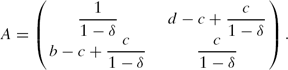
The two strategies in the dilemma-based supergame are TFT and All-D. The values of the supergame payoffs resulting from the combination of these are given by the value of infinite geometrical series, with the discount parameter δ, and shown in the payoff matrix for one agent (b > a > c > d), with the first line showing the payoffs for TFT and the second for All-D:
 \begin{equation*}
A = \left( {\begin{array}{cc}
\displaystyle{\frac{1}{{1 - \delta }}} &\quad \displaystyle{d - c + \frac{c}{{1 - \delta }}} \\
\displaystyle{b - c + \frac{c}{{1 - \delta }}} &\quad \displaystyle{\frac{c}{{1 - \delta }}} \\
\end{array}} \right).\end{equation*}
The condition that has to be fulfilled for a successful transformation of the problem structure into a coordination game is the well-known single-shot condition (Axelrod, Reference Axelrod1984/2006):
 \begin{equation}
\delta > !\ \frac{{b - a}}{{b - c}}.\end{equation}
It is derived from the comparison of the discounted current capital value attainable under the different game plans, specifically the comparison of TFT/TFT and All-D/TFT.
The discount parameter consists of two components, the discount rate (time preference) r and the (subjective) expectation, or (objective, experienced, perceptible) probability, p, that in any interaction, the interaction between the same agents will continue in the SG:
 \begin{equation}
\delta = \frac{p}{{1 + r}}.\end{equation}
 \begin{equation}
\pi _{TFT}^e = \frac{k}{n}\frac{a}{{1 - \delta }} + \frac{{n - k}}{n}\left( {d - c + \frac{c}{{1 - \delta }}} \right)\end{equation}
 \begin{equation}
\pi _{All - D}^e = \frac{k}{n}\left( {b - c + \frac{c}{{1 - \delta }}} \right) + \frac{{n - k}}{n}\frac{c}{{1 - \delta }}.\end{equation}
 \begin{equation}
k^{{\rm crit}} (n) = \frac{{n(c - d)}}{{\frac{{a - c}}{{1 - \delta }} + 2c - b - d}}.\end{equation}
 \begin{equation}
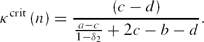
\delta _2 (n) = \frac{p}{{1 + r}} + \frac{{(1 - p)}}{{(1 + r)}}\frac{1}{{n - 1}}.\end{equation}
 \begin{equation}
k^{{\rm crit}} \left( n \right) = \frac{{n(c - d)}}{{\frac{{a - c}}{{1 - \delta _2 }} + 2c - b - d}}.\end{equation}
 \begin{equation}
\kappa ^{{\rm crit}} \left( n \right) = \frac{{(c - d)}}{{\frac{{a - c}}{{1 - \delta _2 }} + 2c - b - d}}.\end{equation}
Finally, allowing for agency mechanisms such as partner selection, the probability of meeting a certain type of agents can be improved above their general prevalence in the population. This will, within limits, improve the results they can achieve beyond the results of random matching. The population payoff functions including a selection parameter with initial cooperative network effects can be given as follows:
 \begin{equation}
\pi _{TFT}^e = \left( {\frac{k}{n}} \right)^\alpha \frac{a}{{1 - \delta _2 }} + \left( {1 - \left( {\frac{k}{n}} \right)^\alpha } \right)\left( {d - c + \frac{c}{{1 - \delta _2 }}} \right)\end{equation}
 \begin{equation}
\pi _{All - D}^e = \left( {\frac{k}{n}} \right)^{\frac{1}{\alpha }} \left( {b - c + \frac{c}{{1 - \delta _2 }}} \right) + \left( {1 - \left( {\frac{k}{n}} \right)^{\frac{1}{\alpha }} } \right)\frac{c}{{1 - \delta _2 }}.\end{equation}