Over the last 40 years, treatment of children with univentricular heart defects has changed considerably. The technique of choice, the Fontan procedure, has evolved from the initial atriopulmonary connection to the total cavopulmonary connection. At present, the total cavopulmonary connection is usually performed as a staged procedure using either the intra-atrial lateral tunnel or the extra-cardiac conduit technique to complete the total cavopulmonary connection. Nowadays, the 10-year-survival after the Fontan completion is more than 90%.Reference d’Udekem, Iyengar and Cochrane 1 , Reference Robbers-Visser, Miedema and Nijveld 2
Fontan patients, however, remain a vulnerable group; therefore, focus on long-term follow-up has shifted from survival to functional parameters such as ventricular performance and exercise capacity. Moreover, in evaluating the success of treatment, health-related quality of life is considered a key outcome.Reference Anderson, Sleeper and Mahony 3
Children with congenital heart disease, specifically those with a Fontan circulation, are at risk for impaired health-related quality of life.Reference Marino, Shera and Wernovsky 4 , Reference Idorn, Jensen and Juul 5 Several studies have assessed associations between objective, functional health status, and health-related quality of life in children with a Fontan circulation.Reference Dulfer, Helbing, Duppen and Utens 6 – Reference McCrindle, Zak and Pemberton 8 Most of these studies, however, have been performed retrospectively. Besides, the authors have not always use standardised assessment of present medical status, or have focused on subjective health status instead of health-related quality of life. These studies found that reduced exercise capacity was associated with a reduced physical health-related quality of life; however, psychosocial domains of health-related quality of life have hardly been studied in Fontan patients treated according to current strategies. Determining the predictive value of functional health status on health-related quality of life is important to be able to identify those children and adolescents who are at risk for an impaired health-related quality of life.
The aim of this study was to determine associations between functional health status – biographical status, medical history, and present medical status – on physical but also on psychosocial domains of health-related quality of life, on both self-reports and parent-reports, in a large cohort of children operated according to current Fontan strategies.
Materials and methods
Inclusion
All consecutive patients, aged 8 years or older, who had undergone completion of the total cavopulmonary connection before the age of 7 years were eligible for this prospective cross-sectional study. The total cavopulmonary connection had an at least two-staged approach according to a current technique – that is, intra-atrial lateral tunnel or extracardiac conduit. Patients had been treated at one of the five participating centres in the Netherlands.
Exclusion
Patients with pacemakers and implantable cardioverter-defibrillators were excluded from the study, as previous studies have shown that the presence of a pacemaker or an implantable cardioverter-defibrillator itself has a large effect on health-related quality of life.Reference Czosek, Bonney and Cassedy 9 Patients with mental retardation, as stated in their medical records, were also excluded from this study.
Assessment procedure
The ethics committee review boards of all five medical centres approved the research protocol. All eligible patients and their parents were approached in a standardised way through a patient information letter. Written informed consent was obtained from all patients and/or their parents. Patients underwent medical and psychological assessment within 1 week. The medical assessment comprised of functional health status measures – that is, cardiac MRI, exercise testing, and rhythm assessment. The psychological assessment comprised a web-based health-related quality of life questionnaire – or pencil-and-paper form when families had no internet access – for patients and one of their parents.
Predictor variables: functional health status
Biographical data and medical history
Biographical data comprised age and gender
The medical records were checked to determine age at Fontan, type of Fontan, ventricular dominance, and number of cardiac surgical procedures. The number of surgical procedures in the course of the staged Fontan was defined as all cardiac operations leading to the total cavopulmonary connection, including the total cavopulmonary connection; the number of operations after Fontan was defined as all cardiac operations after Fontan completion.
Present medical status
MRI
All patients underwent cardiac MRI. Ventricular volumes were imaged using a multi-slice, multi-phase, steady-state free precession sequence. Technical details of the sequences and volume analysis have been reported previously.Reference Robbers-Visser, Jan Ten Harkel and Kapusta 10 , Reference Luijnenburg, Robbers-Visser, Moelker, Vliegen, Mulder and Helbing 11 End-diastolic volume, ejection fraction, and mass/end-diastolic volume ratio were assessed. Ventricular volumes were corrected for body surface area.
Exercise testing
Exercise tests were performed on a bicycle ergometer according to a previously described protocol.Reference Bossers, Helbing and Duppen 12 From these exercise tests, ventilatory efficiency was assessed. To calculate the predicted value, normal values from healthy children were used.Reference Ten Harkel, Takken, Van Osch-Gevers and Helbing 13 Submaximal parameter ventilatory efficiency was chosen over VO2 peak, because it was available for all patients. Particularly in younger children, it can be difficult to achieve maximal exercise levels with reliable VO2 peak values. Moreover, submaximal exercise is more likely to be in line with daily exercise levels of these patients.Reference Bossers, Helbing and Duppen 12 A higher score for ventilator efficiency reflects a poorer exercise performance.
Rhythm assessment
For each patient, a 12-lead ECG was carried out during rest. In addition, patients underwent 24-hour Holter-recording during normal daily activity. From these data, the presence of sinus node dysfunction was determined. Sinus node dysfunction was defined as having one or more of the following symptoms: (1) minimal heart rate >2 SD below the mean value for age and gender, (2) predominant nodal rhythm, (3) sinus pause(s)>3 seconds on Holter recording, and/or (4) (in maximally performed exercise tests) peak heart rate <80% of the predicted value for age and gender.Reference Cohen, Bridges and Gaynor 14 – Reference Epstein, DiMarco and Ellenbogen 18 The presence of sinus node dysfunction was chosen, because in relatively young samples, the prevalence of (tachy-) arrhythmias is low.Reference Robbers-Visser, Miedema and Nijveld 2 , Reference Deal 19 Sinus node dysfunction is relatively common in Fontan patients at medium-term follow-up and can lead to chronotropic incompetence, arrhythmias, and the need for pacemaker therapy at longer follow-up.Reference Cohen, Wernovsky and Vetter 20 , Reference Dilawar, Bradley, Saul, Stroud and Balaji 21
Outcome measure
Health-related quality of life
The TNO/AZL Child health-related quality of life Questionnaire Child Form and Parent Form were used to assess the generic aspects of health-related quality of life.Reference Vogels, Bruil, Koopman, Fekkes and Verrips 22 These questionnaires contained 63 items on the occurrence of functional problems, and if such problems occur the subsequent emotional reactions to these problems. The questionnaire consisted of the following six sub-scales: pain and physical symptoms, motor functioning, cognitive functioning, social functioning (score ranges 0–32), positive emotional functioning, and negative emotional functioning (score ranges 0–16). Higher scores indicate a better health-related quality of life.
Verrips et alReference Verrips, Vogels, den Ouden, Paneth and Verloove-Vanhorick 23 described satisfactory psychometric properties (sub-scale Cronbach’s α ranged from 0.73 to 0.82) of the TNO/AZL Child health-related quality of life Questionnaire. For the Child Form, the normal group consisted of 593 girls and 660 boys (n=1253). For the Form, no normal data were available. Patients and their parents were instructed to complete the questionnaires separately at home.
Statistical analysis
For statistical analysis, only participants with complete data for medical history, present medical status, and self-reported health-related quality of life were included. The comparison of complete cases (n=79) with non-complete cases (n=17) was carried out using Mann–Whitney U tests for age and age at Fontan completion. Pearson’s χ2-tests were used to test differences in distributions of gender, type of Fontan, dominant ventricle, number of operations in the Fontan course, and number of operations after Fontan completion. Comparison with normative data was carried out using Students’ t tests.
To determine the predictive power of functional health status on health-related quality of life, a three-stage strategy was followed for each TACQOL scale. This was carried out separately for the Child Form and for the Parent Form. Multiple linear regression analysis was applied.
In phase 1, each functional health variable was associated with each of the TNO/AZL Child health-related quality of life Questionnaire scales (univariate analysis). When their association was significant (p<0.05), they were entered in a cluster analysis called phase 2: each cluster (i.e. combination) of functional health variables – that is, biographical status, medical history, and present medical status – was associated with each of the TNO/AZL Child health-related quality of life Questionnaire scales. As this second phase served as a selection of candidate functional health variables for the final regression model, p-values were set to p<0.20 (backward elimination procedure). In phase 3, all the functional health variables remaining from phase 2 were forced simultaneously into the final model to test their predictive value of health-related quality of life. Functional health variables that were not significant (p>0.050) in the final model were removed (backward elimination procedure), and then the total explained variance (R2) was calculated. To check multi-collinearity, the variance inflation factor was calculated. For each model, the average of the variance inflation factors of the entered functional health variables was around 1, which is expedient. The linearity assumption was examined by scatter plots, with continuous functional health variables on the x-axis and the TNO/AZL Child health-related quality of life Questionnaire scales on the y-axis. The scatter plots presented no other than linear relationships for continuous variables. Statistics were conducted using SPSS version 21.0.
Results
Baseline characteristics
Participants were recruited and examined between January, 2010 and August, 2012.
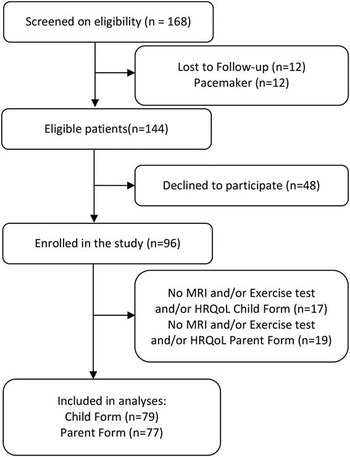
In total, 144 Eligible children were contacted, of whom 96 (67%) finally participated (see Fig 1 for flowchart).
Enrolment in study.

Non-participating patients were comparable with participants in demographic characteristics and medical history – gender, age, and type of Fontan; however, they had a slightly higher age at Fontan completion: median 3.5 (2.7–4.2) versus median 2.9 (2.4–3.6) years, p=0.003.
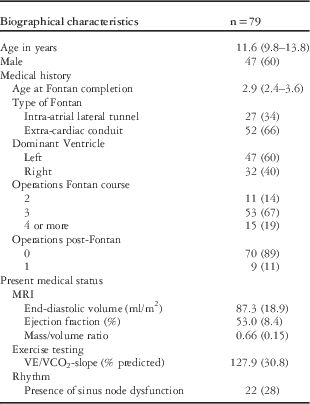
Children with complete data for medical history, present medical status, and self-reported health-related quality of life were included in analyses; therefore, the final sample contained 79 (81%) participants; Table 1 shows demographic characteristics, medical history, and present medical status. As two parents did not fill in the health-related quality of life questionnaire, the sample size for parent-reported health-related quality of life was n=77. No differences were found between children with (n=79) and those without (n=17) complete data regarding demographic characteristics and medical history.
Demographic characteristics and functional health status.

Biographical status and medical history data are presented as number (percentage), only age is presented as median (inter quartile range). Present medical data are presented as mean (SD), only sinus node dysfunction is presented as number (percentage)
Sinus node dysfunction was present in 28% of the patients. These patients had significantly lower resting heart rates compared with those without sinus node dysfunction (59±13 versus 76±15 beats/minute, p<0.001).
Table 2 presents health-related quality of life scores; children themselves reported significantly lower scores for motor functioning and social functioning compared with normative data. For other health-related quality of life scales, scores were comparable with normative data. Overall, parent-reported health-related quality of life scores were comparable with those of their children.
Health-related quality of life child form and parent form.

Data are presented as mean (SD). A higher score indicates a better quality of life
* TNO/AZL Child Quality of Life Questionnaire
** Significant different from normative data; p<0.01
The predictive value of functional health status on health-related quality of life
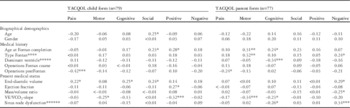
To determine the predictive power of functional health status on health-related quality of life, a three-stage strategy was followed for each health-related quality of life questionnaire scale. Results of the first phase, univariate associations between functional health status and health-related quality of life, are presented in Table 3. Since the second phase, multivariate cluster-analyses served to select the significant functional health variables for the final model; these results are only presented in supplemental Tables S1 and S2.
Associations (β) between functional health status and health-related quality of life; standardised coefficients β.

Cognitive=cognitive functioning; Motor=motor functioning; Negative=Negative emotional functioning; Pain=pain and physical symptom; Positive=positive emotional functioning; Social=social functioning. A higher score indicates a better quality of life
**** 0=Intra-atrial lateral tunnel, 1=Extra-cardiac conduit
***** 0=Left ventricle, 1=right ventricle
****** 0=No, 1=yes
*p<0.05, **p<0.01, ***p<0.005
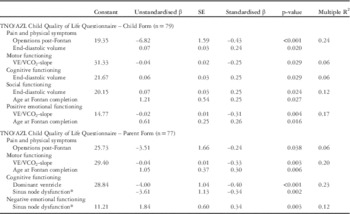
Phase 3: final prediction model of health-related quality of life (see Table 4)
Self-reported health-related quality of life
More operations after Fontan completion and smaller end-diastolic volume significantly predicted more self-reported pain and physical symptoms, explaining 24% of its variance. A lower score for ventilatory efficiency, indicating better exercise performance, significantly predicted better motor functioning.
Final model results of significant functional health status predictors of health-related quality of life.

* 0=No, 1=yes
Both smaller end-diastolic volume and lower age at Fontan completion significantly predicted worse self-reported social functioning, explaining 12% of its variance. Lower score for ventilatory efficiency and higher age at Fontan completion significantly predicted better self-reported positive emotional functioning, explaining 17% of its variance. Finally, smaller end-diastolic volume also significantly predicted worse self-reported cognitive functioning.
Parent-reported health-related quality of life
More operations after Fontan completion significantly predicted lower scores for parent-reported pain and physical symptoms. Both a lower (better) score for ventilatory efficiency and a higher age at Fontan completion significantly predicted higher scores for parent-reported motor functioning, explaining 20% of its variance.
The presence of sinus node dysfunction significantly predicted lower parent-reported scores for negative emotional functioning in the child. Furthermore, both the presence of a dominant right ventricle and the presence of sinus node dysfunction significantly predicted lower parent-reported cognitive-functioning; explaining 23% of its variance.
Discussion
The aim of this study was to investigate the predictive value of functional health status – biographical status, medical history, and present medical status – on self-reported and parent-reported health-related quality of life. Furthermore, we identified those variables that contributed most to the explained variance of health-related quality of life. Medical history and present medical status not only predict outcomes on physical health-related quality of life but also on psychosocial health-related quality of life, such as social functioning, positive and negative emotional functioning, and subjective cognitive functioning.
Psychosocial health-related quality of life
Remarkably, and in contrast with previous studies, several functional health status variables in our study predicted psychosocial health-related quality of life scales: social functioning, positive emotional functioning, and negative emotional functioning. Children reported better social functioning and positive emotional functioning when their age at the Fontan completion was higher. An explanation may be that children had better coping mechanisms with Fontan completion at higher age. To our knowledge, we are the first to describe this finding. At present, the standard practice is to perform the completion of the total cavopulmonary connection as early as possible, around the age of 2 years. These results indicate that this possibly influences emotional functioning; however, the Fontan completion is only the final step in a series of multiple operations. The first operation is often performed within the first few months of life.Reference Khairy, Fernandes and Mayer 24 The observed relationship should, therefore, be interpreted with caution.
The predictive value of smaller end-diastolic volume on worse social functioning is hard to explain. In this study, we observed a wide range of end-diastolic volumes in our patients, confirming observations in other studies.Reference Anderson, Sleeper and Mahony 3 , Reference Robbers-Visser, Jan Ten Harkel and Kapusta 10 A smaller end-diastolic volume might represent a worse diastolic ventricular filling in the preload-dependent Fontan circulation, which might contribute to worse overall ventricular performance, resulting in worse social functioning. On the other hand, a larger end-diastolic volume could also indicate inadequate ventricular dilatation, which is unlikely to contribute to improved ventricular performance. In a recent study, we did not find a relation between exercise capacity – as a marker of overall ventricular performance – and end-diastolic volume. Exercise capacity did, however, correlate with end-systolic volume and ejection fraction.Reference Bossers, Helbing and Duppen 12 In a study of 511 Fontan patients with mixed surgical strategies, MRI-derived ventricular measurements (available for 155 patients) were not associated with parent-reported psychosocial health status. When corrected for age at Fontan completion, McCrindle et al found a weak negative correlation between worse psychosocial health status and smaller end-diastolic volumes, but only in those operated on at an age below 2 years or over 4 years.Reference McCrindle, Zak and Sleeper 25
In our study, parents reported less negative emotions in their child when the child had sinus node dysfunction. This is surprising, as parents are not necessarily aware of the presence of sinus node dysfunction in their child. As sinus node dysfunction and a lower heart rate are highly associated, it is possible that the positive effect of sinus node dysfunction on parent-reported negative emotional function is actually an effect of lower heart rate. Possibly, the lower heart rate in children with sinus node dysfunction contributes to less arousal.Reference Appelhans and Luecken 26 Consequently, the parent may experience less negative emotions in their child. Most patients with sinus node dysfunction did not have clinical symptoms; however, close rhythm surveillance remains important, as sinus node dysfunction could become symptomatic over time and lead to rhythm disturbances requiring intervention.Reference Deal 19 In a study among adult Fontan survivors, Van den Bosch et al have shown that arrhythmias were present in the majority of patients, who had significantly reduced quality of life.Reference van den Bosch, Roos-Hesselink, Van Domburg, Bogers, Simoons and Meijboom 27 Other studies have also shown high incidence of arrhythmias in older Fontan patients.Reference Deal 19 , Reference Khairy, Poirier and Mercier 28 Although the incidence of arrhythmia is relatively low in young Fontan patients, McCrindle et al showed that the presence of arrhythmias was associated with reduced scores for physical quality of life. This emphasises the need for adequate rhythm surveillance in this population.Reference McCrindle, Williams and Mitchell 29
The discrepancy between our finding that functional health status predicted psychosocial health-related quality of life and the lack of predictive value in previous studies could be explained by the differences in the definition of health-related quality of life and the subsequent assessment instruments. Health-related quality of life is an ambiguous concept and consensus about its definition is lacking.Reference Moons, Van Deyk, Budts and De Geest 30 Most of the previous studies assessed health status, instead of health-related quality of life, with the Child Health Questionnaire, a generic instrument. Some studies have assessed health-related quality of life with a disease-specific instrument,Reference McCrindle, Zak and Pemberton 8 , Reference McCrindle, Williams and Mital 31 the Congenital Heart Adolescent and Teenage questionnaire. Both these questionnaires focus on symptoms per se, whereas a surplus value of the TNO/AZL Child health-related quality of life Questionnaire is that it takes not only into account symptoms but also the subjective evaluation of these symptoms. This may explain the associations between psychosocial health-related quality of life and functional health variables that we found. Children may not report complaints when questioned about generic symptoms; however, when questioned about their subjective evaluation of these symptoms, they may be more conscious regarding their subjective feelings of limitations. Furthermore, we assessed multi-informant health-related quality of life (self-reports and parent-reports), whereas most of the previous studies only assessed one informant.
In addition, the discrepancy could also be explained by differences in patient selection between our study and other studies. Although we only included patients with a staged total cavopulmonary connection, other studies included older Fontan types, such as the atriopulmonary connection, as well.Reference Idorn, Jensen and Juul 5 , Reference McCrindle, Zak and Sleeper 25 We included children aged between 8 and 15 only, which allowed us to use one single instrument to assess health-related quality of life.
Subjective cognitive functioning
Children with complex congenital heart disease are at risk for neurocognitive anomalies: lower intelligence quotient, more attention problems, and executive functioning problems.Reference Snookes, Gunn and Eldridge 32 , Reference Marino, Lipkin and Newburger 33 In our study, a smaller end-diastolic volume significantly predicted worse self-reported cognitive functioning, a subscale of health-related quality of life.
As discussed previously, the predictive value of end-diastolic volume is difficult to interpret in this population. Other MRI-derived ventricular parameters we assessed, ejection fraction and mass/volume ratio, were relatively well preserved in this population and did not predict self-reported cognitive functioning.
Parents reported lower scores for cognitive functioning in children with sinus node dysfunction. No data exist on this subject; therefore, we can only speculate on this association. Cardiac output is highly heart rate-dependent in the Fontan circulation. Whether the lower heart rate in patients with sinus node dysfunction results in a lower cardiac output and, as a result, lower cerebral perfusion is unknown. Very little data exist on cerebral perfusion long-term after the operation in Fontan patients. In a recent study, carotid artery flow dynamics were assessed in 34 Fontan patients, comparable with our sample. That study suggested that cerebral perfusion is impaired in Fontan patients.Reference Saiki, Kurishima, Masutani and Senzaki 34 Further studies with direct measurements of cerebral blood flow, including the effects of heart rate are needed. Furthermore, a lower heart rate in Fontan patients is not necessarily a sign of decreased cardiac functioning.Reference Blaufox, Sleeper and Bradley 35 Parents also reported a lower cognitive functioning in children with right dominant ventricles. This is possibly explained by the fact that since the birth of a child with a dominant right ventricle, parents were informed that the child had a worse future prospective than children with a left dominant ventricle. Therefore, these parents may consider their child less capable to develop cognitive functioning. The relationship between cardiac morphology, or ventricular dominance, and objectively measured cognitive functioning has hardly been studied. Sugimoto et al did not find an association between ventricular dominance and intelligence quotient, whereas Sarajuuri et al showed that especially patients with a hypoplastic left heart syndrome were at risk for neurodevelopmental deficits.Reference Sarajuuri, Jokinen and Mildh 36 , Reference Sugimoto, Ota and Ibuki 37 In an older, small cohort, Goldberg et al showed that, although neurodevelopmental scores were significantly lower for hypoplastic left heart syndrome patients compared with non-hypoplastic left heart syndrome patients, scores for all Fontan patients were within the normal range.Reference Goldberg, Schwartz and Brunberg 38 In a study among 158 Fontan patients, Idorn et al demonstrated impaired quality of life and cognitive speed compared with healthy controls. They did not find a difference in quality of life and cognitive speed between patients with hypoplastic left heart syndrome and those without.Reference Idorn, Jensen and Juul 5
Physical health-related quality of life
Several variables from medical history and present medical status domains significantly predict physical health-related quality of life: pain and physical symptoms and motor functioning. This is in line with previous studies that also found associations between parent-reported health status and exercise capacityReference McCrindle, Zak and Sleeper 25 , Reference McCrindle, Williams and Mital 31 , Reference Blaufox, Sleeper and Bradley 39 – Reference Jenkins, Chinnock and Jenkins 41 and MRI measures.Reference McCrindle, Zak and Sleeper 25
In a study among children and adolescents with various congenital heart defects, Hager et al found significant correlations between maximum oxygen uptake and physical functioning and general heath perception, but not with other subscales of quality of life.Reference Hager and Hess 42
McCrindle et al found a weak association between functional health status and exercise capacity. Of 390 patients, 157 reached maximal effort. For that reason, we chose a sub-maximal exercise parameter to assess exercise capacity.Reference McCrindle, Zak and Sleeper 25 In the study of McCrindle et al, MRI parameters, end-sytolic volume, and mass/volume ratio were weakly associated with physical health status. We found that end-diastolic volume significantly predicted self-reported pain and physical symptoms. As stated earlier, in a recent study, we found that end-systolic volume and ejection fraction were significant predictors for exercise capacity as assessed by peak oxygen uptake.Reference Bossers, Helbing and Duppen 12
Recommendations for future research
As discussed, the influence of end-diastolic volume on subjective cognitive functioning, but also on social and emotional functioning, is difficult to explain. Further research is necessary to identify mechanisms behind the influence of medical parameters on health-related quality of life.
Earlier studies in cohorts of Fontan patients, operated mainly according to older techniques, described failure of the Fontan circulation in patients around their third decade of life. It is, therefore, crucial to conduct longer follow-up and to repeat our study at longer follow-up.
Strengths and limitations
As to strengths, the percentage of complete cases on medical history, present medical status, and health-related quality of life was high in this large multi-centre prospective study with a heterogeneous group of patients operated upon according to contemporary strategies. Second, we assessed multi-informant health-related quality of life as the presence of symptoms, together with the subjective evaluations of these symptoms. Third, only single functional health predictor variables, instead of large clusters of variables, were used in the analyses to explain variance in health-related quality of life.
As to limitations, because not all patients agreed to participate in the present study, the results of our study may be influenced by selection bias.
Clinical implications
As functional health status predicted both physical and psychosocial health-related quality of life in children with total cavopulmonary connection, we recommend screening for health-related quality of life problems during outpatient consultations, especially in children after total cavopulmonary connection with medical status. Fontan patients with impaired health-related quality of life might benefit from further psychological screening and psychosocial interventions to improve health-related quality of life.Reference Marino, Lipkin and Newburger 33
Conclusions
Health-related quality of life is impaired in the present cohort of Fontan patients. Medical history and present medical status significantly predicted physical health-related quality of life, but also psychosocial health-related quality of life in children with total cavopulmonary connection. The knowledge of risk factors may help in identifying patients at increased risk for impaired health-related quality of life. For clinical practice, it is recommended not only to assess impairments in functional health status but also to screen for impairments in health-related quality of life.
Acknowledgements
The authors thank the children and their parents for their participation in this study.
Financial Support
This work was supported by the Stichting Rotterdams Kinderrevalidatie Fonds Adriaanstichting and the Dutch Heart Foundation (grant 2008T037).
Conflicts of Interest
None.
Supplementary material
To view supplementary material for this article, please visit http://dx.doi.org/10.1017/S1047951115000426