Introduction
The social and symbolic aspects of food, in addition to its contribution to subsistence and diet, are currently among the major themes in archaeological research. Archaeologists have become keenly aware of the potential of botanical remains to illuminate these issues, and there is a rich literature on food and foodways in archaeobotany (Hastorf Reference Hastorf, Gero and Conkey1991, Reference Hastorf1999; Gumerman Reference Gumerman1997; Gosden & Hather Reference Gosden and Hather1999; Palmer & van der Veen Reference Palmer and van der Veen2002). These studies highlight the fact that food is more than just a source of nutrition, and should be considered a symbolic product whose preparation, distribution and consumption are socially determined. Researchers have argued whether early domesticated plants should be seen as luxury or staple foods, and have highlighted the social contexts within which these foods were shared (Hayden Reference Hayden1990, Reference Hayden2003; van der Veen Reference van der Veen2003; Jones Reference Jones2007). Food often enters the social arena as a means to enhance communal solidarity, while also maintaining social differentiation and distinguishing individuals and groups from one another. This debate extends to include the social meanings of rice, a crop that is regarded as highly important both economically and symbolically in Asian countries (Lee Reference Lee1991; Ohnuki-Tierney Reference Ohnuki-Tierney1993, Reference Ohnuki-Tierney and Dissanayake1996; Hayden Reference Hayden, Barker and Janowski2011).
Although rice is the staple food in contemporary Korea, many researchers doubt that this crop was quantitatively the most important cereal in the past. Rather, it has been argued that the total rice production was insufficient to feed the entire society and that rice constituted a luxury food that was available only to a subset of the population (J.-J Lee Reference Lee2011). Incipient plant cultivation started during the Neolithic period (c. 8000–1500 BC), but it is not until the Bronze Age (c. 1500–300 BC) that archaeological evidence reveals agricultural villages and emergent social hierarchy. Evidence for the latter includes dolmens, which are presented as burial sites for the elites, as well as bronze artefacts, which are thought to have been the prestige goods of emergent social leaders. In this social climate, it is often assumed that rice also symbolised social status and that its consumption was limited to the upper class of society.
The assumption that relates rice to status is primarily based on the historical circumstance that rice functioned as a hard currency throughout Korean history and that, for those towards the bottom of the social hierarchy, rice was used as money to buy other food rather than eaten. Historical texts suggest that rice was regarded as the food for noblemen during the Unified-Three-Kingdoms period (AD 668–935) (Lee Reference Lee2008). Rice was an important item in the tributary tax system of the ancient and medieval states, and a rice payment law (Daedong-beop) was first enacted in 1608 and enforced countrywide by 1708 when the collection of all state taxes in the form of rice was mandated (Kee & Kim Reference Kee and Kim2009). Towards the end of the Joseon period (AD 1392–1910), the tax and surcharges levied by the state became a heavy burden for commoners and rice increasingly moved beyond the reach of many, including the very farmers who produced it (Eckert et al. Reference Eckert, Lee, Lew, Robinson and Wagner1990; Kee & Kim Reference Kee and Kim2009). Rice was constantly in low supply, even during most of the twentieth century, until a high-yield hybrid variety was developed and disseminated in the early 1970s (Lee Reference Lee1991; Lee Reference Lee2009). Many researchers argue that the indulgent consumption of rice in contemporary Korea is a recent tradition and that the rice diet had been limited to the elite members of the society since the beginning of rice cultivation.
Historical and ethnographical research, however, readily indicates that rice is a food for sharing and commensality, as much as a symbol of wealth and power (Lee Reference Lee1991). Rice is not indigenous to the Korean peninsula and was introduced from southern China around 1500 BC (Ahn Reference Ahn2010). In temperate and seasonal climates such as that of Korea, cooperative efforts are required for rice cultivation—to prepare wet paddy fields, to secure a water supply and to transplant and harvest it. This renders rice a group-oriented rather than an individual-oriented crop (Bray Reference Bray1986; Henrich Reference Henrich2014; Talhelm et al. Reference Talhelm, Zhang, Oishi, Shimin, Duan, Lan and Kitayama2014). Rice is the single most important food in the commensal activities that consolidate ancestor/descendant, host/guest and employer/employee relationships, and it is constantly shared among community members at rituals and feasts (Kim Reference Kim2009). The social meanings of rice that can be gleaned from historical and ethnographic texts have two contrasting facets: rice symbolises status by exhibiting the wealth and power of the people who consume it, while it is a shared meal that reinforces an intimate social relationship and creates a sense of communality.
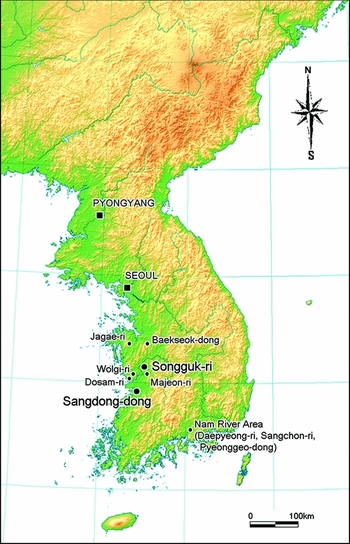
Material evidence for the social implications of rice in prehistory can be explored through the archaeobotanical investigations undertaken at Sangdong-dong andSongguk-ri, two Bronze Age sites in the south-west part of the Korean peninsula (Figure 1). The archaeological literature is replete with examples of hierarchically organised social groups that are reflected in differential food distribution (Gumerman Reference Gumerman1997; Palmer & van der Veen Reference Palmer and van der Veen2002). There is evidence for emergent social complexity in Korea during the Bronze Age, and the social meanings of rice would have influenced the storage, serving and disposal of this crop within each site as well as across multiple sites. Rice as a symbol of status would imply a degree of exclusion and hence limited access, thus generating a discrete spatial distribution, whereas rice as a communal and shared food would afford the opposite pattern. This study further contextualises the observations from these two sites within the body of evidence from other archaeological sites across the region and sheds light on the role of prehistoric rice in maintaining social relationships.
Location of Sangdong-dong, Songguk-ri and other sites mentioned in the text.

Materials and methods
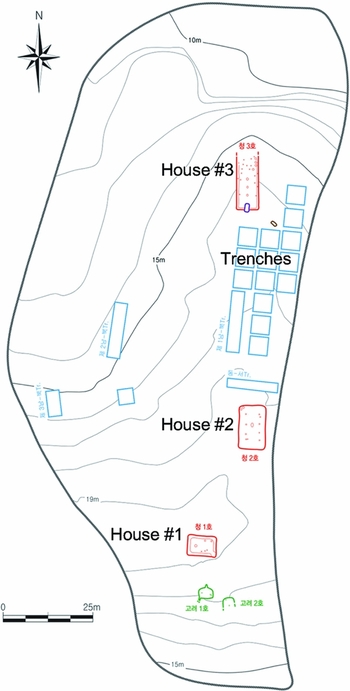
Sangdong-dong is situated on a low hill, at an altitude of 19m, overlooking a plain that currently hosts agricultural villages and fields. The excavation conducted in 2010–2011 by crews from the Jeolla Research Institute of Cultural Heritage unearthed three semi-subterranean Bronze Age houses, indicating a small farming community. The houses had been destroyed by fire, leading to good preservation of carbonised organic remains. The total excavated area measures 13 828m2, within which the houses are widely scattered (Figure 2). Radiocarbon dates and the stylistic characteristics of the associated pottery nonetheless suggest that they were occupied contemporaneously around c. 1000 BC (Kim et al. Reference Kim, Ko, Cha and Ju2013a).
Bronze Age houses of Sangdong-dong; all houses were subject to sampling and flotation.

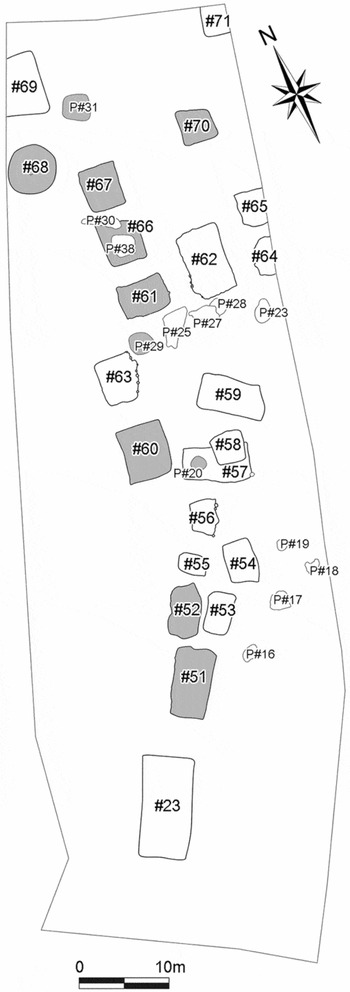
The second site, Songguk-ri, is one of the largest Bronze Age settlements in the region with an area of more than 5km2. It was first excavated in 1974 and 14 field campaignswere conducted over the period of 1974–2013, uncovering a total area of approximately 0.2km2. These excavations led to the discovery of 100 semi-subterranean houses situated on a hilltop at an altitude of c. 40m and fortified with wooden palisades (Son Reference Son2007; Kim Reference Kim2014). Songguk-ri is often interpreted as a central settlement occupied by a political and religious leader who controlled smaller satellite villages scattered around the region (Kim Reference Kim2014). Many of the houses had been destroyed by fire and hence were rich in carbonised remains. The houses are dated to around 850–550 BC by radiocarbon dating and the associated artefacts (Son Reference Son2007). Botanical remains from the site have been reported on multiple occasions, but the early reports, especially those of 1975–1978, were based on isolated discoveries (Kim Reference Kim2014). The current discussion focuses on the botanical remains from the fourteenth season (Kim et al. Reference Kim, Ryu and Kim2013b), which were collected through systematic sampling and flotation conducted by the author in collaboration with excavation crews from the Korean National University of Cultural Heritage.The Bronze Age components at both sites consist primarily of the remains of semi-subterranean rectangular houses sunk 0.1–0.4m into the ground (Figures 2 & 3). The soil samples for archaeobotanical analysis were collected from these houses and from associated pits. To minimise the inclusion of intrusive materials, samples were collected from the basal level of each structure, usually up to 50mm above the floor. Soil volumes ranged from 5–134l per sampled feature. Carbonised organic materials were separated from the soil matrix by bucket flotation and sieved through 4, 2, 1 and 0.5mm meshes. The materials recovered were then air-dried and identified using a Leica S8APO stereoscopic microscope. Identification was aided by archaeobotanical texts (Liu et al. Reference Liu, Jin and Kong2008; Obata Reference Obata and Obata2008; Zhao Reference Zhao2010), seed atlases (Nakayama et al. Reference Nakayama, Inokuchi and Minamitani2004; Lee et al. Reference Lee, Kim, Lee, Park, Ali, Kim, Lee and Kim2009) and comparative modern specimens.
Bronze Age houses and pits of the Songguk-ri 14th excavation; the shading indicates the features subject to sampling and flotation; P = pit.

Results
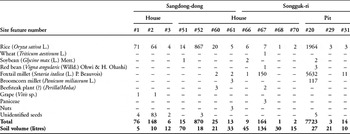
The archaeobotanical data sets from Sangdong-dong and Songguk-ri are summarised in Table 1. At Sangdong-dong the flotation samples produced 230 carbonised seeds, averaging8.5 seeds per litre of soil. Only two taxa were discovered despite comprehensive flotation: rice (Oryza sativa L.) and wild grape (Vitis sp.). The assemblage contained a few other seeds that were unidentifiable and are presumed to have originated from wild or weed plants (Kim & Jeong Reference Kim, Jeong, Kim, Ko, Cha and Ju2013). The Songguk-ri assemblages were more abundant and diverse, producing 20.9 carbonised seeds per litre of soil and representing nine genera in total. As well as rice, the cultigens included wheat (Triticum aestivum L.), soybean (Glycine max (L.) Merr.), red bean (Vigna angularis (Willd.) Ohwi & H. Ohashi), foxtail millet (Setaria italica (L.) P. Beauvois) and broomcorn millet (Panicum miliaceum L.). Most cultigens at Songguk-ri were identifiable to genus level or below, despite some fragmentation and deformation after carbonisation. An exception was the seeds presumed to be from the beefsteak plant, which morphologically resemble those of Perilla frutescens var. japonica but which were smaller than their cultivated counterparts (Kim et al. Reference Kim, Ryu and Kim2013b).The seed assemblages from these two sites by no means represent the full spectrum of edible plants utilised during the Bronze Age. Previous archaeobotanical research in Korea has revealed the presence of a wide range of cultivated plants during this period that included, in addition to the above, barley (Hordeum vulgare L.), peach (Prunus persica (L.) Stokes), bottle gourd (Lagenaria siceraria (Molina) Standl.), melon (Cucumis sp.), potentially hemp (Cannabis sativa L.) and some species from the mustard family (Brassicaceae) (Crawford & Lee Reference Crawford and Lee2003; Ahn Reference Ahn2008). The cultigens were presumably used in addition to a much wider range of wild plants that had a long history of use since the Neolithic (Lee Reference Lee2011a). The recovered remains were, on the other hand, heavily biased towards cultigens at the expense of wild plants. The taxonomic diversity in the taxa represented could have been influenced by the amount of soil processed: a greater diversity of seeds would be expected if more soil had been subject to flotation. Many wild plants of the region were gathered for their leaves, young shoots and fleshy fruit, and it is equally possible that they simply did not survive due to conditions of preservation.
Recovered seed remains from Sangdong-dong and Songguk-ri.

At Sangdong-dong, rice was ubiquitous and found in all three houses. At Songguk-ri, rice was present in all houses and pits that produced any identifiable botanical remains (Table 1). The distribution pattern of rice at Songguk-ri makes an interesting contrast with that of millets, which tend to be found concentrated in certain features. Pit 20 contained considerable amounts of rice, foxtail millet and broomcorn millet, as well as the remains of pottery vessels, arrowheads, whetstone and jade ornaments, supporting the conclusion that this structure was used for the storage of household items (Kim et al. Reference Kim, Kim and Ryu2012). Although foxtail millet remains outnumbered those of rice in the Songguk-ri assemblage as a whole, they were concentrated heavily in Pit 20, whereas rice was commonly encountered across the sampled structures.
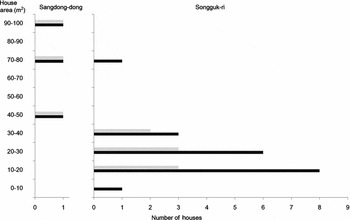
Finally, the distribution of rice did not necessarily correlate with house size (Figure 4). It is often assumed that Bronze Age house sizes reflect the number of household members and/or the social status of the dwellers: the larger the house, the more household members or the higher their social status, or both. At Sangdong-dong, rice was found in all three houses despite their size differences. The smallest house (number 55) at Songguk-ri indeed lacked rice, but the largest one (number 23) also failed to produce any evidence for rice. The absence of rice in these structures appears to be related more to preservation conditions than to house size. The current data sets therefore do not conform to the expectation that rice remains would be observed more frequently or exclusively in large houses and so reflect emergent social hierarchy and the status-related consumption of rice.
House sizes measured by area and the occurrence of carbonised rice; the black bars show the number of houses in each size category and the grey bars indicate the number of houses with carbonised rice in each size category.

Discussion
Comparative Perspectives
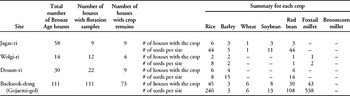
Four Bronze Age sites within 80km of Songguk-ri—Jagae-ri, Wolgi-ri, Dosam-ri and Baekseok-dong (Figure 1)—had previously produced macro-botanical seed assemblages suitable for comparative assessment (Kim et al. Reference Kim, Ryu and Kim2013b). The plants recovered from these sites are narrow in taxonomic range and, as at Sangdong-dong and Songguk-ri, do not represent the full spectrum of utilised species (Table 2). All assemblages contain only cultigens, but their relative abundance varies considerably between the sites, presumably on account of cultural and environmental factors unique to each site, as well as differences in preservation conditions and recovery methods.
Carbonised seed analyses at Jagae-ri, Wolgi-ri, Dosam-ri and Baekseok-dong.

Comparison shows, nonetheless, that rice is the most ubiquitous taxon in each case, although not necessarily the most abundant. Baekseok-dong is particularly interesting because the pattern resembles that of Songguk-ri. All 111 Bronze Age houses were subject to soil sampling and flotation (Oh et al. Reference Oh, Lee, Bae, Ahn and Choi2009); of these, 45 contained the carbonised remains of rice. Foxtail millet was present in 43 houses and was the most abundant taxon in the sheer number of grains. Barley, wheat and soybean were found in 3, 6 and 8 houses respectively. Rice was the most ubiquitous crop in Jagae-ri, Wolgi-ri and Dosam-ri, although fewer houses were sampled in these sites and fewer crop remains were thus found. The pattern of rice observed in Sangdong-dong and Songguk-ri is repeated. The sites may be categorised into different size groups based on the number of discovered houses, i.e. few (<10 houses: Sangdong-dong), medium (10–50 houses: Wolgi-ri and Dosam-ri), and numerous (>50 houses: Jagae-ri, Baekseok-dong and Songguk-ri). Rice appears to have been consumed at all sites regardless of their size. Farther afield, flotation at multiple Bronze Age sites in the Nam River area, including Daepyeong-ri, Sangchon-ri and Pyeonggeo-dong (Figure 1), also indicates that rice is present in all sites under investigation, although it is often outnumbered by other crops such as foxtail and broomcorn millets (Crawford & Lee Reference Crawford and Lee2003; Lee Reference Lee2003, Reference Lee2011b, Reference Lee2012).
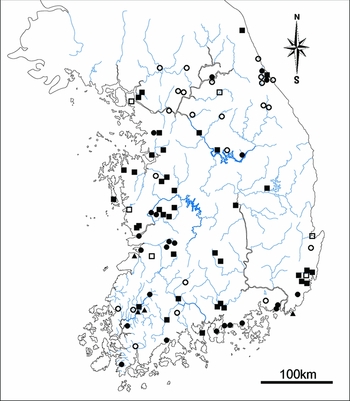
Sangdong-dong and Songguk-ri may be situated within the wider geographical and temporal context of the southern Korean peninsula from 1500 BC to AD 300 (Figure 5). Ninety-four archaeological sites in South Korea have yielded kernel remains of crops (e.g. wheat, barley, millets, legumes and rice) over this time span: 44 for the Bronze Age (c. 1500–300 BC), 4 for the Early Iron Age (c. 300–1 BC) and 46 for the Proto-Three-Kingdoms (c. AD 1–300) (National Museum of Korea 2006; Ahn Reference Ahn2008; Jeong Reference Jeong2010a). The data from these sites are of irregular quality and are difficult to compare quantitatively because many different collection strategies have been implemented and have not necessarily been systematic. Nonetheless, qualitative analysis (i.e. the presence or absence of rice at each site) provides important information. Among the 44 Bronze Age sites with macro-botanical remains, 38 (86.4%) contained at least one grain of rice. Rice was present in all four Early Iron Age sites with crop remains of any kind. These high occurrence rates of rice declined significantly in the Proto-Three-Kingdoms period when rice was found at only 23 of the 46 sites. In other words, rice was frequently encountered in the Bronze and Early Iron Age sites, and present in 87.5% of sites, falling to only 50% at Proto-Three-Kingdoms sites (Figure 5).
The occurrence of rice and crop grains across the southern part of the Korean peninsula; ■/□ Bronze Age site with/without rice; ▲/△ Early Iron site with/without rice; ●/○ Proto-Three-Kingdoms site with/without rice; the dominance of solid squares (■) in the Bronze Age and the increasing abundance of hollow circles (○) in the Proto Three Kingdoms period suggest changes in the social meanings of rice in the later period. See supplementary material for the site names and references.

The general impression from Sangdong-dong, Songguk-ri and the four additional Bronze Age sites is that rice consumption was not restricted to particular households in each community. Nor was rice consumption restricted to particular communities, as rice is frequently encountered at Bronze and Early Iron Age sites. Yet this probably was not the case in the Proto-Three-Kingdoms period. Rice of the latter period is distributed patchily in a relatively small number of sites, suggesting that it disappeared from the consumption of many agrarian communities, or decreased in quantity.
The restricted rice distribution of the Proto-Three-Kingdoms period is not unprecedented in East Asia. Lee and Bestel (Reference Lee and Bestel2007: 49), for example, showed that rice was restricted to the major centres of the Chinese Erlitou period (c. 1900–1500 BC) and argued that rice was thus likely to have been a “prestige crop and status symbol” (Lee & Bestel Reference Lee and Bestel2007: 49). The distribution of rice at the Korean Bronze Age sites is different from that at sites of the Proto-Three-Kingdoms period and at the Erlitou sites. Contrary to the expectations derived from the hypothesis that rice symbolised elite status and would have been consumed only by a fraction of the population, rice is the most ubiquitous crop within and across Bronze Age sites in Korea.
Rice as luxury food
The period c. 300 BC–AD 300 in Korea witnessed dramatic changes in politics, economy and technology. A key event was the establishment of the Lelang commandery by the Chinese Han dynasty in 108 BC. Although territory controlled by Lelang was limited to the northern Korean peninsula with its capital located in modern-day Pyongyang (Figure 1), it exerted far-flung cultural and political influence over the entire peninsula, either directly or indirectly. In the south, confederacies of statelets appeared during the first century BC and eventually developed into kingdoms (Eckert et al. Reference Eckert, Lee, Lew, Robinson and Wagner1990). Agriculture also underwent drastic changes with the introduction of sophisticated iron tools such as the hoe, plough and shovel, as well as cattle and horse as draught animals (Kim Reference Kim and Ahn2012; Lee Reference Lee and Ahn2012). These changes are not only documented in historical texts but also reflected in the archaeological remains of metallic objects and stoneware, and in tombs. Rice becomes less frequently encountered in archaeological contexts as prehistoric communities were being rapidly consolidated into state-level societies.
Several Korean researchers have argued that the Korean peninsula experienced climatic deterioration c. AD 1–300 to become cooler and drier (Seo Reference Seo2000; Ahn Reference Ahn2006; Jeong Reference Jeong2010b; Lee Reference Lee2010). The arguments for the hypothetical climatic deterioration are in essence grounded on Samguk Sagi, a historical text compiled in AD 1145 that mentions anomalous weather events in 57 BC–AD 935 (Yoon & Hwang Reference Yoon and Hwang2009). It is reasonable to speculate that such a cooler and drier climatic trend, if it indeed occurred, would have hindered rice growing and may have contributed to the paucity of rice remains at archaeological sites. More data are, however, needed to support such a conclusion. Palaeoenvironmental studies in China and Japan have postulated a mild climate similar to the ‘Roman Warm Period’ in Europe during the first three centuries AD (Yang et al. Reference Yang, Braeuning, Johnson and Yafeng2002; Liu et al. Reference Liu, Henderson and Huang2006; Kitamura et al. Reference Kitamura, Yamamoto, Kase, Ohashi, Hiramoto, Fukusawa, Watanabe, Irino, Kojitani, Shimamura and Kawakami2007), but it is not clear whether the Korean peninsula followed a similar climatic trend.
Alternatively, the restricted rice distribution may have resulted from a centralised control of rice. The movement of rice outside its production loci in the form of tribute or tax and the subsequent massive storage by centralised authorities could have contributed to the patchy distribution of rice across the landscape. Centralised accumulation of rice is very likely given the burgeoning of state-level societies around AD 1–300. As rural communities were consolidated into states, tensions would have arisen between subject communities and central government over the control of agricultural produce. Control over rice may have been transferred to centralised management. This scenario is plausible because rice was the major tax item during the Three-Kingdoms period. Large-scale rice storage typically requires above-ground structures, often on a raised platform to protect it from moisture and rodents (Grist Reference Grist1975). Facilities of this kind generally leave no archaeological trace other than postholes, hindering archaeobotanical recovery of rice remains. In other words, the disappearance of rice in the later period may not represent reduced production but changes in the modes of storage and management.
Whether environmentally or socially induced, rice became less visible in archaeological contexts and presumably less available to commoners during the Proto-Three-Kingdoms period. Its social status appears to have been elevated more towards ‘luxury’ food as this crop became less widely available and increasingly possessed by fewer people, while remaining potentially desired by many (cf. van der Veen Reference van der Veen2003). The ubiquitous distribution of rice at Bronze Age sites, on the other hand, suggests that its social meanings in that era were radically different. Although resource and labour mobilisation by centralised leadership must have been practised during the Bronze Age, the level of exploitation does not appear to have been high and rice seems to have been distributed and consumed equally among households. Overall, the distribution of rice in the Korean Bronze Age is representative more of equality and inclusion than of differentiation and exclusion.
Rice as a communal crop
The prevalence of rice at Sangdong-dong, Songguk-ri and other Bronze Age sites is best understood within a communal and collaborative agricultural context. Some have suggested that rice was cultivated in dry fields during the Early Bronze Age on the assumption that only simple techniques were involved in this method. Yet dry-rice cultivation is now believed to have been a late introduction to Korea, and prehistoric cultivation was probably confined to wet rice paddies (Ahn Reference Ahn2010). Labour-intensive and cooperative efforts are required to maximise rice production. The need for cooperation is intermittent but seasonally intensive: collaborative labour is particularly crucial for the preparation of fields, the maintenance of irrigation systems, the transplanting of seedlings and harvesting (Bray Reference Bray1986; Henrich Reference Henrich2014; Talhelm et al. Reference Talhelm, Zhang, Oishi, Shimin, Duan, Lan and Kitayama2014). Wong (Reference Wong1971) argued that the amount of land a rice-farming family could work is limited by the amount of labour that could be managed during the busiest farming seasons. In rice-growing traditions, family labour has been supplemented most frequently through labour exchange and less frequently through labour hire and labour-saving equipment (Bray Reference Bray1986). Labour-exchange systems are commonly found in the traditional rice-growing communities of East Asian countries, including Korea (Reed Reference Reed and Wong1979).
The most widespread form of cooperation concerns irrigation systems (Talhelm et al. Reference Talhelm, Zhang, Oishi, Shimin, Duan, Lan and Kitayama2014). Rice paddies are typically made up of sophisticated structures such as flat levelled-fields, bunds, waterways and drainage systems: the construction and management of which tend to lie beyond the abilities of individual households. Bronze Age rice paddies associated with such structures have been found in Majeon-ri, 25km south of Songguk-ri, dated to 800–600 BC (Lee et al. Reference Lee, Park and Lee2004) (Figure 6). Archaeological evidence of wet paddy systems is not common and rice fields have not been found at Sangdong-dong or Songguk-ri, but the presence of such paddies can be assumed from the presence of carbonised rice.
Aerial view of the Bronze Age wet paddy field at Majeon-ri; the numbers indicate the 15 compartments of the field that are separated by bunds and measure 40–89m2; the arrows indicate the directions of water movement along the ditches (photograph courtesy of the Korea Institute of Archaeology and Environment).

Rice-growing communities experience tensions between social differentiation and community spirit, both of which are required to keep irrigation systems functioning smoothly (Bray Reference Bray1986). Irrigation networks foster hierarchical systems and the emergence of authoritative figures in charge of food distribution. The need for collective labour, however, promotes communal harmony and suppresses the overt representation of social inequality. In rice-growing communities, even the most privileged farmers tend to work cooperatively and harmoniously with their fellows in order to secure access to water and labour (Bray Reference Bray1986). The prevalence of carbonised rice in the Korean Bronze Age sites suggests that rice symbolised not so much differentiation and exclusion as equality and inclusion.
Social and technological circumstances would have enhanced the spirit of collaboration and communality in rice cultivation during the Korean Bronze Age. First, iron agricultural tools and draught animals were not available during this period, and rice cultivation was simply based on stone tools and manpower, thus further increasing the demand for communal labour. Second, many Bronze Age sites were pioneering villages newly established in previously uninhabited areas. Neolithic settlements (c. 8000–1500 BC) had mostly been distributed along the coastlines for the optimal exploitation of marine resources. Bronze Age settlements, on the other hand, are typically found inland and located on low hills and along riverbanks better suited for agricultural purposes. It is possible that the activities of collectively creating new farmland weakened the sense of individual land ownership and that rice came to be regarded as a communal rather than an individual product. Finally, comparison of household assemblages suggests that status differentiation within villages was not strongly pronounced, despite house size differences. Furthermore, village members presumably had kinship relations giving them a strong sense of unity. Hence the ubiquitous distribution of rice remains within the Bronze Age sites is most consistent with its status as a communal crop that would have been ‘shared out’ (Earle Reference Earle, Earle and Ericson1977) more or less equally among community members.
Conclusion
The prevalence of carbonised rice in Sangdong-dong, Songguk-ri and other Bronze Age sites suggests that rice was a communal crop and that very few, if any, households were marginalised from its consumption. Although a certain level of resource and labour extraction must have been practised, rice was a food to which most households had access and does not appear to have been a status symbol for these early agrarian communities. It was only in the early centuries AD, with the emergence of state-level societies, that rice became a controlled luxury commodity and its production overseen directly or indirectly by central governments.
According to this interpretation, prehistoric rice in the Korean peninsula contradicts the so-called ‘trickle-down’ phenomenon by which what was initially a luxury food becomes more widely available over time (Hayden Reference Hayden2003; van der Veen Reference van der Veen2003). Classic examples include spices, sugar, coffee, tea and chocolate. The social status of a luxury food is usually downgraded as the production cost, and hence the purchasing cost, is reduced. While the cost of rice production would also have fallen in ancient Korea with various technological developments such as iron tools, draught animals and new rice varieties, the increasing social demand for rice seems to have far surpassed the falling production cost, particularly with the development of state-level societies in the early centuries AD. Hayden (Reference Hayden2003, Reference Hayden, Barker and Janowski2011) argued that the earliest cultivated rice in Southeast Asia was a luxury crop primarily used in feasting contexts. Although it is likely that rice in the Korean Bronze Age was “a highly valued and relatively expensive crop to produce” (Hayden Reference Hayden2003: 462), it cannot have been a luxury food as community members appear to have had relatively equal access to it.
Acknowledgements
This work was supported by the National Research Foundation of Korea Grant funded by the Korean Government (NRF-2013S1A2A1A01033235). I would like to thank Youjin Jeong and Ara Ryu for their assistance in the laboratory work. I am grateful to Chonnam National University for the sabbatical leave during which this article was conceived and written.
Supplementary material
To view supplementary material for this article, please visit http://dx.doi.org/10.15184/aqy.2015.52