Hypoplastic left heart syndrome is a relatively common cardiac malformation, accounting for 4–9% of children born with congenital cardiac disease.Reference Chen and Parry1 Owing to improved surgical techniques and better understanding of the haemodynamics after the modified Norwood operation, early mortality in hypoplastic left heart syndrome has fallen. However, it is still 10–20% even at experienced centres.Reference Tweddell, Hoffman and Fedderly2 Large series have documented the prevalence of early post-operative mortality, with up to 50% occurring in the first 48 hours.Reference Gaynor, Mahle and Cohen3
Mortality correlates with inadequate systemic oxygen delivery caused by an imbalance in the pulmonary and systemic blood flow ratio or low cardiac output, or both.Reference Charpie, Dekeon, Goldberg, Mosca, Bove and Kulik4 Efforts to achieve balanced circulation have concentrated on control of pulmonary vascular resistance by manipulation of the fraction of inspired oxygen, carbon dioxide, and nitric oxide.Reference Tabbutt, Ramamoorthy and Montenegro5
Despite advances in the surgical and perioperative management of patients with hypoplastic left heart syndrome, the outcome for this high-risk group of patients remains suboptimal. The hybrid approach (bilateral pulmonary artery banding, ductal stenting, balloon atrial septostomy) is an emerging alternative therapy for the management of hypoplastic left heart syndrome, which defers the risks of a major surgical repair until the infants are older.Reference Naguib, Winch and Schwartz6
Total resistance of the pulmonary circulation is composed of the resistance of the pulmonary vascular bed and of the modified Blalock–Taussig shunt itself. As the pulmonary vascular resistance falls, the modified Blalock–Taussig shunt becomes the most important resistor in the pulmonary circuit. Pulmonary and systemic blood flow ratio is mainly determined by systemic vascular resistance and modified Blalock–Taussig shunt resistance. After a period of cardiac and circulatory arrest, increased afterload for the single ventricle supplying the systemic and pulmonary circulation is hazardous and will further decrease its already limited reserve. Moreover, the use of a small modified Blalock–Taussig shunt can cause post-operative hypoxaemia in patients with pre-operatively restrictive persistent foramen ovale and concomitant pulmonary vascular disease.Reference Brann, Brawn, Raafat and Sreeram7, Reference Photiadis, Urban and Sinzobahamvya8
In this retrospective study, we aimed to describe the pre-operative and operative findings, post-operative haemodynamics, medications, oximetric data, and the mortality and outcome of patients operated on for hypoplastic left heart syndrome in our clinic. We also compared the findings of patients who survived or those who did not survive after the operation to anticipate the risk factors for mortality.
Materials and methods
Study population
In our retrospective study, we included 11 patients who underwent the modified Norwood operation for hypoplastic left heart syndrome for complex forms of a single ventricle with systemic outflow obstruction between March, 2006 and February, 2010. Patients were grouped into survivors (group of patients who survived; number of patients, eight) who survived or non-survivors (group of patients who did not survive; number of patients, three) who did not survive after the operation. All of the patients were operated on and managed by the same team at the Medicana Hospitals Camlica, Uskudar, Istanbul, Turkey. The study was approved by the institutional ethics committee.
Surgical management (Norwood)
Following appropriate pre-operative stabilisation, patch augmentation of the aortic arch using gluteraldehyde-treated autologous pericardium material, and atrial septectomy, a modified Blalock–Taussig shunt (Goretex®, W.L. Gore and Associates, Inc., Flagstaff, Arizona, United States of America) shunt was placed between the innominate artery and the right pulmonary artery. Shunt diameter (3 millimetres (number of patients, one), 3.5 millimetres (number of patients, five), 4 millimetres (number of patients, four), and 4.5 millimetres (number of patients, one)) was chosen according to the surgeon's preference. Patients were cooled on cardiopulmonary bypass. Phentolamine (0.1–0.2 milligrams per kilogram) was administered to facilitate cooling and rewarming. Arch reconstruction was performed with continuous antegrade cerebral perfusion via the suit size of cannula to limit the duration of complete circulatory arrest. Myocardial protection was achieved with intermittent ostial blood cardioplegia. After completion of the operation, the heart was assisted with a partial cardiopulmonary bypass. It was only rarely that sequential atrioventricular pacemaker stimulation was instituted before the patient was weaned from cardiopulmonary bypass. Modified ultrafiltration was always applied. The sternum was routinely closed. In case of haemodynamic instability and increased airway pressure higher than 24 centimetres of water, the sternum was left open for 48 hours until stable haemodynamic conditions were achieved.
Anaesthetic management
The anaesthetics given during the operation were an inhalation agent (sevoflurane 1–2%) for induction and continuous infusion of fentanyl (2–5 micrograms per kilogram per minute) and midazolam (1–3 micrograms per kilogram per minute). Neuromuscular relaxant, vecuronium, was added incrementally at a dose of 0.05–0.1 milligrams per kilogram per hour. After nasotracheal intubation with a cuffed endotracheal tube, ventilator settings were arranged at a tidal volume of 8 millilitres per kilogram, positive end expiratory pressure of 0, end tidal carbon dioxide volume of 28–32 millimetres of mercury, frequency of 34–40 per minute, peak inspiratory pressure of 20–24 centimetres of water, and then ultrasonography-guided Doppler or illuminated left radial artery catheter were secured. Management is guided by mixed venous oxygen saturation measurement from superior caval vein samples. Frequently, the right internal jugular oximetric catheters 5 French or 5.5 French (Edwards Life Sciences, Irvine, California, United States of America) were placed with ultrasonography-guided Doppler (SonoSite MicroMaxx Bothell, Washington, United States of America) through the common atrium into the superior caval veins to allow continuous monitoring of systemic venous oxygen saturation.Reference Tweddell, Hoffman and Fedderly2 All patients received phentolamine (2–8 micrograms per kilogram per minute) and furosemide (0.5 micrograms per kilogram) before the cardiopulmonary bypass. Anticoagulation was included with heparinisation (300 units per kilogram) to obtain an activated coagulation time of 550 seconds and maintain greater than 500 seconds throughout cardiopulmonary bypass.
Post-operative management
The use of a vasodilator would result in reduction of systemic vascular resistance and pulmonary vascular resistance. Alpha blockade with phentolamine has been used in the pre-operative and post-operative management of the Norwood operation. All patients received dopamine (1–3 micrograms per kilogram per minute), dobutamine (3–10 micrograms per kilogram per minute), and epinephrine (0.05–0.2 micrograms per kilogram per minute), and norepinephrine (0.05–0.2 micrograms per kilogram per minute) was added, if supplementary inotropic support was needed. Post-operative management aimed to obtain a target mean arterial blood pressure of around 50 millimetres of mercury, central venous pressures of 8–12 millimetres of mercury, haematocrit of 32–42%, urinary output greater than 2 millilitres per kilogram per hour, systemic venous oxygen saturation greater than 50%, and arterial oxygen saturation of 75–85%. Patients received adequate sedation using continuous infusion of fentanyl (5–10 micrograms per kilogram per minute) and midazolam (1–3 micrograms per kilogram per minute) until chest closure or extubation. Sedation level was arranged according to the COMFORT scale.Reference Long, Horn and Keogh9
Ventilator settings were adjusted to maintain normocapnia with the lowest fraction of inspired oxygen possible to achieve adequate arterial and venous oxygen saturation. Pulmonary and systemic blood flow ratio was calculated according to the Fick method, assuming a pulmonary venous saturation of 97%. Oxygen excess factor, which has been shown to correlate with systemic oxygen delivery,Reference Leyvi and Wasnick10 was calculated as arterial oxygen saturation divided by the arteriovenous saturation difference. Afterload reduction therapy with captopril (0.5–1 milligrams per kilogram per day) was initiated if necessary.
Study parameters
Pre-operative, perioperative, and post-operative data were collected retrospectively. Normalised shunt area and aortic annulus area were calculated. Normalised shunt area was defined as the cross-sectional area of the modified Blalock–Taussig shunt divided by the patient's body weight, for example, a 3 kilograms neonate receiving a 3.5 millimetres diameter modified Blalock–Taussig shunt would have a normalised shunt area equal to (3.5 millimeters/2)2 × 3.14/3 kilograms equal to 3.21 square millimetres per kilogram.Reference Photiadis, Hübler and Sinzobahamvya11 Normalised aortic annulus area (square millimetres per kilogram) was defined as the cross-sectional area of the aortic annulus diameter divided by the patient's body weight, which is the same as the shunt area diameter calculation.
The pre-operative condition of the patients was defined according to arterial oxygen saturation (%), need of mechanical ventilation and emergency operation, and usage of prostaglandin E2. Mean systemic arterial pressure, heart rate, central venous pressure, urinary output, blood gas analysis, arterial oxygen saturation and systemic venous oxygen saturation, standard base excess, and dosages of epinephrine, norepinephrine, dopamine, dobutamine, and phentolamine were collected as haemodynamic data at 0, 6, 12, 24, and 48 hours after operation was initiated. The hour “0” corresponds to the time of the patient's arrival in the intensive care unit.
Statistical analysis
Data were summarised as the mean, standard deviation, and number (percentage). Data of the group of patients who survived and of the group of patients who did not survive were compared by independent Student's t-test for parametric data analysis. Levene's test was used to test for equality of variances. For non-parametric data, the Mann–Whitney U-test, Fisher's exact test, or the chi-square test was used, as appropriate. Analyses were performed using the statistical software package Statistical Package for Social Sciences 10.0 (SPSS, Inc., Chicago, Illinois, United States of America). Differences were considered statistically significant at a p-value of less than 0.05.
Results
Demography and clinical characteristics of patients
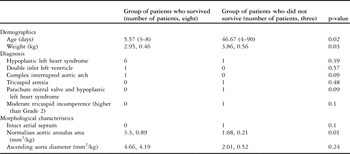
The medical records of 11 patients – 4 female and 7 male – (mean age 16.55, 27.33 days) were reviewed retrospectively. Of these patients, eight survived (the group of patients who survived) and three died (the group of patients who did not survive) after the operation. The mean age of patients in the group of patients who did not survive was significantly higher than in the group of patients who survived (46.67 days versus 5.57 days, p = 0.02; Table 1).
Demographics, diagnostic, and morphological characteristics.

Data are displayed as median (range), mean, standard deviation, or total numbers
The cardiac diagnosis established by echocardiography revealed that seven patients had hypoplastic left heart syndrome. Double inlet left ventricle diagnosis was made in one patient, complex interrupted aortic arch with systemic outflow tract obstruction in one patient, tricuspid atresia with systemic outflow tract obstruction in one patient, and parachute mitral valve and hypoplastic left ventricle in one patient. Moderate tricuspid incompetence was present in one patient. Atrial septum was intact in one patient (Table 1).
There was no significant difference between the group of patients who survived and the group of patients who did not survive in terms of morphological diagnosis. The mean ascending aorta and aortic annulus diameters were 3.97, 0.26 ranging from 2 to 7 square millimetres per kilogram and 3.94, 0.35 (2–6) square millimetres per kilogram, respectively. The normalised aortic annulus was significantly larger in the group of patients who survived than in the group of patients who did not survive (3.3, 0.89 square millimetres per kilogram versus 1.68, 0.21 square millimetres per kilogram, p = 0.01), but the ascending aorta diameter was not significantly different between the groups (Table 1).
Pre-operative and operative findings
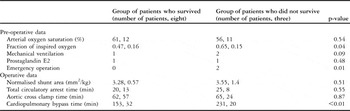
The group of patients who did not survive had a significantly higher fraction of inspired oxygen compared to the group of patients who survived (0.65, 0.15 versus 0.47, 0.16, p = 0.04). Despite one of the patients in the group of survivors having an emergency operation, two other patients in the group needed an emergency operation but did not survive (p = 0.01; Table 2).
Pre-operative and operative data.

Data are displayed as mean, standard deviation, or total numbers
Despite not being statistically significant, the mean shunt area in the group of patients who survived was less than that in the group of patients who did not survive (3.44, 0.57 square millimetres per kilogram versus 3.55, 1.4 square millimetres per kilogram). Total cardiopulmonary bypass time was significantly higher in the group of patients who did not survive than in the group of patients who survived (153, 32 minutes versus 231, 20 minutes, p was less than 0.01).
Other pre-operative and operative data were similar between the group of patients who survived and the group of patients who did not survive (Table 2).
Post-operative haemodynamics
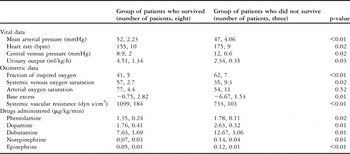
The mean arterial pressure was higher and the central venous pressure was lower in the group of patients who survived than in the group of patients who did not survive (p was less than 0.01 and equal to 0.02, respectively). Urinary output was higher in the group of patients who survived (p = 0.03; Table 3). Systemic venous oxygen saturation, base excess, and systemic vascular resistance were significantly lower in the group of patients who did not survive than in the group of patients who survived (p = 0.02, 0.01, and less than 0.01, respectively; Table 3).
Post-operative patients’ haemodynamics.

Data are displayed as mean, standard deviation
Higher doses of phentolamine (p = 0.02), dopamine (p = 0.01), doputamine (p = 0.01), norepinephrine (p = 0.01), and epinephrine (p was less than 0.01) were needed for patients in the group of patients who did not survive than in the group of patients who survived (Table 3).
Mortality and outcome
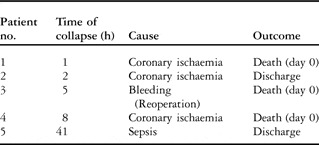
There were five patients who had early circulatory collapse at 1–41 hours following the operation (Table 4); three patients (mortality rate, 27%) died on the same day following the operation due to low systemic cardiac output despite aggressive inotrope therapy; eight patients survived. No arrhythmia that required treatment was recorded.
Time, cause, and outcome of sudden early circulatory collapse after operation.

Atrial balloon septostomy was performed in two patients (mean age, 2 days; mean weight, 3.1 kilograms). Fentanyl was used for analgesia at an average dose of 5.6 micrograms per kilogram. None of the patients who arrived at the hybrid suite were intubated, and the patients had notably stable haemodynamics throughout the first 24 hours in the intensive care unit. One of the patients lived and the other died after the atrial balloon septostomy and the Norwood operation. Owing to unfavourable pre-operative conditions, the mortality rate was 50% in this group.
Patients with moderate tricuspid incompetence (one patient) and intact atrial septum (one patient) died after the operation.
Discussion
Anaesthesic management of single ventricular patients is directed to preserve ventricular function and promote pulmonary blood flow. Hypovolaemia is poorly tolerated because it significantly reduces pulmonary blood flow, ventricular preload, and output. Anaesthetic induction often produces vasodilatation requiring volume administration. Ventilator management is directed to promote maximal pulmonary blood flow by minimising mean airway pressure and providing increased expiratory time.Reference Leyvi and Wasnick10
Low cardiac output and unbalanced pulmonary and systemic flow are common causes of inadequate systemic oxygenation and most of the deaths early after the modified Norwood operation. Post-operative management should therefore aim at maximising systemic oxygenation delivery by balancing the pulmonary and systemic circulation.Reference Tweddell, Hoffman and Fedderly2 For this aim, pulmonary vascular resistance and systemic vascular resistance are intensively rearranged as required in clinical practice. Previous studies have focused on elevating pulmonary vascular resistance by ventilator settings to modify carbon dioxide, or by adding carbon dioxide and/or nitric oxide to the inspired gas mixture.Reference Charpie, Dekeon, Goldberg, Mosca, Bove and Kulik4 In our patients, carbon dioxide was kept at a target level of 28 millimetres of mercury or lower, and pulmonary and systemic blood flow ratio was modified by changing systemic vascular resistance by adding vasodilators (for example, phentolamine) or norephinephrine as needed.
Conventional parameters (arterial blood pressure and arterial oxygen saturation) show only subtle changes that do not provide an early warning of the critical situation or feedback about the effectiveness of corrective measures. Systemic venous oxygen saturation monitoring of the continuous superior caval veins is the single most important factor in improving the survival of stage 1 patients. A continuous display of superior caval veins’ saturation and timely haemodynamic intervention was applied to avoid anaerobic metabolism, which has an apparent systemic venous oxygen saturation threshold near 30% in this population.Reference De Oliveira, Ashburn and Khalid12 The life-threatening haemodynamic deterioration in our patients was clearly shown with systemic venous oxygen saturation monitoring despite the 75–80% range of arterial oxygen saturation. An initial deterioration in systemic venous oxygen saturation was partially corrected with additional analgesia and sedation. Subsequent critical deterioration in systemic oxygen delivery was effectively treated with a combination of additional analgesia and sedation, and by increasing inotropic and vasodilator (for example, phenoxybenzamine) infusions.Reference Hoffman, Ghanayem and Kampine13
De Oliveira et alReference De Oliveira, Ashburn and Khalid12 studied neonates who underwent a Norwood operation and found that there was no difference between patients treated with or without phenoxybenzamine in terms of age, diagnosis, number of neonates with weight less than 2.5 kilograms, aortic size diameter less than 2 millimetres, highest pre-operative lactate level, and shunt size indexed to body weight. In this study, 25 infants had circulatory collapse during the first 72 hours. Diagnosis, aortic size, atrioventricular valve function, birth weight, age at operation, and total circulatory arrest time were not predictive of early sudden circulatory collapse. Optimal surgical technique is the most important predictor of early survival. The aggressive afterload reduction by using phenoxybenzamine reduced the risk of early sudden arrest.Reference De Oliveira, Ashburn and Khalid12
Reduction in oxygen delivery can lead to organ dysfunction and death by cellular hypoxia, detectable by progressive (mixed) venous oxyhaemoglobin desaturation until extraction, is limited at the anaerobic threshold. We sought to determine the critical level of systemic venous oxygen saturation to maintain aerobic metabolism in neonates after the Norwood procedure for the hypoplastic left heart syndrome.
Since the COMFORT scale and bispectral index correlate well between light and moderate sedation, the sedation level was arranged according to the COMFORT scale.Reference Photiadis, Hübler and Sinzobahamvya11
With a drop in pulmonary vascular resistance, a formerly adequately sized shunt may become too large. Notwithstanding that most surgeons would use either a 3, 3.5, or 4 millimetres modified Blalock–Taussig shunt for Norwood palliation in a neonate, there is very little published work with special reference to the size of the modified Blalock–Taussig shunt. In our study, shunt size was chosen according to the surgeon's preference.
However, in cases of increased pulmonary vascular resistance, an adequately sized modified Blalock–Taussig shunt may be too small to achieve sufficient oxygenation. Pulmonary vascular abnormalities are common in hypoplastic left heart syndrome, affecting the pulmonary arteries, veins, and lymphatics.Reference Long, Horn and Keogh9, Reference Leyvi and Wasnick10 The course after the Norwood operation is reported to be complicated by persistent systemic desaturation, leading to death.Reference Brann, Brawn, Raafat and Sreeram7, Reference Photiadis, Urban and Sinzobahamvya8 Therefore, a larger shunt allows more blood flow to the pulmonary vascular bed and should therefore help to reduce the total afterload for the single ventricle. Higher mean arterial pressures with lower ventricular filling pressure and lower doses of norepinephrine administered were recorded in the group of patients who survived.
Increased systemic vascular resistance with concomitant chronic volume overload of the single ventricle may account for unexpected death even a long time after the Norwood operation.Reference Hoffman, Ghanayem and Kampine13, Reference Wright, Crowley, Charpie, Ohye, Bove and Kulik14
In our study, a significantly lower Fraction of inspired oxygen was needed and pulmonary and systemic blood flow ratio was more frequently found to be higher than 1.5 in the group of patients who survived, indicating that pulmonic flow was less restricted in this group, even early after the Norwood operation. However, the arteriovenous difference and oxygen excess factor were similar in the two groups, indicating that the use of a larger shunt was not accompanied by lower systemic oxygen delivery. This was accomplished by the continuous monitoring of pulmonary and systemic blood flow ratio, immediate identification of increased left-to-right shunt, and prompt intervention to decrease pulmonary overcirculation. A reduction in left-to-right shunt was attained by increasing haemoglobin concentrationReference Lister, Moreau, Moss and Talner15 or by decreasing systemic afterload with alpha-adrenoceptor antagonists, angiotensin converting enzyme inhibitors, and beta-adrenoceptor antagonists.Reference Tweddell, Hoffman and Fedderly2, Reference Buchhorn, Ross and Hulpke-Wette16 Therefore, we conclude that the size of the modified Blalock–Taussig shunt does not influence haemodynamics after the Norwood procedure.
Base excess was strongly related to systemic venous oxygen saturation with minimal change after adjustment for physiologic covariates. The risk of anaerobic metabolism was 4.8% overall, but rose to 29% when systemic venous oxygen saturation was 30% or below. Survival was 100% at 1 week and 94% at hospital discharge. Analysis of acid-base changes revealed an apparent anaerobic threshold when systemic venous oxygen saturation fell below 30%. Clinical management to maintain systemic venous oxygen saturation above this threshold yielded low mortality.Reference De Oliveira, Ashburn and Khalid12
Despite the number of patients being too small, mortality was significantly different between the groups. Oximetric catheter place through the common atrium and monitoring of the central venous oxygen saturations provided better management with inotrops and phenoxybenzamine, and haemodynamic follow-up.
The main limitations of this study were its retrospective design and small sample size. However, the findings of this study may provide a basis for further prospective studies with a larger sample size.
In conclusion, this study showed that pre-operative, operative, and post-operative risk factors for early hospital mortality after the modified Norwood operation for hypoplastic left heart syndrome were worse pre-operative condition, increased age, low normalised aortic annulus, high fraction of inspired oxygen, need for emergency operation, longer cardiopulmonary bypass time, low mean common atrial pressure and systemic mean venous pressure, low urinary output, low systemic venous and arterial oxygen saturation, and need for a high dose of drugs in the operative and post-operative periods. These factors should not be the cause of mortality; instead, they should be the results of the process of mortality. Further prospective clinical studies are needed to define predictive pre-operative, operative, and post-operative factors for hospital mortality in these patients.