Infections due to carbapenem-resistant Enterobacteriaceae (CRE) are associated with high mortality rates and limited antibiotic treatment options.Reference Bogan, Kaye and Chopra 1 – Reference Gasink, Edelstein, Lautenbach, Synnestvedt and Fishman 6 Since the initial identification of a Klebsiella pneumoniae carbapenemase (KPC)-producing K. pneumoniae isolate in 1996, CREs have rapidly disseminated worldwide.Reference Tzouvelekis, Markogiannakis, Psichogiou, Tassios and Daikos 5 , Reference Yigit, Queenan and Anderson 7 Although multiple genera of Enterobacteriaceae have been found to carry carbapenemase enzymes, carbapenem-resistant Klebsiella pneumoniae (CRKP) remains the most epidemiologically important in the United States. Recent studies have emphasized the increasing importance of long-term acute care hospitals (LTACHs) as reservoirs and regional amplifiers of CRKP, with up to 9-fold higher prevalence rates of colonization compared with acute care hospitals.Reference Lin, Lyles-Banks and Lolans 8 – Reference Marquez, Terashita, Dassey and Mascola 11
Residents of LTACHs are at increased risk for colonization and infection with CRKP for a number of reasons. LTACHs care for a chronically, critically ill patient population that is characterized by significant debility, prolonged durations of stay, and high rates of invasive device utilization and antibiotic exposure.Reference Munoz-Price 12 Understanding the epidemiology of CRKP in LTACHs is critical for the development of infection prevention and antibiotic stewardship measures to reduce the emergence of these organisms in the long-term care setting. However, prior studies assessing risk factors for CRE acquisition in LTACHs have been performed during ongoing outbreaks.Reference Chitnis, Caruthers and Rao 13 , Reference Endimiani, Depasquale and Forero 14 High levels of colonization pressure during acute outbreaks with multidrug-resistant organisms increases the risk for horizontal transmission, and may not reflect transmission dynamics in other settings.Reference Gould, Rothenberg and Steinberg 15
Therefore, given the limited data on the epidemiology of CRKP in LTACHs in the non-outbreak setting, we performed a case-control study to identify risk factors for infection or colonization with CRKP in LTACH residents.
METHODS
Study Design
A retrospective case-control study was performed at a 38-bed, freestanding LTACH within the University of Pennsylvania Health System to identify risk factors for CRKP infection or colonization. Per institutional policy, all patients at the facility have surveillance blood, urine, and sputum or tracheal aspirate cultures performed routinely on admission. Clinical cultures obtained following admission are ordered at the discretion of treating physicians. Contact precautions are implemented for patients with positive CRKP cultures for the duration of their stay. The facility did not institute universal preemptive contact precautions prior to surveillance culture results during the study period. All patients in the facility are housed in single rooms. The study was reviewed and approved by the Institutional Review Boards of the University of Pennsylvania and Good Shepherd Penn Partners.
All microbiologic isolates were processed at the Hospital of the University of Pennsylvania (HUP) Clinical Microbiology Laboratory. Standard identification and susceptibility testing of K. pneumoniae isolates was performed using the semiautomated Vitek 2 identification and susceptibility system (bioMérieux, Durham, NC) and interpreted according to Clinical and Laboratory Standards Institute (CLSI) criteria. 16 Confirmatory KPC polymerase chain reaction (PCR) testing was performed for isolates with a meropenem MIC of 2 µg/mL and ertapenem MIC <1 µg/mL, or a meropenem MIC ≤2 µg/mL and ertapenem MIC ≥1 µg/mL.
CRKP isolates were tested for susceptibility to tigecycline and colistin or polymyxin B using Etest (bioMérieux, Durham, NC), with isolates with an MIC of ≤2 µg/mL determined to be susceptible. Fosfomycin susceptibility was performed using the disk diffusion method as per CLSI guidelines.
Study Population
Case patients were defined as all patients with a clinical culture (surveillance culture or clinical culture during LTACH stay) positive for CRKP from July 1, 2008, to July 1, 2013. Control patients were defined as all patients with a clinical culture positive for carbapenem-susceptible K. pneumoniae (CSKP) over the same time period. Patients with positive cultures for both CRKP and CSKP during the study period were included as cases. Only the first positive K. pneumoniae culture was included for each unique patient.
Data Collection
Data were abstracted from Penn Data Store, a comprehensive electronic database that includes demographic, laboratory, billing, and pharmacy information for all patients treated within the University of Pennsylvania Health System. The following variables were collected: demographics, comorbidities, length of stay prior to K. pneumoniae culture positivity, location from which the patient was transferred (eg, acute care hospital, rehabilitation facility), and study year. Comorbid conditions included diabetes mellitus, chronic kidney disease, chronic pulmonary disease, and malignancy, among others.
Use of antibiotics and immunosuppressive medications (eg, tacrolimus, cyclosporine) within 30 days of the K. pneumoniae culture was also assessed. For purposes of analyses, antibiotics were classified as follows: aminoglycosides; fluoroquinolones; third-generation cephalosporins (ie, ceftriaxone, ceftazidime); first-generation cephalosporins (ie, cefadroxil, cefazolin, cephalexin); cefepime; ampicillin/sulbactam; piperacillin-tazobactam; meropenem; metronidazole; vancomycin; linezolid; clindamycin; trimethoprim-sulfamethoxazole; tigecycline; and colistin. Finally, data on the use of mechanical ventilation and presence of a central venous or urinary catheter were collected via medical record review.
Statistical Analysis
Cases and controls were characterized by potential risk factors, including demographics, comorbidities, mechanical ventilation, indwelling device use, and antibiotic exposure. Descriptive statistics were conducted to characterize the entire study population. Bivariate analyses of all potential risk factors for CRKP infection or colonization were performed using Fisher’s exact test for categorical variables and the Wilcoxon rank sum test for continuous variables. Odds ratios (OR) and 95% confidence intervals (CIs) were calculated to evaluate the strength of each association. Multivariate analyses were then performed using multiple logistic regression. All variables from bivariate analyses with P<.05 were evaluated and considered for inclusion in the final multivariate model. Backward stepwise selection was performed for selection of variables in the final explanatory model; results were confirmed using likelihood ratio testing.Reference Mickey and Greenland 17 For all calculations, a 2-tailed P value <.05 was considered significant.
All analyses were performed using STATA v.13.0 (StataCorp, College Station, Texas).
RESULTS
Study Population
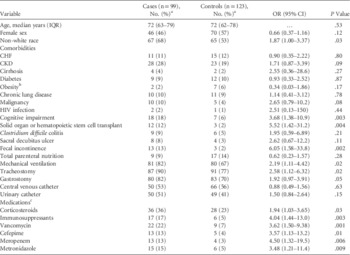
A total of 222 unique patients had clinical cultures positive for K. pneumoniae during the study period. The mean age of patients was 69.8 years and 52% were female. The median length of stay prior to K. pneumoniae culture positivity was 6 days (interquartile range [IQR], 1–19 days) for cases and 4 days (IQR, 1–15 days) for controls, respectively (Table 1). Rates of central venous catheter and urinary catheter utilization were nearly 50% in both groups, with no statistical difference between cases and controls.
Bivariate Analysis of Risk Factors for Infection or Colonization with Carbapenem-Resistant K. pneumoniae in Long-Term Acute Care Hospital Residents

NOTE. OR, odds ratio; CI, confidence interval; IQR, interquartile range; HIV, human immunodeficiency virus; LOS, length of stay; CHF, congestive heart failure; CKD, chronic kidney disease.
a Unless noted otherwise.
b Body mass index ≥25.
c Received within 30 days of the positive culture. Only variables with P<.05 are shown.
Of 222 K. pneumoniae isolates, 99 (45%) were identified as CRKP. Of these, 43 were isolated within 72 hours of admission, with 29 (67%) transferred from regional academic medical centers and 14 (33%) transferred from community medical centers.
The incidence rate of CRKP acquired after 72 hours of LTACH admission was 1.03 cases per 1,000 patient days. No temporal trends were noted in CRKP incidence over the duration of the study period (data not shown).
Risk Factors for Colonization or Infection with CRK
On bivariate analysis (Table 1), there were no significant differences in age (P=.53), gender (P=.12), or length of LTACH stay prior to K. pneumoniae culture positivity (P=.35) between cases and controls.
Colonization or infection with CRKP was significantly associated with non-white race and with the following comorbidities: solid organ or hematopoietic stem cell transplant, mechanical ventilation, cognitive impairment, tracheostomy, and fecal incontinence. There was also an association between CRKP and use of corticosteroids, immunosuppressants, vancomycin, cefepime, meropenem, and metronidazole within the prior 30 days.
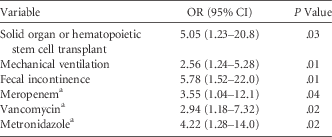
On subsequent multivariate analyses (Table 2), the following variables were significant risk factors for infection or colonization with CRKP: solid organ or hematopoietic stem cell transplant (OR, 5.05; 95% CI, 1.23–20.8; P=.03), mechanical ventilation (OR, 2.56; 95% CI, 1.24–5.28 P=.01), and fecal incontinence (OR, 5.78; 95% CI, 1.52–22.0; P=.01). Administration of the following antibiotics within the prior 30 days was also significantly associated with CRKP isolation: meropenem (OR, 3.55; 95% CI, 1.04–12.1; P=.04), vancomycin (OR, 2.94; 95% CI, 1.18–7.32; P=.02), and metronidazole (OR, 4.22; 95% CI, 1.28–14.0; P=.02).
Multivariate Model of Risk Factors for Infection or Colonization with Carbapenem-Resistant K. pneumoniae in Long-Term Acute Care Hospital Residents

NOTE. OR, odds ratio; CI, confidence interval.
a Receipt within prior 30 days.
Antibiotic Susceptibility Profiles of CRKP Isolates
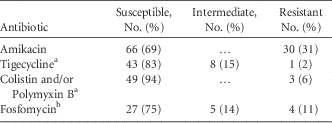
Of 93 CRKP isolates, 16 (17%) had a meropenem minimum inhibitory concentration (MIC) of 1 μg/mL and 17 (18%) isolates had a meropenem MIC of 2 µg/mL. All of these isolates tested positive for KPC by polymerase chain reaction. The remaining 60 CRKP isolates had an MIC >2 μg/mL. Table 3 demonstrates susceptibility profiles of CRKP isolates. Overall, the rate of resistance to amikacin was relatively low (31%). Of the CRKP isolates, 52 underwent tigecycline susceptibility testing, with the majority (83%) identified as susceptible. Of 52 tested CRKP isolates, 49 (94%) were susceptible to colistin or polymyxin B.
Antibiotic Susceptibility Profiles of Carbapenem-Resistant K. pneumoniae Isolates

a 52 isolates tested.
b 36 isolates tested.
DISCUSSION
In this case-control study, nearly half (45%) of K. pneumoniae isolates identified by clinical cultures in a university-affiliated LTACH over a 5-year period were resistant to carbapenems. Risk factors for CRKP infection or colonization included solid organ or hematopoietic stem cell transplantation, mechanical ventilation, fecal incontinence, and use of vancomycin, meropenem, or metronidazole in the prior 30 days.
The results of our study are notable for a high rate of colonization or infection with CRKP in the study population, with nearly half of K. pneumoniae isolates demonstrating resistance to carbapenems. The high incidence rate of CRKP found in our study in a non-outbreak setting is of major concern, and is nearly 5 times the prevalence reported from acute care hospitals. 18 Notably, 43% of CRKP isolates were detected within 72 hours of arrival to the LTACH, suggesting presence on admission vs acquisition in the LTACH. CRKP isolates identified later during hospitalization may have been acquired through horizontal transmission or through detection of CRKP colonization that preceded admission. While detection of CRKP was likely facilitated through the use of admission clinical culture screening, this finding underscores the importance of LTACHs in the regional epidemiology of CRKP emergence and dissemination. Knowledge of local prevalence rates of CRKP are essential to coordinating a regional approach to CRE control, including enhanced interfacility communication between LTACHs, acute care hospitals, and long-term care facilities, and engagement of local health departments in regional surveillance efforts. 19 Furthermore, such high carbapenem resistance rates have important implications for infection prevention and antimicrobial stewardship measures specifically in the LTACH setting, including selection of an empiric antibiotic regimen for infections due to K. pneumoniae.
We found that solid organ and hematopoietic stem cell transplant recipients were at increased risk for CRKP infection or colonization. Prior transplantation was previously identified as a risk factor for CRKP in an acute-care hospital in New York,Reference Patel, Huprikar, Factor, Jenkins and Calfee 20 but to our knowledge, our study is the first to confirm this association in the LTACH setting. Transplant patients are at significant risk for colonization and/or infection with CRKP due to immunosuppression and high rates of antibiotic use. Given frequent hospitalizations and interfacility transfers, these patients may also play an important role in the regional dissemination of CRKP.Reference Mathers, Cox and Bonatti 21 Targeted active surveillance and/or pre-emptive isolation precautions on admission to an LTACH in this patient population may be of particular benefit and should be explored in future studies.
We also found that requirement for mechanical ventilation was a significant risk factor for colonization or infection with CRKP. Mechanical ventilation is a well-described risk factor for CRKP acquisition in acute-care hospitals.Reference Patel, Huprikar, Factor, Jenkins and Calfee 20 , Reference Leavitt, Navon-Venezia, Chmelnitsky, Schwaber and Carmeli 22 The vast majority of ventilated LTACH patients have antecedent intensive care unit (ICU) stays and higher rates of invasive device utilization, increasing their risk for colonization or infection with multidrug-resistant organisms. As ventilation-dependent respiratory failure is the leading admission diagnosis to LTACHs,Reference Munoz-Price 12 this represents a substantial at-risk population contributing to increased CRKP colonization pressure, and could be targeted with enhanced surveillance measures as part of a coordinated regional CRKP control plan.
Fecal incontinence was also associated with an increased risk of CRKP in LTACH residents. While a study performed in a single LTACHReference Thurlow, Prabaker, Lin, Lolans, Weinstein and Hayden 23 demonstrated that only 0.5% of environmental isolates were positive for CRKP, recent studies have implicated environmental sources as contributing factors to ongoing CRKP outbreaks.Reference Snitkin, Zelazny and Thomas 4 , Reference Kotsanas, Wijesooriya and Korman 24 While the role of the environment in the transmission of CRE remains unclear, fecal incontinence likely leads to increased environmental contamination and subsequent risk for CRKP transmission. Fecal incontinence is also a likely surrogate for higher dependence on healthcare staff for hygiene and care, with increased opportunities for healthcare worker and patient contact and horizontal transmission of multidrug-resistant organisms. The potential benefit of enhanced precautions (ie, gown and glove use in LTACH residents with fecal incontinence) should be explored in future studies.
Our analysis of recent antibiotic use found that meropenem, vancomycin, and metronidazole were risk factors for CRKP infection or colonization. Carbapenem use and its association with CRKP acquisition have been well-described in the acute-care hospital setting.Reference Patel, Huprikar, Factor, Jenkins and Calfee 20 , Reference Hussein, Sprecher, Mashiach, Oren, Kassis and Finkelstein 25 The use of broad-spectrum antibiotics, such as those identified in our study, likely exert broad colonization pressure and may select for colonization and/or infection with more resistant strains. Antibiotic utilization is widespread in LTACHs, with rates of vancomycin and carbapenem consumption between the 50th and 75th percentiles of medical ICUs.Reference Gould, Rothenberg and Steinberg 15 Effective and feasible antibiotic stewardship measures are urgently needed in this setting.
This study has several limitations. Given that rectal culture for detection of asymptomatic gastrointestinal colonization was not routinely performed, our results likely underestimated the true burden of CRKP colonization. While our study did not include species of Enterobacteriaceae other than K. pneumoniae, thereby potentially underestimating the degree of overall CRE infection or colonization, data from a prior CRE screening program found that 90% of CRE isolates at our institution are CRKP. Finally, the present study was conducted in a university-affiliated LTACH, and these results may not be generalizable to other LTACHs with differing characteristics.
In conclusion, solid organ or hematopoietic stem cell transplantation, mechanical ventilation, and fecal incontinence were found to be independent risk factors for CRKP infection or colonization in LTACH residents. Patients with these risk factors represent a population who may benefit from enhanced CRKP surveillance measures, including on a regional basis. Recent exposure to meropenem, vancomycin, and metronidazole were also associated with increased risk of CRKP colonization or infection. Future studies are needed regarding optimal antimicrobial stewardship interventions specifically in the LTACH setting with the goal of reducing the emergence of CRKP.
ACKNOWLEDGMENTS
We would like to thank Yuliya Borovskiy and Erik Hossain from the Penn Data Store for their assistance in collecting data used in this study.
Financial support: This work was supported by the National Institutes of Health (grant no. K01-AI103028 to J.H.H.) and the CDC Cooperative Agreement FOA#CK11-001-Epicenters for the Prevention of Healthcare Associated Infections. The funding agency had no role in the design and conduct of the study; collection, management, analysis, and interpretation of the data; or preparation, review, or approval of the manuscript.
Potential conflicts of interest: All authors report no conflicts of interest relevant to this article.