Mozzarella cheese is an Italian unripened cheese with a milky fresh taste and higher moisture content (60–65%) than in other dairy products, obtained by lactic acid bacteria fermentation (lacto-fermented mozzarella) or by direct injection of organic acids into the milk (acidified mozzarella). It is packed until consumption immersed in a preserving liquid, comprising water and sometimes NaCl or organic acids (Mucchetti and Neviani, Reference Mucchetti and Neviani2006). Mozzarella cheese is easily perishable due to excessive microbial growth and also due to mass transfer (i.e. migration of salt and water) between the product and the preserving liquid: shelf life commonly ranges from 5 to 10 d, depending on the moisture level, microbial growth, manufacturing procedures and storage conditions (Faccia et al., Reference Faccia, Gambacorta, Natrella and Caponio2019). In particular, the shelf-life of mozzarella cheese with high water content is 5 d (Altieri et al., Reference Altieri, Scrocco, Sinigaglia and Del Nobile2005). Local firms are very interested in prolonging shelf life, with the aim to expand the business in larger national and international markets. Among the different possibilities for improved dairy products are new packaging solutions (Piscopo et al., Reference Piscopo, Zappia, De Bruno and Poiana2015), greater processing sustainability (Piscopo et al., Reference Piscopo, Zappia, Princi, De Bruno, Araniti, Lupini, Abenavoli and Poiana2019) and reduction of wastes and food losses (Falcone et al., Reference Falcone, De Luca, Stillitano, Iofrida, Strano, Piscopo, Branca and Gulisano2017). Alternative compositions of preserving liquids can be considered as part of this, in particular for the direct interaction with the cheese for microbiological, sensorial and chemical quality. Different studies evaluated NaCl in the preserving liquid for mozzarella cheese. It can preserve texture by delaying the water diffusion between mozzarella cheese and brine, and it may improve shelf life by control of undesirable microbial growth, as well as having a beneficial effect on water activity and enzyme activity of cheese (Guinee and Fox, Reference Guinee and Fox2004). The substitution of Na cation with others such as Ca, Mg and NH4 was considered as a potentially healthier alternative to sodium (Ayyash et al., Reference Ayyash, Sherkat and Shah2013) and to promote protein to protein interactions within the cheese matrix (Faccia et al., Reference Faccia, Angiolillo, Mastromatteo, Conte and Del Nobile2013). Addition of salt improves gel strength and the release of water from the matrix as reported by Pastorino et al. (Reference Pastorino, Hansen and McMahon2003). It has been reported that addition of calcium chloride to governing liquid of mozzarella improves both the structure and taste (Faccia et al., Reference Faccia, Trani, Loizzo, Gambacorta and Di Luccia2011) and could have a bacteriostatic action on Pseudomonas spp. (Faccia et al., Reference Faccia, Trani and Di Luccia2009, Reference Faccia, Trani, Loizzo, Gambacorta and Di Luccia2011, Reference Faccia, Angiolillo, Mastromatteo, Conte and Del Nobile2013).
Plant extracts, essential oils, juices and other derivatives containing bacteriostatic bioactivities can be used as alternative agents in food preservation (Romeo et al., Reference Romeo, De Luca, Piscopo and Poiana2008) and thereby improve the quality of food products (Romeo et al., Reference Romeo, De Luca, Piscopo, De Salvo and Poiana2010). Citrus fruits, commonly widespread and consumed in the south of Italy are important sources of several biomolecules with functional and antioxidant properties (Sicari et al., Reference Sicari, Pellicanò, Giuffrè and Zappia2016). Bergamot (Citrus bergamia Risso) is a natural hybrid fruit derived from bitter orange and lemon that comes from the Province of Reggio Calabria, and is used mostly for the extraction of essential oil and to a lesser extent for juice (Scerra et al., Reference Scerra, Foti, Caparra, Cilione, Violi, Fiammingo, D'Aguì and Chies2018). Bergamot fruits are associated with beneficial effects for human health for their potential anticancer, antimicrobial, antioxidant and anti-inflammatory activities. Bergamot derivatives possess a high quantity of bioactive components including phenolics, flavonoids and other antioxidant compounds (Russo et al., Reference Russo, Arigò, Calabrò, Farnetti, Mondello and Dugo2016; Giuffrè et al., Reference Giuffrè, Zappia, Capocasale, Poiana, Sidari, Di Donna, Bartella, Sindona, Corradini, Giudici and Caridi2019) which throw light on their possible use in food processing to improve functional and microbiological characteristics. Moreover, it was demonstrated by literature that essential oil and juice of bergamot (Fisher and Phillips, Reference Fisher and Phillips2006; Pedonese et al., Reference Pedonese, Fratini, Pistelli, Porta F, Di Ciccio, Fischetti, Turchi and Nuvoloni2017; Rossi et al., Reference Rossi, Chaves-Lopez, Serio, Anniballi, Valbonetti and Paparella2018) reduced the pathogens microbial growth and limited the biofilm formation of bacteria strains and their motility. Thus, in this research governing liquids containing bergamot concentrated juice and calcium lactate were evaluated for the preservation of lacto-fermented mozzarella cheese in relation to microbiological, sensorial and chemical characteristics.
Materials and methods
Preparation of samples
A concentrated bergamot juice (BJC) was used in the preserving liquid for lacto-fermented mozzarella cheeses (125 g of weight, moisture >55%). BJC was collected in a factory (Delizie della Natura, located in Reggio Calabria, Italy), transported in containers certified microbiologically safe and stored at 4°C in dark conditions for 24 h before its use and analysis. Calcium lactate (CL) was also used in the preserving liquid composition. Lacto-fermented mozzarella cheeses were manufactured by a commercial dairy processor located in Reggio Calabria (Italy). Usually mozzarella cheeses are immersed in microbiologically safe tap water, and sold with a shelf life of 5 d. For the experimental plants three preserving liquids were evaluated on mozzarella cheeses shelf life and mozzarella cheeses samples were therefore named as follows: BJ-M (0.1% BJ v/v); BJ + CL-M (0.05% BJ v/v + 0.2% CL w/v); Control (tap water) All samples were submitted to chemical, microbiological and sensory analyses, immediately after 1 d of manufacturing and after 5, 7, 13, and 20 d of storage at 4°C.
Microbiological analyses
The microbiological analyses were performed according to the IDF standard protocol (IDF, 2001). 10 g sample of lacto-fermented mozzarella cheese (mixed centre and edge portions) was aseptically taken and mixed with 90 mL sterile Ringer's solution and homogenized for 3 min in a stomacher bag filter by Bag Mixer (Interscience, Saint Nom, France). Subsequently, decimal dilutions of homogenates were made using the same diluent, and the dilutions were plated on appropriate media in Petri dishes. Bacterial counts were determined in duplicate. Total bacterial count (TBC) was assessed after incubation on Plant Count Agar 90 (PCA-Oxoid, Milan, Italy) at 26°C for 48 h; total lactic acid bacteria (LAB) were enumerated after anaerobic incubation in MRS Agar (Oxoid, Milan, Italy) at 32°C for 48 h. Pseudomonas spp. count was assessed at 25°C for 48 h in Pseudomonas Agar Base 93 (Biolife, Milan, Italy) added of CFC Pseudomonas supplement (Biolife, Milan, Italy). The results were expressed as Log10 cfu/g.
Titratable acidity, pH, water activity and moisture
Titratable acidity and pH were evaluated on water extract obtained from homogenization of 10 g of mozzarella cheese. For the titratable acidity, expressed as lactic acid %, and pH measurement 10 ml of water extract was analysed according to AOAC methods, (1980a, 1980b). The percentage of moisture was evaluated on 5 g of sample following the method AOAC, 1990. Water activity (a w) value was obtained by mean of LabMaster-a w instrument (Novasina, Lachen, 106 Switzerland).
Evaluation of proteolysis
The evolution of proteolysis of lacto-fermented mozzarella cheese samples after (1, 13 and 20 d of storage) was evaluated according to Zoidou et al. (Reference Zoidou, Plakas, Giannopoulou, Kotoula and Moatsou2015). Total nitrogen (TN) was determined in 0.5 g of mozzarella cheese was analysed by means of the Kjeldahl method with Foss equipment (Tecator™ and Kjeltec™ 8400 analyser unit, Fisher Scientific, Foss North America). For the determination of water-soluble nitrogen (SN) ten grams of cheese was homogenized in 100 g of distilled water by mean the Ultra-Turrax T 25 basic. After 60 min at 40°C, the cheese dispersion was re-homogenized under the same conditions. The homogenate was centrifuged at 3000 rcf for 30 min at 6°C, and the supernatant was filtered through filter paper (Whatman, 0.45 μm). The filtrate (10 mL), water-soluble extract of the cheese, was used for the determination of water-soluble nitrogen (SN) of cheese by means of the Kjeldahl method. Furthermore, 25 ml of the water-soluble extract were mixed with an equal quantity of TCA or trichloroacetic acid (24% w/w), remaining overnight at 4°C after which the mixture was filtered through filter paper. Fifteen grams of the supernatant were used for the determination of 12% TCA-soluble N of the cheese (TCASN), and analyses was carried out by means of the Kjeldahl method. The results were expressed as percentage values of primary proteolysis (WSN /TN) and secondary proteolysis (ratio of TCASN /TN).
Texture profile analysis
Texture profile analysis (TPA) of mozzarella cheese samples was performed by TA-XT Plus Texture Analyzer (Stable Micro Systems, Godalming, Surrey, UK) evaluating hardness, adhesiveness, cohesiveness, springiness, gumminess, chewiness and resilience. These parameters were evaluated after a compression test with two successive cycles performed on whole mozzarella (5 mm/s of test speed, 18 mm of distance, 5 s of time, 5 g of force, P/100 aluminium compression probe with a 100 mm of diameter) and after an elaboration of results by mean the Texture Expert for Windows Stable Micro Systems.
Antioxidant properties of water-soluble extracts
In order to characterize and to evaluate the total antioxidant capacity of cheese samples two different and complementary assays were used. The samples were evaluated for their antiradical activity against 2,2′-azinobis-(3-ethylbenzothiazoline-6-sulphonic acid) (ABTS) and 2,2′-azobis (2-methylpropionamidine) dihydrochloride (AAPH) radicals. All data were then expressed as Trolox Equivalents (μmol TE/g) by using a standard curve (0.25–2.0 μm Trolox, 6-hydroxy-2,5,7,8-tetramethylchroman-2-carboxylic acid). Trolox equivalent antioxidant capacity (TEAC) was determined by the decolorization assay using ABTS+ radical cation according to the method of Re et al. (Reference Re, Pellegrini, Proteggente, Pannala, Yang and Rice-Evans1999). ABTS solution (2900 μl) was reacted with 100 μl of methanol extract (10 g of mozzarella sample mixed to 50 ml of methanol:water, 80 : 20, v:v) and the absorbance (734 nm) was measured after 6 min in the dark in a UV-VIS spectrophotometer (Agilent, Santa Clara, California, USA). The ORAC assays was evaluated according to the method of Zulueta et al. (Reference Zulueta, Maurizi, Frigola, Esteve, Coli and Burini2009). The assay was carried out with 20 μl of methanol extract, 150 μl of fluorescein and, 25 μl of AAPH solution, at 37°C at each minute of the total 60 min and ORAC values, were calculated from the differences of areas under the fluorescence decay curves between the blank and the samples.
Statistical analysis
All experimental data were processed using SPSS Statistics 15.0 software and were compared by statistical analysis of variance (one-way ANOVA and Multivariate analysis). Tukey's multiple range test was used to determine significant differences among samples (P < 0.05). The analyses were performed in triplicate and the results were expressed as mean ± standard deviation.
Results and discussion
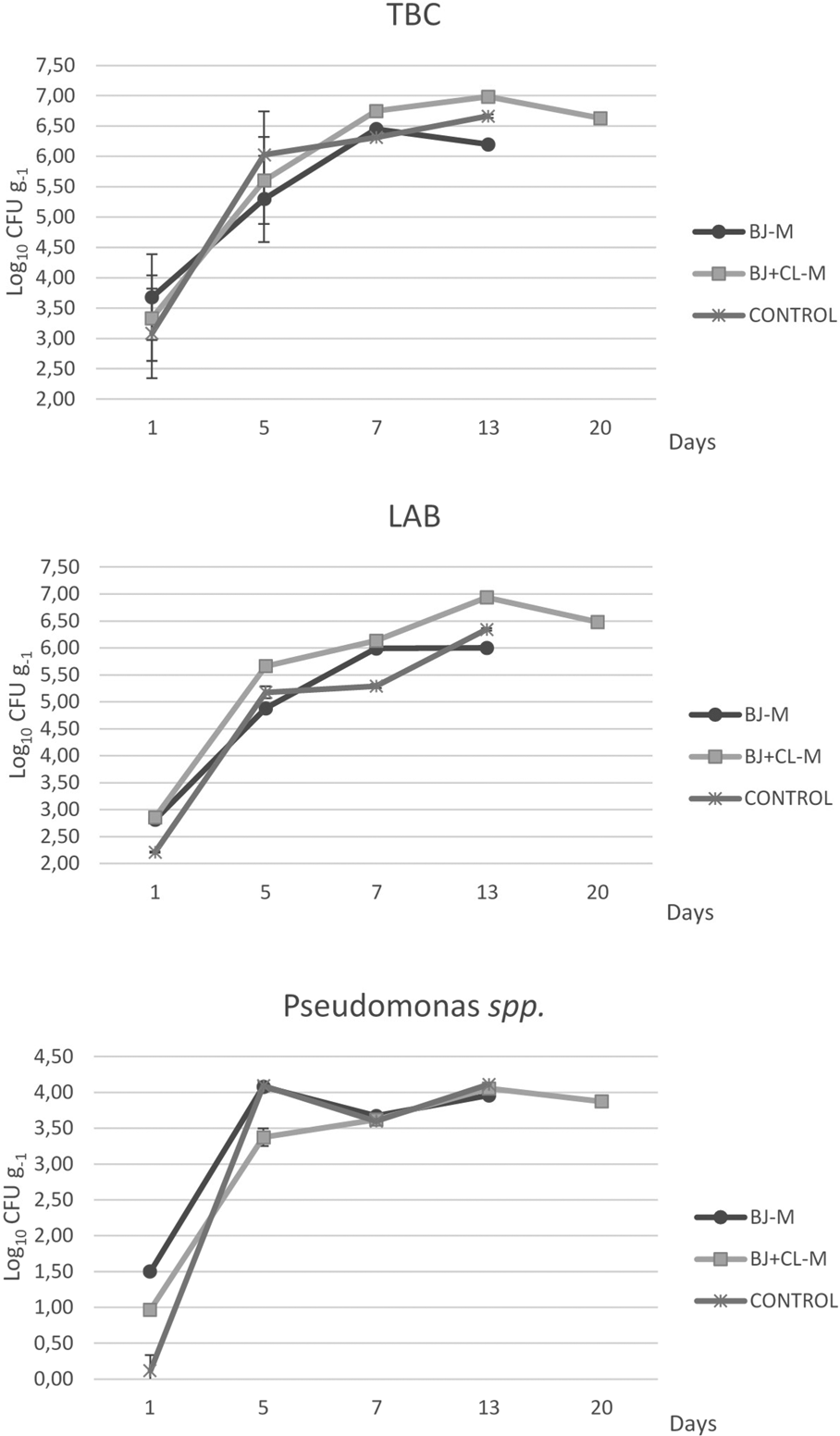
Microbiological analyses highlighted a microbial growth as expected during the 20 d (Fig. 1). Pseudomonas spp. count greatly increased after 5 d with highest values for BJ-M and Control samples (4 Log10 CFU/g). BJ + CL-M presented a lower load that then increased during further storage, reaching the counts of the other samples without further variation up to 20 d. These results demonstrated that concentrated bergamot juice and calcium lactate, when associated, can to some extent inhibit Pseudomonas species as show in Fig. 1. After 13 d BJ-M possessed the lowest Pseudomonas count. For the characteristics of texture, only BJ + CL-M cheeses kept in a viable state to 20 d, ending with a TBC of 6.5 Log10 CFU/g. BJ + CL-M sample showed the highest total bacterial count with high significant differences at 7 d (6.75 ± 0.01 Log10 CFU/g, P < 0.01) and 13 d (6.98 ± 0.05 Log10 CFU/g, P < 0.01). This is probably associated with the major content of lactic acid bacteria (at each monitoring time P < 0.01) with the following values: 6.13 ± 0.03 and 6.94 ± 0.01 Log10 CFU/g at 7 and 13 d respectively, as shown in Fig. 1 (a and b) and confirmed by Pearson's correlation coefficient (r = 0.960, P < 0.05). Time and preserving liquid significantly influenced microbiological parameters (LAB and Pseudomonas spp.) by multivariate analysis (P < 0.01), although preserving liquid composition did not affect the evolution of TBC (P > 0.05). Our results are in contrast with Ayyash and Shah (Reference Ayyash and Shah2011) who reported a stronger effect of brine on LAB counts in mozzarella samples.
Microbiological counts of different lacto-fermented mozzarella cheeses during the storage. Total bacterial count (a), Lactic acid bacteria (b), Pseudomonas spp. (c). BJ-M is bergamot juice (0.1% BJ v/v) as preservative; BJ + CL-M is bergamot juice and calcium chloride (0.05% BJ v/v + 0.2% CL w/v) as preservative; Control is tap water. Values are mean ± standard deviation, n = 3.

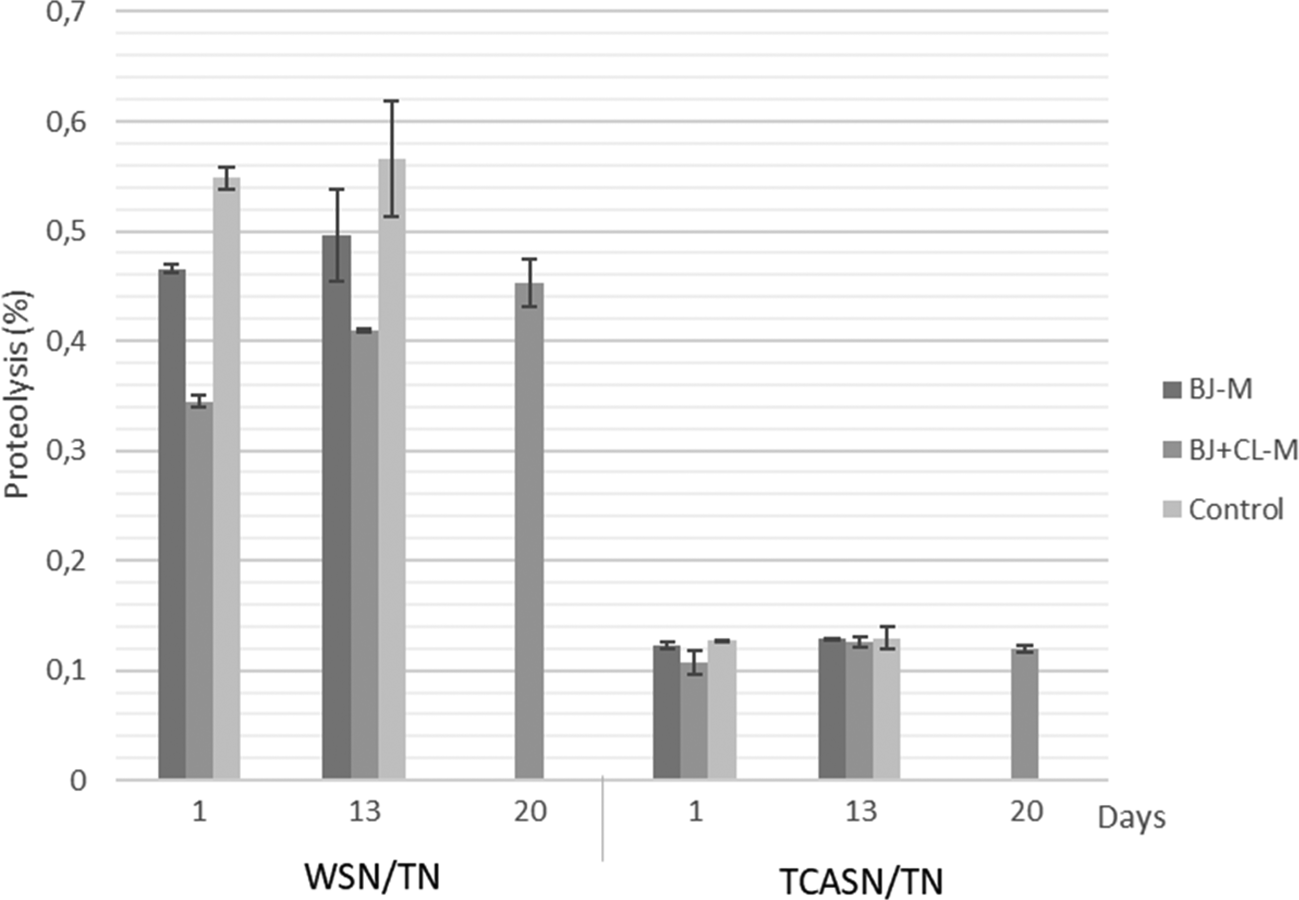
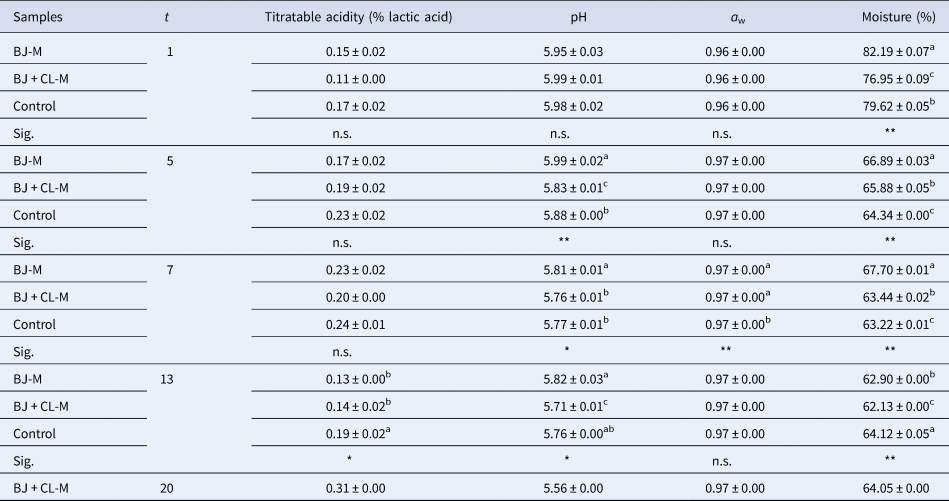
Table 1 shows the results of acidity, pH, a w and moisture of lacto-fermented mozzarella samples. There were no significant differences among samples for titratable acidity, pH and a w after 1 d. Values of titratable acidity were not significantly different among samples at each monitored time except for the 13th day where significantly higher values (P < 0.05) were found in the Control sample (0.19% lactic acid). Moreover, results of water activity did not highlight significant differences related to preserving liquid composition and storage time. BJ-M showed generally the highest pH values during the monitoring days whereas lower pH was observed in BJ + CL-M probably for the larger acidification process due to the higher LAB count. This last assessment was also confirmed by correlation results of Pearson's coefficient (r = −0.855, P < 0.05). Primary proteolysis in cheese may be defined as those changes in α-, β, χ-, caseins, peptides, and other minor bands. Secondary proteolysis products could include those peptides, small fragments of proteins and amino acids which are soluble in acid solutions (Rank et al., Reference Rank, Grappin and Olson1985). The extent of primary and secondary proteolysis in the different samples and storage time are shown in Fig. 2. The primary proteolysis, expressed as WSN/TN, increased in all samples, with higher values for Control sample and lower values for BJ-M and BJ + CL-M samples. As observed by Thibaudeau et al. (Reference Thibaudeau, Roy and St-Gelais2015) storage time significantly influenced the mozzarella cheese proteolysis (P < 0.01 for primary proteolysis and P < 0.05 in secondary proteolysis). In our studies, preserving liquid composition affected only the primary proteolysis (P < 0.05) but not secondary proteolysis. So, the effect of bergamot with calcium lactate preserves the evolution of proteolysis with differences highly significant among sample as found by ANOVA one-way analysis (P < 0.01).
Primary (WSN/TN) and secondary (TCAS/TN) proteolysis in the different samples during storage. TN: total nitrogen. WSN: water-soluble nitrogen. TCAS: TCA-soluble N. BJ-M is bergamot juice (0.1% BJ v/v) as preservative; BJ + CL-M is bergamot juice and calcium chloride (0.05% BJ v/v + 0.2% CL w/v) as preservative; Control is tap water. Values are mean ± standard deviation, n = 3.

Physico-chemical parameters of different lacto-fermented mozzarella cheeses during storage

a–c Data (mean of three replicates) followed by different lowercase letters in a line are significantly different by Tukey's multiple range test (P < 0.05). P > 0,05 n.s. not significant, P < 0.05 *, P < 0.01 ** BJ-M is bergamot juice (0.1% BJ v/v) as preservative; BJ + CL-M is bergamot juice and calcium chloride (0.05% BJ v/v + 0.2% CL w/v) as preservative; Control is tap water.
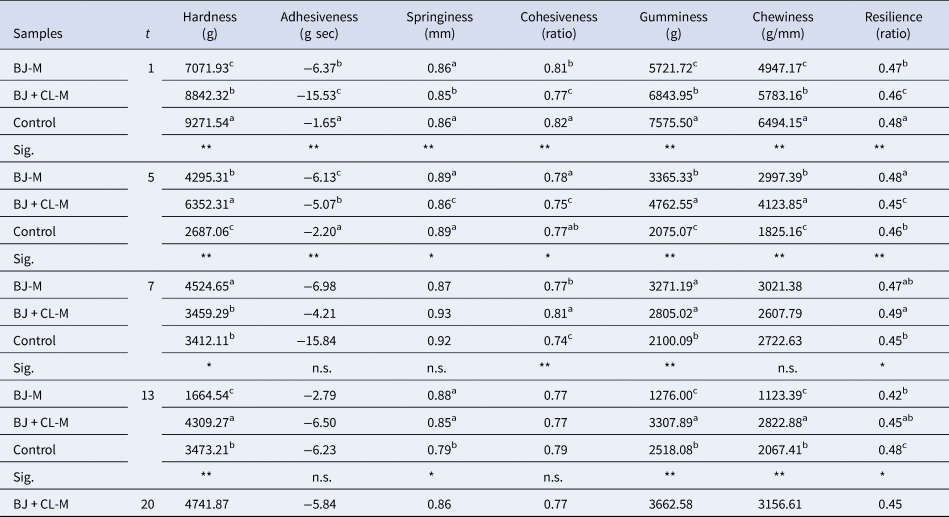
Texture profile analysis (TPA) of all samples during the storage are shown in Table 2. Time and preserving liquid composition significantly affect TPA, in particular for hardness, gumminess and chewiness (P < 0.01). At the initial time the Control had the higher hardness values (9271.54 g), then this parameter decreased in all samples for the exchange from paste to governing liquid and from governing liquid to paste of salts and water. After 13 d of storage BJ + CLM samples showed the highest hardness (4309.27 g) with highly significant differences among samples (P < 0.01). Use of calcium lactate as an alternative to commonly used salts helps to avoid the surface deterioration because of the presence of ionic calcium that counterbalances the sequestering action of the calcium bound to the casein network due to acidic action. Preserving the integrity of the mozzarella surface is a primary aim, since it represents a barrier to the mass transfer (Faccia et al., Reference Faccia, Gambacorta, Natrella and Caponio2019). Literature suggested that some texture parameters, like adhesiveness, were not useful for fresh cheeses such as mozzarella (Fiszman and Damasio, Reference Fiszman and Damasio2000; Halmos et al., Reference Halmos, Pollard and Frank2003). Our multivariate analysis did not show any effect of time on adhesiveness (P > 0.05). TPA springiness and cohesiveness for all samples ranged from 0.85 to 0.75 and 0.95 to -to 0.82, respectively. Chewiness is defined as the energy required for disintegrating solid food and is obtained by TPA hardness × TPA springiness × TPA cohesiveness. As a result, as cheese hardness values increase so does chewiness (Bourne, Reference Bourne2002). The Control sample showed higher values at initial time (6494.15) and the BJ + CL-M sample after 13 d (2822.88), in contrast to results of Fogaça et al. (Reference Fogaça, da Silva and Rodrigues2017) in a work about TPA parameters of mozzarella cheese.
Textural properties of different lacto-fermented mozzarella cheeses during storage

a–c Data (mean of three replicates) followed by different lowercase letters in a line are significantly different by Tukey's multiple range test (P < 0.05). P > 0.05 n.s. not significant, P < 0.05 *, P < 0.01 ** BJ-M is bergamot juice (0.1% BJ v/v) as preservative; BJ + CL-M is bergamot juice and calcium chloride (0.05% BJ v/v + 0.2% CL w/v) as preservative; Control is tap water.
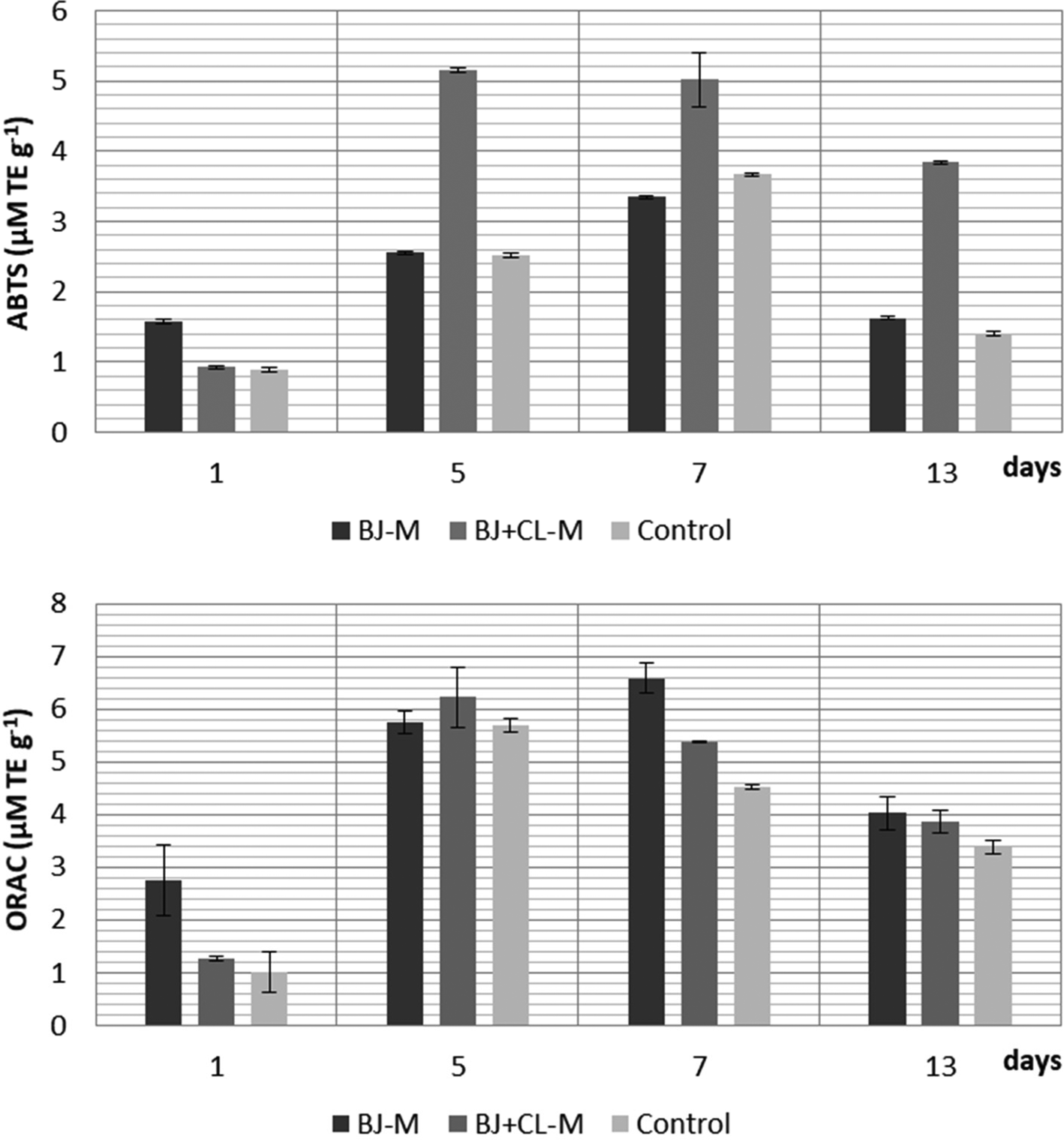
Results of antioxidant activity of mozzarella cheese sample are given in Fig. 3. Antioxidant activity of samples increased throughout the storage period with highly significant differences by multivariate analysis (P < 0.01). Also, preserving liquid composition influenced it antioxidant activity at each storage time, in particular, highly significant differences were found among samples for TEAC (P < 0.01) and for ORAC (P < 0.05). TEAC evaluated for BJ + CL-M sample increased after 5 d, preserving the greater antioxidant activity during all the storage time with a value of 3.83 ± 0.03 μm TE/g at 13 d and 6.17 ± 0.03 μm TE/g at 21 d (data not shown). Results of ORAC showed that the sample with bergamot concentrated juice had higher values throughout and, in particular, after one week from production (6.59 ± 0.28 μm TE/g). Literature showed that LAB are important for the development of the biochemical characteristics and the release of bioactive peptides, in particular during the first weeks in cheese (Santiago-López et al., Reference Santiago-López, Aguilar-Toalá, Hernández-Mendoza, Vallejo-Cordoba, Liceaga and González-Córdova2018). The bioactivities in cheese mainly develop during storage (Hossain et al., Reference Hossain, Khetra, Khade and Ganguly2018), indeed, in our experiments a correlation between Lab and ORAC was found after five days (r = 0.822).
Trolox equivalent antioxidant capacity (TEAC) (a) and oxygen radical absorbance capacity (ORAC) (b) antioxidant activity in mozzarella after 1, 5, 7 and 13 storage days, expressed as μM TE g-1. BJ-M is bergamot juice (0.1% BJ v/v) as preservative; BJ + CL-M is bergamot juice and calcium chloride (0.05% BJ v/v + 0.2% CL w/v) as preservative; Control is tap water. Values are mean ± standard deviation, n = 3.

In conclusion, lacto-fermented mozzarella cheeses stored in preserving liquid with bergamot juice concentrate combined with calcium lactate exhibited a full 20 d of shelf life, whereas those stored with bergamot juice concentrate alone or tap water alone showed a visually observable collapse of mozzarella structure after 13 d, by which time they also had the worst microbiological quality. These results support a potential shelf-life extension compared to the commonly accepted 5 d for this cheese without chemical additives or the use of modified atmosphere storage or active coating. It is notable that this 20 d shelf life was achieved with the use of calcium lactate and a natural product, which we believe will lead to good consumer acceptance.