Learning large numbers of words is an important part of becoming proficient in a second language (L2). Therefore, an important question for L2 pedagogy is how to go about the task of learning and teaching vocabulary in a way that is both successful and efficient. L2 research has addressed this question by testing different methods of learning vocabulary. One method that has been widely found to enhance retention of studied material in the field of psychology is to space repeated study of target material (Crowder, Reference Crowder1976; Dellarosa & Bourne, Reference Dellarosa and Bourne1985; Dempster, Reference Dempster1988, Reference Dempster1989; Hintzman, Reference Hintzman and Solso1974; Pavlik & Anderson, Reference Pavlik and Anderson2005; Rohrer & Pashler, Reference Rohrer and Pashler2007; Wegener, Wang, Beyersmann, Nation, Colenbrander, & Castles, Reference Wegener, Wang, Beyersmann, Nation, Colenbrander and Castles2021). This finding, widely known as the spacing effect, has also been observed with learning of L2 vocabulary (Bloom & Shuell, Reference Bloom and Shuell1981; Koval, Reference Koval2019; Nakata, Reference Nakata2015). A related finding, termed the lag effect, is the finding that how widely repeated study is spaced may have important consequences for learning outcomes (D’Agostino & DeRemer, Reference D’Agostino and DeRemer1973; Toppino, & Gracen, Reference Toppino and Gracen1985).
The spacing effect is one of the most robust and ubiquitous findings in memory research. The benefits of spacing are usually very large: it is often found that two massed (consecutive) exposures to a target item are hardly more effective than a single exposure, while two spaced exposures are often twice as effective as one (e.g., Cepeda, Pashler, Vul, Wixted, & Rohrer, Reference Cepeda, Pashler, Vul, Wixted and Rohrer2006). The spacing effect potentially holds great promise for any learning situation. However, the full extent of its potential benefits is not being exploited in educational settings (Cepeda et al., Reference Cepeda, Coburn, Rohrer, Wixted, Mozer and Pashler2009; Dempster, Reference Dempster1988; Gerbier & Toppino, Reference Gerbier and Toppino2015; Kang, Reference Kang2016; Maddox, Reference Maddox2016). Further, investigations in the context of L2 acquisition have produced mixed results regarding spacing repeated study more widely, with some studies finding that this has either no effect or a detrimental effect on learning (Collins, Halter, Lightbown, & Spada, Reference Collins, Halter, Lightbown and Spada1999; Elgort & Warren, Reference Elgort and Warren2014; Nakata, Reference Nakata2015; Nakata & Elgort, Reference Nakata and Elgort2021; Rogers & Cheung, Reference Rogers and Cheung2020a, Reference Rogers and Cheung2020b; Serrano, Reference Serrano2011; Serrano & Muñoz, Reference Serrano and Muñoz2007; Suzuki & DeKeyser, Reference Suzuki and DeKeyser2017; White & Turner, Reference White and Turner2005). In order to understand when and how spacing repeated study of L2 material may be beneficial and to be able to give useful practical recommendations regarding how to make the best use of this potentially very powerful learning tool in L2 pedagogy, it is important to understand the underlying cognitive mechanisms that drive the effects of spacing in L2 learning. It is further important to understand how the operation of these mechanisms may be affected by variables that are relevant for L2 learning contexts. Prior SLA research has tested the effects of spacing repeated study on the acquisition of various aspects of the second language and provides important information on the usefulness of this learning method for SLA contexts. However, this research has not produced much direct investigation into its underlying cognitive mechanisms and their interactions with relevant variables within the target learning contexts (although this criticism is not limited to the field of SLA, see, e.g., Dempster, Reference Dempster1988). The present study contributes to filling this gap. In the present study, I test the two-process mechanism of successful effortful retrieval during study as an underlying mechanism of spacing and lag effects in L2 vocabulary learning from retrieval practice in paired-associate learning (PAL). Such a dual mechanism is proposed to underlie spacing and lag effects within the reminding framework (Benjamin & Tullis, Reference Benjamin and Tullis2010). I further investigate how the operation of this mechanism may be affected by a variable that is relevant for second-language learning contexts, which is the amount of time a learner is given for studying a foreign word with its translation per encounter and in total (presented as feedback that follows each retrieval attempt), while holding the number of encounters constant. This latter variable is referred to, throughout this text, as feedback study time.
Explaining the spacing and lag effects
Despite the fact that research interest in the effects of spacing dates back over a century and despite the large number of theories that have been proposed in efforts to explain them (e.g., Benjamin & Tullis, Reference Benjamin and Tullis2010; Bjork & Allen, Reference Bjork and Allen1970; Challis, Reference Challis1993; Chen, Paas, & Sweller, Reference Chen, Paas and Sweller2021; Dellarosa & Bourne, Reference Dellarosa and Bourne1985; Estes, Reference Estes1955; Glenberg, Reference Glenberg1979; Greene, Reference Greene1989; Jacoby, Reference Jacoby1978; Küpper-Tetzel & Erdfelder, Reference Küpper-Tetzel and Erdfelder2012; Landauer, Reference Landauer1969; Madigan, Reference Madigan1969; Melton,Reference Melton1970; Pavlik & Anderson, Reference Pavlik and Anderson2005; Raaijmakers, Reference Raaijmakers2003; Rundus, Reference Rundus1971; Thios & D’Agostino, Reference Thios and D’Agostino1976; Zimmerman, Reference Zimmerman1975), their underlying mechanisms are still poorly understood (Kiliç, Hoyer, & Howard, Reference Kiliç, Hoyer and Howard2013; Maddox et al., Reference Maddox, Pyc, Kauffman, Gatewood and Schonhoff2018). It is widely recognized today that a different mechanism, or combination of mechanisms, may underlie the effects of spacing in different learning situations or target tasks (Chen et al., Reference Chen, Paas and Sweller2021; Gerbier & Toppino, Reference Gerbier and Toppino2015; Glenberg & Smith, Reference Glenberg and Smith1981; Greene, Reference Greene1989; Kornell & Bjork, Reference Kornell and Bjork2008; Russo & Mammarella, Reference Russo and Mammarella2002). In the present study, I investigate the contribution of successful effortful retrieval (Pyc & Rawson, Reference Pyc and Rawson2009), which is the dual mechanism proposed by the reminding account (Benjamin & Tullis, Reference Benjamin and Tullis2010), to the effects of spacing and lag in L2 vocabulary learning from L2-L1 retrieval practice.
The reminding account
The reminding account (Benjamin & Ross, Reference Benjamin, Ross and Benjamin2010; Benjamin & Tullis, Reference Benjamin and Tullis2010; Hintzman, 2004; Reference Hintzman2010; Tullis, Benjamin, & Ross, Reference Tullis, Benjamin and Ross2014) is currently a leading explanation for the lag and spacing effects. According to the reminding account, learning from repetition is beneficial when a repeated encounter with an item involves successful, but effortful retrieval of the information encoded at previous encounters. Thus, the reminding account is a dual mechanism account that combines the assumptions of the desirable difficulty and deficient processing proposals (Bjork, Reference Bjork, Metcalfe and Shimamura1994, Reference Bjork, Gopher and Koriat1999; Jacoby, Reference Jacoby1978), which hold that benefits of spacing come from the decreased effort or less attentional engagement that characterizes processing of an item when it repeats with only a very short interval between repetitions, with an important role for processing repeated events as repeated, or successfully retrieving previously encoded information during repeated study events (Hintzman, Reference Hintzman2004, Reference Hintzman2010; Thios & D’Agostino, Reference Thios and D’Agostino1976).
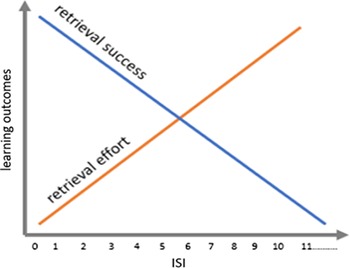
An important characteristic of the lag function (which is the function that relates lag to learning outcomes) is that it is nonmonotonic, or an inverted-U in shape (Cepeda et al., Reference Cepeda, Coburn, Rohrer, Wixted, Mozer and Pashler2009; Cepeda et al., Reference Cepeda, Pashler, Vul, Wixted and Rohrer2006; Cepeda, Vul, Rohrer, Wixted, & Pashler, Reference Cepeda, Vul, Rohrer, Wixted and Pashler2008; Küpper-Tetzel & Erdfelder, Reference Küpper-Tetzel and Erdfelder2012; Rohrer & Pashler, Reference Rohrer and Pashler2007). This means that increasing the inter-stimulus interval (ISI) is beneficial for learning but only to a point: very long ISIs may actually have negative effects on learning (Benjamin & Tullis, Reference Benjamin and Tullis2010; Cepeda, et al., Reference Cepeda, Pashler, Vul, Wixted and Rohrer2006; Maddox, Reference Maddox2016; Peterson, Wampler, Kirkpatrick, & Saltzman, Reference Peterson, Wampler, Kirkpatrick and Saltzman1963; Young, Reference Young1971). In other words, there is a limit to how widely we can space repeated study before this begins to actually have a detrimental effect on learning outcomes. Because with increasing ISIs retrieval of a previous encounter requires more effort, which is beneficial for learning according to the reminding account, but retrieval is only likely to be successful within a limited range of ISIs, beyond which such retrieval may fail, resulting in detrimental effects on learning according to the reminding account, the two processes assumed by the reminding account can together explain the shape of this function. Figure 1 presents a rough conceptual illustration of changes in retrieval effort and success that may be expected with increasing ISIs. Here, we see that if we assume the two processes proposed by the reminding account, learning will be best at a point where both effort and success are at their highest and will be inferior where either one of these is low. Thus, the reminding account can explain the nonmonotonic shape of the lag function better than proposals that assume either of the two mechanisms as the sole underlying mechanism.
A conceptual illustration of changes in retrieval effort and success during training that can be expected with increasing ISI.

A number of findings that are potentially relevant for second-language learning can be accommodated if we assume an important role for successful retrieval during the study phase as it is assumed within the reminding account. One such finding is that optimal learning is at a higher level of ISI under intentional study than it is in incidental learning (Verkoeijen, Rikers, & Schmidt, Reference Verkoeijen, Rikers and Schmidt2005). Optimal learning here refers to the “sweet spot” represented conceptually by the point where the two lines intersect in Figure 1. This finding can be explained in terms of stronger memory traces that are laid down during intentional study, which can survive longer ISIs. Another important finding is a detrimental effect of spacing on learning in situations where repeated exposures occur in different rather than similar contexts (Verkoeijen, Rikers, & Schmidt, Reference Verkoeijen, Rikers and Schmidt2004). Further, study time has been found to positively affect learning from spaced repetitions (Verkoeijen & Bouwmeester, Reference Verkoeijen and Bouwmeester2008), while task complexity and the difficulty of the intervening activity coupled with lower working memory capacity have been shown to negatively affect learning from spaced repetitions (Bui, Maddox, & Balota, Reference Bui, Maddox and Balota2013; Donovan & Radosevich, Reference Donovan and Radosevich1999). Thus, the findings that positive effects of spaced study may be tempered or even reversed under certain levels of the relevant variables can be explained through this affecting the probability of retrieval success during study (see, also, Suzuki, Nakata, & Dekeyser, Reference Suzuki, Nakata and Dekeyser2019).
The focus of the present investigation on a dual-process account that includes successful retrieval during study as an underlying mechanism is motivated by the fact that a failure to process repeated encounters with target items as repetitions has been cited, though not directly tested, in SLA research as a potential explanation for failures to observe benefits of spacing (see, e.g., Elgort & Warren, Reference Elgort and Warren2014; Serrano, Reference Serrano2011). The inclusion of the second element of effortful processing is motivated by the widely held belief that attentional engagement and effort are beneficial for learning of second-language vocabulary (Godfroid, Boers, & Housen, Reference Godfroid, Boers and Housen2013; Laufer & Hulstijn, Reference Laufer and Hulstijn2001; Schmitt, Reference Schmitt2008) as well as the finding that deficient processing of massed encounters mediates the benefits of spacing in L2 vocabulary learning (Koval, Reference Koval2019).
Study time
There is potentially a large number of variables in L2 learning contexts that may affect the operation of the mechanisms of retrieval effort and success. The present study tests the moderating effects of one such variable, which is externally predetermined feedback study time. Longer study time might promote retrieval success with spaced repetitions due to stronger encodings at each repetition that are more likely to survive longer lags (Verkoeijen & Bouwmeester, Reference Verkoeijen and Bouwmeester2008). Verkoeijen and Bouwmeester inferred such an underlying process from their finding that their lower-performing group benefitted from spaced practice only under the longer study time condition. They did not, however, directly test this possibility. Further, intuitively, longer study time might also reduce retrieval effort. Thus, study time might moderate the effects of spacing L2-L1 retrieval practice on the underlying mechanisms of retrieval effort and success and thus affect learning.
Longer study time might also have an independent effect on learning. In both psychology and SLA, studies show that the more time a learner spends studying a word, the better the learning outcomes are (Godfroid et al., Reference Godfroid, Ahn, Choi, Ballard, Cui, Johnston, Lee, Sarkar and Yoon2018; Godfroid, et al., Reference Godfroid, Boers and Housen2013; Koval, Reference Koval2019; Rundus, Reference Rundus1971). Importantly, longer study time has also been shown to mediate the benefits of spacing in L2 word learning (Koval, Reference Koval2019). The latter finding suggests that increased attentional processing underlies the benefits of spacing L2 vocabulary study. Findings from studies investigating self-regulated study time allocation suggest that learners tend to overestimate their knowledge of items in massed practice and devote less study time to these (Benjamin, Bjork, & Schwartz, Reference Benjamin, Bjork and Schwartz1998; Kornell & Bjork, Reference Kornell and Bjork2007; Koval, Reference Koval2019; Rundus, Reference Rundus1971; Shaughnessy, Zimmerman, & Underwood, Reference Shaughnessy, Zimmerman and Underwood1972; Zechmeister & Shaughnessy, Reference Zechmeister and Shaughnessy1980; Zimmerman, Reference Zimmerman1975). Generally, learners are known to be quite ineffective at pacing their own study (Benjamin et al., Reference Benjamin, Bjork and Schwartz1998; Jacoby, Bjork, & Kelley, Reference Jacoby, Bjork, Kelley, Druckman and Bjork1994; Kornell & Bjork, Reference Kornell and Bjork2007). An interesting question that has important practical implications is whether externally predetermined longer study time affects learning in the same way as does learner-regulated longer study. If learners tend not to be effective at pacing their study, can we enhance learning by controlling the pace at which words are studied?
Retrieval practice
In this study, participants learn vocabulary from L2-L1 retrieval practice. Retrieval practice has been shown to enhance learning of studied material, including learning of L2 vocabulary (Barcroft, Reference Barcroft2007; Carrier & Pashler, Reference Carrier and Pashler1992; Cull, Shaughnessy, & Zechmeister, Reference Cull, Shaughnessy and Zechmeister1996; Karpicke & Roediger, Reference Karpicke and Roediger2008; Nakata, Reference Nakata2015, Reference Nakata2016; van den Broek, Takashima, Segers, & Verhoeven, Reference van den Broek, Takashima, Segers and Verhoeven2018). The act of retrieval has been shown to slow and otherwise interfere with forgetting of learned information (Hogan & Kintsch, Reference Hogan and Kintsch1971; Izawa, Reference Izawa1970; Maddox & Balota, Reference Maddox and Balota2015; Runquist, Reference Runquist1986; Wheeler & Roediger, Reference Wheeler and Roediger1992). Retrieval practice may further often constitute more transfer-appropriate processing for many skills (Kolers & Roediger, Reference Kolers and Roediger1984; McDaniel, Friedman, & Bourne, Reference McDaniel, Friedman and Bourne1978), such as when the meaning of an L2 word must be retrieved during comprehension of L2 input. Retrieval practice is believed to be more beneficial the more effortful, or complete the retrieval (Bjork, Reference Bjork and Solso1975; Glover, Reference Glover1989; Pyc & Rawson, Reference Pyc and Rawson2009; Whitten & Bjork, Reference Whitten and Bjork1977). In fact, even when increased effort means more retrieval failures or errors during the learning phase, this is still argued to result in better retention in the long term (Pashler, Zarow, & Triplett, Reference Pashler, Zarow and Triplett2003; Schmidt & Bjork, Reference Schmidt and Bjork1992; Soderstrom, Kerr, & Bjork, Reference Soderstrom, Kerr and Bjork2016; Storm, Bjork, & Storm, Reference Storm, Bjork and Storm2010). Unsuccessful retrieval attempts are still known as powerful learning events because they are believed to promote deeper processing of the feedback that follows (Arnold & McDermott, Reference Arnold and McDermott2013; Hays, Kornell & Bjork, Reference Hays, Kornell and Bjork2013; Izawa, Reference Izawa1970; Kornell, Hays, & Bjork, Reference Kornell, Hays and Bjork2009; Roediger & Karpicke, Reference Roediger and Karpicke2006a).
Just as is the case with the spacing effect, retrieval practice has been widely found to be beneficial for learning. Just as is the case with the spacing effect, however, its full potential has not been used in education (McDaniel & Fisher, Reference McDaniel and Fisher1991; Roediger & Karpicke, Reference Roediger and Karpicke2006b). Given that retrieval practice improves learning and that repeated retrieval further enhances learning (Karpicke & Roediger, Reference Karpicke and Roediger2008), an important question is what role the temporal distribution of such practice may play (Nakata, Tada, Mclean, & Kim, Reference Nakata, Tada, Mclean and Kim2021). Spaced retrieval practice combines the benefits of spacing and retrieval and thus potentially maximizes learning. How best to use it is still a question, however (Storm et al., Reference Storm, Bjork and Storm2010).
Retrieval practice and spacing effects in SLA
Effects of spaced practice have received some attention in the field of SLA (Bird, Reference Bird2010; Bloom & Shuell, Reference Bloom and Shuell1981; Kasprowicz, Marsden, & Sephton, Reference Kasprowicz, Marsden and Sephton2019; Lee, Maechtle, & Hu, Reference Lee, Maechtle and Hu2021; Miles, Reference Miles2014; Miles & Kwon, Reference Miles and Kwon2008; Nakata, Reference Nakata2015; Nakata & Suzuki, Reference Nakata and Suzuki2019; Nakata & Webb, Reference Nakata and Webb2016; Rogers, Reference Rogers2015; Rogers & Cheung, Reference Rogers and Cheung2020a, Reference Rogers and Cheung2020b; Schuetze, Reference Schuetze2015; Serrano & Huang, Reference Serrano and Huang2018, Reference Serrano and Huang2021; Suzuki, Reference Suzuki2017; Suzuki & DeKeyser, Reference Suzuki and DeKeyser2017; Suzuki & Sunada, Reference Suzuki and Sunada2020). While many of these studies have found benefits of spacing L2 study, others have found no effect or even a detrimental effect of spacing repetitions more widely (Collins et al., Reference Collins, Halter, Lightbown and Spada1999; Elgort & Warren, Reference Elgort and Warren2014; Nakata, Reference Nakata2015; Rogers & Cheung, Reference Rogers and Cheung2020a, Reference Rogers and Cheung2020b; Serrano, Reference Serrano2011; Serrano & Huang, Reference Serrano and Huang2021; Serrano & Muñoz, Reference Serrano and Muñoz2007; Suzuki & DeKeyser, Reference Suzuki and DeKeyser2017; White & Turner, Reference White and Turner2005) or that the finding of such an effect may depend on the learning outcome measure used (Nakata & Elgort, Reference Nakata and Elgort2021). In order to know when and how spacing practice may be useful for L2 learning, it is important to understand the cognitive mechanisms that underlie effects of spacing in our specific learning situations and how the operation of these cognitive mechanisms may be affected by variables inherent in L2 learning contexts. SLA research has, thus far, focused mainly on the question of whether or not spacing affects the acquisition of different aspects of a second language, without much focus on the process as well as the product of learning. There are a few exceptions, however (Koval, Reference Koval2019; Nakata & Suzuki, Reference Nakata and Suzuki2019; Suzuki, Nakata, & Dekeyser, Reference Suzuki, Nakata and Dekeyser2019, Reference Suzuki, Nakata and Dekeyser2020). Nakata and Suzuki (Reference Nakata and Suzuki2019), for instance, measured learners’ retrieval success during the study phase through the task of overt L2-L1 translation. However, the authors broke down the study of their 48 target words into 2 sets of 24 to minimize retrieval failure during study and did not test its effects on learning. Suzuki and DeKeyser (Reference Suzuki and DeKeyser2017) included an ad hoc analysis of lexical retrieval performance during training on an element of L2 Japanese morphology and speculated that ease and success of lexical retrieval may affect the nature of cognitive processes involved in distributed and massed learning. Another study that has investigated the process as well as the product of learning under differential spacing is Koval (Reference Koval2019). In Koval (Reference Koval2019), I used eye-tracking methodology to measure reading times and showed that diminished processing of L2 words studied in a massed fashion during sentence reading mediated the large benefits of spacing obtained in my study.
More research is needed that explores the process as well as the product of learning L2 material under different levels of ISI. The present study contributes to an understanding of this process by examining the effects of successful effortful retrieval during study. Both retrieval success and effort may depend on a number of factors. One such factor may be the amount of time a learner is given for studying an L2 word with its translation per repetition. The longer the study time, the stronger the resulting encodings are likely to be (Verkoeijen & Bouwmeester, Reference Verkoeijen and Bouwmeester2008), resulting in a higher level of retrieval success. At the same time, stronger encodings may mean less retrieval effort during subsequent presentations. Thus, feedback study time may have important consequences for the operation of both underlying mechanisms investigated in the present study.
Retrieval practice has been shown to be beneficial for L2 vocabulary learning (Barcroft, Reference Barcroft2007; van den Broek et al., Reference van den Broek, Takashima, Segers and Verhoeven2018). Further, psychology studies using L2 words as the learning targets have generally obtained benefits of spaced retrieval practice over massed retrieval practice as well as benefits of retrieval over restudying, particularly when knowledge is tested after a longer retention interval (RI), such as on delayed tests (Arnold & McDermott, Reference Arnold and McDermott2013; Bahrick et al.,Reference Bahrick, Bahrick, Bahrick and Bahrick1993; Carrier & Pashler, Reference Carrier and Pashler1992; Karpicke & Roediger, Reference Karpicke and Roediger2008; Pashler et al., Reference Pashler, Zarow and Triplett2003; Pavlik & Anderson, Reference Pavlik and Anderson2005; Pyc & Rawson, Reference Pyc and Rawson2009). A similar finding by Nakata et al. (Reference Nakata, Tada, Mclean and Kim2021) is that cumulative L2 vocabulary tests are more beneficial than noncumulative tests. The authors suggest that one of the reasons cumulative tests may produce learning benefits is that learners are forced to review and retrieve the target information in a distributed fashion.
What is still not clear, however, is whether retrieval success is important, as proposed in the reminding account, when retrieval attempts are followed by feedback. It has been argued that, when feedback is provided, failure to retrieve L2 vocabulary information is beneficial for learning outcomes (Bahrick & Hall, Reference Bahrick and Hall2005; Pashler et al., Reference Pashler, Zarow and Triplett2003). However, in these studies, effects of retrieval failure were not directly tested but only inferred. The present study directly tests the effects of retrieval failure during study that might result from longer ISI on learning outcomes. The present study investigates three levels of ISI within a declarative knowledge acquisition task. During study, retrieval effort should be highest at the longest ISI and lowest at the shortest ISI, while retrieval success should show the opposite pattern. If the dual mechanism proposed by the reminding account underlies the benefits of spacing L2 vocabulary study more widely, retrieval effort and success should together mediate the benefits of longer ISI. Further, the feedback study time variable should affect both retrieval success and effort during training, whereby words that are studied under the longer study time condition should be retrieved more successfully but also with less effort during each subsequent repetition.
Method
The present study is motivated by the following research questions:
-
1. Does the amount of lag between repeated retrieval-restudy events affect learning of L2 vocabulary?
-
2. Does feedback study time affect the relationship between lag and learning of L2 vocabulary?
-
3. Does successful effortful retrieval mediate the effects of lag on L2 vocabulary learning?
-
4. Does feedback study time affect the operation of the two mechanisms of retrieval success and effort during study?
Participants
Fifty-two native speakers of English (young adults) participated in the experiment. These were mostly undergraduate students in a wide variety of majors at Michigan State University who had responded to an ad placed through the Office of the Registrar. Twenty-two were male and 30 were female, aged 18–29 years (M = 20.04, SD = 2.08, Median = 20). Most of these students had studied at least one foreign language. None reported being familiar with the Finnish language. The participant sample size was based on previous research that has successfully used a similar population and materials to ask similar research questions (Koval, Reference Koval2019). Throughout the results section, I will discuss the informational value of the results given the present sample size. All 52 participants completed the experiment with the exception of 4 participants who did not return for the delayed posttests and thus did not provide delayed posttest data. Based on a suggestion from two anonymous reviewers, these four participants’ data were excluded from the analyses.
Materials and design
A fully counterbalanced within-item within-participant design was used. The experiment consisted of a study phase, a distractor math task, 30-min delayed vocabulary posttests (referred to as immediate posttests), and 1- to 2-week delayed vocabulary posttests (referred to as delayed posttests).
Study phase
Finnish was selected as the target language for the study. Finnish is a relatively uncommon L2 for US students. Being a language of the Finnic family, it also bears little resemblance to English or languages that are commonly studied by US students. Further, Finnish is written in the same alphabet as English, the participants’ L1, which allowed to control for reading difficulty. All diacritic marks were removed from all Finnish words used in the experiment.
Seventy-two Finnish nouns were selected as the target words. None of these nouns were cognates of their English translations. The 72 target words were divided into 2 main lists (36 words each). The words on each list served as repeated targets half of the time and as once-presented controls the other half. The purpose of the unrepeated controls was to investigate the effects of retrieval practice in the three ISI conditions against a baseline of no retrieval practice. Within the lists, the words were further divided into three ISI sublists (12 words each), each to be used in each of the three levels of ISI (massed, short-spaced, and long-spaced) when serving as repeated targets. Each ISI list was further divided in half for the two levels of feedback study time (3 vs. 9 s). The feedback study time variable was operationalized as the duration of time feedback in the form of the target word pair stayed on the screen. Study-phase instructions asked the participants to study and rehearse the feedback for as long as it remained on the screen and to continue doing so even if they felt that they had learned a given word pair sufficiently. Thus, this variable was used to explore the effects of active engagement with the study of the word pairs for different durations of time. The two levels of feedback study time were determined as short and long based on the presentation duration used in other similar studies (e.g., Nakata & Suzuki, Reference Nakata and Suzuki2019) as well as participants’ comments during the piloting stage. The two study time lists were matched on the number of letters. Four to five participants fell into each of the 12 lists that resulted from full counterbalancing.
The target words ranged in length from four to eight letters (see Appendix A). The N-Watch program (Davis, Reference Davis2005) was used for information on frequency of the English translations. CELEX frequency and LOG 10 frequency were used. In N-Watch, LOG 10 frequency is based on the CELEX English Linguistic Database (Baayen, Piepenbrock, & van Rijn, Reference Baayen, Piepenbrock and van Rijn1995). Brysbaert, Warriner, and Kuperman’s (Reference Brysbaert, Warriner and Kuperman2014) database of concreteness ratings was used for indices of concreteness. Appendix B presents frequency and concreteness information for the English translations in each condition. The target nouns were matched exactly on the number of letters between all lists and sublists. Two hundred and ten additional Finnish words were selected to serve as practice and recency items as well as filler trials during the study phase. The fillers were used to achieve the desired order of target items as well as to increase orthographic interference. They also served to prevent participants from noticing a pattern of repetition among the target words. The filler items were similar to the target items in form. Care was taken to exclude potential study-phase fillers that stood out as overly similar in form to the target items, the posttest distractor items, or to each other. Some of the fillers were followed by translations and others were not. Some fillers repeated and others were only presented once.
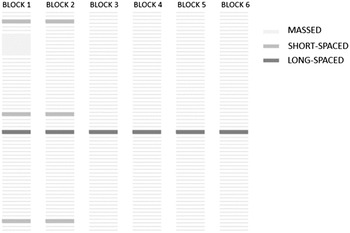
The target words repeated six times. The study phase was divided into six experimental blocks with 6-min breaks in between. This was done to allow participants breaks as well as to organize the distribution of the six repetitions of a word more neatly. The words in the massed condition repeated six times within each block. These were separated by 0–1 intervening trials. While massed practice, in its strictest sense, involves no intervening trials between repetitions (e.g., Cepeda et al., Reference Cepeda, Pashler, Vul, Wixted and Rohrer2006), intervening trials were included here in order to dilute the six consecutive repetitions, particularly with regard to how predictable each next trial was as a repetition of the previous trial. However, the intervening Finnish words that separated repetitions in the massed condition were always fillers that were not accompanied by a translation in order to preserve the massed nature of study of word meanings. Thus, study in the massed condition was never interrupted by study of another form-meaning pair. The words in the short-spaced condition repeated over two consecutive blocks (three times per block) and were separated by 17–38 trials within a block and by 12–22 trials plus the 6-min distractor math task between two adjacent blocks. The words in the long-spaced condition repeated once per block and were separated by 71–119 trials plus the 6-min intervening distractor math task. The once-presented control words were distributed more or less evenly throughout the study phase. The average position across the experimental sequence was equated for the words in all four conditions (massed: 249.82; short-spaced: 249.97; long-spaced: 251.10; and controls: 248.44). Figure 2 presents the conceptual pattern of repetition for one item in each ISI condition across the six blocks. ISI was a within-participant manipulation, which means that each participant studied words under all three ISI conditions.
A conceptual illustration of the repetition pattern for one item in each condition.

Each experimental block started and ended with three filler items. The conditions were equally represented at the beginnings and ends of blocks: blocks 2, 4, and 6 began and ended with two control items; block 1 began and ended with an item from the massed condition (all six repetitions); block 3 began and ended with two items from the short-spaced condition (1 repetition); and block 5 began and ended with two items from the long-spaced condition (1 repetition).
A practice block preceded the experimental sequence. A recency block followed the sixth experimental block. These blocks contained some of the same fillers that were used in the study phase. The purpose of the recency block was to minimize any recency or order effects on the 30-min delayed (immediate) posttest. All fillers that were translated were used in the practice and recency blocks. To resemble target items, these had to be translated. The rest of the fillers were not translated in order not to overwhelm participants with the number of translations they had to memorize. Fillers that were associated with their L1 translations were not in any way different from the target words from the point of view of the participant. Further, these often repeated in a similar pattern to the target words, except that the number of repetitions and the pattern of repetition was different and more haphazard. This was done to prevent participants from anticipating a pattern of repetition for the target items. The practice block served to minimize any effects of primacy as well as to familiarize the participants with the procedure.
Distractor math task
Participants performed addition, subtraction, multiplication, and division operations. Sometimes, they were asked to do mental math; other times, they were allowed to use paper. Such variety in activity was used to minimize boredom and fatigue.
Posttests
Three sets of paper-and-pencil posttests (see Appendix C) were used and were administered in a fixed order. Posttest 1 was a form recognition test. Here, the 72 target words were presented among 156 new Finnish words (distractors) that had not occurred during the study phase. Participants were to underline words that they recognized as ones studied during the study phase.
Posttest 2 was an L2-L1 translation test. Here, participants were to write the English translations next to the target Finnish words (on Sheet A).
Posttest 3 was a form-meaning matching test. Here, participants were presented with the English translations for all the target Finnish words (Sheet B). Participants were to write the numbers associated with English translations on Sheet B next to the corresponding Finnish words on Sheet A, which had been used in Posttest 2. Identical tests were used in immediate and delayed administrations except for order randomization between and within participants. A different set of distractors was used for the immediate and delayed form recognition tests, however.
Background questionnaire
Information was collected on participants’ age, sex, languages studied, and any other information that the participants felt was relevant. The questionnaire also asked to indicate whether any of the studied words had struck participants as familiar upon initial encounter and to elaborate if the answer was yes.
Instruments
The DMDX software (Forster & Forster, Reference Forster and Forster2003) was used on an HP laptop computer for stimulus presentation and recording of response latencies. Two Transcend voice recorders were used to record participants’ oral responses.
Procedure
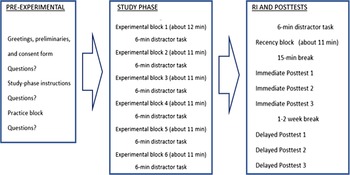
The experimental procedure is summarized in Figure 3. The entire experiment was approximately 3 hr and 45 min in duration, over two sessions, per participant. Session one was about 3 hr and 10 min. Session two was between 20 and 35 min. Session one included the study phase, a 15-min break, the immediate posttests, and the background questionnaire. Session two included only the delayed posttests. The two sessions were separated, depending on participant availability, by approximately 1 or 2 weeks. The experiment was conducted with each participant individually in a small quiet lab.
A summary of the experimental procedure.

The practice block consisted of 83 trials. After and during the practice block, the participants were encouraged to ask any questions they might have. Following the completion of the practice block, the experimental blocks were completed in order, separated by 6-min distractor tasks. Block one consisted of 110 trials. Each subsequent block consisted of 90 trials. Block one took 12 min, on average, and each subsequent block took 11–12 min, on average, to complete.
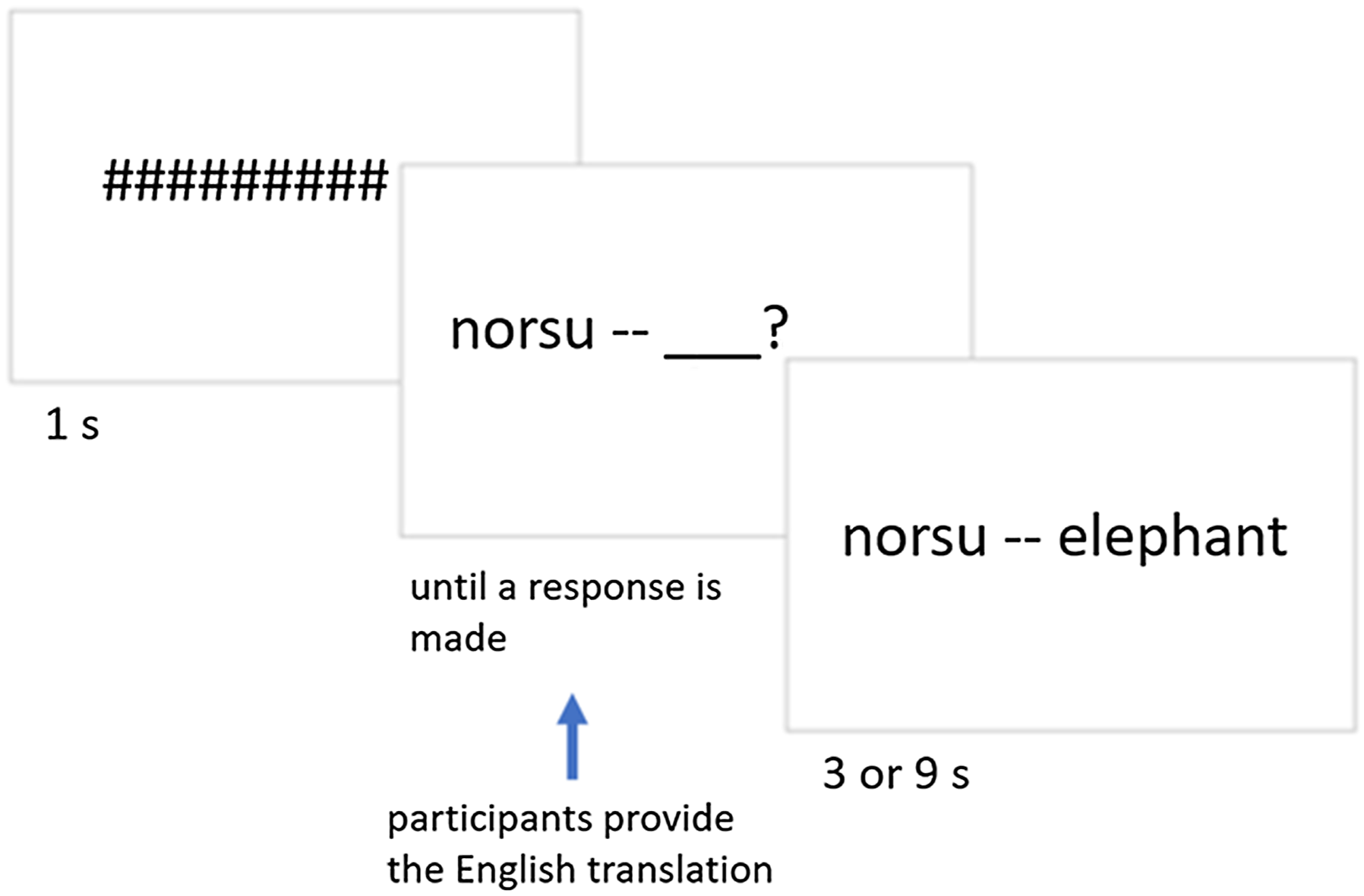
Figure 4 presents an example of an experimental study-phase trial sequence. Each trial started with a row of hash symbols presented in the center of the screen for 1 s, after which it was replaced by a Finnish word prompting participants to produce its English translation. The participants were to say the translations aloud as quickly and accurately as they could while their responses were audio-recorded. If a participant could not remember a translation or if they thought that they had never seen the translation for a given word, they were to say “I don’t know.” Response time was recorded through a button press by the researcher, which initiated the next screen, on which the L1 translation appeared opposite the Finnish word. The pair stayed on the screen for 3 s or 9 s, depending on the level of exposure duration assigned to the word for the specific rotation version, after which the next trial began. Participants had been instructed to study each word pair for as long as it remained on the screen and not to stop studying it even if they felt that it had been sufficiently learned. Distractor words that were presented with translations followed the same sequence. If a distractor word was not presented with a translation, the button press initiated the next trial. The researcher asked the participants how they were feeling at the end of each block, to which all responded that they were feeling good. However, based on the observation, during piloting, that many participants felt like it was difficult to remain seated for the entire duration of the study phase, after blocks 4, 5, and 6, the researcher suggested a walk outside the lab as part of the distractor math task. During the walk, participants performed mental math operations that the researcher asked them to perform. A few participants indicated that they did not feel like taking a walk – these participants performed the distractor math task in its entirety in the lab. The math task was mostly interactive, which was also done to cut down on possible fatigue.
An example of an experimental study-phase trial sequence.

After the recency block, there was a 15-min break, during which participants were free to leave the lab. After the break, participants performed posttests 1, 2, and 3, in order, untimed, and completed the background questionnaire. Participants were asked to return for the second session 2 weeks after session one. However, not all participants were able to come back in exactly 2 weeks. For those who were not, session two was mostly conducted with a shorter interval between the two sessions. Participants can be divided into two groups: 21 participants who came back 6–8 days after session one and 26 participants who came back 11–16 days after session one. Following the suggestion of one of the anonymous reviewers, I additionally performed analyses only on the data from participants who came back after a 2-week period. This did not change the pattern of results.
Participants were not told anything about the content of the second session. Session two was identical in content to the immediate posttests. At the end of session two, participants were asked whether they had had any exposure to the target Finnish words outside of the lab between the two sessions. This was noted by the researcher. All participants except one (whose delayed posttest data were removed from the analysis) stated that they had had no such exposure.
Analyses and results
SPSS version 25 (IBM Corp., 2017) was used for all statistical analyses. Microsoft Office 365 Excel and PowerPoint were used for data management and some of the graphics. Linear mixed modeling and moderated mediation analyses were used. All statistical analyses were two-tailed and conducted at an alpha level of .05 except for cases where a Bonferroni correction was performed. Cohen’s d effect sizes were calculated for the study phase and posttest results and interpreted in terms of the benchmarks suggested by Plonsky & Oswald (Reference Plonsky and Oswald2014) but also in terms of the comparisons being made, which can also affect the substantive interpretation of an effect size in important ways. The posttests were scored as follows: one point was awarded for each correct response and zero points were awarded for an incorrect response or no response. On the translation test, synonyms that were very close to the target meanings (e.g., cigar for cigarette – there were no synonyms that did not have a very close meaning to the target word) as well as slight misspellings (there were no serious misspellings) were counted as correct responses.
Background questionnaire
See the Participants section for the demographic information collected through the background questionnaire. Six participants noted that some or many of the words looked like Spanish words or words from other languages in terms of the spelling. The rest of the participants indicated that none of the words had struck them as familiar or elaborated on their mnemonic devices, such as breaking words down into “mini words” that helped to “remember the whole word.”
Posttest results
To answer the first and second research questions, posttest results were examined as a function of ISI and feedback study time. Reliability (Cronbach’s α) for the posttests was as follows: immediate form recognition: α = .694; immediate L2-L1 translation: α = .790; immediate form-meaning mapping: α = .789; delayed form recognition: α = .779; delayed L2-L1 translation: α = .724; delayed form-meaning mapping: α = .882. According to Plonsky and Derrick (Reference Plonsky and Derrick2016), this reflects medium to moderately high reliability in comparison to the reliability that has been reported for other instruments in the field. Form recognition accuracy was acceptable for all participants (< 10% error) except for two participants on the immediate test and one participant on the delayed test. These participants’ data were excluded for the corresponding tests.
Posttest results: Descriptive statistics
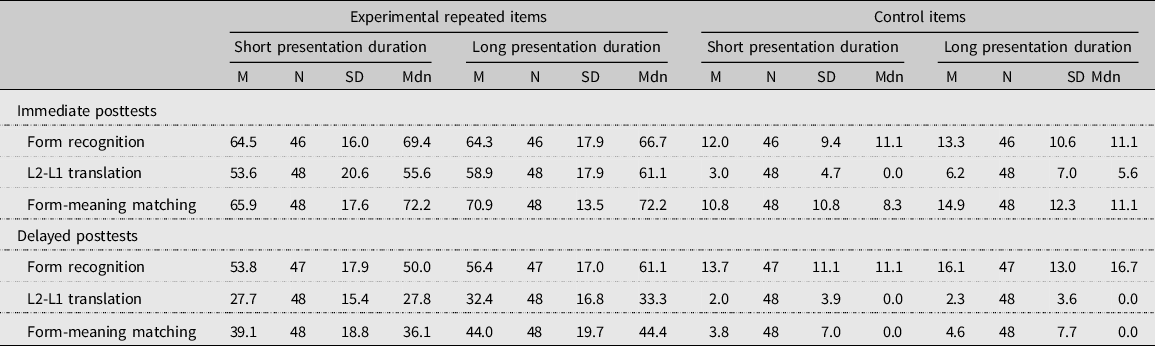
Table 1 presents percent correct scores on the immediate and delayed posttests separately in the experimental and control conditions. The table shows that there is a positive effect of practice on all the tests, across the two test administrations. There is further a small positive overall effect of longer feedback study time in both conditions across the test types, in both test administrations.
Percent correct in the practice and no-practice conditions

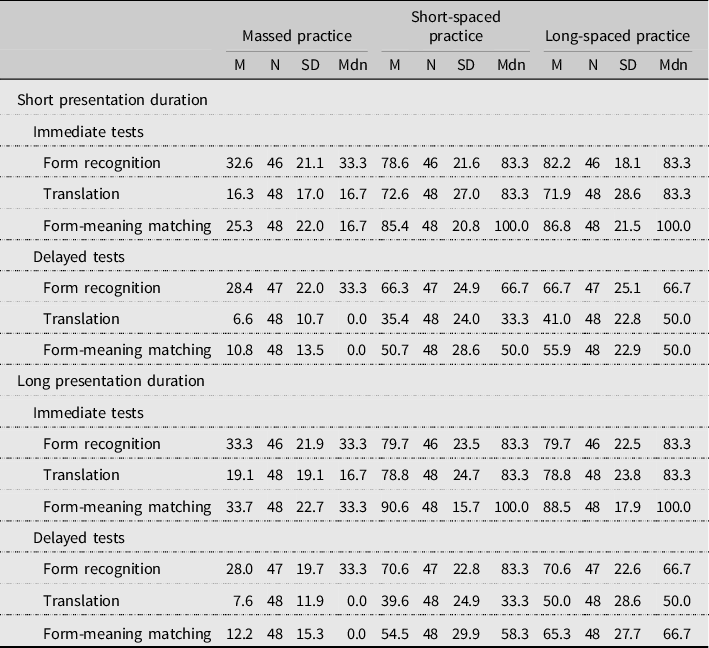
Table 2 presents percent correct scores in the three ISI conditions separately. Across the tests, there is a beneficial effect of spacing practice. In fact, median scores on both delayed meaning tests in the massed condition are zero, across the two levels of feedback study time. Although increasing the time a learner spends studying feedback per repetition and in total appears to benefit learning, spacing practice appears to have a much greater benefit, based on these percent correct descriptive statistics. The benefits of lag, however, do not appear to be as large or consistent: the long-spaced condition has produced scores that are only a bit larger than those in the short-spaced condition and this difference looks to be mostly limited to the delayed scores. Separate analyses further showed that the overall pattern of descriptive statistics was similar between the two genders.
Percent correct in the three ISI conditions

Posttest results: Inferential statistics
ISI, RI (immediate vs. delayed test), and feedback study time were included as the independent variables in an omnibus test for each test type. Percent correct was used as the dependent variable. Due to high collinearity between the two variables of ISI and the variable that distinguishes experimental items from control items, these were collapsed into one variable that will be referred to as practice type. Because participants varied in the time between study-phase and delayed posttests, a random slope was included for the RI variable. Simultaneous entry with restricted maximum likelihood estimation was used.
The residuals for the form recognition test were close to normally distributed with two outliers beyond −3SD and two outliers beyond 3SD, which were removed. This resulted in a normal distribution according to the Kolmogorov–Smirnov (p = .200) and Shapiro–Wilk (p = .153) tests of normality. The distribution further had skewness and kurtosis within acceptable ranges (skewness = −.164, SE skewness = .090; kurtosis = −.1.09, SE kurtosis = .179). The ICC for the effect of participant was .055. The residuals for the L2-L1 translation test were close to normally distributed with two outliers beyond −3SD. After the removal of these outliers, the distribution was normal according to the Kolmogorov–Smirnov (p = .200) and Shapiro–Wilk (p = .203) tests of normality. The distribution further had skewness and kurtosis within acceptable ranges (skewness = −.159, SE skewness = .088; kurtosis = −.100, SE kurtosis = .176). The ICC for the effect of participant was .041. The distribution of the residuals for the form-meaning matching test was close to normally distributed with five outliers beyond −3SD. These outliers were removed, which resulted in a more nearly normal distribution (skewness = −.267, SE skewness = .089; kurtosis = .260, SE kurtosis = .177). The Kolmogorov–Smirnov and Shapiro–Wilk tests of normality were not significant at the .001 alpha level, (p = .036 and .002, respectively). Further, the distribution looked symmetrical and bell-shaped, and the normal Q–Q plot also did not show much deviation from the diagonal. The ICC for the effect of participant was .042.
There was a significant interaction between RI and practice type in all three tests: form recognition: F (3, 633.060) = 8.055, p < .001; translation: F (3, 655.853) = 53.908, p < .001; and translation matching: F (3, 652.992) = 29.186, p < .001. There were no other significant interactions (all ps > .05). Feedback study time did not interact with any of the other independent variables in any of the tests (all ps > .05). Feedback study time did not have a significant main effect for the form recognition test: F (1, 633.159) = 1.322, p = .251, d = 0.06. Here, the effect size is very small. A larger sample size may be needed for such a small effect to be found significant; however, its size tells us that it may not be practically interesting. Feedback study time had a significant positive main effect for the other two tests: translation, F (1, 655.856) = 13.606, p < .001, d = 0.21; and translation matching, F (1, 653.004) = 15.241, p < .001, d = 0.23. Here, the effect sizes are a bit larger but still very small, suggesting only a slight benefit of longer study. In evaluating effect sizes of an intervention, it is important to consider its cost. Given that such longer presentation duration takes three times more time, it may not be a good investment given the small effect sizes that may result.
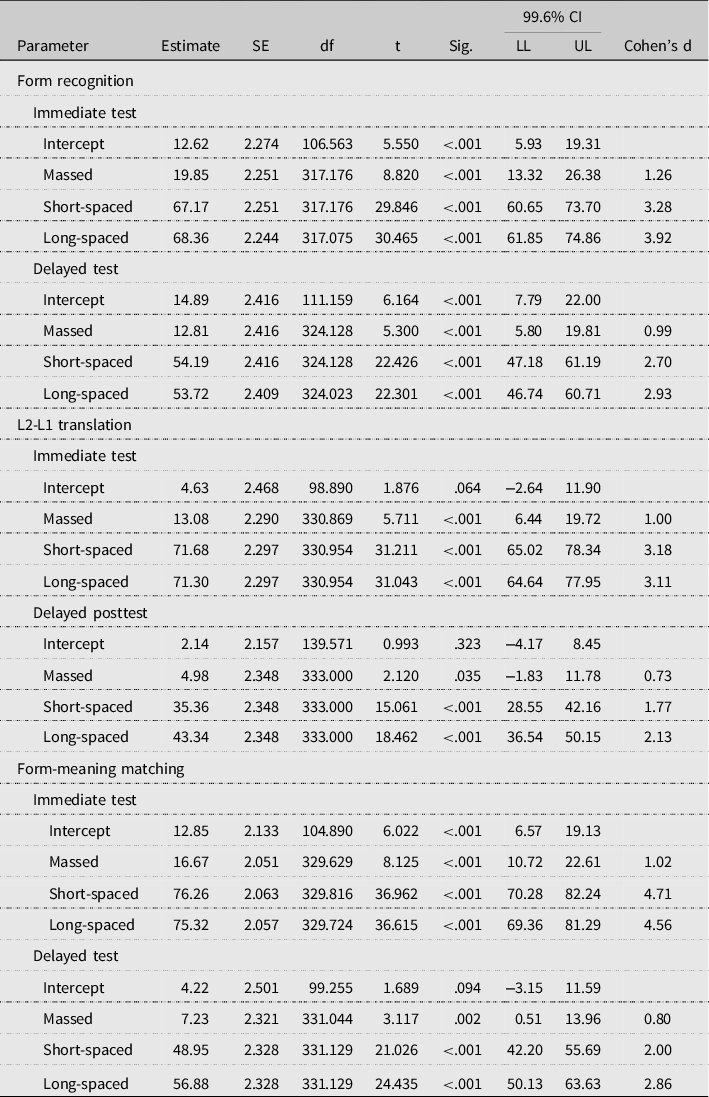
To investigate the RI by practice type interaction, separate linear mixed effects analyses were run for the immediate and delayed posttests with practice type as a four-level independent variable. For consistency, all analyses were run with and without Time of Delayed Test as a covariate. Both sets of analyses showed the same pattern of results. For this reason, this covariate was excluded in order to preserve the meaningfulness of the parameter estimates in tests that could not have been affected by this covariate (immediate tests). Parameter estimates were examined with the no-practice condition and the short-spaced condition as the reference categories in two separate analyses. This allowed to compare all the levels of practice type with a minimum number of separate comparisons. For each test, the Bonferroni correction was used: α = .05/4 = .012. Table 3 presents the parameter estimates for the effects of practice in each ISI condition. Here, the estimates are in raw percentages. The intercept represents the mean score in the no-practice condition and each slope represents the mean difference between the no-practice condition and the corresponding practice condition. The null hypothesis for the intercept is that the mean score in the no-practice condition is equal to zero. The null hypothesis for each slope is that the scores in the corresponding condition are not different from the scores in the no-practice condition. The Cohen’s d effect sizes here were calculated against the baseline of no practice.
Results relative to the no-practice condition

There was a significant difference between the results in the no-practice condition and each of the practice type conditions for each test type in the immediate scores. The delayed scores show a similar pattern with the exception of the translation scores in the massed condition. The slopes are positive throughout, indicating benefits of practice. However, the slopes are of different magnitudes. Thus, while the effects of retrieval practice are quite large in the two spaced conditions, the effects in the massed condition are considerably smaller. Further, the scores on the delayed translation test are not significantly different between the massed practice and the no-practice conditions at the corrected alpha level. Here, the difference between the two conditions is only roughly 5%, suggesting a negligible benefit of massed retrieval practice for L2-L1 translation ability in the long term. The Cohen’s d effect sizes here need to be interpreted with the nature of the differences in mind. Because a comparison is being made between learning outcomes from six retrieval-restudy events distributed under each of the three ISI conditions and learning outcomes from no retrieval practice at all and only a single study event, we expect to see larger effects overall than when two different learning conditions that are matched with respect to variables such as time on task are compared. The effect sizes in the two spaced conditions are much larger than those in the massed condition, on all the tests. The effect of massed practice, given the nature of the comparisons, is quite small. While it is likely that with a larger sample size this effect might reach statistical significance even at the corrected alpha level, it may not be practically significant given its small size. A cost-to-benefit analysis would suggest that massed L2-L1 translation retrieval practice does not appear to be an efficient method of study, particularly for the long-term retention of knowledge, which is of primary interest in vocabulary learning.
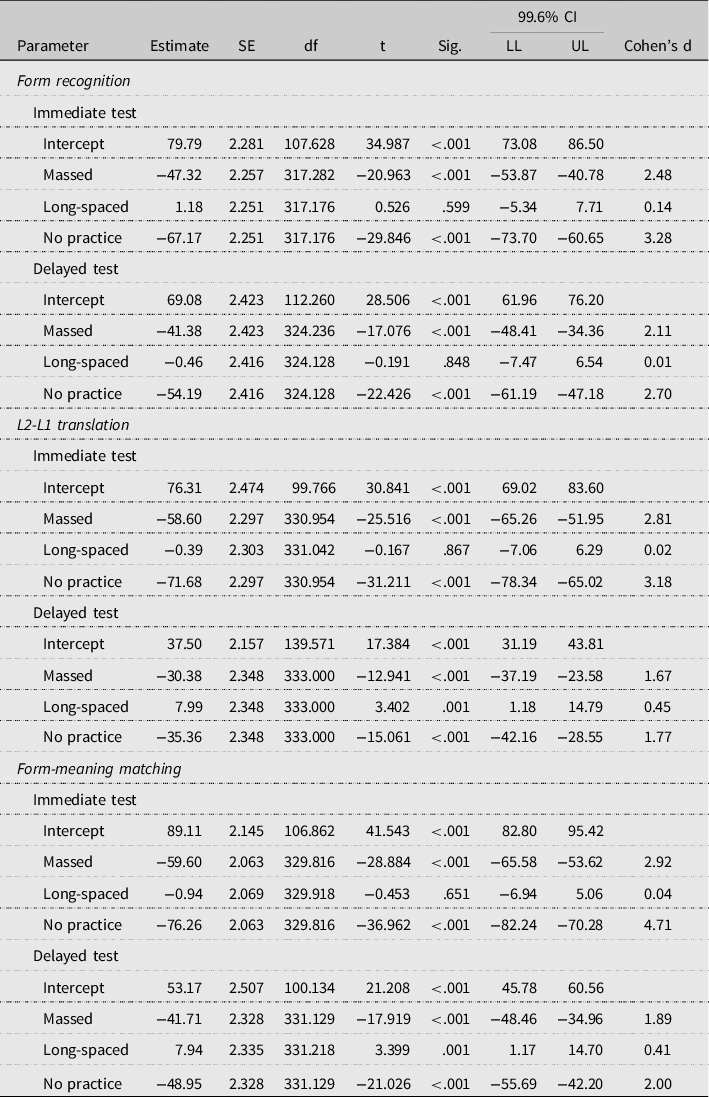
Next, parameter estimates were examined with the short-spaced practice condition as the reference category. Here, the intercept respresents the mean score in the short-spaced practice condition and each slope represents the mean difference between this condition and the corresponding condition. The null hypothesis for the intercept here is that the mean of the scores in the short-spaced practice condition is equal to zero. The null hypothesis for each slope is that the scores in the corresponding condition are not different from the scores in the short-spaced practice condition. Table 4 presents these comparisons. On the immediate posttests, there was no significant difference between the scores in the long-spaced condition and in the short-spaced condition. The difference in raw percent correct here is <1% on all measures, with the Cohen’s d being also very small, suggesting a negligible effect that would likely require a very large sample size to be significant but one that would likely not be interesting in a practical sense.
Results relative to the short-spaced practice condition

On the delayed posttests, however, there was a significant advantage of long-spaced practice over short-spaced practice, indicating a significant lag effect in these scores. The massed condition produced significantly lower scores than the short-spaced condition on all the tests. In terms of the effect sizes, the difference between the long-spaced and the short-spaced condition is not large on all the tests. The difference between the massed practice and the short-spaced practice condition is quite large, on all the tests, suggesting important benefits of spacing L2-L1 retrieval practice. It is important to note that, with regard to effect sizes, spacing study produced much larger effects than did increasing feedback study time.
Moderated mediation
To answer the third and fourth research questions, moderated mediation analyses were performed with the SPSS PROCESS 3.5.2 macro (Hayes, Reference Hayes2018) to explore whether the dual mechanism of successful effortful retrieval during study underlies benefits of lag and whether feedback study time moderates this relationship.
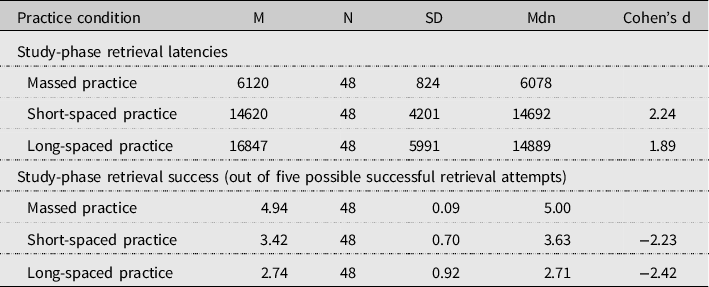
The study phase produced a low percentage of errors (M = 2.4%, SD = 1.9%, Median = 1.8%, Min = 0.2%, Max = 8.8%). Therefore, all participants’ data were included in the analyses. Table 5 presents information on retrieval latencies and successes during study in the three ISI conditions. Effect sizes were calculated relative to the massed condition. The shortest latencies were observed in the massed condition. The short-spaced condition produced latencies that were twice as long as those in the massed condition and the long-spaced condition produced only slightly longer latencies than the short-spaced condition. It is important to note that because the values here include both successful and unsuccessful retrieval attempts mixed together, response latencies in the long-spaced condition were likely affected by the fact that at such long ISIs words may often not have been recognized as ones studied previously, in which case participants produced “I don’t know” responses without engaging in a search of their memory, which resulted in faster responses to these words. Retrieval in the massed condition was almost always successful. Retrieval success decreased with spacing: in the short-spaced condition there were fewer successful retrieval events and in the long-spaced condition these were even fewer.
Training-phase response latencies and retrieval successes across the five true retrieval attempts

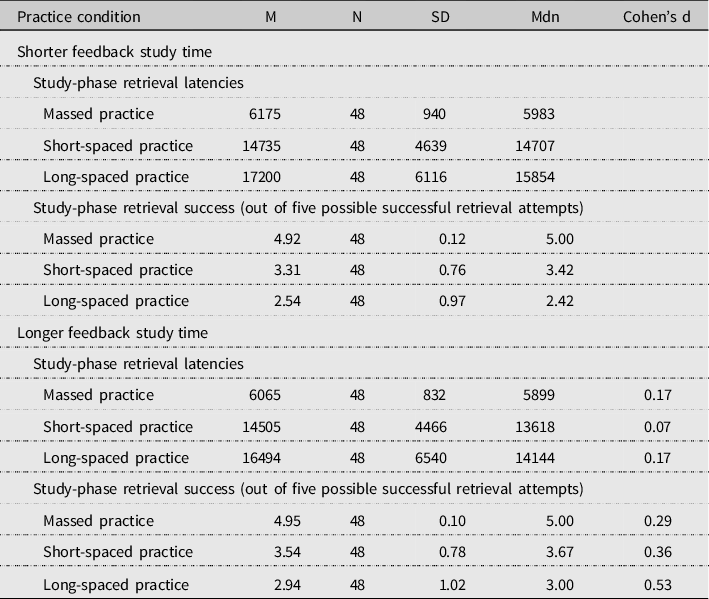
Table 6 presents these results separately for the long and short feedback study time conditions. Effect sizes for ISI were calculated relative to the massed practice condition. The effects of ISI seem a bit more pronounced in the shorter study time condition than in the longer study time condition. This makes intuitive sense, as longer study time should increase retrieval success and decrease retrieval effort, particularly with spaced practice. Words that were presented for study for 9 s received slightly less overall retrieval effort and slightly more retrieval success. Separate analyses further showed that the overall pattern of study phase response latencies and accuracy was similar between the two genders.
Training-phase response latencies and retrieval successes in the two study time conditions

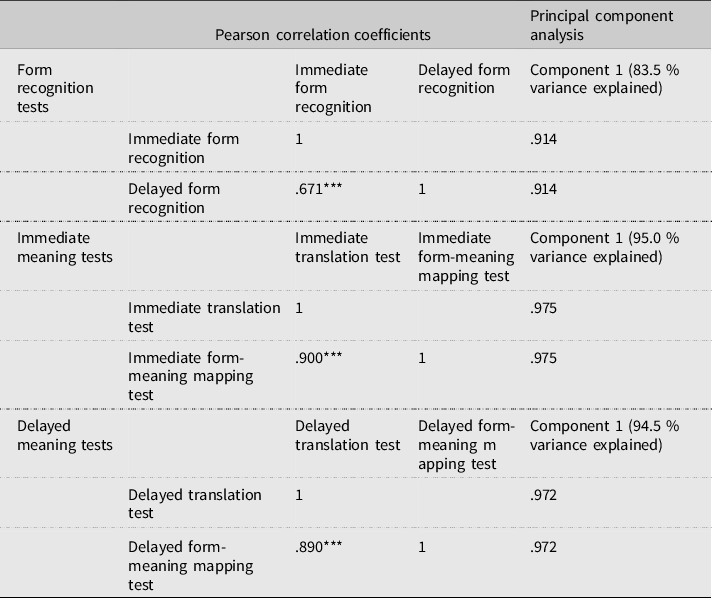
Data reduction was performed to reduce the six sets of scores to fewer dependent variables for the moderated mediation analyses. Based on correlations, theoretical reasons, and principal component analyses, three dependent variables emerged. These combined together (1) the immediate and delayed form recognition tests, (2) the two immediate meaning tests, and (3) the two delayed meaning tests. The three resulting sets of scores will be named, respectively, the form recognition tests, the immediate meaning tests, and the delayed meaning tests. Table 7 presents the bivariate correlations between each member of a pair as well as loadings of each pair of tests on their corresponding extracted component. Each analysis shows high loadings, suggesting that the corresponding test pair likely measures the same underlying construct.
Correlation coefficients and principal component analysis results

***p < .001.
Moderated parallel mediation analyses
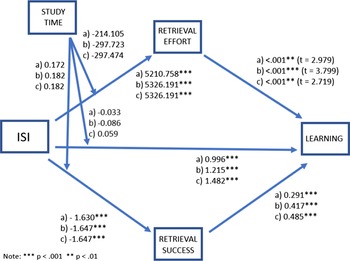
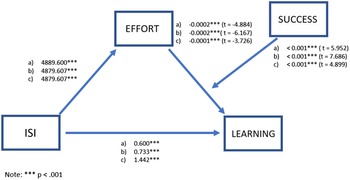
Because multiple models were run on the same or related data, the alpha level was corrected. Further, robust tests were used to ensure against any violations of normality. Bootstrapped 99% confidence intervals (99% BCIs) were requested with 10,000 bootstrap samples. An initial model investigated whether the two mechanisms of retrieval effort and success underlie lag effects and whether feedback study time affects the operation of these two mechanisms. The moderated parallel mediation analysis included effort and success during training as mediators and feedback study time as a moderator of the relationship between ISI and the two mediators and ISI and learning outcomes (Model 8). Time of Delayed Test was included as a covariate. Because the homogeneity of slopes assumption was violated in at least one test, the interaction between the covariate and the corresponding variable (ISI) was included as the covariate in all tests for consistency. Figure 5 presents the conceptual structure of this analysis with the obtained coefficients.
The conceptual structure of the moderated parallel mediation analysis. The form recognition, L2-L1 translation, and translation matching tests are denoted as a, b, and c, respectively.

ISI had a significant positive effect on learning in all three tests. It further had a significant positive effect on retrieval effort and a significant negative effect on retrieval success in all three tests. Both retrieval effort and retrieval success significantly positively affected learning in all three tests. Feedback study time did not significantly moderate the relationships between ISI and retrieval effort, ISI and retrieval success, or ISI and learning outcomes in any of the tests. While the moderating effects of this variable are in the predicted direction, these effects are very small relative to the main effects of ISI on retrieval effort and success during training. Thus, the effects of ISI on retrieval effort and success were not moderated by the level of study time to a substantial degree.
For all three sets of scores, there was significant mediation by retrieval success as a negative effect, across the two levels of feedback study time: the form recognition tests: β = −.4236, bootstrapped SE = .1070, 99% BCI [−.7125, −.1578] for short presentation duration and β = −.3736, bootstrapped SE = .0968, 99% BCI [−.6329, −.1352] for long presentation duration; the immediate meaning tests: β = −.6111, bootstrapped SE = .0971, 99% BCI [−.8739, −.3654] for short presentation duration and β = −.5352, bootstrapped SE = .0903, 99% BCI [−.7833, −.3174] for long presentation duration; and the delayed meaning tests: β = −.7107, bootstrapped SE = .1094, 99% BCI [−1.0120, −.4357] for short presentation duration and β = −.6224, bootstrapped SE = .1010, 99% BCI [−.9055, −.3749] for long presentation duration. This suggests that, despite the fact that a nonmonotonic function of lag was not observed in the present results, a negative effect of longer ISI was still present and operated through a lower rate of retrieval success during study.
For all three sets of scores, there was significant mediation by retrieval effort as a positive effect, across the two levels of feedback study time: the form recognition tests: β = .1486, bootstrapped SE = .0535, 99% BCI [.0303, .3142] for short presentation duration and β = .1423, bootstrapped SE = .0494, 99% BCI [.0285, .2902] for long presentation duration; the immediate meaning tests: β = .1668, bootstrapped SE = .0481, 99% BCI [.0577, .3098] for short presentation duration and β = .1569, bootstrapped SE = .0430, 99% BCI [.0545, .2810] for long presentation duration; and the delayed meaning tests, β = .1253, bootstrapped SE = .0484, 99% BCI [.0019, .2572] for short presentation duration and β = 1179, bootstrapped SE = .0491, 99% BCI [.0018, .2618] for long presentation duration. However, there was no significant moderated mediation in any of the three sets of scores: the form recognition tests: Index of Moderated Mediation (success) = .0499, bootstrapped SE = .0326, 99% BCI [−.0311, .1458] and Index of Moderated Mediation (effort) = −.0064, bootstrapped SE = .0222, 99% BCI [−.0778, .1519]; the immediate meaning tests: Index of Moderated Mediation (success) = .0759, bootstrapped SE = .0425, 99% BCI [−.0323, .1926] and Index of Moderated Mediation (effort) = −.0099, bootstrapped SE = .0232, 99% BCI [−.0793, .0481]; and the delayed meaning tests: Index of Moderated Mediation (success) = .0883, bootstrapped SE = .0491, 99% BCI [−.0401, .2242] and Index of Moderated Mediation (effort) = −.0074, bootstrapped SE = .0174, 99% BCI [−.0536, .0506].
Note that both retrieval effort and retrieval success were modeled in this analysis as main effects. However, a dual mechanism of effortful successful retrieval implies an interaction, where the effect of one may depend on the level of the other. The question whether the positive effects of retrieval effort are conditional on retrieval success will be tested in the following moderated mediation analysis.
Mediation by retrieval effort moderated by retrieval success (a moderated mediation analysis)
Retrieval effort was chosen as the mediator of the effects of spacing on learning. Retrieval success was chosen as a moderator of this mediation. The reason for this choice was theoretical. Because retrieval effort is known to promote word learning (e.g., Pyc & Rawson, Reference Pyc and Rawson2009), it is an interesting question whether the benefits of increased effort that results from longer ISIs in retrieval practice are conditional on retrieval success. It is further interesting to know whether this holds in the presence of feedback that follows each retrieval attempt. Provision of feedback after each retrieval attempt is a more usual situation for second-language vocabulary learning. The moderated parallel mediation analysis showed that despite the fact that a nonmonotonic function was not observed in the learning outcomes, retrieval failure during study that resulted from spacing retrieval attempts more widely still had a negative effect on learning. It is an important question whether retrieval success moderates beneficial effects of retrieval effort on learning and may thus constitute a limitation for how widely we may space retrieval practice even in the presence of feedback.
Because feedback study time was found to only have a small nonsignificant moderating effect on the relationship between ISI and retrieval effort and success during study, participants’ scores were collapsed across the levels of this variable for this analysis. Figure 6 presents the conceptual structure of the moderated mediation analysis (Model 14) with the obtained coefficients. The coefficients show a similar pattern for all three sets of vocabulary scores. There is a positive effect of ISI on retrieval effort and also on the learning outcomes. The effect of effort is now actually negative in each of the three sets of vocabulary scores. However, retrieval success significantly positively moderates this relationship.
The conceptual structure of the moderated mediation analysis. The form recognition, L2-L1 translation, and translation matching tests are denoted as a, b, and c, respectively.

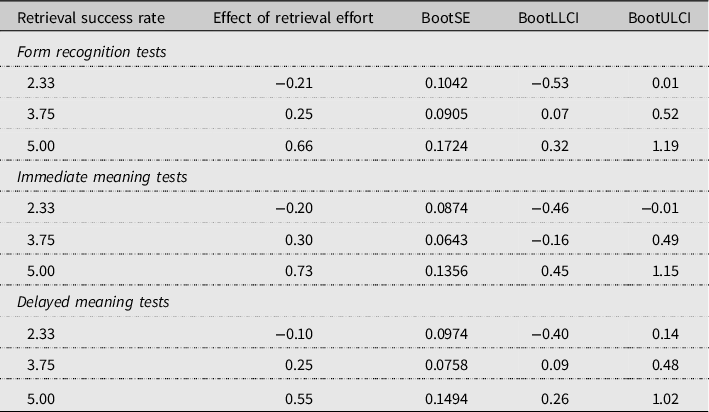
The tests of the indirect effects showed significant moderated mediation for all learning measures: the form recognition tests: Index of Moderated Mediation = .3239, bootstrapped SE = .0846, 99% BCI [.1588, .5812]; the immediate meaning tests: Index of Moderated Mediation = .3494, bootstrapped SE = .0721, 99% BCI [.2010, .5734]; and the delayed meaning tests: Index of Moderated Mediation = .2443, bootstrapped SE = .0771, 99% BCI [.0930, .4830]. To investigate more in depth the moderated mediation process, the effect of the mediator was tested at different levels of the moderator variable, in this case, using the 16th, 50th, and 84th percentiles. Table 8 presents the effect of retrieval effort on vocabulary scores at the three levels of retrieval success represented by the three percentiles. This table shows a similar pattern across the three sets of scores. It shows that the effect of retrieval effort becomes positive and grows in magnitude as retrieval success rate increases. This indicates that the beneficial effects of effort were contingent on a higher rate of retrieval success in this moderated mediation analysis.
Effect of retrieval effort at three levels of retrieval success

Discussion
The present research examined the contribution of the dual mechanism of successful effortful retrieval during study to the effects of spacing L2-L1 retrieval practice on learning novel L2 vocabulary within a declarative knowledge acquisition task. It further investigated the effects of feedback study time, per encounter and in total, on learning outcomes and on the operation of the two study-phase mechanisms under investigation.
The first research question asked whether spacing practice more widely affects learning outcomes, as measured by immediate and delayed form recognition and translation posttests. The results showed a spacing effect of considerable size across the posttest types and RIs. Importantly, the difference between the massed practice condition and the no-practice control condition was very small, particularly in terms of the long-term gains, where, on the most challenging L2-L1 translation test, scores in the massed practice condition were not significantly different from those in the no-practice condition. This suggests that, despite the fact that retrieval practice is believed to be beneficial, massed retrieval practice may not be an effective learning tool if we are targeting longer-term retention of knowledge, which is usually more relevant for L2 vocabulary learning. The present findings are in line with proposals that retrieval from short-term memory may not involve processes that make retrieval beneficial for learning (Glover, Reference Glover1989). An anonymous reviewer has pointed out that, because the immediate tests were conducted 30 min after the study phase in this experiment, the scores on these tests may not be considered immediate scores in the strictest sense. Thus, in the present study, the benefits of massed practice, which are usually most pronounced when knowledge is measured immediately after study, may be underestimated in terms of their immediate effects due to the operationalization of immediate learning as scores on a test that followed the study phase after a bit of a delay.
Retrieval practice was distributed under three levels of lag. The results showed a significant lag effect (advantage of long-spaced practice over short-spaced practice) on the delayed meaning posttests but not on the immediate meaning posttests. However, no lag effect (but only a spacing effect) was observed on both form recognition posttests, where the scores in the short- and long-spaced conditions were similar. This pattern of results is in line with previous findings of more pronounced beneficial effects of lag the more challenging the task (Maddox, Reference Maddox2016) and with findings that effects of spacing study more widely become more pronounced when knowledge is tested after a longer period of time (Delaney, Verkoeijen, & Spirgel, Reference Delaney, Verkoeijen and Spirgel2010; Nakata, Reference Nakata2015; Nakata & Webb, Reference Nakata and Webb2016). Thus, the results suggest that the temporal distribution of retrieval practice may be crucial: massed practice may be not much better than no practice at all but only a single study event, in the long term, and longer intervals between repetitions may produce more robust knowledge that is forgotten more slowly.
The second research question asked whether feedback study time (3 vs. 9 s) affects learning outcomes. Prior research has shown that learners are not effective at pacing their own study (Rundus, Reference Rundus1971), often devoting more study time to items that they believe to be more difficult, such as to spaced rather than massed repetitions, when this impression may not always be accurate. It was an interesting question whether longer study time that is imposed externally can counteract negative consequences of massed study. The present results showed that longer study time has a significant, though quite small, positive effect for knowledge of meaning though not of form. The small size of the effect is different from the considerable learning benefits of more attentional processing found in prior SLA research (e.g., Godfroid et al., Reference Godfroid, Ahn, Choi, Ballard, Cui, Johnston, Lee, Sarkar and Yoon2018; Koval, Reference Koval2019). An important difference may be that in such prior research learners were free to self-pace their study. The present findings suggest that when longer study time is imposed externally, it may not have benefits of the same magnitude as when a learner chooses to devote longer study time to a target word. This, in turn, suggests that the processes that underlie self-regulated and other-imposed longer study time are qualitatively different. Recall that the time participants were given for studying a word in the longer study time condition was three times longer than that in the shorter study time condition. However, the benefit that came from tripling the study time was quite small.
The third and fourth research questions asked whether the dual mechanism of successful effortful retrieval during study underlies benefits of lag and whether feedback study time moderates this relationship, respectively. The results of the moderated mediation analyses showed that increasing feedback study time from 3 to 9 s had a small, nonsignificant effect on the operation of the two cognitive mechanisms under investigation. They further showed that, despite the fact that a nonmonotonic function of lag was not observed in the present learning outcomes, a negative effect of increasing ISI was still present and operated through a lower rate of retrieval success during study. Further, on all learning measures, benefits of retrieval effort were conditional on retrieval success, in line with the predictions of the reminding account.
Despite the fact that in the present study each retrieval attempt was followed by feedback, failed retrieval attempts did not benefit from more effort. This is surprising because, with failed retrieval attempts, one would expect a more effortful search of one’s memory to result in higher quality processing of subsequently presented feedback, which should, in turn, benefit learning (Izawa, Reference Izawa1970; Kornell et al., Reference Kornell, Hays and Bjork2009). Further, despite the study of feedback, spacing repeated retrieval-restudy events more widely had a negative effect on learning by negatively affecting retrieval success during study. This finding disconfirms proposals that training-phase retrieval failures that result from spacing practice more widely are beneficial for learning (Bahrick & Hall, Reference Bahrick and Hall2005; Pashler et al., Reference Pashler, Zarow and Triplett2003). In the latter research, the effects of retrieval failure that resulted from longer spacing were not directly tested but only inferred based on the finding that the longest-spaced condition produced most frequent retrieval failures during study but also superior learning outcomes. On the surface, the same pattern seems to hold in the present results: the long-spaced condition produced the lowest study-phase performance success and the highest posttest scores in the long term. However, the moderated mediation analyses allowed to disentangle these complex relationships more effectively and to detect negative effects of longer spacing. The present results suggest that a balance must be struck between study-phase performance effort and success: words that are retrieved successfully though with difficulty during the study phase are retained better than those that are not retrieved or are retrieved with minimal effort.
Pedagogical implications
The findings of the present research have important implications for second-language vocabulary teaching and learning. The findings indicate, first of all, that despite the fact that retrieval practice is believed to be beneficial, how closely together or widely apart retrieval events occur has very important consequences for L2 vocabulary learning outcomes. If retrieval events occur consecutively or in very close succession, such practice may have little to no benefits for longer-term retention. Despite the fact that the control condition did not involve any true retrieval attempts and only involved one study event, whereas massed practice involved five true (and predominantly successful) retrieval events and six times longer total study of a translation pair, the difference in learning outcomes between these two conditions was very small, particularly in the long term. This finding further suggests that increasing the number of retrieval-(re)study events that occur consecutively or closely together (even if this is increased from one to six) has very little benefit and may not be a good way to use study time. Learners are known to sometimes engage in such self-drilling, whereby they repeat a given word with its translation for a considerable length of time, believing that the longer they rehearse it the better it will be remembered; or test themselves on an item that was very recently seen and while retrieval is still very easy because the information still resides in working memory. The present findings suggest that there may be little to no benefit of such drilling or massed retrieval practice over a single short study event. Learners should schedule self-testing repetitions such that retrieval of the studied material is attempted only once they feel that some, though not complete, forgetting has occurred. For example, if a learner is studying 20 words with their translations, they may wish to go through the entire list before revisiting any given item rather than devoting a number of consecutive retrieval-restudy events to the same item before moving on to the next item. To use time more efficiently, learners may also wish to cut study of the same item short as soon as they feel that it has been sufficiently encoded in memory, if it is to be revisited repeatedly.
Longer intervals between within-study-session retrieval attempts can be used to enhance learning from retrieval practice and slow forgetting of learned material. The higher retrieval effort that results from longer intervals between repetitions underlies these benefits of more widely spaced retrieval practice. However, the benefit of increased retrieval effort is conditional on retrieval success. When selecting a retrieval practice schedule, such as for word learning software or materials design, we need to take into account the probability of retrieval effort and success given our specific circumstances and learner variables. Many different variables may affect retrieval effort and the probability of retrieval success during the training phase. These may be the difficulty of the studied material, the age group and memory ability of our learners, and/or the complexity and interference potential of the intervening material or activity. Thus, we may want to use shorter ISIs with more difficult or complex tasks, for example, in order to ensure a higher rate of retrieval success during study.
Increasing the time, per encounter and in total, that a learner is given to study an L2 word presented with its meaning, such as longer presentation rate in PAL software, has a small beneficial effect on memory and also slightly increases the chances of successful retrieval during study. Increasing study time does not, however, counteract the negative effects of using massed instead of spaced practice, even if such practice involves retrieval. Previous research has shown that more attentional processing of target words leads to more learning (Godfroid et al., Reference Godfroid, Ahn, Choi, Ballard, Cui, Johnston, Lee, Sarkar and Yoon2018; Godfroid, et al., Reference Godfroid, Boers and Housen2013) and may be the reason spacing repeated study results in superior learning outcomes (Koval, Reference Koval2019; Rundus, Reference Rundus1971). The present results suggest that the large benefits of longer study time may be limited to situations where learners choose to allocate more study time to a target item based on learner-internal reasons and may not be observed when longer study time is externally imposed on the learner. This suggests that our efforts should be aimed at getting learners to choose to allocate more attention or study time to target forms, such as, for example, by using spacing (Koval, Reference Koval2019), rather than imposing longer study time externally. At least for receptive knowledge development, computer programs that present immediate feedback after each retrieval attempt need not make feedback presentation longer than is reasonably enough for successful encoding of the information (without additional time to simply rehearse), as doing so appears not to have large benefits and may, therefore, not represent efficient use of time.
Finally, the results suggest that if there is a chance that a learner may be able to retrieve a given target piece of information from memory, they should be allowed to take the time they need to do so rather than being presented with the information before the retrieval process is complete. It is often tempting, in the interest of time, to present information that a learner might otherwise take a longer time to retrieve on their own. However, if we rush to present the target information before a learner completes a potentially successful retrieval attempt, this may constitute a less powerful learning event than if the information were fully retrieved from memory.
Limitations and suggestions for future research
An important limitation of the within-participant design adopted in this study is the fact that the participants completed the same posttests twice. The retrieval processes that occurred during the immediate posttests may have had an effect on the performance on the delayed posttests. However, all the conditions had an equal chance to benefit from such additional practice. Another limitation of the study is that the number of words in each sublist is on the small side, which was done in order not to overwhelm the participants with the number of words they needed to learn.
The present study investigated the contribution of the dual mechanism of successful effortful retrieval to the lag effect in L2 vocabulary learning within a declarative knowledge acquisition task. Retrieval was operationalized as overt retrieval of L1 translations for target L2 words in a paired-associate learning format. It is important to note, however, that overt L2-L1 translation retrieval is only one type of retrieval practice and only one type of retrieval. Overt retrieval is pedagogically interesting primarily because it can be observed. It is an important question whether we need to schedule repeated retrieval events such that they are effortful but still mostly successful, a question that leads to very straightforward pedagogical recommendations. Future research needs to supplement the present results with an investigation of L1-L2 retrieval practice. Such an investigation is also likely to result in pedagogical recommendations that can be applied with relative ease. L1-L2 translation is a more challenging task, which is likely to mean dramatically less retrieval success during study at longer ISIs. Because retrieval failure was shown in the present experiment to have a negative effect on learning and also to interfere with beneficial effects of retrieval effort, an investigation of L1-L2 retrieval practice may be more likely to capture a nonmonotonic function of lag in learning outcomes, whereby longer-spaced practice may actually produce inferior results to shorter-spaced practice, which was not observed in the present experiment. Thus, for example, using L1-L2 translation practice, Nakata (Reference Nakata2015) showed a beneficial effect of spacing but not of lag. The benefits of lag observed in the present study may, at least in part, be due to the fact that L2-L1 translation is an easier task.
In learning situations that do not involve overt retrieval, benefits of spacing may still depend on a covert retrieval process. Future studies need to explore the contribution of covert retrieval to spacing and lag effects in such learning tasks as well. Such covert retrieval can be observed through tests of simple recognition or through indirect memory tests such as facilitation, or speed-up, in task performance. For example, in Koval (Reference Koval2019), I used eye-tracking to examine facilitation in reading times for L2 words encountered multiple times within sentence contexts during study as an indication of a covert retrieval process. However, here I did not intentionally attempt to manipulate retrieval success during study, but only explored this post hoc. Future studies should aim to induce retrieval failure at longer ISIs during performance of L2 learning tasks that do not involve overt retrieval in order to investigate the mediating effects of covert retrieval success.
In the present study, retrieval practice and intentional learning within a declarative knowledge acquisition task may have resulted in stronger memory traces established at each repetition, which may have led to better study-phase performance. This may be one reason why a nonmonotonic function of lag was not observed in the present results. A nonmonotonic function may be easier to capture in a task that may not establish very strong memory traces, such as, for example, incidental learning of vocabulary from reading comprehension activities (Verkoeijen, et al., Reference Verkoeijen, Rikers and Schmidt2005). Future research will also need to examine longer ISIs to capture this function more effectively. Thus, for example, despite the fact that participants continued retrieval attempts until correct performance during the training phase in Cepeda et al. (Reference Cepeda, Coburn, Rohrer, Wixted, Mozer and Pashler2009, Exp 1), the results showed a nonmonotonic function in the learning outcomes 10 days after study that was distributed under six different levels of lag, the longest lag being 14 days’ ISI. An anonymous reviewer has pointed out that many of the SLA studies that have failed to observe benefits of longer ISIs have involved learning over multiple sessions. This may well be due to the fact that more dramatic retrieval failures are produced with such longer ISIs. Another difference between within- and between-session study is that the latter involves sleep-associated consolidation. Future studies will need to compare directly learning from within- and between-session repetitions and investigate how this affects the operation of the underlying cognitive mechanisms.
The present research investigated the effects of externally predetermined feedback study time. Feedback study time is only one potentially relevant variable that may affect the operation of the underlying mechanisms of retrieval effort and success. Other relevant variables are numerous. The issue of what variables will affect the probability of performance success in different learning situations is still unresolved and warrants further investigation. These effects need to be investigated for a fuller picture of the conditions under which various amounts of spacing may be beneficial or detrimental for L2 learning. In the present study, participants studied novel L2 words that represented simple and generic concepts, in a completely novel language, from six repeated L2-L1 retrieval attempts followed by feedback, within one study session. Future research needs to examine other tasks and learning contexts and other learning targets, as well as other learner proficiencies. It will be important also to test the effects of different numbers of repetitions: it may be that fewer repetitions are needed with spaced practice (Maddox & Balota, Reference Maddox and Balota2015); however, this may, in turn, depend on other relevant variables and their effects on the cognitive mechanisms that underlie the effects of spacing study of L2 material.
Acknowledgments
This research was supported in part by the Second Language Studies doctoral program at Michigan State University, USA. I would like to thank my dissertation committee members Drs. Charlene Polio, Patti Spinner, Susan Gass, Aline Godfroid, and Sandra Deshors as well as my three anonymous reviewers and Associate Editor Dr. Miquel Simonet for their valuable comments and suggestions. Any errors that remain are my own.
Dedication
In loving memory of my father, Grigory Ivanovich Koval
APPENDIX A Target Finnish words with their English translations

Information on the English translations
Frequency and concreteness indices for the English translations for the target words

1 = massed, 2 = short-spaced, 3 = long-spaced
Posttests
The form recognition test (Posttest 1)

APPENDIX C (Continued)
The translation test (Posttest 2)

The translation matching test (Posttest 3)