Introduction
Worldwide, Alzheimer's associations and national governments have identified the inadequacy of current long-term care services for the 47 million people living with dementia, requesting that more attention be paid to improving the quality of these services (World Health Organization (WHO), 2015). It is clear that one of the main factors in creating quality care services is the extent to which nurses and care staff are properly prepared, continue to be supported in their learning, and are supervised in giving person-centered care (PCC). This applies to others who also have contact with a person with dementia, including those involved in management, domestic work, catering, gardening, lifestyle activities, and pastoral care. The need for appropriate education and training in dementia work has been identified as an urgent requirement for progressing the WHO's Global Action on Dementia (World Health Organization, 2015).
Internationally, long-term aged care services have striven to improve standards by implementing the PCC model developed by Kitwood and Bredin (Reference Kitwood and Bredin1992). Since different approaches to PCC have been offered (e.g. McCormack and McCance, Reference McCormack and McCance2006; Brooker, Reference Brooker2007), service providers need clarity about the application of Kitwood's model (Brownie and Nancarrow, Reference Brownie and Nancarrow2013). PCC directs the focus of care to the whole person, requires the carer to have knowledge of the resident's life story, personality and preferences, and to recognize and support their strengths rather than focus on the impairment that dementia inflicts (Brooker, Reference Brooker2007). PCC theory argues that the cognitive disintegration apparently concomitant with a dementia diagnosis may not be entirely due to the disease injury, but could be a depressive response to the negative social interactions such a diagnosis incurs, or an agitated response to unmet needs (Boetcher et al., Reference Boetcher, Kemeny, DeShon and Stevens2004). Staff attitudes toward people with dementia are considered central to the quality of care they deliver (Norbergh et al., Reference Norbergh, Dahl, Hellzen and Apslund2006).
Guidance on the implementation of PCC for long-term care is outlined in the VIPS framework (Brooker, Reference Brooker2007). VIPS recognizes that the person's well-being is not only dependent on the setting's prevailing model of care practice but also upon how well direct care staff are educated in how to practice PCC (Chenoweth et al., Reference Chenoweth2009). Assuring adequate training, staffing, and material resources and management support is essential for a person-centered system (Winzelberg et al., Reference Winzelberg, Williams, Preisser, Zimmerman and Sloane2005; Jeon et al., Reference Jeon, Simpson, Chenoweth, Ciunich and Kendig2013). The VIPS model (Brooker, Reference Brooker2007) promotes organizational change through staff and manager-initiated knowledge development, dissemination, and knowledge translation. An important element of the knowledge translation strategy is to establish an understanding of the organizational context, particularly the prevailing culture, leadership, communication and evaluation processes, governance, and available resources (time, space, and staff). This understanding facilitates identification of potential enablers and barriers to implementation of an intervention and gives an insight into which particular ingredients of the strategy are most likely to be effective within that particular context (Ivers et al., Reference Ivers2012). Successful involvement of staff in organizational change is predicated on a collective, collaborative, and empowering approach to establish agreed goals, and to plan and implement strategies to achieve these goals. Important components of the planned change are evaluating what processes are working well, and whether planned outcomes are being achieved and continually reflecting on how best to implement the most effective processes to achieve the best possible outcomes (Dobbins et al., Reference Dobbins2009).
In response to continuing consumer concerns about Australian residential aged care service quality for people with dementia (Alzheimer's Australia, 2013), and guided by the principles of the VIPS (Valuing, Individualizing, Perspectives, Social Psychology) framework, we conducted the Person-Centered Dementia Care and Environment (PerCEN) randomized controlled study (Chenoweth et al., Reference Chenoweth2011; Reference Chenoweth2014). PerCEN implemented and evaluated PCC and person-centered environments (PCE) for people with dementia in long-term care. PerCEN was conducted between 2009 and 2013 in 38 dementia care units located in 38 different Government-accredited residential aged care facilities (RACF) in NSW, Australia, using a pre-/post-test/follow-up design (Australian New Zealand Clinical Trials Registry number 12608000095369). Research ethics approvals were granted by the university's Human Research Ethics Committee (UTS-HREC 2006–269A) and by the participating long-term care homes. Written consent was obtained for all participants, including proxy and/or direct resident consent. Details of PerCEN study protocol are published in Chenoweth et al. (Reference Chenoweth2011).
Following baseline data collection, the study interventions were randomized as follows: PCC was introduced to ten dementia care units (155 residents); PCE changes were made to ten dementia care units (154 residents); a combination of PCC and PCE (PCC+PCE) was introduced to ten dementia care units (150 residents); and no interventions (EC+UE, controls) occurred in eight dementia care units (142 residents). The published study protocol diagram is illustrated in Figure S1 (Figure S1 is available as supplementary material attached to the electronic version of this paper at www.journals.cambridge.org/jid_IPG).
For the PCC intervention, we employed a train-the-trainer-staff coaching model and engaged staff champions to co-create and disseminate PCC knowledge among work teams. Two experts in PCC used experiential and adult learning approaches to train five staff champions from each of the PCC care units (one care manager, one registered nurse, two enrolled nurses or assistants in nursing, and one diversional/recreation therapist). The champions received 32 hours initial off-site training, which focused on the following: attending to the residents’ feelings when agitated; interacting with residents in a person-centered way; using PCC planning to meet the residents’ psychosocial needs; and making detailed records of resident behaviors, triggers, PCC approaches, and their effects on behavior (Stein-Parbury et al., Reference Stein-Parbury, Chenoweth and Jeon2012). The PCC facilitator advised and supported staff champions on disseminating PCC knowledge through care plans, shift handover discussions among work teams, staff education, and supervision. The mean PCC dose score at follow-up was 59% (range 54–66%, SD 9) out of a possible score of 100, calculated on ten weighted criteria relating to staff education/training, supervision, support, and adoption of PCC.
Two experts in PCE helped care unit managers to plan and supervise implementation of PCE interventions recommended following review with the Environmental Audit Tool (EAT) (Fleming, Reference Fleming2011). It was agreed by PCE care unit managers that they would advise nurses and care staff how to make best use of planned environmental changes once developed, while the PCE facilitator would monitor their implementation. Planned PCE included improvements to the safety, accessibility and utility of outdoor spaces, provision of a greater variety of social spaces, and using color and objects for way-finding and to improve feelings of familiarity (Fleming et al., Reference Fleming, Goodenough, Low, Chenoweth and Brodaty2014). The dose score for PCE at follow-up was 54%, calculated on ten weighted criteria of adherence to planned environmental improvements. For a combination of PCC and PCE the dose score was 66%. In the non-intervention (control) care units, any unplanned changes in care practices and environment that were initiated by the managers between baseline and follow-up were regularly monitored.
The PerCEN publication (Chenoweth et al., Reference Chenoweth2014) reports outcomes arising for 601 people with dementia living in the participating 38 long-term care services. Agitation, emotional responses in care, quality of life and depression, and care interaction quality were assessed pre- and four months post-intervention and at eight months follow-up. At follow-up the mean change for quality of life and agitation was significantly different for PCC (p = 0.0003 and 0.002 respectively) and PCE (p = 0.02 and 0.05 respectively), compared with the non-intervention group (p = 0.48 and 0.93 respectively). Quality of life improved non-significantly for PCC+PCE (p = 0.08) but not for agitation (p = 0.37). Improvements in care interaction quality (p = 0.006) and in emotional responses to care (p = 0.01) in PCC+PCE were not observed in other groups. Depression scores did not change in any of the groups. Additional data obtained from study participants that are the subject of this paper provide some clarity and explanations for these inconsistent findings.
Study aims
The aims of this study were to understand the inconsistencies in PerCEN study findings for PCC and PCE from the perspective of participating managers, nurses, care staff, families, and the facilitators of PCC and PCE to gain their views on whether PCC and PCE had made any difference to the quality of care services and outcomes for residents, and the factors that they believed both enabled and inhibited the implementation of PCC and PCE.
Methods
This study was conducted at the follow-up stage of PerCEN (Chenoweth et al., Reference Chenoweth2014). Data were gathered through telephone surveys of volunteer family members of participating residents (n = 73) and face-to-face, semi-structured interviews with volunteer care managers (n = 29), nurses and care staff (n = 70) from each of the intervention sites as well as usual care sites. In addition, from PCC and PCE sites, accessible care plans for remaining participants with dementia (n = 46) were evaluated as well as PCC and PCE facilitator field notes (n = 131).
Data collection
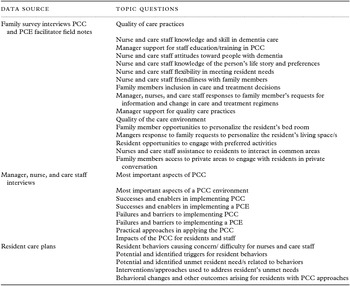
Participants with dementia who remained at follow-up were unable to be interviewed because of severe cognitive impairment, having an average score of 7 on the Global Deterioration Rating Scale (GDS; Reisberg et al., Reference Reisberg, Ferris, de Leon and Crook1982). Consequently, research assistants administered surveys via telephone to volunteer family members of the remaining 296 participants with dementia at follow-up, once re-confirmation of their consent was obtained. Interviews were conducted face to face in private rooms of the long-term care homes with volunteer managers and staff who remained at study follow-up. Survey and face-to-face interview questions focused on participant perceptions of changes in service quality and resident outcomes over the course of the study, and on enablers and barriers to PCC and/or PCE if introduced. Responses were tape-recorded and key participant messages were hand-recorded on the survey and interview forms. Handwritten responses were checked for accuracy with participants at the end of the survey. Tape recordings were transcribed verbatim. PCC and PCE facilitator field notes focused on implementation dose, enablers and barriers to PCC and/or PCE, and observed changes in service quality over time. Nurse-documented resident care plans accessible to the researchers were reviewed for person-centered approaches in the care planned and delivered and the effects of care on residents. Relevant details from field notes and care plans were entered digitally into templates developed by the research team. Table 1 lists the focus of topics of analysis for all data collected.
Topic questions of interviews, field notes, and resident care plans

Data analysis
Survey and face-to-face interview transcripts and hand-recorded notes, field note template data, and care plan records were sorted and classified with computer software, NVivo 8 (QSR International, 2008), and then content was analyzed. Three study team members with expertise in these forms of data analysis independently employed an iterative analysis process to code these data and identified the core concepts to derive key themes for each question domain. Key themes were independently analyzed by the three study team members for each of the participant group responses and then confirmed and/or corrected by data collectors (Tong et al., Reference Tong, Sainsbury and Craig2007). Consensus was reached between the three study team members regarding the categories and themes for each of the key domains of interest: improvements in care practices; improvements in resident agitation and well-being; and factors that enabled and inhibited PCC and PCE implementation.
Results
Improvements in care practices
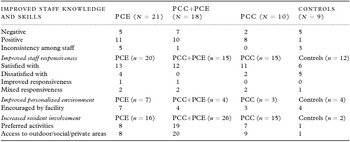
The majority (71.2%) of family members who agreed to be surveyed by telephone visited their relative/friend one to three times weekly, and regularly observed care practices. Table 2 provides frequencies of the families’ perception of changes that occurred in care services between pre-intervention and follow-up in all four groups.
Family perceptions of changes in care quality and environmental opportunities (n = 73)

When asked whether the care staff's care knowledge and skills had improved over time, family responses were more positive for the PCC, PCE, and PCC+PCE care units than the control units (UC). Families identified variations in care quality among staff in all care units and associated resident well-being. Examples provided on how care had changed did not use the term “person centeredness,” instead care quality was described in terms of workforce characteristics and system issues. Statements about care quality included issues such as language barriers of staff from a non-English speaking background and inadequate levels of care staff education, training, and confidence. Several family members also identified differences in care quality and well-being for people with dementia between weekdays and weekends arising from differences in staff to resident ratios and skills. The majority (77%) of family members in the PCC, PCE and PCC+PCE groups considered that following these interventions the nurses and care staff were more responsive in answering questions about their relative and in providing responses to their relative's requests. Two-thirds of these family members considered that they were involved in decisions concerning their relative, mainly with major decisions such as medical and nursing procedures.
Less than half of all family participants said that the staff had made efforts to gain information from them about their relative's life history, in contrast to staff's claim regarding their requests to obtain background information. Being able to personalize the person's room was dependent upon whether it was a shared accommodation, with only 25% of families being encouraged by the care manager to personalize their relative's living environment. When asked what changes they had noticed in the way that staff assisted their relative to make use of communal space over the past 12 months, less than half of the family members responded positively. However, more than half of the family members indicated that their relative had become more involved in activities that they enjoyed. Families reported that care staff were more alert to the needs of people with dementia and to respond accordingly. Examples included helping the person to access garden or courtyard and to provide more opportunities for socialization and/or privacy, which occurred more often in PCC care units.
Field notes of PCC and PCE facilitator (Table 2) identified that staff attitude toward residents was in most instances observed to be more friendly, caring, and diplomatic following PCC and/or PCE implementation. In some care units, direct care staff were seen to be using their skills to help calm the agitated person, rather than relying on medication. In these care units none of the people with dementia were left in their rooms for long periods of time, staff encouraged them to remain physically active, even those with restricted mobility, and families were welcomed and encouraged to visit. Nurses, care staff, domestic, and catering staff were all observed to be interacting with these residents. Diversional therapy (DT) and nursing staff were also observed to work collaboratively in meeting peoples’ needs. The role of the diversional therapy staff was considered an important factor in implementing PCC and making the best use of PCE. When PCC was well integrated,
. . . they had a clear vision of how to implement PCC. Champions adopted the title “Leading lights” and they were identified to all the staff members from the beginning. . .all the staff were cooperative, and there was a supportive manager who provided resources for training and a rewards program. (PCC facilitator note 70)
The many aspects of improved care practices arising from adoption of PCC and/or PCE were echoed by care managers, nurses, and care staff at interview. While the managers and nurses tended to consider the questions from an organizational viewpoint, the care staff answered questions in ways that reflected their own personal experiences. An increase in the number and variety of activities was cited as one of the most successful aspects of PCC and/or PCE interventions by all three groups. Another important aspect was that staff gained knowledge about the person's history and background. This additional information helped staff to better understand why some people with dementia reacted in certain ways to circumstances and events, rather than just assuming that this occurred because of dementia. A manager reported: “Improved communication now occurs between staff and relatives, staff and residents, and between staff” (BRH manager).
Less reliance on routine and a willingness to introduce flexibility in care to fit in with the person's preferences, rather than the staff's schedule, was also cited as being beneficial to people with dementia; for instance, “Staff are more open to change; taking more initiative” (CCH manager), and “teamwork and collaboration are exhibited in teaching other staff and passing on the knowledge” (CAC manager).
Managers of proactive PCC and PCE care units advised that supervising nurses enabled care staff to give people with dementia more freedom and choice in care regimens. This was also the view of nurses and care staff who were happy to see more people with dementia experiencing greater levels of autonomy in daily living; for example: “Seeing the whole person, their uniqueness” (RNBRH06), and “we can now give respect for their past” (CWCCH 11). For care workers, the most enlightening and enjoyable aspects of a change in practice was the freedom to personalize care and to be more flexible in meeting the person's needs; for example: “. . .in order to do the little things that matter to them” (CWCLR 19).
Whenever PCC and/or PCE were adopted, supervising nurses gave care staff advice on how to make use of the modified environment to help calm people who appeared agitated or confused. Strategies to overcome resistance to care included care staff being encouraged to be patient and persistent when giving care, in which, “. . . a calm, more pleasant living/working atmosphere occurs” (CDH manager).
The personalization of the environment was one positive outcome of PCE modifications that had been implemented. Nurses and care staff described a more peaceful and homely environment in which people with dementia felt comfortable and safe, and staff enjoyed working there. For example, “Staff feel a sense of satisfaction from their work because of the positive outcomes and compliments from management and relatives” (RNCCT10).
The nurses considered that the many benefits of a person-centered approach to care gave direction, skill, and purpose to the care staff in their demanding role:
The care staff learned to relax, break down the task (at times of resident resistance to care) . . . like changing the pad first and showering later . . . supervising instead of intervening and controlling . . . this works better for them both and both are happy. (RNCLR09)
Improvements in resident agitation and well-being
Nurse and care staff interview responses provided many examples of how PCC improved well-being and quality of life for people with dementia and also reduced agitation, especially during care activities. Staff participants identified the pleasing changes in the lives of people with dementia, such as feeling more settled when joining group activities, and walking around the garden or care unit arm in arm with another person. Care staff also reported that people with dementia frequently offered to help them with domestic activities, showed concern for another person who was lonely or sad, complimented staff on their appearance, and enjoyed their meals and snacks. Staff identified an increase in the number and variety of activities provided to residents and a greater number of opportunities to explore the living environment as some of the most successful aspects of the PCC and PCE interventions. One care worker's reflection on changes in the daily lives of people with dementia included the following statement:
Staff have been putting in more effort to involve the residents . . . improved their quality of life as they actually get to enjoy their time at the facility, and they are less agitated because they get to engage in something meaningful and enjoyable. (CWCD13)
Since care staff were encouraged to obtain knowledge about each person's history and background from their families, this helped to understand why people with dementia could become agitated by different triggers in the environment and with care approaches. More attention was subsequently given to helping the person to feel happy with whatever they enjoyed doing. Implementation of PCC, therefore, was considered to have a positive impact on family satisfaction with care. Care staff reinforced that in order to improve the person's well-being and to reduce feelings of distress, it was important to give them as much freedom and choice as possible. This was considered to occur when care was delivered at the person's own pace so that they were more settled and less fearful of care practices, for example, “We have learned to be more patient in order to help them feel safe” (CWQPH05).
A focused review of the accessible resident care plans in PCC and PCE care units revealed that 71 out of 97 (73%) agitated behaviors recorded for people with dementia were physically non-aggressive. The PCC approaches used by the nurses to prevent or reduce agitation proved to be innovative, taking into consideration the history, needs, and individuality of the person. The following quote is an example of a PCC approach resulting in positive outcomes for the person who was unsettled, refused to eat, and constantly tried to leave the facility. When PCC staff champions considered the person's history, it became apparent that he missed his “club” and the old friends he used to meet there. The person's social and emotional needs were assessed, PCC approaches were instituted by all staff, and these proved successful:
His family agreed to provide him with a carer to take him out of the facility. He is included in a men's group activity every day and his old friends from Canley Vale RSL visit once afternoon every month bringing beer and sweets for him to enjoy. He is much more settled now. (PNH13)
Another example of good PCC results was reported in the care plan for a person with physical and verbal non-aggression prior to PCC staff training. The resident made repetitive verbalizations, was restless, and constantly looking for her child. The PCC approach comprised giving her a baby doll, which staff treated as a real child, and engaged her in conversation about the baby. The result was reported to have been immediate, as stated: “She is settled, smiles a lot, loves talking about her baby and caring for it. She is no longer upset and appears happy” (CDH01).
The PCC approach was successfully instituted where a person with dementia was resistive to a scheduled care regimen because she felt upset about her situation and refused to speak with staff. The interventions involved moving her to a two bedroom with another person with whom she enjoyed interacting. A craft table was purchased, which she used to make articles for staff and residents on a daily basis. She received physiotherapy exercises each day, was given the opportunity to decide when she would get out of bed, and was able to choose food and the timing of it being served. The outcomes were positive for this person:
She enjoys having her own space and making craft objects each day and engages in conversation with her new room-mate. She is walking around the facility and the garden and so getting the physical activity she needs. She enjoys choosing meals and appears to be happy and relaxed. Her appetite has improved. (CHH14)
Perhaps one of the most revealing descriptions of how people with dementia can suffer from a feeling of deprivation and loss of dignity in not having their needs met was described by a nurse from a different PCC care unit. The person described engaged in rummaging through other peoples’ belongings, urinated on their bedroom floor, undressed in their rooms, and often solicited inappropriate sexual behaviors. The intervention comprised staff holding the person's hand when agitated, hugging him, and talking to him about his life in England. Nurses gave him individual attention and redirected him to the toilet when he undressed. The reported outcome was that: “He is more relaxed, co-operates with staff, inappropriate behavior has virtually disappeared, and he remembers how to use the toilet” (QPH19).
In one PCC+PCE care unit, a person with dementia expressed his extreme frustration and distress by pulling apart air-conditioning units, removing tree branches, pulling up plants, stripping other people’ beds of linen while they slept or rested, expressed anger toward staff and residents and violently resisted staff's attention to his care. His anger abated considerably once fences were erected around air-conditioning units, all trees were trimmed of dead branches, dead or dying flowers were pruned, and other residents’ doors were kept shut while they slept or rested. In addition, he was provided with “busy” boxes of interesting activities and cloths to polish and dust the furniture. Staff also worked with him to develop and assist with a daily activity schedule, using non-confrontational requests for attending to his personal care. The care staff, in particular, were excited to see a reduction in the person's agitation: “He now spends time cleaning rather than stripping beds, wanders happily around the garden, is less agitated with staff and he is more cooperative” (DNH18).
Factors enabling and inhibiting implementation of PCC and PCE
Enabling factors
PCC and PCE facilitator field notes identified the importance of “manager and staff readiness” (PCC facilitator 27) to accept PCC and/or PCE interventions, which proved to be crucial to success. In care units where the managers made themselves available to meet with the PCC facilitator and staff champions and were receptive to PCC, adoption proceeded relatively smoothly. Supportive managers provided resources for training, encouraged and supported staff, and were adept in identifying staff members who could “develop a clear vision and facilitate implementation PCC and PCE” (PCE facilitator 05). When managers provided leadership, PCC staff champions were actively supported by their managers, and their role and status were clearly communicated to the other staff. These managers instituted mentoring programs, where staff were co-operative and showed an eagerness to learn. The quality of leadership also attracted nurses and care staff who were capable, energetic, supportive, and willing to learn, and improvements in care quality and resident well-being were observed.
From the perspective of the managers and nurses, it was essential to establish a PCC workplace culture. They cited the importance of ongoing PCC training, management support for champions to supervise PCC, and staff reward and praise for implementing PCC. They also emphasized the importance of staff's commitment to PCC, communicating positively with relatives and informing them about care change, involving all staff in care planning and providing staff with feedback on progress being made. The managers considered that these supportive approaches had long-lasting benefits for the care facility as well, for instance, “The facility's reputation and public relations improve, with positive feedback from relatives and more new residents requesting entry” (CLR manager).
Nurse and care staff interviews also identified that adoption of PCC and PCE occurred through management communication, support, encouragement, and education. In addition, they cited the importance of “getting positive responses from residents and their families” (CWPNH19), which gave staff more confidence to initiate change, work as a team, respond to individual peoples’ needs, and spend more time with people in their care in getting to know them as individuals.
Nurses and care staff emphasized the importance of “education and on-site support” (RNSSJ06), which they also considered priorities for implementing PCC. Reinforced education on dementia and PCC by staff champions was frequently identified as assisting care staff to achieve desired care outcomes. Care managers also acknowledged the centrality of staff education and training in implementing PCC and making better use of PCE. Managers identified the importance of educating staff in how to relinquish a task approach to care. The importance of “. . .teamwork and a positive approach to PCC and PCE” (RNH manager) was also cited as contributing to their successful adoption. Managers considered that acknowledging staff who demonstrated sound PCC practice was motivational and helped to overcome their resistance to introducing different recreation activities, care regimens, and approaches. Some managers expressed the concern that without ongoing training and supervision, PCC is difficult for staff to maintain in day-to-day practice. The main suggestions to overcome this was for managers and supervising staff to provide immediate feedback to staff on care approaches and to institute a schedule of reinforcement of PCC.
As well, managers advised that in hindsight, emphasis needs to be placed on educating staff as how to help people with dementia make use of the PCE opportunities. Examples of successful use of PCE was to ensure that staff allowed the person to access a garden by leaving doors open to safe outside areas, by helping the person to take notice of interesting objects in the environment, and by assisting the person to explore different spaces where pleasurable activities were available to them.
Inhibiting factors
The PCC and PCE facilitators noted that conflicting care practice quality was often a reflection of “management style” (PCC facilitator 16), oversight of staff supervision, and staff recruitment and scheduling practices. Conflicting care practices were observed with different management approaches, with some staff being rewarded for being affectionate, caring, and person-centered, while other staff's abrupt or detached communication toward people with dementia was ignored by supervisors. Lack of supervision and support of PCC staff champions in poorly managed care units was evident in the application of care and lifestyle activities. For example, in these care units a large proportion of recreation activities were gender-oriented. Because of the uneven female/male ratio of both residents and staff in most care units, males were observed to be left out of the more female activities such as doll therapy and the Audrey Hepburn movie week. In care units devoid of trained diversional therapists, the less-trained recreation staff had little support and experience in implementing and adapting activities to fit the individual needs of people with dementia. This was made more difficult in care units where staff were time poor.
There were some “attitudinal challenges” (PCC facilitator 11) which inhibited implementation of PCC when managers, nurses, and care staff believed that they were already delivering PCC and there was no need to change practice. Minimal progress occurred in these PCC care units, since it was difficult to arrange meetings with managers and staff champions, and there was poor attendance or cancellations of planned meetings with the PCC facilitator.
There was also some resistance by some PCE care unit managers when they disagreed with PCE recommendations, as being “not what we had in mind” (PCE facilitator 08). In other cases managers considered that the updated furniture and/or the outdoor areas that were modified according to PCE principles were not always suitable for people with dementia. Subsequently, there was a lack of cooperation, much disinterest, and low initiative among nurses and care staff for PCE when the managers did not endorse and support recommended changes. In these PCE care units, nurses and care staff were not included in the decision-making process and they were not advised by their managers in the planning stage on how to help the person with dementia make use of PCE changes that were implemented.
While at least half of the managers were pleased with the enhanced opportunities that the PCE intervention provided for people with dementia and how PCE changes helped to enhance care delivery, they also recognized “inadequate consultation with all staff members” by managers (JGH manager). These managers confirmed that their staff were probably largely unaware of the modifications implemented and were not provided with sufficient education on how to use environmental modifications to benefit people with dementia.
Another issue that was frequently reported by nurses was the challenge for care staff in implementing PCC and PCE because of “. . .English language and comprehension skills” (RNHGH22). The understanding of PCC and PCE core principles and applications by these care workers, therefore, was reported to be far lower than with care staff with good English skills. This gave rise to frustration and some tensions between some managers, nurses, and care staff, which “did not help to convey PCC values” (CWCCT26). While in one PCC care unit English tutorials were organized by managers for staff from non-English speaking backgrounds to assist with PCC understanding and implementation, the diversity of the staff's cultural and language backgrounds often inhibited clear communication of person-centered principles.
From the perspective of care staff, common barriers to implementing PCC were “unrealistic family expectations and criticism” (CWJGH22), since PCC required a more flexible approach to the care regimen. Residents’ families were reportedly unhappy if the PCC approach affected established routines and expected care attention. For example if the person with dementia did not want to shower/change even though they had dirty pads/clothes, some staff felt they could not force the person to be changed immediately. In these cases the staff failed to appreciate that the same attention to physical care requirements are needed with PCC, and should be provided in a calm and non-confrontational way. Care staff needed to develop new approaches, such as changing the person's continence pad first and showering them later when they were less resistive. As identified by care workers themselves, many of the nurses identified that their anxiety about recrimination from families was driving care staff to prioritize physical care above psychological support. From the nurses’ perspectives, care staff had to learn to “be patient and persistent whilst maintaining a calm atmosphere” (RNCRH20). Nurses also identified that care workers needed to learn how to explain the PCC approach to family members. Solutions to any resistance to the PCC approach by families included encouraging more volunteers to assist with well-monitored aspects of care, involving family members in agreed aspects of care and communicating more effectively with families on person-centered approaches to care.
Another difficulty in fully adopting PCC from the nurses’ and care staff's perspective was the “lack of family involvement” (RNWNH31). Some families were not observed to visit very often and provided very little information concerning the resident's background. Although nurses reported that they sent requests for further information to families via telephone and emails, this approach was not always efficient or effective. When care staff had few life-story details of individuals with dementia, they needed to attempt a greater variety of care approaches in order to identify approaches that helped to settle and reassure the person.
Discussion
The main results of the PerCEN study showed conflicting evidence for the benefits of PCC and PCE in long-term aged care with regard to enhancing care quality, and improving agitation, quality of life, and well-being in people with dementia (Chenoweth et al., Reference Chenoweth2014). The data provided by care unit managers, nurses, care staff, resident families, and PCC and PCE facilitators at the follow-up stage of PerCEN helped to explain some of these conflicting findings. While the number of remaining study participants willing and able to participate in the follow-up evaluation of the PCC and PCE interventions was relatively low, their insights and experiences are important in gaining a better appreciation of the complex issues associated with instigating change in long-term care for people with dementia. It would have been very helpful to hear the voices of people with dementia on their experiences of person-centered changes occurring, but by follow-up they were mainly a-verbal, or unable to remember and understand the implications of changes that had occurred. Their families’ views on PCC and PCE effects in care services only partially helped to address the lack of a consumer voice.
As we had hoped that valuable information would be gained by inviting family members to discuss their experiences with PCC, PCE, and care services generally, it was disappointing that willing family members represented only one-third of the 296 remaining people with dementia. Some families were very hard to locate three years into the study, and many stated that they were too busy, unwell, or stressed to participate. Those who were willing, provided only brief statements on their perceptions of service quality, and were not interested in the research staff delving further into their answers. For some of these participants, a lack of understanding and appreciation of the person-centered changes occurring was a communication issue, especially for families with poor English skills and/or holding different cultural perspectives on dementia care. Most participating family members stated that over time they learned to understand and appreciate the value of placing the person at the center of the care and lifestyle experiences, so they considered that their relative had benefited when PCC and/or PCE had been implemented. Families’ advice on how to focus more on the person in care services is an important reminder to long-term care managers and staff that the person still has feelings and psychological needs, and that these are of prime concern to families.
Overall, the perceptions of families, managers, nurses, care staff, and PCC and PCE facilitators on the differences in care quality and outcomes for people with dementia can be attributed to variability in the dose of PCC and PCE interventions. Different participant views on the value and benefits of instituting PCC were also a factor in the perceived success of the model. Managerial leadership and cooperation, staff understanding, knowledge, acceptance, and perseverance in applying PCC and PCE approaches, as well as family acceptance, can be considered some of the principal factors supporting perceived implementation success.
One of the factors identified with regard to the success of PCE intervention only became apparent at follow-up interviews with care unit and facility managers. As the care unit managers were advised on the nature and conduct of the randomized controlled trial at the commencement of PerCEN, they took it upon themselves to provide no/very little information to staff about PCE changes occurring and how these could be used to improve care and social activities for people with dementia, and how to enable their engagement and independence in these activities. When this was revealed at follow-up, it was too late to rectify the lack of information provided to nurses and care staff on PCE applications. Consequently, while PCE changes may have been instituted by follow-up in at least half of the PCE care units, it was not always the case that they were being made use of as planned. In hindsight, this might have been avoided by developing a guideline for PCE implementation as the basis for education for care managers and staff of PCE care units. It appears that similar to PCC, nurses and care staff also need detailed instruction and ongoing supervision in making use of PCE in day-to-day care for people with dementia.
To some degree miscommunication occurred with PCC planning, even though some of the nurses and care staff would have been made aware of the training and support that the PCC staff champions had received. An agreed manager role was to enable support for the PCC champions to roll out the PCC education and supervision program in PCC care units. Where managers did not actively support the champions to educate/train and supervise other nurses and care staff in person-centered approaches, such as by hampering the champions’ requests to meet together in order to plan supervision and teaching strategies, there was a slow deterioration in the champions’ scope of influence. Where managers and staff took ownership of their agreed role, implementation progressed more quickly and more eagerly, and was communicated more clearly and convincingly to families. This was reflected in the sample statements of different study participants regarding the enthusiasm and support of managers and nurses in assisting care staff to institute skilled, quality care services.
In spite of the VIPS model (Brooker, Reference Brooker2007) of facility-wide implementation of PCC being used in PCC champion training, and the basis for discussions with facility and care managers prior to and during PerCEN, it appears that this was insufficient to gain the manager's firm commitments to the model's implementation. The role of the care manager was also vital to implementing the planned PCE changes in PCE care units, such as by ensuring staff champions provided education and supervision to staff on all days of the week and in different shifts. In cases where managers agreed to enable implementation of both PCC and PCE, it appeared that this responsibility was too great, and very few were successful in overseeing the full scope of changes required. While the PCC and PCE facilitators worked hard to assist the managers and champions in easing the transition to PCC, on many occasions they were thwarted in their efforts. The factors included manager and champion workload, issues demanding the managers’ and champions’ immediate attention in the workplace, and failure of managers to prioritize staff education and supervision in the model. These findings support the contention that person-centered improvements in long-term care services are largely a function of organizational structure, workforce capabilities, and leadership (Winzelberg et al., Reference Winzelberg, Williams, Preisser, Zimmerman and Sloane2005; Chenoweth et al., Reference Chenoweth2009; Brownie and Nancarrow, Reference Brownie and Nancarrow2013).
As posited by Brooker (Reference Brooker2007), concurrent consultation streams of activity in knowledge translation need to occur with development of PCC implementation. This concurrent process requires active engagement of all stakeholders in interpreting and translating the findings to practice improvement opportunities (Dobbins et al., Reference Dobbins2009; Ivers et al., Reference Ivers2012). While in PerCEN we established clear governance for the planned organizational change processes at the care unit level through consensus between the research team, the organization's executive, and the care unit managers, this may not have been sufficient to ensure adoption of PCC and PCE. It may have also been useful to develop agreed protocols with care unit managers for knowledge dissemination and translation in day-to-day care services, and to establish discrete communication pathways to facilitate organization-wide information sharing as the change process unfolded.
Graham (Reference Graham2012) recommends that in applied research the knowledge creation process needs to involve knowledge inquiry, knowledge synthesis, and the development of knowledge products or tools. These synergistic processes help to synthesize knowledge to make it more relevant and useful to knowledge users. The process that Graham (Reference Graham2012) recommends involves: shared identification of the problem/relevant knowledge with all stakeholders; adaptation of knowledge to the local context; assessment of barriers and enablers to knowledge use; selection, refinement, implementation, and monitoring of the knowledge translation intervention in conjunction with key stakeholders; monitoring stakeholder use of the knowledge; evaluating the outcomes of the knowledge use; and implementing strategies to sustain knowledge use.
To remedy the failure of some care unit managers to enable implementation of PCC and PCE as planned and agreed by them, it may have been helpful to have implemented pre-study workshops with facility and care unit managers to help them gain a deeper understanding of PCC and PCE procedures. Information on the resource use and time required to implement PCC and PCE could have been discussed, making quite clear the time and effort required of all staff. It may have also been useful for care unit managers, nurses, and care staff to attend PCC and PCE workshops together ahead of their implementation, since staff's joint understanding and agreement on implementation roles and responsibilities must first be secured to enable knowledge dissemination and translation (Graham, Reference Graham2012). These pre-study activities may have helped to gain executives’ and care unit managers’ wholehearted support for PCC and PCE, their agreement on the necessary work of PCC champions, and the requirements for applying PCC and PCE in care services.
It was also recognized that there is a role for managers in helping to inform and educate families on the person-centered model, especially in multi-cultural societies. Managers need to take responsibility for navigating an effective course of action which gives voice to both family criticisms and care staff's explanation on reasons for changes in care that support PCC principles. In a few PCC units, the managers dedicated time and resources to educate staff from culturally and linguistically diverse backgrounds on the principles and application of PCC in care services. This was helpful for these staff, and was recommended as an essential staff learning activity in multicultural long-term care homes.
As reported in the PerCEN study outcomes paper (Chenoweth et al., Reference Chenoweth2014), in spite of inconsistent findings and the limitations in being able to fully implement PCC and PCE, the study had many strengths. This was the first attempt by a research team to rigorously test the effects of PCE alterations in residential facilities and staff's use of PCE when caring for residents with moderate to severe dementia. While the mixed methods data reported in this paper were obtained from only a small sample of voluntary study participants at follow-up, these data provide an in-depth view of the issues that will affect reforms in residential care facilities. In particular, these insights confirm Brooker's (Reference Brooker2007) proposition that a system-wide approach to person-centered long-term care services is vital in facilitating changes. Without clear communication, leadership, cooperation, and collegiality of all stakeholders, very little new knowledge can be disseminated and translated (Brownie and Nancarrow, Reference Brownie and Nancarrow2013). The perspectives of families, managers, and long-term care staff concerning these processes provide valuable insights to some of the structures and systems that both enable and impinge on person-centered services and environments for people with dementia.
Conclusions
Recent studies, including PerCEN, have shown that PCC can improve psychological well-being and quality of life for people with dementia. As well, PCE can help the person with dementia to feel settled, secure, and stimulated. Long-term care homes, whose managers show leadership in supporting PCC, tend to produce care services that focus on meeting the unique needs of people with dementia. The PerCEN study findings suggest that leadership and managerial support, staff and family knowledge, understanding and acceptance, and staff's capacity to embrace change are essential when instituting PCC and PCE. In order to sustain PCC, the resident's family and direct care staff need to appreciate that the well-being and quality of life of people with dementia are the prime goals of care. Knowledge translation processes will also require continued reflection on how best to implement the most effective processes to achieve the best possible outcomes (Dobbins et al., Reference Dobbins2009). Further research is now needed to collaborate with key stakeholders in determining how best to refocus organizational structures and systems on person-centered principles as prescribed by the VIPS model (Brooker, Reference Brooker2007).
Conflict of interest
None.
Description of authors’ roles
L. Chenoweth was the lead CI for the study, and conceived the study with I. Forbes and R. Fleming, assisted by Y.-H. Jeon and J. Stein-Parbury. These five authors contributed to the NHMRC grant application to fund the project (ID 513103), wrote and submitted the study protocol to the Australian New Zealand Clinical Trials Registry (Number 12608000095369), wrote the published PerCEN protocol paper (Chenoweth et al., Reference Chenoweth2011) and the main resident outcomes paper (Chenoweth et al., Reference Chenoweth2014). L. Chenoweth and J. Stein-Parbury provided leadership for the PCC study intervention and analyses, I. Forbes and R. Fleming provided leadership for the PCE study intervention and analyses, and Y.-H. Jeon took leadership for the qualitative data analyses. S. Cheah managed the study data and conducted preliminary data analyses and interpretation, S. Fletcher project-managed the study and supervised all data collection and entry, and J. Cook and L. Tinslay collected and entered the data, and contributed to interpretation of study findings. All authors participated in the critical revisions of the paper and approved the final version.
Acknowledgments
The study was funded by the National Health and Medical Research Council (ID 513103) in 2010 of $1473395.00. The authors thank all study participants.
Supplementary material
To view supplementary material for this article, please visit http://dx.doi.org/10.1017/S1041610215001350.