

INTRODUCTION
Radiocarbon (14C) dating is based on 14C activity of once living organisms on the surface of the earth, with a basic assumption that the initial 14C activity of living organisms is in equilibrium with the contemporary atmospheric 14C. After death of an organism, the 14C activity decreases exponentially because of radioactive decay at a constant rate, and thus the age of a dead organism can then be calculated from its 14C activity and the decay rate of 14C (White, Reference White2015). However, it has long been recognized that 14C dates obtained from some materials such as carbonate shells are often much older than they actually are because of the “reservoir effect,” a term commonly used to refer to the 14C deficiency in the dissolved inorganic carbon (DIC) pool (and thus the carbonate shells of aquatic organisms) relative to that of contemporary atmospheric CO2 (e.g., Stuiver et al., Reference Stuiver, Pearson and Braziunas1986; Stuiver and Braziunas, Reference Stuiver and Braziunas1993; Soares and Martins, Reference Soares and Martins2010; Russell et al., Reference Russell, Cook, Ascough, Barrett and Dugmore2011). Reservoir effects in marine settings have been well documented and vary with geographic locations and time (e.g., Stuiver and Braziunas, Reference Stuiver and Braziunas1993; Ingram and Southon, Reference Ingram and Southon1996; Culleton et al., Reference Culleton, Kennett, Ingram, Erlandson and Southon2006; Soares and Martins, Reference Soares and Martins2010; Russell et al., Reference Russell, Cook, Ascough, Barrett and Dugmore2011; Hendy et al., Reference Hendy, Dunn, Schimmelmann and Pak2013; Hua et al., Reference Hua, Webb, Zhao, Nothdurft, Lybolt, Price and Opdyke2015). Radiocarbon deficiencies in DIC have also been observed in many lakes, with reported reservoir ages ranging from <300 yr up to 20,000 yr, controlled primarily by local conditions such as lake-water residence time, the geology and hydrology of the lake watershed, and the presence of peat or wetlands in the watershed (e.g., Hou et al., Reference Hou, D’Andrea and Liu2012; Mischke et al., Reference Mischke, Weynell, Zhang and Wiechert2013). Very old lake reservoir ages are often attributed to groundwater input of DIC derived from dissolution of very old (either 14C-depleted or 14C-free) carbonates in the watershed (e.g., Geyh et al., Reference Geyh, Schotterer and Grosjean1998; Hou et al., Reference Hou, D’Andrea and Liu2012; Mischke et al., Reference Mischke, Weynell, Zhang and Wiechert2013). Thus, 14C reservoir effects, if not recognized and quantified, can severely affect the accuracy of age models based on 14C dating of carbonate shells and other remains of organisms that obtain their carbon from aquatic sources.
Coastal lake sediments are valuable paleoclimate archives and have been used to reconstruct long-term records of paleohurricanes and environmental changes during the late Quaternary (e.g., Liu and Fearn, Reference Liu and Fearn1993, Reference Liu and Fearn2000a, Reference Liu and Fearn2000b; Donnelly and Woodruff, Reference Donnelly and Woodruff2007; Lambert et al., Reference Lambert, Aharon and Rodriguez2008; Liu et al., Reference Liu, Lu and Shen2008; Brandon et al., Reference Brandon, Woodruff, Lane and Donnelly2013; Donnelly et al., Reference Donnelly, Hawkes, Lane, MacDonald, Shuman, Toomey, van Hengstum and Woodruff2015; Chaumillon et al., Reference Chaumillon, Bertin, Fortunato, Bajo, Schneider, Dezileau and Walsh2017). Chronologies of such records are often based on radiocarbon dating of bulk sediment organic matter (OM; e.g., Liu and Fearn, Reference Liu and Fearn2000a, Reference Liu and Fearn2000b; Lambert et al., Reference Lambert, Aharon and Rodriguez2008; Liu et al., Reference Liu, Lu and Shen2008; Das et al., Reference Das, Wang, Donoghue, Xu, Coor, Elsner and Xu2013; Denommee et al., Reference Denommee, Bentley and Droxler2014; Humphries et al., Reference Humphries, Green and Finch2016; Braun et al., Reference Braun, Meyer, Deocampo and Kiage2017). However, bulk organic carbon in lakes, just like DIC, is not necessarily in equilibrium with the contemporary atmospheric 14C, because of possible interference of aged organic materials derived from the watershed, making radiocarbon dating of lake sediment problematic (Aharon and Lambert, Reference Aharon and Lambert2009). In order to establish a reliable radiocarbon chronology for sediment-based paleostorm and paleoenvironmental records, it is crucial to evaluate and quantify the apparent reservoir effect on 14C ages of lake sediments. If the reservoir effect is constant, a correction factor may be applied to the measured 14C age to derive a corrected radiocarbon age. For example, Aharon and Lambert (Reference Aharon and Lambert2009) found significant 14C deficiencies, with a corresponding correction factor (or apparent reservoir age) of 785±80 yr for sediment OM, in a coastal lake in Alabama. Assuming that the apparent reservoir effect was constant over time and applicable to other coastal lakes in the region, they revised previously published 14C-based age models for sediment cores from Lake Shelby and Little Lake in Alabama. Using reservoir-corrected 14C ages, they reexamined the paleostorm records derived from lake sediment cores that they had previously studied. The recalculated hurricane landfall probabilities over the past millennium are significantly higher (from about 0.1% up to 1.1% per 14C year and from 0.6% to 1.4% per 14C year for Lake Shelby and Little Lake, respectively) than the values calculated by using uncorrected radiocarbon ages (Aharon and Lambert, Reference Aharon and Lambert2009). This underscores the importance of reliable chronology in interpreting proxy data from coastal lake sediments.
In this study, we determined the 14C ages of various carbon-containing substrates, including bulk sediment OM, plant fragments, and carbonate shells (when present) in sediment cores collected from coastal lakes along the Gulf Coast of Florida. In addition, we analyzed the 14C contents of particulate organic matter (POM) and dissolved organic matter (DOM) collected at different times from these lakes. The new data, along with previously published data, were used to assess the reservoir effect on 14C dating of both organic and inorganic carbon in these lakes and to address the following questions: Does the “reservoir 14C age” in coastal lakes along the Gulf Coast of Florida vary on different time scales and among lakes, and is it a significant factor? Are 14C dates on bulk sediments and shells from these coastal lakes reliable? The results have important implications for developing reliable radiocarbon-based age models for coastal lake sediment cores in paleoclimate research.
STUDY SITES
Four coastal lakes in the northeastern Gulf of Mexico region were selected for this study, including Western Lake, Eastern Lake, and Mullet Pond in north Florida, and an unnamed small lake in the Cedar Key area in central Florida (Fig. 1). The northeastern Gulf of Mexico region is tectonically stable, overlying a carbonate platform (the Florida Platform) that was formed during late Mesozoic and early Cenozoic marine high stands (Randazzo and Jones, Reference Randazzo and Jones1997). The Apalachicola Embayment is a subsurface structural feature related to an underlying, northeast-trending complex graben system that formed because of continental rifting and the opening of the Atlantic Ocean basin (Schmidt, Reference Schmidt1984). The embayment extends from the Florida panhandle to eastern Georgia (Randazzo and Jones, Reference Randazzo and Jones1997; Schmidt, Reference Schmidt1984). The near-surface sediments in this region consist primarily of late Cenozoic clastic and marine deposits, overlain by Quaternary undifferentiated beach and dune sediments and alluvium (Scott et al., Reference Scott, Campbell, Rupert, Arthur, Missimer, Lloyd, Yon and Duncan2001b). The study region, which is in the humid subtropical zone, experiences mild winters, hot summers, and abundant rainfall (https://www.usclimatedata.com/climate/florida/united-states/3179). Although the water tables in local shallow aquifers intersect the lakes, the lakes in the study area do not currently receive groundwater discharge from the deep limestone aquifer—the Floridan Aquifer. The latter is a confined aquifer in much of Florida except in the northernmost part of the state and also in places where the confining bed is breached by sinkholes where direct recharge by local rainfall and runoff occurs (Sinclair and Stewart, Reference Sinclair and Stewart1985).
(color online) Locations of Western Lake, Eastern Lake, Mullet Pond, and an unnamed lake (in the Cedar Key area) along the Gulf Coast of Florida. Base images are from http://www.geomapapp.org (Ryan et al., Reference Ryan, Carbotte, Coplan, O’Hara, Melkonian, Arko and Weissel2009) and Google Earth.
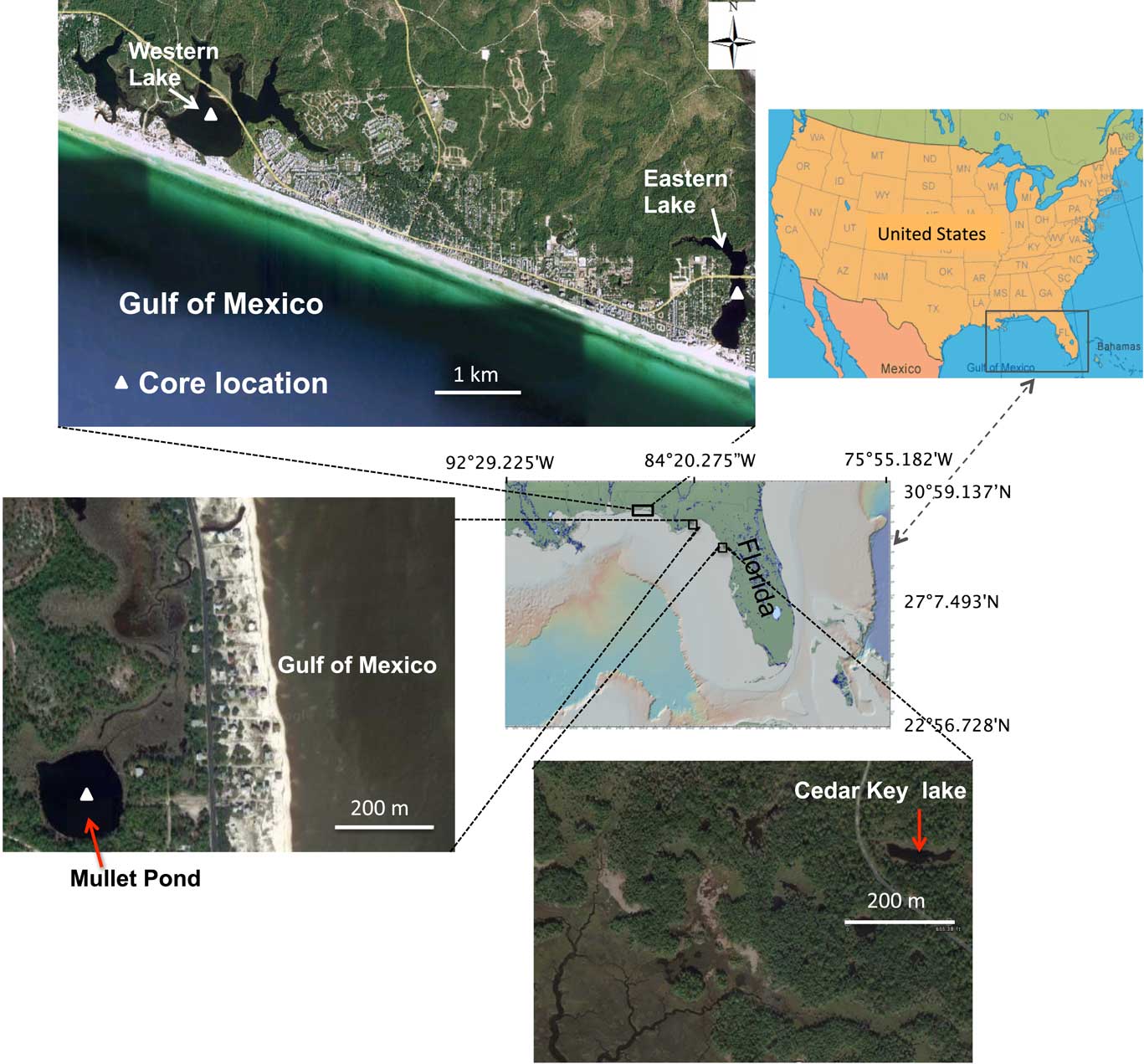
Western Lake (30°19.62′N, 86°9.07′W) is located in Walton County within Grayton Beach State Park along the northwest Gulf Coast of Florida (Fig. 1) and covers ~37.6 ha. The underlying geology in this area consists of up to 33 m of undifferentiated quartz sand and clayey sand overlying the Miocene-Pliocene Intracoastal Formation, which consists of phosphatic, quartz sand and sandy carbonate (Schmidt, Reference Schmidt1984). Western Lake is separated from the Gulf of Mexico by a sandy beach and is surrounded by 150- to 200-m-wide, well-developed sand dunes that reach as much as 9.3 m in height (Liu and Fearn, Reference Liu and Fearn2000b). The lake is temporarily connected to the Gulf by an outlet slough during high-water events. The average water depth of the lake is 3.3 m. The average salinity of the lake water was 10.9 ppt near the bottom and 6.7 ppt at the surface, and the average pH was 7.3 for the period of 2001–2008 (Hoyer and Canfield, Reference Hoyer and Canfield2008). High salinities (up to 25 ppt) have been observed after severe storms that led to seawater flooding of the lake (Hoyer and Canfield, Reference Hoyer and Canfield2008).
Eastern Lake (30°18.70′N, 86°5.59′W), also located in Walton County about 5.5 km southeast of Western Lake, occupies 20.8 ha area on the northwest Gulf Coast of Florida and has an average water depth of approximately 3 m (Hoyer and Canfield, Reference Hoyer and Canfield2008). The underlying geology is similar to Western Lake. The average salinity of the lake water was 12.9 ppt at the bottom and 10.6 ppt at the surface, and the average pH was 7.5 for the period of 2001–2008 (Hoyer and Canfield, Reference Hoyer and Canfield2008). The lake has been briefly connected to the Gulf of Mexico through a small outlet following large storms. The lake area has a relatively flat topography with moderately developed shorelines.
Mullet Pond (29°55.520′N, 84°20.275′W) is located in Franklin County within the Bald Point State Park along the north Florida’s Gulf Coast. The Ochlocknee River estuary is located just north of the state park. This area is underlain by hundreds of meters of Tertiary limestone and dolostone, which is overlain by a thin veneer of sand and clays that, in turn, is covered by a layer of fine quartz sand 10 to 60 m thick (Puri and Vernon, Reference Puri and Vernon1964; Sinclair and Stewart, Reference Sinclair and Stewart1985). Dissolution of the underlying limestone by slightly acidic rainwater is responsible for the formation of sinkholes and other karst features in the area (Sinclair and Stewart, Reference Sinclair and Stewart1985). Many of the sinkholes in this area intersect the water table forming circular sinkhole lakes. The sinkholes, once formed, began to fill with sediment, preserving valuable paleoenvironmental and climatic records (Watts et al., Reference Watts, Hansen and Grimm1992; Watts and Hansen, Reference Watts and Hansen1994; Kindinger et al., Reference Kindinger, Davis and Flocks1999; Hodell et al., Reference Hodell, Brenner, Curtis, Medina-González, Ildefonso-Chan Can, Albornaz-Pat and Guilderson2005; Zarikian et al., Reference Zarikian, Swart, Gifford and Blackwelder2005). Mullet Pond is a nearly circular sinkhole lake formed when an underground cavity in limestone collapsed ~7000 to 8000 yr ago (Lane et al., Reference Lane, Donnelly, Woodruff and Hawkes2011) and has a diameter of ~200 m. The lake is separated from the Gulf of Mexico by a 3- to 4-m-high dune ridge 200 m to the east. The land west of the dune ridge is relatively flat, with an elevation of 2–3 m above sea level. There is a tidal creek that runs through a small salt marsh to the north of the lake and intermittently connects the lake to the open coast (Fig. 1). The lake is about 2–3 m deep, and the surface salinity measured during the period of May 2016 to September 2017 is 10±5 ppt.
Finally, we analyzed a few samples from one of the sediment cores collected from a small unnamed lake (29°17.899′N, 83°3.538′W) located in Levy County approximately 17.7 km north of the Cedar Key on the northeastern Gulf Coast of Florida. This small lake (~134 m long and 29 m wide) is situated on forestland, about 3.8 km away from the nearest shoreline and 350 m from the salt marsh–forest boundary (Fig. 1). This area is underlain by upper Eocene Ocala Limestone with an overlying thin veneer of quartz sand in some locations. This region is east of the Apalachicola Embayment and is located along the Ocala Platform where middle and late Eocene rocks are either at or very near the surface (Scott et al., Reference Scott, Campbell, Rupert, Arthur, Green, Means, Missimer, Lloyd, Yon and Duncan2001a). This lake formed as the result of dissolution of Eocene limestone and is one of many small karst lakes that occur in this area.
MATERIALS AND METHODS
Sample collection and pretreatment
Two sediment cores were collected from (or near) the center of each lake, within 2 m of each other, using a handheld piston corer. Precautions were taken while coring, by holding coring tubes vertical to keep sediment integrity of the cores. Afterward, coring tubes were sealed with rubber stoppers at both ends. Cores were sliced into subsamples at a 0.25 cm interval. These sediment samples were freeze-dried, carefully inspected to pick out plants and shell fragments, and then ground to powder. All of the sediment samples were checked for the presence of carbonate with HCl. Samples from Eastern Lake, Mullet Pond, and the unnamed lake do not contain any detectable amounts of carbonate, whereas Western Lake samples do. Sediments from Western Lake were treated with (5%) HCl to remove carbonate, rinsed with deionized (DI) water several times, and freeze-dried. The plant fragments are mostly terrestrial (small twigs/stems, leaves, and wood) except UCI35740 (mixture of terrestrial and aquatic plants) and UCIT35741 (aquatic plant) from Mullet Pond. They were washed with 5% HCl, followed by treatment with 15% H2O2 in an ultrasonic bath for ~5–10 minutes to remove surface OM and fine sediment particles (that were sticking onto the plant materials), and then rinsed with DI water and dried. The samples were checked under a microscope. The treatment procedure was repeated if necessary until the samples looked clean and free of dark sediment particles from the sediment matrix. After the treatment, some samples did not have enough material left for 14C analysis. We did not follow the standard acid-base-acid (ABA) procedure that is routinely used for treating charcoal and wood as most of our plant samples were small and fragile and might not have survived the standard chemical concentrations and treatment temperatures (Bird et al., Reference Bird, Levchenko, Ascough, Meredith, Wurster, Williams, Tilston, Snape and Apperley2014). However, wet oxidation has been shown to be effective in removing organic carbon in a sample including contaminants not removed by the ABA procedure (Bird et al., Reference Bird, Ayliffe, Fifield, Turney, Gresswell, Barrows and David1999, Reference Bird, Levchenko, Ascough, Meredith, Wurster, Williams, Tilston, Snape and Apperley2014). Fossil shells were unidentifiable because of their fragmentary nature. They were cleaned with 15% H2O2 in an ultrasonic bath for ~5–10 min and rinsed with DI water and dried. The dried samples were then ground to powder.
In order to estimate the lake and marine reservoir effects in the study area, we collected both live and recently dead modern shells from Western Lake and the nearby beach (a potential source for sediment in the lake during overwash events) for 14C analyses. These modern shells include three freshwater neritid snails (Neritina usnea) and one dark false mussel (Mytilopsis leucophaeata), which were collected along the Western Lake shore on May 25, 2016, and also four small dead shells (three marine shells from nearby beach and one freshwater shell from lake shore) that were collected in June 2012. Although the time of death cannot be accurately determined, preservation conditions of these small fragile shells suggest that they died recently within 1 or 2 yr of the collection date. Dark false mussel is commonly found in freshwater and brackish-water environments, but it can tolerate a wide range of salinities (Richardson and Hammond, Reference Richardson and Hammond2016). Both modern live and dead shells were soaked in 30% H2O2 for several hours or longer to remove OM from the shells, cleaned with DI water, and dried. The dried samples were then ground to powder.
POM and DOM samples were collected from Western Lake at several different times from the same location during the period of 2010–2016. One POM and one DOM sample were also collected from Eastern Lake in March 2010. Four POM samples were collected from the same location in Mullet Pond from August to November in 2016. Water samples for DOM analysis were filtered through 0.45 μm precombusted glass filters in the field into clean 1 L bottles using a small pump. In the laboratory, the filtered water samples were freeze-dried to reduce the volume to less than 100 mL and acidified with ~50–100 μL 6N HCl. After acidification, the DOM samples were completely freeze-dried (Wang et al., Reference Wang, Hsieh, Landing, Choi, Salters and Campbell2002). POM samples were collected on precombusted glass filter papers and dried in an oven at 60–70°C.
Extraction of CO2 from samples for 14C analysis
For organic samples (i.e., bulk sediment OM, plant fragments, POM, and DOM), an appropriate amount of each dried sample (depending on the carbon content) was loaded in a precombusted Pyrex tube with cupric oxide (CuO), copper granules, and silver foil. Tubes containing the samples were then evacuated in the vacuum line and sealed. Sealed tubes were combusted overnight at 580°C in a furnace. The tubes were reloaded in the vacuum line. The CO2 released in combustion was extracted from each tube, purified cryogenically, and collected in a precombusted Pyrex tube for graphitization.
For shell samples, about 5–8 mg of each sample was loaded in a glass vessel, and 2 mL of 100% phosphoric acid (H3PO4) was loaded in the side arm of the vessel. The glass vessels containing the samples were evacuated using the vacuum line. Then, the vessels were tilted to allow phosphoric acid to flow toward the bottom of the vessel to react with the sample overnight at 25°C. The CO2 released from the reaction was then purified cryogenically in the vacuum line, and the purified CO2 was collected in a precombusted Pyrex tube for 14C analysis.
Radiocarbon contents of the samples were measured at the National Ocean Science Accelerator Mass Spectrometry (AMS) Facility in Woods Hole, Massachusetts, and the Keck Carbon Cycle AMS Facility at the University of California, Irvine. The radiocarbon data are reported as radiocarbon age in years before present (14C yr BP) and Δ14C values following the convention (Stuiver and Polach, Reference Stuiver and Polach1977; Reimer et al., Reference Reimer, Brown and Reimer2004). The conventional radiocarbon ages were calibrated to calendar years (Ramsey, Reference Ramsey2009) using the OxCal 4.3 online program (https://c14.arch.ox.ac.uk) and the IntCal13 calibration curve (Reimer et al., Reference Reimer, Bard, Bayliss, Beck, Blackwell, Ramsey and Buck2013), with ranges expressed at the 95.4% (2σ) confidence level. For modern samples with positive Δ14C values, the ages were also estimated by using the atmospheric 14C record for the period of 1840–2016 compiled from published data in the literature for the Northern Hemisphere (Suess, Reference Suess1955; Stuiver, Reference Stuiver1965; Manning et al., Reference Manning, Melhuish, Wallace, Brenninkmeijer and McGill1990; Wang et al., Reference Wang, Jahren and Amundson1997; Levin and Kromer, Reference Levin and Kromer2004; Hua et al., Reference Hua, Barbetti and Rakowski2013; Levin et al., Reference Levin, Kromer and Hammer2013) and our own unpublished data. All calibrated 14C ages reported are referred to as “cal yr BP.”
RESULTS
The 14C dates on bulk sediment OM, plants, and shell fragments from sediment cores analyzed in this study are summarized in Supplementary Table 1. The 14C data for modern samples of plants and shells and for POM and DOM are reported in Supplementary Table 2 and Supplementary Table 3, respectively.
Bulk sediment samples from these coastal lakes yielded 14C ages ranging from 230±15 14C yr BP to 5050±60 14C yr BP, corresponding to calibrated mean 14C ages of 230±70 cal yr BP to 5800±75 cal yr BP, while the 14C ages of plant fragments from these sediment cores varied from “> modern” to 2740±10 cal yr BP. The calibrated 14C ages of fossil shell fragments found in Western Lake cores have a range of 1030±40 cal yr BP to 2930±30 cal yr BP, and the modern shells from the Western Lake area and nearby beach yielded 14C ages varying from “> modern” to 510±10 cal yr BP. POM and DOM samples yielded Δ14C values ranging from 91.2‰ to −88.6‰. Δ14C (‰) values >0 indicate “> modern” carbon (i.e., after 1950, containing 14C produced by nuclear weapons tests), whereas Δ14C (‰) values <0 are indicative of “aged” carbon (i.e., before 1950).
DISCUSSION
14C age of bulk sediment OM
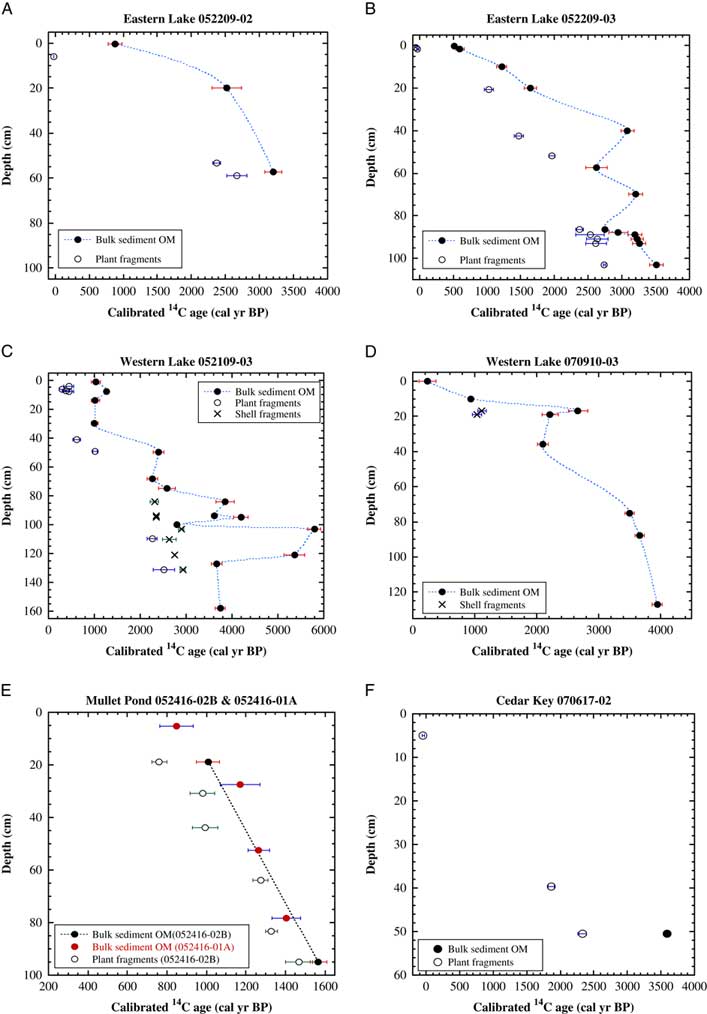
Radiocarbon ages of bulk sediments from the coastal lakes examined in this study do not all increase with depth (Fig. 2; Supplementary Table 1). Three bulk sediment OM samples from core 052209-02 from Eastern Lake yielded radiocarbon ages that increase with depth (Fig. 2A; Das et al., Reference Das, Wang, Donoghue, Xu, Coor, Elsner and Xu2013). Bulk sediment OM at the surface of this core yielded an old 14C age of 880±50 cal yr BP. The average sedimentation rate calculated from the 14C ages of plants found near the top (~6 cm depth) and the bottom of this core is 23 cm/ka. Thirteen sediment samples from Eastern Lake core 052209-03 were dated, and the calibrated 14C ages of these samples exhibit two prominent reversals at ~60 cm and ~87 cm depths (Fig. 2B). The 14C age of bulk sediment OM at the surface of this core is 520±10 cal yr BP, which differs significantly (by more than 300 yr) from that found at the surface of core 052209-02 from the same lake. The average sedimentation rate derived from the 14C ages of plants found near the top and the bottom of this core is 37 cm/ka, which is significantly higher than the sedimentation rate of 23 cm/ka found in core 052209-02 from the same lake. This suggests that sedimentation rate can vary greatly with location in a coastal lake. The old 14C ages of surface sediment OM from both cores indicate a significant 14C deficiency in organic carbon in this lake.
(color online) Plots of mean calibrated 14C ages of bulk sediment organic matter, plants, and shell fragments versus depths for sediment cores collected from coastal lakes in Florida (A–F). Error bars represent 2 standard deviations (2σ) from the mean.
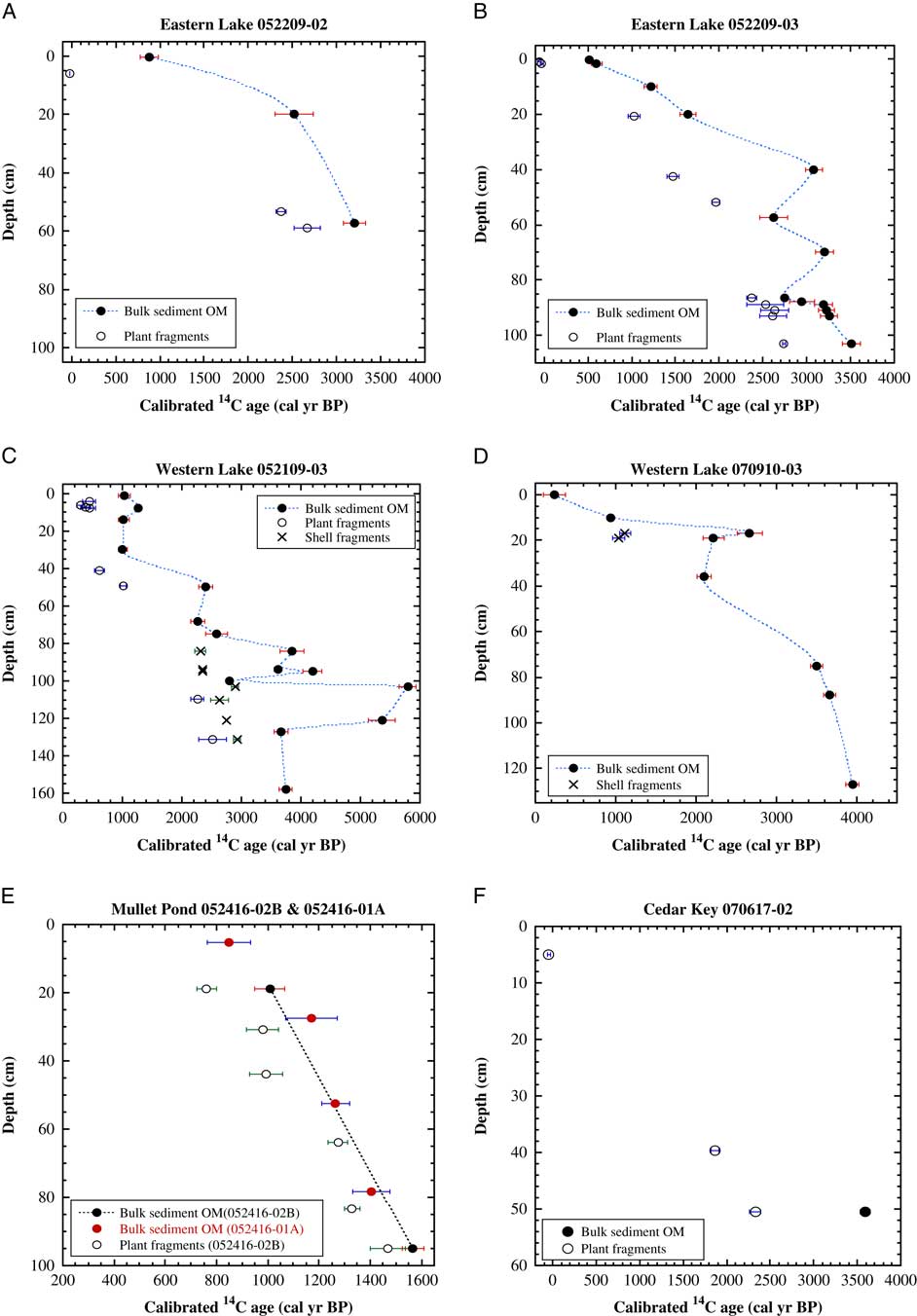
Similarly, 23 bulk sediment samples from Western Lake cores 052109-03 and 070910-03 yielded 14C ages that are not all consistent with depth (Fig. 2C and D). The bulk sediment OM from the top (0–1 cm) of the core 052109-03 yielded a calibrated 14C age of 1030±50 cal yr BP, which is 580 yr older than that of a plant fragment found at ~4 cm below the surface (Fig. 2C). The surface bulk sediment OM from core 070910-03, on the other hand, had a calibrated 14C age of 230±70 cal yr BP, very different (by 800 yr) from that found at the top of core 052109-03. These old 14C ages of surface sediments suggest that sedimentary OM in Western Lake, just like in Eastern Lake, is also significantly deficient in 14C. At depths of 1 cm, 14 cm, and 30 cm in core 052109-03, the 14C ages of bulk sediment OM (1030±50, 1025±45, and 1010±40 cal yr BP, respectively) are essentially the same within the analytical uncertainty, whereas at 8 cm depth, the bulk sediment OM yielded an older 14C age of 1275±25 cal yr BP. This core displays several other age reversals at ~68 cm, 94 cm, 100 cm, 121 cm, and 127 cm depths (Fig. 2C). Western Lake core 070910-03 also has 14C age reversals in bulk sediment OM at 19 cm and 36 cm depths (Fig. 2D). The average sedimentation rate determined from the 14C ages of plant fragments found at 4 cm and 131 cm depths in core 052109-03 is 61 cm/ka, which is much higher than those found in Eastern Lake cores. Unfortunately, core 070910-03 had no visible plant fragments; the apparent sedimentation rate calculated from the 14C ages of the top and bottom bulk sediment OM in this core is 34 cm/ka, much lower than the sedimentation rate found in core 052109-03 from the same lake (Fig. 2C and D).
For Mullet Pond, we have a total of six 14C dates on bulk sediment OM from two sediment cores: two dates from core 052416-02B and four from core 052416-01A. Although these limited bulk sediment 14C dates display an increasing trend with depth in each core, they are also older than plant fragments from the same or similar depths (Fig. 2E). Comparisons with 14C dates on plant fragments that were either associated with the bulk sediment samples or from other sediment cores from this lake reveal significant spatial and temporal variability in sedimentation rate within the lake even at adjacent localities (Fig. 3), similar to observations in Eastern Lake and Western Lake.
(color online) Distribution of mean calibrated 14C ages of bulk sediment organic matter and plant fragments with depth over the depth interval of 0 to 100 cm (A) and 0 to 640 cm (B) in different cores from Mullet Pond, including previously published data from two cores (MLT1 and MLT2) from the same lake (Lane et al., Reference Lane, Donnelly, Woodruff and Hawkes2011). Error bars represent 2 standard deviations (2σ) from the mean.

For the unnamed lake in the Cedar Key area, we analyzed only one bulk sediment sample from core 070617-02. Similar to observations in Eastern Lake, Western Lake, and Mullet Pond, the bulk sediment OM from the bottom of the Cedar Key lake sediment core yielded a calibrated 14C age of 3595±30 cal yr BP, which is 1275 yr older than the co-occurring plant fragments (Fig. 2F; Supplementary Table 4). The average sedimentation rate calculated from the 14C ages of plant fragments found at 5 cm and 51 cm depths in this core is ~20 cm/ka, lower than those found in the other lake cores analyzed in this study (Fig. 2).
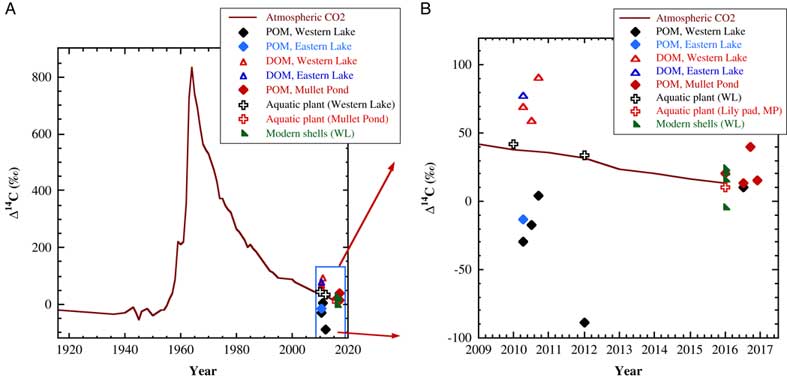
Modern aquatic plants collected from Western Lake and Mullet Pond have Δ14C values that are similar to the contemporary atmospheric CO2 (Fig. 4; Supplementary Table 2), suggesting that sedimentary OM derived from modern primary production within the lake is nearly in equilibrium with the atmosphere. Thus, the old 14C ages (i.e., 14C deficiencies) found in core top sediments are mostly likely caused by the input of aged OM eroded from terrestrial sources in the lake watershed rather than a true reservoir effect in which old carbon is introduced via DIC. The age reversals in bulk sediment OM observed in the cores from Western Lake and Eastern Lake suggest abrupt changes in 14C deficiency of sedimentary OM in these lakes in the past. The dissimilar 14C ages of bulk sediment OM found in the core top sediments of different cores from the same lake are likely because of missing sediments from the top of the cores with older ages (i.e., 052209-02 and 052109-03) and/or variability of the 14C deficiency in organic C pool within the lake. The most likely potential causes for the similar 14C ages at different depths (such as observed at 1–30 cm depths in Western Lake core 052109-03, and at 27 cm and 52 cm depths in Mullet Pond core 052416-01A) are bioturbation and/or unusually high sedimentation rates. Bioturbation by burrowing organisms can mix sediment particles of different ages, resulting in a homogenous age distribution with depth. Bioturbation by burrowing organisms can also carry younger particles to greater depth (or vice versa), resulting in age reversals (Mollenhauer et al., Reference Mollenhauer, Kienast, Lamy, Meggers, Schneider, Hayes and Eglinton2005). However, both digital and X-ray images of the core do not show clear evidence of significant bioturbation (Supplementary Fig. 1). High sedimentation rates, on the other hand, can lead to rapid burial of sediment particles, resulting in little or no age difference within a sediment layer, and thus provide a more plausible explanation for the occurrence of nearly the same ages at different depths of a core. The inconsistent 14C age-depth relationships obtained from bulk sediment OM (Fig. 2B–D) are therefore most likely because of variations in the influx of aged organic carbon derived from terrestrial sources in the watershed.
(color online) Δ14C values of particulate organic matter (POM), dissolved organic matter (DOM), modern aquatic plants, and modern shells collected from Western Lake (WL), Eastern Lake, and Mullet Pond (MP) along the Gulf Coast of north Florida in comparison with the atmospheric Δ14C record for the last century (A) and during the sampling period (B). It shows that the aquatic plants analyzed all had 14C contents similar to the contemporary atmospheric CO2, indicating that these plants either utilize atmospheric CO2 or there was little or no 14C reservoir effect on dissolved inorganic carbon utilized by aquatic plants. The atmospheric 14C data are compiled from various sources (Suess, Reference Suess1955; Stuiver, Reference Stuiver1965; Manning et al., Reference Manning, Melhuish, Wallace, Brenninkmeijer and McGill1990; Wang et al., Reference Wang, Jahren and Amundson1997; Levin and Kromer, Reference Levin and Kromer2004; Levin et al., Reference Levin, Kromer and Hammer2013; Wang, Y., Das, O., Xu, X., Liu, J., Jahan, S., Means, G.H., Donoghue, J., Jiang, S., unpublished data).

These data suggest that the 14C deficiency (or fraction of old carbon) in bulk sediment is not constant and can vary greatly over time and space. This may be expected as lake sedimentary OM is derived not only from primary production within the lake, but also from allochthonous sources (such as soils) being eroded and brought into the lake by runoff/floodwaters and wind. Our data also suggest that the 14C deficiency of sedimentary OM can vary significantly with location in a lake and among lakes. Such temporal and spatial variations make it impossible or difficult to determine a proper correction factor for 14C ages of bulk sediment OM from sediment cores from coastal lakes. Thus, we consider the 14C ages of bulk sediment OM from these coastal lakes to be unreliable. Furthermore, our data suggest that sedimentation rate can vary significantly with location in a lake and even cores collected within 1–2 m of each other can have different sedimentation rates, resulting in very different age-depth relationships. This implies that the age model established based on radiocarbon dating of one core cannot be directly applied to other cores from the same coastal lake in the study region.
Comparison of 14C ages of bulk sediments, plant fragments, and shells
The 14C ages of bulk sediment OM are consistently older than those of plants from the same or similar depths in the same core (Fig. 2). The difference in the calibrated 14C ages of bulk sediment OM and co-occurring plant fragments varies greatly with depth and among cores (Fig. 5A). Ten paired samples of coexisting plant fragments and bulk sediment OM from Eastern Lake cores (052209-03 and 052209-02) were analyzed, and the difference in their calibrated 14C ages ranges from 570 yr to 1610 yr (Fig. 5A; Supplementary Table 4), averaging 770±310 yr. The calibrated 14C ages of four paired bulk sediment OM and plant samples from Western Lake core 052109-03 yielded an average age difference of 1730±1230 yr, ranging from 825 to 3535 yr (Fig. 5A; Supplementary Table 4). The paired bulk sediment OM and co-occurring plant samples from the Cedar Key lake core 070617-02 yielded a 14C age difference of 1275 yr (Fig. 5A). The two paired sediment-plant samples from Mullet Pond yielded the smallest age differences of 250 yr at 19 cm depth and 95 yr at 95 cm depth, respectively (Fig. 5A). Sediment cores from Mullet Pond have higher organic C contents (C%=13.2±2.3% for 052416-02B) than the cores from the other lakes (2.1±1.4% for EL052209-03, 4.5±1.7% for WL052109-03) and are generally rich in plant fragments, which may explain the smaller age differences between co-occurring bulk sediment OM and plant fragments in those cores.
(color online) Difference in calibrated radiocarbon ages between coexisting bulk sediment organic matter and plants in sediment cores from Eastern Lake, Western Lake (WL), and Mullet Pond (A); and between coexisting materials (i.e., bulk sediment and plant, bulk sediment and shell fragments, and shell and plant fragments) in sediment cores from Western Lake (B).
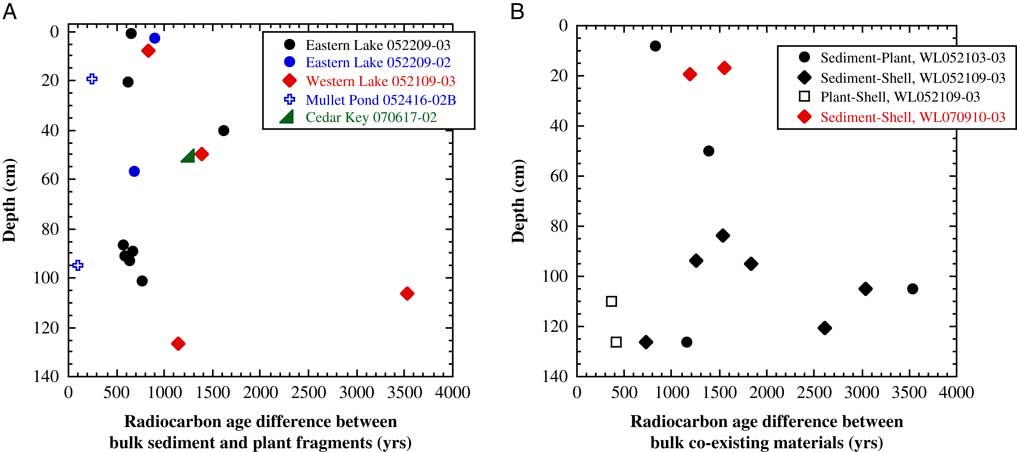
Similarly, the 14C ages of shells differ significantly from those of their associated bulk sediment OM (Figs. 2 and 5B). A total of eight shell samples from Western Lake cores (052109-03 and 070910-03) were analyzed. Plant fragments, which were found associated with two of the shell samples, were also 14C dated. Although the 14C ages of the shells from core 052109-03 generally increase with depth (Fig. 2C), they are much younger than the 14C ages of their associated bulk sediment OM (Fig. 5B). Two shell samples from 17 cm and 19 cm depths in core 070919-03 yielded essentially the same 14C ages within the analytical uncertainty (Fig. 2D). These ages are also considerably younger than those of co-occurring bulk sediment OM (Fig. 2D). The differences in calibrated 14C ages between co-occurring bulk sediments and shell fragments are 1720±760 yr, varying from 735 yr to 3035 yr (Fig. 5B). Two pairs of coexisting shell and plant samples yielded calibrated 14C age differences of 370 yr and 410 yr, respectively, much smaller than those between co-occurring bulk sediment OM and shells (Fig. 5B).
Eight modern aquatic shells, including five collected from Western Lake and three from the nearby beach (a sediment source for overwash deposits in the lake), were analyzed for comparison. The Δ14C values of the modern shells from Western Lake range from 15.9‰ to 59.8‰, with the exception of one sample that has a Δ14C value of −4.9‰ (Fig. 4; Supplementary Table 2). The positive Δ14C values indicate the incorporation of “bomb” 14C produced during the nuclear era. Comparison of the Δ14C values of the modern shells from Western Lake with those of the atmospheric CO2 suggests relatively young carbon (DIC) sources of either 1–3 yr or 60–61 yr old for these freshwater and brackish-water snail shells (Fig. 4A; Supplementary Table 2), which in turn suggests either insignificant or small reservoir effects on DIC in this lake, consistent with the current lack of groundwater discharge from the deep limestone aquifer into the lake. In contrast, three modern beach shells yielded Δ14C values varying from −30.6‰ to −62.9‰, corresponding to conventional 14C ages of 190±15 14C yr BP to 460±20 14C yr BP, with an average of 360±150 14C yr BP (Supplementary Table 2). These age data suggest that the local marine reservoir age, which was previously unknown, is 420±150 14C yr BP. Unfortunately, the fossil shells uncovered from the cores were not identified because of their fragmentary nature. The two paired shell-plant samples were associated with a sand pocket (at ~110 cm depth) and a sand layer (at ~131 cm depth), respectively, in core 052109-03 (Supplementary Fig. 1). The sand deposits most likely represent overwash deposits (Das et al., Reference Das, Wang, Donoghue, Xu, Coor, Elsner and Xu2013). The average age difference observed in these co-occurring shells and plants are 390±30 14C yr, which is essentially the same (given the uncertainties) as the local marine reservoir age estimated from the 14C ages of the modern marine shells from the nearby beach (Supplementary Tables 2 and 4). This confirms that the unidentified shell fragments associated with the sand layer or sand pocket in the Western Lake core are most likely of marine origin and were brought into the lake by overwash events.
The older 14C ages of bulk sediment OM compared with plants and shells are caused by the presence of aged organic carbon derived from old carbon sources in the watershed, leading to ambiguous 14C ages obtained from bulk sediment OM. As discussed in the previous section, bioturbation is not unlikely to be a cause for the age offsets and reversals, because it would have affected not only bulk sediment OM, but also plants and shell fragments. As noted previously, digital and X-ray images of the cores do not reveal clear signs of bioturbation (Supplementary Fig. 1). In contrast, the 14C ages of plants and shells all increase with depth, with one exception at 103 cm depth where the calibrated 14C age of the shell sample, like the bulk sediment sample, is older than the shells at 110 cm and 121 cm depths (Fig. 2C). Some of the age reversals in bulk sediment OM are either associated with or right above visible sand layers (i.e., overwash deposits) in the cores (Fig. 2). Thus, the age reversals are most likely because of rapid increases in erosion and sedimentation resulting from large storm events. This is also supported by our limited 14C dates on plant fragments that suggest increased sedimentation rates during the periods when the 14C age reversals in bulk sediment OM occurred (Fig. 2B and C).
As discussed previously, the 14C signatures of modern freshwater or brackish-water shells collected from Western Lake suggest relatively small DIC 14C reservoir effects in this lake (either 1–3 yr or several decades). This suggests that these fresh/brackish-water shells may have formed in quasi-equilibrium with the atmospheric 14C, and their 14C ages are therefore more reliable than those of bulk sediment OM. Although significant reservoir effect has been observed in shells in some lakes (e.g., Mischke et al., Reference Mischke, Weynell, Zhang and Wiechert2013), it appears that the DIC 14C reservoir effect in the coastal dune lakes along the Gulf Coast of northwest Florida is relatively small (<<100 yr). The carbonate shell fragments associated with sand deposits in the Western Lake core 052109-03, on the other hand, are 390±30 (n=2) yr older than coexisting plant fragments (Fig. 5B). This age difference is, however, about the same as the local marine reservoir age estimated from the 14C ages of small modern shells from the nearby beach (Supplementary Table 2).
The results suggest that freshwater and brackish-water shells (if preserved in the sediment cores) from these coastal dune lakes in northwest Florida may serve as a good substrate for obtaining reliable radiocarbon dates (because of small 14C reservoir effects on DIC). However, 14C ages of shell fragments associated with overwash deposits are likely a few hundred years too old because of their possible marine origin and marine reservoir effect. Our data also show that the difference between calibrated 14C ages of contemporary bulk sediment OM and plant fragments is not consistent throughout the cores, ranging from <100 yr to >3000 yr (Fig. 5). This confirms that the apparent 14C reservoir effect on sedimentary OM varies considerably with time depending on the relative amounts and age of old carbon entering into the lakes from terrestrial sources, which are controlled by precipitation, runoff, and erosion in the lake watershed, and thus the 14C dates obtained from the bulk sediment samples from these lakes are unreliable.
14C age of POM and DOM
The 14C ages of DOM and POM collected at different times from these lakes range from “> modern” to 640 cal yr BP (Supplementary Table 3; Fig. 4). POM samples from Western Lake span the longest time period (2010–2016) and display the largest range of 14C variation, whereas those from Mullet Pond, which were all collected in 2016, display the smallest 14C variability. The Δ14C values of POM samples from Western Lake varied from 10.2‰ (similar to the Δ14C values of atmospheric CO2 in 2016 and also in 1956) on May 25, 2016, to –88.6‰ (corresponding to a 14C age of 685±20 14C yr BP or 640±40 cal yr BP) on June 22, 2012. The only POM sample from Eastern Lake yielded a 14C age of 45±25 14C yr BP, which is 135 yr younger than the POM sample (180±30 14C yr BP) collected on the same day from Western Lake (Supplementary Table 3). The POM samples from Mullet Pond were all collected in 2016, and their Δ14C values varied from 13.1‰ to 40.4‰, suggesting that they originated mostly from OM photosynthesized either within the last few years or about 60 yr ago (Fig. 4; Supplementary Table 3). The limited DOM samples collected from Western Lake and Eastern Lake all had positive Δ14C values (ranging from 58.9‰ to 91.2‰), indicating that they were primarily derived from OM photosynthesized within recent decades (either 50–60 yr ago or less than 15 yr ago) (Fig. 4; Supplementary Table 3). The positive Δ14C values are because of incorporation of “bomb” 14C produced by nuclear weapons testing in the 1950s and 1960s that greatly elevated the 14C levels of the atmosphere (Manning et al., Reference Manning, Melhuish, Wallace, Brenninkmeijer and McGill1990; Wang et al., Reference Wang, Jahren and Amundson1997; Hua et al., Reference Hua, Barbetti and Rakowski2013; Levin et al., Reference Levin, Kromer and Hammer2013). The variations in Δ14C values of DOM and POM samples collected at different times further confirm that the 14C contents of organic carbon pools in these lakes vary with time and among lakes, most likely controlled by variations in runoff and erosion on land.
CONCLUSION
Radiocarbon analyses of various carbon-containing substrates, including bulk sediment OM, plants, shells, and POM, in coastal lakes along the Gulf Coast of Florida reveal significant 14C deficiencies in sedimentary OM in these lakes, resulting in the 14C ages of bulk sediments being too old and erroneous. Because bulk sediment OM is a mixture of organic materials derived from both aquatic primary production within the lake and allochthonous sources transported into the lake by runoff/floodwaters and wind, influx of aged organic carbon eroded from land is most likely the cause of radiocarbon deficiencies in the lake sediments. The data also show that the 14C deficiencies of sedimentary OM in coastal lakes can vary significantly over time (in response to changes in precipitation, runoff, and erosion on land) and with location (within and among lakes), making it difficult, if not impossible, to determine a proper correction factor for 14C ages of bulk sediment OM in sediment cores from these lakes. Thus, we consider the 14C dates obtained from the bulk sediment samples to be generally unreliable. Furthermore, our data show that sedimentation rate can vary considerably with location in a lake and even cores collected within 1–2 m of each other can have different sedimentation rates, resulting in very different age-depth relationships. This implies that the age model based on dating of one sediment core cannot be directly applied to other nearby cores from the same coastal lake despite their close proximity.
Our limited 14C data from modern snail shells from one of the lakes (Western Lake) suggest a relatively small 14C reservoir effect on DIC, with an estimated reservoir age of either 1–3 yr or 5–6 decades. The 14C ages of carbonate shell fragments associated with sand deposits in a sediment core from the same lake, on the other hand, are 390±30 (n=2) yr older than co-occurring plant fragments. This age difference is, however, about the same as the estimated marine reservoir age for this part of the Gulf of Mexico. The results suggest that fresh/brackish-water shells from these coastal lakes may serve as a useful substrate for obtaining reliable radiocarbon dates (because of a small DIC reservoir effect), but radiocarbon ages of shell fragments associated with overwash deposits are likely a few hundred years too old because of their possible marine origin and the influence of the marine 14C reservoir effect.
ACKNOWLEDGMENTS
This study was supported by grants from the U.S. National Science Foundation (EAR1566134, EAR1566180). Some of the radiocarbon analyses were carried out at the National Ocean Sciences Accelerator Mass Spectrometry facility, Woods Hole, Massachusetts. Fieldwork was carried out with the cooperation of the Florida Geological Survey and the Florida Park Service. We thank two anonymous reviewers and associate editor Dr. Pigati for helpful comments on an earlier version of this paper. We are grateful to Steve Petrushak at the Antarctic Marine Geology Research Facility at Florida State University for assistance with obtaining core imagery and X-radiography; to undergraduate student Emily Benayoun for assistance in fieldwork and lab work; to Rupsa Roy for assistance in lab work; and to Dan Phelps of the Florida Geological Survey, Chris Horkman and Patrick Hartsford at the Grayton Beach State Park, Bill Wilkinson at Bald Point State Park, Mike Legare of the Merritt Island National Wildlife Refuge, and Larry Woodward of the Cedar Key National Wildlife Refuge for their invaluable assistance with the fieldwork. Sample preparation was performed at the National High Magnetic Field Laboratory, which is supported by National Science Foundation Cooperative Agreement No. DMR-1644779 and the state of Florida.
SUPPLEMENTARY MATERIAL
To view supplementary material for this article, please visit https://doi.org/10.1017/qua.2018.96