1 Introduction
The main design questions for funded pension contracts are similar across countries. Denmark (Finanstilsynet, 2017 and Germany (Maurer et al., Reference Maurer, Mitchell, Rogalla and Siegelin2016) consider the advantages and disadvantages of pension guarantees. The UK mandated the payout of retirement products in terms of deferred annuities until April 2016 but now allows full lump-sum withdrawal. Australia discusses whether to set up an insurance market for lifelong income provisions on top of the current drawdown options without longevity insurance. Variable annuities, with or without guaranteed lifetime withdrawal benefits, are a large market in the USA (Koijen and Yogo Reference Koijen and Yogo2017).
Proper understanding of the contract designs in different countries is important in order to draw lessons from international experience. This paper summarizes recent developments in occupational pensions in the Netherlands. It identifies the strengths and weaknesses of Dutch contract designs and draws lessons for other countries.
Contract design of occupational pensions is heavily debated in the Netherlands. As regards defined contribution (DC) contracts, the requirement to provide guaranteed fixed nominal lifetime income during the payout phase was lifted in 2016. At the same time, the new legislations maintained the compulsion to offer lifelong payments by pooling idiosyncratic longevity risks.
Defined benefit (DB) pensions are the dominant contracts in the Netherlands. Also, these schemes have been in flux during the past decade. The pension entitlements in these schemes are defined in terms of (deferred) annuities also during the accumulation phase. Employers have progressively withdrawn as risk sponsors of these schemes during this period. Participants thus bear more systematic investment and longevity risks in stand-alone pension schemes. In particular, cost of living adjustments depend on the funding status of the schemes and pensions in payments can be cut in case of underfunding.
Currently under discussion is a more far-reaching reform for DB pensions. This reform replaces (deferred) variable annuities by financial assets as individual entitlements. The proposed system involves personal accounts with insurance contracts pooling longevity risks and possibly collective buffers that share systematic risks with future pension savers. We refer to this proposed contract as Personal Pensions with Risk-sharing and Collective Buffers (PPR-CB). Personal Pensions refer to individual accounts of financial assets; risk-sharing involves pooling longevity risks in insurance contracts, while the Collective Buffers share systematic risks with future pension savers.
The Dutch PPR design attempts to combine the best of the two worlds of DB and DC. Like DB contracts, a PPR aims to provide stable lifelong retirement income by contributing sufficient resources, hedging interest rate risks, smoothing investment returns and pooling idiosyncratic longevity risks. The so-called Defined Ambition (DA) design of a PPR takes the desired retirement income stream as a starting point and endogenously derives the (dis)saving, investment and insurance options from that objective for retirement income. In contrast to traditional DB plans, benefits are not necessarily guaranteed. Another difference with traditional DB plans is that the PPR design allows (dis)saving, investment and insurance to be tailored to personal characteristics of the participants. Moreover, the valuation of individual entitlements and the relationship between contributions and the accrual of entitlements are less complex than their counterparts found in variable annuities in current DB plans. The combination of a richer menu of instruments with which to tailor risk management and more transparent personal property rights prevents intergenerational conflicts about investment and distribution.
The paper is structured as follows. Section 2 summarizes Dutch retirement income provisions. Section 3 outlines the strengths and weaknesses of the current DB contracts in occupational pensions. Section 4 outlines new legislation on decumulation of DC contracts. Section 5 explores proposals on personal pensions with risk-sharing and collective buffers. Section 6 identifies lessons for other countries. Section 7 concludes. The paper updates Bovenberg and Nijman (Reference Bovenberg and Nijman2009) and Bovenberg et al. (Reference Bovenberg, Mehlkopf, Nijman, Mitchell and Shea2015). These latter papers offer more detail on older contract designs and earlier policy discussions.
2 Dutch occupational pensionsFootnote 1
2.1 Three-pillar system
The Dutch pension system consists of three pillars. The first is a pay-as-you-go (PAYG) public pension scheme that provides a uniform, flat pension to all residents at a level that is related to the minimum wage. If workers who earn middle and higher incomes want to maintain their standard of living in retirement they need additional pension income. As the second pillar of pension provision, occupational pensions provide supplementary earnings-related pension income for them. The third pillar consists of voluntary personal pension provisions. This pillar is especially important for self-employed individuals who typically do not participate in occupational pension provisions.
2.2 Occupational pensions
This paper focuses on the occupational pensions (second pillar). Employees are obliged to participate. As a result, the funded schemes cover more than 90% of the labor force in the Netherlands. The value of assets in the occupational pensions currently amounts to about 1.4 trillion Euro (150% of GDP). Second-pillar pension funds are independent non-profit trusts. These members of the governing board act as fiduciary trustees. They determine investments, contribution levels and cost-of-living adjustments for benefits.
2.3 Deferred annuity plans
The vast majority of occupational pensions in the Netherlands are structured as (deferred) annuity contracts. These annuities are no longer guaranteed and have become variable annuities. Employers have retreated as risk-bearing sponsors of pension plans, which are now typically stand-alone. In addition, due to the maturing and aging of pension plans, higher pension contributions have become less effective instruments to finance funding gaps. Moreover, the pension contributions in many sectors have reached levels as high as around 20% of the wage sum (above a so-called franchise level accounting for the flat public benefit). Hence, raising contribution levels further in order to stabilize benefits has become less attractive. Contribution rates are thus more or less fixed in many sectors. Stable contributions and risk-bearing investments in the absence of outside risk-bearing sponsors imply that annuities have become variable. We will refer to these variable annuity plans as DB plans because individual property rights are defined in terms of an income stream rather than a capital claim.Footnote 2
2.4 Back-loading of accumulation
The Dutch DB plans aim at a specific lifetime income stream during retirement. Years of service and a reference wage typically determine the annuity entitlement of an individual participant. The reference wage used to be the final wage, but at the beginning of this century, most funds moved to career-average schemes. In these latter schemes, entitlements accumulate based on a percentage of the average wage level during the career. Schemes typically aim at an annuity level about 75% of average pay (including the flat public benefit) after 40 years of service. The benefit accrual (in terms of annuity level) is uniform across age groups. The accrual rate of annuity units is the same for all workers – irrespective of age. This so-called uniform accrual implies that benefits are backloaded because the time value of money implies that the value of the (deferred) annuity (as a percentage of the wage) rises with age. Despite this back-loading of benefit accrual, industry funds charge the same premium rate for the annuity units irrespective of age. This combination of uniform (i.e. age-independent) accrual and uniform contributions implies that firms with a younger workforce typicallyFootnote 3 subsidize other firms with an older workforce in the same sector. This redistribution implies that the funded system includes an implicit PAYG element.
2.5 Variable annuities
Pension funds aim to index the annuities to wage or price inflation, but these increases in entitlements are conditional on the funding rate (i.e. the ratio between the value of assets and liabilities) of the fund. Moreover, pension rights and thus pension payments can be cut in nominal terms if the assets of a fund are smaller than the value of the nominal liabilities (i.e. the value of the annuities excluding indexation).Footnote 4 Government regulation requires that a funding shortage is in expectation resolved within a ten-year period. In calculating the scope for recovery, funds can use expected returns on assets. Hence, risk premia on risky assets contribute to the potential for recovery.
2.6 Nominal liabilities computed with market interest rates
Solvency regulations of DB plans are based on the idea that annuities are guarantees even though they are not guaranteed in practice. In particular, Dutch pension funds must calculate nominal liabilities on the basis of the term structure of nominal risk-free interest rates published by the Dutch Central Bank. This valuation method was introduced in 2007.Footnote 5 Before that time, pension funds discounted their liabilities against a fixed discount rate of 4%. The introduction of valuation on the basis of market interest rates did not have a substantial effect on funding rates when the system was introduced, as market interest rates were close to 4% in 2007. This changed after the financial crisis in 2008 when interest rates started to drop substantially.
2.7 DC plans
A small but increasing part of Dutch occupational pensions is based on DC plans. During the accumulation phase, individual property rights are defined in terms of a claim on financial capital in personal accounts rather than as deferred annuities. Moreover, several DB pension funds also run DC plans for additional voluntary contributions on top of mandatory accruals in the DB fund. Third-pillar arrangements are also based on DC plans. The ceilings for tax-privileged contributions (in percentage of income) rise with age. This back-loading of contribution levels reflects the Dutch DB tradition with uniform accruals of deferred annuities during the working career. A second aspect that distinguishes Dutch second-pillar DC plans from those in other countries is that at retirement the accumulated capital must be converted into a lifelong annuity.Footnote 6 Also this reflects the annuity insurance tradition of the Netherlands.
2.8 DB versus DC plans
Section 4 provides more detail on the Dutch DC plans, which serve as a benchmark for reform of the DB plans. Indeed, both DB and DC feature strengths. DC plans provide more transparency about the valuation of individual entitlements in general and the relationship between contributions and accrual of entitlements in particular. They thus yield more secure property rights and alleviate conflicts of interest between generations. Moreover, in DC schemes payments can be tailored to individual needs. The income frame of DB schemes aids communication to participants. In addition, it offers a helpful choice architecture for managing macro-economic (interest rate) risk and ensuring idiosyncratic longevity risk (particularly for those who become very old).
3. Dutch DB contracts: strengths, drivers of change and desired requirements
Dutch occupational pensions feature a number of strengths (see Bovenberg et al. Reference Bovenberg, Mehlkopf, Nijman, Mitchell and Shea2015). One may thus wonder why the Dutch are reforming these pensions. After summarizing the main strengths of Dutch occupational schemes, this section identifies the drivers of reform. It also outlines the main criteria that should be met by sustainable occupational pensions.
3.1 Strength: income frame
First of all, the income frame inherent in the Dutch design focuses on adequate and stable lifelong income streams in retirement. Savings and investment strategies during accumulation are derived from desirable properties of the income stream during decumulation. Hence, hedging of interest-rate risks becomes important. If interest rates drop, more capital is required to be able to withdraw the same income in future years. Longevity risks are pooled, which keeps lifelong retirement income affordable and is quite important toward end of life.
3.2 Strength: choice architecture and strengthening position of financial consumers
Collective decision making in pension funds protects individual participants against behavioral biases. In particular, trustees help participants with complex decisions on (dis)saving and the management of systematic financial risks and idiosyncratic risks in insurance. In this connection, the high participation rates and high mandatory contributions negotiated by social partners in collective labor agreements combat the myopia of individual participants. A related strength is that pension schemes bring together consumers who can then operate as a wholesale group in financial markets. This alleviates agency issues due to a weak position of financially illiterate consumers in retail markets.
3.3 Strength: more complete financial and insurance markets
Dutch pension schemes also complete insurance and financial markets. The insurance of idiosyncratic longevity risk allows pension schemes to offer stable benefits for life. Moreover, systematic longevity risk, which is not traded in financial markets, is traded between generations in the pension schemes. This can contribute to more stable retirement benefits. Many would also consider the option to share systematic financial and longevity risks with future generations as one of the strengths of the system.Footnote 7
3.4 Driver #1: transitional labor market
The Dutch DB system was built many years ago in a world in which almost every worker worked 40 years as a full-time employee, often with the same employer. The uniform accrual and uniform contribution rates referred to in Section 2 imply that participants pay an implicit tax on their pension contribution at young ages but are subsidized by older employees. However, career interruptions and labor market mobility across sectors and employers are becoming more common. An individual may work fulltime at some ages and part-time later on – or work as an employee at the beginning of their work career and then switch later to self-employment. An actuarially fair system in which contributions correspond to the value of the retirement benefits accumulated in a particular year is more efficient and equitable in transitional labor markets. An actuarially fair system will also make it easier for the self-employed to participate.Footnote 8 How to induce these workers to build up pension rights is a major policy issue in the Netherlands. It is related to the broader issue of a dual labor market in which a growing group of self-employed individuals does not participate in social insurance.
Not only efficiency but also equity arguments support a more actuarially fair pension system. Several studies have shown that higher income groups feature steeper income profiles than lower income groups do. The first group is consequently subsidized at much higher income levels than the levels at which they paid in contributions. A more actuarially fair system removes this reverse solidarity from lower to higher income groups. A similar equity argument applies toward people that are employed in the beginning of their career and become self-employed later.
3.5 Driver #2: valuation and determination of individual risks
Investment risks are increasingly borne by individual participants. Market-consistent valuation of deferred annuities is complex which makes link between the contributions and the value of annuities opaque. Also the relationship between the funding rate, on the one hand, and cost of living adjustments or nominal benefit cuts, on the other, has been adjusted frequently. These revisions often imply substantial but intransparent value transfers from one group to another. The combination of conflicts of interest among generations and a complex and intransparent system have eroded trust in the DB system, which has become increasingly politicized. Some young participants even question whether there will be a pension for them when they retire. The intergenerational conflicts have also led to more political interference in occupational pensions. These pensions thus have an increasingly public character, with less discretion for the governing boards to tailor their policies to the features of their participants.
3.6 Driver #3: heterogeneity and big data
Also the one-size-fits-all design of DB funds leads to conflicts of interest about investments and contributions. Participants differ substantially in terms of age, accrued rights, other savings, housing status, preferences and so forth. Despite this heterogeneity, (dis)saving and investment profiles are the same for all. Van Ewijk et al. (Reference Van Ewijk, Hoet, Mehlkopf and van den Bleeken2017) show that pension contracts that are better aligned with characteristics and preferences of the individual can substantially enhance welfare. Information technology and big data offer more opportunities to ‘know your customer’ (due e.g. to ‘big data’) and thus to tailor the pension product to individual needs. This is, however, not easily accomplished in the current ‘one-size-fits-all’ design of DB plans.
3.7 Desirable requirements of Dutch occupational pensions
What are the criteria for sustainable occupational pensions? The goal of the reform of occupational pensions is to provide stable lifelong pension income at low costs. Retirement products should be priced transparently and fairly in order to avoid labor market distortions and conflicts of interest among participants. Trust in the system requires that the fund provides each individual with adequate information on the risk profile of the income streams in retirement. The fund should also show individuals how the value of their pension entitlements has developed as a result of contributions, investment returns in financial markets and biometric returns on account of insurance. The new contracts should provide trustees with more levers with which to tailor the pension contract to the individual. Instead of merely offering more individual choice options to agents with limited financial abilities, schemes should offer adequate and flexible choice architectures with defaults tailored to individual characteristics. If schemes offer individual participants explicit choices, these choices should be priced in an actuarially fair fashion in order not to distort these choices.
4. Dutch DC contracts
The DC market is currently only a small part (about 10% in asset value) of the total market for Dutch occupational pensions. DC contracts are relevant for DB contracts, however, because they provide a benchmark for the reform of the DB contracts.
4.1 Accumulation phase
In the accumulation phase of Dutch DC contracts, pension contributions are added to personal accounts and invested in financial markets. In third-pillar contracts, the agents can choose the investment strategy themselves. In occupational pensions, however, the board of the pension fund determines investments. Second-pillar contributions (as a percentage of income minus a threshold) are a mandatory part of the labor contract and typically rise with age but are uniform for all employees of a certain age.
4.2 Pay-out phase: investment and longevity risk
Until recently, Dutch DC capital had to be decumulated as a guaranteed lifelong nominal income stream provided by an insurer. Individuals thus could take neither investment risk nor (micro and macro) longevity risk during the decumulation phase. As of September 2016, a guaranteed lifelong nominal income stream is still the default option, but agents can choose to take investment risk. As regards longevity risk, the capital of agents that pass away must be allocated to the other participants in an insurance pool as a so-called biometric return. Base risk and macro longevity risk (i.e. unexpected adjustments in mortality tables) can also be shared among participants within an insurance pool.
4.3 Drawdown speed
The reform of the payout design of DC plans in 2016 liberalized not only investment risk but also withdrawal speeds. The maximum annual income that can be withdrawn is determined in such a way that the expected (nominal) income level does not decline during the rest of life. This is achieved by imposing that the Assumed Interest Rate (AIR) that determines the initial payout (see Horneff et al. Reference Horneff, Maurer, Mitchell and Stamos2010 or Balter and Werker Reference Balter and Werker2016) cannot exceed the expected return on the investment portfolio. This expected return is derived from the actual allocation in risky investments and legislative assumptions on the risk premium. Moreover, the allocation to risky assets that can be used to calculate the AIR is capped at 35% of the portfolio.Footnote 9
4.4 Empirical illustration
The core properties of the new rules for decumulation of DC capital can be illustrated numerically. A technical explanation that contains the assumptions behind the numerical illustration is provided in Balter and Werker (Reference Balter and Werker2016). In this example, the interest rate is 1%, the equity premium 4%, the volatility of equity returns 20% and (for simplicity) the rather extreme survival table is used that imposes a deterministic date of death 20 years after retirement. The capital to be allocated to monthly payments is 100,000 Euro.
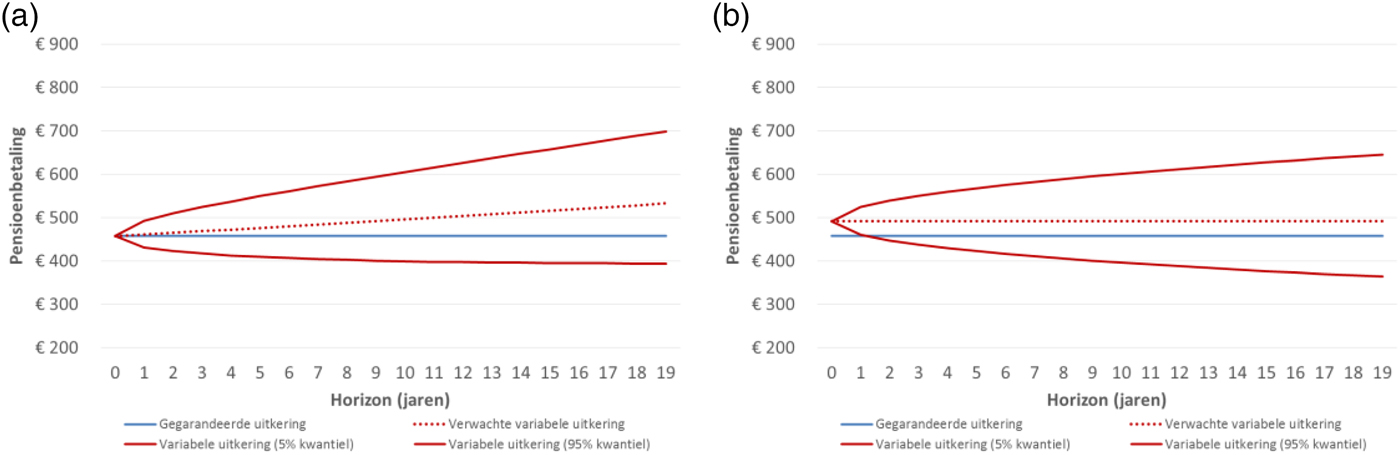
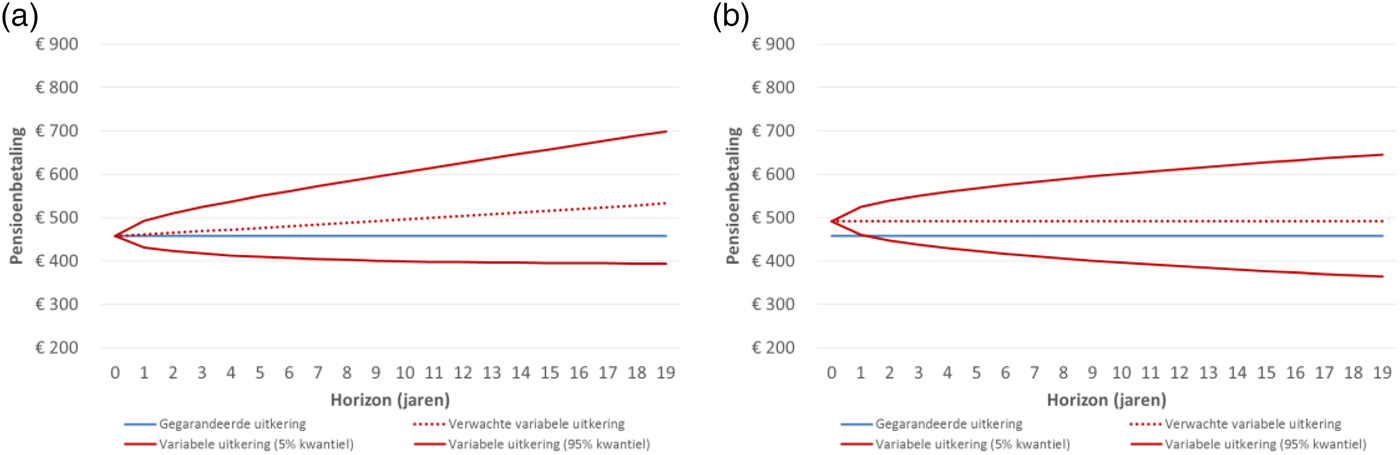
Figure 1a and 1b show the risk profile of retirement income assuming a 20% allocation to equities (compare Figure 1a in Horneff et al. Reference Horneff, Maurer, Mitchell and Stamos2010). In Figure 1a, the AIR equals the risk free rate; in Figure 1b the AIR coincides with the expected portfolio return. The expected income is increasing with age if the AIR is less than the expected portfolio return and vice versa. Initial income depends on the AIR and increases if more investment risk is taken. Not surprisingly, the outcome in the pessimistic scenario worsens if more risk is taken.
Income profiles. (a) Asset allocation 20% equities; AIR = r. (b) Asset allocation 20% equities; AIR = exp ptf return.
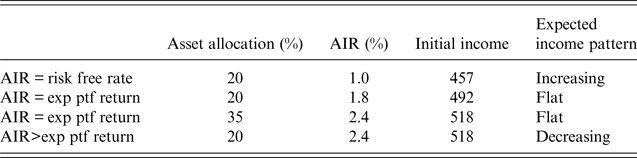
The main results are summarized and extended to the case where a higher AIR is used in Table 1. Note that the fourth case where the expected income pattern is decreasing because the AIR exceeds the expected portfolio return is not allowed.
Summary of results for four cases

4.5 Personal buffers
Another novel aspect of the legislation is that unexpected shocks do not have to be transferred immediately to income shocks but instead can be buffered. Smoothing shocks through personal buffers allows risky investing but also rather stable year-on-year pension income. To prevent large shocks at the end of life, investment, in this case, should have a lifecycle profile in which investment risk is reduced as the individual participants grow older. The maximum so-called recovery period over which shocks can be smoothed is ten years.
4.6 Income versus capital frame: risk management
The emphasis in risk management in Dutch DC products on stable lifelong income stream during retirement contrasts with the typical design of DC schemes in Australia and the USA, where the investment strategy tends to aim at maximum pension capital at retirement at acceptable levels of capital risk. In contrast to this capital frame, the Dutch income frame aims at maximum retirement income at accepted levels of income risk. Accordingly, interest risk management becomes important as the income that can be drawn from a fixed amount of capital depends on the interest rate.
4.7 Tailoring to individual features
The personal nature of a DC plan enables the provider to tailor contribution and payout level, investment strategy and insurance elements (e.g. to have a partner pension) to the characteristics and preferences of the individual participant. All kinds of choices in the accumulation phase, such as additional or lower contributions, and preferences for investment strategies (including sustainable investing) can easily be offered actuarially fairly (i.e. without affecting other participants in the fund). Collective decision making on adequate defaults is likely to remain important. Investment choices can be combined with collective investing through mutual funds. During the payout phase, individual choices on insurance and dissaving must be limited in order to prevent selection. Indeed, the insurance element becomes more important as participants age: a larger part of the overall return consists of a biometric return. Early in the payout phase, the selection is not yet likely to be important.
5. The future of Dutch DB contracts
This section considers the future of the DB contract (described in Section 3). As mentioned in the introduction, a reform is currently under discussion for DB pensions. The main difference between the two new contract types is the presence of collective buffers (i.e. of assets that are not yet allocated to particular individuals). These buffers are added to share systematic risks with future pension savers. The reformed DB contracts are referred to as personal pensions with risk-sharing and collective buffers (PPR-CB).
5.1 The collective buffer mechanism
The Sociaal Economische Raad (Socio Economic Council; SER)Footnote 10 developed a prototype of a PPR-CB contract (SER, 2016). This contract adds a collective buffer to the PPR contract with only personal accounts and personalized buffers described in Section 4. On the one hand, returns on the risky investments in the personal accounts in excess of a certain threshold (say 10%) are added to the collective buffer. On the other hand, personal accounts are supplemented from the buffer if the risky investments in these accounts yield seriously negative returns (say less than −5%). To stabilize buffers, these rules apply only if the buffer is positive and less than a certain percentage (say 20%) of the total value in personal accounts. Collective buffers implement intergenerational risk-sharing with generations that do not yet own personal accounts. In particular, the value of the benefits accrued by these generations exceeds the contributions if good investment returns by previous generations have built up a large buffer. If bad historical returns have depleted collective buffers so that these buffers are only small or non-existent, the situation is reversed. In that case, future generations pay implicit taxes on their pension contributions to replenish buffers.
5.2 Intergenerational risk-sharing versus discontinuity risks
The added value of intergenerational risk-sharing as implemented through pension funds is heavily debated in the Netherlands. Intergenerational risk-sharing is welfare increasing because future generations can benefit from risk premia by taking on financial risks before starting to contribute to the pension system (see e.g. Gollier, Reference Gollier2008 and Ball and Mankiw Reference Ball and Mankiw2007). The downside of taking a financial risk on the basis of the collateral of human capital is so-called discontinuity risk: future generations might not be willing to participate if they have to pay an implicit tax on their contributions to replenish collective buffers. Hence, mandatory participation is required to commit future generations to risk-sharing with present generations. However, workers still have various ways to avoid implicit taxes associated with risk-sharing. In particular, they may reduce labor supply to the formal economy, become self-employed or switch to another sector. Intergenerational risk-sharing may also generate political risks. Indeed, generations that suffer from risk-sharing ex-post may want to change the system.
5.3 Numerical estimates of trade-off
Clearly a trade-off exists between the benefits of intergenerational risk-sharing and the drawbacks in terms of discontinuity risk. This trade-off varies across pension funds. In particular, sectors differ in the sector-specificity of human capital or the prospects for continuity of the sector. Based on models that abstract from discontinuity risk, Boeijen et al. (Reference Boeijen, Bonenkamp, Bovenberg, Frehen, de Haan, Joseph, Lever, Loois, Michielsen, Ponds, Nijman and Werker2016) present estimates of the welfare gains from intergenerational risk-sharing. These gains amount to about 1% to 2% of supplementary pension income. In order to get an idea of discontinuity risk, Boeijen et al. (Reference Boeijen, Bonenkamp, Bovenberg, Frehen, de Haan, Joseph, Lever, Loois, Michielsen, Ponds, Nijman and Werker2016) estimate that the implicit tax for new participants after poor investment outcomes can be as high as 40% of the contributions after poor investment results (5% quantile).
5.4 Collective buffers: benefits
Other arguments against and in favor of collective buffers exist. An important argument in favor of collective buffers is that they require mandatory participation of firms in sectoral funds. Mandatory participation in sectoral funds and risk-sharing with future generations is essential for labor unions. Unions also want to avoid that individual participants must enter financial markets themselves without the aid of trustees who design choice architectures, combat agency issues and enhance the bargaining position vis-à-vis financial institutions. Mandatory participation protects the role of trustees in these governance issues and protects the market share of the Dutch pension funds vis-à-vis commercial insurers.
5.5 PPR-CB versus DB and DC
Compared to Dutch DB contracts, the reformed PPR-CB contracts increase transparency and reduce conflicts of interests across participants. Moreover, they raise the scope for tailoring (dis)saving, financial risks, and insurance to individual needs. Compared to the Dutch DC, the collective buffers add intergenerational risk-sharing and thus support mandatory participation. At the same time, however, these buffers introduce discontinuity risk. Moreover, they introduce conflicts of interest and reduce transparency – for example, in pricing personalized savings, investment and insurance decisions. Indeed, pricing individual decisions becomes more complicated in the presence of buffers.
5.6 Impacts on pensions in payment
The Dutch SCP (The Netherlands Institute for Social Research) has repeatedly argued that participants are concerned mainly about the adequacy and risks of pension incomes rather than about the more technical arguments. An important argument in favor of reform is that the PPR is likely to raise pensions in payment and projected pension incomes for current workers. In contrast to the situation in a DB system, adjustment of the AIR in the PPR does not lead to redistribution of resources across generations and thus does not result in intergenerational conflicts. Whereas DB contracts employ risk-free interest rates to compute solvency, the PPR allows the use of a risk premium in the computation of the AIRFootnote 11. This results in more dissaving and thus larger pension benefits in the short run.
5.7 Income risk
According to the SCP, the second main concern for participants is the level of certainty in pension income. Current DB benefits in the Netherlands are uncertain, as evidenced by the cuts in nominal pension payments in 2013. Introduction of the PPR can be attractive for participants because risk levels can be tailored to individual circumstances. In fact, older participants can opt for guaranteed income. Guaranteed income at higher ages is much less expensive than long-term guarantees.
5.8 Dual transition
The generational distributional effects of the two transitions of moving to age-independent accruals in terms of capital and quickly transforming the existing DB rights into capital in personal accounts seem to largely offset each other (see SER, 2016). This is an argument in favor of a so-called dual transition in which both transitions are combined. The transition to age-independent accruals in terms of capital benefits young workers and future participants who no longer have to pay the implicit tax generated by the PAYG element in the current uniform contribution and accrual system. This transition hurts older workers who lose their implicit subsidies on contributions in the DB system. Converting existing DB rights into capital in personal accounts at least partially compensates the loss of implicit subsidies for older workers, for two reasons. First, no (PPR-VA) or smaller (PPR-CB) buffers are to be built up by these generations. Second, the possibility of using a higher AIR (due to a risk premium) in the PPR system compared to the lower risk-free interest rate as AIR in DB allows for more flexibility in the speed with which pension capital is paid out.
6. Potential lessons for other countries
The main design questions for funded pension contracts are similar across countries. Dutch policy discussions have benefited from designs and experiences in other countries (see e.g. Bovenberg et al. Reference Bovenberg, Cox and Lundbergh2016; Ponds and Garcia Huitron Reference Ponds and Huitron2016). This section focuses on elements of the Dutch design that might be of interest for other countries.
6.1 Potential lesson #1: income stream during retirement as the starting point
A first important element of the Dutch designs that might be relevant elsewhere is that the income stream during retirement (in terms of median level and risk properties) is taken as the starting point for determining contributions, payouts, investment and insurance. This so-called DA perspective (see e.g. van Bilsen and Bovenberg Reference van Bilsen and Bovenberg2016 and Bovenberg and Nijman Reference Bovenberg and Nijman2017) typically leads to higher savings and insurance rates. As regards risk management, DA generalizes the liability-driven investment from guaranteed DB plans to personal accounts with stochastic benefits. Indeed, compared with guarantees in DB, DA offers more flexibility in risk-return trade-offs.
A PPR-VA of the Dutch DC type yields transparency about individual property rights and fair pricing. The capital frame on property rights facilitates choice. In particular, fair pricing allows trustees and/or individual participants to flexibly decide on (dis)saving, investment and insurance choices on the basis of an income frame. Accordingly, the capital frame for entitlements and pricing is thus complementary with an income frame for structuring choices and communication.
6.2 Potential lesson #2: personal buffers and biometric returns
The transparency of the capital frame can be combined with smoothing of investment risk during the payout phase. The PPR design with smoothing is relevant for countries that are looking for alternatives for guaranteed pension products (which have become rather unattractive in the current low-interest environment), but want to maintain stable, lifelong retirement incomes. The personalized buffers and interest rate hedging contribute to a better risk-return trade-off. If desired, collective buffers can add intergenerational risk-sharing.
Another factor contributing to adequate levels of retirement income with low risk is the pooling of idiosyncratic longevity risk in mandatory pools. Indeed, countries may want to stimulate various forms of longevity insurance for the eventuality that people become very old. Indeed, in policy discussions in many countries (including Australia, the USA and the UK), deferred annuity solutions have been advocated. The PPR design includes pension products that become more of an insurance product at the end of the lifecycle but offers more flexibility.
6.3 Potential lesson #3: unbundling
The PPR design allows unbundling of the various functions of retirement products in order to reconcile transparency, fair pricing and adequate governance with the flexibility to tailor (dis)saving, investment and insurance to heterogeneous income needs (see Bovenberg and Nijman Reference Bovenberg and Nijman2017). Each particular country, sector or firm can build an appropriate mix of collective and individual elements. In this context, collective investing, collective governance, and uniform adjustments in pension payments entitlements should be carefully distinguished. Also, various risk factors (equity risk, interest risk, inflation risk, micro and macro longevity risk) can be unbundled. One can, for example, choose exposure to equity risk, and at the same time hedge interest rate risk and micro longevity risk. Separate contracts can share macro longevity risk between generations.
The flexibility of the PPR concept makes it particularly relevant in the context of Pan European Pension Plans (PEPPs) proposed in the European Union (see European commission, 2017). European countries differ substantially in how they organize the decumulation of pension capital. PPR shows how PEPPs can be designed flexibly to tailor to various traditions, including, for example, integrating accumulation and decumulation phases. The current PEPPs proposals still largely ignore this aspect and focus on the accumulation stage.
7. Conclusions
Discussions on reforming Dutch occupational pensions have been going on for some time now. In 2015, the Socio Economic Council (SER, 2015) issued an advisory report referring to personal pensions with collective risk-sharing as an interesting option. Over the last 2 years, SER and others have developed the concept in more detail. Dutch DC pensions have already been redesigned to allow for risk-taking during the pay-out phase.
At the time of writing, the Socio Economic Council has not yet come to a final recommendation – but the direction for the future seems to be clear. A new Dutch cabinet was formed in October 2017. The coalition agreement clearly states the goal to reform the occupational pension system based on some form of personal pension as an alternative to the DB funds. Hence, PPR-CB contracts are likely to be introduced.
Appendix: Summaray of contract designs
Terminology contract designs
PPR: Personal Pensions with Risk-sharing refers to contract designs combining old-age insurance with personal financial investments. Personal capital changes in a transparent way due to contributions (or drawdowns), investment returns and possibly biometric returns on account of longevity insurance. The various components of the pension contract ((dis)saving, financial investments, insurances) can be adjusted flexibly. See Bovenberg and Nijman (Reference Bovenberg and Nijman2017).
PPR-VA: A PPR design based on variable lifelong annuities in the drawdown phase
Dutch-DC: The current (as of 2016) Dutch Defined Contribution contracts, which combine age-dependent contributions during the accumulation phase with PPR-VA during the payout phase
Dutch-DB: The current Dutch DB contracts based on (deferred) variable annuities as individual entitlements already in the accumulation phase and adjustments (positive and negative) of these entitlements based on the collective funding rate
PPR-CB: A PPR design based on variable lifelong annuities in the drawdown phase as well as collective buffers that share risks over time with future pension savers
DA: A Defined Ambition (DA) design derives the required (dis)saving, investment and insurance strategy from the desired properties of the retirement income stream (level, volatility of adjustments, probability of cuts in nominal benefits in payment and so forth)