Dryocoetes krivolutzkajae Mandelshtam, Reference Mandelshtam2001 (Coleoptera: Curculionidae: Scolytinae) exhibits a feeding preference for herbaceous roots, which is uncommon among scolytine bark beetles (Wood and Bright Reference Wood and Bright1992). This species was described from three beetles removed from the rhizomes of Rhodiola rosea Linnaeus (Crassulaceae) near the northeastern coast of Kamchatka Peninsula, Russia (Mandelshtam Reference Mandelshtam2001; Smetanin Reference Smetanin2013). It is a relatively large beetle (~3.9 mm), which shares morphological similarity with Dryocoetes hectographus Reitter, but is distinguished by wider pronotum, longer body, and obscure punctures on the elytral declivity (Mandelshtam Reference Mandelshtam2001).
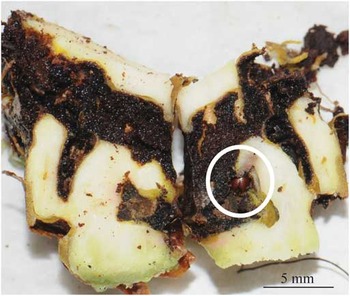
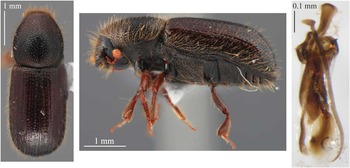
In 2009, R. rosea rhizomes infested with weevil adults and larvae were discovered in plants from Simmons Cove, New Brunswick, Canada (Fig. 1). Similar damage and beetles were found in 2012 in Nain and Rigolet (Nunatsiavut, Labrador, Canada). The senior author identified the adult weevil specimens as D. krivolutzkajae through comparison of body and male genitalia images of the Russian and Canadian specimens. There was no noticeable different between the specimens. Dr. Michail Mandelshtam (St. Petersburg, Russia) also examined the images and confirmed the identification. Voucher specimens were deposited in the A.J. Cook Arthropod Research Collection, Michigan State University (Michigan, United States of America). In Canada, this species is most similar to Dryocoetes autographus (Ratzeburg) but differs by the shallow and narrower strial punctures of the elytral declivity (less than the width of the interstriae) (Fig. 2). Human introduction of beetles from Russia to Canadian may potentially explain the occurrence of this population but this is not likely because live Rhodiola roots have not been extensively traded internationally. Given the sub-arctic range of the host plant of the beetle it is likely that the Canadian populations represent the natural range of D. krivolutzkajae. Locating any beetles in Rhodiola rhizomes in western Canada and Alaska for phylogeographic study of these and Russian specimens would provide a more complete understanding of the provenance of all populations.
Rhodiola rosea rhizome infested with Dryocoetes krivolutzkajae. Black areas indicate larval and adult feeding. Posterior end of an adult is circled.

Dryocoetes krivolutzkajae: dorsal; lateral; male genitalia.

Dryocoetes krivolutzkajae may potentially negatively affect cultivated roseroot (R. rosea) by feeding and tunnelling in rhizomes. In addition, infestation may also cause a shift in the natural chemical production and expression. Inuit and other indigenous groups in Eurasia use roseroot for nutritional and medicinal purposes (Cuerrier et al. Reference Cuerrier, Tendland and Rapinski2014). The plant has been cited as adaptogenic (Winston and Maimes Reference Winston and Maimes2007) and is reported to improve mental and physical fatigue (Panossian and Wikman Reference Panossian and Wikman2014). The potential impact of the beetle on plant secondary metabolites is not known, but ongoing phytochemical analysis will address this question. Mites feeding on the upper leaves and inflorescences of roseroot reduce the concentration of some metabolites (salidroside) while others (rosavins) are not affected (A.C., personal observation). Both types of metabolites are known to have important pharmacological activities. Although impacts can be negative as shown in the case of the mite, it might also trigger the plant to elevate metabolite concentration for defensive purposes and, therefore, increase the medicinal value of the plant. Infested plants sampled in Nunatsiavut did not show obvious signs of morphological growth or stress due to the beetle. They were vigourous and flowering or fruiting (V.M., personal observation). Further study is needed to determine the physical and chemical impacts of the beetle on roseroot.
Acknowledgements
The authors thank Michail Mandelshtam for helpful discussion concerning the identity of this beetle. The comments of the reviewers help to improve this manuscript. The work in Nunatsiavut was funded through an ArcticNet grant (A.C. and L.H.).