This article revisits a debate between Jurg Steiner and Paul Johnson (Johnson 1990; Steiner 1990) over the civic implications of teaching rational choice that appeared in PS a little over 15 years ago. That debate summarized key contemporary arguments about the possible civic implications of teaching rational choice that likely still reverberate in department and conference discussions today. Despite numerous books, articles, and conference sessions on the perils and pluses of rational choice in scholarship, very few empirical studies examine the civic consequences of learning rational choice in undergraduate political science courses. This article reports the results of a study that attempts to do just that; to measure rational choice influences on students' civic attitudes.
Two past studies that examine a civic consequence of learning rational choice focus specifically on whether learning a simple instrumental utility model of voting reduces the likelihood that students will vote (Brunk 1980; Blais and Young 1999). The simple instrumental voting model assumes that the utility of voting depends only on the likelihood that the voter's vote will change the outcome of the election multiplied by the value to the voter of one candidate over the other. Given the extremely small probability that any single voter changes the outcome of the election, the model stresses the irrationality of voting in most elections. The two studies of students exposed to the simple instrumental model show declines in turnout or expected turnout of seven to ten percentage points in major elections (Brunk 1980; Blais and Young 1999).
Classic rational choice discussions of voting (Downs 1957; Riker and Ordeshook 1968) and a common text for teaching rational choice to students (Shepsle and Bonchek 1997) move beyond the rather dire instrumental model of voting to acknowledge other incentives that motivate voters. Moreover, rational choice models for other civic activities present less stark participation paradoxes. Olson's (1965) classic, Logic of Collective Action, for example, moves beyond simple prediction that collective action is irrational analysis of reasons why some groups are able to mobilize for political action. However, the voting studies' findings do indicate that learning rational choice can impact students' civic attitudes, which makes it all the more important to analyze the civic influence of broader learning about rational choice.
What impact does learning a range of rational choice models have on students' civic attitudes and their expected civic engagement? The 1990 debate suggests some hypotheses, which I tested with data from students in introductory classes at Creighton University in Omaha, Nebraska.
The 1990 Debate
Debates over the appropriateness and usefulness of the rational choice approach for research in the discipline have raged over the years in articles, books, and academic conference panels. The 1990 debate over rational choice in this journal focused instead on questions of the appropriateness of teaching rational choice in the classroom.
Steiner (1990) argued that students would likely mistake the logical assumptions of rational choice models for normative lessons and consequently develop assumptions that would be detrimental to civic life. He cited a study showing higher levels of free-riding among economics students (Marwell and Ames 1981) as evidence that caution, at least, was warranted. Rational choice assumptions used in models of political behavior might be internalized by students as normative lessons that one should not trust others and one should also not value being trustworthy. Although Steiner does not explicitly discuss generalized trust, one prediction from his argument would be a drop in generalized trust in students exposed to rational choice. Steiner challenged those who use rational choice in teaching to at least study the implications of using it in the classroom.
Johnson (1990), in response to Steiner, argued that rational choice theory appropriately challenges students' naïve assumptions about politics and government. Rather than discouraging civic engagement, he argued, the theory helps students better anticipate the challenges of collective action and power imbalances. Moreover, he argued that rational choice, if taught with an emphasis on strategies that improve the chances of cooperation, provides tools to help students better organize and sustain collective civic activities.
Research Questions
The pitfalls and advantages of teaching rational choice argued in the 1990 debate center on two key civic attributes: trust and internal efficacy. Empirical research on civic engagement in the discipline also often stresses the importance of trust and internal efficacy (e.g., Almond and Verba 1963; Niemi and Associates 1974; Putnam 2000). So, measuring the impact of rational choice course work on trust and efficacy makes sense both in light of the 1990 debate as well as in light of current concerns that college coursework should strengthen the civic capacity of students (Barber 1992; Eyler and Giles, Jr. 1999; Kahne and Westheimer 2006; Macedo et al. 2005; Walker 2000; Westheimer and Kahne 2004). The three core research questions below ask whether substantial course work in rational choice influences the levels of trust or internal efficacy and whether it influences students' expectations of future civic engagement.
- Does learning rational choice reduce student levels of generalized trust in others? Trust in others is a key civic attitude related to civic engagement and one that would appear to be most vulnerable to deterioration from exposure to rational choice. One of the rational choice lessons that may be most striking to students, especially given the simple models likely to be taught in undergraduate courses, is the rationality of free-riding and non-cooperative behavior in some settings. As Steiner (1990) argues, students might take away the argument that one should adopt non-trusting (and possibly non-trustworthy) strategies. Introductory political science courses that do not have a strong rational choice emphasis often include brief discussions of free-riding and of officials acting on re-election interests. This question assumes that these brief discussions in most introductory courses do not constitute “learning rational choice,” and thus would not be expected to impact student trust like substantial coursework in rational choice might.
- Does learning rational choice content with an emphasis on strategies increase student levels of internal efficacy? Internal efficacy refers to a citizen's sense of his or her competence to engage in politics. Johnson (1990) argues that providing analysis of tools that address collective action challenges could increase a student's sense that they are well qualified to participate in politics. If this prediction holds, one would expect to see increases in students' levels of internal efficacy after they learn rational choice.
- Does learning rational choice influence the level of expected future civic engagement? This question gets to the crux of the matter, but it is the most difficult to answer with any reasonable level of validity. While the other questions examine the influence of rational choice content on attitudes that predict civic engagement, this question examines whether students who learn rational choice become more or less likely to expect to participate in civic life in the future.
Method and Data
This study uses a quasi-experimental design that compares levels of civic attitudes and expected civic engagement before and after students complete introductory political science courses at a medium-sized private Midwestern university. To examine the influence of learning rational choice, the analysis compares the changes in levels for these two variables for those students in sections with a heavy rational choice emphasis to changes for students who were in sections that did not have a significant rational choice emphasis. The data were collected over a three-semester period from 95 students in four rational choice sections (out of 97 total students) and from 104 students (out of 107 students) in three non-rational choice sections of 100-level political science courses at Creighton University.
All four rational choice sections are Introduction to Politics sections. The non-rational choice sections include a mix of Introduction to Politics and American Government and Politics sections. This raises concerns about whether the American Government students differ substantially from the Introduction to Politics students. However, analyses of pre-test survey results for the students in this study indicate no statistically significant differences in the initial core civic attitudes of the students in the two different courses. Students in the American Government classes, however, were a little more likely to see themselves engaged in civic action in the future, a difference that just missed significance at the .05 level. This difference, combined with the fact that all American Government students fall into the non-rational choice sections, means that the non-rational choice sections start out at higher levels of expected civic engagement.
I taught all of the rational choice sections. The other sections were taught by two different professors. Post-test analysis of the non-rational choice sections, where there was a difference in professors, suggests no significant professor effects. However, since I taught all of the rational choice sections, it is not possible to eliminate the possibility that differences between the rational choice and other sections might reflect other differences between myself and the professors who taught the other sections. Other than a gender difference (the other instructors are male), no striking difference between myself and the other professors stands out. We each use fairly traditional syllabi structures, use a mixture of lecture and class discussion, administer two or three tests per section a semester, and assign writing that emphasizes analysis and synthesis.
The sections do differ on rational choice learning. The Introduction to Politics rational choice sections incorporate a rational choice textbook and substantial class discussion and test material on expected utility, collective action, and normal and extended form games. The rational choice coursework adopts an instrumental approach like that recommended by Johnson (1990). The rational choice text (Shepsle and Bonchek 1997) and classroom activities stress rational choice lessons concerning strategic problem-solving. So, the rational choice sections should be a good test of whether learning instrumental rational choice lessons increases internal efficacy.
Despite the time and focus on rational choice models in these sections, however, the students also cover material on ideology, democracy, government institutions, and policy. So, outside of the rational choice material, the courses cover similar topics. The rational choice sections also expose students to other approaches. Course readings, discussion, and assignments also emphasize empirical social science and political philosophy. Rational choice is not taught as the only, nor the clearly superior way to understand politics in these sections. Those who use a more strident rational choice approach, or who teach with others who do, could test whether the results differ for students exposed to rational choice taught in that manner.
The other introductory sections follow formats commonly found in Introduction to Politics and American Government and Politics courses elsewhere. The Introduction to Politics course uses a comparative text and places a strong emphasis on political behavior and institutions. The American Government and Politics course uses a core text with supplemental readings on political behavior and policy. The non-rational choice sections include a brief discussion of the basic dilemma of free-riding. However, they do not stress rational choice learning.
A short survey was administered near the first day of class then again near the last week of class to measure student civic attributes. Since there were seven sections, this yields 14 survey points. The surveys were anonymous and students were informed that the survey was voluntary. The age of majority in Nebraska is 19. Since some freshman in introductory classes fall below the age of majority, additional precautions, including anonymity, were required for Institutional Review Board approval. Most students who attended class on the survey days completed the surveys. In the rational choice sections, 94% of the enrolled students completed the pre-test survey and 88% of the enrolled students completed the post-test survey. In the other sections, 96% of the enrolled students completed the pre-test survey and that same percentage completed the post-test survey.
The survey includes American National Election Studies (ANES) questions for trust, efficacy, and civic engagement. The survey also includes an adaptation of three civic engagement questions I use to gauge whether students expect to engage in civic activities in the next six years. Granted, these questions about long-term future intentions pose serious validity problems, but they at least provide a rough measure of the present openness of the students to future civic activity.
The analysis uses three civic indices based on the survey responses: trust, internal efficacy, and anticipated civic engagement. The trust index measures the number of trusting responses (most people can be trusted, most people try to be fair, and most of the time people try to be helpful) that a student gives in the battery of three trust questions used in the ANES. The internal efficacy index combines student answers to two questions. One asks a student's level of agreement with the statement that they consider themselves well qualified to participate in politics, while the other asks for a student's level of agreement to the statement that they are better informed about politics and government than most people. The index ranges from 10 (students who strongly agree with both statements) to two (students who strongly disagree with both). Expected civic engagement combines answers to a series of three questions about future engagement. Students earn one point for each of the three civic activities that the student indicates that s/he expects to do in the next six years: 1) work with others to deal with an issue facing your community, 2) contact a pubic official to express your view, or 3) attend a meeting about an issue facing your community or school.
Results
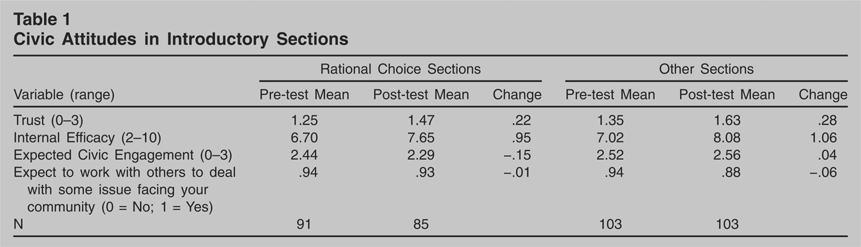
To assess whether learning rational choice influences either of the two core civic attributes and the likelihood that students will participate in civic action, we need to see whether the students in rational choice sections change on any of those attributes more or less than the students do in the non-rational choice sections. Table 1 reports the pre-test mean, post-test mean, and change for each measure for the rational choice and non-rational choice sections. The anonymous surveys render paired t-tests of individual level shifts in student attitudes impossible. The results instead provide an aggregate view of whether overall trust plummets or whether overall efficacy climbs.
Civic Attitudes in Introductory Sections

The results demonstrate little evidence that teaching rational choice wreaks havoc on students' civic attitudes. Learning rational choice does not lower overall levels of trust. The average trust score actually increases slightly. The non-rational choice sections yield a slightly higher increase in trust than the rational choice sections.
The overall average internal efficacy for the students in the rational choice sections improves, as would be predicted by advocates of the civic learning potential of rational choice. An independent t-test of the difference between aggregate levels of efficacy before and after the class is statistically significant at the .01 level. However, students in the non-rational choice sections also experience an increase in internal efficacy, and a slightly higher increase at that. So, the results offer no evidence that a rational choice curriculum performs better than other curricula in increasing students' internal efficacy. Since the rational choice sections also include material similar to the material covered in the traditional sections, we cannot be sure whether the increase in efficacy for rational choice students comes from the rational choice material, from the traditional material, or from both. At the very least, significant time spent studying rational choice does deter from the increases in efficacy that occur in introductory political science courses at Creighton University.
The expected civic activity measure is the only one that shows a decrease for rational choice students. However, this decrease is very small. Moreover, the decrease does not appear to come from students learning that collective action is futile, the civic lesson one might be most concerned that rational choice would teach. As Table 1 shows, the levels of expected collective action participation (expect to work with others to deal with some issue in the community) remain stable for students in the rational choice sections, even slightly more stable than for students in the other sections.
The study design assumes that it is fair to say that students in a course with substantial coverage of rational choice are students who can be treated as students who have learned rational choice. Prompted by a discussion of the difficulty of teaching for deep understanding (Bain 2004), I wondered at the end of the second semester of the study whether this was a fair assumption. Perhaps trust fails to drop and/or efficacy fails to soar because students are not really “getting” the rational choice material. Bain (2004) uses findings from an experiment by physics instructors (Halloun and Hestenes 1985) to point out that students can often perform well in class assignments without getting to a deep understanding that changes how they solve problems. Halloun and Hestenes (1985) found that students gave pre-Newton responses to questions about motion before and after completing their physics course, despite the fact that many were able to do well on the course assignments (Bain 2004, 22). These results lead me to wonder if students might be completing course assignments on rational choice without really learning rational choice theory at a level that could change their way of thinking about human interaction.
With the physics study in mind, I developed a final essay question for the two sections of the Introduction to Politics course that I taught in the third semester (spring 2006). The question asked students to discuss how they would address a workplace, school, or family problem and the answers were assessed based on the ability of students to explicitly apply rational choice material and explain the application. I used a politics writ small question rather than a politics writ large question because I wanted to see if students could talk about dynamics with which they were familiar in new ways. Close to 75% of the students in each section (74% in one section and 73% in the other) were able to use rational choice concepts or models to discuss how they would tackle a family, workplace, or school problem differently.
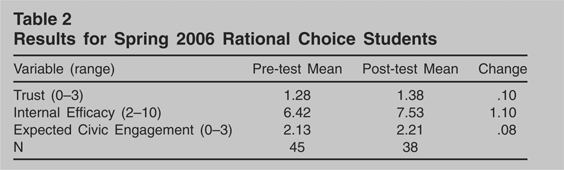
The final question assessment is not as valid a test as an experiment in which students were asked how they would handle the same problem before and after the class without any graded prompting to apply the rational choice material. However, it does at least indicate that a large percentage of students in those two sections were able to apply the material to day-to-day problems. Table 2 reports the results for only these spring 2006 rational choice students (two of the four rational choice sections). The results show that these students, most of whom understand rational choice enough to apply it, still show no drop in trust. These students also show a higher increase in internal efficacy than the rational choice students overall; an increase that also slightly exceeds the increase for non-rational choice students in Table 1. The expected civic engagement remains mostly stable, with a very slight increase instead of a very slight decrease. So, students who appear to have “learned” rational choice still do not show decreases in trust and still show increases in internal efficacy.
Results for Spring 2006 Rational Choice Students

Conclusion
The results from this quasi-experimental study of rational choice material in introductory classes indicate that learning rational choice does not weaken overall levels of trust and that students who learn rational choice material experience increases in internal efficacy similar to those of students in traditional introductory courses. Although these results should allay fears about the potential damage of teaching rational choice, at least in courses where the approach is taught alongside others, they do not offer a ringing endorsement of its civic education strengths. It will be interesting to see whether the results differ if the study is replicated at different universities and with different instructors. Of particular interest would be whether a more strident rational choice approach yields different results.
The results reinforce the importance of developing control group measures for scholarship of teaching studies. If this study had been done without a control group, the results might have been used to argue for the effectiveness of rational choice curriculum in increasing students' internal efficacy. Seeing the increase in efficacy for the traditional courses alongside the increase in efficacy for the rational choice courses puts the results in a more appropriate perspective.
The study results indicate that introductory courses in our discipline, even traditional classroom courses with curricula that challenge naïve assumptions about politics, can yield small positive shifts in civic attitudes. In all fairness, studies with control groups not in political science classes need to be done to eliminate the possibility that a semester worth of college courses in general increases internal efficacy for students regardless of whether they take an introductory political science course. Although the shifts are small, it is important to recognize that the stimulus here is just one course, likely taken alongside four or five other courses, for one semester, only a small part of a student's life for a short time window. This raises the challenge of the need to compare the influence of longer curriculum periods, such as courses of study, tracks, and majors.
The emphasis here on trust and efficacy as core civic attributes comes from their relevance to discussions of the potential perils and strengths of rational choice learning and from their centrality to discipline discussions of civic engagement. It is not the intent of the article to argue that bolstering efficacy and trust should be the top priority of civic education. The study here simply assumes that fostering trust and efficacy moves students in a positive direction toward civic engagement. On this front, Kahne and Westheimer (2006) offer a useful discussion of the importance of balancing efficacy with other political education goals.
One is most likely to find analyses of the civic consequences of education for studies of service learning (Eyler and Giles, Jr. 1999; Kahne and Westheimer 2006). Studies in these areas can help us see what difference service-learning approaches make. However, there are many other questions to study concerning the consequences of curriculum choices in our discipline. This study begins to address just one, the debate over whether learning rational choice positively or negatively affects students' civic attitudes.
Author Bio
Sue E. S. Crawford is associate professor of political science at Creighton University. The author gratefully acknowledges research support from the Office for Academic Excellence and Assessment at Creighton University; assistance from faculty colleagues Joseph Snipp and Richard Witmer who administered surveys in their courses; and assistance from Scott Chadwick, Joleen Richwine, Nathan Tracey, and Shakilah Hill.