The subject of differential involvement in political activism has received an enormous amount of attention in recent decades from students of participation and collective action. Scholarship on this subject has tended to take one of two approaches. The first approach, usually associated with students of political behavior, typically emphasizes the range of activism in a general (often electoral) sense without specifying issue content.Footnote 1 A second approach, often associated with social-movement scholars, emphasizes involvement in particular political causes.
Neither approach pays much attention to multi-issue activists, people who are currently involved or have a history of involvement in multiple issues. This neglect occurs despite the extensive theoretical focus on the spillover of tactics, ideological frames, and organizational structures from one issue domain to another (Klandermans and Oegema Reference Klandermans and Oegema1987; Ohlzak and Uhrig Reference Ohlzak and Uhrig2001), as well as the emphasis on selective mobilization into participation (e.g., Rosenstone and Hansen Reference Rosenstone and Hansen1993). By definition, issue spillover necessitates the existence of connectors or bridges between issues, and there is general agreement that activists themselves are a primary source of such connections (Ferree and Roth Reference Ferree and Roth1998; McAdam and Rucht Reference McAdam and Rucht1993; Meyer and Whittier Reference Meyer and Whittier1994). In this article we explore multi-issue activism, beginning with a group of activists in a particular issue arena and charting the degree and nature of overlapping issue involvement, the key role of “initiator” issues, and individual characteristics that promote multi-issue activism.
In 1992, the AIDS Memorial Quilt was displayed in its entirety for three days in Washington, D.C., covering the National Mall from the base of the Washington Monument to the Reflecting Pool by the Lincoln Memorial. The massive undertaking required the physical participation of approximately 4,000 volunteers. With the cooperation of the quilt's caretaker, the NAMES Project, and prior to the event, we conducted a national mail survey of people who pre-registered as volunteers at the event.Footnote 2 The initial mailing and one follow-up postcard reminder yielded 2,525 returned, usable questionnaires for a remarkably high response rate of 63%. We make no claim that beginning with a set of issue activists in other domains would yield results resembling those reported on below.Footnote 3 Rather, we see this report as suggestive of the kinds of processes and patterns involved in multi-issue activism.
In this connection we note the unusual composition of the sample in terms of (self-identified) gender and sexual orientation combinations: 48% gay men, 34% straight women, 13% lesbian women, and 5% straight men. While this distribution differs widely from what would be found in most issue arenas, it does not necessarily do so in terms of whose interests get represented in an issue arena. The prominence of gay men stems from the fact that they were bearing the brunt of the AIDS epidemic at the time of the study. Similarly, parents tend to be overrepresented in school politics, women in issues such as breast cancer, union members in work protests, the churched on the abortion issue, and so forth.
THE BREADTH AND PATTERNING OF MULTI-ISSUE ACTIVISM
As part of the questionnaire, the respondents were presented with a list of 14 issues in addition to AIDS and asked to indicate whether they had been involved in them “in the past” and whether such involvement included “last year.” Virtually all of these volunteers qualified as multi-issue activists. Nearly 90% reported past involvement in at least two causes other than AIDS, and 15% reported activity in 10 or more issues. We constructed 0–14 cumulative indexes for past (lifetime) and recent (last year) issue involvement. The mean number for lifetime issue involvement was a hefty 6.2 (SD = 3.1). For recent involvement the mean was 4.2 (SD = 2.7). The sheer breadth of lifetime and recent engagement demonstrates the problematic nature of treating activists as single-issue actors. If these results are indicative, many activists in any given issue arena will bring with them various and perhaps divergent participation histories, which may in turn affect the dynamics and overall effectiveness of the activism efforts.
The list of issues and the frequencies for lifetime involvement were as follows: gay/lesbian rights (79%), environment (71%), abortion rights (70%), women's rights (61%), civil rights (57%), education (51%), health care (50%), anti-war/peace (50%), crime/neighborhood watch (33%), child care (25%), taxes (21%), “support our troops” (during the first Iraq war) (18%), labor (18%), and welfare rights (13%). The high percentages for several of the issues make eminently good sense in light of the sample's composition. According to their own self-assessments, these volunteers were quite liberal in their political orientation, some two-thirds identifying themselves as liberal or extremely liberal on the 7-point lib-con scale, and nine-tenths planning to vote for Bill Clinton in the upcoming 1992 presidential election. That three-fifths of the volunteers were either gay or lesbian also shapes these distributions.
For each issue the respondents also indicated whether they had performed the following activities: signing a petition, attending a meeting, contacting a public official, contributing money, being an active member of an organization affiliated with the issue, attending a rally or demonstration, and complaining to or boycotting a business. The volunteers, understandably, reported greatest involvement in the AIDS domain, with an average of 4.0 acts (SD = 2.3), but also high levels of involvement in several other domains. Correlating the degree of activity across the issues demonstrates clustering effects and the interconnectedness of issue activism. The degree of activism in all but four issues is at least moderately correlated (r ≥ .30) with activism in at least two other issue arenas. The prominence of past involvement in the large-scale civil rights, peace, and women's movements merits special emphasis. Women's-rights activism is at least moderately correlated with nine other causes, civil-rights activism with eight other causes, and anti-war/peace activism with seven other causes. Implicit in these relationships is the possibility that these movements—all of which peaked in the 1960s or 1970s—served as conduits or originators (McAdam Reference McAdam and Traugott1995) for activism in a wide range of subsequent causes.
ORIGINATOR ISSUES AND ISSUE MIGRATION
Do we see evidence of issue migration from originator issues among these AIDS activists? The cross-sectional nature of the design limits our ability to trace precisely the chronological sequencing of multi-issue involvement. However, by looking at the intersection of date of birth and political movements, strong inferential evidence can be advanced to support the hypothesis that certain causes served as introductory vehicles. Mobilization for civil rights and against the Vietnam War constituted two of the most prominent political movements of the 1960s and early 1970s. Both movements attracted large numbers of young adults and served as their initiation into political activism. To the extent that political involvement had become a part of their political identity, those who were caught up in one or both of these movements at an early age could be expected to migrate to other ideologically compatible causes as those earlier issues faded (e.g., Whalen and Flacks Reference Whalen and Flacks1989). Modest support for this migration thesis rests in the fact that the two highest absolute differences between lifetime and recent involvement are represented by civil rights (57% vs. 30%) and anti-war activity (50% vs. 18%).
Much stronger support for cohort effects comes from looking at the impact of formative age ranges on the intensity of activity reported in those two arenas. If our claims are valid, AIDS activists coming of age during the heyday of the civil-rights and anti-war movements should report having been more active in those domains than were earlier or later cohorts. To test this proposition we divided the activists into five birth cohorts, built a dummy variable for each one, and then regressed the civil-rights and anti-war activism indexes against these dummy variables, using the 1951–56 cohort as the reference group and controlling for a host of other predictors (see figure 1).
Birth Cohorts and Lifetime Activism Level in Three Issue Areas
Note: Entries are un-standardized regression coefficients. The 1951–56 cohort is the omitted category. Also included in the equations were controls for political interest, political competence, education, support for liberal causes, support for conservative causes, education, income, and dummy variables for Catholic, lesbian woman, straight woman, and straight man.

Being in the two oldest cohorts has a strong positive effect (when compared with the reference group) on lifetime civil-rights participation, whereas being in the two younger groups has no impact, though the negative signs are in the right direction. If we take 1965 as approximating the midpoint of the civil-rights movement (e.g., Kinder and Sanders Reference Kinder and Sanders1996, chapter 5; McAdam Reference McAdam1989), the 1944–50 cohort would have been 15–21 at the time, and the great majority of the pre-1944 cohort would have been between 22 and 30. Considering the number of other characteristics being held constant, a plausible argument can be made regarding the baptismal effects of civil-rights activism for these two cohorts—a precursor to later issue activism including that involving AIDS.
A similar argument can be made for anti-war activity, though the effects of impressionable age are even more narrowly confined. Being in the two youngest cohorts, both of whom came of age well after the height of the anti-Vietnam War movement, has a significant negative impact on peace activism relative to the baseline group. By contrast, being in the 1944–50 cohort exerts a strong positive impact. The midpoint of the shift in public opinion (1967–1973) regarding the Vietnam War occurs around 1970 (e.g., Page and Shapiro Reference Page and Shapiro1992, 226–39). People in the 1944–50 cohort would have ranged from 20–26 years of age at that time, a prime life stage for recruitment into the anti-war effort. To a far greater extent than the civil-rights movement, the anti-Vietnam War movement was populated by college-age young adults, especially in the early years of the anti-war protests. That compositional difference helps explain our finding that being in the oldest age group is not significantly related to peace activism whereas it is related to civil-rights engagement.
Most of the other movements and issues under consideration do not have the period-defined clarity attached to the civil-rights and anti-war movements. One near contender is the second women's movement of the twentieth century, which stretches out over a long period. Analysts tend to agree, however, that the movement crested during the 1970s (e.g., Klein Reference Klein1984, chapters 1, 8; Wolbrecht Reference Wolbrecht2000, chapter 5). Let us posit that 1975 represents a midpoint in the women's movement. As figure 1 shows, the 1944–50 cohort is the only one having a statistically significant positive effect with respect to level of activism in the women's movement. As of 1975 this cohort would have ranged in age from 25–31, again an age range very susceptible to the lure of political movements.Footnote 4
These three instances illustrate what has been widely believed and anecdotally reported but seldom systematically demonstrated about the critical role of originator issues and social movements in developing the foot soldiers for subsequent causes.
BRIDGING ISSUE DOMAINS
What kinds of people are most likely to move from issue to issue, thereby providing the connective tissue of skills, experience, motivations, and value orientations? In considering this question, we are not making the usual distinction between activists and non-activists in a single issue or in the electoral arena. That said, most of our posited predictors about issue bridging are similar to those found in studies of single-issue and electoral activism.
We divided the predictors into two broad categories. The first consists of four measures falling under the heading of political engagement. Political interest was assessed by how often the respondents reported following “what's going on in public affairs,” ranging from “hardly at all” (0) to “most of the time” (4). Political competence is an additive index based on responses to four Likert-style statements probing the respondents' self-appraisals of their qualifications to engage in politics.Footnote 5 We expected that increased interest and competence would stimulate multi-issue activism. We included two measures of ideological intensity, both of them indexes derived from a factor analysis of feeling-thermometer ratings, 0–100 degrees, applied to a number of prominent liberal and conservative groups and personalities in American life. Two main factors emerged, one pertaining to groups traditionally identified with liberal causes and the other pertaining to conservative icons.Footnote 6 Given the specific activists studied, we expected that increased liberal fervor would promote issue bridging while increased conservative fervor would depress it.
A second category of predictors falls under the heading of social location. Included here are two measures usually associated with more exertion in single issues, namely, education and income. Education is a 5-point index running from 0 (high school or less) to 4 (post-college degree), and income is calibrated on an index running from 0 (less than $10,000 before taxes) to 10 (over $100,000). Age is the third indicator of social location.Footnote 7
The final markers of social location are more specific to this group of activists. Inclusion of gender and sexual orientation as sources of issue bridging were clearly warranted due to the population surveyed. Gender and sexual orientation were combined to create four dummy variables. Gay men serve as the comparison group in the multivariate analysis to follow.
Although using contemporaneous measures to predict recent participation is standard procedure in studies of political participation, employing them to predict behaviors that occurred in the more distant past—as we do with respect to the index of lifetime activity—poses a problem. Most of the social location and political engagement variables we employ are subject to individual-level fluctuation over time. However, the best predictor of a future attribute is typically the present one, and, working backwards, the best predictor of a past attribute is the present one. That is, we would expect to see at least a rough correspondence, in a relative sense, between past, present, and future values of all the predictors described above. That would be especially so given the population under study in that political activists have much more stable political orientations than do members of the general public (e.g., Jennings Reference Jennings1992).
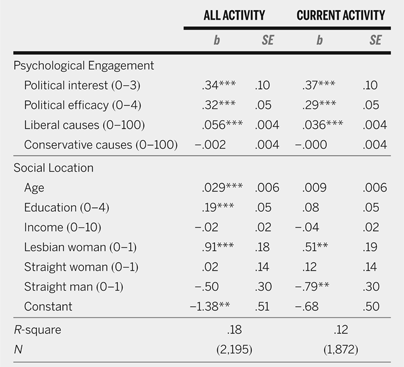
The political-engagement and social-location measures were used as predictors in a multivariate analysis where the dependent variables were the lifetime and recent cumulative issue indexes described above (table 1). In general the model provides a better fit for the lifetime than for the current index (F ratios of 47.2 and 25.3, respectively), probably because of differences in the breadth of activism captured by the two indexes. As noted earlier, on a scale of 0–14 causes, the volunteers reported current mean involvement in 4.2 causes but lifetime involvement in a mean of 6.2 causes—a fairly substantial difference. Because the contribution of the explanatory variables is spread out over a greater number of domains in the lifetime model, the fit of the model is improved, better illuminating the cumulative impact of the predictors. Variation between the two indexes by strength of the predictors highlights the importance of the time dimension when studying multi-issue activists.
Predictors of Multi-Issue Activism

Note: Entries are un-standardized regression coefficients with standard errors in parentheses
* p ≤ .05,
** p ≤ .01
*** p ≤ .001
Turning to the impact of specific variables, we see that both political engagement and social location influence the magnitude of multi-issue activism, largely in the expected fashion. The more politically interested and competent activists served more often as the connectors or bridges across issues. Activists with more intense ideological fervor were also more likely to bridge issue arenas. Illustratively, the 6% of respondents giving liberal symbols an average score of 90 or better on the feeling thermometer spread their lifetime activist net to nearly four more causes than did the 1% assigning average scores of 25 degrees or less, all other factors held constant. The most liberal averaged about three more causes than did the least liberal with respect to current involvement, a smaller but still impressive difference in the magnitude of multi-issue activism. Feelings about conservative markers had no impact, which may be an artifact of the dearth of conservative causes itemized. Alternatively, passion for rather than against attitude objects may drive the breadth of activism. In any event, ideological intensity seems to motivate bridging across issues and causes.
Certain aspects of social location also serve to connect issues but in a less consistent fashion. Better-educated activists have traversed more issues over their lifetimes, even within this highly educated group (29% hold masters or higher degrees), but are not more likely to display multiple issue commitments at a single point in time. Household income makes no difference in either lifetime or current issue overlap within this affluent group of multi-issue activists (39% with household incomes of $50,000 or more). Older people more often serve as inter-issue bridges than do younger ones with respect to lifetime but not current multi-issue activism.Footnote 8 One reason for the lifetime difference is that ceteris paribus, older respondents have simply had more opportunities to add issues to their activist baskets. With respect to current activism, younger activists are just as likely as their elders to bridge issue domains.
As noted earlier, the social-location characteristics that most distinguish these activists are the four gender and sexual-orientation combinations. Does one of these groupings more often serve as the linkage across issues, other matters held constant? It turns out that lesbian women—when laid against the comparison group of gay men—appear to have the most diverse issue repertories and to serve as the most common bridges across issues with respect to both lifetime and current scores. Straight men, in contrast, were active in fewer causes than gay men, a finding that is statistically significant only in the context of current levels of participation. Straight women were indistinguishable from gay men in terms of the breadth of their activist efforts.Footnote 9
Just why lesbian women should lead the way connecting issue domains is not self-evident and cannot be thoroughly explored here. Densham suggests that as a byproduct of marginalization based on both gender and sexual orientation, lesbians have constructed “internally developed resistant identities” that promote political involvement (Densham Reference Densham, Cohen, Jones and Tronto1997, 286). In a related vein, there is much evidence that individual decisions to participate are affected by influential others within their social sphere (e.g., Diani and McAdam Reference Diani and McAdam2003; Kitts Reference Kitts2000). For example, in their study of participation in several religious and political movements, Snow, Zurcher, and Ekland-Olson (Reference Snow, Zurcher and Ekland-Olson1980) found that those who reported personal ties to someone already active in a movement were much more likely to become active themselves than were people who had no such ties. Inferential evidence exists for that process at work in the case of lesbian women with respect to a prominent set of issues contained in the battery presented to the respondents. Lesbian women are in principle socially linked to participants in three issue domains that commanded much engagement in this population—gay rights by virtue of their sexual orientation, and women's rights and abortion rights by virtue of their gender identification. It may be that the social networks for lesbians in this sample are more political—more tied into activist networks—than the social networks for heterosexuals and gay men, at least with respect to the range of issues examined here. Indeed, issue-specific analysis revealed that lesbian women were especially active in these three arenas as compared with gay men and straight women.
CONCLUSION
In this article we demonstrated that activists in one issue had very sizable but variable past and current participation histories in other issues, that involvement in specific past issues served as a gateway to later involvement in the issue at hand, that psychological engagement in politics prompted cross-issue activism even among these already activated individuals, and that unique personal characteristics (in this case gender and sexual orientation) led to more issue interconnectedness. Many of the findings regarding these AIDS activists would undoubtedly depart from the particulars found for other sets of issue activists. Nevertheless, we suspect that the broad patterns would be replicated, if for no other reason than that mobilization around many issues and causes tends to be cyclic and episodic rather than stable and periodic. Movement across issues may be the norm rather than the exception. Establishing the factors that distinguish people according to the number and variety of causes in which they become involved over time, and the consequences thereof, should be a part of the research agenda on political participation.
Developing the requisite longitudinal data is no easy task. The typical cross-section study of general populations does not yield enough cases for issue-specific information. Capturing a set of issue activists at an early stage in their careers and then following them over time is one alternative. Having contemporary activists in a number of issue areas (not just one as in this article) reconstruct their careers is another possibility. Each alternative poses serious logistical and access challenges. Yet exploring the patterns of cross-issue involvement promises to offer rich rewards in terms of expanding our knowledge of differential recruitment, the impact of initial activism on subsequent configurations of activism, the variable mixtures that comprise a set of activists, and the spillover of tactics, ideological frames, and organizational structures from one issue domain to another.