


In recent years, a striking new phenomenon has emerged in American politics: more women are running for, or holding office, while pregnant or caring for very young children.Footnote 1 Katie Darling’s (D-LA) campaign ad famously followed her through labor; Christine Hernandez (D-CA) ran for a California school board seat while pregnant and managing diabetes; and Erin Maye Quade delivered a party-convention speech for the Minnesota State Senate Democratic nomination while in labor. These candidacies make newly visible the tensions between (impending) motherhood and political work, and invite a direct question that scholarship has largely overlooked: when candidates are pregnant or have very young children, how do voters evaluate them as fit to serve?
In this article, I build on vibrant gender and psychology literature to investigate sources of candidate evaluation penalties unique to candidates who are pregnant or mothers to young children, and the effect that elective office type (state executive or legislative) may have on these penalties. I consider how voters distinguish these candidates and evaluate their perceived level of time to do the job effectively; commitment to the job and competency as a good leader for the office they are seeking. I also investigate voter perceptions of candidates on a range of political issue competencies. To test these questions empirically, I use a vignette survey experiment to explore candidate evaluation with reference to different types of women candidates — childfree, mother, and expecting — varying these conditions with office type (legislative and executive). Additionally, I consider partisanship differences by identifying the candidate as a member of the respondents’ preferred party. Incorporating candidates who are pregnant as an experimental condition provides a novel angle to this analysis by testing stereotype effects that pregnant women may uniquely face in an electoral context. As recent trends suggest that women are less likely to wait until their children are out of the house to run for office, scholarship needs to consider and adapt to these changing candidate conditions (Vote Mama 2024).
I focus on three voter evaluation dimensions: time, commitment, and competency because they translate well-documented gendered expectations within the workplace into voter-relevant judgments. Time captures concerns about whether officeholders can meet 24/7 demands while managing family responsibilities, especially in roles with high temporal intensity (e.g., executive office positions) (Stalsburg Reference Stalsburg2010). Commitment taps the “ideal worker” norm and intensive mothering expectations: voters may infer that family will take priority over public duties, questioning whether the candidate will fully devote herself to the job (Masser et al. Reference Masser, Grass and Nesic2007). Competence/leadership reflects the “maternal wall” (warmth–competence trade-off) mothers face and distinct pregnancy-specific stereotypes (e.g., fatigue, “baby brain,” physical limits) that can depress perceived capability to lead effectively (Cuddy et al. Reference Cuddy, Fiske and Glick2004; Hebl et al. Reference Hebl, King, Glick, Singletary and Kazama2007). If pregnancy is a salient, visual cue of imminent role strain, it should uniquely shape these three evaluations, beyond typical “motherhood” effects. Accordingly, I test whether pregnancy uniquely depresses perceived time, commitment, and competence, beyond motherhood effects, with penalties sharper in executive contests and conditioned by partisanship, thereby motivating the experiment that follows.
This study contributes to the literature on parenthood in politics by examining the ways in which (impending) motherhood affects candidate evaluations and importantly whether this changes by office type. The key theoretical contribution advances our understanding of voter expectations, women candidates, and the transition to motherhood. First, I theorize that existing negative stereotypes about pregnant women in the workplace will similarly affect pregnant candidates running for office. Based on work in social psychology, I theorize that pregnant candidates must overcome distinct stereotypic barriers due to the visual cue of their pregnancy and the association that pregnancy limits a person’s ability to do their job due to perceptions of impending life changes, the development of “baby brain” and being overly tired, emotional, and physically limited. I empirically demonstrate a parenthood timing gap whereby pregnant candidates incur a perceived time-availability deficit, pointing to distinct stereotype-consistent obstacles linked to pregnancy rather than to motherhood or childfree status. Empirical findings also support the emerging literature that suggests a voter preference for mothers running for office, which I find particularly salient for Democrats and for moms running for executive office.Footnote 2 This research has important real-world implications for how candidates might need to strategize their self-presentation as we see increasing numbers of women and (expecting) mothers running at varying levels and types of elected office in the United States.
Gender Stereotypes and Shifting Standards of Candidate Evaluation
Existing research suggests that voters may prefer mothers over childfree women candidates; however, this preference is often conditional and varies depending on the comparison group — particularly when evaluating women against male candidates versus other women (Bell and Kaufmann Reference Bell and Kaufmann2015; Stalsburg Reference Stalsburg2010). Mothers may face a double bind, where their identity can be strategically leveraged to appear more relatable and empathetic, yet it can also reinforce gendered concerns about commitment or capability to serve due to family and caregiving obligations when juxtaposed against men. Research has shown a preference for emphasizing masculine traits in candidates, and while family can be used in campaigns to evoke empathy from voters, women candidates may downplay maternal identities to demonstrate an alignment with stereotypical masculine traits, which resonates with voters as a leadership quality (Bauer Reference Bauer2020; Dittmar Reference Dittmar2015; Huddy and Terkildsen Reference Huddy and Terkildsen1993a; Oliver and Conroy Reference Oliver and Conroy2017; Schneider and Bos Reference Schneider and Bos2014).
In fact, research shows that mothers running for office evoke a specific set of stereotypes or traits, “maternal qualities” that are incongruent with ideas associated with traditional officeholders. Maternal qualities such as selflessness, devotion to others, and nurturance stand in opposition to the values commonly associated with politics, including self-interest and competition (Deason Reference Deason2020: 5). Moreover, while some motherhood traits resonate positively with voters, pregnancy — a distinct and highly visible form of impending motherhood — may trigger distinct negative stereotypes that do not apply to candidates who are already mothers. In this way, pregnancy may heighten gendered concerns about a candidate’s ability to balance political and family responsibilities, reinforcing traditional gender norms in a way that existing research has yet to fully explore.
In the workplace, pregnant people experience distinct negative stereotypes and perceptions (Crawley, Grant, and Hinshaw Reference Crawley, Grant and Hinshaw2008; Halpert et al. Reference Halpert, Wilson and Hickman1993). Pregnant people suffer from exaggerated or problematic stereotypes in job-related scenarios, including lacking competence (“baby brain”), being less committed to, and requiring special accommodation on the job, as well as lower overall productivity (Cuddy et al. Reference Cuddy, Fiske and Glick2004; Hebl et al. Reference Hebl, King, Glick, Singletary and Kazama2007). Crawley et al. (Reference Crawley, Grant and Hinshaw2008) show that pregnant people are perceived as less cognitively skilled and unable to perform in the workplace due to cultural expectations about pregnancy, regardless of whether a performance difference exists. When a women’s reproductive role is foregrounded, traditional gender roles and cultural views about women are activated and linked to the pregnancy. Masser et al. (Reference Masser, Grass and Nesic2007) find that pregnant women are discriminated in the workplace, and that these discriminations are driven by two mechanisms: (1) cultural beliefs and negative stereotypes about pregnancy and (2) beliefs about future leave of absence and concerns about their ability to manage competing work/life priorities. The stereotypical traits of motherhood, such as gentleness, warmth, and morality associated with private sphere in addition to pregnant stereotypes including requiring special accommodation, emotional and irrationality, and lacking competence and commitment to a job, are counter to the traits considered desirable for political leadership.
I anticipate that many of these findings based on traditional workplaces will map onto the political realm. I theorize voters will have distinct concerns about whether a pregnant candidate has enough time and commitment to do the job due to the confluence of stereotypes around needing special accommodation, being overly tired and physically limited, and perceptions or concerns about a candidate taking maternity leave early on in their political tenure. Due to the existence of these unique negative stereotypes already demonstrated in psychology literature, I expect pregnant candidates will be rated significantly lower by voters on the measure of time and commitment compared to candidates who are already mothers or are childfree (Hypothesis 1a). While these candidates are complying with traditional gender norms, they will still face negative stereotypes that emerge from pregnancy.
While the above hypothesis predicts penalties for pregnant candidates, shifting standards theory suggests a competing expectation. Voters may complete a within-group comparison when evaluating pregnant candidates, assessing them relative to stereotypical expectations of pregnant people, including the expectation of requiring special accommodation, experiencing cognitive decline, and being preoccupied with impending family life changes. Research on pregnancy in the workplace shows pregnant job candidates have a reduced threshold to demonstrate leadership and competency traits compared to non-pregnant counterparts, leading to more positive evaluations with less effort (Masser et al. Reference Masser, Grass and Nesic2007; Walker and Morgan Reference Walker and Morgan2019). These findings suggest that voters may adjust their expectations downward for pregnant candidates, perceiving them as exceeding leadership expectations relative to stereotypical pregnant individuals (rather than compared to other politicians). Thus, voters may rate them more positively on commitment, time management, and leadership ability. While this research is based on job performance and evaluation studies, it is possible these findings may extend to the political sphere in terms of voter evaluation of candidates.
This theory leads to an alternative expectation that pregnant candidates will get a boost from voters and be rated significantly higher as a good leader, having commitment, and time to do the job effectively compared to candidates who are already mothers or are childfree (Hypothesis 1b). Because of a shifting standard mechanism, voters may view the pregnant candidate as surpassing expectations compared to a typical pregnant person or evaluate them more favorably on these measures.
Pregnant candidates must also overcome distinct stereotypes due to the visual cue of their pregnancy, which I expect will lead votes to consider them “hyperfeminine” on policy issues. For some issues this may be a benefit relative to mothers or childfree women. As such, I expect the pregnant candidate will be considered most capable of handling feminine policy issue areas (childcare and healthcare) compared to childfree candidates and candidates who are already mothers (Hypothesis 2). I expect this due to the visual “baby bump” and “hyper femininity” of pregnancy, and thus, for pregnant candidates to be seen as most competent in traditional gendered issue areas.
A Motherhood Bump?
Role congruity theory provides a useful framework for explaining differences in voter evaluations across candidate types (Eagly and Karau Reference Eagly and Karau2002). The theory posits that prejudice emerges when there is perceived incongruity between the traits associated with a social group and those believed to be necessary for success in a particular role. In the political context, this incongruity is most evident for women candidates, whose traditional gender roles are often viewed as incongruent with expectations of political leadership. As a result, women are frequently evaluated less favorably than men and are judged more harshly when they enact behaviors prescribed to leadership roles. Importantly, role congruity theory extends beyond gender to parental identities, as scholarship has documented a “motherhood penalty” in workplace settings that similarly reflects perceived incompatibility between maternal roles and evaluation (Bernard, Correll, and Paik Reference Bernard, Paik and Correll2007).
In terms of the demand-side of obstacles that candidates face, women have been found to be penalized for having children, while men often benefit more from being a parent (Stalsburg Reference Stalsburg2010). Women are more likely to be childfree than their male peers, suggesting women who consider a political career may feel as though they cannot balance motherhood and political roles (Thomas and Lambert Reference Thomas, Lambert, Thomas and Bittner2017; Campbell and Childs Reference Campbell and Childs2014). Several studies have found that women candidates tend to erase their families in campaign materials (Bystrom et al Reference Bystrom, Robertson, Banwart and Kaid2004; Lee Reference Lee2013; Niven and Zilber Reference Niven and Zilber2001; Stalsburg and Kleinberg Reference Stalsburg and Kleinberg2016) which may in part be due to women candidates’ fear of being pegged to traditional gender roles or being perceived as not being equipped for the job. These concerns are not unjustifiable, as one study notes that voters are more likely to remember male candidates’ campaign activities, whereas they are far more likely to recall a female candidate’s family role and appearance (Hitchen and Chang 1995). Additional research by The Barbara Lee Foundation finds that voters express concern about the ability of women candidates to balance competing priorities such as family and public office, especially if they have young children (2017). These studies demonstrate a role incongruity with maternal roles and political candidacy.
However, more recent scholarship suggests that perceptions of leadership ability may be shifting among the electorate and running for office as a mother may not be as politically dire as once thought. Eagly and Carli (2004) show that when leadership roles are seen as a better “match” with traditionally “feminine” traits and abilities, women who pursue these types of roles are more positively evaluated. Deason (Reference Deason2020) finds that a candidate’s use of maternal appeals can lead voters to weigh more feminine characteristics such as warmth more heavily in candidate evaluations; however, this strategy and the stereotypes they elicit from voters tend to favor male candidates. Research has also demonstrated that women who are childfree do worse on evaluations compared to candidates who are mothers, as the former are more likely to be perceived as violating gender norms (Bell and Kaufman Reference Bell and Kaufmann2015; Campbell and Cowley Reference Campbell and Cowley2018; Stalsburg Reference Stalsburg2010). Normative values such as a heterosexual marriage and having children have become beneficial attributes for both men and women candidates (Teele et al. Reference Teele, Kalla and Rosenbluth2018). Scholars have also found that Black mothers in politics leverage their maternal identity to advocate for equity and justice policies, using it as a strategic frame to challenge the status quo and shape their leadership platforms (Sweet-Cushman and Bauer Reference Sweet-Cushman and Bauer2024; Wright Reference Wright2023; Wright and McNeely Reference Wright, McNeely, Brown and Gershon2023). Research in psychology has suggested that mothers in leadership roles can temper negative evaluations in the workplace by highlighting their motherhood status (Heilman and Okimoto Reference Heilman and Okimoto2008).
Thus, the effect of motherhood on leadership may come down to perceived competence. I expect mothers with young children to have the highest ratings on the good leader competency compared to childfree or pregnant candidates (Hypothesis 3). While maternal traits run counter to stereotypes about elected office, recent research shows that motherhood is not incongruent with holding office. “Competent” mothers who are seen fulfilling normative expectations (such as having a husband and children) are likely to receive positive voter evaluations. Given the stereotypes about pregnant women in the workplace, I do not expect voters to lump pregnant candidates in with mothers and rate them as high on leadership as compared to mother candidates (Crawley et al. Reference Crawley, Grant and Hinshaw2008; Halpert et al. Reference Halpert, Wilson and Hickman1993; Hebl et al. Reference Hebl, King, Glick, Singletary and Kazama2007).
Office Type Expectations on Candidate Electability
Research has also identified the incongruence of stereotypical expectations for a specific office type and the public perceptions of a women’s “fit” in an office type as another key barrier for candidates. In terms of office-type positions, legislative positions are coded as more “feminine” roles that require collaboration, coordination with others, and consensus building (e.g. communal traits) and are more congruent with traditional expectations of women, compared to executive positions which require traditionally “masculine” traits including decisive authority and strong leadership (e.g. agentic traits). Huddy and Terkildsen (Reference Huddy and Terkildsen1993b) suggest that voters who prefer leaders with traditionally masculine traits would be less likely to support a woman running for an executive position. Fox and Oxley (Reference Fox and Oxley2003) find that women’s likelihood of winning varies significantly across office types and that women are less likely to run for masculine offices (such as governor) compared to other “feminine” or “neutral” state executive positions; however, these findings are limited and do not include offices at other levels of government.
Due to these incongruities, I would expect to see women being perceived as a better fit for the more communal, legislative work. Sweet-Cushman (Reference Sweet-Cushman2021) argues that rather than broad gender stereotypes by office, voters hold distinct and specific stereotype expectations for executive and legislative offices. As a result, women may face electoral disadvantages when they appear to fulfill stereotypes that are incongruent with the type of office they seek, particularly in executive races. Consistent with role congruity, pregnant women are penalized for seeking masculine positions deemed incongruent with traditional gender roles and subsequently face heightened hostility from evaluators (Hebl et al. Reference Hebl, King, Glick, Singletary and Kazama2007). Pregnant women also experience additional workplace discrimination beyond gender alone and receive lower performance ratings, particularly when pregnancy is most physically salient (Halpert et al. Reference Halpert, Wilson and Hickman1993). These dynamics likely extend to the political sphere, particularly for pregnant women seeking executive or masculine leadership positions. Based on this research, I expect that votes will rate the pregnant candidate significantly lower on the good leadership competency when running in the executive office condition than when running in the legislative office condition (Hypothesis 4a).
Executive positions are commonly perceived as requiring traditionally masculine leadership traits such as rationality and assertiveness. As a result, pregnant candidates may be viewed as lacking these traits and as incongruent with executive office, with pregnancy cueing voters to see them as hyperfeminine and better suited for communal, legislative work. Additionally given the time demands and commitment associated with executive office, voters may view pregnant candidates as the least compatible with these expectations due to concerns about parental leave, work–life balance, and the ability to fully commit to the role as a new parent. Mothers with young children, however, may be viewed as having already navigated these challenges, making them appear more stable, competent, and dedicated to leadership roles, particularly in executive contexts. I expect voters to rate the mother candidate significantly higher on the good leadership measure in the executive office condition compared to mothers in the legislative office condition (Hypothesis 4b).
Partisan Affiliation
Research shows that we should expect partisanship to influence voter evaluations of candidates. As with party image and gender stereotypes, in which explicit traits and issues are associated with Democrats and Republicans (Bittner Reference Bittner2011; Hayes Reference Hayes2005, Reference Hayes2011; Petrocik Reference Petrocik1996; Winter Reference Winter2010; Sanbonmatsu and Dolan Reference Sanbonmatsu and Dolan2009), parties have also politicized motherhood in distinct ways — often through the lens of traditional views of women’s roles or through an extension connecting motherhood to policy change(Greenlee Reference Greenlee2014). Deason, Greenlee, and Langner (Reference Deason, Greenlee and Langner2015) argue that parties have created a “Politicized Motherhood” effect, “which increases the salience of motherhood and parental identity generally and makes motherhood more relevant for women’s experiences in politics” (135). While this focus on motherhood can empower candidates, it also risks reinforcing gender stereotypes and tethering women to traditional domestic roles.
The Democratic Party has historically embraced connecting motherhood through the context as economic decision makers and laborers (Greenlee Reference Greenlee2014: 14). Democratic motherhood appeals frequently connect personal caregiving experiences to policy priorities such as healthcare or social justice, which overlap with traditionally “feminine” and maternal expectations (Dittmar Reference Dittmar2019; Petrocik Reference Petrocik1996; Winter Reference Winter2010). These appeals also reflect among Democratic partisans a willingness to challenge traditional gender norms, framing motherhood as a source of political insight and moral authority rather than merely a domestic role.
The Republican Party has a fraught relationship with women and mothers as the party frames itself in terms of traditional family values (Freeman Reference Freeman, Katzenstein and Mueller1987). While conservative women have been running for office as “moms first” in recent years, motherhood has primarily been a vehicle to validate a candidate’s adherence to traditional gendered beliefs while showcasing leadership capabilities derived from their maternal role (Deckman Reference Deckman2016; Schreiber Reference Schreiber, Thomas and Bittner2017; Wineinger Reference Wineinger2021). Deason et al. (Reference Deason, Greenlee and Langner2015) find that Republican voters penalize mother candidates compared to father candidates with young children. Based on this research on partisanship, I anticipate that party ID will play an important moderating role in candidate evaluations.
Building on this research on partisanship and gender norms, I expect that party identification will serve as a key moderating factor in candidate evaluations. Given the Republican Party’s emphasis on traditional family values, pregnant candidates may be perceived as incongruent with expectations for political leadership, as their role is more readily associated with caregiving and feminized responsibilities. Meanwhile, Democrats have more communal and feminine “owned” issues, less attachment to traditional family structure, and are more open to non-traditional candidates running for office. I expect Democratic respondents will rate the pregnant candidate higher on good leadership, time to do the job effectively, and commitment compared to Republicans (Hypothesis 5a) and that these effects will be more pronounced when candidates are running for executive office (Hypothesis 5b). I expect Republican respondents to rate the pregnant candidate lowest on good leadership, time to do the job effectively, and commitment compared to the childfree or mother condition. Pregnant women break from the expected gender norms that Republicans support and thus Republican voters will rate the childfree candidate highest on the measures across all levels of office (Hypothesis 5c).
Data and Methods
This study uses an online experimental survey design to assess how pregnancy and motherhood influence candidate evaluations for legislative and executive office elections.Footnote 3 The module ran as part of a larger survey and was fielded August 5–8, 2020, with a total of 913 randomly assigned respondents.Footnote 4 The experiment was conducted using Lucid survey for subject recruitment, a non-probability sample that is representative of the national voting population.Footnote 5 The respondents were nationally representative in terms of partisan identification, gender, education, and parenthood, but skewed slightly older, whiter, and lower income; 51% of respondents identified as Democrats and 49% as Republicans.Footnote 6
Experimental Conditions
In the 3 × 2 experiment, respondents were randomly assigned to one of six conditions (Table 1). Each respondent is presented with a photo of a mock candidate, short caption, and an excerpt from a speech given by the candidate at a campaign rally.Footnote 7 The speech was originally adapted from 2008 Virginia gubernatorial candidate Terry McAuliffe’s website to mimic genuine campaign rhetoric.Footnote 8 The vignette was adapted from the Stalsburg (Reference Stalsburg2010) experiment which looked at the effect of motherhood and fatherhood on voter evaluation and thus provides a baseline of theoretical expectations. The candidate description also controlled for marital status and sexual orientation by indicating the candidate is in a heterosexual marriage. Race is controlled for by comparing a white candidate in all conditions.Footnote 9
Experimental conditions

Table 1. Long description
From the top row, columns are Condition, Motherhood Status, Office type, Caption, and N. Row 1: Condition 1 control, Childfree, Governor, caption states Jane Smith is married with no children, N equals 165. Row 2: Condition 2 treatment, Mother, Governor, caption states Jane Smith is married and mother of one child Ben age 4, N equals 145. Row 3: Condition 3 treatment, Expecting, Governor, caption states Jane Smith is married and expecting her first child due in 12 weeks, N equals 153. Row 4: Condition 4 control, Childfree, State Rep, caption states Jane Smith is married with no children, N equals 154. Row 5: Condition 5 treatment, Mother, State Rep, caption states Jane Smith is married and mother of one child Ben age 4, N equals 142. Row 6: Condition 6 treatment, Expecting, State Rep, caption states Jane Smith is married and expecting her first child due in 12 weeks, N equals 154. The final row at the bottom right shows Total N equals 913. All captions note Jane Smith has worked as a lawyer for more than 8 years.
Note: In addition to these vignettes, all respondents saw the same additional candidate statement. Full text is available in the appendix.
Respondents viewed one of three variations of a mock candidate photo based on motherhood status: one in which the candidate was alone, one with a 4-year-old son, and one in which she had her hands on her ‘baby bump’. I did not include a “pregnant-and-already-a-mother” condition to preserve parsimony and power. Theoretically, that case combines pregnancy cues with motherhood expectations and would likely amplify time/commitment penalties, especially in executive races. A question I flag for future work. All other details of the photo were held constant. Respondents were asked to imagine that this candidate was running for office in their home state. To control for the effects of partisanship, respondents were placed in a Republican or Democratic condition based on their partisan self-identification.
Outcomes
Following exposure to the treatment, respondents were asked to evaluate the candidate on several dimensions that were developed from previous candidate evaluation experiments. Respondents were asked their level of agreement on six questions using a four-point Likert scale which were displayed in a random order.Footnote 10 Four indicators were combined to form a standardized summary scale, which ranged from 0 to 3 (0 = poor leadership and 3 =good leadership) to determine the respondent’s overall perception of the candidate as Good Leader. These items assessed whether the candidate would make a good officeholder, is qualified for office, will get things done in office, and has the qualities respondents look for in an elected official.Footnote 11 Respondents were also asked whether the candidate will have enough time to fulfill their role as an elected official to capture the perception of the candidate’s time to do the job effectively, and if the candidate will be committed to the job to capture the level of perceived commitment to the office sought. These two indicators capture perceptions of time and commitment and are analyzed as separate dependent variables, as they capture theoretically and empirically distinct concepts (Stalsburg Reference Stalsburg2010). To measure respondent’s perception of a candidate’s ability to handle political issues, respondents were also asked a series of randomized issue competency questions that were measured using a five-point Likert scale from “extremely well” to “not very well at all.” Two “feminine” issues (childcare policy and a public health crisis) and two “masculine” issues (military or police crisis and terrorist threat) were included to capture respondents’ perceptions of the candidate’s ability to manage issues and determine patterns of issue stereotyping across conditions.Footnote 12
Results
To guide the analysis, I begin by establishing baseline voter perceptions of different candidate attributes, including pregnancy. Next, I test Hypotheses 1(a) and 1(b) by examining how voters evaluate pregnant candidates’ leadership competencies including time and commitment concerns across executive and legislative office conditions. I then assess Hypothesis 2, which considers whether pregnant candidates are viewed as hyperfeminine and more competent in stereotypically feminine policy areas. Following this, I explore Hypotheses 3 and 4, investigating how mothers versus pregnant candidates are perceived at different office levels and whether maternal identity is viewed as an asset or liability depending on the position sought. Finally, I examine Hypothesis 5, analyzing partisan differences in voter evaluations, including how Democrats and Republicans differentially assess pregnant, mother, and childfree candidates across leadership and policy competencies.
I begin by evaluating a baseline of voter perceptions of different candidate attributes, including pregnancy. Early in the survey, respondents were asked how likely they would be to vote for a well-qualified candidate with a specific attribute, running for state office who was nominated by the respondent’s party.Footnote 13 Eighty-eight percent of respondents were very or somewhat likely to vote for a woman; 87% of respondents were very or somewhat likely to vote for a childfree candidate or a candidate who was a parent to young children.Footnote 14 Seventy-two percent of respondents were very or somewhat likely to vote for a candidate who was pregnant. This is a notable decline in voter support for the pregnant candidate compared to other candidate characteristics, despite being well-qualified and supported by their party.Footnote 15 Pregnancy triggers a distinct electoral penalty, suggesting voters perceive it differently than general motherhood. Support for pregnant candidates is significantly higher among Democrats compared to Republicans (p <.0001) and those with lower sexism scores (p <.001). Together these results provide initial support that a voter’s partisanship and gendered beliefs may condition how receptive they are to an in-party qualified pregnant candidate running for a state office.Footnote 16
To analyze the experimental results, I use linear regressions with the experimental conditions as independent variables — pregnancy and mother with childfree as the reference category, and the office level with state representative as the reference category.Footnote 17 To assess whether respondent identity conditions the results, the Appendix reports models estimated on a women-only subset, comparing mothers to non-mothers. These robustness checks yield results consistent with the main analyses. I also include a dummy variable for party ID with Republican as the reference category. This refers to both candidate and respondent party, as subjects were matched to have a candidate with their own partisanship.Footnote 18
Candidate Differences within Office Type
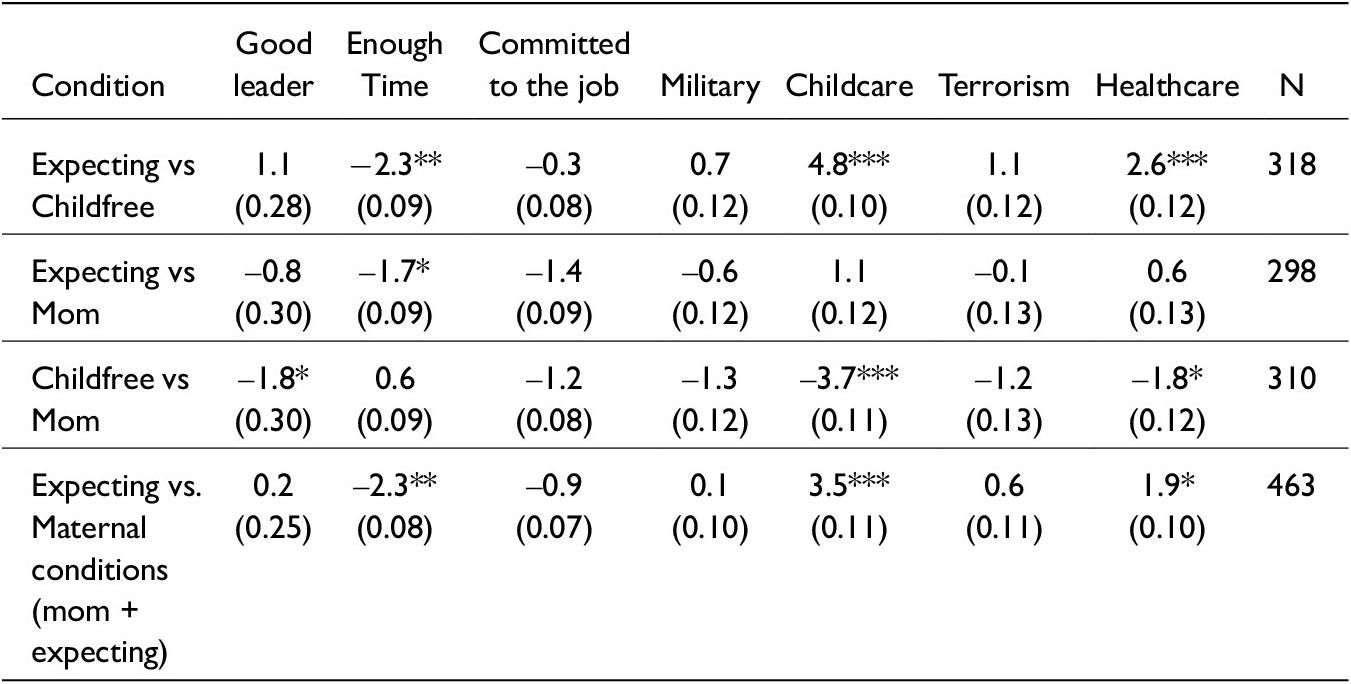
Next, I assess the experimental results on perceptions of different candidate conditions by controlling for office level in the candidate evaluation. The most consistent pattern among respondents placed in the executive office condition (governor) is the perception that the pregnant candidate will not have enough time to do their job.Footnote 19 Table 2 shows the average treatment effects between the candidate conditions in the executive office condition, for all respondents regardless of partisanship. I find partial support for H1(a), pregnant candidates are seen as less able to manage time (p <.05) but not less committed to the job compared to both the mother and childfree conditions, suggesting voter concerns about the physical demands of pregnancy rather than dedication to the role. This provides initial support that voters perceive role incongruity between pregnant candidates and executive office, and runs counter to H1(b), the hypothesis that pregnant candidates may get a boost from voters as they would be evaluated within-group, comparing expectations of their competencies to a “typical” pregnant woman. The visual cue of the bump may elicit the discrimination by voters about time, as they may associate negative stereotypes tied to pregnancy, in addition to the saliency of impending life changes of the candidate and concerns about subsequent maternity leave while in office. Mothers are rated marginally higher on good leadership (p <.1) compared to childfree candidates, but pregnant candidates do not share in this advantage, suggesting that motherhood may be a strategic asset, but pregnancy is not. This finding supports H3, which expected mothers to be rated higher on the leadership measure.
Average treatment effects for executive (governor) office candidates

Table 2. Long description
The table has eight columns. The header row lists Condition, Good leader, Enough Time, Committed to the job, Military, Childcare, Terrorism, Healthcare, and N. The first row, Expecting vs Childfree, shows Good leader 1.1 (0.28), Enough Time minus 2.3 double asterisk (0.09), Committed to the job minus 0.3 (0.08), Military 0.7 (0.12), Childcare 4.8 triple asterisk (0.10), Terrorism 1.1 (0.12), Healthcare 2.6 triple asterisk (0.12), N 318. The second row, Expecting vs Mom, shows Good leader minus 0.8 (0.30), Enough Time minus 1.7 single asterisk (0.09), Committed to the job minus 1.4 (0.09), Military minus 0.6 (0.12), Childcare 1.1 (0.12), Terrorism minus 0.1 (0.13), Healthcare 0.6 (0.13), N 298. The third row, Childfree vs Mom, shows Good leader minus 1.8 single asterisk (0.30), Enough Time 0.6 (0.09), Committed to the job minus 1.2 (0.08), Military minus 1.3 (0.12), Childcare minus 3.7 triple asterisk (0.11), Terrorism minus 1.2 (0.13), Healthcare minus 1.8 single asterisk (0.12), N 310. The fourth row, Expecting vs Maternal conditions (mom plus expecting), shows Good leader 0.2 (0.25), Enough Time minus 2.3 double asterisk (0.08), Committed to the job minus 0.9 (0.07), Military 0.1 (0.10), Childcare 3.5 triple asterisk (0.11), Terrorism 0.6 (0.11), Healthcare 1.9 single asterisk (0.10), N 463. Asterisks indicate statistical significance: single asterisk equals p equals point one, double asterisk equals p equals point zero five, triple asterisk equals p equals point zero zero one. Higher numbers indicate more positive ratings. Standard errors are in parentheses.
Caption: for each indicator the higher the number, the more positive the rating | p values * = .1; ** = .05; *** = .001. Statistical significance is determined through two tailed t-test comparing mean scores of each condition. Reported values represent difference in means, with standard errors in (). Totals of N for each condition will add up to more than the total number of respondents in experiment as a condition appears in more than one row. Refer to Table 1 for N of each experimental condition.
Table 2 shows that respondents find both the pregnant and mother candidates significantly more competent on stereotypically “feminine” policy issues; childcare and healthcare, compared to the childfree candidate in the executive office condition. There are no significant differences between the pregnant and mother conditions. This suggests that the saliency of (impending) motherhood is a factor and affects how voters view a candidate’s competency on stereotypical policy issues. Role congruity between (expectant) mothers and feminine issues likely plays a role in the results. Respondents are primed to think women, particularly those who are (impending) mothers, will be experts at traditional private sphere issues and demonstrate more competence on these issues compared to women who are childfree and do not conform to motherhood roles. There are no significant differences between any of the three-candidate conditions and the masculine policy areas, terrorism, and military issues. Thus, H2 which expected pregnant candidates to be seen as hyperfeminine and most competent on feminine policy issues is not borne out. While pregnancy might be expected to heighten femininity cues, voters categorize pregnant and mother candidates similarly in feminine policy domains.
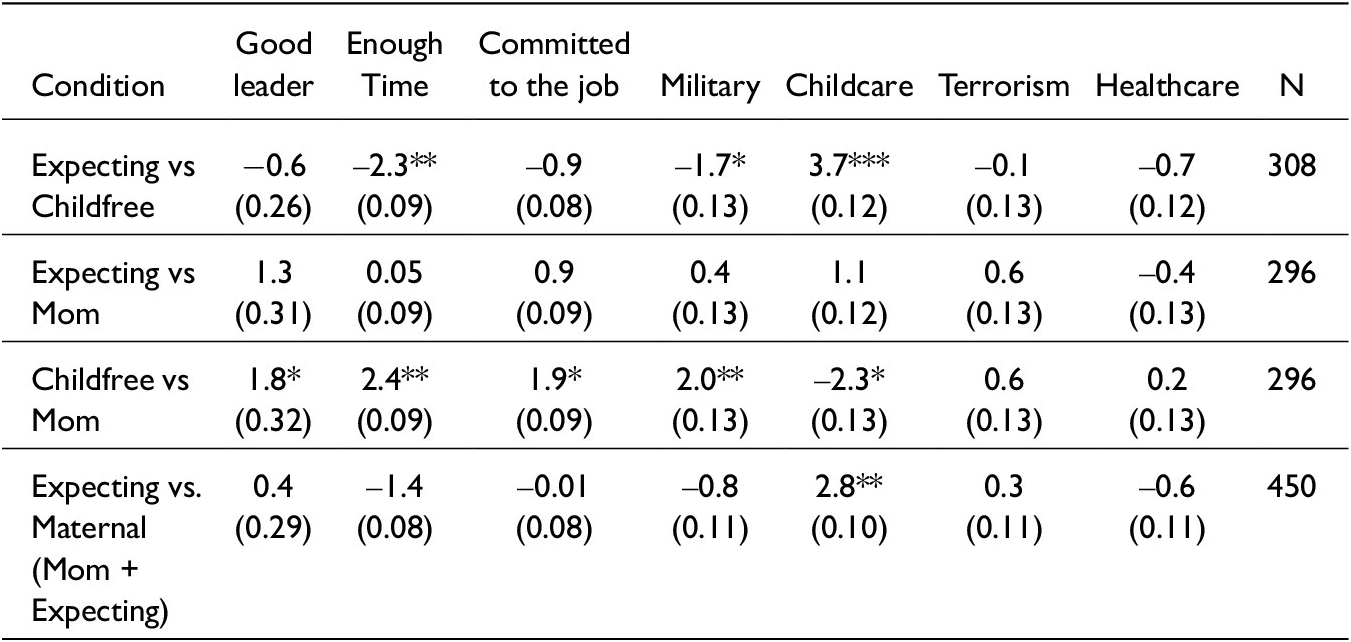
Table 3 shows the average treatment effects between candidate conditions at the state legislative office level. Respondents reduce levels of support for both the pregnant and mother candidates compared to the childfree condition on whether they have enough time to do their job. These findings suggest that there are important differences between voters’ perceptions of candidate types and the office level they are seeking. Respondents at the state legislative level perceive candidates without children as having significantly more time on average to complete their job compared to those with (or expecting) children, reinforcing the role incongruity of leadership and motherhood at this level the state legislative level. Voters may not be as supportive of mothers (or expectant mothers) running for office, as they perceive and rate mothers lower on having enough time to do their job, due to domestic expectations, compared to childfree candidates. The finding partially supports H1(a), the expectation that pregnant candidates will be rated significantly lower on time by voters; however, it more broadly supports the idea that voters prefer women without children as candidates rather than mothers or expectant mothers when running for state legislative office. Additionally, unlike the executive condition, mothers are rated marginally lower on leadership compared to childfree candidates, while pregnant candidates do not share in this disadvantage, suggesting that (impending) motherhood may be a liability at the legislative level. This finding refutes H3, which postulates that mothers will be rated higher on the leadership measure, suggesting that motherhood may be a benefit at higher levels of office.
Average treatment effects for state legislative office candidates

Table 3. Long description
The table has four rows for conditions: Expecting versus Childfree, Expecting versus Mom, Childfree versus Mom, and Expecting versus Maternal (Mom plus Expecting). Columns, from left to right, are: Good leader, Enough Time, Committed to the job, Military, Childcare, Terrorism, Healthcare, and N. For Expecting versus Childfree, values are: Good leader minus 0.6 (0.26), Enough Time minus 2.3 double asterisk (0.09), Committed minus 0.9 (0.08), Military minus 1.7 asterisk (0.13), Childcare 3.7 triple asterisk (0.12), Terrorism minus 0.1 (0.13), Healthcare minus 0.7 (0.12), N 308. For Expecting versus Mom: Good leader 1.3 (0.31), Enough Time 0.05 (0.09), Committed 0.9 (0.09), Military 0.4 (0.13), Childcare 1.1 (0.12), Terrorism 0.6 (0.13), Healthcare minus 0.4 (0.13), N 296. For Childfree versus Mom: Good leader 1.8 asterisk (0.32), Enough Time 2.4 double asterisk (0.09), Committed 1.9 asterisk (0.09), Military 2.0 double asterisk (0.13), Childcare minus 2.3 asterisk (0.13), Terrorism 0.6 (0.13), Healthcare 0.2 (0.13), N 296. For Expecting versus Maternal: Good leader 0.4 (0.29), Enough Time minus 1.4 (0.08), Committed minus 0.01 (0.08), Military minus 0.8 (0.11), Childcare 2.8 double asterisk (0.10), Terrorism 0.3 (0.11), Healthcare minus 0.6 (0.11), N 450. Asterisks indicate statistical significance: single asterisk p equals point one, double asterisk p equals point zero five, triple asterisk p equals point zero zero one. Standard errors are in parentheses. Higher numbers indicate more positive ratings.
Caption: for each indicator the higher the number, the more positive the rating | p values * = .1; ** = .05; *** = .001. Statistical significance is determined through two tailed t-test comparing mean scores of each condition. Reported values represent difference in means, with standard errors in (). Totals of N for each condition will add up to more than the total number of respondents in experiment as a condition appears in more than one row. Refer to Table 1 for N of each subgroup.
Gendered patterns also emerge in the policy issue competencies. Respondents in the state legislative condition perceive both the pregnant and mother candidate as significantly more competent on the feminine issue, childcare; however, they also perceive both the pregnant and mother candidate as significantly less competent on the masculine policy area, the military, compared to the childfree candidate. Similar to the findings in the executive office condition, there are no significant differences in policy issues between the pregnancy and mother condition, reinforcing the idea that on issue competencies, respondents stereotype women candidates as those who are (or are soon to be) mothers and those who are not. Candidates with maternal identifiers are perceived as more competent in hyperfeminine policy areas, such as childcare, yet there is no significant difference in healthcare, the other feminine issue in the experiment, unlike the findings in the executive office condition. The patterns on these issue areas provide limited support for stereotype incongruence between maternal-identified candidates and “masculine” issue areas. In turn, this could indirectly limit their electoral prospects as most issue contexts, particularly those at higher levels of office, are generally considered in the “masculine” domain (Bauer and Santia Reference Bauer and Santia2023). These findings refute H2 which expected pregnant candidates to be seen as hyperfeminine on feminine policy issues, rather the results support the notion that more broadly, candidates with maternal identifiers will be viewed as less capable of handling masculine-type issues.
While previous work has examined how voters perceive mothers as candidates compared to fathers, less is known about how pregnant candidates are evaluated, particularly across different office levels. In this analysis, I find that at the executive level, mothers are rated as significantly better leaders compared to childfree candidates, whereas pregnant candidates face a distinct time penalty, reinforcing role incongruity concerns. Both mothers and pregnant candidates are perceived as equally competent on feminine policy issues, suggesting that (impending) motherhood cues activate stereotypical expertise in these domains, with no effect on masculine issues. At the legislative level, motherhood — not just pregnancy — is seen as incongruent with leadership, as childfree candidates are rated most favorably on leadership and time. Voters perceive both mothers and pregnant candidates as having less time, reinforcing the view that domestic expectations conflict with legislative responsibilities. These findings suggest that motherhood, rather than pregnancy alone, poses challenges for women seeking legislative office, while executive-level mothers may benefit from positive leadership stereotypes and pregnant candidates face distinct barriers.
Perceived Candidate Differences Between Office Conditions
Next, I consider the differences based between office types and compare if voters perceive pregnant candidates as better suited for an executive or state legislative office. I begin by running difference in means tests between the pregnant candidate running for executive office and state legislative office to determine effects by office type.Footnote 20 Among all respondents, no significant effects are observed on the measures of time, commitment, and good leadership, as shown below in Figure 1. The only significant difference that appears is that respondents perceive the pregnant candidate to be significantly more capable at handling healthcare issues at the executive than the state legislative office level. This may be an effect of perceived duties and authority between office level, rather than the candidate condition. These results refute the expectations for H4(a), anticipating that pregnant candidates would be rated significantly lower on the competency measures for the executive office compared to legislative.
Candidate condition differences between office type.
Caption: This graph shows the voter perception differences of each candidate condition by office type (legislative and executive) on competency issues rated on a scale from 0 (lowest agreement) to 3 (highest agreement) in the executive office condition. Confidence Intervals are at 95%.

Figure 1. Long description
From left to right, the three panels are labeled Childfree, Expecting, and Mother. Each panel contains seven horizontal rows for dependent variables: Terrorism, Childcare, Health, Military, Commitment, Leadership, and Time. In each row, two data points are shown: a red circle for Legislative and a blue square for Executive office type, both with horizontal error bars indicating 95 percent confidence intervals. The x-axis is labeled Mean Rating with 95 percent Confidence Interval, ranging from 2.0 to 2.8. For all dependent variables, mean ratings for Executive office type (blue squares) are generally higher than for Legislative (red circles), especially in the Mother and Expecting panels. The largest differences between office types appear in the Mother panel for Childcare, Health, and Commitment, where Executive ratings are notably higher. In the Childfree panel, ratings for both office types are lower and closer together across all variables. Confidence intervals overlap in some cases but are wider for certain variables, such as Health and Military. The legend at the bottom identifies red circles as Legislative and blue squares as Executive.
However, results between office level for mother candidates provide valuable insight and further support the idea that mothers are valued differently as candidates by office type. Figure 1 shows that among all respondents, there is a clear preference for moms as candidates running for executive office compared to state legislative. Respondents rate moms in the executive condition as having marginally more time (p <.1), are considered significantly more committed (p <.05), and a significantly better leader (p <.05) compared to moms in the state legislative condition. This supports H4(b) where I expected voters to rate mothers as significantly higher on leadership competencies in the executive compared to state legislative condition. There are no significant differences on any measure for the childfree candidates between office types.
These findings highlight the nuanced role of motherhood and pregnancy in shaping voter perceptions across office types. While previous research has not examined whether voters differentiate between mothers by office level, the results show that maternal identity is perceived as an asset in the executive office. Additionally, I provide a novel contribution by considering how pregnancy, distinct from motherhood, interacts with office type. Voters do not treat pregnancy and motherhood interchangeably—mothers receive a leadership advantage in executive roles, while pregnancy does not produce a similar boost, nor does it generate consistent penalties across office levels. In contrast, evaluations of childfree and pregnant candidates remain stable across office types, suggesting that voters primarily differentiate candidates based on maternal identity rather than parental status alone. These findings underscore how traditional gendered expectations about leadership and caregiving shape candidate evaluations in office-specific ways.
Partisan Differences on Leadership and Issue Competencies
Finally, I compare candidate differences on the competency measures by partisanship to determine if there are any candidate-type preferences within each party.Footnote 21 I begin by looking at each partisan group of respondents (Democrats and Republicans) and how they rate the candidate on time, commitment, and good leadership by office type. Figure 2 below shows the average treatment effects within each party in the executive office condition and I find patterns that support the expectations. Democratic respondents rate the pregnant candidate and mother candidate significantly higher than childfree candidates on good leadership. Democratic respondents also rate the mother candidate as significantly more committed to the position compared to the childfree condition. There are no significant differences on these measures between the pregnant and mother candidate, suggesting that Democrats may see a division between candidates who are (or are soon to be) mothers and candidates who are not.
Leadership competencies by candidate condition and party.
Caption: This graph shows the difference between Democrat and Republican voter perception by candidate type on competency issues rated on a scale from 0 (lowest agreement) to 3 (highest agreement) in the executive office condition.

Figure 2. Long description
The plot is divided into two vertical sections labeled Republican on the left and Democrat on the right. The y-axis lists three leadership competencies from top to bottom: Time, Good Leader, Commitment. The x-axis shows mean rating of respondents from 1.8 to 2.4. For each competency and party, three colored markers represent candidate conditions: pink circles for Mother, green squares for Childfree, blue triangles for Expecting. Each marker is centered on its mean value with a horizontal error bar. For Time, Republican ratings cluster near 2.0, with Expecting highest, Childfree and Mother lower. Democrat ratings are higher overall, with Expecting and Childfree close to 2.2, Mother slightly lower. For Good Leader, all conditions are close to 2.0 for Republicans, with little spread; Democrats rate all conditions higher, around 2.2. For Commitment, Republican ratings are lowest for Expecting, higher for Childfree and Mother; Democrats rate Mother highest, Expecting and Childfree lower but above Republican values. Legend at bottom identifies marker colors and shapes for each candidate condition.
Among Democrats, there is a clear preference for maternal cuing candidates running for executive office compared to childfree candidates. Different patterns emerge among Republican respondents in the executive office condition. The only significant difference among Republican respondents is that they rate the pregnant candidate as having significantly less time to do the job compared to the childfree candidate. There are no significant differences between candidates on any other measure. These findings show limited support for the hypothesis H(3) that the mother condition will receive the highest ratings on good leader competency, at least among Democrats, and also provide initial support for H(5a) that Democrats will rate pregnant candidates higher on leadership competencies compared to Republicans. Consistent with H5(c), pregnant candidates receive lower competency ratings, especially time, from Republicans.
At the state legislative level, patterns are less clear among Democrat respondents. There are no differences between the pregnant and motherhood conditions on any measure, and respondents rate pregnant candidates as having significantly less time to do their job (p = 0.004) compared to the childfree condition. These findings provide additional support for H5(a) that Democrats rate maternal cuing, including pregnant candidates, higher on leadership competencies, and H5(b) it is more pronounced at the executive office level. Republican respondents, however, show a clear preference for the childfree candidate at the legislative office level. Republicans rate the childfree candidate as a significantly better leader, more committed and as having enough time to do their job compared to the mother condition. Republicans also rate the mother as significantly less committed than pregnant candidates. There are no significant differences between the pregnant and childfree condition. Consistent with previous research Republicans show more of a preference for childfree candidates, particularly at the state legislative level (Deason et al. Reference Deason, Greenlee and Langner2015). These findings do not fully support H5(c), that Republicans will rate the pregnant candidate lowest on competencies, but rather Republicans rate the childfree candidate highest among the competencies and rate the mother candidate as least committed to the job.
In terms of policy issues, Democrats rate the pregnant candidate as significantly more capable on healthcare, childcare, and military issues compared to the childfree candidate in the executive office condition. These findings suggest that Democratic respondents may not necessarily uphold stereotypes that pregnant candidates are less competent due to “baby brain” or being overly emotional. Democrats rate both mothers and pregnant candidates as significantly more capable on childcare issues compared to the childfree candidate, which, given their maternal status, is unsurprising. However, pregnant candidates are only moderately rated higher than mothers on healthcare, suggesting the effect is stronger when comparing them to childfree candidates. One possible explanation is that the “baby bump” visual cue activates perceptions of care and nurturing, leading to higher competence ratings for healthcare. Like Democrats, Republicans rate both pregnant and mother candidates as significantly more competent on childcare issues compared to the childfree candidate. However, there is no significant difference between pregnant and mother candidates on this measure. With the exception of childcare, Republican respondents do not show significant differences in their evaluations of candidate types on gendered issues in the executive office condition.
In the legislative condition, Democrats again rate both pregnant and mother candidates higher on childcare compared to childfree candidates, following the same pattern as in the executive condition. Republican respondents, however, only rate pregnant candidates as significantly more competent on childcare compared to childfree candidates, and do not find mothers significantly different from childfree candidates in this condition. Additionally, Republicans rate childfree candidates as somewhat more competent on military/policing compared to pregnant candidates, though this finding is only marginally significant (p <.10). This may reflect pregnancy stereotypes (e.g., overly emotional, hyperfeminine), making the pregnant condition appear incongruous with military or policing roles.
While previous work has considered the effect of partisanship on candidate evaluations who are parents, works to date have not considered the effect of partisanship with the added condition of pregnancy as a candidate condition. In this analysis, I sought to disentangle how voters perceive candidate evaluation qualities based on a woman candidates’ maternal status: as a childfree woman, expecting or mother to young child. The results underscore the finding that Democrats prefer maternal candidates, both expecting and mothers, especially in executive roles, while Republicans show little preferences at the executive level but demonstrate a preference for childfree candidates in the legislative roles, rating them as better leaders and more committed compared to mothers. Pregnancy does not lead to an across-the-board penalty, but there is evidence that Republican voters reduce support for pregnant candidates distinctly over time compared to childfree candidates, reinforcing stereotypes about work-life balance and gender expectations and leadership roles. In terms of issues, Democrats see pregnant candidates as significantly more competent on healthcare, childcare, and military issues compared to childfree candidates, potentially due to maternal and “care” stereotypes.
Discussion and Conclusions
Do candidates face a penalty for pregnancy while running for office? This study examines how voters evaluate pregnant candidates, a previously unexplored dimension, and adds to the literature on motherhood and politics. The results indicate that pregnant candidates face a distinct electoral barrier, regarding perceived time availability rather than general leadership or commitment. This is strongest in executive office races, where voters view pregnancy as incongruent with the demands of the role. More broadly, disaggregating motherhood into distinct stages including pregnancy and early parenthood clarifies how gendered and temporal perceptions shape women’s political prospects. Even modest differences reveal where penalties emerge and the mechanisms sustaining inequality. However, pregnant and mother candidates are largely grouped together on most leadership and policy competencies, suggesting that maternal identity — rather than pregnancy alone — shapes voter perceptions. The unique deficit in time by voters may stem from stereotypes about pregnancy, such as cognitive decline or physical limitations, or concerns about maternity leave early in office. While this result may in part reflect the unique physical and temporal demands associated with pregnancy, which differ from those of being a parent more generally, notably, the penalty is sharper in executive compared to legislative contests. Executive terms are generally held for a longer period and imply that voters are inferring a sustained capacity deficit, not a short-term leave. At the same time, this pattern reflects broader prescriptive expectation about women’s capacity and availability for public service at various stages of life. Even if pregnancy is viewed as a temporary constraint, the assumption that a candidate is less able to fully commit to the time of the job can reinforce enduring implicit gender norms about who is fit to serve that is not captured in this experiment. As indicated in the descriptive findings, voters, particularly those who hold attitudes about maintaining traditional gender roles, reduce support for pregnant candidates for violating traditional gender norms, as pregnancy is culturally associated with rest and caregiving rather than political ambition. While this experiment does not establish causality between these items, future work should explore how sexism and pregnancy stereotypes interact to shape voter perceptions.
Pregnant and mother candidates also experience policy-related barriers, particularly at the executive level, where they are rated as more competent on stereotypically feminine policy issues compared to childfree candidates. These effects may be due to traditional socialization and stereotypical expectations, associating mothers (or expecting mothers) as maternal and caring, and thus would be primed to better handle a health crisis or childcare issues. These associations with warmth, empathy, and caregiving traits align with prior research on gendered candidate evaluations (Deason Reference Deason2011). Stereotypes must be activated to impact voter decisions, and these findings suggest that candidates who highlight their motherhood will lead to higher evaluations on feminine stereotypical issues (Bauer Reference Bauer2015). However, while emphasizing motherhood may enhance perceptions of competence in feminine policy areas, it may also reinforce the incongruity between motherhood and executive leadership, where masculine traits are typically more valued (Huddy and Terkildsen Reference Huddy and Terkildsen1993b; Fox and Oxley Reference Fox and Oxley2003; Sweet-Cushman Reference Sweet-Cushman2021). This suggests that expecting mothers running for higher office may need to counteract these stereotypes through alternative campaign strategies.
A key finding is that pregnant candidates are rated lower on time, whereas mothers of young children are not — at least among Democratic voters, suggesting a motherhood timing gap in which pregnancy is viewed as a constraint but motherhood can function as an electoral asset. The results indicate that Democratic voters, in particular, rate mothers of young children more favorably in leadership roles, especially at the executive level. However, this benefit does not extend to pregnant candidates, who are perceived as lacking the time needed to fulfill leadership responsibilities. This gap has important implications for women’s political trajectories, as it suggests that women may face strategic incentives to delay running for office until they have young children rather than while they are expecting. While these trends do not necessarily apply to Republican voters, who demonstrate a broader preference for childfree candidates, the partisan dynamics reinforce how gendered expectations around motherhood and leadership shape electoral opportunities differently across party lines.
Finally, I investigate if there is a penalty for pregnancy conditioned by office type. The results indicate that there does not appear to be a consistent penalty or boost for pregnant candidates based on office type among respondents; however, there are important differences between partisan groups. While respondents do not significantly consider the pregnant candidate as better suited for either executive or state legislative office type, Democratic respondents are more likely to consider the pregnant candidate as a better-suited leader in executive office compared to Republicans. Potential pregnant Republican candidates who run for office may face more challenges with their base to overcome this gap and demonstrate leadership qualities. Additionally, the results also support growing evidence for a voter preference, regardless of partisanship, for moms in executive office.Footnote 22 Given the recent trends of more moms running for office, showcasing their family and in executive roles, research shows this can help to view the role as a better “match” with traditionally feminine characteristics and traits, such as motherhood, and thus women who fit normatively and pursue these roles are likely to be more positively evaluated (Deason Reference Deason2011; Eagly and Carli Reference Eagly, Linda L., Antonakis, Cianciolo and Sternberg2004). Cuddy et al. (Reference Cuddy, Fiske and Glick2004) also argue that working moms can fit as either female professionals, who are seen as competent but cold, or as housewives, seen as warm but incompetent. It is likely that in the masculine domain of politics, standards are shifting for moms running for executive compared to legislative office. Respondents presume moms running for executive office fit more within the bounds of “female professionals” and are preferred, compared to running in the less masculine state legislative offices, where moms may be stereotyped as more of a “mom/housewife” and thus seen as having lesser leadership skills and commitment.
With the caveat that this evidence comes from primary conditions, these findings offer practical implications for how women navigate campaigning while pregnant or as mothers of young children. First, mothers need not hide family status, though visibly pregnant candidates may need to be more deliberate about addressing time/capacity concerns. Mothers generally see a boost of support when running for executive office relative to childfree candidates, suggesting greater congruence between motherhood and leadership expectations at that level. By contrast, pregnant candidates face a distinct time/capacity hurdle — especially in executive races — where voters perceive a temporary mismatch between the physical realities of pregnancy and nonstop executive demands. Practically, this implies campaigns to consider how pregnancy is presented and how continuity of work is demonstrated (e.g., clear coverage plans, sustained presence). Second, while voters demonstrate a preference for mothers in office, two moderators matter that campaigns should consider: office level and partisanship. At higher office levels, showcasing family can complement leadership expectations; at lower or part-time legislative posts, voters appear to rely more on gendered heuristics, making motherhood seem less congruent with job demands. Partisanship further conditions these practical considerations for campaigns: Democrats are more receptive to maternal cues, while Republicans are less supportive of mothers or pregnant candidates, posing distinct challenges for Republican women, and the intensity of partisan attachment may amplify these tendencies.
This study highlights the strengths and limitations of experimental methods in assessing voter perceptions. Research suggests that caution is required in terms of generalizing survey experiments, as experimental manipulations can sometimes create stronger contrasts than those observed in real-world settings (Barabas and Jerit Reference Barabas and Jerit2010). This study attempts to minimize threats to external validity as much as possible and enhance realism. The stimuli were designed to closely reflect real-world candidate portrayals, ensuring that the experimental conditions mirror plausible political dynamics rather than artificial or exaggerated scenarios. Additionally, because it follows a design like Stalsburg (Reference Stalsburg2010), it provides a useful benchmark for assessing confidence in the findings. Importantly, relying solely on observational data and real-world cases would introduce selection effects, as pregnancy and parenthood likely influence candidate entry, making it difficult to isolate their impact on electoral outcomes. The experiment is essential in this context — it allows us to directly test the effect of pregnancy and motherhood on candidate evaluations while holding other factors constant, providing a clearer understanding of its role in shaping voter perceptions. Without an experiment, it would be nearly impossible to disentangle the effect of pregnancy itself from the broader, confounding forces that shape candidate emergence and electoral success.
This study considers many factors but does not include intersectional items such as candidate family status, sexuality, race, and ethnicity which could add to the heterogeneity of results. Integrating these important identity intersections would enhance current understanding of how socialization factors affect perceived candidate competencies. Future studies should consider integrating these measures. The experiment also only compares effects among different types of women candidates. What is not known is the effect of pregnancy on races with male competitors. However, this experiment provides an important lens into future potential race dynamics; as more diverse women are running for office at all levels, this experiment provides a potential baseline of what some of these candidates may face in terms of voter support and evaluation.
Additionally, Republican women face distinct constraints in primaries versus general elections that my design does not capture. I intentionally framed the vignette as a primary contest to hold partisan cues constant and isolate within-party evaluations of maternal-cuing candidates, preventing partisanship from overwhelming identity effects the way it often does in general elections. Because Republican women who win primaries often do so in Democratic-leaning districts, they frequently encounter poor general-election prospects (Ondercin and Welch Reference Ondercin and Welch2009; Palmer and Simon Reference Palmer and Simon2005). My estimates are best read as evidence about within-party dynamics rather than general-electorate outcomes. Moreover, recent work shows that Republican voters often reward a masculinity premium in preferred candidates regardless of sex (Karpowitz et al. Reference Karpowitz, Monson, Preece and Aldridge2024), suggesting Republican mothers or pregnant candidates may face an additional trade-off between maternal cues and displays of traditionally masculine competence. Future work should test these boundary conditions directly by comparing primary and general contexts and experimentally varying concurrent masculinity and competence signals to map how maternal cuing candidates navigate these competing expectations.
Although many questions remain about the effects of pregnancy on voter evaluation, these results show distinct barriers for pregnant candidates. This study is unique by centering the effect of pregnancy in voter evaluations, distinguishing it from motherhood. It empirically demonstrates that pregnant women running for executive office face a time perception penalty, reinforcing gendered work-family expectations. This theoretical and empirical contribution on the negative impacts of perception of time adds to the burgeoning literature on parenthood in politics and the distinct barriers that parents and (expectant) mothers face when running for office. Additionally, I empirically demonstrate that the Democrats are more likely to support pregnant and mother candidates, compared to Republicans. Pregnant candidates will need to employ strategies to combat voter penalty to be viewed as a more committed candidate when running for office — particularly at the executive level and those running in the Republican party. While this study sheds light on the mechanism, perceptions of time, that uniquely affects pregnant candidates and demonstrates its conditionality based on office type, additional research can continue to explore the intersections of pregnancy and running for office to fully understand these underlying mechanisms that affect candidate evaluation.
Supplementary material
The supplementary material for this article can be found at http://doi.org/10.1017/S1743923X26100762.
Competing interests
The author(s) declare none.
Funding statement
Funding was provided by Rutgers University. They played no role in the design, execution, analysis and interpretation of data, or writing of the study.



 Open access

