Implications
Valid welfare indicators are required nationally and internationally by farmers, veterinary surgeons, the sheep industry and farm inspectors in order to measure and monitor on-farm welfare standards for benchmarking, certification, farm assurance and legal purposes. Currently, on-farm welfare inspections rely on the assessment of management- and resource-based measures. However, there are increasing demands for measures that assess the quality of an animal's life using direct animal-based outcomes. Compared to other farm animal species, few validated animal-based measures of sheep welfare currently exist. Therefore, this study has the potential to inform and enhance future on-farm assessments of sheep welfare.
Introduction
Consumer awareness and concern for farm animal welfare has provided the impetus for driving the provision of products from high welfare systems, assurance of farm animal welfare standards and demands for welfare labelling of food (Waiblinger et al., Reference Waiblinger, Knierim and Winckler2001; Blokhuis et al., Reference Blokhuis, Jones, Geers, Miele and Veissier2003; Main et al., Reference Main, Kent, Wemelsfelder, Ofner and Tuyttens2003b). In addition to non-regulatory purposes, welfare assessments are undertaken to assess compliance with legislative and regulatory standards (EFSA, 2007). Consequently, there is a need for valid, reliable and feasible measures for use in on-farm welfare assessment systems which would be transparent and fair to both producers and consumers (FAWC, 2009; Mullan et al., Reference Mullan, Edwards, Butterworth, Whay and Main2009).
In the past, on-farm welfare assessments focused on the evaluation of farm resources (e.g. provision of housing and feed) known as resource-based indicators or those that assess farmer policies and management practices (management-based indicators; Capdeville and Veissier, Reference Capdeville and Veissier2001; FAWC, 2009; Mullan et al., Reference Mullan, Edwards, Butterworth, Whay and Main2009). Since animal welfare can be considered to be the outcome of the interaction between genotype, management and the environment (Sørensen and Fraser, Reference Sørensen and Fraser2010), a valid assessment of welfare should also include animal-based welfare outcomes (FAWC, 2009; Mullan et al., Reference Mullan, Edwards, Butterworth, Whay and Main2009; Sørensen and Fraser, Reference Sørensen and Fraser2010).
A valid welfare indicator would be a genuine measure of animal welfare (EFSA, 2007; Bracke et al., Reference Bracke, Edwards, Engel, Buist and Algers2008). Since welfare measures (or indicators) are akin to diagnostic tests, they may be evaluated in a similar manner. Essentially, a new diagnostic test would be conferred as valid, if it produced the same result as an established reference test (Greiner and Gardner, Reference Greiner and Gardner2000). However, this approach is problematic for animal welfare assessment as a reference test does not currently exist (de Passillé and Rushen, Reference de Passillé and Rushen2005). An alternative approach is to use a consensus of expert opinion to judge the validity of welfare indicators that are incorporated into on-farm assessment protocols. By judging the suitability and relevance of each measure, expert opinion provides consensual and face validity to the selection of welfare indicators (Abramson, Reference Abramson1974; Johnsen et al., Reference Johnsen, Johannesson and Sandøe2001; Scott et al., Reference Scott, Nolan and Fitzpatrick2001; Bracke et al., Reference Bracke, Metz, Spruijt and Schouten2002). Previously, expert opinion has identified a number of welfare indicators for cattle, poultry and pigs (Capdeville and Veissier, Reference Capdeville and Veissier2001; Whay et al., Reference Whay, Main, Green and Webster2003a; Botreau et al., Reference Botreau, Veissier and Perny2009) and has also been used to identify a number of welfare issues for sheep (Cronin et al., Reference Cronin, Barnett, Edge and Hemsworth2002; Waterhouse et al., Reference Waterhouse, Colgrove, Vipond and Goddard2003; Pines et al., Reference Pines, Petherick, Gaughan and Phillips2007; Phillips et al., Reference Phillips, Wojciechowska, Meng and Cross2009).
The methods for gathering the consensus of expert opinion vary, from using Delphi questionnaires (Whay et al., Reference Whay, Main, Green and Webster2003a; Phillips and Phillips, Reference Phillips and Phillips2010), online surveys (Fernie et al., Reference Fernie, Tribe, Murray and Phillips2008), small group meetings such as the Nominal Group Technique (NGT; Delbecq et al., Reference Delbecq, Van de Ven and Gustafson1975) to conference-style meetings (Glaser, Reference Glaser1980; NIH, 1990; Pines et al., Reference Pines, Petherick, Gaughan and Phillips2007; Rousing et al., Reference Rousing, Jakobsen, Hindhede, Klaas, Bonde and Sørensen2007). The NIH consensus development programme (NIH, 1990) is a well-recognised conference-style method that has been used in human medicine to identify numerous clinical and biotechnological issues (www.consensus.nih.gov). This method is relevant for developmental research studies as experts meet face-to-face enabling idea generation and open discussions (NIH, 1990). The NIH approach can involve a pre-meeting consultation, such as the use of questionnaires to give experts greater time to enlarge on the topic of interest (Glaser, Reference Glaser1980). In addition, experts may be split into sub-groups during the conference to allow an in-depth discussion of all the relevant issues (Glaser, Reference Glaser1980).
The overall aim of this study was to establish valid, reliable and feasible indicators for the on-farm assessment of sheep welfare. This paper describes the initial identification of a number of sheep welfare indicators which encompassed the welfare concepts in the Farm Animal Welfare Council (FAWC) five freedoms (FAWC, 1994) and were sensitive to the current on-farm welfare issues for sheep. An NIH approach (NIH, 1990) allowed a panel of experts to judge the validity (face and consensual) of sheep welfare indicators that were included in on-farm assessment studies. Following this initial validation step, the internal validity (evaluation of bias, reliability and diagnostic accuracy) and the external validity (generalisability, feasibility and applicability) of these indicators would be evaluated in field studies (Greiner and Gardner, Reference Greiner and Gardner2000). Thereafter, the ranking or exclusion of any indicators could be based on the evidence of their diagnostic validity, reliability, and feasibility for use in on-farm welfare applications.
Material and methods
Expert panel selection
The objective of the expert panel selection process was to identify a broad panel of expert members (Garabed et al., Reference Garabed, Perez, Johnson and Thurmond2009). An ‘expert’ was defined as a person having a minimum of 10 years sole experience of sheep farming in the UK sheep industry and/or professional achievements in industries and organisations allied to sheep farming, veterinary services and welfare research. Experts were short-listed by members of the research team to avoid overlap in areas of representation (Garabed et al., Reference Garabed, Perez, Johnson and Thurmond2009). Following approval by the Department for the Environment, Farming and Rural Affairs (Defra), 33 experts were formally invited to attend a 1 day expert panel meeting.
Before their attendance, experts were given clear, written guidance on the objectives of the meeting and the required output of the expert panel – to produce a list of indicators of sheep welfare, which encompassed all aspects of the five freedoms and were sensitive to current on-farm welfare issues for sheep in England and Wales. In addition, experts were informed of their role at the meeting, that is, to validate the identification of potential indicators of sheep welfare. Where invited members did not respond to follow-up contact (n = 2), or were unable to attend (n = 3), a substitute member with similar expertise was selected from the short-list and invited to attend. As a result, 33 members confirmed their attendance.
Identifying on-farm welfare issues for sheep – postal worksheet
One month before the meeting, a one-page worksheet was distributed to all experts (electronic and postal hard copy) in order to identify potential on-farm welfare issues for the individual sheep. Each expert was asked to list a maximum of 10 issues considered to affect the on-farm welfare of (i) ewes (female sheep over 1 year old), (ii) rams (male sheep over 1 year old), (iii) growing and fat lambs (any sex, over 6 weeks to 1 year old) and (iv) young lambs (from birth to 6 weeks old) in England and Wales. Experts were asked to consider the factors that affected the welfare at the level of the individual sheep. Anonymous responses from completed worksheets were reviewed by the authors who categorised the suggested welfare issues into the relevant area(s) of the five freedoms framework (FAWC, 1994). The five freedoms detailed by the FAWC are accepted as a sound framework for the development of animal welfare indicators (Whay et al., Reference Whay, Main, Green and Webster2003a; FAWC, 2009). This information was summarised into a document that was distributed in electronic and paper versions to all panel members 1 week before the expert panel meeting (Figure 1).
Flow-chart of the expert consensus of opinion method. Structure of the consensus of opinion methodology summarising the steps involved in the validation of the sheep welfare indicators. The final step in this flow-chart summarises the subsequent validation stages, in which the diagnostic and external validity of indicators are evaluated in on-farm studies.

Identifying on-farm welfare issues for sheep – expert panel meeting
The expert panel meeting was held on 23 February 2008, and consisted of 30 members from welfare organisations and charities (n = 2), sheep welfare research (n = 5), welfare inspectors (n = 1), veterinary animal welfare advisors (n = 2), government advisors on animal welfare policies (n = 2), veterinary sheep specialists (n = 3), veterinary surgeons from general practice (n = 4), sheep farmers (n = 5), sheep industry services (n = 2), and sheep production consultants (n = 4). The meeting followed NIH guidelines (NIH, 1990), in which an introductory presentation on the objectives of the research project was given and members were informed of their specific role in the validation of welfare indicators. The expert panel comprised of members with different experiences and expertise in sheep health, welfare and production. Therefore, in line with NIH meetings (NIH, 1990), the authors gave the expert panel a presentation on the current, scientific knowledge of on-farm welfare issues for sheep (Figure 1), identified through a systematic literature search (C. Phythian, 2008, unpublished). For the purposes of this study, welfare was defined as a factor, event or action that affected one or more of the five freedoms of an individual sheep (FAWC, 1994). The panel was then divided into four focus groups (Figure 1). Each group focused on identifying the welfare issues for one of four production stages: (i) ewes, (ii) rams, (iii) growing and fat lambs and (iv) young lambs. The aim was to allow a balance of opinions within each group and a mix of members from the different representative areas was allocated into each group. A focus group comprised of seven or eight experts, plus a facilitator, who was a trained member of the project team (Glaser, Reference Glaser1980; Krueger and Casey, Reference Krueger and Casey2009). In addition, two non-participating recorders maintained accurate written minutes of group discussions. The welfare issues document, which categorised all the welfare issues identified from the pre-meeting worksheet into the five freedoms framework (FAWC, 1994), was distributed to the panel 1 week ahead of the expert panel meeting. This provided the experts with more time to consider the welfare issues. At the meeting, this document was used as the basis for focus group discussions. All panel members were given the opportunity to consider, discuss, modify and clarify the welfare issues listed in this document and were free to alter the categorisation of any welfare issue within the five freedoms framework. As well as guiding the identification of welfare indicators by the experts, this document was also one of the final outputs of the expert panel meeting – akin to the consensus of expert opinion statement produced in NIH conferences (NIH, 1990).
Identifying potential welfare indicators – expert panel meeting
The next stage in the expert panel process was to identify valid indicators of sheep welfare based on the suggested welfare issues for sheep and the five freedoms framework (FAWC, 1994). Following the NIH process (NIH, 1990), the authors gave a presentation to the panel on the current scientific knowledge of animal welfare indicators, including those developed for other species. Experts then returned to their focus groups (Figure 1) and were asked to consider and identify measures capable of assessing each of the issues listed within the five freedoms framework. Experts were asked to identify indicators that were animal-based (where possible), non-invasive and practicable for assessments performed under farm conditions. Once the focus groups had completed this task, the panel reconvened and each facilitator gave a presentation on the valid indicators identified by their group. All members of the panel were then asked to comment on the output of the other focus groups. Following the guidance of NIH consensus methods, an official output for the consensus of expert opinion was produced by the authors after the meeting (NIH, 1990). This consisted of a final document listing the on-farm welfare issues and indicators for sheep as suggested by the expert panel. This document was electronically distributed to all experts within 1 week of the meeting. Experts were then requested to read the document and confirm that the indicators and issues were those as suggested at the meeting. If the majority of experts agreed with the meeting outputs, then a consensus of opinion would be established (NIH, 1990).
Results
On-farm welfare issues for sheep
A total of 19 out of 33 worksheet responses was received (response rate of 58%). Experts suggested 193 potential welfare issues for sheep in England and Wales. Of these, 53 on-farm welfare concerns were identified for the ewe production stage. A total of 45 issues for rams, 53 issues for growing and fat lambs and 42 issues for young lambs were also raised. Table 1 lists the welfare issues identified in the postal worksheet by at least 50% of experts (n ⩾ 17). The pre-meeting consultation found that lameness was consistently identified as an on-farm welfare issue for all four of the production stages. For young lambs, mutilation procedures of tail docking and castration were considered to be key welfare issues (Table 1). Poor body condition was identified as an on-farm welfare issue for both ewes and rams, whereas gastro-intestinal parasitism of growing lambs and dystocia in ewes were issues specific to these production stages.
Welfare issues identified through a pre-meeting postal worksheet

Perceived welfare issues identified by pre-meeting consultation by more than 50% of respondents (n = 17) are displayed together. The percentage of respondents who identified the issue to be of importance for each of the sheep production stages is shown in brackets.
§No additional issues suggested by more than 50% of respondents.
At the panel meeting, experts identified and categorised a total of 193 welfare issues for ewes, rams and lambs into the relevant criteria of the five freedoms framework (FAWC, 1994). Since all the experts indicated their agreement with the post-meeting output documents, a consensus of expert opinion on the welfare issues for sheep was achieved.
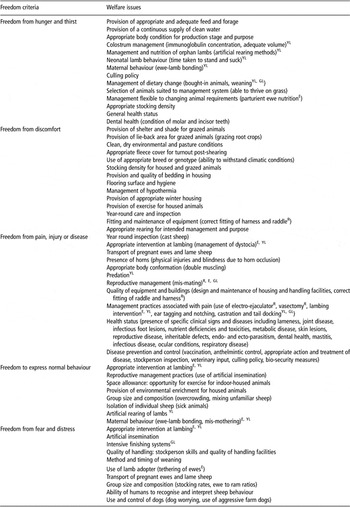
Given the large number of issues identified by the panel, a summary of the welfare issues identified for each freedom criteria was produced (Table 2). The authors grouped and summarised the 193 issues into a list of general welfare issues, which covered all four production stages (n = 58). Where appropriate, issues specific to the welfare of ewes, rams, young and growing lambs were highlighted. This organisation provided 14 general welfare issues within the freedom from hunger and thirst, 14 within the freedom from discomfort, 11 within the freedom from pain, injury and disease, 8 for freedom to express normal behaviour and 10 general welfare issues were produced under the freedom from fear and distress criterion. For example, within the freedom from pain, injury or disease, the expert panel suggested that a large number of diseases and health conditions were on-farm welfare issues for sheep and lambs. Accordingly, specific diseases and health conditions were grouped and summarised by the authors, for example, contagious ovine digital dermatitis, foot rot and scald were summarised as ‘infectious foot lesions’ (shown in brackets in Table 2). Subsequently, the general disease conditions were grouped into an overall, general welfare issue, which was termed ‘heath status’ (Table 2).
On-farm welfare issues for sheep and lambs

R Welfare issue specific to rams.
E Welfare issue specific to ewes.
GL Welfare issue specific to growing lambs.
YL Welfare issue specific to young lambs.
On-farm welfare indicators for sheep
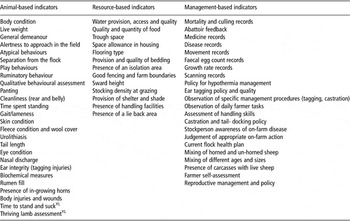
The animal-, resource- and management-based indicators suggested by the panel are shown in Table 3. Of the animal-based indicators suggested, 10 were identified for ewes, 13 for rams, 11 for young lambs and 9 for growing and fat lambs. Many of the welfare indicators identified for each production stage were similar. Since there was overlap across the focus group outputs, the authors grouped all the suggested measures into a single list of animal- (n = 26), resource- (n = 13) and management-based (n = 22) indicators (Table 3). Although most indicators could be used to assess all four production stages, the assessment of time taken to stand and suck, along with an overall indicator of lamb thrift was specifically suggested for young lambs. Resource- and management-based indicators suggested by the four focus groups also showed similarity, so these indicators were also grouped into a single list (Table 3). Resource-based measures included the assessment of housing and associated facilities and provisions, for example, space allowance and quality of bedding. The panel identified that castration and tail docking procedures were painful procedures (Tables 1 and 2). However, experts suggested that it may be more feasible to ascertain whether these mutilations were practised, the method used, and the on-farm policy regarding analgesia and anaesthesia use, rather than measuring the pain responses of lambs (Molony and Kent, Reference Molony and Kent1997).
Animal-, resource- and management-based indicators of sheep welfare identified by a consensus of expert opinion

YL Indicators specific to young lambs.
Experts were also asked to consider the feasibility of any suggested measures (Table 3). Assessments under working farm conditions were considered to pose several difficulties, including the location and gathering of extensive flocks, handling of pregnant ewes and gathering of ewes with lambs at foot. Experts therefore suggested that the nature of the sheep production year should be considered before assessment visits were undertaken. Following distribution of the post-meeting document, two panel members made additional comments, which were duly noted and recorded. These comments did not affect the list of identified indicators (Table 3), but they helped to inform the on-farm evaluation studies. Experts confirmed the validity of the indicators listed in the post-meeting consensus document. Therefore, a consensus of expert opinion provided validity to the selection of welfare indicators to undergo on-farm testing on sheep in England and Wales.
Discussion
Expert validation of welfare indicators
In the absence of a reference test (or gold standard) for welfare assessment (de Passillé and Rushen, Reference de Passillé and Rushen2005), previous welfare research has also based the selection and initial validation of welfare indicators on expert opinion (Cronin et al., Reference Cronin, Barnett, Edge and Hemsworth2002; Whay et al., Reference Whay, Main, Green and Webster2003a; Bracke et al., Reference Bracke, Edwards, Engel, Buist and Algers2008). This is because expert opinion is considered to provide both face and consensual validity to the welfare indicators (Abramson, Reference Abramson1974; Johnsen et al., Reference Johnsen, Johannesson and Sandøe2001; Scott et al., Reference Scott, Nolan and Fitzpatrick2001). The study presented here is the first to determine valid sheep welfare indicators for the on-farm welfare assessment of sheep using an NIH consensus approach (NIH, 1990). The NIH methodology provided validation of welfare indicators that were identified by expert opinion. The consensus method appears to be suitable for other animal health and welfare research applications, for example, agreeing on standard laboratory techniques or defining a specific animal welfare condition. Before applying this method, there are several factors that need to be considered. First, the definition of who is an ‘expert’ and what is their level of expertise (Spoolder et al., Reference Spoolder, De Rosa, Horning, Waiblinger and Wemelsfelder2003). Second, expert opinion can differ according to occupation (Bracke et al., Reference Bracke, Edwards, Engel, Buist and Algers2008; Fernie et al., Reference Fernie, Tribe, Murray and Phillips2008). Therefore, a biased view of welfare may be ascertained by using an unbalanced panel with experts from specific occupations (Vang, Reference Vang1986). Furthermore, consensus methodologies make assumptions on the quality of the expert panel's decisions (Fink et al., Reference Fink, Kosecoff, Chassin and Brook1984). Expert opinion may have little in common with widely known scientific facts or reasoning (Vang, Reference Vang1986) and specialists may concentrate on a small and specific issue instead of considering the whole picture (Vang, Reference Vang1986). Expert opinion should alter as scientific knowledge advances, although experts can ignore welfare research findings and provide opinion based solely on their personal experiences (Main et al., Reference Main, Whay, Green and Webster2003a). In view of these issues and in the absence of a reference test for animal welfare, a combined approach using a scientific literature review (C. Phythian, 2008 unpublished) and expert opinion guided the identification of valid welfare indicators in this study (Figure 1). The advantage of employing expert opinion, over the opinion of the study researchers, is that a group of experts would be expected to possess greater diversity in experience and knowledge of the subject under discussion, which is beneficial to an idea-generation process. As a number of concerns are recognised with the use of expert opinion, these factors were accounted for in both study design and conduct. In particular, the following considerations were made: (i) clear definition of experts (Garabed et al., Reference Garabed, Perez, Johnson and Thurmond2009), (ii) selection of experts according to level of expertise, (iii) balanced composition of members in terms of expertise in sheep welfare and occupation, (iv) quality of decisions, by using a sound consensus method (NIH, 1990), (v) clear communication of meeting objectives and fulfilment of distinct tasks (Kynn, Reference Kynn2008) and (vi) presentation of scientific knowledge to establish an educated and informed panel.
Methods for gathering a consensus of opinion
The Delphi method has been suggested as a feasible way of collecting expert opinion by avoiding conflicts between individual opinions and thereby minimising bias of opinion (Delbecq et al., Reference Delbecq, Van de Ven and Gustafson1975; Whay et al., Reference Whay, Main, Green and Webster2003a). However, Delphi questionnaires can be criticised on the grounds of poor response rates and long response times (Hsu and Sanford, Reference Hsu and Sanford2007). Furthermore, postal questionnaire methods are unsuitable for research requiring personal and direct communications (Fink et al., Reference Fink, Kosecoff, Chassin and Brook1984). Here, face-to-face Delphi questionnaire methods, recently used to identify individual farmer concerns for sheep welfare (Phillips and Phillips, Reference Phillips and Phillips2010) may prove useful. Individual interviews were not considered to be appropriate for this study, instead, a method that elicited the opinion of a number of experts during a 1-day meeting and encouraged discussion and ideas-generation was required. As a result, other face-to-face consensus methods including the NGT (Delbecq et al., Reference Delbecq, Van de Ven and Gustafson1975), Improved Nominal Group Technique (Fox, Reference Fox1989) and the NIH method (NIH, 1990) were examined. The selected NIH method allows researchers to present the most current, scientific knowledge and concepts to experts attending a consensus-style meeting (NIH, 1990). NIH can include a pre-meeting consultation to prevent a ‘bottleneck’ in group discussions and also to reduce the meeting time required (Fox, Reference Fox1989). Focus groups, as used in NIH meetings, allow for idea generation and exchange of expertise and opinions (Glaser, Reference Glaser1980; Fitzpatrick and Boulton, Reference Fitzpatrick and Boulton1994; Krueger and Casey, Reference Krueger and Casey2009). In this study, each focus group was comprised of seven to eight members, guided by trained facilitators (Glaser, Reference Glaser1980) to encourage full contribution and minimise over-domination by any member (Delbecq et al., Reference Delbecq, Van de Ven and Gustafson1975; Krueger and Casey, Reference Krueger and Casey2009). To reduce opinion biases, groups were mixed in terms of occupation, experience and expertise, and this also prevented the group from deferring to the opinion of any one individual (Kynn, Reference Kynn2008; Krueger and Casey, Reference Krueger and Casey2009). There is a lack of a definition on the establishment of a consensus in decision-making processes (Scott and Black, Reference Scott and Black1991). The NIH method, takes the ‘majority rule’ approach (NIH, 1990) to the identification of consensus, so, one disadvantage is that minority or extreme views may be ignored. The goal of this study was to identify broad expert agreement, so it may be appropriate to discount very polarised or minority opinions (Scott and Black, Reference Scott and Black1991). The final step in NIH methods allows experts to comment and deliberate on the scientific evidence before finally offering their judgement (NIH, 1990). The post-meeting distribution of the output of this study (Figure 1) permitted individual experts to review the welfare indicators further and confirm to the authors their agreement of the list of welfare indicators as created at the expert panel meeting. As a result, this approach provided both face and consensual validity to the sheep welfare indicators identified by the expert panel (Table 3).
Welfare issues identified
This study identified a number of on-farm welfare issues affecting sheep. Although experts were asked to specifically identify issues that were relevant to farms in England and Wales, many of the welfare issues raised are applicable to other countries, systems and stages of production, such as transport and lairage (Cronin et al., Reference Cronin, Barnett, Edge and Hemsworth2002; Waterhouse et al., Reference Waterhouse, Colgrove, Vipond and Goddard2003; Phillips and Phillips, Reference Phillips and Phillips2010). Furthermore, to the author's knowledge, this is the first study to validate potential welfare indicators that consider: (i) sheep of all ages (neonates to adult sheep), (ii) all stages of on-farm production (birth, lactation, weaning, growth, reproduction) and (iii) the diversity in sheep management (intensive, indoor-managed flocks to large extensive systems). The pre-meeting worksheet identified thin ewes (84% of respondents), hypothermia of young lambs and endo-parasitism of growing lambs (74%) were on-farm welfare issues. Pre-meeting consultation also found that both lameness and poor body condition were consistently identified as sheep welfare issues (Table 1). Interestingly, the welfare issues suggested by this expert panel concur with the expert opinion regarding the welfare issues for extensively managed sheep (Waterhouse et al., Reference Waterhouse, Colgrove, Vipond and Goddard2003), and for sheep managed in Australia (Cronin et al., Reference Cronin, Barnett, Edge and Hemsworth2002; Phillips et al., Reference Phillips, Wojciechowska, Meng and Cross2009; Phillips and Phillips, Reference Phillips and Phillips2010). In contrast to other studies (Cronin et al., Reference Cronin, Barnett, Edge and Hemsworth2002; Rousing et al., Reference Rousing, Jakobsen, Hindhede, Klaas, Bonde and Sørensen2007; Phillips et al., Reference Phillips, Wojciechowska, Meng and Cross2009; Phillips and Phillips, Reference Phillips and Phillips2010), the suggested welfare issues were not ranked in terms of their importance. Ranking can be used to create an overall welfare index (Fernie et al., Reference Fernie, Tribe, Murray and Phillips2008), or to identify a set number of measures that are used to assess on-farm welfare standards (Rousing et al., Reference Rousing, Jakobsen, Hindhede, Klaas, Bonde and Sørensen2007). However, the creation of an overall welfare index or overall welfare assessment system for sheep was not the objective of this study. Instead, the aim was to identify a number of valid welfare measures, essentially individual diagnostic tests, which would undergo further validation in on-farm studies. A fundamental aspect of this study was to view welfare from the animal's point of view by encompassing both physical and mental elements as detailed in the FAWC five freedoms (1994). As the authors consider that each of the five freedoms is important to the welfare of the individual sheep, ranking was not appropriate for this initial study stage. Indeed, ranking of measures at this stage risked omitting a welfare issue that was specific to a certain time point or to a particular farm management system. The authors intended that any ranking, synthesis or exclusion of the suggested indicators would be based on the results of diagnostic validity, reliability and feasibility studies (Figure 1).
Potential sheep welfare indicators
Before this study, indicators for the on-farm assessment of sheep in England and Wales had not been identified. Previous work has identified potential animal-based welfare indicators for sheep transported by sea (Pines et al., Reference Pines, Petherick, Gaughan and Phillips2007) and for organic sheep managed in Italy (Napolitano et al., Reference Napolitano, De Rosa, Ferrante, Grasso and Braghieri2009). Animal-based indicators have received increasing attention for their value in on-farm welfare assessments (Whay et al., Reference Whay, Main, Green and Webster2003b; Knierim and Winckler, Reference Knierim and Winckler2009; Mullan et al., Reference Mullan, Edwards, Butterworth, Whay and Main2009). A combination of animal-, resource- and management-based indicators may be most appropriate for on-farm welfare assessments (Capdeville and Veissier, Reference Capdeville and Veissier2001; Waiblinger et al., Reference Waiblinger, Knierim and Winckler2001). The panel therefore generated a range of animal-based, resource-based and management-based indicators that they considered to be practical given on-farm assessment conditions and the limits of a 1-day assessment period (Table 3).
Animal-based indicators
Many of the animal-based indicators suggested by this expert panel were focused on measures of flock health, for example, body condition scoring (BCS), lameness scoring, and skin lesion assessment. Although BCS was identified as a useful welfare assessment tool, and has been scientifically validated as a measure of the body fat content of sheep (Russel et al., Reference Russel, Doney and Gunn1969), the panel recognised that BCS was not an inappropriate indicator for young and growing animals. The panel also suggested that fewer categories of condition scores may be more appropriate for welfare assessment purposes. For example, sheep could be categorised as simply ‘fit’, ‘fat’ or ‘thin’. Another specific indicator suggested by the panel included the use of an overall young lamb thriving score in order to categorise lambs as either ‘thriving’ or ‘ill-thriven’. This composite indicator was designed by the panel members to provide an overall welfare score based on the assessment of a number of health and welfare measures such as posture, demeanour, standing ability and also specific health-based measures such as abdominal fill, gait, body condition and the presence of any ocular abnormalities. Experts also identified the need to assess animals managed at specific times during the sheep production calendar. They also emphasised the importance of including artificially reared lambs in any young lamb welfare assessments.
Experts suggested that an assessment of sheep behaviour was a useful welfare assessment tool and that behavioural separation of individual animals from the flock and/or the expression of a dull, depressed demeanour clearly indicated a health and/or welfare issue for the individual sheep. In addition, the use of a whole-animal behavioural approach to sheep welfare assessment was proposed. The expert panel identified that qualitative behavioural assessment; a holistic approach to the assessment of animal behavioural expression (Wemelsfelder and Lawrence, Reference Wemelsfelder and Lawrence2001), should also be included in the list of animal-based indicators (Table 3).
Overall, the panel's suggestions closely followed those of another expert panel (Waterhouse et al., Reference Waterhouse, Colgrove, Vipond and Goddard2003) who proposed that on-farm issues for sheep welfare may be considered in terms of the severity, duration and intensity of the effect on welfare. In this project, the intensity was considered to be the number of sheep affected by a specific indicator. There is a lack of definition between individual and flock welfare indicators (Waterhouse et al., Reference Waterhouse, Colgrove, Vipond and Goddard2003), but in this study, experts were asked to consider welfare issues that were important for the individual sheep. Although it was clear from the outputs of each focus group that experts identified issues and indicators that were relevant to the welfare of the individual sheep, they suggested that the interpretation of indicator assessments could be based on a flock-level approach. Indeed, the panel in this study suggested that the flock prevalence of indicators was the most valid and feasible way of performing on-farm assessments of the animal-based indicators. Experts were informed that any indicators initially suggested by the panel would undergo further validation in the next stage of the project, when diagnostic test evaluation of the indicators would be performed in field studies. This approach permitted the study of both individual and group-level methods of assessing sheep. Results of on-farm testing of indicators would be presented to the expert panel at subsequent meetings in order to allow experts to make an informed and science-based decision on the interpretation of individual- and flock-based welfare assessments. The panel also suggested that, where appropriate, the severity and duration of the welfare indicators could be considered in any scoring systems that were developed by the authors.
As this is the first step in identifying valid indicators of sheep welfare, not all the animal-based indicators suggested by the panel may be applied during field testing. Experts suggested that biochemical measures (Table 3), such as plasma cortisol, could be used for on-farm assessment of sheep welfare, although they also suggested that measures may not be feasible for a whole flock assessment. Interestingly, experts did not suggest any non-invasive biochemical measures such as faecal cortisol levels. Accordingly, the authors did not incorporate any biochemical measures into the field testing of indicators.
Resource- and management-based indicators
The indicators suggested by the panel (Table 3) broadly fell into (i) assessments of grazing, housing and on-farm facilities, (ii) assessments of farm records, and, finally, (iii) discussions with farmers to ascertain on-farm management practices. The effect of season and production system should be considered in the application of resource-based indicators, for example, sheep may only be housed during short and specific periods and often receive intermittent supplementary feeding. For a large proportion of the sheep production calendar, the main resource for sheep in the United Kingdom may be considered to be the provision of grazing. Therefore, resource-based assessments would be likely to be focused on the quality and the quantity (sward height) provided (Table 3).
Conclusion
The objective of this study was to identify valid indicators for the on-farm assessment of sheep welfare. This study followed good practice guidelines regarding meeting design, conduct of focus groups, and selection of experts in order to use a consensus of expert opinion to validate potential indicators of sheep welfare. Although the NIH approach is widely used in human medicine, it has not previously been reported for use in expert consultation processes for animal health and welfare research purposes. A clear advantage for expert consultations that require direct and face-to-face communication of a number of members is the balanced, multi-disciplinary, science-based and informed approach offered by the NIH technique. Experts identified a large number of on-farm welfare concerns for sheep and also suggested a range of potential animal-, resource- and management-based indicators. The use of the method employed here may be appropriate for the development of welfare indicators for other species. This expert validation process was the first step in the identification of valid indicators of sheep welfare. The next step is to investigate the diagnostic validity (accuracy and reliability) and feasibility of these measures during field studies.
Acknowledgements
The authors gratefully acknowledge the role of Defra in funding this project (AW1025, Development of indicators for the on-farm assessment of sheep welfare) and thank all members of the expert panel for their contribution and support with the project.