Introduction
The disturbance of olfaction has generated much interest in the field of olfactory research, with many studies documenting the incidence of anosmia and hyposmia.Reference Deems, Doty, Settle, Moore-Gillon, Shaman and Mester1, Reference Landis, Konnerth and Hummel2 However, less attention has been given to the enhanced ability to detect odours, except in pregnant women.Reference Nordin, Broman, Olofsson and Wulff3, Reference Olofsson, Broman, Wulff, Martinkauppi and Nordin4 A study by Doty found that patients with apparent multiple chemical sensitivity did not appear to have increased sensitivity to either phenylethyl alcohol or methyl ethyl ketone.Reference Doty5 In 1994, Amoore reported a possible ‘specific hyperosmia’ to N-butyl alcohol in three subjects, but concluded that partial oxidation of the odourant and trigeminal activation accounted for these findings.Reference Amoore6
Research in this area was initiated to develop an olfactometer for possible use in the clinical setting.Reference Philpott, Goodenough, Robertson, Passant and Murty7 However, during a preliminary study to establish ‘normal’ values for the odourant phenethyl alcohol, it was discovered that some subjects occasionally exhibited the ability to reliably smell much lower concentrations. This paper therefore aims to report both the frequency of this phenomenon and any common influencing factors.
Subjects and methods
Subjects
Full ethical approval for the existing studies had been obtained from the relevant local committee. The subjects, in different cohorts, comprised a total of 230 healthy volunteers (131 women and 99 men), recruited from amongst hospital staff and from the out-patient clinic waiting room. Subjects had no active rhinological complaints, were not taking any medications, and were aged between 20 and 60 years. The subjects were screened for any history of rhinological disease, and then underwent rigid nasendoscopy to assess any nasal abnormalities.
Methods
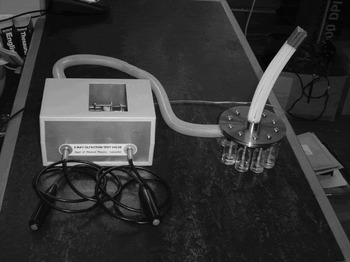
All tests were performed in the same room, using an olfactometer (Figure 1) which could deliver eight concentrations of an odorant dissolved in a carrier solvent and also the solvent without the odorant. This composite device comprised nine glass bottles, nine airflow-in conducting tubes, nine odorised airflow-out tubes, an olfactory presenting funnel, a nine-way olfactory valve (universal serial bus driven) with two switches attached, a laptop computer and an air pump. (It should be noted that the airflow tubes remained separate at all times so there could be no cross-contamination of odour concentrations.) The basic details of the apparatus have been described previously.Reference Philpott, Goodenough, Robertson, Passant and Murty7, Reference Philpott, Wolstenholme, Goodenough, Clark and Murty8 The odours used were either phenethyl alcohol or eucalyptus oil (Sigma-Aldrich, Gillingham, UK), established odourants for this purpose,Reference Doty, McKeown, Lee and Shaman9–Reference Bensafi, Rouby, Farget, Bertrand, Vigouroux and Holley11 made up in 10-fold serial dilutions (10−2 to 10−9 for phenylethyl alcohol and 10−1 to 10−8 for eucalyptol) using mineral oil.Reference Philpott, Goodenough, Robertson, Passant and Murty7, Reference Philpott, Goodenough, Wolstenholme and Murty12 The ambient room temperature and relative humidity were also recorded at the beginning of the test, using a hand-held thermohygrometer (Fisher Scientific, Loughborough, UK).Reference Philpott, Goodenough, Robertson, Passant and Murty7 The time of testing was noted, and it was ensured that subjects had not eaten or drunk for at least 30 minutes before a test.
The Leicester olfactometer.

This semi-automated test utilised an olfactory valve that enabled the subject to deliver olfactory stimuli using the attached push-buttons. Subjects were prompted to press the pair of buttons in turn, using a series of audible tones, to deliver a pair of stimuli; each pair contained one ‘blank’ (i.e. solvent only) and one odour, the latter being determined by the tester, who set the dilution level. However, it should be noted that the order of presentation of the stimuli was randomised by the olfactometer software. The tests proceeded, using a two alternative forced choice ascending staircase method with subjects requiring three correct answers in a row at a particular threshold in order to progress to a lower concentration. Any wrong answers led to an increase in the concentration stimulus supplied. Each test generally lasted 10 minutes.
Subjects were tested either in cohorts (20 times each) or alone, as part of our centre's ongoing study of the computer-driven olfactometer. In the former case, two cohorts of 10 subjects each underwent 20 tests on separate occasions with phenylethyl alcohol and eucalyptol, respectively implies the 2 odours were not tested at the same time. (In the phenylethyl alcohol cohort, ‘superosmic’ events were considered extra, and hence 225 tests were performed.) In the latter case, the relevant studies recruited subjects for single tests; these numbered 107 with phenylethyl alcohol and 103 with eucalyptol.
It should be stressed that the present report does not represent a study conducted in its own right, but rather findings obtained while conducting other studies attempting to establish normal values for use of the olfactometer by healthy subjects.
The characteristic features of the superosmic events witnessed were as follows. Firstly, subjects confidently perceived the odour at a threshold at least equal to if not lower than three threshold levels below their average threshold (or in the case of the single-test studies, the group average). Secondly, subjects repeatedly perceived the odour at this level for at least 10 responses (representing a one in 1024 chance of not being superosmic). Thirdly, subjects exhibited a sudden, rapid loss of their ability to continually detect the odour at this low concentration, returning to their average (non-superosmic) perception threshold value (this was not evident on a few occasions when the subjects were superosmic for the duration of the test).
Results
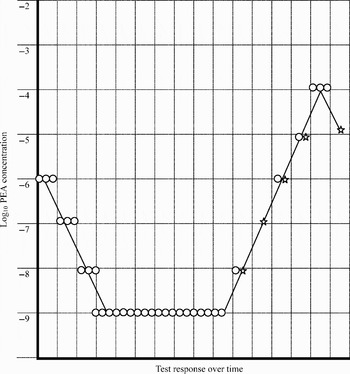
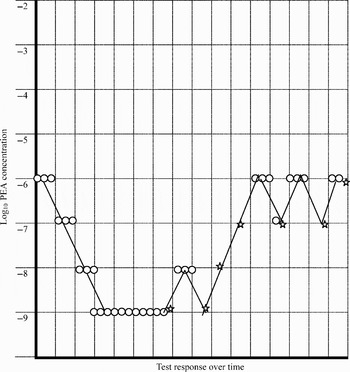
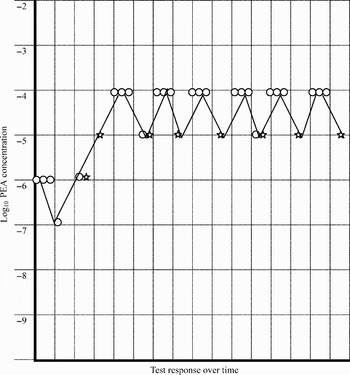
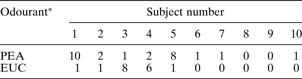
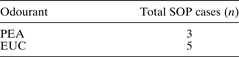
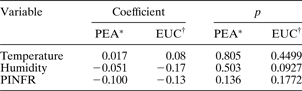
In the cohorts undergoing repeated tests, eight of 10 subjects tested with phenylethyl alcohol and five of 10 subjects tested with eucalyptol were deemed to have superosmic events, with a total of 42 superosmic events (9.91 per cent). In addition, the single tests performed on 210 subjects generated a total of eight superosmic events (3.8 per cent) (five with eucalyptol and three with phenylethyl alcohol). We considered that these unique results represented incidences of what we termed the superosmic olfactory phenomenon (SOP). Such results were distinguishable from the normal responses shown by subjects undergoing testing, in which average thresholds were 10−3.6 for phenylethyl alcohol and 10−3.16 for eucalyptol. The frequency of superosmic events per subject, for the cohort groups and single-test groups, is displayed in Tables I and II. Only results demonstrating the features defined above were considered to represent the SOP (we included cases in which incorrect responses punctuated the correct responses). These features are clearly shown in Figures 2 and 3, which give examples of threshold plots for two of our subjects. For comparison, a typical trace from a normal result is shown in Figure 4. Ambient room temperature, relative humidity and peak inspiratory nasal flow rate did not appear to influence the threshold levels detected (see Table III), confirming the evidence of our previous study.Reference Philpott, Goodenough, Robertson, Passant and Murty7
Superosmic trace for subject number 1. Circle = correct response; star = incorrect response

Superosmic trace for subject number 2. Circle = correct response; star = incorrect response

A ‘normal’ threshold trace. Circle = correct response; star = incorrect response

cases of superosmic olfactory phenomenon, cohort studies
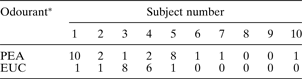
Data shown represent number of cases of superosmic olfactory phenomenon. *For each odourant, 10 subjects underwent 20 tests each on separate occasions. PEA = phenylethyl alcohol; EUC = eucalyptol
cases of superosmic olfactory phenomenon, single test studies
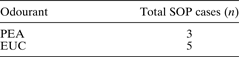
SOP = superosmic olfactory phenomenon; PEA = phenylethyl alcohol; EUC = eucalyptol
spearman's correlation for olfactory variables and olfactory thresholds
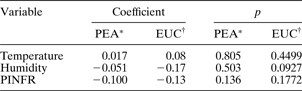
* Cohort studies; †single test studies. PEA = phenylethyl alcohol; EUC = eucalyptol; PINFR = peak inspiratory nasal flow rate
Discussion
The findings reported here clearly demonstrate the occurrence of an innate ability to detect much smaller concentrations than would commonly be expected in the majority of tests of the main olfactory pathway. Why these SOP occur, and what enables them to ‘switch on’ and then ‘switch off’, is not immediately obvious. Normal threshold values for phenylethyl alcohol detection appear to vary. Subjects in our centre scored mean thresholds of between 10−3 and 10−4,Reference Philpott, Goodenough, Robertson, Passant and Murty7, Reference Philpott, Wolstenholme, Goodenough, Clark and Murty8 while other European centres have found similar mean values of between 10−2 and 10−5.Reference Damm, Vent, Schmidt, Theissen, Eckel and Lotsch13–Reference Lotsch, Lange and Hummel15 However, work by Doty et al. in the USA suggests normal values of 10−6 to 10−7.Reference Pierce, Doty and Amoore10, Reference Doty, Shaman and Dann16 Despite these geographical variances, which may reflect cultural differences and, indeed, different testing methods, it is clear that, at our centre, subjects consistently scored mean thresholds of 10−3 to 10−4, and that the cases of SOP reported here reflect a significant deviation from normal. It is also notable that subjects often commented on perceiving the odour as strong when they were superosmic, and yet did not even detect it when performing the test in a normal fashion on another occasion.
The increased incidence of SOP in our cohorts was partly caused by three subjects who appeared to have enhanced superosmic ability, which may suggest a learned response to olfactometer testing, as the incidence of superosmia in the single-test groups was low for both phenylethyl alcohol and eucalyptol. If these ‘enhanced superosmics’ are excluded, the incidence of SOP in the cohort groups is also 3.8 per cent. However, this explanation of a learned response would not be fully supported by the observation that subjects could appear superosmic one day and normal the next, and that, in the phenylethyl alcohol cohort, it was noted that the SOP became less common with time over the duration of the period of testing. One of the enhanced superosmics was 60 years old; as stated below, age does not appear to have any bearing on this phenomenon. The superosmic events are likely to be specific to one odour, and early evidence from ongoing studies at our centre with four odours tested concurrently suggests that these events occur for only one odour at a time.Reference Gaskin, Robinson, Philpott, Goodenough, Clark and Murty17, Reference Robinson, Gaskin, Philpott, Goodenough, Elloy and Clark18
• Disturbance of olfaction has generated much interest in the field of olfactory research, with many studies documenting the incidence of anosmia and hyposmia
• Less attention has been given to the enhanced ability to detect odours, except in pregnant women
• This report documents a previously unreported, variable phenomenon – ‘superosmia’ – in which threshold concentrations are up to 100 000 smaller than the average value
• Enhancement of olfactory ability may be possible through activation of an accessory pathway or modulation of the existing olfactory apparatus
This study (and those previously conducted) eliminated potential variables such as temperature, humidity and peak inspiratory nasal flow rate (Table III),Reference Philpott, Goodenough, Robertson, Passant and Murty7 age and sex,Reference Philpott, Wolstenholme, Goodenough, Clark and Murty19 and sinonasal pathology or anatomical abnormalities. Time of day did not appear to play a role, as cases of SOP occurred at various times of the day, sometimes before or after a normal result. Although this does not eliminate the roles of the nasal cycle or circadian rhythm, it suggests they are unlikely to be significant factors. However, we recognise the need to control some of these factors in a more specific fashion than is reported here, and accept the limitation of this study as simply reporting an observation. Due to the consistent results for olfactory thresholds obtained with our apparatus, as published previously,Reference Philpott, Wolstenholme, Goodenough, Clark and Murty8, Reference Philpott, Wolstenholme, Goodenough, Clark and Murty19 we are confident that such variations are not effects of the apparatus or the technique used.
One theory explaining the occurrence of the SOP is that it is enabled by stimulation of an alternative olfactory pathway, such as the vomeronasal organ. This theory has been suggested by animal studies,Reference Trinh and Storm20 and is currently being addressed by further research into the SOP. Another theory has been generated by previous olfactory sensitivity studies which suggested that repeated olfactory testing with odours increases subjects' sensitivity to that odour; however, this finding showed a gradual trend rather than the ‘on and off’ effect seen in our subjects.Reference Rabin and Cain21 Once again, we note that our cohort studies did not show any increase in the incidence of superosmia over the course of the 20 tests performed.
Conclusion
We have observed a definite phenomenon which occurs when patients perform olfactory threshold tests that implies innate and seemingly random yet specific superosmic ability – the superosmic phenomenon.