In The Nuclear Taboo: The US and the Non-Use of Nuclear Weapons Since 1945, Nina Tannenwald melds together rationalist and constructivist explanations to provide a historically rich and well researched argument to explain how it is possible that ‘nuclear weapons have remained unused by the US since 1945’.Footnote 1 Tannenwald argues that normative ideas about morality and legitimacy have led to the development of a collectively held, self-reinforcing norm of non-use of nuclear weapons, or a nuclear weapons taboo. The taboo not only constrains the behaviour of nuclear states but also constitutes their identities and interests as civilised nations. As a result, the United States has not detonated a nuclear weapon in war (since 1945) because the resultant indiscriminate and horrific destruction is antithetical to the US national identity as a civilised nation.
Tannenwald's melding of a constructivist explanation with rationalist mechanisms is one of the book's significant contributions; it reminds us that to fully understand why certain behaviours occur we need to examine not only rationalist explanations but also explanations of a constructivist nature: inter-subjective understandings, identity, sense of Self and Other, and collective beliefs as causal mechanisms. In this article, I examine the general structure of the constructivist argument that Nina Tannenwald presents in The Nuclear Taboo and its implications for how we think about the use of weapons as instruments of power and instruments of force. In addition to the outcome proposed by Tannenwald, the nuclear weapons taboo, I argue that acts of force, such as detonating a nuclear weapon, are only one aspect of how nuclear weapons are used. By restricting her meaning of ‘use’ to a material phenomenon, the detonation of a nuclear weapon, Tannenwald provides us with only a portion of a constructivist analysis of nuclear weapons policy by the United States. That is, in addition to thinking about how ideational mechanisms might lead to material outcomes, we should not forget that outcomes might also be ideational. Theoretically and practically, we should no more discount ideational outcomes, than we should discount ideational factors as causal mechanisms.
Tannenwald's characterisation of nuclear weapons use is consistent with the theoretical conceptualisation of power as a means to prevail in conflict through the use of force. Power seen through this conceptual lens ‘focuses on behavior in the making of decisions on issues over which there is an observable conflict of (subjective) interests, seen as express policy preferences, revealed by political participation’.Footnote 2 However, this behavioural view is only one dimension of how power is experienced and exercised in international politics. Nuclear weapons also underpin a state's latent power. As argued by Bachrach and Baratz ‘it is commonly supposed that anyone who possesses what appear to be important instruments for exercising power, such as wealth, high social rank, or a well-stocked military arsenal, necessarily puts them to work […] [This point tends] to overlook that those who have the means for threatening sanctions may and often do abstain from doing so. Their power is latent, rather than real’.Footnote 3
Possession of nuclear weapons also imparts the ability to control issues and agendas so that observable conflict does not emerge in the first place. States with nuclear weapons operate ‘systematically and consistently’ to mobilise ‘a set of predominant values, beliefs, rituals, and institutional procedures (‘rules of the game’)’ through which they benefitFootnote 4 and, hence, achieve their own interests, sometimes at the expense of non-nuclear countries, and often in the absence of observable conflict. Whether used or not in the material sense, the idea that a country either has or does not have nuclear weapons exerts political influence as a form of latent power, and thus represents an instance of the broader meaning of use in a full constructivist analysis.
Constructivist arguments are frequently employed to show how ideas, such as norms and values, lead to normatively ‘good’ outcomes, such as Tannenwald's ‘civilized nation’ identity leading to absence of nuclear warfare. However, by exploring the full constructivist argument, we see not just restraint of power, but the enabling of power. By limiting the concept of ‘use’ to the material realm of detonating a nuclear weapon against one's enemy, we miss the complete spectrum of how the United States has used its nuclear weapons. After examining the structure of the argument presented by Tannenwald, I then explore different ways that we might conceptualise ‘use’ in the sense of using a weapon. I look at the implications of these definitions for our understanding of how weapons are used as instruments of force as well as how they constitute a state's power and influence. I illustrate my theoretical argument by describing two contemporary examples of the use of nuclear weapons by the United States.
The argument: mechanisms and outcomes
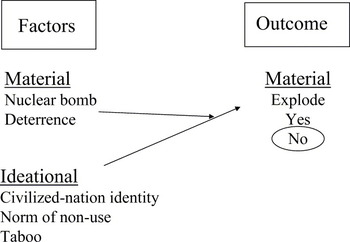
The argument in The Nuclear Taboo might be laid-out as shown in Figure 1. Tannenwald defines ‘use’ as a nuclear explosive device being dropped or launched ‘in all circumstances other than testing’.Footnote 5 The factors affecting decisions regarding nuclear weapons might be categorised as two different ideal types: material and ideational. For material factors we have possession of the material object of the nuclear bomb, the capability to launch and detonate the bomb, and calculations of material costs. For ideational factors we have the civilised-nation identity and the norm of non-use or the nuclear weapons taboo. Tannenwald assesses the extent to which these factors determine a material outcome: the detonation of a nuclear device.
Figure 1.

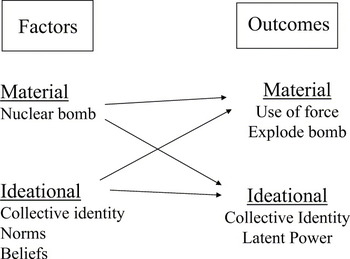
The core of this argument focuses on ideational mechanisms as an explanation of a material outcome: norms and beliefs are important factors that significantly diminish the probability that the United States would launch or detonate nuclear weapons. Tannenwald's approach provides insights into how leaders (and their countries) make decisions to use military force; yet, it tells only a portion of the story. If causal factors can be conceptualised as two different ideal types: material and ideational; then outcomes should also be conceptualised as material and ideational as shown in Figure 2.
Figure 2.

Tannenwald argues that collective identity can be an important causal factor that helps explain why the nuclear powers have not exploded even a single nuclear device (apart from weapons testing). As shown in Figure 2, collective identity can also be an outcome of nuclear weapon possession. That is, the possession or lack of possession of nuclear weapons also constitutes a collective identity between possessors of nuclear weapons and those that do not possess such weapons. This collective identity can be observed in how non-nuclear states behave in their interactions with nuclear states. Material objects, nuclear weapons, are used in an ideational sense by the United States because they serve to construct a collective identity between nuclear and non-nuclear powers whereby the nuclear powers exert latent power over those that do not possess nuclear weapons.
Latent power and collective identity
Peter Bachrach and Morton S. Baratz distinguish different forms of power that help to clarify how we might think about the concept. In their conceptualisation, the difference between power and force is that in a power relationship the weaker party complies with demands, but when force is used it signals the non-compliance of the weaker party and loss of power. Power is relational in that it does not exist in a vacuum, but only in relation to another party.Footnote 6 To illustrate, they note: ‘if and when thermonuclear weapons are transformed from instruments of a policy of deterrence into activated missiles of death, power will have given way to force’.Footnote 7 Influence can be differentiated from power in that influence is the ability to gain compliance without resorting to either a tacit or an overt threat of severe deprivation. ‘The exercise of power depends on potential sanctions, while the exercise of influence does not’.Footnote 8 Latent power is conceptually closer to influence than force or power. Not only might it affect what decisions are made, but it might also limit what issues become salient.
Bachrach and Baratz argue that compliance is often obtained not by the use of instruments of force in the material sense of using a tool, but in the ideational sense of deference given by the weak to the powerful because of a mutual recognition of the existing power disparities. The less powerful may regularly defer to real or imagined preferences of the powerful without resort to threats or sanctions because both parties understand the implications of the great power disparities between them.Footnote 9 In such a situation both parties (the weak and the powerful) have a mutual understanding of their relationship and the normative expectations that they themselves have socially constructed over a number of interactions.
In the case of nuclear weapons, it is their potential to cause pain to human beings that is most fearful, not their ability to destroy material objects.Footnote 10 Thomas Schelling argued that in the aftermath of the nuclear attacks on Hiroshima and Nagasaki, it was not the ability of the nuclear weapons to destroy, but the ability to cause future pain that was significant:
These are weapons of terror and shock. They hurt, and promised more hurt, and that was their purpose. The few ‘small’ weapons we had were undoubtedly of some direct military value, but their enormous advantage was in pure violence. In a military sense the United States could gain little by destruction of two Japanese industrial cities; in a civilian sense, the Japanese would lose much. The bomb that hit Hiroshima was a direct threat aimed at all of Japan. The political target of the bomb was not the dead of Hiroshima or the factories they worked in, but the survivors in Tokyo.Footnote 11
It is this latent power of nuclear weapons that is used by the nuclear weapon states. It is the context within which confrontational situations take place between nuclear armed states and those who do not possess nuclear arms that shapes international politics in a nuclear world.
To illustrate this interaction and its impact, we might think about the different ways that weapons can be used. If we look up the word ‘use’ in a dictionary, we find several alternative definitions. One meaning is ‘to put into action or service’; an alternative meaning is ‘to carry out a purpose or action by means of’.Footnote 12 In terms of nuclear weapon use, the first definition comes closest to Tannenwald's meaning of exploding a nuclear weapon which is the sense of the material use of a tool. We have a tool and employ it. In this first definition of use, the action is direct: we pull out a gun and fire it. The gun has been used in the material sense. Turning to the second definition, the concept of use is indirect or latent: to obtain an objective ‘by means of’, which does not necessarily mean material use in the sense of direct action. For example, the driver of an automobile (usually) stops the movement of his vehicle when encountering a red octagonal piece of metal of a particular type. The stop sign is not employed in the same sense as the gun; nevertheless, it is used to stop the driver from moving the automobile. What does this meaning of the concept ‘use’ imply when we think about the use of weapons? How might a gun be used to influence behaviour other than firing it?
Consider that you are walking down a dark, deserted street at night, I approach you and I pull out a gun and point it at you. I then demand your wallet. If you had no idea what the piece of metal called a gun was, you would think the demand outrageous. The ideas that people hold in their minds about what constitutes a weapon, how the weapon is used to cause harm, and beliefs about the nature of the harm it might cause can affect behaviour in addition to the material use of the weapon. In fact, police and military researchers have found that, other things being equal, a person who knows what a gun is and has some idea of what it means to be shot, is incapacitated more quickly than a person who has no concept of what a gun is and has no idea what should happen when one gets shot.Footnote 13
However, most of us have in our minds a concept of guns and the pain that they might inflict. So in this situation, many of us would turn over our wallets. We would also agree that I used the gun to obtain your wallet. If not for the gun, would you part with your wallet? But, I have not fired the gun; I have only shown it to you. Let us consider further that you are on that same dark street and I demand your wallet, but this time I only pull back my jacket so that you can see that I have a gun tucked in my belt. Am I using the gun? In both of these examples the gun has not been fired, but we might agree that I used the gun to change your behaviour.
We see here what it means to use a gun in the ideational sense. Although no force was used, we can recognise that power is present because compliance was obtained. In this sense, power is a rational calculation of costs and benefits: you hand over your wallet because the cost of being shot is greater than the cost of losing your wallet. While it may appear that the more powerful party is in control, this is not the case. Bachrach and Baratz argue that it is the weaker party that defines the relationship because ‘the successful exercise of power is dependent upon the relative importance of conflicting values in the mind of the recipient in the power relationship’.Footnote 14 Material capabilities must be used to coerce or take what you want if the weaker party decides not to comply. When the weaker party is non-compliant, the use of force by the stronger party signals that the stronger party has lost power over the situation. This is because the stronger party must use force to obtain compliance, because they no longer exert sufficient power.
The above interactions rely on rationalist calculations of costs and benefits. Nuclear deterrence, the threat to detonate a nuclear weapon, or actual detonation is the exercise of force and the use of power in the above sense. Influence, or what I have called latent power, is different from power: ‘One person has influence over another within a given scope to the extent that the first, without resorting to either a tacit or an overt threat of severe deprivations, causes the second to change his course of action […] the exercise of power depends upon potential sanctions, while the exercise of influence does not’.Footnote 15
In the above example I have shown you a gun and you have given me your wallet. In repeated interactions of this sort, mutual expectations of each of our roles in this situation might emerge. Perhaps at some point in the future, I meet you at another location, I make some small demand and you defer to me. This occurs without my ever having to show you the gun. The weapon still exerts influence but only indirectly or as a latent power, in that our mutual interactions have constructed a relationship where deference is obtained as part of the established relationship, not because either an implicit or explicit threat was used in each specific case. Over time the implied threat from the weapon might become institutionalised and routinised so only the latent effect of the gun remains. This is precisely how the theoretical argument put forth by Bachrach and Baratz might be observed over time in our everyday lives. The broader implication of this theoretical point is that by considering only material outcomes, we miss how nuclear weapons are used on a near continual basis to constitute the relationship between the United States and less powerful countries. The two cases below illustrate this dynamic by showing how nuclear weapons have been used by the United States as latent power to circumscribe the scope and nature of the interactions between the United States and other countries.
Illustration: Operation Desert Storm
First, we might consider how the United States used nuclear weapons during the first Gulf War of 1991. During Operation Desert Storm, UN coalition forces conducted a massive conventional attack that swept through southern Iraq, surrounded the opposing Iraqi forces, and achieved a quick and decisive military victory. In chapter 8, Tannenwald shows how nuclear weapons ‘were an important part of both the context and the dynamics of the war’.Footnote 16 She argues that while there was significant support in the US general public for the use of nuclear weapons in retaliation if Iraq had used chemical, biological, or nuclear weapons,Footnote 17 ‘the taboo was no longer simply a “constraint” but had itself become a foreign policy goal for a “civilized” state’.Footnote 18 Nuclear weapons were ‘hardly even discussed, let alone seriously considered’ by US military and political leaders.Footnote 19 Tannenwald argues that the US political leaders nevertheless publicly threatened the use of nuclear weapons.Footnote 20 She concludes that ‘we do not really know’ whether the nuclear threats were effective.Footnote 21
I argue that although no nuclear shots were fired in the short war, nuclear weapons were used by the United States to define the rules and scope of the war. In early January, Secretary of State James Baker had delivered a letter from President Bush to Tariq Aziz, the Iraqi Foreign Minister, for relay to Saddam Hussein. At the meeting Baker told his counterpart: ‘This will not be a war of attrition like you fought with Iran. It will be fought using the means and weapons that play to our strengths, not yours. We have the means to define how the battle will be fought, and you do not. This is not to threaten, but to inform’.Footnote 22 In limiting the scope of the battlefield, Baker relayed a specific point from US Chairman of the Joint Chiefs of Staff Colin Powell: ‘If the conflict involves your use of chemical or biological weapons against our forces […] the American people will demand vengeance. We have the means to extract it. With regard to this part of my presentation, this is not a threat, it is a promise’.Footnote 23 The goal was not to use nuclear weapons to fight the war, but to use them to limit the scope of the war. We observed that Iraqi forces did not use weapons of mass destruction against US military forces which was the goal of US political leaders in threatening their use.
Focus on whether or not the United States would have fired a nuclear weapon is an important consideration but it misses the point that the United States achieved its objective to limit the types of weapons that were used by Iraqi forces. Much like showing a gun tucked in a waistband; the US exerted its latent power as a nuclear armed state. In the earlier Iran-Iraq War, non-nuclear Iran did not have this power and had been attacked with weapons of mass destruction. From the battlefield perspective, it is the latent power of nuclear weapons that is most useful. It is not the power to destroy, but the ability to prevent destruction through the latent power to hurt as Schelling argued. Thus, for the United States to launch a nuclear attack against Iraq or any other adversary would be to acknowledge that US power over the conflict had been lost.
As Tannenwald pointed out, military commanders have increasingly seen little military utility in detonating nuclear weapons on the battlefield.Footnote 24 That is not to say, however, that nuclear weapons are not used. In Operation Desert Storm, the use of US nuclear weapons as latent power is observed in what did not happen; the United States did not conduct a nuclear attack and the Iraqi forces did not attack coalition forces with weapons of mass destruction. If we think about outcomes in the ideational sense, then what we might observe is whether or not nuclear weapons constrain or enable behaviour based on collectively held notions of power that constitute the interactions between the nuclear powers and the non-nuclear powers.
Illustration: Strategic Air Command's airborne nuclear command post
For the second illustration of how nuclear weapons were used by the United States as latent power, I describe the mission and operations of Strategic Air Command (SAC) airborne nuclear command.Footnote 25 The airborne command post of US Strategic Air Command was more commonly known as ‘Looking Glass’ because it mirrored the command, control, and communication capabilities of Strategic Air Command's main underground command post.Footnote 26 Both the ground command centres and airborne command post provided command, control, and communication for the nuclear forces of the United States to include the intercontinental ballistic missile launch facilities, strategic bomber crews, and the US Navy's ballistic missile fleet. In the event that ‘ground-based command centers become inoperable’, it was the mission of the airborne command post to assume command and control of US strategic nuclear weapons which included the ability to launch the strategic nuclear arsenal of the United States should that be ordered by US national command authorities.Footnote 27
During the Cold War years, the core of the Looking Glass capability was a fleet of EC-135 aircraft. To assure the survivability of the United States’ ability to control and execute its nuclear arsenal, there were aircraft and crews on continuous ground alert prepared to take-off at a moment's notice as well as one aircraft that was routinely airborne as part of Strategic Air Command's Post Attack Command and Control System. The Looking Glass mission consisted not only of the EC-135 aircraft; it was supported by many military assets to include airborne refuelling aircraft, radio relay aircraft, auxiliary aircraft, and many people on the ground who provided logistic, intelligence, communication and other types of support. The mission had begun in the early years of the Cold War. It required an extensive commitment of US military assets as well as coordination and integration with the US political leadership. From 3 February 1961, to 24 July 1990, there was at least one Looking Glass aircraft continuously airborne over the continental United States. At the height of the Cold War, 24 hours a day for 7 days a week, there might be two complete battle staffs on ground alert, a complete battle staff airborne, and at least one additional complete battle staff that would fly on the mission aircraft that would changeover with the aircraft that was already in the air.
Each Looking Glass mission aircraft (both airborne and ground alert) consisted of a battle staff of approximately 25 people that had the responsibility, authority, and capability to perform functions necessary to launch a strategic nuclear attack as well as to aid in the deployment and recovery of strategic assets in event of a nuclear attack on the United States. The battle staffs were commanded by a general/flag rank officer who would take command of US strategic forces in the event the national command authorities and Strategic Air Command Headquarters were unable to exercise command and control of US strategic forces. In order to perform this function the general officer relied on his battle staff. The organisation consisted of many groups of technical experts from which numerous individual battle staffs could be formed. These experts included a missile launch team, communication experts, intelligence advisors, strategic targets planners, command and control managers, logistics planners, and weather advisors; in addition to the aircrews that flew the aircraft.Footnote 28
The airborne battle staffs were one element in a network of command and control assets that ensured the survivability of the United States’ ability to launch and control US strategic weapons during a nuclear attack. The Looking Glass battle staffs, as one element of the Post Attack Command and Control System, were trained and ready to perform many functions to support launch of the United States’ strategic nuclear forces. These included that ability to execute the SIOPFootnote 29 as well as planning and coordinating strategic strikes against enemy targets, helping to plan post-strike recovery by assessing battle damage, providing survivable communications, assessing radioactive fallout within the continental United States, and determining the location and strength of surviving forces.
In an intuitive manner, military strategists flying the Looking Glass missions were well aware of the theoretical distinction between force, power, and influence: when nuclear weapons become instruments of death, they are no longer instruments of influence. The strategic planners and mission crews that constituted the strategy and operations of the Looking Glass missions were using nuclear weapons all the time. In addition to their use more overtly in deterrence and overt threats, nuclear weapons were used as latent power. The Looking Glass missions were widely known; battle staff members frequently gave tours of the unclassified portions of the facilities and mission. It was much like showing the gun that is tucked in a waistband.
Implications
The Nuclear Taboo demands our attention for its deft melding of rationalist and constructivist explanations as well as for the depth and breadth of its historical account of the evolution of US nuclear policy. Tannenwald's analysis shows us how ideas about morality and ethics play a significant role in international politics, even in issues involving important national security concerns which are usually the purview of rationalist explanations. She shows how the United States is constrained by moral and normative ideas that have become deeply embedded as a taboo that constrains US political leaders from launching nuclear weapons. I have argued that the United States does not have to detonate a nuclear device in order to use nuclear weapons to exert its will in international politics. While the United States might be constrained in the use of its material capabilities, its adversaries have also been constrained by the existence of US nuclear weapons and how these weapons have been used to constitute the relationship between the United States and potential adversaries. Nuclear weapons have also enabled the nuclear countries to behave in ways that they would not if they did not have nuclear weapons. But even more subtle, we might consider the ways in which possession of nuclear weapons by the United States has thwarted or suppressed challenges to the values and interests of the United States. Steven Lukes has argued that this latent form of power, while frequently overlooked, should not be discounted: ‘is it not the most supreme and most insidious exercise of power to prevent people, to whatever degree, from having grievances by shaping their perceptions, cognitions and preferences in such a way that they accept their role in the existing order of things because they see or imagine no alternative to it, or because they see it as natural and unchangeable, or because they value it as divinely ordained and beneficial?’Footnote 30 By confining our analyses to only overt, observable conflict, Lukes has argued that ‘the analysis remains superficial precisely because it confines itself to studying individual decisions made to avert potentially threatening demands from becoming politically dangerous. A deeper analysis would also concern itself with all the complex and subtle ways in which the inactivity of leaders and the sheer weight of institutions’, delimit the scope of interactions.Footnote 31 Admittedly such an analysis is difficult because it requires the identification of non-events and non-decisions. Yet, if we overlook such mechanisms then we do not see the full spectrum of how power is used in international politics.
If we think only in terms of how the nuclear taboo constrains the behaviour of the nuclear powers, one policy implication that follows from The Nuclear Taboo is that nuclear weapons are becoming increasingly obsolete because the collectively held taboo makes it unlikely that nuclear weapons will be exploded on the battlefield or territory of one's enemy. Tannenwald suggests that ‘It is true that if nuclear weapons were fully delegitimized and their use unthinkable in absolutely all circumstances, we would expect nations to cease preparing for nuclear war and to get rid of their nuclear arsenals. That would suggest a fully robust taboo. The fact that we have not yet reached this final destination, however, should not prevent us from noticing that we have made it part way down the path’.Footnote 32 But how far down the path have we travelled? Are we all on the same path? The recent acquisition of nuclear capability by North Korea, and concerns with nuclear proliferation by Iran highlight the ambitions of countries to acquire their own nuclear capabilities in defiance of the wishes of the United States.
Samuel Huntington in his article on the clash of civilisations provides one telling anecdote illustrating this dynamic. Huntington recalls that in the aftermath of Operation Desert Storm, when the Indian defence minister was asked what lesson he learned from the Gulf War; the minister responded: ‘Don't fight the United States unless you have nuclear weapons’.Footnote 33 If the use of nuclear weapons was taboo and if you believe that the United States would not use nuclear weapons against you, then why would a potential adversary be admonished to have nuclear weapons before confronting the United States? The point that we might draw from Huntington's anecdote is that ‘use’ can be both material and ideational. Nuclear weapons and their ideational uses are factors in the construction of the mutual understanding that defines the collectively held beliefs about Self and Other between nuclear and non-nuclear states. Non-nuclear states view nuclear weapons as beneficial to their security because nuclear weapons might not only constrain adversarial actions toward them, but also afford them influence in at least two ways. First, nuclear armed states can act in ways that would not be considered without nuclear weapons in hand. This would be no less true for those trying to develop their own nuclear arsenals, than for the US. Second, nuclear weapons are used in the ideational sense by circumscribing the manner in which issues become salient. As Bachrach and Baratz have argued: ‘power may be, and often is, exercised by confining the scope of decision-making to relatively “safe” issues’.Footnote 34
Aspiring nuclear states could use nuclear weapons to redefine the terms of what is ‘safe’ or at least participate in the discussions. Etel Solingen argues that this dynamic is common in attitudes favouring the acquisition of nuclear weapons in areas of the Middle East and South Asia: ‘derived from nationalistic, religious, and other identities, such norms invested nuclear weapons with redemptive value as tools of modernization and defiance of the international order’.Footnote 35 She describes how immediately after the 1979 revolution in Iran, use of weapons of mass destruction were proclaimed to be contrary to shari'a (Islamic law). But after the Iran-Iraq war Ayatollah Yazdi, President Ahmadinejad's spiritual mentor, proclaimed that ‘shari'a did not forbid nuclear use, let alone acquisition’.Footnote 36 Former Iranian president Hashemi Rafsanjani described the impact that the Iran-Iraq War had on Iranian thinking about nuclear weapons: ‘it was made very clear during the war, that [chemical, bacteriological, and radiological] weapons are very decisive. It was also made clear that the moral teachings of the world are not very effective when war reaches a serious stage and the world does not respect its own resolutions and closes its eyes to the violations and all the aggressions which are committed in the battle field. We should fully equip ourselves both in the offensive and defensive use of chemical, bacteriological, and radiological weapons’.Footnote 37
Conclusion
I have argued that by limiting the concept of ‘use’ to the material realm of detonating a nuclear weapon against one's enemy, we do not fully explore how nuclear weapons are used by the United States and the implications for understanding both weapons use and national power. If we think about outcomes in the ideational sense, then what we observe is whether or not nuclear weapons constrain or enable behaviour based on collectively held notions of power that constitute the interactions between the nuclear powers and the non-nuclear powers. Nuclear weapons are not just instruments of death and destruction; they are also instruments of power and influence. I have argued that nuclear weapons constitute a collective identity between possessors of nuclear weapons and those that do not possess such weapons. We might agree with Tannenwald that within the United States a collective identity as a ‘civilized nation’ may have constrained the United States from initiating nuclear warfare. However, since 1945 another collective identity emerged; a relationship of deference constructed between the nuclear powers and the non-nuclear countries that saw themselves as subject to the will of the United States and other nuclear countries. This collective identity serves not only to enable the nuclear countries to behave in ways that they might not without nuclear weapons, but also to control and shape the international political agenda.
To obtain one's objectives without launching a nuclear attack against one's adversary is a clear demonstration of one's power and influence. Yet, no less important is the ability to shape preferences and prevent conflict of interests from arising in the first place. The great military treatise The Art of War by Sun Tzu emphasises this point: ‘to win one hundred victories in one hundred battles is not the acme of skill. To subdue the enemy without fighting is the acme of skill’.Footnote 38 To successfully shape the mind and motivations of the adversary is the most effective use of national power. To fight the adversary on the battlefield is less efficient and very costly in terms of human lives, national resources, and the stature and credibility of the United States. The use of nuclear weapons in the material sense of exploding the weapon signifies the loss of power and influence. It is in the ability to define what is salient and to delimit the scope of behaviour that nuclear weapons are most relevant to the security of nuclear powers.