Human communication rests crucially on inferences about intentions (Grice, Reference Grice1957). This is perhaps especially true in the case of the pointing gesture, since there is virtually no information ‘in’ the communicative signal itself. Consider the following example. My child and I are cleaning up the living room. As I move around, in one case I incidentally expose to my child's view her backpack on the sofa, which may or may not lead her to think or do anything in particular. But if in this cleaning-up context I point ostensively to the backpack for my child, it is very likely she will infer that I want her to notice her backpack and so take it and put it away. Prelinguistic infants as young as 1 ; 2 make inferences such as this from the pointing gesture (Behne, Carpenter & Tomasello, Reference Behne, Carpenter and Tomasello2005).
Based on the model of Sperber & Wilson (Reference Sperber and Wilson1986), we may say that infants make inferences of this type guided by the implicit question, ‘Why does she think that that referent is relevant for me?’, that is, they may attribute to the adult the motive to help by providing useful information. This, in turn, requires them to reason about the adult's intentions toward their knowledge states. In addition, finding the correct answer to the question of relevance also requires the infant to understand the common conceptual ground she has with the adult. If we both know together that we are cleaning up, then my directing her attention to the backpack should be relevant to that common ground. But if we are getting ready to leave for school, my pointing to the backpack will be relevant to this different common ground. Though this process seems very natural and straightforward to us, it is not trivial. Great apes apparently do not comprehend any of this – the informing motive, the human's intentions toward their knowledge states, or common conceptual ground – as they do not make inferences about communicative intentions of this type, despite being able to discern intentions in instrumental actions generally (Tomasello, Reference Tomasello2008).
Recently, the role of common ground in infants' comprehension of communicative acts has been experimentally demonstrated. Infants in their second year of life use shared experience to interpret others' communication in terms of both reference resolution – what the adult is directing their attention to (Ganea & Saylor, Reference Ganea and Saylor2007; Moll, Richter, Carpenter & Tomasello, Reference Moll, Richter, Carpenter and Tomasello2008; Saylor & Ganea, Reference Saylor and Ganea2007) – and motive resolution – why she is directing their attention to it (Liebal, Behne, Carpenter & Tomasello, Reference Liebal, Behne, Carpenter and Tomasello2009). For example, in terms of reference resolution, Ganea & Saylor (Reference Ganea and Saylor2007) had infants aged 1 ; 3 and 1 ; 6 search for an object (e.g. a telephone) together with the experimenter. When the adult later ambiguously asked the infant, ‘Can you get it for me?’ (with the telephone and a distractor object present), infants of both ages identified the telephone as the intended referent. However, they did not choose the telephone when a second adult, who had not previously shared this searching experience with them, made the request.
Since recipients of communicative acts assume that the communicator is trying to be relevant to them and their interests, their search for the communicator's intended referent and motive thus begins with whatever is most relevant or ‘obvious’ in their common ground (Sperber and Wilson prefer the term ‘mutual cognitive environment’). But sometimes communicators wish to communicate about something that is not so obvious or that relates to a different common ground than the currently obvious one. Imagine, for example, that in the context of looking for my child's backpack to go to school, I spy it on the sofa but I also notice some scissors sticking out of a pocket dangerously and I want to warn my child of this – using only pointing (maybe I am on the phone). Since the obvious referent within our current common ground is the backpack itself, as we are searching for it, I would have to somehow mark my pointing act as attempting to communicate something not obvious. In effect, I anticipate that my child will infer from a normal pointing gesture that I am simply locating the missing backpack for her. To pre-empt this interpretation I might use an exaggerated facial expression and pointing motion, hoping that this special marking will alert my child to look for a non-obvious interpretation (i.e. the danger of the protruding scissors).
Markedness is a principle widely applied in different disciplines such as art, psychology and linguistics. Its central feature is a contrast between the normal, expected case and the special, unexpected case – based on the ‘normal context’ (see Battistella, Reference Battistella1990; Reference Battistella1996, for an overview). In linguistics, the unmarked case is typically the most frequent one in the relevant context – and so the linguistic form is maximally simple – whereas the marked case is the less frequent one in which some form of extra marking serves to alert the listener to this fact (e.g. Haspelmath, Reference Haspelmath2006). From the recipient's point of view, markedness is cognitively complex as the recipient must make inferences about the communicator's understanding of their common ground, that is, her understanding of their common expectations about what is the normal way to do things in this context.
From a developmental perspective, there are a few related studies of children's word learning which show that two- to four-year-old children understand that new (and thus contrastive) labels refer to different referents than expected (e.g. Grassmann & Tomasello, Reference Grassmann and Tomasello2007; Markman & Wachtel, Reference Markman and Wachtel1988; Saylor, Baldwin & Sabbagh, Reference Saylor, Baldwin and Sabbagh2002; Saylor & Sabbagh, Reference Saylor and Sabbagh2004). For example, Grassmann & Tomasello (Reference Grassmann and Tomasello2007) found that two-year-olds use the correlation between novelty to the context and intonational stress to learn new words (i.e. a word said with stress refers to the new thing in the non-linguistic context). Importantly, Clark (Reference Clark1988; Reference Clark1990) has emphasized the pragmatic dimension of this. She proposed that the ‘principle of contrast’ guides children's word learning such that children reason about speakers' intentions and understand that when a speaker uses a different word (e.g. ‘mug’ instead of ‘cup’), she must have a reason to do so, namely to indicate a difference between what the child had previously mapped the label ‘cup’ to and the new object. Also relevant is a recent eye-tracking study by Arnold (Reference Arnold2008), which varied both whether a word had been previously used (and so was part of common ground) and whether the word was marked with intonational stress. When the word was presented without stress, in response adults and four- and five-year-old children looked first at an object that was already in common ground; but when the word was marked with intonational stress, they looked equally often at the familiar object and a new object.
These studies provide evidence that children are sensitive to markedness in verbal communication. However, it is not clear whether an understanding of markedness involves the pragmatics of communication more generally and so also can be demonstrated in gestural communication, like pointing, in which there is less information in the signal itself. In the current study, therefore, we investigated whether two- and three-year-old children could use an adult's exaggerated facial expression and hand movements to infer that with her pointing gesture she intended to direct them not to the normal, expected referent, but rather to something less obvious. A prerequisite for understanding that someone is marking a case as special is that communicator and recipient share an understanding of what is normal in such cases. For example, within the common ground of putting away boxes, the normal expectation would be that a point to a box would designate that box as the next one to be put away. Thus, we expected that in such a context when the adult pointed normally, children would choose the normal object within their current common ground as the referent of her point – the box. In contrast, when the adult marked her pointing, we expected that children would bypass the obvious referent and search instead for some less obvious referent – for example, the contents of the box. We chose to study two- and three-year-olds because it is around this age that children begin to understand related phenomena like contrast and intonational stress (e.g. Grassmann & Tomasello, Reference Grassmann and Tomasello2007; Markman & Wachtel, Reference Markman and Wachtel1988; Saylor et al., Reference Saylor, Baldwin and Sabbagh2002; Saylor & Sabbagh, Reference Saylor and Sabbagh2004).
STUDY 1
In Study 1 we asked whether three-year-old children would respond differently and appropriately in their choice of the referent of a marked and an unmarked communicative act. The tasks involved opaque containers, such as boxes, with objects inside. Children never saw the containers open nor did they know that something was inside. We set up the context of putting the containers away, and hypothesized that children would identify the container as a whole as the referent of the communicative act when the experimenter pointed normally to the container, because this was the obvious referent given their common ground with her. In contrast, when the experimenter pointed to the exact same location in a marked way, we hypothesized that children would make the inference that she could not mean the container – otherwise she would not point in such an exaggerated way – and instead try the most natural alternative given that the point was to the container: open the container and look inside for some other possible referent of her communication.
METHOD
Participants
Thirty-six three-year-old German children (16 girls, 20 boys; M=3 ; 6; range=3 ; 4–3 ; 8) participated in the study. They were recruited from a database of children whose parents had volunteered to participate in child development studies. Testing for two additional children was begun but abandoned because they declined to participate.
Materials and design
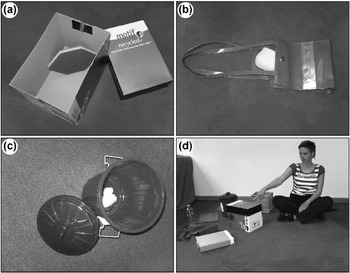
Test materials were three containers, each with a lightweight object inside: (i) a green cardboard box (30×21×25 cm) with a blue sponge inside; (ii) a grey leather purse (25×21×7 cm) with a yellow sponge inside; and (iii) a red plastic bucket (with a blue lid; 30 cm high, 23 cm in diameter) with a white plastic ball inside. ‘Adult’ containers and objects were chosen to make the test situation as natural as possible, and to eliminate the possibility that children would consider the materials as interesting in themselves. There were also three distractor objects: a wooden basket, a plastic bottle and a cardboard clipboard. All materials were scattered to one side of a small rug on which the child and the experimenter sat, facing each other (see Figure 1). An assistant who adjusted the camera between trials sat next to the child and watched the procedure passively.
Materials of Study 1: (a) the box with the sponge; (b) the purse with the sponge; (c) the bucket with the ball; and (d) the set-up with all test objects and distractor objects and a re-enactment of E pointing at the box in the unmarked condition.

A between-subjects design was used. Children were randomly assigned to either the unmarked or the marked condition. Each child received three trials, with the experimenter (E) pointing to a different container in each trial. The order of containers was fully counterbalanced.
Procedure
Children were tested in a quiet room in their kindergarten. First, E introduced the objects and explained that they were hers and that they were not toys. Then, before each test trial, E and the child played an unrelated distractor game (either a stamping game, a puzzle game or making a small wooden figure tumble down a ladder) for approximately three minutes. During these games E never pointed. When they had finished, E put away the distractor game and then said that she needed to clean up her things and move them to a designated area (which she indicated by touching the location on the floor where the objects should be placed). She asked the child to help her, saying, ‘I'm going to show you what I need and you help me, ok? First, watch me!’ Then she looked around at all the objects searchingly for a moment, then looked at the child, called his or her name, and pointed and looked at a predetermined position at the top of one of the objects (see Figure 1d). The way she pointed differed between conditions. In the unmarked condition, E pointed normally at the object once with a straight index finger, vocalizing very briefly (‘Mh!’, with slightly rising intonation), and alternating gaze between the object and the child's face once. The point lasted for a total of three seconds. In the marked condition, in contrast, E pointed at the object with emphasis, moving her pointing hand back and forth approximately 10 cm three times and alternating gaze between the object and the child three times with raised eyebrows. The point (also with a straight index finger) was accompanied by an effortful, insistent vocalization (a longer ‘Mmmh!’, with slightly falling intonation) and facial expression. In this condition, the point lasted for a total of six seconds. To make sure that children attended to the point, in both conditions E asked them to watch her first, as described above. In addition, the assistant who was watching the procedure checked that children attended to the pointing gesture in every trial. After E had finished the point, she told children that now they could help her clean up.
Coding and reliability
Children's responses were coded from videotape. For each trial we coded whether children took the container versus the object inside the container as the referent of E's pointing gesture. Responses were coded either as choosing the container (i.e. picking up the container and moving it to the designated area or giving it to E, or saying something like, ‘You need the box’) or as choosing the contents of the container (i.e. opening the container or saying something like, ‘What's in there?’).
Each child received one score for each trial (‘0’ if the child chose the container, ‘1’ if she chose the contents). To assess inter-rater reliability, a coder who was unaware of the hypothesis of the study independently coded 33% of the videotapes. Excellent agreement was achieved (Cohen's kappa=0·94).
RESULTS AND DISCUSSION
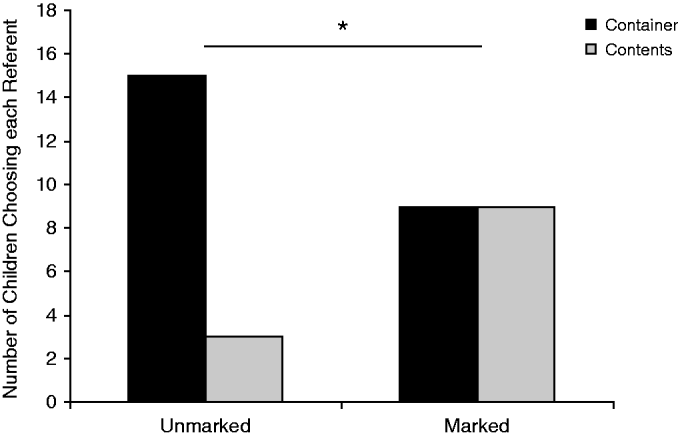
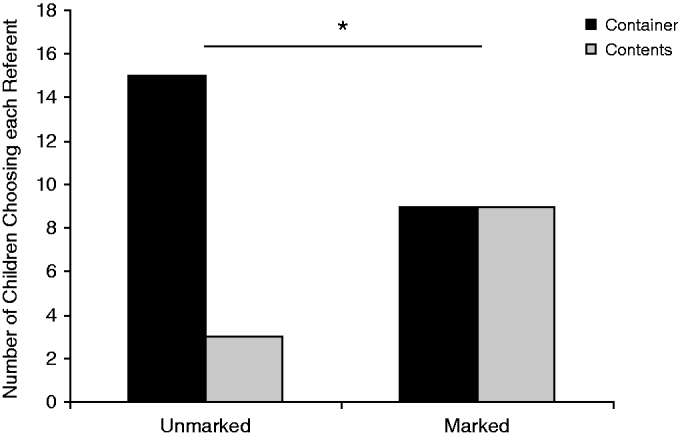
Almost all children participated in all three trials (104 of 108 possible trials; M=2·89 trials in each condition). Since there was a carry-over effect such that every child's responses in trials 2 and 3 were identical to their response in trial 1, in our analysis we focused on their performance in trial 1. Figure 2 presents the number of children who chose the container versus the contents in each condition. Results show a significant difference between conditions: in the unmarked condition, as predicted, the majority of children (15 out of 18) chose the most obvious referent, the container, as the referent of the pointing gesture. In contrast, in the marked condition only 9 out of 18 children chose the container – the rest chose the contents of the container as the referent of the pointing gesture (χ2=5·04, df=1, p=0·025; φ=0·354).
The number of children who chose the container versus its contents in the first trial in each condition in Study 1.
Thus, as predicted, when three-year-old children interpreted an adult's unmarked pointing gesture, they did this within the current common ground they shared with that adult (i.e. within the activity of cleaning up, when the adult pointed normally to the object, the normal expectation was that she wanted that object – the container – to be cleaned up). However, when the adult marked her communicative act with extra emphasis, children understood this deviation from the normal, unmarked case. They more often chose the referent that was not the obvious, perceptually co-present one than in the unmarked condition, even though the adult pointed to exactly the same place on the container as in the other condition. Children thus went beyond what they would normally expect to be the referent to give the adult the non-obvious referent, the contents of the container.
It is important to note that it was difficult for children to switch to the non-obvious referent in the marked condition: only half of the children chose the non-obvious referent, the other half still chose the obvious container. However, this might not be surprising given that they had never experienced a direct contrast of what the adult's normal and marked communication is like (the adult never pointed before the test) – they had to infer across different people and different situations what ‘normal’ communication is like and when communication deviates from that. In addition, there was a bias toward the obvious-referent interpretation: children had never seen the containers open nor did they know that there was something inside, so the alternative referent was not readily accessible for children. In fact, other studies have demonstrated that although they can differentiate between marked and unmarked communication (Dahan, Tanenhaus & Chambers, Reference Dahan, Tanenhaus and Chambers2002), even adults have a tendency to employ the obvious interpretation (Arnold, Reference Arnold2008). This preference is thus difficult to overcome.
In summary, despite the difficulty of our task, three-year-old children appeared to have some understanding of markedness in non-verbal communication. When an adult marked her communicative act with extra emphasis, they understood that she did so to alert them to a different-than-expected referential interpretation, and as a consequence, they searched for an alternative referent. They demonstrated sensitivity to the ‘normal’ vs. ‘exceptional’ expression of the adult's communicative intention and knew how to interpret this difference.
STUDY 2
In Study 2 we attempted to replicate these findings and extend them to younger children. Piloting with the containers from Study 1 revealed that two-year-old children were compelled to open boxes in both conditions, even in the unmarked condition. Therefore, we could not use the same boxes for these younger children, and so we used a new set of objects: big, very light objects with another small object (an ‘aspect’, e.g. a sticker) on their back side which the children did not know about. In each trial, after telling children she needed to put away her things, E pointed toward one of these big objects, in an unmarked or a marked way. We hypothesized that children would identify the big object as the referent of the communicative act when E pointed normally, but when she pointed in a marked way, they would infer that she could not mean the big, obvious object and instead would look behind the object for some other possible referent of her communicative act (the aspect).
METHOD
Participants
Sixty three-year-old children (30 girls, 30 boys; M=3 ; 7; range=3 ; 5–3 ; 9) and 60 two-year-old children (32 girls, 28 boys; M=2 ; 6; range=2 ; 5–2 ; 9) participated in the study. They were recruited from the same database as in Study 1. Additional children were tested but excluded because they declined to participate (13 two-year-olds and 3 three-year-olds) or because of experimenter error (3 three-year-olds).
Materials and design
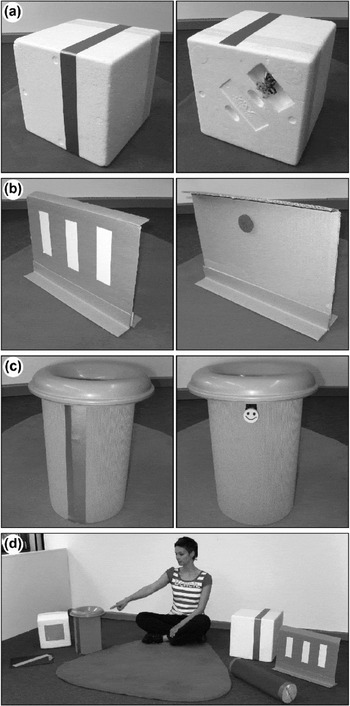
Test materials were three big objects (the obvious referents) with a small, detachable object, the so-called ‘aspect’ (the non-obvious referents) on the back side: (i) a white Styrofoam cube (30×30×30 cm) with a small chain of beads attached to the back side; (ii) a brown cardboard barrier (45×28 cm) with a red velvet circle on the back side; and (iii) a blue cardboard cylinder with a grey plastic lid (35 cm high, 20 cm in diameter) with a yellow rubber smiley face on the back side. The back side of the big objects with the attached aspect faced E (see right column of Figure 3) and the front side of the objects faced the child (see left column of Figure 3) so that the child could not see the aspect on the back side. Along with the test materials, there were also three distractor objects: a small Styrofoam cube, a cardboard clipboard and a long cardboard cylinder. All materials were scattered to the left and right of a small rug on which the child and the experimenter sat facing each other. Figure 3d depicts the set-up.
Materials of Study 2: front and back sides of: (a) the cube with the chain of beads; (b) the barrier with the velvet circle; (c) the cylinder with the rubber smiley face; and (d) the set-up with all test objects and distractor objects and a re-enactment of E pointing to the cylinder in the unmarked condition.

A between-subjects design was used. Children were randomly assigned to either the unmarked or the marked condition. Each child received three trials with a different object in each trial. The order of objects was fully counterbalanced. The position of the object (on the left or right side of the rug) was randomly assigned with the exception that the objects were not on the same side in all three trials; identical assignments were used in each condition and age group.
Procedure
As in the first study, E introduced the objects and explained that they were hers and that they were not toys. At the beginning of each trial, E and the child played an unrelated distractor game, as before. When they had finished, E said that she needed her things and asked the child to help her, saying, ‘I'm going to show you what I need and you give it to me, ok?’ Then she looked around searchingly and pointed, exactly as in Study 1, with the only difference that for this set of tasks she pointed and looked at a predetermined position at the back of the target object.
Coding and reliability
For each trial we coded whether children took the big object versus the aspect on the back side of the object as the referent of E's pointing gesture. Children's response to E's pointing gesture was coded either as choosing the big object (i.e. picking up or touching the object without ever looking behind it, or saying something like, ‘You need the cube’) or as choosing the aspect (i.e. looking at the back side of the object and/or commenting on the aspect).
Each child received one score for each trial (‘0’ if the child chose the big object, ‘1’ if she chose the aspect). To assess inter-rater reliability, a coder who was unaware of the hypothesis of the study independently coded 33% of the videotapes. Excellent agreement was achieved (Cohen's kappa=0·84).
RESULTS AND DISCUSSION
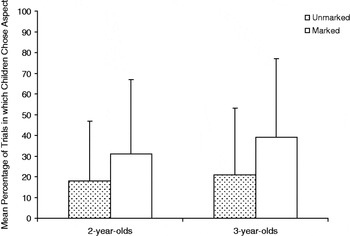
On average, children participated in 2·85 trials (two-year-olds: M=2·77, 166 of 180 possible trials; three-year-olds: M=2·93, 176 of 180 possible trials). Unlike in Study 1, there were no carry-over effects: children's responses differed across trials. Results are presented in Figure 4. A 2 (age)×2 (condition) ANOVA was conducted on the mean percentage of trials in which children chose the aspect as the referent of E's point. It yielded a significant main effect of condition (F(1, 116)=6·03, p=0·016, η2=0·05) but no main effect of age and no interaction (both p's>0·398). Thus, overall, children chose the aspect significantly more often in the marked (35%) than in the unmarked condition (20%). Planned comparisons analyzing each age group separately showed that the three-year-olds differentiated between conditions and chose the aspect more in the marked condition (t(58)=1·95, p=0·028, one-tailed, d=0·20) whereas the two-year-olds only tended to do so (t(58)=1·51, p=0·068, one-tailed, d=0·25).
Mean percentage of trials in which children chose the aspect as the referent in each condition in Study 2.

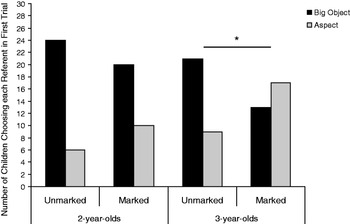
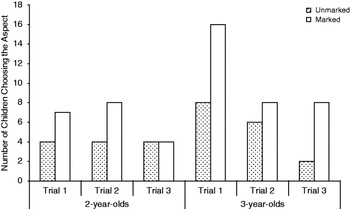
We also looked at children's performance across the three trials to see: (i) whether they performed correctly from the beginning of the study, already in their first trial; and (ii) whether their performance changed after repeated pointing by E. In their first trial, without any previous experience of how that adult normally pointed (as she had never pointed for them before), three-year-olds correctly chose the obvious big object as the referent of E's pointing gesture in the unmarked condition but the non-obvious aspect on the back as the referent in the marked condition (χ2=4·34, df=1, p=0·037; φ=0·27; see Figure 5). Two-year-olds did not differentiate in that same way in their first trial; they mostly chose the obvious big object in both conditions (χ2=1·36, df=1, p=0·243). Interestingly, the performance of the three-year-olds changed across trials: they became less likely to choose the aspect after repeated pointing in both conditions (unmarked: N=29, Cochran's Q=6·22, df=2, p=0·045; marked: N=29, Cochran's Q=9·85, df=2, p=0·007; see Figure 6). In the unmarked condition, this probably happened as the ‘cleaning up (big) objects’ routine became more entrenched. In the marked condition it is actually also an appropriate response, as the marking becomes less meaningful (or even changes meaning) once the aspect(s) have become a new part of the dyad's common ground. The performance of the two-year-olds, in contrast, did not change: they consistently chose the aspect infrequently across trials in both conditions (unmarked: N=27, Cochran's Q=0, df=2, p=1·00; marked: N=24, Cochran's Q=2·167, df=2, p=0·338).
The number of children who chose each referent in the first trial in each condition in Study 2.

The number of children who chose the aspect as the referent across trials in each condition in Study 2 (note: only children who completed all three trials are included in this analysis: N=27, for the two-year-olds; N=29, for the three-year-olds).

Taken together, these results support the findings of Study 1 that three-year-old children are sensitive to adults' ‘normal’ vs. ‘exceptional’ expression of communicative intent and know how to interpret this difference: they chose the most obvious referents within their common ground when the adult pointed normally. In contrast, when the adult marked her communication with extra emphasis, three-year-olds more often looked for a non-obvious referent, appearing to understand that she was informing them about a special, exceptional case.
Although the two-year-olds showed a similar overall pattern of results, their performance was weaker than that of the three-year-olds. In their first trial in particular, two-year-olds did not reliably differentiate between the two kinds of pointing the way three-year-olds did. One might thus suspect that two-year-olds somehow simply learned over the course of the test session that the adult's unusual point meant that they should look behind the big object. However, this is unlikely, because the adult never showed children the back of the object if they did not look there themselves after her point, nor did she provide any feedback about the correctness of their choice, so there is no way children could have made an association of this kind. There was also no significant improvement in the two-year-olds' performance across trials. We thus think it is more likely that the two-year-olds' understanding of markedness is simply still relatively rudimentary and fragile.
The three-year-olds in this study differentiated between the two kinds of pointing and correctly chose the aspect more often in the marked than the unmarked condition. However, they seemed to do this somewhat less often in this study than in Study 1. This may be a result of an additional task demand present in this study (in addition to those that this study has in common with Study 1 – see above). That is, whereas in Study 1 we used objects that children were somewhat familiar with (boxes, bags, bins) and which they knew in general could contain objects, in Study 2 we used novel objects which children had no reason to expect might have some small aspect attached to the back. This might have made identifying the referent of E's point in the marked condition even harder for children than in Study 1. Thus, with all the task demands present in both studies, we might well have underestimated young children's ability to respond appropriately to marked non-verbal communication.
GENERAL DISCUSSION
In the current studies, we presented young children with one and the same situation in both conditions: in the context of putting away objects, an adult asked for help and pointed at an object. In one case, the adult directed children's attention to that object in a normal communicative way. In the other case she pointed longer and with more emphasis than would normally be expected to direct children's attention to an object that was directly visible for child and adult. We were interested in whether children would interpret these two cases differently in terms of reference resolution.
We found that three-year-old children were able to differentiate marked from unmarked pointing gestures and respond appropriately, even from their very first trial. When the adult pointed longer and with extra emphasis, children went beyond the referent that was most obvious to choose the special, exceptional case. As a group, three-year-olds thus demonstrated a quite complex understanding of communication: they apparently inferred that the adult knew what was relevant for them based on their common ground and recognized that in her communicative signal the adult was trying to pre-empt this interpretation and make manifest a different referential intention (referring to some other referent that was not obvious within their common ground). Then they had to identify what the adult was actually referring to instead, some less obvious aspect of the situation.
The two-year-olds in the current study were beginning to differentiate marked and unmarked pointing but were not as good at this as the three-year-olds. This might be the case either because the two-year-olds had difficulty noticing the difference in the adult's communication in the marked condition (in terms of her facial expression and exaggerated pointing) or, perhaps more likely, it could be that they noticed the difference but had trouble interpreting it in terms of some special relation to their common expectational ground. It would be interesting to see whether a direct comparison of an unmarked and a marked pointing gesture would help these younger children, and whether it would be easier for them if they had both potential referents visually available and only had to choose which one the adult was referring to. Future research will help to answer these questions.
Another interesting avenue for future research is to investigate which cues in particular children use to detect markedness. As a first approach to this topic we presented the marked communication as one naturally would do it, as a combination of different cues such as facial expression and the duration of the communication. It would be interesting to determine which of these cues children use in particular and whether a combination of different cues is especially helpful.
The results of the current study fit well with those of other studies on related topics, which have found that two- to four-year-olds are beginning to use contrastive information to make different referential interpretations (Grassmann & Tomasello, Reference Grassmann and Tomasello2007; Markman & Wachtel, Reference Markman and Wachtel1988; Saylor et al., Reference Saylor, Baldwin and Sabbagh2002; Saylor & Sabbagh, Reference Saylor and Sabbagh2004). Taken together, these studies show that even very young children have a sophisticated understanding of the process of communication, including non-verbal gestural communication in which there is less information in the signal itself (see Tomasello, Carpenter & Liszkowski, Reference Tomasello, Carpenter and Liszkowski2007, for an overview). The current results thus demonstrate that markedness in communication is not just a linguistic phenomenon, but rather, in line with social–pragmatic views of language acquisition (e.g. Tomasello, Reference Tomasello2003; Reference Tomasello2008) it concerns the pragmatics of intentional communication more generally.