Introduction
Education is key to increased economic opportunities and improved health and wellbeing for Aboriginal and Torres Strait Islander (hereafter respectfully, Indigenous) Australians (Calma, Reference Calma2008; Hutchings et al., Reference Hutchings, Bainbridge, Bodle and Miller2018). There are clear social, cultural and economic imperatives to support Indigenous student engagement in, and completion of, schooling. Yet, accessible and equitable education is limited for Indigenous secondary students from most remote communities across Australia. Remote and very remote communities are identified by the Australian Bureau of Statistics (2018) according to the measures of relative access to services. Only 42% of remote Indigenous students finish year 12 (Department of the Prime Minister and Cabinet, 2017a). Some communities, such as Wadeye in the Northern Territory (NT), have had no student complete year 12 in the last 5 years (Stewart, Reference Stewart2017).
Restricted secondary educational opportunities in remote and very remote communities compel thousands of Indigenous students to enrol in boarding schools each year (Pearson, Reference Pearson2011; Australian Bureau of Statistics, 2013). In the 2015 calendar year, there were more than 5700 Indigenous secondary boarders who received Abstudy payments to assist with the costs of study, boarding expenses and travel. Approximately 91% of these students had their Abstudy benefits paid directly to a boarding school or residence (e.g. student hostel) on their behalf, and 77% of them were attending non-government schools within their home state. More than 75% had a home address classified as ‘very remote’ or ‘remote’, and 38% of students receiving Abstudy are from Queensland (Department of the Prime Minister and Cabinet, 2017b).
For many families and students, boarding is an intentional choice to access the benefits of what is perceived as a better education or access to opportunities beyond what is available in rural or remote communities (Mander, Reference Mander2012; Benveniste et al., Reference Benveniste, Dawson, Guenther, Rainbird and King2016). For others, frustration exists in the lack of legitimate options available to access quality schooling remotely (Bramston and Patrick, Reference Bramston and Patrick2007; Hadwen, Reference Hadwen2014). Regardless, the choice to attend or send a child to boarding school is not an easy one. While there are remote communities with secondary schools and partial or alternate education programmes, to access a full secondary curriculum or programme, many students find themselves with the limited choice of Distance Education or boarding school.
The potential consequences of boarding school experiences have been seen in Indigenous histories across the world, where institutions were used as a tool of assimilation, leading to loss of language, culture and lives, alongside the trauma of separation from land, family and culture (Smith, Reference Smith2009). Although there have been considerable changes to boarding institutions and policies of forced removal have ceased, contemporary students still face complex challenges in their transitions to boarding schools such as culture shock, increased classroom pressure and separation from family and home (Mander, Reference Mander2012; Hadwen, Reference Hadwen2014). Furthermore, these transitions are generally made in year 7, as young as age 11 or 12 years. While some students thrive in a boarding environment, boarding is not suitable for all students. Where the transitioning student resides, how they live, the culture they are exposed to and the language/s they use all change as a result of the shift to boarding school. Educational standards in boarding schools are often different to the schools in the student's home community; the roles, responsibilities and expectations of the student changes and a shift occurs in parental influence, personal freedom and the nature of relationships (Mellor and Corrigan, Reference Mellor and Corrigan2004; Mander et al., Reference Mander, Cohen and Pooley2015a, Reference Mander, Cohen and Pooley2015b, Reference Mander, Lester and Cross2015c; Bainbridge et al., Reference Bainbridge, McCalman, Redman-MacLaren, Tsey and Klieve2016; McCalman et al., Reference McCalman, Bainbridge, Russo, Rutherford, Tsey, Wenitong, Shakeshaft, Doran and Jacups2016). In addition, adolescent students typically undergo physiological changes and face increased peer pressure during the time they are boarding (Mander, Reference Mander2012). This transition to boarding school impacts the health and wellbeing of students and can also contribute to greater risk of depression and anxiety (Roeser et al., Reference Roeser, Eccles and Sameroff2000; Mander et al., Reference Mander, Cohen and Pooley2015a, Reference Mander, Cohen and Pooley2015b, Reference Mander, Lester and Cross2015c). However, as Wexler and coworkers (2016) argue, with protective processes and resources in place (in particular relating to family, peer network, community or culture), youth can thrive in spite of risk factors. Resilience theory draws on a strengths-based approach, and strives to highlight the presence of risk and protective factors and their influence in a person's life outcomes (Fergus and Zimmerman, Reference Fergus and Zimmerman2005; Zolkoski and Bullock, Reference Zolkoski and Bullock2012). This paper presents a subset of data from a broader project (described in further detail below), which investigates the contributing factors to the resilience of Indigenous students from remote and very remote communities who are attending boarding schools across Queensland.
Resilience and transitioning to boarding school
Numerous definitions of resilience have been developed, but a commonality amongst them is that in the face of a challenge (e.g. transitioning to boarding school), positive outcomes (e.g. successful educational experiences and healthy social and emotional wellbeing) are still achieved (Zolkoski and Bullock, Reference Zolkoski and Bullock2012; Theron et al., Reference Theron, Liebenberg and Malindi2014). Strengths-based and positive youth development paradigms allow us to privilege the voices of young people in understanding their experiences, and their development and demonstration of resilience. Protective and risk factors should not be seen as static, or stand-alone, but should be investigated across all levels of the socio-ecological model—individual, family and community. According to Sanders and Munford (Reference Sanders, Munford, Liebenberg and Ungar2008), consensus exists amongst researchers that caring, support, high expectations and participation in all ecological systems play a role in achieving positive outcomes for youth. Consistent with ecological approaches, understandings of resilience need to move beyond an individual trait to take into account the relationships and interactions of youth, and how they can become protective factors and positively influence their lives (Sanders and Munford, Reference Sanders, Munford, Liebenberg and Ungar2008).
An ecological understanding of resilience refers to:
‘…the capacity of individuals to navigate their way to the psychological, social, cultural, and physical resources that sustain their well-being, and their capacity individually and collectively to negotiate for these resources to be provided in culturally meaningful ways’ (Ungar, Reference Ungar2008, p. 225).
Community protective factors can include various aspects, for example, access to health services, recreational facilities and religious organisations (Walsh, Reference Walsh2003; Zolkoski and Bullock, Reference Zolkoski and Bullock2012). However, for the purpose of this paper, we investigate the role of relevant support services in the lives of Indigenous adolescents. International resilience studies have found that positive experiences of service use by adolescents facilitate their resilience (Ungar et al., Reference Ungar, Liebenberg, Armstrong, Dudding and Van de Vijver2013). A positive experience with a service supports students to feel valued, listened to and have decision-making power over what happens to them. These experiences support resilience in adolescents, including the strength of their belief systems, connectedness to their environment or community, friendships with supportive peers, and coping and social skills. Adolescents then function better, in ways consistent with their culture and context (Ungar et al., Reference Ungar, Liebenberg, Armstrong, Dudding and Van de Vijver2013). In contrast, adolescent users who experienced services as disrespectful, disempowering and discouraging of their agency do not improve resilience and wellbeing (Ungar et al., Reference Ungar, Liebenberg, Armstrong, Dudding and Van de Vijver2013).
Remote and very remote-dwelling Indigenous students, their families and communities require positive, specialist support to successfully navigate the difficult transition from their community primary schools to secondary boarding schools (Stewart, Reference Stewart2015). One service providing specialist transition services for remote and very remote-dwelling Indigenous students from Cape York and Palm Island is the Transition Support Services (TSS), delivered by the Queensland Department of Education (Indigenous Education). This paper examines the satisfaction of Indigenous students with the support they receive from TSS for the purpose of enhanced educational and wellbeing outcomes.
Supporting transitions to secondary boarding schools
Access to education programmes vary considerably throughout Cape York and Palm Island. Cape York schools in the remote communities of Bamaga, Weipa and Cooktown offer mainstream equivalent secondary schooling options accessible to students from the communities of Bamaga, Seisia, New Mapoon, Umagico, Injinoo, Weipa, Napranum, Cooktown and Hope Vale. The remote communities of Aurukun and Kowanyama have schools that currently provide an alternate (not mainstream) curriculum for students up to grade 10, and Lockhart River provides a school programme up to year 12. Pormpuraaw, Coen, Laura and Wujal Wujal communities currently have no secondary schools that exist in or are within their range. Palm Island offers a mainstream secondary schooling option through the Catholic Education system and the state system up to year 12. However, many Indigenous parents and students from Cape York and Palm Island exercise their right to choose to attend boarding schools.
TSS was initiated as a grassroots response in the communities of Lockhart River, Aurukun and Kowanyama in 2004. Families, principals and local community members were concerned that students were not succeeding in secondary schooling boarding environments and families were unable to provide the specialist interface required to support their transitions (Mackie, Reference Mackie2004). For the period 1997–2003, completion of secondary schooling was achieved by only 6% of Indigenous students who came from Cape York Indigenous communities (Mackie, Reference Mackie2004). Successful transitions to boarding schools require three inter-related components: the students’ readiness; the schools’ readiness for the student; and their family and community's readiness to work in partnership with the school to support the student (What Works National Office, 2013). Schools, parents, communities and students, along with Indigenous and other stakeholder organisations all identified a need for specialist transition support for this cohort of students attending boarding schools.
In response, a pilot service called the Transition Support Unit (TSU) was established by Education Queensland in 2005 (Department of Education and Training, 2010). This Unit initially delivered transition support services for students from the three Cape York communities: Kowanyama, Aurukun and Lockhart River. The Unit was evaluated, new resources allocated, and expertise and geographical reach was expanded to formally establish transition support services for the communities in Cape York and Palm Island in 2008. The vision of TSS was to provide transition support to students, their families and community, and destination schools with the aim of increasing the number of Indigenous students completing year 12 or its equivalent (Department of Education and Training, 2010).
The TSS has expanded further since this time, and is now a mandated service by the Queensland Department of Education to support primary and secondary students and their families from the Cape York communities of Aurukun, Pormpuraaw, Kowanyama, Lockhart River, Coen, Laura, Hope Vale and Wujal Wujal. TSS does not initiate engagement with families or these communities where comprehensive secondary education programmes are available, but does offer at destination support for these students and families after enrolment in a boarding school. Engagement with families is to support them to make informed choices about their education options and to enact their chosen secondary pathway, whether that is to remain in the local community, or apply to and attend a boarding school. The service also provides in-school support at the boarding destination to students from the eight communities surrounding the Northern Peninsula Area (Bamaga, Seisia, New Mapoon, Umagico, Napranum and Injinoo), Weipa, Cooktown and Palm Island. No engagement with families in these communities is made by TSS prior to the student attending boarding school. The service is evolving however, and is moving to expand further to reach other areas across Queensland. The TSS team at the time of survey administration consisted of 17 Indigenous and non-Indigenous staff members including a State Manager, Primary into Secondary Team Leader, Transition Support Teachers/Officers, Youth Mentors, Re-engagement Officer and Community Support Officers. At the time of survey administration, TSS staff worked across the following three service streams; (1) supporting students from Cape York state primary schools as they prepare for transition into secondary school; (2) supporting secondary school students as they navigate transition issues while at 30 destination boarding schools and residential facilities across Queensland; and (3) supporting students who are no longer attending a school and are seeking to re-engage with education (Department of Education and Training, 2015; ‘Transition Support Services’, n.d.).
The primary into secondary school transition team support year 6 students and their families to develop and enact a primary into secondary transition plan. This includes working with the students, families and teachers to determine school readiness and whether boarding school is an appropriate or desired pathway. Transition Support Officers work closely with the Community Support Officer and local primary school staff to provide comprehensive support. If the student and family identify that they would like to pursue a boarding school pathway, the primary into secondary team work in close consultation with the student and their family to: (i) provide comprehensive information to support the selection of ‘best-fit’ secondary boarding school options for each student; (ii) apply to, attend interviews and gain a placement at boarding school; (iii) apply for bursary or scholarship programmes; (iv) apply to and gain additional support documents or entitlements from providers such as Australian Government's Centrelink payment and service programme (through Abstudy, which provides financial help for Indigenous students), birth certificates, immunisation and medical records; (v) provide information and learning opportunities to prepare for the social, emotional and physical/practical transition to boarding school; and (vi) take up placement at boarding school at the start of the secondary phase of schooling (Department of Education and Training, 2015).
The second component of TSS support is provided for students moving into or returning to secondary school. Transition Support Officers in service stream 2 work across Queensland to support secondary students in over 30 destination boarding schools. TSS staff support the continuing engagement into education of secondary students at their boarding schools, working with boarding and school staff and the student's family in community to: (i) enable students to orientate to the new settings in which they learn and live; (ii) engage with educational and community life in their new setting; (iii) make the most of new opportunities; and (iv) to maintain connection and contact with kin and Country (Indigenous Education and Training Futures, 2010; Department of Education and Training, 2015). In addition, TSS staff work with the student's family to support their children to live away from home. TSS staff explain to students and their parents how enrolment in boarding school works, behavioural expectations and the various requirements of government departments (including Abstudy, Births, Deaths and Marriages, and Australian Taxation Office). TSS staff also support parents to link with the student's school, and are a familiar face that knows the student's home community or a family member. Staff at boarding schools and residential facilities are also supported by TSS to work with students and families from Cape York and Palm Island in ways that enable students and families to achieve their aspirations of educational attainment. Transition Support Officers work closely with the local schools and have varying agreements on their interaction with staff and what they offer in ways of support or advocacy for each student. These agreements vary between supporting staff through professional development, to small group interaction and one-on-one mentorship with students.
The third component (service stream three) of TSS’ work is re-engagement support. Students who disengage or are excluded from boarding school and return to their home communities are supported by TSS staff to re-engage with another school, training or employment pathway. Partnerships with the student, family and a wide range of service providers in and outside of the student's home community are engaged to enact a re-engagement action plan (Department of Education and Training, 2015).
The resilience study
In mid-2013, TSS staff members and Central Queensland University researchers discussed concerns about the risk of self-harm and suicide in the TSS student cohort. Given that many remote-dwelling Indigenous students are at boarding school for up to 40 weeks of the year, a proactive study was planned to support increased resilience for students. A 5-year, partnered research study was developed and funded by the National Health and Medical Research Council targeted call for suicide prevention research. The study commenced December 2014 (McCalman et al., Reference McCalman, Bainbridge, Russo, Rutherford, Tsey, Wenitong, Shakeshaft, Doran and Jacups2016), with pilot findings reported in 2017 (Redman-MacLaren et al., Reference Redman-MacLaren, Klieve, McCalman, Russo, Rutherford, Wenitong and Bainbridge2017). The broader resilience study draws on a mixed-methods approach, with qualitative interviews supplementing the survey results, part of which are reported here. The study also uses a step-phased approach to improving practices that support students’ resilience within boarding schools and TSS. As part of the broader study, this paper reports survey results of students’ experiences of and satisfaction with the TSS provided by the Queensland Department of Education. Qualitative data from students’ perspectives collected in the study will be reported elsewhere. The aim of this paper is to investigate, through the students’ eyes, whether TSS is effective for them and how it supports their transitions to boarding.
The joint TSS/Central Queensland University research team includes Indigenous and non-Indigenous education, psychology and health researchers and practitioners who are committed to supporting Indigenous and decolonising approaches to research. The team draws upon the positive, rather than deficit-focused approach in reporting this research (Walter and Andersen, Reference Walter and Andersen2013; Walter, Reference Walter, Kukutai and Taylor2016).
Methodology
Where students come from
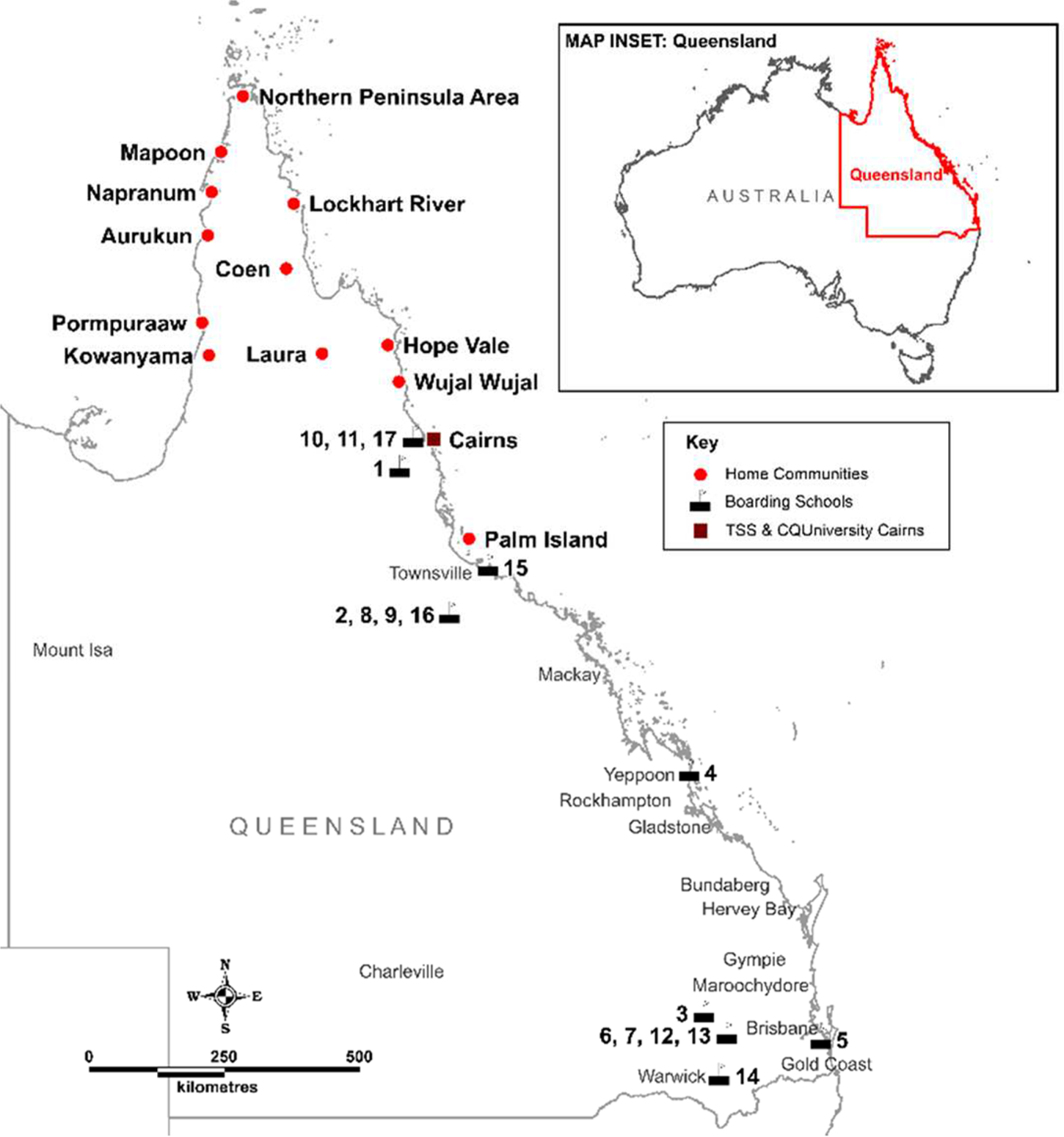
Students who participated in this study came from 17 remote and very remote communities in Cape York and Palm Island (figure 1). Cape York is a far northern region of Queensland; 51% (8566) of residents are Indigenous (Australian Bureau of Statistics, 2012). These remote and very remote communities were formed from the late 1800s to early 1900s as a result of the removal and relocation of Indigenous people to mission settlements. Each community has a distinctive history, tribal population groups and church influence. Limited economic development means that many Indigenous residents experience socioeconomic disadvantage, with high rates of unemployment and low incomes. Palm Island, located 65 km North West of Townsville, was established as a settlement for Indigenous people from over 40 different language groups. These people were forcibly removed and relocated from all around Queensland as a result of colonial social policies (Watson, Reference Watson1994).
Map of student's home communities and destination boarding schools (Kelly, Reference Kelly and Cartographer2017).

As described in detail above, schools in many remote and very remote Indigenous communities variously provide limited secondary programmes. Limited programming particularly impacts students not ready to go to boarding school at the end of year 6, or students who have been excluded from boarding school or a residential facility.
Where students go to secondary school
The TSS supports students and their families in their transitions to approximately 30 destination boarding schools and residential facilities across Queensland; from Weipa in the north west of Cape York, to Brisbane in the south, and Toowoomba, Warwick and Dalby to the south west.
The destination boarding schools are based in both urban and rural areas, with some schools over 2000 km from the student's home community. A number of boarding schools operate as Independent schools, mostly in alignment with a Catholic or another Christian denomination. Two boarding facilities are administered by the Queensland Department of Education and two are operated under the auspices of sporting organisations. Students at these facilities access various local secondary schools in their regions.
Procedure
Ethics and approach
Ethics approval for the study was obtained from James Cook University Human Research Ethics Committee (H5964), Central Queensland University Research Ethics Committee (H16/01-008) and Department of Education, Queensland Government (File No. 50/27/1646). School principals were approached by TSS and/or Central Queensland University researchers, and all agreed that their schools would participate in the study. Each participating school signed a Memorandum of Understanding with the University and TSS to clarify the expectations and partnership. Parental consent for all students participating in the study was gained. Students gave their consent before they began the survey.
The survey instrument
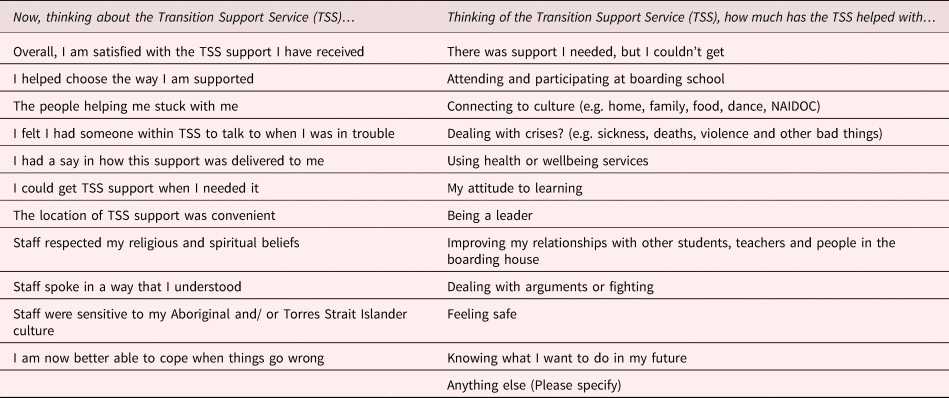
The overall survey instrument was developed collaboratively with TSS and piloted with students using questions drawn from a number of validated scales (McCalman et al., Reference McCalman, Bainbridge, Redman-MacLaren, Russo, Rutherford, Tsey, Ungar, Wenitong and Hunter2017). The broader survey contains other sections including questions on students’ home and community life, their experience and views of boarding school, health service satisfaction and risk of psychological distress. The student satisfaction section of the survey was derived from the Pathways to Youth Resilience (PYRM) (Resilience Research Centre, 2014), and was a composite of validated scales and sub-scales measuring supports available to students and their patterns of TSS use. Students were asked 22 close-ended questions consistent with the PYRM questions (described above) and designed to elicit student satisfaction levels as they related to the TSS. Twelve were dichotomous (no/yes) responses and 10 had a rating scale with a not applicable option. The rating scale contained three points each with an anchor point representing the possible range of utility of the service. The satisfaction questions were preceded by a series of demographic questions that would allow the students to be categorised according to gender, age, school and year level. It took students approximately 30–40 min to complete the full questionnaire. Participation in the survey was entirely voluntary. In this paper, findings related to questions asked specifically about the students’ experience of the TSS are reported. The questions relating to the service provided by TSS are included in Table 1.
Questions asked about TSS

Sampling of schools
TSS-supported schools and communities that met screening criteria (supported at least five TSS students) were invited to participate in the study. Two primary schools on Cape York, 17 secondary schools (Far North Queensland n = 4, North Queensland n = 5; South Queensland n = 8) and one community with re-engagement support were included (figure 1). The primary schools and community with students who had de-enrolled were randomly selected. Boarding schools met the criteria of having at least 10 TSS-supported students and being representative of the three TSS regions across Queensland.
Data collection
Data were collected electronically using SurveyMonkey™. Two researchers facilitated the surveys with students outside of school hours, supported by TSS staff. Researchers created a supportive environment where students would feel comfortable to respond. This approach was consistent with the importance of centralising relationship when conducting research with Indigenous people (Gray and Oprescu, Reference Gray and Oprescu2016).
Many of the students completed the survey independently, although some younger students in year 6 and/or those students who had lower levels of literacy completed the surveys in a group or with the support of researchers (one-on-one, or in small groups with 2–6 students). When support was required, the researcher read out the question and waited for students to make an individual response before moving onto the next question. Some of the younger children required assistance to understand the survey questions. For example, the word satisfied was explained as ‘happy with’, and examples were given to help students relate the questions to their own experience. For example, where appropriate the names of a TSS person was inserted into a question—‘did [staff name] speak in a way that you understood?’—as this helped guide a year 7 students’ memory to their experience in year 6. If guidance was needed in understanding a question, the examples given were in direct relation to their schooling experiences as this was easily identifiable for students.
Data analysis
Data were downloaded into Microsoft Excel for cleaning. Incomplete records caused by Internet connectivity issues in very remote locations were identified and matched using participants’ date of birth, gender, school attended and school year. All incomplete records caused by Internet drop out were successfully matched to complete records. Three students completed the survey twice. In these instances, the initial entry was kept. The second entry was checked for additional information in the open-ended questions, with any additional information added to the initial entry. The second response was then deleted.
Data were then imported into SPSS v24 (IBM Corporation, 2016) for analysis. Descriptive statistics were calculated separately for the three groups of students (primary, secondary and re-engaging) for the variables assessing service support, student perceptions and experiences. Because of the small sample of re-engaging students (n = 9), it was not possible to undertake further meaningful analysis. We analysed data consistent with the Guidelines for Reporting Quantitative Methods (Norris et al., Reference Norris, Plonsky, Ross and Schoonen2015).
Results
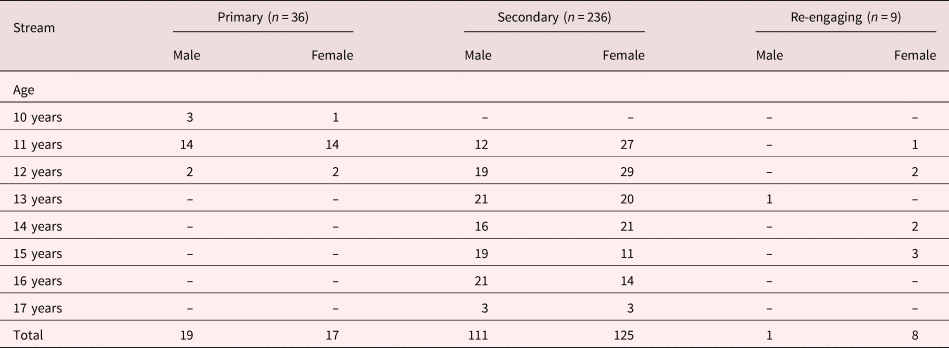
Data were provided by a total of 294 students, comprising primary (n = 36), secondary (n = 236) and re-engaging (n = 9) students across 20 sites (17 secondary, two primary and one re-engaging community site). A full breakdown of participant gender and age across the three groups of students is shown at Table 2.
Participant demographics

Primary students
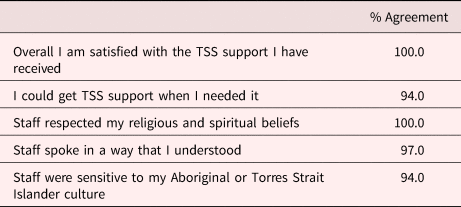
Nearly all of the primary students (97%) identified a potential boarding school, and that TSS would be of assistance for their move to boarding school the next year. High levels of agreement were reported for all types of TSS satisfaction, as shown at Table 3, with overall satisfaction and respect for religious or spiritual beliefs scoring the highest level of agreement at 100%.
Primary students service impact (n = 36)

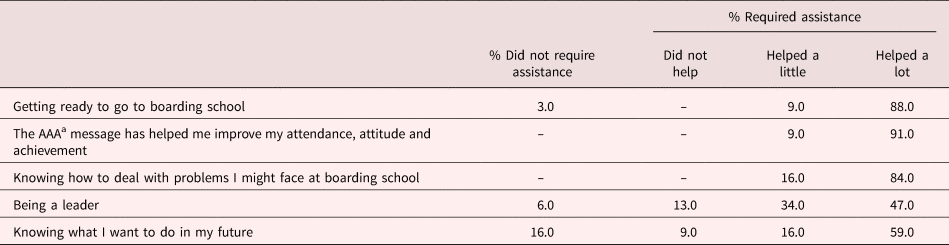
Students were surveyed a third of the way through their transition programme in year 6. When the specific outcomes of the transition programme were examined, high levels of effect were identified for immediate/practical preparation for boarding school, including the improvement of attendance, attitude and achievement, and understanding the problems they might face, as shown in Table 4. More conceptual or distal issues such as leadership and long-term aspirations had lower levels of perceived need for assistance.
TSS areas of assistance for primary students (n = 36)

a AAA message is attendance, attitude and achievement.
Secondary students
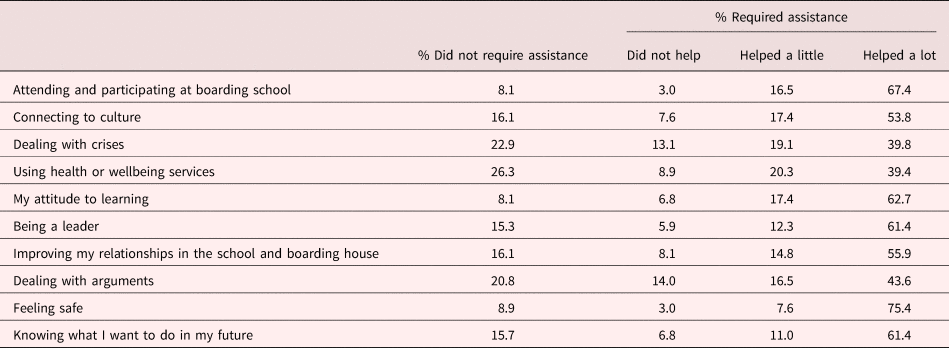
All of the secondary students identified TSS support, family support, visiting the school and web-based information as assisting in their transition to boarding school. Just under half of the students (47.9%) found that having someone they knew already at the school assisted their transition (Tables 5 and 6). In an open-ended question asking what other factors assisted in their transition, younger students identified other students who they already knew and specific staff at the school, while older students identified their school friends, the value they placed on education or achieving their aspirations.
Secondary students service impact (n = 236)

TSS areas of assistance for primary students (n = 236)

Re-engaging students
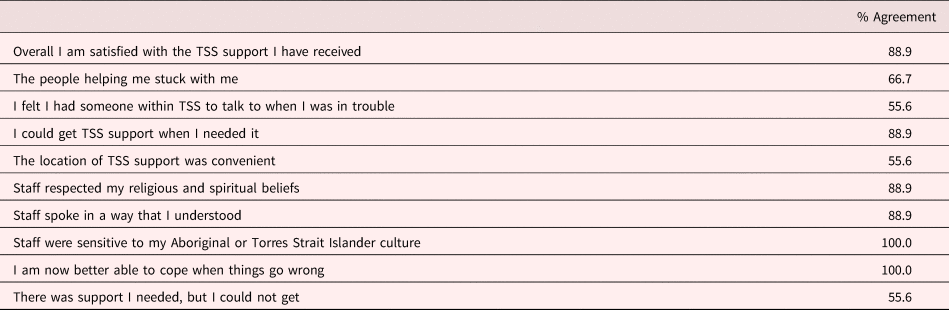
Nearly all (88.9%) of the re-engaging students nominated TSS support as helping them move from home to boarding school. Overall agreement for the satisfaction of TSS was high, with lower scores being related to TSS’ capacity and accessibility, as shown in Table 7. All students agreed that the service provided culturally sensitive services and had increased their capacity to cope when things go wrong.
Re-engaging students service impact (n = 9)

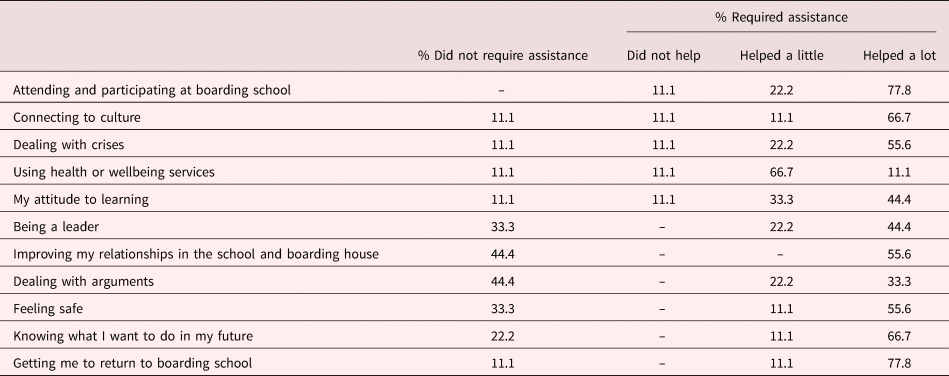
Students were asked about the specific ways in which TSS had helped them. High levels of support were found in the core functions of TSS relating to attending and re-engaging with boarding school. High levels of support were also found in areas relating to students’ resilience and life skills, such as connection to culture, future aspirations, dealing with a crisis, feeling safe and improving their relationship with the school and boarding house as detailed in Table 8.
TSS areas of assistance for re-engaging students (n = 9)

Discussion
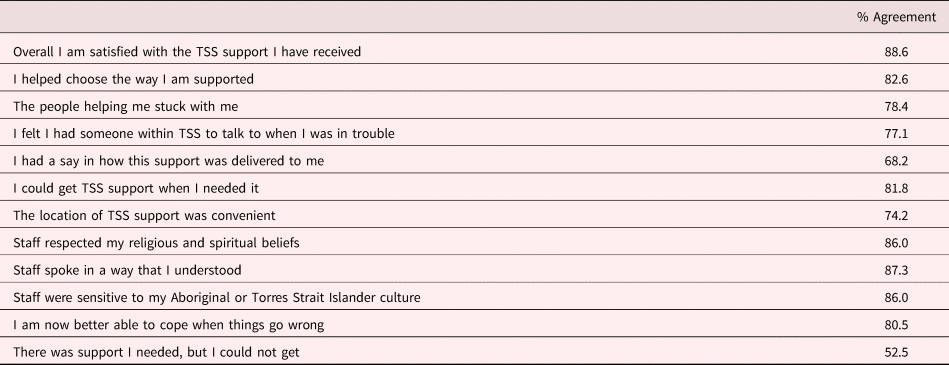
Almost all Indigenous students who participated in this study were highly satisfied with the service provided by TSS, with 86% of secondary students reporting TSS was respectful of culture and spiritual beliefs. International studies have found that respectful, empowering and relevant service provision increases adolescent resilience, and that increased resilience processes (facilitated by effective service provision) improve functional outcomes for adolescents (Ungar et al., Reference Ungar, Liebenberg, Armstrong, Dudding and Van de Vijver2013). For example, a South African study found that students’ experiences of respect from teachers and opportunities for exercising personal agency were significantly correlated with their levels of resilience (Theron et al., Reference Theron, Liebenberg and Malindi2014). Services that work with Indigenous students should prioritise respectful engagement that promotes student agency (Theron and Donald, Reference Theron and Donald2013). Given the experience of TSS as reported by students and international evidence, it is evident that an Indigenous-specific bridging service to support remote and very remote-dwelling Indigenous students and their families in their transitions to secondary boarding schools is both necessary and highly valued.
Resourcing is a challenge facing TSS. Students responded less positively to questions about access to TSS staff. This response reflects the regional and highly dispersed nature of the TSS staff. Just over half of secondary students reported there was TSS support when it was needed (52.5%). Most TSS staff visit a boarding school weekly. Unless there is a TSS staff member located in a community (n = 2), primary and re-engaging students from remote and very remote communities receive TSS visits infrequently; this is because of vast travel distances and high transport costs. Similar student satisfaction studies could also be conducted in the boarding schools where students spend considerably more time and receive more educational service exposure than they currently receive from TSS.
Students reported that TSS delivered their service in a way that centralises relationships. Research in one Cape York community, conducted by Stewart (unpublished data, Reference Stewart2016), shows that TSS has built a series of relationships and partnerships that are critical factors in maintaining and improving transition outcomes for the community's children. TSS relationships have been developed with children, families, school staff in the communities and with boarding and teaching staff in destination schools throughout Queensland over the past 10 years. A number of TSS staff have held positions as teachers in Cape York communities prior to their positions in TSS, and with these existing relationships with students and their families, leveraged to support both the student to be prepared for boarding school, the school to be prepared for the student and for parents to accept TSS support. Furthermore, some students have grown up with brothers, sisters, aunties, uncles and cousins who have had positive experiences with TSS staff that fuels confidence in the support that TSS offers. What this translates to for students is that amongst the challenges they face in transitioning from their home community to a culturally different boarding school, they have a service provider (a TSS staff member) they feel safe with who is known to their families, but separate from their school. A lack of meaningful relationships between TSS staff, students or families would inevitably make the support offered much less effective.
There is potential for increased boarding school readiness for remote and very remote Indigenous students and for the school to provide enabling environments that support students beyond the service that TSS can provide. Boarding providers should consider how they can work with families and communities prior to and during students’ enrolment to ensure that just as the students and families are prepared and learn about the boarding context, they as boarding providers should equally prepare for and learn about the context from which students and families come from. There is also a move towards increasing the responsibility of remote and very remote primary schools in preparing students for boarding, particularly in regards to a proposed transition curriculum.
Diligent evaluation of transition support services is necessary to document their incremental effectiveness and costs and benefits to ensure government expenditure is justified. Student experiences of transition services, such as those reported in this paper, are important. However, evaluations must also draw upon accurate and complete data about service provision, resources and outcomes. The provision of education, health and other supports for vulnerable youth can have a significant positive impact on their educational attainment and adult contribution to society (Reynolds et al., Reference Reynolds, Temple, Robertson and Mann2001; Belfield et al., Reference Belfield, Nores, Barnett and Schweinhart2006; Moodie and Fisher, Reference Moodie and Fisher2009). The impact of school disengagement by Indigenous youth has consequences for society as well as for the individual, including loss of human capital, loss of national income, loss of tax revenues, increased use and demand for social services, increased crime, reduced economic participation and higher health care costs (Purdie and Buckley, Reference Purdie and Buckley2010; Wilson et al., Reference Wilson, Stemp and McGinty2011). Investment in transition services that support students by enhancing their academic success and re-engagement in education and training present a significant opportunity for social impact. Consideration should be given to designing and implementing a longitudinal study that could document the cost-effectiveness and social impact of TSS. Furthermore, research that evaluates the causes of school disengagement, particularly boarding school disengagement, would better inform the ways that education can be delivered for remote and very remote Indigenous students and how disengagement can be prevented. Evaluation of the long-term impacts of boarding school engagement should also be considered as the impact of separation from culture, and the potential loss of human capital should students remain away from their communities after boarding, are significant risks that come with the boarding model.
High levels of student satisfaction with TSS does not necessarily equate to effectiveness or efficiency in the service, but does point to a potential model for transition services for remote and very remote-dwelling Indigenous boarding students. With approximately 5700 remote and very remote Indigenous students transitioning to boarding schools across Australia, there is a need to establish or expand transition services, especially in Western Australia, the NT and other remote areas of Queensland, that have higher proportions of Indigenous students. The NT Government, acting on the recommendations of the Wilson Review in 2014 (Wilson, Reference Wilson2014), established the Transition Support Unit (TSU), which began operating in 2016. The TSU are developing a model which has been in part informed by the transition work of TSS in Queensland. The challenge is now to consider how the current service model of TSS can be evaluated, expanded and embedded to support successful educational outcomes for all remote and very remote Indigenous boarding students in Queensland. Naturally, successful education outcomes are interpreted in a variety of ways; however, the most dominant view is success comes in the form completion of year 12 or transition to work, training or further education. Establishing what successful educational outcomes mean for the resilience and long-term personal outcomes for students is also essential.
Limitations
Primary students were asked to rate their satisfaction and outcomes based on a very short exposure to the TSS programme. The surveys were done in early May, thus TSS had little opportunity to make a difference during the school year (which starts in late January in Australia). While it would be ideal to assess primary students’ PYRM scores at the start of the year, and their satisfaction/impact with TSS at the end of the year, this is not feasible because of TSS resources limiting the amount of involvement with primary students. Not all surveys were self-administered because of age and/or literacy levels of participating students. However, researchers ensured that all students understood the nature of questions and explanations were given consistently across the 21 research sites by two researchers. A limitation of researchers assisting students to complete the survey was a potential change in student responses due to social desirability effect. Furthermore, while students reported their satisfaction with TSS, the uniqueness of the service means there is no comparable service that students engage with—therefore, improvements are hard to envision for students who are not able to critically compare the service with a similar service. Since the introduction of the Northern Territory Education Department's TSU, it may be useful in future studies to compare satisfaction of students in each of these services. Mander (Reference Mander2012) further highlighted frustrations felt by parents at the lack, or poor quality, of local secondary options. They also found that many parents saw boarding school as a ‘great opportunity’ for their children, offering them a way to grow beyond the margins of local secondary school pathways and limited opportunities. Inclusion of family, community and school voices in future assessment of services such as TSS is critical if the service aims to truly improve relationships between schools, families and communities, in order to contribute to successful educational outcomes for remote and very remote Indigenous students.
Conclusion
Remote and very remote Indigenous students from Cape York and Palm Island experience very high levels of satisfaction with the current transition support services provided by TSS. However, the constraints of distance and resources influence the availability of the service to students, and hence their satisfaction with service accessibility. Data reported from this research will assist to inform the strategic direction of TSS and inform resourcing levels and service reach. They also highlight the effectiveness of a service which operates on the basis of staff relationships with students, their families and their home communities and the flow-on benefits this provides for on-the-ground support at boarding schools. These findings point to the need for a more equitable provision of transition services for all remote and very remote Indigenous students across Queensland. Findings can also inform other transition support services across Australia as they support remote and very remote Indigenous students to access secondary education. It is critical to Australian society as a whole that we invest in the successful education of all Indigenous students.
Author ORCIDs
Janya McCalman, 0000-0002-3022-3980
Michelle Redman-MacLaren facilitates participatory, action-oriented public health research with Aboriginal and Torres Strait Islander people in Australia, and with people in the Pacific (particularly Papua New Guinea and Solomon Islands). Michelle is committed to enacting and enabling decolonising and indigenous research methodologies. Michelle's research interests are focused around the social and cultural determinants of health of Indigenous Australian and Pacific peoples, including the sexual health and wellbeing of women in the Pacific. Michelle actively facilitates research capacity strengthening activities in her research work.
Tessa Benveniste is a Senior Research Officer at the Centre for Indigenous Health Equity Research at Central Queensland University. Her research interests and experience span psychology, education and health, and particularly the intersection of these in the lives of Australian Aboriginal and Torres Strait Islander youth. Tessa has recently completed a PhD in Social Psychology examining the expectations, experiences and outcomes of boarding school for remote Aboriginal students, families and communities from the Anangu Pitjantjatjara Yankunytjatjara Lands in South Australia.
Janya McCalman is the Deputy Director of the Centre for Indigenous Health Equity Research at Central Queensland University, which she co-manages with Roxanne Bainbridge. She is a NHMRC research fellow and a public health researcher. Her research has focussed on the interactions between Aboriginal and Torres Strait Islander Australians and schools, workplaces, health services and other community contexts which enable resilience, empowerment and wellbeing.
Katrina Rutherford is a researcher at the Centre for Indigenous Health Equity Research at Central Queensland University. She has worked in the education sector for the past 19 years with extensive experience in remote Indigenous communities. Katrina is a strong advocate for equitable access to education and has a keen interest in the development of social ecologies which promote and sustain the resilience and wellbeing of Indigenous youth. For the past 8 years, she has supported students and families from Cape York, who due to limited access in their communities have transitioned to boarding schools. Katrina is currently undertaking a doctoral research project exploring the post-schooling transitions of Indigenous boarding school graduates from remote communities.
Amelia Britton has worked in education both as a teacher and guidance officer in regional centres and remote Indigenous communities. Her most recent role was working with students excluded from boarding schools and their families around pathways to return to school. She is now working on a doctoral research project in alternate pathways for remote Indigenous adolescents who do not attend mainstream schooling options.
Erika Langham is a Lecturer in health promotion and public health researcher at the Centre for Indigenous Health Equity Research at Central Queensland University. Her research interests include the influence of social, political and commercial determinants of health, as well as strengths-based approaches to improving population-level health. She has conducted research into public health approaches to understanding and measuring the impact of gambling-related harm, the influence of early life experiences on adult health and the validity of standard research measurements in vulnerable populations.
Richard Stewart is the Program Manager for the Queensland Department of Education Transition Support Service. He has experience in leading boarding facilities and secondary schools in Queensland, Western Australia, the Northern Territory and Papua New Guinea and is currently undertaking PhD research through James Cook University into the transition to boarding for students from remote Cape York communities.
Pat Saunders has worked as a Transition Support Officer at the Queensland Department of Education Transition Support Service for the past 8 years. She holds an Arts Degree in Humanities and Social Sciences and has extensive experience in public service. Pat is a Gungarri woman from South West Queensland born in Mitchell situated beside the Marnoa River. Pat has a passion for supporting young Aboriginal and Torres Strait Islander youth to find their own tools to negotiate the complex transitions they often undergo coming from rural and remote communities.
Irina Kinchin is a Senior Postdoctoral Fellow in health economics at the School of Health, Medical and Applied Sciences, CQUniveristy (CQU). She co-leads an impact evaluation research stream at the Centre for Indigenous Health Equity Research (CQU). Her research focuses on empirical impact evaluations of public health and primary care interventions for vulnerable populations. The underlying aim of Irina's work is to ensure that committed investments are cost-effective and spent in ways leading to greatest improvements in target populations’ health and wellbeing.
Roxanne Bainbridge is a Gungarri woman from South-Western Queensland. She is the Director of the Centre for Indigenous Health Equity Research at Central Queensland University Australia; and an inaugural Atlantic Fellow for Social Equity. Roxanne has multidisciplinary expertise specifically clustered around the social and cultural determinants of health, equity, Aboriginal psychosocial resilience, empowerment and social inclusion. Her methodological expertise is in high-impact applied research conducted in participatory and action-oriented research approaches embed in systems sciences.