Historical and literary scholars have taken up the study of political and religious motives in the early modern book trade with increasing seriousness and complexity. Over the past twenty years, there has emerged a shift from scholars ruling out all but economic motives for those stationers who took the financial risks to publish, to a willingness to consider that ideological commitment was not the sole province of authors, but also of printer-publishers. Crucial to the emerging picture is the distinction to be drawn between the ‘trade’ work of a printer hired only to manufacture a printed text, and the very different financial investment, and therefore implied commitment, by a publisher (who, of course, might also print the work). But all of these discussions continue to rely almost entirely on the analysis of imprints themselves.Footnote 1 Here I continue the discussion by showing how research in archival sources not hitherto used by scholars of the book trade can prove the possibility of ideological congruence between publications and stationer. A detailed case-study of the life and trade of stationer Richard Badger (1585–1641) reveals, as matrices for ‘publication’, not merely politics, religion, and economics, but also kinship, regional alliance, and royal patronage. In addition to suggesting new directions for the study of early modern print and publication, Badger's career also further enriches our understanding of the origins, fluorescence, and collapse of Laudianism.
As I have shown before, the publication of William Laud and John Buckeridge's important folio edition of Lancelot Andrewes's XCVI sermons (1629) was entrusted to the then relatively unknown Richard Badger when still a journeyman printer. His few other early imprints dated from 1625, and included court sermons by Laud, and the notorious defence of the Forced Loan by Roger Manwaring, Religion and alegiance (1627), commissioned for print by Charles I through Laud. Two years later, while XCVI sermons was in press, Badger was, by the king's command and Laud's personal endorsement, made a master printer, the first such elevation made in breach of the 1615 Star Chamber decree limiting the number of master printers. Thereafter Badger's publishing business burgeoned, and included most of the ‘greatest hits’ on the Laudian charts, with further works by Laud, sermons by his most aggressive supporters, visitation articles for him and his closest episcopal and archidiaconal protégées, and subsequent authorized editions of Andrewes. These facts led me to argue that a degree of religio-political alignment could be found in at least one member of the Stationers' Company, something which questioned the received orthodoxy that stationers pursued financial success without reference to religious or political ideology.Footnote 2
Later in this article, I will come to the important distinction to be drawn between the books any stationer published and those he or she merely printed for another publisher. But first, in a detailed consideration of Badger's biography, I present the kinds of non-bibliographical evidence that can be adduced in order to venture what one printer-publisher might have thought about the political and religious content of the works he published – an exercise in what Zachary Lesser reasonably worries might be a ‘circular attempt to divine [a stationer's] intentions’Footnote 3. This biographical work shows that books alone should not continue to dominate our assessments of their publishers' careers. The historiography of kinship and regional alliances outside London could have significant ideological implications for the book trade plied within it.
I
Richard Badger was baptized in Holy Trinity church, Stratford-upon-Avon, on 17 August 1585, the sixth of sixteen children born to George Badger and his wife, Juliana Court, alias Smith.Footnote 4 The printer's father (a younger son of a second marriage) was apprenticed in Stratford as a woollen draper and inherited from his father a house on Henley Street ‘three doors below John Shakespeare's’.Footnote 5 After taking his freedom he held a succession of borough offices, from ‘taster’ (regulator of brewing enterprises) in 1580 to alderman in 1594.Footnote 6 Following the great Stratford fire of 1595, Badger bought a further strip of land from his neighbour John Shakespeare (with whom he had served as constable in 1586) to rebuild his Henley street property, but it appears from taxation records that the Badgers and their fifteen surviving children dwelt in Sheep Street.Footnote 7 Council and parish records also reveal that George Badger was a somewhat factious man: in 1597 he was repeatedly fined for refusing to come to borough hall and declining to serve as bailiff, and was expelled the following year; he was also frequently fined for selling beer and ale without licence or in short measure, and for unlawful games in his alehouse.Footnote 8
Much more significant is the likely reason for his vexed relationship with his borough. Both George Badger and his wife, Alice, were noted recusants, and, unlike the case of their neighbour John Shakespeare, there is no ambiguity about whether this recusancy was puritan or Roman Catholic. The Badgers had been antogonistic to religious reform in the Avon valley from its beginnings, even sparring with none other than bishop of Worcester, Hugh Latimer, over Protestant preaching at Hampton Lucy. From 1603 until his death in 1635, George Badger, his wife, and daughters were routinely presented at the vicar's peculiar court as ‘stubborn papists’ and ‘excommunicate’ for not attending divine service, including the required minimum of Easter communion.Footnote 9 And, in the wake of the Gunpowder Plot, in a night-raid on the residence of plotter Ambrose Rookwood the bailiff of Stratford intercepted ‘a cloakbag … full of copes, vestments, crosses, crucifixes, chalices and other massing relics’ intended for safe-keeping with ‘one George Badger’.Footnote 10
George and Alice Badger's third son, Richard, was in 1602 apprenticed (aged seventeen, presumably after education at Stratford grammar school) to the London printer Peter Short.Footnote 11 Short died a year later in 1603, and Badger was trained-up under the man who succeeded to Short's business (and his widow) in 1604, Humphrey Lownes (d. 1630). Although prominent in company records, Badger's domestic establishment in London itself is obscure after the date of his freedom (1610) until residence in the parish of St Martin Ludgate (immediately west of St Paul's churchyard, and including Stationers' Hall) becomes clear from December 1619 with the birth there of his four younger children between that date and 1627.Footnote 12
The mother of Richard Badger's seven children provides further evidence about Badger's likely religious milieu. She was Alice, daughter of Thomas Stempe, minister of Winchester (c. 1564–1635). In his will dated 1635, Thomas Stempe left ‘to Alice my daughter wife of Richard Badger citizen & Stacion[er] of London … tenne pownd[es]’ and named as co-executor ‘my loving Sonne in lawe … Richard Badger’.Footnote 13 Stempe had been a scholar of Winchester College, and was ordained deacon (January 1591) and priest (January 1592) by Thomas Cooper, a bishop of Winchester keen on battling both Catholic recusancy and puritan nonconformity through episcopal authority – and because of the latter, a famously prime target for Martin Marprelate. Cooper kept high standards for the education and training of his clergy, which makes his ordination of Stempe, who held no degrees, striking.Footnote 14 Moreover, Cooper instituted Stempe to the rectory of St Peter's Colebrook in Winchester, to which he had been presented by Queen Elizabeth, in May 1591, between the dates of his diaconate and priesthood. These circumstances suggest either Cooper's personal affinity for Stempe, or Stempe's good court connections, or, of course, both. Upon his translation to Winchester, Stempe's former schoolmaster and kinsman-by-marriage, Thomas Bilson, appointed him to the ranks of minor pluralists with his own gift of Winchester's St Mary Kalendar (1607), and Winhall (1613). And, according to a 1633 visitation return, Stempe held these livings without licence to preach, a natural correlative of his lack of a university degree.Footnote 15 Given the educational standards of the late Elizabethan and Jacobean clergy, and the ever-increasing expectation over the period that incumbents be both graduates and preachers, Stempe stands out as a minor, but well-connected, ‘prayer-book’ minister, and anything but the dominant ideal of a preaching pastor.Footnote 16
Stempe's wider family confirms this picture. The loss of most early registers for Winchester parishes frustrates any attempt to confirm exactly Thomas Stempe's parentage, but Winchester birth, the recurrence of certain Christian names, and a tradition of association with Winchester College make it certain that Stempe was of the yeomanry family of Stempes closely associated with the soke (eastern suburbs) and city of Winchester and Winchester College since the late fifteenth century. His near relations in the immediately preceding generations were the siblings Ellis Stempe (gentleman of the Chapel Royal and page to Elizabeth I) and Agnes Stempe (Bishop Bilson's step-mother); Walter Stempe, a Winchester yeoman; and their distinguished brother, another Thomas Stempe (1523–81) – all children of Henry Stempe (d. 1549), a salaried lay clerk in the Winchester cathedral choir.Footnote 17 The elder Thomas Stempe was an Oxford-educated common lawyer and musicologist who, during the reigns of Mary and Elizabeth, trimmed his sails successfully enough to keep a canonry in Winchester cathedral (1557–81), and the wardenship of Winchester College itself (1556–81; he was thus warden at the time of the younger Thomas Stempe's education there). He was briefly imprisoned for Catholic nonconformity at the first Elizabethan visitation of Winchester diocese, but was never deprived. Foxe immortalized him as an assistant of the Marian persecuters, Bishop Edmund Bonner and Abbot John Feckenham. The martyrologist even went so far as to ‘out’ Stempe for his trimming by inserting in the 1570 edition of Actes and monuments – on a paste-down opposite his account of an interrogation of London Protestants – the acid marginal note, ‘This Stempe is now Warden of the Colledge in Winchester.’Footnote 18 Further confirmation of warden Stempe's religion is found in an early biography of his pupil, and later Jesuit, Henry Garnett, who attested that Stempe was ‘Catholic at heart’.Footnote 19 Striking among the Stempes is of course their malleable catholicism, but also the evident family talent for music, and their links with some of the most conservative choral foundations in Elizabethan England: the Chapel Royal, and both the cathedral and college at Winchester.Footnote 20
Another kinsman of Alice Stempe Badger was the leading Jacobean churchman, author, and Winchester native, Christopher Sutton (c. 1564–1629). Again in the absence of parish registers, this relationship is inferred from the fact that in his will dated 1629, Sutton left a bequest to ‘my Sister Stempe’, probably the ‘trulie loving and beloved wife’ of Thomas Stempe (and thus mother of Alice Stempe Badger).Footnote 21 The connection seems even clearer in that when Thomas Stempe was granted the rectory of St Mary Kalendar in 1607, he marshalled Sutton as one of his sureties, and the relationship continued when Stempe's younger son, John (Badger's brother-in-law), stood surety for Sutton's receipt of the rectory of Cranworth, Norfolk, in 1623.Footnote 22 Sutton's reputation rests on three fervent devotional works, Disce mori (1600), Disce vivere (1602), and Godly meditations upon the most holy sacrament (1613), the latter of which is rivalled only by Andrewes for its commendation of the real presence in the eucharist.Footnote 23 After a fellowship at Lincoln College, Oxford, Sutton became a chaplain to James I, and held four East Anglian livings and a residentiary's stall in Westminster abbey from 1605 until his death. His will, written 3 April 1629, ‘Beinge Goodfriday’, is striking for its deeply penitential preamble and its attachment to Westminster's famous choral liturgy: he nostalgically uses the defunct Marian title of ‘the Cathedrall and Collegiate Church of Westm[inster]’, and requests burial, if he died at Westminster, ‘before the Vestrie doore where the Quire men keepe theire Serplices to whom I giue the some of fiue pounds’. In the event of death ‘in the countrie’, his priorities are just as telling: ‘to bee buried w[ith] deuine service if it happen there bee a sermon I request the Preacher to speake little of praise’. In short, Sutton was an epitome of the proto-Laudian (that is, ceremonialist, sacramentalist, and sermon-suspicious) culture that flourished at the abbey, and has now been so fully documented by Julia Merritt.Footnote 24
And Richard Badger's union with the Stempes produced links to the print trade, some of which also have suggestive religious inflections. Two of his wife's brothers, William and John Stempe (d. 1643, and ?1665, respectively), were both free of the Stationers' Company, but both somewhat irregularly. William was a non-printer's apprentice, freed by redemption 20 December 1623. John's apprenticeship was a tangled one, first in 1620 to the printer-publisher John Browne, Sr, who died 1622; upon his widow's re-marriage out of the company in 1624, Stempe was transferred to the non-printer, Thomas Dewe (himself apprenticed, but never free of the company), and finally in 1626 from Dewe to his own brother William Stempe.Footnote 25 John did trade as a bookseller, but the source of his mechanical training in printing is revealed in a 1635 list of printers and their apprentices which noted ‘men brought vpp to Printing against order’: ‘Iohn Stempe a Bookseller, brought vpp to printing by M[aster] Badger. Stempe is his wives brother.’Footnote 26 This tangled trade genealogy, with Richard Badger as pater familias, is mirrored in a web of other life records: John Browne, Sr.'s will left bequests to Thomas Dewe (‘my friend’), and was witnessed by John Stempe, then his own apprentice, and about to become Dewe's.Footnote 27 The latter apprenticeship to the non-printer Dewe was clearly supplemented by Badger who trained his brother-in-law (either surreptitiously, or, perhaps in an extension of the principle of freedom by patrimony) in breach of the orders limiting the number of apprentices. And to round things off, in April 1642, Thomas Dewe's daughter, Elizabeth, would marry Badger's son George.Footnote 28
William Stempe, though, seems never to have practised as a stationer, but was instead parish clerk of St Dunstan's-in-the-West, where he first appears in the quarterly accounts endorsed 12 May 1625 by the vestry and its vicar – John Donne. He was clearly an especially admired servant of the parish, receiving in addition to regular wages several gratuities from the vestry for his ‘pains and attendance’ and ‘good service donn in the Parish’ until his death in March 1643.Footnote 29 Stempe's churchmanship might be suggested by his standing as a financial backer for Dr James Marsh, Donne's successor as vicar of St Dunstan's, when Marsh was granted the chancellorship and archdeaconry of Chichester under the Laudian bishop Brian Duppa in 1640.Footnote 30 Upon his appointment at St Dunstan's, though, Stempe may have transferred from the livery of the Stationers, for he was a leading member of the Worshipful Company of Parish Clerks, having proceeded assistant (1626), under-warden (1633), upper warden (1636), under-master (1637), and master (1641), during which time the company negotiated, with Laud's direct support, two new royal charters in 1635 and 1639. The Clerks' Company, attractive to Laud as a means of ecclesiastical control at parish level, was one of his pet projects in the City of London, and the Company was markedly royalist. It should take a larger place in any future work on the relationship between printing and religion in Stuart London, because it not only governed the duties of clerks in parishes (which included reading lessons and chanting psalms, as well as secretarial duties), but also printed London's bills of mortality, for which purpose it had its own press installed in its hall in 1625.Footnote 31 This, then, not only makes some sense of William Stempe's migration between the two companies, but also of Richard Badger's actually almost having done the same. At its meeting on 1 May 1626 the vestry of St Martin's Ludgate elected ‘Richard Badger … of Stationers Hall’ to ‘succeed in the next vacancy of the … parish clarkshipp of Sainct Martins’.Footnote 32 He did not take up the post, as it was filled by another on 2 January 1627. But his election to the reversion does very strongly suggest how close to the surface Badger's religious sensibilities lay, and, like his brother-in-law's career, shows how parish clerkship provided a now largely unrecognized link between printing and lay administration in London parishes.Footnote 33
This biographical sketch shows that by both birth and marriage, Richard Badger came from, and was associated with, an extended family that was at best ambivalent to English evangelical Protestantism – arranged on a spectrum from persistent Catholic recusancy (the elder Badgers), to ‘flexible’ conformity to both Marian Catholicism and Elizabethan Protestantism (the elder Stempes), to the Jacobean and Caroline alternative of (proto-) Laudianism (Thomas Stempe, Christopher Sutton, William Stempe, Badger himself). Historians debate the likelihood of evolutionary links between recusancy and Laudianism, but the Badger–Stempe family seems to document precisely such a shift over three generations.Footnote 34 And this seems a crucial backdrop to Badger's emergence as house-printer to William Laud.
But what first brought these two men, of such different classes, education, and profession, together? It was probably not in the first instance religion per se, but rather the ties of region and kinship between Badger and Laud's chaplain, Richard Baylie, with Stratford-upon-Avon as the common denominator. As I have shown elsewhere, Badger in 1623 began to stand surety (i.e., to guarantee payment of first fruits) for Baylie and other of Laud's clerical protégées.Footnote 35 But why? A likely answer is that Baylie's mother was Anne née Quiney: daughter of Adrian (d. 1602), the patriarch of the prominent Stratford family; sister of Richard Quiney, famous as the author of the only surviving letters written to William Shakespeare; and sister-in-law of Judith Shakespeare by the latter's ill-fated marriage (1616) to Thomas Quiney.Footnote 36 Richard Quiney and George Badger had been neighbours in Stratford, and their sons (both Richards) pursued their professions (grocer and stationer, respectively) in London. And George Badger's father was godfather to Richard Quiney, and Richard Quiney was very likely godfather to the printer Richard Badger.Footnote 37 And it was the younger Richard Quiney who Richard Badger joined as surety for Quiney's first cousin Richard Baylie's first clerical preferment from William Laud in 1622.Footnote 38 The amity and trust between Badger and Quiney would persist to the end of Badger's life, when in his 1641 will he appointed as one of its overseers ‘my Lo: Cossen Richard Quiney Cittizent & Grocer of London’. The Quineys had always been associated with religious conservatism, even recusancy, in Stratford, and Badger's friend Richard's allegiances are very clear in his 1655 will's insistence that his funeral sermon be preached by an ‘orthodox’ minister ‘who shall haue taken orders’ – that is, episcopal ordination.Footnote 39
In the intervening years, both Baylie and Badger would only strengthen their ties with Laud. Baylie in 1626 married Laud's niece, Elizabeth Robinson, followed Laud as president of St John's College, Oxford (where as vice-chancellor he steered Laud's dealings with the University), and finally, as Laud's loyal executor, kept the memory of Laud alive until the Restoration.Footnote 40 The increasing strength of Baylie's ties to Laud was also reflected in the sureties he chose for subsequent preferments, replacing his cousin Quiney with Laud's chamberlain, Adam Torlesse. Loyalty to a household network thus replaced reliance on a relative, as Baylie's financial backers for the rest of his life were Laud's household chief-of-staff, and Laud's printer.Footnote 41 To stand surety required no ‘cash down’, but rather a sworn guarantee to pay the first fruits due to the crown should the cleric default. Both to choose and to stand as a surety suggest a degree of personal amity, affiliation, and trust between minister and stationer that can be too risky to infer from the author/printer-publisher relationship alone.
Because of this, the exchequer's composition books from the Office of First Fruits and Tenths, which I have relied on here, seem to me the most neglected primary source for book historians at all interested in religious affiliations in the print trade. The composition books dating 1618–41 show stationers standing as surety for well over 300 clerical appointments. Among these, patterns analogous to Badger's and Baylie's mix of religious and regional loyalties are immediately apparent. Nathaniel Butter, for example, appears as surety for eight livings between 1628 and 1641, all in Joseph Hall's diocese of Exeter (including several for Hall's pluralist sons, and one for Hall himself). At the same time, Butter was also the exclusive publisher of all of Hall's numerous religious works. Butter was pursued to the point of fines and imprisonment by the privy council and Stationers' Company in the 1620s and 1630s for publishing corantos which were correctly taken to be critical of Stuart policy in the Thirty Years War. And Hall himself was also one of the most vociferous clerical opponents of the same royal policy.Footnote 42
II
Since constraints of space exclude a full chronological survey of Badger's trade career, I will instead highlight select aspects of it that exemplify the degree of interrelationship (both ideological and financial) between Badger, Laud, and his circle. First, some trade facts. On 7 February 1624/5 the Stationers' Company granted Badger's petition ‘to ioyne w[ith] some M[aster] Printer’. At its next meeting (1 March), the Company gave George Miller permission to succeed to the business and materials of the widow of his former master Richard Field (yet another Stratford man) and its consent for Miller's admission to Field's vacant master printer's place. The outcome of these decisions was Badger's four-year partnership with George Miller, an enterprise that saved Badger from the insecurity of life as a journeyman printer and occasional publisher, and probably accounts for his decision not to change careers by taking up the St Martin's Ludgate parish clerkship when it fell vacant the following year.Footnote 43
Some further brief attention to Miller is helpful for highlighting, by way of contrast, the religious tone of Badger's later trade. Miller lived and worked in St Anne's Blackfriars, the parish adjoining immediately south of Badger's own St Martin's Ludgate. Blackfriars was famous as one of London's leading centres of nonconformity, epitomized by the succession there of its godly lecturers, Stephen Egerton (d. 1622) and William Gouge (d. 1653). Miller seems not to have been hostile to this tradition, since his only two appearances in the exchequer books is as a surety in the early 1630s for benefices in his native Northamptonshire presented to the sabbatarian ministers Joseph Bentham and Thomas Harris, again illustrating the revealing combination of region and religion.Footnote 44 Recently, Sara J. van den Berg and W. Scott Howard have identified Miller not just as the printer of the first attacks on Milton's divorce tracts, but also as a printer with firm links to advanced puritan-presbyterian ministers who served that cause as an agent for the Long Parliament's suppression of seditious printing.Footnote 45 It was this religiously unlikely pairing of Miller and Badger that produced the first folio of Andrewes's XCVI sermons, which appeared in the early summer of 1629, ‘Printed by George Miller, for Richard Badger.’ But this otherwise odd couple anticipates a point I will shortly pursue in more detail: that simply serving as the ‘mechanick printer’ of a book (here, ‘Printed by George Miller’), does not have the same valency of endorsement and promulgation as does being its publisher (‘for Richard Badger’).
The 1629 XCVI sermons was the Miller–Badger partnership's last hurrah, for it was precisely at the time of its production that Badger's own independent business emerged. On 1 March 1629 he rented at Stationers' Hall two ‘warehouses … for a printing house’, and on 25 March renewed a company loan for £50 (with Richard Quiney as his surety). On 12 June the company court then read and allowed the royal mandate, endorsed by Laud, for Badger himself to become a master printer, in breach of the 1615 Star Chamber restrictions, supplying a very early example of Laud's practice of often irregular promotion of clients.Footnote 46 To complete the process, the master and wardens on 7 September allowed Badger to purchase ‘the presse and le[tt]er which are in the hall and were lately praised [i.e., ‘appraised’] by Mr Dawson and mr Miller' at £14 12s.Footnote 47 Exactly whose materials these were is as yet unclear, but my analysis (in progress) of Badger's ornaments and type shows that Badger acquired at least ornaments and block-capitals from John Bill which had for many years been used in the King's Printing House; one of the effects of this being that Badger's grander folio work looked very like some of the most emphatically ‘establishment’ works that had issued from the King's Printing House, including the King James Bible (1611), and the Workes of James I (ed. James Montagu, 1616). This chronology strongly suggests that the successful publication of Laud's edition of Andrewes secured for Badger both the professional prestige and the episcopal favour that allowed him his irregular promotion, by Laud, to master printer. He had, after all, shouldered the financial risk of an expensive Laudian publication project, since there is no evidence that Laud himself, much less the king, financed XCVI sermons. The scenario I suggest is that, as with Laud's early sermons published by Badger, copy for XCVI sermons probably came from Laud to Badger through Laud's chaplain and Badger's countryman, Richard Baylie. Then, according to company records, that copy was first vested (10 September 1628) in Badger alone by the editors (Laud and Buckeridge). But on 9 October, presumably in order to share costs (and, of course, latterly profits), Badger divided the rights to half of this copy into eight shares held by six individual and two pairs of shareholding stationers.Footnote 48 And as that edition came off Miller's presses, Badger was already setting about the business of renting his own premises and buying materials for the printing house which he could himself now run as a newly allowed master printer.
A handlist of Badger's total output after setting up his own press in autumn 1629 shows that of his 233 surviving imprints, 204 or 88 per cent are explicitly religious, a figure in itself remarkable for being a full 30 per cent higher than that in the tally for pre-1641 English books at large. Lesser has quite correctly called attention to the need, when analysing a printer's output, to distinguish between ‘trade printing’ and ‘publishing’.Footnote 49 When Badger's trade printing (jobs printed for another publisher) is separated from his work as a publisher-printer (who both owns the copy and prints it), stark differences emerge. Of Badger's output, 57 per cent was trade printing, 20 per cent of which could be called miscellanea (grammars, romances, an occasional play), with the remaining 80 per cent of works being popular piety, most of which were small-format religious bestsellers already well into multiple editions. Significantly, it is only in this trade category, where Badger is acting as a printer for other publishers, that classically ‘godly’ works appear, such as the thirty-sixth edition of Lewis Bayley's Practice of piety, and several sermons by John Preston.Footnote 50
But the list of works printed and published by Badger could hardly look more different. Here over 99 per cent are religious, with only one exception. Of these, seventy-four imprints, or 83 per cent, are unambiguously Laudian – either Laud's own works as author or editor, visitation articles by his protégées, or sermons and tracts defending the most controversial Laudian reforms.Footnote 51 As Anthony Milton has shown, the only examples of prominent Laudian bishops who published defences of the policies they were implementing in the 1630s were Francis White in his defences of the ‘Book of Sports’, and Laud himself in his denunciation of Burton, Bastwick, and Prynne. To this we can add the now significant fact that both of these defences were, unsurprisingly, published by Richard Badger. Furthermore, of the two minor clergy whom Milton shows to have most aggressively used print polemic to ingratiate themselves with the archbishop, one, John Pocklington, also used Badger exclusively as his publisher. If, as Milton concludes, writing Laudian polemic was a key means by which hopeful clients ‘worked towards’ Laud, and in the process cast his policies in increasingly shrill terms, their principle means for doing so was by using his publisher, Richard Badger, as their own.Footnote 52
Lesser worries that the ‘non-Laudian’ imprints in Badger's trade-printing list compromise him as a religiously and politically recognizable publisher: ‘If Badger were a committed Laudian, would he have consented to print the works of John Preston or Stephen Marshall?’Footnote 53 But Marshall's famously pro-parliament sermon Meroz cursed (1642) was printed by Badger's son, Richard, Jr, a year after his father's death in August 1641.Footnote 54 That aside, it is unnecessary to harden the definition of ‘political’ or ‘Laudian’ publishing to such an extent as to say that Badger would refuse, on principle, to print (as distinct from ‘publish’) sermons by the high-Calvinist likes of Preston, or (as was also the case) George Hakewill and Andrew Willet.Footnote 55 As Lesser so well explains, ‘publishers … were concerned with the text of a book in a way that trade printers were not’; for the latter, ‘the book is not a commodity, for he does not invest capital in its future sale’.Footnote 56 So, in my view, the stationer's name that matters primarily, in any ideological sense, on an imprint is that of the publisher, not the printer.Footnote 57 In Badger's case this point is particularly sharp, since in every piece of his trade printing he either reduced his name simply to his initials or elided it altogether.Footnote 58 Thus I would combine Lesser's dictum that ‘publishers specialize, while printers do not’ with his insistence on the ‘difference between Badger qua printer and Badger qua publisher’ to say that there is nothing unsettling about Badger the Laudian publisher appearing also as a printer of non-Laudian titles. And, using Lesser's extremely helpful conclusion that ‘the best way for an early modern publisher to succeed economically seems to have been to specialize in one or more areas of the book trade’, I would say that Badger did exactly that: at the core of his business was an emphatically Laudian publication list, to which he added an economically supplementary list of broader trade printing in small formats, and finally fitted in, as time and materials allowed, occasional delux folio work.Footnote 59
It is possible, however, that when certain biographical facts are brought into the picture, even some trade work in a printer's list can suggest partisan alignments. A vivid case in point is Badger's relationship with the printer, Thomas Andrewes (no relation to the bishop), who lived and worked on the fringes of the trade in the parish of St Bartholomew-the-Less, Smithfield. In John Gee's 1624 account of the ‘fatal vespers’ at a Catholic conventicle in Blackfriars where almost a hundred recusants lost their lives in the building's collapse, Gee named ‘Thomas Andrewes, Bookebinder’ among ‘the names of such as disperse, print, binde or sell Popish Bookes about London’.Footnote 60 Andrewes's trade was primarily that of bookbinder, and parish accounts show that further income came from service as a sexton there from 1632 to 1652.Footnote 61 He fronted only three publications during his long career, two of which were successive editions of a notable religious work by his former vicar, Joseph Henshaw (d. 1679), chaplain to the duke of Buckingham, client of Laud, and Restoration bishop of Peterborough. While vicar of St Bartholomew's, Henshaw's Laudianism, and Thomas Andrewes's loyalty to it, had been aired before the privy council. According to a statement submitted by Andrewes, in July 1634 the curate, one Richard Worstley, bustled into Andrewes's shop ‘& desyred a little Starch. Whereupon presently he pulld a paper out of his pocket and fell to starching of [the] Backe syde of it’. Puzzled, the stationer followed to see that the curate ‘fastned it to little St Bartholomews gate’. ‘But I perceyuing’, he continued, ‘M[aster] Henshawes name in it … went after him, and as soone as his backe was turned pulled downe [that] paper before any man read it.’ The contents of the libellous bill, which Andrewes passed to the lord mayor, were openly affirmed by Worstley to be his protestation ‘against the popish doctrine, w[hich] the vpstart boy M[aster] Hinshaw … is about to bringe into the Church of England, and w[hich] popish doctrine Kinge Charles … is a meanes to bringe forward’, not least through his papist wife, Queen Henrietta Maria.Footnote 62 So, unsurprisingly, it was to Andrewes that Henshaw entrusted for publication his Meditations miscellaneous, holy and humane (1637, ‘revised and Enlarged’ 1639). Both editions, equally unsurprisingly, were printed by Richard Badger. Moreover, the second edition was ‘to be sold at the little Shop in S. Dunstans Church-yard turning up to Cliffords Inne’, which, as we will see, was not Andrewes's, but Badger's, shop. And finally, in terms of proof that Badger's affiliation with Andrewes extended beyond a coincidental trade relationship, Badger's will was ‘Sealed and published in the p[re]sence of … Thomas Androes.’
As this episode suggests, attention to the distinct function of publishing vs printing, and the related point that ‘publishers tended to specialize in order to appeal to their customers’, must also raise questions about point-of-sale.Footnote 63 This becomes particularly acute in Badger's case, because in no imprint does he say explicitly where his own shop was. In only a tiny fraction of his publications – less than ten – did he even name another bookseller or shop where books from his very Laudian list could actually be acquired. Perhaps Badger's publishing market was so very well defined that he did not need to do so. At his trial, Laud himself declared, in response to a question about his print patronage, that ‘Badger was the Man whom I imployed, as is well known to all the Stationers.’Footnote 64 If one wanted works by Laud or Lancelot Andrewes (or Joseph Henshaw?), perhaps one knew to go to Badger. Laud was in fact accused of encouraging Badger in precisely such ‘soft-sell’ tactics of ideologically charged imprints. His detractors alleged that when his chaplain's licensing of ‘certain Bibles with superstitious pictures for one Badger the Archbishops Printer’ was complained of by the Stationers' Company, ‘the Archbishop returned answer That they might sell them to those that desired them, though they did not lay them openly upon the Stall’.Footnote 65 Furthermore, a significant portion of Badger's publications were visitation articles (thirty-two of ninety-two titles), for which there was a highly defined, even captive, market (the churchwardens in the given province, diocese or archdeaconry). Any comparison across the wide contextual divide separating the 1630s from later periods should be applied with great caution. But perhaps, if Badger's business was well known to a target clientele, there was in it an anticipation of the sort of printing house catering to a religious sub-culture like that of Giles Calvert, who, ‘as a supplier of books … played an important, and active, part in the organizational development of the Quaker movement’.Footnote 66
But the question of where one physically went to get Badger's publications remains. Perhaps his position as beadle of the Stationers' Company, coupled with his presses themselves being located at its hall, meant that where to find his work went without saying. Yet the question is again best answered by a kind of genealogy, this time of trade premises. On two publications executed before becoming a master printer, both variants of Laud's Sermon preached … at Westminster (1628), Badger gave the name and address of two booksellers as vendors – Hugh Perrie ‘at Brittaines Bursse’ and Robert Allot in Paul's churchyard. A second issue of the second edition of Andrewes' XCVI sermons (1632) was also to be sold by Allot at St Paul's. And Lesser has identified a copy of Badger's most incendiary Laudian publication, John Pocklington's Altare Christianum (1637), which bears the hand-stamped addition to its imprint, ‘sould by N. Vavasour’.Footnote 67 The fact that all of these are reissues, with variant title pages, suggests an effort on Badger's part to shift stock that had not sold well; and the fact that these are, with the exception of the two Allot title pages, different locations suggests further that they were occasional, not routine, points-of-sale.
The only recurring address in the few remaining Badger publication imprints that have them is some version of one that first appeared on John Davenant's One of the sermons preached at Westminster (1628), ‘Printed for Richard Badger and are to be sold by Iohn Stempe at his shop at the East end of S. Dunstans Church-yard in Fleet-street.’Footnote 68 This is the only surviving imprint by Badger's brother-in-law, John Stempe, noted earlier as a bookseller who had been trained-up ‘against order’ by Badger, and whose brother was clerk of St Dunstan's. In addition, the address ‘at his shoppe in Saint Dunstanes Church-yard’ was the only one used by Thomas Dewe, Stempe's former master, whose daughter married Badger's son George. Could Stempe, and then George Badger, have succeeded to Dewe's St Dunstan's premises where Richard Badger's publications were then sold? These strands only come together with any clarity in Badger's will, where he left to George ‘all such bookes of what sorte soever that are in my Shoppe wherein the said George doeth trade Inne scituate neare the Church of St. Dunstons in ffleetestreete’.Footnote 69 So Richard, Sr, sold his publications in St Dunstan's, in a shop that at some date after his son's George's freedom (1639; also the year of the edition of Henshaw Meditations to be sold there), doubled as the younger Badger's bookshop. Although the exact lines of succession are unclear, it seems likely that Richard Badger's stationer brother-in-law John Stempe, together with his master and in-law Thomas Dewe, as well perhaps as his brother, later master, and parish clerk William Stempe, all played their role in the house of Richard Badger by tacitly running the retail outlet for his Laudian publication list from their shop or shops in St Dunstan's churchyard.Footnote 70
III
This article has, first, reconstructed the family connections that very likely made Richard Badger religiously sympathetic to Laud and his circle, and, second, attended to the manifestations of those connections in Badger's career as a publisher. It will conclude by documenting the mutually reinforcing patronage relationship which existed between prelate and printer.
Very useful to Laud must have been Badger's position as beadle of the Stationers' Company, to which Badger was elected and sworn on 6 January 1618.Footnote 71 The beadle carried out a number of routine duties for the company, ranging from messenger for the master and wardens, pursuivant for company-ordered searches and seizures, down to cleaning the company hall. He was expected to attend every meeting of the company court. Excessive zeal, or perhaps intrusiveness, resulted in a 1625 minute that he only attend meetings ‘w[ith]out the doore of the Counsell Roome as other Beadles his predecessors have done and not Come in except he be called by the bell’; and his election to the livery in July 1631 came with the stern proviso that ‘during the houlding of his place of Beadle he should goe in rancke last of all’.Footnote 72 Together these hint that Badger had inherited something of his father's tendentiousness when it came to corporate service.
There is also strong evidence that he was capable of blurring the lines between self-interest, Laud's interest, and company policy when intervening with other printers' work. Episcopal nurture and deployment of individual stationers was not a new phenomenon; Whitgift had used beadle John Wolfe in his persecution of Marprelate's Robert Waldegrave, and Thomas Cranmer's most recent biographer describes his father Reyner Wolfe as Cranmer's own ‘client bookseller and printer’.Footnote 73 In November 1640, Sir Edward Dering's parliamentary committee on religion heard the complaint of printer Thomas Payne that, busy ‘three monthes since’ in ‘setting his presse for Bishop Andrews his Catechistical Doctrine’,
Richard Badger (beadle to the Company of Stationers) did come and forbid him to proceed therewith; and this he did in the name of my Lord of Canterbury, by word of mouth, not showing any authority, but yet gave this reason, that the printing of this book was against the King and state … and then the said Bageant [sic] took away four reame and a half of printed paper of it[.]
When summoned, Badger's story was rather different:
Richard Badger (bedle to the Stationers) being asked why he did cease at Thomas Payn's a book then in presse … answred, it was not entred among the bookes to be licensed, and therefore, by order of the wardens of the company, he did cease it, which was, afterward, liked or allowed per the Archbishop.Footnote 74
Badger was behaving like a beadle – but whose? In Payne's version, he was both Laud's (acting to preserve the royal commission that gave sole editorial control over Andrewes' works to him) and his own (acting to preserve his own monopoly on publishing Laud's editions of Andrewes).Footnote 75 But under interrogation, Badger himself fell back on the only beadle's role that would be acceptable to Dering's committee, which was of course drawing a noose around Laudian printing: that is, enforcing the protection of copy by the warden and master of the company, and then portraying the now-discredited archbishop's role as a mere endorsement of company policy.
Another aspect of Badger's potential usefulness to Laud that has been overlooked was the beadle's obligation to bundle and ship copies of all books printed in London to the new library in Oxford founded by Sir Thomas Bodley. The survival among the library records of a list of books ‘Receaued from M[aster] Badger the 12 of Aprill 1623’, heretofore described as a donor's list, must in fact be a tally of one of the regular deposits not from Badger qua donor, but Badger qua beadle.Footnote 76 On a related front, the single surviving volume of Laud's household accounts has frequent entries for payments to Badger for the binding of manuscripts. When the dates for these payments are collated with dates of deposits by Laud to the Bodleian, it emerges that Laud's famous collection of oriental manuscripts, donated to the Oxford library late in the 1630s, are those still to be consulted in Badger's dark calf bindings stamped in gold leaf with Laud's seal.Footnote 77
But Badger was also a donor of his own publications, and in a pattern that clearly shows a cultivation of his own religio-political alliances. As part of a census of pre-1660 editions of Andrewes in English cathedral and Oxbridge college libraries, I have found Badger himself, and not Laud, as donor to the libraries of four institutions: Cambridge University; Pembroke College, Cambridge; Wells cathedral; and Winchester College.Footnote 78 The benefactors' books of the first three of these institutions record donation from Badger of the 1635 third edition of XCVI sermons (which had been enlarged by Laud with an index, engraved frontispiece, and commendatory poem by Richard Crashaw); the fourth, Winchester College, received from him a large-paper edition of Laud's Conference with Fisher (1639).Footnote 79 The Cambridge University Library donation balances the assumed statutory submission of a copy to the Bodleian. The donation to Pembroke (Andrewes's college) literally inscribed Badger into the pantheon of Andrewesian proto-Laudianism. The college's lavish, illuminated vellum benefactors' book was a pet project begun by Andrewes's chaplain, and later Laud's fiercest ally, Matthew Wren. In it, Badger's donation is recorded with the same flourish accorded donors like Andrewes and Wren themselves. Moreover, his name even appears in the painted frontispiece's ‘tree of life’, in which the green leaves all bear the gilt names of Pembroke Laudian clergy, except for one: ‘Ricard[us] Badger’. Wells cathedral was a Laudian fiefdom at least since Laud's time there as bishop (1626–8). And Winchester College, as shown, had strong connections with Badger's family through the Stempes, a point perfectly reinforced by the fact that the donation recorded immediately before Badger's own is one from his father-in-law: ‘1629 Thomas Stempe huius Coll: quondam Alumnus dedit Andraeae Musculi Locos communes.’ Even Stempe's benefaction, Andreas Musculus's Loci communes sacri, makes a valuable religio-political point, since the work is a fierce German Lutheran attack on Swiss Calvinism. And to reinforce, by contrast, the politics of bibliographical donation, the radical puritan printer Michael Sparke later in the 1640s teamed up with Laud's bête-noir William Prynne to stuff the same library at Wells with no less than thirty-two imprints of theology, puritan sermons and anti-Laudian invectives.Footnote 80 Authors and publishers could be as motivated by piety and polemic as by profit.
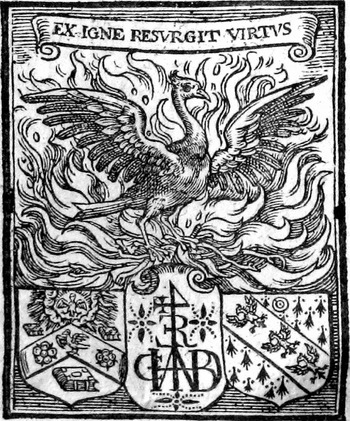
But where was such close association with Laud taking Badger and his business? The pater familias seems to have had in mind nothing short of a printing dynasty, or at least a comfortable principality. In 1632, Badger began using a new printer's device (Fig. 1) which in itself is a rather grand piece of self-aggrandizement.Footnote 81 Its iconography (a phoenix on a burning nest) and motto (‘ex igne resurgit virtvs’) are unique in English printer's devices.Footnote 82 The former is of course a traditional Christian emblem of the resurrection; with the motto, it may also allude to the Badger family's ‘resurrection’ from the great Stratford fires of 1595 and 1596, or to some unknown disaster that Badger or his trade had suffered in London itself.Footnote 83 Also striking is the monogram of ‘richard badger’, which in form is conventional, being related to tradesmen's and merchants' marks which combine their initials (or, as here, a complete anagram) and a cross. Such monograms were ubiquitous in English incunabula, but were very infrequently used after the early Elizabethan decades. There may then be some degree of conservative nostalgia in Badger's revival of it.Footnote 84 But perhaps the most interesting aspects of this device are the two heraldic shields that flank the monogram: that of the Stationers' Company (left), and of Badger (right). Given this heraldry, Badger's device may have been designed specially for his printing, for the Stationers' Company, of a fine folio of the Sternhold and Hopkins psalter (1632), where it first appears. The only problem is that neither Badger nor his family was armigerous. In fact, Badger has here poached a coat of arms from the more distinguished, but entirely unrelated, family of Bagehot alias Badger of Gloucestershire. He has, however, inserted at the top of the borrowed Badger shield a cadency mark (a rose) which signifies a seventh son, which none of the legitimate bearers of this coat of arms ever was. Perhaps he was simply trying to vary the arms from those of the legitimate bearer, or perhaps he was including an heraldic reference to the seven sons he himself had fathered. And finally, it is perhaps not insignificant that in the same year (indeed perhaps at the same time) Badger printed the heralds' vade mecum, John Guilim's A display of heraldrie.Footnote 85 At any rate, this device was a bid for prestige by Badger, whilst John and William Shakespeare were clearly not the only Stratford yeomen to construct gentle status by playing the heralds.Footnote 86
Badger's printer's device (actual size 49×59 mm), from John Buckeridge, A sermon … at the funeral (1634), appended to Lancelot Andrewes, XCVI Sermons (3rd edn, 1635; author's copy). Photo: T. Knollys.

Badger's four surviving sons – Thomas, John, George, and Richard, Jr – did enter the trade, which is not in itself unusual. For John, his father secured (with Lord Keeper Coventry's intervention) the second reversion of his beadle's place and a comfortable marriage to Elizabeth, the daughter of yet another non-printing stationer, William Crawley.Footnote 87 For Thomas, Laud again supported a Badger petition, this time for the master printer's place left vacant by the death of Thomas Purfoot.Footnote 88 In his will, Badger left to Thomas the family's Sheep Street property in Stratford, presumably inherited from his father George (d. 1635), on condition that his mother and then his wife ‘shall peaceably and quietly have and inioye the said Messuage … duringe thyre naturall lives successively’. To John he left ‘threescore pounds’. To George he left the books in both the St Dunstan's shop and those in ‘my ware house’. And to Richard he bequeathed ‘all my materiall vtensells and implem[entes] whatsoever that doe belonge vnto my Printinge house scituate in Pater noster roe’. All of his copy was to be divided evenly between Thomas and George, with the proviso that ‘the working & inprintinge of the said Coppie’ be shared equally between Thomas and Richard, and that profits be shared with their mother until her death or remarriage.Footnote 89
But since 1638, Badger's establishment in Pater Noster Row had been called something even more aspiring than the proprietor's faux-heraldry. As he described it in his will, Badger left to Richard, Jr, ‘my Printinge house … called or knowne by the name of the Princes printinge house’, and with it came ‘all the right title interest and Clayme that I nowe have … And the benifitt that shall be made of the same of or by reason of any graunte made to me by the Princes most Excellent Ma[jestie] that now is.’ The ‘graunte’ Badger mentions now lies buried in the bundles of royal warrants issued by the lord chamberlain for the household of Charles I and his family, not the usual place to find documents relating to the print trade. It simply reads, ‘A warrant to sweare Rich[ard] Badger A servant to [the] Prince his Highnes in [the] Quality of Printer. Octob 22. 1638.’Footnote 90 This in itself is remarkable: a unique instance from the print trade where a warrant for royal household service, rather than a royal patent, was issued for commercial privilege.Footnote 91 Perhaps just as striking was to appoint a household printer to an eight-year-old prince (the future Charles II). But even more intriguing than the warrant itself is the marginal note on it: ‘per Grace Cant’. That is, ‘by his Grace of Canterbury’, yet another instance of Laud somewhat creatively securing privilege for one of his own clients, this time through royal patronage. So from 1638, Badger could pair his ambitious heraldic device, which advertised alleged gentility as well as office (beadle) in the Stationers' Company, with reputation as the archbishop's printer, capped with the flourish of ‘Printer to the prince his highnes’. And, from 1640, Badger was also working in partnership with Robert Young, a fellow apprentice from Humphrey Lownes's shop, who had succeeded to the latter's business and recently been appointed king's printer for Scotland, thus giving their imprints a double-barrelled royalism: ‘Printed by R. Young, His Maiesties Printer for Scotland, and R. Badger, Printer to the Prince His Highnesse.’Footnote 92
It is easy to see why being sceptical about ‘collapsing the distinction between the publisher's personal politics and the politics of the publisher's work’ makes good common sense, but such caution may be misplaced if the only evidence used to ‘divine [a publisher's] intentions’ is his imprints alone. In a study of another printer with a strongly Laudian list in the 1630s, Nicholas Vavasour, Lesser shies away from speculation about Vavasour's personal politics because nothing in the texts he published, or their paratextual matter, explicitly states such a connection.Footnote 93 But it is in the absence of such evidence where historical (or, more exactly, biographical) research can come into play. Book trade history which focuses on printers only qua printers (or even, now, qua publishers) can stunt the biographical study of stationers, and in turn impede the recognition that stationers could have lives that were just as politically and religiously engaged as members of other professions. Put another way, arguments from imprints alone are certainly inadequate for assessing a printer-publisher's ideological convictions. But archival research can supply facts about them that, when added to a list of imprints, can yield a far more nuanced picture of the interplay between politics and economics in the book trade. Every case will be different, and, I suspect, Badger's case is an extreme one, but the biographical work presented here supports the view that he was without doubt personally invested in the politics of his Laudian publications.
But by the time of Badger's death in August 1641, the foundation on which he had built his ambitious profile was crumbling beneath him. His will's dispersal of his printing and publishing interests between his sons was anticipated by the bifurcation of the Badger ‘brand’ as those same sons began to take their freedoms and establish their own trades. George, as we have seen, was already trading as a bookseller in the family's Fleet Street premises. Both he and Richard, Jr, began to venture in publishing themselves, with various combinations of the father and sons as publisher and printer in 1640–1.Footnote 94 In retrospect, there is no little irony in the passing of ‘the Prince's Printing House’ to Richard, Jr, for he alone of the three sons made an unmistakable break with the politics of his father's publishing, or at least suppressed the royalist and Laudian associations of the printing house he inherited. His career seems to have been a short one, as a flurry of eleven imprints appeared only in 1642; of these only one is of his own publishing, and all are explicitly parliamentarian. Tellingly, having inherited all the ‘rights and privileges’ of the Prince's Printing House, neither its name nor the honorific title ‘Printer to the Prince’ ever appears on any of Richard Badger, Jr's, work, and only once does he use his father's distinctive armorial printer's device.Footnote 95 Badger's second son, John, though free of the Stationers' and married to a stationer's daughter, left no imprints and disappears from recorded sight after 1648.Footnote 96 The first and fourth sons, Thomas and George, however, seem to have inherited more of their father's political and ecclesiastical loyalties.
Thomas succeeded to both the master's place and distinguished printing house (The Lucrece, without Newgate) of Thomas Purfoot (d. 1640).Footnote 97 Thereafter his imprints show that he worked only as a trade printer. But, even keeping in mind the acceptable general caution against inferring ideological allegiances from a printer's trade work, the political homogeneity of Thomas Badger's trade titles, and the reputations of some of his publisher-stationers is suggestive. Not least, from 1640 to 1642 he was the printer of choice for nearly all publications for the royalist stationer Humphrey Moseley.Footnote 98 Thomas was also resident in the same tiny parish, St Bartholomew's-the-Less, as his father's associate Thomas Andrewes, and printed for Samuel Brown their incumbent's loyal sermon for Charles I's 1642 accession day.Footnote 99 Other religious titles printed by Thomas Badger for publishers other than Moseley or Brown were by godly authors well known as opponents of Laud – Cornelius Burges, Ephraim Udall, John Lightfoot, and Bishop Thomas Morton – yet all of these had reputations as moderates hostile to radicalism and sympathetic to a reduced form of episcopacy.
Finally, George Badger (d. 1655) had the longest life, and thus the most substantial career after his father's, including not insignificant work as a publisher. Although his list includes some overtly royalist works – David Owen's posthumous A perswasion to loyalty, or, the subiect's dutie (1642), the Shropshire assize's loyal Declaration & protestation (1642), and Sir Christopher Wyvill's Certaine serious thoughts (1647) – it is heavily dominated by the works of two clerics who epitomised moderate religion with broad appeal: Edward Reynolds (d. 1676), a ‘reconciling’ presbyterian and Restoration bishop of Norwich; and James Ussher (d. 1656), archbishop of Armagh. Not surprising to find among these titles by cautiously royalist Protestants is also the print debut of Henry Vaughan in Poems, with the tenth satyre of Iuvenal Englished (1645, 1646), and the 1650 Laudian reappropriation of Lancelot Andrewes's Pattern of catechistical doctrine (1650), printed ‘by Roger Norton’, but ‘sold by George Badger … in S. Dunstans Church yard’. For this small-paper folio, Badger redeployed the frontispiece engraved for his father's editions of XCVI sermons, thus returning a Laudian Andrewes to the Badger shop in St Dunstan's.Footnote 100
If the house of Badger was splintering in 1640–1, political events that exacerbated it were also coming thick and fast. After disastrous association with the Bishops' War in Scotland, and the disastrous canons and visitation articles of 1640 (the latter printed by Badger, of course), Laud was impeached in December 1640 and languished in the Tower from March 1641. Here, a remarkable collection of letters to Richard Baylie, the kinsman of Laud and Richard Quiney who had presumably first brought Badger into Laud's orbit, reveals the last panicked days of the printer's involvement with his Laudian Warwickshire network. Between 1639 and 1641 letters from four correspondents reached Baylie at St John's, Oxford, where he, like Laud before him, was president. One correspondent was Baylie's first-cousin Thomas Quiney, the brother of Badger's associate, Richard Quiney, and the husband of Judith Shakespeare. The others were from three of Laud's closest clients who were allied to Laud by blood through his half-siblings William and Bridget Robinson, and to Baylie through his marriage with William Robinson's eldest daughter, Elizabeth.Footnote 101 The first was William Duckett, Laud's secretary who married Sarah Robinson. Second was Edward Layfield (d. 1680), son of Laud's half-sister Bridget née Robinson, Laud's archdeacon of Essex, and his appointee-vicar of Lancelot Andrewes's birth-parish, All-Hallows Barking (‘by-the-Tower’), hence now strategically situated for ministering to the imprisoned patron.Footnote 102 The third was Dr Thomas Walker (married to Laud's niece Jane Robinson), master of University College, Oxford, canon of Wells, and rector of Somerton, Oxfordshire.Footnote 103
Like ants around a disturbed nest, these Laudian protagonists scuttled between Oxford, the west Midlands, and their imprisoned master in the Tower, relaying to Bailey their anxious concern for Laud's safety against ‘the blood crying voice of the Puritane’ with pleas of ‘make what haste you can’; ‘keepe y[our]selfe out from [the] Troubles [that] dayly arise heere’; ‘My Lord [Laud] wishes him to make what hast you can’; ‘I am now p[re]sently goeing to [the] Tower, with yo[ur] service to his Grace’. And in the midst of it all, Richard Badger played his little part. His residence near the Prince's Printing House, where his fourth and final edition of Andrewes's XCVI sermons was in press, now doubled as a safe house for the imprisoned Laud's ministering circle: ‘To [the] right Wor[shipful]: my reverend Brother Docto[r] Bayly Deane of Sarum at M[aster] Richard Badger's house in Amen-Corner these.’ And, ‘I have sent yo[ur] gown and cassock to M[aster] Badger's.’ It was also Badger's privilege to supply his employer and patron with reading material with which to pass his time in the Tower: the last entry for payment to Badger in Adam Torlesse's account books for the archbishop's household was ‘for Pamflett[es] & Books sent to yo[ur] Grace to the vijth of Iuly’.Footnote 104 Whereas Badger's father had been left holding a bag of popish relics after the Gunpowder Plot, thirty-five years later his son was left holding a bag of discredited Laudian ones.
And then, only days later, on 19 July 1641, Badger, ‘sicke and weake in bodie’, signed his last will and testament.Footnote 105 Its last bequests poignantly sum up much of his life and career: to his recusant mother ‘the some of five poundes of Current English money … and … a black ffrigadoe gounde [gown]’, and, ‘vnto my Cosin Thomas Dighton one of the B[ishop] of Winchesters workes to bee delivered to him when they are finished’. So a copy of the works of the bishop which had launched Badger's career as a Laudian publisher went to yet another ‘cosin’ (in the sense of ‘countryman’), Thomas Dighton. This Cliffords Inn lawyer, of Stratford-upon-Avon and St Dunstan's-in-the-West, himself resided in two of the places that had defined Badger's life and trade. Moreover, he was yet another cousin of Richard Quiney and Anne Quiney Baylie, and thus kin of Badger's first likely bridge to Laud, Richard Baylie.Footnote 106
The interdisciplinary combination of bibliographical, biographical, and historical research can, at least in some cases, reveal that the politics of the books of a printer-publisher might not just collapse into his own, but could be an organic manifestation of them.