Scholars have long argued that legislators gain appreciable advantages from serving on their preferred committees. Fenno (Reference Fenno1973) first identified legislators’ three main goals—achieving re-election, crafting good public policy, and securing influence in their chamber—and argued that committee memberships can help legislators achieve all of them. Scholars since Fenno have consistently found empirical evidence that legislators who receive their preferred committee assignments are more likely to win re-election (Bullock Reference Bullock1976; Crain and Sullivan Reference Crain and Sullivan1997; Fowler et al. Reference Fowler, Douglass and Clark1980; Heberlig Reference Heberlig2003; Katz and Sala Reference Katz and Sala1996; Maltzman Reference Maltzman1997; Milyo Reference Milyo1997; Shepsle Reference Shepsle1978; Smith and Deering Reference Smith and Deering1983).Footnote 1 Scholars have also argued that valuable committee assignments help legislators gain prestige and power among their colleagues as they vie for leadership positions (Fenno Reference Fenno1973; Manley Reference Manley1970; Shepsle Reference Shepsle1978), and raise more money (Dow et al. Reference Dow, Endersby and Menifield1998; Grier and Munger Reference Grier and Munger1991; Grier and Munger Reference Grier and Munger1993; Milyo Reference Milyo1997; Romer and Snyder Reference Romer and Snyder1994). While the benefits of committee assignments have been primarily studied in Congress, similar patterns have been found in state legislatures (e.g., Hedlund and Patterson 1992; Kanthak Reference Kanthak2009). Numerous scholars thus argue that membership on certain committees is instrumental in legislators’ attempts to attain re-election, achieve their policy goals, and gain influence among their colleagues.
The existence and magnitude of these advantages is important to understand for several reasons. Most importantly, leading theories of legislative politics argue that control over committee assignments is a key tool party leaders use to discipline legislators (e.g., Coker and Crain Reference Coker and Crain1994; Cox and McCubbins Reference Cox and McCubbins1993; Crook and Hibbing Reference Crook and Hibbing1985; Kanthak Reference Kanthak2004; Roberts and Smith Reference Roberts and Smith2003; Rohde and Shepsle Reference Rohde and Shepsle1973; Sinclair Reference Sinclair1995; Stratmann Reference Stratmann2000). However, endogeneity may confound existing work investigating the impacts of committee assignments on legislators’ careers: if party leaders tend to systematically place some legislators on more desirable committees, observational differences between legislators across committees may be biased estimates of the causal effect of committee membership (although see Grimmer and Powell Reference Grimmer and Powell2013).
We add to the growing literature using randomized experiments to study legislative politicsFootnote 2 with novel evidence on the causal effects of winning preferred committee assignments on legislators’ careers from the Arkansas state legislature. In Arkansas, parties play no role in making standing committee assignments; instead, legislators choose their own assignments in the order of their seniority. Crucially, for legislators who have served the same length of time, this seniority order is determined by a random lottery. Some legislators are thus randomly assigned to have a better opportunity to select their preferred assignments, a situation equivalent to randomly assigning party leaders’ intention to reward some members with access to their most preferred committee assignments and consign others to their least preferred assignments.
We exploit this randomized lottery to test whether legislators who have a more complete and higher quality slate of committee assignments to choose from gain appreciable benefits over those who are forced to accept the assignments no other legislators want. We find no evidence that legislators are more likely to attain their principal goals as a result of attaining their preferred assignments.
THE RANDOMIZED COMMITTEE LOTTERY IN ARKANSAS
The random assignment of Arkansas legislators in the committee assignment process occurs as follows. Each legislator in Arkansas’ two state legislative chambers has a seniority number, and legislators choose their own standing committee assignments in the order of this seniority number.Footnote 3 This seniority number is first determined by how long a member has served in the chamber, with the lowest numbers (and thus the first choice of committee assignments) going to those who have served longest. Crucially, however, the seniority number of legislators who have served the same length of time is randomly determined: before their first term, legislators draw numbers written on slips of paper out of a hat to determine their seniority within their freshman class. Their relative seniority within their cohort stays with them for the remainder of their time in the legislature.
Although legislators’ seniority is randomized across their entire cohort, committee assignments in the House are allotted within four separate ‘‘caucus districts’’ corresponding to the four congressional districts in Arkansas. Because only a certain pre-set number of legislators from each caucus district can sit on each committee, House members only compete with legislators in their caucus district for committee seats.
Legislators thus choose their committees in a fully randomly assigned order only within chamber-cohort-caucus groupings. We therefore compute a metric Relative Rank to capture legislators’ relative seniority of legislators within these fully randomized groupings. This Relative Rank metric gives the percentile ranking of each legislator's lottery number relative to the legislators in their year-chamber-cohort-caucus district on a 0 to 1 scale. Legislators assigned to 1 are the most senior in their year-chamber-cohort-caucus district group (and thus can select the best committee assignment available to those in their caucus district elected at the same time) and legislators with a 0 are the least senior. Likewise, a Relative Rank value of 0.5 would mean that the legislator is at the 50th percentile and chooses in the middle of her group.
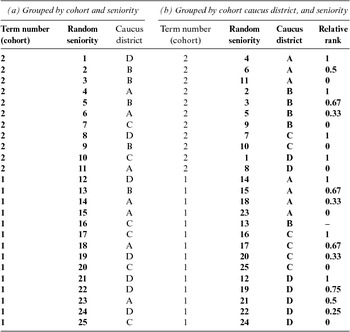
To illustrate how Relative Rank is determined, Table 1 presents a fictional 25-member Arkansas House populated with legislators in their first or second term. Note that all legislators in their first term have lower seniority numbers than the legislators in their second term, shown in part (a). The resulting Relative Rank metric is shown for our fictional legislature in part (b). Legislators are arranged in groups by their cohort and caucus district and then sorted by their randomized seniority number within these groups because legislators pick their own assignments in direct succession within these groups. Thus, for example, within caucus district A, legislator 4 would pick first, followed by legislator 6 and 11. Once the senior members finish picking, legislators 14, 15, 18, and 23 would then pick the remainder of the assignments allocated to district A.
Hypothetical Example of how Relative Rank is Computed
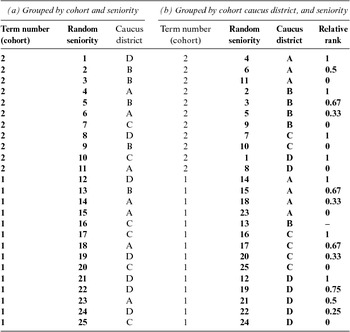
Notes: This table illustrates how Relative Rank is calculated using a hypothetical 25-member Arkansas House populated with legislators who were either just elected or are serving their second term.
In summary, we use legislators’ Relative Rank as our independent variable and analyze its effects within the fully exchangeable legislators who share the same chamber-cohort-caucus district. Note that, as a result, we do not analyze only one experiment; instead, we pool the results from a series of many smaller experiments, one in each year-chamber-cohort-caucus district group (see Table 1). For this reason, we also drop legislators who have no peers in their cohort and caucus district (such as legislator 13 in Table 1) from the analysis; these legislators have no counterfactual peers for comparison. We account for this pooling across the year-chamber-cohort-caucus district groups by including fixed effects for these groups in the analysis.
CONTRASTING RELATIVE RANK AND TYPICAL MEASURES OF LEGISLATIVE COMMITTEE ASSIGNMENT QUALITY
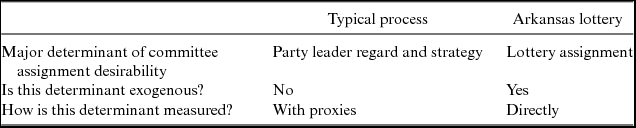
One may wonder why a committee assignment lottery in the Arkansas legislature would provide useful data for broader theories of legislative organization. Box 1 compares the determinants of the committee assignment process in Arkansas to the process elsewhere in order to illustrate the benefits of studying this question in the Arkansas context.
The Benefits of Using Arkansas to Study the Effects of Committees
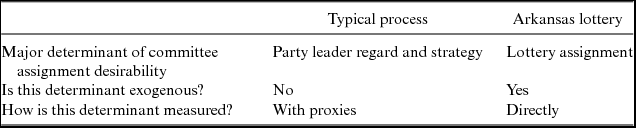
In most other legislatures, party leaders are thought to hold some legislators in higher regard than others as a result of their service and loyalty to the party. This regard cannot be measured directly and is sometimes proxied with party unity scores (e.g., Cox and McCubbins Reference Cox and McCubbins2005). Moreover, party leader regard and strategy is also endogenous to other aspects of the legislators’ career that might influence their assignment choices and legislators’ behavior, such as the safeness of legislators’ seats.
Unlike the regard party leaders have for legislators, this first stage of the assignment process (Relative Rank) is both exogenous and directly measurable in Arkansas. Although there are undoubtedly other factors that influence whether legislators achieve their goals, these factors will be uncorrelated with the assignment mechanism in our data—the randomized lottery—whereas in traditional data they may be highly correlated with the assignment mechanism—the strategic decisions party leaders make. Moreover, although party leader regard cannot be measured in other legislatures, we can observe legislators’ Relative Rank directly.
In neither Arkansas nor in other legislatures can we directly measure the desirability of each committee to each legislator. However, as with other studies, we are not ultimately interested in the average effects of legislators being assigned to particular committees; we are interested in the effect of legislators’ ability to win the assignments they want.Footnote 4 Because a chance to choose one's own assignment is randomly determined in Arkansas, we can measure the impact of legislators having a better chance of getting their preferred assignments (the first stage of the process) directly on their outcomes. This makes increases in Relative Rank similar to hypothetical exogenous increases in party leader regard we would ideally deliver in other legislatures.
ADDITIONAL CHECKS: THE DESIRABILITY OF COMMITTEES AND PRE-TREATMENT BALANCE
Although our statistical model does not rely upon measures of each committee's desirability to each legislator, the Appendix verifies that committees in Arkansas are at least meaningfully heterogeneous in their desirability to legislators (see especially Figures A1 and A2 in the supplementary Appendix).
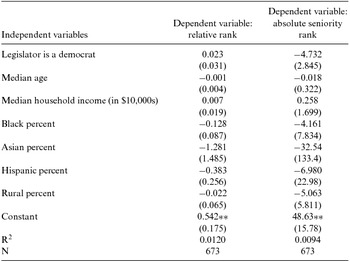
Table 2 also presents a balance check on whether the legislator's partisanship or characteristics of their districtsFootnote 5 predict either the relative rank metric or legislators’ original seniority numbers. In both cases, the pre-treatment covariates do not predict legislators’ treatment status. This gives us additional confidence that the randomization was successful and no other confounding factors lead some legislators to gain their preferred committee assignments within chamber-cohort-caucus district groupings.
Balance of Covariates across Relative Rank and Seniority Score
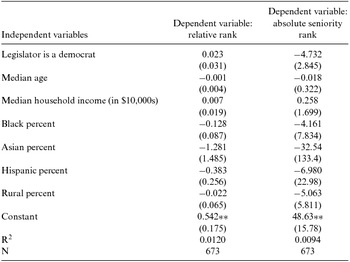
Notes: In the first column, the dependent variable is the scaled random seniority rank of each legislator within their caucus district. The variable ranges from 0 to 1, with legislators assigned to 1 as the most senior. In the second column, dependent variable is the seniority rank of each legislator within their caucus district. The variable ranges from 1 to 100 in the House and 1 to 35 in the Senate, with legislators assigned to 1 as the most senior. No results are significant at the 0.10 level.
DATA AND DEPENDENT VARIABLES
Our analysis uses 2,173 legislator-term observations from the period 1977–2011.Footnote 6 We analyze thirteen dependent variables related to three aspects of legislators’ careers and goals: legislators’ electoral success, chamber leadership, and policy productivity.
For electoral goals, we used data from Carsey et al. (Reference Carsey, Berry, Niemi, Powell and Snyder2007) and the Arkansas Secretary of State's website on whether each legislator won re-election, lost their primary re-election, lost their general re-election, ran for or won higher office, retired, was opposed in the general election, and was opposed in the primary election, as well as their general and primary election vote shares. We collected the amount of campaign money that each incumbent raised from www.followthemoney.org.
For chamber leadership, we collected data from the Arkansas Legislative Digest on whether legislators served in party or chamber leadership.
Policy productivity variables were only available for the years 2005–2008. For those years we collected data from the Arkansas Legislative Digest on the number of bills legislators filed and the number of bills they passed, a metric many other scholars have used to measure policy productivity and effectiveness.
Last, we used members’ roll call votes from 1997–2010 to measure the percentage of the time they vote with their party on roll calls where the majority of Democrats opposed the majority of Republicans (Party Unity); and the percentage of the time they vote with their party on roll calls where the majority of Democrats opposed the majority of Republicans and their party lost the vote, i.e., when the majority of their party is rolled (Party Unity (Losing Votes)).
RESULTS: ARE COMMITTEE ASSIGNMENTS VALUABLE TO LEGISLATORS?
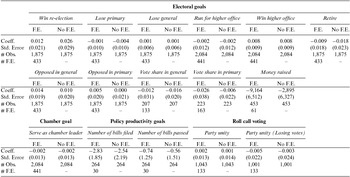
Table 3 presents the estimated benefits that legislators gain from obtaining their preferred committee assignments. In all the regressions the independent variable is Relative Rank, the scaled randomized seniority of legislators within their year-chamber-cohort-caucus district that allows them to pick from a much larger and more desirable set of committees. Because Relative Rank varies from 0 to 1, the coefficient on this variable indicates the estimated difference between the most and least senior member within each cohort—that is, between the cohort members who have the most and least choice in their assignments. These limiting cases are roughly analogous to the situations in which a hypothetical party leader wished to reward a loyal legislator with the best available committee assignment that more senior members had not already taken or, alternatively, consign a disloyal one to the last remaining assignment after all others legislators’ wishes were granted.Footnote 7
Effect of Seniority within Cohort (Relative Rank) on Outcomes of Interest (OLS)
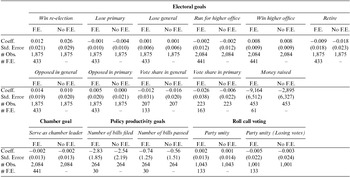
Notes: Fixed effects refer to the groups in which the randomization takes place (i.e., for each year-chamber-cohort-caucus district group). The independent variable for all regressions, relative rank, is the scaled random seniority rank of each legislator within their randomization group. The variable ranges from 0 to 1, with legislators assigned to 1 as the most senior. Coefficients represent the estimated effects of being the most senior member instead of the least senior member. No outcomes are significant at the 0.10 level. Ns differ in regressions with dependent variables for which data is not available for all years.
The dependent variables, each described in the previous section, are listed under each of the headings in Table 3. For each outcome, we present the results from a regression without any fixed effects and the results from a regression with fixed effects for year-chamber-cohort-caucus district (i.e., the groups within which the randomizations occur). Table 3 shows that legislators’ relative rank does not have a statistically significant effect on any measures of their election outcomes. Legislators who have their pick of committee assignments are not meaningfully more likely to win their primary or general election bids, raise campaign money, run for or win for higher office, deter opponents, or increase their vote share. We also find that legislators are no more likely to write nor pass bills as a result of their seniority. Further seniority does not affect legislators’ probability of becoming a party leader, nor how they vote.Footnote 8
In their totality, the results are consistent across outcomes and highly surprising in light of decades of relatively unchallenged conventional wisdom about the benefits legislators accrue from winning their preferred committee assignments. We find no statistically significant effects for a legislators’ seniority on the outcomes of interest we identified (with a generous threshold of p < 0.10). Further, our estimates are based on a large number of observations and have substantively small standard errors. For example, the 95% confidence interval for the estimate of the decreased probability that a legislator loses a general election because of their seniority extends only to 1.2 percentage points.Footnote 9
EXTERNAL VALIDITY
As with any data in the social sciences, results from this one setting are ultimately not dispositive about other contexts. For example, Arkansas implemented legislative term limits in the 1990s, which may have decreased the value of committees.Footnote 10 Similarly, one party dominated Arkansas for most of the time period under study, possibly decreasing the need for members of the majority party to secure benefits from their committee assignments.
Despite these differences, there are many ways in which the Arkansas legislature is similar to other legislatures. For example, the majority party in Arkansas exercises power that is comparable to the level of power enjoyed in other states (Anzia and Jackman Reference Anzia and Jackman2013). Similarly, committees have sole jurisdiction over large policy areas, supervise regulatory agencies, are responsible for doling out substantial sums of state money, and are de facto veto points for legislation in their jurisdiction. The committees and parties in the Arkansas legislature are similar enough to those in other legislatures that scholars should take interest in these results and consider revisiting the importance of committee assignments to legislators’ career goals. That committee assignments have large effects on legislators’ careers is a central assumption in many theories of party discipline and legislative organization, but most existing studies are unable to identify the causal effect of assignments on legislators’ success. At least in Arkansas, where persuasive causal identification is possible, legislators appear to reap at most relatively minor benefits from winning their preferred committee assignments.
SUPPLEMENTARY MATERIALS
For supplementary material for this article, please visit Cambridge Journals Online http://dx.doi.org/10.1017/XPS.2014.30.