1. Introduction
Since the financial crisis, regulation of the financial sector has undergone many changes in advanced economies. Several financial regulators have implemented macroprudential policy frameworks that envisage systematic variations of regulatory capital ratios of banks in response to changes in cyclical variations of aggregate variables. In the European Union, the European Systemic Risk Board (ESRB) has recommended that macroprudential authorities pay particular attention to the so-called credit gap (the deviation of the credit-to-GDP-ratio from a long-run trend) when setting regulatory capital buffers (European Systemic Risk Board, Reference Board2014). However, in its Recommendation, the ESRB suggests that macroprudential authorities may take into account other indicators, among them price gaps in the housing market. Out of 12 European countries that have either implemented or announced the countercyclical capital buffer (CCyB) rate increase (as of March 2019), most have cited both credit and house prices as reasons for increasing the CCyB rate.
In this paper, we investigate the effects of linking the CCyB to the credit gap or to the house price gap. We do so in a macroeconomic model of a small open economy in a monetary union, with a nontrivial financial sector. The model should be viewed as a reasonable proxy for the countries that have announced the CCyB rate in Europe. In this setting, we analyze how the CCyB affects the macroeconomic performance, riskiness of borrowers and banks, and the welfare of households. Following Beneš and Kumhof (Reference Beneš and Kumhof2015) and Jakab and Kumhof (Reference Jakab and Kumhof2015), banks in our model are subject to idiosyncratic shocks to their net return on assets, which may reduce their capital ratio below the regulatory minimum in the following quarter, in which case they face a penalty. An increase in the regulatory capital requirement therefore induces banks to restrict their lending, thus raising the cost of credit for the nonfinancial sector and providing regulators with a means to affect real activity. Furthermore, the model features spillovers from the housing market to domestic demand due to risky household borrowing from banks. We embed these features in a small open economy model to mimic a typical European country. We calibrate the model to the Irish economy by matching the sample averages of the key macroeconomic ratios in the steady state and by fitting the dynamics of responses of the model to the impulse response functions of an estimated structural Vector Autoregression (VAR) model.
Our main finding is that the optimal simple policy rule for the CCyB is based on a strong response to real house prices, but not to the credit gap. The welfare gain associated with the optimal simple rule (OSR) amounts to 0.82% of quarterly consumption in the absence of the CCyB, the bulk of which is related to lower inefficient nominal wage volatility in the presence of the CCyB. The reason why responding to house prices is beneficial is that house prices move procyclically in response to all shocks considered, so that regulatory capital is tightened when GDP increases, which limits the increase in domestic demand, while providing relief during a downturn. In contrast, the credit gap moves procyclically in response to housing demand shocks, but countercyclically in response to export demand shocks, so that linking the CCyB to the credit gap amplifies fluctuations in domestic demand in response to export demand shocks. Hence, linking the CCyB to the credit gap creates a trade-off between stabilizing fluctuations originating in the housing market and fluctuations caused by foreign demand shocks. Moreover, the CCyB rule recommended by the ESRB, which requires an increase in the CCyB once the credit gap exceeds a threshold, is very unlikely to make a difference, as it is activated only for extremely large shocks.
Our analysis adds to the existing literature by simultaneously incorporating the following five features. First, we analyze CCyB rules based on the credit gap, which is considered a good predictor of financial crises and their costs (e.g. Schularick and Taylor (Reference Schularick and Taylor2012) and Jorda et al. (Reference Jorda, Schularick and Taylor2013)), and features prominently in the ESRB Recommendation. Second, as far as we are aware, our contribution is the first to investigate CCyB rules including house prices, one of the alternative indicator variables considered in Drehmann et al. (Reference Drehmann, Borio, Gambacorta, Jimenez and Trucharte2010). Third, we examine the performance of OSRs that allow the regulator to respond to both the credit gap and house prices. We obtain these rules by searching for the optimal weights on the credit gap and the house prices in the CCyB rule that maximizes welfare in our model. Fourth, unlike Clerc et al. (Reference Clerc, Derviz, Mendicino, Moyen, Nikolov, Stracca, Suarez and Vardoulakis2015), we focus on a small open economy within a monetary union, implying that monetary policy is absent as a stabilizing factor. Regulatory policy operates under such or similar conditions not only in the euro area countries but also in those economies that peg the exchange rate. Fifth, banks perform two functions in our model, namely channeling savings from (foreign) lenders to (domestic) borrowers and meeting the liquidity preference of domestic households by supplying deposits to them. We find that this feature is important for replicating the procyclicality of nonfinancial sector credit. Importantly, we do all this in a model that we estimate by matching the model impulse responses to those of an estimated structural VAR model. The ability of our model to mimic the empirical findings makes it a good candidate to compare the welfare consequences of linking the CCyB to the credit gap and to house prices. Finally, the Irish economy underwent a boom-and-bust cycle after the adoption of the Euro. It thus provides an ideal background to analyze the performance of various policy rules for the CCyB.
Our analysis differs from some recent contributions that investigate the merit of cyclically varying loan to value ratios (e.g. Rubio and Carrasco-Gallego (Reference Rubio and Carrasco-Gallego2016), Draeger and Proano (Reference Draeger and Proano2020)) or other policy instruments (Chadha et al. (Reference Chadha, Corrado and Corrado2015)) in response to financial variables. Some papers that allow for cyclical variation of the CCyB consider policy rules based on GDP (Angelini et al. (Reference Angelini, Neri and Panetta2014) and Angeloni and Faia (Reference Angeloni and Faia2013)), while regulators tend to respond to financial variables. Christensen et al. (Reference Christensen, Meh and Moran2011), following the empirical investigation of Drehmann et al. (Reference Drehmann, Borio, Gambacorta, Jimenez and Trucharte2010), consider a rule for regulatory capital involving the credit gap, but not house prices, and their model does not feature a housing market. The only contribution incorporating the small open economy dimension is Clancy and Merola (Reference Clancy and Merola2017), who consider a more restricted set of shocks and rules. In particular, they only look at a rule based on the credit gap and do not investigate the performance of the ESRB rule or examine welfare-maximising OSRs. In contrast, Angelini et al. (Reference Angelini, Neri and Panetta2014), Lewis and Villa (Reference Lewis and Villa2016), and Beneš and Kumhof (Reference Beneš and Kumhof2015) study the optimal interaction between macroprudential and monetary policy. Among these papers, only Beneš and Kumhof (Reference Beneš and Kumhof2015) and Clancy and Merola (Reference Clancy and Merola2017) study regulatory policy in a model where credit does not merely serve the purpose of intermediating savings between borrowers and lenders. Finally, from the contributions cited above, only Angelini et al. (Reference Angelini, Neri and Panetta2014) employ an estimated model, while Beneš and Kumhof (Reference Beneš and Kumhof2015) consider only first and second moments of the data.
The paper is structured as follows: Section 2 develops the model, Section 3 describes the parametrisation, and Section 4 introduces the macroprudential rules whose performance we evaluate. Section 5 contains the main results and Section 6 concludes.
2. The model
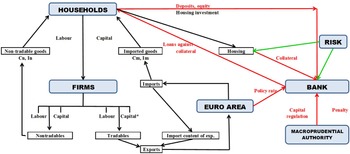
Figure 1 gives an overview of the model. The nonfinancial sector consists of households, non-tradable goods sector, and tradable goods sector. The tradable sector uses imports as inputs, a feature of many small open economies. Households consist of workers and bankers. Workers supply labor to firms and bankers use their net worth to provide equity to banks. Banks lend to and collect deposits from households and the rest of the world. All foreign capital inflows go through the banking sector. Banks are subject to minimum capital regulation, which may be time-varying. The economy is part of a currency union.
Structure of the model.

2.1 Banks
Following Gertler and Karadi (Reference Gertler and Karadi2011) and Mendicino et al. (Reference Mendicino, Nikolov, Suarez and Supera2018), some members of the household are bankers with finite working lives. With a fixed probability
 $1-\theta _b$
, they retire and transfer their accumulated net worth to the household. They are replaced by newly created bankers with ”start-up” funds equal to a fraction
 $\omega$
of total bank equity at the beginning of period
 $t$
. Aggregate bank equity at the end of period
 $t$
,
 $E_{b,t}$
equals
 \begin{equation} E_{b,t}=E_{b,t-1} R_{E,t} \theta _b+E_{b,t-1} R_{E,t}\omega =E_{b,t-1} R_{E,t} (\theta _b+\omega ), \end{equation}
where
 $R_{E,t}$
denotes the period
 $t$
return on bank equity. These assumptions capture the empirical finding that banks are reluctant or unable to raise equity outside or cut dividends when faced with higher regulatory capital requirements or higher demand for credit (Mesonnier and Monks (Reference Mesonnier and Monks2015), Gropp et al. (Reference Gropp, Mosk, Ongena and Wix2019) and Jimenez and Ongena (Reference Jimenez and Ongena2017)) so that banks never become fully self-financing. A bank’s balance sheet constraint is given by:
 \begin{equation} L_t = D_t + B_t + E_{b,t}. \end{equation}
where
 $D_t$
are domestic deposits,
 $B_t$
are foreign deposits, and
 $L_t$
are loans to households.
Following Beneš and Kumhof (Reference Beneš and Kumhof2015) and Jakab and Kumhof (Reference Jakab and Kumhof2015), we assume that an individual bank’s net return on assets is subject to idiosyncratic shocks so that its return on assets may differ from the banking industry average
 $\widetilde{R_{t}}$
. These shocks may represent above-average exposures to bad loans, or losses from trading activities not explicitly modeled. An individual bank’s
 $t+1$
total revenue is therefore
 $\widetilde{R_{t+1}}\omega _{b,t+1}L_t$
, where
 $\omega _{b,t+1}$
is a lognormally distributed i.i.d. random variable with mean 1 and variance
 $var(log(\omega _{b,t+1}))=\sigma _b^2$
. Its density and cumulative density functions are
 $\phi (\omega _{b,t+1})$
and
 $\Phi (\omega _{b,t+1})$
, respectively.
A bank’s expenditure consists of the repayment of its debt liabilities with interest,
 $R_{t}(B_t + D_{t})$
, and the potential penalty if, as a result of an adverse idiosyncratic shock, its capital ratio
 $L_t/E_{b,t}$
falls short of the minimum capital requirement
 $g_t$
, set by the regulator. This penalty represents all costs of “being caught” as badly capitalized and may include regulatory penalties, the damage to the brand, and the dilution of shareholder value associated with recapitalization at low share prices. Formally, a bank has to pay a fraction
 $\chi _b$
of its total assets
 $L_t$
, if
 $\omega _{b,t}\widetilde{R_{t}} L_{t-1} - R_{t-1} (B_{t-1} + D_{t-1}) \lt \omega _{b,t} g_{t-1} \widetilde{R_{t}} L_{t-1}$
, where
 $R_t$
is the deposit rate. The threshold value of
 $\omega _{b,t}$
where a bank becomes undercapitalized is defined as:
 $\overline{\omega _{b,t}} \equiv (R_{t-1} (B_{t-1} + D_{t-1}))/((1-g_{t-1}) \widetilde{R_{t}} L_{t-1})$
.
To obtain a bank’s maximization problem, we first use the bank’s balance sheet identity (equation (2)) to eliminate
 $B_t+D_t$
in the expression for
 $\overline{\omega _{b,t}}$
and in the expression for bank expenditure. We then use the assumption that
 $\omega _{b,t+1}$
is i.i.d. with the expected value of 1 to obtain the following bank optimization problem:
 \begin{equation*} \max _{L_{t}} \mathbb {E}_t\bigg \{ \beta \frac {\Lambda _{t+1}}{\Lambda _{t}}\left [ \widetilde {R_{t+1}} L_{t} - R_{t}(L_t - E_{b,t}) - \chi _b L_{t} \Phi \left (\frac {R_{t} (L_t - E_{b,t})}{(1-g_{t}) \widetilde {R_{t+1}} L_{t}}\right ) \right ]\bigg \}, \end{equation*}
where
 $ \beta \frac{\Lambda _{t+1}}{\Lambda _{t}}$
is the households’ stochastic discount factor.Footnote 1 The bank’s first-order condition with respect to loans determines the expected return on the banks loan portfolio
 $\mathbb{E}_t \widetilde{R_{t+1}}$
consistent with the loan supply
 $L_t$
:
 \begin{equation} \mathbb{E}_t \left \{ \beta \frac{\Lambda _{t+1}}{\Lambda _{t}}\left [\widetilde{R_{t+1}} - R_t\right ]\right \} = \mathbb{E}_t \left \{ \beta \frac{\Lambda _{t+1}}{\Lambda _{t}} \chi _b \left ( \Phi (\overline{\omega _{b,t+1}} )+ \phi (\overline{\omega _{b,t+1}} ) \frac{R_t \frac{E_{b,t}}{L_t}}{(1-g_t) \widetilde{R_{t+1}}} \right )\right \}. \end{equation}
The average net return on assets must compensate the bank for any expected losses associated with bankruptcy so that the actual lending rate
 $ R_{L,t}$
has to satisfy the following equation:
 \begin{equation} \mathbb{E}_t \bigg \{ \widetilde{R_{t+1}} - R_{L,t}\left ( 1-\lambda \mathbb{E}_{t}\left (J_{t+1}\right ) \right ) = 0 \bigg \}, \end{equation}
where
 $J_{t+1}$
is the expected share of defaulting household loans and
 $\lambda$
is the loss given default (LGD).Footnote 2 Equations (3) and (4) imply that to increase its lending by one unit, the expected net return on assets
 $\widetilde{R_{t+1}}$
has to compensate the bank for its cost of funds
 $R_t$
and the expected increase in the risk of ending up uncapitalized in period
 $t+1$
due to higher leverage. The lending rate has to be such that after deducting all default costs, the bank expects to earn
 $\widetilde{R_{t+1}}$
. The bank capital ratio at the end of the period will therefore typically exceed the regulatory minimum. The regulator can increase the costs of funds of the nonfinancial sector by raising
 $g_t$
and thus increasing the expected penalty associated with a given leverage. Unless stated otherwise, we assume
 $g_t=gmin\gt 0$
.
The return on equity is defined as
 $R_{E,t} \equiv R_{t-1} + (\widetilde{R_{t}} - R_{t-1}) \frac{1}{el_{t-1}} - \chi _b \frac{1}{el_{t-1}} \Phi (\overline{\omega _{b,t}})$
, where
 $el_t = \frac{E_{b,t}}{L_t}$
is the bank capital ratio. The first term is the riskless rate, the second term is the spread earned on the loan portfolio (scaled by the bank leverage), and the last term is the penalty paid in case minimum capital requirements are breached.
2.2 Households
2.2.1. Utility and budget constraints
We assume a continuum of optimizing households indexed by
 $j$
. Household
 $j$
derives utility from consumption
 $C_{j,t}$
, real bank deposits
 $D_{j,t}/P_{t}$
, and housing
 $H_{j,t}$
, and disutility from the labor
 $N_{j,t}$
supplied by its worker-members:
 \begin{equation} \mathbb{E}_{t}\sum _{i=0}^{\infty }\beta ^{i}\left [\frac{\left (C_{j,t+i}-\chi C_{t+i-1}\right )^{1-\sigma }}{\left (1-\chi \right )^{-\sigma }(1-\sigma )}-\phi _{N}\frac{N_{j,t+i}^{1+\eta }}{1-\eta }+\varepsilon _{H,t}\frac{\zeta _{H,t}H_{j,t}^{1-\nu }}{1-\nu }+\zeta _{D}\frac{\left (\frac{D_{j,t+i}}{P_{t+i}}\right )^{1-\iota }}{1-\iota }\right ], \end{equation}
where
 $\beta$
and
 $\chi$
are the discount factor and the degree of habit formation, respectively,
 $\sigma$
,
 $\eta$
,
 $\nu$
, and
 $\iota$
are curvature parameters, and
 $P_{t}$
is the price level of the consumption basket
 $C_{j,t}$
.
 $\zeta _{H,t}$
is a shock to housing preferences.Footnote 3 Household
 $j$
earns
 $R_{K,t}$
on capital
 $K_{j,t-1}$
,
 $R_{t}$
on deposits
 $D_{j,t-1}$
, receives profits
 $\Pi _{j,t}$
of the monopolistically competitive firms and net worth of retiring bankers
 $(1-\theta _{b})R_{E,b,j,t}E_{b,j,t-1}$
. It provides new bankers with total start-up funds
 $\omega R_{E,b,j,t}E_{b,j,t-1}$
. Households can sell housing stock
 $H_{j,t-1}$
at price
 $P_{H,t}$
and borrow
 $L_{j,t}$
. The households’ debt repayment is given by:
 \begin{equation} \left (1-{\unicode[Times]{x1D7D9}}_{j,Def}\right )R_{L,t}L_{j,t-1}+{\unicode[Times]{x1D7D9}}_{j,Def}\left (\lambda R_{L,t}L_{j,t-1}+DefCost_{t}\right ) \end{equation}
where
 ${\unicode[Times]{x1D7D9}}_{j,Def}$
is an indicator function that takes the value of one in case of default and zero otherwise. Hence in case of default, the household has to repay only a fraction
 $\lambda$
of its liabilities, but also faces default costs,
 $DefCost_{t}$
, which can be thought of as the legal and reputational costs associated with default.Footnote 4 We assume that
 $DefCost_{t}$
represents a transfer to other households and affects only the distribution of resources (but not production). Moreover,
 $DefCost_{t}=\left (1-\lambda \right )R_{L,t}L_{j,t-1}$
so that the total costs associated with households’
 $t-1$
debt equal
 $R_{L,t}L_{j,t-1}$
regardless of default. The households’ budget constraint is thus given by:
 \begin{align} &P_{t}C_{j,t}+P_{I,t}I_{j,t}+P_{H,t}H_{j,t}-L_{j,t}+D_{j,t}\left [1+\frac{1}{2}\xi _{D}\Omega _{D,t}\right ]=\nonumber \\ &\quad =W_{t}N_{j,t}\left [1-\frac{1}{2}\xi _{W}\Omega _{W,t}\right ]+R_{K,t}K_{N,j,t-1}+P_{H,t}H_{j,t-1}+(1-\theta _{b}-\omega )R_{E,b,j,t}E_{b,j,t-1}-R_{L,t}L_{j,t-1}\nonumber\\ &\qquad +R_{t}D_{j,t-1}+\Pi _{j,t}-\Omega _{N,t}-\Omega _{M,t}-\Omega _{E,t}-\Theta _{j,t}. \end{align}
where
 $\Theta _{j,t}$
is lump sum tax, and
 $\Omega$
are adjustment costs.Footnote 5 Capital
 $K_{N,t}$
denotes non-tradable sector capital and is determined in the aggregate by:
 \begin{equation} K_{N,t}=\left (1-\delta \right )K_{N,t-1}+I_{t}\left (1-\frac{1}{2}\xi _{I}\Omega _{I,t}\right ), \end{equation}
where
 $\Omega _{I,t}\equiv (\log (I_{t}/I_{t-1})^{2}$
and
 $\xi _{I}\geq 0$
is the curvature of the adjustment cost function. We assume that physical capital in the non-tradable sector is exogenous.
2.2.2. Household default
Housing wealth of households is subject to idiosyncratic shocks
 $\omega _{h,j,t}$
. Households default if their housing is worth less than their debt
 $R_{L,t-1}L_{j,t-1}$
:
 \begin{equation} \exp \left (\omega _{h,j,t}\right )H_{j,t-1}P_{H,t}\lt L_{j,t-1}R_{L,t-1}, \end{equation}
and
 $\omega _{h,j,t}\sim N\left (0,\sigma _{h}\right )$
. The default threshold for
 $\omega _{j,t}$
and the default probability
 $J_{j,t}$
are
 \begin{equation} \overline{\omega _{h,j,t}}=\log (L_{j,t-1}R_{L,t-1}/(H_{j,t-1}P_{H,t})), \end{equation}
 \begin{equation} J_{j,t}=\Phi \left (\frac{\overline{\omega _{h,j,t}}}{\sigma _{h}}\right ), \end{equation}
where
 $\Phi \left (\bullet \right )$
is the standard normal c.d.f. and
 $\sigma _{h}$
is the idiosyncratic risk of households. After
 $\omega _{h,j,t}$
materializes and some households default, resources are redistributed between households so that their housing wealth is identical before they make their consumption and saving decisions, so we can drop the
 $j$
subscript. Combining equations (12), (13) and (4) yields a closed relationship between the lending rate, borrowing, and housing. This relationship represents the menu of choices offered to the household by the bank, from which the household will choose the optimal combination:
 \begin{equation} R_{L,t}=\frac{\mathbb{E}_{t}\widetilde{R_{t+1}}}{\left (1-\lambda \mathbb{E}_{t}\left (\Phi \left (\frac{\overline{\omega _{h,t+1}}}{\sigma _{h}}\right )\right )\right )} \end{equation}
The assumption of a fixed LGD
 $\lambda$
simplifies a bank’s participation constraint compared to, for example, Clerc et al. (Reference Clerc, Derviz, Mendicino, Moyen, Nikolov, Stracca, Suarez and Vardoulakis2015).Footnote 6
2.2.3. First-order conditions
The Lagrange multiplier on the budget constraint (equation (9)) is
 $\Lambda _{t}$
and the Lagrange multiplier on the interest rate constraint (equation (14)) is
 $\Lambda _{R_{L},t}$
. The first-order conditions with respect to
 $C_{t}$
,
 $L_{t}$
,
 $R_{L,t}$
,
 $D_{t}$
,
 $H_{j,t}$
,
 $I_{t}$
, and
 $K_{N,t}$
imply (where we have imposed a symmetric equilibrium, which is why we can omit the
 $j$
-subscripts):
 \begin{equation} \Lambda _{t}P_{t}=\left (1-\chi \right )^{\sigma }\left (C_{t}-\chi C_{t-1}\right )^{-\sigma }, \end{equation}
 \begin{equation} \Lambda _{t}=\beta \mathbb{E}_t \bigg \{\Lambda _{t+1}\left (R_{L,t}+\frac{dR_{L,t}}{dL_{t}}\left (\overline{\omega _{h,t+1}},L_{t}\right )L_{t}\right )\bigg \} \end{equation}
 \begin{equation} \frac{\Lambda _{R_{L},t}}{\Lambda _{t}L_{t}}\left (1-\lambda \mathbb{E}_t(J_{t+1})-\lambda \mathbb{E}_t\left (\frac{\phi (\overline{\omega _{h,t+1}})}{\sigma _{h}}\right )\right )=\beta \mathbb{E}_t\bigg \{\frac{\Lambda _{t+1}}{\Lambda _{t}}\bigg \}, \end{equation}
 \begin{equation} D_{t}^{-\iota }P_{t}^{\iota -1}\zeta _{D}\frac{1}{\Lambda _{t}}=1-\beta \mathbb{E}_t \bigg \{ R_{t}\frac{\Lambda _{t+1}}{\Lambda _{t}}\bigg \}+\xi _{D}\Omega '_{D,t}, \end{equation}
 \begin{align} P_{H,t}=\varepsilon _{H,t}\zeta _{H,t}\frac{H_{t}^{-\nu }}{\Lambda _{t}}+\beta \mathbb{E}_t \bigg \{\frac{\Lambda _{t+1}}{\Lambda _{t}}\left (P_{H,t+1}+\frac{dR_{L,t}}{dH_{t}}\left (\overline{\omega _{h,t+1}},H_{t}\right )L_{t}\right )\bigg \} \end{align}
 \begin{align} P_{I,t}=P_{K,t}\left [1-\frac{\xi _{I}}{2}\Omega _{I,t}-\xi _{I}\Omega '_{I,t}\right ]+\beta \mathbb{E}_t \bigg \{\frac{\Lambda _{t+1}}{\Lambda _{t}}P_{K,t+1}\xi _{I}\Omega '_{I,t}\frac{I_{t+1}}{I_{t}}\bigg \}, \end{align}
 \begin{equation} P_{K,t}=\beta \mathbb{E}_t \bigg \{\frac{\Lambda _{t+1}}{\Lambda _{t}}\left (\left (1-\delta \right )P_{K,t+1}+R_{K,t+1}\right )\bigg \}. \end{equation}
Due to the cost of default, equation (16) differs from a conventional consumption Euler equation because of the presence of the
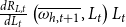 $\frac{dR_{L,t}}{dL_{t}}\left (\overline{\omega _{h,t+1}},L_{t}\right )L_{t}$
term. This term represents the increase in the households interest rate burden on his existing stock of borrowing, where
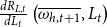 $\frac{dR_{L,t}}{dL_{t}}\left (\overline{\omega _{h,t+1}},L_{t}\right )$
is the effect of an increase in borrowing
 $L_{t}$
on the loan rate
 $R_{L,t}$
(holding
 $H_{t}$
constant) implied by a bank’s participation constraint (14).
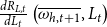 $\frac{dR_{L,t}}{dL_{t}}\left (\overline{\omega _{h,t+1}},L_{t}\right )$
is positive because higher borrowing implies a higher risk of default in period
 $t+1$
. Correspondingly,
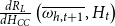 $\frac{dR_{L}}{dH_{CC}}\left (\overline{\omega _{h,t+1}},H_{t}\right )$
denotes the implied (negative) effect of an increase in the housing stock on the loan rate (holding
 $L_{t}$
constant). In equilibrium,
 $H_{j,t}=H$
.Footnote 7 For household optimality conditions for labor supply and wage setting, see Appendix D.1.
2.3 Firms
The model has four sectors (see Appendix D.2). The final goods sector combines non-tradable and imported goods to produce consumption and investment goods. Importers sell goods to final goods firms at a markup over the world price. The non-tradable sector produces using domestic capital and labor. The export sector produces using domestic capital, labor, and imported intermediate goods, which accounts for the substantially higher import content of exports in small open economies. Capital in the tradable sector is exogenous, because a large part of exporters in Ireland are foreign-owned multinationals, and some profits of the tradable sector are transferred abroad, which helps the model to match the Irish export surplus.
2.4 International capital flows
The bank deposit rate is linked to the foreign interest rate
 $R_{W,t}$
by:
 \begin{equation} R_{t} = \theta _B \left ( \frac{B_{t}}{Y_{t}} - \zeta \right ) R_{W,t}, \end{equation}
where the first term on the right denotes a country risk premium, which depends positively on the deviation of the foreign-debt-to-GDP ratio from its steady state value
 $\zeta \equiv \overline{B}/ \overline{Y}$
, with a sensitivity
 $\theta _B$
. This assumption ensures the stationarity of foreign deposits
 $B_{t}$
that evolve according to
 \begin{equation} B_{t} =R_{t-1}B_{t-1}-TB_{t} + \Gamma _{t}, \end{equation}
where
 $TB_{t}$
and
 $\Gamma _{t}$
denote the trade balance and profits transferred abroad by foreign-owned exporters, respectively. If
 $X_{t}$
are exports,
 $P_{X,t}$
the price of exports,
 $M_{t}$
are imports, and
 $P_{M,t}$
the price of imports, then the trade balance is given by:
 \begin{equation} TB_{t} =P_{X,t}X_{t}-P_{M,t}M_{t}. \end{equation}
For the purpose of taking the model to the data below, we assume that the percentage deviation of the exogenous foreign interest rate from its steady state
 $\hat{R}_{W,t}$
is the sum of a monetary policy component
 $\hat{R}_{m,t}$
and a “global credit supply” component
 $\hat{R}_{cs,t}$
:
 \begin{equation} \hat{R}_{W,t} =\hat{R}_{m,t}+\hat{R}_{cs,t}. \end{equation}
3. Estimation and model validation
We bring the model to the data using a combination of calibration and estimation by separating model parameters in three groups. The first group is calibrated based on the literature and other considerations. The second group is calibrated to match the steady state. The third group is estimated by matching model impulse responses to those of an estimated structural VAR.
In the first group of parameters, we set the inverse of the Frisch elasticity of labor supply,
 $\eta$
, to 2, assume log utility (
 $\sigma =1$
), and set
 $\nu$
to 1.Footnote 8 We assume Cobb–Douglas preferences over imported and domestic consumption and investment goods, and we set the minimum capital requirement,
 $gmin$
, to 8%, in line with the Basel II rules. Demand elasticities of the individual varieties in the labor, non-tradable, tradable, and import CES baskets are set to 11, implying steady state markups of 1.1. The price elasticity of exports,
 $\eta _{X}$
, is the average of available micro- and macro-evidence for Ireland (see CorboandOsbat (Reference Corbo and Osbat2012) and Bredin et al. (Reference Bredin, Fountas and Murphy2003)), and we set the price elasticity of imports to one. The depreciation rate of capital is
 $\delta =0.04\%$
, and the elasticity of the risk premium on domestic deposits over the world interest rate is
 $\theta _B=0.0001$
. The only evidence for LGD in Ireland,
 $\lambda$
, covers the years 2014 and 2015. We set
 $\lambda$
equal to the 2014 value for mortgages.Footnote 9 Finally, we set the degree of investment adjustment costs
 $\xi _{I}=2$
, which allows us to match the standard deviation of investment relative to domestic demand, conditional on the calibrated and estimated parameters (see Appendix B).
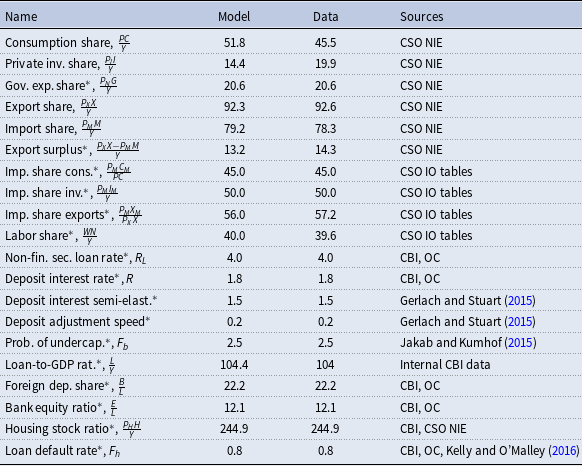
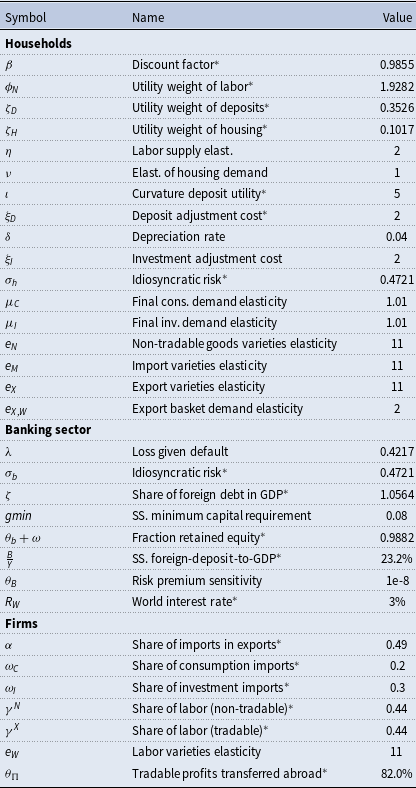
The second set of parameters are calibrated by matching the steady state values of a number of model variables, following for example, Bernanke et al. (Reference Bernanke, Gertler and Gilchrist1999), Nolan and Thoenissen (Reference Nolan and Thoenissen2009), Christiano et al. (Reference Christiano, Motto and Rostagno2014), and Rannenberg (Reference Rannenberg2016). The targets include deposit and loan interest rates for the non-financial sector, information on bank funding, and the ratio of non-financial sector loans and the value of the housing stock to GDP.Footnote 10 Parameters used to match calibration targets in Table 1 are listed in Table 2 and marked by asterisks.
Steady state values of important variables and their counterparts in the data

Notes: All values are in %. CSO = Central Statistical Office; NIE = National Income and Expenditure, IO = Input-Output. OC = own calculations. All target and model values are annual levels. As the model is quarterly ratios involving a division of stock with a (quarterly) flow (e.g. housing stock-to-GDP ratio) in the model have to be multiplied by 4. Details of the calculations are available upon request. Asterisks denote target values.
Calibrated parameters
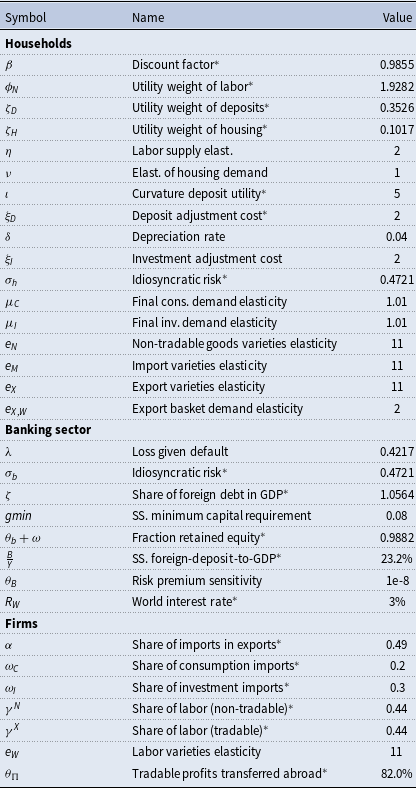
Parameters denoted with an asterisk are implicitly calibrated in order to support targets listed in Table 1, as well as
 $P_{N}=1$
.
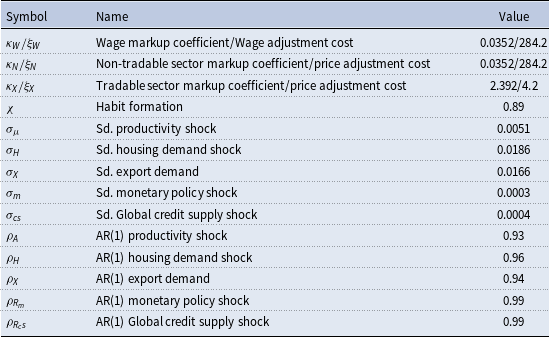
We estimate the third group of parameters by matching the Impulse Response Functions (IRFs) of the model with the IRFs of an identified BVAR model (see Altig et al. (Reference Altig, Christiano, Eichenbaum and Linde2011)). This group includes habit formation, the degree of investment, wage and price adjustment costs, and the persistence and standard deviations of shocks. The VAR includes real loans to the nonfinancial sector, real house prices, real exports, a measure of real domestic demand, the corresponding deflator, the Euro OverNight Index Average (EONIA) as a measure of
 $\hat{R}_{m,t}$
(see equation (25)), and, following Ben Zeev (Reference Ben Zeev2019), the Excess Bond Premium (EBP) of Gilchrist and Zakrajšek (2012) as a measure of the global credit supply shock
 $\hat{R}_{cs,t}$
.Footnote 11 Furthermore, we use an estimate of trend total factor productivity by the European Commission (see Planas and Rossi (Reference Planas and Rossi2018)) as a counterpart of total factor productivity of firms in the model. The sample period is 1999Q1–2016Q4.
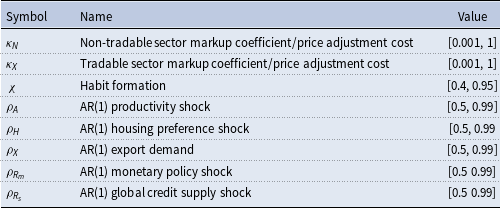
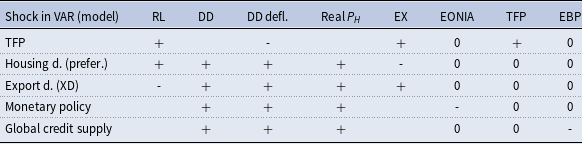
We identify five shocks, namely shocks to Total Factor Productivity (TFP), housing demand, export demand, monetary policy, and global credit supply, by using a range of exogeneity restrictions and by placing sign restrictions on the IRFs. Specifically, we assume that both the EONIA and EBP are block exogenous with respect to all Ireland-specific variables, which follows directly from the small open economy assumption, and that EBP contemporaneously affects the EONIA but not vice versa. Second, we assume that Irish TFP is fully exogenous. Finally, following Peersman and Straub (Reference Peersman and Straub2009), we derive further robust theory-consistent sign restrictions by simulating the model IRFs for a wide range of values of the parameters to be estimated.Footnote 12 We assume that the parameters are uniformly distributed over the intervals reported in Table 3. The intervals of the AR(1) coefficients of the shocks are taken directly from Peersman and Straub (Reference Peersman and Straub2009). Furthermore, similar to Peersman and Straub (Reference Peersman and Straub2009), the intervals for the coefficients on the negative of the price markup in the (linearised) price Phillips curves of the non-tradable and tradable sectors (i.e.
 $\kappa _n$
and
 $\kappa _x$
) range from extremely rigid to extremely flexible prices. The interval for the degree of habit formation ranges from very little to almost complete habit formation. However, our results are robust to assuming tighter intervals informed by recent estimates of Dynamic Stochastic General Equilibrium (DSGE) models on euro area data (see Appendix A). Since we cannot separately identify the degrees of nominal wage and price rigidity in the estimation, both during the simulation exercise and the estimation using IRF matching, we impose that the response of wage inflation to a decline in the wage markup equals the response of non-tradable goods price inflation to a decline in the price markup, that is,
 $\kappa _n=\kappa _w$
.
Model parameter ranges in the simulation excercise

Note: All parameters listed in the table are assumed to be uniformly distributed over the reported intervals. The markup coefficient of a sector
 $i$
 $\kappa _i$
is the coefficient on minus the percentage deviation of the markup from its steady state obtained after linearizing the respective price (or wage) setting equation. The relationship between
 $\kappa _i$
and sector
 $i$
’s price (or wage) adjustment cost
 $\xi _{i}$
is given by
 $\xi _{i}=1/(\kappa _i*(\mu _i-1))$
, where
 $\mu _i$
denotes the steady state markup in sector
 $i$
.
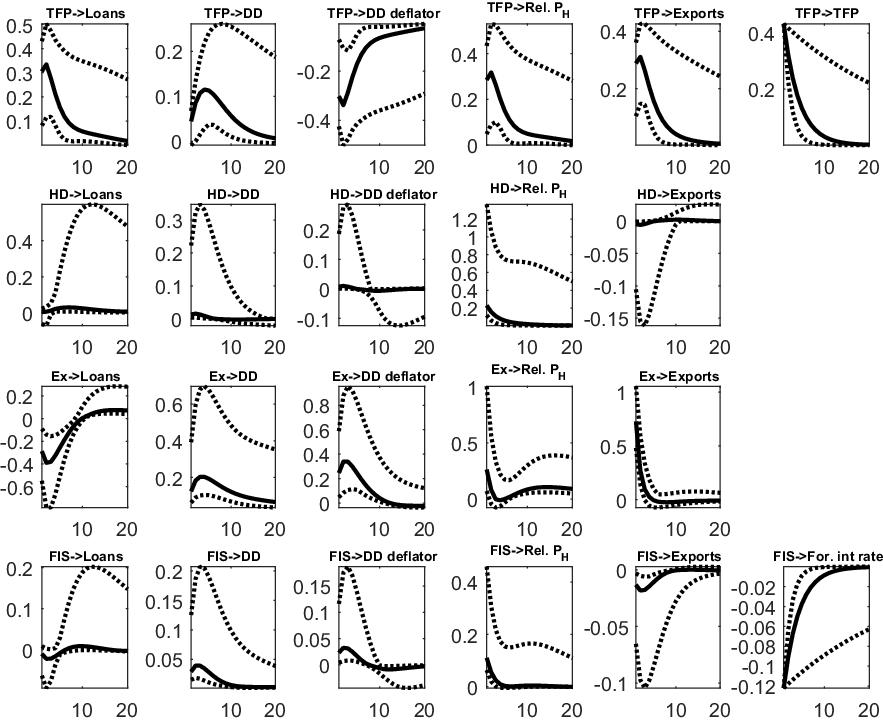
Figure 2 displays the 90% confidence bands of the resulting simulated IRFs. Since the global credit supply shock and the monetary policy shock are both shocks to the foreign interest rate and thus observationally equivalent in the model, they give rise to the same IRF confidence bands, reported in row four under the label “foreign interest rate shock” (FIS). All shocks are signed to trigger an increase of domestic demand on impact, with the exception of the TFP shock, which represents a TFP improvement, but where the impact response of domestic demand may be negative for a small number of parameter combinations.
Theoretical impulse response functions.
Notes: The figure reports the results of simulating the model IRFs for 1,000,000 draws of the model parameters to be estimated. The parameters are assumed to be uniformly distributed over the intervals reported in Table 3. The solid line denotes the median response, while the dotted lines denote 90% confidence intervals. DD denotes modified domestic demand. FIS = “Foreign Interest rate Shock”.

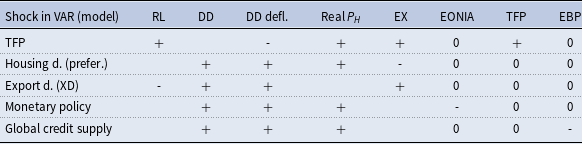
We use this simulation result to impose sign restrictions in our VAR as follows: if the confidence band of the response of a given variable to a given shock meets a sign restriction for at least the first three periods, we impose that restriction during the first three periods in the estimation of the VAR. An exception are the responses of exports to the shocks triggering a decline in the foreign interest rate. In the model, the effect of this shock on exports is strictly negative as the associated increase in domestic demand raises wages and prices, thus making exports less competitive. However, our empirical counterparts—the monetary policy and global credit supply shock—are international expansionary shocks which are likely to have a positive effect on the foreign demand for Irish exports at a given export price, which we do not model. Hence, the overall effects of these shocks on exports would be a priori ambiguous. Therefore, we do not restrict them when identifying the VAR. The resulting sign restrictions are summarized in Table 4.Footnote 13 For the estimation, we use the BEAR toolbox (Dieppe et al. Reference Dieppe, Legrand and van Roye2016).Footnote 14
We collect the model parameters to be estimated in the vector
 $\zeta _{par}$
, whose values we choose in order to minimize the criterion function:
 \begin{equation*} (\hat {\Psi }-\Psi (\zeta _{par}))'V^{-1}(\hat {\Psi }-\Psi (\zeta _{par})), \end{equation*}
where
 $\hat{\Psi }$
is the vector of IRFs from the VAR,
 $\Psi (\zeta _{par})$
are IRFs from the model, and
 $V$
is the diagonal weighting matrix based on the variance of each point of the IRF. This matrix attaches a higher weight to more precisely estimated points of the IRFs.Footnote 15 We compute the model IRFs using a constant minimum capital requirement
 $g_t$
, since there was no CCyB in place during the sample period.
Matrix of sign restrictions

Note: In the estimation, the sign restriction is always applied to the first three elements of the IRF of the respective variable to the respective shock. An exception is the response of the EONIA, where the restriction applies on impact. RL stands for real NFS loans, DD is domestic demand, EX are exports.
Estimated parameters

Note: We imposed an upper bound on the AR(1) coefficients of 0.99 and a lower bound on the price markup coefficients of 0.005. The markup coefficient of a sector
 $i$
 $\kappa _i$
is the coefficient on minus the percentage deviation of the markup from its steady state obtained after linearizing the respective price (or wage) setting equation. The relationship between
 $\kappa _i$
and sector
 $i$
’s price (or wage) adjustment cost
 $\xi _{i}$
is given by
 $\xi _{i}=1/(\kappa _i*(\mu _i-1))$
, where
 $\mu _i$
denotes the steady state markup in sector
 $i$
.
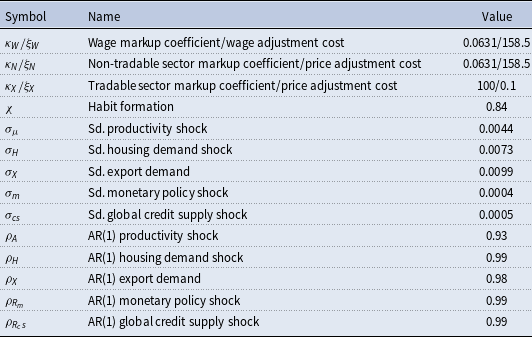
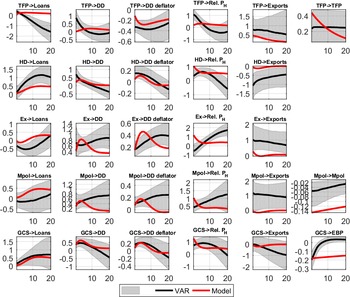
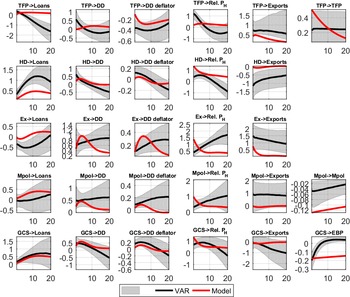
Table 5 reports the estimated parameters. We find that export prices are essentially flexible, in line with the euro area estimates by Coenen et al. (Reference Coenen, Straub and Trabandt2013), and significant external habit formation. Appendix B shows that the model is able to replicate second moments of a number of important variables not included in the VAR. We also show that the preference of households for bank deposits is important for replicating the procyclicality of nonfinancial sector credit observed in the data. Figure 3 displays the responses of the model and the VAR to the four identified shocks.
VAR and model IRFs.
Notes: Impulse response functions of the model and the impulse responses in the VAR to the identified shocks. Shaded areas denote 68% confidence intervals. DD: Modified domestic demand. GCS: Global Credit Supply shock.

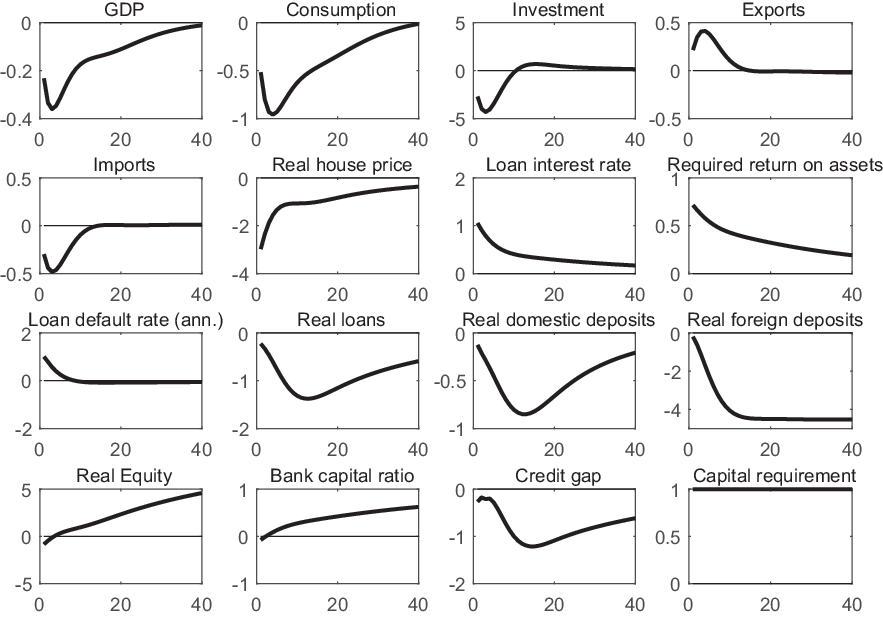
A mechanism at the heart of the assessment of different rules for the CCyB is the effect of a change in the capital requirement on domestic demand and GDP. To verify the calibration of the model, we simulate the effect of a permanent one p.p. increase in the minimum capital requirement and compare the results to a set of studies (Basel Committee for Banking Supervision, 2010).Footnote 16 An increase in the minimum capital requirement increases the risk of a capital shortfall and thus the expected associated penalty, so they reduce loan supply and increase lending rates (Figure 4). The higher cost of borrowing depresses domestic consumption and investment, causing a decline of GDP of 0.3% at the trough. The decline in domestic demand reduces wages, which leads to an improvement of the current account. The increase in the marginal utility of consumption and the stronger discounting of the utility from owning the house due to a higher lending rate both lower the demand for housing and thus the house price. The house price decline results in a lower value of collateral and an increase in defaults. The improvement in the current account and the drop in house prices are reflected both in lower borrowing of households from banks and in lower borrowing of banks from abroad. The increase in the lending rate increases the revenues of banks, which gradually raises their equity.Footnote 17 The bank capital ratio slowly approaches the new regulatory ratio and the marginal cost of lending declines, allowing domestic demand and house prices to recover. Importantly, the GDP response to an increase in capital requirements is in line with the literature. The response of output is of similar magnitude as that considered in Slovik and Cournéde (Reference Slovik and Cournéde2011) and close to the median of the range of model responses considered in Basel Committee for Banking Supervision (2010).Footnote 18
Permanent increase in minimum capital requirements.
Notes: Impulse responses to a permanent increase in minimum capital by 1 p.p. All variables are in percentage deviations from the steady state, except interest rates, default rate, and required return on assets, which are in annualized percentage-point deviations, and the bank capital ratio, the credit gap, and the minimum capital requirement, which are in percentage-point deviations. House prices, loans, domestic and foreign deposits and equity are deflated using the consumption price deflator.

4. CCyB rules and welfare
We consider a simple linear rule which relates the minimum capital requirement faced by banks,
 $g_{t}$
, to the credit gap,
 $gap_{t}$
, and the house price gap,
 $price\ gap_{t}$
:
 \begin{equation} g_{t}=8\%+\psi _{L}\cdot gap_{t}+\psi _{P_{H}}\cdot price\ gap_{t}, \end{equation}
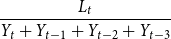
 \begin{equation} gap_{t}=\left (\frac{L_{t}}{Y_{t}+Y_{t-1}+Y_{t-2}+Y_{t-3}}-\frac{\overline{L}}{4\cdot \overline{Y}}\right ), \end{equation}
 \begin{equation} price\ gap_{t}=\frac{P_{H,t}/P_{t}-\overline{P_{H}}/P}{\overline{P_{H}}/P}. \end{equation}
The definition of the credit gap follows the recommendation of the ESRB.Footnote 19
We perform a grid search for a simple policy rule that maximizes the unconditional expectation of household welfare (equation (5)). Following Schmitt-Grohé and Uribe (Reference Schmitt-Grohé and Uribe2007), we take a second-order approximation to the model’s solution and obtain the welfare level associated with a given policy from there.Footnote 20 We compute the model’s solution and household welfare level associated with a given policy rule using Dynare (see Adjemian et al. (Reference Adjemian, Bastani, Juillard, Mihoubi, Perendia, Ratto and Villemot2011)). The grid is given by the intervals
 $\psi _{L},\psi _{P_{H}}\in [0\ 2]$
. We exclude policies for which the probability that
 $g_{t}$
hits its zero lower bound exceeds 5%. We convert the welfare gain of a proposed policy over the no CCyB case into a percentage
 $\tau _{C}$
of quarterly consumption under the no CCyB case. Details on the computation of
 $\tau _{C}$
are provided in Appendix E.
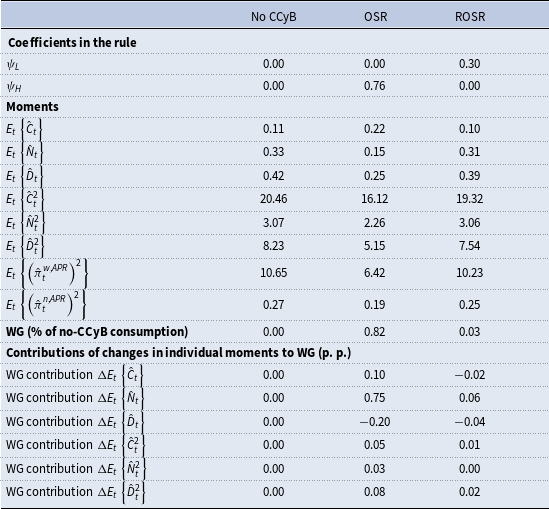
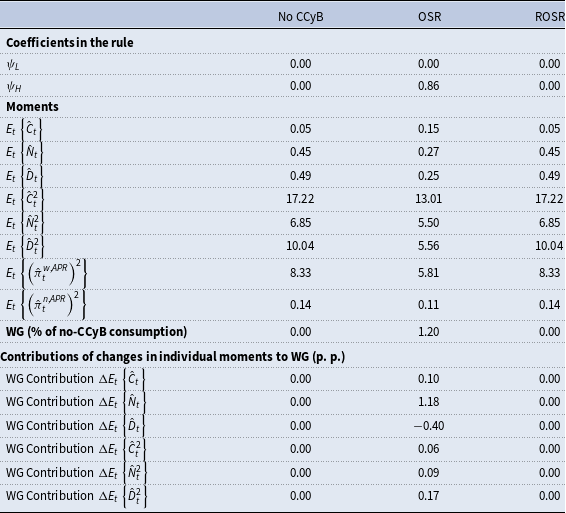
The resulting OSR only responds to real house prices and not to the credit gap (Table 6, column OSR), with
 $\psi _{P_{H}}^{*}=0.76$
. The welfare gain under the optimal policy, compared to the absence of a CCyB, is 0.82% of consumption with no CCyB.Footnote 21 Since the OSR turns out not to involve a response to the credit gap, we consider also restricted version of the rule, where we set
 $\psi _{P_{H}}=0$
and optimize
 $\psi _{L}$
conditional on this restriction. The resulting restricted OSR (Table 6, column ROSR) features a positive response to the credit gap, but the associated welfare gain with respect to the no-CCyB case is essentially zero.
Performance of optimal simple rules

Notes: The table displays the results of the grid search for the optimal simple rule (OSR), with grid
 $\psi _{L},\psi _{P_{H}}\in [0\ 2]$
, and for the restricted optimal simple rule (ROSR), with grid
 $\psi _{L}\in [0\ 2]$
and
 $\psi _{P_{H}}=0$
, step size 0.02. We restrict attention to policies for which the probability that
 $g_{t}$
hits the zero lower bound is less than 5%, that is, for which
 $\sqrt{Var(g_{t})}*\Phi _{0.95}\lt E_{t}{g_{t}}$
, where
 $\Phi _{0.95}$
denotes the 95 percentile of the standard normal distribution. A hat above a variable denotes percentage deviation from its non-stochastic steady state.
 $\hat{\pi }_{t}^{w,APR}$
denotes annualized wage inflation. Second moments are computed from the first-order approximation to the model’s solution. The means are based on the second-order approximation to the models solution using first-order accurate second moments. The respective welfare gain associated with the OSR and the ROSR are expressed as a percentage of consumption in the absence of the CCyB. For each variable directly entering the utility function, the table lists the contribution of the change in the first and second moment of that variable to the total welfare gain. Hence, summing rows “WG Contribution
 $\Delta E_{t}\left \{ \hat{C}_{t}\right \}$
” to “WG Contribution
 $\Delta E_{t}\left \{ \hat{D}_{t}^{2}\right \}$
” yields the values in row “WG (% of no-CCyB consumption),“ up to small rounding errors.
We also investigate the ESRB rule, which requires that
 $g_{t}$
responds only to the credit gap exceeding 2 p.p., and the maximum increase is capped at 2.5 p.p.:
 \begin{equation} g_{t}=8\%+\begin{cases} 0 & if\ gap_{t}\leq 2\%\\[5pt] 0.3125\cdot gap_{t}-0.625 & if\ 2\%\lt gap_{t}\leq 10\%\\[5pt] 2.5\% & if\ gap_{t}\gt 10\%. \end{cases} \end{equation}
5. Simulations
This section discusses the effects of two types of a housing demand shock, a decline in export demand, a productivity shock, and a decrease in the cost of foreign borrowing, all for the alternative rules described by equations (26)–(29). The magnitude of the shocks we assume in the simulations below equals one standard deviation.Footnote 22
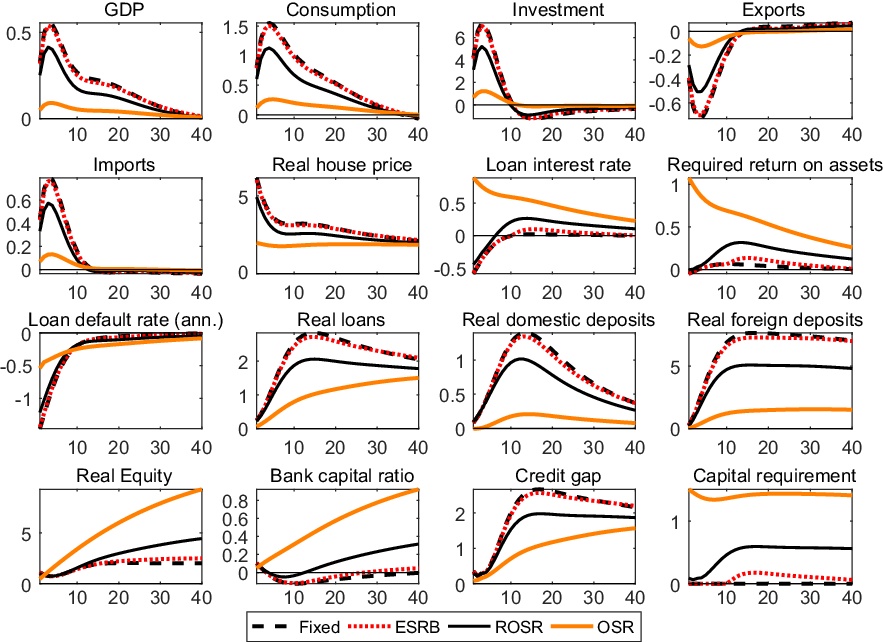
5.1 Positive housing demand shock
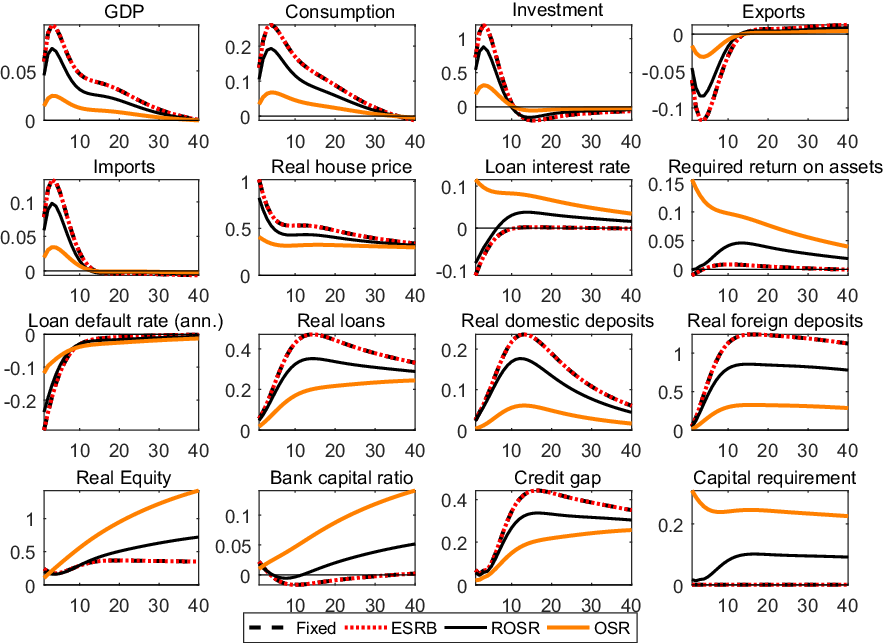
A positive housing demand shock is a temporary increase in preferences for housing (Figure 5). Our baseline is the constant capital requirement of 8% (dashed black line). With the supply of housing fixed, the increase in housing demand increases house prices and reduces households’ loan-to-value ratios and the default rate. Banks pass lower expected losses from defaults to households by reducing the loan rate, which stimulates consumption and investment. Lower interest rates and higher consumption further increase house prices, which can be interpreted as a financial accelerator mechanism. Wages and goods prices increase, worsening the country’s competitiveness. Exports decrease and imports increase, implying that borrowing from abroad rises, and is intermediated to the nonfinancial sector as loans.
Housing demand shock.
Notes: Impulse responses to a positive housing demand shock. For details on the units of the variables, see the note below Figure 4.

Loans to households increase in response to the housing demand shock because the increase in households’ expenditure relative to their revenue requires an increase in borrowing. The decline in the spread between the loan and deposit rates and higher consumption increase the demand for deposits by households. Bank equity increases because the share of nonperforming loans declines. More bank equity helps accommodate the increase in loans, implying only a small decline in the bank capital ratio.
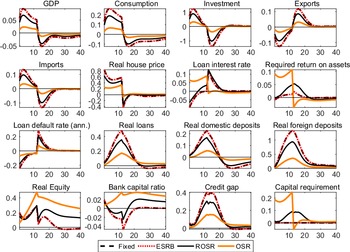
We now turn to the CCyB rules. The ESRB rule (dotted red line) performs exactly as the constant minimum capital requirement, because the credit gap opens by less than 2 p.p. and the rule does not kick in.Footnote 23 We show in Appendix G that a 6-standard-deviation shock is necessary to move the ESRB rule enough to have a meaningful effect. Both the OSR (full orange line) and the ROSR (full black line) require an increase of minimum capital, as the credit gap and real house prices increase in response to the shock. With a higher minimum capital requirement, banks’ capital buffer is smaller and the risk of ending up undercapitalized and having to pay a fine increases. This risk is reflected in a higher required expected return on assets (
 $\widetilde{R_{t+1}}$
). Banks pass this increase in their expected cost of lending to households through higher lending rates. As a result, the increase in consumption, investment, and house prices is lower than when minimum capital requirement is constant. The OSR achieves a substantially higher attenuation than the ROSR because the increase in the real house price exceeds the increase in the credit gap and the response coefficient is higher as well, leading to higher capital requirements under the OSR.
5.2 Boom and bust in the housing market
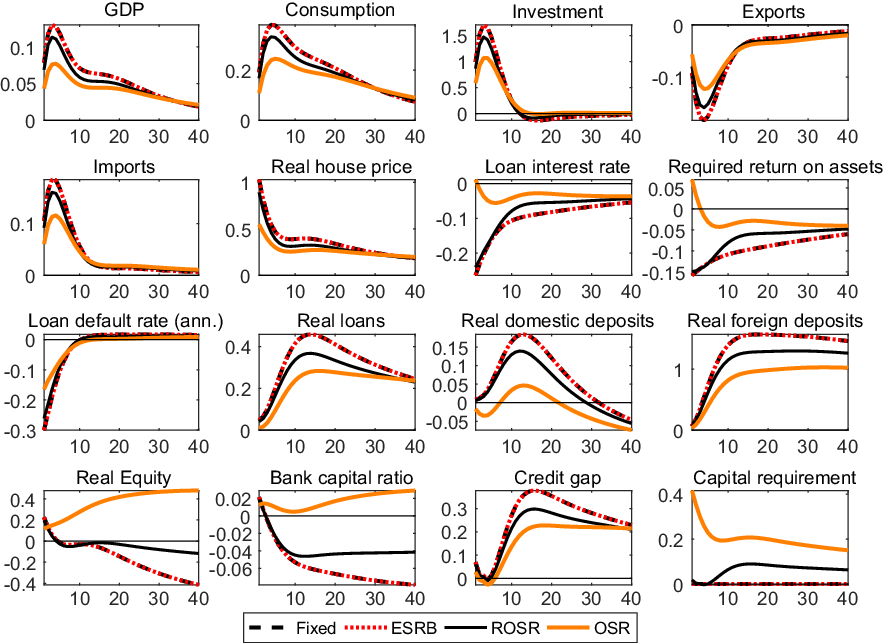
We model the boom-and-bust scenario on the housing market (a housing bubble) by assuming that the agents expect an increase in the demand for housing to occur in 3 years (i.e. in quarter 13), which ultimately does not materialize.Footnote 24 Expectations of a future increase in housing demand cause an immediate increase in house prices (Figure 6), which transmit across the economy in a qualitatively similar manner as the housing demand shock. The main difference is that when quarter 13 arrives, the demand for housing does not increase, causing house prices to collapse. The house price decline causes a recession because the economy too much (foreign) debt relative to the the reduced collateral value, which substantially increases the default and thus the lending rate, which lowers consumption, and a too high capital stock for the new low demand/higher interest rate environment. When minimum capital requirements are constant, there is no relief from the change in capital requirements in recession. As a result, the increase in the default rate dominates and fixed capital requirements are not able to prevent the increase in the loan interest rate after the burst of the bubble, which amplifies the recession.
Stylised boom and bust in the housing market.
Notes: Responses to an anticipated increase in housing demand in quarter 13. Once quarter 13 arrives, the shock does not materialize. For details on the units of the variables, see the note below Figure 4.

The ESRB rule performs identically to the fixed minimum capital requirement because the credit gap again does not move sufficiently. Unlike the ESRB rule, the OSR and the ROSR provide more stabilization. The distinction is that the OSR stabilizes the economy both during the boom and during the bust, while the ROSR does it mostly during the boom. Under both rules, the increase in real house prices or the credit gap in the boom causes an increase in the regulatory capital requirement. The higher capital requirement results in higher lending rates, which dampen the increase in domestic demand and help to increase bank equity. During the bust, house prices drop and the OSR allows a decline in the minimum capital requirement almost to its steady state level. Importantly, this happens immediately after the expected increase in housing demand does not materialize, which quickly releases the accumulated capital buffer. The resulting overcapitalization of banks lowers the required expected return on bank assets sufficiently to dominate the increase in lending rates due to higher defaults, and as a result the lending rate decreases. Elevated loan rates during the boom are followed by lower rates during the bust, which stimulates domestic demand and helps to stabilize the economy. For the ROSR, the stabilizing effect during the bust is absent, because even though the credit gap drops during the bust from its boom level, it still remains above its steady state for years. The persistence of loans is mainly due to the fact that part of the boom-related borrowing was used for spending on goods and services above disposable income, and the repayment requires an increase in household net lending. Because households want to smooth consumption, they prefer a gradual reduction of their stock of borrowing. Moreover, because the capital requirement declines more gradually and from lower levels under the ROSR, the capital buffer release is neither timely nor large, which leads to a higher trajectory for the required expected return on assets and a higher loan rate. Any credit-gap-based rule suffers from this disadvantage, because the credit gap remains positive throughout the simulation.
5.3 Reduction in the foreign deposit interest rate
In this scenario, the foreign interest rate
 $\hat{R}_{W,t}$
declines, which in turn lowers the interest rate banks pay on all their deposits (see equation (22)). In our model, the decline of
 $\hat{R}_{W,t}$
may come about as either the result of an expansionary EA monetary policy shock or an expansionary global credit supply shock (see equation (25)). However, we report results only for the monetary policy shock since the estimated AR(1) coefficient of the two shocks are identical, and thus the response to the shocks is identical up to a scaling factor as well. Under the baseline scenario with fixed minimum capital requirements, banks pass the reduction in their borrowing costs caused by the shock to households through a lower lending rate (Figure 7), which increases consumption, investment, and house prices. The associated decline in the default rate further lowers the lending rate. Higher domestic demand results in higher wages, prices and imports, and lower exports, which increases foreign borrowing.
Reduction in the foreign deposit interest rate.
Notes: Impulse responses to a decrease in the foreign interest rate. For details on the units of the variables, see the note below Figure 4.

The credit gap does not open much because of the simultaneous increase in GDP and loans. Because the 2 p.p. threshold is not breached, the ESRB rule does not react and its performance is identical to that of the constant minimum capital requirement. By contrast, the OSR and the ROSR rules do react. The main difference is that because of the muted and delayed response of the credit gap, the tightening of the minimum capital requirements is very small under the ROSR and so are the resulting impacts on the lending rate and the economic activity. In contrast, the OSR reacts strongly and immediately because house prices increase. As a result, the loan interest rate does not decrease as much as under other rules (it even increases slightly on impact), which dampens consumption and reduces the peak response of GDP by about a half.
5.4 Temporary decline in export demand
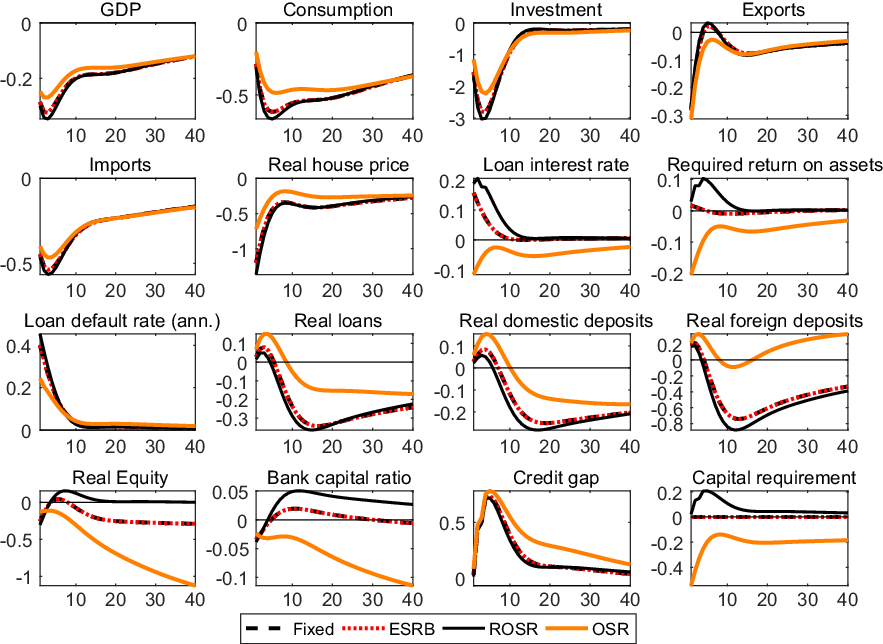
In this scenario, foreign demand for domestic goods temporarily declines (Figure 8). The fall in foreign demand has a direct negative effect on GDP and an indirect negative effect via lower domestic demand. The decline in domestic demand comes about for the following reasons. Lower production means lower real wages and marginal costs in both the tradable and the non-tradable sector, and thus lower inflation and a higher real loan rate. At the same time, the decline in export revenue and the desire of households to smooth their consumption tends to increase the paths of household borrowing from banks and the borrowing of banks from abroad.Footnote 25 The associated increase in foreign deposits tends to increase the interest rate banks have to pay on their deposits and thus the loan rate faced by the households.Footnote 26 Finally, the increase in household borrowing and the decline in house prices result in an increase in the risk of household default and thus also increase the lending rate.Footnote 27
Temporary decline in export demand.
Notes: Impulse responses to a temporary decline in foreign demand. For details on the units of the variables, see the note below Figure 4.

Under the baseline scenario with fixed minimum capital requirement, the temporary increase in loans and the decrease in GDP lead to an increase in the credit gap. This increase is not sufficient to activate the ESRB rule so that the results under the ESRB rule and under the fixed minimum capital requirements are the same. Under the ROSR, the increase in the credit gap causes a sufficiently large increase in the minimum capital requirement to worsen the downturn caused by the shock (bottom-right panel of Figure 8).Footnote 28 Higher minimum capital requirement results in a higher probability for banks of having to pay the penalty for being undercapitalized if they do not increase capital. The larger expected penalty causes an increase in the lending rate and a contraction in loan supply, which aggravates the recession compared to the fixed capital requirement case. Note that because the credit gap opens in the wrong direction, any capital rule that responds positively to the credit gap worsens the downturn under this shock. Furthermore, we would observe an increase of the credit gap even if we substituted, say, domestic demand for GDP in the denominator of the credit gap definition equation, as domestic demand declines even more than GDP. In contrast, under the OSR, the regulator quickly lowers the minimum capital requirements, because house prices decline. The easing of the minimum capital requirement reduces the likelihood that banks will have to pay the penalty for breaching the minimum capital requirement. The lower expected penalty translates into an expansion of loan supply, as banks can decrease the required return on their assets. The reduction is sufficient to offset the increase in the default rate, allowing the lending rate to decrease. The improved access to credit (compared to the fixed capital requirement) enables households to borrow more from abroad in order to smooth consumption, which substantially alleviates the decline in consumption, investment, and GDP.
Note that the model may actually understate the increase in the credit gap and thus the tightening prescribed by rules based on the credit gap. The reason is that the model does not have import adjustment costs that can be found, say, in the ECB’s New Area Wide Model (Christoffel et al. Reference Christoffel, Coenen and Warne2008), implying that short- and long-run price elasticities of are identical. A lower short-run price elasticity would lower the drop in imports, which decline almost twice as much as GDP, and thus strengthen the overall GDP decline. Furthermore, it would likely cause a higher path for foreign borrowing, and thus a higher path for domestic lending. Lower GDP and higher lending would imply a higher path for the credit gap and even stronger tightening of capital requirements under the rules based on the credit gap.
These results suggest that the credit gap may be a problematic indicator variable under a very common shock for small open economies. It prescribes tightening minimum capital requirements exactly at the time when foreign borrowing could be used to help smooth the adverse effects of a temporary decline in foreign demand. The reason for such an adverse outcome is that the credit gap is countercyclical in this case. Policy rules based on the credit gap, if followed by the regulator without discretion, therefore create a trade-off between stabilizing the economy’s response to housing demand and export demand shocks. By contrast, this trade-off is absent when the capital requirement responds to house prices.Footnote 29
5.5 Productivity shock
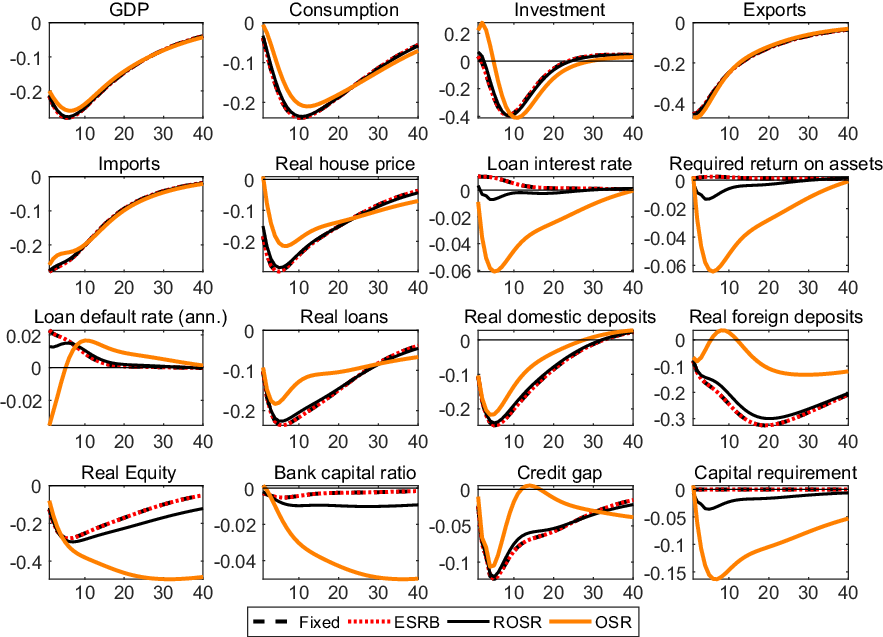
We model the productivity shock as a temporary decrease in productivity in tradable and non-tradable sectors (Figure 9). Under the baseline with constant minimum capital, the decrease in productivity immediately decreases output. Because households are now poorer, they demand less housing and deleverage by reducing borrowing. House prices drop initially by more than loans, which causes a temporary increase in the default rate and a small increase in the lending rate.Footnote 30 Foreign debt drops on impact due to the reduction in demand for imports, which is a consequence of the drop in domestic consumption and investment, but also due to the drop of exports, which contain a substantial fraction of imports.
Decrease in non-tradable and export goods productivity.
Notes: Impulse responses to a decrease in productivity for non-tradable goods and for export goods. For details on the units of the variables, see the note below Figure 4.

The ESRB rule again performs exactly the same as the constant minimum capital requirement because the credit gap drops and the rule does not allow reductions of minimum capital. The ROSR, in contrast, allows for an immediate reduction in minimum capital requirements, which moves banks away from the regulatory constraint and allows them to reduce the required return on assets and thus the lending rate. However, because the credit gap closes relatively quickly, this provides only a limited dampening of consumption and the business cycle. The OSR performs somewhat better in terms of the reduction in the lending rate, because the decrease in real house prices is larger than the reduction in the credit gap and the response coefficient in the OSR is higher than in the ROSR. Because the reduction in minimum capital requirements under the OSR is stronger, the lending rate declines substantially more. Households anticipate the lower lending rate trajectory and reduce their consumption by less. In addition, lending decreases faster than house prices under the OSR, resulting in an initial decrease in the default rate, which further contributes to the initial reduction in the lending rates.
6. Conclusion
We investigate the performance of several CCyB rules based on the credit gap and the real house prices as indicator variables, conditional on a set of structural shocks that are typically considered important for small open economies. To do so, we use an estimated medium-scale DSGE model of the Irish economy. We take as the benchmark the case where the minimum capital requirement is fixed at 8%. Against this benchmark, we compare the performance of CCyB rules where the regulatory capital ratio is positively linked to the credit gap, including the rule recommended by the ESRB, as well as a simpler and more reactive linear policy rule, optimized to give the best performance in terms of welfare (ROSR). Moreover, we consider specifications where the CCyB rule is based on both the credit gap and real house prices. If such a rule is optimized, it is positively linked to real house prices only (OSR).
Our main finding is that the CCyB rules based on the credit gap are only able to dampen the fluctuations of the economy to housing demand shocks as well boom-and-bust cycles driven by expectations. The reason is that in such cases the credit gap is procyclical, implying that the regulatory capital is tightened when GDP increases. This timely tightening limits the development of foreign debt overhang and creates a bank capital cushion which can be released once the economy and borrowing contract. For shocks of realistic magnitudes, the ESRB rule does not help stabilize the economy, because the credit gap threshold of 2 p.p. is never exceeded. In addition, it does not allow for a response to negative credit gap values, which limits the scope for stabilization when the credit gap becomes negative.
Most importantly, CCyB rules based on the credit gap not only fail to attenuate the response of the economy to shocks that cause an acyclical credit gap response but also even amplify their negative effects when shocks trigger a countercyclical credit gap response. A relevant example, especially for small open economies, is a temporary decline in export demand, which lowers GDP more than domestic lending: If the macroprudential authority responds aggressively to the credit gap, it worsens the export-induced downturn by effectively making borrowing more expensive. Overall, by targeting the credit gap, the macroprudential authority creates a trade-off between stabilizing the response of the economy to housing demand shocks and destabilizing the economy after export demand shocks. In contrast, such a trade-off does not arise if the regulator targets the house price gap, since house prices move procyclically in response to all shocks considered.
Our results indicate that policymakers should take seriously the part of the ESRB Recommendation that allows them to consider a wider set of indicators when setting CCyB rates that are relevant for the particular country, in particular house prices (in the economies where real estate values serve as an important form of collateral for households and firms). They also suggest that the prominence given to the credit-gap-based rules and CCyB thresholds should be taken with caution.
A. Results for alternative sign restrictions
In the second exercise, we set the intervals for the Phillips Curve slopes and the degree of habit formation by drawing on recent estimates of DSGE models on euro area data, namely Coenen et al. (Reference Coenen, Karadi, Schmidt and Warne2018), De Walque et al. (Reference De Walque, Lejeune, Rychalovska and Wouters2017) and Gadatsch et al. (Reference Gadatsch, Hauzenberger and Staehler2016).Footnote 31 The resulting intervals are [0.002, 0.062] for the non-tradable Phillips curve marginal cost coefficient, [0.05, 0.14] for the export price Phillips Curve marginal cost coefficient and [0.56, 0.84] for the degree of habit formation. We keep the intervals of the AR(1) coefficients the same in this exercise because several of our shocks (the housing the demand shock, the global credit supply shock and the monetary policy shock) are either absent from the aforementioned contributions or have characteristics which are quite specific to our small-open-economy-in-a-monetary-union setup.
As can be obtained from comparing Tables 4 and 7, the restrictions resulting from the alternative parameter intervals are almost identical to those derived in the main text for the wider parameter intervals. Only the response of loans to the housing demand shock and the response of house prices to the TFP and the export demand shock change. The VAR and model IRFs are quite similar to the results in the main text (compare Figures 3 and 10), but the estimated model parameters change somewhat in the direction of less shock persistence (lower AR(1) coefficients) and more endogenous persistence due to higher nominal rigidity and more consumption habit formation (compare Tables 5 and 8). The OSR features a slightly higher response to house prices and delivers a stronger welfare gain (compare Tables 6 and 9). The stronger welfare gain from the OSR is driven by a stronger welfare gain from the reduction in mean employment. Furthermore, the response to the credit gap in the ROSR is now zero, and hence results are identical to the No CCyB case.
Alternative sign restrictions - Matrix of sign restrictions

Note: In the estimation, the sign restriction is always applied to the first three elements of the IRF of the respective variable to the respective shock. An exception is the response of the EONIA, where the restriction applies on impact. RL stands for real NFS loans, DD for domestic demand, EX are exports.
Alternative sign restrictions - VAR and model IRFs.
Notes: Impulse response functions of the model and the impulse responses in the VAR to the identified shocks. The sign restrictions imposed in the estimation of the VAR are reported in Table 7. Shaded areas denote 68% confidence intervals. DD: Modified domestic demand. GCS: Global Credit Supply shock.

Alternative sign restrictions - Estimated parameters

Alternative sign restrictions - Performance of optimal simple rules

Notes: The table displays the results of the grid search for the optimal simple rule (OSR), with grid
 $\psi _{L},\psi _{P_{H}}\in [0\ 2]$
, and for a restricted optimal simple rule (ROSR), with grid
 $\psi _{L}\in [0\ 2]$
and
 $\psi _{P_{H}}=0$
, step size 0.02. We restrict attention to policies for which the probability that
 $g_{t}$
hits the zero lower bound is less than 5%, that is, for which
 $\sqrt{Var(g_{t})}*\Phi _{0.95}\lt E_{t}{g_{t}}$
, where
 $\Phi _{0.95}$
denotes the 95 percentile of the standard normal distribution. A hat above a variable denotes percentage deviation from its non-stochastic steady state.
 $\hat{\pi }_{t}^{w,APR}$
denotes annualized wage inflation. Second moments are computed from the first order approximation to the model’s solution. The means are based on the second order approximation to the models solution using first-order accurate second moments. The respective welfare gain associated with the OSR and the ROSR are expressed as a percentage of consumption in the absence of the CCyB. For each variable directly entering the utility function, the table lists the contribution of the change in the first and second moment of that variable to the total welfare gain. Hence summing rows “WG Contribution
 $\Delta E_{t}\left \{ \hat{C}_{t}\right \}$
” to “WG Contribution
 $\Delta E_{t}\left \{ \hat{D}_{t}^{2}\right \}$
” yields the values in row “WG (% of no-CCyB consumption),“ up to small rounding errors.
Finally, the responses to the various shocks is qualitatively and quantitatively similar to those discussed in Section 5, with the exception that the responses under the ROSR are now identical to those without a CCyB. Therefore we do not report them here, but they are available upon request.
B. Second moments
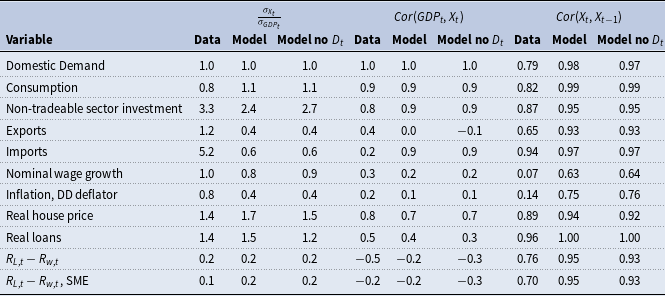
Table 10 displays second moments of a number of important variables from the model and their closest counterparts in the data. The model performs well at matching the correlations with GDP and relative volatilities of investment, consumption, nominal wage growth, house prices, real loans, and
 $R_{L,t}-R_{w,t}$
, and the correlation of GDP and inflation. The model performs somewhat less well at matching the relative volatility of the remaining variables, though the differences between the model and the data are mostly limited. Table 10 also shows that variation in domestic deposits helps replicating the procyclicality of non-financial sector credit, by reporting results for a version of the model where household deposits remain constant (columns labeled “Model no
 $D_t$
”). In this version of the model, movements in non-financial sector credit are driven purely by the difference between borrower spending and income. As a result, credit becomes less procyclical because borrowing increases less in response to expansionary housing demand and monetary policy shocks, and declines more persistently in response to a favorable export demand shock.
Second moments

Notes:
 $\sigma _{X_t}$
and
 $Cor(\ldots )$
denote the standard deviation of a variable and the correlation coefficient of the variables in brackets, respectively. The data was HP-filtered (
 $\lambda =1600$
), and, with the exception of interest and growth rates, logged. ”DD deflator” denotes the deflator of modified domestic demand. We proxy non-tradable sector investment as residential investment. We proxy nominal wages as compensation of employees per employee. We report two proxies for
 $R_{L,t}-R_{w,t}$
. The first is based on the mortgage interest rate, the second on the interest rate on loans to nonfinancial firms with a volume of one million Euro or less. The sample period is 1999Q1–2010Q3 since the interest rate data we use is not available after 2010Q3. The empirical moments are based on HP filtered data (
 $\lambda =1600$
). We report theoretical model moments based on the first order approximation to the solution of the model. The results in the columns labeled ”Model” are based on the parameterization reported in Tables 2 and 5, while column ”Model no
 $D_t$
” refers to a model where domestic deposit are constant (
 $\xi _{D}=1000$
). We do not apply the HP filter to the model. First, the model variables are stationary and thus no trend needs to be removed before computing second moments. Furthermore, filtering the model results with the HP filter (
 $\lambda =1600$
) creates a spurious negative correlation between real loans and domestic demand, which may be due to the way the filter treats the response of domestic demand and loans to the export demand shock. As can be obtained from Figure 3, real loans initially decline following an expansionary export demand shock, but increase above their steady state value later, while domestic demand peaks much earlier and then slowly returns to its steady state. To the extend the HP-filter attempts to fit the trend to the later increase in loans, it enhances the negative deviation of loans from trend in the initial quarters after the shock. For domestic demand, HP-filtering tends to lower the domestic demand response in later quarters. Both of these mechanisms tend to lower the correlation of real loans and domestic demand.
C. Complete list of equations
C.1 Households
 \begin{equation} \Lambda _{t}P_{t} = \left (1-\chi \right )^{\sigma }\left (C_{t}-\chi C_{t-1}\right )^{-\sigma } \end{equation}
 \begin{equation} \Lambda _{t} = \beta \Lambda _{t+1}\left (R_{L,t}+\frac{dR_{L,t}}{dL_{t}}\left (\overline{\omega _{h,t+1}},L_{t}\right )L_{t}\right ) \end{equation}
 \begin{equation} \beta \frac{\Lambda _{t+1}}{\Lambda _{t}} = \frac{\Lambda _{R_{L},t}}{\Lambda _{t}L_{t}}\left (1-\lambda J_{t+1}-\lambda \frac{\phi (\overline{\omega _{h,t+1}})}{\sigma _{h}}\right ) \end{equation}
 \begin{equation} D_{t}^{-\iota }P_{t}^{\iota -1}\zeta _{D}\frac{1}{\Lambda _{t}} = 1-\beta R_{t}\frac{\Lambda _{t+1}}{\Lambda _{t}}+\xi _{D}\Omega '_{D,t}, \end{equation}
 \begin{equation} P_{H,t} = \varepsilon _{H,t}\zeta _{H,t}\frac{H_{t}^{-\nu }}{\Lambda _{t}}+\beta \frac{\Lambda _{t+1}}{\Lambda _{t}}\left (P_{H,t+1}+\frac{dR_{L,t}}{dH_{t}}\left (\overline{\omega _{h,t+1}},H_{t}\right )L_{t}\right ) \end{equation}
 \begin{equation} P_{I,t} = P_{K,t}\left [1-\frac{\xi _{I}}{2}\Omega _{I,t}-\xi _{I}\Omega '_{I,t}\right ]+\beta \frac{\Lambda _{t+1}}{\Lambda _{t}}P_{K,t+1}\xi _{I}\Omega '_{I,t}\frac{I_{t+1}}{I_{t}}, \end{equation}
 \begin{equation} P_{K,t} = \beta \frac{\Lambda _{t+1}}{\Lambda _{t}}\left (\left (1-\delta \right )P_{K,t+1}+R_{K,t+1}\right ) \end{equation}
 \begin{equation} \frac{dR_{L,t}}{dL_{t}}\left (\overline{\omega _{h,t+1}},L_{t}\right ) = \frac{\lambda \Phi '\left (\frac{\overline{\omega _{h,t+1}}}{\sigma _{h}}\right )\frac{1}{L_{t}}}{\sigma _{h}\left (1-\lambda \left (\Phi \left (\frac{\overline{\omega _{h,t+1}}}{\sigma _{h}}\right )\right )\right )-\lambda \Phi '\left (\frac{\overline{\omega _{h,t+1}}}{\sigma _{h}}\right )} \end{equation}
 \begin{equation} \frac{dR_{L,t}}{dH_{t}}\left (\overline{\omega _{h,t+1}},H_{t}\right ) = \frac{\lambda \Phi '\left (\frac{\overline{\omega _{h,t+1}}}{\sigma _{h}}\right )\frac{1}{H_{t}}}{\sigma _{h}\left (1-\lambda \left (\Phi \left (\frac{\overline{\omega _{h,t+1}}}{\sigma _{h}}\right )\right )\right )-\lambda \Phi '\left (\frac{\overline{\omega _{h,t+1}}}{\sigma _{h}}\right )} \end{equation}
 \begin{equation} J_{t} = \Phi \left (\frac{\overline{\omega _{h,t}}}{\sigma _{h}}\right ) \end{equation}
 \begin{equation} \overline{\omega _{h,t}} = \log (L_{t-1}R_{L,t-1}/(H_{t-1}P_{H,t})) \end{equation}
 \begin{align} \phi _{N}N_{t}^{\eta }\frac{e^{W}}{e^{W}-1}\frac{1}{W_{t}\Lambda _{t}} & = 1-\frac{\xi _{W}}{2}\left (\log \left (\frac{\pi _{t}^{W}}{\pi }\right )\right )^{2}+\xi _{W}\left (\log \left (\frac{\pi _{t}^{W}}{\pi }\right )\right )\frac{1}{e^{W}-1} \\& \quad-\frac{1}{e^{W}-1}\beta \frac{\Lambda _{t+1}}{\Lambda _{t}}\pi _{t+1}^{W}\frac{N_{t+1}}{N_{t}}\xi _{W}\log \left (\frac{\pi _{t+1}^{W}}{\pi }\right )\nonumber \end{align}
 \begin{align} \pi _{t}^{W} = \frac{W_{t}}{W_{t-1}} \end{align}
C.2 Firms
 \begin{equation} P_{t} = \left(\omega _{C}P_{M,t}^{1-\mu _{C}}+(1-\omega _{C})P_{N,t}^{1-\mu _{C}}\right)^{(1/(1-\mu _{C}))} \end{equation}
 \begin{equation} \frac{\xi _{N}}{e^{N}-1}\log \left (\frac{\pi _{t}^{N}}{\pi }\right ) = \beta \frac{\Lambda _{t+1}}{\Lambda _{t}}\pi _{t+1}^{N}\frac{Y_{N,t+1}}{Y_{N,t}}\left [\frac{\xi _{N}}{e^{N}-1}\log \left (\frac{\pi _{t+1}^{N}}{\pi }\right )\right ] \end{equation}
 \begin{align} & \qquad +\frac{MC_{N,t}}{P_{N,t}}\frac{e^{N}}{e^{N}-1}-\left [1-\Omega _{P_{N},t}\right ]\nonumber \\[4pt] P_{N,t} & = P_{N,t-1}\pi _{t}^{N} \end{align}
 \begin{equation} \left (1-\gamma _{N}\right )MC_{N,t}Y_{N,t} = R_{K,t}K_{N,t-1} \end{equation}
 \begin{equation} \gamma _{N}MC_{N,t}Y_{N,t} = W_{t}N_{N,t} \end{equation}
 \begin{equation} P_{M,t} = \frac{e^{M}}{e^{M}-1}S_{t}P_{M,t}^{\ast } \end{equation}
 \begin{align} \frac{\xi _{X}}{e_{X}-1}\log \left (\frac{\pi _{t}^{X}}{\pi }\right ) & = \beta \frac{\Lambda _{t+1}}{\Lambda _{t}}\pi _{t+1}^{X}\frac{X_{t+1}}{X_{t}}\frac{\xi _{X}}{e_{X}-1}\log \left (\frac{\pi _{t+1}^{X}}{\pi }\right ) \nonumber \\ & \quad +\frac{P_{XI,t}}{P_{X,t}}\frac{e^{N}}{e^{N}-1}-\left [1-\frac{\xi _{X}}{2}\left (\log \left (\frac{\pi _{t}^{X}}{\pi }\right )\right )^{2}\right ] \end{align}
 \begin{align} P_{X,t} = P_{X,t-1}\pi _{t}^{N} \end{align}
 \begin{equation} P_{XI,t} = \alpha P_{M,t}+MC_{Z,t}\left (1-\alpha \right ) \end{equation}
 \begin{equation} P_{M,t} = \frac{e^{M}}{e^{M}-1}S_{t}P_{M,t}^{\ast } \end{equation}
 \begin{equation} \gamma _{X}MC_{Z,t} = W_{t}N_{X,t} \end{equation}
 \begin{equation} C_{M,t} = \omega _{C}\left (\frac{P_{M,t}}{P_{t}}\right )^{-\mu _{C}}C_{t} \end{equation}
 \begin{equation} C_{N,t} = (1-\omega _{C})\left (\frac{P_{N,t}}{P_{t}}\right )^{-\mu _{C}}C_{t} \end{equation}
 \begin{equation} Y_{N,t} = A_{t}K_{N,t-1}^{1-\gamma _{N}}N_{N,t}^{\gamma _{N}} \end{equation}
 \begin{equation} Z_{t} = A_{t}\overline{K}_{X}^{1-\gamma _{X}}N_{X,t}^{\gamma _{X}} \end{equation}
 \begin{equation} Z_{t} = (1-\alpha )X_{t} \end{equation}
 \begin{equation} X_{M,t} = \alpha X_{t} \end{equation}
 \begin{equation} X_{t} = X_{D,t}\left (\frac{P_{x,t}/S_{t}}{P_{W,t}T_{t}}\right )^{-e_{X}} \end{equation}
C.3 Banks
 \begin{equation} \mathbb{E}_{t}\bigg \{\beta \frac{\Lambda _{t+1}}{\Lambda _{t}}\left [\widetilde{R_{t+1}}-R_{t}\right ]\bigg \} = \mathbb{E}_{t}\bigg \{\beta \frac{\Lambda _{t+1}}{\Lambda _{t}}\chi _{b}\left (\Phi (\overline{\omega _{b,t+1}})+\phi (\overline{\omega _{b,t+1}})\frac{R_{t}\frac{E_{b,t}}{L_{t}}}{(1-g_{t})\widetilde{R_{t+1}}}\right )\bigg \} \end{equation}
 \begin{equation} \widetilde{R_{t+1}} = R_{L,t}\left (1-\lambda \mathbb{E}_{t}\left (J_{t+1}\right )\right ) \end{equation}
 \begin{equation} \overline{\omega _{b,t}} = (R_{t-1}(B_{t-1}+D_{t-1}))/((1-g_{t-1})\widetilde{R_{t}}L_{t-1}) \end{equation}
 \begin{equation} E_{b,t} = E_{b,t-1}R_{E,t}(\theta _{b}+\omega ), \end{equation}
 \begin{equation} L_{t} = D_{t}+B_{t}+E_{b,t} \end{equation}
C.4 Net foreign assets
 \begin{equation} B_{t} = R_{t-1}B_{t-1}-TB_{t}+\theta _{\Pi }\left ((P_{X,t}-\alpha P_{M,t})X_{t}-W_{t}N_{X,t}\right ) \end{equation}
 \begin{equation} TB_{t} = P_{X,t}X_{t}-P_{M,t}M_{t} \end{equation}
 \begin{equation} R_{t} = e_{t}R_{W,t}*S_{t+1}/S_{t} \end{equation}
 \begin{equation} e_{t} = \theta _{B}(B_{t}/Y_{t}-\zeta ) \end{equation}
C.5 Market clearing
 \begin{equation} P_{t}C_{t} = P_{N,t}C_{N,t}+P_{M,t}C_{M,t} \end{equation}
 \begin{equation} P_{t}I_{t} = P_{N,t}I_{N,t}+P_{M,t}I_{M,t} \end{equation}
 \begin{equation} Y_{N,t} = C_{N,t}+I_{N,t}+G_{t} \end{equation}
 \begin{equation} M_{t} = C_{M,t}+I_{M,t}+X_{M,t} \end{equation}
 \begin{equation} N_{t} = N_{N,t}+N_{X,t} \end{equation}
 \begin{equation} Y_{t} = P_{t}C_{t}+P_{I,t}I_{t}+P_{N,t}G_{t}+P_{X,t}X_{t}-P_{M,t}M_{t} \end{equation}
C.6 Policy authorities
 \begin{equation} S_{t} = 1 \end{equation}
 \begin{equation} G_{t} = G \end{equation}
 \begin{equation} g_{t} = 8\%+\psi _{L}\cdot gap_{t}+\psi _{P_{H}}\cdot price\ gap_{t} \end{equation}
 \begin{equation} gap_{t} = \left (\frac{L_{t}}{Y_{t}+Y_{t-1}+Y_{t-2}+Y_{t-3}}-\frac{\overline{L}}{4\cdot \overline{Y}}\right ) \end{equation}
 \begin{equation} price\ gap_{t} = \frac{P_{H,t}/P_{t}-\overline{P_{H}}/P}{\overline{P_{H}}/P}. \end{equation}
C.7 Shocks
 \begin{equation} log\left (A_{t}\right ) = \rho _{A}log\left (A_{t-1}\right )+\epsilon _{A,t} \end{equation}
 \begin{equation} log\left (\varepsilon _{H,t}\right ) = \rho _{H}log\left (\varepsilon _{H,t-1}\right )+\epsilon _{H,t} \end{equation}
 \begin{equation} log(X_{D,t}) = (1-\rho _{XD})log(\overline{X})+\rho _{X}log(X_{D,t-1})+\epsilon _{XD,t} \end{equation}
 \begin{equation} log\left (R_{W,t}\right ) = \left (1-\rho _{R_{W}}\right )\bar{R}_{W}+\rho _{R_{W}}log\left (R_{W,t-1}\right )+\epsilon _{R_{W},t} \end{equation}
D. Optimisation not discussed in the main text
D.1 Wage setting
Wage and price adjustment costs are in terms of deviations from past growth rates.Footnote 32 Only the deviation from previous-period growth rates is subject to adjustment costs. For wages we have Households set wages facing a downward sloping labor demand curve,
 $N\left (W_{i,t}\right )=(W_{i,t}/W_{t})^{-e^{W}}N_{t}$
, and wage adjustment costs
 $\Omega _{W,t}\equiv \xi _{W}/2(\log (W_{i,t}/W_{i,t-1}*1/\pi ))^{2}$
. After substituting-in
 $N\left (W_{i,t}\right )$
and the adjustment costs the objective is
 \begin{equation} -\frac{1}{1+\eta }\left (\left (\frac{W_{i,t}}{W_{t}}\right )N_{t}\right )^{1+\eta }+\Lambda _{t}\frac{W_{i,t}}{W_{t}^{e^{W}}}^{1-e^{W}}N_{t}\left [1-\frac{\xi _{W}}{2}\left (\log \left (\frac{W_{i,t}}{W_{i,t-1}}\frac{1}{\pi }\right )\right )^{2}\right ] \end{equation}
 \begin{equation} +\beta \Lambda _{t+1}W_{i,t+1}N\left (W_{i,t+1}\right )\left [1-\frac{\xi _{W}}{2}\left (\log \left (\frac{W_{i,t+1}}{W_{i,t}}\frac{1}{\pi }\right )\right )^{2}\right ] \end{equation}
Because in equilibrium all households set the same wage, the FOC w.r.t.
 $W_{i,t}$
is
 \begin{align} &\phi _{N}N_{t}^{\eta }\frac{e^{W}}{e^{W}-1}\frac{1}{W_{t}\Lambda _{t}}=1-\frac{\xi _{W}}{2}\left (\log \left (\frac{\pi _{t}^{W}}{\pi }\right )\right )^{2}+\xi _{W}\left (\log \left (\frac{\pi _{t}^{W}}{\pi }\right )\right )\frac{1}{e^{W}-1}\nonumber \\[5pt] &\quad -\frac{1}{e^{W}-1}\beta \frac{\Lambda _{t+1}}{\Lambda _{t}}\pi _{t+1}^{W}\frac{N_{t+1}}{N_{t}}\xi _{W}\log \left (\frac{\pi _{t+1}^{W}}{\pi }\right ) \end{align}
D.2 Firms
D.2.1 Non-tradable goods firms
There is a continuum of non-tradable goods firms, indexed by
 $i$
. Each produces output using
 $Y_{N,t}=A_{t}K_{N,t-1}^{1-\gamma _{N}}N_{N,t}^{\gamma _{N}}$
, and faces quadratic price adjustment costs
 $\Omega _{P_{N},t}\equiv \xi _{N}/2(\log (P_{N,i,t+j}/P_{N,i,t+j-1}*1/\pi ))^{2}$
. Each firm is a monopolistic supplier of its product variety, takes its demand curve as a constraint,
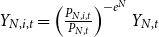 $Y_{N,i,t}=\left (\frac{P_{N,i,t}}{P_{N,t}}\right )^{-e^{N}}Y_{N,t}$
, and chooses prices, capital, and labor. Its objective is:
 \begin{equation*} \sum _{j=0}^{\infty }\beta ^{j}\Lambda _{t+j}\left [P_{N,i,t+j}Y_{N,i,t}\left [1-\Omega _{P_{N},t}\right ]-W_{t+j}N_{t+j}-R_{K,t+j}K_{t+j-1}\right ], \end{equation*}
The first-order conditions w.r.t. capital and labor are
 $\left (1-\gamma _{N}\right )MC_{N,t}Y_{N,t}=R_{K,t}K_{N,t-1}$
and
 $\gamma _{N}MC_{N,t}Y_{N,t}=W_{t}N_{N,t}$
, and the F.O.C w.r.t. prices is (note that in equilibrium, all firms choose the same price):
 \begin{equation*} \frac {\xi _{N}}{e^{N}-1}\log \left (\frac {\pi _{t}^{N}}{\pi }\right )=\beta \frac {\Lambda _{t+1}}{\Lambda _{t}}\pi _{t+1}^{N}\frac {Y_{N,t+1}}{Y_{N,t}}\left [\frac {\xi _{N}}{e^{N}-1}\log \left (\frac {\pi _{t+1}^{N}}{\pi }\right )\right ]+\frac {MC_{N,t}}{P_{N,t}}\frac {e^{N}}{e^{N}-1}-\left [1-\Omega _{P_{N},t}\right ] \end{equation*}
D.2.2 Importers
Importers buy goods at the (exogenous) world price
 $P_{M,t}^{\ast }$
, which, multiplied by the exchange rate
 $S_{t}$
, is their marginal cost,
 $MC_{M,t}=S_{t}P_{M,t}^{\ast }$
. They transform imports into varieties, facing demand curve
 $M_{i,t+j}=(P_{M,i,t+j}/P_{M,t+j})^{-e^{M}}M_{t+j}$
. Their FOC thus implies
 \begin{equation*} P_{M,t}=\frac {e^{M}}{e^{M}-1}S_{t}P_{M,t}^{\ast } \end{equation*}
D.2.3 Tradable goods producers
Tradable goods firms use domestic goods
 $Z_{t}$
and imports
 $X_{M,t}$
to produce an export good using
 $X_{t}=\min \{Z_{t}/(1-\alpha ),X_{M,t}/\alpha \}$
, where
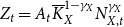 $Z_{t}=A_{t}\overline{K}_{X}^{1-\gamma _{X}}N_{X,t}^{\gamma _{X}}$
, and
 $\overline{K}_{X}$
, the capital used in the production, is exogenous. They sell the products to the final goods sector at price
 $P_{XI,t}$
. They maximize
 \begin{equation*} \begin {array}{c} P_{XI,t}X_{t}-W_{t}N_{X,t}-R_{K,t}\overline {K}_{X,t-1}-P_{t}^{M}X_{m,t}\end {array} \end{equation*}
subject to
 \begin{align*} Z_{t} & =A_{t}\overline{K}_{X}^{1-\gamma _{X}}N_{X,t}^{\gamma _{X}}\\ X_{t} & =\min \{Z_{t}/(1-\alpha ),X_{M,t}/\alpha \} \end{align*}
The Lagrangian is given by:
 \begin{equation*} \begin {array}{c} P_{XI,t}X_{t}-W_{t}N_{X,t}-R_{K,t}\overline {K}_{X,t-1}-\alpha P_{t}^{M}X_{t}\end {array}+MC_{Z,t}\left (A_{t}\overline {K}_{X}^{1-\gamma _{X}}N_{X,t}^{\gamma _{X}}-X_{t}\left (1-\alpha \right )\right ) \end{equation*}
The FOCs with respect to
 $X_{t}$
,
 $N_{X,t}$
and the optimal values of
 $Z_{t}$
and
 $X_{M,t}$
are given by
 \begin{equation} P_{XI,t} = \alpha P_{M,t}+MC_{Z,t}\left (1-\alpha \right ) \end{equation}
 \begin{equation} \gamma _{X}MC_{Z,t} = W_{t}N_{X,t} \end{equation}
 \begin{equation} Z_{t} = (1-\alpha )X_{t} \end{equation}
 \begin{equation} X_{M,t} = \alpha X_{t} \end{equation}
D.2.4 Final goods firms
Final goods firms combine intermediate and imported goods to create final goods used for consumption and investment, using a CES technology:
 \begin{equation*} C_{t}=\left (\left (1-\omega _{C}\right )^{\frac {1}{\mu _{C}}}\left (C_{N,t}\right )^{\frac {\mu _{C}-1}{\mu _{C}}}+\left (\omega _{C}\right )^{\frac {1}{\mu _{C}}}\left (C_{M,t}\right )^{\frac {\mu _{C}-1}{\mu _{C}}}\right )^{\frac {\mu _{C}}{\mu _{C}-1}} \end{equation*}
Demand functions for imported (
 $C_{M,t}$
) and non-tradable consumption goods (
 $C_{N,t}$
) are
 \begin{equation} C_{M,t}=\omega _{C}\left (\frac{P_{M,t}}{P_{t}}\right )^{-\mu _{C}}C_{t}\ \ and\ \ C_{N,t}=(1-\omega _{C})\left (\frac{P_{N,t}}{P_{t}}\right )^{-\mu _{C}}C_{t} \end{equation}
where
 $\omega _{C}$
is the bias towards imported consumption goods,
 $\mu _{C}$
is the elasticity of substitution between imported and non-tradable consumption goods,
 $P_{M,t}$
is the import price,
 $P_{N,t}$
is the price of non-tradable goods, and
 $P_{t}$
is the general price index
 $P_{t}=(\omega _{C}P_{M,t}^{1-\mu _{C}}+(1-\omega _{C})P_{N,t}^{1-\mu _{C}})^{(1/(1-\mu _{C}))}$
. The equations for investment goods are analogous.
D.2.5 Exporters of final goods
Exporters maximize:
 \begin{equation*} \sum _{j=0}^{\infty }\beta ^{j}\Lambda _{t+j}\left [P_{X,i,t+j}X_{i,t+j}\left [1-\frac {\xi _{X}}{2}\left (\log \left (\frac {P_{X,i,t+j}}{P_{X,i,t+j-1}}\frac {1}{\pi }\right )\right )^{2}\right ]-P_{XI,t+j}X_{i,t+j}\right ] \end{equation*}
Demand is
 $X_{i,t+j}=(P_{X,i,t+j}/P_{X,t+j})^{-e_{X}}X_{t+j}$
, price setting and the demand curve for the export basket
 $X_{t}$
are:
 \begin{align} & \frac{\xi _{X}}{e_{X}-1}\log \left (\frac{\pi _{t}^{X}}{\pi }\right )= \nonumber \\ & =\beta \frac{\Lambda _{t+1}}{\Lambda _{t}}\pi _{t+1}^{X}\frac{X_{t+1}}{X_{t}}\frac{\xi _{X}}{e_{X}-1}\log \left (\frac{\pi _{t+1}^{X}}{\pi }\right )+\frac{P_{XI,t}}{P_{X,t}}\frac{e^{N}}{e^{N}-1}-\left [1-\frac{\xi _{X}}{2}\left (\log \left (\frac{\pi _{t}^{X}}{\pi }\right )\right )^{2}\right ] \end{align}
 \begin{equation} X_{t}=X_{D,t}\left (\frac{P_{x,t}/S_{t}}{P_{W,t}T_{t}}\right )^{-e_{X}}, \end{equation}
where
 $X_{D,t}$
is the exogenous component of world demand,
 $S_{t}$
is the exchange rate, and
 $P_{W,t}$
and
 $T_{t}$
are exogenous. We assume
 $S_{t}=1$
, which implies that, given
 $X_{D,t}$
, exports will fall when exporters increase prices.
D.3 Net foreign assets, policy authorities, and market clearing
The domestic interest rate is linked to that of the euro area through
 $R_{t}=e_{t}R_{W,t}*S_{t+1}/S_{t}$
and
 $e_{t}=\theta _{B}(B_{t}/Y_{t}-\zeta )$
, where
 $\theta _{B}$
determines how the sensitivity of the interest rate on domestic debt depends on the deviation of the current indebtedness of the country from its steady state value,
 $\zeta \equiv \overline{B}/\overline{Y}$
. With trade balance
 $TB_{t}=P_{X,t}X_{t}-P_{M,t}M_{t}$
and
 $\theta _{\Pi }$
the share of profits transferred abroad by foreign-owned firms, foreign debt
 $B_{t}$
evolves as:
 \begin{equation} B_{t}=R_{t-1}B_{t-1}-TB_{t}+\theta _{\Pi }\left ((P_{X,t}-\alpha P_{M,t})X_{t}-W_{t}N_{X,t}\right ). \end{equation}
The exchange rate is fixed (
 $S_{t}\equiv 1$
) and government spending is funded by lump sum taxes,
 $P_{N,t}G_{t}=\Theta _{t}$
. Market clearing conditions for goods are
 $P_{t}C_{t}=P_{N,t}C_{N,t}+P_{M,t}C_{M,t}$
,
 $P_{t}I_{t}=P_{N,t}I_{N,t}+P_{M,t}I_{M,t}$
,
 $Y_{N,t}=C_{N,t}+I_{N,t}+G_{t}$
,
 $M_{t}=C_{M,t}+I_{M,t}+X_{M,t}$
,
 $N_{t}=N_{N,t}+N_{X,t}$
for labor, and
 $K_{t}=K_{N,t}+\overline{K}_{X}$
for capital. Output clears as
 $Y_{t}=P_{t}C_{t}+P_{I,t}I_{t}+P_{N,t}G_{t}+P_{X,t}X_{t}-P_{M,t}M_{t}$
.
E. Converting the welfare gain into a percentage of no-CCyB consumption
This section shows how to express the welfare gains delivered by the different CCyB rules we consider as a percentage of consumption in the absence of the CCyB. Under the assumption that households receive a quarterly transfer
 $\tau _{C}\geq 0$
with certainty, the quarterly utility flow
 $V_{f,t}$
becomes:
 \begin{align*} V_{f,t} & =\frac{ln\left (\left (1+\tau _{C}\right )C_{r,t}-\chi \left (1+\tau _{C}\right )C_{r,t-1}\right )}{\left (1-\chi \right )^{-1}}-\frac{\phi _{N}N_{r,t}^{1+\eta }}{1+\eta }+\varepsilon _{H,t}\zeta _{H}ln\left (H_{r,t}\right )+\frac{\zeta _{D}}{1-\iota }\left (\frac{D_{S,r,t}}{P_{r,t}}\right )^{1-\iota } \end{align*}
We now take a a second order approximation around the non-stochastic steady state and
 $\tau _{C}=0$
to this equation. The derivatives are given by
 \begin{eqnarray*} \frac{dV_{f,t}}{dC_{t}} & = & \frac{1}{\left (C_{r,t}-\chi C_{r,t-1}\right )\left (1-\chi \right )^{-1}}=\frac{1}{C}\\ \frac{dV_{f,t}}{dC_{t-1}} & = & \frac{-\chi }{\left (C_{r,t}-\chi C_{r,t-1}\right )\left (1-\chi \right )^{-1}}=\frac{-\chi }{C}\\ \frac{d^{2}V_{f,t}}{\left (dC_{t}\right )^{2}} & = & -\frac{1}{\left (C_{r,t}-\chi C_{r,t-1}\right )^{2}\left (1-\chi \right )^{-1}}=-\frac{1}{C^{2}\left (1-\chi \right )}\\ \frac{d^{2}V_{f,t}}{\left (dC_{t-1}\right )^{2}} & = & \frac{-\chi }{\left (C_{r,t}-\chi C_{r,t-1}\right )^{-2}\left (1-\chi \right )^{-1}}=\frac{-\chi }{C^{2}\left (1-\chi \right )}\\ \frac{d^{2}V_{f,t}}{dC_{t}dC_{t-1}} & = & \frac{\chi }{\left (C_{r,t}-\chi C_{r,t-1}\right )^{2}\left (1-\chi \right )^{-1}}=\frac{\chi }{C^{2}\left (1-\chi \right )}\\ \frac{dV_{f,t}}{d\tau _{C}} & = & \frac{1}{\left (1+\tau _{C}\right )\left (1-\chi \right )^{-1}}=\frac{1-\chi }{\left (1+\tau _{C}\right )}\\ \frac{dV_{r,t}^{2}}{\left (d\tau _{C}\right )^{2}} & = & -\frac{1-\chi }{\left (1+\tau _{C}\right )^{2}}=-\left (1-\chi \right )\\ \frac{dV_{f,t}}{dN_{t}U_{h,0}} & = & -\phi _{N}N_{r,t}^{\eta }=-\phi _{N}N_{r}^{\eta }\\ \frac{d^{2}V_{f,t}}{\left (dN_{t}\right )^{2}} & = & -\phi _{N}\eta N_{r,t}^{\eta -1}=-\phi _{N}\eta N_{r}^{\eta -1}\\ \frac{dV_{f,t}}{d\left (\frac{D_{S,t}}{P_{t}}\right )} & = & \zeta _{D}\left (\frac{D_{S,t}}{P_{t}}\right )^{-\iota }=\zeta _{D}\left (\frac{D_{S}}{P}\right )^{-\iota }\\ \frac{d^{2}V_{f,t}}{\left (d\left (\frac{D_{S,t}}{P_{t}}\right )\right )^{2}} & = & -\iota \zeta _{D}\left (\frac{D_{S,r}}{P_{r}}\right )^{-\iota -1} \end{eqnarray*}
where we evaluate the derivatives at the non-stochastic steady state and
 $\tau _{C}=0$
. The second order Taylor approximation to the deviation of
 $V_{f,t}$
from its non-stochastic steady state is then
 \begin{align*} dV_{f,t} & =\left (1-\chi \right )\left [\tau _{C}-\tau _{C}^{2}\right ]+\frac{dC_{t}-\chi dC_{r,t-1}}{C}-\frac{\left (dC_{t}\right )^{2}+\chi \left (dC_{t-1}\right )^{2}}{2C^{2}\left (1-\chi \right )}\\ & +\frac{2\chi dC_{t}dC_{t-1}}{2C^{2}\left (1-\chi \right )}-\phi _{N}N^{\eta }dN_{t}-\frac{\phi _{N}}{2}\eta N^{\eta -1}\left (dN_{r,t}\right )^{2}\\ & +\zeta _{D}\left (\frac{D_{S,r}}{P_{r}}\right )^{-\iota }d\left (\frac{D_{S,r,t}}{P_{r,t}}\right )-\frac{\iota \zeta _{D}}{2}\left (\frac{D_{S}}{P_{r}}\right )^{-\iota -1}\left (d\left (\frac{D_{S,t}}{P_{t}}\right )\right )^{2} \end{align*}
 \begin{align*} dV_{f,t} & =\left (1-\chi \right )\left [\tau _{C}-\tau _{C}^{2}\right ]+\hat{C}_{t}-\chi \hat{C}_{t-1}-\frac{\left [\hat{C}_{t}^{2}+\chi \hat{C}_{t-1}^{2}-\chi 2\hat{C_{t}}\hat{C}_{t-1}\right ]}{2\left (1-\chi \right )}-\phi _{N}N^{\eta +1}\hat{N}_{t}\\ & -\frac{\phi _{N}\eta }{2}N^{\eta +1}\left (\hat{N}_{t}\right )^{2}+\zeta _{D}\left (\frac{D_{S}}{P}\right )^{1-\iota }\widehat{\frac{D_{S,t}}{P_{t}}}-\iota \frac{\zeta _{D}}{2}\left (\frac{D_{S}}{P}\right )^{1-\iota }\widehat{\frac{D_{S,r,t}}{P_{r,t}}}^{2} \end{align*}
The unconditional expectation of the second order approximation to
 $V_{0}$
is
 \begin{eqnarray*} dV_{0} & = & E_{0}\left \{ \sum _{t=0}^{\infty }\beta ^{t}\hat{V}_{f,t}\right \} =\\ & = & \frac{\left (1-\chi \right )\tau _{C}}{1-\beta }+\frac{\left (1-\chi \right )E_{0}\hat{C}_{t}-\left [\frac{\left (1+\chi \right )E_{0}\left \{ \hat{C}_{t}^{2}\right \} -2\chi E_{0}\left \{ \hat{C_{t}}\hat{C}_{t-1}\right \} }{2\left (1-\chi \right )}\right ]}{1-\beta }\\ & & +\frac{-\phi _{N}N^{\eta +1}\left [E_{0}\left \{ \hat{N}_{t}\right \} +\frac{\eta }{2}E_{0}\left \{ \hat{N}_{t}^{2}\right \} \right ]}{1-\beta }\\ & & +\frac{\zeta _{D}\left (\frac{D_{S,r}}{P_{r}}\right )^{1-\iota }}{1-\beta }\left [E_{0}\left \{ \widehat{\frac{D_{S,t}}{P_{t}}}\right \} -\frac{\iota }{2}E_{0}\left \{ \widehat{\frac{D_{S,t}}{P_{t}}}^{2}\right \} \right ] \end{eqnarray*}
where we use the fact that
 $E_{t}\left \{ \tau _{C}^{2}\right \} =0$
since
 $\tau _{C}$
is known with certainty. Note that the
 $E_{t}\left \{ \left (..\right )^{2}\right \}$
terms may be approximated using a first order approximation to the model’s solution (e.g. Lombardo and Sutherland (Reference Lombardo and Sutherland2007)). Since under the first order approximation
 $E_{0}\hat{X_{t}}=0$
, the
 $E_{t}\left \{ \left (..\right )^{2}\right \}$
are simply the variances of the respective variables calculated using the first-order accurate solution of the model (the autocovariance in case of
 $E_{t}\left \{ \hat{C_{t}}\hat{C}_{t-1}\right \}$
).
Assuming that a given policy a leads to (second order accurate) welfare level of
 $\hat{V}_{a,o}$
, and that welfare in the absence of this policy equals
 $dV_{o}$
, the quarterly transfer
 $\tau _{C}$
we need to make households as well off in the absence of policy as in its presence is determined by
 \begin{equation*} dV_{a,0}=\frac {\tau _{C}\left (1-\chi \right )}{1-\beta }+dV_{0} \ \ or \ \ \tau _{C}=\frac {\left (1-\beta \right )}{\left (1-\chi \right )}\left (dV_{a,0}-dV_{0}\right ). \end{equation*}
 $\tau _{C}$
may be decomposed into the contributions of changes in the unconditional expectation of each variable and the variance terms as follows:
 \begin{equation} CON_{E_{0}\hat{C}_{t}} = E_{0}\hat{C}_{a,t}-E_{0}\hat{C}_{t} \end{equation}
 \begin{equation} CON_{E_{0}\left \{ \hat{C}_{t}^{2}\right \} } = -\left [\frac{\left (1+\chi \right )\left [E_{0}\left \{ \hat{C}_{a,t}^{2}\right \} -E_{0}\left \{ \hat{C}_{t}^{2}\right \} \right ]-2\chi \left [E_{0}\left \{ \hat{C_{a,t}}\hat{C}_{a,t-1}\right \} -E_{0}\left \{ \hat{C_{t}}\hat{C}_{t-1}\right \} \right ]}{2\left (1-\chi \right )^{2}}\right ] \end{equation}
 \begin{equation} CON_{E_{0}\hat{N}_{t}} = -\frac{\phi _{N}N^{\eta +1}}{1-\chi }\left [E_{0}\left \{ \hat{N}_{a,t}\right \} -E_{0}\left \{ \hat{N}_{t}\right \} \right ] \end{equation}
 \begin{equation} CON_{E_{0}\left \{ \hat{N}_{t}^{2}\right \} } = -\frac{\phi _{N}N^{\eta +1}}{\left (1-\chi \right )}\frac{\eta }{2}\left [E_{0}\left \{ \hat{N}_{a,t}^{2}\right \} -E_{0}\left \{ \hat{N}_{t}^{2}\right \} \right ] \end{equation}
 \begin{equation} CON_{E_{0}\left \{ \widehat{\frac{D_{S,t}}{P_{t}}}\right \} } = \frac{\zeta _{D}\left (\frac{D_{S,r}}{P_{r}}\right )^{1-\iota }}{1-\chi }\left [E_{0}\left \{ \widehat{\frac{D_{S,a,t}}{P_{t}}}\right \} -E_{0}\left \{ \widehat{\frac{D_{S,t}}{P_{t}}}\right \} \right ] \end{equation}
 \begin{align} CON_{E_{0}\left \{ \widehat{\frac{D_{S,t}}{P_{t}}}^{2}\right \} } = -\frac{\iota \zeta _{D}\left (\frac{D_{S,r}}{P_{r}}\right )^{1-\iota }}{2\left (1-\chi \right )}\left [E_{0}\left \{ \widehat{\frac{D_{S,a,t}}{P_{a,t}}}^{2}\right \} -E_{0}\left \{ \widehat{\frac{D_{S,t}}{P_{t}}}^{2}\right \} \right ] \end{align}
F. Data used for VAR estimation and second moments
All data except for the TFP estimate are quarterly and seasonally adjusted. As a proxy for real GDP we use modified domestic demand and for prices the corresponding modified domestic demand deflator (source: CSO). Real loans to the nonfinancial sector are total notional nonfinancial private sector loans to Irish counterparts, quarterly data, deflated with the modified domestic demand deflator. See McElligott et al., (2011). Real house prices come from internal Central Bank of Ireland series, deflated with the modified domestic demand deflator. EONIA are quarterly averages of monthly data (source: Deutsche Bundesbank). We obtain TFP from an annual estimate by the European Commission, which removes the effect of short-term variations in capacity utilization (see Planas and Rossi (Reference Planas and Rossi2018) and Planas et al. (Reference Planas, Roeger and Rossi2013)). To generate a quarterly series, we interpolate the estimate using MATLAB’s modified Akima (makima) piecewise cubic Hermite interpolation method (this gives the intermediate values of cubic spline and PCHIP method). Interpolated series are almost indistinguishable whether we use cubic spline, PCHIP or makima methods. EBP is the Excess Bond Premium of Gilchrist and Zakrajšek (2012), for which we downloaded updated values from the Federal Reserve Board (https://www.federalreserve.gov/econresdata/notes/feds-notes/2016/files/ebp_csv.csv). Imports are real imports (source: Eurostat). Consumption is real consumption expenditure of households and nonprofit organizations serving households (source: Eurostat). Nominal wage growth is the growth rate of compensation of employees per employee (source: Eurostat). Interest rate spread,
 $R_{L,t}-R_{w,t}$
, is an internal CBI series computed from (1) the spread between the interest rate on loans to nonfinancial firms with a volume of one million or less and the EONIA, and (2) the spread between the household mortgage interest rate and the EONIA.
Large housing demand shock.
Notes: Impulse responses to a large (six s.d.) positive housing demand shock. For details on the units of the variables, see the note below Figure 4.

G. Performance of the ESRB rule for a large shock
Here we show that the performance of the ESRB rule after a positive housing demand shock that is large enough to open the credit gap by more than 2 p.p. is dismal. The only difference in Figure 11 compared to Figure 5 is that in the bottom-right panel, the ESRB rule leads to a mild increase in minimum capital requirements, and even this with a substantial delay. While this leads to an increase in the required return on bank assets and somewhat higher lending rates than under fixed minimum capital requirements, the increase is too small and too late to have a marked effect. The ESRB rule cannot help smoothing business cycle fluctuations even when shocks are so large that the credit gap opens sufficiently for the rule to kick in.