The employee is now, and always has been, a one-person small business, a one-man band out to get personal results. It's really not a tough concept. Even Uncle Sam gets it. When each of us signs that IRS Form 1040 on April 15, we sign as a one-person economic unit – a money-making, revenue-earning, self-enterprise. (Winford E. Holland Reference Holland2000)
Introduction
The practice of live solo multi-instrumentalism, which more commonly goes under the name of the ‘one-man band’, has until recently occupied a relatively marginal position in Western musical culture.Footnote 1 From the itinerant pipe and tabor traditions of early modern Europe, to the entertaining displays of virtuosity by vaudeville and blues musicians in the early 20th century, solo multi-instrumentalists have often performed in situations where the music itself was regarded as a pretext for kinetic athleticism and slapstick humour. Their status as novelty acts would often work in tandem with their equally marginal race and class positions, their disarmingly comical affect on stage both embodying and reinforcing prevailing cultural stereotypes. In this context, one-man band performances would often be seen as sideshows, unfolding in the interstitial spaces between ostensibly ‘serious’ sites of artistic creation.
In recent years, several developments have worked to destabilise this set of assumptions surrounding the one-man band. These developments are, in part, technological: new digital audio technologies have introduced possibilities for sequencing, sampling and multi-tracking that greatly facilitate live multi-instrumental performance, and open it up to a broader range of performers (Grossman Reference Grossman2008; Richardson Reference Richardson and Scott2009). However, these technological improvements cannot fully explain the newly respectable position of live solo multi-instrumentalism over the last decade or so, as one-person acts have achieved a degree of critical visibility. A useful index of the improved status of one-man bands is their liberal representation among the ranks of critically lauded ‘indie’ and underground artists. With its central role in such initiatives as Jon Brion's performances at Largo (a Los Angeles club), or prominent use by such celebrated performers as Andrew Bird or Annie Clark (St. Vincent), live solo multi-instrumentalism bestows a level of cultural capital on the one-person band unknown to earlier generations of similar musicians, whose work was often seen as synonymous with the medicine show huckster or the carnival barker (Weiss Reference Weiss1999; Wray Reference Wray2008, p. 37).Footnote 2
This increased status of the contemporary one-man band resonates with a broader set of social transformations outside the culture industry. Since the late 1970s, Western governments have set in motion a series of structural realignments in the global economy, deregulating industry, opening labour markets and facilitating the increased mobility of financial capital. In doing so, they rely upon an ideological framework that privileges social atomisation over collectivity, and that conceives of the isolated individual as an autonomous, self-directing economic unit. This framework, which goes under the name of neoliberalism, has come to resemble a kind of inevitable ‘common sense’ inhabiting the very texture of everyday life in Western democracies. Set loose from the strictures of the postwar welfare state, the individual human subject (as conceived by neoliberal thought) is understood as an ‘enterprise of one’, empowered to maximise their position within the economy through the deft negotiation of risk and reward. This idealised subject of neoliberalism is a kind of multitasking virtuoso, whose acquisition of multiple skill sets enables her to remain an agent, rather than object, of volatile market conditions.
This discussion addresses the contemporary rise to prominence of the ‘one-man band’, with a mind to understanding how it might tell us something about the cultural workings of neoliberalism. Situating the present practice in relation to the extended history of live solo multi-instrumental performance, I argue that the present interest in one-person musical performances works in tandem with a pervasive set of discourses that privilege the individual as an economic actor, an entrepreneurial self. The contemporary solo multi-instrumentalist leverages physical dexterity and digital/mechanical prostheses to produce multivalent sound constructions, harnessing limited resources in the service of maximal results. In this way, solo multi-instrumentalism can be understood as a useful window onto contemporary political economy and its idealised representations.Footnote 3
The analogy that I outline here, linking the practice of live solo multi-instrumentalism to the ideological discourse of neoliberalism, takes the form of what Lawrence Kramer has called a ‘structural trope’ (Kramer Reference Kramer1990, pp. 10–11). For Kramer, structural tropes consist of procedures that may be realised in a variety of expressive forms, and that override conventional distinctions between particular categories of discourse and representation. They may, for example, cut across our neat demarcations between the aesthetic and the political, binding musical style to political ideology through their common reliance upon particular structures of feeling. Taken together with other structural tropes, these patterns contribute to a loose network of ‘structuring structures’ that enable a social group from a given time and place to ‘respond coherently to the constantly changing texture of experience’ (Kramer Reference Kramer2002, p. 243). The trope with which I am largely concerned here, that of a dexterous, virtuosic self-reliance, manifests itself in a myriad of contexts in contemporary neoliberal culture. It extends from the plucky individualism of the Hollywood action or science-fiction heroine, often pitted against a tyrannical state apparatus or volatile social conditions, to the self-contained ‘Army of One’ celebrated in the recent marketing strategies of American military recruiters (Bauman Reference Bauman2002, pp. 61–70; García-Mainar Reference García-Mainar2009; Vincent Reference Vincent, Birkenstein, Froula and Randell2010, pp. 45–56). These texts offer a powerful model of social conduct in which the abstract values of neoliberal selfhood are performatively realised as concrete narratives. Live solo multi-instrumentalists may not consciously emulate these texts, but their performances succeed within the broader context of a culture that takes immense pleasure in representations of protean self-sufficiency.
Following an overview of certain key moments in the history of the one-man band, I will address its appearance in new contexts in recent years, highlighting its resonances with contemporary socioeconomic forces. In the remaining part of my discussion, I will provide analyses of several performances by Theresa Andersson, a New Orleans-based artist whose work illuminates how some of these ideas work in practice. Andersson's videos of her own performances, in which she stages the unadorned nuts and bolts of her productive process, provide us with an intriguing point of departure for examining the one-person band's distillation of contemporary social dynamics.
The one-man band in the industrial era
Solo multi-instrumentalism has long been associated with itinerant musicians and outdoor, street and public sites of performance. For example, pipe and tabor music, in which the taborer played the drum with one hand while the other manipulated a short, three-holed flute, became part of the repertory of itinerant musicians charged with providing accompaniment for jugglers and acrobats at festivals and pageants in early modern Europe (Rowland-Jones Reference Rowland-Jones and Thompson1995, p. 30; Harms Reference Harms and Kite-Powell2007, p. 197). Pipe and tabor music was generally accorded a lesser status (and lower pay) than professional minstrels affiliated with courtly performance (Wood Reference Wood1999, pp. 105–7).
The liminal status of solo multi-instrumentalism remains a consistent theme well into the industrial era, during which this practice was largely confined to street performance and novelty entertainment. A number of 19th-century writers provide descriptions of urban street musicians in Victorian London using recognisably ‘one-man band’ techniques (Oliver Reference Oliver and Shepherd2003, p. 48). In his ground-breaking study of the London poor, Victorian journalist Henry Mayhew interviews a blind street musician, who in the following passage describes an ingenious setup that enabled him to play violin, bells and cello simultaneously:
I had hammers fixed on a rail, so as each bell had its particular hammer; these hammers were connected with cords to a pedal acting with a spring to bring itself up, and so, by playing the pedal with my feet, I had full command of the bells, and made them accompany the violin, so that I could give any tune almost with the power of a band. (Anonymous musician, in Mayhew Reference Mayhew1864, p. 171)
Mayhew's study foregrounds the specifically economic function of street performance, lingering on the minutiae of daily earnings, and implicitly connecting this activity to the other economic activities of the working poor (Zucchi Reference Zucchi1992, pp. 80–82). Set in relation to other contexts of performance in this period, the overt visibility of this appeal for money indexes the street musician's class position and social status: unlike the classical performer, whose venue sets her at a remove from the financial activity that sustains her, the street performer's very act is inseparable from its self-evident entrepreneurship.Footnote 4
The one-man band occupies an even more acutely material position in relation to this act of self-salesmanship. The blind musician cited in the passage above, with his elaborate contraption of improvised mechanical devices, renders visible the forces of production necessary for performance, and harnesses that visibility as part of his appeal to the passer-by: it is precisely the mechanical spectacle of the one-man band that closes the sale. At the same time, this situation could not be more distant from the conception of music idealised by the bourgeois critical establishment of that time, which had come to celebrate music as an autonomous art form, its aesthetics kept meticulously separate from the materiality of everyday life (Wolff Reference Wolff, Leppert and McClary1989, p. 3; McClary Reference McClary2002, p. x). During a period of rapid industrial development, the visibility of the one-man band's improvised contraptions necessarily offends bourgeois fastidiousness about the relationship between art and production, placing evidence of its industrial underpinnings right before the listener's eyes.
For upwardly mobile professionals in 19th-century London, the very presence of itinerant musicians in the city's streets constituted an intolerable threat to the sonic and spatial demarcations of middle-class life. In the 1850s, newspapers such as The Times began to publish complaints about the nuisance caused by street musicians, many of whom were immigrants arriving in London during a period of economic expansion. Many of these complaints, which targeted foreign musicians in the most viciously xenophobic terms, were penned by middle-class professionals who worked in the home, and who therefore had to contend with ambient noises outside the domiciles that doubled as their spaces of work and leisure. For these writers, clergymen, artists and academics, the complaints often expressed legitimate grievances about the encroachment of public sound on the quiet they required for their work. At the same time, their denunciations of street musicians often betrayed their own anxieties about the precariousness of their social status, which they laboured to distinguish from that of the impoverished workers who constituted the primary audience for the street musicians. Eventually, the anti-street musician movement, which counted such prominent figures as Charles Dickens, Alfred Tennyson and Wilkie Collins among its number, would advocate successfully for legal measures designed to regulate and criminalise street performance (Picker Reference Picker1999, pp. 438–40). This move can be understood as an enclosure of the sonic commons, domesticating the residential street and extending a bourgeois zone of silence into the disorder of the urban environment.
Here, too, economic considerations shape our understanding of the dubious status of the Victorian street musician. One of the chief complaints about organ grinders, for example, was that their performances constituted a kind of extortion: grinders would reportedly continue to play music outside a resident's window until they were paid to go elsewhere (Picker Reference Picker1999, p. 432). Elsewhere, beleaguered professionals invited their readers to consider the high taxes and rent paid by bourgeois writers, architects and academics, and to contrast their manifestly valuable economic contributions to those of the musicians, which they portrayed as parasitical or extortionate (Picker Reference Picker1999, p. 439). These discourses consistently sought to criminalise the class of street performers to which contemporaneous one-man bands usually belonged, setting them in opposition to legitimate enterprise.
In the late 19th and early 20th centuries, a number of blues and vaudeville performers in the United States also took up solo multi-instrumentalism as a mode of performance. In vaudeville, which had to negotiate a delicate balance between sensationalism and respectability, the one-man band format provided promoters with a reliable source of slapstick humour. For example, the clarinettist Wilbur Sweatman, who began his career playing with a band supporting the Adam Forepaugh and Sells Brothers Circus, developed a routine in which he played two or even three clarinets simultaneously. Overheard by booking agents at a small theatre in Harlem, Sweatman soon became one of the few African American performers on the major vaudeville circuits (Brooks Reference Brooks2004, pp. 338–40).
One important role for the one-man band was that of the blues ‘songster’, capable of performing whatever a given audience would ask (Oliver Reference Oliver and Shepherd2003, p. 49). One such songster, Johnny ‘Daddy Stovepipe’ Watson, brought this sensibility to Chicago's Maxwell Street, where his performances on guitar, harmonica, kazoo and other makeshift instruments was a regular feature of the scene for many years. Watson performed in an eclectic range of musical contexts: alongside his important early recordings of the blues, he had also played mariachi music during his years in Mexico, and again in the late 1930s with a number of Texan zydeco bands. For a time, he performed with the Rabbit Foot Minstrels, and in the 1920s he would tour with a medicine show, where he would perform his guitar and harmonica act as part of a blackface comedy routine (Bastin Reference Bastin1984, pp. 32–3).Footnote 5
Jesse ‘Lone Cat’ Fuller, a 12-string guitarist based in San Francisco, was another important ‘one-man band’ performer in the songster tradition. Having grown up in segregated Georgia, Fuller relocated to California in the 1920s, eventually settling in Oakland. During the 1950s folk revival, Fuller came to national prominence as the writer of such songs as ‘San Francisco Blues’. However, more locally, he was known as a distinctive interpreter of songs in the gospel, blues, ragtime and pop traditions, playing on a multi-instrumental setup of formidable intricacy. Dave Van Ronk, the so-called ‘mayor of McDougal Street’ whose recordings and concerts made him a prominent fixture in the Greenwich Village folk scene, recalls the striking visual impact of Fuller's rig:
With his left foot, he operated a high-hat cymbal, and with his right he deftly tapped out a bass line on five treadles that he had hooked up to one of the damnedest musical contraptions I have ever seen. It was a piano box with five strings on it, and each treadle activated a felt-tipped piano hammer that struck one of the strings with a satisfying boom. This was his own invention, which he called a ‘footdella’, and it was amazing how much bass he could play with just those five notes. (Van Ronk and Wald Reference Van Ronk and Wald2006, p. 116)
According to Van Ronk and Wald, the striking ‘visual’ of the footdella apparatus was merely the most tacit element of Fuller's assertive strategies of self-promotion. When Leadbelly appeared on a San Francisco radio program in 1948, declaring himself the ‘king of the twelve-string guitarists of the world’, Fuller called into the station, indignantly rejecting Leadbelly's claim to the title: ‘Who is this bum? I'm the king of the twelve-string guitar, and if you put me on the air, I'll prove it’ (Fuller, in Van Ronk and Wald Reference Van Ronk and Wald2006, p. 116).
In each of these cases, the tradition of black solo multi-instrumental performance is bound up in a sensibility of showmanship and self-promotion. The striking visuals and flamboyant virtuosity of one-man band performances become especially important in understanding the economic efficacy of solo multi-instrumentalism for a generation of black musicians in the post-emancipation era. The legacy of black songsters and itinerant musicians is closely tied to the migration of emancipated slaves to major cities after the Civil War: barred from musical venues and prohibited from taking conventional jobs, many ex-slaves turned to street performance as one of the few economic opportunities available to them (Tanenbaum Reference Tanenbaum1995, p. 37). In this context, the novelty of multi-instrumentalism constitutes a form of advertising, a means of marking out distinctive territory within the sphere of street performance. Virtuosic performativity here becomes inseparable from the most practical impulses of economic self-sustenance.
At the same time, the very novelty that captured onlookers’ interest was also, historically, the basis of ridicule for one-man bands, reinforcing their marginal status. Beyond the longstanding affiliation of one-man band performances with circus acts and clowning, solo multi-instrumentalism has also been part of the broader history of racialised humour. As I indicated earlier in my discussion, the visual language of the black solo multi-instrumental performance was never very distant from the imagery of the coon song or the minstrel show, as its exploitation of slapstick sensibilities could be readily paired with the demeaning iconography of these genres.Footnote 6 Even where such racialised tropes were not overtly present, the humour of solo multi-instrumentalism has often disqualified performers from serious critical appreciation. For Wilbur Sweatman, who would go on to make early jazz recordings contemporaneous with the well-known releases by the Original Dixieland Jazz Band, the ‘unforgivable’ showmanship of his three-clarinet routine earned him the lasting contempt of later jazz critics (Brooks Reference Brooks2004, pp. 352–3).
In these performances, where humorous spectacle has often functioned as a double-edged sword, players operate on the terrain of the carnivalesque. As a site of abundant laughter, of demanding bodily performance, the novelty routines of the one-man band accentuate the embodied, corporeal and specular dimensions of music, those elements that have situated certain kinds of performativity outside the zone of cultural respectability. Laughter plays a particularly important role here: David Ake, drawing upon Jure Gantar's work, has noted that the humour of the carnivalesque differs from the deadpan and targeted humour of satire, with its skewering of specific trends, ideas or people. Instead, the humour of the carnivalesque is inclusive and participatory, acknowledging the flaws inherent in the human condition, while directing as much mockery at itself as at others (Ake Reference Ake2010, pp. 65–6). This self-deprecating humour was a crucial ingredient in early one-man band performances, which would mobilise ridiculous contraptions and exaggerated gestures as part of their atmosphere of absurd hilarity.
However, the crucial fact about the carnivalesque ‘unseriousness’ of the early one-man band was its relation to political economy. The one-man band was denied serious consideration as an artistic or political project precisely because its overtly promotional sensibility always reminded the onlooker of its proximity to commerce: to the medicine huckster, to the carnival barker, to the tin cup or open instrument case of the street performer. Here again, the persistence of a 19th-century ideology of autonomous art, in which the exchange value of the artwork is disavowed, served as an impediment to solo multi-instrumentalists. Moreover, its affiliation with the cultural institutions cited above might have contributed to the reputation of the one-man band as an ‘unserious’ and faintly mercenary practice. Despite the best efforts of their celebrants, vaudeville and circus culture (both erstwhile institutional homes for one-man band acts) remained associated with immorality, vulgarity and cultural ‘otherness’ before they were displaced by other mass entertainments in the early 20th century (Carmeli Reference Carmeli2003, p. 67; Abel Reference Abel2006, p. 128; Little Reference Little2006, pp. 598–9). Prior to the contemporary era, live solo multi-instrumentalism occupied a terrain in which its visual spectacle, its social affiliations and its self-evidently economic connotations would locate it at the periphery of cultural modernity.
The one-man band in postmodern culture
Thus far, my discussion has outlined a relatively stable set of cultural expectations surrounding the one-man band in 19th- and early 20th-century music. During this period, solo multi-instrumentalism was consistently associated with situations that stood in a tenuous relation to cultural respectability. While the spectacle of solo multi-instrumentalism often served as an ingenious strategy of promotion, it could also prove to be disadvantageous in a context where itinerant performance was deemed deviant, potentially criminal. Moreover, the inescapably embodied virtuosity of the one-man band violated an ideology of aesthetic autonomy that served as a crucial precondition for music's acceptance as ‘serious’ art.
However, over the last 30 years, we have begun to see a shift in the way that solo multi-instrumental music is understood as a cultural phenomenon. This transformation cuts across several different aspects of the practice, ranging from the specific tools used for multi-instrumental performance to the very nature of the musicians and venues taking it up. Once situated at the margins of bourgeois society, the institution of the one-man band has recently undergone a process of gentrification. Formerly relegated to the circus tent or the street corner, live solo multi-instrumentalists have more recently enjoyed access to a different range of venues, gracing the stages of avant-garde loft spaces and urban rock clubs.Footnote 7 At the same time, the most prominent of these contemporary acts perform within an indie rock, experimental pop milieu that is decidedly white and middle class in its orientation (Wilson Reference Wilson, George and Carr2008, pp. 4–5; Powers Reference Powers2001, pp. 33–4).Footnote 8
Along the way, one-person acts such as Andrew Bird, Annie Clark or KT Tunstall have lent the practice a cultural capital that distances it from its erstwhile associations with comedic showmanship. To be sure, a number of performers continue to celebrate the element of the carnivalesque inherent in the older one-man band tradition. The acts surveyed in Adam Clitheroe's documentary One Man in the Band (2008), from the fuzzed-out, distorted Southern rock of Honkeyfinger to the Moog-centred retro-futurism of Man From Uranus, often maintain a wilful eccentricity at odds with conventional notions of polish or decorum. However, in the context of the contemporary indie and avant-garde scene, such eccentricities are often understood within and through the distancing effects of a pervasive postmodern irony, a move that complicates any easy comparison between these and earlier manifestations of the one-man band.
In my view, a couple of developments help to explain the increased viability, prominence and relevance of live solo multi-instrumentalism in late 20th-century culture: these include the increasing prominence of neoliberalism as ideology and social practice, as well as the shift to a post-Fordist mode of economic organisation. I will discuss each of these concepts in turn, situating them in relation to recent developments in the practices of live solo multi-instrumentalism and mediated single-instrument polyphony.
Frippertronics and neoliberal culture
In 1977, the guitarist Robert Fripp, returning to music after a half-decade away from the progressive rock band King Crimson, took up a distinctive musical practice that he called ‘Frippertronics’. Drawing upon techniques that he developed in collaboration with Brian Eno earlier in the decade, Fripp's solo projects used tape looping to build up elaborate, multiple-layered textures around simple guitar lines. For Fripp, the practice, which enabled him to produce complex, polyphonic voicings in live solo performance, was envisioned as part of a larger strategy for redefining the very conditions of music making in rock. In pairing solo performance with an insistence on performing in small venues, Fripp saw Frippertronics as a corrective to the bloated institutions of 1970s rock, from the alienating atmosphere of the arena rock gig to the excessive scale of the major labels themselves. By Fripp's reckoning, the intimacy of his idealised performing spaces would recalibrate the very nature of artist–audience interaction, reframing the performing context as a site of serious contemplation among musical equals (Macan Reference Macan1997, p. 207).
Several things are noteworthy about Fripp's musical conception. For one thing, it is ironic that the concept of the one-man band, long understood as inherently distinct from the realm of ‘serious’ art, is here understood as the very means through which rock would achieve a seriousness of artistic purpose: its very intimacy would serve as the catalyst for contemplative listening, a key determinant of musical claims to autonomous art (Macan Reference Macan1997, p. 207). This new aura of legitimacy could likely be attributed, at least in part, to Fripp's departure from the historically conventional site of live solo multi-instrumentalism (a showy cacophony of different instruments, held together by a set of improvised mechanical contraptions) in favour of an approach we might describe as mediated single-instrument polyphony, in which the texture available to a single instrument is multiplied via electronic mediation. The actual visible spectacle of Frippertronics consists primarily of the respected institution of the solo guitarist, and it is only acoustically that we hear the multiple voices made possible through tape loops. In this way, the technique of mediated polyphony allows Fripp to minimise his exposure to what Christopher Martin has referred to as the ‘demonization of the visual’ (an aversion to excessive spectacle in rock ideology), holding at bay the more humorous, carnivalesque attributes historically associated with the one-man band. This may help to explain the pervasiveness of mediated single-instrument polyphony in postmodern approaches to one-man band performance, as we shall see below (cf. Martin Reference Martin1993, p. 67).
At the same time, Fripp's artistic conception for Frippertronics, far from distancing itself from the material conditions of musical production, is explicitly justified as a distinctive approach to the political economy of music. For Fripp, the reduced scale of Frippertronics permits him to become a nimble, efficient economic unit, in anticipation of the volatile socioeconomic conditions that he predicts for the years ahead. Greil Marcus notes that, for Fripp, the one-man band of Frippertronics is part of a larger stratagem set in opposition to the hegemony of large institutions, whether within the music industry or outside it:
Fripp posits a struggle between ‘dinosaurs’ – the huge record companies and multimillion-dollar acts – and ‘small, intelligent objects’ that will be all but invisible amidst the feet of the giants until their day comes. Frippertronics, he suggests, is one version of the small object: music that is not itself minimal made within an economic context that is. Fripp listed ‘Three Rules for Potential Pop Stars’ […] do your own grocery shopping; do your own laundry; use public transportation. (Marcus Reference Marcus1993, p. 41)
Fripp's opposition between ‘small, intelligent objects’ and bloated ‘dinosaurs’ situates the one-man band as an ideal economic paradigm for music making, a self-sufficient ‘enterprise-of-one’ capable of navigating treacherous market conditions.
Stripped of excessive attachments, and pared down to core functions, Fripp's notion of a ‘future pop star’ is not too different from the neoliberal ideal of ‘entrepreneurial selfhood’ – it is also a model of individual subjectivity whose advocates would gain widespread attention in the wake of Margaret Thatcher's ascendancy in 1979.Footnote 9 Neoliberal theory holds that the overriding goal of state policy should be to foster an environment that privileges the individual as a self-interested economic unit, set loose within an unfettered global marketplace. Neoliberal theorists idealise a regulatory regime of free trade, flexible labour markets and strong private property rights, in which the state is enjoined to establish the conditions of possibility for this open market environment (Harvey Reference Harvey2007, p. 2).
In its concrete, practical guise, neoliberalism is often understood as a set of macroeconomic policy initiatives, of the kind initially put forth in the late 1970s and early 1980s by Ronald Reagan in the US and Margaret Thatcher in the UK. In their implementation of sweeping changes to monetary policy and tax law, their insistent suppression of labour and their aggressive deregulation of financial capital, Reagan, Thatcher and their political successors would indeed decisively alter the socioeconomic landscape through policy intervention (Harvey Reference Harvey2007, pp. 23–6; Dean Reference Dean2009, pp. 53–4). However, this work at the macro-level depended for its efficacy on a sustained intervention at the level of ideas, a pervasive, thoroughly naturalised ideological framework experienced by individuals as a form of ‘common sense’.
One of the most salient arguments associated with neoliberalism is the concept of human capital. Human capital conceives of the autonomous human subject as an isolated, self-sufficient agent responsible for her own performance within the market. Instead of viewing the subject as an entity subject to external macroeconomic forces (such as unemployment or inflation), the theory of ‘human capital’ conceives of the subject as an ‘entrepreneurial self’ empowered to maximise her economic position by making decisions about the most effective strategies for self-advancement (Foucault Reference Foucault, Senellart and Burchell2008, pp. 226–30). By this reckoning, an unemployed individual is not a victim of external circumstances, but an enterprise-of-one ‘in transit between an unprofitable activity and a more profitable activity’ (Foucault Reference Foucault, Senellart and Burchell2008, p. 139). Neoliberal theory locates agency and responsibility entirely within the isolated market actor, whose precarious relation to employment is celebrated as a condition of ‘flexibility’.
Fripp's Frippertronics concept, his pursuit of an austere, stripped-down individualism as an appropriate musical response to the anticipated volatility of late capitalism, sets up an analogy equating the solo performer with something quite like the idealised subject of human capital. Drawing upon Kramer, we might argue that Frippertronics reinforces what would soon become a highly pervasive structural trope, harnessing mediated polyphony as a means of emulating through musical procedure the figure of the isolated free-market actor negotiating uncertain socioeconomic terrain (Kramer Reference Kramer1990). Like the protagonist in theories of human capital, the performer of Frippertronics pares down all non-essential elements, and assumes personal responsibility for her successful navigation of rapidly changing circumstances.
In this sense, Frippertronics suggests a new context for our understanding of the one-man band, commensurate with the emergent economic landscape of the late 20th century. If some of the more apocalyptic social conditions anticipated by Fripp did not come to pass, the stratagems he devised for adapting to these conditions would prove highly prescient (Marcus Reference Marcus1993, pp. 40–41). In the decades to follow, as conventional sites of employment fell prey to processes of deindustrialisation and economic restructuring, youth in Britain and the United States sought new opportunities at the interstices of the old industrial order, setting up alternative sites of cultural production (hip hop MCing, punk bands, fanzine publishing, fashion design) among the shuttered factories of the old economy. These were the ‘small, intelligent objects’ anticipated in Fripp's account of the coming order – tiny, resistant sites of economic agency that enabled youth to manoeuvre within the hostile environment of post-industrial decline (Kelley Reference Kelley1997, pp. 43–78; McRobbie Reference McRobbie1999, pp. 25–7).
Looping as post-Fordist practice
As part of its Cemetery Gates series, which presents videos of independent artists performing in a Brooklyn cemetery chapel, Pitchfork Media recently showcased a live solo performance by singer-songwriter Andrew Bird, centred on his song ‘Anonanimal’ (Bird Reference Bird2009). Standing alone with nothing but a violin and a battery of effects pedals, Bird built up a resonant, polyvocal texture, each new melodic line contributing a further layer of harmonisation to the underlying chord progression, set in a recurring loop. While singing or whistling over the top, Bird variously realised the six-measure harmonic sequence as an arco homophonic groove or as an intricate pizzicato web of instrumental polyphony.
Much like the tape loops used in the mediated polyphony of Frippertronics, looping pedals are powerful instruments of leverage. In multiplying the number of voices available to performers in real-time, looping devices potentially extend the possibility of large-ensemble sounds to very small-ensemble performers. In particular, they enable a density of texture that might previously have only been possible in the context of large group performance or in-studio multi-track recording. Indeed, John Wray has noted that the rise of solo acts in recent years has coincided with a trend towards large-ensemble pop, with groups such as the Polyphonic Spree or Broken Social Scene harnessing enormous stables of musicians to perform their music. In this connection, Annie Clark suggests that both trends speak to a desire for ‘maximalisation’:
I think a lot of bands decided to maximalise their sound […] as a kind of reaction to the stark, sort of minimalist indie rock in the 90's […] One way to do that is to form these massive collectives and put on big stage shows: a ‘more is more’ kind of thing […] Another way is to maximalise yourself. (Clark, in Wray Reference Wray2008, p. 34)
In this way, looping devices and other artificial extensions of solo performance can be understood as a means of generating maximal results from minimal means.
The transformations implicit in this performative leverage of the one-man band resonate with a series of macroeconomic trends that have collectively gone under the name of ‘post-Fordism’. Where Fordism implies a set of relations of production that favour large-scale production runs, mass consumer markets and ‘vertical integration’ (centralised control of a company's core and non-core functions), theories of post-Fordism outline a newly emergent set of industrial processes and labour conditions in the years following the global recessions of the 1970s. In post-Fordist economies, new technologies allow significantly reduced economies of scale, enabling manufacturers to focus on carefully delimited small production runs. At the same time, many previously integrated functions can be outsourced, allowing a firm to concentrate upon its core functions. Moreover, contemporary information technologies also allow a more nuanced approach to marketing, enabling producers to target carefully defined niche markets (Hall Reference Hall1988, p. 24; Amin Reference Amin1994, pp. 6–16; Krims Reference Krims2007, pp. xxiii–iv).Footnote 10
The recent trend towards live solo multi-instrumentalism provides us with a compelling, if potentially misleading, metaphor for these processes. As Keith Negus has argued, the concept of a straightforward post-Fordist transformation works less well when it is applied to the music industry. Small, flexible institutions (such as independent record labels) and niche marketing (‘race’ records, Billboard's R&B and Country charts) have long been important aspects of the music industry, working in and alongside more large-scale institutions (Negus Reference Negus1999, pp. 16–17). In this sense, we might understand the one-man band as simply making visible aspects of the self-sufficiency and small-scale flexibility that have long characterised the culture industry. At the same time, the intricate multiplier effect of the loop pedal is one among a series of developments, including hard disc recording, cheap CD duplication, MP3s and new Internet portals, which have intensified the leverage available to small units and individual musicians. These developments serve as powerful analogies for the new market conditions of the contemporary global economy.
Together, the neoliberal conception of human capital and the post-Fordist theorisation of contemporary political economy can provide us with a compelling portrait of the idealised subject of late 20th- and early 21st-century culture. Solo multi-instrumental performance models this subjectivity in a powerful way: autonomous and flexible, capable of shifting deftly between multiple competencies, the entrepreneurial self of the one-man band navigates a world in which the conspicuous performance of flexible dexterity counts for as much as its end result. In order to illustrate how these ideas might work in practice, the following section will take up the music of Theresa Andersson, whose songs enact a performative self-sufficiency at the level of songwriting, improvisation and public dissemination.
Theresa Andersson's one-woman band
In the summer of 2008, the Swedish-born, New Orleans-based violinist and singer Theresa Andersson uploaded a video to YouTube. The video was a demo of her song ‘Na na na’, from her forthcoming album Hummingbird, Go!, and featured the artist in her kitchen, layering each of the myriad parts of the song in real-time, triggering the components in sequence with a series of loop pedals (Andersson Reference Andersson2008a). If Andersson saw YouTube as a low-key, practical tool, enabling her to demonstrate her setup for her collaborator, Tobias Fröberg, the video soon took on a life of its own. Within a matter of months her performance had ‘gone viral’, having garnered over 800,000 page views, and Andersson was soon booked to play on Late Night with Conan O'Brien (Duke Reference Duke2009, p. E7).
Andersson's music reflects her command of a formidable range of stylistic idioms. Andersson grew up on the island of Gotland in Sweden, where she initially learned to play local traditional folk music on the violin. Inspired by the Ella Fitzgerald and Mahalia Jackson records in her mother's collection, she developed an interest in jazz and R&B vocals, eventually moving to New Orleans in 1990 to form a band with fellow expatriate Anders Osborne (Himes Reference Himes2008, p. WE07). Since moving to New Orleans, Andersson has played violin and provided background vocals on a wide variety of live performances and record dates, most recently involving collaborations with such artists as David Byrne, Fatboy Slim (Norman Cook), and New Orleans legend Alain Toussaint (Wirt Reference Wirt2010, p. 23).
In her own work, these diverse stylistic proclivities translate into a genuinely catholic sonic palate, which amalgamates such elements as the vocal textures of 1960s soul, the dulcimer timbres of Appalachian folk or the jazz violin portamentos of Stéphane Grappelli. For all its virtuosity, Andersson's facility frequently comes across in the aural register as a straightforwardly pleasing eclecticism. In the visual sphere, however, this facility comes across as something else entirely. In the YouTube videos for ‘Na na na’ and ‘Birds Fly Away’, a static webcam records Andersson's uninterrupted, real-time performance of the multiple overlapping components of her songs, each element meticulously choreographed to ensure no lag-time in its execution. The virtuosic dexterity inherent in these actions becomes especially clear when we recognise that Andersson's songs do not always adhere to the vamp constructions that we might ordinarily associate with ‘loop-based’ music. Rather, Andersson integrates shorter, loop-based patterns into harmonically dynamic, multi-sectional forms, assembling songs that reflect something of the small-scale intricacy typically associated with the singer-songwriter tradition in popular music. Consequently, Andersson's real-time multi-instrumentalism moves beyond layering techniques to enable her to build verse, chorus, and bridge constructions in the moment (Andersson, in Bentley Reference Bentley2009).Footnote 11
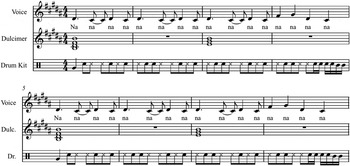
Andersson's video of her kitchen-based performance of ‘Na na na’ provides us with a neat distillation of her performing style. In the opening moments, Andersson introduces a few key loops and figures that will serve as building blocks for the song. First, she samples two chords on her dulcimer, the B major and E major triads, setting up an alternating I–IV progression that will serve as the song's chief harmonic underpinning. After she assigns these chords to her loop pedal, she then turns to a partial drum kit, recording a two-bar cross-sticking groove with a brief fill embellishment at the end. As this drum loop is triggered, Andersson uses the vocal mic to lay down the four-bar melodic ostinato that constitutes the song's central hook. By this time, Andersson has begun the song in earnest, coordinating these three basic units with a few other elements, including an alternating I–IV bass line and a short bridge sequence, both played on her acoustic guitar, and a separate concluding flourish on the violin. Looping the sung ostinato of the song's hook, she is also able to layer in a countermelody, producing the illusion of vocal polyphony with lead singer and backup vocalists. Each of these elements is triggered or performed in real-time, marking a series of frequent, precise shifts within the song's crisp, minimalist pop song form (see Example 1).Footnote 12
Full texture from chorus section of Theresa Andersson, ‘Na na na’ (0:52–1:05).

Wedged alongside a battery of pedals used for compression, octave splitting or other effects, Andersson's key piece of hardware is the Boss RC-50 Loop Station, a device that combines a digital sampler with an intuitive set of footswitch triggers (Gershuny Reference Gershuny2009). The loop pedal allows the artist to record material and then assign them to phrase pedals, which can then be triggered in real-time. The RC-50 is one of a number of similar ‘stompbox’ devices presently on the market, including the Line 6 DL4 Delay Modeler, the Akai E2 Headrush (employed by KT Tunstall) and the Boomerang Phrase Sampler (used by Trey Anastasio of the rock band Phish) (Anastasio, in Ellis Reference Ellis2000, p. 100; Richardson Reference Richardson and Scott2009, p. 89). An important precedent for the loop sampler pedals is the Electro-Harmonix 16-Second Digital Delay, introduced in the early 1980s and marketed as a kind of ‘Fripp-in-a-box’ (Cleveland Reference Cleveland2006, p. 89). The 16-Second Delay, one of the earliest inexpensive samplers, allowed performers to sample and store a loop for later use, enabling guitarists such as Bill Frisell or Nels Cline to produce elaborate ‘sound-on-sound’ textures in real-time (Thompson Reference Thompson2002, p. 70). Devices such as the RC-50 build upon the basic features of earlier pedals, permitting artists to synchronise loops with an external MIDI source, play samples in reverse or trigger loops automatically within a specified time grid.
The proliferation of loop pedal devices over the last decade or so can be understood as part of a larger trend outlined by Paul Théberge (Reference Théberge1997) in his account of the relationship between consumerism and digital music production technologies. For Théberge, the explosion of new possibilities for music making made possible through new MIDI, multi-tracking, and ‘home studio’ technologies has taken place within an environment increasingly characterised by logics of consumption and market infiltration. As musicians acquire new devices in order to enhance their creative potential, they reinforce a trend whereby the line separating production from consumption becomes increasingly blurred, each new advance in creative capacity dependent upon a corresponding accumulation of new consumer technologies.
Théberge's analysis makes note of the introduction of pre-recorded sample CDs, which provided producers with a range of purchasable grooves and textures during the growth of MIDI-based music in the 1990s. The adoption of sample CDs has had the effect of reorienting artists’ conception of how they forge a distinctive sound, and the development of sound-modifying hardware for live performance has had a similar impact (Théberge Reference Théberge1997, pp. 79, 198). In contrast to an earlier cultural moment when artists would understand their sound as intrinsically bound to their own physicality of performance, contemporary musicians rely upon devices that decouple musical sounds from any unmediated connection to physical gesture. Instead, music making in the age of digital technology relocates the source of sonic creativity in the response to pre-recorded sounds, the timbral or rhythmic manipulation of sounds imported from external sources (Théberge Reference Théberge1997, p. 198).
To be sure, Andersson is loading her own acoustic gestures into the RC-50 sampler, not purchased sounds from a sample library or other external source. In doing this, though, Andersson is essentially externalising her own sounds, severing them from the gestural physicality of live performance and giving them something of the ‘objective character of the pre-existing sound’ (Théberge Reference Théberge1997, p. 198). In this way, even some of the elements of her songs that originate with live acoustic performance become bound up in the logic of the devices that record them. Andersson's one-woman band is best understood as a distributed subjectivity, with components of ‘her’ sound located in the consumer equipment lining her pedalboard. The corollary to Andersson's autonomy from live accompanists is her increased dependence upon the technologies that help her secure such autonomy.
The same contradictory logic of autonomy informs Andersson's use of the Internet as a means of promotion for her music. Andersson is one of a number of artists who have been able to attain visibility by way of YouTube's platform, which (in theory, at least) enables intimate and local sites of production to attain some degree of publicity, universality and global reach (Everdell Reference Everdell2009). For independent artists, the recent rise of such content-sharing websites as MySpace and YouTube holds out the promise of alternatives to the hegemonic control over music promotion and distribution that the major labels exerted throughout the 20th century.Footnote 13 However, we must also recognise that YouTube is bound up in the same networks of capital that have historically imposed conditions of entry on artists, shaping their access to resources, publicity and remuneration. For this reason, artists dependent upon YouTube's platform for publicity and exposure are frequently vulnerable to the company's shifts in policy (Everdell Reference Everdell2009, p. 31). These disruptions foreground the asymmetrical relationship between YouTube and its users, in which minor policy adjustments on YouTube's part may mean a sudden loss of visibility and access for amateur and professional musicians. Where YouTube and other web portals can enable artists to harness the powers of distributed selfhood, these transactions are often executed on YouTube's terms.
Andersson's post-Fordist ‘Motown sound’
The technologies of distributed selfhood described here are closely tied to broader developments in the contemporary post-industrial economy, in the ways that they allow Theresa Andersson to participate in the distinctive social relations of the post-Fordist regime of accumulation. Jettisoning the rigid hierarchies and unwieldy economies of scale of Fordist production, post-Fordist institutions rely on procedures that favour a more nimble, flexible and autonomous workforce, in which individuals are enjoined to leverage their own creativity as a productive force. If Andersson's technological prostheses do reaffirm what I have outlined as a structural trope of atomised, entrepreneurial subjectivity, their connection to post-Fordism is not simply metaphorical. In permitting the same techniques of digital manipulation, production and distribution available (for example) to independent, unaided web designers and desktop publishers, they are often indistinguishable from technologies of post-Fordist production in other spheres of the economy.
Andersson's realisation of a post-Fordist mode of performative labour becomes especially clear if we situate her music in relation to one of its most illuminating stylistic threads: its appropriation of the ‘Motown sound’. Beyond its distinctive aesthetic impact, the ‘Motown sound’ is noteworthy for its reliance on a set of procedures that closely resembled the Fordist practices of industrial production, practices initially set in motion by auto manufacturers located elsewhere in the same city (Smith Reference Smith1999, pp. 14–16). Andersson's song ‘Birds Fly Away’ invites comparisons with both the style and production approach of Motown records (Andersson Reference Andersson2008b). Andersson's YouTube clip for ‘Birds Fly Away’, which revisits the kitchen-based multi-instrumental performance of ‘Na na na’, engages with Motown precisely at the level of a tension between style and production: if the sound of Andersson's song faithfully adheres to the stylistic parameters of early 1960s Detroit R&B, its visual representation highlights her distance from the large-scale, vertically integrated hit-making machinery associated with Motown or Brill-building pop.
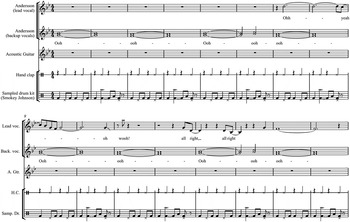
On ‘Birds Fly Away’, Andersson begins with the same process she uses on the similar video for ‘Na na na’, recording a few isolated gestures that she will later incorporate into her real-time execution of the song. Here, Andersson sings and records three chromatically descending long tones (B♭–A–A♭), doubled on the glockenspiel, which she reassembles later as textural components for a transitional section of the song. With this item complete, she begins the song in earnest, recording an alternating long tone pattern oscillating between B♭ and A, backed by handclaps on beats two and four. After eight bars, this pattern is established as a loop, and Andersson layers in a second vocal line, which moves in parallel thirds beneath the initial phrase. Together, these long tones (all on the syllable ‘oo’) in turn serve as background vocals for a much more bluesy, melismatic vocal countermelody introduced in the last 16 bars before the first verse (see Example 2).
Full texture of introductory section, Theresa Andersson, ‘Birds Fly Away’ (0:47–1:08).

Heard by itself, Andersson's audio track suggests her close alignment with the songwriting and production methods of Motown. The densely layered texture of the song, in which Andersson superimposes tambourine backbeats, glockenspiel accents, syncopated basslines, vocal harmonies and intricate string passages, alludes to the kinds of arrangements assembled by the Holland–Dozier–Holland songwriting team for such Motown artists as Marvin Gaye, the Supremes and the Four Tops.Footnote 14 However, Andersson's video, which visually depicts her real-time assembly of the music's individual components, dramatises the historical and technological gap that separates the postwar Motown sound from Andersson's postmodern sound. In front of her webcam, Andersson stages the movement from Fordist to post-Fordist conceptions of cultural production. If the ‘Motown sound’ is famously attributed to Berry Gordy's emulation of the large-scale, intergroup coordination he witnessed as a line worker at the Ford Wayne Assembly Plant, Andersson's creative approach harnesses the digital technologies of the self that have transformed production in the post-Fordist era (Smith Reference Smith1999, pp. 13–14). Her loop pedals and video webcasting can be understood as devices of leverage, radically amplifying Andersson's potentiality as a solo performer and enabling her to bypass the expensive and time-consuming mechanisms of creative production and distribution associated with ‘big label’ studio recording.
Moreover, the YouTube video of ‘Birds Fly Away’ highlights another intriguing point of comparison between Andersson's song and the Motown legacy. Part of what makes Motown paradigmatic as a pop label is the way that it helped to establish a division of labour in the visual representation of pop music. The public ‘faces’ of Motown were the vocalists, whose meticulous choreography, performed against the backdrop of pristine stage sets, stood in for the entirety of the ‘Motown sound’. Other units of the label, such as the house band of rotating studio musicians known as the Funk Brothers, generally remained out of the limelight, anonymous labour largely invisible to the public at large. Such was the thesis of Paul Justman's documentary Standing in the Shadows of Motown (2002), which told the stories of such musicians as Earl Van Dyke or James Jamerson, in an effort to bring these musicians broader recognition. Justman's film showed images of the musicians working together in cramped quarters, diligently assembling Motown's hits in a space completely sequestered from the glamorous set pieces inhabited by the vocalists. This binary between visible vocalists and invisible instrumentalists upholds the image of Motown as a literal ‘hit factory’, producing glossy, affirmative commodities that efface the traces of their own production (Smith Reference Smith1999, pp. 118–21).Footnote 15
Andersson's YouTube videos upend this hierarchy of the visible in the Motown sound, opening her entire productive process to public scrutiny. Indeed, this ready availability of Andersson's production methods cannot be construed simply as an intriguing by-product of her performance, a kind of musical ‘behind-the-scenes’ supplement to the finished product of the song. The virtuosic execution of the song's part-by-part assembly before the viewer's gaze is the entire point. This is because the viewer's pleasure resides in those details of Andersson's production method that, in an earlier cultural moment, would have been kept meticulously out of sight (see Auslander Reference Auslander2008, p. 41; Richardson Reference Richardson and Scott2009, pp. 99–100).Footnote 16
The shift from Motown's stratified division of visible labour to Andersson's integrated version of the same is itself a reflection of a particular moment in the history of relations of production. As Paulo Virno has argued, performative virtuosity, which Marx had previously understood as a marginal form of ‘unproductive labour’, has come to occupy a central position in the present regime of accumulation: management, team-building, customer service and the intangible, communicative dimensions of labour have themselves become privileged sites of productivity in post-Fordist economies. This ‘activity without a finished product’ has displaced manufacturing as the paradigmatic form of waged labour in the postmodern economy (Virno Reference Virno, Virno and Hardt1996, pp. 191–3).
Music, of course, has always been a form of performative labour. However, in an age of mediated performance, the visual spectacle of Andersson's one-person band, with its self-conscious display of the nuts and bolts of production, highlights the process of performance in a way that conventional studio recordings, with their ‘acousmatic’ severing of sound from source, do not (cf. Richardson Reference Richardson and Scott2009, p. 86). In live, solo multi-instrumentalism, the visible performance of multivalent skill is as important to the overall effect as the ‘finished product’ of musical sound. For audiences, being able to see the intricacy of a solo performer's coordination and dexterity is a crucial ‘value add’ for their appreciation of the songs themselves (Auslander Reference Auslander2008, pp. 40–41). In this way, Theresa Andersson's webcam, which collapses the distinction between ‘behind the scenes’ musical production and a ‘finished product’ of polished audiovisual performance, is itself a symptom of a larger shift in cultural priorities. In an economy that, throughout the mid-20th century, had held up the finished commodity of the studio recording as its central object of interest, live solo multi-instrumentalism redirects our attention back towards the specifically performative nature of musical performative labour, taking pleasure in the idea of music as an ‘activity without a finished product’, its creative procedures visually laid out for our inspection. As the rest of the post-Fordist economy increasingly assumes music's performative form, musical texts tend towards greater self-reflexivity with respect to their own procedural, process-based qualities.
Conclusion
In its powerful distillation of ideas of self-sufficiency, economic thrift and multi-competence, the one-person band embodies some of the most pervasive tropes of our contemporary ‘free market’ consensus, providing us with a visceral image of the subjectivity idealised by theorists of neoliberalism. It can do so because it is a cultural form that taps into several competing priorities of pop and rock aesthetics: by collapsing conventional distinctions between the creative ‘auteur’ of the multi-track recording studio, on the one hand, and the spectacle of live instrumental mastery on the other, contemporary live solo multi-instrumentalism arrives at a viscerally engaging synthesis of earlier modes of authenticity (Goodwin Reference Goodwin1988, p. 44; Richardson Reference Richardson and Scott2009, pp. 85–6).
However, despite the exciting creative possibilities of live solo multi-instrumentalism, we must recognise that its presence in contemporary culture tacitly underwrites an ideology that has had destructive economic and social consequences. Over the last 30 years, advocates of neoliberalism have implemented a strategy of ‘creative destruction’ within the public and private sectors, with calamitous repercussions for key labour markets, institutions and networks of community support (Harvey Reference Harvey2007, p. 3). Live solo multi-instrumentalism, while by no means complicit in this turn of events, might help us to understand how neoliberal modes of thought might come to seem appealing or pleasurable. While the individual artists associated with this practice may themselves be stalwart advocates of socially communitarian values, the ‘heroic individualism’ of the one-person band serves as a tactile and visceral endorsement of a much more atomised social order.Footnote 17 As a performative model for the lone individual, pitted against a turbulent, socially fragmented environment, the one-man band provides us with a useful window onto one of the more disquieting aspects of our present cultural moment.
Acknowledgements
The author would like to thank the students in his undergraduate seminar on ‘DiY and Mashup Culture’ for their thoughtful commentary on contemporary solo multi-instrumental music. He is also grateful to Theresa Andersson and to Basin Street Records for permission to include transcriptions of the artist's work.