


The spring issue of Language of 1949 brought a remarkable new paper to its readers on the behaviour of morphophonemes, and the techniques that should be used to uncover them. This paper was entitled ‘Automatic alternations’ (Wells Reference Wells1949) and was the work of a young professor at Yale University, Rulon S. Wells (1919–), who would much later – in 1976 – be president of the LSA. It tackled the question of how to deal with the fact that if we view the world from a phonemicist's perspective, we may want to speak about a single morpheme, like ‘the plural /-z/’ in English, having several distinct phonemic realisations, all of which are predictable from purely phonological information in the environment of the morpheme. Such generalisations are not the purview of phonemics, of course, from a phonemic point of view – but they are the responsibility of the linguist, for generalisations of this sort may constitute a large portion of a language's structure.Footnote 1
In this paper, Wells introduces explicitly all of the reasoning that would characterise the heart of generative phonology: (i) underlying forms (which he calls ‘basic forms’), which may be abstract, (ii) rules that derive surface (phonemic) forms from the underlying forms by rules that dynamically modify a segment in the rule's focus when it occurs in a particular phonological environment, (iii) the crucial character of rule ordering in some cases and (iv) the necessity of intermediate forms in a derivation.
Much of Wells' paper is thoroughly modern in conception, and we shall take the opportunity to go through it in some detail, because it foreshadows – indeed, presents – the dynamic and rule-based conception of generative phonology, and also because it directly addresses the question of how to relate rule application to repairs of constraint violations, another topic that seems very contemporary in its perspective. The paper is organised into four parts. In the first, Wells discusses the directionality inherent in some alternations; in the second, some dangers that arise from analysing morphophonemic changes as having been causally triggered by violations of surface phonotactics – an implicit criticism of some Sapir-inspired phonological description. In the third part, he offers a rather baroque attempt to clarify how to deal with morphophonemic generalisations within a traditionally Bloomfieldian and static conception, and in the fourth part, a detailed spelling out of a dynamic conception of morphophonemics – what we would today call a derivational approach. We will discuss each of these in turn.
Was Wells' perspective on phonology mainstream in the late 1940s? The question is answered already by the fact that his article was published in Language: his was a view that had some novelty to it, and it was not a view that everyone already subscribed to. On the other hand, he was defending this idea as one within the standard theory of his day. He did not view himself as a revolutionary, and his form of argumentation was not noticeably different from that used by other phonologists in Language at the time. In the final section, we turn to the question which motivated this short paper itself: why would it come as a surprise to a modern-day phonology that phonologists in the late 1940s were sketching the outline of an approach to phonological analysis that would come to be known as generative phonology ten years later? Is there a story to be told if all there is is scholarly continuity? The story, I will suggest, is that the reality on the ground was intellectual continuity, while the story being told after the fact is one of revolutionary change. But the story cannot be told without dipping rather deeply into the published phonological work, and to that we now turn.
1 The directionality of morphophonemic change
Wells begins with the observation that if a morpheme has two alternants A and B, A might be predictable from B without B being predictable from A: the relationship may well be asymmetrical (p. 101):
It does not follow that from the knowledge of morph A we could predict the phonemic shape of morph B and conversely. In general, one of two automatically alternating morphs is predictable from the other but not the other from the one, a situation illustrated by Bloomfield's familiar example (Language 218-9) from German: the morpheme for ‘round’ has the alternants |runt| before pause, voiceless consonants, and glottal stop, and |rund| elsewhere; whereas the morpheme for ‘motley’ has |bunt| in both classes of environments. In view of these facts, |rund| may be labeled as the basic alternant and |runt| as derivative (op. cit. 212). (We shall symbolize: |rund| >|runt|; or d>t.)Footnote 2
Wells notes that he will use the ‘>’ notation for any alternation in which the element to the left of the ‘>’ is ‘taken as basic’ to the element to the right of the ‘>’. The notation thus emphasises that there can be an inherent asymmetry in the relationship between a ‘basic form’ and the morphs (which are strings of phonemes) that realise that form.
Now, it is clear that Wells is a bit uncomfortable with what he has just done – or rather, he recognises that his reader may be a bit uncomfortable with it – and much of the article is spent analysing the dynamic character of the perspective which notations like ‘>’ and terms like ‘taken as basic’ will lead to. He is concerned that this way of speaking about an analysis may appear, in his terms, more picturesque than accurate – but with that proviso, he acknowledges that this analysis allows him to formulate the notion that:
knowing the existence of |rund| we could predict the morpheme |runt| as the one that would occur before pause etc., whereas knowing only the existence of |runt| we could not, in view of the behavior of |bunt|, predict whether it would be |runt| again or |rund| that would appear before vowels etc. (p. 101).
Having said that, he tells the reader that he wishes ‘to replace picturesqueness by accuracy’: to find a legitimate and systematic way to incorporate these linguistic insights. The way to do this is by comparing two radically distinct conceptions, a static and a dynamic conception, as he calls them, and the dynamic conception, of course, is the one that employs the conceptual metaphor of one element being changed into another in a particular environment.Footnote 3 As we have noted, the dynamic conception is what would become the dominant perspective from the mid 1960s through the mid 1990s, only to be challenged by a number of static conceptions, including declarative phonology and Optimality Theory.
2 Alternations triggered by constraint violation
Wells begins by noting that he is aware that there are some pitfalls in front of him, and that he has no intention of falling into them. It is clear that he knows that the motive force behind the dynamic change is, at least in many cases, the appearance of an illicit phonemic sequence,Footnote 4 but he also is aware that we must be careful in how we deal with this fact. It would not do, for example, to say:
(1) When, by the placing of a morpheme in a certain phonemic environment, a phonemically non-occurrent sequence would arise, an alternation or change in this sequence is called automatic if it yields a phonemically occurring sequence (p. 102).
Wells considers an example that might seem to work along these lines. Suppose one observed that in Greek, no consonant except n, r or s appears word-finally, and that all other consonants will be dropped. Such a view would be motivated by pairs in (2), from galakt and stomat respectively: these are the forms which Wells calls ‘basic to the automatic alternation’, though today we would call them ‘underlying’.Footnote 5
(2)

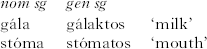
Wells agrees that the data in (2) motivates an analysis like that in (1) (‘no consonant except n, r, or s … can stand at the end of a Greek word. All other consonants are dropped’); and he agrees that this analysis is one that a linguist would find plausible – nonetheless, a theory that contains the principle in (1) is not sufficient, because it would also be consistent with a language which is like Greek, but in which different strategies are used in the two cases to avoid violation of the constraint on what can appear word-finally. As it is, Greek uses consonant deletion as its repair strategy in all cases, but the theory in (1) does not force that; it would be consistent with a different dialect of Greek in which some stems satisfied the constraint violation by using a suffix -o in the nominative singular. Wells unambiguously says (p. 102) that ‘we would be willing to regard gálakt and stómat as basic to automatic alternations if (a) their nominative singulars were gála and stóma, or (b) if they were gálakto and stómato, or (c) if they were both different from their basic alternants in any other way, provided that that way was the same or comparable in both cases and all other essentially similar ones; but not otherwise’. In contemporary terminology, Wells puts the requirement on the constraint-based theory that the change effected in order to satisfy the constraint must be the same in all cases – and in even more contemporary terms, he requires that the constraint violation triggers a specific rule. That is exactly what a generative phonological rule does.Footnote 6
Wells presents another argument against a surface-constraint based approach, one that is perhaps even more surprising in its prescience. He says that the constraints that are critical for triggering morphophonemic changes are not simply based on what sequences cannot appear in a language; they are based on what sequences cannot be found at morpheme boundaries.Footnote 7 A language can disprefer sequences (enough to trigger a rule to correct them) even if the language accepts them strictly inside a morpheme. Wells expands on this point, referring to Whitney (Reference Whitney1889) and Trubetzkoy (Reference Trubetzkoy1939) in this discussion (p. 103):
[The constraint violation] could occur, but not at a morpheme boundary. A perfect actual example has not come to the writer's notice, but some close enough approximations have been encountered to make the possibility worth discussing. In Sanskrit, as+n yields on … and ās+n yields ān (Whitney §175, §177) yet the phoneme sequences written asn, āsn occur. Only, when they occur there is no morpheme boundary between the s and the n. For instance, the following words contain the suffixes snu, sna (Whitney §§1194-5): vadhasnu ‘wielding a deadly weapon’, sthāsnu ‘fixed’, karasna ‘forearm’. The sequence sn is then what Trubetzkoy (256) calls a negative Grenzsignal: a sign that there is no morpheme boundary within it.
Would we, in this case, say that the alternations as>o, ās>ā before n are automatic in Sanskrit? The affirmative answer will be an instance of what we shall call the wide static conception, the negative an instance of the narrow static conception. It is not incumbent upon us here to choose between these conceptions, but only to mark their difference. They will be exactly defined in §10.
3 Two static conceptions of automatic alternation
Wells next develops in some detail a ‘static’ conception of automatic alternation, one which is conceptually parallel to the then-dominant conception of allophony, by which two allophones may be realisations of a single phoneme depending on the environment in which they appear. Such a conception (for allophones and for automatic alternations) is non-processual and non-dynamic, and Wells spends from page 105 to page 109 spelling it out.Footnote 8 One reasonable interpretation of Wells' strategy in this paper is that he feels obliged to present both a static and a dynamic analysis – that is, if he had presented only the dynamic analysis, his professional colleagues would have castigated him for not exploring the possibility of what they presumably would have preferred, a static analysis. He therefore presents a static analysis, but in such a way that its complexities (in a thoroughly pejorative sense now) are brought clearly to the fore.
Even within this static conception, though, Wells makes the point quite clearly that a consistent analysis of automatic alternations requires the positing of basic forms that are never found as such on the phonetic level: as we would say today, basic forms that are abstract. This can happen if there are two rules, one of which applies in one realisation of the morpheme, and one of which applies in the other. He illustrates this point with some examples from English.
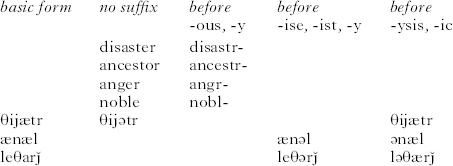
Wells points out that there is, in his words, an alternation ‘zero>ə before prepausal or preconsonantal r, l’, illustrated by forms in (3), but also an alternation ‘æ>ə in unstressed position’. This forces an abstract analysis of the stem in that case, but (p. 104):
we need only recognize that theatr>theater exhibits, simultaneously, two independent alternations – both of them capable, as it happens, of being considered automatic: (a) æ>ə in unstressed position, and (b) zero>ə before prepausal or preconsonantal r, l.
The same point holds, he says, for the morphemes anal and letharg, which are basically ænæl and leθar  , though these forms never surface as such.
I have organised Wells' examples in (3), using an interspersing of standard orthography and phonemic representation as he does (though his examples appear in running text).
(3)
4 A dynamic conception of automatic alternation
Wells introduces the dynamic conception in the following terms (p. 109):
The manner of describing alternation that is implicit in most grammars is quite different from the static one as presented above. The customary description of an alternation (not necessarily automatic) presents, in its most formalized dress, a quasi-chemical equation; e.g. rabh+ta=rabdha. In words: rabh before ta becomes rab; ta after rabh becomes dha. This manner of conception and description we call dynamic, because it employs the metaphor of change – change in the environment as well as in the focus … The difference between the dynamic and the static conceptions is obvious: the former takes as the relevant conditioning environment the basic alternant of the conditioning morpheme, the latter takes the derivative alternant. It follows that there is no difference in result between the static and the dynamic conceptions when the conditioning morpheme remains invariant; for example, the past participle of the Sanskrit root man ‘think’ is mata; if we describe in phonemic terms the environment conditioning this alternation man>ma, it would be ta according to either conception. But when a form, e.g. rabdha, contains a derivative alternant of the environment as well as of the focus – when, in other words, there is what may be described as reciprocal conditioning of two morphemes, the static and the dynamic descriptions diverge.
Restated in generative terms, Wells' suggestion is that the dynamic conception is appropriate when the underlying form, rather than the surface form, specifies the context correctly, while the static conception is appropriate when the surface form rather than the basic (that is, the underlying) form is the appropriate one for specifying the context of the phonological rule. He then proceeds to illustrate a derivational account of the Sanskrit form, pointing out that we may in principle apply the two rules simultaneously, or crucially order them in either of two ways (pp. 109–110):
There is in use a modification of the dynamic conception: the compromise mentioned [above]. This modification gives a stepwise description of a reciprocal conditioning, assigning an order of succession to the steps. Using the metaphor of change, we might describe the change of rabh+ta to rabdha in any of three ways: (i) in one step: rabh and ta change simultaneously. This is the pure dynamic conception. (ii) In two steps: first rabh+ta becomes rabh+dha; then rabh+dha becomes rab+dha. (iii) Again in two steps: first rabh+ta becomes rab+ta; then rab+ta becomes rab+dha. In (ii) ta changes before rabh; in (iii) after it; and in (i) simultaneously with it. The reason for calling descriptions (ii) and (iii) compromises between the pure static and the pure dynamic conceptions is that in each of them, the conditioning alternant of one morpheme is its basic alternant and the conditioning alternant of the other morpheme is its derivative alternant. The chief advantage of these compromises is an expository one … we may be saved the need of stating an extra rule, if the two steps into which a reciprocally conditioned alternation can be broken up are each of them covered by a rule which is needed anyway. In some cases, in order to achieve this economy, it is necessary to specify the order in which the steps take place; in other cases it is not.
Wells points out then that his conception of phonological analysis is found in Whitney's account of Sanskrit (p. 110):
Whitney himself, in describing forms like rabdha (§§159–60), uses the pure dynamic description, for the following reason. His consistent practice is, in all cases where a preceding and a following morpheme condition each other, automatically or otherwise, never to describe the following morpheme as changing first. In nearly all these cases he describes the preceding morpheme as changing first (compromise of type (iii) above); in those few exceptions, like the case of rabdha itself, where, for special reasons, he does not do this, what he does is to revert to pure dynamic description, i.e. describe the two changes as simultaneous.
Wells then turns to some data from Latin that is amenable to a dynamic analysis, but which, he will argue, is ‘fatal’ for the static conception (p. 110).
Let us consider the hypothesis that formulae such as pat ‘suffer’+tus (past participle, nom. sing. masc.)=passus, met ‘harvest’+tus=messus, etc., display two automatic and reciprocally conditioning alternations. Stated in dynamic terms, and reduced to the phonemes involved, these alternations are: (a) t becomes s between a short vowel and a following t which in turn is followed by a vowel; (b) a t followed by a vowel becomes s after a t that follows a short vowel.
Wells reformulates these rules in a static conception as follows (p. 111):
(A) between a preceding short vowel and a following s which is in turn followed by a vowel, derivative s occurs instead of basic t; (B) between a preceding sequence of short vowel and s and a following vowel, derivative s occurs instead of basic t.
Wells considers several forms that demonstrate that rule (B) is incorrect, and suggests that the strongest counterexamples are estō ‘be thou!’ and este ‘be ye!’. Similarly, rule (A) is incorrect, on the basis of the form etsī ‘and yet, although’.
Wells observes that a preference for a dynamic conception may lie in part in linguists' interest in historical analysis, although he makes it clear that the ‘basic’ forms that are posited are not necessarily the historically anterior forms. And he notes that the overall system can be compactly expressed by a notational system which focuses on morphophonemic structure (p. 113):
Such a system is a class of letters or other symbols, each of which is said to designate a morphophoneme, and to which meanings are assigned in such a way that from the morphophonemically written formula for a given morpheme, by application of the rules which assign meanings to each of its component symbols, one can deduce some or all of its actually occurring morphs. The simplest meaning that such a symbol can have is simply one single phoneme, under all circumstances; it is customary to use for such a symbol the same mark as for that phoneme itself, by a systematic ambiguity which is generally dispelled by the context or by some explicit convention. The next simplest meaning is, that the morphophonemic symbol designates one phoneme in the neighborhood of such-and-such symbols and another phoneme in the neighborhood of such-and-such other symbols. The convention in this case is to use the capital letter corresponding to the small letter that designates the phoneme which is regarded as basic.
Wells is well aware that some important aspects of the conception that he is discussing have appeared in the literature, and among these he cites are Bloomfield (Reference Bloomfield1939) and Swadesh & Voegelin's (Reference Swadesh and Voegelin1939) earlier analysis of Tübatulabal. Of the last, he notes that the analysis is very similar in spirit, and writes (p. 113):
Swadesh and Voegelin (10) say: ‘If it has been possible, by the recognition of a non-patent phonology [which involves the construction of fictive formulae] …, to reduce the apparent irregularity of Tübatulabal phonology to system, this very fact guarantees the truth of our theory.’ However, it is not clear what the ‘theory’ is, as distinct from their construction of formulae. On p. 2 they remark that ‘the process of constructing morpho-phonemic formulae has some resemblance to that of historico-phonological reconstruction.’ Is their theory the theory that their formulae represent not only historical realities but synchronic realities of some sort as well?
Wells concludes with several striking remarks, all of which are important in understanding the intellectual continuity between phonological theory in this period and that of the next two decades. First, ‘two phonemes [may] yield one’ is a dynamic statement, and he gives examples from Korean and from Kota in which two morphophonemes merge to a single phoneme. Second, in the search for notational conciseness, paying attention to the precise formulation of a rule may allow us to dispense with a rule by decomposing it into two independently needed rules; he illustrates this with an example from Sanskrit.Footnote 9 Third, the complete specification of a phonemic alternation requires four items: ‘(i) the phonemes involved; (ii) their phonemic environment …; (iii) the direction of the alternation …; and (iv) in the case of non-automatic alternations, the environments in which each member of the alternation occurs’ (p. 115).
And fourth, intermediate forms – which Wells calls ‘evanescent forms’ – may be ‘convenient’ in what we today would call the derivation (pp. 115–116):
It is sometimes convenient to make use of evanescent forms in stating alternations. For instance, the Latin alternations [discussed above] … could be less stringently stated so as to cover the formula: ūt ‘use’+tus=ūsus. We would postulate an evanescent form ūssus, and would then add another rule according to which this ūssus immediately changes to ūsus. The formula ‘ūt+tus=ūssus=ūsus’ reflects historical fact … but the point we wish to make is that there was a period (sometime after the beginning of the Imperial period) when ūsus occurred and ūssus did not, and that in describing the language of this period the symbol ‘ūssus’ has neither actual nor hypothetical, but only fictive meaning.
Translating into contemporary terminology, Wells is saying that the form uːssus is neither a predicted surface form (‘actual’), nor a hypothesised underlying form (‘hypothetical’) but only a ‘fictive’ form: in modern terminology, an intermediate form.
5 A few remarks on rule ordering in the late 1940s
The primary goal of the present paper has been to look at a single publication in some detail. In the final section, we will address the question as to why scholars and historians of generative phonology have seen fit to exaggerate the discontinuity between phonological studies being published in Language in the 1940s and that which was developed in early generative phonology some ten to fifteen years later. But we need to spend at least a brief moment looking at the landscape in the 1940s beyond Wells' paper. There is really no doubt that some linguists did not like phonological analyses with ordered rules – though, to be sure, the same thing could be said about the phonological community during the 1970s,Footnote 10 and I daresay that there is no single dominant view today, as I write these words, with regard to how issues of opacity should be treated in a formal theory. But returning to the 1940s, the subject was a live one, with a range of positions held by different people, for different reasons.Footnote 11 The evidence does not suggest that the paper by Wells which we have discussed here was particularly uncharacteristic of its time. Wells explained in the first footnote that he had written the paper in 1946 that he had gotten comments from Carl Voegelin, Charles Hockett and Bernard Bloch, and that Hockett had sent him a summary of points that he had made on automatic alternations in a paper presented at the 1947 Linguistics Institute in Ann Arbor. As we have already seen, Wells was aware of the influential paper by Swadesh & Voegelin (1939) on Tübatulabal, heavily and directly influenced by Sapir. In this paper, Swadesh &Voegelin argued that the formal simplicity and effectiveness of their account, with intermediate stages, was the best argument for the validity of such an approach. Presumably, their theory was that their formulae represent not only historical realities but synchronic realities of some sort as well.
Zellig Harris's position on derivations in phonology is nuanced, and must be understood in the context of his understanding of the goal of linguistic analysis, which was pragmatic – using the term as Rorty (Reference Rorty1991), for example, would have wanted it used: a position according to which an analytic technique was appropriate if it led to an analysis that was useful. Harris, however, seems to have been dubious that rule ordering provided enough benefit to pay for its conceptual costs. As Aravind Joshi (personal communication) has pointed out, Harris appeared to put considerable value on the fact that in a system with rules, but no extrinsic ordering, there is a natural way to relate derivations to objects with an algebraic structure; the imposition of rule ordering deprives one of the possibility of seeing a natural relationship between classes of derivations and a semi-group generated by the rules. From that point of view, it is natural that Harris would look for ways to avoid rule ordering in analysis. In Harris (Reference Harris1944: 201–205), he suggests how phenomena described by Newman in dynamic terms could be handled:
without bringing in the time or motion analogy implicit in ‘process’ … [and without employing any] primacy of the base (pp. 203–204).
but at the same time, Harris's major work recognises the validity of such an approach. In Structural linguistics (1951), he wrote:
It is sometimes convenient to consider one of the members to be the symbol of the new class [phoneme, morphophoneme or other]; that member is then said to be primary (or the base) while the other members are derived from it by a set of environmentally (or otherwise) conditioned ‘rules’ or operations. For example, we may say that the phoneme /t/ is the member segment [t] plus various changes in various positions. Or we may say that the morphophoneme /f/ is the phoneme /f/ plus the change to voicing before {–s} ‘plural’ … In all these cases, we could consider one member a as primary if we can state the conditions in which the other elements b, c replace it (are derived from it). The choice of a is clearer if we can not reversibly derive a from b or c; i.e. if we can not state the exact conditions in which b is replaced by a. When no member of a class can be set up as primary, it may be possible to set up a theoretical base form from which each member can be derived (cf. in morphophonemics) (1951: 367–368).
And a few pages later, in the book's conclusions (p. 373), Harris considers ways of analysing data which:
have depended ultimately on moving-parts models such as machines or historical sciences. In using such models, the linguistic presentation would speak, for example, of base forms (e.g. in morphophonemics, where the observed forms are obtained from the base form by applying a phonemic substitution), of derived forms (e.g. stems plus those affixes which are added first in the descriptive order might be called derived stems), or processes which yield one form out of another. In all these types of presentation, the elements are seen as having histories, so that the relation of an element to sequences which contain it becomes the history of the element as it is subjected to various processes and extensions. (Footnote: In such presentations, a relation between two elements a and b is essentially the difference between two historical or otherwise derivational paths: that from A to a and that from A to b. A is set up as a base from which both a and b have, by different paths, been derived.)
Charles Hockett's recollection, in the early 1990s, was that rule ordering was a hot topic in the late 1940s. In a letter to the present author (February 7, 1991), he wrote:
Quite apart from publications, a number of us (Bloch, Trager, Harris, Voegelin, Smith, Joos) were in active correspondence in the late 1940s and early 1950s. I have (or did have; some of them are lost) letters from Zellig Harris that mention a young student named Chomsky. One of them speaks enthusiastically of Chomsky's work on Hebrew morphophonemics, saying that Chomsky had found a way to put the ordering of morphophonemic rules on a logical basis.
Hockett himself, on the other hand, was quite sceptical at the time of the usefulness of the approach. He wrote (1954: 211):
If it be said that the English past-tense form baked is ‘formed’ from bake by a ‘process’ of ‘suffixation’, then no matter what disclaimer of historicity is made, it is impossible not to conclude that some kind of priority is being assigned to bake, as against either baked or the suffix. And if this priority is not historical, what is it?
Sydney Lamb, also in correspondence with the present author (February 23, 2006), has more recently noted that during his graduate study at Berkeley in the first half of the 1950s:
this method [of ordered rules] was taught by Murray Emeneau in his morphology course at UC Berkeley (which I took). And also in his ‘Sanskrit sandhi and exercises’ booklet which I and others of his Sanskrit students used.
The weight of the evidence thus seems to be that using a sequence of ordered rules in a phonological analysis was a recognised, though not especially popular, theoretical option by the late 1940s or early 1950s. Wells' paper was just what it appeared to be: a proposal, based on several empirical cases, to take more seriously an idea that had been discussed but was not widely accepted.
6 Separation of levels
A reviewer for this journal (who was himself a student of Charles Hockett) has rightly raised the question of the conceptual connection between Wells' work on phonological rules and the structuralists' commitment to a principle of separation of levels. The role played by concerns of separation of levels deserves a long study by itself, perhaps one similar in spirit to the present paper. The greatest part of the evidence supporting sequential rule application of the sort that we are considering in this paper is evidence only when we take into consideration knowledge about the way an identifiable morpheme (stem or affix) is realised differently in different phonological contexts. If the principle of separation of levels ruled out the use of that sort of evidence, then phonological derivations could only rarely be justified, if at all.
The bottom line, in this writer's opinion, is that there was a spectrum of opinion ranging from those on one end, such as Joos and Hockett, who strongly supported the principle of separation of levels, to those at the other end, such as Pike and Harris, who thought such a principle was in no way binding. Pike's views on this (famously presented in Pike Reference Pike1947) are well known, but Harris's views seem to have been misrepresented in the literature, so I will present some of his thoughts on this in some detail. The upshot is that Wells' account of rule application is safe within a Harrisian view of the interaction of morphology and phonology.
I offer the following analogy. The linguist who analyses a language and produces a particular grammar is like a man who needs to push a heavy handcart from the train station to a dock on the riverside, 200 feet downhill and a mile away, and he needs to do it without ever having to pass through a stretch where the route goes uphill, and without ever going the wrong way down a one-way street. The linguists who, like Joos, supported a strong thesis of the separation of levels imagined that this problem had to be solvable the very first time the man arrives at the train station, and solvable just by looking around, seeing which streets seem to go uphill and which downhill at each corner he passes. The more liberal linguists, like Harris (as we shall see), thought that a rigorous solution was perfectly valid even if it meant that the fellow was permitted to walk around town ahead of time and take notes, and make himself a map. As long as the eventual route obeyed the traffic laws, why should the linguist not take advantage of some free time the day before, and exploit the more global knowledge he might obtain? As we will see, Joos thought that phonologists had agreed that such knowledge was illicit for phonologists, while Harris, like Pike, simply did not agree.
Martin Joos expressed his point of view in 1964, the extreme one that is remembered today:
Quite a few of us are old enough to remember some of the linguistic quarrels of the 1930's. One that particularly sticks in my mind had to do with the beginnings of phonemic theory. It seems that there were two words spelled candied and candid, and the problem was to prove that they were different words. Bloomfield transcribed the first of them with /ij/ and the second with plain /i/. Now that was a sufficient solution; but was it also a necessary one? Bloomfield himself said that it was not a necessary solution: ‘Any transcription that works’ is a good one, he said; provided that it works through the whole lexicon and is not wasteful of symbols. Daniel Jones pointed out that the two words could be transcribed with the same vowel symbols, and candied with a hyphen before the final consonant, and that then both the British standard identity of the two words and the American difference between them emerge from the single rule that before a hyphen one pronounces the same as at the end of the word candy. The Bloomfield theory of the day had no defense against that proposal; in fact, Bloomfield himself was not above using hyphens on occasion.
How did we get out of that jam? By instituting the principle of the Separation of Levels. That hyphen was a grammatical symbol, and it had no business intruding into a phonological description; and by the same token, nothing specifically semantic should be allowed to intrude into a grammatical description. It was an easy principle to defend, for we could simply remark that every mixing of levels amounted to begging the question. First, we said, the complete phonemic description without grammatical contaminations was a prerequisite to beginning to describe the grammar of a language; and then the complete grammatical description would be a prerequisite to beginning the study of meaning.
By the early part of the second world war we were erecting defenses on both flanks of this principle of the separation of levels. On one flank were ranged the literary critics – remember Leo Spitzer twenty years ago in Language? – who kept sniping at us for denying that meaning exists; that forced us to say that we meant to use meaning only differentially; we promised to confine ourselves to asking whether two things had the same or a different meaning. One blood defender, Zellig Harris, undertook to show that even that employment of meaning was unnecessary for phonology and grammar; but most of us conceded that life would be too complicated on those terms. On the other flank were those who pointed out that even the differential use of meaning was not enough for a practical discovery-procedure: there, the leader was Kenneth Pike with his Grammatical Prerequisites to phonological analysis; and we covered that flank by distinguishing between practical analysis with no holds barred, on the one hand, and on the other hand a publishable description for which we would maintain the separation of levels. Many of us still maintain that that can be done with the help of a long spoon, but we can't deny that it is difficult (1964: 59–60).
Joos certainly could not have been clearer, and he was right that Pike was not at all in agreement. But he was quite wrong about Harris, as we can see if we actually read what he had to say. The crucial point, as the reader will see, is that the phonemic analysis was not completed after studying the distribution of sounds. Quite to the contrary; a tentative phonology had been set up, but it would be modified as we learned more about the morphology.
This Harris makes clear in Chapter 8 of Methods in structural linguistics (1951), which presents a discussion which is quite surprising to a reader today, because while it describes itself as being concerned with boundary elements (as we would say today; Harris calls them junctures), it is really about abstract analyses. The point of the discussion is to show that a great deal of formal simplification can be achieved with the addition of a small amount of abstraction. Harris' example is the relationship of /ay/ (minus) and /ay/ (sly, slyness). Given the pair minus/slyness, the two phones seem to be in contrast, and Harris cites a similar case for /ey/ and /ey/ (which appears to no longer exist in American English). But /ay/'s environment is so restricted – it appears primarily at the end of utterances, plus in a few other words – that it seems inappropriate to set it up as a separate phoneme, even though the leading principles laid out so far demand that this be done.
Harris proposes that this is a fine place to posit an abstract element (which he indicates this way: /-/), and it will appear in words such as /sly-ness/. This abstract element is motivated by three considerations: we may be able to reduce the set of phonemes by doing so. In the case at hand, while we introduce /-/, Harris suggests we can get rid of two phonemes, /a/ and /e/, whereas American English of 2008 may have only one sound, /a/, which can be gotten rid of here. Second, the abstract element may account for other, quite separate phenomena. Harris identifies this boundary element with one that would be posited in compound nouns, such as night-rate (whose pronunciation is quite different from that of nitrate); the allophones of the final sound of night in night-rate are different from the single phone possible in nitrate, and this difference can be described by positing a /-/ juncture in night-rate. Harris's third argument is that the /-/ juncture coincides with a position of possible pause. Harris also suggests (p. 82) that this juncture element can be used to replace the notion of syllable; instead of saying that a segment is the first segment of a syllable, we can say that it is preceded by a /-/ juncture.
It is clear that Harris realises he is on to a new method, with this postulation of boundaries. He writes (p. 86): ‘by the setting up of the junctures, segments which had previously contrasted may now be associated together into one phoneme, since they are complementary in respect to the juncture’. Of course this flies in the face of phonemicist methodology, in the sense that if we follow Harris's suggestion, any contrast can now be accounted for without positing a new phoneme by positing a juncture that ‘triggers’ a condition that the phoneme is realised in a special way when in the context of this boundary. I think that there is therefore some irony in the sentence that follows, in Harris's presentation, since many phonologists were unhappy about allowing phoneme-realisation rules to be sensitive to contexts like ‘word-final’ for precisely this reason.
Although the explicit use of junctures is relatively recent, the fundamental technique is involved in such traditional linguistic considerations as ‘word-final’, ‘syllabification’, and the use of space between written words (p. 86).
The next sentence is as direct a rejection of the principle of separation of levels as one could hope to have. He writes:
When a linguist sets up the phonemes of a language, he does not stop at the complementary elements of Chapter 7 [that is, traditional phonemic analysis, JG], but coalesces sets of these complementary elements by using considerations of juncture.
In fact, Harris goes on to point out that in order to get English right, we need to postulate two (abstract) boundary elements, one which he denotes as ‘#’ and the other as ‘-’. The first appears between words, while the second appears inside certain words, like slyness, where the stem sly is longer than a syllable in a monomorphemic word like minus would be.
It certainly now appears that Harris is encouraging phonologists to postulate boundary symbols in order to simplify the phonology – boundary symbols that are essentially the reflection of morphological structure. If the reader has come to the discussion expecting to find all the phonology to be morphology-free, Harris makes it clear that he does not agree (p. 87):
The great importance of junctures lies in the fact that they can be so placed as to indicate various morphological boundaries.
If a language has predictable penultimate stress, for example – like Swahili – then we can eliminate stress as an element of the phonemic representation just as long as we include word boundaries between the words. In fact, Harris goes on to point out that the phonologist would be wise to restrict his use of boundary symbols to cases where they really do mark morpheme boundaries. German presents an interesting case: the phonologist knows that word-final obstruents are devoiced in German, and so he might want to remove the voiceless obstruents from the phonemic inventory, replacing everywhere /t/, for example, by /d#/, but this would have the unfortunate consequence of requiring us to place #'s in all sorts of places that are not at all morpheme boundaries, like right after a word-initial consonant: Teil ‘part’ would be /d#ayl/, and this would not correlate with morphological boundaries.
In English, Harris notes, every case where a /-/ boundary is needed, it corresponds to a morpheme boundary (as in slyness, for example), but the converse does not hold: not every morpheme boundary corresponds phonemically to a /-/: Harris says playful does not have a /-/ boundary, but trayfull does – purely on descriptive grounds.
Harris is quite clear (p. 88) that phonemic analysis should take morphemic analysis into account when the data of the language suggest that this be done: phonological analysis can be simplified by positing phonological boundary elements which typically correspond to morphological boundaries:
The agreement [between the needs of the phonemic analysis and the boundaries motivated by morphology] is, furthermore, due in part to the partial dependence between phonemes and morphemes.
And the phonologist just may have to guess where the morpheme boundaries are to be placed, by seeing how this simplifies the phonological analysis:
In much linguistic practice, where phonemes are tentatively set up while preliminary guesses are being made as to morphemes, tentative junctures may be defined not on the basis of any knowledge that particular morphemes are worth uniting … but only on the basis of suspicions as to where morpheme boundaries lie in given utterances (p. 89).
To summarise, then, in contemporary terms: the phonologists may posit abstract boundary symbols – any number of them – in his phonology, if he suspects that a morphological analysis will find motivation for them. No-one could read this carefully and interpret this method as one in which phonemic analysis precedes morphological analysis!
Harris turns next to another way to lead to a simpler phonological analysis – not by positing abstract elements of a sort that are never pronounced, but by analysing a phonetic sound as being the realisation of two distinct phonemes, one preceding the other (though Harris points out that really this is a generalisation of the abstract boundary case; p. 96). Harris refers to this as rephonemicisation, and its purpose, and its goal, is two-fold: it allows us to reduce the size of the underlying phoneme inventory, and it eliminates (or simplifies) conditions on what sequences of phonemes are permitting in phonemic representations. Harris offers the example of the nasalised flap in some American pronunciations of painting, which can be reanalysed phonemically as a nasal followed by a /t/.
True to his methodological principles, he does not insist that one must perform this kind of analysis. Many linguists are doing this, Harris knows: ‘the current development of linguistic work is in part in this direction’ (p. 94). But one shouldn't feel obliged to do so: ‘any degree of reduction and any type of simplification merely yields a different, and in the last analysis equivalent, phonemic representation which may be more or less suited to particular purposes’ (p. 94). Still, this method can be very useful; one of Harris's examples concerns reanalysis of /š/ as /sy/, which does not lead to a simplification of the phonemic analysis, but definitely simplifies the morphological analysis, since it allows us to have a single representation for the morpheme admiss in admissible (with /s/) and admission (with /š/).
Where do things stand, then, with allowing morphological considerations to influence the phonemic analysis? The answer is essentially this: use morphological information in developing a phonemic analysis, unless that would have a clearly undesirable effect on the phonology. In Harris's words (p. 111):
If two segments having different environments (i.e. non-contrasting) occur in two morphemic segments which we would later wish to consider as variants of the same morpheme in different environments, we will group the two segments into one phoneme
That's clear: design your phonology in order to simplify the morphology. But the sentence continues:
… provided this does not otherwise complicate our general phonemic statement. Our assignments of segments to phonemes should, if possible, be made on the basis of [purely phonemic criteria], since [this particular principle] introduces considerations drawn from a later level of analysis.
So we cannot walk away from this saying that things are crystal clear, from a methodological point of view. This seems like a fair summary: use purely phonological criteria to come up with the smallest inventory of phonemes and the fewest constraints on distribution of phonemes. When it is possible to simplify the morphology by relatively modest modifications of the phonemic inventory, one should do so, and Harris clearly supported such an analysis. But Harris did take the position that the analyst was not obliged to do so at any given point. Separation of levels is a consideration, but one whose significance is less than that of any insight that can be obtained on the morphological level of analysis.
I urge the reader to compare Joos's remarks with Harris's. Harris was the consummate theoretician, who followed every hypothesis through to its ultimate conclusion, and he had no place for separation of levels as a fundamental principle. Joos disagreed. There was a range of opinion during the 1940s and 1950s in American phonological theory, and generative phonology continued the tradition that was clearly enunciated in Harris (Reference Harris1951) : separation of levels was not a fundamental principle of linguistic analysis.
7 Discussion
Although no phonologist is obliged to be interested in the history of his or her discipline, the way we view our past inevitably brings a bias to some of our work, if only with regard to what we consider to be new and citation-worthy. But most students of the history of science give more weight to the importance of how a discipline views its past, and the discrepancies between the history of a discipline, as documented in its annals, and its presentation to a later generation has been of interest to more than one scholar. Thomas Kuhn, in his widely influential Structure of scientific revolutions (1962), remarked that textbooks in the scientific disciplines that he analysed tended to be inaccurate in that they exaggerated the extent to which researchers in the past were grappling with the kinds of issues that we care about today. He wrote (1962: 136–137):
textbooks of science contain just a bit of history, either in an introductory chapter or, more often, in scattered references to the great heroes of an earlier age. From such references both students and professionals come to feel like participants in a long-standing historical tradition … Partly by selection and partly by distortion, the scientists of earlier ages are implicitly represented as having worked upon the same set of fixed problems and in accordance with the same set of fixed canons that the most recent revolution in scientific theory and method has made seem scientific. No wonder that textbooks and the historical tradition they imply have to be rewritten after each scientific revolution. And no wonder that, as they are rewritten, science once again comes to seem largely cumulative.
The case we have looked at in this paper leans in the opposite direction: the picture that we have of phonology in the 1940s is one that is oversimplified. The existence of analyses with derivations and sequential rule application was an issue, even in the 1940s, about which phonologists could disagree, and publish articles (see the references cited in note 1).
There has been some discussion in the literature in recent years about how the effects of ordered rules were understood ‘by the American linguistic community in the 1940s and 1950s’ (Bromberger & Halle Reference Bromberger and Morris1989: 66), and the present paper is indeed motivated by a desire to shed further light on this question. The paper by Bromberger & Halle stimulated a reply by Encrevé (Reference Encrevé1997), republished in somewhat modified form as Encrevé (Reference Encrevé2000). Bromberger & Halle's position is that analyses with ordered rules in synchronic accounts were widely rejected in the 1930s (they call this rejection ‘the prevailing wisdom’), but they note that a solution with ordered rules was seriously proposed by Bloomfield (Reference Bloomfield1939) ; this paper, they suggest (1989: 67) was ‘so unknown in America that Chomsky tells us that he had not read ‘Menomini morphophonemics’ until his attention was drawn to it by Halle in the late 1950s'. Encrevé and Koerner (Reference Koerner2003, Reference Koerner and Koerner2004)Footnote 12 have both addressed the question as to whether, in retrospect, the view that Chomsky was unaware of Bloomfield's work on ordered rules is plausible. Whatever the answer may be that question, it seems to the present author that the question is of little intellectual interest. Why would we care whether a student at the University of Pennsylvania had or had not read a ten-year-old published paper by the most prominent linguist of that time (i.e. Leonard Bloomfield)? Still, given the amount of ink that has been devoted to the question, it is clear that some people have cared. Why so?
The answer surely is this: there is a legitimate interest in ascertaining the degree to which the rise of generative phonology in the 1950s formed a continuous development with the intellectual themes that were in play already in the 1940s. Documenting that is the central point of this paper. One might think that evidence showing that this development was in fact continuous would be about as interesting as the observation that a rooster crowed at dawn: why shouldn't the field show continuity in its development, after all?
An adequate response to that question would require a much fuller and more detailed account than space permits in this paper. Such an account would deal not simply with the historical development of ideas in phonology, which is the topic to which I have limited myself here, but also the ways in which social units that are larger than the individual, but considerably smaller than the discipline – a group such as early generative grammarians – undertake to form an intellectual vanguard, and define themselves in opposition to what are perceived to be the dominant views. Such social formations are both natural and numerous, and in phonology, they are to be found both before and after the rise of generative phonology. In order to strengthen the social character of the formation, work must be undertaken to characterise, in retrospect, what the dominant views were, and this work is for obvious reasons biased in a certain direction. The existence in the late 1940s in mainstream journals of ideas that were to become central to generative phonology is thus a threat to the success of such as a characterisation.
In observing this, I have in mind statements like the one in Chomsky (Reference Chomsky1986: 13, n. 3), where he notes that ‘a modern counterpart [to Panini's grammar] is Bloomfield (Reference Bloomfield1939), which was radically different in character from the work of the period and inconsistent with his own theories of language, and remained virtually without influence or even awareness despite Bloomfield's great prestige'. The published literature, however, does not support this claim, and we have seen in this brief paper that Wells goes out of his way to forcefully and didactically characterise the step-by-step analysis that generative phonology came to characterise as a derivation.
Indeed, the 1949 article by Wells which is the focus of our attention here cites Bloomfield (Reference Bloomfield1939) on the first footnote on the first page, and it is one of 24 items cited – the list reads for the most part like a list of the most important papers in phonology over the preceding two decades. A scholarly look at the major publications of the 1940s and 1950s (to which this paper is intended to be a contribution) would have to draw two conclusions: first, that Bloomfield's analysis in ‘Menomini morphophonemics’ was both cited and influential, and second, that the line of influence was continuous from Bloomfield, through Harris, Wells and Chomsky. To believe otherwise, it seems to me, is to turn a blind eye to the documentary record.
I do not doubt for a moment that someone in Chomsky's position might even today look back at Wells' article from 1949 and see it as pure description, lacking at least some of what emerged in generative phonology ten to fifteen years later. But the claim that intellectual continuity is the norm would expect just that: Halle and Chomsky's work in the late 1950s should indeed be an advance when judged against Wells' work in 1946. But it ill behoves us to dismiss earlier work because it fails to surpass work that still lies in the future.
Needless to say, I encourage the reader to read Wells' paper for himself, and to judge whether it is not a cautious and careful exegesis of the benefits that can be reaped from derivational analysis, aimed at an audience that was leery of confusing synchronic and diachronic analysis. As a phonologist working at the beginning of the 21st century, I would argue that we should not characterise the work of linguists such as Wells, Harris and Hockett as the last gasp of a dying structuralism, but as a body of scholarship out of which generative phonology was a natural development.
Surely this conclusion is reasonable and, ultimately, not at all surprising. My admiration for generative phonology is in no way diminished by the realisation that its key ideas were being considered and developed by the mid 1940s. It is, after all, the ideas that matter to us now.


