

%20--%3e%3c!DOCTYPE%20svg%20PUBLIC%20'-//W3C//DTD%20SVG%201.0//EN'%20'http://www.w3.org/TR/2001/REC-SVG-20010904/DTD/svg10.dtd'%3e%3csvg%20version='1.0'%20id='Layer_1'%20xmlns='http://www.w3.org/2000/svg'%20xmlns:xlink='http://www.w3.org/1999/xlink'%20x='0px'%20y='0px'%20width='64px'%20height='64px'%20viewBox='5.5%20-3.5%2064%2064'%20enable-background='new%205.5%20-3.5%2064%2064'%20xml:space='preserve'%3e%3cg%3e%3ccircle%20fill='%23FFFFFF'%20fill-opacity='0'%20cx='37.785'%20cy='28.501'%20r='28.836'/%3e%3cpath%20fill='%23595959'%20d='M37.441-3.5c8.951,0,16.572,3.125,22.857,9.372c3.008,3.009,5.295,6.448,6.857,10.314%20c1.561,3.867,2.344,7.971,2.344,12.314c0,4.381-0.773,8.486-2.314,12.313c-1.543,3.828-3.82,7.21-6.828,10.143%20c-3.123,3.085-6.666,5.448-10.629,7.086c-3.961,1.638-8.057,2.457-12.285,2.457s-8.276-0.808-12.143-2.429%20c-3.866-1.618-7.333-3.961-10.4-7.027c-3.067-3.066-5.4-6.524-7-10.372S5.5,32.767,5.5,28.5c0-4.229,0.809-8.295,2.428-12.2%20c1.619-3.905,3.972-7.4,7.057-10.486C21.08-0.394,28.565-3.5,37.441-3.5z%20M37.557,2.272c-7.314,0-13.467,2.553-18.458,7.657%20c-2.515,2.553-4.448,5.419-5.8,8.6c-1.354,3.181-2.029,6.505-2.029,9.972c0,3.429,0.675,6.734,2.029,9.913%20c1.353,3.183,3.285,6.021,5.8,8.516c2.514,2.496,5.351,4.399,8.515,5.715c3.161,1.314,6.476,1.971,9.943,1.971%20c3.428,0,6.75-0.665,9.973-1.999c3.219-1.335,6.121-3.257,8.713-5.771c4.99-4.876,7.484-10.99,7.484-18.344%20c0-3.543-0.648-6.895-1.943-10.057c-1.293-3.162-3.18-5.98-5.654-8.458C50.984,4.844,44.795,2.272,37.557,2.272z%20M37.156,23.187%20l-4.287,2.229c-0.458-0.951-1.019-1.619-1.685-2c-0.667-0.38-1.286-0.571-1.858-0.571c-2.856,0-4.286,1.885-4.286,5.657%20c0,1.714,0.362,3.084,1.085,4.113c0.724,1.029,1.791,1.544,3.201,1.544c1.867,0,3.181-0.915,3.944-2.743l3.942,2%20c-0.838,1.563-2,2.791-3.486,3.686c-1.484,0.896-3.123,1.343-4.914,1.343c-2.857,0-5.163-0.875-6.915-2.629%20c-1.752-1.752-2.628-4.19-2.628-7.313c0-3.048,0.886-5.466,2.657-7.257c1.771-1.79,4.009-2.686,6.715-2.686%20C32.604,18.558,35.441,20.101,37.156,23.187z%20M55.613,23.187l-4.229,2.229c-0.457-0.951-1.02-1.619-1.686-2%20c-0.668-0.38-1.307-0.571-1.914-0.571c-2.857,0-4.287,1.885-4.287,5.657c0,1.714,0.363,3.084,1.086,4.113%20c0.723,1.029,1.789,1.544,3.201,1.544c1.865,0,3.18-0.915,3.941-2.743l4,2c-0.875,1.563-2.057,2.791-3.541,3.686%20c-1.486,0.896-3.105,1.343-4.857,1.343c-2.896,0-5.209-0.875-6.941-2.629c-1.736-1.752-2.602-4.19-2.602-7.313%20c0-3.048,0.885-5.466,2.658-7.257c1.77-1.79,4.008-2.686,6.713-2.686C51.117,18.558,53.938,20.101,55.613,23.187z'/%3e%3c/g%3e%3c/svg%3e)
%20--%3e%3c!DOCTYPE%20svg%20PUBLIC%20'-//W3C//DTD%20SVG%201.0//EN'%20'http://www.w3.org/TR/2001/REC-SVG-20010904/DTD/svg10.dtd'%3e%3csvg%20version='1.0'%20id='Layer_1'%20xmlns='http://www.w3.org/2000/svg'%20xmlns:xlink='http://www.w3.org/1999/xlink'%20x='0px'%20y='0px'%20width='64px'%20height='64px'%20viewBox='5.5%20-3.5%2064%2064'%20enable-background='new%205.5%20-3.5%2064%2064'%20xml:space='preserve'%3e%3cg%3e%3ccircle%20fill='%23FFFFFF'%20fill-opacity='0'%20cx='37.637'%20cy='28.806'%20r='28.276'/%3e%3cg%3e%3cpath%20fill='%23595959'%20d='M37.443-3.5c8.988,0,16.57,3.085,22.742,9.257C66.393,11.967,69.5,19.548,69.5,28.5c0,8.991-3.049,16.476-9.145,22.456%20C53.879,57.319,46.242,60.5,37.443,60.5c-8.649,0-16.153-3.144-22.514-9.43C8.644,44.784,5.5,37.262,5.5,28.5%20c0-8.761,3.144-16.342,9.429-22.742C21.101-0.415,28.604-3.5,37.443-3.5z%20M37.557,2.272c-7.276,0-13.428,2.553-18.457,7.657%20c-5.22,5.334-7.829,11.525-7.829,18.572c0,7.086,2.59,13.22,7.77,18.398c5.181,5.182,11.352,7.771,18.514,7.771%20c7.123,0,13.334-2.607,18.629-7.828c5.029-4.838,7.543-10.952,7.543-18.343c0-7.276-2.553-13.465-7.656-18.571%20C50.967,4.824,44.795,2.272,37.557,2.272z%20M46.129,20.557v13.085h-3.656v15.542h-9.944V33.643h-3.656V20.557%20c0-0.572,0.2-1.057,0.599-1.457c0.401-0.399,0.887-0.6,1.457-0.6h13.144c0.533,0,1.01,0.2,1.428,0.6%20C45.918,19.5,46.129,19.986,46.129,20.557z%20M33.042,12.329c0-3.008,1.485-4.514,4.458-4.514s4.457,1.504,4.457,4.514%20c0,2.971-1.486,4.457-4.457,4.457S33.042,15.3,33.042,12.329z'/%3e%3c/g%3e%3c/g%3e%3c/svg%3e)
%20--%3e%3c!DOCTYPE%20svg%20PUBLIC%20'-//W3C//DTD%20SVG%201.0//EN'%20'http://www.w3.org/TR/2001/REC-SVG-20010904/DTD/svg10.dtd'%3e%3csvg%20version='1.0'%20id='Layer_1'%20xmlns='http://www.w3.org/2000/svg'%20xmlns:xlink='http://www.w3.org/1999/xlink'%20x='0px'%20y='0px'%20width='64px'%20height='64px'%20viewBox='5.5%20-3.5%2064%2064'%20enable-background='new%205.5%20-3.5%2064%2064'%20xml:space='preserve'%3e%3cg%3e%3ccircle%20fill='%23FFFFFF'%20fill-opacity='0'%20cx='36.924'%20cy='28.403'%20r='28.895'/%3e%3cpath%20fill='%23595959'%20d='M37.442-3.5c8.99,0,16.571,3.085,22.743,9.256C66.393,11.928,69.5,19.509,69.5,28.5c0,8.992-3.048,16.476-9.145,22.458%20C53.88,57.32,46.241,60.5,37.442,60.5c-8.686,0-16.19-3.162-22.513-9.485C8.644,44.728,5.5,37.225,5.5,28.5%20c0-8.762,3.144-16.343,9.429-22.743C21.1-0.414,28.604-3.5,37.442-3.5z%20M12.7,19.872c-0.952,2.628-1.429,5.505-1.429,8.629%20c0,7.086,2.59,13.22,7.77,18.4c5.219,5.144,11.391,7.715,18.514,7.715c7.201,0,13.409-2.608,18.63-7.829%20c1.867-1.79,3.332-3.657,4.398-5.602l-12.056-5.371c-0.421,2.02-1.439,3.667-3.057,4.942c-1.622,1.276-3.535,2.011-5.744,2.2%20v4.915h-3.714v-4.915c-3.543-0.036-6.782-1.312-9.714-3.827l4.4-4.457c2.094,1.942,4.476,2.913,7.143,2.913%20c1.104,0,2.048-0.246,2.83-0.743c0.78-0.494,1.172-1.312,1.172-2.457c0-0.801-0.287-1.448-0.858-1.943l-3.085-1.315l-3.771-1.715%20l-5.086-2.229L12.7,19.872z%20M37.557,2.214c-7.276,0-13.428,2.571-18.457,7.714c-1.258,1.258-2.439,2.686-3.543,4.287L27.786,19.7%20c0.533-1.676,1.542-3.019,3.029-4.028c1.484-1.009,3.218-1.571,5.2-1.686V9.071h3.715v4.915c2.934,0.153,5.6,1.143,8,2.971%20l-4.172,4.286c-1.793-1.257-3.619-1.885-5.486-1.885c-0.991,0-1.876,0.191-2.656,0.571c-0.781,0.381-1.172,1.029-1.172,1.943%20c0,0.267,0.095,0.533,0.285,0.8l4.057,1.83l2.8,1.257l5.144,2.285l16.397,7.314c0.535-2.248,0.801-4.533,0.801-6.857%20c0-7.353-2.552-13.543-7.656-18.573C51.005,4.785,44.831,2.214,37.557,2.214z'/%3e%3c/g%3e%3c/svg%3e)
%20--%3e%3c!DOCTYPE%20svg%20PUBLIC%20'-//W3C//DTD%20SVG%201.1//EN'%20'http://www.w3.org/Graphics/SVG/1.1/DTD/svg11.dtd'%3e%3csvg%20version='1.1'%20id='Layer_1'%20xmlns='http://www.w3.org/2000/svg'%20xmlns:xlink='http://www.w3.org/1999/xlink'%20x='0px'%20y='0px'%20width='64.000977px'%20height='64px'%20viewBox='0%200%2064.000977%2064'%20enable-background='new%200%200%2064.000977%2064'%20xml:space='preserve'%3e%3cg%3e%3ccircle%20fill='%23FFFFFF'%20fill-opacity='0'%20cx='32.064453'%20cy='31.788086'%20r='29.012695'/%3e%3cg%3e%3cpath%20fill='%23595959'%20d='M31.943848,0C40.896484,0,48.476562,3.105469,54.6875,9.314453C60.894531,15.486328,64.000977,23.045898,64.000977,32%20s-3.048828,16.457031-9.145508,22.513672C48.417969,60.837891,40.779297,64,31.942871,64%20c-8.648926,0-16.152832-3.142578-22.513672-9.429688C3.144043,48.286133,0,40.761719,0,32.000977%20c0-8.723633,3.144043-16.285156,9.429199-22.68457C15.640137,3.105469,23.14502,0,31.943848,0z%20M32.060547,5.771484%20c-7.275391,0-13.429688,2.570312-18.458496,7.714844C8.381836,18.783203,5.772949,24.954102,5.772949,32%20c0,7.125,2.589844,13.256836,7.77002,18.400391c5.181152,5.181641,11.352051,7.770508,18.515625,7.770508%20c7.123047,0,13.332031-2.608398,18.626953-7.828125C55.713867,45.466797,58.228516,39.353516,58.228516,32%20c0-7.3125-2.553711-13.484375-7.65625-18.513672C45.504883,8.341797,39.333984,5.771484,32.060547,5.771484z%20M44.117188,24.456055%20v5.485352H20.859863v-5.485352H44.117188z%20M44.117188,34.743164v5.481445H20.859863v-5.481445H44.117188z'/%3e%3c/g%3e%3c/g%3e%3c/svg%3e)
Summary Contents
There are approximately 200 research universities operating in the United States today. These universities, with aggregate annual research budgets in excess of $70 billion,Footnote 1 are responsible for many of the most important scientific and technological discoveries of the last century. As recounted by Jonathan Cole, “[t]he laser, magnetic-resonance imaging, FM radio, the algorithm for Google searches, global-positioning systems, DNA fingerprinting, fetal monitoring, bar codes, transistors, improved weather forecasting, mainframe computers, scientific cattle breeding, advanced methods of surveying public opinion, even Viagra had their origins in America’s research universities.”Footnote 2
Universities actively seek patents and other intellectual property (IP) protection for their innovations. From 1996 to 2015, American universities obtained more than 80,000 US patents, and more than 7,600 in 2018 alone.Footnote 3 Many of these patents are licensed to start-up and mature companies. The Association for University Technology Managers (AUTM) reports that in 2018 US universities entered into 9,350 new technology license and option agreements.Footnote 4 Accordingly, any discussion of technology licensing and transactions would be incomplete without a brief stop in the world of university technology transfer.Footnote 5
14.1 Academic Research and the Bayh–dole Act
Before World War II, US academic research was confined largely to the laboratory and scientific conferences.Footnote 6 But with the advent of war against technologically formidable adversaries, President Franklin D. Roosevelt placed Vannevar Bush, the Dean of MIT’s School of Engineering and the founder of Raytheon, in charge of the government’s new Office of Scientific Research and Development. Bush drew on his longstanding ties to MIT as he oversaw key wartime initiatives like the Manhattan Project and the development of radar. During America’s post-war boom, Bush continued to shape US research policy, convinced that American academic institutions could serve the national interest through research and development. As a result, the federal government began to pour money into academic labs. In 1953, federal nondefense R&D funding was $2.2 billion. By 1980 it had reached $41.5 billion.
But although an increasing share of each year’s Nobel prizes went to US scientists, relatively little academic research was finding its way into the commercial sector. Unlike Japan, where the government directly funded industrial research programs in fields like semiconductors and consumer electronics, US research had a hard time finding its way into commercial applications. It has been estimated that of the 30,000 federally owned patents in existence prior to 1980, only 5 percent were ever licensed to industry, and even fewer made their way into commercial products or services.Footnote 7 The problem, many felt, had to do with the way that patents were awarded for federally funded research.
Under prevailing federal regulations prior to 1980, IP rights in federally funded discoveries were murky. Some agencies claimed ownership over inventions that they funded, others gave rights to their grantees, others didn’t specify one way or the other. A result of this lack of clarity was that few federally funded inventions were being used by the private sector. A solution to this problem was proposed by Senators Birch Bayh, a Democrat from Indiana, and Bob Dole, a Republican from Kansas. The resulting Bayh–Dole Act of 1980 made a number of tweaks to the patent system focused on federally funded research.Footnote 8
35 U.S.C. § 200: Policy and Objective
It is the policy and objective of the Congress to use the patent system to promote the utilization of inventions arising from federally supported research or development; to encourage maximum participation of small business firms in federally supported research and development efforts; to promote collaboration between commercial concerns and nonprofit organizations, including universities; to ensure that inventions made by nonprofit organizations and small business firms are used in a manner to promote free competition and enterprise without unduly encumbering future research and discovery; to promote the commercialization and public availability of inventions made in the United States by United States industry and labor; to ensure that the Government obtains sufficient rights in federally supported inventions to meet the needs of the Government and protect the public against nonuse or unreasonable use of inventions; and to minimize the costs of administering policies in this area.
14.1.1 Ownership of Federally Funded Intellectual Property
The principal feature of the Bayh–Dole Act was to allow research institutions receiving federal funding to retain ownership of the discoveries and inventions that they made using this funding.Footnote 9 The Act requires these institutions to disclose each such federally funded invention to the government, and to elect whether or not it wishes to retain rights to that invention. If the institution fails to make this disclosure within a reasonable time or to make this election within two years after the disclosure, then the government may take title to the invention (35 U.S.C. § 201(c)(1)-(2)). Then, if the institution elects to take title to the invention, it must file patent applications in the United States and any other countries where it wishes to retain rights (35 U.S.C. § 201(c)(3)). Again, if the institution fails to file such patent applications in a country, the government may take title to the invention in that country.
Despite these provisions, universities typically do not file patent applications covering every invention that is disclosed by their researchers. In many cases the potential commercial value of an invention may be small compared to the cost of filing and prosecuting a patent application, and the university’s educational and research missions may better be served by permitting the researcher to publish the relevant findings and/or to release the invention, for example, on an “open source” basis. If a university wishes to discontinue prosecuting a patent application or maintaining a patent that was developed using federal funding, it must so notify the federal agency (37 C.F.R. § 401.14(f)(3)). While such a notification technically gives the agency the right to claim ownership of the invention, governmental agencies seldom exercise this right.
Senators Birch Bayh and Bob Dole.

A related issue concerns a university’s ownership of an invention when a researcher assigns the rights in that invention to a commercial research sponsor. This issue was considered in the following case.
563 U.S. 776 (2011)
ROBERTS, CHIEF JUSTICE
Since 1790, the patent law has operated on the premise that rights in an invention belong to the inventor. The question here is whether the Bayh–Dole Act displaces that norm and automatically vests title to federally funded inventions in federal contractors. We hold that it does not.
In 1985, a small California research company called Cetus began to develop methods for quantifying blood-borne levels of human immunodeficiency virus (HIV), the virus that causes AIDS. A Nobel Prize winning technique developed at Cetus—polymerase chain reaction, or PCR—was an integral part of these efforts. PCR allows billions of copies of DNA sequences to be made from a small initial blood sample.
In 1988, Cetus began to collaborate with scientists at Stanford University’s Department of Infectious Diseases to test the efficacy of new AIDS drugs. Dr. Mark Holodniy joined Stanford as a research fellow in the department around that time. When he did so, he signed a Copyright and Patent Agreement (CPA) stating that he “agree[d] to assign” to Stanford his “right, title and interest in” inventions resulting from his employment at the University.
At Stanford Holodniy undertook to develop an improved method for quantifying HIV levels in patient blood samples, using PCR. Because Holodniy was largely unfamiliar with PCR, his supervisor arranged for him to conduct research at Cetus. As a condition of gaining access to Cetus, Holodniy signed a Visitor’s Confidentiality Agreement (VCA). That agreement stated that Holodniy “will assign and do[es] hereby assign” to Cetus his “right, title and interest in each of the ideas, inventions and improvements” made “as a consequence of [his] access” to Cetus.
For the next nine months, Holodniy conducted research at Cetus. Working with Cetus employees, Holodniy devised a PCR-based procedure for calculating the amount of HIV in a patient’s blood. That technique allowed doctors to determine whether a patient was benefiting from HIV therapy.
Holodniy then returned to Stanford where he and other University employees tested the HIV measurement technique. Over the next few years, Stanford obtained written assignments of rights from the Stanford employees involved in refinement of the technique, including Holodniy, and filed several patent applications related to the procedure. Stanford secured three patents to the HIV measurement process.
In 1991, Roche Molecular Systems, a company that specializes in diagnostic blood screening, acquired Cetus’s PCR-related assets, including all rights Cetus had obtained through agreements like the VCA signed by Holodniy. After conducting clinical trials on the HIV quantification method developed at Cetus, Roche commercialized the procedure. Today, Roche’s HIV test “kits are used in hospitals and AIDS clinics worldwide.”
Some of Stanford’s research related to the HIV measurement technique was funded by the National Institutes of Health (NIH), thereby subjecting the invention to the Bayh–Dole Act. Accordingly, Stanford disclosed the invention, conferred on the Government a nonexclusive, nontransferable, paid-up license to use the patented procedure, and formally notified NIH that it elected to retain title to the invention.
In 2005, the Board of Trustees of Stanford University filed suit against Roche, contending that Roche’s HIV test kits infringed Stanford’s patents. As relevant here, Roche responded by asserting that it was a co-owner of the HIV quantification procedure, based on Holodniy’s assignment of his rights in the Visitor’s Confidentiality Agreement. As a result, Roche argued, Stanford lacked standing to sue it for patent infringement. Stanford claimed that Holodniy had no rights to assign because the University’s HIV research was federally funded, giving the school superior rights in the invention under the Bayh–Dole Act.
Although much in intellectual property law has changed in the 220 years since the first Patent Act, the basic idea that inventors have the right to patent their inventions has not. Under the law in its current form, “[w]hoever invents or discovers any new and useful process, machine, manufacture, or composition of matter … may obtain a patent therefor.” 35 U.S.C. § 101.
Our precedents confirm the general rule that rights in an invention belong to the inventor. It is equally well established that an inventor can assign his rights in an invention to a third party. Thus, although others may acquire an interest in an invention, any such interest—as a general rule—must trace back to the inventor.
In accordance with these principles, we have recognized that unless there is an agreement to the contrary, an employer does not have rights in an invention “which is the original conception of the employee alone.” Such an invention “remains the property of him who conceived it.” Ibid. In most circumstances, an inventor must expressly grant his rights in an invention to his employer if the employer is to obtain those rights.
Stanford and the United States as amicus curiae contend that the Bayh–Dole Act reorders the normal priority of rights in an invention when the invention is conceived or first reduced to practice with the support of federal funds. In their view, the Act moves inventors from the front of the line to the back by vesting title to federally funded inventions in the inventor’s employer—the federal contractor.
[But] nowhere in the Act is title expressly vested in contractors or anyone else; nowhere in the Act are inventors expressly deprived of their interest in federally funded inventions. Instead, the Act provides that contractors may “elect to retain title to any subject invention.” 35 U.S.C. § 202(a). A “subject invention” is defined as “any invention of the contractor conceived or first actually reduced to practice in the performance of work under a funding agreement.” § 201(e).
Stanford asserts that the phrase “invention of the contractor” in this provision “is naturally read to include all inventions made by the contractor’s employees with the aid of federal funding.” That reading assumes that Congress subtly set aside two centuries of patent law in a statutory definition. It also renders the phrase “of the contractor” superfluous. If the phrase “of the contractor” were deleted from the definition of “subject invention,” the definition would cover “any invention … conceived or first actually reduced to practice in the performance of work under a funding agreement.” Reading “of the contractor” to mean “all inventions made by the contractor’s employees with the aid of federal funding,” as Stanford would, adds nothing that is not already in the definition, since the definition already covers inventions made under the funding agreement. That is contrary to our general “reluctan[ce] to treat statutory terms as surplusage.”
Construing the phrase to refer instead to a particular category of inventions conceived or reduced to practice under a funding agreement—inventions “of the contractor,” that is, those owned by or belonging to the contractor—makes the phrase meaningful in the statutory definition. And “invention owned by the contractor” or “invention belonging to the contractor” are natural readings of the phrase “invention of the contractor.”
Stanford’s reading of the phrase “invention of the contractor” to mean “all inventions made by the contractor’s employees” is plausible enough in the abstract; it is often the case that whatever an employee produces in the course of his employment belongs to his employer. No one would claim that an autoworker who builds a car while working in a factory owns that car. But, as noted, patent law has always been different: We have rejected the idea that mere employment is sufficient to vest title to an employee’s invention in the employer. Against this background, a contractor’s invention—an “invention of the contractor”—does not automatically include inventions made by the contractor’s employees.
The Bayh–Dole Act’s provision stating that contractors may “elect to retain title” confirms that the Act does not vest title. Stanford reaches the opposite conclusion, but only because it reads “retain” to mean “acquire” and “receive.” That is certainly not the common meaning of “retain.” “[R]etain” means “to hold or continue to hold in possession or use.” You cannot retain something unless you already have it. The Bayh–Dole Act does not confer title to federally funded inventions on contractors or authorize contractors to unilaterally take title to those inventions; it simply assures contractors that they may keep title to whatever it is they already have. Such a provision makes sense in a statute specifying the respective rights and responsibilities of federal contractors and the Government.
The Bayh–Dole Act applies to subject inventions “conceived or first actually reduced to practice in the performance of work” “funded in whole or in part by the Federal Government.” Under Stanford’s construction of the Act, title to one of its employee’s inventions could vest in the University even if the invention was conceived before the inventor became a University employee, so long as the invention’s reduction to practice was supported by federal funding. What is more, Stanford’s reading suggests that the school would obtain title to one of its employee’s inventions even if only one dollar of federal funding was applied toward the invention’s conception or reduction to practice.
Stanford contends that reading the Bayh–Dole Act as not vesting title to federally funded inventions in federal contractors “fundamentally undermin[es]” the Act’s framework and severely threatens its continued “successful application.” We do not agree. Universities typically enter into agreements with their employees requiring the assignment to the university of rights in inventions. With an effective assignment, those inventions—if federally funded—become “subject inventions” under the Act, and the statute as a practical matter works pretty much the way Stanford says it should. The only significant difference is that it does so without violence to the basic principle of patent law that inventors own their inventions.
Stanford University failed to acquire rights in one of its researchers’ inventions due to the future-looking language of its IP assignment policy. The Bayh–Dole Act did not remedy this failure.

Notes and Questions
1. University ownership. Why does the Bayh–Dole Act allow universities to patent federally funded inventions? Why doesn’t the act award such patents to the federal funding agency? Section 105(a) of the Copyright Act provides that copyright protection is not available for any work of the US government, meaning that works of authorship made by federal personnel are largely in the public domain. Why wasn’t a similar rule adopted for patents?
2. The importance of words. The Supreme Court, in ruling for Cetus, merely confirmed that the Bayh–Dole Act did not rescue Stanford from the results of its unfortunate drafting choices, discussed in Section 2.3, Notes 3–4. Is this fair? Should a mere contractual slip override the public policy goals of the Bayh–Dole Act?
14.1.2 Royalty Sharing with Researchers
Academic institutions, while excellent sources for basic research, are seldom equipped to bring their inventions to the marketplace. Accordingly, most universities seek to license their patents and other IP to the private sector (see Section 14.2). In most cases these licenses are royalty-bearing, meaning that the university will collect a royalty based on some percentage of its licensees’ sales of products covered by the patents (see Section 8.2). The Bayh–Dole Act requires that universities share these royalties with individual inventors, and that the balance of the proceeds (after payment of expenses) “be utilized for the support of scientific research or education” (35 U.S.C. § 202(c)(7)(B)-(C)). Royalty-sharing arrangements vary widely among institutions. For example, Stanford University allocates the first 15 percent of net license revenue (after patenting costs) to its technology transfer office (TTO), then splits the remaining 85 percent in three equal parts among the inventors (in equal shares), their departments and the university; Washington University in St. Louis allocates 25 percent to its TTO, 35 percent to the inventors and 40 percent to the university; and Rice University allocates 37.5 percent to the inventors, 14 percent to their departments, 18.5 percent to the graduate education function, and 30 percent to the university.Footnote 10
14.1.3 Preference for United States Industry
Section 204 of the Bayh–Dole Act embodies a specific preference for US manufacturing in its terms.
Notwithstanding any other provision of this chapter, no [entity] which receives title to any subject invention … shall grant to any person the exclusive right to use or sell any subject invention in the United States unless such person agrees that any products embodying the subject invention or produced through the use of the subject invention will be manufactured substantially in the United States. However, in individual cases, the requirement for such an agreement may be waived by the Federal agency under whose funding agreement the invention was made upon a showing by the [entity] that reasonable but unsuccessful efforts have been made to grant licenses on similar terms to potential licensees that would be likely to manufacture substantially in the United States or that under the circumstances domestic manufacture is not commercially feasible.
An exclusive licensee of a federally funded invention should thus be vigilant – if a US manufacturing provision is included in the license agreement proffered by an academic institution, the licensee should evaluate whether US manufacturing will be practical under the circumstances. For example, does the licensee intend to offshore manufacturing to another country? Will its costs increase substantially if required to manufacture in the United States? Although the US manufacturing requirement is often waived by the funding agency, such waiver must be requested specifically.
Notes and Questions
1. Bayh–Dole as an engine of global innovation? In 2002 The Economist lauded the Bayh–Dole Act as “Possibly the most inspired piece of legislation to be enacted in America over the past half-century.” The Act, the editors proclaimed, “unlocked all the inventions and discoveries that had been made in laboratories throughout the United States with the help of taxpayers’ money [and] helped to reverse America’s precipitous slide into industrial irrelevance.”Footnote 11 An industry coalition celebrating the fortieth anniversary of the Act in 2020 proudly announced that “Bayh–Dole made the United States the engine of global innovation … Thanks to Bayh–Dole, over 200 new therapies – including drugs and vaccines – have been created since 1980. The legislation has also bolstered U.S. economic output by $1.3 trillion, supported 4.2 million jobs, and led to more than 11,000 start-up companies.”Footnote 12 Why would university patenting be responsible for economic growth on this scale? What is your impression of these figures?
2. Bayh–Dole, oncomouse, and the Republic of Science. Beginning in the 1990s, critics began to fear that the promise of licensing revenue may have caused universities to stray from their core educational and public missions. Members of the public, including a number of students, began to protest prominent academic–industry ties. One of the most heated of these incidents involved Harvard’s genetically engineered “oncomouse,” which the university licensed exclusively to DuPont Corporation. The arrangement led to student protests, newspaper op-eds and two rounds of Congressional hearings.Footnote 13 Eventually, in response to this flurry of negative publicity, Harvard and DuPont rescinded some of the more controversial aspects of their arrangement. In response to episodes like this, science journalist Dan Greenberg, in his influential book Science for Sale: The Perils, Rewards, and Delusions of Campus Capitalism (2007), asks whether “today’s commercial values [have] contaminated academic research, diverting it from socially beneficial goals to mercenary service on behalf of profit-seeking corporate interests?” (p. 2).Footnote 14 What do you think of these critiques? Do they detract from the economic benefits that seem to have flowed from the Bayh–Dole Act?
3. Royalty sharing. As noted above, the Bayh–Dole Act requires that universities share royalties that they earn from patent licensing with individual inventors. Why? Private companies that license their patents have no such requirements. Should they? And which “inventors” should be entitled to a share of the university’s royalties? In most cases, inventors for patent purposes must make a meaningful original contribution to the discovery or reduction of an invention to practice – a far higher standard than that required for authorship of a scientific paper. Should other members of the scientific team or lab that made a major breakthrough receive any compensation?Footnote 15
4. US manufacturing. As noted above, the Bayh–Dole Act requires that an exclusive licensee of a federally funded invention substantially manufacture the resulting product in the United States. Why do you think this preference was included in the Act? Why does it apply only to exclusive licenses? Given the shift of manufacturing capacity overseas, how relevant do you think this preference is today? How often do you think the preference is waived by the relevant federal funding agency?
In Ciba-Geigy Corp. v. Alza Corp., 804 F. Supp. 614 (1992), Ciba-Geigy obtained an exclusive license under the University of California’s patents claiming a nicotine patch. Ciba-Geigy then sued Alza, claiming that Alza’s Nicoderm product infringed the patent. Alza counterclaimed that Ciba-Geigy’s exclusive license from the university was not valid because Ciba-Geigy had been manufacturing its own product in Germany, in violation of the US manufacturing requirement under Bayh–Dole. The court held that Alza could not defend against an infringement claim based on the failure of a university licensee to comply with US manufacturing requirements. Specifically, the court ruled that failing to manufacture in the United States does not automatically invalidate an exclusive license nor convert it to a nonexclusive license, so long as the government agency that funded the invention does not invoke its march-in rights (see Section 14.2). Unless and until the funding agency chose to exercise those rights (which it had shown no interest in doing), the license was unaffected. Do you agree with this result? If so, what purpose, if any, do US manufacturing rights serve today?
5. Bayh–Dole around the world. The apparent success of the Bayh–Dole Act in the United States has led a number of other countries to adopt legislation that seeks, in whole or in part, to replicate the benefits of the Act in their own economies. These include both developed countries such as China, Japan, France, Germany and the United Kingdom, as well as a range of mid-tier and developing countries, including Argentina, Brazil, Ethiopia, India, Indonesia, Malaysia, Nigeria, Poland, Russia and Vietnam. Do you think that local versions of the Bayh–Dole Act will be successful in each of these countries? Are there factors that would make a statutory structure such as that provided under Bayh–Dole less or more attractive in developing countries?
14.2 March-in Rights Under the Bayh–dole Act
Because inventions subject to the Bayh–Dole Act were made using federal funding, the federal government retains some rights to these inventions even when title is held by a research institution. Under Section 202(c)(4), the funding agency has “a nonexclusive, nontransferable, irrevocable, paid-up license to practice or have practiced for or on behalf of the United States any subject invention throughout the world.” This is a “government use” license, which ensures that the government is able to make use of inventions that it funds, even if they are otherwise commercialized.
A more controversial right exists under Section 203 of the Act. This section permits the funding agency to require an academic institution to license an invention to one or more third parties if necessary to “achieve practical application” of the invention or “to alleviate health or safety needs” that are “not reasonably satisfied” by the institution or its existing licensees. This right has significant implications both for the academic institution and its licensees. That is, if a university has granted an exclusive license to a private company, but that company cannot supply the licensed invention in sufficient quantities to meet health or safety needs, then the funding agency can require the university to license other manufacturers to produce the product, notwithstanding the original licensee’s exclusivity.
August 2, 2010
Joseph M. Carik, Anita Hochendoner, and Anita Bova seek an open license under the Bayh–Dole Act that would allow supply of agalsidase beta [Fabrazyme] in the U.S. and abroad to treat Fabry patients. Specifically, this petition requests that NIH authorize responsible entities and individuals to use U.S. Patent No. 5,356,804 and U.S. Patent No. 5,580,757 in order to manufacture, import, export or sell agalsidase beta.
Background on Fabry Disease
Fabry disease is an X-linked recessive (inherited) lysosomal storage disease, which can cause [renal, heart, dermatological, ocular and other symptoms]. Fabry disease significantly shortens the life of its sufferers.
Government Role in Funding Research and Development
NIH is one of the largest funding entities for Fabry research, and is heavily invested in securing the well-being of Fabry patients. A July 22, 2010 search of the NIH Research Portfolio Online Reporting Tools (RePORT) database using the keyword “Fabry” identified 372 NIH grants. A July 23, 2010 search of clinicaltrials.gov using the key words “Fabry’s Disease” identified 54 clinical trials, including 14 that were funded by the NIH, 16 identified as having received funding from Universities or other non-profit organizations, and 27 trials that received funding from industry.
Invention of Agalsidase Beta Treatment
While no cure is yet available, one of the greatest breakthroughs in scientific research on Fabry disease has been the discovery that enzyme replacement therapy with agalsidase beta (Fabrazyme) can effectively treat Fabry patients. The breakthrough was a direct result of NIH funding of grant no. DK 34045 awarded to Dr. Robert J. Desnick at the Mount Sinai School of Medicine of New York University. The adoption of Fabrazyme treatment has been widespread and is currently the gold standard of care for patients in the U.S. exhibiting symptoms.
Genzyme’s Fabrazyme.

Ownership and Licensing of Fabrazyme
Currently, Fabrazyme treatment is the only FDA approved enzyme replacement therapy in the United States. Genzyme, Inc. is the exclusive licensee to produce Fabrazyme.
The initial production of Fabrazyme was sufficient to meet the needs of all patients in the United States. However, in mid-2009, Genzyme decreased production as a result of a viral infection of their Allston, MA manufacturing plant. Further, in November 2009, Fabrazyme was produced which contained contaminants. The FDA initiated action against Genzyme which resulted in a consent decree including $175 million dollars in fines as profit disgorgement and oversight of the manufacture of Fabrazyme for at least 7 years.
Genzyme is only producing 30% of Fabrazyme estimated to meet the needs of patients. Current patients cannot have dosage increases, and no new patients being diagnosed are eligible to receive therapy. Although the most recent communication from Genzyme indicates that it expects to increase production by late 2011, there is no substantial guarantee that the projected date will be met.
Health Impact of Genzyme’s Rationing of Fabrazyme
No cumulative data on the impact of Fabrazyme rationing is yet available; however, anecdotal data indicate that patients are struggling and at least one patient may have died due to reduced dosage (Genzyme disputes that the death was due to rationing). In addition, the petitioners have suffered immediate and significant harm due to the rationing. Specifically, Mr. Carik, Ms. Hochendoner, and Ms. Bova have had their dosage cut by 70%. They have had a return of symptoms and are now at far greater risk for cardiac disease and renal failure than before rationing began.
Genzyme Has Not Satisfied and Cannot Reasonably Satisfy the Health and Safety Needs of Fabry Patients by Rationing Drugs While Preventing Additional Sources of Manufacture
Rationing drugs does not satisfy the health and safety needs of individuals because there is no alternative treatment, and absent rationing all patients would receive their recommended treatment. The Bayh–Dole Act requires that Genzyme reasonably satisfy the health and safety needs of patients, which it has not done.
1) It is … unreasonable, improper, and even catastrophic to limit patient access to a drug where such a limitation causes morbidity and death. The idea that drug access should be limited where there is a way to mitigate or prevent that limitation is anathema to virtually all ethical and scientific principles. Currently, 100% of Fabry patients have either limited access, or no access at all to Fabrazyme or any alternative treatment. Limiting access instead of encouraging others to make up the shortfall in manufacturing is the worst conceivable public health solution to supply shortages of publicly funded inventions.
2) It is further unreasonable and unfair to limit patient access to drug where the only impediment to its full production is a patent monopoly that was paid for in part from the tax dollars of the patients themselves. In fact, the exception regarding health and safety concerns in Bayh–Dole Act ensures that patent laws do not trump health and safety concerns. Thus, absent an overwhelming argument that patent exclusivity is more important than drug access (e.g., critical national security concerns), there is no medically or ethically justifiable reason to limit access to Fabrazyme where a statutory remedy to the rationing exists.
3) To the extent that economic policy is to be balanced against the public need, it is further unreasonable to deny march-in rights where the petitioners or other licensees will not compete against the patentee. Specifically, granting march-in rights will not discourage industry investment in drug development, because licensees will normally not ration drug thus avoiding the instant situation altogether. Further, by granting march-in rights, Genzyme’s revenues will actually increase since Genzyme sells every dose of Fabrazyme that it currently manufactures, but only meets 30% of the demand. By being granted march-in rights, the licensee will pay a reasonable 5% royalty rate to Genzyme to sell drug that Genzyme cannot otherwise produce.
4) Further it is unwise economic policy (and further unreasonable) to protect, or otherwise favor the licensee where the licensee caused the health crisis in the first place. While there is no specific remedy in the Bayh–Dole Act for licensees with “unclean hands,” the drafters never anticipated that a licensee would breach the public trust by limiting access to drug that could otherwise be manufactured. Specifically, the Bayh–Dole Act has operated seamlessly and successfully for the invention of Fabrazyme until the drug was produced. The only dysfunction in the process has been Genzyme’s negligent manufacture of drug and the failure to obey FDA regulations. Thus, where the licensee actually caused the crisis (whether willfully or not), it is inconsistent with the objectives of Bayh–Dole to continue to reward the patentee with further patent exclusivity as it attempts to fix its own mistakes, especially while patients are suffering without a remedy.
5) It is unreasonable to deny march-in-rights where it is likely that manufacturers are motivated and encouraged to use the publicly funded patent monopoly to shift the economic costs of its errors directly to patients who, in part, funded the invention. The balance struck in the Bayh–Dole Act between public funding and private development is completely eviscerated where publicly funded pharmaceutical/biological inventions can be rationed due to negligence but, ironically, prices can be increased beyond the FDA disgorgement fees to thereby avoid the economic damages caused by that negligence. Thus, the grant of march-in rights assures that Genzyme will not increase prices in response to the FDA fines further vitiating an already grave health crisis to recover lost profits.
6) It is unreasonable to deny march-in rights where granting the license would harmonize with FDA actions. Specifically, the FDA has fined Genzyme $175 million dollars in disgorgement fees for its negligent manufacturing practices. If Genzyme is allowed to use its patent monopoly to shift the cost of the FDA fine to Fabry patients, then the FDA fines have no effect other than increasing the price of already limited drug. Even worse, failure to grant march-in rights after an FDA fine has the net effect of punishing the victims, not the manufacturer. While there is no provision in the Bayh–Dole Act for regulating prices directly, the remedy of march-in rights assures that the patent monopoly from a publicly funded invention cannot be misused to undermine FDA punishments for regulatory violations. Specifically, if Genzyme attempts to profiteer from the situation, patients will turn to the march-in licensees for drug. Absent the grant of march-in rights, the FDA fines will have no deterrent effect and, worse, force the victims pay for the manufacturer’s breach of regulations.
7) In addition, it is reasonable, prudent, and necessary to allow second sourcing where initial demands cannot be met and/or where market disruptions are likely to continue.
8) Finally, it unreasonable to argue that inaction is preferable to action where a remedy is available. Specifically, two possible future developments could ameliorate the crisis, the return of normal production of Fabrazyme (projected in late 2011) and/or the FDA approval of Replagal (projected date unknown) by Shire pharmaceuticals. Either development could restore access to effective enzyme replacement treatment for Fabry patients. Despite the fact that both results are hoped for by the petitioners, there is no guarantee that full access will be restored in the near future. In fact, both developments could be delayed by any number of factors. Absent an ironclad guarantee of success in the very near term for these developments, exercising march-in rights is the only immediate solution to the current problem. Because human health is at stake, it is critical for the Government act immediately to ensure that another alternative exists, even if the need for such an alternative may be hopefully mooted in longer term.
Grant of March-in Rights Is Consistent with Prior March-in Determinations
NIH has reviewed three previous petitions for march-in rights and denied exercise of the rights in each case. However, unlike previous petitions, the current petition is distinguishable for the following reasons.
Regarding interpretation of 35 U.S.C. § 203(a)(2) with regard to In re Cellpro, the NIH stated that reasonably satisfying a health need included “First, refraining from enforcing patent rights” and a pledge “to ensure that the product is as widely available as possible … and to ensure patient access to the fullest extent possible.” Genzyme has failed to do either.
With regard to In re Norvir and In re Xalatan, the NIH refrained from acting based on pricing concerns. In both instances, the NIH determined that patients had reasonable physical access to drug, whether or not they could pay the price charged. In contrast, the instant case involves drastic drug rationing and profoundly limited physical access. There is simply not enough of the drug manufactured to treat everyone who needs it. While economic concerns are involved in the instant case and weigh heavily in favor of granting march-in rights, additional facts distinguish the instant case because physical access to the drug is the primary limiting factor preventing access.
Remedy Requested
The Bayh–Dole Act authorizes the Secretary of the Department of Health and Human Services to require that Genzyme issue licenses under terms that are reasonable under the circumstances and, if Genzyme refuses the request, to grant such licenses itself. The petitioners request that NIH use this authority to require Genzyme to issue an open license for use of the Fabrazyme patents subject to this petition. [An open license is a nonexclusive license that is available to any petitioner willing to meet standard nondiscriminatory terms.]
Right to Manufacture and Export World-Wide
The open license should include the rights to use the patents to make, sell, use, import or export Fabrazyme as either a standalone product or as a component. Additionally, the license should include access to the cell line producing Fabrazyme and any technical know-how developed in conjunction with producing the drug in order to expedite production and reduce duplication of efforts. The license should include the right to export Fabrazyme to overseas markets. These rights are necessary to restore access not only in the U.S. but also meet global treatment needs.
Royalty to the Patent Owner
The petitioners propose that the open license provide to the owners of the Fabrazyme patents a combined royalty of 5 percent of the net sales of the Fabrazyme. The five percent royalty is roughly equal to the average US pharmaceutical royalty payment, as reported by the pharmaceutical manufacturing sector to the US Internal Revenue Service. This is more than adequate given that each of the patents in question were invented through a government funding agreement, and that Genzyme has earned approximately $431 million from the sale of Fabrazyme in 2009 alone.
Conclusion
The Bayh–Dole Act provides the Federal Government with the tools it needs to address the current public health crisis caused by Genzyme’s drug rationing. Petitioners request that the march-in provisions of the Bayh–Dole Act be immediately implemented in order to restore access to critical treatment for Fabry disease victims.
Determination in the Case of Fabrazyme® Manufactured by Genzyme Corporation
December 1, 2010
Based upon the information currently available, NIH has determined that a march-in proceeding under 35 U.S.C. § 203(a)(2) is not warranted at the present time because any licensing plan that might result from such a proceeding would not, in our judgment, address the problem identified by the Requestors. A march-in proceeding resulting in the grant of patent use rights to a third party will not increase the supply of Fabrazyme in the short term because years of clinical studies and regulatory approval would be required before another manufacturer’s product could become available to meet patients’ needs in the United States. NIH has no information that a company is expecting imminent FDA approval of a competing version of an agalsidase beta product. Secondarily, the ’804 patent is not an obstacle for a company to conduct clinical trials in the United States in furtherance of regulatory approval for a competing drug, because such clinical trials are exempt from infringement under the Hatch–Waxman statutory safe harbor provision (35 U.S.C. § 271(e)). Finally, Genzyme has indicated that it expects the production of Fabrazyme to be back to full supply levels in the first half of 2011. Genzyme, appears to be working diligently and in good faith to address the Fabrazyme shortage.
Notwithstanding the foregoing, NIH will continue to carefully monitor the shortage of Fabrazyme and will re-evaluate this determination immediately upon receiving any information that suggests progress toward restoring the supply of Fabrazyme to meet patient demand is not proceeding as represented.
Further, in the unlikely event that NIH receives information that a third party has a viable plan to obtain FDA approval to market agalsidase beta during the period in which Genzyme is not able to meet patient demand for Fabrazyme, and, that third party requires commercial rights to the ’804 patent in order to proceed with its plan, NIH will immediately re-consider its decision to exercise its march-in authority. Toward this end, NIH has asked Mount Sinai to: (1) provide monthly reports on the status of Genzyme’s progress toward addressing the supply shortage of Fabrazyme until such time as U.S. Fabry patients’ needs have been met; (2) provide a copy of Genzyme’s reports on the allotment of Fabrazyme to Fabry patients; and, (3) notify NIH within two business days after receiving any request from a third party for a license to the ’804 patent to market agalsidase beta during the Fabrazyme shortage.
Notes and Questions
1. The Fabrazyme dispute. Which of the petitioners’ arguments for march-in rights do you feel was the strongest? Why did NIH decline to exercise its march-in rights with respect to Fabrazyme? Did NIH address all of the petitioners’ concerns? Based on the petitioners’ description, do you think that the Fabrazyme case was similar to or different than the previous cases in which NIH declined to exercise march-in rights?Footnote 16
2. March-in and royalties. The petitioners requested that NIH require Genzyme to license other manufacturers to make and sell Fabrazyme. The requested license was royalty-bearing. That is, any other manufacturer who operated under the march-in license would be required to pay a royalty to Genzyme. Why did the petitioners request a royalty-bearing license? Wouldn’t a royalty-free license have been more likely to induce other manufacturers to begin production of Fabrazyme? How did the petitioners arrive at a proposed royalty rate of 5 percent? Were they required to propose a particular royalty rate under the Bayh–Dole Act? Do you think that NIH would have been more likely to exercise its march-in rights had the petitioners proposed a 10 percent royalty rate? Would Genzyme have been less likely to object?
3. March-in and the market. In a 1997 petition, CellPro, the manufacturer of a stem cell separation device, asked that NIH exercise its march-in rights against patents licensed by Johns Hopkins University to the drug company Baxter, which CellPro allegedly infringed. NIH offered some insights into its reluctance to exercise those rights:
We are wary … of forced attempts to influence the marketplace for the benefit of a single company, particularly when such actions may have far-reaching repercussions on many companies’ and investors’ future willingness to invest in federally funded medical technologies. The patent system, with its resultant predictability for investment and commercial development, is the means chosen by Congress for ensuring the development and dissemination of new and useful technologies. It has proven to be an effective means for the development of health care technologies. In exercising its authorities under the Bayh–Dole Act, NIH is mindful of the broader public health implications of a march-in proceeding, including the potential loss of new health care products yet to be developed from federally funded research.
To what degree should a federal agency take market factors into account when deciding whether or not to exercise march-in rights? Does it matter whether all of the statutory conditions for exercising those rights are met?
4. March-in rights and drug pricing. In 2016, 51 members of Congress asked the NIH to use its march-in rights under the Bayh–Dole Act to rein in the cost of prescription drugs. As explained by Rep. Lloyd Doggett (D-TX), “When drugs are developed with taxpayer funds, the government can and should act to bring relief from out-of-control drug pricing … There is a difference between earning a profit and profiteering. The Administration should use every tool it has to rein in the practice of pricing a drug at whatever the sick, suffering, or dying will pay.” How could NIH’s exercise of march-in rights influence drug pricing? Not surprisingly, NIH declined to act on this request. Do you agree?
5. What’s a licensee to do? Suppose that your company is negotiating an exclusive license for an experimental new drug candidate with a major research university. Assuming that the university received at least some federal funding in support of its research, should you be concerned about march-in rights? What steps might you take in order to address those concerns?
6. Are march-in rights illusory? To date, no federal agency has exercised its march-in rights under the Bayh–Dole Act. Moreover, there is no practical legal or administrative mechanism available to challenge or appeal an agency determination not to exercise those rights. Should there be? What mechanism(s) might you suggest to give greater force to the prospect of march-in rights?
7. Compulsory licensing. If exercised by a government agency, march-in rights under the Bayh–Dole Act can require a patent licensee to grant sublicenses to third-party manufacturers, or require a patent holder to license additional manufacturers to operate under that patent. These actions are broadly classified as types of “compulsory licensing” – governmental acts that mandate the licensing of IP to others. There are many types of compulsory licenses in addition to Bayh–Dole march-in rights. In Section 16.1 we discuss various statutory compulsory licenses for musical copyrights. But perhaps the most controversial form of compulsory licensing arises when governments in the developing world have authorized local manufacturers to practice under patents held by foreign drug companies, usually to create an inexpensive version of a drug for local use. To date, the governments of Thailand, Brazil, South Africa and India, among others, have issued compulsory licenses under drug patents held by companies in the United States and Europe. Such compulsory licenses are generally not granted gratis, however, and a royalty is often paid to the foreign patent holder. How should the level of such a royalty be determined? What arguments for and against such compulsory licenses can be made?
The US federal government operates approximately 300 different scientific laboratories across the country. These federal laboratories conduct research across a broad range of civilian and military disciplines, including nuclear physics, materials science, astronomy, meteorology, geology, oceanography and biomedicine. Like universities, federal labs patent many of their inventions and seek to license them to the commercial sector.
Federal statutes, including portions of the Bayh–Dole Act, place limitations on the ability of federal labs to license their technology on an exclusive basis. In particular, 35 U.S.C. § 209(a) requires that: (1) any such exclusive license must be a “reasonable and necessary incentive to call forth the investment capital and expenditures needed to bring the invention to practical application; or otherwise promote the invention’s utilization by the public”; (2) the public must be served by granting the license, “as indicated by the applicant’s intentions, plans, and ability to bring the invention to practical application or otherwise promote the invention’s utilization by the public”; and (3) the scope of exclusivity is no greater than reasonably necessary to achieve these goals. The exclusive licensee must commit “to achieve practical application of the invention within a reasonable time.” The agency must also ensure that “granting the license will not tend to substantially lessen competition or create or maintain a violation of the Federal antitrust laws.”
Federal laboratories like Sandia National Laboratory in New Mexico have active technology licensing and commercialization programs.

14.3 Licensing University Technology
14.3.1 The Role of the TTO
In order to put university research to commercial use, universities must license or “transfer” technology to the private sector. To do this, most universities have established technology transfer offices (TTOs) responsible for evaluating the commercial potential of each new university invention, making decisions regarding patenting, identifying appropriate commercial partners, negotiating suitable license and option agreements, and then distributing the resulting royalties and other economic gains within the university.Footnote 17 The TTO typically employs individuals with backgrounds in business, law and technology. While most universities, including research powerhouses such as Stanford, MIT and Harvard, operate their TTOs as internal units, sometimes falling under the jurisdiction of the university counsel or the office of the provost and sometimes operating semi-autonomously, others have elected to establish independent entities to manage IP emerging from university labs. The most notable of these is the University of Wisconsin-Madison, whose Wisconsin Alumni Research Foundation (WARF) was established in 1925 and today enters into approximately 100 commercial licensing agreements per year. It is likely that any company seeking to negotiate a license agreement with a university will deal with its TTO.Footnote 18
14.3.2 Nine Points for University Licensing
In many ways, academic license agreements are no different than the ordinary business-to-business license agreements discussed elsewhere in this book. Likewise, the contractual terms of academic license agreements are largely those that are described in Part II. However, the public and educational missions of universities, the traditional role of universities as centers for open, scholarly interaction, and pressures from internal constituencies including students, researchers and alumni have led universities to observe a range of special considerations when licensing their IP.
In 2007, eleven major research universities together with the Association of American Medical Colleges (AAMC) released a document setting forth nine principles relevant to the licensing of academic technology “in the public interest and for society’s benefit” (the “Nine Points Document”).Footnote 19 This nonbinding set of principles relates not only to the terms of academic–industry licensing agreements, but also to issues surrounding enforcement of IP, export controls and conflicts of interest. The Nine Points document has been adopted by more than one hundred academic and research funding institutions around the world and has influenced norms and practices around university technology licensing more broadly. The Nine Points are summarized below and those that impact transactional agreements are discussed in greater detail in the following section.
March 6, 2007
1. Universities should reserve the right to practice licensed inventions and to allow other nonprofit and governmental organizations to do so.
2. Exclusive licenses should be structured in a manner that encourages technology development and use.
3. Strive to minimize the licensing of “future improvements.”
4. Universities should anticipate and help to manage technology transfer-related conflicts of interest.
5. Ensure broad access to research tools.
6. Enforcement action should be carefully considered.
8. Be mindful of the implications of working with patent aggregators.
9. Consider including provisions that address unmet needs, such as those of neglected patient populations or geographic areas, giving particular attention to improved therapeutics, diagnostics and agricultural technologies for the developing world.
14.3.3 University Reserved Rights
Point 1 of the Nine Points emphasizes one of the most important issues for universities when licensing their IP – the university must retain the right to use the licensed IP for its own internal research and educational purposes. Thus, whether the IP covers a small molecule drug target or an online safety training module, the university will retain the right for its faculty to continue to use and modify that IP in their own research and teaching activities.
This right is particularly important because, contrary to the beliefs of many academic faculty members, US law provides no inherent right to use IP for noncommercial research purposes.Footnote 20 And while limited classroom reproduction of copyrighted materials may be permitted as “fair use” under the Copyright Act (17 U.S.C. § 107(1)), there is no similar exception for patents. As a result, universities are particularly cautious to retain sufficient internal rights when granting third parties exclusive rights to their IP (this is obviously not an issue when the university only grants nonexclusive rights to third parties).
While the general principle of university retained rights is not objectionable to most exclusive licensees, the scope of the contractual exclusion can sometimes cause concern. Thus, it is one thing to permit the licensing university to retain the right to use licensed IP for its own faculty’s research and educational purposes. But what about other academic institutions? The Nine Points document recommends that universities reserve noncommercial research rights not only for themselves, but for all other nonprofit and governmental organizations (p. 2).Footnote 21 Moreover, many university researchers collaborate with the private sector. Should a university’s commercial collaboration partners also be permitted to conduct research using IP that has been exclusively licensed to someone else? Some university license agreements seek to retain rights that are this broad, but potential exclusive licensees may wish to seek limitations, particularly if they are concerned about competitors gaining access to university-generated technology that they have paid to develop and/or license.
14.3.4 Publication Rights
Another important right that universities seek to preserve in licensing agreements is the right of their researchers to publish academic papers and articles covering their discoveries. This right to disseminate knowledge is fundamental to the educational missions of universities, and generally cannot be waived.
Licensee acknowledges that Institution is dedicated to free scholarly exchange and to public dissemination of the results of its scholarly activities. Institution and its faculty and employees shall have the right to publish, disseminate or otherwise disclose any information relating to their research activities including, in Institution’s sole discretion, information relating to the Inventions, subject to Institution’s obligation to preserve the confidentiality of Licensee’s Confidential Information [1].
Institution will submit the manuscript of any proposed publication to Licensee at least 30 days before publication, and Licensee shall have the right to review and comment upon such proposed publication in order to protect Licensee’s Confidential Information [2]. Upon Licensee’s request, publication may be delayed up to 60 additional days to enable Licensee to secure adequate intellectual property protection for the Inventions. [3].
[1] Confidential information – in some cases, a corporate partner will provide a university with data that it considers to be confidential. This information should not be disclosed in a published paper.
[2] Review and comment – academics will often object to any review of their scholarly work by corporate partners, but it is increasingly common for corporate researchers to collaborate with academic scientists on research projects and to co-author any resulting papers for publication.
[3] Delay for patent filing – if a discovery is patentable, and if the corporate partner has the responsibility for filing patent applications, then it may seek to delay a publication that would otherwise disclose an invention in a manner that would limit patentability within the United States or elsewhere.Footnote 22 If the university has responsibility for patent prosecution, then its internal policies likely contain such a delay mechanism as well.
14.3.5 Limiting Exclusivity
As discussed in Section 7.1, there are valid commercial justifications for granting exclusive license rights: without exclusive rights to a particular discovery or invention, a commercial partner may not be willing to invest the substantial amounts necessary to conduct product development, complete clinical trials, and otherwise bring a product to market. Universities recognize this need, but, as the Nine Points document reminds them, “[u]niversities need to be mindful of the impact of granting overly broad exclusive rights and should strive to grant just those rights necessary to encourage development of the technology” (p. 2). The Nine Points document thus urges universities to grant exclusive licenses only when needed in order to ensure the practical application of an invention.
Moreover, the document (in Points 2, 3, 5 and 9) suggests several strategies that universities can use to soften the effect of exclusive rights:
requiring the exclusive licensee to meet “diligence” or performance milestones toward commercial development (see Section 8.5);
requiring the exclusive licensee to grant sublicenses to third parties to address unmet market or public health needs;
reserving a right in the university to grant licenses to third parties to address unmet market or public health needs (akin to a “march-in” right);
granting a company the exclusive right to sell a product, but not to make or use it (thus freeing others, including other research institutions, to make their own noncommercial, in-house versions of a product);
excluding from the scope of the exclusive license grant “clinical research, professional education and training, use by public health authorities, independent validation of test results or quality verification and/or control”; and
limiting exclusive rights to existing patents and patent applications, and not automatically licensing improvement or follow-on inventions.
The Nine Points document also echoes the advice of NIH in urging patent holders to avoid granting exclusive rights with respect to broadly applicable research tools and methods (see Section 7.1).
14.3.6 Socially Responsible Licensing
Since the 1980s there has been mounting public pressure to expand the availability of patented technologies, particularly so-called “essential medicines,” to those who could not otherwise afford them, especially in the developing world. When the HIV antiretroviral drug Zerit, developed and patented by researchers at Yale University, became a critical part of the AIDS treatment regimen, Yale students and faculty, together with the popular press, exerted sufficient pressure on the university’s exclusive licensee Bristol-Myers Squibb (BMS) to persuade the company in 2001 to make the drug available at nominal cost to patients in Africa.Footnote 23 Since the Zerit episode, an increasing number of universities have declared their support for such humanitarian or “socially responsible” licensing. Point 9 of the Nine Points document refers explicitly to a university’s “social compact with society” and urges universities to structure their licensing arrangements so as to ensure that underprivileged populations have access to medical innovations. In 2009 a group of six major research universities endorsed an even stronger statement committing that their IP would not “become a barrier to essential health-related technologies needed by patients in developing countries.”Footnote 24
Potential licensing structures that reflect socially responsible licensing by universities, as suggested by the experience of essential medicines, include
excluding developing countries from exclusive license grants;
requiring licensees to grant sublicenses to local producers in developing countries;
retaining university private march-in rights if products are not made suitably accessible in developing countries;
prohibiting the filing of corresponding patent applications in developing countries; and
requiring that products sold in developing countries be priced on a humanitarian basis (i.e., subsidized, at-cost or no cost).
14.3.7 Price Controls
The last of these approaches – controls on downstream pricing – is perhaps the most controversial. Typically, IP licensees retain flexibility to price their products as they wish, based on market and competitive factors.Footnote 25 Efforts to control the prices of prescription drugs in the United States have taken many forms, though none has yet been successful. Experiments with contractual price control mechanisms were attempted as early as the 1980s, when NIH tried to rein in drug pricing by requiring a “fair pricing” clause in all of its cooperative R&D agreements (“CRADAs”) with private industry.
This mandatory contractual language, widely reviled by the pharmaceutical industry, was adopted by NIH in response to a controversy surrounding the AIDS drug AZT. The drug, which was released in 1987 by Burroughs Wellcome, bore the then-stratospheric price tag of $8,000 per year.Footnote 26 Yet, as AIDS activists were quick to point out, Burroughs Wellcome had not been the one to discover the drug nor its effectiveness against AIDS. A failed cancer treatment, AZT’s potential use against AIDS was first suspected by scientists at NIH’s National Cancer Institute. To encourage Burroughs to bring AZT to market, NIH allowed the company to retain full ownership of the resulting patent. But once that happened, there was no way to constrain Burroughs’ pricing of the drug, and it charged what it felt the market would bear.
To prevent further instances of price gouging, in 1989 NIH inserted a new fair pricing clause into all of its CRADAs, requiring that there be a “reasonable relationship between the pricing of a licensed product, the public investment in that product, and the health and safety needs of the public.” But in Varmus’s view, despite its worthy aims, NIH’s fair pricing clause had little impact on drug pricing. Instead, it seemed to make companies reluctant to cooperate with government labs, or at least to sign agreements with them. Which would be preferable, he must have asked, a high-minded pricing policy that resulted in little or no collaboration with the government, or more collaboration without the fair pricing policy? Ever the pragmatist, in 1995, Varmus decided to eliminate the fair pricing clause from NIH’s standard research agreement, reasoning that this would better “promote research that can enhance the health of the American people.”Footnote 27
Despite the failure of contractual price control mechanisms in the United States, these mechanisms have achieved some success with respect to drug pricing in the developing world. Thus, university license agreements for biomedical discoveries may include provisions requiring that the licensee, if it sells products in less developed countries, charge prices lower than those it charges in the developed world. Some licenses, such as those promulgated by the Medicines Patent Pool (see Section 6.2.3), are focused entirely on less developed countries, and are thus entirely price constrained.
Outside of the developing world, attempts to constrain pricing of end products have been less successful, though some efforts have been made. For example, in the context of IP relevant to COVID-19, twenty-two universities and other research institutions around the world have committed to granting royalty-free licenses for technologies that may help to prevent, diagnose or treat COVID-19 under a “COVID-19 Technology Access Framework.”Footnote 28 As part of the Framework, the universities expect their licensees “to distribute the resulting products as widely as possible and at a low cost that allows broad accessibility.” It remains to be seen whether and to what extent licenses are granted under the Framework and with what effect.
In many cases the most promising industrial licensee of a university invention is an established enterprise that is actively pursuing the development of products in a related field. Sometimes, however, established industrial partners may not exist, particularly when technologies are in new and emerging fields. In these cases, university researchers, backed by external funders, may form start-up companies to commercialize the discoveries generated by their labs. These companies are referred to as university “spinouts.” According to the AUTM, 1,080 university spinouts were formed in 2018, and were the recipients of approximately 15 percent of university technology licenses granted.Footnote 29
In addition to licenses of university IP, spinouts often make use of university-owned facilities and equipment, as well as the services of academics, technicians and graduate students. Several universities have established incubators, shared laboratory spaces and entrepreneurship labs to encourage the formation of spinout companies by faculty, staff and students.
University spinouts have attracted significant public attention in recent years, due to both the success of a handful of these ventures and the potential conflicts of interest that plague academic investigators who actively participate in corporate research. Notable university spinouts over the years have included Bose (MIT), Digital Equipment Corporation (MIT), Google (Stanford), Myriad Genetics (U. Utah), Netscape Communications (U. Illinois), Oxford Instruments (Oxford) and RSA Data Security (MIT).
Notes and Questions
1. Surrogate licensing. Despite the Nine Points cautionary language concerning exclusive licensing, some universities have recently been criticized for granting exclusive licenses with extremely broad fields of use to their own spinout companies. When a university effectively grants the entire set of rights with respect to an IP portfolio to a single company, Professor Jacob Sherkow and I refer to that company as a “surrogate” because it acts as a stand-in for the university, but without its public mission and charter.
For example, the academic institutions holding the foundational patents to the CRISPR gene editing technology (University of California Berkeley and the Broad Institute, a joint venture of Harvard and MIT) each granted to a single surrogate company broad exclusive licenses to use CRISPR in all fields of human therapeutics across all 20,000+ human genes. This broad exclusivity, we point out, could result in serious research bottlenecks:
Because no single company could develop, test, and market therapeutics on the basis of even a fraction of the entire human genome … it is … unlikely that any of the surrogate companies could explore a significant fraction of the potential human health applications that CRISPR could enable, even with a range of experienced commercial partners and collaborators. If an unlicensed company has the expertise and wherewithal to develop a novel human therapy using CRISPR—even if that therapy concerns a previously unexplored gene—that company might not be able to obtain the sublicense necessary to undertake this work.Footnote 30
Why do universities engage in surrogate licensing? Does this practice subvert the public missions of these institutions? What can be done to limit the impact of this practice on research and discovery?
2. Improvements. We discussed a licensee’s improvements to a licensor’s technology in Section 9.1. Why does the Nine Points document suggest that universities not include improvement patents in the scope of exclusive licenses? Why might a licensee feel differently? The Nine Points document (p. 4) suggests that if improvements are included within the scope of an exclusive license, they should be limited to “inventions that are dominated by the original licensed patents, as these could not be meaningfully licensed to a third party, at least within the first licensee’s exclusive field.” How would this limitation address potential concerns about hold-up?
3. Ethical licensing and field restrictions. Some academic institutions have begun to focus on constraining the activities of their licensees based on ethical principles beyond pricing and access to medicines. For example, in the area of CRISPR gene editing, the Broad Institute has limited several of its patent licenses to industrial partners on ethical grounds. In its license of CRISPR technology to Monsanto for agricultural applications, Broad is reported to have prohibited Monsanto from: “(i) performing gene drives that spread altered genes quickly through populations, which can alter ecosystems; (ii) creating sterile ‘terminator’ seeds, which would impose a serious financial burden on farmers who would be forced to buy them each year; and (iii) conducting research directed to the commercialization of tobacco products, which might increase the public health burden of smoking.”Footnote 31 Likewise, in its license of CRISPR technology to Editas Medicines, Broad’s surrogate company, Broad excludes the right “to modify human germ cells or embryos for any purpose or to modify animal cells for the creation or commercialization of organs suitable for transplantation into humans.” Restrictions like these generally take the form of exclusions from the licensee’s permitted field of use (FOU), rather than contractual covenants such as fair pricing requirements. Why might a licensor wish to use FOU restrictions rather than contractual covenants under these circumstances? Would there be a benefit to using both FOU restrictions and covenants?
4. Other terms of university licensing agreements. While the contractual issues and terms discussed in this part of the book are among the most controversial ones raised in the area of academic technology transfer, it is worth remembering that academic licensing agreements contain many other terms as well – mostly along the lines discussed in Part II. The licensing attorney, however, should be aware of some prevalent norms in university licensing agreements. For example, technology licensed under university licenses is almost always provided as is, without warranties of any kind (except, in some cases, as to ownership). A university will almost never indemnify a licensee. Sublicensing generally requires the consent of the university. Progress reports and milestones will usually be required. The governing law and forum of the agreement are almost always those of the university’s home jurisdiction. If challenged, university attorneys will often argue that these terms are nonnegotiable, either due to strict university policy, state law, the Bayh–Dole Act or some combination of these factors. This positioning can sometimes be frustrating, but it is a reality that must be faced when dealing with academic institutions.
Tobacco plants have been genetically modified to grow larger, faster and more efficiently. The Broad Institute prohibits licensees of its CRISPR gene editing technology from using it in connection with commercialization of the tobacco plant.

5. Impact of the Nine Points. One recent study of university licensing agreements executed before and after the Nine Points document reveals that the document had very little impact on actual university licensing practices, and that universities continued to use essentially the same licensing documents both before and after signing the Nine Points document.Footnote 32 What do you think these findings suggest about university technology transfer?
14.4 Sponsored Research: Dollars and Options
Under the traditional – some would say idealized – model of academic research, researchers select projects to pursue based on some combination of intellectual curiosity, unanswered questions in the field, and the scientific impact of their discoveries. Oftentimes, this research is funded by grants from the federal and state government, as well as private foundations. However, it is largely directed by researchers themselves.
In reality, much research that is conducted on the campuses of modern academic institutions is driven by corporate programs that use universities as outsourced R&D contractors. As Cynthia Cannady explains,
In the United States, research institutions rely increasingly on private research sponsorships, as a number of factors coincide: constraints on public funding, ambitious research agendas and university development, and physical plant expansion. Even with massive public funding of research in the United States, there is a financial codependency between research institutions and private sponsors that increases reliance on the sponsored research model of contract.Footnote 33
Sponsored research arrangements are effectively service contracts under which a company pays an academic institution to perform specified research activities and report the results back to the company. The services are almost always led by a particular senior investigator. If the company is a university spinout, the investigator will often have an additional consulting or founding role at the company.
University sponsored research agreements resemble many of the other technology development and service agreements discussed elsewhere in this volume. One significant difference, however, relates to IP ownership. As discussed in Section 9.2, it is typical that when one company (the client) engages a second company (the developer) to conduct R&D, the results of that R&D are owned by the client, not the developer. A university sponsored research agreement is usually different. Whether because of the Bayh–Dole Act or simply because the outcome of basic research is difficult to predict, the company sponsoring research at a university typically does not automatically obtain ownership of the resulting IP.
If the company is a university spinout that already has an exclusive license covering a particular university lab’s output, then the IP generated by the sponsored research arrangement will often fall under that existing agreement. Myriad Genetics offers a good illustration of this principle.
Myriad Genetics was formed in 1991 by Dr. Mark Skolnick, a genetic epidemiologist at the University of Utah, and Peter Meldrum, a local investor. The company’s goal was to locate the BRCA1 gene that was suspected to have a high correlation with certain cases of breast cancer, and then to develop, patent and commercialize a diagnostic test for the gene.
The first thing that the new company did was enter into an exclusive license agreement with the university. Under the agreement, Myriad obtained exclusive rights to any discoveries made by Skolnick’s academic lab in the area of breast cancer genetics. Whatever the lab discovered concerning BRCA1 – or any other breast cancer gene – would be patented by the university, as required by the Bayh–Dole Act. But, practically (and legally) speaking, a university couldn’t develop a commercial testing service and offer it to the public. That could only be done by a company, and, in this case, the company would be Myriad. It didn’t matter that Skolnick hadn’t discovered anything yet, or that his lab hadn’t even begun to look for BRCA1. The company would simply acquire all future rights to the gene whenever it was discovered.
In exchange for this license, Myriad agreed to pay the university $250,000 to fund the lab’s research, cover all of the university’s patenting expenses, pay the university a 1 percent royalty on the company’s future BRCA1 testing revenue and grant the university a 2 percent ownership stake in the company.
Researchers from Myriad, the university and other collaborators isolated and patented the BRCA1 gene in 1994. Over the lifetime of the BRCA patents, which were cut short by a Supreme Court ruling in 2013, Myriad paid the university approximately $40 million.Footnote 34
If, however, research at a university is sponsored by an established company without an existing license to the university’s technology, then the company may receive an option to obtain a license to the results of that research. An example option clause is given here.
Option Clause
a) In consideration of Sponsor’s funding of the Research Program, Institution hereby grants to Sponsor, and Sponsor accepts, an option to obtain a license to all or any portion of the developed IPR (the “Option”). Sponsor shall have sixty (60) days from the receipt of Institution’s notice that it has filed a patent application covering any developed IPR to provide Institution with written notice of its election to exercise the Option with respect to such IPR. Sponsor’s failure to so notify Institution within this time period shall be deemed to be an election by Sponsor not to secure a license to such IPR, in which case Institution shall have the unrestricted right to license such IPR to third parties.
b) Should Sponsor elect to exercise its Option for any IPR, the parties agree promptly to commence negotiations, in good faith, of an exclusive License Agreement to be entered into no later than three (3) months after the date of the exercise of the Option. Such License Agreement shall take into consideration the relative contributions of both parties, including the support provided by Sponsor to the Research Program and shall include at least the following provisions:
i. the exclusive license to Sponsor of the right to exploit the IPR in [all fields] for the duration of such IPR;
ii an up-front license fee,
iii. ongoing royalty payments,
iv. reimbursement by Sponsor of past, present, and future Patent Costs,
v. the right to grant sublicenses,
vi. a summary of a commercial development plan for the IPR,
vii. the right of Institution to terminate the license should Sponsor not meet specified milestones, and
viii. indemnity and insurance provisions satisfactory to Institution’s insurance carrier.
If the parties do not execute a License Agreement by such date, Institution shall be free to offer the IPR for licensing to third parties, but for a period of one (1) year after failure to reach an agreement Institution shall not license the subject IPR to any third party on terms more favorable than those last offered to Sponsor without first offering such terms to Sponsor.
c) If Sponsor elects not to exercise its Option for any IPR pursuant to Paragraph (a), Sponsor shall have no further rights to such IPR. Notwithstanding the foregoing, Sponsor’s failure to exercise the Option with respect to any particular IPR shall not limit Sponsor’s rights with respect to any other IPR developed hereunder.
Notes and Questions
1. Myriad – sponsored research, version 2. As noted above, Myriad Genetics sponsored breast cancer genetic research conducted in Mark Skolnick’s lab at the University of Utah. But Myriad was also the recipient of sponsored research funding, in much larger amounts, from pharmaceutical firms. Its first research sponsor was pharmaceutical giant Eli Lilly, developer of the blockbuster antidepressant Prozac. Like many large drug companies, Lilly had become interested in genetics during the 1980s. It believed that Myriad’s foray into breast cancer genetics offered a promising opportunity to explore potential gene-based therapeutics. In 1992 (still two years before the BRCA1 gene was located) Lilly entered into a sponsored research agreement with Myriad. Lilly agreed to pay Myriad $1.8 million over three years, invest another $1 million in Myriad’s stock and pay Myriad a royalty of 4 percent on sales of any BRCA1-based drugs that Lilly developed. In exchange, Myriad granted Lilly exclusive rights to any BRCA1-related discoveries made by Myriad or the university, but solely in the field of breast cancer therapeutics. Myriad thus reserved for itself the sole right to exploit BRCA1 in the diagnostics market (it sold a third company the right to make test kits – a business that never materialized).
Why did Myriad find it advantageous to split the field into three different subfields? Why didn’t the University of Utah, which owned several of the underlying patents, limit Myriad’s original license to the diagnostics subfield? In other words, why did the university allow Myriad to control the therapeutic and test kit fields when Myriad had no intention of entering those markets?
2. Sponsored research variants. Why do sponsored research agreements look so different depending on whether the sponsor is a university spinout company versus an established company?
3. Options and incomplete agreements. The sample option clause shown above commits the parties to negotiate a license agreement, but only outlines a few terms of the license agreement in advance. Why aren’t these terms specified in greater detail? Better still, why don’t the parties attach a complete license agreement to the option, which could be exercised simply by signing the license agreement and tendering the first payment?
14.5 Material Transfer
Often, scientific research involves the use of unique or novel materials – cell lines, DNA, tissue samples, model organisms, plant specimens, fossilized remains, geologic core and soil samples, lunar minerals, historic artifacts, new polymers, alloys, fibers, chemical compounds and the like. In order to access such materials, researchers must either come to the place where they are stored, or request a sample for use in their own laboratory. If materials are not overly fragile or unique, many researchers are willing to send samples for others to use, but only under certain conditions. Those conditions are often set out in material transfer agreements (MTAs).
These MTAs vary in length and complexity, depending on the type of material in question. Soil samples taken from a large contaminated field might be supplied under relatively minimal terms and conditions, whereas DNA from living human subjects would usually be subject to much more stringent restrictions. The complexity of MTAs also depends on the parties involved. Generally, MTAs between academic institutions are relatively lightweight, but complications can arise when materials come from the private sector. As one National Academies report notes, “private companies often make demands that researchers—or their technology licensing offices—balk at. A company might, for instance, ask researchers to hold off in publishing their results to give it a head start in applying the results. Or it might insist on rights to an exclusive license on any invention or discovery made using its materials.”Footnote 35 Do you understand why a university might find provisions like these to be objectionable?
As noted by Dr. Tania Bubela and colleagues, “Researchers commonly express frustration with institutional processes. Surveys and interview-based studies of researchers have come to the conclusion that access to research reagents is hampered by negotiations over MTAs, whose complexity rarely reflects the value to the institution of the materials to be shared.”Footnote 36
One way to simplify the MTA process is to use a standardized set of MTAs. The NIH was among the first institutions to regularize the use of MTAs in 1995. As Bubela et al. explain:
These policies were, in part, a response to restrictions over access to two transgenic mouse technologies: OncoMouse, a mouse strain with a genetic predisposition to cancer, developed by researchers at Harvard and exclusively licensed by DuPont; and Cre-lox, a technology for generating conditional mouse mutants, developed by DuPont researchers. In both cases, the NIH stepped in to negotiate access and distribution on less restrictive terms than the original MTAs proposed by DuPont.Footnote 37
Below are excerpts from two of NIH’s standard MTAs, one for general purposes, and one geared toward biological materials. As you read these two documents, consider how they differ and why.
In response to Recipient’s request for the Material, the Provider asks that the Recipient and the Recipient Scientist agree to the following before the Recipient receives the Material:
1. The above Material is the property of the Provider and is made available as a service to the research community.
2. This Material Is Not for Use in Human Subjects.
3. The Material will be used for teaching or not-for-profit research purposes only.
4. The Material will not be further distributed to others without the Provider’s written consent. The Recipient shall refer any request for the Material to the Provider. To the extent supplies are available, the Provider or the Provider Scientist agree to make the Material available, under a separate Simple Letter Agreement to other scientists for teaching or not-for-profit research purposes only.
5. The Recipient agrees to acknowledge the source of the Material in any publications reporting use of it.
6. Any Material delivered pursuant to this Agreement is understood to be experimental in nature and may have hazardous properties. THE PROVIDER MAKES NO REPRESENTATIONS AND EXTENDS NO WARRANTIES OF ANY KIND, EITHER EXPRESSED OR IMPLIED. THERE ARE NO EXPRESS OR IMPLIED WARRANTIES OF MERCHANTABILITY OR FITNESS FOR A PARTICULAR PURPOSE, OR THAT THE USE OF THE MATERIAL WILL NOT INFRINGE ANY PATENT, COPYRIGHT, TRADEMARK, OR OTHER PROPRIETARY RIGHTS. Unless prohibited by law, Recipient assumes all liability for claims for damages against it by third parties which may arise from the use, storage or disposal of the Material except that, to the extent permitted by law, the Provider shall be liable to the Recipient when the damage is caused by the gross negligence or willful misconduct of the Provider.
7. The Recipient agrees to use the Material in compliance with all applicable statutes and regulations.
8. The Material is provided at no cost, or with an optional transmittal fee solely to reimburse the Provider for its preparation and distribution costs. If a fee is requested, the amount will be indicated here: ____________________.
March 8, 1995
1. The Provider retains ownership of the Material, including any Material contained or incorporated in Modifications.
2. The Recipient retains ownership of: (a) Modifications (except that, the Provider retains ownership rights to the Material included therein), and (b) those substances created through the use of the Material or Modifications, but which are not Progeny,Footnote 38 Unmodified Derivatives or Modifications (i.e., do not contain the original Material, Progeny, Unmodified Derivatives). If either 2(a) or 2(b) results from the collaborative efforts of the Provider and the Recipient, joint ownership may be negotiated.
3. The Recipient and the Recipient Scientist agree that the Material:
a) is to be used solely for teaching and academic research purposes;
b) will not be used in human subjects, in clinical trials, or for diagnostic purposes involving human subjects without the written consent of the Provider;
c) is to be used only at the Recipient organization and only in the Recipient Scientist’s laboratory under the direction of the Recipient Scientist or others working under his/her direct supervision; and
d) will not be transferred to anyone else within the Recipient organization without the prior written consent of the Provider.
4. The Recipient and the Recipient Scientist agree to refer to the Provider any request for the Material from anyone other than those persons working under the Recipient Scientist’s direct supervision. To the extent supplies are available, the Provider or the Provider Scientist agrees to make the Material available, under a separate implementing letter to this Agreement or other agreement having terms consistent with the terms of this Agreement, to other scientists (at least those at Nonprofit Organization(s)) who wish to replicate the Recipient Scientist’s research; provided that such other scientists reimburse the Provider for any costs relating to the preparation and distribution of the Material.
a) The Recipient and/or the Recipient Scientist shall have the right, without restriction, to distribute substances created by the Recipient through the use of the Original Material only if those substances are not Progeny, Unmodified Derivatives, or Modifications.
b) Under a separate implementing letter to this Agreement (or an agreement at least as protective of the Provider’s rights), the Recipient may distribute Modifications to Nonprofit Organization(s) for research and teaching purposes only.
c) Without written consent from the Provider, the Recipient and/or the Recipient Scientist may NOT provide Modifications for Commercial Purposes.Footnote 39 It is recognized by the Recipient that such Commercial Purposes may require a commercial license from the Provider and the Provider has no obligation to grant a commercial license to its ownership interest in the Material incorporated in the Modifications. Nothing in this paragraph, however, shall prevent the Recipient from granting commercial licenses under the Recipient’s intellectual property rights claiming such Modifications, or methods of their manufacture or their use.
6. The Recipient acknowledges that the Material is or may be the subject of a patent application. Except as provided in this Agreement, no express or implied licenses or other rights are provided to the Recipient under any patents, patent applications, trade secrets or other proprietary rights of the Provider, including any altered forms of the Material made by the Provider. In particular, no express or implied licenses or other rights are provided to use the Material, Modifications, or any related patents of the Provider for Commercial Purposes.
7. If the Recipient desires to use or license the Material or Modifications for Commercial Purposes, the Recipient agrees, in advance of such use, to negotiate in good faith with the Provider to establish the terms of a commercial license. It is understood by the Recipient that the Provider shall have no obligation to grant such a license to the Recipient, and may grant exclusive or non-exclusive commercial licenses to others, or sell or assign all or part of the rights in the Material to any third party(ies), subject to any pre-existing rights held by others and obligations to the Federal Government.
8. The Recipient is free to file patent application(s) claiming inventions made by the Recipient through the use of the Material but agrees to notify the Provider upon filing a patent application claiming Modifications or method(s) of manufacture or use(s) of the Material.
9. Any Material delivered pursuant to this Agreement is understood to be experimental in nature and may have hazardous properties. THE PROVIDER MAKES NO REPRESENTATIONS AND EXTENDS NO WARRANTIES OF ANY KIND, EITHER EXPRESSED OR IMPLIED. THERE ARE NO EXPRESS OR IMPLIED WARRANTIES OF MERCHANTABILITY OR FITNESS FOR A PARTICULAR PURPOSE, OR THAT THE USE OF THE MATERIAL WILL NOT INFRINGE ANY PATENT, COPYRIGHT, TRADEMARK, OR OTHER PROPRIETARY RIGHTS.
10. Except to the extent prohibited by law, the Recipient assumes all liability for damages which may arise from its use, storage or disposal of the Material. The Provider will not be liable to the Recipient for any loss, claim or demand made by the Recipient, or made against the Recipient by any other party, due to or arising from the use of the Material by the Recipient, except to the extent permitted by law when caused by the gross negligence or willful misconduct of the Provider.
11. This agreement shall not be interpreted to prevent or delay publication of research findings resulting from the use of the Material or the Modifications. The Recipient Scientist agrees to provide appropriate acknowledgement of the source of the Material in all publications.
12. The Recipient agrees to use the Material in compliance with all applicable statutes and regulations, including Public Health Service and National Institutes of Health regulations and guidelines such as, for example, those relating to research involving the use of animals or recombinant DNA.
13. This Agreement will terminate on the earliest of the following dates: (a) when the Material becomes generally available from third parties, for example, through reagent catalogs or public depositories or (b) on completion of the Recipient’s current research with the Material, or (c) on thirty (30) days written notice by either party to the other, or (d) on the date specified in an implementing letter, provided that:
i. if termination should occur under 13(a), the Recipient shall be bound to the Provider by the least restrictive terms applicable to the Material obtained from the then-available sources; and
ii. if termination should occur under 13(b) or (d) above, the Recipient will discontinue its use of the Material and will, upon direction of the Provider, return or destroy any remaining Material. The Recipient, at its discretion, will also either destroy the Modifications or remain bound by the terms of this agreement as they apply to Modifications; and
iii. in the event the Provider terminates this Agreement under 13(c) other than for breach of this Agreement or for cause such as an imminent health risk or patent infringement, the Provider will defer the effective date of termination for a period of up to one year, upon request from the Recipient, to permit completion of research in progress. Upon the effective date of termination, or if requested, the deferred effective date of termination, Recipient will discontinue its use of the Material and will, upon direction of the Provider, return or destroy any remaining Material. The Recipient, at its discretion, will also either destroy the Modifications or remain bound by the terms of this agreement as they apply to Modifications.
14 The Material is provided at no cost, or with an optional transmittal fee solely to reimburse the Provider for its preparation and distribution costs. If a fee is requested by the Provider, the amount will be indicated in an implementing letter.
Notes and Questions
1. Onward distribution. Both the NIH SLA and UBMTA prohibit the onward transfer of materials by the recipient. Why? What risks may be inherent in a researcher providing such materials to a third party?
2. Noncommercial research. Both the NIH SLA and UBMTA require that materials be used for “teaching or not-for-profit research purposes only.” What is the reason for this restriction? Some academic researchers have criticized this restriction. Why?
3. No liability. Both the NIH SLA and UBMTA release the provider from all liability for the materials. Why? What if the materials are more dangerous than expected (e.g., infectious, toxic, combustible or inflammable) and cause damage, injury or death at the recipient’s facility?
4. Ownership. Both the NIH SLA and UBMTA allow the recipient to own and file for patent protection of any modifications made to the materials or results achieved using the materials. But this approach is not universally followed. Some MTAs give the provider of materials rights not only to modifications of the materials, but to anything developed using the materials (so-called “reach-through” rights [see Section 8.2.3, Note 3]). Thus, if a new drug is discovered using a reagent or cell line provided to the discoverer under such an MTA, ownership of that drug could be challenged. What is the best approach to the ownership of discoveries made using someone else’s materials, that of the NIH or “reach-through” rights?
5. Human samples. Bubela et al. describe the additional difficulties that are presented when materials involve human samples or data:
Informed consent given by research participants determines the use of their samples; for example, limiting research to a specific disease. Thus, if each sample in a biobank is collected using a different consent form, the samples may be deposited on different terms. Those terms must then attach to the sample and, in turn, dictate the distribution terms. This adds a layer of complexity to the transactions managed by biobanks, requires significant informatics resources, and may impede the ability of biobanks to accept legacy materials and data from the research community. Additional constraints arise for associated data that may link to patient records or other identifiable information. In this case, MTAs must comply with national or regional privacy laws in setting conditions for storage and use of samples and associated data.Footnote 40
14.6 Universities and Copyright
While much of the focus of university technology transfer is on patents, university personnel develop a broad range of IP beyond patented inventions. In fact, on a per capita basis, academic faculty produce far more copyrighted works – articles, books, blog posts, teaching materials, software, recordings – than inventions. Yet the Bayh–Dole Act relates only to inventions, and academic faculty generally assume that copyrighted works, even if supported by government funding, are owned by themselves rather than by their employers.
The truth is not quite so simple. As shown by Professor Shubha Ghosh, universities differ in their treatment of copyrighted material.Footnote 41 Under many university policies, computer software is treated as “technology” and subjected to the same rules as patentable inventions. University TTOs routinely seek to license and commercialize software developed within university labs. According to one 2011 study, software accounted for about 10 percent of both licensing activity and invention disclosures at US research universities.Footnote 42 This being said, an increasing number of university researchers are releasing software on an open source basis.Footnote 43
The treatment of other forms of copyrighted works is less clear. Most universities appear to allow individual faculty members to retain copyright in traditional scholarly, creative and pedagogical works such as books, articles and artistic creations. An exception sometimes occurs, however, when those works are developed at the behest of the university or under a sponsored research grant. Thus, the university may claim ownership of the copyright in an online course or website that a professor develops if the university wishes to utilize it after the professor retires or departs for another university. An example of a detailed university policy governing copyrights and other forms of IP follows.
Purpose and Scope
Purpose
The Purpose of this Policy on ownership of copyrightable Works is to outline the respective rights that all members of the University community – faculty, students and staff – have in such Works created during the course of affiliation with the University. This Policy preserves the practice of allowing faculty to own the copyrights to traditional scholarly works, and at the same time seeks to protect the interests of the university in works that are created with the substantial use of university resources (see section III).
Types of Works Covered by this Policy
The following is a list of the types of Works that are covered by this Policy. This list is intended to be illustrative rather than definitive: literary Works, musical Works including accompanying words, dramatic Works including accompanying music, pantomimes and choreographic Works, pictorial, graphic, and sculptural Works, motion pictures and audiovisual Works, sound recordings, multi-media Works, computer programs and documentation, electronic course materials and software used in on-line courses and in the classroom, architectural Works, other Works of authorship, as defined in the U.S. Copyright Act, fixed in a tangible medium of expression, semiconductor mask Works, databases.
General Rules of Ownership
University Staff and Student-Employees
Works created by University staff and student-employees within the scope of their University employment are considered to be works made for hire, and thus are Works as to which the University is the Owner and controls all legal rights in the Work. In contrast, Works created by University staff and student-employees outside the scope of their University employment are not covered by this Policy and are considered to be owned by the Creators, unless such Works are created through “substantial use of University resources” (as described in Section III of this Policy).
Faculty
The principal mission of the University is the creation and dissemination of knowledge. Therefore, the University transfers to the Creators any copyrights that it may own in a traditional scholarly Work created by University faculty members that result from teaching, research, scholarly or artistic endeavors, regardless of the medium in which the Work is expressed, unless the Work was developed with substantial use of university resources and commercial use is made of the Work. If the Creator intends to make commercial use of the Work, then disclosure must be made as required under section IV.A.
Students
Notwithstanding Section III … students are the Owners of the copyright of Works for which academic credit is received, including theses, dissertations, scholarly publications, texts, pedagogical materials or other materials.
Independent Contractors
Any Work created by an independent contractor for the University shall be the subject of a written agreement whereby the contractor may be required to assign all rights in the Work to the University and to acknowledge that such Work constitutes work made for hire, if appropriate.
Assignment or Release
The University may, at its sole discretion, determine whether to assign or release to a Creator of a Work any ownership rights of the University in such Work upon such conditions as the University deems beneficial and fair to all parties. Any such release of rights must be in writing and approved by the appropriate dean or equivalent supervisor of the Creator, in consultation with the Technology Transfer Office, and by the cognizant vice president or similar administrator.
Substantial Use of University Resources
The following provisions provide guidance in determining whether or not the creation of a Work involved the “substantial use of University resources.”
Categories of Substantial Use
“Substantial use of University resources” in the creation of a Work, resulting in the University being the Owner of the Work, includes, but is not limited to the following situations:
1. The University and the Creator-employee (whether faculty, staff or student) agree to create the Work, in whole or in part, as part of a specific grant, contract, appointment or assignment, with or without a reduction in other University responsibilities. The agreement to create the work should include a clear stipulation of the copyright ownership.
2. The Work is produced through the use of University facilities not available to the general public and beyond the level of facilities and services (e.g., office space, libraries, limited secretarial and support staff, ordinary use of computers or other University facilities or equipment) that are customarily used by similarly situated colleagues of the Creator. Such facilities and services the use of which constitutes substantial use include, but are not limited to, laboratories, studios, equipment, production facilities, specialized computing resources, or special expertise of University-employed individuals.
3. The University provides significant University funding in direct support of the Work’s creation. However, regular sabbatical and administrative leaves shall not count as a factor in determining substantial use.
4. The Work is significantly based upon material that is proprietary to the University, regardless of whether the Creator produced such proprietary information.
5. The Work is produced under the specific terms of a sponsored research grant or contract administered by the Office of Sponsored Projects.
Commercialization and Revenue
Obligation to Disclose and Assign
The Creator shall promptly disclose to the Technology Transfer Office the creation of any Work in which the University has an ownership interest, as provided in Section II of this Policy. The … Creator of a Work owned by the University according to the provisions of this Policy shall promptly execute an assignment of all their rights to the University when requested to do so by the administration. The Creator shall cooperate fully with the University and the Technology Transfer Office in further protection, promotion or dissemination of the Work.
Revenue Sharing
1. The Creator of a Work that is owned by the University, other than a Creator of a work made for hire, shall receive a share of any royalty income or other revenue realized by the University as Owner, from the sale, licensing or other commercialization of the Work. The Creator of a Work made for hire may receive a share of royalty income or other revenue, provided that an appropriate agreement is entered into between the University and the Creator prior to the inception of the Work.
2. The Creator’s share of income shall be based on a percentage of such income or revenue remaining after reimbursement of all the University’s direct costs of copyright registration, licensing and other legal protection of the Work (“net revenue”). The Creator’s share (which, in the case of co-Creators, shall be divided between them equally or as they shall agree in their sole discretion) shall normally be forty percent (40%) of the first twenty thousand dollars ($20,000) of net revenue, thirty-five percent (35%) of the next twenty thousand dollars ($20,000) of net revenue, and thirty percent (30%) of any additional net revenue received by the University from the Work.
Creators’ Rights in University-Owned Works
1. The University will make reasonable efforts to consult with the Creator of a Work with respect to proposed uses to be made of the Work before it is licensed or sold to a third party. When disputes over use occur, the matter shall be referred to the cognizant vice president or similar administrator for resolution, in consultation with the Vice President for Research.
2. University-owned Works that have not been licensed or sold shall not be altered or revised without making reasonable efforts to provide the Creators an opportunity to assume the responsibility for the revision. If the Creators decline the opportunity to revise such material, the University shall assign responsibility for the revision in consultation with the appropriate department.
3. The Creator may request that University-owned Works that have not been licensed or sold be withdrawn from use when the Creator or the relevant department deems such use obsolete or inappropriate. The cognizant vice president or similar administrator shall decide disputes over the withdrawal of Works.
Notes and Questions
1. Employment status. In the sample policy excerpted above, why are staff, faculty, students and contractors treated differently? Do you think that different categories of employees are treated differently under the IP policies of most private companies?
2. Categories of works. Does it make sense under this policy to treat such a broad range of works – books, articles, art works, software, semiconductor mask layouts, databases – in the same manner? Would it be preferable to tailor the policy more specifically to each different category of work, or is there a benefit to a more uniform treatment?
3. Adjudication. In the policy above, most discretionary questions are left to the judgment of the university TTO. Is this appropriate? Why doesn’t the policy leave such judgment questions to individual faculty members, or a committee of the faculty governing body? Are there advantages to giving this discretion to the TTO?
4. Revenue sharing. Why do university employees automatically receive a share of university revenue from their works that are owned by the university, but not from works made for hire? What practical reasons might exist for this distinction?
5. Rights of authors. Why does section IV.C give authors any rights with respect to works owned by the university? Do you think that the rights granted are too generous or not generous enough to authors?
6. Continuing uncertainty. Not all universities have always had detailed copyright policies. Consider the dispute between Columbia University and the estate of one of its former faculty members, Persian scholar Ehsan Yarshater, who died in 2018.Footnote 44 Yarshater founded Columbia’s Center for Iranian Studies in the late 1960s. In 1973, he began to assemble the Encyclopaedia Iranica, a comprehensive reference work dedicated to the study of Iranian civilization. Today, the Encyclopaedia includes dozens of volumes with contributions from more than 1,300 scholars. The Encyclopaedia Iranica Foundation created by Yarshater claims that it began to list itself as the owner of the copyright in the Encyclopaedia in 2003. But after Yarshater’s death, Columbia claimed that it never authorized the foundation to list itself as the registered copyright owner and did not become aware of this practice until 2017. Columbia also says that it rejected the foundation’s request to transfer ownership of the Encyclopaedia to it in 2015 under a policy allowing professors to request rights to their noncommercial work.
Could this dispute have been avoided if Columbia had a policy similar to the one excerpted above? If Columbia did have such a policy, how would the dispute over the Encyclopaedia Iranica have turned out?
Problem 14.1
Professor Plum, a historian, is on the faculty of Bigg University, which has adopted the copyright policy excerpted above. Over the past ten years Professor Plum has been working on a definitive biography of US president William Henry Harrison. While conducting research for the book, Plum has traveled multiple times to Harrison’s birthplace in Virginia, the battlegrounds at Tippecanoe, Indiana, where he earned the nickname “Old Tippecanoe” and various sites in the former Northwest Territory where Harrison served in the government. All of these trips were funded by a grant that Plum received from Bigg University. Much of the background research for the book was performed by a series of five different undergraduate research assistants provided by the History Department at Bigg University. Recently, Professor Plum signed a publishing contract for the biography with Southern University Press, a reputable academic publisher, which paid him an advance of $10,000. Then, to Professor Plum’s surprise, he received a call from a New York literary agent, who informed him that a famous Broadway producer wished to option the book for a new musical production. What obligations, if any, does Professor Plum have with respect to Bigg University?
Summary Contents
In this chapter we will discuss some of the unique legal features and commercial practices associated with licensing agreements, including franchise agreements, that cover trademarks and associated rights such as trade dress, character copyrights and design patents.
15.1 Brand and Character Licensing
According to Licensing International’s 6th Annual Global Licensing Survey, sales of licensed merchandise and services reached nearly $300 billion in 2019. This impressive figure relates primarily to the licensing of trademarks and brands, though other rights such as trade dress, copyrights and design patents are also implicated in such licenses. Brands and characters are licensed for use in connection with a vast array of products and services from toys and school supplies to apparel and sports gear to restaurants, theme parks and museums. As impressive as they are, figures like this likely understate the total amount of trademark and brand licensing that occurs in the market, as they do not include the huge volume of business associated with franchise agreements in the restaurant, fast-food, hotel, retail and other industries.
Below, we discuss some of the rights that are licensed in this area beyond trademarks.
15.1.1 Trade Dress
In addition to registered and unregistered trademarks, brand licensing includes trade dress, which can also be registered or unregistered. Trade dress protection has become particularly important in the area of franchising, as it can protect the interior and exterior design of restaurants and other retail outlets.Footnote 1 In fact, one of the most important cases involving trade dress protection centered on the décor scheme of a Tex-Mex fast-food chain in Texas, which the Supreme Court found to be distinctive and protectible:
A festive eating atmosphere having interior dining and patio areas decorated with artifacts, bright colors, paintings and murals. The patio includes interior and exterior areas with the interior patio capable of being sealed off from the outside patio by overhead garage doors. The stepped exterior of the building is a festive and vivid color scheme using top border paint and neon stripes. Bright awnings and umbrellas continue the theme.Footnote 2
In Two Pesos v. Taco Cabana, the Supreme Court recognized the protectable elements of Taco Cabana’s interior and exterior store design – features that are regularly licensed as part of fast-food franchises.

Trade dress is not protected via a unique statute, but instead is included under the Lanham Act as a “device” used “to identify and distinguish … goods or services … from those manufactured or sold by others” (15 U.S.C. § 1127). As such, trade dress registrations are identical to registrations for word or symbol marks and are subject to the same limitations, duration, renewal and other requirements of registered marks. In addition, like trademarks, trade dress enjoys protection at common law.
In addition to being distinctive, in order to be entitled to protection, trade dress must not be functional. That is, a protectable feature of trade dress cannot be “essential to the use or purpose of the article or [that] affects the cost or quality of the article.”Footnote 3 Thus, in the context of the Taco Cabana store design discussed above, a bright ribbon painted just below the roofline serves no functional purpose and is protectable as trade dress, while the presence of a functioning door and windows would not be protectable.
Trade dress is often difficult to define in a licensing agreement, especially if it is not registered. Even registrations for trade dress are sometimes less than illuminating. Thus, a licensing agreement (or a franchise operating manual) will often include an appendix including photographs and drawings of the licensed design/layout.
Apple’s 2013 registration for the Apple Store layout (No. 4,277,914).

“The mark consists of the design and layout of a retail store. The store features a clear glass storefront surrounded by a paneled facade consisting of large, rectangular horizontal panels over the top of the glass front, and two narrower panels stacked on either side of the storefront. Within the store, rectangular recessed lighting units traverse the length of the store’s ceiling. There are cantilevered shelves below recessed display spaces along the side walls, and rectangular tables arranged in a line in the middle of the store parallel to the walls and extending from the storefront to the back of the store. There is multi-tiered shelving along the side walls, and a [sic] oblong table with stools located at the back of the store, set below video screens flush mounted on the back wall.”
15.1.2 Character Copyrights and Trademarks
Fictional characters are among the most important assets for product licensing. Memorable characters from popular films, television shows, comic books, novels and children’s books adorn apparel, school supplies, Happy Meals, Halloween costumes and countless other products, form the basis for video games and animated programming and even appear in theme parks and sporting events.
Traditionally, fictional characters have been protected by copyright law, and most character licensing agreements are essentially copyright licenses. Nevertheless, there is an increasing trend to protect characters with trademarks, if they indicate a source of goods or services. The quintessential example is Mickey Mouse, whose status as a trademark has been debated for more than half a century.Footnote 4 But whatever the merits of protecting fictional characters with both copyrights and trademarks, the attentive licensing attorney should be aware that these two forms of protection exist and must be addressed in any licensing agreement.
15.1.3 Design Patents
Unlike the patents with which most people are familiar (so-called “utility patents,” which are discussed extensively in this book), “design patents” do not cover useful inventions or discoveries. As the Patent and Trademark Office (PTO) explains, “a utility patent protects the way an article is used and works (35 U.S.C. § 101), while a design patent protects the way an article looks (35 U.S.C. § 171).”Footnote 5 Section 171 of the Patent Act defines “inventions” subject to design patent protection as “any new, original, and ornamental design for an article of manufacture.”
Design patents differ from utility patents in a number of important ways. For example, the term of a design patent is fifteen years from the date of issuance, rather than twenty years from the date of filing. Moreover, design patents lack written claims – the entire protection of a design patent lies in its drawings.
Many attorneys who work in the field of character licensing are accustomed to dealing with copyrights (see Section 15.1.2), but have less familiarity with patent issues. Thus, it is important in character licensing agreements to include both design patents and patent applications within the scope of the licensed rights, and to be aware of patent-specific issues that may not arise under pure copyright licenses (e.g., responsibility for prosecution and maintenance [Section 9.5], no-challenge clauses [Section 22.4] and adjustment of royalty rates when protection lapses [Section 8.2.2.4]).
In addition to the Star Wars® brand, the copyrighted Star Wars characters have been licensed for use in thousands of products from plush toys and action figures to knee socks and table lamps.

1932 design patent for the “Betty Boop” character.

It is also important to remember that copyrights and, to a lesser degree, trademarks cover a character in various manifestations (e.g., the copyright on Mickey Mouse covers Disney’s rodent in films, and on lunchboxes, backpacks and wristwatches). Design patents, however, are drawn to the design of a specific product – so a design patent covering Mickey as a watch face or a plush toy would not extend to his use as a desk lamp. As a result, crafting fields of use that are of appropriate breadth for the intended business purpose and licensed rights is essential. For example, the licensor of a design patent covering a Mickey Mouse plush toy would be beyond its rights (and possibly committing patent misuse – see Chapter 24) if it sought to charge royalties on a licensee’s sales of Mickey Mouse lunchboxes.
Notes and Questions
1. IP convergence. Commentators have bemoaned the expansion of intellectual property (IP) rights to such a degree that many simple (and complex) products are now protected under numerous IP regimes. The true extent of this trend became apparent in Apple v. Samsung, 137 S. Ct. 429 (2016), in which Apple’s iPhone and iPad products were shown to have protection under utility patents, design patents, copyrights, trademarks, trade dress and trade secrets. Is it a problem that fictional characters like Mickey Mouse can be protected by both copyright and trademark rights?Footnote 6 What challenges does this double-coverage present for licensees? For nonlicensees? Think about this question as you read the sections in this chapter on trademark licensing.
Problem 15.1
The CEO of SportTrex, an athletic shoe and apparel manufacturer, has decided that the company will introduce a new line of sports shoes for the 8–12-year-old “tween” market. Key to marketing this new line will be the use of a famous cartoon character that will appeal to both boys and girls within the target age range. Market research suggests that the best candidate is Rarebit Rabbit, a zany cartoon character owned by Spiffy Productions. Outline (a) the rights that you would want to license from Spiffy and (b) the scope of the license grant that you would request.
15.2 Naked Trademark Licensing and Abandonment
Until the mid-twentieth century, trademark licensing was not viewed with favor by US courts and was, in fact, treated as a species of trademark abandonment. Abandonment of a mark signifies that the owner no longer wishes to treat the mark as its own and results in a loss of ownership of the mark.
In MacMahan Pharmacal Co. v. Denver Chemical Mfg. Co., 113 F. 468 (8th Cir. 1901), MacMahan, the owner of the trademark “antiphlogistine” (for an early dental anesthetic cream), brought an infringement action against Denver Chemical, the manufacturer of an “antiphlogistine” ointment used as a general topical pain reliever. In rejecting MacMahan’s claim, the court held that because MacMahan had previously sold (licensed) the right to use the mark to a third party (a former Denver executive), MacMahan “evinced an intention to abandon its claim to the trade-mark.” The court explained that:
A trade-mark cannot be assigned, or its use licensed, except as incidental to a transfer of the business or property in connection with which it has been used. An assignment or license without such a transfer is totally inconsistent with the theory upon which the value of a trade-mark depends and its appropriation by an individual is permitted. The essential value of a trade-mark is that it identifies to the trade the merchandise upon which it appears as of a certain origin, or as the property of a certain person … Disassociated from merchandise to which it properly appertains, it lacks the essential characteristics which alone give it value, and becomes a false and deceitful designation. It is not by itself such property as may be transferred.
For the next half-century, MacMahan stood for the widely accepted proposition that a “naked” trademark license, without an accompanying transfer of the underlying business, constituted an abandonment of the mark.
When the Lanham Act was enacted in 1946, codifying many years of prior common law precedent, it addressed the issue of trademark abandonment.
A mark shall be deemed to be “abandoned” if either of the following occurs:
(1) When its use has been discontinued with intent not to resume such use. Intent not to resume may be inferred from circumstances. Nonuse for 3 consecutive years shall be prima facie evidence of abandonment. “Use” of a mark means the bona fide use of such mark made in the ordinary course of trade, and not made merely to reserve a right in a mark.
(2) When any course of conduct of the owner, including acts of omission as well as commission, causes the mark to become the generic name for the goods or services on or in connection with which it is used or otherwise to lose its significance as a mark. Purchaser motivation shall not be a test for determining abandonment under this paragraph.
Accordingly, if a mark owner engaged in a “course of conduct” that caused its mark to lose its significance as a mark (i.e., to indicate the origin of goods or services bearing the mark), the mark would be considered abandoned. One such “course of conduct” was naked licensing.
The Lanham Act did, however, permit licensing of trademarks, so long as the licensee was a corporate affiliate of the licensor. Such licenses did not result in abandonment of the mark because the mark’s owner, in theory, retained control over the quality of the goods produced by the licensee.
In Dawn Donut Co. v. Hart’s Food Stores, Inc., 267 F.2d 358 (2d Cir. 1959), the Second Circuit considered the case of a trademark license in which the mark’s owner did not own or control its licensees. Since 1922, Dawn Donut Co. used the mark DAWN on 25–100 lb bags of doughnut and cake mix, which it sold to bakeries and retail shops. It also licensed shops to operate under the DAWN name, so long as they exclusively sold Dawn Donut products. The DAWN mark received a federal trademark registration in 1927. In 1929, Hart, the operator of a grocery store chain in western New York, began to sell doughnuts and other baked goods using the slogan “Baked at midnight, delivered at Dawn” and to brand its bakery products with the mark DAWN in 1951. Dawn Donut sued Hart for infringement of the DAWN mark, and Hart responded by arguing, among other things, that Dawn Donut abandoned its mark by licensing it to unaffiliated bakeries and retailers.
Denver Chemical sold its popular “Antiphlogistine” compound as a general topical analgesic.

Considering the case on appeal, Judge Lumbard first acknowledged the general rule that “the Lanham Act places an affirmative duty upon a licensor of a registered trademark to take reasonable measures to detect and prevent misleading uses of his mark by his licensees or suffer cancellation of his federal registration.” He further explained that
Without the requirement of control, the right of a trademark owner to license his mark separately from the business in connection with which it has been used would create the danger that products bearing the same trademark might be of diverse qualities. If the licensor is not compelled to take some reasonable steps to prevent misuses of his trademark in the hands of others the public will be deprived of its most effective protection against misleading uses of a trademark. The public is hardly in a position to uncover deceptive uses of a trademark before they occur and will be at best slow to detect them after they happen. Thus, unless the licensor exercises supervision and control over the operations of its licensees the risk that the public will be unwittingly deceived will be increased and this is precisely what the Act is in part designed to prevent. Clearly the only effective way to protect the public where a trademark is used by licensees is to place on the licensor the affirmative duty of policing in a reasonable manner the activities of his licensees.Footnote 7
The court thus established that a trademark license, even to an unaffiliated third party, might be valid, so long as the mark’s owner exercised adequate “supervision and control” over the use of the mark. And determining the adequacy of such measures is a question of fact for the trial court. With this, the court eliminated the requirement that a trademark license must be accompanied by a transfer of the goodwill of the business in order to be valid, and established the “quality control” requirement that is now required of all trademark licenses.Footnote 8
Dawn Donut Co. licensed its trademark to bakeries and retailers who used its packaged mixes for doughnuts, coffee cakes, cinnamon rolls and oven goods.

15.3 Quality Control
15.3.1 The Quality Control Requirement
The “quality control” requirement for trademark licenses has, not surprisingly, generated significant discussion since it was introduced in Dawn Donut. The following case helps to establish the minimum threshold for adequate quality control.
289 F.3d 589 (9th Cir. 2002)
O’SCANNLAIN, CIRCUIT JUDGE
We must decide whether a company engaged in “naked licensing” of its trademark, thus resulting in abandonment of the mark and ultimately its cancellation.
Barcamerica International USA Trust (“Barcamerica”) traces its rights in the Leonardo Da Vinci mark to a February 14, 1984 registration granted by the United States Patent and Trademark Office (“PTO”), on an application filed in 1982. Barcamerica asserts that it has used the mark continuously since the early 1980s. In the district court, it produced invoices evidencing two sales per year for the years 1980 through 1993: one to a former employee and the other to a barter exchange company. Barcamerica further produced invoices evidencing between three and seven sales per year for the years 1994 through 1998. These include sales to the same former employee, two barter exchange companies, and various sales for “cash.” The sales volume reflected in the invoices for the years 1980 through 1988 range from 160 to 410 cases of wine per year. Barcamerica also produced sales summaries for the years 1980 through 1996 which reflect significantly higher sales volumes; these summaries do not indicate, however, to whom the wine was sold.
In 1988, Barcamerica entered into a licensing agreement with Renaissance Vineyards (“Renaissance”). Under the agreement, Barcamerica granted Renaissance the nonexclusive right to use the “Da Vinci” mark for five years or 4,000 cases, “whichever comes first,” in exchange for $2,500. The agreement contained no quality control provision. In 1989, Barcamerica and Renaissance entered into a second agreement in place of the 1988 agreement. The 1989 agreement granted Renaissance an exclusive license to use the “Da Vinci” mark in the United States for wine products or alcoholic beverages. The 1989 agreement was drafted by Barcamerica’s counsel and, like the 1988 agreement, it did not contain a quality control provision. In fact, the only evidence in the record of any efforts by Barcamerica to exercise “quality control” over Renaissance’s wines comprised (1) Barcamerica principal George Gino Barca’s testimony that he occasionally, informally tasted of the wine, and (2) Barca’s testimony that he relied on the reputation of a “world-famous winemaker” employed by Renaissance at the time the agreements were signed. (That winemaker is now deceased, although the record does not indicate when he died.) Nonetheless, Barcamerica contends that Renaissance’s use of the mark inures to Barcamerica’s benefit.
Cantine Leonardo Da Vinci Soc. Coop. a.r.l. (“Cantine”), an entity of Italy, is a wine producer located in Vinci, Italy. Cantine has sold wine products bearing the “Leonardo Da Vinci” tradename since 1972; it selected this name and mark based on the name of its home city, Vinci. Cantine began selling its “Leonardo Da Vinci” wine to importers in the United States in 1979. Since 1996, however, Tyfield Importers, Inc. (“Tyfield”) has been the exclusive United States importer and distributor of Cantine wine products bearing the “Leonardo Da Vinci” mark. During the first eighteen months after Tyfield became Cantine’s exclusive importer, Cantine sold approximately 55,000 cases of wine products bearing the “Leonardo Da Vinci” mark to Tyfield. During this same period, Tyfield spent between $250,000 and $300,000 advertising and promoting Cantine’s products, advertising in USA Today, and such specialty magazines as The Wine Spectator, Wine and Spirits, and Southern Beverage Journal.
Cantine learned of Barcamerica’s registration of the “Leonardo Da Vinci” mark in or about 1996, in the course of prosecuting its first trademark application in the United States. Cantine investigated Barcamerica’s use of the mark and concluded that Barcamerica was no longer selling any wine products bearing the “Leonardo Da Vinci” mark and had long since abandoned the mark. As a result, in May 1997, Cantine commenced a proceeding in the PTO seeking cancellation of Barcamerica’s registration for the mark based on abandonment. Barcamerica responded by filing the instant action on January 30, 1998, and thereafter moved to suspend the proceeding in the PTO. The PTO granted Barcamerica’s motion and suspended the cancellation proceeding.
Although Barcamerica has been aware of Cantine’s use of the “Leonardo Da Vinci” mark since approximately 1993, Barcamerica initiated the instant action only after Tyfield and Cantine commenced the proceeding in the PTO. A month after Barcamerica filed the instant action, it moved for a preliminary injunction enjoining Tyfield and Cantine from any further use of the mark. The district court denied the motion, finding, among other things, that “there is a serious question as to whether [Barcamerica] will be able to demonstrate a bona fide use of the Leonardo Da Vinci mark in the ordinary course of trade and overcome [the] claim of abandonment.”
Thereafter, Tyfield and Cantine moved for summary judgment on various grounds. The district court granted the motion, concluding that Barcamerica abandoned the mark through naked licensing. The court further found that, in any event, the suit was barred by laches because Barcamerica knew several years before filing suit that Tyfield and Cantine were using the mark in connection with the sale of wine. This timely appeal followed.
[Barcamerica] first challenges the district court’s conclusion that Barcamerica abandoned its trademark by engaging in naked licensing. It is well-established that “[a] trademark owner may grant a license and remain protected provided quality control of the goods and services sold under the trademark by the licensee is maintained.” But “[u]ncontrolled or ‘naked’ licensing may result in the trademark ceasing to function as a symbol of quality and controlled source.” McCarthy on Trademarks and Unfair Competition § 18:48, at 18–79 (4th ed., 2001). Consequently, where the licensor fails to exercise adequate quality control over the licensee, “a court may find that the trademark owner has abandoned the trademark, in which case the owner would be estopped from asserting rights to the trademark.” Such abandonment “is purely an ‘involuntary’ forfeiture of trademark rights,” for it need not be shown that the trademark owner had any subjective intent to abandon the mark. Accordingly, the proponent of a naked license theory “faces a stringent standard” of proof.
Label from a bottle of DaVinci Chianti.

Judge Damrell’s analysis of this issue in his memorandum opinion and order is correct and well-stated, and we adopt it as our own. As that court explained,
In 1988, [Barcamerica] entered into an agreement with Renaissance in which [Barcamerica] granted Renaissance the non-exclusive right to use the “Da Vinci” mark for five years or 4,000 cases, “whichever comes first.” There is no quality control provision in that agreement. In 1989, [Barcamerica] and Renaissance entered into a second agreement in place of the 1998 agreement. The 1989 agreement grants Renaissance an exclusive license to use the “Da Vinci” mark in the United States for wine products or alcoholic beverages. The 1989 agreement was to “continue in effect in perpetuity,” unless terminated in accordance with the provisions thereof. The 1989 agreement does not contain any controls or restrictions with respect to the quality of goods bearing the “Da Vinci” mark. Rather, the agreement provides that Renaissance is “solely responsible for any and all claims or causes of action for negligence, breach of contract, breach of warranty, or products liability arising from the sale or distribution of Products using the Licensed Mark” and that Renaissance shall defend and indemnify plaintiff against such claims.
The lack of an express contract right to inspect and supervise a licensee’s operations is not conclusive evidence of lack of control. “[T]here need not be formal quality control where ‘the particular circumstances of the licensing arrangement [indicate] that the public will not be deceived.’” Indeed, “[c]ourts have upheld licensing agreements where the licensor is familiar with and relies upon the licensee’s own efforts to control quality.”
Here, there is no evidence that [Barcamerica] is familiar with or relied upon Renaissance’s efforts to control quality. Mr. Barca represents that Renaissance’s use of the mark is “controlled by” plaintiff “with respect to the nature and quality of the wine sold under the license,” and that “[t]he nature and quality of Renaissance wine sold under the trademark is good.” [Barcamerica]’s sole evidence of any such control is Mr. Barca’s own apparently random tastings and his reliance on Renaissance’s reputation. According to Mr. Barca, the quality of Renaissance’s wine is “good” and at the time plaintiff began licensing the mark to Renaissance, Renaissance’s winemaker was Karl Werner, a “world famous” winemaker.
Mr. Barca’s conclusory statements as to the existence of quality controls is insufficient to create a triable issue of fact on the issue of naked licensing. While Mr. Barca’s tastings perhaps demonstrate a minimal effort to monitor quality, Mr. Barca fails to state when, how often, and under what circumstances he tastes the wine. Mr. Barca’s reliance on the reputation of the winemaker is no longer justified as he is deceased. Mr. Barca has not provided any information concerning the successor winemaker(s). While Renaissance’s attorney, Mr. Goldman, testified that Renaissance “strive[s] extremely hard to have the highest possible standards,” he has no knowledge of the quality control procedures utilized by Renaissance with regard to testing wine. Moreover, according to Renaissance, Mr. Barca never “had any involvement whatsoever regarding the quality of the wine and maintaining it at any level.” [Barcamerica] has failed to demonstrate any knowledge of or reliance on the actual quality controls used by Renaissance, nor has it demonstrated any ongoing effort to monitor quality.
[Barcamerica] and Renaissance did not and do not have the type of close working relationship required to establish adequate quality control in the absence of a formal agreement. See, e.g., Taco Cabana Int’l, Inc., 932 F.2d [1113] at 1121 [(5th Cir. 1991)] (licensor and licensee enjoyed close working relationship for eight years); Transgo, [Inc. v. Ajac Transmission Parts Corp.,] 768 F.2d [1001] at 1017–18 (9th Cir. 1985) (licensor manufactured 90% of components sold by licensee, licensor informed licensee that if he chose to use his own parts “[licensee] wanted to know about it,” licensor had ten year association with licensee and was familiar with his ability and expertise); Taffy Original Designs, Inc. v. Taffy’s Inc., 161 U.S.P.Q. 707, 713 (N.D.Ill.1966) (licensor and licensee were sisters in business together for seventeen years, licensee’s business was a continuation of the licensor’s and licensee’s prior business, licensor visited licensee’s store from time to time and was satisfied with the quality of the merchandise offered); Arner v. Sharper Image Corp., 39 U.S.P.Q.2d 1282 (C.D.Cal.1995) (licensor engaged in a close working relationship with licensee’s employees and license agreement provided that license would terminate if certain employees ceased to be affiliated with licensee). No such familiarity or close working relationship ever existed between [Barcamerica] and Renaissance. Both the terms of the licensing agreements and the manner in which they were carried out show that [Barcamerica] engaged in naked licensing of the “Leonardo Da Vinci” mark. Accordingly, [Barcamerica] is estopped from asserting any rights in the mark.
On appeal, Barcamerica does not seriously contest any of the foregoing. Instead, it argues essentially that because Renaissance makes good wine, the public is not deceived by Renaissance’s use of the “Da Vinci” mark, and thus, that the license was legally acceptable. This novel rationale, however, is faulty. Whether Renaissance’s wine was objectively “good” or “bad” is simply irrelevant. What matters is that Barcamerica played no meaningful role in holding the wine to a standard of quality – good, bad, or otherwise. As McCarthy explains,
It is important to keep in mind that “quality control” does not necessarily mean that the licensed goods or services must be of “high” quality, but merely of equal quality, whether that quality is high, low or middle. The point is that customers are entitled to assume that the nature and quality of goods and services sold under the mark at all licensed outlets will be consistent and predictable.
McCarthy § 18:55, at 18–94. And “it is well established that where a trademark owner engages in naked licensing, without any control over the quality of goods produced by the licensee, such a practice is inherently deceptive and constitutes abandonment of any rights to the trademark by the licensor.”
Certainly, “[I]t is difficult, if not impossible to define in the abstract exactly how much control and inspection is needed to satisfy the requirement of quality control over trademark licensees.” And we recognize that “[t]he standard of quality control and the degree of necessary inspection and policing by the licensor will vary with the wide range of licensing situations in use in the modern marketplace.” But in this case we deal with a relatively simple product: wine. Wine, of course, is bottled by season. Thus, at the very least, one might have expected Barca to sample (or to have some designated wine connoisseur sample) on an annual basis, in some organized way, some adequate number of bottles of the Renaissance wines which were to bear Barcamerica’s mark to ensure that they were of sufficient quality to be called “Da Vinci.” But Barca did not make even this minimal effort.
We therefore agree with Judge Damrell, and hold that Barcamerica engaged in naked licensing of its “Leonardo Da Vinci” mark – and that by so doing, Barcamerica forfeited its rights in the mark.
Notes and Questions
1. Measuring quality. Once a trademark licensor overcomes the relatively low hurdle established in Barcamerica (there must be some quality control), is there any standard governing how much quality control it must exercise over its licensees? How should the quality of a product be measured, especially when intangible factors such as the taste, body and color of a wine are relevant to consumer choice?
2. Consistency versus quality. The court in Barcamerica, adopting Professor McCarthy’s reasoning, observes that “‘quality control’ does not necessarily mean that the licensed goods or services must be of ‘high’ quality, but merely of equal quality, whether that quality is high, low or middle. The point is that customers are entitled to assume that the nature and quality of goods and services sold under the mark at all licensed outlets will be consistent and predictable.” Do you agree? Is there any implication that a mark like WALMART is less valuable than SAKS FIFTH AVENUE simply because the goods bearing that mark are arguably of lower quality? Is consistency with the mark owner’s own product quality more important than the objective quality of the marked goods? Why?
3. Level of policing. How stringently must a trademark licensor police its licensees’ conduct? The licensor in Barcamerica essentially exercised no efforts at all, but is there some marginally higher level of quality control that is required of licensors? What if the licensor itself did not closely monitor the quality of its own products or services?
4. Process similarities. Can a licensor rely on the fact that its licensees’ quality control procedures are similar to its own? In Barcamerica, the court cites a number of cases establishing that a “close working relationship” between the licensor and licensee may suffice as quality control by the licensor. For example, the court cites Taco Cabana Int’l, Inc. v. Two Pesos, Inc., 932 F.2d 1113 (5th Cir. 1991), aff’d on other gnds, 505 U.S. 763 (1992), in which the Fifth Circuit reasons that:
Where the license parties have engaged in a close working relationship, and may justifiably rely on each parties’ intimacy with standards and procedures to ensure consistent quality, and no actual decline in quality standards is demonstrated, we would depart from the purpose of the law to find an abandonment simply for want of all the inspection and control formalities … The history of the [parties’] relationship warrants this relaxation of formalities. Prior to the licensing agreement at issue, the [parties] operated Taco Cabana together for approximately eight years. Taco Cabana and TaCasita do not use significantly different procedures or products, and the brothers may be expected to draw on their mutual experience to maintain the requisite quality consistency. They cannot protect their trade dress if they operate their separate restaurants in ignorance of each other’s operations, but they need not maintain the careful policing appropriate to more formal license arrangements.
Do you think that this standard of care meets the requirements for quality control established in Dawn Donuts?
Note the importance that the court placed on quality control procedures in Societe Des Produits Nestle, S.A. v. Casa Helvetia, Inc., 982 F.2d 633 (1st Cir. 1992) (reproduced in Section 23.6.3) (discussing gray market imports, not naked licensing):
Although Nestle and Casa Helvetia each oversees the quality of the product it sells, the record reflects, and Casa Helvetia concedes, that their procedures differ radically. The Italian PERUGINA leaves Italy in refrigerated containers which arrive at Nestle’s facility in Puerto Rico. Nestle verifies the temperature of the coolers, opens them, and immediately transports the chocolates to refrigerated rooms. The company records the product’s date of manufacture, conducts laboratory tests, and destroys those candies that have expired. It then transports the salable chocolates to retailers in refrigerated trucks. Loading and unloading is performed only in the cool morning hours.
On the other hand, the Venezuelan product arrives in Puerto Rico via commercial air freight. During the afternoon hours, airline personnel remove the chocolates from the containers in which they were imported and place them in a central air cargo cooler. The next morning, employees of Casa Helvetia open random boxes at the airport to see if the chocolates have melted. The company then transports the candy in a refrigerated van to a warehouse. Casa Helvetia performs periodic inspections before delivering the goods to its customers in a refrigerated van. The record contains no evidence that Casa Helvetia knows or records the date the chocolates were manufactured.
In Casa Helvetia, these process differences were among the factors that persuaded the court that chocolates manufactured in Italy and Venezuela were sufficiently dissimilar to warrant a ban on importing the unauthorized versions into the United States. But is this type of analysis also useful to determine whether a licensor and licensee have sufficiently similar quality control procedures to avoid a finding of naked licensing?
5. Different classes of goods. Trademark owners need not license their marks for use on the same types of products that they produce themselves. For example, the Walt Disney Company licenses many of its marks for use on school supplies, lunchboxes, video games and other products manufactured by others. How should a trademark owner establish quality standards for products that it does not produce itself?
6. Higher quality. What happens if a trademark licensee sells products that are of substantially higher quality than those of its licensor? Must the licensor enforce a uniformly low standard of quality among its licensees?
7. Just say “no.” Does a licensor need to explain why it has rejected a licensee’s use of a licensed mark, or tell the licensee what it must do in order to attain an acceptable quality level? In Authentic Apparel Grp., LLC v. United States, 989 F.3d 1008 (Fed. Cir. 2021), a trademark licensing agreement required the licensee to obtain the licensor’s advance written approval of all “products, packaging, labeling, point of sale materials, trade show displays, sales materials and advertising” bearing the licensor’s marks. The agreement gave the licensor “sole and absolute discretion” to approve such uses, and relieved the licensor of any damages or other liability for the “failure or refusal to grant any [such] approval.” When, between 2011 and 2014, the licensor refused 41 of more than 500 such requests, the licensee sued, claiming that the licensor breached the licensing agreement and failed to act in good faith. The Federal Circuit held, and the licensee conceded, “that the approval provisions in the license agreement allowed the [licensor] to fulfill its duty to ensure quality control and thus avoid a ‘naked license’ of the trademarks.” Do you agree? Should a trademark licensor be required to explain why it has refused a requested use of its marks? Would it matter if the licensee were obligated to pay minimum annual royalties to the licensor (as it was in Authentic Apparel)?
15.3.2 Contractual Quality Control Requirements
Must a trademark licensor include specific “quality control” language in its licensing agreement in order to satisfy the quality control requirement? The court in Dawn Donut answered this question in the negative, holding instead that a court must assess the mark owner’s quality control efforts holistically:
The absence … of an express contract right to inspect and supervise a licensee’s operations does not mean that the plaintiff’s method of licensing failed to comply with the requirements of the Lanham Act. Plaintiff may in fact have exercised control in spite of the absence of any express grant by licensees of the right to inspect and supervise. The question, then, with respect to both plaintiff’s contract and non-contract licensees, is whether the plaintiff in fact exercised sufficient control.Footnote 9
This question was again raised in Exxon Corp. v. Oxxford Clothes Inc., 109 F.3d 1070 (5th Cir. 1997), in which oil giant Exxon sued bespoke clothier Oxxford for using the letters “XX” in a manner that allegedly infringed and diluted Exxon’s registered interlocking XX trademark.
As noted by the court,
For more than two decades Exxon has aggressively protected its mark from infringement and/or dilution by seeking out and negotiating with other companies using marks similar to its own.Footnote 10 In lieu of conclusive litigation, many of these companies opted to enter “phase out” agreements with Exxon in which the other company agreed that after existing stores of stationary, advertising materials, and products bearing the offending mark were exhausted, use of that mark would be discontinued. These phase out periods afforded the potentially infringing or diluting companies time to develop and implement a new mark. The phase out agreements did not contain any quality control mechanisms ensuring the quality of goods or services offered under the offending mark during the phase out period.
In its defense, Oxxford argued that these phase-out agreements constituted “naked licenses” demonstrating Exxon’s abandonment of its XX mark. “The gist of Oxxford’s argument was that these agreements, insofar as they authorized third parties to continue to use infringing or diluting marks with Exxon’s knowledge and approval, were ‘licenses’; and, because these ‘licenses’ contained no quality control provision, they were ‘naked licenses’ which, under prevailing law, could lead to forfeiture of Exxon’s rights in its licensed marks.”
Competing “XX” marks used by Exxon Corp. and Oxxford Clothes.

Exxon’s XX trademark registration and other XX marks challenged by Exxon and subject to phrase-out agreements.

In considering Oxxford’s defense, the court reasoned as follows:
A naked license is a trademark licensor’s grant of permission to use its mark without attendant provisions to protect the quality of the goods or services provided under the licensed mark. A trademark owner’s failure to exercise appropriate control and supervision over its licensees may result in an abandonment of trademark protection for the licensed mark. Because naked licensing is generally ultimately relevant only to establish an unintentional trademark abandonment which results in a loss of trademark rights against the world, the burden of proof faced by third parties attempting to show abandonment through naked licensing is stringent.
The language of [15 U.S.C. § 1127] reflects that to prove “abandonment” the alleged infringer must show that, due to acts or omissions of the trademark owner, the incontestable mark has lost “its significance as a mark.” This statutory directive reflects the policy considerations which underlie the naked licensing defense: “[if] a trademark owner allows licensees to depart from his quality standards, the public will be misled, and the trademark will cease to have utility as an informational device … [a] trademark owner who allows this to occur loses his right to use the mark.” Conversely, if a trademark has not ceased to function as an indicator of origin there is no reason to believe that the public will be misled; under these circumstances, neither the express declaration of Congress’s intent in subsection 1127(2) nor the corollary policy considerations which underlie the doctrine of naked licensing warrant a finding that the trademark owner has forfeited his rights in the mark.
Oxxford, pointing to recent precedent in this Circuit indicating that naked licensing results in an “involuntary trademark abandonment,” posits that when a defendant proves that the trademark owner has licensed its mark without any quality control provisions the courts should presume a loss of significance. We disagree. Abandonment due to naked licensing is “involuntary” because, unlike abandonment through non-use, referred to in subsection 1127(1), an intent to abandon the mark is expressly not required to prove abandonment under subsection 1127(2). In addition, a trademark owner’s failure to pursue potential infringers does not in and of itself establish that the mark has lost its significance as an indicator of origin. Instead, such a dereliction on the part of the trademark owner is largely relevant only in regard to the “strength” of the mark; absent an ultimate showing of loss of trade significance, subsection 1127(2) (and the incorporated doctrine of naked licensing) is not available as a defense against an infringement suit brought by that trademark owner. We, like the district court, would find it wholly anomalous to presume a loss of trademark significance merely because Exxon, in the course of diligently protecting its mark, entered into agreements designed to preserve the distinctiveness and strength of that mark. We decline Oxxford’s invitation to judicially manufacture a presumption of loss of trademark significance under the facts of this case given that had Exxon simply ignored the prior threats to its marks no such presumption would obtain.
Though courts in cases from Dawn Donuts to Exxon have held that a trademark licensor need not include quality control language in its licensing agreements to avoid a finding of trademark abandonment, most trademark licensing agreements today do include such language.
Weak Version
The quality of the Licensed Product sold during the Term of this License Agreement, as well as the manner and style in which the Trademark is used by Licensee, shall be at least as high as the quality standards maintained by Licensor prior to the Effective Date.
Strong Version
Licensee may not use, offer for sale, sell, advertise, ship, or distribute any Licensed Product bearing the Trademark until Licensee has provided Licensor with a sample of the use of the Trademark on Licensed Product and has received written approval from Licensor for such use and sale during the Term. In the event that Licensor determines, following such approval, that Licensed Products do not meet its quality standards, Licensor shall so notify Licensee and [the Parties shall use their best efforts to agree upon a mutually satisfactory solution OR Licensee shall make such reasonable quality improvements to the Licensed Products as requested by Licensor [1]].
[1] Remedy – in the strong version of a quality control clause, one must always ask what action the licensee must take if its products do not live up to the quality requirements of the licensor. Two customary choices are presented here: the parties must agree on a mutually satisfactory resolution, or the licensee must make whatever (reasonable) adjustments the licensor requests.
As shown in the above example, quality control clauses come in two general flavors: weak and strong. The weak version is a straightforward requirement that the licensee maintain quality standards commensurate with those of the licensor. There are no built-in mechanisms to ensure that such quality standards are actually being observed, or even to define what they are. In the strong version, the licensee is required to provide samples to the licensor for approval, and to adjust its products if they do not meet with the licensor’s approval. As such, quality control procedures are built into the relationship of the parties.
Notes and Questions
1. Permitting phase-out. The court in Exxon concludes that “We … would find it wholly anomalous to presume a loss of trademark significance merely because Exxon, in the course of diligently protecting its mark, entered into agreements designed to preserve the distinctiveness and strength of that mark.” How did Exxon’s phase-out agreements preserve the distinctiveness and strength of its XX mark? Other than expressing an admiration of Exxon’s business practices and trademark enforcement diligence, what rationale does the court offer to overcome Oxxford’s argument that Exxon’s phase-out agreements were, in fact, naked licenses?
2. Requiring contractual quality control. The courts in Dawn Donut and Exxon establish that a licensor need not include quality control language in its licensing agreement in order to avoid a finding of naked licensing. Why isn’t such language required? And if not, why do attorneys today routinely include quality control language in virtually all trademark licensing agreements?
3. Weak vs. strong clauses. Some might view the “weak” version of the quality control clause provided in the example as merely paying lip service to the notion of quality control. Yet, in some ways, this clause is stronger than the “strong” version of the clause. How? Which clause would you prefer if you were a licensor?
Problem 15.2
Luke, a popular Topeka DJ, operates under the trademark LUKKEN TUNES. After working local nightclubs and parties for seven years, Luke relocates to New York and licenses the mark to his former assistant, Perry, for use in Topeka. The license gives Luke the right to approve all publicity and uses of the mark by Perry. Luke, however, absorbed by the club scene in New York, fails to contact Perry for five years, and Perry fails to send Luke any promotional materials or proposals for use of the mark. Now, a new DJ has begun to operate in New York under the name LUKE-IN-TOONZ. Luke believes that there is substantial consumer confusion and wishes to bring an action for infringement against the new DJ. Can the infringer challenge Luke’s mark as abandoned?
15.4 Trademark Usage Guidelines
It is important to distinguish between quality control requirements and stylistic guidelines for the use of trademarks. Independently of, and in addition to, quality control requirements, many trademark owners impose restrictions on how their marks are to be presented and used (as opposed to requirements pertaining to the quality of the goods and services to which the marks are applied). While the precise requirements vary, below is a nonexhaustive list of stylistic restrictions imposed by trademark owners … on the use of licensed marks :
Marks must be reproduced according to specified color, size, font and placement guidelines (often including the mandatory use of a downloadable graphics file to reproduce a logo)
Prohibition on use of a mark as a verb (e.g., “I am going to Xerox these papers”)
Prohibition on use of a mark as a noun (e.g., “DECT” is necessary in this configuration)
Prohibition on altering the mark or combining it with other marks
Prohibition on using the mark in a demeaning, derogatory or misleading manner
Prohibition on registering or using the mark as, or as part of, a trade name, domain name, metatag or similar device (e.g., Bluetooth Consultants, Bluetooth-users.org)
Prohibition on using the mark in, or as, a punFootnote 11
The mark must be accompanied by the ® or ™ symbol and acknowledged as the property of the mark owner
Notes and Questions
1. Usage guidelines. How do trademark usage guidelines differ from quality requirements? Why are both needed?
2. Avoiding genericide. Some trademark owners go to great lengths to restrict how their marks are used. One recurrent concern of mark owners is genericide – a trademark that comes to be associated with a generic class of goods or services loses its character as an indication of origin and thus becomes unprotectable. There is a long list of marks that have been canceled over the years because they have become generic: aspirin, brassiere, escalator, linoleum, thermos, trampoline and zipper are just a few. To avoid genericide through the actions of their licensees, mark owners often draft licensing terms that prohibit uses that tend to frame their marks as generic terms (e.g., prohibiting uses of the mark as a noun [please hand me a Kleenex] rather than as an adjective [please hand me a Kleenex facial tissue]).Footnote 12 How effective do you think these measures are? What is a licensor’s remedy if its licensee violates such a requirement, contributing to the cancelation of a mark on the basis of genericide?
15.5 Franchising
Some of the best-known trademarks in the world are associated with franchises, which are prevalent in markets from fast-food to car dealerships to motels to tax preparation services. Legally speaking, franchises are little more than souped-up trademark licenses, often with know-how and some copyrighted materials thrown in. As such, many of the license, payment, reporting and other provisions discussed in Part II of this book are also found in franchise agreements. Yet the franchise has evolved over the years into a highly specialized, and extremely popular, form of commercial arrangement. According to the Department of Agriculture, between 2009 and 2014, the United States added nearly 18,000 mostly franchised fast-food restaurants, expanding at more than twice the rate of population growth. In this section we will explore a few of the current controversies and contractual details characterizing these unique business arrangements.
15.5.1 The Business of Franchising
The excerpt below discusses some of the commercial issues that face both franchisees and franchisors in today’s marketplace.
Timothy Noah
Pacific Standard, March/April 2014
BHUPINDER “BOB” BABER bought two Quiznos franchises in Long Beach, California, in 1998 and 1999. His investment totaled $500,000, and Baber’s wife, Ratty, quit her job to work at the restaurants for no pay. The Babers did this because, as Bob would later recall, he “trusted in Quiznos.” But, as he soon found out, being a franchisee can be a very swift and painful way to lose a lot of money.
Franchising as we know it is an American invention, and it dates back to the mid-19th century. The McCormick Harvesting Machine Company, which made reapers, and the I.M.Singer Company, which made sewing machines, found that wholesalers didn’t want to carry or distribute these expensive and novel machines, nor did they want to offer parts and repair. So McCormick and Singer came up with an innovative solution: They built a network of independent agents. In return for carrying the product, the agents received a sizable cut of revenues from sales and repair, and exclusive rights to sell the machines in a certain area. In a vast country, franchising solved a lot of problems related to distribution, distance, and repairs. In subsequent decades, franchising also became the model for selling automobiles.
Beginning in 1925, Howard Johnson used franchising to expand from a single soda fountain outside of Boston into a nationwide chain of more than 1,000 orange-roofed family restaurants.Footnote 13

In the 20th century, businesses began to see the value of franchising in the service sector. Howard Johnson used franchising in the 1930s, and Ray Kroc built an empire on McDonald’s franchises in the 1950s, ’60s and ’70s. Today, fast food is sold almost entirely through franchises. Worldwide, franchises represent about 80 percent of McDonald’s restaurants, 95 percent of Burger King restaurants, and 100 percent of Subway restaurants. (The rest are usually company-owned flagship restaurants in high-profile locations or restaurants relinquished by one franchisee and not yet assigned to another.)
It’s not just the workers who get a lousy deal. Over the years, Bob Baber, the Quiznos franchisee, became increasingly frustrated by the terms of his contract. One of the issues that galled him the most was that Quiznos was allowed to (and did) place additional sub shops in his franchise area, creating what he felt was direct competition that cut into his profits. Baber formed the Quiznos Subs Franchise Association, a sort of franchisees’ union, through which he hoped to leverage better terms. A month later, the Denver-based company terminated Baber’s franchise, claiming his restaurants were not being maintained properly, and other contractual defaults. When a franchise agreement is terminated, all investment by the franchisee – including acquisition cost, equipment, and fees – is effectively flushed away. Baber and Quiznos became enmeshed in a protracted legal struggle, with Baber refinancing his house and spending nearly $100,000.
Despite such stories, people still buy into the franchise dream. For many Americans, owning a franchise seems like a starter kit for being your own boss as a small-business owner. You have the benefit of riding on a well-established national brand, and all you have to do is manage the shop. But a 1997 study by Timothy Bates, an economist at Wayne State University, concluded that “entering self-employment by purchasing an ongoing franchise operation is riskier than alternative routes.” If everything goes right for a fast-food franchisee, he might enjoy a profit margin of about 10 to 12 percent, but a profit margin in the single digits is far more common. By contrast, at the corporate level, McDonald’s enjoys a profit margin around 20 percent.
Well-known fast-food companies have so much clout that franchisors get to set the terms, and franchisees can take them or leave them. A 2013 McDonald’s franchise agreement stipulates not only how the restaurant shall be designed and the food prepared, but also how many days a week it shall be open (seven) and during what hours (7 a.m. to 11 p.m. or “such other hours as may from time to time be prescribed by McDonald’s”). In order to ensure clean finances among those with whom it partners, McDonald’s requires the franchisee to submit two financial reports monthly, plus a profit and loss statement and balance sheet once a year, and McDonald’s is free to examine at any time all franchisee financial records.
The more successful the brand, the tighter the leash. “Thirty years ago,” says Rick Swisher, who opened Los Angeles County’s first Domino’s in 1981, “we ran our own business with guidelines from the franchisors as to how the product was to look.” But by the time he closed his 11 Domino’s franchises in 2012, he says, franchise reps were so concerned with corporate imaging that they were telling employees, “You’re not answering the phone correctly.”
Franchise agreements usually require the franchisee to purchase food and other items only from authorized vendors. This helps to maintain consistency in quality. More than one observer has likened contemporary franchising to sharecropping.
If a franchisee folds, moreover, the corporation may not suffer much. So long as willing buyers keep lining up, a restaurant can churn through successive franchisees.
At some point, however, squeezing franchisees becomes bad business. If too many restaurants go belly up, so could the franchisor.
Franchisees enjoy few regulatory protections at the federal level, and even at the state level, statutes intended to prevent exploitative franchising arrangements can be vague. New Jersey’s Franchise Practices Act, for instance, outlaws the imposition of “unreasonable standards of performance upon a franchisee” but doesn’t define what these are.
The approach favored by Purvin, who is chairman of the American Association of Franchisees and Dealers, is to strengthen franchisees’ ability to create franchisee associations to engage in something like collective bargaining. (Some franchisors actually require franchisees contractually not to join franchisee groups.) Granted, enshrining such rights of association wouldn’t necessarily prevent companies from finding ways to retaliate (just as detailed labor laws don’t prevent companies from finding ways to fire union supporters), and enabling franchise owners to earn larger profits wouldn’t guarantee that they’d treat workers better (that’s why fast food workers must themselves unionize). But it would at least make better treatment more possible.
Notes and Questions
1. The price of franchising. As the article by Timothy Noah illustrates, franchise relationships are often stacked in favor of the franchisor. Consider product pricing, which is often controlled by the franchisor. According to one Subway sandwich franchisee, the cost of producing a “footlong” Subway sandwich, including ingredients, labor, rent, utilities, credit card fees and royalties payable to the franchisor, is “well over $4” for a sandwich priced at about $6.Footnote 14 So when Subway announced in January 2018 that it was bringing back its “$5 Footlong” promotion, hundreds of Subway’s 10,000 US franchisees protested that the promotion would cause them significant financial hardship and force some stores to close. But according to Subway, such promotions result in increased traffic and make up for losses with high profit margins on sides and drinks. How should franchisors and franchisees deal with questions of product pricing?
2. Franchise disclosures. In the United States, the Federal Trade Commission (FTC) oversees the promotion and sale of franchises.Footnote 15 The FTC’s Franchise Rule (16 CFR Parts 436–37), last updated in 2007, relates primarily to disclosures that franchisors must make when offering franchises to the public. The core of the rule (which itself runs to 133 pages, including commentary) sets out the requirements for a detailed “Franchise Disclosure Document,” or FDD, that must be delivered to any prospective franchisee. Every FDD must include twenty-three sections detailing all fees, requirements, restrictions, obligations and risks associated with the franchise. In some cases, these disclosures relate directly to business risks that the franchisee will face from the franchisor itself, such as the warning:
You will not receive an exclusive territory. You may face competition from other franchisees, from outlets that we own, or from other channels of distribution or competitive brands that we control.
Given the extensive disclosures and warnings required by law, why do so many franchisees continue to experience financial disappointment, if not ruin, in franchised markets? Should the FTC or other regulatory agencies do more to protect franchisees? If so, what should they do?
Subway’s national $4.99 Footlong promotion reportedly hurt franchisees.


3. Franchise advertising. In addition to federal and state disclosure rules, California, Maryland, Minnesota, New York, North Dakota, Rhode Island and Washington all regulate a franchisor’s advertising seeking to attract new franchisees.Footnote 16 Many of these regulations require the filing of franchise advertisements with a state agency, and some even require agency approval. Given that franchises represent significant financial investments by (presumably) sophisticated businesspersons, why do states feel that such regulation is necessary?
4. A café without franchising? Though most chain restaurants and cafés are franchised, there are some exceptions, most notably Starbucks. In his 1997 book Pour Your Heart Into It, Starbucks CEO Howard Schultz wrote:
To me, franchisees are middlemen who would stand between us and our customer … If we had franchised [as some executives wanted to in the 1980s], Starbucks would have lost the common culture that made us strong. We teach baristas not only how to handle the coffee properly but also how to impart to customers our passion for our products. They understand the vision and value system of the company, which is seldom the case when someone else’s employees are serving Starbucks coffee.
Do you agree with Schultz’s assessment? Are Starbucks employees more dedicated to quality than, say, employees of McDonald’s, Subway or Quiznos? Can you think of other reasons that a corporation would choose not to franchise?
5. Product distribution vs. business format franchises. Franchises come in two general flavors. Product distribution franchises permit the franchisee to sell the franchisor’s products – soft drinks, automobiles, gasoline – and to display the franchisor’s logos and trademarks in connection with the sale and promotion of those products. These relationships are slightly more detailed and burdensome than ordinary product distribution agreements, but do not seek to control every aspect of the franchisee’s business. Automobile dealerships are good examples of product distribution franchises. The physical showroom, layout and amenities vary from one Toyota dealership to another, but share common features such as signage, staff uniforms, promotional literature and exclusivity (i.e., a dealer cannot sell Toyotas and Chevrolets out of the same showroom). Business format franchises, on the other hand, exert an entirely different level of control, seeking to specify virtually every aspect of the franchised business. Most restaurant franchises, such as the Quiznos and Subway franchises discussed above, are of the business format variety. Why might a franchisor choose one type of franchise model over the other? What are the relative advantages and disadvantages of product distribution and business format franchises?
15.5.2 The Franchise Agreement
Franchise agreements are long and complex and are filled with requirements on the conduct of franchisees’ businesses. The following case illustrates what can go wrong when a franchisee fails to live up to the expectations in its franchise agreement.
2018 U.S. Dist. LEXIS 19707 (S.D. Ala. 2018)
DUBOSE, CHIEF UNITED STATES DISTRICT JUDGE
This action is before the Court on the Complaint, Motion for Preliminary Injunction, and Brief in support filed by Plaintiffs IHOP Restaurants, LLC and IHOP Franchisor, LLC (IHOP), the response filed by Defendant Moeini Corporation, and IHOP’s reply. Upon consideration of the motion, response and reply and the evidence presented at the hearing, and for the reasons set forth herein, the Motion for Preliminary Injunction is GRANTED.
Factual and Procedural Background
Defendant IHOP Franchisor is a franchisor of nationally and internationally recognized restaurants with a system of approximately 400 franchisees operating over 1,600 restaurants. Defendant IHOP Restaurants has adopted and used in interstate commerce and licensed to IHOP Franchisor and indirectly to authorized franchisees certain trademarks (the Marks), which have been registered with the United States Patent and Trademark Office, in connection with the operation of IHOP restaurants.
Mehdi Moeini began working with IHOP corporation in 1996. After working his way up to a management position, Moeni purchased his first IHOP restaurant franchise in 2004. Moeini Corporation was formed in 2006 and now owns or operates five IHOP restaurants. Two restaurants are located in Florida and three are located in Alabama. [Each Franchise Agreement has a term of 20 years.]
IHOP, through the Franchise Agreements licensed Moeini Corporation to use the IHOP Marks to identify the goods and services in the three franchised IHOP restaurants. The Marks distinguish IHOP and its franchisees from others who are not authorized or licensed to use the Marks. To insure uniformity of operation and protection of the Marks, the Franchise Agreements also require Moeini Corporation to strictly comply with IHOP’s standard operating procedures, policies and rules, etc., set forth in the Franchise Agreements or in operations manual or operations bulletins. The operations bulletins are defined to “mean the Franchisor’s Operations Manual, and all bulletins, notices, and supplements thereto, and all ancillary manuals, specifications and materials, as the same may be amended and revised from time to time.” Franchise Agreements § 1.02. These documents are made available to IHOP franchisees through the IHOP password protected website and apply to all aspects of operating an IHOP restaurant.
Section 10.05 sets forth, in relevant part, as follows:
Franchisee shall operate the Franchised Restaurant in strict compliance with all Applicable Laws and with the standard procedures, policies, rules and regulations established by Franchisor and incorporated herein, or in Franchisor’s Operations Bulletins. Such standard procedures, policies, rules and regulations established by Franchisor may be revised from time to time as circumstances warrant, and Franchisee shall strictly comply with all such procedures as they may exist from time to time as though they were specifically set forth in this Agreement and when incorporated in Franchisor’s Operations Bulletins the same shall be deemed incorporated herein by reference. By way of illustration and without limitation, such standard procedures, policies, rules and regulations may or will specify accounting records and information, payment procedures, specifications for required supplies and purchases, including Trademarked Products, hours of operation, advertising and promotion, cooperative programs, specifications regarding required insurance, minimum standards and qualifications for employees, design and color of uniforms, menu items, methods of production and food presentation, including the size and serving thereof, standards of sanitation, maintenance and repair requirements, specifications of furniture, fixtures and equipment, flue cleaning, and fire prevention service, appearance and cleanliness of the premises, accounting and inventory methods and controls, forms and reports, and in general will govern all matters that, in Franchisor’s judgment, require standardization and uniformity in all IHOP Restaurants. Franchisor or its Affiliate will furnish Franchisee with Franchisor’s current Operations Bulletins upon the execution of this Agreement.
To ascertain whether an IHOP franchised restaurant is in compliance with the standards set out in the operations bulletins or policy manuals, IHOP’s franchise business consultants perform periodic unannounced operations evaluation (OEs) (except in certain training and instruction circumstances) whereby its franchise business consultants will evaluate the franchisee’s restaurant. The franchise business consultants rate all aspects of restaurant operation and during the relevant time period, 80% compliance on the OE is a passing score. IHOP also retains third party contractors, in this instance Ecosure, that periodically inspect food safety and cleanliness and provide an operations assessment report (OAR). As with the OEs, the inspections are unannounced and 80% compliance would pass the inspection.
At the end of 2016, Moeini Corporation lost 19 employees from the Alabama restaurants. Included were the district manager and two IHOP certified managers who left within a month. The managers then recruited other managers and employees from the restaurants. Moeini Corporation attempted to find new qualified employees to manage and work at the restaurants, but the attempt was not met with great success.
Immediately, the three restaurants began to experience deficiencies in operation. All three restaurants failed the OEs conducted in December 2016. All three restaurants passed the announced OEs for February 2017, but then failed the OEs for June and August 2017.
Additionally, during 2017, IHOP received 305 customer complaints regarding these three restaurants, which greatly exceeded the national norm for IHOP restaurants. The complaints covered many aspects of the restaurants’ operations, but of primary concern to IHOP were the complaints related to food preparation, food service, food storage, food safety, cleanliness and sanitation. IHOP’s Division Vice President testified that the restaurants licensed to Moeini Corporation had the highest number of complaints in the IHOP system.
If a franchisee commits a material breach of the franchise agreement, IHOP must provide written notice of the default and a period of time to cure the material breach. If the franchisee fails to cure within the time period, then the franchise agreement terminates at IHOP’s election without further notice or opportunity to cure. At this point, the franchisee must, pursuant to the franchise agreements, discontinue use of the IHOP Marks and not operate the restaurants in any manner that would give the public the impression that the restaurant was authorized or licensed by IHOP.
On June 22, 2017, IHOP wrote Moeni Corporation that the three Alabama restaurants were rated as “F” on IHOP’s operation rating system. IHOP pointed out two primary factors that contributed to the rating: The failure to obtain Certified General Managers at the Spanish Fort and Mobile restaurants within the time frame provided and failure of the Corporate owner or its District Manager to visit the restaurants. IHOP stated that it would send consultants to work with Moeini Corporation to improve the restaurants.
On August 4, 2017, IHOP wrote Moeini Corporation that the “results of your Operations are alarming and the Guest Complaints are the highest in the IHOP system. Additionally, your OAR results … are below IHOP standards[.]” Again, IHOP offered assistance to improve the three restaurants. The letter also indicated that IHOP understood that Moeini Corporation was pursuing the sale of its IHOP locations, but to date no sale was indicated.
On August 23, 2017, IHOP sent Moeini Corporation a notice of default letter. IHOP notified Moeini Corporation that it had breached its “obligations under Section 10.05 of the respective Franchise Agreements” because it had failed to “operate the Restaurants in compliance with the standard procedures, policies, rules and regulations established by IHOP” as shown by the failing scores.
IHOP stated as follows:
Pursuant to Section 12.01, you are hereby notified of your default of the Franchise Agreements, and of IHOP’s intent to terminate all 3 of your Franchise Agreements if you fail to cure within 30 days of receipt of this Notice. IHOP hereby demands that you fully comply with all terms and conditions of the Franchise Agreements and pass the next OEs for each restaurant to cure.
All three restaurants failed the OEs conducted in September 2017. As of late September 2017, after the expiration of the 30-day period to cure, Moeini Corporation had not presented IHOP with any evidence that it had cured the material breach at any of the restaurants.
On September 27, 2017, IHOP sent Moeini Corporation a written notice of termination of the three Franchise Agreements.
IHOP also demanded that Moeini Corporation “de-brand and de-identify” all three restaurants “within 60 days of receipt of [the] letter, in accordance with your obligations under the Franchise Agreements …”
IHOP continued to inspect the restaurants, for food safety and cleanliness, after the September 27, 2017 notice of termination because the IHOP Marks were still being used at the restaurants. The Mobile IHOP failed the OARS on September 29, 2017. The Spanish Fort IHOP passed the OARs on October 6, 2017. The Foley IHOP passed the OARS assessments on October 18, 2017.
During October 2017, Moeini Corporation presented one potential buyer to IHOP. Upon interview, IHOP determined that the buyer was not qualified. Another potential buyer revoked the letter of intent.
On October 26, 2017, the day before the Franchise Agreements would effectively terminate, Moeini Corporation filed a Chapter 11 bankruptcy action. On December 6, 2017, the Bankruptcy Court granted IHOP’s motion for relief from the automatic stay.Footnote 17
In December 2017, the Division Vice President instructed two franchise business consultants to perform OEs at the three restaurants. However, Moeini Corporation denied access.
IHOP filed this action on December 29, 2017. IHOP alleges breach of the Franchise Agreements because Moeini Corporation failed to comply with IHOP’s policies and procedures and operations bulletins and failed to perform contractual obligations after notice of termination of the Franchise Agreements. IHOP alleges trademark infringement pursuant to 15 U.S.C. § 1114 of the Lanham Act for continuing use of IHOP’s marks for the three restaurants, without IHOP’s permission, after the Franchise Agreements had been terminated. IHOP also filed a motion for preliminary injunction which is now before the Court.
Discussion
According to the terms of the Franchise Agreements, when a material breach occurs, IHOP has the right to terminate the Franchise Agreements if, after notice and an opportunity to cure, Moeini Corporation fails to timely cure the material breach. In relevant part, as defined and applied in the Franchise Agreements, “material breach” includes the “failure of Franchisee to comply with any other material obligation of Franchisee under the agreements, including failure to comply with Franchisor’s Operations Bulletins as described in paragraph 10.05.” Section 10.05 states that the franchisee Moeini Corporation “shall operate the Franchised Restaurants in strict compliance with all Applicable Laws and with the standard procedures, policies, rules and regulations established by Franchisor and incorporated herein, or in Franchisor’s Operations Bulletins.” The IHOP policy manuals and operations bulletins include the policies and procedures for operating an IHOP restaurant including the policies and procedures for maintaining IHOP’s standards of food safety, food preparation, sanitation and cleanliness at the restaurants.
The (now-closed) IHOP in Spanish Fort, Alabama. Online customer reviews included comments such as “The wait for our food was about an hour, the place was not the cleanest.”

The OEs, OARs, and the customer complaints significantly support IHOP’s position that Moeini Corporation failed to strictly comply with IHOP’s operations bulletins, as defined in § 1.02, and thus committed a material breach of the Franchise Agreements. Moreover, and importantly, repeated violations of food safety standards constitute a material breach of a restaurant franchise agreement. The corporate representative Mehdi Moeini’s testimony that he disagreed with certain findings on the OEs does not change the fact there were many food safety standards that were not strictly observed as required.
The Franchise Agreements set out a seven-day or ten-day period to cure the material breach. However, consistent with the provision that IHOP may allow additional time to cure as it “may specify in the notice of default,” IHOP gave Moeini Corporation thirty days to cure after receipt of the August 23, 2017 notice of default letter, or until late September 2017. The only evidence as to the condition of the restaurants during the cure period came from the three failed OEs of September 19 and 20, 2017.
Now, Moeini Corporation argues that the Franchise Agreements were not properly terminated because IHOP’s franchise business consultant conducted the OEs before the 30-day period expired, and therefore, Moeini Corporation was not allowed the full 30 days to cure before IHOP declared a material breach. Although Moeini testified at the hearing that the plan was to cure and at the same time, try to sell the restaurants, there was no evidence of cure of the material breach during the 30-day time period or before the October 27, 2017 Franchise Agreement termination date. And, Moeini testified that at the end of October, he requested another 30 days to cure.
Moeini testified at the hearing that many of the low scores were the result of unreasonable inspections or assessments. He stated that during the September 2017 evaluations at the Spanish Fort and Mobile IHOP’s, he objected to many of the franchise business consultant’s decisions regarding the cleanliness, food safety, and other aspects of the restaurants.
In addition to the OEs and OARs showing underperformance, IHOP presented evidence and testimony regarding significant customer complaints including complaints related to sanitation, food preparation, cleanliness of the restrooms, insects, and food safety, and negative reviews on social media or internet-based restaurant review websites. IHOP’s Division Vice President testified that IHOP utilized a normalized guest complaint score which is the number of complaints per 10,000 guest checks without regard to the volume of sales for the restaurants or the length of time necessary for a restaurant to generate 10,000 guest tickets. The average number of complaints was 2.9 normalized guest complaints per restaurant per month. For the year of 2017, the three restaurants at issue received 305 guest complaints and averaged between 30 and 50 normalized guest complaints per 10,000 guest tickets. The Division Vice President testified that this was the highest number of complaints in the IHOP system.
IHOP has expended substantial sums for developing, advertising and promoting its Marks. As a result, IHOP has a valuable reputation and goodwill among the public. The Marks are now associated with IHOP. They are distinctive, recognizable, and engender the goodwill upon which the IHOP franchisees depend. The complaints demonstrate that these three IHOP franchised restaurants are harming the reputation and goodwill that IHOP has developed. Importantly, as the Division Vice President testified at the hearing, the food safety concerns put the IHOP brand at great risk and if there is a food-safety related issue and guests are infected, the impact to the IHOP brand could be catastrophic, as well as the possible harm to the public.
Moreover, Moeini Corporation denied access to the restaurants for assessments and evaluations in December 2017. Therefore, IHOP has no method to monitor the restaurants and protect its brand. As stated in IHOP Restaurants, LLC v. Len-W Foods, Inc., “IHOP suffers harm because the consuming public continues to believe that” these three restaurants are “authorized by IHOP. Thus, IHOP loses goodwill in the eyes of the public for each day” these restaurants continue their “poor performance.”
IHOP’s Motion for Preliminary Injunction is GRANTED. Accordingly, as to the three IHOP restaurants at issue in this action, Defendant Moeini Corporation is enjoined from:
(1) using the IHOP Marks or any trademark, service mark, logo, or trade name that is confusingly similar to the IHOP Marks;
(2) otherwise infringing the IHOP Marks or using any similar designation, alone or in combination with any other component;
(3) passing off any of its goods or services as those of IHOP or IHOP’s authorized franchisees;
(4) causing likelihood of confusion or misunderstanding as to the source or sponsorship of its business, goods, or services;
(5) causing likelihood of confusion or misunderstanding as to its affiliation, connection, or association with IHOP and IHOP’s franchisees or any of IHOP’s goods or services …
Notes and Questions
1. Franchise termination laws. Given the extreme disproportionality between the bargaining leverage of most franchisors and franchisees, statutes have been enacted at both the federal and state levels to protect franchisees from unjustified termination. For example, the New Jersey Franchise Practices Act, N.J. Stat. § 56:10-5, provides that a franchise may not be terminated, canceled or non-renewed by the franchisor “without good cause.” And the federal Petroleum Marketing Practices Act, 15 U.S.C. § 2801, et seq., prohibits termination or nonrenewal of any gasoline station franchise agreement except on the basis of specifically enumerated grounds and compliance with certain notification requirements. Would such legislation have helped Moeini in the IHOP case? Was IHOP justified in terminating his franchises?
2. Cure of nonperformance. The judge in IHOP seems quite sympathetic to IHOP. Do you agree that IHOP was the “good guy” in this situation? What were Moeini’s actual breaches? What more should Moeni have done to avoid a termination of the franchises?
3. The operations manual. In most franchise relationships, the terms of the franchisor’s operations manual (which is incorporated by reference into the franchise agreement) are far more important than the terms of the franchise agreement itself. This document, often running to hundreds of pages, describes virtually every aspect of running the franchised business. As the New York Attorney General warns prospective franchisees:
You will be told exactly how to run your business, right down to how to organize your books or where to keep the napkins. Even if you believe that the franchisor’s decision is not the best one for your particular store or regional location, you will be required to follow the rules. If you are a natural entrepreneur with a creative mind, who wants to operate your business your own way, franchising is probably not for you.Footnote 18
Why is such a detailed operational guide viewed as necessary by most franchisors?
4. Unilateral modifications. Like many consumer software licenses and online terms of use (see Chapter 17), the terms of a franchisor’s operations manual may generally be amended by the franchisor unilaterally. But unlike a software app or website, for which the user pays a minimal amount, many franchises cost tens of thousands of dollars. Is it fair to allow the franchisor to amend contractually binding terms without the consent of the franchisee? What practical difficulties might emerge if franchisees were given a greater voice in such decisions?
Problem 15.3
You represent Rachel Ranger, an entrepreneur who has a fabulous idea for a new casual dining experience that she calls RACOON REPAST. The idea is that customers would self-serve their own meals from metal trash cans arranged throughout the dining room while blindfolded. Wait staff dressed like park rangers would help guide customers to relevant “feeding stations” (e.g., salads, meats, canned foods). Rachel wishes to franchise a chain of RACOON REPAST restaurants throughout the United States. You have been engaged to help her draft a suitable franchise agreement. List ten specific requirements that you would impose on franchisees who wished to open RACOON REPAST locations.
Summary Contents
The licensing of musical and audiovisual content under US law is complex and somewhat arcane,Footnote 1 but it arises in an increasingly broad spectrum of transactions. Industries in which music licensing crops up include software and video games, consumer electronics, television and film, advertising and of course traditional music publishing, distribution and performance. To understand how multimedia transactions are structured today, it is first useful to gain a basic understanding of the dual nature of copyright in music, and the complex statutory framework surrounding music licensing.
16.1 The Legal Structure of Music Copyright in the United States
U.S. Register of Copyrights 16–18 (2015)
Brief History of Copyright Protection for Music
Congress passed the first federal copyright act in 1790. That act did not provide express protection for musical compositions (or “musical works” in the parlance of the current Copyright Act), though such works could be registered as “books.” Then, in 1831, Congress amended the law to provide expressly that musical works were subject to federal copyright protection. The 1831 amendment, however, provided owners of musical works with only the exclusive right to reproduce and distribute their compositions, i.e., to print and sell sheet music, because, “[a]t the time, performances were considered the vehicle by which to spur the sale of sheet music.”Footnote 2 In 1897, Congress expanded the rights of music owners to include the exclusive right to publicly perform their works. With the 1909 Copyright Act, federal copyright protection for musical works was further extended by adding an exclusive right to make “mechanical” reproductions of songs in “phonorecords”—in those days, piano rolls, but in the modern era, vinyl records and CDs.Footnote 3 At the same time, Congress limited the new phonorecord right by enacting a compulsory license for this use, a topic that is addressed in greater depth below. And in 1995, Congress confirmed that an owner’s exclusive right to reproduce and distribute phonorecords of musical works extends to digital phonorecord deliveries (“DPDs”)—that is, the transmission of digital files embodying musical works.
Over time, new technologies changed the way people consumed music, from buying and playing sheet music, to enjoying player pianos, to listening to sound recordings on a phonograph or stereo system. But it was not until 1971, several decades after the widespread introduction of phonorecords, that Congress recognized artists’ sound recordings as a distinct class of copyrighted works that were themselves deserving of federal copyright protection. This federal protection, however, was limited to sound recordings fixed on or after February 15, 1972, and, until more recently, protected only the exclusive rights of reproduction, distribution, and preparation of derivative works.
No exclusive right of public performance was granted. Then, in 1995, Congress granted sound recording owners a limited public performance right for digital audio transmissions—though, as discussed below, that right was made subject to compulsory licensing under sections 112 and 114 of the Copyright Act.
Musical Works versus Sound Recordings
As the above history indicates, a musical recording encompasses two distinct works of authorship: the musical work, which is the underlying composition created by the songwriter or composer along with any accompanying lyrics, and the sound recording, which is the particular performance of the musical work that has been fixed in a recording medium such as a CD or digital file. Because of this overlap, musical works and sound recordings are frequently confused. It is important to keep in mind, however, that these are separately copyrightable works.
A musical work can be in the form of sheet music, i.e., notes and lyrics written on a page, or embodied in a phonorecord, i.e., in a recording of the song. A sound recording comprises the fixed sounds that make up the recording. The musical work and sound recording are separately protected, and can be separately owned, under copyright law.
Prior to 1972, US copyright law did not protect sound recordings, leaving performances of public domain works (such as much of the classical repertoire) entirely without protection.

Notes and Questions
1. Influence of the dead hand? As the above excerpt indicates, much of our current law relating to music copyright is based on technologies that developed over a century ago. How sensible is it for our laws relating to digital downloads and streaming to harken back to the days when vinyl records and AM/FM broadcast, let alone player piano rolls, were the primary means for distributing music?
2. Nondramatic works. Several important provisions of the Copyright Act, including the compulsory license under Section 115, apply only to “nondramatic” musical works. These provisions thus do not apply to musical works that are part of a dramatic production, such as an opera, ballet or musical. Why do you think this distinction exists? Does it make sense today? In practice, the distinction between dramatic and nondramatic musical works does not play a large role today. If a song from a popular musical such as Hamilton or The Phantom of the Opera is released separately from the show (e.g., on CD, streaming or download), then it is understood to be subject to Section 115. In general, it is only the performance/recording of the song in a dramatic setting itself (e.g., an unauthorized performance of Hamilton) that triggers this distinction. But the question still remains: Why should this distinction exist at all? Why should we treat audio works such as “The Collected Speeches of Martin Luther King, Jr.” or an audio recording of The Sound and the Fury differently than an Andrew Lloyd Webber show tune or Lady Gaga’s “Poker Face”?
16.2 Licensing Musical Works and Compositions
The divide under US copyright law between musical compositions and sound recordings has led to a bifurcated licensing system with both voluntary and statutory components. In this section we will discuss the licensing of musical compositions (works). Section 16.3 will discuss the licensing of sound recordings. With respect to each type of right licensed (composition/work and sound recording) there are two general categories of rights granted: the “mechanical” reproduction right and the performance right.
16.2.1 The “Mechanical” Reproduction Right
The “mechanical” right to reproduce a musical work was first recognized over a century ago:
Until the early twentieth century, owners of musical works were compensated primarily through the reproduction and distribution of sheet music … And prices for sheet music were, as they are today, set in the free market. By the early 1900s, however, technological advances made music available for the first time via “mechanical” renderings of songs captured in player piano rolls and phonograph records. Although music publishers insisted that physical embodiments of their works were copies, the Supreme Court held otherwise in the 1908 case White-Smith Music Publishing v. Apollo, 209 U.S. 1, 8–9, 17–18 (1908), reasoning that such reproductions were not in a form that human beings could “see and read.” With the enactment of the 1909 Copyright Act, however, Congress overrode the Court’s decision and recognized copyright owners’ exclusive right to make and distribute, and authorize the making and distribution, of phonorecords—i.e., mechanical reproductions—of musical works.Footnote 4
Today, the “mechanical” reproduction right covers the reproduction of a musical work in all physical forms, including not only sheet music and player piano rolls, but vinyl records, magnetic tape, CDs, DVDs, ringtones and electronic downloads and copies of all kinds. Even some works that are electronically streamed require mechanical reproduction rights (see Note 5, below). For anachronistic reasons, all of these types of recordings are still called “phonorecords.”
16.2.2 The Compulsory License for Mechanical Reproductions under Section 115
When the mechanical reproduction right was first incorporated into the 1909 Copyright Act, Congress was concerned that the Aeolian Company, the dominant US manufacturer of player pianos, could acquire enough exclusive rights from music publishers that it would develop a monopoly in player piano rolls. To avoid that result, Congress simultaneously enacted the first compulsory license under US copyright law. This compulsory license is currently codified at Section 115 of the Copyright Act.
Paper rolls used in player pianos were the first “mechanical” reproductions of music.

In the case of nondramatic musical works, the exclusive rights provided by clauses (1) and (3) of section 106, to make and to distribute phonorecords of such works, are subject to compulsory licensing under the conditions specified by this section.
Availability and Scope of Compulsory License
(1) When phonorecords of a nondramatic musical work have been distributed to the public in the United States under the authority of the copyright owner, any other person … may, by complying with the provisions of this section, obtain a compulsory license to make and distribute phonorecords of the work. A person may obtain a compulsory license only if his or her primary purpose in making phonorecords is to distribute them to the public for private use, including by means of a digital phonorecord delivery.
(2) A compulsory license includes the privilege of making a musical arrangement of the work to the extent necessary to conform it to the style or manner of interpretation of the performance involved, but the arrangement shall not change the basic melody or fundamental character of the work, and shall not be subject to protection as a derivative work under this title, except with the express consent of the copyright owner.
The compulsory license under Section 115 is sometimes referred to as the “cover” license because it allows anyone to release a “cover” recording of a musical work after an initial recording of the work has been released with the authorization of the copyright owner. Recall that this license applies only to a musical composition (i.e., a song), and not to a recording of a song. For example, in 1984 Leonard Cohen released the song “Hallelujah,” which he wrote, on his album Various Positions. Following its initial release, more than 300 other artists, including k.d. lang, Rufus Wainwright, John Cale and Jeff Buckley, have released their own versions of “Hallelujah.”Footnote 5 So long as the cover version does not alter “the basic melody or fundamental character” of the original work, it may be released under Section 115 without the permission of the copyright owner.
Though a compulsory license permits a performer to release a version of a musical work without the permission of the copyright owner, it does not grant this right for free. Under the 1909 Copyright Act, Congress established a statutory royalty rate of two cents per copy. That rate has since been increased and is today established by the Copyright Royalty Board (“CRB”), which is composed of three administrative judges appointed by the Librarian of Congress. The following excerpt from a recent case explains the CRB’s process for determining royalties for particular mechanical rights, in this case ringtones.
608 F.3d 861 (DC Cir. 2010)
KAVANAUGH, CIRCUIT JUDGE
By law, the Copyright Royalty Board sets the terms and rates for copyright royalties when copyright owners and licensees fail to negotiate terms and rates themselves. As part of its statutory mandate, the Board sets royalty terms and rates for what is known as the § 115 statutory license. That license allows individuals to make their own recordings of copyrighted musical works for distribution to the public without the consent of the copyright owner.
In carrying out its statutory responsibilities under 17 U.S.C. § 115, the Board instituted a … penny-rate royalty structure for cell phone ringtones, under which copyright owners receive 24 cents for every ringtone sold using their copyrighted work.
The Recording Industry Association of America challenges … the Board’s decision, arguing that [it was] arbitrary and capricious for purposes of the Administrative Procedure Act.Footnote 6 We conclude that the Board’s decision was reasonable and reasonably explained. We therefore affirm the Board’s determination.
A
Most songs played on the radio, sold on CDs in music stores, or digitally available on the Internet through services like iTunes embody two distinct copyrights—a copyright in the “musical work” and a copyright in the “sound recording.” See 17 U.S.C. § 102. The musical work is the musical composition—the notes and lyrics of the song as they appear on sheet music. The sound recording is the recorded musical work performed by a specific artist.
Although almost always intermingled in a single song, those two copyrights are legally distinct and may be owned and licensed separately. One party might own the copyright in the words and musical arrangement of a song, and another party might own the copyright in a particular artist’s recording of those words and musical notes.
This case involves licenses in a limited category of copyrighted musical works—as opposed to sound recordings. Section 115 of the Copyright Act allows an individual to make and distribute phonorecords (that is, sound recordings) of a copyrighted musical work without reaching any kind of agreement with the copyright owner. That right does not include authorization to make exact copies of an existing sound recording and distribute it; if a musical work has been recorded and copyrighted by another artist, a licensee “may exercise his rights under the [§ 115] license only by assembling his own musicians, singers, recording engineers and equipment, etc. for the purpose of recording anew the musical work that is the subject of the [§ 115] license.” 2 Melville B. Nimmer & David Nimmer, Nimmer On Copyright § 8.04[A], at 8–58.5 (2009). For example, a § 115 licensee could pull together a group of musicians to record and sell a cover version of Bruce Springsteen’s 1975 hit “Born to Run”, but that licensee could not make copies of Springsteen’s recording of that song and sell them.
The § 115 licensing regime operates in a fairly straightforward manner. When a copyright owner distributes work “to the public,” § 115’s provisions are triggered. Once that occurs, anyone may “obtain a compulsory license to make and distribute phonorecords of the work” under § 115 so long as the “primary purpose in making [the] phonorecords is to distribute them to the public for private use.” Id. Assuming the copyright has been registered with the Copyright Office, the licensee owes the copyright owner a royalty for every phonorecord “made and distributed in accordance with the [§ 115] license.” Id.
Because the § 115 license issues without any agreement between the copyright owner and the licensee, the system needs a mechanism to figure out how much the licensee owes the copyright owner and what the terms for paying that rate should be. Although that mechanism has changed over time, the Copyright Royalty Board currently serves as the rulemaking body for this system. The Board is a three-person panel appointed by the Librarian of Congress and removable only for cause by the Librarian. The Board sets the terms and rates for copyright royalties when copyright owners and licensees fail to negotiate terms and rates themselves.
As relevant here, the Copyright Act requires the Board to set “reasonable terms and rates” for royalty payments made under the § 115 license when the parties to the license fail to do so. When establishing terms and rates under that license, the Copyright Act requires the Board to balance four general and sometimes conflicting policy objectives: (1) maximizing the availability of creative works to the public; (2) providing copyright owners a fair return for their creative works and copyright users a fair income; (3) recognizing the relative roles of the copyright owners and users; and (4) minimizing any disruptive impact on the industries involved. Id. § 801(b)(1)(A)–(D).
At specified intervals, the Board holds ratemaking proceedings for licenses issued under the Copyright Act. Section 115 rate-making proceedings can occur every five years “or at such other times as the parties have agreed.” Id. § 804(b)(4).
In 1996, the parties with an interest in the § 115 license (such as the Recording Industry Association of America, the Songwriter’s Guild of America, and the National Music Publishers’ Association) agreed on various terms and rates for the compulsory license. They also agreed that the settlement with respect to those terms and rates would expire 10 years later. In 2006, after the parties found they could not reach a new compromise, the Board instituted proceedings to set certain terms and rates governing the operation of the § 115 license. The process was long and complicated, involving 28 days of live testimony, more than 140 exhibits, and more than 340 pleadings, motions, and orders.
When the Board published its final determination from those proceedings in 2009, it … established a royalty rate for cellular phone ringtones—a sound cell phones can make when they ring that often samples a popular song. It set the rate at 24 cents per ringtone sold.
The Recording Industry Association of America, known as RIAA, is a trade association representing companies that create, manufacture, and distribute sound recordings. It participated as a party in the § 115 licensing proceedings. After the Board issued its determination, RIAA filed a motion for rehearing. The Board denied the motion. RIAA now appeals … the imposition of a penny-rate royalty structure for ringtones at 24 cents per ringtone sold.
The Board’s rulings are subject to review in this Court under the arbitrary and capricious standard of the Administrative Procedure Act. 17 U.S.C. § 803(d)(3). As a general matter, our review under that standard is deferential. And we give “substantial deference” to the ratemaking decisions of the Board because Congress expressly tasked it with balancing the conflicting statutory objectives enumerated in the Copyright Act. “To the extent that the statutory objectives determine a range of reasonable royalty rates that would serve all [the] objectives adequately but to differing degrees, the [Board] is free to choose among those rates, and courts are without authority to set aside the particular rate chosen by the [Board] if it lies within a zone of reasonableness.”Footnote 7
In 2010, the Copyright Royalty Board determined compulsory licensing rates for ringtones.

As part of the § 115 licensing proceedings, the Board established what is known as a penny-rate royalty structure for ring-tones. Under that rate, copyright owners receive 24 cents for every ringtone sold using their copyrighted work.
In the proceeding before the Board, RIAA argued for a percentage-of-revenue royalty structure under which copyright owners would receive 15 percent of the wholesale revenue derived from the sale of a ringtone. As a less preferred alternative, RIAA sought a penny-rate royalty structure in which copyright owners would receive 18 cents per ringtone sold.
Applying the § 801(b)(1) criteria, the Board settled on a penny-rate royalty structure of 24 cents per ringtone sold. With respect to the first statutory criterion it had to consider—maximizing the availability of creative work—the Board concluded that a “nominal rate[] for ring-tones” supports that objective. As to the second criterion—affording the copyright owner a fair return—the Board found that the new rates did not deprive copyright owners of a fair return on their creative works. The Board also found that the penny rate met the third statutory criterion—respecting the relative roles of the copyright owner and user. And under the fourth criterion—minimizing disruptive impact on the industry—the Board found that the rate structure it chose was reasonable and already in place in many parts of the market, minimizing any disruptive impact.
On two separate grounds, RIAA now challenges the structure of the ringtone royalty rate imposed by the Board—specifically, the fact that it is a penny rate rather than a percentage-of-revenue rate. First … RIAA alleges that the penny-rate royalty structure inappropriately departs from market analogies for voluntary licenses. Second, RIAA contends that a penny rate is unreasonable in light of falling ringtone prices.
As previously discussed, although existing market rates for voluntary licenses do not bind the Board when making its determinations, the Board considered those rates when selecting the penny-rate royalty structure.
The Board expressly recognized that marketplace ringtone contracts typically provide for royalty payments at the greater of (1) a penny rate ranging from 10 to 25 cents; (2) a percentage of retail revenue ranging from 10 to 15 percent; and (3) a percentage of gross revenue ranging from 9 to 20 percent.
After weighing the costs and benefits of the parties’ proposals and taking into account relevant market practices, the Board concluded that a penny rate was superior to a percentage-of-revenue rate for several reasons.
First, the Board determined that a penny rate was more in line with reimbursing copyright owners for the use of their works. Under the Board’s determination, every copyright owner will receive 24 cents every time a ringtone using their work is sold. By contrast, under a percentage-of-revenue system, the royalty paid to copyright owners would vary based on factors in addition to the number of ringtones sold, such as the price charged to the end consumer. This Court has validated the Board’s preference for a royalty system based on the number of copyrighted works sold—like the penny rate—as being more directly tied to the nature of the right being licensed than a percentage-of-revenue rate.
Second, when looking to market analogies, the Board determined that many of the concerns driving the adoption of a percentage-of-revenue royalty structure in other instances were absent here. For example, the Board had previously concluded that a percentage-of-revenue royalty structure made sense in the satellite digital radio context because it would be difficult to measure how much a given work was actually used. In the case of ring-tones, “measuring the quantity of reproductions presents no such problems.” 74 Fed.Reg. at 4516. In a market based on the sale of individual copyrighted works (like the ringtone market) as opposed to a market where copyrighted works are bundled and sold as a service to consumers (like satellite radio) figuring out how many times a copyrighted work is used (i.e., sold) is much easier.
Third, the Board found that the simplicity of using a penny-rate royalty structure supported its adoption: “No proxies need be formulated to establish the number of such reproductions,” which are “readily calculable as the number of units in transactions between the parties.” 74 Fed.Reg. at 4516. That simplicity contrasts sharply with the “salient difficulties” presented by RIAA’s proposed percentage-of-revenue royalty structure. As the Board recognized, not least among these difficulties were definitional problems such as disagreements about what constituted “revenues.”
Tying all of those strands together, the Board ultimately concluded “that a single penny-rate structure is best applied to ringtones as well as physical phonorecords and digital permanent downloads” because of “the efficiency of administration gained from a single structure when spread over the much larger number of musical works reproduced” under the § 115 licensing regime. 74 Fed.Reg. at 4517 n. 21. In the Board’s view, the penny rate provided “the most efficient mechanism for capturing the value of the reproduction and distribution rights at issue.” 74 Fed.Reg. at 4515.
We find nothing unreasonable about the Board’s preference for a penny-rate royalty structure.
RIAA also argues that plummeting ring-tone prices render the penny rate inherently unreasonable. The Board considered and rejected this argument, stating: “RIAA’s shrill contention that a penny-rate structure ‘would be disruptive as consumer prices continue to decline’ and should, therefore, be replaced by a percentage rate system in order to satisfy 801(b) policy considerations is not supported by the record of evidence in this proceeding. RIAA [does not] offer any persuasive evidence that would in any way quantify any claimed adverse impact on projected future revenues stemming from the continued application of a penny-rate structure” 74 Fed.Reg. at 4516.
Although the Board concluded that falling ringtone prices were not relevant to the choice of a penny-rate royalty as opposed to a percentage-of-revenue royalty, it did find information about declining prices useful in structuring the terms of the penny rate it chose. For example, the Board referenced concerns about reduced revenues when rejecting the copyright owners’ request that selected rates be adjusted annually for inflation.
The Board examined the relevant data and determined that there was no meaningful link between the selection of a penny-rate royalty structure for ringtones and future ringtone revenues. RIAA has failed to present any basis for us to overturn that conclusion.
We affirm the Copyright Royalty Board’s determination.
So ordered.
Notes and Questions
1. Whose interests? As discussed in RIAA v. Librarian of Congress, in 2009 the CRB established a compulsory license rate of 24 cents per ringtone. RIAA had initially requested a rate of 15 percent of revenue or 18 cents per ringtone. Whose interests was RIAA seeking to advance?
2. The ringtone premium. While the court confirmed the reasonableness of this rate, it is curious that the mechanical compulsory licensing rate for full phonorecord recordings is only 9.1 cents per copy. Why the discrepancy? The Registrar of Copyrights explains:
It may seem counterintuitive that ringtones—which typically use only short excerpts of musical works—have a significantly higher royalty rate than full-length reproductions. Because ringtones abbreviate the full-length work, it was not immediately clear whether ringtones were eligible for the section 115 license. As a result, many ringtone sellers entered into privately negotiated licensing arrangements with publishers at rates well above the statutory rate for the full use of the song. In 2006, the Copyright Office resolved the section 115 issue, opining that ringtones were subject to compulsory licensing. But in the ensuing rate-setting proceeding before the CRB, music publishers were able to introduce the previously negotiated agreements as marketplace benchmarks, and as a result secured a much higher rate for ringtones than the rate for full songs.Footnote 8
3. Harry Fox and voluntary mechanical licenses. Not all mechanical reproductions of cover versions are made under the Section 115 compulsory license. As the Registrar of Copyrights explains, many such reproductions are made pursuant to negotiated licenses:
[I]n practice, because of the administrative burdens imposed by the [Section 115 compulsory] license—including service of a notice on the copyright owner and monthly reporting of royalties on a song-by-song basis—mechanical licensing is often handled via third-party administrators. The oldest and largest such organization is the Harry Fox Agency, Inc. (“HFA”), which was established … in 1927 and today represents over 48,000 publishers in licensing and collection activities. Mechanical licenses issued by HFA incorporate the terms of section 115, but with certain variations from the statutory provisions. Another entity that assists with mechanical licensing is Music Reports, Inc. (“MRI”), which prepares and serves statutory notices on behalf of its clients and administers monthly royalty payments in keeping with the requirements of section 115. Mechanical licenses are also issued and administered directly by music publishers in many instances.
…
Although the use of the section 115 statutory license has increased in recent years with the advent of digital providers seeking to clear large quantities of licenses, mechanical licensing is still largely accomplished through voluntary licenses that are issued through a mechanical licensing agency such as HFA or by the publisher directly. While HFA and other licensors typically incorporate the key elements of section 115 into their direct licenses, they may also vary those terms to some degree, such as by permitting quarterly accountings rather than the monthly statements required under the statute. That said, as observed above, the terms of the statutory license act as a ghost in the attic, effectively establishing the maximum amount a copyright owner can seek under a negotiated mechanical license.Footnote 9
4. The decline of mechanical reproduction. The rise of online music consumption has caused a drastic shift in the rights being exploited by music copyright holders. As shown in Figure 16.4, between 2004 and 2013 the music industry transitioned from deriving almost all of its revenue from the sale of physical CDs to revenue that is dominated by digital downloads (also mechanical reproductions), with streaming playing an increasingly important role. Why should this shift matter to the music industry? To composers? To performing artists?
5. Mechanical copies and digital streaming. The streaming of music is considered a performance or broadcast, and as such is addressed by the performance licenses discussed in Section 16.3. Nevertheless, streaming services are required, as a technical matter, to make reproductions of musical works in order to operate. As a result, the Copyright Office determined in 2008 that streaming services could utilize the Section 115 compulsory licensing process to cover the reproductions made to facilitate streaming. In 2009, the CRB established the first rates under Section 115 for interactive streaming services. As a result of these developments, on-demand streaming services seek both mechanical and performance licenses for the musical works they use. The Music Modernization Act of 2018 created a new collecting society, the Mechanical Licensing Collective (MMA), to collect compulsory mechanical royalties from interactive streaming services and then distribute them to the relevant copyright holder, such as SoundExchange does for sound recordings (see Section 16.3).
US music industry revenues, 2004 and 2013.

6. The rate standard. In RIAA v. Librarian of Congress, Judge Kavanaugh notes that under the Copyright Act, the Board must “balance four general and sometimes conflicting policy objectives: (1) maximizing the availability of creative works to the public; (2) providing copyright owners a fair return for their creative works and copyright users a fair income; (3) recognizing the relative roles of the copyright owners and users; and (4) minimizing any disruptive impact on the industries involved.” This “four-factor” rate standard was eliminated by the Music Modernization Act of 2018 and replaced by a “willing buyer, willing seller” standard, in which the Board must estimate what rate the parties would have agreed if they were bargaining in a competitive market (17 U.S.C. §§ 114(f)(1)(B), 114(f)(2)(B)). Which of these standards do you think generally results in higher royalties? Which do you suspect is easier for the Board to implement in its decision-making? Why do you think Congress amended this standard in 2018?
16.2.3 Public Performance Rights and Performing Rights Organizations (PROs)
Unlike the mechanical right, the public performance of musical works and compositions is not subject to compulsory licensing under the Copyright Act. Thus, anyone wishing to perform a musical work in public, either by performing it live or by playing a recording of it, must obtain a license from the copyright owner. Public performance is defined broadly and includes any performance of a work “at a place open to the public or at any place where a substantial number of persons outside of a normal circle of a family and its social acquaintances is gathered” (17 U.S.C. 101). This has been interpreted to include terrestrial (i.e., AM/FM) radio,Footnote 10 satellite and internet radio, broadcast and cable television, online services, bars, restaurants, nightclubs, sporting events, live performance venues, and commercial establishments (offices, stores, salons, elevators) that play background music.
[A]lthough musical compositions were expressly made subject to copyright protection starting in 1831, Congress did not grant music creators the exclusive right to publicly perform their compositions until 1897. Though this right represented a new way for copyright owners to derive profit from their musical works, the sheer number and fleeting nature of public performances made it impossible for copyright owners to individually negotiate with each user for every use, or detect every case of infringement.
Songwriters and publishers almost always associate themselves with a performing rights organization (“PRO”), which is responsible for licensing their public performance rights. The two largest PROs—the American Society of Composers, Authors and Publishers (“ASCAP”) and Broadcast Music, Inc. (“BMI”)—together represent more than 90% of the songs available for licensing in the United States. ASCAP and BMI operate on a not-for-profit basis and, as discussed below, are subject to antitrust consent decrees that impose constraints on their membership and licensing practices. In ASCAP’s case, this includes an express prohibition on licensing any rights other than public performance rights.
In addition to these larger PROs, there are two considerably smaller, for-profit PROs that license performance rights outside of direct government oversight. Nashville-based SESAC, Inc. was founded in the 1930s. SESAC’s market share of the performance rights market is unclear, but appears to be at least 5% and possibly higher. Global Music Rights (“GMR”), a newcomer to the scene established in 2013, handles performance rights licensing for a select group of songwriters. While ASCAP and BMI’s consent decrees prohibit them from excluding potential members who are able to meet fairly minimal criteria, SESAC and GMR have no such restriction and add new members by invitation only.
Today, the PROs provide various different types of licenses depending upon the nature of the use. Anyone who publicly performs a musical work may obtain a license from a PRO, including terrestrial, satellite and internet radio stations, broadcast and cable television stations, online services, bars, restaurants, live performance venues, and commercial establishments that play background music.
Most commonly, licensees obtain a blanket license, which allows the licensee to publicly perform any of the musical works in a PRO’s repertoire for a flat fee or a percentage of total revenues. Some users opt for a blanket license due to its broad coverage of musical works and relative simplicity as compared to other types of licenses. Large commercial establishments such as bars, restaurants, concert venues, stores, and hotels often enter into blanket licenses to cover their uses, paying either a percentage of gross revenues or an annual flat fee, depending on the establishment and the type and amount of use. Terrestrial radio stations obtain blanket licenses from PROs as well, usually by means of the [Radio Music License Committee (RMLC)]. Many television stations, through the [Television Music License Committee (TMLC)], also obtain blanket licenses.
SoundExchange, BMI, ASCAP and SESAC logos.

Less commonly used licenses include the per-program or per-segment license, which allows the licensee to publicly perform any of the musical works in the PRO’s repertoire for specified programs or parts of their programming, in exchange for a flat fee or a percentage of that program’s advertising revenue. Unlike a blanket license, the per-program or per-segment license requires more detailed reporting information, including program titles, the specific music selections used, and usage dates, making the license more burdensome for the licensee to administer.
Users can also license music directly from music publishers through a direct license or a source license. A direct license is simply a license agreement directly negotiated between the copyright owner and the user who intends to publicly perform the musical work. Source licenses are commonly used in the motion picture industry, because the PROs are prohibited from licensing public performance rights directly to movie theater owners. Instead, film producers license public performance rights for the music used in films at the same time as the synchronization rights, and pass the performance rights along to the theaters that will be showing their films. In the context of motion pictures, source licenses do not typically encompass non-theatrical performances, such as on television. Thus, television stations, cable companies, and online services such as Netflix and Hulu must obtain public performance licenses from the PROs to cover the public performance of musical works in the shows and movies they transmit to end users.
Notes and Questions
1. Public and noncommercial broadcasting. Section 118 of the Copyright Act creates a statutory license permitting public and noncommercial educational broadcasters to make terrestrial radio (i.e., nondigital) broadcasts of musical works at rates that are either agreed or set by the CRB. Why do you think Congress established this special licensing structure for noncommercial broadcasters? Why not subject them to the same rates charged by ASCAP and BMI to commercial broadcasters?
2. The ASCAP/BMI antitrust decrees. In 1934 and 1941, the Department of Justice filed actions against ASCAP and BMI under the Sherman Antitrust Act of 1890, alleging that ASCAP and BMI fixed prices for songs and committed other anticompetitive acts (see Chapter 25 for discussion of the Sherman Act). These cases were settled in 1941 with the entry of consent decrees overseen by the DOJ and enforced by federal district courts in New York:
Although the ASCAP and BMI consent decrees are not identical, they share many of the same features. As most relevant here, the PROs may only acquire nonexclusive rights to license members’ public performance rights; must grant a license to any user that applies, on terms that do not discriminate against similarly situated licensees; and must accept any songwriter or music publisher that applies to be a member, as long as the writer or publisher meets certain minimum standards.
ASCAP and BMI are also required to offer alternative licenses to the blanket license. One option is the adjustable fee blanket license, a blanket license with a carve-out that reduces the flat fee to account for music directly licensed from PRO members. Under the consent decrees, ASCAP and BMI must also provide, when requested, “through-to-the-audience” licenses to broadcast networks that cover performances not only by the networks themselves, but also by affiliated stations that further transmit those performances downstream. ASCAP and BMI are also required to provide per-program and per-segment licenses, as are described above.
ASCAP is expressly barred from licensing any rights other than its members’ public performance rights (i.e., ASCAP may not license mechanical or synchronization rights). Although BMI’s consent decree lacks a similar prohibition, in practice BMI does not license any rights other than public performance rights.
Finally, and perhaps most significantly, prospective licensees that are unable to agree to a royalty rate with ASCAP or BMI may seek a determination of a reasonable license fee from one of two federal district court judges in the Southern District of New York.Footnote 11
The ASCAP consent decree was modified in 1950 and 2001. The BMI consent decree was superseded by a new decree in 1966, which was last amended in 1994. The Department of Justice has periodically reviewed the ASCAP and BMI consent decrees, and has recently indicated that the decrees may have outlived their usefulness. What do you think? Should ASCAP and BMI continue to enjoy the antitrust immunities granted to them in the mid-twentieth century?
3. Pandora v. ASCAP. Beginning in 2010, online streaming service Pandora developed a dispute with ASCAP regarding the rates at which ASCAP licensed works to Pandora for online streaming. Pandora initiated a rate-setting action in New York, and the court fixed the rate payable by Pandora at 1.85 percent for a five-year period. ASCAP appealed, but the Second Circuit upheld the district court’s rate, holding that the district court did not commit error by establishing the 1.85 percent rate. More interestingly, in view of the “below market” rates that ASCAP was charging Pandora, three large music publishers (Universal, Sony and EMI) sought to withdraw from ASCAP the right to license their works to “new media” outlets such as Pandora. The Second Circuit, in rejecting the publishers’ right to exclude new media outlets from their ASCAP licenses, held that “as ASCAP is required [under the consent decree] to license its entire repertory to all eligible users, publishers may not license works to ASCAP for licensing to some eligible users but not others.”Footnote 12
4. How have artists fared? Even though digital streaming services are required to pay the owners of musical works, many songwriters complain that their compensation has fallen with the rise of digital streaming. Bette Midler, a major recording star, tweeted in 2014: “@Spotify and @Pandora have made it impossible for songwriters to earn a living: three months streaming on Pandora, 4,175,149 plays = $114.11.”Footnote 13
The Registrar of Copyrights offers the following response to complaints such as Ms. Midler’s:
For their part, the digital music services deny that they are the cause of the decline in songwriter income. These services note that they pay royalties for the public performance of sound recordings, while terrestrial radio does not, and so the total royalties they pay to both sound recording and musical work owners must be considered. Accordingly, Pandora challenged the numbers cited by Midler … by publicizing the total amounts paid for all rights to perform the songs, including sound recording rights—stating that they paid $6,400 in royalties in Midler’s case …Footnote 14
Who do you believe? Should the system be changed to become more favorable to composers and songwriters? How?
16.3 Licensing Sound Recordings
In Section 16.2 we discussed the industry and statutory framework for licensing musical works or compositions. In this section we will discuss the other major set of rights that must be considered in music licensing: sound recordings. Under the Copyright Act, “sound recordings” are “works that result from the fixation of a series of musical, spoken, or other sounds, but not including the sounds accompanying a motion picture or other audiovisual work, regardless of the nature of the material objects, such as disks, tapes, or other phonorecords, in which they are embodied” (17 U.S.C. § 101). In other words, a sound recording is a particular recorded performance of a work by a particular artist. A separate copyright exists in every sound recording independent of the copyright in the underlying musical work. The protection of sound recordings in the United States was not introduced until the Copyright Act of 1976, which extends protection to all sound recordings made on or after February 15, 1972. Traditionally, we speak of the owner of a sound recording as a “record label,” though that nomenclature is understandably outdated today.
16.3.1 Reproduction and Distribution Rights
With a few exceptions discussed below, a sound recording may not be reproduced or distributed without the authorization of the owner of the sound recording copyright. For the most part, the necessary licenses for such rights are obtained through direct negotiation between the distributor and the record label that controls the sound recording. Thus, if an online merchant wished to distribute downloaded copies of Imagine Dragons’ 2013 hit “Radioactive,” it would require a license from both the band’s record label, KIDinaCORNER, which owns the sound recording, as well as Universal Music Publishing Group, which holds the copyright in the composition. As discussed in Section 16.2, the compulsory license under Section 115 may be available with respect to the mechanical rights to the musical work, though a license from Harry Fox Agency may also be available.
16.3.2 Public Performance Rights: Nondigital
When the sound recording copyright was first recognized in the United States in 1971, the exclusive right to publicly perform a sound recording was not granted. That is, the owner of a sound recording does not have the exclusive right to perform that sound recording and, by extension, cannot prevent others from making such a public performance. Thus, in 2004 the singer Beyoncé performed a memorable rendition of the “Star Spangled Banner” at the opening of SuperBowl XXXVIII. Anyone who bought an authorized audio recording of that performance has the right to play it at sporting events, high school dances, restaurants and bars and, most importantly, to broadcast it via terrestrial radio and HD radio,Footnote 15 without permission of Beyoncé or her record label, and without paying anything to do so.Footnote 16
This result is surprising to many. The lack of an exclusive right for the public performance of a sound recording can be traced back to arguments that the public performance of phonorecords (generally via terrestrial radio) served primarily to advertise the sale of records. And since, as discussed in Section 16.3.1, the owner of a sound recording is entitled to charge a royalty for sales of phonorecords, there was no need to burden radio broadcasters with the payment of a royalty to record labels. So, to this day, terrestrial radio broadcasters, not to mention sports arenas, dance halls and restaurants, are not required to compensate the performers whose recordings they play.
Notes and Questions
1. Political rally tunes. Politicians wishing to rouse their supporters often adopt musical theme songs that they blast over loudspeakers at public rallies, speeches and events. In many cases, the public performance of these musical works has not been authorized by the relevant copyright holders, much to the consternation of bands and composers who do not support the player’s political message. For example, in 2020 Neil Young brought suit against the Trump campaign for unauthorized use of the songs “Rockin’ in the Free World” and “Devil’s Sidewalk” at a number of campaign rallies. The complaint states that “in good conscience [Young] cannot allow his music to be used as a ‘theme song’ for a divisive, un-American campaign of ignorance and hate.”Footnote 17
Young alleges that the Trump campaign did not have a license to publicly perform his songs. But in an increasing number of cases, campaign managers do acquire the necessary licenses to perform the musical compositions from ASCAP or BMI (no license being required for a live performance of the sound recording). What recourse, if any, does a musician or composer have to prevent a candidate from playing a work at a rally, even if properly licensed?Footnote 18 Does a candidate’s public performance of a recorded work imply that the artist supports the candidate’s political message?
In its license agreements, BMI allows artists to opt out of having their music played at political events. The Rolling Stones, which took this option, threatened to sue the Trump campaign for playing their song “You Can’t Always Get What You Want” at a political rally in Tulsa, Oklahoma.Footnote 19 What would be the basis for the Rolling Stones’ claim?

16.3.3 Public Performance Rights: Digital
By 1995 Congress had become convinced that the owners of sound recordings deserved to receive some revenue from digital transmissions made via satellite radio and the Internet. But rather than create a general performance right for sound recordings, Congress elected to leave in place the existing no-royalty structure for terrestrial radio, reasoning that, unlike digital services, traditional radio broadcasters posed no threat to the recording industry. The resulting Digital Performance Right in Sound Recordings Act of 1995 (DPRSRA) created a specific set of rules for digital performances of sound recordings in Sections 112 and 114 of the Copyright Act.
16.3.3.1 Interactive and Noninteractive Services
The digital performance rights created under Sections 112 and 114 depend on whether a digital broadcast service is classified as “interactive” or “noninteractive.” Noninteractive services are those that resemble traditional radio broadcasts and which the user has little opportunity to customize. These include satellite radio and webcasting. An interactive service, on the other hand, is one that enables a listener to receive either “a transmission of a program specially created for the recipient,” or “on request, a transmission of a particular sound recording, whether or not as part of a program, which is selected by or on behalf of the recipient.” Spotify is a typical example of an interactive digital service, in which the songs streamed to the listener are determined by the listener’s choices. Nevertheless, there are a number of gray areas between interactive and noninteractive services which are discussed in the Launch Media case excerpted below.
16.3.3.2 The Statutory License for Noninteractive Services
Under Sections 112 and 114, noninteractive digital services may avail themselves of a compulsory license to publicly perform sound recordings at rates established by the CRB. All such royalties are paid to an independent nonprofit entity called SoundExchange. After deducting an administrative fee, SoundExchange distributes royalties paid under Section 114 to the owner of the sound recording copyright (50 percent), the featured recording artist(s) (45 percent), an agent representing nonfeatured musicians who perform on the recording (2.5 percent), and an agent representing nonfeatured vocalists who perform on the recording (2.5 percent). It distributes royalties paid under Section 112 directly to the sound recording owner. Through 2015, SoundExchange had distributed more than $2 billion to artists and record labels.
16.3.3.3 Privately Negotiated Licenses for Interactive Services
Interactive digital broadcasters cannot take advantage of the compulsory licenses under Sections 112 and 114. Instead, they must negotiate licenses directly with record labels to broadcast their sound recordings. As explained by the Registrar of Copyrights,
It is common for a music service seeking a sound recording license from a label to pay a substantial advance against future royalties, and sometimes an administrative fee. Other types of consideration may also be involved. For example, the major labels acquired a reported combined 18% equity stake in the on-demand streaming service Spotify allegedly based, at least in part, on their willingness to grant Spotify rights to use their sound recordings on its service.Footnote 20
Because significant sums of money can depend on whether a digital music service is treated as noninteractive or interactive, disputes over this distinction have arisen as the music streaming industry has matured. The Launch Media case exemplifies the interpretations that have had to be made in this area.
578 F.3d 148 (2d Cir. 2009)
WESLEY, CIRCUIT JUDGE
We are the first federal appellate court called upon to determine whether a webcasting service that provides users with individualized internet radio stations—the content of which can be affected by users’ ratings of songs, artists, and albums—is an interactive service within the meaning of 17 U.S.C. § 114(j)(7). If it is an interactive service, the webcasting service would be required to pay individual licensing fees to those copyright holders of the sound recordings of songs the webcasting service plays for its users. If it is not an interactive service, the webcasting service must only pay a statutory licensing fee set by the Copyright Royalty Board. A jury determined that the defendant does not provide an interactive service and therefore is not liable for paying the copyright holders, a group of recording companies, a licensing fee for each individual song. The recording companies appeal claiming that as a matter of law the webcasting service is an interactive service.
Background
Launch operates an internet radio website, or “webcasting” service, called LAUNCHcast, which enables a user to create “stations” that play songs that are within a particular genre or similar to a particular artist or song the user selects. BMG holds the copyrights in the sound recordings of some of the songs LAUNCHcast plays for users.
BMG, as a sound recording copyright holder, has no copyright in the general performance of a sound recording, but BMG does have the exclusive right “to perform the copyrighted [sound recording] publicly by means of a digital audio transmission”. Launch does not dispute that LAUNCHcast provides a digital audio transmission within the definition of § 106(6). BMG has a right to demand that those who perform—i.e., play or broadcast—its copyrighted sound recording pay an individual licensing fee to BMG if the performance of the sound recording occurs through an “interactive service.”
An interactive service is defined as a service “that enables a member of the public to receive a transmission of a program specially created for the recipient, or on request, a transmission of a particular sound recording …, which is selected by or on behalf of the recipient.” If a digital audio transmission is not an interactive service and its “primary purpose … is to provide to the public such audio or other entertainment programming,” the transmitter need only pay a compulsory or statutory licensing fee set by the Copyright Royalty Board.
At trial, BMG claimed that between November 1999 and May 2001 Launch—through LAUNCHcast—provided an interactive service and therefore was required to obtain individual licenses from BMG to play BMG’s sound recordings. The jury returned a verdict in favor of Launch.
BMG appeals … arguing that LAUNCHcast is an interactive service as a matter of law because LAUNCHcast is “designed and operated to enable members of the public to receive transmissions of programs specially created for them.” BMG claims that under the DMCA there is no tipping point for the level of influence a user must assert before the program becomes an interactive service—all that matters is that the alleged copyright infringer is “transmi[tting] … a program specially created for” the user.
Discussion
The parties do not materially disagree on how LAUNCHcast works; their point of conflict centers on whether the program is “interactive” as defined by the statute. An “interactive service” according to the statute “is one that enables a member of the public to receive a transmission of a program specially created for the recipient, or on request, a transmission of a particular sound recording, whether or not as part of a program, which is selected by or on behalf of the recipient.” The statute provides little guidance as to the meaning of its operative term “specially created.”
BMG sees the issue as a simple one. BMG argues that any service that reflects user input is specially created for and by the user and therefore qualifies as an interactive service. But we should not read the statute so broadly. The meaning of the phrase in question must significantly depend on the context in which Congress chose to employ it.
Congress extended the first copyright protection for sound recordings in 1971 by creating a right “[t]o reproduce and distribute” “tangible” copies of sound recordings. Sound Recording Act of 1971 (the “SRA”). Congress drafted the SRA to address its concern about preventing “phonorecord piracy due to advances in duplicating technology.” Notably, unlike the copyright of musical works, the sound recording copyright created by the SRA did not include a right of performance. Therefore, holders of sound recording copyrights—principally recording companies such as BMG—had no right to extract licensing fees from radio stations and other broadcasters of recorded music. The reason for this lack of copyright protection in sound recordings, as the Third Circuit has put it, was that the “recording industry and [radio] broadcasters existed in a sort of symbiotic relationship wherein the recording industry recognized that radio airplay was free advertising that lured consumers to retail stores where they would purchase recordings.” Bonneville Int’l Corp., 347 F.3d at 487. As the Bonneville court also noted, however, the relationship has been, and continues to be, “more nuanced” and occasionally antagonistic.
With the inception and public use of the internet in the early 1990s, the recording industry became concerned that existing copyright law was insufficient to protect the industry from music piracy. At the time, the United States Register of Copyrights referred to the internet as “the world’s biggest copying machine.” What made copying music transmitted over the internet more dangerous to recording companies than traditional analog copying with a tape recorder was the fact that there is far less degradation of sound quality in a digital recording than an analog recording. Although data transmission over the internet was slow—in 1994 it took on average twenty minutes to download one song—the recording industry foresaw the internet as a threat to the industry’s business model. If an internet user could listen to music broadcast over, or downloaded from, the internet for free, the recording industry worried that the user would stop purchasing music. Jason Berman, president of the Recording Industry Association of America (the “RIAA”), the lobbying arm of the recording industry, stated in 1994 that without a copyright in a right of performance via internet technology, the industry would be “unable to compete in this emerging digital era.” Berman warned that “digital delivery would siphon off and eventually eliminate the major source of revenue for investing in future recordings” and that “[o]ver time, this [would] lead to a vast reduction in the production of recorded music.”
In light of these concerns, and recognizing that “digital transmission of sound recordings [were] likely to become a very important outlet for the performance of recorded music,” Congress enacted the Digital Performance Right in Sound Recordings Act of 1995 (the “DPSR”), giving sound recording copyright holders an exclusive but “narrow” right to perform—play or broadcast—sound recordings via a digital audio transmission. The right was limited to exclusive performance of digital audio transmissions through paid subscriptions services and “interactive services.” While non-interactive subscription services qualified for statutory licensing, interactive services were required to obtain individual licenses for each sound recording those interactive services played via a digital transmission. Under the DPSR, interactive service was defined as one that enables a member of the public to receive, on request, a transmission of a particular sound recording chosen by or on behalf of the recipient. The ability of individuals to request that particular sound recordings be performed for reception by the public at large does not make a service interactive. If an entity offers both interactive and non-interactive services (either concurrently or at different times), the non-interactive component shall not be treated as part of an interactive service.
Fairly soon after Congress enacted the DPSR, critics began to call for further legislation, charging that the DPSR was too narrowly drawn and did not sufficiently protect sound recording copyright holders from further internet piracy. For instance, webcasting services, which provide free—i.e., nonsubscription—services that do not provide particular sound recording on request and are therefore not interactive within the meaning of term under the DPSR, at that time fell outside the sound recording copyright holder’s right of control. Recording companies became concerned that these webcasting services were allowing users to copy music transmitted to their computer via webcast for free, or to listen to these webcasting services in lieu of purchasing music. Record companies were concerned that these webcasting services were causing a diminution in record sales, which the companies feared would cut into profits and stunt development of the recording industry. According to Cary Sherman, Senior Executive Vice President and General Counsel of the RIAA, by 1997, the record industry was losing $1 million a day due to music piracy.
In light of these concerns, Congress enacted the current version of § 114 under the DMCA in 1998. The term “interactive service” was expanded to include “those that are specially created for a particular individual.” As enacted, the definition of “interactive service” was now a service “that enables a member of the public to receive a transmission of a program specially created for the recipient, or on request, a transmission of a particular sound recording, whether or not as part of a program, which is selected by or on behalf of the recipient.”
According to the House conference report,
The conferees intend that the phrase “program specially created for the recipient” be interpreted reasonably in light of the remainder of the definition of “interactive service.” For example, a service would be interactive if it allowed a small number of individuals to request that sound recordings be performed in a program specially created for that group and not available to any individuals outside of that group. In contrast, a service would not be interactive if it merely transmitted to a large number of recipients of the service’s transmissions a program consisting of sound recordings requested by a small number of those listeners.
The House report continued that a transmission is considered interactive “if a transmission recipient is permitted to select particular sound recordings in a prerecorded or predetermined program.” Id. at 88. “For example, if a transmission recipient has the ability to move forward and backward between songs in a program, the transmission is interactive. It is not necessary that the transmission recipient be able to select the actual songs that comprise the program.”
In sum, from the SRA to the DMCA, Congress enacted copyright legislation directed at preventing the diminution in record sales through outright piracy of music or new digital media that offered listeners the ability to select music in such a way that they would forego purchasing records.
[The court next describes the complex methodology by which LAUNCHcast dynamically creates a “personalized radio station” for each user based on the user’s ratings of songs, albums and artists, similar ratings by DJs followed by the user, songs deleted or skipped by the user and songs played for the user within the past three hours.]
Given LAUNCHcast’s format, we turn to the question of whether LAUNCHcast is an interactive service as a matter of law. As we have already noted, a webcasting service such as LAUNCHcast is interactive under the statute if a user can either (1) request—and have played—a particular sound recording, or (2) receive a transmission of a program “specially created” for the user. A LAUNCHcast user cannot request and expect to hear a particular song on demand; therefore, LAUNCHcast does not meet the first definition of interactive. But LAUNCHcast may still be liable if it enables the user to receive a transmission of a program “specially created” for the user. It comes as no surprise to us that the district court, the parties, and others have struggled with what Congress meant by this term.
The language and development of the DPSR and DMCA make clear that Congress enacted both statutes to create a narrow copyright in the performance of dig ital audio transmissions to protect sound recording copyright holders—principally recording companies—from the diminution in record sales. Congress created this narrow right to ensure that “the creation of new sound recordings and musical works [would not] be discouraged,” and to prevent the “threat to the livelihoods of those whose income depends upon revenues derived from traditional record sales.”
Contrary to BMG’s contentions, Congress was clear that the statute sought to prevent further decreases in revenues for sound recording copyright holders due to significant reductions in record sales, perceived in turn to be a result of the proliferation of interactive listening services.Footnote 21 If the user has sufficient control over the interactive service such that she can predict the songs she will hear, much as she would if she owned the music herself and could play each song at will, she would have no need to purchase the music she wishes to hear. Therefore, part and parcel of the concern about a diminution in record sales is the concern that an interactive service provides a degree of predictability—based on choices made by the user—that approximates the predictability the music listener seeks when purchasing music.
The current version § 114(j)(7) was enacted because Congress determined that the DPSR was not up to the task of protecting sound recording copyright holders from diminution in record sales, presumably because programs not covered by the DPSR’s definition of interactive service provided a degree of control—predictability—to internet music listeners that dampened the music listeners’ need to purchase music recordings. By giving sound recording copyright holders the right to require individual licenses for transmissions of programs specially created for users, Congress hoped to plug the loophole the DPSR had left open for webcasting services.
Launch does not deny that each playlist generated when a LAUNCHcast user selects a radio station is unique to that user at that particular time. However, this does not necessarily make the LAUNCHcast playlist specially created for the user. Based on a review of how LAUNCHcast functions, it is clear that LAUNCHcast does not provide a specially created program within the meaning of § 114(j)(7) because the webcasting service does not provide sufficient control to users such that playlists are so predictable that users will choose to listen to the webcast in lieu of purchasing music, thereby—in the aggregate—diminishing record sales.
First, the rules governing what songs are pooled … ensure that the user has almost no ability to choose, let alone predict, which specific songs will be pooled in anticipation for selection to the playlist. Second, the selection of songs … to be included in the playlist is governed by rules preventing the user’s explicitly rated songs from being anywhere near a majority of the songs on the playlist.
Even the ways in which songs are rated include variables beyond the user’s control. For instance, the ratings by all of the user’s subscribed-to DJs are included in the playlist selection process. When the user rates a particular song, LAUNCHcast then implicitly rates all other songs by that artist, subjecting the user to many songs the user may have never heard or does not even like. There are restrictions placed on the number of times songs by a particular artist or from a particular album can be played, and there are restrictions on consecutive play of the same artist or album. Finally, because each playlist is unique to each user each time the user logs in, a user cannot listen to the playlist of another user and anticipate the songs to be played from that playlist, even if the user has selected the same preferences and rated all songs, artists, and albums identically as the other user. Relatedly, a user who hears a song she likes and wants to hear again cannot do so by logging off and back on to reset her station to disable the restriction against playing the same song twice on a playlist. Even if a user logs off LAUNCHcast then logs back on and selects the same station, the user will still hear the remainder of the playlist to which she had previously been listening with its restrictions still in operation, provided there were at least eight songs left to be played on the playlist—or, in other words, until the user listens to at least forty-two of the playlist’s songs.
Finally, after navigating these criteria to … generate a playlist, LAUNCHcast randomly orders the playlist. This randomization is limited by restrictions on the consecutive play of artists or albums,Footnote 22 which further restricts the user’s ability to choose the artists or albums they wish to hear. LAUNCHcast also does not enable the user to view the unplayed songs in the playlist, ensuring that a user cannot sift through a playlist to choose the songs the user wishes to hear.
It appears the only thing a user can predict with certainty—the only thing the user can control—is that by rating a song at zero the user will not hear that song on that station again. But the ability not to listen to a particular song is certainly not a violation of a copyright holder’s right to be compensated when the sound recording is played.
In short, to the degree that LAUNCHcast’s playlists are uniquely created for each user, that feature does not ensure predictability. Indeed, the unique nature of the playlist helps Launch ensure that it does not provide a service so specially created for the user that the user ceases to purchase music. LAUNCHcast listeners do not even enjoy the limited predictability that once graced the AM airwaves on weekends in America when “special requests” represented love-struck adolescents’ attempts to communicate their feelings to “that special friend.” Therefore, we cannot say LAUNCHcast falls within the scope of the DMCA’s definition of an interactive service created for individual users.
When Congress created the sound recording copyright, it explicitly characterized it as “narrow.” There is no general right of performance in the sound recording copyright. There is only a limited right to performance of digital audio transmission with several exceptions to the copyright, including the one at issue in this case. We find that LAUNCHcast is not an interactive service within the meaning of 17 U.S.C. § 114(j)(7).
The district court’s judgment of May 16, 2007 in favor of Appellee is hereby AFFIRMED with costs.
Notes and Questions
1. Legislative intent. What do you make of the Congressional rationale for giving record labels the exclusive right to perform sound recordings digitally? Should this right have been extended to terrestrial radio and other nondigital broadcast channels?
2. Interactive versus noninteractive digital services. Following the Launch Media decision, personalized music streaming services such as Pandora and Rdio took pains to ensure that they continue to be recognized as noninteractive services. Why should so much ride on whether a digital music service is interactive or noninteractive? Does this distinction make sense today?
3. SoundExchange. As noted above, after deducting an administrative fee, SoundExchange distributes royalties paid under Section 114 to the owner of the sound recording copyright (50 percent), the featured recording artist(s) (45 percent), an agent representing nonfeatured musicians who perform on the recording (2.5 percent) and an agent representing nonfeatured vocalists who perform on the recording (2.5 percent). Is this split sensible?
4. Pre-1972 sound recordings. When Congress granted federal copyright protection to sound recordings in 1971, it extended protection only to recordings created on or after February 15, 1972. Sound recordings fixed before that date are protected not by federal law, but by a patchwork of inconsistent and often vague state laws. The disparate treatment of pre-1972 sound recordings under federal and state law has given rise to a number of significant policy issues. For example, some digital broadcasters, including YouTube and Spotify, have negotiated deals with record labels that expressly cover pre-1972 sound recordings, and others, such as Music Choice, pay statutory rates for pre-1972 recordings to SoundExchange. Sirius XM and Spotify, however, have taken the position that state law does not grant the owners of sound recordings any exclusive right to perform those sound recordings; accordingly, they do not pay royalties either to owners directly or to SoundExchange for performances of pre-1972 sound recordings. This position has led to significant litigation. As summarized by the Registrar of Copyrights:
Recently, three courts—two in California and one in New York—have held that the unauthorized public performance of pre-1972 sound recordings violates applicable state law. In the initial case, a California federal district court ruled that Sirius XM infringed rights guaranteed to plaintiffs by state statute. A state court in California subsequently adopted the federal court’s reading of the California statute in a second action against Sirius XM. Following these decisions, in a third case against Sirius XM, a federal district court in New York has indicated that the public performance of pre-1972 sound recordings constitutes common law copyright infringement and unfair competition under New York law. Notably, the reasoning employed in these decisions is not expressly limited to digital performances (i.e., internet streaming and satellite radio); they thus could have potentially broad implications for terrestrial radio (currently exempt under federal law for the public performance of sound recordings) as well. In the meantime, similar lawsuits have been filed against other digital providers, including Pandora, Google, Apple’s Beats service, and Rdio, alleging the unauthorized use of pre-1972 recordings.Footnote 23
The Music Modernization Act of 2018 seeks to bring some clarity to this area by requiring that noninteractive digital services such as Sirius XM and Pandora pay performance royalties to SoundExchange for pre-1972 sound recordings at rates established by the CRB, while interactive services such as Spotify and Apple Music would continue to negotiate private licenses with record labels. What the MMA does not do, however, is establish a general performance right for pre-1972 (or post-1972) sound recordings, leaving terrestrial radio stations, sports arenas, bars, restaurants, office buildings and supermarkets free to perform these sound recordings without charge.
5. International rights. The United States is something of an outlier with respect to sound recording rights. As observed by the Registrar of Copyrights in 2015, “[v]irtually all industrialized nations recognize a more complete public performance right for sound recordings than does the United States … Only a handful of countries – including Iran and North Korea – lack [the exclusive right to publicly perform a sound recording].”Footnote 24 Why do you think the United States diverges from international norms to this degree? Do you think the US position helps or hurts recording artists as compared to other countries?
16.4 Synchronization Rights
All of the rights and licenses discussed so far in this chapter relate to the distribution and performance of music on a standalone basis. To incorporate music into an audiovisual work – a film, television program, advertisement, music video or video game – a separate license is required from both the owner of the copyright in the musical work and the sound recording. This right is generally called a “synchronization (or ‘synch’) license” with respect to the musical work, and a “master recording license” with respect to the sound recording. Although the Copyright Act does not refer explicitly to a synchronization or master recording right, these are generally understood to be aspects of a copyright owner’s reproduction and derivative work rights.
There is no statutory scheme for licensing music for audiovisual works, and all such arrangements must be negotiated separately. In practice, similar amounts are typically paid to acquire synch rights for a musical work and its sound recording. A number of specialized intermediaries exist to facilitate licensing of musical works in multimedia productions. These include companies such as Greenlight, Dashbox, Cue Songs and Rumblefish, which provide online services that offer different songs for synchronization purposes.
In the early 2000s, major record labels and publishers entered into “New Digital Media Agreements” (“NDMAs”) to allow labels efficiently to obtain licenses from their major publisher counterparts so they could pursue new digital products and exploit music videos in online markets. These licensing arrangements, in turn, became a model for a more recent 2012 agreement between UMG and NMPA that allowed UMG to seek similar rights from smaller independent publishers on an “opt-in” basis. The licensing arrangement includes rights for the use of musical works in “MTV-style” videos, live concert footage, and similar exploitations.
Like the major record labels, larger music publishers have entered into direct licensing relationships with the on-demand video provider YouTube that allow them some amount of control over the use of user-uploaded videos incorporating their music and provide for payment of royalties. Following the settlement of infringement litigation by a class of independent music publishers against YouTube in 2011, NMPA and its licensing subsidiary HFA announced an agreement with YouTube under which smaller publishers could choose to license their musical works to YouTube by opting in to prescribed licensing terms. Those who choose to participate in the arrangement grant YouTube the right to “reproduce, distribute and to prepare derivative works (including synchronization rights)” for videos posted by YouTube’s users. The license does not, however, cover the public performance right. Music publishers who opt into the YouTube deal receive royalties from YouTube and have some ability to manage the use of their music through HFA, which administers the relationship and can access YouTube’s content identification tools on behalf of individual publishers. Over 3,000 music publishers have entered into this licensing arrangement with YouTube.
Another developing area is the market for so-called “micro-licenses” for music that is used in videos of modest economic value, such as wedding videos and corporate presentations. In the past, income received by rightsholders from licensing such uses might not overcome administrative or other costs. But the market is moving to take advantage of technological developments—especially online applications—that make micro-licensing more viable. This includes the aforementioned services like Rumblefish, but also efforts by NMPA, HFA, and RIAA to license more synchronization rights through programs that allow individual copyright owners to effectuate small licensing transactions.Footnote 25
Notes and Questions
1. Synch rates. Rates for synchronization rights vary dramatically based on the intended use of a song and the popularity of the song. The use of a song in a single US television episode broadcast for a five-year term would run approximately $1,000. That rate increases to $7,000–10,000 if rights are worldwide with no expiration. Fees for motion picture synchronization can be significantly higher, running into the low six figures for recent hits that are used in the opening or closing credits.
2. Clearing rights in advance. The producer of a work that requires music licenses is well-advised to obtain those rights as early in the production process as possible. Once principal photography for a motion picture has been completed, altering a scene to remove a work that has not been authorized can be prohibitively expensive. Take, for example, the case of performer Sam Cooke, owner of the hit song “Wonderful World.” After Cooke’s death in 1964 his manager, the notorious music industry figure Allen Klein, who also managed the Beatles and the Rolling Stones, gained control of the copyright in Cooke’s songs.
When Klein saw a rough cut of the Harrison Ford movie Witness in 1984 and realised the barn dance sequence would have to be reshot if the producers couldn’t get “Wonderful World”, he demanded and got $200,000 for the use of that one song, thereby triggering the sync-rights gold rush that rages to this day. He was, as Goodman puts it, “the first hardball player in a slow-pitch league”.Footnote 26
3. Works made for hire. Not all music synchronized with video content is subject to the licensing considerations discussed above. Much of the music that accompanies video – TV theme songs, advertising jingles, video game soundtracks – is commissioned specifically for the programming that it accompanies. As such, the copyright owner is considered to be the commissioner of the work (usually the production company). Though composition credits may be given under industry collective bargaining agreements, the individual composers and performers of such works generally do not collect ongoing royalties.
4. As you have seen in this chapter, music licensing can be complex, with numerous moving parts and parties in every transaction. Table 16.1 can help to organize the different rights and parties involved in a given transaction.
| Musical composition | Sound recording | |
|---|---|---|
| Print (musical score, lyrics) | Negotiated between composer and publisher | N/A |
| Performance right (live performance, broadcast, streaming) | Licensed by PROs (ASCAP, BMI, SESAC) |
|
| Mechanical right (reproduction and distribution of copies: CD, DVD, MP3, ringtones, iTunes downloads, interactive streaming) |
| Negotiated license with performer/record label |
| Synchronization with video (film, TV, advertising, music video, video games) | Synchronization license negotiated with publisher | Master recording license negotiated with performer/record label |

16.5 Music Sampling
It is increasingly common in certain musical genres – hip hop, rap, dance club – to incorporate or “sample” short portions of existing sound recordings into new, combined works. Some artists, operating primarily online (e.g., Girl Talk), create works of significant length and complexity doing nothing more than combining portions of dozens or hundreds of existing works over a new beat or rhythm track. As such, sampling usually implicates both the copyright in a musical composition and a sound recording.Footnote 27
Absent the existence of a legal exception such as “fair use,”Footnote 28 copying or imitating even a very small segment of a copyrighted musical work generally requires permission of the copyright holder.Footnote 29 Failure to obtain that permission constitutes copyright infringement.
Professors Kembrew McLeod and Peter DiCola have extensively analyzed the practice of sampling in the music industry.
As shown in the Table 16.2,Footnote 30 the use of a “small” sample of a work of “medium” popularity would cost $2,500 (up-front) or $0.01 per copy for the sound recording rights, and $4,000 (up-front) or 10 percent of revenues for the musical composition rights, while a “small” sample of a “superstar” recording (e.g., the Beatles or Led Zeppelin) would cost $100,000 or $0.15 per copy for the sound recording, and 100 percent of revenue or assignment of the copyright in the new work for the musical composition (a prohibitive proposition).
| Use in the sampling work | |||
|---|---|---|---|
| Profile of the sampled work | Small | Moderate | Extensive |
| Low | SR: $0 to $500 | SR: $2,500 or $0.01/copy | SR: $5,000 or $0.025/copy |
| MC: Not infringement | MC: $4,000 or 10% | MC: 25% | |
| Medium | SR: $2,500 or $0.01/copy | SR: $5,000 or $0.025/copy | SR: $15,000 or $0.05/ copy |
| MC: $4,000 or 10% | MC: 25 | MC: 40% | |
| High | SR: $5,000 or $0.025/copy | SR: $15,000 or $0.05/copy | SR: $25,000 or $0.10/copy |
| MC: 25% | MC: 40% | MC: 50% or co-ownership | |
| Famous | SR: $50,000 or $0.12/copy | ||
| MC: 100% (assignment) | |||
| Superstar | SR: $100,000 or $0.15/copy | ||
| MC: 100% (assignment) | |||
SR denotes the sound recording copyright in the sampled song; MC denotes the musical composition copyright in the sampled song.
Against this backdrop, MacLeod and DiCola analyzed two popular albums by the artists Public Enemy and the Beastie Boys. They identified a total of 81 and 125 identifiable samples on each album and estimated the cost that would have been required to clear and license each of these samples.Footnote 31 The end result of this analysis: If the two artists had cleared the rights necessary to sample each of the works on their albums, Public Enemy would have lost $4.47 per copy sold, and the Beastie Boys would have lost $7.87 per copy sold.Footnote 32
As the above passage illustrates, many bands do not clear all necessary rights with respect to sampled tracks, often with few or no consequences. Yet artists who are sampled without permission have become increasingly litigious, and the rise of sampling infringement suits is clearly having an impact on the industry.
Notes and Questions
1. “Bittersweet Symphony.” One of the most notorious sampling cases on record pitted Allen Klein (again), this time in his capacity as the manager of the Rolling Stones, against Brit-pop group The Verve. The controversy concerned The Verve’s 1997 hit single “Bittersweet Symphony,” which gained fame both on the pop charts as well as the soundtrack to the 1999 teen romance film Cruel Intentions. Though the lyrics were original, the instrumental backing was partially sampled from a slowed-down symphonic version of the Rolling Stones’ song “The Last Time.” The Verve licensed a five-note segment of the recording from the Stones in exchange for 50 percent of the song’s royalties, but Klein claimed that they exceeded this licensed use. He sued on behalf of Stones members Mick Jagger and Keith Richards, and won. As a result, The Verve forfeited all songwriting royalties and publishing rights to “Bittersweet Symphony,” and Jagger and Richards were credited as its writers. To make matters worse, Andrew Oldham, another former Rolling Stones manager who owned the sound recording that was sampled, sued The Verve for $1.7 million in mechanical royalties. In the end, the Verve lost all control of their biggest hit. It was used in a Nike commercial without their permission, earning them nothing. Then, when “Bittersweet Symphony” was nominated for a “Best Song” Grammy, Jagger and Richards, and not the Verve, were named on the ballot.Footnote 33 Were The Verve treated unfairly by Klein and his clients? As the attorney for The Verve, how would you have advised them to avoid some of their legal woes?
In an unexpected turn of events, in 2019 Mick Jagger and Keith Richards of the Rolling Stones voluntarily assigned their rights in “Bittersweet Symphony” back to Richard Ashcroft of The Verve. Ashcroft, who announced the resolution of the decades-long dispute at a British music awards event, called it, “a kind and magnanimous gesture from Mick and Keith.”Footnote 34
2. Amending the law to accommodate sampling? What, if anything, should be done about the law and music sampling? MacLeod and DiCola offer several possibilities, including the enactment of a compulsory licensing scheme for sampling (along the lines of the existing licenses under Sections 114 and 115 of the Copyright Act), the establishment of a “de minimis” threshold for music copyright infringement and the expansion of “fair use” to cover sampling more explicitly. What problem are MacLeod and DiCola trying to solve? Which, if any, of these proposals do you think would be effective?
Summary Contents
Has this happened to you? You plunk down a pretty penny for the latest and greatest software, speed back to your computer, tear open the box, shove the CDROM into the computer, click on “install” and, after scrolling past a license agreement which would take at least fifteen minutes to read, find yourself staring at the following dialog box: “I agree.” Do you click on the box? You probably do not agree in your heart of hearts, but you click anyway, not about to let some pesky legalese delay the moment for which you’ve been waiting. Is that “clickwrap” license agreement enforceable?
Standardized end user and consumer license agreements have a bad reputation. Professor Margaret Jane Radin associates them with “democratic degradation.”Footnote 1 Chief Justice John Roberts has admitted that he does not read them (see Section 17.3, Note 2). But, for better or worse, these maligned instruments have become a part of US law that is not likely to disappear entirely in the foreseeable future. As a result, it is worth spending some time to understand the contours and ramifications of these ubiquitous contractual documents.
This chapter reviews the development of consumer license agreements through their three principal phases of development: the paper “shrinkwrap” agreements that accompanied packaged software, the electronic “clickwrap” or “click-through” agreements that emerged with the popularization of the Internet, and the even more amorphous “browsewrap” agreements that seemingly bind users to website terms and other contractual commitments without any affirmative indication of assent. The principal issue in the discussion and cases that follow is contract formation – is a valid and enforceable contract formed under the various circumstances that are described? Once a contract is found to exist, then routine principles of contract interpretation that are described elsewhere in this book apply.
17.1 Shrinkwrap Licenses
Beginning in the 1980s, the computer software industry had to contend with a question that had not previously been asked: how to license valuable intellectual property (IP) to thousands, if not millions, of consumer software users in an efficient and effective manner. Clearly, it would not be possible to execute a signed license agreement with every consumer who purchased a diskette containing a computer game or utility. Nor did the industry want to rely solely on copyright law to protect their products, as the book and magazine publishing industries had done for centuries. Though a consumer who purchased a copy of a software program on magnetic tape, a diskette or a hard drive might “own” that copy, it should obtain no rights, by implication or otherwise, to exercise rights in the manufacturer’s copyright. While the copyright laws prevented purchasers of books from illegally photocopying and distributing them, photocopying a book took a lot of effort – more than the average consumer would be willing to expend for a relatively modest payoff. Computer software, on the other hand, could be copied and redistributed with the click of a button. In the view of the industry, more robust protection than the law provided was needed (more on this below).
The answer that the industry arrived at was the “shrinkwrap” license agreement, a paper license agreement affixed to the package in which a software program was sold, visible through the clear plastic shrinkwrap surrounding the package. The consumer’s assent to the terms of the license was evidenced by her tearing open the package and using the software within. One of the first legal tests of this licensing structure came in the now-seminal ProCD case.
86 F.3d 1447 (7th Cir. 1996)
EASTERBROOK, CIRCUIT JUDGE
Must buyers of computer software obey the terms of shrinkwrap licenses? The district court held not, for two reasons: first, they are not contracts because the licenses are inside the box rather than printed on the outside; second, federal law forbids enforcement even if the licenses are contracts. The parties and numerous amici curiae have briefed many other issues, but these are the only two that matter – and we disagree with the district judge’s conclusion on each. Shrinkwrap licenses are enforceable unless their terms are objectionable on grounds applicable to contracts in general (for example, if they violate a rule of positive law, or if they are unconscionable).
ProCD, the plaintiff, has compiled information from more than 3,000 telephone directories into a computer database. We may assume that this database cannot be copyrighted, although it is more complex, contains more information (nine-digit zip codes and census industrial codes), is organized differently, and therefore is more original than the single alphabetical directory at issue in Feist Publications, Inc. v. Rural Telephone Service Co., 499 U.S. 340 (1991). ProCD sells a version of the database, called SelectPhone, on CD-ROM discs. (CD-ROM means “compact disc – read only memory.” The “shrinkwrap license” gets its name from the fact that retail software packages are covered in plastic or cellophane “shrinkwrap,” and some vendors, though not ProCD, have written licenses that become effective as soon as the customer tears the wrapping from the package. Vendors prefer “end user license,” but we use the more common term.) A proprietary method of compressing the data serves as effective encryption too. Customers decrypt and use the data with the aid of an application program that ProCD has written. This program, which is copyrighted, searches the database in response to users’ criteria (such as “find all people named Tatum in Tennessee, plus all firms with ‘Door Systems’ in the corporate name”). The resulting lists (or, as ProCD prefers, “listings”) can be read and manipulated by other software, such as word processing programs.
ProCD’s SelectPhone product (c.1996).

The database in SelectPhone cost more than $10 million to compile and is expensive to keep current. It is much more valuable to some users than to others. The combination of names, addresses, and SIC codes enables manufacturers to compile lists of potential customers. Manufacturers and retailers pay high prices to specialized information intermediaries for such mailing lists; ProCD offers a potentially cheaper alternative. People with nothing to sell could use the database as a substitute for calling long distance information, or as a way to look up old friends who have moved to unknown towns, or just as an electronic substitute for the local phone book. ProCD decided to engage in price discrimination, selling its database to the general public for personal use at a low price (approximately $150 for the set of five discs) while selling information to the trade for a higher price. It has adopted some intermediate strategies too: access to the SelectPhone (trademark) database is available via the America Online service for the price America Online charges to its clients (approximately $3 per hour), but this service has been tailored to be useful only to the general public.
If ProCD had to recover all of its costs and make a profit by charging a single price – that is, if it could not charge more to commercial users than to the general public – it would have to raise the price substantially over $150. The ensuing reduction in sales would harm consumers who value the information at, say, $200. They get consumer surplus of $50 under the current arrangement but would cease to buy if the price rose substantially. If because of high elasticity of demand in the consumer segment of the market the only way to make a profit turned out to be a price attractive to commercial users alone, then all consumers would lose out – and so would the commercial clients, who would have to pay more for the listings because ProCD could not obtain any contribution toward costs from the consumer market.
To make price discrimination work, however, the seller must be able to control arbitrage. An air carrier sells tickets for less to vacationers than to business travelers, using advance purchase and Saturday-night-stay requirements to distinguish the categories. A producer of movies segments the market by time, releasing first to theaters, then to pay-per-view services, next to the videotape and laserdisc market, and finally to cable and commercial tv. Vendors of computer software have a harder task. Anyone can walk into a retail store and buy a box. Customers do not wear tags saying “commercial user” or “consumer user.” Anyway, even a commercial-user-detector at the door would not work, because a consumer could buy the software and resell to a commercial user. That arbitrage would break down the price discrimination and drive up the minimum price at which ProCD would sell to anyone.
Instead of tinkering with the product and letting users sort themselves – for example, furnishing current data at a high price that would be attractive only to commercial customers, and two-year-old data at a low price – ProCD turned to the institution of contract. Every box containing its consumer product declares that the software comes with restrictions stated in an enclosed license. This license, which is encoded on the CD-ROM disks as well as printed in the manual, and which appears on a user’s screen every time the software runs, limits use of the application program and listings to non-commercial purposes.
Matthew Zeidenberg bought a consumer package of SelectPhone in 1994 from a retail outlet in Madison, Wisconsin, but decided to ignore the license. He formed Silken Mountain Web Services, Inc., to resell the information in the SelectPhone database. The corporation makes the database available on the Internet to anyone willing to pay its price – which, needless to say, is less than ProCD charges its commercial customers. Zeidenberg has purchased two additional SelectPhone packages, each with an updated version of the database, and made the latest information available over the World Wide Web, for a price, through his corporation. ProCD filed this suit seeking an injunction against further dissemination that exceeds the rights specified in the licenses (identical in each of the three packages Zeidenberg purchased). The district court held the licenses ineffectual because their terms do not appear on the outside of the packages. The court added that the second and third licenses stand no different from the first, even though they are identical, because they might have been different, and a purchaser does not agree to – and cannot be bound by – terms that were secret at the time of purchase.
Following the district court, we treat the licenses as ordinary contracts accompanying the sale of products, and therefore as governed by the common law of contracts and the Uniform Commercial Code. Whether there are legal differences between “contracts” and “licenses” (which may matter under the copyright doctrine of first sale) is a subject for another day. Zeidenberg does argue, and the district court held, that placing the package of software on the shelf is an “offer,” which the customer “accepts” by paying the asking price and leaving the store with the goods. In Wisconsin, as elsewhere, a contract includes only the terms on which the parties have agreed. One cannot agree to hidden terms, the judge concluded. So far, so good – but one of the terms to which Zeidenberg agreed by purchasing the software is that the transaction was subject to a license. Zeidenberg’s position therefore must be that the printed terms on the outside of a box are the parties’ contract – except for printed terms that refer to or incorporate other terms. But why would Wisconsin fetter the parties’ choice in this way? Vendors can put the entire terms of a contract on the outside of a box only by using microscopic type, removing other information that buyers might find more useful (such as what the software does, and on which computers it works), or both. The “Read Me” file included with most software, describing system requirements and potential incompatibilities, may be equivalent to ten pages of type; warranties and license restrictions take still more space. Notice on the outside, terms on the inside, and a right to return the software for a refund if the terms are unacceptable (a right that the license expressly extends), may be a means of doing business valuable to buyers and sellers alike. Doubtless a state could forbid the use of standard contracts in the software business, but we do not think that Wisconsin has done so.
Transactions in which the exchange of money precedes the communication of detailed terms are common. Consider the purchase of insurance. The buyer goes to an agent, who explains the essentials (amount of coverage, number of years) and remits the premium to the home office, which sends back a policy. On the district judge’s understanding, the terms of the policy are irrelevant because the insured paid before receiving them. Yet the device of payment, often with a “binder” (so that the insurance takes effect immediately even though the home office reserves the right to withdraw coverage later), in advance of the policy, serves buyers’ interests by accelerating effectiveness and reducing transactions costs. Or consider the purchase of an airline ticket. The traveler calls the carrier or an agent, is quoted a price, reserves a seat, pays, and gets a ticket, in that order. The ticket contains elaborate terms, which the traveler can reject by canceling the reservation. To use the ticket is to accept the terms, even terms that in retrospect are disadvantageous. Just so with a ticket to a concert. The back of the ticket states that the patron promises not to record the concert; to attend is to agree. A theater that detects a violation will confiscate the tape and escort the violator to the exit. One could arrange things so that every concertgoer signs this promise before forking over the money, but that cumbersome way of doing things not only would lengthen queues and raise prices but also would scotch the sale of tickets by phone or electronic data service.
Consumer goods work the same way. Someone who wants to buy a radio set visits a store, pays, and walks out with a box. Inside the box is a leaflet containing some terms, the most important of which usually is the warranty, read for the first time in the comfort of home. By Zeidenberg’s lights, the warranty in the box is irrelevant; every consumer gets the standard warranty implied by the UCC in the event the contract is silent; yet so far as we are aware no state disregards warranties furnished with consumer products. Drugs come with a list of ingredients on the outside and an elaborate package insert on the inside. The package insert describes drug interactions, contraindications, and other vital information – but, if Zeidenberg is right, the purchaser need not read the package insert, because it is not part of the contract.
Next consider the software industry itself. Only a minority of sales take place over the counter, where there are boxes to peruse. A customer may place an order by phone in response to a line item in a catalog or a review in a magazine. Much software is ordered over the Internet by purchasers who have never seen a box. Increasingly software arrives by wire. There is no box; there is only a stream of electrons, a collection of information that includes data, an application program, instructions, many limitations (”MegaPixel 3.14159 cannot be used with Byte-Pusher 2.718”), and the terms of sale. The user purchases a serial number, which activates the software’s features. On Zeidenberg’s arguments, these unboxed sales are unfettered by terms – so the seller has made a broad warranty and must pay consequential damages for any shortfalls in performance, two “promises” that if taken seriously would drive prices through the ceiling or return transactions to the horse-and-buggy age.
According to the district court, the UCC does not countenance the sequence of money now, terms later. One of the court’s reasons – that by proposing as part of the draft Article 2B a new UCC sec. 2-2203 that would explicitly validate standard-form user licenses, the American Law Institute and the National Conference of Commissioners on Uniform Laws have conceded the invalidity of shrinkwrap licenses under current law, depends on a faulty inference. To propose a change in a law’s text is not necessarily to propose a change in the law’s effect. New words may be designed to fortify the current rule with a more precise text that curtails uncertainty.
What then does the current version of the UCC have to say? We think that the place to start is sec. 2-204(1): “A contract for sale of goods may be made in any manner sufficient to show agreement, including conduct by both parties which recognizes the existence of such a contract.” A vendor, as master of the offer, may invite acceptance by conduct, and may propose limitations on the kind of conduct that constitutes acceptance. A buyer may accept by performing the acts the vendor proposes to treat as acceptance. And that is what happened. ProCD proposed a contract that a buyer would accept by using the software after having an opportunity to read the license at leisure. This Zeidenberg did. He had no choice, because the software splashed the license on the screen and would not let him proceed without indicating acceptance. So although the district judge was right to say that a contract can be, and often is, formed simply by paying the price and walking out of the store, the UCC permits contracts to be formed in other ways. ProCD proposed such a different way, and without protest Zeidenberg agreed. Ours is not a case in which a consumer opens a package to find an insert saying “you owe us an extra $10,000” and the seller files suit to collect. Any buyer finding such a demand can prevent formation of the contract by returning the package, as can any consumer who concludes that the terms of the license make the software worth less than the purchase price. Nothing in the UCC requires a seller to maximize the buyer’s net gains.
Section 2-606, which defines “acceptance of goods”, reinforces this understanding. A buyer accepts goods under sec. 2-606(1)(b) when, after an opportunity to inspect, he fails to make an effective rejection under sec. 2-602(1). ProCD extended an opportunity to reject if a buyer should find the license terms unsatisfactory; Zeidenberg inspected the package, tried out the software, learned of the license, and did not reject the goods. We refer to sec. 2-606 only to show that the opportunity to return goods can be important; acceptance of an offer differs from acceptance of goods after delivery; but the UCC consistently permits the parties to structure their relations so that the buyer has a chance to make a final decision after a detailed review.
Some portions of the UCC impose additional requirements on the way parties agree on terms. A disclaimer of the implied warranty of merchantability must be “conspicuous.” UCC sec. 2-316(2), incorporating UCC sec. 1-201(10). Promises to make firm offers, or to negate oral modifications, must be “separately signed.” UCC secs. 2-205, 2-209(2). These special provisos reinforce the impression that, so far as the UCC is concerned, other terms may be as inconspicuous as the forum-selection clause on the back of the cruise ship ticket in Carnival Lines. Zeidenberg has not located any Wisconsin case – for that matter, any case in any state – holding that under the UCC the ordinary terms found in shrinkwrap licenses require any special prominence, or otherwise are to be undercut rather than enforced. In the end, the terms of the license are conceptually identical to the contents of the package. Just as no court would dream of saying that SelectPhone (trademark) must contain 3,100 phone books rather than 3,000, or must have data no more than 30 days old, or must sell for $100 rather than $150 – although any of these changes would be welcomed by the customer, if all other things were held constant – so, we believe, Wisconsin would not let the buyer pick and choose among terms. Terms of use are no less a part of “the product” than are the size of the database and the speed with which the software compiles listings. Competition among vendors, not judicial revision of a package’s contents, is how consumers are protected in a market economy. ProCD has rivals, which may elect to compete by offering superior software, monthly updates, improved terms of use, lower price, or a better compromise among these elements. As we stressed above, adjusting terms in buyers’ favor might help Matthew Zeidenberg today (he already has the software) but would lead to a response, such as a higher price, that might make consumers as a whole worse off.
The district court held that, even if Wisconsin treats shrinkwrap licenses as contracts, § 301(a) of the Copyright Act prevents their enforcement. The relevant part of § 301(a) preempts any “legal or equitable rights [under state law] that are equivalent to any of the exclusive rights within the general scope of copyright as specified by section 106 in works of authorship that are fixed in a tangible medium of expression and come within the subject matter of copyright as specified by sections 102 and 103.” ProCD’s software and data are “fixed in a tangible medium of expression,” and the district judge held that they are “within the subject matter of copyright.” The latter conclusion is plainly right for the copyrighted application program, and the judge thought that the data likewise are “within the subject matter of copyright” even if, after Feist, they are not sufficiently original to be copyrighted. One function of § 301(a) is to prevent states from giving special protection to works of authorship that Congress has decided should be in the public domain, which it can accomplish only if “subject matter of copyright” includes all works of a type covered by sections 102 and 103, even if federal law does not afford protection to them.
But are rights created by contract “equivalent to any of the exclusive rights within the general scope of copyright”? Three courts of appeals have answered “no.” The district court disagreed with these decisions, but we think them sound. Rights “equivalent to any of the exclusive rights within the general scope of copyright” are rights established by law – rights that restrict the options of persons who are strangers to the author. Copyright law forbids duplication, public performance, and so on, unless the person wishing to copy or perform the work gets permission; silence means a ban on copying. A copyright is a right against the world. Contracts, by contrast, generally affect only their parties; strangers may do as they please, so contracts do not create “exclusive rights.” Someone who found a copy of SelectPhone on the street would not be affected by the shrinkwrap license – though the federal copyright laws of their own force would limit the finder’s ability to copy or transmit the application program.
Think for a moment about trade secrets. One common trade secret is a customer list. After Feist, a simple alphabetical list of a firm’s customers, with address and telephone numbers, could not be protected by copyright. Yet Kewanee Oil Co. v. Bicron Corp., 416 U.S. 470 (1974), holds that contracts about trade secrets may be enforced – precisely because they do not affect strangers’ ability to discover and use the information independently. If the amendment of § 301(a) in 1976 overruled Kewanee and abolished consensual protection of those trade secrets that cannot be copyrighted, no one has noticed – though abolition is a logical consequence of the district court’s approach. Think, too, about everyday transactions in intellectual property. A customer visits a video store and rents a copy of Night of the Lepus. The customer’s contract with the store limits use of the tape to home viewing and requires its return in two days. May the customer keep the tape, on the ground that § 301(a) makes the promise unenforceable?
A law student uses the LEXIS database, containing public-domain documents, under a contract limiting the results to educational endeavors; may the student resell his access to this database to a law firm from which LEXIS seeks to collect a much higher hourly rate? Suppose ProCD hires a firm to scour the nation for telephone directories, promising to pay $100 for each that ProCD does not already have. The firm locates 100 new directories, which it sends to ProCD with an invoice for $10,000. ProCD incorporates the directories into its database; does it have to pay the bill? Surely yes; Aronson v. Quick Point Pencil Co., 440 U.S. 257 (1979), holds that promises to pay for intellectual property may be enforced even though federal law (in Aronson, the patent law) offers no protection against third-party uses of that property.Footnote 2 But these illustrations are what our case is about. ProCD offers software and data for two prices: one for personal use, a higher price for commercial use. Zeidenberg wants to use the data without paying the seller’s price; if the law student and Quick Point Pencil Co. could not do that, neither can Zeidenberg.
Although Congress possesses power to preempt even the enforcement of contracts about intellectual property … courts usually read preemption clauses to leave private contracts unaffected. American Airlines, Inc. v. Wolens, 513 U.S. 219 (1995), provides a nice illustration. A federal statute preempts any state “law, rule, regulation, standard, or other provision … relating to rates, routes, or services of any air carrier.” Does such a law preempt the law of contracts – so that, for example, an air carrier need not honor a quoted price (or a contract to reduce the price by the value of frequent flyer miles)? The Court allowed that it is possible to read the statute that broadly but thought such an interpretation would make little sense. Terms and conditions offered by contract reflect private ordering, essential to the efficient functioning of markets. Although some principles that carry the name of contract law are designed to defeat rather than implement consensual transactions, the rules that respect private choice are not preempted by a clause such as § 1305(a)(1). Section 301(a) plays a role similar to § 1301(a)(1): it prevents states from substituting their own regulatory systems for those of the national government. Just as § 301(a) does not itself interfere with private transactions in intellectual property, so it does not prevent states from respecting those transactions. Like the Supreme Court in Wolens, we think it prudent to refrain from adopting a rule that anything with the label “contract” is necessarily outside the preemption clause: the variations and possibilities are too numerous to foresee.
Aronson emphasized that enforcement of the contract between Aronson and Quick Point Pencil Company would not withdraw any information from the public domain. That is equally true of the contract between ProCD and Zeidenberg. Everyone remains free to copy and disseminate all 3,000 telephone books that have been incorporated into ProCD’s database. Anyone can add SIC codes and zip codes. ProCD’s rivals have done so. Enforcement of the shrinkwrap license may even make information more readily available, by reducing the price ProCD charges to consumer buyers. To the extent licenses facilitate distribution of object code while concealing the source code (the point of a clause forbidding disassembly), they serve the same procompetitive functions as does the law of trade secrets. Licenses may have other benefits for consumers: many licenses permit users to make extra copies, to use the software on multiple computers, even to incorporate the software into the user’s products. But whether a particular license is generous or restrictive, a simple two-party contract is not “equivalent to any of the exclusive rights within the general scope of copyright” and therefore may be enforced.
REVERSED AND REMANDED.
Notes and Questions
1. Shrinkwrap and assent. The original “shrinkwrap” software licenses were visible in their entirety through the clear plastic packaging of the software box or diskette. By the time of ProCD, however, software vendors, not wishing to detract from the visual appeal of their packaging, included only a sticker indicating that licensing terms could be found inside the box, on the theory that if a consumer opened the box, then read the terms and was dissatisfied, he or she could return the product for a refund. What practical difficulties arise from this theory? How many consumers to you think requested such refunds? What risks exist for the software vendor in this scenario?
2. ProCD and the rise of the EULA. The ProCD case stands for two important principles of law. First, as discussed above, shrinkwrap license agreements can be enforceable contracts. But the second principle established in ProCD is equally important: the Copyright Act does not preempt state contract law when it seeks to cover material protected (or not protected) by copyright. As the court in ProCD notes, it was not the first court to rule in this manner on preemption, and the Supreme Court’s decision in Aronson laid the groundwork for ProCD, though in the area of patents rather than copyrights. But ProCD opened the door to consumer software contracts (end user license agreements or “EULAs”) that grew in length and contained an increasing number of legal terms that went well beyond the restrictions imposed by the Copyright Act. Just a few of the terms included in typical EULAs are:
limitations on the number of users/devices;
restrictions on uses (noncommercial, educational, no spam);
prohibitions on rental, resale, reverse engineering and transfer;
limitations and exclusions of warranty and damages;
consent to use of personal data; and
disputes will be resolved by arbitration in a designated locale.
Are EULA terms like this reasonable? How many consumers to you think are aware of the EULA limitations on the hundreds of different software programs that they use on a daily basis? This issue is discussed in greater detail in Section 17.3.
3. Preemption and the “extra element.” Most courts that have reviewed application of Section 301 of the Copyright Act to state law claims adopt what has been described as the “extra element” test. Under this approach, a state law claim is not preempted if it requires proof of a qualitatively extra or different element from that required to prove infringement. ProCD, and a number of other decisions, stand for the proposition that a contract claim involves that extra element. How would you describe the “extra element” that is involved? What types of claims might be subject to preemption? Does Judge Easterbrook suggest any of these in ProCD?
4. Reverse engineering. As in ProCD, in the absence of misuse or overreaching, courts have enforced standard-form contracts even if the contract terms give an IP holder rights beyond those afforded by copyright, patent or other applicable laws. For example, in Bowers v. Baystate Technologies, Inc., 320 F.3d 1317 (Fed. Cir. 2003), the Federal Circuit held that a shrinkwrap license agreement prohibiting reverse engineering of software was not preempted by the copyright law, even though reverse engineering would likely have been permissible as fair use under copyright law. The Bowers decision was criticized by Judge Dyk, who dissented. In his view, such contractual clauses had the potential to displace the protections of federal law in a manner that would not have been permissible had they been enacted by a state legislature. Judge Dyk acknowledges that parties may in “freely negotiated” agreements give up rights like fair use that are otherwise available under the law, but doing so under a contract of adhesion, which effectively gives the user no alternative, should not be permitted.Footnote 3 Which of these positions do you find more persuasive?
998 P.2d 305 (Wash. 2000)
JOHNSON, JUSTICE
Mortenson is a nationwide construction contractor. Respondent Timberline is a software developer located in Beaverton, Oregon. Respondent Softworks, an authorized dealer for Timberline, is located in Kirkland, Washington and provides computer-related services to contractors such as Mortenson.
Since at least 1990, Mortenson has used Timberline’s Bid Analysis software to assist with its preparation of bids. Mortenson had used Medallion, an earlier version of Bid Analysis, at its Minnesota headquarters and its regional offices. In early 1993, Mortenson installed a new computer network operating system at its Bellevue office and contacted Mark Reich (Reich), president of Softworks, to reinstall Medallion. Reich discovered, however, that the Medallion software was incompatible with Mortenson’s new operating system. Reich informed Mortenson that Precision, a newer version of Bid Analysis, was compatible with its new operating system.
Mortenson wanted multiple copies of the new software for its offices, including copies for its corporate headquarters in Minnesota and its northwest regional office in Bellevue. Reich informed Mortenson he would place an order with Timberline and would deliver eight copies of the Precision software to the Bellevue office, after which Mortenson could distribute the copies among its offices.
After Reich provided Mortenson with a price quote, Mortenson issued a purchase order dated July 12, 1993, confirming the agreed upon purchase price, set up fee, delivery charges, and sales tax for eight copies of the software. The purchase order indicated that Softworks, on behalf of Timberline, would “[f]urnish current versions of Timberline Precision Bid Analysis Program Software and Keys” and “[p]rovide assistance in installation and system configuration for Mortenson’s Bellevue Office.” The purchase order also contained the following notations:
Provide software support in converting Mortenson’s existing Bid Day Master Files to a format accepted by the newly purchased Bid Day software. This work shall be accomplished on a time and material basis of $85.00 per hour. Format information of conversion of existing D-Base Files to be shared to assist Mortenson Mid-West programmers in file conversion.
— System software support and upgrades to be available from Timberline for newly purchased versions of Bid Day Multi-User.
— At some future date should Timberline upgrade “Bid Day” to a windows version, M.A. Mortenson would be able to upgrade to this system with Timberline crediting existing software purchase toward that upgrade on a pro-rated basis to be determined later.
Below the signature line the following was stated: “ADVISE PURCHASING PROMPTLY IF UNABLE TO SHIP AS REQUIRED. EACH SHIPMENT MUST INCLUDE A PACKING LIST. SUBSTITUTIONS OF GOODS OR CHANGES IN COSTS REQUIRE OUR PRIOR APPROVAL.” The purchase order did not contain an integration clause.
Reich signed the purchase order and ordered the requested software from Timberline. When Reich received the software, he opened the three large shipping boxes and checked the contents against the packing invoice. Contained inside the shipping boxes were several smaller boxes, containing program diskettes in plastic pouches, installation instructions, and user manuals. One of the larger boxes also contained the sealed protection devices for the software.
All Timberline software is distributed to its users under license. Both Medallion and Precision Bid Analysis are licensed Timberline products. In the case of the Mortenson shipment, the full text of Timberline’s license agreement was set forth on the outside of each diskette pouch and the inside cover of the instruction manuals. The first screen that appears each time the program is used also references the license and states, “[t]his software is licensed for exclusive use by: Timberline Use Only.” Further, a license to use the protection device was wrapped around each of the devices shipped to Mortenson. The following warning preceded the terms of the license agreement:
CAREFULLY READ THE FOLLOWING TERMS AND CONDITIONS BEFORE USING THE PROGRAMS. USE OF THE PROGRAMS INDICATES YOUR ACKNOWLEDGEMENT THAT YOU HAVE READ THIS LICENSE, UNDERSTAND IT, AND AGREE TO BE BOUND BY ITS TERMS AND CONDITIONS. IF YOU DO NOT AGREE TO THESE TERMS AND CONDITIONS, PROMPTLY RETURN THE PROGRAMS AND USER MANUALS TO THE PLACE OF PURCHASE AND YOUR PURCHASE PRICE WILL BE REFUNDED. YOU AGREE THAT YOUR USE OF THE PROGRAM ACKNOWLEDGES THAT YOU HAVE READ THIS LICENSE, UNDERSTAND IT, AND AGREE TO BE BOUND BY ITS TERMS AND CONDITIONS.
Under a separate subheading, the license agreement limited Mortenson’s remedies and provided:
LIMITATION OF REMEDIES AND LIABILITY
NEITHER TIMBERLINE NOR ANYONE ELSE WHO HAS BEEN INVOLVED IN THE CREATION, PRODUCTION OR DELIVERY OF THE PROGRAMS OR USER MANUALS SHALL BE LIABLE TO YOU FOR ANY DAMAGES OF ANY TYPE, INCLUDING BUT NOT LIMITED TO, ANY LOST PROFITS, LOST SAVINGS, LOSS OF ANTICIPATED BENEFITS, OR OTHER INCIDENTAL, OR CONSEQUENTIAL DAMAGES ARISING OUT OF THE USE OR INABILITY TO USE SUCH PROGRAMS, WHETHER ARISING OUT OF CONTRACT, NEGLIGENCE, STRICT TORT, OR UNDER ANY WARRANTY, OR OTHERWISE, EVEN IF TIMBERLINE HAS BEEN ADVISED OF THE POSSIBILITY OF SUCH DAMAGES OR FOR ANY OTHER CLAIM BY ANY OTHER PARTY. TIMBERLINE’S LIABILITY FOR DAMAGES IN NO EVENT SHALL EXCEED THE LICENSE FEE PAID FOR THE RIGHT TO USE THE PROGRAMS.
Reich personally delivered the software to Mortenson’s Bellevue office, and was asked to return at a later date for installation. The parties dispute what happened next. According to Neal Ruud (Ruud), Mortenson’s chief estimator at its Bellevue office, when Reich arrived to install the software Reich personally opened the smaller product boxes contained within the large shipping boxes and also opened the diskette packaging. Reich inserted the diskettes into the computer, initiated the program, contacted Timberline to receive the activation codes, and wrote down the codes for Mortenson. Reich then started the programs and determined to the best of his knowledge they were operating properly. Ruud states that Mortenson never saw any of the licensing information described above, or any of the manuals that accompanied the software. Ruud adds that copies of the programs purchased for other Mortenson offices were forwarded to those offices.
Reich claims when he arrived at Mortenson’s Bellevue office he noticed the software had been opened and had been placed on a desk, along with a manual and a protection device. Reich states he told Mortenson he would install the program at a single workstation and “then they would do the rest.” Reich proceeded to install the software and a Mortenson employee attached the protection device. Reich claims he initiated and ran the program, and then observed as a Mortenson employee repeated the installation process on a second computer. An employee then told Reich that Mortenson would install the software at the remaining stations.
In December 1993, Mortenson utilized the Precision Bid Analysis software to prepare a bid for a project at Harborview Medical Center in Seattle. On the day of the bid, the software allegedly malfunctioned multiple times and gave the following message: “Abort: Cannot find alternate.” Clerk’s Papers at 60. Mortenson received this message 19 times that day. Nevertheless, Mortenson submitted a bid generated by the software. After Mortenson was awarded the Harborview Medical Center project, it learned its bid was approximately $1.95 million lower than intended.
Mortenson filed an action in King County Superior Court against Timberline and Softworks alleging breach of express and implied warranties. Timberline moved for summary judgment of dismissal in July 1997, arguing the limitation on consequential damages in the licensing agreement barred Mortenson’s recovery. Mortenson countered that its entire contract with Timberline consisted of the purchase order and it never saw or agreed to the provisions in the licensing agreement.
Mortenson used Timberline’s Precision Bid Analysis software to prepare a bid for a project at Harborview Medical Center in Seattle. The software malfunctioned.

Analysis
Terms of the Contract
Mortenson [argues that] even if the purchase order was not an integrated contract, Timberline’s delivery of the license terms merely constituted a request to add additional or different terms, which were never agreed upon by the parties. Mortenson claims under RCW 62A.2-207 the additional terms did not become part of the contract because they were material alterations. Timberline responds that the terms of the license were not a request to add additional terms, but part of the contract between the parties. Timberline further argues that so-called “shrinkwrap” software licenses have been found enforceable by other courts, and that both trade usage and course of dealing support enforcement in the present case. For its section 2-207 analysis, Mortenson relies on Step-Saver Data Sys., Inc. v. Wyse Tech., 939 F.2d 91 (3d Cir.1991). Mortenson claims Step-Saver is controlling, as “virtually every element of the transaction in the present case is mirrored in Step-Saver.” We disagree.
First, Step-Saver did not involve the enforceability of a standard license agreement against an end user of the software, but instead involved its applicability to a value added retailer who simply included the software in an integrated system sold to the end user. In fact, in Step-Saver the party contesting applicability of the licensing agreement had been assured the license did not apply to it at all. Such is not the case here, as Mortenson was the end user of the Bid Analysis software and was never told the license agreement did not apply.
Further, in Step-Saver the seller of the program twice asked the buyer to sign an agreement comparable to their disputed license agreement. Both times the buyer refused, but the seller continued to make the software available. In contrast, Mortenson and Timberline had utilized a license agreement throughout Mortenson’s use of the Medallion and Precision Bid Analysis software. Given these distinctions, we find Step-Saver to be inapplicable to the present case. We conclude this is a case about contract formation, not contract alteration. As such, RCW 62A.2-204, and not RCW 62A.2-207, provides the proper framework for our analysis.
RCW 62A.2-204 states:
(1) A contract for sale of goods may be made in any manner sufficient to show agreement, including conduct by both parties which recognizes the existence of such a contract.
(2) An agreement sufficient to constitute a contract for sale may be found even though the moment of its making is undetermined.
(3) Even though one or more terms are left open a contract for sale does not fail for indefiniteness if the parties have intended to make a contract and there is a reasonably certain basis for giving an appropriate remedy.
Although no Washington case specifically addresses the type of contract formation at issue in this case, a series of recent cases from other jurisdictions have analyzed shrinkwrap licenses under analogous statutes.
In ProCD, which involved a retail purchase of software, the Seventh Circuit held software shrinkwrap license agreements are a valid form of contracting under Wisconsin’s version of U.C.C. section 2-204, and such agreements are enforceable unless objectionable under general contract law such as the law of unconscionability. The court stated, “[n]otice on the outside, terms on the inside, and a right to return the software for a refund if the terms are unacceptable (a right that the license expressly extends), may be a means of doing business valuable to buyers and sellers alike.”
In Hill, the customer ordered a computer over the telephone and received the computer in the mail, accompanied by a list of terms to govern if the customer did not return the product within 30 days. Relying in part on ProCD, the court held the terms of the “accept-or-return” agreement were effective, stating, “[c]ompetent adults are bound by such documents, read or unread.” Elaborating on its holding in ProCD, the court continued:
The question in ProCD was not whether terms were added to a contract after its formation, but how and when the contract was formed – in particular, whether a vendor may propose that a contract of sale be formed, not in the store (or over the phone) with the payment of money or a general “send me the product,” but after the customer has had a chance to inspect both the item and the terms. ProCD answers “yes,” for merchants and consumers alike.
Interpreting the same licensing agreement at issue in Hill, the New York Supreme Court, Appellate Division concluded shrinkwrap license terms delivered following a mail order purchase were not proposed additions to the contract, but part of the original agreement between the parties. The court held U.C.C. section 2-207 did not apply because the contract was not formed until after the period to return the merchandise.
We find the approach of the ProCD, Hill, and Brower courts persuasive and adopt it to guide our analysis under RCW 62A.2-204. We conclude because RCW 62A.2-204 allows a contract to be formed “in any manner sufficient to show agreement … even though the moment of its making is undetermined,” it allows the formation of “layered contracts” similar to those envisioned by ProCD, Hill and Brower. We, therefore, hold under RCW 62A.2-204 the terms of the license were part of the contract between Mortenson and Timberline, and Mortenson’s use of the software constituted its assent to the agreement, including the license terms.
The terms of Timberline’s license were either set forth explicitly or referenced in numerous locations. The terms were included within the shrinkwrap packaging of each copy of Precision Bid Analysis; they were present in the manuals accompanying the software; they were included with the protection devices for the software, without which the software could not be used. The fact the software was licensed was also noted on the introductory screen each time the software was used. Even accepting Mortenson’s contention it never saw the terms of the license, it was not necessary for Mortenson to actually read the agreement in order to be bound by it.
Furthermore, the U.C.C. defines an “agreement” as “the bargain of the parties in fact as found in their language or by implication from other circumstances including course of dealing or usage of trade or course of performance”. Mortenson and Timberline had a course of dealing; Mortenson had purchased licensed software from Timberline for years prior to its upgrade to Precision Bid Analysis. All Timberline software, including the prior version of Bid Analysis used by Mortenson since at least 1990, is distributed under license. Moreover, extensive testimony and exhibits before the trial court demonstrate an unquestioned use of such license agreements throughout the software industry. Although Mortenson questioned the relevance of this evidence, there is no evidence in the record to contradict it. While trade usage is a question of fact, undisputed evidence of trade usage may be considered on summary judgment.
As the license was part of the contract between Mortenson and Timberline, its terms are enforceable unless “objectionable on grounds applicable to contracts in general.”
We affirm the Court of Appeals, upholding the trial court’s order of summary judgment of dismissal and denial of the motions to vacate and amend.
Notes and Questions
1. Offer and counteroffer. Though cases like ProCD and Mortenson generally established that shrinkwrap agreements are enforceable contracts, some courts have declined to enforce them under certain circumstances. One such case is Step-Saver Data Sys., Inc. v. Wyse Technology, 939 F.2d 91, 102–03 (3d Cir. 1991), which the court in Mortenson distinguished. In that case, Step-Saver was a value-added reseller (VAR) that obtained computer terminals from Wyse and software operating systems from TSL. Step-Saver combined these components with IBM computers and sold them as a package to consumers. When consumers complained that the system did not work, Step-Saver brought a warranty claim against TSL. TSL argued, in response, that a box-top disclaimer accompanying its operating system software negated any warranties to Step-Saver or its customers. The court disagreed, holding that in order for the warranty disclaimer to form part of the contract between TSL and Step-Saver, it must constitute a formal counteroffer by TSL, without which TSL was unwilling to complete the transaction.
On its face, the box-top license states that TSL will refund the purchase price if the purchaser does not agree to the terms of the license. Even with such a refund term, however, [TSL] may be relying on the purchaser’s investment in time and energy in reaching this point in the transaction to prevent the purchaser from returning the item. Because a purchaser has made a decision to buy a particular product and has actually obtained the product, the purchaser may use it despite the refund offer, regardless of the additional terms specified after the contract formed. But we need not decide whether such a refund offer could ever amount to a conditional acceptance; the undisputed evidence in this case demonstrates that the terms of the license were not sufficiently important that TSL would forego its sales to Step-Saver if TSL could not obtain Step-Saver’s consent to those terms. [A Step-Saver employee] testified that TSL assured him that the box-top license did not apply to Step-Saver, as Step-Saver was not the end user of the Multilink Advanced program. Supporting this testimony, TSL on two occasions asked Step-Saver to sign agreements that … contained warranty disclaimer and limitation of remedy terms similar to those contained in the box-top license. Step-Saver refused to sign the agreements; nevertheless, TSL continued to sell copies of Multilink Advanced to Step-Saver.
With this reasoning in mind, what should a licensor like TSL do in order to limit its liability to resellers like Step-Saver?
A 1980s-era computer terminal of the type at issue in Step-Saver.

2. Invoicing and terms beyond software. Software vendors are not alone in their use of standardized consumer contracts. For example, in Greenfield v. Twin Vision Graphics, Inc., 268 F. Supp. 2d 358 (D.N.J. 2003), a court enforced a restriction on the use of a commercial photograph that was contained in a photographer’s invoice. The court distinguished Step-Saver, reasoning that TSL continued to provide the Multilink software even after Step-Saver refused to enter into a contract with the requested disclaimer. The photographer, in contrast, did not provide additional services after sending the invoice, nor did the customer reject the terms of the invoice. Puget Sound Financial, LLC v. Unisearch, Inc., 47 P.3d 940 (Wash. 2002) also involved a term contained in an invoice – a damages limitation relating to services provided by a public records search firm. The court held that the damages limitation became part of the contract whether or not the customer expressly agreed to the invoice containing the terms because the limitation was common in the trade and routinely used in such contracts. Given these decisions, what limits exist on the ability of product and service vendors to impose contractual restrictions and terms on customers through invoices and other post-transaction documentation?
3. Seed tag licenses. For years, Monsanto and other sellers of genetically modified seeds and other proprietary agricultural products have affixed legal terms to the bags and packaging of these products. Known as “seed tag” licenses, these terms generally prohibit the purchaser from selling new seeds that result from the planting of the original seeds (see discussion of Bowman v. Monsanto in Section 23.4, Note 8). Recently, however, this practice has invaded the consumer market. In 2020, a surprised Twitter user circulated a photo of a EULA on a plastic bag of Carnival brand seedless grapes. It read:
The recipient of the produce contained in this package agrees not to propagate or reproduce any portion of this produce, including “but not limited to” seeds, stems, tissue, and fruit.
Is there any product the use of which is not susceptible to limitation by contract of adhesion?
4. Unconscionability. Despite general skepticism toward standard-form contracts, US law has generally accepted that they are enforceable, so long as they do not rise (or fall) to the level of unconscionability. While there is no clear definition of unconscionability, the Restatement (Second) of Contracts § 208 (Comment), explains, somewhat unhelpfully:
The determination that a contract or term is or is not unconscionable is made in the light of its setting, purpose and effect. Relevant factors include weaknesses in the contracting process like those involved in more specific rules as to contractual capacity, fraud, and other invalidating causes; the policy also overlaps with rules which render particular bargains or terms unenforceable on grounds of public policy.
In AT&T Mobility, LLC v. Concepcion, 563 U.S. 333 (2011), the Supreme Court summarized the California law of unconscionability as requiring “a ‘procedural’ and a ‘substantive’ element, the former focusing on ‘oppression’ or ‘surprise’ due to unequal bargaining power, the latter on ‘overly harsh’ or ‘one-sided’ results.” One common challenge to online agreements arises from arbitration clauses that require consumers to participate in binding arbitration, often in distant cities, in order to resolve disputes under the agreements. In Carey v. Uber Technologies, Inc., Case No. 1:16-cv-1058 (N.D. Ohio Mar. 27, 2017), a district court applied the procedural unconscionability test to uphold a contractual clause that delegated the question of whether an issue was arbitrable to the arbitrator. The court found that the user’s assent to the clickwrap terms and the opportunity to opt out of the arbitration provision defeated any finding of procedural unconscionability. Likewise, in Corwin v. NYC Bike Share, LLC, 238 F. Supp. 3d 475 (S.D.N.Y. 2017), the court held that an injury release in a clickwrap agreement was not unconscionable because the full text of the release agreement was embedded within the registration page, the user could not continue to register before manifesting assent and the terms were in plain view. Given these precedents, what kind of shrinkwrap license terms, if any, might a court find unconscionable?
Vendors have sought to control the use of products, including seedless grapes, through “shrinkwrap” agreements.

The doctrine of unconscionability under US law today is distinctly anemic. Amit Elazari Bar On has recently proposed that unconscionability be reinvigorated along the lines used in Israel. There, according to Elazari, “if a term in a standard form contract meets the criteria of unconscionability presumptions, the burden of proof is borne by the drafter, who must prove that, in view of the contract as a whole and its particular circumstances, the condition in question is justified and reasonable.”Footnote 4 How might Elazari’s proposal change the frequency of unconscionability findings in the United States? If you were advising a software or online services provider, would you recommend that they support or oppose such a change to the law? Why?
17.2 Clickwrap and Browsewrap Licenses
In the mid-1990s, firms began to distribute consumer software and services via the Internet. In doing so, they had to contend with means for imposing binding contractual terms on users. Without a physical software disc or CD, they could not rely on the tried-and-true shrinkwrap method, but they quickly adapted the principles of ProCD to the online realm. What emerged were contractual terms presented to the user in electronic, on-screen form only, in which the user’s assent was manifested through clicking an “I ACCEPT” or similar graphic button. Initially, courts struggled with the ability of parties to form contracts electronically through the click of a button on a computer screen. However, they soon accepted the notion that such “clickwrap” or “click-through” agreements offered sufficient evidence of assent to form binding contracts if the user’s notice and assent were clear.
A committee of the American Bar Association, writing early in the evolution of clickwrap agreements, proposed a series best practices for the creation of legally binding clickwrap agreements.Footnote 5 The principles articulated by the ABA Committee recommended that online terms be clearly displayed, and users be given an opportunity to review them, that users have the opportunity to manifest their acceptance or rejection of the terms, that an opportunity to correct errors be provided, and that records be maintained to prove assent. Over the years, online agreements meeting these guidelines have generally been found to be enforceable.
Some software vendors, however, sought to streamline the contracting process further by eliminating the consumer’s click – after all, traditional shrinkwrap agreements simply required the user to open a package and begin to use a software program in order to be bound. A new generation of agreements thus emerged that sought to bind the user simply by virtue of his or her use of the licensed software, website or service. These agreements became known as “browsewrap” agreements.Footnote 6 The following case is one of the first to deal thoroughly with the issues that they raised.
306 F.3d 17 (2d Cir. 2002)
SOTOMAYOR, CIRCUIT JUDGE
This is an appeal from a judgment of the Southern District of New York denying a motion by defendants-appellants Netscape Communications Corporation and its corporate parent, America Online, Inc. (collectively, “defendants” or “Netscape”), to compel arbitration and to stay court proceedings. In order to resolve the central question of arbitrability presented here, we must address issues of contract formation in cyberspace. Principally, we are asked to determine whether plaintiffs-appellees (“plaintiffs”), by acting upon defendants’ invitation to download free software made available on defendants’ webpage, agreed to be bound by the software’s license terms (which included the arbitration clause at issue), even though plaintiffs could not have learned of the existence of those terms unless, prior to executing the download, they had scrolled down the webpage to a screen located below the download button. We agree with the district court that a reasonably prudent Internet user in circumstances such as these would not have known or learned of the existence of the license terms before responding to defendants’ invitation to download the free software, and that defendants therefore did not provide reasonable notice of the license terms. In consequence, plaintiffs’ bare act of downloading the software did not unambiguously manifest assent to the arbitration provision contained in the license terms.
We also agree with the district court that plaintiffs’ claims relating to the software at issue – a “plug-in” program entitled SmartDownload (“SmartDownload” or “the plug-in program”), offered by Netscape to enhance the functioning of the separate browser program called Netscape Communicator (“Communicator” or “the browser program”) – are not subject to an arbitration agreement contained in the license terms governing the use of Communicator … We therefore affirm the district court’s denial of defendants’ motion to compel arbitration and to stay court proceedings.
Background
In three related putative class actions, plaintiffs alleged that, unknown to them, their use of SmartDownload transmitted to defendants private information about plaintiffs’ downloading of files from the Internet, thereby effecting an electronic surveillance of their online activities in violation of two federal statutes, the Electronic Communications Privacy Act, 18 U.S.C. §§ 2510 et seq., and the Computer Fraud and Abuse Act, 18 U.S.C. § 1030.
In the time period relevant to this litigation, Netscape offered on its website various software programs, including Communicator and SmartDownload, which visitors to the site were invited to obtain free of charge. It is undisputed that [plaintiffs] downloaded Communicator from the Netscape website. These plaintiffs acknowledge that when they proceeded to initiate installation of Communicator, they were automatically shown a scrollable text of that program’s license agreement and were not permitted to complete the installation until they had clicked on a “Yes” button to indicate that they accepted all the license terms. If a user attempted to install Communicator without clicking “Yes,” the installation would be aborted. All five named user plaintiffs expressly agreed to Communicator’s license terms by clicking “Yes.” The Communicator license agreement that these plaintiffs saw made no mention of SmartDownload or other plug-in programs, and stated that “[t]hese terms apply to Netscape Communicator and Netscape Navigator” and that “all disputes relating to this Agreement (excepting any dispute relating to intellectual property rights)” are subject to “binding arbitration in Santa Clara County, California.”
Although Communicator could be obtained independently of SmartDownload, all the named user plaintiffs, except Fagan, downloaded and installed Communicator in connection with downloading SmartDownload. Each of these plaintiffs allegedly arrived at a Netscape webpage captioned “SmartDownload Communicator” that urged them to “Download With Confidence Using SmartDownload!” At or near the bottom of the screen facing plaintiffs was the prompt “Start Download” and a tinted button labeled “Download.” By clicking on the button, plaintiffs initiated the download of SmartDownload. Once that process was complete, SmartDownload, as its first plug-in task, permitted plaintiffs to proceed with downloading and installing Communicator, an operation that was accompanied by the clickwrap display of Communicator’s license terms described above.
Netscape Navigator was the most popular early web browser.

The signal difference between downloading Communicator and downloading SmartDownload was that no clickwrap presentation accompanied the latter operation. Instead, once plaintiffs Gibson, Gruber, Kelly, and Weindorf had clicked on the “Download” button located at or near the bottom of their screen, and the downloading of SmartDownload was complete, these plaintiffs encountered no further information about the plug-in program or the existence of license terms governing its use. The sole reference to SmartDownload’s license terms on the “SmartDownload Communicator” webpage was located in text that would have become visible to plaintiffs only if they had scrolled down to the next screen.
Had plaintiffs scrolled down instead of acting on defendants’ invitation to click on the “Download” button, they would have encountered the following invitation: “Please review and agree to the terms of the Netscape SmartDownload software license agreement before downloading and using the software.” Plaintiffs Gibson, Gruber, Kelly, and Weindorf averred in their affidavits that they never saw this reference to the SmartDownload license agreement when they clicked on the “Download” button. They also testified during depositions that they saw no reference to license terms when they clicked to download SmartDownload, although under questioning by defendants’ counsel, some plaintiffs added that they could not “remember” or be “sure” whether the screen shots of the SmartDownload page attached to their affidavits reflected precisely what they had seen on their computer screens when they downloaded SmartDownload.
In sum, plaintiffs Gibson, Gruber, Kelly, and Weindorf allege that the process of obtaining SmartDownload contrasted sharply with that of obtaining Communicator. Having selected SmartDownload, they were required neither to express unambiguous assent to that program’s license agreement nor even to view the license terms or become aware of their existence before proceeding with the invited download of the free plug-in program. Moreover, once these plaintiffs had initiated the download, the existence of SmartDownload’s license terms was not mentioned while the software was running or at any later point in plaintiffs’ experience of the product.
Even for a user who, unlike plaintiffs, did happen to scroll down past the download button, SmartDownload’s license terms would not have been immediately displayed in the manner of Communicator’s clickwrapped terms. Instead, if such a user had seen the notice of SmartDownload’s terms and then clicked on the underlined invitation to review and agree to the terms, a hypertext link would have taken the user to a separate webpage entitled “License & Support Agreements.” The first paragraph on this page read, in pertinent part:
The use of each Netscape software product is governed by a license agreement. You must read and agree to the license agreement terms BEFORE acquiring a product. Please click on the appropriate link below to review the current license agreement for the product of interest to you before acquisition. For products available for download, you must read and agree to the license agreement terms BEFORE you install the software. If you do not agree to the license terms, do not download, install or use the software.
Below this paragraph appeared a list of license agreements, the first of which was “License Agreement for Netscape Navigator and Netscape Communicator Product Family (Netscape Navigator, Netscape Communicator and Netscape SmartDownload).” If the user clicked on that link, he or she would be taken to yet another webpage that contained the full text of a license agreement that was identical in every respect to the Communicator license agreement except that it stated that its “terms apply to Netscape Communicator, Netscape Navigator, and Netscape SmartDownload.” The license agreement granted the user a nonexclusive license to use and reproduce the software, subject to certain terms:
BY CLICKING THE ACCEPTANCE BUTTON OR INSTALLING OR USING NETSCAPE COMMUNICATOR, NETSCAPE NAVIGATOR, OR NETSCAPE SMARTDOWNLOAD SOFTWARE (THE “PRODUCT”), THE INDIVIDUAL OR ENTITY LICENSING THE PRODUCT (“LICENSEE”) IS CONSENTING TO BE BOUND BY AND IS BECOMING A PARTY TO THIS AGREEMENT. IF LICENSEE DOES NOT AGREE TO ALL OF THE TERMS OF THIS AGREEMENT, THE BUTTON INDICATING NON-ACCEPTANCE MUST BE SELECTED, AND LICENSEE MUST NOT INSTALL OR USE THE SOFTWARE.
Among the license terms was a provision requiring virtually all disputes relating to the agreement to be submitted to arbitration:
Unless otherwise agreed in writing, all disputes relating to this Agreement (excepting any dispute relating to intellectual property rights) shall be subject to final and binding arbitration in Santa Clara County, California, under the auspices of JAMS/EndDispute, with the losing party paying all costs of arbitration.
Unlike the four named user plaintiffs who downloaded SmartDownload from the Netscape website, the fifth named plaintiff, Michael Fagan, claims to have downloaded the plug-in program from a “shareware” website operated by ZDNet, an entity unrelated to Netscape. Shareware sites are websites, maintained by companies or individuals, that contain libraries of free, publicly available software. The pages that a user would have seen while downloading SmartDownload from ZDNet differed from those that he or she would have encountered while downloading SmartDownload from the Netscape website. Notably, instead of any kind of notice of the SmartDownload license agreement, the ZDNet pages offered only a hypertext link to “more information” about SmartDownload, which, if clicked on, took the user to a Netscape webpage that, in turn, contained a link to the license agreement. Thus, a visitor to the ZDNet website could have obtained SmartDownload, as Fagan avers he did, without ever seeing a reference to that program’s license terms, even if he or she had scrolled through all of ZDNet’s webpages.
Discussion
Whether governed by the common law or by Article 2 of the Uniform Commercial Code (“UCC”), a transaction, in order to be a contract, requires a manifestation of agreement between the parties. Mutual manifestation of assent, whether by written or spoken word or by conduct, is the touchstone of contract. Although an onlooker observing the disputed transactions in this case would have seen each of the user plaintiffs click on the SmartDownload “Download” button, a consumer’s clicking on a download button does not communicate assent to contractual terms if the offer did not make clear to the consumer that clicking on the download button would signify assent to those terms. California’s common law is clear that “an offeree, regardless of apparent manifestation of his consent, is not bound by inconspicuous contractual provisions of which he is unaware, contained in a document whose contractual nature is not obvious.”
Arbitration agreements are no exception to the requirement of manifestation of assent. “This principle of knowing consent applies with particular force to provisions for arbitration.” Clarity and conspicuousness of arbitration terms are important in securing informed assent. “If a party wishes to bind in writing another to an agreement to arbitrate future disputes, such purpose should be accomplished in a way that each party to the arrangement will fully and clearly comprehend that the agreement to arbitrate exists and binds the parties thereto.” Thus, California contract law measures assent by an objective standard that takes into account both what the offeree said, wrote, or did and the transactional context in which the offeree verbalized or acted.
The Reasonably Prudent Offeree of Downloadable Software
Defendants argue that plaintiffs must be held to a standard of reasonable prudence and that, because notice of the existence of SmartDownload license terms was on the next scrollable screen, plaintiffs were on “inquiry notice” of those terms. We disagree with the proposition that a reasonably prudent offeree in plaintiffs’ position would necessarily have known or learned of the existence of the SmartDownload license agreement prior to acting, so that plaintiffs may be held to have assented to that agreement with constructive notice of its terms. See Cal. Civ.Code § 1589 (“A voluntary acceptance of the benefit of a transaction is equivalent to a consent to all the obligations arising from it, so far as the facts are known, or ought to be known, to the person accepting.”). It is true that “[a] party cannot avoid the terms of a contract on the ground that he or she failed to read it before signing.” Marin Storage & Trucking, 89 Cal.App.4th at 1049. But courts are quick to add: “An exception to this general rule exists when the writing does not appear to be a contract and the terms are not called to the attention of the recipient. In such a case, no contract is formed with respect to the undisclosed term.”
Most of the cases cited by defendants in support of their inquiry-notice argument are drawn from the world of paper contracting. As [these] cases suggest, receipt of a physical document containing contract terms or notice thereof is frequently deemed, in the world of paper transactions, a sufficient circumstance to place the offeree on inquiry notice of those terms. “Every person who has actual notice of circumstances sufficient to put a prudent man upon inquiry as to a particular fact, has constructive notice of the fact itself in all cases in which, by prosecuting such inquiry, he might have learned such fact.” Cal. Civ.Code § 19. These principles apply equally to the emergent world of online product delivery, pop-up screens, hyperlinked pages, clickwrap licensing, scrollable documents, and urgent admonitions to “Download Now!” What plaintiffs saw when they were being invited by defendants to download this fast, free plug-in called SmartDownload was a screen containing praise for the product and, at the very bottom of the screen, a “Download” button. Defendants argue that under the principles set forth in the cases cited above, a “fair and prudent person using ordinary care” would have been on inquiry notice of SmartDownload’s license terms.
We are not persuaded that a reasonably prudent offeree in these circumstances would have known of the existence of license terms. Plaintiffs were responding to an offer that did not carry an immediately visible notice of the existence of license terms or require unambiguous manifestation of assent to those terms. Thus, plaintiffs’ “apparent manifestation of … consent” was to terms contained in a document whose contractual nature [was] not obvious. Moreover, the fact that, given the position of the scroll bar on their computer screens, plaintiffs may have been aware that an unexplored portion of the Netscape webpage remained below the download button does not mean that they reasonably should have concluded that this portion contained a notice of license terms. In their deposition testimony, plaintiffs variously stated that they used the scroll bar “[o]nly if there is something that I feel I need to see that is on – that is off the page,” or that the elevated position of the scroll bar suggested the presence of “mere formalities, standard lower banner links” or “that the page is bigger than what I can see.” Plaintiffs testified, and defendants did not refute, that plaintiffs were in fact unaware that defendants intended to attach license terms to the use of SmartDownload.
We conclude that in circumstances such as these, where consumers are urged to download free software at the immediate click of a button, a reference to the existence of license terms on a submerged screen is not sufficient to place consumers on inquiry or constructive notice of those terms. The SmartDownload webpage screen was “printed in such a manner that it tended to conceal the fact that it was an express acceptance of [Netscape’s] rules and regulations.” Internet users may have, as defendants put it, “as much time as they need” to scroll through multiple screens on a webpage, but there is no reason to assume that viewers will scroll down to subsequent screens simply because screens are there. When products are “free” and users are invited to download them in the absence of reasonably conspicuous notice that they are about to bind themselves to contract terms, the transactional circumstances cannot be fully analogized to those in the paper world of arm’s-length bargaining. In the next two sections, we discuss case law and other legal authorities that have addressed the circumstances of computer sales, software licensing, and online transacting. Those authorities tend strongly to support our conclusion that plaintiffs did not manifest assent to SmartDownload’s license terms.
Shrinkwrap Licensing and Related Practices
Defendants cite certain well-known cases involving shrinkwrap licensing and related commercial practices in support of their contention that plaintiffs became bound by the SmartDownload license terms by virtue of inquiry notice. For example, in Hill v. Gateway 2000, Inc., 105 F.3d 1147 (7th Cir.1997), the Seventh Circuit held that where a purchaser had ordered a computer over the telephone, received the order in a shipped box containing the computer along with printed contract terms, and did not return the computer within the thirty days required by the terms, the purchaser was bound by the contract. In ProCD, Inc. v. Zeidenberg, the same court held that where an individual purchased software in a box containing license terms which were displayed on the computer screen every time the user executed the software program, the user had sufficient opportunity to review the terms and to return the software, and so was contractually bound after retaining the product.
These cases do not help defendants. To the extent that they hold that the purchaser of a computer or tangible software is contractually bound after failing to object to printed license terms provided with the product, Hill and Brower do not differ markedly from the cases involving traditional paper contracting discussed in the previous section. Insofar as the purchaser in ProCD was confronted with conspicuous, mandatory license terms every time he ran the software on his computer, that case actually undermines defendants’ contention that downloading in the absence of conspicuous terms is an act that binds plaintiffs to those terms. In Mortenson, the full text of license terms was printed on each sealed diskette envelope inside the software box, printed again on the inside cover of the user manual, and notice of the terms appeared on the computer screen every time the purchaser executed the program. In sum, the foregoing cases are clearly distinguishable from the facts of the present action.
Online Transactions
Cases in which courts have found contracts arising from Internet use do not assist defendants, because in those circumstances there was much clearer notice than in the present case that a user’s act would manifest assent to contract terms …
After reviewing the California common law and other relevant legal authority, we conclude that under the circumstances here, plaintiffs’ downloading of SmartDownload did not constitute acceptance of defendants’ license terms. Reasonably conspicuous notice of the existence of contract terms and unambiguous manifestation of assent to those terms by consumers are essential if electronic bargaining is to have integrity and credibility. We hold that a reasonably prudent offeree in plaintiffs’ position would not have known or learned, prior to acting on the invitation to download, of the reference to SmartDownload’s license terms hidden below the “Download” button on the next screen. We affirm the district court’s conclusion that the user plaintiffs, including Fagan, are not bound by the arbitration clause contained in those terms.
For the foregoing reasons, we affirm the district court’s denial of defendants’ motion to compel arbitration and to stay court proceedings.
Notes and Questions
1. A victory for browsewrap. Despite the holding in Specht, two years later the Second Circuit upheld the enforceability of a browsewrap agreement. In Register.com v. Verio, Inc., 356 F.3d 393 (2d Cir. 2004), the court found that a user’s downloading of factual data from a website was sufficient to indicate its assent to the site’s online terms of use. The Register site enabled users to access the Internet’s centralized “WHOIS” database, which contains information relating to the identity of Internet domain name registrants. A user making a WHOIS query through The Register site would receive a reply furnishing the requested WHOIS information, accompanied by a legend stating that: “By submitting a WHOIS query, you agree that you will use this data only for lawful purposes and that under no circumstances will you use this data to … support the transmission of mass unsolicited, commercial advertising or solicitation via email” (i.e., The Register sought to prohibit the use of WHOIS data to fuel email spam). Importantly, this notice arrived after the user submitted its WHOIS request. The court analyzed The Register’s online agreement as follows:
Verio contends that in no instance did it receive legally enforceable notice of the conditions Register intended to impose. If Verio had submitted only one query, or even if it had submitted only a few sporadic queries, that would give considerable force to its contention that it obtained the WHOIS data without being conscious that Register intended to impose conditions, and without being deemed to have accepted Register’s conditions. But Verio was daily submitting numerous queries, each of which resulted in its receiving notice of the terms Register exacted. Furthermore, Verio admits that it knew perfectly well what terms Register demanded. Verio’s argument fails. The situation might be compared to one in which plaintiff P maintains a roadside fruit stand displaying bins of apples. A visitor, defendant D, takes an apple and bites into it. As D turns to leave, D sees a sign, visible only as one turns to exit, which says “Apples – 50 cents apiece.”
D does not pay for the apple. Thereafter, each day, several times a day, D revisits the stand, takes an apple, and eats it. D never leaves money. In our view, however, D cannot continue on a daily basis to take apples for free, knowing full well that P is offering them only in exchange for 50 cents in compensation. Verio’s circumstance is effectively the same. Each day Verio repeatedly enters Register’s computers and takes that day’s new WHOIS data. Each day upon receiving the requested data, Verio receives Register’s notice of the terms on which it makes the data available – that the data not be used for mass solicitation via direct mail, email, or telephone. Verio acknowledges that it continued drawing the data from Register’s computers with full knowledge that Register offered access subject to these restrictions. Verio is no more free to take Register’s data without being bound by the terms on which Register offers it, than D was free, in the example, once he became aware of the terms of P’s offer. We recognize that contract offers on the Internet often require the offeree to click on an “I agree” icon. And no doubt, in many circumstances, such a statement of agreement by the offeree is essential to the formation of a contract. But not in all circumstances. [It] is standard contract doctrine that when a benefit is offered subject to stated conditions, and the offeree makes a decision to take the benefit with knowledge of the terms of the offer, the taking constitutes an acceptance of the terms, which accordingly become binding on the offeree.
Do you agree with the court’s analysis? What do you think of the court’s $0.50 apple analogy? Do you think that Verio had more or less knowledge of the applicable restrictions than an ordinary user of The Register site? How does this case accord with Specht? Could Netscape have prevailed on a similar theory?
2. Browsewrap today. Courts remain divided over the enforceability of browsewrap agreements. Those following Specht have generally found that, even without multiple or repeat transactions, “the enforceability of browsewrap agreements depends upon whether ‘there is evidence that the user has actual or constructive notice of the site’s terms.’” Mohammed v. Uber Techs., Inc., 237 F. Supp. 3d 719, 731 n.8 (N.D. Ill. 2017). Generally, this “actual or constructive notice” should occur before the user begins to use the site in question.
In the end, the assessment of browsewrap agreements often boils down to a question of website design and layout. One court derived the following “general principles” from the growing body of case law on this subject:
First, “terms of use” will not be enforced where there is no evidence that the website users had notice of the agreement
Second, “terms of use” will be enforced when a user is encouraged by the design and content of the website and the agreement’s webpage to examine the terms clearly available through hyperlinkage
Third, “terms of use” will not be enforced where the link to a website’s terms is buried at the bottom of a webpage or tucked away in obscure corners of the website where users are unlikely to see it.Footnote 7
Why are website design and layout so important to the enforceability of online agreements? Do lawyers now need to become familiar with graphical design principles in addition to contract law, or is graphical design now an integral part of contract law?
3. Feels like paper? Some courts continue to analyze electronic contracts as though they were electronic versions of paper contracts. For example, the court in Hubbert v. Dell Corp., 844 N.E.2d 965, 968 (Ill. 2006) considered the enforceability of online terms that included hyperlinks to numerous other documents. It held that hyperlinks “should be treated the same as a multipage written paper contract. The blue hyperlink simply takes a person to another page of the contract, similar to turning the page of a written paper contract.” Do you agree? How often do you click through the linked documents in online terms?
In contrast, the ABA Committee argues that electronic and paper contracts are inherently different:
To equate digital contracts with paper contracts is to ignore the difference that tangibility makes. The recipient of a paper contract is more likely to skim the pages for capitalized and bolded terms than is a recipient of an electronic contract with terms that remain hidden until the hyperlink is clicked.Footnote 8
Which view do you find more persuasive? In the end, does it matter whether electronic contracts can be analogized to their paper counterparts?
4. Automated scraping and acceptance. The legal analysis of shrinkwrap and browsewrap agreements depends on a finding that there was sufficient assent to support contract formation. Yet what happens when both the presentation of the agreement and its “acceptance” are accomplished without human intervention? The Internet today teems with automated programs, agents, bots and spiders that crawl across billions of webpages collecting (“scraping”), compiling and analyzing information for their creators. Can these automated devices “assent” to a website’s terms of use? Many websites contain prohibitions on automated access in their online terms of use, but are these prohibitions enforceable against an automated bot or spider? Some website operators have argued that, even absent contractual assent, unauthorized access to a website may be prohibited by the Computer Fraud and Abuse Act, 18 U.S.C. § 1030, or common law doctrines such as trespass.Footnote 9
5. Contracting authority. One recurrent issue with online agreements is whether the person purporting to agree to the terms of the license has the legal authority to enter into the agreement. For example, a five-year-old can easily click “I ACCEPT” on a computer screen, but lacks the requisite legal capacity to make a contract. Likewise, if a low-level employee of a company purports to bind his or her company pursuant to a clickwrap agreement when downloading a piece of software, is the company legally bound? Does it matter whether the software is a $0.99 app or a $50 million enterprise resource management system? What duty does the licensor have to ensure that the person on the other side of the click actually has authority to bind the licensee?
It may be for this reason that companies like IBM have adopted across-the-board policies prohibiting their employees from clicking to accept any agreement in connection with their work duties. Do you think this approach is effective? What drawbacks might a company implementing such a policy face?
Courts have wrestled with the issue of apparent authority and clickwrap agreements. See National Auto Lenders, Inc. v. SysLOCATE, Inc., 686 F. Supp. 2d 1318 (S.D.Fla. 2010), in which the licensee (NAL) informed a software vendor (SysLOCATE) that only its executives could make decisions on behalf of their company. As a result, when lower-level employees clicked to accept a software agreement proffered on the vendor’s website, the court found that provisions in the software agreement requiring disputes to be resolved through arbitration were not enforceable.
6. Supersedure. If clickwrap, browsewrap and other electronic terms are considered to be binding contracts, then they can supersede prior written agreements, including agreements that were negotiated and signed by the parties. Why might this effect be considered risky by some parties? What might a party do in order to avoid this risk? For a hint, see Section 13.10, dealing with the precedence of agreements.
17.3 The (D)Evolution of Consumer Licenses
Firms and their attorneys do not observe developments in the law of technology licensing passively. Rather, as the below academic study demonstrates, they adapt their agreements to take new legal developments into account.
Florencia Marotta-Wurgler and Robert Taylor, 88 NYU L. Rev. 240 (2013)
In this Article, we examine the innovation and evolution of a common type of mass-market consumer standard, End User License Agreements (EULAs). EULAs are an important type of online standard-form contract and have been at the forefront of various regulatory debates. Recently, the American Law Institute approved the Principles of the Law of Software Contracts (Law of Software Contracts), which focuses in large part on mass-market transactions involving EULAs. We use a sample of EULAs from 264 mass-market software firms between 2003 and 2010 to track changes to thirty-two common contractual terms. Our methodology measures the relative buyer-friendliness of each term relative to the default rules of Article 2 of the Uniform Commercial Code (U.C.C.) to examine how the pro-seller bias of EULAs changes over time. Since buyers need to become informed about terms to “shop” around effectively, we measure changes in contract length and readability. We begin exploring the firm, product, and market characteristics that are associated with contract changes. Finally, we record relevant court decisions around the sample period to evaluate whether the sample contracts are sensitive to changes in the enforceability of terms.
There are a number of interesting results. Thirty-nine percent of the sample firms made material changes to their contracts during the seven-year period, despite the fact that the product being licensed was held as constant as possible. While there is no absolute baseline against which to measure contract stickiness, our results contrast with the high degree of standardization and stickiness that has generally been observed in sovereign-bond contracting. In our study, a material change occurs when a EULA changes at least one of the thirty-two terms that we track. The list of terms is fairly comprehensive, as explained in Part II. Contracts have also gotten considerably longer on average but no easier to read; despite being ostensibly written for the consumer, the average license agreement remains, by standard textual analysis criteria, as hard to read as an article in a scientific journal. Increased contract complexity over time is problematic in this context because it increases the cost of becoming informed, which, in the absence of intermediaries who can simplify information, might weaken a market disciplining mechanism.
We find that most of the terms that changed have become more pro-seller relative to the original contract. Most of these changes are driven by firms opting out of U.C.C. Article 2 default rules in favor of relatively more pro-seller terms. Clauses that changed the most (in that they have become relatively more pervasive) are forum-selection and arbitration clauses, restrictions on reverse engineering, and restrictions on transfer. While most terms are likely to change away from the default rules, terms that are more pro-seller relative to the default rules are almost twice as likely to change away from those defaults as terms that benefit buyers, all else being equal. That is, pro-buyer defaults are relatively less sticky than pro-seller defaults. We also document innovations, as new and largely pro-seller terms have been introduced even in the absence of strong property rights. In particular, seven terms that were virtually absent in 2003 emerged by 2010. These relate to remote disablement of software, firms’ ability to collect user information, and terms related to the rights and software of third parties. Most of these new terms allow sellers to increase control over users, which is possible because of technological innovation. What parties are associated with change? We find that younger, growing, and large firms, as well as firms with legal departments, are more likely to innovate. We hypothesize that young and growing firms might be more sophisticated and ambitious, and thus more willing to experiment. We test the hypothesis that contract changes might have been shaped by increased legal certainty on the enforceability of such terms. We find that the terms that have become more enforceable during the sample period were more likely to be used in a pro-seller sense, consistent with this hypothesis.
Number of terms changed, 2003 vs. 2010.

Next, we explore the appearance and adoption of innovative terms. We identified seven terms that were rare or absent at the beginning of the period and fell into the three categories of modification and termination, information collection, and third parties. Terms allowing the drafter to unilaterally modify the agreement are examples of changes borrowed from other areas, such as credit card agreements and online Terms of Use. Terms that define the relationship between the user and third parties are innovations in the narrower sense of the term, as these terms allow software providers to contract out some of the functionalities of their products, arguably to parties who can provide them in a better way at a lower cost. Most of these terms take advantage of technological changes (such as electronic licensing) that allow sellers to exercise more control over buyers’ use of the product. As explained above, we do not mean to imply that the terms that we designate “innovative” are economically efficient or good in any welfare sense. All we can say for sure is that they are novel.
Who are the innovators and who are those who adopt the terms later on? Controlling for contract length, the results show that young and larger companies are more likely to adopt innovative terms. A possible explanation for this finding is that larger firms have more resources and are thus more likely to be aware of technological changes that present opportunities to revise EULAs, or that these firms receive more cutting-edge legal advice. Younger firms might be more sophisticated and also more attuned to technological innovations.
We [also] explore the role of in-house counsel in the evolution of fine print … In both 2003 and 2010, the presence of lawyers is associated with more pro-seller bias. Again, lawyers are associated not with change in terms per se, but with a negative change in bias over the sample period. Of course, firm size and the presence of legal counsel are highly correlated, so it might be hard to identify the contribution of legal counsel to change in terms. We assume that firms with legal departments are likely to assign the job of revising and drafting terms to lawyers.
[L]awyers are also associated with innovation, as firms with lawyers are more likely to adopt innovative terms at the beginning of the sample period. [The data] shows no effect between the presence of lawyers and adoption of the innovative terms at the end of the period. This might be because such firms adopted them earlier. Firms without legal departments might look at the contracts of other firms and copy the innovative terms. This possibility is consistent with accounts of various firms in the sample with whom we communicated. In contrast to previous studies, we find that lawyers (at least those who work in-house) appear to be involved in revising and innovating in mass-market agreements.
Conventional wisdom suggests that standard-form contracts are essentially static given that they are rarely invoked, govern relatively low-price items that are unlikely to be the source of litigation, and are not protected by property rights. This study finds change and innovation in several aspects of common consumer standard-form contracts. Contrary to studies of innovation in law firms, it finds that in-house lawyers are associated with new terms. Almost forty percent of the contracts we examined saw at least one standard term change over the period between 2003 and 2010; some changed more than ten terms. While this number could be perceived as low, especially in an industry as dynamic as software, the results challenge conventional views that a large fraction of consumer fine print is set in stone. We find that contracts have become longer but no simpler to read. On average, EULAs accumulate more terms over time, a process consistent with the observation that the process of contract creation involves the overlaying of terms without much revision. Drafters might be thinking myopically about the effect of the particular term being added as opposed to the meaning of the contract as a whole. The implication of this trend is that, to the extent consumers read terms to comparison shop, the cost of becoming informed about terms has increased. The cost is also higher for would-be intermediaries such as ratings websites and consumer nonprofits. An important implication of this is that proposals for increased contract disclosure are less likely to be effective because what is increasingly costly for consumers is not gaining access to the contract but reading it. Any type of disclosure reform might be more effective if it included directives for plainer and more succinct language. Consumer advocates, who have been lobbying for plain-language laws in consumer agreements for some time, may have picked up this trend.
Notes and Questions
1. Directional evolution. Is it a surprise that EULA terms have steadily grown more pro-seller over the years? Under what circumstances might new pro-consumer terms become ingrained in EULAs?
2. Does anybody read the fine print? What do you think about the usefulness of EULA terms given statements like those of Chief Justice John G. Roberts of the US Supreme Court in response to a question during a 2010 speech:
Roberts admitted he doesn’t usually read the computer jargon that is a condition of accessing websites … “It is a problem,” he added, “because the legal system obviously is to blame for that.” Providing too much information defeats the purpose of disclosure, since no one reads it, he said. “What the answer is,” he said, “I don’t know.”Footnote 10
What is “the answer” in your opinion?
Chief Justice Roberts admits that he doesn’t read the fine print …

3. A thicket of restrictions? Much information that is publicly available on the Web is now used for epidemiological and public health research. Genetic epidemiologists have made important discoveries using automated web crawling techniques (see Section 17.2, Note 4) to gather information from tens of millions of individual genealogy records contained online. Yet, as one recent study has found, many genealogy websites contain terms of use that place numerous restrictions on this publicly accessible data.Footnote 11 Restrictions include:
genealogical use only: limits usage to personal, private or professional genealogical use;
no commercial use: prohibits any commercial use of content;
no downloads: prohibits downloading all or significant portions of other users’ content;
no automated access: prohibits automated scraping, crawling and/or harvesting of content;
no transfer: prohibits unauthorized distribution, reproduction, retransmission, publication, sale, exploitation (commercial or otherwise) or any other form of transfer of any portion of the content;
Most of these restrictions, individually and in combination, appear to prohibit scientific research. Yet, it seems that most researchers are unaware of, or do not understand, such restrictions and, to date, no such restrictions appear to have been enforced against biomedical researchers. Is there an issue here? Would the answer change if more website operators began to enforce their online terms? What do you think about a system in which legally enforceable online terms exist but are widely ignored and seldom enforced?
4. Unilateral modification. One of the contractual terms identified by Marotta-Wurgler and Taylor is the licensor’s unilateral ability to amend the terms of the contract. Think about it. Would you knowingly agree to a contract in which the other party could unilaterally amend the terms simply by notifying you? The very idea sounds absurd, but unilateral amendments to consumer contracts are now pervasive. In a recent article, Shmuel Becher and Uri Benoliel report that of 500 browsewrap agreements used with popular US websites, 81.6 percent could be modified unilaterally by the licensor.Footnote 12 They find that “[c]ommon modifications include, for example, a change in fees, a modification of a dispute resolution clause, or revision of the firm’s privacy policy. In fact, unilateral modifications can address virtually every aspect of a contract.” Does the realization that every aspect of an online contract is malleable give you pause? Does it make such instruments less than contracts? Should it?
Courts appear to be divided over the enforceability of contract terms that are unilaterally amended, as well as the general principle of unilateral amendment. At least one court has held that terms of service that permitted a provider to amend the terms at any time rendered the entire contract illusory.Footnote 13 Do you agree? Why shouldn’t a party be entitled to agree that terms may be amended by the other party in the future?
5. The innovations of lawyers. Marotta-Wurgler and Taylor observe that the “innovation” in online contracting terms has largely been driven not by changes in technology or product offerings, but by lawyers. In your view, has this degree of legal innovation helped or hindered the marketplace?
Problem 17.1
Find an online EULA on your computer, tablet or phone. How long is it? Read it. What terms does it contain that surprise you? Would you have agreed to these terms if you were negotiating the agreement in person, or on behalf of a client?
Now put the shoe on the other foot. If you represented the company that wrote the EULA, what additional terms might be beneficial for your client that you could include in the agreement? How close to the line of unconscionability would you advise your client to venture?
Summary Contents
Software and data licensing are tied to a significant amount of global commerce. While many aspects of the licensing agreements in these industries are similar to those in other industries, there are a number of unique features that characterize licenses of software and data.
18.1 Data and Databases
Analysts estimate that the global market for data will grow from $139 billion in 2020 to $229 billion by 2025.Footnote 1 Data fuels financial markets, consumer sales, advertising, healthcare, political campaigning, natural resources extraction and thousands of other industries, small and large. Yet surprisingly little is known or written about the licensing of data and database products.Footnote 2 This section offers an introduction to this increasingly important field.
18.1.1 Protecting the Unprotectable
Despite the expansive reach of US copyright law, no copyright exists in facts, information or data. This principle was established by the Supreme Court more than a century ago in the seminal case International News Service v. Associated Press, 248 U.S. 215 (1918), in which the Court held that the news of the day, independent of its expression in a particular news story, is not subject to copyright. The Court reaffirmed this principle three decades ago in Feist Publications v. Rural Telephone, 499 U.S. 340 (1991), explaining “That there can be no valid copyright in facts is universally understood. The most fundamental axiom of copyright law is that no author may copyright his ideas or the facts he narrates.” In Feist, the compiler of a telephone directory argued that copyright should be recognized in its compilation of names and telephone numbers – the product of significant labor and effort. Nevertheless, the Court flatly rejected this “sweat of the brow” theory of protection. It notes that “The same is true of all facts – scientific, historical, biographical, and news of the day. They may not be copyrighted and are part of the public domain available to every person.” Under the principles set forth in Feist, the compiler of a collection of data may obtain a “thin” copyright in any creative arrangement and selection of entries in a database, but no copyright in the data elements themselves, singly or in the aggregate.
The situation is different in Europe. In 1996, the EU adopted Directive 96/9 on the Legal Protection of Databases (the EU Database Directive), granting fifteen years of legal protection to any collection of data, information or other material that is arranged in a systematic or methodological way, provided that it is accessible by electronic or other means and its producer has made a “substantial investment” in its compilation. Around the same time, a significant debate occurred in the United States regarding the advisability of enacting similar database protection legislation. Despite the introduction of several different proposals in Congress, no such legislation was enacted, leaving databases without formal legal protection in the United States.Footnote 3 More recently, the EU enacted the General Data Protection Regulation (GDPR), a sweeping set of legislation intended to protect individual data, which is discussed in greater detail in Section 18.1.4.
This being said, there are numerous legal tools at the disposal of a US database owner to prevent the unauthorized use of data that it has compiled. For example, Section 1201 of the Digital Millennium Copyright Act of 1998 (DMCA) prohibits the circumvention of technological devices that are intended to control access to copyrighted works. In other words, hacking the protections that a database owner implements to protect its data could be a violation of the DMCA, even if the use of the protected data is not a copyright infringement.Footnote 4 Claims for unauthorized use of data are also available under theories of trade secret misappropriation, unfair competition and trespass (sometimes referred to as “cybertrespass”).Footnote 5
In addition, there are ongoing efforts to “propertize” data in the United States, thus overcoming the precedent established in INS v. AP and other cases, as discussed in the following article relating to individual health information.
Debates regarding data ownership and privacy have been brewing in academic circles since the emergence of computers and digital records in the 1960s, but it was the growth of the Internet in the late 1990s and early 2000s that sparked widespread debate among cyberlaw and intellectual property scholars. In recent years, increasing wealth inequality and the rise of digital platforms have fueled a renewed conversation about the ownership of personal information.
Joining this debate, some health law scholars have raised concerns regarding individual autonomy, privacy and distributive justice in arguing for the propertization of genetic and other health information. In his bestselling book The Patient Will See You Now, cardiologist and patient advocate Eric Topol asserts that “[t]he ownership of property is essential to emancipation. It’s unquestionably appropriate, a self-evident truth, that each individual is entitled to own all of his or her medical data.” Popular awareness of these issues has been fueled, among other things, by the story of Henrietta Lacks, an indigent African-American cancer patient whose excised tumor cells formed the basis of a multi-billion industry while her descendants continued to live in poverty. At least six U.S. states have enacted legislation purporting to grant individuals ownership of their genetic information (though one has since repealed that legislation). And even former President Barack Obama once opined that “if somebody does a test on me or my genes … that’s mine.”
But the push toward individual data ownership has gained the most momentum thanks to a new crop of technology-focused startups. In a global health data market worth an estimated $67 to $100 billion per year, these aspiring data intermediaries seek to use Blockchain and mobile apps to enable consumers to control, and get paid for, the use of their Individual Health Information (IHI), and in the process retain a healthy portion of the proceeds. These firms include Nebula Genomics (co-founded by Harvard Medical School professor and genomics pioneer George Church), Genos (a spinout from Chinese sequencing giant BGI-Shenzhen), DNASimple (a recent contestant on the ABC television show Shark Tank), Invitae (seeking to sell “genome management” services) and LunaDNA (backed by equipment manufacturer Illumina). The motivations of these firms may be summed up by the Chairman of Genos, who has publicly stated that “our business is to make money enabling researchers and individuals to connect and transact with each other.”
In a less commercial vein, Unpatient.org, a short-lived not-for-profit effort by Topol and Leonard Kish, sought to empower patients through data ownership. Unpatient.org released its own “Data Ownership Manifesto” which proclaimed that “[d]ata that reflects you should belong to you,” rather than to healthcare providers and pharmaceutical companies.
But perhaps the most intriguing addition to the propertization camp is Hu-manity.org, which approaches the issue of data propertization from the perspective of international human rights, arguing that a “31st human right” in personal data ownership should be recognized under the Universal Declaration of Human Rights, following from which individuals should be able to sell, and profit from, access to their data.
In each of these business models, the aspiring data intermediary acts as the consumer’s authorized agent in selling or licensing her IHI to healthcare providers, pharmaceutical manufacturers, and anyone else interested in it, remitting a share of the revenue back to the consumer and, of course, retaining a portion for itself. While the idea that consumers, as a matter of equity and distributive fairness, should share in the profits earned from the use of their data is not a new one, it is only today, with the advent of technologies such as Blockchain and pervasive mobile connectivity, that markets in IHI have become feasible.
Though there are differences among these proposed offerings, an individual who signed up with one of these data intermediaries would be given the ability to opt-in to one or more research studies and contribute all or a portion of her stored data to the study. In some cases, an individual may not wish to share certain types of information, such as a family history of schizophrenia or an HIV-positive diagnosis. In that case, the intermediary could screen the studies offered to the individual or exclude IHI relating to the sensitive subject area. DNAsimple advertises that it will pay donors for saliva samples to help genetic disease research. Genos estimates that IHI payments to consumers would be in the range of $50 to $250; while LunaDNA offers participants a mere $3.50 for the use of their genetic marker data and $21 for a full genomic sequence.
The linchpin of this new business model is the recognition of an individual’s ownership of IHI. Without it, companies, hospitals, insurers, and data intermediaries can (and today do) aggregate and sell individual health information without consulting, or paying, the individual. But if consumers owned their data, anyone who tried to use or sell it without permission would be stealing (or at least converting) that data. Ownership of IHI would potentially invest individuals with powerful and legally enforceable mechanisms to prevent intrusion, appropriation, and exploitation of information that they do not wish to share—authority that seems particularly desirable in today’s world of untrammeled data exploitation.
Recognizing a property right in IHI, of course, would represent a significant departure from current U.S. law, which has held for more than a century that data—objective information and facts—cannot be owned as property. As Justice Louis Brandeis wrote, facts are “free as the air to common use.” This longstanding rule has been applied consistently to information ranging from the news of the day, stock recommendations, and sports scores to the sequence of naturally occurring human DNA. The federal court in Greenberg v. Miami Children’s Hospital Research Institute, Inc. expressly rejected property-based claims under which the plaintiffs sought a share of the profits made using discoveries based on their children’s genetic data. Thus, under current law, facts—raw information about the world—once generally known, cannot be owned.
Numerous scholars have argued against the creation of a new form of personal property covering individual data. Their objections range from moral and dignitary concerns over commodification of the individual, to utilitarian concerns about barriers that individual ownership of health information could impose on biomedical research and its potential impact on patient safety and public health, to a sense that the propertization of IHI is unnecessary in view of existing common law and regulatory protections of individual privacy and safety.
But, as noted above, the current movement toward ownership of IHI is driven, to an increasing degree, by concerns over privacy, autonomy, and distributive justice. These core ethical considerations are difficult to balance against a “communitarian” instrumental analysis. Thus, even if granting individuals ownership over IHI is likely to impede scientific research and public health monitoring, this cost may be acceptable to those who value personal privacy and autonomy above aggregate net benefits to society.
Notes and Questions
1. No protection for data. Why doesn’t US law recognize copyright in data? Should the United States move toward a database protection regime similar to that in the EU?
2. Health data. What do advocates for recognizing property interests in personal health data hope to gain? Do you think, as the author suggests, that “granting individuals ownership over IHI is likely to impede scientific research and public health monitoring”? Is this cost worth the benefit of such ownership?
18.1.2 Licensing Data
If a data licensing agreement will cover the EU, then the licensor may rely on the sui generis protection afforded by the EU Database Directive as a licensable intellectual property (IP) right. To do so, the definition of IP in the agreement should include “data and database rights” or language to the same effect. This small modification allows data to be licensed on terms similar to those used for patents and copyrights.
In the United States, database licensors have largely compensated for this lack of per se legal protection by relying on a combination of trade secret law, restrictive contractual terms and technological access and control mechanisms. These are discussed in greater detail below.
18.1.2.1 Trade Secrets
Trade secret protection for databases is a tricky subject. At one extreme, a database may contain information that is entirely proprietary to the database creator, such as a company’s internal sales and production figures, or the results of an internal safety testing program. In these instances, assuming that the information in the database otherwise meets the statutory requirements for trade secret protection, the data within the database can be considered to be protected by trade secret law. At the other extreme, a database may contain public information that is readily accessible to others, such as stock prices or sports scores. In these cases, trade secret protection is probably not available for the data (though, as we will see below, such databases can be protected quite effectively through contractual terms of use).
In the middle lies a gray area. A database may contain information that is technically public, but the collection and combination of which is not straightforward. As explained by the Ninth Circuit in the context of the Economic Espionage Act, 18 U.S.C. § 1839(3),
A trade secret may consist of a compilation of data, public sources or a combination of proprietary and public sources. It is well recognized that it is the secrecy of the claimed trade secret as a whole that is determinative. The fact that some or all of the components of the trade secret are well-known does not preclude protection for a secret combination, compilation, or integration of the individual elements. The theoretical possibility of reconstructing the secret from published materials containing scattered references to portions of the information or of extracting it from public materials unlikely to come to the attention of the appropriator will not preclude relief against the wrongful conduct. Expressed differently, a compilation that affords a competitive advantage and is not readily ascertainable falls within the definition of a trade secret.Footnote 6
Thus, many data and database licensing agreements refer to trade secrets as the IP being licensed, though doing so may involve some risk that portions of the license grant may be invalidated if the data is no longer viewed as having trade secret status.Footnote 7
18.1.2.2 Data Licensing as a Contractual Matter
When there is no trade secret or other underlying IP right to support a license of data under US law (e.g., a database of stock prices or sports scores), licensing agreements often elide the question of what rights, specifically, are being “licensed.” Rather, they often state that the data in question is being licensed without reference to a particular set of IP rights.
a. Licensor hereby grants Licensee a worldwide, nonexclusive license during the term of this Agreement to incorporate the Database into the Licensee Product in the manner described in Appendix A, and to license the Licensee Product to users (directly or indirectly through one or more sublicensees) for the users’ internal purposes only and for a period as long as the Agreement is in effect.
b. The Parties agree and acknowledge that any use of the Database not expressly authorized by the foregoing clause (a) is strictly prohibited. Without limiting the generality of the foregoing, Licensee and the users are expressly prohibited from (i) sublicensing or reselling the Database or any data elements included therein on a standalone basis separate from the Licensee Products; (ii) using or allowing third parties to use the Database for the purpose of compiling, enhancing, verifying, supplementing, adding to or deleting from any mailing list, geographic or trade directories, business directories, classified directories, classified advertising, or other compilation of information which is sold, rented, published, furnished or in any manner provided to a third party; (iii) using the Database in any service or product not specifically authorized in this Agreement or offering it through any third party other than the sublicensees; or (iv) disassembling, decompiling, reverse engineering, modifying or otherwise altering the Database, other than as required to provide the products and services permitted under this Agreement, or any part thereof without Licensor’s prior written consent, which consent may be withheld in Licensor’s sole discretion.
The absence of an underlying IP right results in several challenges for the data licensor. First, it means that if the licensee violates the licensing agreement, the licensor cannot bring an infringement suit. Rather, it is left with only its contractual remedies. Second, because the licensor lacks contractual privity with third parties who obtain and use the data that the licensee impermissibly disclosed or disseminated, it cannot bring contractual claims against them. And without an IP claim, the licensor has little recourse against such third parties.
The lack of an underlying IP right also makes it particularly important for the licensor to construct a contractual framework that emulates the existence of an IP right, as shown in clause (b) of the above example. This text makes it clear that the “license” granted in clause (a) is the only use that the licensee is permitted to make of the licensed data, even if there is no underlying IP right that would prevent other uses. It is also beneficial, in these cases, to specify the types of uses that are not permitted, as shown above.
It has been said that “data is the new oil,” and data has, for decades, fueled the oil and gas industry itself. Vast quantities of geophysical data are generated in the search for new fossil fuel reservoirs, and the petroleum exploration and production (E&P) industry was one of the pioneers of the use of “big data” in its operations. The following case involves a license of E&P data that went awry.
565 F.3d 753 (10th Cir. 2009)
BRISCOE, CIRCUIT JUDGE
Plaintiff M.D. Mark, Inc. (Mark) filed this action alleging that defendants Kerr-McGee Corporation (Kerr-McGee) and Oryx Energy Company breached the terms of seismic data license agreements and also misappropriated seismic data owned by Mark. Mark prevailed on its claims at trial and was awarded $25,266,381 in compensatory damages. Kerr-McGee now appeals, attacking each aspect of the jury’s liability findings, as well as the amount of the damage award. [W]e affirm the district court’s judgment in all respects.
PGI, Mark and the Seismic Data
In the 1970’s and 1980’s, a Texas-based company called Professional Geophysics, Inc. (PGI) developed, at substantial expense, a collection of geophysical information called seismic data. PGI in turn licensed that data, for a fee, to members of the oil and gas industry for exploration purposes. In 1991, PGI declared bankruptcy and Mark, a Texas-based company, purchased PGI’s database for $1.4 million, or approximately $53 per mile for approximately 26,000 miles of data. Mark then began, and continues to this day, to license that data.
Sun/Oryx
In the early 1980’s, the Sun Exploration & Production Company (Sun), a Delaware corporation headquartered in Houston, Texas, entered into a series of license agreements with PGI covering approximately 16,000 miles of seismic data. In December 1985, Sun created a subsidiary called Sun Operating Limited Partnership (SOLP) and transferred to it a group of assets, including the seismic data licensed from PGI. In doing so, however, Sun apparently did not transfer to SOLP any of the underlying license agreements. In May 1989, Sun changed its name to Oryx Energy Company (Oryx).
Kerr-McGee
Between 1984 and 1994, Kerr-McGee, an Oklahoma-based corporation, entered into a series of license agreements in its own name with PGI and Mark covering approximately 775 miles of seismic data. Kerr-McGee itself, however, did not engage in any oil or gas exploration. Instead, all such exploration was conducted by its subsidiaries, including Kerr-McGee Oil and Gas Corporation (KMOG).
Merger Between Kerr-McGee and Oryx and Subsequent Changes
On October 14, 1998, Kerr-McGee and Oryx entered into a written agreement pursuant to which Oryx would merge into Kerr-McGee. That merger was approved by the companies’ shareholders on February 26, 1999.
Communications Between Oryx/Kerr-McGee and Mark re Merger
On October 16, 1998, Mark, aware of the pending merger between Kerr-McGee and Oryx, sent a letter to Oryx reminding it that Oryx had licensed “certain PGI … seismic data” and that “[t]hose licenses [we]re not transferable, as stated in the agreements.” The letter went on to state:
However, M.D. Mark will allow the data to be transferred and licensed to Kerr-McGee upon the payment of a transfer fee and the execution of a current M.D. Mark license agreement. This offer to transfer the data is valid for thirty (30) days from the date of this letter. If, however, Kerr-McGee does not wish to transfer the data, then M.D. Mark is requesting the immediate return of its data within thirty (30) days.
Oryx apparently responded to the letter by telephoning Mark and asking additional questions about the proposed transfer fee.
On November 11, 1998, Marilyn Davies, the president of Mark, sent another letter to Oryx stating, in pertinent part:
As we discussed, M.D. Mark would authorize Kerr McGee to have access to this seismic data for about $200 per mile if all of the data was retained. The fee would go higher if Kerr McGee chose to retain only certain data sets instead of the entire volume …
Since the actual consummation of the [merger] deal won’t take place until 1st Quarter 1999, M.D. Mark will extend its offer to transfer the data until thirty (30) days after the merger/consolidation/control change date.
No further response was received from Oryx until February 11, 1999, when Patricia Horsfall, Oryx’s manager of exploration, sent a letter … to Mark stating, in pertinent part:
Contingent upon approval of the merger by the companies’ shareholders, your records will need to be changed to reflect the name change of the Licensee, under the referenced Seismic Data License Agreement(s), from Oryx Energy Company to Kerr-McGee Oil & Gas Corporation, a subsidiary of Kerr-McGee, located in Houston.
On February 17, 1999, Davies sent a letter to Horsfall stating that “the PGI seismic [data] is not transferable, assignable, etc. and cannot be made available to Kerr-McGee without prior written approval from M.D. Mark and the payment of an authorization or transfer fee.” Davies’ letter further stated that, in the absence of such authorization or transfer fee, “the licenses of all PGI seismic data in Oryx’s possession w[ould] be automatically terminated” upon the closing of the merger, and all “data must be returned.”
On March 26, 1999, Salazar, Kerr-McGee’s in-house counsel, sent a letter to Mark stating:
Please be advised that Kerr-McGee Corporation will not pay a transfer fee for any data subject to a license from PGI to Oryx Energy Company or any of its predecessors. We are in the process of packaging all data identified on our records as being subject to any such license and will be shipping it to you as soon as packaging is complete.
On March 31, 1999, Davies acknowledged Salazar’s March 26, 1999 letter and requested that all data be “returned to [Mark’s] storage facilities” in Houston, Texas. Davies’ letter outlined all of the types of material that needed to be returned to Mark, and stated, in conclusion, “that any and all licenses to PGI seismic data re [sic] now terminated.”
On August 16, 2000, Davies sent a letter to Salazar stating that “[t]he option of returning the data ha[d] been withdrawn,” and enclosed an invoice in the amount of $3,000,000 “reflecting the charges based on the discount given to a volume license purchase.” On August 29, 2000, Salazar sent a letter to Davies stating that it “remain[ed] [Kerr-McGee’s] intention to retain the data … and to not pay a transfer fee.”
This Lawsuit
On February 16, 2001, Mark filed suit against Kerr-McGee and Oryx in Colorado state court asserting claims for misappropriation of trade secrets, breach of contract, tortious interference with contract, and unjust enrichment. On March 7, 2001, Kerr-McGee removed the action to federal district court in Colorado, premised on diversity jurisdiction.
During discovery, it was determined that Kerr-McGee was in possession of 3,175 miles of Mark’s seismic data that was not covered by any of the existing license agreements between PGI or Mark and Kerr-McGee, Sun, or Oryx. This discovery gave rise to an additional claim of misappropriation by Mark against Kerr-McGee.
The case proceeded to trial on September 17, 2007. During trial, the parties and the district court focused on three categories of seismic data underlying Mark’s claims 2:
Category 1 Data – this category encompassed approximately 15,745 miles of seismic data licensed by Sun/Oryx from PGI/Mark prior to Oryx’s merger into Kerr-McGee;
Category 2 Data – this category encompassed the 775 miles of seismic data licensed directly by Kerr-McGee from PGI/Mark prior to the merger; and
Category 3 Data – this category encompassed approximately 3,175 miles of seismic data found during discovery to be in Kerr-McGee’s possession but not covered by any pre-existing license agreements (this is sometimes referred to as the “bootleg data”).
At the conclusion of all the evidence, the jury found that:
Oryx breached one or more of the license agreements it entered into with PGI/Mark, covering Category 1 data, by “transferr[ing] the license agreement[s] to Kerr McGee Corp, without prior approval,” and that Mark suffered $15,745,000 in damages as a result of the breach;
Kerr-McGee breached one or more of its own pre-merger license agreements with PGI/Mark, covering Category 2 data, by “transfer[ring] license[s] to Kerr McGee Oil & Gas [Corporation]” without “prior consent,” by failing to return all data to Mark, and by failing to safeguard Mark’s trade secrets, and that Mark suffered $968,750 in damages as result of this conduct; and
Kerr-McGee “gained access to and possessed PGI data [i.e., Category 3 data] through improper means” beginning in at least 1996, Kerr-McGee also, after the merger with Oryx, wrongfully transferred control of the Category 1 data to a Kerr-McGee subsidiary, id., and that Mark suffered $25,266,381 in damages as a result of Kerr-McGee’s misconduct regarding the Category 1 and Category 3 data.
On September 28, 2007, the district court entered judgment in favor of Mark and against Kerr-McGee in the amount of $25,266,381.
[The parties appealed].
Challenges to the Jury’s Liability Findings Regarding Category 1 Data
Kerr-McGee … attacks the jury’s findings that Oryx and Kerr-McGee misappropriated Category 1 seismic data. More specifically, Kerr-McGee contends that there was no evidence of any “wrongful transfer” of the Category 1 data from Oryx or Kerr-McGee to a Kerr-McGee subsidiary, as was necessary to a finding of misappropriation under the district court’s instructions.
It is true that Kerr-McGee presented evidence in its defense suggesting that the Category 1 data was not transferred to KMOG, and instead “was left in the former Oryx subsidiary SOLP … ” However … the evidence presented at trial … suggested that the employees of Kerr-McGee and its subsidiaries generally paid little heed to corporate formalities, instead viewed Kerr-McGee and its subsidiaries as a “family,” and readily shared seismic data without regard to any limitations imposed by the underlying license agreements. In light of this evidence, we cannot say that the jury’s misappropriation findings were “clearly, decidedly, or overwhelmingly against the weight of the evidence.”
Challenges to the Jury’s Liability Findings Regarding Category 2 Data
The jury found, with regard to the Category 2 data, that Kerr-McGee breached one or more of its own pre-merger license agreements with PGI/Mark by “transfer[ring] license[s] [covering Category 2 data] to Kerr McGee Oil & Gas,” i.e., KMOG, without “prior consent,” by failing to return all data to Mark, and by failing to safeguard Mark’s trade secrets.
As previously noted, Mark presented, during its case-in-chief, the testimony of Kerr-McGee’s in-house attorney Carlos Salazar. Salazar testified, in pertinent part, that Kerr-McGee itself did not engage in any oil and gas exploration. Instead, Salazar testified, such exploration was handled by Kerr-McGee’s subsidiaries. Further, Salazar testified that he and other Kerr-McGee employees “considered [Kerr-McGee] to be a family of companies,” and “didn’t … see anything wrong with affiliates and subsidiaries exchanging [seismic data] information.” … Marilyn Young, a Kerr-McGee-employed attorney who oversaw Kerr-McGee’s family of subsidiaries, testified … that “Kerr-McGee wanted all [of] its oil and gas exploration and development and production to go through” KMOG, and that, in 2002, the subsidiaries were reorganized in a fashion such that KMOG oversaw Onshore LP.
In addition to this testimony, the jury was presented with a copy of the 1994 Agreement between Kerr-McGee and Mark. That agreement required Kerr-McGee, absent “written permission” from Mark, to “maintain the Data on its premises at all times” and prohibited Kerr-McGee from “provid[ing] copies [of the data] to third parties for removal from [Kerr-McGee]’s premises for any purpose.” Notably, the agreement provided that these requirements “appl[ied] even in the event of a corporate reorganization … or a merger,” and that “no disclosure” could “be made to any parties involved in such actions, even if such parties [we]re the surviving entities after such corporate reorganization … or merger.” Lastly, the agreement provided that in the event of a breach by Kerr-McGee, Mark could terminate the agreement and require the return of “all physical evidence of the Data including any reprocessing of the Data.”
In light of this evidence, we are unable to conclude that the jury’s findings regarding the Category 2 data were “clearly, decidedly, or overwhelmingly against the weight of the evidence.” Thus, in turn, we conclude that the district court did not abuse its discretion in denying Kerr-McGee’s motion for new trial as to the Category 2 data issues.
Challenges to the Jury’s Liability Findings Regarding Category 3 Data
The jury found that Kerr-McGee gained access to and possessed through improper means the Category 3 data.
Turning now to the evidence presented at trial, it is true, as asserted by Kerr-McGee, that Mark did not produce any direct evidence that Kerr-McGee acquired the Category 3 data by means of theft, bribery, misrepresentation, or breach or inducement of a breach of a duty to maintain secrecy or not to disclose a trade secret. Importantly, however, Mark’s evidence established that:
Mark regularly maintained records of the data sets it licensed to third parties, and those records showed no license or delivery of the Category 3 data to Kerr-McGee, Oryx/Sun or any Kerr-McGee subsidiary;
[A]lthough Kerr-McGee was in possession of the Category 3 data, it could not produce a single employee, former or present, who could explain how Kerr-McGee obtained the data, when the data was obtained, or how or when it may have been utilized by Kerr-McGee or any of its subsidiaries;
Kerr-McGee could produce no license agreements or other records validating its possession of the Category 3 data; and
[T]he Category 3 data films possessed by Kerr-McGee were of arguably poor quality, thereby allowing the jury to reasonably infer they were not originals provided directly by Mark to Kerr-McGee.
In our view, this circumstantial evidence was more than sufficient to have allowed the jury to reasonably infer that Kerr-McGee utilized one of the improper means listed in the district court’s instructions to obtain access to the Category 3 data. Thus, we conclude the district court did not abuse its discretion in denying Kerr-McGee’s Rule 59 motion for new trial with respect to the jury’s findings regarding the Category 3 data.
The judgment of the district court is AFFIRMED.
Notes and Questions
1. Intercompany sharing. M.D. Mark relates in large part to a licensee’s sharing of licensed data among a group of affiliated companies. Both the jury and the court found that such sharing violated the terms of the relevant data licensing agreements. Why do you think that such data sharing among affiliated companies was prohibited? What harm did M.D. Mark suffer from Kerr-McGee’s internal sharing of the data? Do you think that M.D. Mark was reasonable in its request for a transfer fee for the licensed data?
2. Good lawyering. What would you have done to avoid, or reduce, liability if you had represented Kerr-McGee before and during the events described in this case, at least with respect to the Category 1 and 2 data?
18.1.3 Noncircumvention and Noncompetition in Data Licensing
In some cases, parties licensing data may seek additional contractual protections to prevent the misuse of their licensed data. The following case describes one such contractual mechanism.
914 F.2d 556 (4th Cir. 1990)
RUSSELL, CIRCUIT JUDGE
Eden Hannon & Co. (“EHC”) is an investment company located in Alexandria, Virginia, and Sumitomo Trust & Banking Co. is a New York subsidiary of a Japanese bank. This appeal involves the competition between EHC and Sumitomo to purchase an investment portfolio from Xerox Corporation. In the past, EHC has produced extensive economic models for the purpose of valuing Xerox lease portfolios, bidding on these portfolios, and selling the income rights to the portfolios to institutional investors. In the late summer of 1988, Sumitomo indicated interest in purchasing a portfolio through EHC. To that end, Sumitomo signed a “Nondisclosure and Noncircumvention” agreement with EHC, in order to protect the confidential information that EHC later shared with Sumitomo. In violation of that agreement, and after taking possession of EHC’s confidential analyses, Sumitomo bid on the December 1988 Xerox portfolio, won the bid, and made a direct purchase of the portfolio. EHC had bid also on that portfolio, and its bid was ranked third by Xerox officials.
EHC subsequently filed this suit, stating four counts: misappropriation of trade secrets, breach of contract, breach of fiduciary duty, and breach of the duty of good faith and fair dealing. Sumitomo denied these allegations. [The district court] found that Sumitomo’s actions constituted a breach of contract, and found that a misappropriation of trade secrets had not been proven. As a remedy, the district judge enjoined Sumitomo from repeating its violation of the Nondisclosure and Noncircumvention Agreement. Both parties have appealed the rulings adverse to their positions, and we affirm in part, reverse in part, and remand.
The “portfolio” that Xerox sells is composed of the right to receive the stream of income from a group of copiers leased by Xerox, and to receive the residual value of the copiers when the leases expire or are terminated. This is known as the Xerox Partnership Asset Strategy (“PAS”) Program. Four times a year, Xerox invites a limited number of investors to bid for a portfolio, which typically contains several hundred copiers leased by Xerox to various customers for terms usually ranging from one to three years. EHC has been a regular bidder and frequent winner in the past, winning ten quarterly bids in the first three-and-a-half years of the program. The bids submitted to Xerox are not just dollar figures; instead, a bid consists of several components, and each component addresses how an element of the projected revenue stream would be divided between Xerox and the successful bidder.
EHC does not bid with its own money in these sales. Instead, it arranges in advance for a bank or insurance company to provide the monetary investment, and in return that investor receives all of the revenue generated by the leases.
Given that EHC’s value is in its knowledge, it must guard that knowledge jealously. On the other hand, it must also disclose a great amount of its confidential analysis regarding a proposed bid on a portfolio in order to convince an institution to bid from $25 million to more than $60 million on a single portfolio. To that end, EHC requires any interested investor to sign a “Nondisclosure and Noncircumvention Agreement” (an “Agreement”) before it can receive any of EHC’s confidential information. This Agreement requires that the investor not disclose the information it receives from EHC to other parties. Most importantly, it also requires that the potential investor “not independently pursue lease transactions” with Xerox’s PAS Program “for a period equal to the term of the Purchase Agreement.” Since the copiers are usually leased for one to three years, we presume that this term would prevent an investor from independently pursuing a portfolio for approximately three years.
Sumitomo was a potential investor interested in the PAS portfolio. Immediately after EHC won the June 1988 portfolio bid, a Sumitomo officer, Ragheed Shanti, based in the United States, telephoned EHC to express interest. In order to evaluate the PAS program, Shanti attempted to obtain EHC’s economic data on their winning June bid. EHC insisted that it could not disclose that information without an Agreement signed by a Sumitomo representative. Shanti tried to avoid signing an Agreement, and then attempted to water down the provision that would require Sumitomo not to “independently pursue” portfolio purchases … EHC refused this substitution, and Shanti eventually signed the original Agreement on the part of Sumitomo. During these negotiations over the language of the Agreement, Sumitomo admitted to EHC that it was also considering financing a portfolio bid by a competitor of EHC, DPF Leasing Services, Inc. (“DPF”). EHC indicated that the Agreement would not prevent Sumitomo from financing a competitor’s bid. However, EHC did not want to create a new competitor that would use EHC’s information to bid directly against it. Thus, the understanding between EHC and Sumitomo was that Sumitomo could finance a competitor’s bid, but it could not directly bid (i.e., “independently pursue”) on a portfolio during the “term of the Purchase Agreement.”
Once the Agreement was signed, EHC disclosed a great amount of confidential bidding information to Sumitomo. However, Sumitomo and EHC could not reach a deal on a bid for the next portfolio to be offered in December, 1988.
This did not prevent Sumitomo from participating in the bidding for the December portfolio, however. In fact, Sumitomo bid directly on the portfolio, in clear violation of the Agreement with EHC. In submitting its bid, Sumitomo worked through Gerry Sherman, who was a former employee of DPF, a competitor of EHC. Sherman had formed his own one-man company, Oasis, which would work on bids for Xerox PAS portfolios. Sherman had experience from his days at DPF in the economic modelling and bidding process for such portfolios. Sumitomo argues that Oasis won the December bid by carrying out the same functions as EHC would have carried out.
This is not true. To us, and to the district court, it is clear that Oasis was merely a stalking horse for Sumitomo, and that Sumitomo was the direct bidder for the December portfolio. Unfortunately, it is unclear whether Sherman also provided the financial advice to Sumitomo that enabled it to make its bid. Sherman did work on the Xerox PAS Program when he was employed by EHC’s competitor, DPF. Sumitomo has claimed that it gained all of its knowledge on how to value and bid for a Xerox portfolio from Sherman. While Sumitomo admits that it had possession of the confidential materials it got from EHC, it claims that it did not use these materials at all. It states that after negotiations fell through with EHC on August 25, 1988, Shanti put these materials in a box and never looked at them again. In a close call, the district judge found that Sumitomo had not misappropriated EHC’s trade secrets, and thus, the district judge must have found Sumitomo’s story more credible on this point.
In the 1980s, Xerox sold investment portfolios comprising revenue streams from hundreds of leased photocopier machines.

Since our disposition of this case does not depend on knowing whether Sumitomo actually used this information, we will not dwell on the point. However, we have our doubts about the correctness of this finding.
II The Supreme Court of Virginia has decided several cases involving agreements not to compete in the employment law arena, and those cases are substantially similar to the case at bar. In many employment contracts, there is language stating that upon termination of the employment relationship, the employee is restricted from competing with the employer within a certain amount of time and within a certain geographical area (for the purposes of this opinion, these are called “employment agreements”). The Virginia courts have held repeatedly that employment agreements are enforceable if they pass a three-part reasonableness test:
(1) Is the restraint, from the standpoint of the employer, reasonable in the sense that it is no greater than is necessary to protect the employer in some legitimate business interest?
(2) From the standpoint of the employee, is the restraint reasonable in the sense that it is not unduly harsh and oppressive in curtailing his legitimate efforts to earn a livelihood?
(3) Is the restraint reasonable from the standpoint of sound public policy?
Paramount Termite Control Co. v. Rector, 380 S.E.2d 922, 924 (Va. 1989). The agreements that pass this test may be enforced in equity.
The Noncircumvention and Nondisclosure Agreement … is nearly identical in purpose to an employment agreement. Most importantly, an employment agreement enables an employer to expose his employees to the firm’s trade secrets. Similarly, a noncircumvention agreement enables potential joint venturers to share confidential information regarding a possible deal. In both instances, the idea is to share trade secrets so that business can be conducted without losing control over the secrets. Often, the value of a firm is its special knowledge, and this knowledge may not be an idea protectible by patent or copyright. If that firm cannot protect that knowledge from immediate dissemination to competitors, it may not be able to reap the benefits from the time and money invested in building that knowledge. If firms are not permitted to construct a reasonable legal mechanism to protect that knowledge, then the incentive to engage in the building of such knowledge will be greatly reduced. Free riders will capture this information at little or no cost and produce a product cheaper than the firm which created the knowledge, because it will not have to carry the costs of creating that knowledge in its pricing. Faced with this free rider problem, this information may not be created, and thus everybody loses. To counteract that problem, an employer can demand that employees sign an employment agreement as a condition of their contract, and thus protect the confidential information. This means that if an employer takes in an employee and exposes that employee to trade secrets, the employer does not have to allow the employee to go across the street and set up shop once that employee has mastered the information. Although it was not explained in this detail, Virginia has recognized this interest in protecting confidential information.
These employment agreements (or in the present case, a noncircumvention agreement) are often necessary because it can be very difficult to prove the theft of a trade secret by a former employee. Often, the purpose of an employment agreement can be to prevent the dissemination of trade secrets, yet a mere ban on using trade secrets after the termination of employment would be difficult to enforce. Judge Lord explained the problem well in Greenberg v. Croydon Plastics Co., 378 F.Supp. 806, 814 (E.D.Pa.1974):
Plaintiffs in trade secret cases, who must prove by a fair preponderance of the evidence disclosure to third parties and use of the trade secret by the third parties, are confronted with an extraordinarily difficult task. Misappropriation and misuse can rarely be proved by convincing direct evidence. In most cases plaintiffs must construct a web of perhaps ambiguous circumstantial evidence from which the trier of fact may draw inferences which convince him that it is more probable than not that what the plaintiffs allege happened did in fact take place. Against this often delicate construct of circumstantial evidence there frequently must be balanced defendants’ witnesses who directly deny everything.
Actually, Judge Lord’s description of the problem covers just the tip of the iceberg. There are several problems with trying to prevent former employees from illegally using the former employer’s trade secrets, and these problems are caused by the status of the law regarding the misappropriation of trade secrets. First, as Judge Lord depicted so well, it is difficult to prove that the trade secret was actually used. Second, the former employee tends to get “one free bite” at the trade secret. Most courts will refuse to enjoin the disclosure or use of a trade secret until its illegal use is imminent or until it has already occurred. By that time, much of the damage may be done. Third, even if a clearly illegal use of the trade secret by a former employee can be shown, most courts will not enjoin that person from working for the competition on that basis. Instead, they will merely enjoin future disclosure of the trade secret. Yet, policing the former employee’s compliance with that injunction will be difficult. Finally, even if the employee does not maliciously attempt to use his former employer’s trade secrets in the new employer’s workplace, avoiding this use can be difficult. It would be difficult for the employee to guard the trade secret of the former employer and be effective for the new employer.
In order to avoid these problems, many employers ask their employees to sign non-competition agreements. These agreements prevent an employee from working with the competition within a limited geographical range of the former employer and for a limited time. As seen above, Virginia courts will only enforce these agreements if they are reasonable. Yet, when they are valid, they make the guarding of a trade secret easier since they remove the opportunity for the former employee to pass on the trade secret to the competition, either malevolently or benevolently. This does not supplant the need for law protecting trade secrets. Non-competition agreements cannot prevent disclosure anywhere in the world and until the end of time, for they would be held unreasonable. Instead, a non-competition agreement will merely prevent the illegal use of a trade secret next door in the near future, where the use might do the most damage.
EHC’s position regarding potential investors was the same as an employer–employee relationship in regard to the use of trade secrets. The thing that made EHC valuable was its expertise in valuing lease portfolios. EHC would “sell” its knowledge of the value of a particular PAS portfolio to investors for a percentage of the profit. It was necessary for EHC to share its confidential economic models and projections on the particular bid in order to attract investors. Yet, if it gave this information to an investor without restriction, that investor would merely make the bid directly and cut EHC out of the deal, after EHC’s investment in expertise and research made the bid possible.
EHC could have merely prohibited its potential customers from using its information if that customer became a rival bidder. Indeed, this was the essence of Shanti’s counterproposal regarding the language of the agreement, which was rejected by EHC. Such an arrangement would have become an unenforceable honor system. In the present case, Sumitomo has denied that it used the materials it received from EHC, and claimed that it gained its expertise primarily from Gerry Sherman. The trial judge ultimately ruled that there had not been a misappropriation of trade secrets, but his ruling was based on Sumitomo’s denials and the citing of Sherman’s experience in the area. The trial court did not definitively discover whether Sumitomo actually used these materials, and there was no way that it could have found out. For that reason, EHC chose to include in its agreement with potential investors the noncircumvention clause. Armed with that agreement, EHC could protect its information by merely showing that an investor was competing contrary to the agreement, without having to prove that it was actually using EHC’s confidential information.
One reason why [EHC] had a noncircumvention clause was to prevent its disclosures from creating new competitors. The competition for the PAS portfolios was already keen. Xerox invited a limited number of businesses to bid for the portfolios, and there were many other businesses who wanted a chance to bid that were seeking invitations. EHC had a legitimate fear that it would let a new bidder through the door if it educated that investor and gave it contacts to Xerox. Thus a reasonable noncircumvention clause was constructed to place a reasonable limit on competition from a temporary ally.
Thus, EHC’s noncircumvention agreement is merely a twist on employment noncompetition agreements that have been recognized by the Virginia courts. That being so, we will briefly discuss the application of Virginia’s three-factor test for reasonableness to the case at bar. We have reworked the terms of the test so that it will address noncircumvention agreements.
1. Is the restraint on circumvention no broader than is necessary, from the standpoint of the trade secret holder, to protect the holder from the disclosure of its confidential information? Yes. The limitation provided by the noncircumvention clause did not prevent Sumitomo from doing many things. Sumitomo could still invest in a bid won by a competitor of EHC; it could use this information internally in order to put together its own bid for lease portfolios offered by companies other than Xerox; and Sumitomo could bid directly for PAS portfolios in approximately three or four years after the Agreement was signed. This was a narrowly drawn limitation.
2. From the standpoint of the party that received the confidential information, is the restraint reasonable in the sense that it is not unduly harsh and oppressive in curtailing the legitimate efforts of that party to conduct its business? Yes. Most importantly, Sumitomo could still invest immediately in any winning bids, including EHC’s competitors. Also, Sumitomo could bid directly on any other lease program other than Xerox’s, and it could directly invest in Xerox’s PAS Program after several years. Furthermore, presumably Sumitomo can make (and has made) money in its other banking activities.
3. Is the restraint reasonable from the standpoint of sound public policy? Yes. This factor overlaps the area covered by the first two factors to a great extent. Presumably, public policy seeks to protect the development of trade secrets without ruining competition or driving the receiver of confidential information out of business. As discussed above, this noncircumvention agreement satisfies those concerns. EHC’s economic modeling process receives some protection, the bidding for Xerox PAS portfolios remains highly competitive, and Sumitomo will certainly remain a profitable bank.
Notes and Questions
1. Noncircumvention. How does noncircumvention differ from nondisclosure (as discussed in Section 5.2)? Why do you think that EHC included both types of restrictions in its agreement? How did Sumitomo allegedly breach the noncircumvention provision of its agreement with EHC? Did Sumitomo also violate the nondisclosure provisions?
2. Nonuse. Sumitomo claimed that it did not use the data obtained from EHC, and the district court agreed. Why did the Fourth Circuit find this fact to be irrelevant?
3. Suspicious behavior. The Fourth Circuit in Eden Hannon seems to make much of the admittedly suspicious behavior exhibited by Sumitomo’s employee Ragheed Shanti and its consultant Gerry Sherman. Why does this behavior matter in establishing the breach of contract claims made by EHC?
4. Employee noncompetition agreements. The court in Eden Hannon bases its analysis of the parties’ Noncircumvention and Nondisclosure Agreement on the law of employee noncompetition agreements. How are these two types of agreement similar? Do you think that agreements between sophisticated business parties should be judged by the same standards as agreements between an employer and its employees?
5. Free riders. What is the “free rider” problem identified by the court as a justification for restrictive noncompetition and other agreements?
18.1.4 Data Privacy
As noted in Section 18.1.1, there is a plethora of recent legislation relating to the protection and privacy of individual data.Footnote 8 The most prominent recent legislative enactment in this area has been the EU’s General Data Protection Regulation (GDPR), which has caused companies around the world to scramble to adjust their data-handling practices and online privacy policies.Footnote 9 Data privacy legislation also exists at the US federal level in certain industries, namely healthcare (with the Privacy Rule under the Health Insurance Portability and Accountability Act of 1996 [HIPAA]Footnote 10) and consumer financial information (with the Gramm-Leach-Bliley ActFootnote 11).
At the state level, all fifty states, the District of Columbia, Guam, Puerto Rico and the Virgin Islands have enacted legislation requiring private and governmental entities to notify individuals of breaches of security involving personally identifiable information.Footnote 12 In addition, states such as California have also enacted broadly applicable data privacy laws that apply to all entities holding personal data in the state or affecting the state’s residents.Footnote 13
Beyond these legislative and regulatory mechanisms, governmental oversight exists to protect individual data and privacy. Since the early days of internet commerce, the US Federal Trade Commission (FTC), which is authorized to police unfair and deceptive business practices, has monitored the collection and use of consumer data by online vendors.Footnote 14 In recent years, the FTC has investigated and brought actions for deceptive data claims and practices against prominent companies including Uber, Vizio, BLU and AshleyMadison.com.Footnote 15 The FTC has also been active in policing the data security practices of healthcare providers and personal genomics testing companies. In 2014 it filed charges against two companies, Genelink, Inc. and foru International, among other things, for failing to maintain adequate and reasonable data security for their customers’ personal information.Footnote 16 These claims were settled with the companies agreeing to “establish and maintain comprehensive data security programs and submit to security audits by independent auditors every other year for 20 years.”Footnote 17 Two years later, the FTC found medical testing company LabMD liable for data security practices “lacking even basic precautions to protect the sensitive consumer information maintained on its computer system.”Footnote 18
This panoply of regulation – state, federal and international – coupled with monitoring and enforcement by governmental agencies has sweeping consequences for transactions involving data and databases. These include:
the structuring of internal systems and processes to secure personal data;
the creation and updating of compliant data privacy policies and notifications;
the development of mechanisms to obtain and record individual consent to data practices and to take necessary measures to address information by nonconsenting individuals; and
implementing response and remediation plans to address consumer complaints and data breaches.
But while these measures will undoubtedly require substantial resources, both financial and personnel, they need not lead to an excess of additional contractual verbiage in data licensing agreements. The following example illustrates language that may be used to supplement a data licensee’s obligations with respect to data privacy and security regulations.
a. Licensee shall, at its sole expense, comply with all applicable Laws regarding the storage and handling of personally identifiable information (“PII”), obtaining consent from individuals for the collection, storage and use of PII, and the notification of individuals and relevant governmental agencies in the event of a breach of security pertaining to PII, an unauthorized release, disclosure or exposure of PII or other unauthorized data or information disclosure [1].
b. Within 24 hours after discovering or being informed of any breach of Licensee’s security measures pertaining to PII, any unauthorized access to or release of PII, or of any other event requiring notification under applicable Law (a “Data Breach”), Licensee shall notify Licensor of the Data Breach using the expedited Notification procedure specified in Section __ [2], and shall keep Licensor fully apprised of Licensee’s investigation and response to such Data Breach. Licensee shall implement all additional security and privacy measures reasonably requested by Licensor in response to such Data Breach.
c. Licensee shall, at its sole expense [3], prepare and disseminate all notifications required by Law to all individuals affected by a Data Breach, as soon as possible, but in no event later than required by Law. Licensee shall consult with Licensor during the preparation of such notifications and shall incorporate Licensor’s reasonable suggestions with regard thereto.
d. Licensee shall indemnify and defend Licensor against any losses arising out of claims related to any Data Breach in accordance with the provisions of Section __ [4].
[1] Compliance – strictly speaking, it is not necessary to require specifically that the licensee comply with applicable data privacy and protection laws, as compliance is typically required under the general compliance with law clause found in most agreements (see Section 13.5). However, if the licensing of PII forms an important component of an agreement, then it may be prudent to call out compliance with data privacy and security laws simply to raise awareness of this key issue.
[2] Expedited notification – some agreements provide special expedited email or telephonic notice instructions for events requiring immediate action (see Section 13.12).
[3] Data subject notification – many state statutes require that written notice of data breaches be provide to all affected individuals, which could number in the millions. As a result, this obligation can be costly, and it is important that responsibility for this cost be allocated between the licensor and licensee.
[4] Indemnification – assuming that an agreement contains a general indemnification provision (see Section 10.3), the data breach provision may simply reference the general indemnification provision of the agreement. Alternately, the general indemnification clause may be adjusted to specify that data breaches are subject to its requirements.
Notes and Questions
1. Data privacy versus value. Most data privacy regulation seeks to protect personally identifiable information obtained from individuals. How valuable is this information? What are the consequences of its unauthorized disclosure or use? Why is this type of data protected so much more stringently than valuable commercial data such as the seismological geophysical data in Kerr-McGee or the Xerox portfolio data in Eden Hannon?
18.2 Proprietary Software Licensing
The software industry today is almost too large to size accurately. Almost every electronic product – from medical devices to automobiles to kitchen appliances – contains software, and in many cases cannot operate without it. This section provides a brief background concerning the legal protection of computer software, as well as considerations for software licensing. The subject of “open source software” (OSS) licensing, an important phenomenon, is addressed in Section 19.2.
18.2.1 Source Code and Object Code
The classic legal model of computer software contemplates two basic forms of code: source code – programming language instructions written (usually) by a human author; and object code – the machine-readable executable version of a source code program.Footnote 19 Under this classic model, a source code program is “compiled” by another program, called a compiler, to form the object code version of the program. Object code is what most people are familiar with when they download or install a computer program – it is the file often labeled with the suffix “.exe” or similar designation.
Anyone who has taken an introductory computer class will recognize some of the programming languages in the example below.
CFootnote 20
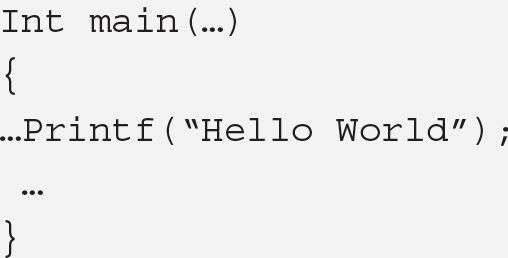
Int main(…)
{
…Printf(“Hello World”);
 …
}HTMLFootnote 21

== History =={{Main|History of copyright}}[[File:European Output of Books 500–1800.png|thumb|upright=2|European output of books before the advent of copyright, 500s to 1700s. Blue shows printed books. [[Log-lin plot]]; a straight line therefore shows an exponential increase.]]PerlFootnote 22

#!/usr/bin/perl -w
# 531-byte qrpff-fast, Keith Winstein and Marc Horowitz <sipb-iap-dvd@mit.edu>
# MPEG 2 PS VOB file on stdin -> descrambled output on stdout
# arguments: title key bytes in least to most-significant order$_=‘while(read+STDIN,$_,2048){$a=29;$b=73;$c=142;$t=255;@t=map{$_%16or$t^=$c^=(
$m=(11,10,116,100,11,122,20,100)[$_/16%8])&110;$t^=(72,@z=(64,72,$a^=12*($_%16
-2?0:$m&17)),$b^=$_%64?12:0,@z)[$_%8]}(16..271);if((@a=unx”C*”,$_)[20]&48){$h
=5;$_=unxb24,join””,@b=map{xB8,unxb8,chr($_^$a[–$h+84])}@ARGV;s/ … $/1$&/;$
d=unxV,xb25,$_;$e=256|(ord$b[4])≪9|ord$b[3];$d=$d≫8^($f=$t&)$d≫12^$d≫4^
$d^$d/8))≪17,$e=$e≫8^($t&($g=($q=$e≫14&7^$e)^$q*8^$q≪6))≪9,$_=$t[$_]^
(($h≫=8)+=$f+(~$g&$t))for@a[128..$#a]}print+x”C*”,@a}‘;s/x/pack+/g;eval
These examples of source code are very different, just as different human languages differ in grammar, character sets and vocabulary. Yet each has the power to convert human instructions into commands that can be executed by a computer. As Professor Sonia Katyal has observed, “source code is much more than just lines of commands—it comprises the lifeblood of software, embodying both the potential of the creativity that produces the code and the functionality that the code achieves.”Footnote 23
Object code, on the other hand, is comprehensible only to the true computer savant. As one such savant has written, “All computer code is human readable. Some forms are simply more convenient to read than others.”Footnote 24 Object code is also referred to as “binary” or “machine” code, as it is processed and executed directly by a computer.

10110100
11111111
01011100
10100101
18.2.2 Legal Protection of Software
Legal rules concerning software began to emerge in the 1970s when software first left government labs and corporate data processing centers and began to enter the mainstream marketplace. Among the most heated debates that occurred during that era concerned the most sensible mode of legal protection for software: patent, copyright, trade secret or something new? Eventually, copyright protection prevailed as the primary mode of protecting software in the United States.Footnote 26
18.2.2.1 Copyright
Given the analogy between software created using written programming languages and other written works of authorship (books, articles, etc.), it was felt that computer software was best considered a “literary work” for the purposes of copyright protection.Footnote 27 This is the case even though lines of computer code are purely functional in nature, and copyright generally excludes the functional elements of a work.Footnote 28 By extension, the executable object code version of a computer program, even though it is incomprehensible to most people, is deemed to constitute a different representation of that same copyrightable work and, thus, is also subject to copyright, though this position was heavily contested at the outset.Footnote 29
Beginning in the 1980s, courts began to distinguish between protectable forms of software expression and unprotectable ideas regarding software architecture and structure.Footnote 30 In Whelan Associates, Inc. v. Jaslow Dental Laboratory, Inc., 797 F.2d 1222 (3d Cir. 1986), the court held that a software program’s “structure, sequence, and organization” were eligible for copyright protection. And in Google v. Oracle, the Supreme Court confirmed that certain functional elements of computer code – particularly so-called application programmer interfaces (APIs) – can be protected by copyright.Footnote 31 As suggested by the dispute in Google v. Oracle, the lines separating protectable and unprotectable software content remain blurred today.
Finally, the screen displays and other images produced by computer software are protected by copyright, even though these images are not necessarily “fixed” in a tangible medium (i.e., they are intangible projections or manifestations of the illumination of different electronic elements in a computer screen).Footnote 32 Moreover, these images often change in a manner enabled by the programmer, but controlled by the user. Nevertheless, the different configurations and motions of an avatar in a video game would generally be owned by the designer of the game. However, there is a limit to this logic, and the text typed by the user of a word processing program or the music composed with a music synthesis program are owned by the user.
One consequence of treating computer software as a copyrightable work is that its reproduction is an exclusive right of the copyright owner. Yet “reproduction” in the copyright sense has two distinct connotations in the context of software: first is making copies of the software for distribution to others, but a second connotation involves the inevitable reproduction of every computer program in the memory of a computer when the program is executed. The Ninth Circuit confirmed that this “transient” copy is, indeed, a copy for the purposes of the Copyright Act in MAI Systems Corp. v. Peak Computer Inc., 991 F.2d 511 (9th Cir. 1993). In MAI, the court held that even though a licensee was authorized to reproduce MAI’s software as part of its use, a third-party maintenance provider, Peak, was not so authorized. Thus, when Peak performed maintenance services on the licensee’s computers, thereby creating a transient copy of MAI’s software, Peak was found to infringe.Footnote 33
18.2.2.2 Patents
The eligibility of computer software and algorithms for patent protection has fluctuated over time. It has long been the case that abstract ideas, such as mathematical formulas, are not eligible patent subject matter. In Gottschalk v. Benson, 403 U.S. 63 (1972), the Supreme Court rejected a patent claiming “a method for converting binary-coded-decimal … numerals into pure binary numerals” using a general-purpose digital computer. The Court reasoned that the “claim is so abstract and sweeping as to cover both known and unknown uses of the … conversion [method].” As a result, the claims were considered to be abstract ideas that were ineligible for patent protection. Six years later, in Parker v. Flook, 437 U.S. 584 (1978), the Supreme Court held that a patent claiming several conventional applications of a novel mathematical formula was similarly drawn to ineligible subject matter.
It was not until 1981, in Diamond v. Diehr, 450 U.S. 175 (1981), that the Supreme Court upheld a patent claiming computer software. The claimed method employed the well-known Arrhenius equation to calculate and control the temperature in a process for curing rubber. The Court held that, while the Arrhenius equation itself was not patentable, the claimed method for curing rubber was an industrial process of a type that has historically enjoyed patent protection. The use of the equation and a computer were incidental to the patentable inventive process.
Software patents differ substantially from copyrights covering computer software. Copyright protects the expression of a work – the lines of code written by a programmer, the executable version of that code and the screen displays and images generated by the code. Patents, on the other hand, protect software functionality at a higher level. Actual source code is seldom included in a patent application, and in many cases software patents simply describe, and claim, the functions accomplished by particular programs.Footnote 34
U.S. Pat. No. 5,960,411 (September 28, 1999)
A method of placing an order for an item comprising:
under control of a client system, displaying information identifying the item; and
in response to only a single action being performed, sending a request to order the item along with an identifier of a purchaser of the item to a server system;
under control of a single-action ordering component of the server system, receiving the request;
retrieving additional information previously stored for the purchaser identified by the identifier in the received request; and
generating an order to purchase the requested item for the purchaser identified by the identifier in the received request using the retrieved additional information; and
fulfilling the generated order to complete purchase of the item whereby the item is ordered without using a shopping cart ordering model.
The vagueness, potential overbreadth and poor quality of many software patents led to significant criticism of software patenting in the 2000s. Notorious examples of questionable software patents emerged, including Amazon’s “one-click shopping” patent, British Telecom’s patent that allegedly covered “the Internet” and Apple’s patents covering basic smartphone gestures such as “tap to zoom.” Compounding these issues, the 2000s also saw the rise of significant patent litigation initiated by so-called patent assertion entities (colloquially known as “patent trolls”) that took advantage of broad and vague patent claim language to seek monetary settlements from firms across the electronics and computing industry. The system came under heavy fire from the popular media, scholars and even the Obama Administration.
Perhaps in response to some of these issues, the Supreme Court again turned its attention to algorithmic patents in 2010. In Bilski v. Kappos, 561 U.S. 593 (2010), the Court held that an algorithm for calculating a fixed price for monthly utility bills was an unpatentable abstract idea. Then, in Alice Corp. v. CLS Bank, 573 U.S. 208 (2014), the Court rejected patent claims drawn to a computer-implemented electronic escrow service for facilitating financial transactions, holding that the invention was merely an abstract idea. The Court also observed that claiming a generic computer implementation of such an abstract idea cannot transform it into a patent-eligible invention. Alice overturned much existing wisdom and practice regarding software patenting and appears to be responsible, at least initially, for a sharp increase in the number of software patent applications that have been rejected on eligibility grounds, and patents that have been invalidated, either at the Patent Trial and Appeals Board (PTAB) or in the courts.Footnote 35
18.2.2.3 Trade Secrets
Computer software may be treated as a trade secret, even when copyright and patent protection are also available. The principal source of software trade secrecy is its source code – the human-readable instructions that are generally invisible and inaccessible to a user of an executable (object code) program (see Section 18.3.3.3).Footnote 36
Yet trade secrecy is also sought with respect to the object code versions of programs. Take, for example, software developed by an enterprise and used internally for key strategic purposes, such as economic forecasting, oil and gas exploration or programmed securities trading. The enterprise could be seriously injured if a competitor obtained an executable version of such a program, or even its readouts and displays.
The issue becomes murkier, however, when dealing with computer software that has been publicly distributed.Footnote 37 Despite the inconsistency that seems to arise when treating something distributed to the public as a secret, a combination of contractual confidentiality requirements and the inherent difficulty of extracting intelligible source code from executable object code has resulted in a general recognition of trade secret protection for the internal mechanics of publicly distributed executable software programs.Footnote 38
18.2.3 Software Licensing
As noted above, computer software can be, and often is, covered by a range of IP rights including copyright, trade secret and patent. As discussed in Section 6.1.4, software licenses are generally product licenses rather than rights licenses. That is, a blanket license is granted under all IP covering a particular software program, rather than enumerating the specific IP rights being licensed. Below are some other special provisions that are encountered in software licensing agreements.Footnote 39
18.2.3.1 Software Use Licenses
Object Code.
Most software licenses authorize the licensee to use the licensed software in executable, object code form. Whether the licensed software is an enterprise inventory management system, a consumer photo-editing app or an algorithm embedded in a pacemaker, the user only requires an executable version of the software, and the licensor is only willing to share object code with the user. Generally, these licenses do not permit the licensee to modify the software or to distribute it to third parties (other than its own affiliates).
User Limits.
Such licenses sometimes include limits on the number of individual users that may access or use the software. These limits may be stated in terms of a maximum number of registered users, or in terms of the number of concurrent “seats” that may use the software at any given time. Thus, an app intended for individual use may be authorized for use on a single smartphone or other device. An enterprise software system may be limited to use by fifteen individual user IDs in the licensee’s finance department. And a university mathematical simulation program may be limited to use by no more than fifty concurrent users at any given time. Often, technical measures enforce these limitations, and avoidance or circumvention of such measures can constitute both a breach of the licensing agreement as well as a violation of the Digital Millennium Copyright Act. And, as the Federal Circuit held in Bitmanagement Software GmbH v. United States, 989 F.3d 938 (Fed. Cir. 2021), failing to track and exceeding seat limitations for a licensed software system may constitute a breach of a license condition giving rise to a claim for copyright infringement in addition to breach of contract.
Internal Use Only.
Many software use licenses are limited to the licensee’s “internal business purposes.” This limitation ensures that the licensee cannot use the software for “service bureau” purposes – permitting others to access and use the software remotely. When software contains “internal use” restrictions, the licensee should ensure that its external consultants, contractors, collaborators and business partners are also entitled to access and use the software to the extent necessary to support the licensee’s business or to perform services for the licensee.
18.2.3.2 Software Distribution Agreements
One common form of software licensing agreement authorizes the licensee to distribute the licensed software to others, rather than use the licensed software for its own internal purposes. These agreements have various labels, including “original equipment manufacturer” (OEM), “value-added reseller” (VAR) and distribution agreements.
OEMs.
OEM agreements typically authorize the licensee to incorporate the licensed software into another software program or a hardware device. For example, the vendor of an electronic French grammar checker might license this program to Microsoft for incorporation into Microsoft Word, or the developer of road-mapping software might license it to Toyota for incorporation into its vehicles. Often, the licensee (OEM) sells the combined product under its own name, and the licensor is recognized only briefly (e.g., on a “splash” screen when its software is launched, or in the product user manual).
VARs.
VAR and distribution agreements, on the other hand, typically limit the licensee to distributing or reselling the software as a standalone product or combined with other software in a manner that does not require substantial integration (e.g., reselling a video game as part of a video game “ten pack”). Some of these licensees may provide value-added services, such as software installation, support and training, along with the licensed software. In these cases, the licensor’s software is usually identified by name (requiring a trademark license if the licensee will advertise or promote it).
APIs.
Incorporation of one program into another sometimes requires the licensee to access and modify the source code of the licensed software (see below). However, this is usually not required, as software often includes object code “application programmer interfaces” or APIs that enable the integration of software programs without the need to access or modify source code. It is important to recall, however, that APIs themselves may constitute copyrightable code, which was the subject of the dispute in Oracle v. Google (Oracle alleged that Google infringed the copyright in Oracle’s APIs for the Java programming language by incorporating them into the Android operating system without Oracle’s permission).
18.2.3.3 Proprietary Source Code Licenses
Unlike the developers of OSS (see Section 19.2), the licensors of proprietary software seldom make the source code of their programs available to licensees. As discussed above, most typical uses of software – whether for internal use or incorporation into other products – require only object code. In some cases, however, a licensee may require access to the source code of licensed software. Some situations in which this might occur include the following:
The licensed software will be incorporated into a proprietary program or device in a manner that requires detailed knowledge of licensee’s larger systems, which knowledge the licensor lacks.
The licensee requires modifications or customizations to the licensed software to reflect its own proprietary algorithms, formulas or processes.
The licensee wishes the flexibility to modify the licensed software as it desires, without relying on the licensor.
The licensee plans to use the software in a mission-critical application and wishes to verify independently that it contains no bugs, defects or vulnerabilities, and that it operates in a manner that will not compromise other licensee systems.
The licensor is a small company with a limited track record, and the licensee does not have confidence that the licensor will be available indefinitely to make required modifications, updates and upgrades to the software.
In these and other cases, the licensor may grant the licensee access to the source code of a proprietary software program, together with rights to reproduce, modify and create derivative works of the source code and then to use or distribute modified versions of the object code program that is derived from that source code. Unless the software is OSS, it is highly unlikely that the licensee will be granted the right to distribute or disclose the source code itself, or modifications of that source code.
Licensor hereby grants to Licensee, and Licensee accepts, a nonexclusive, nontransferable right and license:
a. to modify, reproduce and prepare Derivative Works of the Source Code, and to incorporate those Derivative Works into Licensee Programs to produce Modified Licensee Programs;
b. to reproduce and distribute Modified Licensee Programs in Object Code form to Licensee’s end user customers in the Territory pursuant to End User Sublicense Agreements meeting the requirements of Section __ below.
Licenses of proprietary source code require the parties consider several issues that do not arise in the context of typical software licenses or OSS licenses.
Confidentiality.
A software proprietor’s source code is often a valuable trade secret. Thus, source code releases are often governed by strict confidentiality restrictions – sometimes more strict than even the ordinary confidentiality terms applied to information exchanged under an agreement. For example, the number and identity of individuals to whom source code may be released is often specified, there are requirements regarding heightened security measures that must be applied to the storage and transmission of source code (e.g., encryption, password-protected directories). Likewise, the duration of confidentiality provisions relating to source code are often indefinite, rather than limited to a period of years, and almost always survive the termination of the license agreement. Often, the licensee must produce evidence that it has destroyed or permanently deleted all copies of source code and modifications thereto once its license has terminated.
Ownership.
If the licensee is granted the right to modify the licensor’s source code, then the parties must agree who will own those modifications. If the modifications are to be owned by the licensee, then the parties must also agree whether the licensor will receive a grantback license of any kind. These issues are discussed at length in Section 9.1.2.
Disclaimer of Warranties.
If a licensee has the right to modify the licensor’s source code, then the licensor will usually seek to disclaim any warranty or liability for errors or disruptions in the operation of the software, whether or not they are directly traceable to the licensee’s modifications. While this may seem harsh for the licensee, it is often impossible to determine with precision what, precisely, has caused a software fault, particularly in large and complex systems (see Section 10.1.3.3, discussing warranty exclusions).
Escrow.
Often, source code is “licensed,” but placed in a third-party escrow account and released to the licensee only if the licensor fails to meet its warranty or maintenance obligations, or if the licensor suffers a bankruptcy or similar event that makes it likely that it will be unable to perform in the future (see Section 21.6).
18.2.4 Maintenance, Support, Updates and Upgrades
As noted in Section 10.1.3.8, many enterprise and OEM software licensing agreements include paid maintenance, support and other services by the licensor. The charge for these services is often based on a percentage (15–25 percent) of the annual licensing fee for the software. While the types of services included in these relationships can vary, below is a rough summary of what each generally entails.
Maintenance.
Software “maintenance” generally means the correction of software errors and issues, often in accordance with a timescale that depends on the severity of the issue (see Sections 10.1.3.7 and 10.1.3.8).Footnote 40 Most maintenance plans include the provision of regular updates of the software (see below). Upgrades, on the other hand, may be included, but may also be offered by the licensor as new products subject to additional charges.
Support.
Support generally refers to training and helpdesk support for the licensee’s personnel who are using the licensed software. If the licensee has its internal “Level 1” helpdesk (which interacts directly with users), then the licensor may provide only “Level 2” and “Level 3” support. Level 2 support personnel generally interact with Level 1 personnel and do not take queries directly from users. Level 2 personnel are generally understood to be senior or specialist personnel with a higher degree of skill and familiarity with the software. Note that neither Level 1 or Level 2 support personnel are responsible for correcting errors in the software itself, only for responding to the large number of user inquiries and problems that can be resolved through the normal operation of the software. Level 3 support is often referred to as “engineering” support, and becomes involved only if an error in the software is detected or there is a compatibility issue with other software or hardware. Level 3 support personnel typically deal only with Level 2 support, and not with the Level 1 helpdesk or users. Level 3 support may be available only if the licensor also provides maintenance services to the licensee.
Patch or Correction.
A software “patch” or “correction” is usually modified code that can be installed to address a problem or error in a software program.
Workaround.
A workaround is a temporary way to avoid the consequences of a software error without actually correcting the error. For example, if a system uses the wireless Bluetooth protocol to connect to an office printer but the Bluetooth module malfunctions, a workaround might be to connect the system to the printer using a physical USB cable. This is not a correction of the software error in the Bluetooth module, but can often be implemented quickly to ensure that users can continue to use the system while a more permanent correction is developed or installed.
Updates.
Software updates are new releases of a software program that correct errors, close security holes, ensure compatibility with new versions of hardware or operating systems, add support for new devices and make cosmetic changes. Updates are often designated by incremental increases of the software version number to the right of the decimal point (e.g., version 3.2 to 3.3 or 5.4.4 to 5.4.5, also called “point updates”).
Upgrades.
Software upgrades, often designated by increments to the left of the decimal point (e.g., version 3.2 to 4.0), are major modifications to a program that introduce substantial new features, performance or functionality.
18.2.5 Reverse Engineering Restrictions
The term “reverse engineering” has its roots in the hardware world. It refers to the process of taking apart and inspecting a device to determine how it works, usually with the goal of building one’s own device or creating another device that interacts with it.Footnote 41 From a hardware standpoint there is little that can be done to prevent reverse engineering. While patents may prevent one from making or using a new and infringing device, they are not effective at preventing the disassembly of a validly acquired device (particularly given recent judicial interpretations invalidating “conditional sales” of patented articles – see Section 23.5).
In the software industry, however, prohibitions on reverse engineering are viewed as more enforceable, both under trade secret and copyright law. These prohibitions are intended to prevent the user of a software program from reverse engineering an executable object code version of the software to derive its source code (or at least a source code approximation of what it does). In addition to reverse engineering, this process is also called disassembly or decompilation. While each of these activities is, from a technical standpoint, slightly different, the goal of each is to take the long string of zeros and ones comprising an object code program and convert it into human-readable source code. This, in turn, reveals how a proprietary software program works and, in theory, allows the reverse engineer to replicate it or to create products that interface directly with it (i.e., if the vendor does not provide an API to enable interoperability).
Reverse engineering of software code has long been a subject of dispute. In NEC Corp. v. Intel Corp., 1989 U.S. Dist. LEXIS 1409 (N.D. Cal. 1989), the court held that NEC’s reverse engineering of copyrighted microcode contained in Intel chips did not constitute an infringement of Intel’s copyright.Footnote 42 A series of other cases found that the disassembly of video game console software in order to create game cartridges compatible with those consoles was a fair use under copyright law.Footnote 43 A few years later, § 1201(f) of the Digital Millennium Copyright Act expressly permitted reverse engineering for the sole purpose of achieving interoperability.
These legal developments led to the proliferation of contractual prohibitions on reverse engineering. Such prohibitions have, in turn, been challenged as preempting copyright law (which seemingly permits reverse engineering), but the prohibitions have largely been upheld (Bowers v. Baystate Technologies, Inc., 320 F.3d 1317 (Fed. Cir. 2003, discussed in Section 17.1, Note 4)). Thus, prohibitions on reverse engineering are now standard features of the software licensing landscape.
Licensee agrees that it shall not, through manual or automated means, reverse engineer, reverse compile, reverse assemble, decompile, disassemble or otherwise seek to derive a Source Code version of the Licensed Software or otherwise to discern its internal architecture, structure or design.
Notes and Questions
1. Is software special? Think of five ways that software licenses differ from licenses for other copyrighted works such as literary works and musical compositions. Now think of five ways that software licenses differ from patent licenses. How important are these differences? What would happen if a software program were licensed under an agreement used to license a motion picture for theatrical display, or a patent covering a new method of sequencing DNA?
2. Source code. Why is software source code treated so carefully? Think about the special measures taken to protect software source code when you read Section 19.2 about OSS licensing.
3. Reverse engineering. Why is reverse engineering routinely prohibited by software licensing agreements? Why do courts uphold these prohibitions, given the ample precedent establishing that reverse engineering does not constitute copyright infringement?
4. Noncircumvention. Noncircumvention clauses such as that discussed in the Eden Hannon case are not common in the software industry. Why not? Could a software vendor achieve advantages from such clauses that it might not otherwise be able to achieve using the provisions discussed in this section?
5. Maintenance. At 15–25 percent of the licensing fee per year, software maintenance programs are not cheap. Why does a licensee need to obtain maintenance services from the licensor? If you represented a licensee, are there any services typically included in a maintenance program that you would recommend your client forego (in an effort to reduce the annual charge for the program)? Other than revenue generation, why do you think that software licensors often insist that licensees purchase maintenance programs from them?
Problem 18.1
Your client AirBrain has designed a robotic carrier pigeon. In order to keep on track while flying it requires geospatial navigation software. As there is no existing pigeon-based navigation software, your development team believes that the fastest way to market is to adapt the navigation software developed by Boeing for commercial aircraft. Draft the licensing terms that you would propose to Boeing, including fallback positions if Boeing rejects your initial offers.
18.3 Licensing in the Cloud
Liza Vertinsky, Patent Pledges: Global Perspectives on Patent Law’s Private Ordering Frontier 260–62 (Jorge L. Contreras & Meredith Jacob, eds., Edward Elgar, 2017)
The U.S. National Institute of Standards and Technology (NIST) defines cloud computing as “a model for enabling convenient, on-demand network access to a shared pool of configurable computing resources (e.g., networks, servers, storage, applications, and services) that can be rapidly provisioned and released with minimal management effort or service provider interaction.” Put more simply, cloud computing is a form of computing that utilizes shared computer resources accessed over the internet or through mobile devices to deliver on-demand computing services. The cloud is a metaphor for the large data centers that perform the computing tasks desired by the end users.
This idea of concentrating computing resources at the center of a network rather than in user terminals is not new, but rather marks a return to the mainframe models of the 1950s, 1960s and 1970s. The use of the term “cloud computing” to refer to a distinct model of computing is new, however, and the rapid growth in cloud computing applications and services has produced what is now considered to be a distinct cloud computing industry.
While there are many firms offering different kinds of cloud computing applications and services, the industry is dominated by a small number of large firms. Amazon, Google, Microsoft and IBM are among the leaders in terms of market share and market influence, with Amazon by far in the lead in terms of market share. Other companies important in the cloud computing space include Salesforce.com, which pioneered software as a service, VMware and its competitor Citrix, which offer software for clouds, and Rackspace, which is leading a large coalition for free cloud software and provides its own public cloud and related services. On top of cloud computing platforms sit an increasing number of successful cloud computing companies such as LinkedIn (offers cloud based recruiting software), NetSuite (offers cloud-based business software), WorkDay (offers cloud based HR and finance software) and AthenaHealth (offers cloud based services for electronic health records), to name a few, all of which offer software as a service in targeted areas.
While the market leaders operate in all major segments of cloud computing and provide platforms for both developers and consumers, their business models and the ways in which these companies compete and expect to make money vary. In its current form the cloud computing market has been roughly stratified into three different segments: infrastructure as a service (IaaS), platform as a service (PaaS), and software as a service (SaaS). IaaS involves raw computing resources, analogous to virtualized hardware, providing customers with computing infrastructure for data storage, management and manipulation. It allows companies to outsource computing equipment and resources while giving them flexibility in how to deploy the infrastructure for their own purposes. Amazon has by far the lion’s share of this market with its Amazon Web Services (AWS) platform. PaaS provides a platform and environment for building applications and services over the internet, operating essentially as a cloud based operating system. Microsoft and Google are among the market leaders in this segment, although Amazon’s AWS is increasingly encompassing services that resemble those offered by a PaaS platform. PaaS examples include Google AppEngine, Microsoft Azure, and AWS Elastic Beanstalk. SaaS involves preconfigured software applications offered as a web based service to end users, like Google Docs and Gmail. These market categories increasingly overlap, however, as firms compete with alternative cloud platforms and accommodate new and disruptive technologies.
The cloud computing market is also differentiated into private, public and hybrid clouds. Private clouds are computing platforms that are under the control of a single customer, operated within the customer’s firewall and under its own control. Public clouds can be used by anyone anywhere, based on a model of pooled, shared computing resources accessed over the internet. Hybrid clouds involve a combination of public and private cloud computing, allowing companies to keep certain computing functions or databases in house and have others externally provided via a public cloud. Amazon and Google focus primarily on public clouds, IBM began with a focus on private clouds but has subsequently found the need to embrace hybrid and public cloud strategies as well, and Microsoft has taken the lead in offering hybrid clouds.
Amazon makes a range of applications available on a service-basis through Amazon Web Services (AWS).

Microsoft’s cloud computing platform is called Azure. Below is an excerpt from a Microsoft document explaining the advantages of Azure to companies that are considering offering their own software and services to customers through the Azure platform.
Debra Shinder, Microsoft Corp. (n.d.), https://aka.ms/Azure-Trusted-IP
Business method and software patents provide a lucrative opportunity for non-practicing entities (NPEs), who stockpile large numbers of patents with no intention of developing products, but for the purpose of suing companies and individuals for infringement. This type of cloud-based patent litigation is increasing, and lawsuits and countersuits can cost your organization money and time and damage your reputation. The aggressive tactics of NPEs discourage innovation.
Trust in the cloud encompasses not only the assurance of security, privacy, compliance, and resiliency, but also clarity and confidence that your innovations will be protected against frivolous infringement claims, including when you co-develop innovative solutions working together with a cloud provider. Microsoft Azure IP Advantage and the Shared Innovation Initiative can help offer that assurance.
IP in the Cloud
As computing shifts to the cloud, new risks to innovation emerge. These include risks to developers, to Azure customer organizations working in the cloud, and to customers who co-create intellectual property with Microsoft as part of their digital transformation.
Microsoft trust and IP initiatives build on one another to provide protections to all three of these categories.

Azure IP Advantage
Intellectual property is increasingly being created, stored, and shared in digital form. Digital transformation has brought a paradigm shift to the business environment as companies embrace new approaches to creating, communicating, and interacting with customers, partners, and the public.
NPEs see this as an opportunity; they collect and hoard patents and then assert patent infringement against innovators. This is a growing concern for cloud services customers, and the fear of a patent suit discourages innovation in the cloud. Cloud providers can help their customers reduce the risk to be able to innovate with confidence, and Microsoft Azure offers best-in-industry protection against IP risks. Azure IP Advantage includes:
Uncapped indemnification. This covers claims for IP infringement and extends to open source software (OSS) incorporated by Microsoft in Azure services (for example, Apache Hadoop used for Azure HDInsight). It is provided by default for all Microsoft cloud customers.
Patent Pick. Microsoft provides a portfolio of 10,000 patents that customers can pick from and use to deter and defend against patent lawsuits. It is available to consuming Azure customers with an Azure usage of $1 k/m over the last three months who have not filed a patent infringement lawsuit against another Azure customer for their Azure workloads in the last two years. This helps to discourage excessive litigation.
Springing license. This provides peace of mind with future patent protection; if Microsoft sells any of its patents to an NPE in the future, its customers will receive a license, so the NPE won’t have an infringement suit against the customer. This is available to all consuming Azure customers with an Azure usage of $1 k/m over the last three months. Unlike other cloud providers, Microsoft does not require a reciprocal commitment from the customer for its patents. In addition, Microsoft is a member of the LOT Network, a non-profit community of companies that was formed to preserve the traditional uses of patents while providing immunization against the patent troll problem.
These protections help free companies to concentrate more on building their businesses, leveraging open source software, and serving their customers, and less on dealing with patent litigation.
Shared Innovation Initiative
Every company today is becoming in part a software company. Companies are increasingly collaborating with their cloud providers to co-create intellectual property to transform their business operations. There is growing concern that without an approach that ensures customers own key patents to these new solutions, tech companies will use the knowledge to enter their customers’ market and compete against them—perhaps even using the IP that customers helped create.
Microsoft developed its Shared Innovation Initiative in response to these concerns when customers collaborate with Microsoft to develop new products and services that run on the Azure platform. We’ve created contract terms that lay out these principles for engagements where the parties are co-creating new IP. Shared Innovation builds on our approach outlined in the AIPA, and is based on seven guiding principles:
1. Respect for ownership of existing technology. We each own the existing technology and IP that we bring to the table when we partner together. As we work with customers, we’ll ensure that we similarly will each own the improvements made to our respective technologies that result from our collaboration.
2. Assuring customer ownership of new patents and design rights. As we work together to create new technology, our customers, rather than Microsoft, will own any patents that result from our shared innovation work.
3. Support for open source. If our shared innovation results in the creation of source code and our customers so choose, Microsoft will work with them to contribute to an open source project any code the customer is licensed to use.
4. Licensing back to Microsoft. Microsoft will receive a license back to any patents and design rights in the new technology that results from the shared innovation, but the license will be limited to improving our platform technologies.
5. Portability. We won’t impose contractual restrictions that prevent customers from porting to other platforms the new, shared innovations they own.
6. Transparency and clarity. We will work with customers to ensure transparency and clarity on all IP issues as the shared innovation project moves forward.
7. Learning and improvement. We’ll continue to learn from this work and use this learning to improve further our shared innovation work.
Notes and Questions
1. The cloud. What is the “cloud”? How many of your daily activities involve use of a service provided via the cloud? (There may be more than you think.) As Liza Vertinsky points out, cloud computing is not new – it goes back to the roots of the computing industry in the 1950s. Why do you think that, after a long dormancy from the 1990s through the 2010s, cloud computing has recently made a comeback?
2. Service not software. From a contracting standpoint, the principal difference between obtaining software through physical media (disc or download) and through a SaaS model via the cloud is that cloud-based software delivery services typically don’t provide the user with a copy of the executable program itself. Rather, the software is accessed through a browser or “thin” app front-end, but the bulk of the program – its guts – are stored and executed remotely. Thus, a SaaS license is really a service contract. While some small software elements may be downloaded to the user’s computer, the crux of the contractual relationship that is established is not one of licensor–licensee, but of service provider–customer. What advantages and disadvantages can you see to obtaining access to a program remotely through SaaS rather than obtaining a physical copy of the software to run on your own computer?
SaaS applications are priced in various ways, but one common method is a monthly service fee – just like a cable or phone service contract – rather than a one-time “purchase price” for a software program. What advantages and disadvantages exist with these different “purchase” models?
3. Public, private, hybrid. What relative advantages and disadvantages do you think a software vendor would derive from offering its software through a public, private or hybrid cloud platform? What are the differences among these three cloud structures?
4. IP risks in the cloud. Microsoft offers its customers (companies that host their software on the Azure cloud platform) several novel IP-related incentives. What threat is Microsoft responding to? Why is this threat of concern to customers of cloud-based services? How does each of Microsoft’s Azure IP initiatives (uncapped indemnity, patent pick and springing license) respond to this threat? Which of these initiatives do you think offers customers the greatest protection from IP threats?
5. Shared Innovation Initiative. Microsoft’s Shared Innovation Initiative is aimed at companies that wish to develop new software offerings for the Azure platform. How do the IP allocation terms of the Shared Innovation Initiative differ from what one might expect in a collaboration between Microsoft (one of the world’s largest corporations) and a developer of software for its platform (see Section 9.3, discussing allocation of IP in joint development projects)? Why do you think Microsoft took this approach? Which of the Shared Innovation Initiative program features do you think is most important to Microsoft? To its customers?
Summary Contents
This chapter discusses licenses that are granted to the public at large, typically without monetary compensation. Like consumer EULAs, these “public” licenses are made available to potential users online, do not require signature, delivery or formal execution, and are generally effective automatically upon the user’s download or use of the licensed content. Despite their relative informality, such licenses underlie vast quantities of online content, computer software and even patent rights today. Below, we discuss the history, motivations and strategies of three distinct types of public licensing: Creative Commons online content licenses, open source software (OSS) licenses and patent pledges.
19.1 Creative Commons and Open Content Licensing
Lawrence Lessig, 64 Montana Law Review 1, 10–13 (2004)
In the beginning of the Internet, the architecture of the Internet disabled any ability to control the distribution of copyrighted works. That meant that if we had this triad among all, some, and none, the effective protection of the original Internet was none. The architecture meant that copyright was not respected because anybody could copy and perfectly distribute any copyrighted work without control.
That extreme begot another: the terror of the copyright industry, which in 1995, in response to the Internet launched a campaign to change the technical and legal infrastructure that defined the Internet, to change the Internet from an architecture of no control into an architecture of total control. So again, instead of a triad, we have increasingly an architecture of total control over everything. We have thus moved from one extreme to the other: from the extreme of total freedom to total control, and this is the shift the law is encouraging.
We’re setting up a regime that thinks as if the world is either one or the other when it is in fact neither. Some want total control, some want no control, but most want this balance in the middle. Not “all rights reserved,” not “no rights reserved,” but increasingly the idea of “some rights reserved.” My content is out there, I want you to respect it in some ways, but I want you to use it in lots of ways that traditional “all rights reserved” models would not permit.
Enter an organization that I have helped start called the Creative Commons. Think of it as pushing, as another founder, James Boyle, describes it, as a kind of environmentalism for culture. The idea here is that we need to build a layer of reasonable copyright law, by showing the world a layer of reasonable copyright law resting on top of the extremes. Take this world that is increasingly a world by default regulating all and change it into a world where once again we can see the mix between all, none, and some, using the technology of the Creative Commons.
This change is done through the voluntary action of individuals – creators, content owners. They take voluntary action by marking their content with a tag that expresses a kind of freedom. They use these tags then to build a kind of balance into the system to restore this reasonableness into the system by giving people a way to say, “I don’t believe in this extremism.”
For example, if you go to the Creative Commons Web site (http://creativecommons.org), you are given a very simple choice by which you can select the freedoms you want to grant. You can say, “I want people to give me attribution or not,” or you can say, “I want people to use this for commercial use or not,” or you can say, “I want to allow people to modify this or not,” or you can use what we call a “share alike” license that says, whatever freedoms you got from me, you have to pass on to someone else.
Once you make these selections, the technology then produces a license that is comprised of three separate layers. One layer is a human-readable version of that license. Another is the lawyer-readable version of the license – the license. And a third layer is a machine-readable version of the license, which enables computers to understand what freedoms you are granting.
These three layers live together in a “Creative Commons” tag. And in four months, more than 400,000 pages have appeared on the Internet linking back to these licenses. Four hundred thousand have said, we believe in a kind of freedom associated with our content that is not the extreme.
Now we want this 400,000 to turn into 10,000,000. Because if there are 10,000,000 people out there who say we don’t believe in the extremes, then this debate is no longer a debate between copyright owners and anarchists. Instead, it is increasingly a debate between extremists and those who believe in a tradition that expresses a freedom more fundamental. Beyond the permissions of fair use, these licenses give people ways to say go ahead, sample me, share me, copy me, liberate me, and together they restore something of balance in this debate. And this balance, we believe, will enable a different kind of creativity: creativity built upon a tradition of building upon the works of others, freely. A free culture, not the permission culture that our law has produced.
There is an extraordinary potential enabled by a technology that is increasingly threatened and destroyed. The potential for a different, critical, democratic creativity, is increasingly being forced into last century’s model for doing business.
It is a world where the dinosaurs have been given the power to control evolution. A system where last century’s powerful has the ability to veto next century’s innovators. In such a world, creativity and innovation die. The free culture that defined our tradition has been eroded, not by idealists, but by lobbyists. The free culture that we have lived under now is under threat. And we have an obligation, all of us, to engage in this practice to enable this freedom again.
Lessig’s vision of ten million Creative Commons (CC) tags has been more than fulfilled. The CC website today claims that more than 500 million online images are available under CC licenses. As Lessig and others intended, the appeal of the CC licensing system is its simplicity and its intuitiveness. Users can choose to apply one of six different combinations of four different licensing options to their works. Each option is described in simple, plain language and identified by an intuitive icon.
Thus, if I wish to post a photo to a social media site and make it available for anyone else to use for any purpose so long as they give me credit (attribution), I can tag the photo with the “CC BY” symbol, and the CC Attribution license will apply. If I also wish to stipulate that my photo cannot be modified in any way, then I can tag it with the “CC BY ND” (Attribution, No Derivatives) license.Footnote 1 If I want to be sure that my photo remains free for all to use, even if someone incorporates it into a proprietary database or website, then I can add the “SA” (Share Alike) tag. And if I wish to prohibit commercial uses (e.g., using my photo in a corporate ad), then I can use “NC” (Non-Commercial). As shown in Figure 19.1, there are only six permitted combinations of these four licensing tags (out of fifteen possible combinations), reflecting the designers’ views of the most frequent and logical types of uses that should be permitted.
The Creative Commons suite of licenses.

The CC suite of licenses appears simple, but a sophisticated legal structure underlies its streamlined user-facing tags. That is, the tag “CC BY ND” does not itself convey a license to the user. Rather, when a tag is attached to an online image or other content, it includes a hyperlink to a more comprehensive licensing agreement that is hosted on CC’s website. For example, the full text of the CC BY NC ND 4.0 license can be found at https://creativecommons.org/licenses/by-nc-nd/4.0/legalcode.
By many measures, the CC licensing framework has been phenomenally successful. Professor Jane Ginsburg points to four important design features that have contributed to the success of the CC model: its overall simplicity, its extension of credit to authors (included in each of the six permitted licenses), its ability to authorize use of the licensed content instantly and forever, and its potential to expand distribution of a work through search engines.Footnote 2 These features have made CC licensing a standard feature of online platforms and social media sites.
Notes and Comments
1. Which rights reserved? In Lessig’s view, why is a third option necessary for copyrighted material in addition to “all rights reserved” and “no rights reserved”?
2. Public licenses. The CC licenses are “public” licenses. That is, they are not specifically negotiated between copyright owners and users, but are publicly posted and can be “accepted” by anyone who wishes to use the licensed content. Thus, the introduction to the CC BY NC ND 4.0 license reads as follows:
By exercising the Licensed Rights (defined below), You accept and agree to be bound by the terms and conditions of this Creative Commons Attribution-NonCommercial-NoDerivatives 4.0 International Public License (”Public License”). To the extent this Public License may be interpreted as a contract, You are granted the Licensed Rights in consideration of Your acceptance of these terms and conditions, and the Licensor grants You such rights in consideration of benefits the Licensor receives from making the Licensed Material available under these terms and conditions.
How consistent is the CC approach to that recognized by courts in the context of consumer EULAs and terms of use discussed in Chapter 17? Why aren’t more IP licenses structured as public licenses?
3. Permitted combinations. Why did the designers of the CC licenses only permit six out of fifteen possible combinations of the four licensing tags? Can you think of any useful combinations beyond the six permitted ones?
4. The importance of attribution. In one early survey of CC licenses, 98 percent of users selected the BY attribution requirement – far more than any of the other licensing options. For this reason, when it revamped its licensing options, CC included the “BY” requirement in all options (i.e., there is no CC licensing option that omits “BY”). Why do you think attribution is so important to content creators?
CC is fairly flexible when it comes to specifying how attribution must be made. The license states:
You may satisfy the conditions in Section 3(a)(1) in any reasonable manner based on the medium, means, and context in which You Share the Licensed Material. For example, it may be reasonable to satisfy the conditions by providing a URI or hyperlink to a resource that includes the required information.
Is this flexible approach ideal? How might it be abused?
5. Sharealike and Copyleft. The Share Alike or “SA” feature of CC licenses resembles the controversial “copyleft” approach to some OSS software promoted by the Free Software Foundation and others (see Section 19.2). As such, CC SA is probably the least commonly used variant of the CC licensing suite. What is the rationale for imposing an SA licensing requirement? Why do you think it is not widely used? Keep these issues in mind as you review Section 19.2 and 19.3.
6. Applications. The core application for CC licenses is digital content, particularly images such as photographs, drawings and artworks. But the CC licenses are general copyright licenses that are not strictly limited to visual images. It is not difficult to imagine how CC licensing could be used for text – blog posts, academic articles, short stories, poems. But what about music? In the mid-2000s, CC created three music sampling licenses,Footnote 3 but those have since been discontinued in favor of the general suite of six licenses. Likewise, CC has experimented with licenses for scientific data, though that project has also been discontinued. And despite the growth of OSS licensing (see Section 19.2), CC licenses are seldom used for software. Why does CC licensing appear to be limited to visual images? Are there other logical expansions for the use of CC licensing?
7. Database rights. As discussed in Section 18.1, databases, per se, are not protected under US intellectual property law, though they are protected in the EU and other jurisdictions. Thus, the CC licenses, which are intended to apply internationally, include a provision stating that “Where the Licensed Rights include Sui Generis Database Rights that apply to Your use of the Licensed Material,” the licenses granted with respect to copyrights are also granted with respect to those database rights. Under what circumstances do you think that this provision could become important?
8. CC 0. In addition to its suite of licenses, CC also permits users to select a CC 0 or “No Rights Reserved” tag for their content. As CC explains,
CC 0 enables scientists, educators, artists and other creators and owners of copyright- or database-protected content to waive those interests in their works and thereby place them as completely as possible in the public domain, so that others may freely build upon, enhance and reuse the works for any purposes without restriction under copyright or database law.
Why was the CC 0 option necessary? Does this option conflict with Lessig’s original plan to create a system that offered options other than “all rights reserved” and “no rights reserved”?
9. Choice of law? The CC licenses do not include an express choice of law provision (see Section 11.3). Why do you think this term was omitted?
10. The business of CC. Creative Commons is not a governmental body or an international organization, but a nonprofit corporation based in the United States, with local chapters around the world. Is it advisable to entrust the licensing structure for so much online content to a single private organization? What would happen to CC licenses if the Creative Commons corporation were to be liquidated or simply disappear? Is there any viable competitor to CC today? Is there a need for one, now that the CC licenses are published and available online? Why is a legal entity needed at all for a self-executing licensing framework?
19.2 The Open Source Phenomenon
As discussed in Section 18.2.1, a computer program’s “source code” is a version of the program written in a human-readable programming language such as C++, Perl, BASIC or Fortran. Most proprietary software is licensed and distributed in object code or executable form. But beginning in the 1970s, a group of software developers in Cambridge, Massachusetts, began to make their source code publicly available too. This trend began the “free software” or “open source software” (OSS) movement, which today is at the heart of a multi-billion-dollar industry.
19.2.1 Origins: The Free Software Movement
The excerpt below is by Richard Stallman, who is generally credited as the father of the free software movement.
Richard Stallman, Open Sources: Voices from the Open Source Revolution (1999)
When I started working at the MIT Artificial Intelligence Lab in 1971, I became part of a software-sharing community that had existed for many years. Sharing of software was not limited to our particular community; it is as old as computers, just as sharing of recipes is as old as cooking. But we did it more than most.
We did not call our software “free software,” because that term did not yet exist, but that is what it was. Whenever people from another university or a company wanted to port and use a program, we gladly let them. If you saw someone using an unfamiliar and interesting program, you could always ask to see the source code, so that you could read it, change it, or cannibalize parts of it to make a new program.
The situation changed drastically in the early 1980s when Digital discontinued the PDP-10 series. The modern computers of the era, such as the VAX or the 68020, had their own operating systems, but none of them were free software: you had to sign a nondisclosure agreement even to get an executable copy.
This meant that the first step in using a computer was to promise not to help your neighbor. A cooperating community was forbidden. The rule made by the owners of proprietary software was, “If you share with your neighbor, you are a pirate. If you want any changes, beg us to make them.”
One assumption is that software companies have an unquestionable natural right to own software and thus have power over all its users … Interestingly, the U.S. Constitution and legal tradition reject this view; copyright is not a natural right, but an artificial government-imposed monopoly that limits the users’ natural right to copy.
Another unstated assumption is that the only important thing about software is what jobs it allows you to do—that we computer users should not care what kind of society we are allowed to have.
A third assumption is that we would have no usable software (or would never have a program to do this or that particular job) if we did not offer a company power over the users of the program. This assumption may have seemed plausible, before the free software movement demonstrated that we can make plenty of useful software without putting chains on it.
If we decline to accept these assumptions, and judge these issues based on ordinary common-sense morality while placing the users first, we arrive at very different conclusions. Computer users should be free to modify programs to fit their needs, and free to share software, because helping other people is the basis of society.
So I looked for a way that a programmer could do something for the good. I asked myself, was there a program or programs that I could write, so as to make a community possible once again?
The answer was clear: what was needed first was an operating system. That is the crucial software for starting to use a computer. With an operating system, you can do many things; without one, you cannot run the computer at all. With a free operating system, we could again have a community of cooperating hackers—and invite anyone to join. And anyone would be able to use a computer without starting out by conspiring to deprive his or her friends.
I chose to make the system compatible with Unix so that it would be portable, and so that Unix users could easily switch to it. The name GNU was chosen following a hacker tradition, as a recursive acronym for “GNU’s Not Unix.”
The term “free software” is sometimes misunderstood—it has nothing to do with price. It is about freedom. Here, therefore, is the definition of free software. A program is free software, for you, a particular user, if:
You have the freedom to run the program, for any purpose.
You have the freedom to modify the program to suit your needs. (To make this freedom effective in practice, you must have access to the source code, since making changes in a program without having the source code is exceedingly difficult.)
You have the freedom to redistribute copies, either gratis or for a fee.
You have the freedom to distribute modified versions of the program, so that the community can benefit from your improvements.
In January 1984 I quit my job at MIT and began writing GNU software. Leaving MIT was necessary so that MIT would not be able to interfere with distributing GNU as free software. If I had remained on the staff, MIT could have claimed to own the work, and could have imposed their own distribution terms, or even turned the work into a proprietary software package.
I began work on GNU Emacs [a text editing program] in September 1984, and in early 1985 it was beginning to be usable … At this point, people began wanting to use GNU Emacs, which raised the question of how to distribute it. So I announced that I would mail a tape to whoever wanted one, for a fee of $150. In this way, I started a free software distribution business, the precursor of the companies that today distribute entire Linux-based GNU systems.
If a program is free software when it leaves the hands of its author, this does not necessarily mean it will be free software for everyone who has a copy of it. For example, public domain software (software that is not copyrighted) is free software; but anyone can make a proprietary modified version of it. Likewise, many free programs are copyrighted but distributed under simple permissive licenses that allow proprietary modified versions.
The goal of GNU was to give users freedom, not just to be popular. So we needed to use distribution terms that would prevent GNU software from being turned into proprietary software. The method we use is called “copyleft.”
Copyleft uses copyright law, but flips it over to serve the opposite of its usual purpose: instead of a means of privatizing software, it becomes a means of keeping software free.
The central idea of copyleft is that we give everyone permission to run the program, copy the program, modify the program, and distribute modified versions—but not permission to add restrictions of their own. Thus, the crucial freedoms that define “free software” are guaranteed to everyone who has a copy; they become inalienable rights.
For an effective copyleft, modified versions must also be free. This ensures that work based on ours becomes available to our community if it is published. When programmers who have jobs as programmers volunteer to improve GNU software, it is copyleft that prevents their employers from saying, “You can’t share those changes, because we are going to use them to make our proprietary version of the program.”
The requirement that changes must be free is essential if we want to ensure freedom for every user of the program. The companies that privatized the X Window System usually made some changes to port it to their systems and hardware. These changes were small compared with the great extent of X, but they were not trivial. If making changes was an excuse to deny the users freedom, it would be easy for anyone to take advantage of the excuse.
A related issue concerns combining a free program with non-free code. Such a combination would inevitably be non-free; whichever freedoms are lacking for the non-free part would be lacking for the whole as well. To permit such combinations would open a hole big enough to sink a ship. Therefore, a crucial requirement for copyleft is to plug this hole: anything added to or combined with a copylefted program must be such that the larger combined version is also free and copylefted.
The specific implementation of copyleft that we use for most GNU software is the GNU General Public License, or GNU GPL for short.
As interest in using Emacs was growing, other people became involved in the GNU project, and we decided that it was time to seek funding once again. So in 1985 we created the Free Software Foundation, a tax-exempt charity for free software development. The FSF also took over the Emacs tape distribution business; later it extended this by adding other free software (both GNU and non-GNU) to the tape, and by selling free manuals as well.
The free software philosophy rejects a specific widespread business practice, but it is not against business. When businesses respect the users’ freedom, we wish them success.
Selling copies of Emacs demonstrates one kind of free software business. When the FSF took over that business, I needed another way to make a living. I found it in selling services relating to the free software I had developed. This included teaching, for subjects such as how to program GNU Emacs and how to customize GCC, and software development, mostly porting GCC to new platforms.
Today each of these kinds of free software business is practiced by a number of corporations. Some distribute free software collections on CD-ROM; others sell support at levels ranging from answering user questions to fixing bugs to adding major new features. We are even beginning to see free software companies based on launching new free software products.
Richard Stallman, founder of the free software movement, speaking in Oslo as Saint IGNUcius in 2009.

Watch out, though—a number of companies that associate themselves with the term “Open Source” actually base their business on non-free software that works with free software. These are not free software companies, they are proprietary software companies whose products tempt users away from freedom. They call these “value added,” which reflects the values they would like us to adopt: convenience above freedom.
Teaching new users about freedom became more difficult in 1998, when a part of the community decided to stop using the term “free software” and say “open source software” instead.
Some who favored this term aimed to avoid the confusion of “free” with “gratis”—a valid goal. Others, however, aimed to set aside the spirit of principle that had motivated the free software movement and the GNU project, and to appeal instead to executives and business users, many of whom hold an ideology that places profit above freedom, above community, above principle. Thus, the rhetoric of “Open Source” focuses on the potential to make high quality, powerful software, but shuns the ideas of freedom, community, and principle.
We can’t take the future of freedom for granted. Don’t take it for granted! If you want to keep your freedom, you must be prepared to defend it.
Notes and Questions
1. Software and morality. Stallman’s rhetoric is steeped in notions of morality and justice. Is this moralistic attitude surprising when discussing a field such as software development? Do developers of automotive engines, chemical solvents or even chemotherapy agents speak in the same terms about their work? Why is software different? Would the software world today look different if Richard Stallman had simply moved on to a different project at MIT instead of beginning to develop free software? Would OSS have emerged as a market phenomenon in any event?
2. Nondisclosure. Stallman takes great offense at the nondisclosure agreement that he was required to sign. Why?
3. Assumptions of the software industry. What three pre-existing assumptions does Stallman posit about the software industry? Do you think that Stallman’s depiction of the realities of the software industry of the 1970s were accurate? Was his response a sensible reaction to these realities?
4. A question of terminology. Why does Stallman object to the use of the term “open source software”? Why do you think that many preferred this term to “free software”? Consider these questions when you read Section 19.2.2.
5. Copyleft. What is “copyleft”? Why does Stallman view it as fundamentally important to free software? Why does Stallman believe that it is necessary that the GPL be applied not only to redistribution of GPL programs, but to modifications of those programs? What does he seek to avoid? Consider these issues as you read the next section and the details of the GPL’s copyleft provisions.
6. Free software versus the public domain. Somewhat surprisingly, Stallman did not argue that software should be contributed to the public domain. He explains that “public domain software (software that is not copyrighted) is free software; but anyone can make a proprietary modified version of it.” What did he mean? Why did he prefer copyleft to the public domain?
19.2.2 Defining Open Source Software
The year 1998 was a watershed in the OSS world. The Linux operating system, created in 1991 by a twenty-one-year-old Finnish undergraduate named Linus Torvalds, was quickly becoming the operating system of choice for corporate enterprises. In that year, database vendors Oracle, Sybase and Informix all announced Linux-compatible products, and Torvalds appeared on the cover of Forbes magazine.Footnote 4 IBM announced that it would distribute and support the OSS Apache web server. Red Hat, a company devoted to OSS software distribution and support, was formed with backing from Intel and Netscape. And Netscape itself announced that it would release the source code for its popular Navigator web browser.
That year also saw the formation of the Open Source Initiative (OSI), an educational, advocacy and stewardship organization dedicated to open software development. The organization grew out of a February 1998 meeting in Palo Alto, California, shortly after the Netscape announcement. Among the organizers of the meeting was Eric Raymond, the author of a 1997 manifesto on open software development titled The Cathedral and the Bazaar. As explained on the OSI website:
The conferees believed the pragmatic, business-case grounds that had motivated Netscape to release their code illustrated a valuable way to engage with potential software users and developers, and convince them to create and improve source code by participating in an engaged community. The conferees also believed that it would be useful to have a single label that identified this approach and distinguished it from the philosophically- and politically-focused label “free software.” Brainstorming for this new label eventually converged on the term “open source”…Footnote 5
With this new label in hand, OSI presented itself to the world as the arbiter of what constitutes an open source license, and what does not. To this end, it created a list of characteristics that it felt all open source licenses should possess and in 1999 identified fourteen such licenses that met its criteria, including the GPL, the BSD license, the Artistic License (featured in Jacobsen v. Katzer, discussed in Section 19.2.4) and the Mozilla Public License. These were the first OSI “certified” licenses. Since then, OSI has slightly expanded its list of characteristics to ten, and has certified over 100 different OSS licenses.Footnote 6 OSI’s current list of OSS characteristics is reproduced here.

Introduction
Open source doesn’t just mean access to the source code. The distribution terms of open source software must comply with the following criteria:
Free Redistribution
The license shall not restrict any party from selling or giving away the software as a component of an aggregate software distribution containing programs from several different sources. The license shall not require a royalty or other fee for such sale.
Source Code
The program must include source code, and must allow distribution in source code as well as compiled form. Where some form of a product is not distributed with source code, there must be a well-publicized means of obtaining the source code for no more than a reasonable reproduction cost, preferably downloading via the Internet without charge. The source code must be the preferred form in which a programmer would modify the program. Deliberately obfuscated source code is not allowed. Intermediate forms such as the output of a preprocessor or translator are not allowed.
Derived Works
The license must allow modifications and derived works, and must allow them to be distributed under the same terms as the license of the original software.
Integrity of the Author’s Source Code
The license may restrict source-code from being distributed in modified form only if the license allows the distribution of “patch files” with the source code for the purpose of modifying the program at build time. The license must explicitly permit distribution of software built from modified source code. The license may require derived works to carry a different name or version number from the original software.
No Discrimination Against Persons or Groups
The license must not discriminate against any person or group of persons.
No Discrimination Against Fields of Endeavor
The license must not restrict anyone from making use of the program in a specific field of endeavor. For example, it may not restrict the program from being used in a business, or from being used for genetic research.
Distribution of License
The rights attached to the program must apply to all to whom the program is redistributed without the need for execution of an additional license by those parties.
License Must Not Be Specific to a Product
The rights attached to the program must not depend on the program’s being part of a particular software distribution. If the program is extracted from that distribution and used or distributed within the terms of the program’s license, all parties to whom the program is redistributed should have the same rights as those that are granted in conjunction with the original software distribution.
License Must Not Restrict Other Software
The license must not place restrictions on other software that is distributed along with the licensed software. For example, the license must not insist that all other programs distributed on the same medium must be open source software.
License Must Be Technology-Neutral
No provision of the license may be predicated on any individual technology or style of interface.
Notes and Questions
1. The OSI definition. OSI’s definition of OSS is clearly inspired by Richard Stallman’s ideas, but is phrased in more neutral language. Are there any ways that the OSI definition falls short of Stallman’s goals? Does the OSI definition go beyond Stallman’s original ideas? Which of the ten OSI attributes of OSS do you think are the most important? The least important?
2. Free redistribution. There is considerable confusion in the industry over the ability to charge for OSS. OSI’s Definition 1 states that an OSS license “shall not require a royalty or other fee” for the sale or reproduction of OSS software. Yet Richard Stallman himself makes it clear that a software developer may charge for OSS software and emphasizes that the term “free software” “has nothing to do with price.” So what does OSI mean in Definition 1?
3. No copyleft? OSI’s definition is notably silent on the issue of copyleft. Why is this feature of OSS, which was so important to Stallman, omitted from the OSI definition?
4. Export controls. OSI Definition 5 requires that OSS not discriminate against any person or group, which sounds like an admirable goal. But OSI explains that Definition 5 is intended to prevent software licensors from prohibiting the export of software to users in countries that are subject to national (i.e., US) export restrictions, such as Cuba, North Korea, Iran and the like. Why would OSI wish to ban prohibitions on such software exports, particularly if they are mandated by law?
5. Commercial use. Definition 6 prohibits discrimination against different business models. In particular, it prohibits OSS licenses from containing restrictions on commercial use along the lines of the Creative Commons Non-Commercial (NC) licensing model. OSI goes so far as saying that “We want commercial users to join our community, not feel excluded from it.” Why doesn’t OSI recognize an “NC” OSS license? Isn’t this something that Richard Stallman would approve of?
6. The anti-NDA clause. The annotations to the OSI definition explain that Definition 7 is intended to “forbid closing up software by indirect means such as requiring a non-disclosure agreement.” Is this how you originally read the definition? What problem is this clause trying to avoid?
7. Technology neutrality. OSI Definitions 8 and 10 seek to divorce OSS from any particular software or hardware dependencies. Why is this approach perceived as beneficial?
Eric Raymond, one of the founders of OSI, in 2004.

8. OSS license proliferation. Once OSI set itself up as a certifier of OSS licenses, it received a flood of licenses from groups seeking certification – companies, nonprofit organizations, attorneys, standards bodies and more. As OSI explains,
This explosion of choice in licensing reflected both the interest in Open Source as well as the many particular ways in which people wanted to create and or manage their Open Source software. Unfortunately, while all of these licenses provide the freedom to read, modify, and share source code, many of the licenses were legally incompatible with other free and open source licenses, seriously constraining the ways in which developers could innovate by combining rather than merely extending Open Source software.Footnote 8
As a result, in 2004, OSI began a process to “clear out the licensing deadwood so as to make more room (and potentially ensure greater license compatibility) for the more popular licenses.” It formed a License Proliferation Committee, which produced a report in 2006 recommending that OSI-certified licenses be classified according to popularity, and that in addition to OSI’s substantive criteria for determining whether licenses comply with the OSS definition, certification also take into account three additional questions: (1) Is the license duplicative? (2) Is the license clearly written, simple and understandable? And (3) is the license reusable?Footnote 9 Today, there are over 100 OSI-certified OSS licenses, but only 8 in the category “popular and widely-used or with strong communities.”Footnote 10 These are:
3-clause BSD license (BSD-3-Clause)
2-clause BSD license (BSD-2-Clause)
GNU General Public License (GPL)
GNU Lesser General Public License (LGPL)
MIT license (MIT)
Mozilla Public License 2.0 (MPL-2.0)
Common Development and Distribution License 1.0 (CDDL-1.0)
Eclipse Public License 2.0 (EPL-2.0)
What is the problem with license proliferation? Why did the License Proliferation Committee recommend that the most popular OSI-certified licenses be identified and grouped together? When might you recommend that a client develop its own OSS license and seek OSI certification for it?
19.2.3 The BSD Licenses
Researchers at AT&T Bell Laboratories developed the Unix operating system in the late 1960s and liberally shared its source code with researchers at other institutions. A copy of Unix was sent to the University of California Berkeley in 1974, and in 1978 researchers there released a version of Unix known as the Berkeley Software Distribution, or BSD. Berkeley researchers released their software under various simple licensing terms, and in 1990 standardized their use around what became known as the original BSD license.
The original BSD license contained four short clauses plus a disclaimer of warranties and limitation of liability. One of those clauses (#3) caused considerable consternation in the industry. It read:
3. All advertising materials mentioning features or use of this software must display the following acknowledgement: This product includes software developed by the <organization>.
A “daemon” is a type of software agent. This demon in sneakers came to be associated with the BSD project.

The problem with the so-called “advertising clause” was its cumulative effect. That is, when a developer used a piece of BSD code distributed by Berkeley, it was not burdensome to include a one-sentence acknowledgment of Berkeley in the ad. But when that developer passed along its software to someone else, who passed it along to someone else, and so on, the number of required acknowledgments quickly outnumbered the actual text of any advertisement. Richard Stallman claims that he counted seventy-five such notices in a 1997 software program released under this license.Footnote 11 As a result, Berkeley amended the BSD license in 1999 to remove the advertising clause.
This left a version of the BSD license with three clauses, which became known as the Revised or Modified BSD License. An even simpler version containing just one clause (in addition to the disclaimers) was also released in 1999.
Copyright (c) [Year]
[Name of Organization] [All rights reserved].
Redistribution and use in source and binary forms, with or without modification, are permitted provided that the following conditions are met:
Redistributions of source code must retain the above copyright notice, this list of conditions and the following disclaimer.
THIS SOFTWARE IS PROVIDED BY [Name of Organization] “AS IS” AND ANY EXPRESS OR IMPLIED WARRANTIES, INCLUDING, BUT NOT LIMITED TO, THE IMPLIED WARRANTIES OF MERCHANTABILITY AND FITNESS FOR A PARTICULAR PURPOSE ARE DISCLAIMED. IN NO EVENT SHALL [Name of Organization] BE LIABLE FOR ANY DIRECT, INDIRECT, INCIDENTAL, SPECIAL, EXEMPLARY, OR CONSEQUENTIAL DAMAGES (INCLUDING, BUT NOT LIMITED TO, PROCUREMENT OF SUBSTITUTE GOODS OR SERVICES; LOSS OF USE, DATA, OR PROFITS; OR BUSINESS INTERRUPTION) HOWEVER CAUSED AND ON ANY THEORY OF LIABILITY, WHETHER IN CONTRACT, STRICT LIABILITY, OR TORT (INCLUDING NEGLIGENCE OR OTHERWISE) ARISING IN ANY WAY OUT OF THE USE OF THIS SOFTWARE, EVEN IF ADVISED OF THE POSSIBILITY OF SUCH DAMAGE.
Copyright <YEAR> <COPYRIGHT HOLDER>
Redistribution and use in source and binary forms, with or without modification, are permitted provided that the following conditions are met:
1. Redistributions of source code must retain the above copyright notice, this list of conditions and the following disclaimer.
2. Redistributions in binary form must reproduce the above copyright notice, this list of conditions and the following disclaimer in the documentation and/or other materials provided with the distribution.
3. Neither the name of the copyright holder nor the names of its contributors may be used to endorse or promote products derived from this software without specific prior written permission.
THIS SOFTWARE IS PROVIDED BY THE COPYRIGHT HOLDERS AND CONTRIBUTORS “AS IS” AND ANY EXPRESS OR IMPLIED WARRANTIES, INCLUDING, BUT NOT LIMITED TO, THE IMPLIED WARRANTIES OF MERCHANTABILITY AND FITNESS FOR A PARTICULAR PURPOSE ARE DISCLAIMED. IN NO EVENT SHALL THE COPYRIGHT HOLDER OR CONTRIBUTORS BE LIABLE FOR ANY DIRECT, INDIRECT, INCIDENTAL, SPECIAL, EXEMPLARY, OR CONSEQUENTIAL DAMAGES (INCLUDING, BUT NOT LIMITED TO, PROCUREMENT OF SUBSTITUTE GOODS OR SERVICES; LOSS OF USE, DATA, OR PROFITS; OR BUSINESS INTERRUPTION) HOWEVER CAUSED AND ON ANY THEORY OF LIABILITY, WHETHER IN CONTRACT, STRICT LIABILITY, OR TORT (INCLUDING NEGLIGENCE OR OTHERWISE) ARISING IN ANY WAY OUT OF THE USE OF THIS SOFTWARE, EVEN IF ADVISED OF THE POSSIBILITY OF SUCH DAMAGE.
The BSD licenses were among the first to be certified by OSI. Today, the BSD licenses are widely used, largely because of their simplicity and their lack of restrictions and obligations. They contain no copyleft or other burdensome restrictions or obligations. To use an analogy from the world of real property conveyances, the BSD licenses most closely resemble quitclaim deeds – they allow any use of the licensed software in source and object code forms, and release the provider from all liability. As we will see below, this simplified approach diverged significantly from that of Richard Stallman and the Free Software Foundation (FSF).
Notes and Questions
1. BSD and OSI compliance? OSI lists ten elements that define OSS licenses. The BSD licenses were among the first that it certified in 1999. How do the BSD licenses embody the ten OSI definitional elements?
2. Attribution. As discussed in Section 19.1 (Note 4), creators of copyrighted works are most interested in getting credit for their work, even if they give it away for free. The BSD and most other OSS licenses (including the GNU GPL) provide for attribution by requiring that subsequent distributors of OSS software reproduce any copyright notices that are included in the original source code. The theory is that when a user modifies a portion of that code, it should add itself to the copyright notice, thereby accumulating a list of all contributors to the code. Is this a sensible approach to attribution? Why don’t OSS licenses use the simpler approach exemplified by the CC BY licensing tag?
3. Corporate appropriation? The BSD licenses contain no copyleft requirement, meaning that a recipient of BSD-licensed code can take that code, modify it and include it in a proprietary software program distributed under a traditional, non-OSS license. In other words, code that was once OSS can be appropriated and turned into proprietary code. Not surprisingly, the FSF and other OSS advocates objected strongly to this possibility. But it has made the BSD license extremely popular among corporate users of OSS. Do you think that the original BSD license drafters at UC Berkeley were right to omit a copyleft provision or not? How does the historical development of BSD (as opposed to the GNU project) help to explain why this approach was chosen?
4. Disclaimers. The BSD licenses are famously (and refreshingly) short. In fact, the majority of their text is devoted to a disclaimer of warranties and limitation of liability. Why are liability disclaimers the focus of these agreements? How do these liability provisions differ between the 1-Clause and 3-Clause BSD licenses?
19.2.4 The GNU General Public License

Without a doubt, the most famous and infamous OSS license is the Free Software Foundation’s (FSF) GNU General Public License (GPL). Richard Stallman released version 1 of the GPL in February 1989. The agreement embodied the principles of freedom and copyleft that he espoused when creating the GNU project. The original GPL was short by the standards of IP licensing agreements, running to just over 1,600 words. Version 2, which added some corrections and clarifications, was released in 1991 and amounted to around 2,500 words. GPL v2 was adopted broadly by many significant OSS projects, most notably the Linux operating system. And even though Stallman was not part of the OSI project, and in fact vocally objected to its rejection of his “free software” terminology, the GPL heavily influenced OSI’s definition of OSS and GPL v2 was the first OSS license to be certified by OSI.
But over the years, as the law and norms of the software industry evolved, GPL v2 started to become outdated. Concerns emerged over how the GPL should handle developments such as the Digital Millennium Copyright Act (DMCA) of 1998, digital rights management, software patents and compatibility with the dozens of new OSS licenses being certified by OSI. As a result, in 2005 the FSF began a public consultation process to update the GPL. Over the eighteen-month consultation period, more than 2,600 written comments were submitted. GPL v3 was released in June 2007, comprising over 5,200 words.
GPL v3 was controversial for a number of reasons, including its treatment of patents and digital rights management. As a result, many OSS projects, including Linux, declined to “upgrade” from GPL v2 to v3 (more on this below). Nevertheless, the GPL licenses, principally v2 and v3, remain important documents in the OSS ecosystem. Their language is, however, notoriously turgid and requires a significant amount of background knowledge and lore to parse. For this reason, it is not reproduced here. Instead, some of its more significant and controversial provisions are summarized and discussed below.Footnote 12
19.2.4.1 Access to Source Code
The sine qua non of OSS licensing is the availability of the source code underlying a computer program. The GPL, which was created with the goal of source code availability in mind, contains detailed prescriptions on when and how source code must be provided or made available to recipients of the software. Importantly, the requirement to deliver source code can be met in a variety of ways, including by providing a physical disc or other medium, making it available for download from a network server or peer-to-peer service or, if the software is embedded in a physical device, extending a written offer valid for three years to provide such source code.
19.2.4.2 Copyleft: The “Viral” Nature of GPL
Today, the GPL is probably best known for the “viral” effect of its copyleft provisions. That is, if a piece of software is distributed under the GPL, then anyone who redistributes that software, or any modified version of that software, must also distribute it under the GPL. Thus, like a biological virus, the GPL propagates itself from user to user. But the real threat perceived by the GPL was not the continuing need to license GPL’d code under the GPL, but the risk that the GPL’d code could infect any proprietary code with which it was combined, making the entire combined work subject to the GPL.
To be specific, § 5(c) of the GPL provides that “You must license the entire work, as a whole, under this License to anyone who comes into possession of a copy.” Section 0 defines a “covered work” as “either the unmodified Program or a work based on the Program,” and provides that to “modify” a work means “to copy from or adapt all or part of the work in a fashion requiring copyright permission, other than the making of an exact copy. The resulting work is called a ‘modified version’ of the earlier work or a work ‘based on’ the earlier work.” While these provisions, read together, are less than clear, they are generally understood to mean that a larger program that incorporates GPL’d software should itself become subject to the GPL.
Graphical illustration of the perceived “viral effect” of GPL software combined with proprietary software. OSS advocates claim that representations like this overstate the risk of using GPL software.

This being said, the GPL does recognize an exception of “mere aggregation” of separate works on the same “storage or distribution medium.” Thus, distributing a proprietary program and a GPL program on the same CD would not “infect” the proprietary program with the GPL. This exception, however, has given cold comfort to commercial users, who are generally more concerned with proprietary programs that might actually call or access the GPL’d code.
19.2.4.3 Anti-Anti-Circumvention
The enactment of the DMCA in 1998 galled many in the OSS and hacker communities, particularly the “anti-circumvention” provisions of 17 U.S.C. § 1201. These provisions made it illegal to attempt to circumvent any “technological measure that effectively controls access to a [copyrighted] work.” As such, the DMCA prohibited the hacking of encryption and digital rights management protections. In response, GPL v3 expressly states that any software code covered by the GPL will not be deemed to be part of such a technological measure. In other words, it ensured that no one would be liable for hacking any code covered by the GPL, whether it was used in a protection system or not.
19.2.4.4 Anti-Tivoization
In 1999, TiVo released one of the first consumer digital video recorders (DVR), which allowed viewers to make digital recordings of broadcast television programs. As a significant improvement over tape-based VCR machines, the TiVo DVR became incredibly popular. It incorporated the Linux kernel, which was licensed under GPL v2. But because the Linux software controlled a complex hardware device, TiVo prevented users from uploading modified versions of the Linux software to the DVR. This restriction infuriated the FSF and Richard Stallman, who claimed that TiVo had violated the GPL in spirit, if not in fact. So when GPL v3 was proposed in 2005, it contained a provision that became known as the “Anti-Tivoization” clause. The lengthy clause, which is included in Section 6 of GPL v3, was heavily negotiated and bears the signs of a Frankenstein contractual clause negotiated by committee. In effect, it requires that consumer hardware devices intended for home use (i.e., not equipment used in hospitals, factories, etc.) allow end users to upload modified versions of GPL software, so long as this will not interfere with their operation. It also permits the manufacturer to void warranties and service commitments when modified software is installed.
In 1999 TiVo introduced the first successful mass-market DVR device. It ran the Linux kernel.

There were significant objections to the Anti-Tivoization clause, including by Linus Torvalds, the creator of Linux. Torvalds believed that hardware manufacturers were entitled to prevent users from uploading modified software to their hardware products, and didn’t see why doing so violated the OSS spirit. As a result, Torvalds never “upgraded” the Linux license from GPL v2 to v3 (and Linux remains under v2 today).
19.2.4.5 Patentleft
The preface to the GPL states that “every program is threatened constantly by software patents.” But concerns about patents and OSS are not unique to the FSF and OSS advocates. Professor Greg Vetter points out that patent law may be “particularly threatening” to [OSS] for a variety of reasons.Footnote 13 And IBM, the holder of one of the largest patent portfolios in the world, observed in 2005 that
Patents … must be considered when OSS is developed. When OSS is created and licensed, it must, as a practical matter, carry with it a grant of license to any patents concerning the software that the author holds. Doing otherwise creates an untenable situation, wherein any users of that OSS may become inadvertent infringers of the patent. Some licenses … include an explicit grant of a patent license, but most do not.Footnote 14
To address patent issues, “the GPL assures that patents cannot be used to render [a] program non-free.” How, exactly, does the GPL do this? In typical fashion, the answer is complex. It involves four parts, all contained in § 11 of the GPL:
i. Present and Future Patent License. Section 11, ¶ 2 describes “essential patent claims” as all patent claims owned or controlled by a contributor to the licensed code currently or in the future. Under ¶ 3, each such contributor grants to each user of the code
a non-exclusive, worldwide, royalty-free patent license under the contributor’s essential patent claims, to make, use, sell, offer for sale, import and otherwise run, modify and propagate the contents of its contributor version.
The GPL thus makes it clear that a patent holder who distributes software under the GPL (”Licensor”) cannot later sue users of that software for patent infringement.
One concern with this provision is that it covers not only the software contribution made by the licensor, but all other software contained in the relevant GPL program. Thus, if a licensor obtains a GPL program to which seventy-five previous contributors have contributed, then modifies it and redistributes it under the GPL, the licensor’s patents are licensed with respect to the entire GPL program, even the portions written by the other seventy-five contributors. This is the case even if some of those other contributors were intentionally infringing the licensor’s patents.Footnote 15
ii. Third Party Licenses. In addition to the patent license described above, Section 11, ¶ 5 addresses patents held by third parties. It provides that:
If you convey a covered work, knowingly relying on a patent license, and the Corresponding Source of the work is not available for anyone to copy, free of charge and under the terms of this License, through a publicly available network server or other readily accessible means, then you must either (1) cause the Corresponding Source to be so available, or (2) arrange to deprive yourself of the benefit of the patent license for this particular work, or (3) arrange, in a manner consistent with the requirements of this License, to extend the patent license to downstream recipients.
Thus, if a licensor of GPL code has the benefit of a license under a third-party patent, and recipients of that GPL code do not have the right to operate under that third-party patent license (i.e., the licensor does not have the right to sublicense), then the licensor must do one of three things. The first and third options are effectively the same: the licensor must extend the rights under the patent license to all users of the GPL code on a royalty-free basis (i.e., “under the terms of this License”). In most cases, this will be impossible. This leaves the licensor with option 2, under which it must disavow the benefits of the patent license with respect to itself. How it would do this is unclear, but the idea, presumably, is that the licensor will be motivated to find ways to extend patent licenses or sublicenses to users of the GPL code if it is itself stripped of the benefit of its patent licenses.
iii. No One-Off Patent Licenses. Section 11, ¶ 6 addresses a situation in which a licensor grants a patent license to some (but not all) parties receiving a piece of GPL code (e.g., in a litigation settlement). If that happens, then the license “is automatically extended to all recipients of the covered work and works based on it.” Again, it is not clear how this automatic expansion of rights would legally occur, but it will certainly make licensors think twice before granting one-off patent licensors to recipients of GPL code.
iv. Discriminatory Licenses. Section 11, ¶ 7 seeks to eliminate the benefits that Licensors and selected users might receive from cross-licenses and other private arrangements. As one commentator explains:
Section 11(7) stemmed from a 2006 cross-licensing agreement between Microsoft and Novell. As a result of this agreement, Microsoft and Novell customers were granted protection against the other party’s patent claims. Section 11(7) was incorporated into the draft licence text at the time; it is a narrow clause which is tailored at such cross-licensing agreements. It covers only one of numerous possible cases which can be easily circumvented by minor modifications made by the affected entities.Footnote 16
Notes and Questions
1. The SaaS loophole and the Affero General Public License. The GPL requires that anyone who “conveys” software covered by the GPL to another must provide the recipient with the source code of that software. But the GPL contains an important exception stating that “Mere interaction with a user through a computer network, with no transfer of a copy, is not conveying.” That is, an entity’s use of GPL-licensed software to provide services to others does not constitute a conveyance, so long as software code is not actually transferred to the service recipient. This “loophole” allows firms to obtain software under the GPL, modify its source code, then make that modified software remotely available to users on a “software as a service” (SaaS) basis (see Section 18.3), all while avoiding the obligation to make their own source code modifications publicly available. The appearance of this “SaaS loophole” in GPL v3 (also known as the “ASP” [application service provider] loophole) shocked many in the OSS community, and seemed to contradict the fundamental “open source” precepts of the FSF.Footnote 17 Yet, through the difficult negotiation and public commenting process that led to GPL v3, it remained. The concession to OSS purists was the concurrent release in 2007 of the GNU Affero General Public License, a version of the GPL that closes the SaaS loophole by providing that
if you modify the Program, your modified version must prominently offer all users interacting with it remotely through a computer network (if your version supports such interaction) an opportunity to receive the Corresponding Source of your version by providing access to the Corresponding Source from a network server at no charge, through some standard or customary means of facilitating copying of software.
The degree to which the Affero GPL has been adopted is uncertain. Some commentators see evidence that it is gaining in popularity.Footnote 18 Yet major online service providers such as Google have reportedly banned its use.Footnote 19 How would you advise a client that is interested in offering a SaaS environment using OSS? Would you recommend avoiding or embracing the Affero GPL?
2. The LGPL. When the FSF released GPL v2 in 1991, it also released a licensing agreement called the “Library GPL” or LGPL. The LGPL was intended to be used with software “libraries” – standalone software modules used to perform discrete functions, such as time zone conversions or the calculation of square roots. Libraries can be used by application programs such as databases, spreadsheets and word processors, but remain relatively independent of these larger programs.
In the early days, commercial software developers were reluctant to use libraries released under the GPL because they were concerned that “linking” a commercial program to the library would cause the entire linked body of software (application plus library) to become GPL software (i.e., through the viral effect of the GPL’s copyleft provisions). To address this concern, the FSF developed the LGPL.
For most purposes, a software library released under the LGPL is treated just like software released under the ordinary GPL. The source code of the library is provided to users, and if it is modified, the modified source code is also covered by the LGPL. The major difference between the LGPL and the ordinary GPL is how they treat other programs that are “linked” to the covered software. Section 5 of the original LGPL provided that
A program that contains no derivative of any portion of the Library, but is designed to work with the Library by being compiled or linked with it, is called a “work that uses the Library”. Such a work, in isolation, is not a derivative work of the Library, and therefore falls outside the scope of this License.Footnote 20
Thus, if I create a time zone utility and release it as a library under the LGPL, and UPS wishes to use this utility in its proprietary delivery scheduling software, the LGPL library will not “contaminate” UPS’s proprietary software so long as my library is kept separate from the proprietary software.
This exception to the copyleft feature of the GPL was enthusiastically welcomed by corporate software developers. Now they could use OSS libraries without the risk of contaminating their proprietary software. But it was perhaps this very enthusiasm that caused the FSF to step back from the LGPL licensing model. When it updated the LGPL in 1999, it changed its name from the “Library GPL” to the “Lesser GPL” and published a warning to developers titled “Why you shouldn’t use the Lesser GPL for your next library.”Footnote 21
Given the importance of distinguishing between a work that “uses” an LGPL library and a work “based on” an LGPL library, a significant amount of lore and guidance has developed over the years, most of which is comprehensible only to computer programmers (and then only partially). For example, much of the debate focuses on whether a proprietary software program links with an LGPL library in a manner that is “static” (embedding the library into the code of the proprietary program) or “dynamic” (where a proprietary program accesses the library “on the fly” as it is executed). Many commentators argue that dynamic linking should not result in a combined program “based on” the library, while static linking could result in a combined program subject to the copyleft terms of the LGPL. But the FSF itself seems to take the position that both static and dynamic linking create such a combined program.Footnote 22 While the issue has never been litigated, many companies continue to view the LGPL as a relatively “safe” OSS license.
Why do you think the FSF discourages use of its own LGPL? If the FSF dislikes the LGPL so much, why didn’t it revoke the license entirely, instead of reissuing it with a warning? As an attorney advising a software client, how would you explain the LGPL and its potential effect when the OSS community and the FSF themselves cannot seem to agree on its precise meaning?
3. The GPL and patents. GPL v3 contains more patent-related language than any other OSS license and seeks rights well beyond the straightforward, though broad, patent license contained in § 11, ¶ 3. Why are the additional rights under ¶¶ 5, 6 and 7 needed? What would be the effect of eliminating these provisions from the GPL?
4. Implied patent licenses. Unlike the GPL, the BSD licenses contain no provisions relating to patents. Is it likely that someone distributing software under the BSD license could later sue users for patent infringement? GPL v2 likewise contains no explicit patent license, but commentators have suggested that users of GPL v2 code would have a strong implied license argument if the distributor later sued them for patent infringement.Footnote 23 And § 11, ¶ 8 of the GPL v3 itself states that nothing in the GPL “shall be construed as excluding or limiting any implied license or other defenses to infringement that may otherwise be available to you under applicable patent law.” Does a user of OSS software licensed under these different licenses have an implied license under the patents of the OSS licensor? If so, what is the likely scope of this implied license? Why do you think the FSF included so much language about patents in GPL v3 if implied licenses were already understood to exist under OSS programs, including under GPL v2? (See Chapter 4 for a discussion of implied licenses.)
5. Microsoft and the Linux patent litigation. The FSF was somewhat vindicated in its worries about patents when, in 2009, Microsoft began to file patent infringement suits, first against electronics manufacturers using the Linux kernel, and later against mobile device makers using the Android operating system. According to one estimate, Microsoft earned $3.4 billion from patent licenses on Android, including $1 billion from Samsung alone.Footnote 24 As noted above, Linux and its variants (including Android) are licensed under GPL v2, which lacks the patent clauses of GPL v3. But Microsoft, which was not a major contributor to these OSS projects, would not likely have been subject to the patent licensing provisions of GPL v3 even if they had applied. What, if anything, could the FSF have done to prevent Microsoft’s litigation campaign?Footnote 25
6. Defensive termination. The Apache License 2.0, which grants a patent license more limited in scope than that under GPL v3, § 11, ¶ 3, contains a provision that is not found in the GPL. Section 3 of the Apache License provides that
If You institute patent litigation against any entity (including a cross-claim or counterclaim in a lawsuit) alleging that the Work or a Contribution incorporated within the Work constitutes direct or contributory patent infringement, then any patent licenses granted to You under this License for that Work shall terminate as of the date such litigation is filed.
This is called a “defensive termination” clause. It results in the automatic termination of the patent licenses granted by the OSS licensor if the user sues the licensor for patent infringement with respect to the licensed OSS. Why do you think such a clause is not included in the GPL? (See Section 20.1.4 for a discussion of defensive termination in the context of licenses of standards-essential patents.) Note that copyright licenses are not terminated by this provision. Why not?
19.2.5 Enforcement of OSS Licenses
In the discussion of OSS licenses to this point, we have assumed that such licenses are binding and enforceable legal agreements. Yet this was not always clear. There have been a handful of cases in the United States and Europe interpreting and enforcing the terms of OSS licenses.Footnote 26 The following is among the best known of these.
HOCHBERG, DISTRICT JUDGE (by designation)
We consider here the ability of a copyright holder to dedicate certain work to free public use and yet enforce an “open source” copyright license to control the future distribution and modification of that work. Appellant Robert Jacobsen (“Jacobsen”) appeals from an order denying a motion for preliminary injunction. Jacobsen holds a copyright to computer programming code. He makes that code available for public download from a website without a financial fee pursuant to the Artistic License, an “open source” or public license. Appellees Matthew Katzer and Kamind Associates, Inc. (collectively “Katzer/Kamind”) develop commercial software products for the model train industry and hobbyists. Jacobsen accused Katzer/Kamind of copying certain materials from Jacobsen’s website and incorporating them into one of Katzer/Kamind’s software packages without following the terms of the Artistic License. Jacobsen brought an action for copyright infringement and moved for a preliminary injunction.
The District Court held that the open source Artistic License created an “intentionally broad” nonexclusive license which was unlimited in scope and thus did not create liability for copyright infringement [and] denied the motion for a preliminary injunction. We vacate and remand.
Jacobsen manages an open source software group called Java Model Railroad Interface (“JMRI”). Through the collective work of many participants, JMRI created a computer programming application called DecoderPro, which allows model railroad enthusiasts to use their computers to program the decoder chips that control model trains. DecoderPro files are available for download and use by the public free of charge from an open source incubator website called SourceForge; Jacobsen maintains the JMRI site on SourceForge. The downloadable files contain copyright notices and refer the user to a “COPYING” file, which clearly sets forth the terms of the Artistic License.
Screenshot from the DecoderPro model railroad control software released by Jacobsen for the JMRI project.

Katzer/Kamind offers a competing software product, Decoder Commander, which is also used to program decoder chips. During development of Decoder Commander, one of Katzer/Kamind’s predecessors or employees is alleged to have downloaded the decoder definition files from DecoderPro and used portions of these files as part of the Decoder Commander software. The Decoder Commander software files that used DecoderPro definition files did not comply with the terms of the Artistic License. Specifically, the Decoder Commander software did not include (1) the authors’ names, (2) JMRI copyright notices, (3) references to the COPYING file, (4) an identification of SourceForge or JMRI as the original source of the definition files, and (5) a description of how the files or computer code had been changed from the original source code. The Decoder Commander software also changed various computer file names of DecoderPro files without providing a reference to the original JMRI files or information on where to get the Standard Version.
Jacobsen moved for a preliminary injunction, arguing that the violation of the terms of the Artistic License constituted copyright infringement and that, under Ninth Circuit law, irreparable harm could be presumed in a copyright infringement case. The District Court found that Jacobsen had a cause of action only for breach of contract, rather than an action for copyright infringement based on a breach of the conditions of the Artistic License. Because a breach of contract creates no presumption of irreparable harm, the District Court denied the motion for a preliminary injunction.
Jacobsen appeals the finding that he does not have a cause of action for copyright infringement. Although an appeal concerning copyright law and not patent law is rare in our Circuit, here we indeed possess appellate jurisdiction. In the district court, Jacobsen’s operative complaint against Katzer/Kamind included not only his claim for copyright infringement, but also claims seeking a declaratory judgment that a patent issued to Katzer is not infringed by Jacobsen and is invalid. Therefore the complaint arose in part under the patent laws.
A
Public licenses, often referred to as “open source” licenses, are used by artists, authors, educators, software developers, and scientists who wish to create collaborative projects and to dedicate certain works to the public. Several types of public licenses have been designed to provide creators of copyrighted materials a means to protect and control their copyrights. Creative Commons, one of the amici curiae, provides free copyright licenses to allow parties to dedicate their works to the public or to license certain uses of their works while keeping some rights reserved.
Open source licensing has become a widely used method of creative collaboration that serves to advance the arts and sciences in a manner and at a pace that few could have imagined just a few decades ago. For example, the Massachusetts Institute of Technology (“MIT”) uses a Creative Commons public license for an OpenCourseWare project that licenses all 1800 MIT courses. Other public licenses support the GNU/Linux operating system, the Perl programming language, the Apache web server programs, the Firefox web browser, and a collaborative web-based encyclopedia called Wikipedia. Creative Commons notes that, by some estimates, there are close to 100,000,000 works licensed under various Creative Commons licenses. The Wikimedia Foundation, another of the amici curiae, estimates that the Wikipedia website has more than 75,000 active contributors working on some 9,000,000 articles in more than 250 languages.
Open Source software projects invite computer programmers from around the world to view software code and make changes and improvements to it. Through such collaboration, software programs can often be written and debugged faster and at lower cost than if the copyright holder were required to do all of the work independently. In exchange and in consideration for this collaborative work, the copyright holder permits users to copy, modify and distribute the software code subject to conditions that serve to protect downstream users and to keep the code accessible. By requiring that users copy and restate the license and attribution information, a copyright holder can ensure that recipients of the redistributed computer code know the identity of the owner as well as the scope of the license granted by the original owner. The Artistic License in this case also requires that changes to the computer code be tracked so that downstream users know what part of the computer code is the original code created by the copyright holder and what part has been newly added or altered by another collaborator.
Traditionally, copyright owners sold their copyrighted material in exchange for money. The lack of money changing hands in open source licensing should not be presumed to mean that there is no economic consideration, however. There are substantial benefits, including economic benefits, to the creation and distribution of copyrighted works under public licenses that range far beyond traditional license royalties. For example, program creators may generate market share for their programs by providing certain components free of charge. Similarly, a programmer or company may increase its national or international reputation by incubating open source projects. Improvement to a product can come rapidly and free of charge from an expert not even known to the copyright holder. The Eleventh Circuit has recognized the economic motives inherent in public licenses, even where profit is not immediate. See Planetary Motion, Inc. v. Techsplosion, Inc., 261 F.3d 1188, 1200 (11th Cir. 2001) (Program creator “derived value from the distribution [under a public license] because he was able to improve his Software based on suggestions sent by end-users … It is logical that as the Software improved, more end-users used his Software, thereby increasing [the programmer’s] recognition in his profession and the likelihood that the Software would be improved even further.”).
B The parties do not dispute that Jacobsen is the holder of a copyright for certain materials distributed through his website. Katzer/Kamind also admits that portions of the DecoderPro software were copied, modified, and distributed as part of the Decoder Commander software. Accordingly, Jacobsen has made out a prima facie case of copyright infringement. Katzer/Kamind argues that they cannot be liable for copyright infringement because they had a license to use the material. Thus, the Court must evaluate whether the use by Katzer/Kamind was outside the scope of the license. The copyrighted materials in this case are downloadable by any user and are labeled to include a copyright notification and a COPYING file that includes the text of the Artistic License. The Artistic License grants users the right to copy, modify, and distribute the software:
provided that [the user] insert a prominent notice in each changed file stating how and when [the user] changed that file, and provided that [the user] do at least ONE of the following:
a) place [the user’s] modifications in the Public Domain or otherwise make them Freely Available, such as by posting said modifications to Usenet or an equivalent medium, or placing the modifications on a major archive site such as ftp.uu.net, or by allowing the Copyright Holder to include [the user’s] modifications in the Standard Version of the Package.
b) use the modified Package only within [the user’s] corporation or organization.
c) rename any non-standard executables so the names do not conflict with the standard executables, which must also be provided, and provide a separate manual page for each nonstandard executable that clearly documents how it differs from the Standard Version, or
d) make other distribution arrangements with the Copyright Holder.
The heart of the argument on appeal concerns whether the terms of the Artistic License are conditions of, or merely covenants to, the copyright license. Generally, a “copyright owner who grants a nonexclusive license to use his copyrighted material waives his right to sue the licensee for copyright infringement” and can sue only for breach of contract. If, however, a license is limited in scope and the licensee acts outside the scope, the licensor can bring an action for copyright infringement.
Thus, if the terms of the Artistic License allegedly violated are both covenants and conditions, they may serve to limit the scope of the license and are governed by copyright law. If they are merely covenants, by contrast, they are governed by contract law. The District Court did not expressly state whether the limitations in the Artistic License are independent covenants or, rather, conditions to the scope; its analysis, however, clearly treated the license limitations as contractual covenants rather than conditions of the copyright license.
Jacobsen argues that the terms of the Artistic License define the scope of the license and that any use outside of these restrictions is copyright infringement. Katzer/Kamind argues that these terms do not limit the scope of the license and are merely covenants providing contractual terms for the use of the materials, and that his violation of them is neither compensable in damages nor subject to injunctive relief. Katzer/Kamind’s argument is premised upon the assumption that Jacobsen’s copyright gave him no economic rights because he made his computer code available to the public at no charge. From this assumption, Katzer/Kamind argues that copyright law does not recognize a cause of action for non-economic rights. The District Court based its opinion on the breadth of the Artistic License terms, to which we now turn.
The Artistic License states on its face that the document creates conditions: “The intent of this document is to state the conditions under which a Package may be copied.” The Artistic License also uses the traditional language of conditions by noting that the rights to copy, modify, and distribute are granted “provided that” the conditions are met. Under California contract law, “provided that” typically denotes a condition.
The conditions set forth in the Artistic License are vital to enable the copyright holder to retain the ability to benefit from the work of downstream users. By requiring that users who modify or distribute the copyrighted material retain the reference to the original source files, downstream users are directed to Jacobsen’s website. Thus, downstream users know about the collaborative effort to improve and expand the SourceForge project once they learn of the “upstream” project from a “downstream” distribution, and they may join in that effort.
The District Court interpreted the Artistic License to permit a user to “modify the material in any way” and did not find that any of the “provided that” limitations in the Artistic License served to limit this grant. The District Court’s interpretation of the conditions of the Artistic License does not credit the explicit restrictions in the license that govern a downloader’s right to modify and distribute the copyrighted work. The copyright holder here expressly stated the terms upon which the right to modify and distribute the material depended and invited direct contact if a downloader wished to negotiate other terms. These restrictions were both clear and necessary to accomplish the objectives of the open source licensing collaboration, including economic benefit. Moreover, the District Court did not address the other restrictions of the license, such as the requirement that all modification from the original be clearly shown with a new name and a separate page for any such modification that shows how it differs from the original.
Copyright holders who engage in open source licensing have the right to control the modification and distribution of copyrighted material. As the Second Circuit explained in Gilliam v. ABC, 538 F.2d 14, 21 (2d Cir. 1976), the “unauthorized editing of the underlying work, if proven, would constitute an infringement of the copyright in that work similar to any other use of a work that exceeded the license granted by the proprietor of the copyright.” Copyright licenses are designed to support the right to exclude; money damages alone do not support or enforce that right. The choice to exact consideration in the form of compliance with the open source requirements of disclosure and explanation of changes, rather than as a dollar-denominated fee, is entitled to no less legal recognition. Indeed, because a calculation of damages is inherently speculative, these types of license restrictions might well be rendered meaningless absent the ability to enforce through injunctive relief.
In this case, a user who downloads the JMRI copyrighted materials is authorized to make modifications and to distribute the materials “provided that” the user follows the restrictive terms of the Artistic License. A copyright holder can grant the right to make certain modifications, yet retain his right to prevent other modifications. Indeed, such a goal is exactly the purpose of adding conditions to a license grant. The Artistic License, like many other common copyright licenses, requires that any copies that are distributed contain the copyright notices and the COPYING file.
It is outside the scope of the Artistic License to modify and distribute the copyrighted materials without copyright notices and a tracking of modifications from the original computer files. If a downloader does not assent to these conditions stated in the COPYING file, he is instructed to “make other arrangements with the Copyright Holder.” Katzer/Kamind did not make any such “other arrangements.” The clear language of the Artistic License creates conditions to protect the economic rights at issue in the granting of a public license. These conditions govern the rights to modify and distribute the computer programs and files included in the downloadable software package. The attribution and modification transparency requirements directly serve to drive traffic to the open source incubation page and to inform downstream users of the project, which is a significant economic goal of the copyright holder that the law will enforce. Through this controlled spread of information, the copyright holder gains creative collaborators to the open source project; by requiring that changes made by downstream users be visible to the copyright holder and others, the copyright holder learns about the uses for his software and gains others’ knowledge that can be used to advance future software releases.
For the aforementioned reasons, we vacate and remand. While Katzer/Kamind appears to have conceded that they did not comply with the aforedescribed conditions of the Artistic License, the District Court did not make factual findings on the likelihood of success on the merits in proving that Katzer/Kamind violated the conditions of the Artistic License.
The judgment of the District Court is vacated and the case is remanded for further proceedings consistent with this opinion.
Jacobsen v. Katzer concerned OSS used to control model trains.

Notes and Questions
1. The artistic license. The OSS license used by Jacobsen was the Artistic License, an OSI-certified, but relatively uncommon, license (OSI places the Artistic License in the “Other/Miscellaneous” category). Given this, how useful is Jacobsen v. Katzer for interpreting other, more popular, OSS licenses, such as the GPL and BSD licenses? Does the court’s holding extend generally to all OSS licenses, or is it specific to the Artistic License?
2. Economic harm and free software. Katzer argued that Jacobsen was not entitled to any economic damages “because he made his computer code available to the public at no charge.” What did the court think of this argument? Assuming that Katzer breached the attribution requirement of the Artistic License, what harm did Jacobsen suffer?
3. Covenant versus condition. Did the court find that the attribution requirements of the Artistic License were contractual covenants or conditions to the copyright license? What is the significance of this distinction?
4. What breach? The district court in Jacobsen did not make factual findings regarding the scope of Katzer’s use of the DecoderPro software. On remand, what did Katzer need to show to avoid liability?
5. What dispute? The district court in Jacobsen notes that “[Katzer and Kamind] represent that they have voluntarily ceased all potentially infringing activities utilizing any of the disputed material and … both parties conceded that the disputed material is no longer of value.” If this is the case, why did the parties continue to litigate? What did Jacobsen hope to gain with the injunction that he sought?Footnote 27
Problem 19.1
Softbot downloads a copy of the PlanEt workflow planning software from Mikro Software, Inc. (MSI) for $100. In addition, Softbot pays MSI $5,000 for a copy of the software source code and agrees to a one-year maintenance agreement with MSI. The PlanEt source code is licensed under GPL v3, and MSI is listed as its owner in the copyright notice, along with two of its employees. Softbot incorporates the PlanEt code into its Factotum factory management system and begins distributing it to large manufacturing entities around the world. The price of Factotum is $3 million. Before incorporating the PlanEt code into Factotum, Softbot makes significant modifications. When Softbot distributes Factotum, it requires the customer to sign a customary software licensing agreement that prohibits reverse engineering, accessing the source code and attempting to modify the code. What legal recourse does MSI have against Softbot?
19.3 Open Source in the Commercial Market
Early OSS advocates like Richard Stallman and the FSF felt that OSS should never be combined with proprietary, commercial software. As Stallman famously wrote in 1999, “To permit such combinations would open a hole big enough to sink a ship.” This anti-corporate sentiment, and the “viral” nature of Stallman’s GPL, frightened corporate IT managers and software developers. They feared that using even a tiny piece of GPL code in a commercial program could result in the entire program becoming OSS – a potentially catastrophic result for a company in the business of selling proprietary software.
Major OSS successes include the Linux and Android operating systems, the Apache web server, the Firefox browser and Red Hat, which provides services related to Linux.

Yet as the market for OSS grew, and OSS products like Linux, the Apache web server and the Android mobile operating system began to be adopted globally, that fear began to diminish. Nonviral OSS licenses such as BSD, MIT and Apache were viewed as “friendly” to proprietary software. And even GPL code such as Linux could be used safely within a corporate enterprise or in a commercial system, so long as modifications were not made to the software itself, and it was well-segregated from any proprietary programs with which it was distributed.
Today, OSS has come far from its underground, countercultural origins in the 1970s and has assumed a prominent place in the mainstream software industry. In 2019 IBM paid $34 billion for RedHat, a pioneer in distributing and providing services for Linux and other OSS tools, and in 2018 Microsoft paid $7.5 billion in stock to acquire GitHub, a leading platform for OSS development. Deals of this magnitude signal that major corporations view OSS “not as a fad or an adjunct but as a core part of how [they] will make software in the future.”Footnote 28 In this section we explore how OSS is integrated into commercial software products, services and business models.
19.3.1 Open Source as a Business Model
What is the thinking behind corporate strategies involving OSS? The following two excerpts present different perspectives on corporate OSS approaches.
Greg R. Vetter, 77 Fordham Law Review 2087, 2088–94 (2009)
Compare Robert Jacobsen [the OSS developer who served as plaintiff in Jacobsen v. Katzer] to MetaCarta, a company involved in both proprietary software development and related services for its users, and involved with certain niche open source communities relating to software for displaying geographic information. I choose MetaCarta as a stylized example because it is not involved in any litigation of which I am aware. But it has a noteworthy approach to its role in the greater world of free and open source software (FOSS) development. MetaCarta contributes some of its software to the FOSS community by acting as the organizing hub for three FOSS projects. This is not unheard-of. More uniquely, however, it also actively seeks a small portfolio of patents in related areas of software technology. Following a trend, MetaCarta is backed by venture capital investors while explicitly embracing the FOSS movement. Compared to a for-profit entity such as MetaCarta, Robert Jacobsen is a sympathetic figure for a court. He was a volunteer developing FOSS with public benefit spillovers. His motivations likely fit within some of the typically offered explanations for FOSS volunteerism: to scratch a technological itch; to have fun; to participate in a community; to learn; or to enhance career prospects. MetaCarta’s motivations are those of a for-profit firm with investors hoping for return and market share. While software patenting has become common among information technology companies, much of the FOSS movement would see it as nonbeneficial. MetaCarta, however, represents a trend: “commercial FOSS” that hybridizes proprietary software appropriation techniques with conventional FOSS volunteerism-centric development.
Jacobsen and MetaCarta illustrate a dualism in FOSS that channels the knowledge production and distribution influences of the movement and could impact the perspective of future courts as they engage other licensing law issues likely to arise … On one side of the dualism is the free software strand within the FOSS movement, while on the other is the open source strand. Each correlates to different licensing models and to different practices to gather satisfaction from writing and supplying software. The free software strand would typically use licenses with a mechanism known as copyleft to ensure that the original license conditions (often requiring source code availability and sometimes prohibiting ongoing royalties) remain in place for downstream versions of the software. With this, appropriating value from the software is biased toward services and other economic complements whenever the FOSS developer needs value to accrue to her in a pecuniary fashion.
Jacobsen’s story is the narrative of the stylized FOSS developer who codes and shares for nonpecuniary satisfactions. Jacobsen’s group did not use a copyleft license, but many similarly situated groups do so. For historical reasons developers often choose the Free Software Foundation’s (FSF) General Public License (GPL), which is a strong copyleft license locking the software under its scope into a development mode characterized by source code availability and a prohibition against ongoing royalties to run the software.
MetaCarta’s narrative is that of open source software development within a for-profit company. It applies an attribution-only license to the projects it stewards, meaning that others can deploy or use the software however they wish so long as such later deployment gives attribution to the software’s originators. Open source developers sometimes start projects under an attribution-only license to allow for the future involvement of a company under a proprietary or hybridized model. The attribution-only license allows for the possibility to later release the software under either the GPL or as proprietary software, or perhaps as both in a dual-licensing strategy. MetaCarta has the twist of involving itself with patents. Other commercial FOSS entities, however, use kindred mechanisms, such as dual licensing, to rig an appropriability mix that allows some benefits of FOSS development to contribute to the prospects of the entity. Hopefully, as a result, the entity is therefore also a better (more financially viable) steward for the FOSS projects.
FOSS’s influences on knowledge production and distribution … must be considered in light of the free software/open source dualism, but also in light of appropriability. The weight of the literature to date treats FOSS as a nonmarket, peer-production method of developing and distributing new knowledge. FOSS has generated new knowledge in the sense of new collaboration models for software development and market deployment; inspired other movements, such as Creative Commons or free culture generally; and it provides or supports numerous technology platforms, including important elements of the Internet’s past and future development.
This impressive scorecard of knowledge production is bronzed by FOSS benefits in knowledge distribution. Simply put, FOSS created a sea change in the availability of source code to study and learn coding and software technology at every level of complexity and in an incredibly diverse array of languages and information technology environments. In other ways, however, the benefits of FOSS are less clear. Superior code quality, in terms of lower defects and greater resistance to problems, is often argued to be a FOSS benefit for structural reasons. Empirical evidence on the point, however, is mixed, although many high-profile FOSS projects are clearly of very high quality. A reframed question is more to the point: is the quality of software developed with the methods of the FOSS movement of higher quality compared to traditional proprietary software development? If so, this is a part of FOSS’s contribution to knowledge creation for the information technology ecosystem.
Software is of greater benefit not only if its quality is high, but also if it provides superior functionality. Often superior functionality means new functionality; that is, technology innovation from some programmatic processing, presentation, or interfacing that is novel and heretofore not in existence within information technology. The creation of new nonplatform software functionality may not yet be a primary strength of FOSS development. Assuming this is true, it raises a knowledge production question for FOSS: can the movement gain momentum in generating new nonplatform functionality as opposed to primarily moving functionality from one platform to another, or commoditizing existing software products?
Is the mechanism to gain this momentum in the nonpecuniary satisfaction of volunteer developers coupled with the leveraging of economic complements under the free software approach? Or, is the path in open source appropriability with commercial FOSS experiments such as MetaCarta?
These questions are not in a vacuum because other new appropriability mechanisms for software have mainstreamed in the last decade. Thus, the traditional models, such as the proprietary software product vendor model and the custom software developer model, now compete with advertising-supported software and web-delivered software as a service.
Peter G. Capek, et al., 44 IBM Systems Journal 249 (2005)Footnote 29
The origins and principles of free software and of open-source software (OSS) may lead the casual observer to conclude that they are a world apart from—if not opposed to—more traditional software development, use, and evolution. An alternative view sees OSS as essentially an alternative business model which provides types of flexibility, opportunity, and benefits different than those provided by the conventional model. IBM was among the earliest of the major computer companies to embrace opensource software and was probably the first to realize that doing so could be consistent with our business goals. Indeed, a problem with which IBM has long contended is that of how to provide to our customers internally developed software that was not planned to be a product, without the inevitable support and product issues.
In December of 1998, an effort was first made to understand the broad strategic implications for IBM of open-source software. At that point, it was clear that the OSS phenomenon was taking hold in a substantial way. Most visibly, Linux was starting to appear widely in the media, but more importantly, parts of our customer organizations were starting to pay attention, with Linux reportedly being used in some cases without the involvement or blessing of corporate IT organizations. Quickly, we realized that whether this evolved into an important force or whether it remained a minor fad, the potential was such that it was important to understand its implications for our customers and for us and be able to respond appropriately. Before 1999, our involvement was on a case-by-case basis.
…
An important issue was the quality of software that was produced by open-source communities and their collaboration. Much of IBM’s product software development was historically quite structured, with substantial initial planning and design, followed by implementation, unit and system testing phases, and of course ongoing support and maintenance. Many at IBM had the impression—partly from what appeared in the business and technical press—that open-source software efforts were closer to the other end of the spectrum in terms of structure and management discipline, and they were accordingly skeptical that the quality of the open-source software produced could be sufficient to be relevant to us and our customers.
These early fears turned out to be unfounded. Even at that time (ca. 1999), the quality of the software from the open-source projects investigated was impressive. It was clear that this development style attracted very skilled developers, and that the overlap between developers and users of a particular OSS project made possible excellent and open communication, rapid development cycles, and intensive real-environment testing, ultimately producing software that was often very good and sometimes excellent by our standards. At the same time, it was immediately clear that there were important areas where IBM’s large and excellent technical community could make significant contributions, having substantial experience, and in doing so, our customers could be helped to reap the benefits of our expertise in an open context. In more recent years, the possibility of inverting the model has been investigated, whereby our proprietary development activities can benefit from what has been learned from the open community.
…
From the outset, it was clear that a host of legal and business considerations needed to be understood if IBM was going to participate in any OSS activities in a meaningful way. Much of the participation and development of OSS at that time was done by individuals acting on their own. There were some early efforts that were more organized and which involved small companies, but these were, for the most part, companies organized around their opensource participation. A few notable examples included companies that were using open source in their own operations and contributing enhancements and development to it for the broader good.
IBM, of course, had a large software business, which could not be put at risk; therefore, it was important that any risks associated with OSS be identified, and the legal, strategic, and business issues surrounding open source and its licensing be understood. Where needed, procedures would have to be established to ensure that our participation was principled and appropriate.
…
More generally, a strategy was planned that allowed us to add value for our customers in the areas where our ability to do so was greatest. This was clearly in the broad area of what is called middleware, and not in operating systems, because our enterprise customers benefit more directly from middleware functions than from operating-system functions; analogous statements can be made in other areas. Consequently, our strategy for open-source participation was one which effectively minimized the distinctions at the operating-system level and allowed us to retain the ability to differentiate where we could have the greatest impact.
…
Complexity sets in with software because most substantial open-source software has many authors and is developed in a collaborative and informal manner by people with no particular legal relationship. For these projects, it is often difficult years later to know reliably whether the person granting a license had the right to do so. For instance, was a particular contributor the author of the code, and did he have the right to grant a license, or did his employer acquire that right when he wrote it? Although some projects, including those under the Free Software Foundation, have long required assignment of copyright by each contributor including written signatures, this has not been a universal practice. Recently, more software community leaders have recognized the importance of creating clarity of code “pedigree” and rights, and IBM has worked to assist some open-source projects to increase the rigor of their processes in this area. Examples of these efforts are the Linux kernel and its Developer’s Certificate of Origin and the Apache Software Foundation and its Contributor License Agreement.
Another legal consideration was the proliferation of licenses used for open-source projects. None of these licenses had been interpreted by any court, and they varied greatly in terms of their legal robustness and completeness. Many of them were unclear with respect to the granting of intellectual property rights. As a commercial organization, we felt it was important to encourage a model in which commercial products could be based on open-source efforts, and we needed to identify a license that would permit such a model. Thus, IBM created, used, and encouraged the use of, what is now known as the CPL, or Common Public License. This license has been well received by the community, and its use seems to be increasing. It has been certified as an open-source license by the Open Source Initiative. Our goals in creating this license were to provide a means for commercial organizations to base products on open-source efforts, to encourage a common OSS practice of making modifications and enhancements available as source code, and to provide a model which could help to shape other open-source licenses. In our opinion, this license provides a good balance between open-source and commercial efforts and encourages enhancements to open-source projects.
Notes and Questions
1. OSS dualism. Explain the “dualism” that Vetter observes in the OSS world.
2. Commercial hurdles. What strategic and business assumptions did IBM have to overcome before it was convinced that adoption of OSS was a sensible commercial move?
3. Small vs. large. Compare the OSS strategies of Robert Jacobsen, MetaCarta and IBM. How do they differ? What are their similarities?
4. Software pedigree. Why does IBM raise the issue of a software program’s “pedigree” as a concern? The authors mention that the FSF once required that contributors assign copyright in their software contributions to the FSF. Why would they do that? IBM and others elected not to require such assignments, but developed alternative methods of ensuring software pedigree. What do you think these alternative methods entailed?
5. License proliferation. One of the challenges that IBM notes is the proliferation of OSS licenses – a problem that OSI was considering at about the same time (see Section 19.2.2). In IBM’s case, this concern resulted in IBM developing its own form of OSS license. Why did IBM take this approach? Some observers have called company-specific OSS licenses “vanity licenses.” What benefits can you see in allowing every company to create its own form of OSS license versus using a small set of widely adopted OSS licenses?
19.3.2 Integrating OSS with Commercial Products
How, precisely, should OSS be integrated with commercial products? This section addresses some of the practical legal and contracting issues that arise when integrating OSS and commercial software, both for internal use within an enterprise and in a software product or service for distribution to others.
19.3.2.1 Considerations for Using OSS in a Corporate Enterprise
Corporate IT managers who are considering the use of OSS products within the enterprise must consider a host of technical issues including the following:
1. Do the enterprise’s internal IT staff have the expertise to install and operate the OSS software without external assistance, or must external consultants be hired?
2. How will the OSS be integrated with existing systems?
3. Does the OSS meet all data security and privacy requirements imposed by internal corporate policies as well as external regulatory and licensing agencies (e.g., HIPAA for medical records)?
4. Is it necessary to customize the OSS for internal usage, or will it satisfy internal needs in its current form?
5. Is a commercial substitute available at a reasonable cost?
6. How important is the availability of technical support, help, maintenance and updates? Can these be provided by internal IT staff?
7. What experiences have other similarly situated enterprises had with this OSS product?
8. What licensing restrictions surround the use of the OSS?
9. Is there any chance that the OSS, or a system that includes the OSS, will be shared with third-party partners, collaborators or affiliates in a manner that will constitute “distribution” of the code triggering OSS licensing requirements such as source code availability?
10. How closely is the OSS code integrated into proprietary code? Can it introduce security vulnerabilities?
19.3.2.2 Considerations for Incorporating OSS into a Distributed Product
A host of OSS modules, libraries and applications that perform a wide range of functions are available for minimal or no cost. It is tempting to use these OSS programs in commercial products, as they reduce costs and accelerate development schedules. What’s more, many software engineers are familiar with OSS code that they used (or wrote) in graduate school or at prior jobs. Product developers and managers, however, should consider a variety of factors before permitting OSS to be incorporated into a commercial hardware or software product.
1. What type of license is the OSS covered by? A “viral” license such as GPL, or a license that requires broad patent grants, such as GPL or Mozilla, may be disqualifying. Permissive licenses such as BSD, MIT and Apache may be more acceptable. Careful study of the projected integration of the OSS code into proprietary software should be made before accepting OSS licensed under the LGPL.
2. Is the larger product intended to be released on an OSS basis? If so, then a “viral” license such as GPL may not be as problematic as it might be if the larger product were intended to be released on a proprietary basis.
3. How important is the support of an OSS community of developers to the acceptance, adoption and dissemination of the product?
4. How will the product be supported and updated? Does the internal staff have the ability to support the OSS code?
5. Bearing in mind that most OSS comes with no warranty or liability, what risks are involved in the operation of the product, and what harm might arise if the OSS malfunctions? Is the product a pacemaker, a nuclear reactor controller or a new Solitaire app?
6. Can the OSS be validated in terms of security, privacy and regulatory compliance?
7. Is there a reasonably priced commercial alternative to the OSS code?
8. How closely is the OSS code integrated into proprietary code? Can it introduce security vulnerabilities?
19.3.2.3 Required Notices and Licensing Terms
Even companies like Apple that have traditionally favored the use of proprietary code have integrated OSS with some of their commercial software products. When doing so, a company must be careful to disclose any applicable OSS licensing terms in its relevant product licensing agreements, just as it must for any other third-party software integrated into its products (see Section 9.2.1.2). Below is an example of the text that Apple includes in one of its recent software license agreements to address OSS requirements.
Open Source. Certain components of the Apple Software, and third party open source programs included with the Apple Software, have been or may be made available by Apple on its Open Source web site (https://www.opensource.apple.com/) (collectively the “Open-Sourced Components”). You may modify or replace only these Open-Sourced Components; provided that: (i) the resultant modified Apple Software is used, in place of the unmodified Apple Software, on Apple-branded computers you own or control, as long as each such Apple computer has a properly licensed copy of the Apple Software on it; and (ii) you otherwise comply with the terms of this License and any applicable licensing terms governing use of the Open-Sourced Components. Apple is not obligated to provide any updates, maintenance, warranty, technical or other support, or services for the resultant modified Apple Software. You expressly acknowledge that if failure or damage to Apple hardware results from modification of the Open-Sourced Components of the Apple Software, such failure or damage is excluded from the terms of the Apple hardware warranty.
Certain software libraries and other third party software included with the Apple Software are free software and licensed under the terms of the GNU General Public License (GPL) or the GNU Library/Lesser General Public License (LGPL), as the case may be. You may obtain a complete machine-readable copy of the source code for such free software under the terms of the GPL or LGPL, as the case may be, without charge except for the cost of media, shipping, and handling, upon written request to Apple at opensource@apple.com. The GPL/LGPL software is distributed in the hope that it will be useful, but WITHOUT ANY WARRANTY, without even the implied warranty of MERCHANTABILITY or FITNESS FOR A PARTICULAR PURPOSE. A copy of the GPL and LGPL is included with the Apple Software.
Notes and Questions
1. Enterprise versus product. How do the considerations for IT managers considering using an OSS program within an enterprise differ from the considerations for software product developers considering using an OSS program in a product for distribution? What should be the greatest concerns for each?
2. Dual licensing. It is important to remember that neither the GPL nor any other OSS license requires the owner of a copyright in a software program to assign or give up that copyright. Accordingly, the owner of a software program that releases it under an OSS license retains copyright in that program. And, as such, the owner may decide to release the program under both an OSS license and a proprietary license. Why would a copyright owner do this?
Companies like MySQL have developed “dual-licensing” programs. They make their software available for free on an OSS basis (sometimes under the GPL), but also offer a commercial licensing option that comes with user support, maintenance and a warranty. This option is often attractive to corporate IT managers. While they would save some money by using the free OSS version, they also value the ability to get support from the software vendor. What drawbacks might a software vendor face with a dual-licensing approach?
Problem 19.2
You are the general counsel of FishFry Corp. (NYSE: FFC), a publicly traded Seattle-based manufacturer of deep-frying equipment for the fast-food restaurant market. FFC’s flagship product is the FF-1000 (so-named because it heats the cooking oil to a temperature of 1000°F). The FF-1000 uses a sophisticated proprietary sensor-plus-software system to monitor and adjust cooking temperature during use. Unfortunately, due to the “health food craze” that is sweeping the nation, the deep-fried food market is suffering and FFC’s customers are not inclined to upgrade their equipment. Worse, FFC’s biggest competitor, HeißFrei GmbH, a German manufacturer, has just released the SuperHeiß-1001, which cooks at one degree hotter and is priced $100 less than the FF-1000. But there may be hope! FFC’s chief engineer, Haddock Sturgeon, just came by your office and mentioned that a well-known thermodynamics engineer at the University of East Nevada recently released a new, highly efficient, open source code temperature control algorithm on his website. The software was developed as part of a research project on geothermal energy, but Haddock is pretty sure that his team can make any necessary modifications and integrate it into the FF-1000 control system. Best of all, it’s free, and it will make the FF-1000 15 percent more energy efficient, a big selling point for customers. What questions and concerns do you have regarding Haddock’s plan?
19.3.3 OSS Due Diligence
The issue of open source “contamination” of proprietary code often arises in the context of acquisition transactions. That is, when an acquirer is considering the purchase of a target company or a division of another company, it may wish to understand the licensing regimes governing the target’s products. This is particularly important if the target is a small company or university spinoff, in which software developers and engineers are accustomed to working with OSS code.
The bulk of an acquirer’s “due diligence” in considering such an acquisition should be technical and include code reviews and walkthroughs with the target’s technical personnel. But legal due diligence is also advisable. This includes reviewing the licensing agreements that apply to the target company’s products.
“Open Source Materials” means all software or other material that is distributed as “free software,” “open source software” or under a similar licensing or distribution model, including, but not limited to, the GNU General Public License (GPL), GNU Lesser General Public License (LGPL), Mozilla Public License (MPL), BSD Licenses, and the Apache License.
Open Source Code. Section __ of the Disclosure Schedule lists all Open Source Materials that Company has utilized in any way in the Exploitation of Company Offerings or Internal Systems and describes the manner in which such Open Source Materials have been utilized, including, without limitation, whether and how the Open Source Materials have been modified and/or distributed by Company. Except as specifically disclosed in Section __ of the Disclosure Schedule, Company has not (i) incorporated Open Source Materials into, or combined Open Source Materials with, the Customer Offerings; (ii) distributed Open Source Materials in conjunction with any other software developed or distributed by Company; or (iii) used Open Source Materials that create, or purport to create, obligations for Company with respect to the Customer Offerings or grant, or purport to grant, to any third party, any rights or immunities under Intellectual Property rights (including, but not limited to, using any Open Source Materials that require, as a condition of Exploitation of such Open Source Materials, that other Software incorporated into, derived from or distributed with such Open Source Materials be (a) disclosed or distributed in source code form, (b) licensed for the purpose of making derivative works, or (c) redistributable at no charge or minimal charge).
Notes and Questions
1. The importance of OSS review. Why is it important for an acquirer to understand the degree to which a target company employs OSS in its products?
2. Black Duck. In many cases, the recollections and records of a target company’s personnel are inadequate to identify the OSS code within a large product code base. Since the early 2000s, products have been available to scan a code base to detect OSS code included within it, and to identify the applicable licensing terms. One early entrant into this market was Black Duck Software, a firm formed in 2002 by former Microsoft employees and acquired by Synopsis in 2017. Black Duck deploys algorithms to scan a code base for incidences of more than 2,700 known OSS programs.
OSS proponents have charged that firms like Black Duck exist only to spread fear, uncertainty and doubt (FUD) about OSS. What do you think? Is OSS scanning/auditing a useful service, or merely a ploy by proprietary software giants to discredit OSS?
19.4 Patent Pledges
The previous sections of this chapter have focused largely on public licenses of copyrighted material – online content and software. While several OSS licenses include explicit or implicit terms relating to patents, these are not their primary focus. Yet the rise of commercial OSS in the 1990s, particularly the Linux operating system, motivated several large companies to eliminate the potential barriers to large-scale adoption of OSS software presented by their patent portfolios. The solution that they arrived at were public-facing patent “pledges.”
Jorge L. Contreras, 2015 Michigan State Law Review 787
Patent pledges are “[public] commitments voluntarily made by patent holders to limit the enforcement or other exploitation of their patents.” These pledges encompass a wide range of technologies and firms: from promises by multinational corporations like IBM and Google not to assert patents against open source software users; to commitments by developers of industry standards to grant licenses on terms that are fair, reasonable, and non-discriminatory (FRAND); to the recent announcement by Tesla Motors that it will not enforce its substantial patent portfolio against any company making electric vehicles in “good faith.”
Despite this diversity in content and form, patent pledges share a number of unifying features. The public nature of patent pledges distinguishes them from the broad array of formal licenses that patent holders routinely grant in commercial transactions. First, patent pledges are not made to direct contractual counterparties or business partners, but to the public at large, or at least to large segments of certain markets. Second are the motivations that lead patent holders to make patent pledges. In general, these motivations fall into two broad categories: (1) inducing other market participants to adopt, and make investments in, a standardized technology or other common technology platform; and (2) “soft” factors including communitarianism, altruism, and the desire for improved public relations. Broadly speaking, this Article addresses the first category of pledges, those that are made with an intention to induce movement in the relevant technology market, and which I have termed “actionable” pledges.
To understand the reasons that patent holders make patent pledges, it is first important to consider the beneficial market-wide effects that patent pledges can have. For example, technical interoperability standards enable devices manufactured by different vendors to interoperate automatically and without significant user intervention. The Wi-Fi wireless networking suite of standards is a good example. Any computer, tablet, smart phone, or other device that implements the relevant Wi-Fi standard can communicate with any other device that implements the same standard. The manufacturers of those devices need not interact at all during the development and manufacturing of their respective products. So long as two devices comply with the relevant standard, they can communicate with each other.
The benefits that can be achieved through widespread product interoperability are known as “network effects” and generally increase as the number of compatible devices grows. The interoperability of different vendors’ products opens markets for new products and services, fostering innovation, competition, consumer choice, and economic growth. As observed by the principal U.S. antitrust agencies, standards enabling product interoperability “are widely acknowledged to be one of the engines of the modern economy.” The same holds true for some software platforms, particularly those that are characterized by open application program interfaces (APIs) or are distributed in open-source form. The broad availability of such software platforms can give rise to market-wide cost savings and efficiencies, and can promote consumer choice and competition, as exemplified by the Linux and Android operating systems.
Patent pledges create an environment in which multiple firms are more likely to adopt particular standards or open-technology platforms, resulting in greater product interoperability and increased network effects. Why? This is because the holder of patents, which might otherwise be used to block a competitor from developing and selling a compatible product, commits to limit the use of those patents. This commitment might come close to contributing the patent to the public domain, for example, by pledging not to enforce a software patent against any company with fewer than twenty-five employees. At the other end of the spectrum, the pledge might simply be to grant royalty-bearing patent licenses on terms that are “fair, reasonable and non-discriminatory.” In both cases, patent owners limit their statutory right to enforce their patents. By doing so, they seek to induce market participants to adopt their preferred standards or technology platforms. In other words, such pledges create a “safe space” in which product development and innovation can flourish with a reduced threat of patent enforcement. Such commitments thus benefit the market broadly, but also guide the market toward the patent holder’s own products and technologies, which benefits the patent holder. Patent pledges thus have the potential to produce a number of beneficial market effects, which alone should be sufficient reason to respect and enforce them.
However, there is another reason that patent pledges, as a general rule, should be treated as legally enforceable obligations. This justification is based on the reliance of other market actors on these pledges. Manufacturers who rely on a patent holder’s promise not to block the sale of a product will often make costly investments on that basis. These investments could include product design and development, marketing, materials, capital equipment, information technology, employee training, and supply chain management. Once such investments have been made, the manufacturer is said to be “locked-in” and cannot switch to an alternative technology without significant, and potentially prohibitive, cost. Thus, it is important to enforce the patent holder’s pledge to protect other market actors who have relied on those pledges in making investments that, in the end, are likely to have a socially beneficial effect.
Various theories have been advanced regarding the most appropriate legal framework for enforcing patent pledges. These include common law contract, antitrust law, patent misuse, and other theories based in equity and property law. Each of these approaches has theoretical or practical drawbacks that I have previously discussed at length. As an alternative, I have proposed a new theory termed “market reliance,” which begins with the equitable doctrine of promissory estoppel and adds to it a rebuttable presumption of reliance adapted from the “fraud-on-the-market” theory under Federal securities law. The market-reliance approach, which focuses on a patent holder’s behavior-inducing promise to the market, may enable patent pledges to be recognized and enforced without the need to prove the elements of contract formation, antitrust injury or specific reliance.
But as I have also explained elsewhere, any reliance-based approach requires that the relevant promise have some degree of visibility to the market, even if individual market actors are not aware of specific pledges made with respect to specific patents. Thus, pledges that are posted on a web site and taken down the next day, or are substantially changed after they are made, raise questions regarding their later enforcement. If an initial announcement attracted sufficient public attention, such pledges might influence markets significantly. Yet if their appearance and disappearance went unnoticed, then it is likely they would have no impact on the market. And, of course, most situations will fall somewhere between these two extremes.
Patent pledges have already shaped critical technology markets and enabled the interoperability of a vast range of products and services. However, as patent litigation in these markets has increased, the premises and assumptions underlying these pledges have begun to show stress. I have proposed both a theoretical framework (market reliance) and a practical resource (the pledge registry) that, it is hoped, will solidify the legal foundation for this critical middle ground between the public domain and market exclusivity.
Elon Musk, CEO [Tesla Motors], June 12, 2014
Yesterday, there was a wall of Tesla patents in the lobby of our Palo Alto headquarters. That is no longer the case. They have been removed, in the spirit of the open source movement, for the advancement of electric vehicle technology.
Tesla Motors was created to accelerate the advent of sustainable transport. If we clear a path to the creation of compelling electric vehicles, but then lay intellectual property landmines behind us to inhibit others, we are acting in a manner contrary to that goal. Tesla will not initiate patent lawsuits against anyone who, in good faith, wants to use our technology.
When I started out with my first company, Zip2, I thought patents were a good thing and worked hard to obtain them. And maybe they were good long ago, but too often these days they serve merely to stifle progress, entrench the positions of giant corporations and enrich those in the legal profession, rather than the actual inventors. After Zip2, when I realized that receiving a patent really just meant that you bought a lottery ticket to a lawsuit, I avoided them whenever possible.
At Tesla, however, we felt compelled to create patents out of concern that the big car companies would copy our technology and then use their massive manufacturing, sales and marketing power to overwhelm Tesla. We couldn’t have been more wrong. The unfortunate reality is the opposite: electric car programs (or programs for any vehicle that doesn’t burn hydrocarbons) at the major manufacturers are small to non-existent, constituting an average of far less than 1% of their total vehicle sales.
At best, the large automakers are producing electric cars with limited range in limited volume. Some produce no zero emission cars at all.
Elon Musk, the flamboyant CEO of Tesla Motors, pledged all of the company’s patents in a 2014 blog post.

Given that annual new vehicle production is approaching 100 million per year and the global fleet is approximately 2 billion cars, it is impossible for Tesla to build electric cars fast enough to address the carbon crisis. By the same token, it means the market is enormous. Our true competition is not the small trickle of non-Tesla electric cars being produced, but rather the enormous flood of gasoline cars pouring out of the world’s factories every day.
We believe that Tesla, other companies making electric cars, and the world would all benefit from a common, rapidly-evolving technology platform.
Technology leadership is not defined by patents, which history has repeatedly shown to be small protection indeed against a determined competitor, but rather by the ability of a company to attract and motivate the world’s most talented engineers. We believe that applying the open source philosophy to our patents will strengthen rather than diminish Tesla’s position in this regard.
Notes and Questions
1. Pledge plus public license. Like the Creative Commons licensing tags, some patent pledges include both a short public pledge statement as well as a public license containing more detailed terms. This approach was used, for example, by the Open COVID Pledge (www.opencovidpledge.org),Footnote 31 under which a number of IP holders pledged patents and copyrights to fight the COVID-19 pandemic. What are the advantages of this two-tiered pledge approach? Can you think of any disadvantages?
2. Tesla’s pledge. Do you think that the pledge made by Elon Musk in a blog post legally binds his company, Tesla Motors? Why do you think that Musk approached this important grant of rights in this relatively informal manner? As it turns out, Tesla’s legal department also had concerns with Musk’s pledge, and a year later reissued it on Tesla’s corporate website in more robust legal terms. Was this revision necessary?
3. Motivations for pledges. What do you think motivated Tesla to make its pledge? Why did it sacrifice potential royalty income, or market exclusivity, for no apparent financial gain? Likewise, why did several large IP holders like IBM, Microsoft, Amazon and Facebook make the Open COVID Pledge? Do you think their motivations differed from Tesla’s motivation to pledge its electric vehicle patents?Footnote 32
Summary Contents
20.1 Standards, Standardization and Patents
Technical interoperability standards like Wi-Fi, 3G/4G/5G, Bluetooth and USB enable devices made by different manufacturers – whether laptops, smartphones, automobiles or heart monitors – to communicate with very little effort by the end user. Today, these standards impact virtually all aspects of the modern networked economy. The existence of these standards, and the widespread product interoperability that they enable, give rise to significant market efficiencies known as “network effects.” Such standards can increase innovation, efficiency and consumer choice; reduce barriers to market entry; foster public health and safety; and enable efficient and reliable international trade. As the Ninth Circuit has observed, “[w]hen we connect to WiFi in a coffee shop, plug a hairdryer into an outlet, or place a phone call, we owe thanks to standard-setting organizations.”Footnote 2
The critical importance of interoperability standards is illustrated by the tragic story of the 1904 Baltimore fire. At the outbreak of the fire, which portended to be large, fire crews were called in from as far away as Washington, DC. But when they arrived, the crews discovered that their fire hoses could not be coupled to the fire hydrants in Baltimore due to differences in shape, diameter and thread count. As a result, the fire fighters stood by helplessly as more than seventy city blocks were destroyed.
20.1.1 The SDO Ecosystem
Most of the technical standards currently deployed throughout the world were developed collaboratively by market participants in voluntary standards-development organizations (SDOs, also referred to as “standard-setting organizations” or SSOs). SDOs range from large, governmentally recognized bodies that address a diverse range of standardization projects (e.g., the International Organization for Standardization [ISO]), to established private sector groups that address the standardization needs of major industry segments (e.g., the European Telecommunications Standards Institute [ETSI], Internet Engineering Task Force [IETF], and Institute for Electrical and Electronics Engineers [IEEE]) to smaller groups often referred to as “consortia” that focus on one or a handful of related standards (e.g., the HDMI Forum, Bluetooth Special Interest Group, USB Forum). Because of the significant market benefits that are made possible by technical standards, a high degree of cooperation among competitors has long been tolerated by antitrust and competition law authorities, which might otherwise discourage such large-scale coordination efforts among competitors.Footnote 3
A lack of standardized fire hydrant couplings resulted in a tragic loss of life and property in the 1904 Baltimore fire.

20.1.2 Patents and Standards
Many of the technological features specified by standards can be patented. Such patents are typically obtained by those participants in a standardization activity that make technical contributions to the standard (SDOs themselves almost never obtain patent protection over their standards). However, to the extent that patents cover technologies that are “essential” to the implementation of a standard (“standards-essential patents” or “SEPs”), concerns can arise.

Ordinarily, if the manufacturer of a product that allegedly infringes a patent is unable, or does not wish, to obtain a license on the terms offered by the patent holder, the manufacturer has three options: stop selling the infringing product, design around the patent or do neither and risk liability as an infringer. With standardized products, however, the manufacturer’s choices are more limited, as designing around the patent may be impossible or may make the product noncompliant with a commercially necessary standard (e.g., who would sell a smartphone today without Wi-Fi capability?). Moreover, once a standard is approved and released by an SDO, manufacturers may make significant internal investments on the basis of the standard. In such cases, the cost of switching from the standardized technology to an alternative technology may be prohibitive (a situation often referred to as “lock-in”). Once manufacturers are locked into a particular standardized technology, the holders of SEPs covering that technology may be able to extract fees that exceed the value of their patented technology, simply because the manufacturer is unable to switch to an alternative technology without incurring substantial costs. As explained by the Ninth Circuit, “The tactic of withholding a license unless and until a manufacturer agrees to pay an unduly high royalty rate for an SEP is referred to as ‘hold-up.’”Footnote 4
The risk of hold-up is likely to increase as the number of parties holding SEPs covering a single standard rises. Complex technological products may implement dozens, if not hundreds of standards, each of which may be covered by hundreds or thousands of patents held by a wide range of parties. As such, the aggregation of royalty demands by multiple patent holders could lead to high costs on implementing standards-compliant products. This situation is sometimes referred to as “royalty stacking.” Royalty stacking can arise “when a standard implicates numerous patents, perhaps hundreds, if not thousands,” each of which bears a royalty that must be paid by product manufacturers and which “may become excessive in the aggregate.”Footnote 5 When royalty stacking occurs, “(1) the cumulative royalties paid for patents incorporated into a standard exceed the value of the feature implementing the standard, and (2) the aggregate royalties obtained for the various features of a product exceed the value of the product itself.”Footnote 6
20.1.3 SDO IP Policies
In order to mitigate the threats of patent hold-up and royalty stacking, many SDOs have adopted internal policies that are binding on their participants. These policies fall into two general categories: disclosure policies and licensing policies. Disclosure policies require SDO participants to disclose SEPs that they hold, generally prior to the approval of a relevant standard. These disclosures are often made available to the public via the Internet. Early disclosure of SEPs enables standards developers to decide whether or not to approve a design that is covered by these SEPs, to choose an alternative, noninfringing technology, to modify a draft standard before it is approved to eliminate the infringing feature, or to seek licenses to the patented technology.
Licensing policies, on the other hand, require SEP holders to grant manufacturers of standardized products licenses to use their SEPs on terms that are either royalty-free (RF) or “fair, reasonable and nondiscriminatory” (FRAND). These commitments are intended to assure product manufacturers that they will be able to obtain all SEP licenses necessary to manufacture a standardized product. FRAND or RF licensing commitments are required of all SDOs accredited by the American National Standards Institute (ANSI) and are also utilized widely among other SDOs around the world.
A holder of standards-essential patents must offer all implementers of the standard “reasonable terms and conditions that are demonstrably free of any unfair discrimination.”

Before diving into the issues surrounding FRAND royalty rates, it is important to make two ancillary points. First, a FRAND commitment, such as the one illustrated above, is not itself a license. It is a promise to enter into a license. As such, it is a binding obligation, but it is not itself a conveyance of rights to the licensee.Footnote 7 Second, most SDO licensing commitments require that all terms of a SEP license be fair and reasonable, not only the royalty provisions. For obvious reasons, royalty rates have gotten most of the attention in recent FRAND litigation (see below), but there are other significant terms in every FRAND license agreement that should not be ignored. In most cases, these terms (scope, duration, disclaimers, indemnity, etc.) are similar or identical to comparable terms in other patent license agreements, which are discussed elsewhere in this volume. In many respects, FRAND patent licenses share similarities with open source code software licenses (Section 19.2), inasmuch as they are nonexclusive and carry few or no warranties or indemnities. Some have also required the licensee to grant a license in improvements, or its own patents, back to the licensor, sometimes at no charge.
20.1.4 The Challenge of Defining FRAND Royalty Rates
Despite the appeal of FRAND licensing commitments, a consistent, practical and readily enforceable definition of the level of a FRAND royalty for a given patent/standard, or a methodology for calculating FRAND royalties more generally, has proven difficult to achieve. Virtually no SDO defines precisely what this phrase means, and many SDOs affirmatively disclaim any role in establishing, interpreting or adjudicating the reasonableness of FRAND royalties. As explained in the common patent policy adopted by ISO, ITU and IEC, “The detailed arrangements arising from patents (licensing, royalties, etc.) are left to the parties concerned, as these arrangements might differ from case to case.” Some SDOs even go so far as to prohibit discussions of royalties and other licensing terms at SDO meetings, making the development of a consensus view on the precise meaning of FRAND difficult. This lack of clarity has contributed to litigation over FRAND commitments.
These disputes have arisen when a SEP holder and a product manufacturer cannot agree on the terms of a license and there is disagreement whether the patent holder’s proposed royalty is “reasonable.” However, FRAND disputes can also involve the reasonableness of nonroyalty terms, such as requirements that the vendor license-back its own patents to the patent holder (“reciprocity”) or that the license be “suspended” if the manufacturer threatens the patent holder with litigation (“defensive suspension”).Footnote 8 When parties cannot agree on license terms, no license is granted and any product that conforms to a standard may infringe the patent holder’s SEPs. The parties are thus left in a difficult and ambiguous situation, which has led to a vigorous debate within industry, government and academia regarding the scope and contour of FRAND obligations. Some of the specific issues arising in these disputes are discussed in the following sections.
Notes and Questions
1. Essentiality. The SDO disclosure and licensing policies described above relate primarily to patents that are “essential” to the SDO’s standards. This qualifier is important, as SDOs would likely be overstepping their bounds if they sought to require patent holders to disclose or license patents that did not directly impact a manufacturer’s ability to implement the SDO’s standards. But what, exactly, does “essential” mean? This question has been heavily debated, and SDOs generally take one of three approaches. Some speak in terms of patents that are “technically” essential to a standard, some speak in terms of those that are “commercially” essential, and some do not specify which of these approaches they prefer. The following excerpt highlights some of the issues that can arise with respect to this critical definition:
One major divide among SDO patent policies is whether they define an “essential” patent claim as covering a technology that must, as a technical or engineering matter, be included in a product implementing a standard (technical essentiality) or whether that patented technology, though not strictly required as a technical matter, is the only commercially feasible way that the standard can be implemented (i.e., considering factors such as manufacturing cost, efficiency, reliability, manufacturability, etc.) (commercial essentiality).
For example, suppose that a municipal electrical standard specifies a range of tolerances (pressure, temperature, corrosion resistance, puncture resistance, etc.) for wiring conduits. Such conduits are typically made from aluminum, though other materials could also be used to make such conduits. Thus, a patent covering the use of aluminum conduits for wiring would not be technically essential to the standard, as one could use various other materials. But suppose that the only alternative material that met the other tolerance requirements of the specification were gold. Aluminum conduit costs an average of $0.15 per meter, while gold conduit, if such a thing were ever made, would cost $2,000.00 per meter. Under this scenario, a patent covering aluminum conduit might no longer be considered technically essential to the standard, as gold, technically speaking, could also be used to make compliant conduits. Nevertheless, given these two alternatives, there is no commercially feasible alternative to aluminum. Thus, when the only technical substitute for aluminum conduit is significantly more costly, a patent covering the use of aluminum conduit would likely be commercially essential to the standard.
But what if, in addition to aluminum and gold, polyvinyl chloride (PVC) is also a suitable material for conduit which meets all the requirements of the specification. PVC costs $0.45 per meter: three times more than aluminum, but far less than gold. Is PVC, at three times the cost of aluminum, a commercially feasible substitute for aluminum? If so, is an aluminum conduit patent still commercially essential to the implementation of the conduit standard? What if the cost of PVC conduit dropped to $0.25 per meter? Or to $0.16? Just how different must the qualities and pricing of a substitute technology (PVC) be before another technology (aluminum) is no longer considered commercially essential to the standard?
This question of degree must be factored into the analysis by SDOs deciding how to define essentiality. While technical essentiality may seem rather unforgiving and unfairly exclude some patents from the reach of the SDO’s policy (e.g., a patent on aluminum conduit, when gold exists as a technically, though not commercially, feasible alternative), the virtually limitless gradations of pricing, quality and availability that factor into commercial manufacturing decisions could make determinations as to commercial essentiality hopelessly fraught.Footnote 9
What advantages and drawbacks do each of the approaches outlined above have for SDO participants, the SDO itself, and the standards that are developed? Given these considerations, how would you define “essentiality” in a new SDO’s patent policy?
2. De facto standards. The standards discussed in this chapter are generally known as “voluntary consensus standards” and are developed by groups of competitors within SDOs. However, not all standards are created in this way. Several important standards that are widely deployed in the market were developed by a single firm and became so broadly used that they have come to be considered standards (generally known as “de facto” standards). An example is Adobe’s Portable Document Format (PDF). Though Adobe originally developed PDF as a proprietary document format, PDF has become so widespread that Adobe has made available the tools necessary to read and convert PDF documents to the industry generally. Yet because Adobe developed PDF on its own and without the involvement of an SDO, the standard carries no FRAND or other licensing commitments to third parties. Should firms like Adobe be required to license patents covering de facto standards to others, including their competitors? Some commentators have argued that they should, while others worry that doing so could be problematic.Footnote 10 What do you think?
3. Patent pools. As we will discuss in greater detail in Chapter 26, patent pools are created when the holders of patents wish to license their patents collectively, at uniform rates via a single point of contact. Over the years, patent pools have formed to facilitate the licensing of patents covering several important standards including Advanced Audio Coding (AAC), Digital Video Broadcast (DVB) and Digital Video Disc (DVD). The Department of Justice has reviewed several of these pooling arrangements and has generally concluded that they are likely to have significant procompetitive effects.Footnote 11
Yet most SDO-developed standards are not associated with patent pools, and the licensing of SEPs is conducted on a bilateral basis between individual SEP holders and product manufacturers. One recent study found that of more than 250 standards implemented in a new laptop computer, only 3 percent of them were subject to SEP licensing under a patent pool, while 75 percent were covered by FRAND licensing policies and 22 percent were subject to royalty-free licensing.Footnote 12
One of the principal reasons patent pools are used infrequently in the context of voluntary consensus standards relates to “essentiality,” discussed in Note 1 above:
[P]atent pools must ensure, with a high degree of certainty, that all patents placed in the pool are essential. This requirement flows from the risk that a patent pool may stifle competition if it contains patents covering substitute technologies. Under this theory, including substitute technologies in the pool could effectively fix prices on competing technologies. For this reason, the parties forming patent pools typically engage in a lengthy and expensive process (usually through external counsel engaged for the purpose) of vetting each patent that is proposed to be included in the pool and ensuring its essentiality.
Such a vetting process would typically be cost-prohibitive in the context of SDO-based standards. Some SDOs produce hundreds or thousands of standards in a wide range of product areas. Many SDO standards are never widely adopted or have limited application, so much of an up-front investment of resources to determine essentiality would be wasted. In contrast, relatively little up-front investment is required to identify SEPs in SDOs: patents are voluntarily declared essential by patent holders and essentiality is not tested unless and until litigation ensues. While this structure relies on litigation to resolve questions regarding patent essentiality, its significant up-front cost savings makes it far more desirable in the SDO context.Footnote 13
Given these differences, do you see any way to increase the efficiency of SEP licensing for SDOs?
20.2 Patent Disclosure Policies
As discussed above, many SDOs require that their participants disclose patents that are likely to be “essential” to standards under development by the SDO. However, the specific conditions under which such disclosures must be made are sometimes hazy. The cases in this section address what happens when an SDO participant allegedly fails to comply with its obligation to disclose SEPs to an SDO.
548 F.3d 1004 (Fed. Cir. 2008)
PROST, CIRCUIT JUDGE
Background
This case presents the question of whether Qualcomm waived its right to assert its patents by failing to disclose them to the JVT SSO. The asserted patents relate to video compression technology. The ’104 Patent issued in 1995 and is entitled, “Adaptive Block Size Image Compression Method and System.” The ’767 Patent issued in 1996 and is entitled, “Interframe Video Encoding and Decoding System.” Qualcomm is the assignee of the ’104 and ’767 Patents.
In late 2001, the JVT was established as a joint project by two parent SSOs: (1) the Video Coding Experts Group (“VCEG”) of the International Telecommunication Union Telecommunication Standardization Sector (“ITU-T”); and (2) the Moving Picture Experts Group (“MPEG”) of the International Organization for Standardization (“ISO”) and the International Electrotechnical Commission (“IEC”). The JVT was created to develop a single “technically aligned, fully interoperable” industry standard for video compression technology. The standard developed by the JVT was later named the H.264 standard. In May 2003, the ITU-T and ISO/IEC adopted and published the official H.264 standard.
Plaintiff Qualcomm is a member of the American National Standards Institute (“ANSI”), which is the United States representative member body in the ISO/IEC, and was an active dues-paying member for many years prior to 2001. It is also a member of the ITU-T and a participant in the JVT. Qualcomm did not disclose the ’104 and ’767 Patents to the JVT prior to release of the H.264 standard in May 2003.
On October 14, 2005, Qualcomm filed the present lawsuit against Broadcom in the United States District Court for the Southern District of California, claiming that Broadcom infringed the ’104 and ’767 Patents by making products compliant with the H.264 video compression standard. A jury trial was held from January 9, 2007, to January 26, 2007. The jury returned a unanimous verdict as to non-infringement and validity, finding that (1) Broadcom does not infringe the ’104 and ’767 Patents; and (2) the ’104 and ’767 Patents were not shown to be invalid. The jury also returned a unanimous advisory verdict as to the equitable issues, finding by clear and convincing evidence that (1) the ’104 Patent is unenforceable due to inequitable conduct; and (2) the ’104 and ’767 Patents are unenforceable due to waiver.
On March 21, 2007, the district court entered an order (1) finding in favor of Qualcomm and against Broadcom on Broadcom’s counterclaim of inequitable conduct as to the ’104 Patent; (2) finding in favor of Broadcom and against Qualcomm on Broadcom’s affirmative defense of waiver as to the ’104 and ’767 Patents; and (3) setting a hearing on an Order to Show Cause as to the appropriate remedy for Qualcomm’s waiver. The district court’s conclusion that Qualcomm waived its rights to assert the ’104 and ’767 Patents was based on Qualcomm’s conduct before the JVT.
Throughout discovery, motions practice, trial, and even post-trial, Qualcomm adamantly maintained that it did not participate in the JVT during development of the H.264 standard. Despite numerous requests for production and interrogatories requesting documents relating to Qualcomm’s JVT participation prior to adoption of the H.264 standard, Qualcomm repeatedly represented to the court that it had no such documents or emails. On January 24, 2007, however, one of the last days of trial, a Qualcomm witness testified that she had emails that Qualcomm previously claimed did not exist. Later that day, Qualcomm produced twenty-one emails belonging to that witness. As the district court later discovered, these emails were just the “tip of the iceberg,” as over two hundred thousand more pages of emails and electronic documents were produced post-trial. The district court later determined that these documents and emails “indisputably demonstrate that Qualcomm participated in the JVT from as early as January 2002, that Qualcomm witnesses … and other engineers were all aware of and a part of this participation, and that Qualcomm knowingly attempted in trial to continue the concealment of evidence.”
On August 6, 2007, after a hearing on the Order to Show Cause, the district court entered an Order on Remedy for Finding of Waiver, ordering the ’104 and ’767 Patents (and their continuations, continuations-in-part, divisions, reissues, and any other derivatives thereof) unenforceable against the world.
Discussion
By failing to disclose relevant intellectual property rights (“IPR”) to an SSO prior to the adoption of a standard, a “patent holder is in a position to ‘hold up’ industry participants from implementing the standard. Industry participants who have invested significant resources developing products and technologies that conform to the standard will find it prohibitively expensive to abandon their investment and switch to another standard.” In order to avoid “patent hold-up,” many SSOs require participants to disclose and/or give up IPR covering a standard.
In Rambus Inc. v. Infineon Technologies AG, this court considered the question of whether the plaintiff, Rambus, had a duty to disclose information about patents or patent applications to the Joint Electron Device Engineering Council (“JEDEC”), which is an SSO associated with the Electronic Industries Alliance (“EIA”). 318 F.3d 1081, 1096 (Fed. Cir. 2003). It stated that, “[b]efore determining whether Rambus withheld information about patents or applications in the face of a duty to disclose, this court first must ascertain what duty Rambus owed JEDEC.” In determining what duty, if any, Rambus owed JEDEC, our court considered both the language of the written EIA/JEDEC IPR policy and the members’ treatment of said language. It determined that the written policy did not impose a direct duty on members expressly requiring disclosure of IPR information. “Nevertheless, because JEDEC members treated the language of [the policy] as imposing a disclosure duty, this court likewise treat[ed] this language as imposing a disclosure duty.”
After considering evidence regarding the JEDEC members’ understanding of the JEDEC policy, this court determined that “Rambus’s duty to disclose extended only to claims in patents or applications that reasonably might be necessary to practice the standard.” Applying that rationale to the claims at issue and the evidence in the case, it stated that “[t]he record shows that Rambus’s claimed technology did not fall within the JEDEC disclosure duty.” Accordingly, this court concluded that “substantial evidence does not support the jury’s verdict that Rambus breached its duties under the EIA/JEDEC policy.”
Existence of Disclosure Duty
Determining whether Qualcomm had a duty to disclose the ’104 and ’767 Patents to the JVT involves two questions. First, we must determine whether the written JVT IPR policies impose any disclosure obligations on participants (apart from the submission of technical proposals). Second, to the extent the written JVT IPR policies are ambiguous, we must determine whether the JVT participants understood the policies as imposing such obligations.
The district court first considered the written JVT IPR policies. Specifically, the district court considered the JVT ToR, which encompass patent and copyright IPR. As the district court noted, the IPR disclosure provisions of the JVT IPR policies apply to Qualcomm, as a member of the ITU-T and participant in the JVT.
Section 3 of the JVT ToR is entitled “IPR Policy & Guidelines.” Subsection 3.2, entitled “Collection of IPR information during the standardization process,” reads:
According to the ITU-T and ISO/IEC IPR policy, members/experts are encouraged to disclose as soon as possible IPR information (of their own or anyone else’s) associated with any standardization proposal (of their own or anyone else’s). Such information should be provided on a best effort basis …
As the district court observed, it is clear from a review of the JVT IPR policies that identification of IPR by JVT participants is critical to the development of an effective industry standard.
On appeal, the threshold dispute between the parties is whether the written JVT IPR policies impose any disclosure duty on participants apart from the submission of technical proposals. Qualcomm argues that the written JVT IPR policies require disclosure only when a technical proposal is made, and that disclosure is merely encouraged from participants not submitting technical proposals. Broadcom, however, argues that the written policies of both the JVT and its parent organizations impose disclosure obligations on participants (apart from the submission of technical proposals). Additionally, Broadcom submits that, to the extent there is any ambiguity in the written policies, the understanding of the JVT participants controls.
Pointing to subsection 3.2, Qualcomm argues that the express language of the written JVT policies only requires disclosure when a technical proposal is made, and that disclosure is merely “encouraged” from participants not making technical proposals. Thus, Qualcomm argues that the district court erred in holding that Qualcomm waived patent rights by breaching an “unwritten” JVT disclosure duty. In addition to the language of subsection 3.2, Qualcomm points to the JVT patent disclosure form, which states: “JVT requires that all technical contributions be accompanied with this form. Anyone with knowledge of any patent affecting the use of JVT work, of their own or any other entity (‘third parties’), is strongly encouraged to submit this form as well.”
As Broadcom notes, however, subsection 3.2 expressly incorporates a “best effort[s]” standard. When asked at oral argument whether there is any evidence in the record that Qualcomm made any efforts, let alone best efforts, to disclose IPR information associated with any standardization proposal, Qualcomm responded, “No, we didn’t because we did not view that as imposing a duty on us.” On rebuttal, Qualcomm clarified this response by arguing that the use of best efforts is merely “encouraged,” not required.
We disagree with Qualcomm’s reading of subsection 3.2. While Qualcomm places much emphasis on the use of the word “encouraged” in subsection 3.2, we agree with Broadcom that, when considered in light of the relevant context, this language applies to the timing of the disclosure (i.e., encouraged to disclose as soon as possible), not the disclosure duty itself. Thus, while the language of the JVT IPR policies may not expressly require disclosure by all participants in all circumstances (e.g., if relevant IPR is not disclosed despite the use of best efforts), it at least incorporates a best efforts standard (even apart from the submission of technical proposals). By Qualcomm’s own admission, it did not present evidence of any efforts, much less best efforts, to disclose patents associated with the standardization proposal (of their own or anyone else’s) to the JVT prior to the release of the H.264 standard.
In sum, we conclude that Qualcomm, as a participant in the JVT prior to the release of the H.264 standard, did have IPR disclosure obligations, as discussed above, under the written policies of both the JVT and its parent organizations.
JVT Participants’ Understanding of the JVT IPR Policies
Even if we were to read the written IPR policies as not unambiguously requiring by themselves the aforementioned disclosure obligations, our conclusion as to the disclosure obligations of JVT participants would nonetheless be the same. That is because the language of the JVT IPR policies coupled with the district court’s unassailable findings and conclusions as to the JVT participants’ understanding of the policies further establishes that the policies imposed disclosure duties on participants (apart from the submission of technical proposals). As previously discussed, even though the Rambus court determined that there was not an express disclosure duty in the JEDEC patent policy in that case, it treated the policy as imposing a disclosure duty because the members treated it as imposing a disclosure duty.
In the present case, while the district court concluded that there was no express disclosure requirement in the written policies apart from the submission of technical proposals, it found “clear and convincing evidence that JVT participants treated the JVT IPR Policies as imposing a duty to disclose,” and “that Qualcomm was aware of this treatment as early as August 2002,” prior to the release of the H.264 standard in May 2003. Specifically, the district court noted that, “like Rambus, in addition to the written guidelines, JVT participants also learned of the patent disclosure policy from attendance of JVT meetings.”
The district court considered witness testimony, including testimony from Qualcomm employees, indicating that it was the practice of the chairman of the JVT, Gary Sullivan, to discuss the JVT IPR policies at every meeting. The district court also considered testimony indicating that JVT participants sometimes submitted disclosures without an accompanying technical proposal.
Qualcomm attempts to distinguish Rambus by arguing that the JEDEC patent policy in Rambus was silent as to whether members had a disclosure duty, while the written JVT IPR policies are “unambiguous,” and “expressly specify disclosure duties only in conjunction with a submission”. Thus, Qualcomm argues that the district court erred by inferring a disclosure duty that is “directly contrary to the written JVT policy.” As previously discussed, however, we disagree with Qualcomm’s interpretation of the written JVT IPR policies in the present case. Moreover, even if we were to read the written IPR policies as not unambiguously requiring by themselves the aforementioned disclosure obligations, the disclosure duty found by the district court based on the understanding of the JVT participants is certainly not “directly contrary to the written JVT policy.”
Scope of Disclosure Duty
Having concluded that Qualcomm, as a participant in the JVT prior to release of the H.264 standard, had a duty to disclose patents, we turn to the question of the scope of the disclosure duty. In Rambus, although the JEDEC IPR policy did not use the language “related to,” the parties consistently agreed that the policy required disclosure of patents “related to” the standardization work of the committee. The parties disagreed, however, in their interpretation of “related to”. The court considered evidence regarding the JEDEC members’ understanding of the JEDEC policy, and concluded that “Rambus’s duty to disclose extended only to claims in patents or applications that reasonably might be necessary to practice the standard”. The court reasoned that, “[t]o hold otherwise would contradict the record evidence and render the JEDEC disclosure duty unbounded. Under such an amorphous duty, any patent or application having a vague relationship to the standard would have to be disclosed”. The court noted, “[j]ust as lack of compliance with a well-defined patent policy would chill participation in open standard-setting bodies, after-the-fact morphing of a vague, loosely defined policy to capture actions not within the actual scope of that policy likewise would chill participation in open standard-setting bodies.”
In the present case, the district court noted that the JVT IPR policies refer to IPR information “associated with” any standardization proposal or “affecting the use” of JVT work. Applying the reasoning of Rambus, the district court concluded that this language requires only that JVT participants disclose patents that “reasonably might be necessary” to practice the H.264 standard. To hold otherwise, the district court explained, “would render the JVT disclosure duty inappropriately ‘unbounded,’ ‘amorphous,’ and ‘vague.’”
On appeal, Qualcomm argues that we should reject the district court’s formulation of the “reasonably might be necessary” standard. Qualcomm characterizes the “reasonably might be necessary” formulation from Rambus as follows: “it must be reasonably clear at the time that the patent or application would actually be necessary to practice the standard.” Thus, according to Qualcomm, when the Rambus court explained the standard in terms of whether the patent or application “reasonably might be necessary” to practice the standard, the court really meant that the patent or application must “actually be necessary” to practice the standard. Qualcomm submits that “[i]t is nonsensical to conceive that an SSO would require disclosure to design a standard around a patent when the standard does not read on the patent in the first place.”
We disagree with Qualcomm’s characterization of the standard applied in Rambus. The plain language used by the Rambus court (“reasonably might be necessary”) contradicts Qualcomm’s claim that the Rambus formulation requires that a patent must “actually be necessary” in order to trigger a disclosure duty. The Rambus court explained the “reasonably might be necessary” standard by stating that “the disclosure duty operates when a reasonable competitor would not expect to practice the standard without a license under the undisclosed claims.”
It further clarified that the “reasonably might be necessary” standard is an objective standard, which “does not depend on a member’s subjective belief that its patents do or do not read on the proposed standard.” Likewise, in the present case, we agree with the district court that the language requires JVT participants to disclose patents that “reasonably might be necessary” to practice the H.264 standard. This is an objective standard, which applies when a reasonable competitor would not expect to practice the H.264 standard without a license under the undisclosed claims. This formulation does not require that the patents ultimately must “actually be necessary” to practice the H.264 standard.
Breach of Disclosure Duty
Having concluded that the proper scope of the disclosure duty requires JVT participants to disclose patents that “reasonably might be necessary” to practice the H.264 standard, we next address the question of whether Qualcomm breached this disclosure duty. It is undisputed that Qualcomm did not disclose the ’104 and ’767 Patents to the JVT prior to the release of the H.264 standard. Thus, Qualcomm breached its disclosure duty if, as the district court found by clear and convincing evidence, the ’104 and ’767 Patents “reasonably might be necessary” to practice the H.264 standard.
As previously mentioned, the district court found clear and convincing evidence that the ’104 and ’767 Patents “reasonably might be necessary” to practice the H.264 standard. In reaching this conclusion, the district court relied on the testimony from several Qualcomm witnesses. For example, the district court relied on testimony from Qualcomm’s H.264 expert, who testified at trial that “the claims of the [’104] patent map onto the H.264 standard, so that devices or systems that practice H.264 actually practice claims of the ‘104 patent.” Additionally, inter alia, the district court relied on an email from a Qualcomm employee discussing the coverage of the ’767 Patent, and describing it as a “core patent relevant to H.264.”
Qualcomm argues that the finding of non-infringement here refutes any finding that it breached a disclosure duty. Broadcom responds, however, that it is inconsistent for Qualcomm to now argue that the asserted patents do not meet the “reasonably might be necessary” standard, when Qualcomm accused Broadcom’s products of infringement in this case solely because they practiced the H.264 standard. Broadcom also points to testimony of Qualcomm’s own JVT participants in support of its claim that JVT participants considered that the asserted patents “reasonably might be necessary” to practice the H.264 standard.
On appeal, Qualcomm does not present any arguments comparing the asserted claims to the H.264 standard in an attempt to show that they do not meet the “reasonably might be necessary” formulation. Indeed, Broadcom argues that if Qualcomm truly believes that the asserted patents do not meet the “reasonably might be necessary” standard, then it necessarily lacked a Rule 11 basis to bring this litigation in the first place.
We are not persuaded by Qualcomm’s arguments on this point, and are unable to reconcile its ex post argument that the asserted patents do not meet the “reasonably might be necessary” standard with its ex ante arguments regarding infringement. Based on the foregoing, we conclude that the district court did not err in finding clear and convincing evidence that the ’104 and ’767 Patents fell within the “reasonably might be necessary” standard. Thus, the district court properly determined that Qualcomm breached its disclosure duty by failing to disclose the ’104 and ’767 Patents to the JVT prior to the release of the H.264 standard in May 2003.
Accordingly, we turn to the question of whether it was within the district court’s equitable authority to enter an unenforceability remedy in this case.
Equitable Remedies
The district court analyzed the consequence of Qualcomm’s failure to disclose the ’104 and ’767 Patents under the framework of waiver as a consequence of silence in the face of a duty to speak. The parties disagree on whether waiver was the appropriate equitable framework, and whether the scope of the unenforceability remedy was within the district court’s equitable authority.
Waiver
First, we address the question of whether waiver was the appropriate equitable doctrine to apply in this case. Qualcomm argues that the district court’s findings do not constitute waiver as a matter of law. It argues that “true waiver” requires a voluntary or intentional relinquishment of a known right.
Specifically, Qualcomm claims that the district court’s findings in this case run directly contrary to any claim that Qualcomm intended to voluntarily waive its patent rights. On this point, we agree with Qualcomm. The following finding by the district court certainly suggests that Qualcomm did not intend to waive its patent rights:
The Court finds by clear and convincing evidence that Qualcomm intentionally organized a plan of action to shield the ’104 and ’767 patents from consideration by the JVT with the anticipation that (1) the resulting H.264 standard would infringe those patents and (2) Qualcomm would then have an opportunity to be an indispensable licensor to anyone in the world seeking to produce an H.264-compliant product.
Therefore, rather than establishing that Qualcomm intentionally relinquished its rights, the district court’s findings demonstrate that Qualcomm intentionally organized a plan to shield its patents from consideration by the JVT, intending to later obtain royalties from H.264-compliant products. Thus, in these circumstances, it appears that “true waiver” is not the appropriate framework.
As Broadcom notes, however, the district court’s formulation of the law of waiver was not limited to “true waiver,” but also addressed “implied waiver.” The district court’s advisory jury instruction stated:
In order to prove waiver, Broadcom must show by clear and convincing evidence either that Qualcomm, with full knowledge of the material facts, intentionally relinquished its rights to enforce the 104 and 767 patents or that its conduct was so inconsistent with an intent to enforce its rights as to induce a reasonable belief that such right has been relinquished.
Broadcom submits that “[t]he second element of that instruction correctly states the long-established doctrine of implied waiver.”
Qualcomm responds that “[e]ven if a duty to disclose had been breached, this breach is best explained as negligence, oversight, or thoughtlessness, which does not create a waiver.” In the present case, however, the district court found clear and convincing evidence that Qualcomm knew that the asserted patents “reasonably might be necessary” to practice that H.264 standard, and that it intentionally did not disclose them to the JVT. These findings demonstrate much more than “negligence, oversight, or thoughtlessness.”
Qualcomm also argues that any “nondisclosure did not cause any harm to Broadcom or any other entity.” Qualcomm submits that there is no harm because (1) the jury’s non-infringement verdict conclusively establishes that the asserted patents are not needed to produce H.264-compliant products, and (2) even if the asserted patents were needed to practice the H.264 standard, Qualcomm would be willing to license them. We disagree. Even if Qualcomm agreed not to pursue an injunction in this case, injunctions are not the only type of harm. Forcing a party to accept a license and pay whatever fee the licensor demands, or to undergo the uncertainty and cost of litigation (which in this case was substantial), are significant burdens.
Qualcomm further argues that “[t]he district court never found detrimental reliance by Broadcom because of its misconception that such reliance is not an element of a defense premised on conduct that allegedly is objectively misleading to a reasonable person.” In essence, it appears that Qualcomm wants to benefit from its intentional nondisclosure of the asserted patents by arguing that Broadcom cannot succeed on an implied waiver defense without specific findings as to detrimental reliance by Broadcom.
We disagree with Qualcomm’s contention that the district court’s findings in this case were insufficient to support the application of an implied waiver defense. The district court found that JVT participants understood the JVT IPR policies as imposing a disclosure duty, that Qualcomm participated in the JVT prior to release of the H.264 standard, and that Qualcomm was silent in the face of its disclosure duty. Indeed, the district court stated that “participants in the JVT project shared the aims and policies of the JVT and considered themselves obligated to identify IPR owned or known by them, whether or not they made technical proposals for study.” As the district court noted, “Broadcom, ignorant of the existence of the ’104 and ’767 patents, designed and is in the process of manufacturing numerous H.264-compliant products.” In light of the record in this case in its entirety, it would be improper to allow Qualcomm to rely on the effect of its misconduct to shield it from the application of the equitable defense of implied waiver.
In sum, we agree with the district court that, “[a] duty to speak can arise from a group relationship in which the working policy of disclosure of related intellectual property rights (‘IPR’) is treated by the group as a whole as imposing an obligation to disclose information in order to support and advance the purposes of the group.” Not only did the district court find that Qualcomm was silent in the face of a disclosure duty in the SSO context, it also found clear and convincing evidence that Qualcomm had knowledge, prior to the adoption of the H.264 standard in May 2003, that the JVT participants understood the policies as imposing a disclosure duty, that the asserted patents “reasonably might be necessary” to practice the H.264 standard, and that Qualcomm intentionally organized a plan to shield said patents from consideration by the JVT, planning to demand license fees from those seeking to produce H.264-compliant products. Then, after participating in the JVT and shielding the asserted patents from consideration during development of the H.264 standard, Qualcomm filed a patent infringement lawsuit against Broadcom, alleging infringement primarily, if not solely, based on Broadcom’s H.264 compliance. In these circumstances, we conclude that it was within the district court’s authority, sitting as a court of equity, to determine that Qualcomm’s misconduct falls within the doctrine of waiver.
Unenforceability Remedy
On August 6, 2007, after a hearing on the Order to Show Cause, the district court entered an Order on Remedy for Finding of Waiver, ordering the ’104 and ’767 Patents (and their continuations, continuations-in-part, divisions, reissues, and any other derivatives thereof) unenforceable against the world. In reaching this conclusion, the district court rejected Qualcomm’s argument that Broadcom may not have any remedies beyond itself, because it raised waiver as an affirmative defense rather than as a counterclaim or cross-claim. The district court noted that this court has upheld the unenforceability of a patent to the world due to inequitable conduct even when pled as an affirmative defense.
Qualcomm argues that the remedy of unenforceability entered on Broadcom’s defense of waiver is contrary to law. It submits that once the jury returned a non-infringement verdict the district court lacked any legal basis to consider the affirmative defense of waiver. It appears to base this argument largely on the fact that Broadcom pled waiver only as an affirmative defense, as opposed to a counterclaim. Thus, Qualcomm argues that, because waiver was pled as an affirmative defense, it cannot result in a judgment of unenforceability. We disagree. It was entirely appropriate for the district court to address the defense of waiver after the jury returned a non-infringement verdict. As the district court noted, this court has upheld judgments of unenforceability based on inequitable conduct even where pled as an affirmative defense. We see no reason why an affirmative defense of waiver cannot similarly result in a judgment of unenforceability.
Broadcom also submits that “[t]he district court, sitting in equity, had the authority to grant relief as a result of Qualcomm’s conduct.” By analogy, it claims that successful assertion of the defenses of inequitable conduct, equitable estoppel, and patent misuse has resulted in unenforceability judgments. In response to Broadcom’s analogy to inequitable conduct, Qualcomm argues “the rationale for a remedy of unenforceability for inequitable conduct before the PTO—that such conduct taints the property right ab initio—is simply not present for waiver based on post-PTO conduct before a private SSO.” In response to the patent misuse analogy, Qualcomm states that “[w]hen patent misuse is proven, a court may temporarily suspend the owner’s ability to enforce the patent while the improper practice and its effects remain ongoing.”
In addition to the analogy to inequitable conduct, we find the remedy of unenforceability based on post-issuance patent misuse instructive in this case. As Qualcomm notes, the successful assertion of patent misuse may render a patent unenforceable until the misconduct can be purged; it does not render the patent unenforceable for all time. In B. Braun Medical, Inc. v. Abbott Laboratories, this court stated:
[T]he patent misuse doctrine is an extension of the equitable doctrine of unclean hands, whereby a court of equity will not lend its support to enforcement of a patent that has been misused. Patent misuse arose, as an equitable defense available to the accused infringer, from the desire to restrain practices that did not in themselves violate any law, but that drew anticompetitive strength from the patent right, and thus were deemed to be contrary to public policy. When used successfully, this defense results in rendering the patent unenforceable until the misuse is purged.
124 F.3d 1419, 1427 (Fed. Cir. 1997). In light of the foregoing, we agree with Qualcomm that patent misuse does not render a patent unenforceable for all time. Contrary to Qualcomm’s arguments, however, the limited scope of unenforceability in the patent misuse context does not necessarily lead to the conclusion that an unenforceability remedy is unavailable in the waiver context in the present case. Instead, we conclude that a district court may in appropriate circumstances order patents unenforceable as a result of silence in the face of an SSO disclosure duty, as long as the scope of the district court’s unenforceability remedy is properly limited in relation to the underlying breach.
While the scope of an unenforceability remedy in the patent misuse context is limited to rendering the patent unenforceable until the misuse is purged, the scope of the district court’s unenforceability remedy in the present case was not limited in relation to Qualcomm’s misconduct in the SSO context. The basis for Broadcom’s waiver defense was Qualcomm’s conduct before the JVT during development of the H.264 standard, including intentional nondisclosure of patents that it knew “reasonably might be necessary” to practice the standard. The district court correctly recognized that the remedy for waiver in the SSO context should not be automatic, but should be fashioned to give a fair, just, and equitable response reflective of the offending conduct. In determining the appropriate equitable remedy in this case, the district court properly considered the extent of the materiality of the withheld information and the circumstances of the nondisclosure relating to the JVT proceedings. While we agree with the district court that there is an “obvious connection between the ’104 and ’767 patents and H.264 compliant products,” we do not discern such a connection between the asserted patents and products that are not H.264-compliant, and neither party points us to any such connection.
Accordingly, based on the district court’s findings, the broadest permissible unenforceability remedy in the circumstances of the present case would be to render the ’104 and ’767 Patents (and their continuations, continuations-in-part, divisions, reissues, and any other derivatives thereof) unenforceable against all H.264-compliant products (including the accused products in this case, as well as any other current or future H.264-compliant products). Accordingly, we vacate the unenforceability remedy and remand with instructions to enter an unenforceability remedy limited in scope to any H.264-compliant products.
Notes and Questions
1. Rambus v. Infineon. Perhaps the best-known case of a failure to disclose patents to an SDO involves Rambus, Inc., a developer of semiconductor memory technology. Much has been written about the decade-long legal battles in which Rambus sought to assert its patents against implementers of dynamic random access memory (DRAM) technology standardized by JEDEC, a voluntary SDO in which Rambus participated in the early 1990s. In the cases (which involved US and EU enforcement agencies, as well as multiple semiconductor companies), Rambus escaped liability largely because some (but not all) of the triers of fact determined that the JEDEC patent policy was too vague to prohibit the conduct that Rambus allegedly committed. Or, as concluded by the Federal Circuit in Rambus v. Infineon (Fed. Cir. 2003), the JEDEC policy suffered from “a staggering lack of defining details” that left SDO participants with “vaguely defined expectations as to what they believe the policy requires.” In hindsight, it is easy to criticize JEDEC and its counsel for poor drafting, but can you think of any factors that might have led to the deliberate creation of such an imprecise policy?
2. Policy language. The outcome of Broadcom hangs on whether or not Qualcomm had a duty to disclose two of its patents to JVT. The court concedes that the language of JVT’s patent policy does not expressly create this obligation, yet imposes this obligation on Qualcomm based on the general understanding of JVT participants. Is it valid to impose a legal obligation based on non-lawyers’ (mis)understanding of legal policies? How does the court reconcile its holding with that of Rambus v. Infineon, in which no duty to disclose was found under a similarly unclear policy?Footnote 14
3. Noninfringement. At the district court, the jury found that Qualcomm’s patents were not infringed by Broadcom. What does this finding imply regarding the essentiality of Qualcomm’s patents to the H.264 standard? Why did the Federal Circuit give little weight to the jury’s noninfringement finding or Qualcomm’s argument that, as a result, Broadcom suffered no harm from Qualcomm’s failure to disclose the patents at issue?
4. Unenforceability. In Broadcom, the district court held that Qualcomm’s undisclosed patents were unenforceable as against the entire world. The Federal Circuit vacated this holding and remanded to narrow the scope of the unenforceability remedy. Was this a victory for Qualcomm? What practical difference is there between an unenforceability order as to the entire world and as to a standard with respect to which the patent is essential? Even with the Federal Circuit’s narrowing of the district court’s unenforceability order, patent unenforceability is a remarkably strong remedy. Was this remedy justified in this case? Why?
5. Nondisclosure as an antitrust violation? After the Federal Circuit’s 2003 ruling in Rambus v. Infineon, the Federal Trade Commission initiated a separate action against Rambus, arguing that its failure to disclose relevant patents to JEDEC violated US antitrust law. In 2006, the FTC ruled against Rambus, finding that it had violated both the Sherman Act and the FTC Act through its deceptive conduct toward JEDEC. The FTC’s ruling was overturned on technical antitrust grounds in 2008 by the Court of Appeals for the DC Circuit.Footnote 15 Nevertheless, it is still generally understood that an SDO participant’s intentional failure to disclose relevant patents to the SDO in violation of its policies could result in serious penalties. Why is violation of SDO disclosure policies viewed as harmful to competition?
6. Disclosure of licensing terms. The disclosure policies at issue in the Rambus and Broadcom cases discussed above concern the disclosure of patents that are (or may be) essential to the implementation of technical standards. In addition, at least one SDOFootnote 16 has adopted a policy requiring the disclosure of not only patents essential to its standards, but also the most restrictive licensing terms (i.e., the highest royalty rates) on which the patent holder will license those patents to others. Surprisingly, such “ex ante” licensing disclosure policies have proven controversial and have been vehemently opposed by patent holders at other SDOs. Why do you think that a patent holder would object to disclosing its licensing terms for standards-essential patents?Footnote 17 What benefits might such disclosures offer to SDOs and the market?
20.3 Frand Royalty Rates
One of the most complex issues arising with respect to FRAND licensing is the royalty level that complies with a SEP holder’s commitment to grant a license on terms that are “fair and reasonable.” As noted above, most SDOs offer little guidance regarding the actual FRAND royalty level. Thus, the determination of FRAND royalty rates is typically left to bilateral negotiations among SEP holders and manufacturers of standardized products. Not surprisingly, there is sometimes disagreement whether a royalty rate is compliant with the SEP holder’s FRAND commitment. In some cases, a SEP holder and a manufacturer may disagree whether the royalty rate demanded by the SEP holder for such a license is FRAND, and the manufacturer may sue the SEP holder for breaching its FRAND commitment. In other cases, a SEP holder may sue a manufacturer for infringing its SEPs, and the manufacturer may raise as an affirmative defense the SEP holder’s obligation to grant the manufacturer a license on FRAND terms. In both of these scenarios, one of the central questions is whether the royalty rate that the SEP holder sought to charge the manufacturer was FRAND.
20.3.1 FRAND Royalties in the United States and the Georgia-Pacific Framework
Under the U.S. Patent Act, the principal measure of damages for patent infringement is a “reasonable royalty.” As a result, several courts that have calculated FRAND royalty rates have looked to traditional methodologies for determining reasonable royalty damages. The calculation of reasonable royalty damages in the United States has generally followed the fifteen-factor framework established in 1970 by Georgia-Pacific Corp. v. U.S. Plywood Corp., 318 F. Supp. 1116 (S.D.N.Y. 1970). However, because this framework assumes that the patent holder and the infringer have no pre-existing relationship, and that the patent holder is not otherwise constrained in its ability to determine its royalty rate, many of the assumptions underlying the Georgia-Pacific analysis do not apply in cases involving FRAND-encumbered SEPs.
In Microsoft v. Motorola, the federal District Court for the Western District of Washington sought to determine both a reasonable royalty and a range of reasonable royalties for Motorola’s patents covering two industry standards. In doing so, the court looked first to the reasonable royalty damages analysis in Georgia-Pacific, including its hypothetical negotiation framework. It reasoned that the parties to a hypothetical negotiation would set [F]RANDFootnote 18 royalty rates by “looking at the importance of the SEPs to the standard and the importance of the standard and the SEPs to the products at issue.” However, he also noted that “[f]rom an economic perspective, a RAND commitment should be interpreted to limit a patent holder to a reasonable royalty on the economic value of its patented technology itself, apart from the value associated with incorporation of the patented technology into the standard.”
Ultimately, the court adopted a modified version of the Georgia-Pacific framework in which it altered twelve of the fifteen factors to take Motorola’s RAND commitment into account. After establishing this analytical framework, the court looked to several “comparable” sets of license agreements, including some patent pools, to evaluate the basis for Motorola’s RAND royalty rates.
The RAND royalty rates determined by the court in Microsoft were significantly lower than the rates originally demanded by Motorola. For example, with respect to SEPs covering the H.264 audio-video encoding standard, Motorola initially demanded a royalty of 2.25 percent of the end price of Microsoft products embodying the standard. Thus, for a low-end $500 computer, the per-unit royalty would have been $11.25. The court, in assessing the value of Motorola’s patents to the H.264 standard and the value of the standard to the overall products in which it was embodied, determined a FRAND royalty rate of $0.00555 per unit. Based on these results, Motorola’s initial royalty demand to Microsoft was more than 2,000 times higher than the “reasonable” royalty rate determined by the court.
In Innovatio IP Ventures, 956 F. Supp. 2d 925 (N.D. Ill. 2013), Innovatio, a patent assertion entity (PAE) holding twenty-three SEPs covering the 802.11 Wi-Fi standards, sent demand letters to hundreds of coffee shops, motels, supermarkets and other retail establishments that offered public Wi-Fi access (thereby allegedly infringing the SEPs), in each case seeking a modest monetary settlement. The case was consolidated and the court considered Innovatio’s proposed royalty of 6 percent of the end price of products such as wireless access points, laptops, tablets and barcode scanners, resulting in potential royalties ranging from $3.39 to $36.90 per unit. In assessing the appropriate RAND royalty rate, the District Court for the Northern District of Illinois largely followed the framework described in Microsoft for the determination of RAND royalties. In particular, it applied a modified Georgia-Pacific analysis that simulates a hypothetical bilateral negotiation in the context of RAND obligations. After assessing the value of Innovatio’s SEPs, the court held that the appropriate FRAND royalty was only $0.0956 per unit, making Innovatio’s initial royalty proposals between 35 and 386 times higher than the adjudicated FRAND royalty rate.
In Ericsson v. D-Link, 773 F.3d 1201, 1226 (Fed. Cir. 2014), the FRAND royalty rate was determined by a jury. Thus, the Federal Circuit, on appeal, was limited to reviewing the trial court’s instructions to the jury. In the appeal, the Federal Circuit reversed and remanded the jury verdict based, in part, on the district court’s instruction to apply the fifteen Georgia-Pacific factors without modification. The Federal Circuit affirmed that, “[i]n a case involving RAND-encumbered patents, many of the Georgia-Pacific factors simply are not relevant; many are even contrary to RAND principles.” The Federal Circuit noted several respects in which the Georgia-Pacific factors were both irrelevant and contrary to the RAND commitment under consideration. Thus, like the court in Microsoft, the Federal Circuit criticized the use of several specific Georgia-Pacific factors when considering royalties subject to RAND commitments.
The Federal Circuit in Ericsson v. D-Link made several other important rulings. In particular, it held that an accused infringer seeking to raise the issue of hold-up to a jury must introduce actual evidence of the SEP holder’s hold-up behavior. Because this evidence was not introduced by the alleged infringer, the court was justified in not instructing the jury on the question of hold-up. The court used similar reasoning with respect to the question of royalty stacking and held that actual evidence of stacking must be introduced in order for the question to be considered by the jury.
20.3.2 Bottom-Up versus Top-Down Royalty Determinations
In most of the cases discussed in Section 20.1, the courts determined FRAND royalties in a “bottom-up” manner. That is, they calculated the royalty due to the patent holder based primarily on the alleged value of the patents in suit, without regard to the overall number or value of patents covering the standard in question or the results reached by other courts addressing the same standards. In fact, as the Federal Circuit emphasized in Ericsson v. D-Link, a court may not even instruct the jury regarding royalty stacking without actual evidence of stacking. When such bottom-up approaches are used, royalties due to individual patent holders are determined in an uncoordinated manner independently of one another, and the total royalty burden associated with a standard emerges only as the sum of its individual components. The problem with such bottom-up approaches is that courts may use different royalty criteria and factors case by case, even when patents covering the same features of the same standard are involved, thus yielding inconsistent and potentially excessive results. For example, as shown in Table 20.1, in 2013 and 2014 five different US district courts calculated royalties for a total of thirty-five SEPs covering IEEE’s Wi-Fi standards using different methodologies, with widely divergent results.
| Case | Court (year) | Royalty |
|---|---|---|
| Microsoft v. Motorola | W.D. Wash. (2013) | $0.035 per unit |
| In re Innovatio | N.D. Ill. (2013) | $0.0956 per unit |
| Ericsson v. D-Link | E.D. Tex. (2013) | $0.15 per unit |
| Realtek v. LSI | N.D. Cal. (2014) | 0.12% of net sales |
| CSIRO v. Cisco | E.D. Tex. (2014) | Up to $1.90 per unit |
The aggregate royalty for these thirty-five SEPs amounted to approximately 4.5 percent of the total sale price of a typical $50 Wi-Fi router. Yet it has been estimated that there are approximately 3,000 patents covering the Wi-Fi standard. If the royalty for each of these patents were calculated in a similarly uncoordinated, bottom-up manner, the aggregate patent royalty on a Wi-Fi router could easily surpass the product’s total selling price by at least an order of magnitude. And even if, as suggested by some commentators, this effect might be reduced because many of these SEPs are held by the same large firms, the total number of firms holding SEPs covering Wi-Fi is still significantly larger than the number of adjudicated cases to date.
Given the growing recognition of these issues, commentators, courts and policy makers have become increasingly attracted to mechanisms that take into account the aggregate royalty burden associated with a standard when considering the royalties owed to any particular patent holder. Thus, as noted by the European Commission in a recent communication regarding SEPs, “an individual SEP cannot be considered in isolation. Parties need to take into account a reasonable aggregate rate for the standard, assessing the overall added value of the technology.” Royalty calculation methodologies that seek to address these issues can broadly be termed “top-down” approaches because they look first to the overall level of royalties associated with a standard and then allocate a portion of this total to individual patent holders. Top-down approaches implicitly recognize that when multiple patents cover a single standard, the rate charged by one SEP holder will necessarily affect the rates that the other SEP holders are able to obtain from a given manufacturer. Of course, the biggest challenge of a top-down approach is determining the overall royalty rate for the patents covering a particular standard.
Notes and Questions
1. Top-down vs. bottom-up. What are the relative advantages and drawbacks of top-down and bottom-up approaches to calculating FRAND royalties? Do these advantages and drawbacks apply to patents other than SEPs?
2. Vive la différence? Are there advantages or disadvantages to the multiple methods of calculating FRAND royalties recognized by the courts? How might different judicial approaches to FRAND royalty calculation influence licensing negotiations among SEP holders and manufacturers of standardized products?
3. Third-party beneficiaries. In general, a FRAND commitment is made by a SEP holder as part of its agreement to participate in an SDO, whether through a written membership agreement, the SDO’s corporate bylaws, or a formal policy adopted by the SDO’s board or membership. In all of these cases, the SEP holder’s formal commitment runs to the SDO rather than to third-party manufacturers of standardized products. Yet it is precisely those manufacturers who will benefit most directly from the SEP holder’s commitment: They are the ones to which the SEP holder must grant licenses on FRAND terms. More importantly, it is they, rather than the SDOs themselves, who are far more likely to seek to enforce a SEP holder’s FRAND commitment in court. Do you understand why this is the case?
As a result of this mismatch, manufacturers seeking to enforce FRAND commitments against SEP holders have often sought to do so as intended third-party beneficiaries of the SEP holders’ FRAND commitments. As described in Section 301 of the Restatement (Second) of Contracts,
Unless otherwise agreed between promisor and promisee, a beneficiary of a promise is an intended beneficiary if recognition of a right to performance in the beneficiary is appropriate to effectuate the intention of the parties and … the circumstances indicate that the promisee intends to give the beneficiary the benefit of the promised performance.
What challenges might a product manufacturer face in seeking to enforce a SEP holder’s FRAND commitment as a third-party beneficiary?Footnote 20 What if some countries do not recognize a third-party beneficiary doctrine in their contract law?Footnote 21
4. Royalty-free standards. Not all SEPs are licensed on FRAND terms. In fact, SEPs covering broadly adopted standards such as USB, Bluetooth, HTML, HTTP, the World Wide Web and the Internet Protocol are all made available on a royalty-free basis. Why would the SDOs behind these standards, and their members, choose this approach? Is this corporate philanthropy, or are there commercial reasons to release a standard on a royalty-free basis? And if it works for them, why aren’t all SEPs licensed on a royalty-free basis?Footnote 22
(a) Contract paradigm – black to white: “I will grant you a license.” (b) Standards Paradigm – black to SDO: “I will grant implementers a license.”

5. Disclosure versus licensing commitments. Not all SDOs require their participants to license SEPs, whether on FRAND or any other terms. The principal example of such an SDO is IETF, which requires its participants to disclose any of their patents or patent applications that may cover an IETF standard that they have helped to develop, but does not require them to license those patents to anyone. Is this a major oversight, or can you think of a reason that IETF may have adopted this approach?Footnote 23 Despite IETF’s lack of a patent licensing commitment, most IETF participants voluntarily commit to license their patents to implementers of IETF standards on a royalty-free basis. What might motivate companies to do this?
20.4 Nondiscrimination and Frand Commitments
The terms offered under a FRAND license must be not only fair and reasonable, but “nondiscriminatory.” Like “fair” and “reasonable,” there is significant debate concerning the meaning and contours of the obligation to grant licenses on terms that are “nondiscriminatory.”
There is a general consensus that in order to comply with the nondiscrimination prong of the FRAND commitment, a SEP holder must treat “similarly situated” licensees in a similar manner. Several commentators have understood this constraint to allow a SEP holder to charge different royalty rates to implementers based on their size or market share (often with the understanding that larger players are likely to sell more licensed products and thus pay higher levels of royalties). In Unwired Planet v. Huawei, the UK High Court for Patents reasoned that a FRAND royalty rate should be set based on the value of the licensed patents, not on the size of other characteristics of the licensee. Thus, “all licensees who need the same kind of licence will be charged the same kind of rate” and “[s]mall new entrants are entitled to pay a royalty based on the same benchmark as established large entities.”
Likewise, in TCL v. Ericsson, the federal District Court for the Central District of California concluded that similarly situated firms are “all firms reasonably well-established in the world market [for telecommunications products].” 2017 U.S. Dist. LEXIS 214003 (C.D. Cal. 2017). The court expressly excluded from this group “local kings” – firms that sell most of their products in a single country (e.g., India’s Karbonn and China’s Coolpad). The firms that the court found to be similarly situated to TCL were Apple, Samsung, Huawei, LG, HTC and ZTE. The SEP holder, Ericsson, argued that Apple and Samsung are not similar to TCL given their greater market shares and brand recognition, but the court rejected this argument, reasoning that “the prohibition on discrimination would mean very little if the largest, most profitable firms could always be a category unto themselves simply because they were the largest and most profitable firms.”Footnote 24
20.4.1 Hard-Edged Nondiscrimination
In Unwired Planet, the UK court asks what happens if, after a FRAND rate is agreed between a SEP holder and an implementer, the implementer discovers that the SEP holder has, previously or subsequently, granted more favorable terms (i.e., a lower royalty rate) to another “similarly situated” implementer? Has the SEP holder violated its nondiscrimination commitment? Interestingly, the court rules that a SEP licensee cannot challenge a license granted to it on FRAND terms if it later discovers that a similarly situated licensee is paying a lower rate for the same patents unless the difference would “distort competition” between the two licensees. In reaching this conclusion, the court rejects the notion that the ND prong of FRAND implies a “hard-edged” obligation that places an absolute ceiling on the rate that a SEP holder may charge to other licensees. That is, some level of “discrimination” might be permitted, so long as the discrepancy between rates does not distort competition.
20.4.2 Level Discrimination
One of the most hotly debated issues concerning the ND prong of FRAND is whether a FRAND commitment requires a SEP holder to grant a license to all applicants, or whether the SEP holder may refuse to license certain categories of potential licensees (usually “upstream” component vendors) so that they may instead license other categories of licensees (usually “downstream” product vendors that purchase components from upstream vendors). This approach is largely motivated by the doctrine of patent exhaustion (see Chapter 23.4), under which a patent holder may collect a royalty only once per patented article. Thus, if a standardized technology is implemented in a chip, the SEP holder may collect a royalty either from the manufacturer of the chip, the assembler of the circuit board on which the chip resides, the producer of the smartphone in which the board is installed or the user of the smartphone that utilizes the chip. But it cannot collect royalties from more than one of these parties in the supply chain. The SEP is “exhausted” once a product is sold by an authorized licensee, and the SEP holder cannot collect royalties from further downstream users of the patented technology.
There is thus a significant debate regarding the ability of SEP holders, under their FRAND commitments, to refuse to grant licenses to upstream component manufacturers who seek SEP licenses. Courts and commentators are divided on this issue. The US Court of Appeals for the Ninth Circuit held in Microsoft v. Motorola that a SEP holder, in its declarations to the ITU, promised to “grant a license to an unrestricted number of applicants on a worldwide, non-discriminatory basis.” Likewise, the district court in FTC v. Qualcomm, 2018 U.S. Dist. LEXIS 190051, *11–12 (N.D. Cal. 2018) found that the policies of two SDOs, the Telecommunications Industry Association (TIA) and the Alliance for Telecommunications Industry Solutions (ATIS), required Qualcomm to grant licenses to “all applicants.”Footnote 25
Nevertheless, some have argued that the “nondiscrimination” prong of FRAND does not require SEP holders to offer licenses to every applicant, but only to avoid discrimination within the class of applicants that the SEP holder chooses to license. SEP holders who refuse to license component vendors have argued that by instead licensing such component vendors’ downstream customers, they have, in effect, “indirectly licensed” the component vendors, and that refusing to license component vendors does not discriminate against competitors. In other words, so long as no component vendors receive licenses, no one component maker is placed at a competitive disadvantage compared to the others. This reasoning was accepted by the district court in Ericsson v. D-Link, which held that Ericsson did not violate its nondiscrimination commitment to ETSI by offering licenses only to vendors of “fully compliant” products and refusing to grant licenses to chip and component vendors.
Notes and Questions
1. Interpretive differences. As the cases in this section indicate, different courts have interpreted SDO licensing commitments differently. To some degree, these differences may arise from language variations in the SDO policies under consideration. But not always. To what degree should one US district court’s interpretation of an SDO policy bind other courts that are interpreting the same SDO policy? What about different SDO policies?
2. International variation. As with so many things (chips vs. fries, hood vs. bonnet, football vs. soccer), the British and American approaches to nondiscrimination in FRAND licenses seem to be at odds with one another. Does this transatlantic divergence matter? Why? In recent years, courts in China have also taken an active role in interpreting SDO FRAND commitments, often with strikingly different results than those in the United States. What implications might arise from these and other international differences in interpretation?Footnote 26
3. Making policies clear. The reader should by now have realized that if SDO policies were more explicit about their requirements, disagreements like the ones described in this section would be less likely to occur. As the National Academies of Science observed:
Ideally, SSO policies should clarify the nature of rights and obligations transferred with an SEP in a manner that promotes widespread implementation of standards without creating additional transaction costs that could impede the otherwise efficient transfer of patent rights. To achieve that balance, SSOs need to consider both the legal implications of their IPR policies and their practical effects on different stakeholders.Footnote 27
Some SDOs have sought to clarify their IP policies. For example, in 2015 the IEEE amended its IP policy to describe various expectations associated with its FRAND commitment, including an express obligation to grant SEP licenses to all applicants. Why don’t more SDOs clarify their policies to avoid disagreement over their meaning and intent? What vested interests do you think might work against clarity of SDO policies? The IEEE’s 2015 policy amendments were met with fierce opposition. Who do you think opposed them and why?
4. The origin of patent access requirements. Commitments to license patents on FRAND terms have their origin in a series of antitrust remedial orders extending back to the early 1940s. These orders were put in place to remedy a range of anticompetitive arrangements that patent holders had created using their patents. More than 100 such orders were entered by the 1970s.Footnote 28 Today’s FRAND obligations are different, as they are voluntary commitments made by participants in SDOs. If the commitment is the same, does it matter that one is imposed by a court but the other is made voluntarily? Should these commitments be interpreted in a similar manner, or does the voluntary nature of today’s FRAND commitments make them so unlike their mandatory predecessors that comparison is unwarranted?
20.5 Effect of a Frand Commitment on Injunctive Relief
One of the remedies available to a patent holder when its patent is infringed is an injunction – a court order that prohibits the infringer from continuing to infringe the patent. Often, the entry of an injunction means that the infringer may no longer manufacture or sell the infringing product, or that it must design around the patent so that the product no longer infringes. But what happens when a product implements a widely adopted industry standard and infringes a SEP that the SEP holder has committed to license on FRAND terms? May the patent holder seek or obtain an injunction blocking the manufacturer from making and selling the standardized product?
The analysis of injunctive relief in US patent cases takes its current form from the landmark US Supreme Court decision in eBay Inc. v. MercExchange, L.L.C., 547 U.S. 388 (2006). In eBay, the Court held that the decision to grant or deny an injunction is an act of judicial discretion that must be exercised in accordance with “well-established principles of equity.” The Court articulated a four-factor equitable test to be applied by courts considering the grant of injunctive relief. This test requires the plaintiff seeking an injunction to demonstrate:
1. that it has suffered an irreparable injury;
2. that remedies available at law (i.e., monetary damages) are inadequate to compensate it for that injury;
3. that considering the balance of hardships between the plaintiff and defendant, a remedy in equity is warranted; and
4. that the public interest would not be disserved by the award of an injunction.
In view of these factors, some have argued that a SEP holder, by making a FRAND commitment, implicitly concedes that remedies available at law (i.e., monetary damages) must be adequate to compensate it for the infringement. They reason that, by committing to grant everyone a license on FRAND terms, the SEP holder has agreed not to exclude others from the market, but only to collect a “reasonable” royalty to compensate it for the infringement of its SEPs. As a result, they argue that the second eBay factor can never be satisfied by a patent holder that has made a FRAND commitment, and therefore such a SEP holder should generally be precluded from seeking injunctive relief to prevent others from operating under its SEPs. The interplay of FRAND commitments with the US law of patent injunctions has given rise to several judicial decisions as well as guidance from regulatory and enforcement agencies in the United States.
In Microsoft Corp. v. Motorola, Inc., Motorola sought an injunction to prevent Microsoft’s continued infringement of Motorola’s patents covering two industry standards (IEEE’s 802.11 and ITU’s H.264) as to which Motorola made FRAND commitments. The court evaluated Motorola’s request for an injunction in view of the four eBay factors and determined that Motorola did not suffer an irreparable injury or show that monetary damages would be inadequate to compensate it for the infringement. Accordingly, the court denied Motorola’s request for an injunction.
In Realtek Semiconductor Corp. v. LSI Corp., the US District Court for the Northern District of California held that a SEP holder breached its FRAND commitment by seeking injunctive relief against an implementer of a standard before the patent holder offered a license to the implementer. Again, the injunction was denied.
These district court decisions laid the groundwork for the Court of Appeals for the Federal Circuit to consider the issue of injunctive relief in Apple, Inc. v. Motorola, Inc., in which the district judge (Richard Posner, sitting by designation from the Seventh Circuit) denied Motorola’s request for an injunction against Apple’s sale of products that allegedly infringed a SEP covering part of the UMTS 3G wireless telecommunications standard published by the European Telecommunications Standards Association (ETSI). The fractured, three-way opinion of the Federal Circuit is excerpted below.
757 F.3d 1286 (Fed. Cir. 2014)
REYNA, CIRCUIT JUDGE
Apple moved for summary judgment that Motorola was not entitled to an injunction for infringement of the ’898 patent. The ’898 patent is a SEP and, thus, Motorola has agreed to license it on fair, reasonable, and non-discriminatory licensing (“FRAND”) terms. The district court granted Apple’s motion, stating:
I don’t see how, given FRAND, I would be justified in enjoining Apple from infringing the ’898 unless Apple refuses to pay a royalty that meets the FRAND requirement. By committing to license its patents on FRAND terms, Motorola committed to license the ’898 to anyone willing to pay a FRAND royalty and thus implicitly acknowledged that a royalty is adequate compensation for a license to use that patent. How could it do otherwise? How could it be permitted to enjoin Apple from using an invention that it contends Apple must use if it wants to make a cell phone with UMTS telecommunications capability—without which it would not be a cell phone.
To the extent that the district court applied a per se rule that injunctions are unavailable for SEPs, it erred.
While Motorola’s FRAND commitments are certainly criteria relevant to its entitlement to an injunction, we see no reason to create, as some amici urge, a separate rule or analytical framework for addressing injunctions for FRAND-committed patents. The framework laid out by the Supreme Court in eBay, as interpreted by subsequent decisions of this court, provides ample strength and flexibility for addressing the unique aspects of FRAND committed patents and industry standards in general. A patentee subject to FRAND commitments may have difficulty establishing irreparable harm. On the other hand, an injunction may be justified where an infringer unilaterally refuses a FRAND royalty or unreasonably delays negotiations to the same effect. To be clear, this does not mean that an alleged infringer’s refusal to accept any license offer necessarily justifies issuing an injunction. For example, the license offered may not be on FRAND terms. In addition, the public has an interest in encouraging participation in standard-setting organizations but also in ensuring that SEPs are not overvalued. While these are important concerns, the district courts are more than capable of considering these factual issues when deciding whether to issue an injunction under the principles in eBay.
Applying those principles here, we agree with the district court that Motorola is not entitled to an injunction for infringement of the ’898 patent. Motorola’s FRAND commitments, which have yielded many license agreements encompassing the ’898 patent, strongly suggest that money damages are adequate to fully compensate Motorola for any infringement. Similarly, Motorola has not demonstrated that Apple’s infringement has caused it irreparable harm. Considering the large number of industry participants that are already using the system claimed in the ’898 patent, including competitors, Motorola has not provided any evidence that adding one more user would create such harm. Again, Motorola has agreed to add as many market participants as are willing to pay a FRAND royalty. Motorola argues that Apple has refused to accept its initial licensing offer and stalled negotiations. However, the record reflects that negotiations have been ongoing, and there is no evidence that Apple has been, for example, unilaterally refusing to agree to a deal. Consequently, we affirm the district court’s grant of summary judgment that Motorola is not entitled to an injunction for infringement of the ’898 patent.
Rader, Chief Judge, Dissenting-in-Part
I join the court’s opinion in its entirety, except for the affirmance of the district court’s denial of Motorola’s request for an injunction. To my eyes, the record contains sufficient evidence to create a genuine dispute of material fact on Apple’s posture as an unwilling licensee whose continued infringement of the ’898 patent caused irreparable harm. Because of the unique and intensely factual circumstances surrounding patents adopted as industry standards, I believe the district court improperly granted summary judgment. Therefore, on this narrow point, I respectfully dissent in part.
At the outset, a patent adopted as a standard undoubtedly gains value by virtue of that adoption. This enhancement complicates the evaluation of the technology independent of the standardization. By the same token, the standardization decision may also simply reflect and validate the inherent value of the technology advance accomplished by the patent. Untangling these value components (at the heart of deciding whether a putative licensee was “unwilling” to license, and thus irreparable harm and other injunction factors) requires intense economic analysis of complex facts. In sum, right from the theoretical outset, this question is not likely to be susceptible to summary adjudication.
In reciting the legal principles for an injunction, this court accurately states the inquiries. Those principles supply no per se rule either favoring or proscribing injunctions for patents in any setting, let alone the heightened complexity of standardized technology. This court notes that a patent owner in a standard context “may have difficulty establishing irreparable harm … [but] an injunction may be justified where an infringer unilaterally refuses a FRAND royalty or unreasonably delays negotiations to the same effect.”
Market analysts will no doubt observe that a “hold out” (i.e., an unwilling licensee of an SEP seeking to avoid a license based on the value that the technological advance contributed to the prior art) is equally as likely and disruptive as a “hold up” (i.e., an SEP owner demanding unjustified royalties based solely on value contributed by the standardization). These same complex factual questions regarding “hold up” and “hold out” are highly relevant to an injunction request. In sum, differentiating “hold up” from “hold out” requires some factual analysis of the sources of value—the inventive advance or the standardization.
The record in this case shows evidence that Apple may have been a hold out. This evidence alone would create a dispute of material fact.
More important, the district court made no effort to differentiate the value due to inventive contribution from the value due to standardization. Without some attention to that perhaps dispositive question, the trial court was adrift without a map, let alone a compass or GPS system. In fact, without that critical inquiry, the district court could not have properly applied the eBay test as it should have.
Instead of a proper injunction analysis, the district court effectively considered Motorola’s FRAND commitment as dispositive by itself: “Motorola committed to license the ’898 to anyone willing to pay a FRAND royalty and thus implicitly acknowledged that a royalty is adequate compensation for a license to use that patent. How could it do otherwise?” To the contrary, Motorola committed to offer a FRAND license, which begs the question: What is a “fair” and “reasonable” royalty? If Motorola was offering a fair and reasonable royalty, then Apple was likely “refus[ing] a FRAND royalty or unreasonably delay[ing] negotiations.” In sum, the district court could not duck the question that it did not address; was Motorola’s FRAND offer actually FRAND?
Furthermore, the district court acknowledged the conflicting evidence about Apple’s willingness to license the ’898 patent: “Apple’s refusal to negotiate for a license (if it did refuse—the parties offer competing accounts, unnecessary for me to resolve, of why negotiations broke down) was not a defense to a claim by Motorola for a FRAND royalty.” Yet this scenario, adequately presented by this record, is precisely one that the court today acknowledges may justify an injunction.
In my opinion, the court should have allowed Motorola to prove that Apple was an unwilling licensee, which would strongly support its injunction request. The court states that “the record reflects that negotiations have been ongoing,” but, as the district court even acknowledged, Motorola asserts otherwise—that Apple for years refused to negotiate while nevertheless infringing the ’898 patent. Motorola should have had the opportunity to prove its case that Apple’s alleged unwillingness to license or even negotiate supports a showing that money damages are inadequate and that it suffered irreparable harm. The district court refused to develop the facts necessary to apply eBay as it should have. Consequently, the case should be remanded to develop that record. For these reasons, I respectfully dissent in part.
Prost, Circuit Judge, Concurring in Part and Dissenting in Part
I concur in the majority’s judgment that Motorola is not entitled to an injunction for infringement of the ’898 patent. However, I write separately to note my disagreement with the majority’s suggestion that an alleged infringer’s refusal to negotiate a license justifies the issuance of an injunction after a finding of infringement.
As an initial matter, I agree with the majority that there is no need to create a categorical rule that a patentee can never obtain an injunction on a FRAND-committed patent. Rather, FRAND commitment should simply be factored into the consideration of the eBay framework. Moreover, I agree that a straightforward application of the eBay factors does not necessarily mean that injunctive relief would never be available for a FRAND-committed patent. However, I disagree as to the circumstances under which an injunction might be appropriate.
Motorola argues—and the majority agrees—that an injunction might be appropriate where an alleged infringer “unilaterally refuses a FRAND royalty or unreasonably delays negotiations to the same effect.” Motorola insists that in the absence of the threat of an injunction, an infringer would have no incentive to negotiate a license because the worst-case scenario from a patent infringement lawsuit is that it would have to pay the same amount it would have paid earlier for a license.
I disagree that an alleged infringer’s refusal to enter into a licensing agreement justifies entering an injunction against its conduct, for several reasons. First, as Apple points out, an alleged infringer is fully entitled to challenge the validity of a FRAND-committed patent before agreeing to pay a license on that patent, and so should not necessarily be punished for less than eager negotiations. Second, there are many reasons an alleged infringer might prefer to pay a FRAND license rather than undergoing extensive litigation, including litigation expenses, the possibility of paying treble damages or attorney’s fees if they are found liable for willful infringement, and the risk that the fact-finder may award damages in an amount higher than the FRAND rates. Indeed, as Motorola itself pointed out, we have previously acknowledged that a trial court may award an amount of damages greater than a reasonable royalty if necessary “to compensate for the infringement.” Stickle v. Heublein, Inc., 716 F.2d 1550, 1563 (Fed. Cir. 1983). Thus, if a trial court believes that an infringer previously engaged in bad faith negotiations, it is entitled to increase the damages to account for any harm to the patentee as a result of that behavior.
But regardless, none of these considerations alters the fact that monetary damages are likely adequate to compensate for a FRAND patentee’s injuries. I see no reason, therefore, why a party’s pre-litigation conduct in license negotiations should affect the availability of injunctive relief.
Instead, an injunction might be appropriate where, although monetary damages could compensate for the patentee’s injuries, the patentee is unable to collect the damages to which it is entitled. For example, if an alleged infringer were judgment-proof, a damages award would likely be an inadequate remedy. Or, if a defendant refused to pay a court-ordered damages award after being found to infringe a valid FRAND patent, a court might be justified in including an injunction as part of an award of sanctions.
But regardless, these circumstances are not present in this case, and I agree with the district court that under the facts here, Motorola cannot show either irreparable harm or inadequacy of damages. I would therefore affirm the district court’s denial of Motorola’s claim for injunctive relief for the ’898 patent.
Notes and Questions
1. Three judges, three opinions. What is the crux of the disagreement among the three Federal Circuit judges in Apple v. Motorola? Which of the judges do you most agree with?
2. Holdout. In the plurality opinion in Apple v. Motorola, Judge Reyna comments that “an injunction may be justified where an infringer unilaterally refuses a FRAND royalty or unreasonably delays negotiations to the same effect.” This type of behavior by potential licensees is often referred to as “holdout” or “reverse hold-up.” Chief Judge Rader argues that holdout “is equally as likely and disruptive as a ‘hold up.’” Do you agree? Are hold-up and holdout just two sides of the same coin, or different types of wrongs? How should each be treated by the courts?
3. Enhanced damages for FRAND violations? In her concurring opinion in Apple v. Motorola, Judge Prost makes that point that a SEP holder that is denied injunctive relief may not be entirely out of luck, as courts have the discretion to increase a damages awarded if the infringer engaged in “willful” infringement. Is the likelihood of an enhanced damages award higher with respect to SEPs than other patents? Why?Footnote 29
4. The FTC and injunctive relief. The Federal Trade Commission has also determined that a SEP holder subject to a FRAND commitment should be limited in its ability to seek injunctive relief from a potential SEP licensee. In late 2012 and 2013, the FTC brought actions under Section 5 of the FTC Act against Robert Bosch GmbH and Motorola Mobility (since acquired by Google) to address these companies’ threats of injunctive relief against potential SEP licensees. The FTC’s claims were settled by consent decrees in which the SEP holders agreed not to seek injunctive relief against an infringer of FRAND-committed patents unless the infringer was beyond the jurisdiction of the US courts, stated in writing that it would not accept a license of the patent, refused to enter into a license agreement determined by a court or arbitrator to comply with the FRAND requirement, or failed to provide written confirmation of an offer of a FRAND license. How do these exceptions square with the opinions in Apple v. Motorola?
5. The European approach: Huawei v. ZTE. Under the national laws of some European countries, Germany in particular, injunctions are issued almost automatically once a patent holder establishes that its patent has been infringed, and prior to any adjudication of the validity of the asserted patent. This strong presumption in favor of injunctions is somewhat offset by the effect of Article 102 of the Treaty on the Functioning of the European Union (TFEU), which prohibits the “abuse of a dominant position.” In some cases, dominance may be conferred by patent rights, and SEPs in particular. Thus, it is possible that a SEP holder’s attempt to obtain an injunction against the manufacturer of a standardized product could constitute a violation of Article 102.
The analytical framework for assessing abuse of dominance with SEPs subject to FRAND commitments was established by the European Court of Justice (ECJ) in 2015 in Huawei v. ZTE. In Huawei, the ECJ held that if a SEP holder possesses market dominance, then in order to avoid violating Article 102, the SEP holder must comply with a series of procedural steps. Likewise, in order to preserve its ability to challenge the SEP holder’s conduct under Article 102, the infringer must comply with a similar series of procedural steps. The combination of these behavioral requirements has been referred to as the Huawei “choreography,” which includes the following steps:
1. the patentee must notify the defendant of the alleged infringement;
2. the defendant must show its willingness to license on FRAND terms;
3. the patentee must make a specific, written offer for a license on FRAND terms;
4. the defendant must diligently respond to that offer without delaying tactics;
5. if the defendant rejects the patentee’s offer, it must make a counteroffer on FRAND terms; and
6. if the patentee rejects the counteroffer, the defendant must provide appropriate security (including for past use) and be able to render an account of its acts of use.
In the years since the Huawei decision, a number of cases in Germany and other jurisdictions have helped to clarify these requirements, though they seem to raise as many questions as they answer.Footnote 30 Should courts in the United States look to the Huawei framework when assessing parties’ compliance with FRAND obligations? Does it matter that Huawei is a case about European competition law, and not contractual interpretation?
6. Waiver. Given the legal uncertainty surrounding the availability of injunctive relief, particularly on an international basis, some SDOs have sought to address the issue in their IP policies. While an SDO’s internal policies do not affect underlying legal rules, they can impose contractual restraints on SDO members’ behavior and establish presumptions that can be considered by courts when assessing a request for injunctive relief. Below is an example of a contractual waiver of injunctive relief included in IEEE’s patent policy (note that in IEEE, SEP holders make licensing commitments under written Letters of Assurance, or LOAs):
IEEE-SA Standards Board Bylaws (December 2017)
“Prohibitive Order” shall mean an interim or permanent injunction, exclusion order, or similar adjudicative directive that limits or prevents making, having made, using, selling, offering to sell, or importing a Compliant Implementation.
An Accepted LOA … signifies that reasonable terms and conditions, including without compensation or under Reasonable Rates, are sufficient compensation for a license to use those Essential Patent Claims and precludes seeking, or seeking to enforce, a Prohibitive Order except as provided in this policy.
The Submitter of an Accepted LOA who has committed to make available a license for one or more Essential Patent Claims agrees that it shall neither seek nor seek to enforce a Prohibitive Order based on such Essential Patent Claim(s) in a jurisdiction unless the implementer fails to participate in, or to comply with the outcome of, an adjudication, including an affirming first-level appellate review, if sought by any party within applicable deadlines, in that jurisdiction by one or more courts that have the authority to: determine Reasonable Rates and other reasonable terms and conditions; adjudicate patent validity, enforceability, essentiality, and infringement; award monetary damages; and resolve any defenses and counterclaims. In jurisdictions where the failure to request a Prohibitive Order in a pleading waives the right to seek a Prohibitive Order at a later time, a Submitter may conditionally plead the right to seek a Prohibitive Order to preserve its right to do so later, if and when this policy’s conditions for seeking, or seeking to enforce, a Prohibitive Order are met.
What is prohibited by the above policy clause? Under what circumstances is a SEP holder permitted to seek a prohibitive order against the implementer of an IEEE standard? What is the purpose of the final sentence of this policy language?
As noted above, the IEEE policy has been controversial. Who might have opposed the adoption of the clause shown above? On what basis? Do you think that the clause will have a positive or negative effect on standards development at IEEE? Why?
20.6 The Transfer of Frand Commitments
In Chapter 2 we considered issues arising from the assignment and transfer of IP rights. In Section 13.3 we addressed the assignment and transfer of IP licenses. FRAND commitments raise a new set of issues: when a patent as to which a FRAND commitment has been made is transferred, what happens to that commitment?Footnote 31 Does the commitment only bind the firm that made the commitment, or does the commitment travel with the patent to bind its new owner? Absent specific language in the relevant SDO policy, the answer is less than clear.
This issue first received broad attention in connection with a patent covering part of IEEE’s 802.3 Fast Ethernet standard. In 1994, the patent’s original owner, National Semiconductor, committed to IEEE that it would license the patent for a flat fee of $1,000 to any party implementing the standard. National Semiconductor later sold the patent, which was eventually acquired by Negotiated Data Solutions (N-Data), a PAE run by a former National Semiconductor attorney. N-Data announced that while it would license the patent on FRAND terms, it did not intend to honor National Semiconductor’s original $1,000 licensing offer. The FTC brought an action claiming that N-Data’s disavowal of National Semiconductor’s commitment constituted an unfair method of competition, as well as an unfair act or practice, in violation of Section 5 of the FTC Act (see Chapter 25). The case was settled with a consent decree pursuant to which N-Data agreed to honor National Semiconductor’s original $1,000 licensing commitment.Footnote 32
The issue of transfers arose again in 2011, when bankrupt Nortel Networks, a contributor to several SDOs, proposed the sale of its assets, including approximately 4,000 patents, in a bankruptcy sale on a “free and clear” basis.Footnote 33 Several product vendors, together with IEEE, argued that Nortel’s “free and clear” sale could erase the patent licensing commitments that Nortel had previously made to SDOs, including IEEE. Ultimately, the purchaser of the patents, a consortium including several large product vendors, voluntarily agreed to abide by Nortel’s prior FRAND commitments and the issue was not adjudicated.Footnote 34
Because the law remains unsettled in this regard, an increasing number of SDOs require participants that transfer SEPs as to which FRAND commitments have been made to ensure that those commitments are binding on subsequent owners of those SEPs. The policy approach adopted by IETF is shown below.
Internet Engineering Task Force
5.5.c. It is likely that IETF will rely on licensing declarations and other information that may be contained in an IPR disclosure and that implementers will make technical, legal, and commercial decisions on the basis of such commitments and information. Thus, when licensing declarations and other information, comments, notes, or URLs for further information are contained in an IPR disclosure, the persons making such disclosure agree and acknowledge that the commitments and information contained in such disclosure shall be irrevocable and will attach, to the extent permissible by law, to the associated IPR, and all implementers of Implementing Technologies will be justified and entitled to rely on such materials in relating to such IPR, whether or not such IPR is subsequently transferred to a third party by the IPR holder making the commitment or providing the information. IPR holders making IPR disclosures that contain licensing declarations or providing such information, comments, notes, or URLs for further information must ensure that such commitments are binding on any transferee of the relevant IPR, and that such transferee will use reasonable efforts to ensure that such commitments are binding on a subsequent transferee of the relevant IPR, and so on.
Notes and Questions
1. A noncontested policy. Unlike SDO policy amendments seeking to clarify the method of calculating FRAND royalties or limiting the ability of SDO members to seek injunctive relief, policy language requiring SEP licensing commitments to travel with transferred patents has not been particularly controversial.Footnote 35 Why not? Are there parties that might not wish FRAND licensing commitments to continue after a SEP is transferred to a new owner?
2. The view from the government. As noted above, the FTC brought an action against N-Data when it disavowed National Semiconductor’s original SEP licensing commitment to IEEE. It raised similar concerns in its 2012 and 2013 actions against Motorola Mobility and Robert Bosch (see Section 20.4, Note 4). Officials from the DOJ and the European Commission have also encouraged SDOs to clarify that SEP licensing commitments travel with the underlying patents when they are transferred. Why are government enforcement agencies so interested in this topic? Why is this issue primarily addressed by antitrust and competition enforcement agencies rather than the legislature or other administrative agencies? What arguments might exist that such FRAND commitments do not travel with the underlying patents?
3. FRAND as servitude? One academic theory that has been proposed in the literature is that FRAND commitments relating to SEPs can be analogized to real property servitudes (easements, covenants) that “run with the land.” When a piece of real estate is sold, easements across that property continue to bind the new owner. Likewise, FRAND commitments made with respect to a patent should continue to bind each successive owner of the patent. What do you think of this theory? Property-based analogies have not been embraced by courts assessing FRAND commitments. Why not?Footnote 36 Compare this reluctance with courts’ willingness to treat other aspects of patent and copyright licenses as “running with the right” (see Section 3.5).


 Open access