Exposure to aggression between parents is a significant public health concern in the lives of children (Jouriles, Norwood, McDonald, & Peters, Reference Jouriles, Norwood, McDonald, Peters, Grych and Fincham2001; Osofsky, Reference Osofsky1999). As an extreme type of family dysfunction, interparental aggression increases children's vulnerability to experiencing psychological distress (Davies, Winter, & Cichetti, Reference Davies, Winter and Cicchetti2006; Kitzmann, Gaylord, Holt, & Kenny, Reference Kitzmann, Gaylord, Holt and Kenny2003). Consistent with this conclusion, Milgram (Reference Milgram, Ollendick and Hersen1998) ranked witnessing aggressive acts of violence between parents as moderate to high in adversity for children, a rating comparable to experiencing maltreatment, life-threatening illness, and permanent injuries. Guided by the assumption that the cumulative stress of repeatedly witnessing aggression between parents undermines children's functioning, a new direction of contemporary research is to identify the nature and meaning of physiological alterations in stress-responsive systems resulting from interparental aggression.
Allostatic load frameworks provide a useful heuristic for understanding children's biological reactivity to interparental conflict (Evans, Reference Evans2003; Lupien, King, Meaney, & McEwen, Reference Lupien, King, Meaney and McEwen2001; Susman, Reference Susman2006). Through the process of allostasis, biological “set points” in homeostasis are altered in order to generate the physiological resources necessary to successfully cope with stressful events such as inteparental aggression. Although allostasis serves an adaptive function of promoting survival, recurring cycles of allostasis produced by histories of witnessing interparental aggression are proposed to result in progressively greater changes in the operation of children's stress-sensitive neurobiological systems. Over time, the resulting allostatic load is reflected in significant disruptions in the physiological reactivity to stress, deterioration of neurodevelopmental systems, and eventually the manifestation of psychological problems (Cicchetti, Reference Cicchetti2002; Repetti, Taylor, & Seeman, Reference Repetti, Taylor and Seeman2002; Susman, Reference Susman2006).
Through its role as a second wave of autonomic responding to stress (Cahill & McGaugh, Reference Cahill and McGaugh1998), the hypothalamic–pituitary–axis (HPA) system is regarded as a central system for advancing allostatic conceptualizations of how children adapt to aggression between parents (Saltzman, Holden, & Holahan, Reference Saltzman, Holden and Holahan2005). In response to stressful events, components of the limbic system (e.g., amygdala, hippocampus) involved in processing aversive stimuli modulate the release of corticotropin-releasing factor by the hypothalamus. Corticotropin-releasing factor, in turn, activates the adrenal gland to secrete cortisol by stimulating the pituitary gland to produce and release ACTH into the bloodstream. Increases in cortisol in response to stress serve to mobilize energy (e.g., glucose, oxygen), increase cardiovascular activity, and modulate the processing, learning, and memory consolidation of emotionally significant events (Gunnar & Vazquez, 2006; Lupien et al., 2006).
Translated to the study of interparental conflict, a central premise of many conceptualizations is that the stressfulness of witnessing discord between parents ultimately compromises the children's psychological health by progressively altering children's HPA system (Davies, Sturge-Apple, Cicchetti, & Cummings, Reference Davies, Sturge-Apple, Cicchetti and Cummings2007; Saltzman et al., Reference Saltzman, Holden and Holahan2005). The few studies designed to examine adrenocortical activity in models of interparental distress have largely focused on obtaining concurrent measures of children's basal cortisol activity (Pendry & Adam, Reference Pendry and Adam2007; Saltzman et al., Reference Saltzman, Holden and Holahan2005). Although this research is valuable in highlighting the significance of HPA functioning of children from discordant homes, little is known about how exposure to destructive conflict between parents impacts the allostatic set points in actual contexts of interparental conflict over time. Therefore, the broad objective of this study was to examine the role of aggression between parents in understanding subsequent changes in children's cortisol reactivity to interparental conflict.
Despite its heuristic value in informing an understanding of how children cope with interparental problems, hypotheses on the nature of relationships between interparental conflict and child functioning vary significantly across different allostatic load models. At one extreme, the hypercortisolism hypothesis posits that chronic exposure to adverse contexts such as interparental aggression may alter children's adaptation by sensitizing the HPA axis to subsequent stressors (Essex, Klein, Cho, & Kalin, Reference Essex, Klein, Cho and Kalin2002; Pine & Charney, Reference Pine and Charney2002). At the other extreme, synthesis of the hypocortisolism hypothesis into models of interparental discord suggests that aggression between parents may be linked with child psychological problems by diminishing children's cortisol reactivity to subsequent family conflict (Gunnar & Vazquez, Reference Gunnar and Vazquez2001; Susman, Reference Susman2006). Complicating the theoretical landscape, the only two studies examining children's cortisol reactivity of interparental conflict have not generated a consistent pattern of findings in favor of any one hypothesis. For example, in supporting the hypocortisolism hypothesis, one study identified children's dampened cortisol reactivity to interparental conflict as a modest intervening mechanism in linking exposure to interparental conflict with subsequent increases in externalizing symptoms (Davies et al., Reference Davies, Sturge-Apple, Cicchetti and Cummings2007). Yet, analysis of data from this same sample at a later measurement occasion yielded indirect support for the hypercortisolism hypothesis. Children who exhibited greater psychological distress to interparental conflict as manifested in elevated fear responses exhibited correspondingly higher levels of cortisol reactivity to the interparental conflicts (Davies, Sturge-Apple, Cicchetti, & Cummings, Reference Davies, Sturge-Apple, Cicchetti and Cummings2008). Thus, the scant research underscores the considerable variability in the adrenocortical reactivity of children grappling with the stressfulness of interparental conflict.
These observations raise a central question: Why do children who experience similar adversity in the interparental subsystem evince substantial differences in their HPA reactivity to interparental conflict? Prevailing evolutionary frameworks offer promising conceptual blueprints for identifying sources of individual differences in the nature and magnitude of associations between marital conflict and child functioning. A common assumption across these models is that differences between children in reactivity to the environment have emerged and persisted based on their selective advantages in promoting the survival of individuals within specific ecological niches (Belsky & Pluess, Reference Belsky and Pluess2009; Boyce & Ellis, Reference Boyce and Ellis2005; Ellis & Boyce, Reference Ellis and Boyce2008; Korte, Koolhaas, wingfield, & McEwen, 2005). Temperament, as reflected in individual differences in characteristic ways of behaving that are largely constitutional in origin, is conceptualized in these models as a phenotypical proxy for variability in children's sensitivity to environmental events. Thus, when applied to allostatic load models of interparental conflict, variability in the cortisol reactivity of children who are exposed to similarly high levels of interparental difficulties may be the result of their individual differences in their temperamental dispositions.
Although no studies have specifically examined the role of temperament as a moderator of associations between interparental conflict and children's cortisol reactivity, there are several lines of work that yield indirect evidence for this hypothesis. For example, associations between interparental conflict and children's psychological adjustment have been documented to vary significantly as a function of children's temperament characteristics (e.g., David & Murphy, Reference David and Murphy2007; Davies & Windle, Reference Davies and Windle2001). Thus, as outgrowths of allostatic load processes, it is possible that the psychological difficulties experienced by these children may be accompanied by reliable differences in their HPA functioning (Ganzel, Morris, & Wethington, Reference Ganzel, Morris and Wethington2010). Likewise, work by Cicchetti and colleagues has shown that the nature of the association between maltreatment and diurnal patterns of children's cortisol functioning partly depends on their existing differences in personality and symptomatology (Cicchetti & Rogosch, Reference Cicchetti and Rogosch2001; Cicchetti, Rogosch, Gunnar, & Toth, Reference Cicchetti, Rogosch, Gunnar and Toth2010). Consequently, it is plausible that different symptom patterns evidenced by these children may have been foreshadowed by earlier temperamental characteristics that may help to calibrate how children's neuropsychological systems respond to histories of family stress. Consistent with this interpretation, children's cortisol reactivity to stressful events involving the mother were predicted by an interaction between young children's temperamental characteristics and the quality of mother–child relationship (Nachmias, Gunnar, Mangelsdorf, Parritz, & Buss, Reference Nachmias, Gunnar, Mangelsdorf, Parritz and Buss1996; Spangler & Schieche, Reference Spangler and Schieche1998). To address the significant gap in knowledge on allostatic load formulations of interparental conflict, the current study specifically examines whether the association between interparental aggression and changes in children's cortisol reactivity to interparental conflict depends, in part, on their temperamental characteristics.
Because the evolutionary model of allostatic load developed by Korte and colleagues (2005) was designed to offer hypotheses on the origins and correlates of individual differences in adrenocortical reactivity to stress, the primary objective of this study was to apply and test their formulation of temperament to understanding children's cortisol reactivity to interparental aggression. According to their model, children can be characterized as falling within two broad bands of temperament. Individuals fitting the “Hawk” profile adopt bold, aggressive, and dominating strategies for coping with challenge, whereas the “Dove” pattern is reflected in vigilant, submissive, and inhibited tendencies in the face of stress and novelty. Despite the unique survival advantages of each of these behavioral patterns within specific ecological niches, Korte and colleagues (2005) proposed that Dove and Hawk tendencies also selectively confer distinct patterns of allostatic load in the face of stress and adversity. Children with Hawk characteristics are posited to be more vulnerable to exhibiting dampened cortisol reactivity to stress following exposure to high levels of adversity. Conversely, high levels of stress are proposed to increase HPA reactivity to subsequent stress for children who exhibited Dove profiles.
Toward our specific goal of resolving inconsistencies in findings on children's cortisol reactivity in contexts of interparental conflict, a plausible extension of the evolutionary model is that the viability of hypercortisolism and hypocortisolism hypotheses varies depending on whether the children exhibit Dove or Hawk characteristics. Consequently, we specifically test two interrelated hypotheses. First, consistent with a conditional hypercortisolism hypothesis, we examine whether greater exposure to interparental conflict is associated with heightened cortisol reactivity to interparental conflict over time for children who adopt Dove temperamental profiles. Second, in accord with a provisional hypocortisolism model, we explore the prediction that greater exposure to interparental conflict may be related to dampened cortisol reactivity to interparental conflict over time for children with Hawk tendencies.
Another critical challenge is to determine if any documented changes in children's cortisol reactivity signify developmentally meaningful differences in psychological adjustment. According to Korte and colleagues (2005), the hypocortisolism pattern of accommodation exhibited by Hawks is proffered to be an allostatic proxy for high levels of aggression, inattention, and hyperactivity. Conversely, hypercortisolism is specifically is proposed to be a biomarker of increases in internalizing symptoms. Supporting these predictions, research has documented significant associations between children's (a) dampened cortisol functioning and their externalizing (e.g., aggression, hyperactivity, inattention) symptoms (e.g., King, Barkley, & Barrett, 1998; Loney, Butler, Lima, Counts, & Eckel, Reference Loney, Butler, Lima, Counts and Eckel2006; van Goozen, Fairchild, Snoek, & Harold, Reference van Goozen, Fairchild, Snoek and Harold2007) and (b) heightened cortisol activity and their internalizing symptoms (e.g., Granger, Weisz, & Kauneckis, Reference Granger, Weisz and Kauneckis1994; Klimes-Dougan, Hastings, Granger, Usher, & Zahn-Waxler, Reference Klimes-Dougan, Hastings, Granger, Usher and Zahn-Waxler2001). By the same token, the results from other studies do not readily support this pattern of findings (e.g., de Haan, Gunnar, Tout, Hart, & Stansbury, Reference de Haan, Gunnar, Tout, Hart and Stansbury1998; Shirtcliff, Granger, Booth, & Johnson, Reference Shirtcliff, Granger, Booth and Johnson2005). Complicating the picture, the predominant reliance on a snapshot of children's cortisol activity at a single time point does not effectively permit an analysis of the hypothesis that dynamic allostatic adjustments of the HPA axis are associated with corresponding changes in mental health patterns (van Goozen et al., Reference van Goozen, Fairchild, Snoek and Harold2007). Accordingly, although we test the hypothesis that dampened and heightened cortisol reactivity over time are differentially associated with contemporaneous changes in children's internalizing and externalizing symptoms, it is still possible that any changes in cortisol reactivity may simply reflect temporary allostatic cycles that have negligible links with children's mental health.
In summary, the current investigation is designed to break new substantive ground by using the evolutionary model of allostatic load as a guide to identifying multiple developmental pathways between preschool children's histories of exposure to interparental aggression and their cortisol reactivity to interparental conflict. We specifically focused on the early childhood period for three primary reasons. First, empirical evidence suggests that early childhood marks a developmental period of heightened risk for witnessing aggression between parents (e.g., Fantuzzo, Boruch, Beriama, Atkins, & Marcus, Reference Fantuzzo, Boruch, Beriama, Atkins and Marcus1997). Second, some evidence suggests that associations between interparental aggression and child adjustment may be stronger for preschool children than older children (Kitzmann et al., Reference Kitzmann, Gaylord, Holt and Kenny2003). Supporting these results, critical reaction and regulatory mechanisms underlying children's security in the interparental relationship are theorized to be more easily overwhelmed by exposure to interparental animosity during early childhood than later developmental periods (Davies et al., Reference Davies, Winter and Cicchetti2006). Third, in light of the rapid transformations in neurobiological development during early childhood, the preschool years may be a sensitive period for allostatic accommodations to high levels of adversity, particularly in the context of the family (Cicchetti et al., Reference Cicchetti, Rogosch, Gunnar and Toth2010).
To overcome the predominant reliance on cross-sectional designs and static snapshots of children's cortisol reactivity at a single time point, this study specifically nested a multimethod and multi-informant measurement battery within a prospective design. Through the integration of structural equation modeling, latent growth curve modeling, and latent difference score (LDS) analyses, our multivariate developmental analysis plan affords tests of two dynamic components of the allostatic load model developed by Korte and colleagues (2005). In examining the first component, we examined whether associations between children's exposure to interparental conflict during toddlerhood and their subsequent changes in their cortisol reactivity to interparental conflict over the course of a year varied significantly as a function of observer ratings of children's temperament dispositions. In addressing the second component of the model, analyses were designed to identify associations between contemporaneous changes in children's cortisol reactivity to interparental conflict and experimenter ratings of their internalizing, inattention–hyperactivity, and aggressive symptoms over the course of 1 year.
Methods
Participants
Participants included 201 2-year-old children and their mothers in a moderately sized metropolitan area in the Northeastern United States. To complement the predominant reliance on middle-class families in previous research, a two-step recruitment process was implemented to enroll a high-risk sample of families experiencing elevated levels of interparental aggression and sociodemographic adversity. In the first step, we recruited participants through agencies serving disadvantaged children and families, including Women, Infants, and Children, Temporary Assistance to Needy Families rosters from the Department of Human and Health Services, and the county family court system. In the second step, we administered the abbreviated version of the Physical Assault Scale of the Conflict Tactics Scale 2 (CTS2; Straus, Hamby, Boney-McCoy, & Sugarman, Reference Straus, Hamby, Boney-McCoy and Sugarman1996) to obtain roughly equal proportions of participating mothers who experienced (a) no violence (i.e., 40%), (b) mild/moderate physical violence (i.e., 24%), and (c) severe physical violence (i.e., 36%) in the interpartner relationship. Additional inclusionary criteria consisted of (a) the female caregiver is the biological mother, (b) the child participant is 27 months old (±5 months) and has no serious developmental disabilities, and (c) the male partner had regular contact with the mother and toddler over the past year.
Median annual income for the family household was $18,300 (US) per year and a substantial minority of mothers (30%) and their partners (24%) did not complete high school. Most families received public assistance (95%) and were impoverished according to the US Federal Poverty Guidelines (99.5%). Based on the Hollingshead Four Factor Index, the majority of families (77%) fell within the lower two social strata (i.e., unskilled or semiskilled workers).
The mean age of the children was 26 months (SD = 1.69), with 44% of the sample consisting of girls (n = 92). The majority of mothers and children were Black (56%), followed by smaller proportions of family members who identified as White (23%), Latino (11%), Multiracial (7%), and “Other” (3%). The retention rate across the two annual measurement occasions was 83%. Comparisons between mother–child dyads who participated in all three measurement occasions and dyads who dropped out of the study did not differ from each other along the nine family and child measures at Wave 1 (e.g., interpartner aggression, child temperament, cortisol, and child psychological problems) and 10 additional demographic variables (e.g., maternal age, race, income, education, occupational prestige, child age, and gender). Because data from the families who dropped out of the study were missing at random, we utilized full-information maximum likelihood (FIML) in Amos 18.0 to estimate missing data and retain the full sample for analyses. FIML is a well-established data imputation technique that effectively preserves the original structure of the relationships among the primary variables (Enders, 2001). Missing data for the primary and demographic variables ranged from 0% to 22% across variables (median = 7%).
Procedures
Data for this study were collected at two measurement occasions each spaced 1 year apart. At each wave, mothers and children visited our research laboratory at Mt. Hope Family Center two times within a period of approximately 2 weeks. The research procedures were approved by the institutional review board at the research site prior to conducting the study.
Interparental disagreement interview and questionnaires
During Wave 1, mothers completed questionnaires and an interview to assess interparental aggression. The Interparental Disagreement Interview (IDI) is a semistructured, narrative interview with the mother that is designed to generate descriptions of the frequency, nature, course, and aftermath of interpartner conflicts witnessed by child participants (Davies, Sturge-Apple, Cicchetti, Manning & Zale, Reference Davies, Sturge-Apple, Cicchetti, Manning and Zale2009). For example, after responding to questions about the frequency and content of intense interparental disagreements that their children commonly witness, mothers respond to additional questions, including “How would you describe your disagreements over [topic]? How do they typically come up? What happens?” “How do you [your partner] typically feel during these disagreements,” and “What do you [your partner] usually say or do when you disagree. . . ?” Probes were used to obtain a thorough characterization of the specific behaviors and verbalizations displayed by the mother and her partner during the disagreements. Video records of the interview were subsequently coded independently by a pair of judges to obtain assessments of interparental aggression.
Unfamiliar episodes
Following comparable procedures to previous temperament batteries (e.g., Fox, Henderson, Rubin, Calkins, & Schmidt, Reference Fox, Henderson, Rubin, Calkins and Schmidt2001; Kagan, Reznick, & Snidman, Reference Kagan, Reznick and Snidman1987; Putnam & Stifter, Reference Putnam and Stifter2005), children were exposed to a series of novel objects and events during Wave 1. The mothers, who were in the same room, were instructed to complete questionnaires and only intervene with their children during the procedure if they were concerned about their well-being. In the first episode, the experimenter escorted the child into the room containing a number of unusual objects (e.g., funnel, goggles, windshield cover). After the experimenter departed, the child was free to explore the room and play with the objects for three minutes. In the second task, the experimenter returned and instructed the child to manipulate the objects in different ways (e.g., windshield cover: “Poke it!”; funnel: “Put it on your head!”). In the third episode, an unfamiliar female experimenter dressed as a clown invited the child to play with a sack of toys for 2 min after introducing herself. In the final event, the primary female experimenter instructed the children to imitate the following events after first enacting them herself: (a) reaching behind a black curtain to pull out a doll, (b) placing a finger in glasses of water and prune juice, and (c) picking up a rubber snake and letting it slide back on to the table. All episodes were videorecorded for subsequent behavioral coding.
Cortisol reactivity in response to the interparental conflict task
At Waves 1 and 2, children and their mothers participated in the Simulated Phone Argument Task (SPAT) to assess child cortisol reactivity to interparental conflict. In this procedure, children witnessed a live simulated conflict and resolution between their parents over the telephone. Each exchange lasted approximately 1 min and was interspersed by a 3-min free period to assess prolonged or delayed responses of children. The conflict script revolved around a relatively trivial disagreement regarding whether the partner had completed a task requested by the mother. The mothers were instructed to convey mild irritation, frustration, and anger toward their partner as they normally would at home. Although the simulation indicated to the child that the partner was on the other end of the phone, an experimenter was actually on the phone feeding the mother the lines from the script. For purposes of allaying any child distress, the resolution consisted of the mother communicating a moderate level of caring and warmth in her tone of voice.
Several procedures were instituted during a presimulation training session to maximize the validity of the SPAT. First, mothers listened to a standard, audiotaped sample of the conflict and resolution and practiced the script with the experimenter until they were able to convey accurately the content and affective tone of the exchanges. Moreover, in feeding the mother the lines during the procedure, the experimenter simulated the affective tone and level for the mother to emulate. Second, to increase the ecological validity of the exchanges, mothers (a) scheduled the visit during a time in which the father was accessible by phone. (b) chose one of three script options that most realistically reflected the nature of interparental activities, and (c) had the opportunity to alter the scripts to reflect the content and nature of actual interparental conflicts and resolutions that occur in the home. Script changes were only implemented if they did not significantly alter the intensity, meaning, and affective tone of the disagreement or resolution. Thus, this procedure provided important controls over the nature of interparental conflict stimuli, while at the same time presenting conflicts that were for all purposes live and real from the observing child's perspective. The validity of the SPAT is supported by associations between children's distress reactions to the simulated conflict and their exposure to family conflict and psychological problems (e.g., Davies, Cummings, & Winter, Reference Davies, Cummings and Winter2004; Davies et al., Reference Davies, Sturge-Apple, Cicchetti and Cummings2007).
Experimenters collected saliva samples from each child at three points around the simulated conflict procedure to obtain cortisol measures during the third visit at Waves 1 and 2. To limit variability between children due to the diurnal rhythm in HPA activity, sample collection times were limited to a narrow period in the morning at Wave 1 (pretask time of measurement M = 9:27 a.m., SD = 31 min) and Wave 2 (pretask time of measurement M = 9:24 a.m., SD = 34 min), respectively. Two postconflict saliva samples were also obtained to assess trajectories of cortisol change across three assessments. Although no definitive guidelines are available for precisely identifying the timing of peak cortisol levels following stressors, a meta-analysis of cortisol functioning revealed that cortisol levels across 10-min periods following the stressor were highest during the 21- to 30- and 31- to 40-min epochs than any other 10-min period (Dickerson & Kemeny, Reference Dickerson and Kemeny2004). Therefore, the two postconflict saliva samples were obtained approximately 25 and 37 min after the conflict to roughly correspond with the midpoints of the two 10-min peak periods of cortisol reactivity to stressors.
In the initial 20 min of the visit prior to the collection of the pretask saliva sample, the experimenters developed rapport with the families, provided an overview of the procedures of the visit, and invited children to get reacquainted with the laboratory. While the mother was learning the script for the SPAT, the children then followed conventional sampling procedures in preparation of saliva sampling procedures (Schwartz, Granger, Susman, Gunnar, & Laird, Reference Schwartz, Granger, Susman, Gunnar and Laird1998). Toddlers were monitored to ensure they did not eat or drink for 30 min before sample collection to limit saliva contamination. All toddlers had been awake at least 1 hr prior to providing the morning saliva samples, thus avoiding the period of the dynamic cortisol awakening response (Susman et al., Reference Susman, Dockray, Schiefelbein, Herwehe and Dorn2007). Because of the age of the participants, a sorbette was held under the child's tongue by a research assistant for 1 min to ensure a sufficient quantity of saliva was obtained. Each sorbette was placed in a 2-mL cryovial and immediately stored at −80°C until shipped on dry ice to Salimetrics, LLC. (State College, PA).
Measures
Child exposure to interparental aggression
A multimethod composite of interparental aggression was derived from three measures collected at Wave 1. For the first two indices of aggression, mothers completed two questionnaires: the physical assault subscale of the Revised CTS2 (Straus et al., Reference Straus, Hamby, Boney-McCoy and Sugarman1996) and physical aggression subscale of the Conflict and Problem-Solving Scales (CPS; Kerig, Reference Kerig1996). The CTS2 physical assault subscale contains 24 items designed to assess maternal and partner acts of physical violence toward each other in the interpartner relationship. Items vary from relatively mild (e.g., “I pushed or shoved my partner”) to severe (e.g., “I used a knife or gun on my partner”) forms of assault. Following guidelines, prevalence scores were calculated for the scale based on the sum of the occurrences of specific aggressive acts (1 = act occurred one or more times, 0 = specific act did not occur). The CPS physical aggression subscale assessed maternal reports of children's direct exposure to violent interpartner conflicts. Mothers completed fourteen items indexing the frequency with which they and their partner's engage in physically aggressive conflict tactics within the interparental relationship (e.g., “beat up,” “slap”) using a Likert scale of response alternatives ranging from Never (0) to Often (3). Reliability was satisfactory for both the CTS2 and CPS scales in this sample (αs = 0.92 for each measure) and research supports the validity of the measures (El-Sheikh, Cummings, Kouros, Elmore-Staton, & Buckhalt, Reference El-Sheikh, Cummings, Kouros, Elmore-Staton and Buckhalt2008; Kerig, Reference Kerig1996).
For the remaining indicator of interparental aggression, coders rated videorecords of the IDI for the level of maternal and partner aggression during the conflicts along 7-point scales. Aggression was operationally defined as the level of hostility and aggression directed toward the partner in the interparental relationship. At one extreme, no aggression (0 = none) was characterized by no evidence of any overt form of aggression or hostility direct toward the partner. At the other extreme, high (6) aggression reflects elevated levels of aggression that reflect considerable dysregulation, disorganization, and/or loss of control on the part of the parent that reflects a clear risk to the psychological or physical welfare of the child. Because of their considerable overlap (r = .54, p < .001), ratings of mother and partner aggression were aggregated to yield a single, dyadic assessment of interparental aggression. The intraclass correlation coefficient, indexing the reliability of two independent coders for 26% of the interviews, was 0.85. Support for the validity of the IDI aggression scale is evidenced by its significant associations with established measures of interparental discord and child psychological functioning (e.g., Davies, Sturge-Apple, Cicchetti, Manning, & Zale, Reference Davies, Sturge-Apple, Cicchetti, Manning and Zale2009).
In light of their significant interrelationships (α = 0.76), the three indicators were standardized and summed to obtain a parsimonious, multimethod index of interparental aggression for the primary analyses.
Child cortisol
All samples are assayed for salivary cortisol in duplicate using a highly sensitive enzyme immunoassay (Salimetrics, PA). The test uses 25 µl of saliva per determination, has a lower limit of sensitivity of 0.003 µg/dl, standard curve range from 0.012 to 3.0 µg/dl, and average intra- and interassay coefficients of variation of 3.5% and 5.1%, respectively. Method accuracy, determined by spike and recovery, and linearity, derived from serial dilution are 100.8% and 91.7%. Values from matched serum and saliva samples show the expected strong linear relationship (r = .91, p < .001; Salimetrics, Reference Salimetrics2005).
Child inhibited and bold temperament dimensions
Video records of children's behavioral expressions of emotion in response to each of the four unfamiliar episodes were rated by another set of coders along four 5-point scales designed to index children's dispositions to inhibit and approach novel stimuli and events. Consistent with behavioral distinctions between the Dove and Hawk personalities (Ellis, Jackson, & Boyce, Reference Ellis, Jackson and Boyce2006; Korte et al., Reference Korte, Koolhaas, Wingfield and McEwen2005), the coding system differentiated between inhibited and approach dimensions of temperamental reactivity. For each of the four episodes, coders rated the two indices of Dove and Hawk temperament profiles along 5-point rating scales ranging from (0) no to (4) multiple, intense, and prolonged indications. Dove indices were as follows: (a) inhibition, characterized by the tendency to restrain behavior in order to assess the situation through signs of vigilance and hesitant or apprehensive forms of curiosity and (b) vulnerable negative affect, defined as subordinate affective responses manifested in fear, freezing, anxiety, crying, self-soothing, and comfort seeking (e.g., hiding behind mom). In contrast, Hawk dimensions included (a) approach, reflected in physical movement toward the novel stimuli that is commonly accompanied by self-confidence, unbridled curiosity, and excitement about the objects or events; and (b) dominant negative affect, as evidenced by aggressive, assertive, and bold behavioral responses to the novel events.
Because of the satisfactory internal consistency of each of the temperament codes across the four novel episodes (α range = 0.74–0.82), the ratings of each code were aggregated across the episodes to obtain composites of the four temperament dimensions. Two coders, who were extensively trained to reliability, were randomly assigned to code 60% of the children in the unfamiliar episodes task, overlapping on approximately 25% for purposes of calculating reliability. Intraclass correlation coefficients, which indexed interrater reliability for each temperament dimension, ranged from 0.80 to 0.96. To test whether the Hawk and Dove dimensions are reflected in spectra along a temperament continuum or qualitatively distinct dispositions, a principal components analysis with varimax rotation was performed on the four temperament composites. Inspection of the eigenvalues (>1) and scree plot supported a single-factor solution. The solution accounted for 66% of the variance, yielding negative loadings for approach and dominant negative affect variables and positive loadings for inhibition and vulnerable negative affect. Consequently, after reverse scoring the approach and dominant variables, we aggregated the standardized indices of the four measures to create a single, internally consistent (α = 0.78) composite of temperament. Thus, higher scores on the temperament composite reflected greater Dove tendencies, whereas lower scores reflected Hawk dispositions.
Child psychological maladjustment
The experimenter who was primarily responsible for keeping contact with the families, arranging transportation to our laboratory, and overseeing the child activities and tasks during the visit completed the California Child Q-Set (CCQ; Block & Block, Reference Block and Block1980) at both waves. The CCQ requires raters to sort 100 descriptors of children's behaviors, personality characteristics, and psychological symptoms into nine different piles ranging from “most undescriptive or unsalient” to “most descriptive or salient.” Experimenters based their ratings on close observations of the children for approximately 10 to 12 hr during each wave, encompassing three lengthy visits to our laboratory and, in most cases, transportation of families to and from Mt. Hope Family Center. To increase the validity of the observations, experimenters organized their observations of the children after each visit in written form on a Q-set record form that consisted of psychologically relevant dimensions (e.g., shyness, obedience/defiance, emotional expressiveness, physical activity).
To assess children's psychological symptoms, we utilized expert ratings of prototypical characteristics of internalizing, aggression/oppositional–defiant, and attention-deficit/hyperactivity disorder (ADHD) symptoms from the previous establishment of the psychometric properties of the CCQ (Block, Reference Block2008). Consistent with prior research (Shields & Cicchetti, Reference Shields and Cicchetti1997), we specifically selected q-set items for scale development that were, on average, rated in the top two piles by the experts. Descriptors of peer behavior were dropped based on the a priori decision that there was insufficient opportunity to observe the children in peer settings. Likewise, in the few instances in which the same descriptor qualified as an item on more than one scale, the descriptor was only retained on the scale for which it was rated by experts as most salient in defining the target construct. Each of three resulting scales consisted of 10 items with the following properties and internal consistency values across the two waves: (a) internalizing symptoms consisted of tendencies to exhibit high levels of anxiety and depressive difficulties (e.g., “is inhibited and constricted,” “has a readiness to feel guilty; puts blame on self”) with internal consistencies ranging from 0.68 to 0.76; (b) ADHD problems reflected displays of inattention, disruptive behaviors, and excessive, disorganized activities (e.g., “characteristically pushes and tries to stretch limits,” “is restless and fidgety”) with α reliabilities ranging from 0.61 to 0.70; and (c) the aggressive problems reflecting high levels of hostility, defiance, and oppositional behaviors (e.g., “is aggressive (physically or verbally),” “overreacts to minor frustrations; is easily irritated,” “is stubborn”) with satisfactory α coefficients ranging from 0.80 to 0.86.
Results
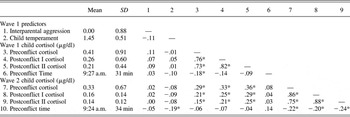
For ease of interpretation, Table 1 provides the raw means and standard deviations of the composite predictors and cortisol variables. Cortisol values greater than 3.5 SD away from their means were eliminated and the data were estimated using the FIML technique for the primary analyses. Consistent with diurnal rhythm of cortisol, inspection of the means reveals that cortisol levels dropped across the samples (i.e., preconflict, Post I, Post II) collected within each wave. For the correlation calculations in Table 1 and the subsequent primary analyses, cortisol values were transformed using the logarithmic calculation to normalize their distributions. The correlations in Table 1 indicate that associations between the interparental aggression, child temperament, and the individual assessments of cortisol were not significant. The stability of individual differences in cortisol levels were strong in magnitude within each wave, with r ranging from .73 to .88 (ps < .001). Likewise, modest to moderate consistency in individual differences in cortisol levels was also evident in the year span between the two measurement occasions, with r ranging from .15 to .36 (ps < .05).
Means, standard deviations, and intercorrelations of the main variables used in the first set of primary analyses

*p < .05.
Analysis of growth models of adrenocortical activity and reactivity over time
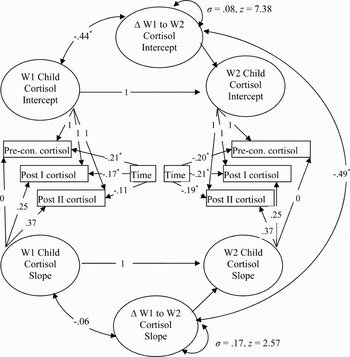
To assess children's cortisol reactivity in response to the simulated interparental conflict across two time points, our analytic approach nested latent growth curve (LGC) models of children's three cortisol assessments at each of two measurement occasions within LDS models that charted changes in children's cortisol activity and reactivity over the two measurement occasions (McArdle, Reference McArdle2009). Figure 1 depicts the baseline model prior to the inclusion of interparental aggression, temperament, and their interaction as predictors. In developing the model, the first step involved specifying the intercept and slope parameters of children's three cortisol assessments at each time point by simultaneously developing two LGC models. We followed conventional procedures for assigning loadings of 1 to each cortisol measurement occasion in the estimate of the cortisol intercept. For our focal indices of cortisol reactivity, the mean slope parameters in each of the LGC models characterized the estimate of the average, constant change over time in cortisol across the three time assessments at each measurement occasion. To estimate the linear slope, weights of each manifest assessment of cortisol in the model were specified to correspond with the time elapsed since the preconflict cortisol measure. Thus, the weight of 0.25 was assigned to the Post I assessment because it occurred approximately 25 min after the preconflict assessment, whereas the weight of 0.37 for the Post II conflict measure indicates that the assessment took place approximately 37 min after the baseline. Time of measurement during collection of the baseline sample was significantly associated with five of the six cortisol assessments. Therefore, time was specified as a covariate of the three cortisol measures at each time point (see Figure 1).
A synthesis of latent growth curve and latent difference score analyses for delineating change in children's cortisol activity and reactivity over the two measurement occasions. *p < .05.

In the second analytic step, changes in children's cortisol reactivity and preconflict cortisol levels were evaluated by specifying an LDS model linking each LGC slope and intercept together across the two measurement occasions (Ferrer, Ballluerka, & Widaman, Reference Ferrer, Balluerka and Widaman2008; McArdle, Reference McArdle2009). The versatility of LDS is reflected in its ability to identify overall sample changes and individual differences in change for cortisol activity and reactivity over time (McArdle, Reference McArdle2009). Of further relevance to our main research questions, LDS further allows for an analysis of the predictors of individual differences of subsequent changes in children's cortisol functioning (e.g., Geiser, Eid, Nussbeck, Courvoisier, & Cole, Reference Geiser, Eid, Nussbeck, Courvoisier and Cole2010; Maikovich, Jaffee, Odgers, & Gallop, 2008). The model in Figure 1, which depicts the integration of the LGC and LDS analytic components, fit the data well, χ2 (16, N = 201) = 27.25, p = .04, root mean square error of approximation (RMSEA) = 0.06, comparative fit index (CFI) = 0.99, Tucker–Lewis index (TLI) = 0.97, and χ2/df ratio = 1.70. Reflecting a relatively common finding (e.g., King, King, McArdle, Shalev, & Doron-LaMarca, Reference King, King, McArdle, Shalev and Doron-LaMarca2009), the Wave 1 cortisol intercept was negatively correlated with change in the intercept over time (r = −.44, p < .01). Wave 1 cortisol slope was not associated with the change in slope (r = −.06, ns). In accord with the focal interest in changes in children's cortisol over time, changes in the sample as a whole for the children's cortisol activity (i.e., intercept), z = −0.36, and reactivity (i.e., slope), z = 1.15, were not significant. However, the variances of the latent mean difference factors were statistically significant for cortisol intercept, 0.08 (z = 7.38), and slope, 0.17 (z = 2.57), indicating that there were significant individual differences in mean changes in the children's cortisol activity and reactivity over the two waves.
Predictors of growth indices of adrenocortical activity and reactivity over time
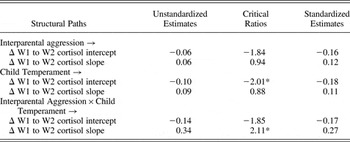
Given our aim of examining origins of interindividual differences in intraindividual change in cortisol over time, we proceeded to examine predictors of change in cortisol activity and reactivity within a structural equation model. Thus, we expanded upon the integrated LGC and LDS analysis depicted in Figure 1 by including interparental aggression, temperament, and their two-way interaction as predictors of change in the cortisol intercept and slope across the two waves. Correlations among the predictors, the covariates (i.e., time of measurement at each wave), and the children's cortisol intercept and slope at Wave 1 were also specified in the model. The model provided a good representation of the data, χ2 (21, N = 201) = 27.45, p = .16, RMSEA = 0.04, CFI = 0.99, TLI = 0.98, and χ2/df ratio = 1.31. Table 2 provides the resulting estimates of the structural paths among the three predictors and the two latent mean difference scores for the slope and intercept of children's cortisol across the two waves. The findings revealed that children's temperament was a significant predictor of the latent mean difference in their cortisol intercepts from Wave 1 to Wave 2 (β = 0.18, p < .05), indicating that greater Dove dispositions were associated with decreases in children's overall cortisol activity.
Estimates of the structural paths of the predictors of the latent difference scores of changes in children's cortisol levels and cortisol reactivity to interparental conflict

Note: W1, Wave 1; W2, Wave 2
*p < .05.
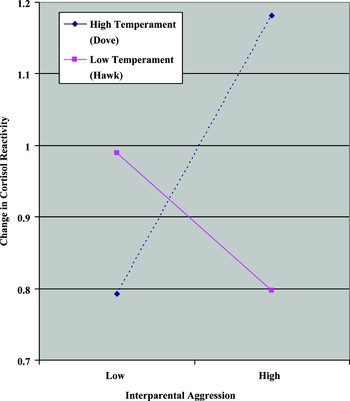
Of greater relevance to the primary hypotheses, the interaction between interparental aggression and child temperament significantly predicted the latent mean difference in children's cortisol slopes across the two waves (β = 0.27, p < .05). The graphical depiction of the interaction in Figure 2 reveals a crossover interaction. In accordance with conventional procedures (Aiken & West, Reference Aiken and West1991; Preacher, Bauer, & Curran, 2004), the nature of the significant interaction was further clarified by calculating the simple regression slopes of interparental aggression at high (1 SD above the mean) and low (1 SD below the mean) values of temperament. The results indicated that exposure to interparental aggression significantly predicted subsequent increases in children's cortisol reactivity to inteparental conflict over the year for children who exhibited Dove (i.e., 1 SD above the mean) characteristics (B = 0.24, SE = 0.10, p < .05). For children in the Hawk (i.e., 1 SD below the mean) spectrum of the temperament composite, interparental aggression did not significantly predict children's cortisol reactivity (B = −0.12, SE = 0.10, p = .25). Because it is possible that interparental aggression may still predict dampened cortisol reactivity over time for children who exhibit more extreme Hawk characteristics, we also calculated the simple slope of interparental aggression at 2 SD below the mean of temperament. The results indicated that the interparental aggression marginally predicted decreases in children's cortisol reactivity (B = −0.29, SE = 0.18, p < .10).
A graphical plot of the interaction between interparental aggression and children's temperament in predicting changes in children's cortisol reactivity to interparental aggression.

Associations between change in cortisol reactivity and change in psychological symptoms
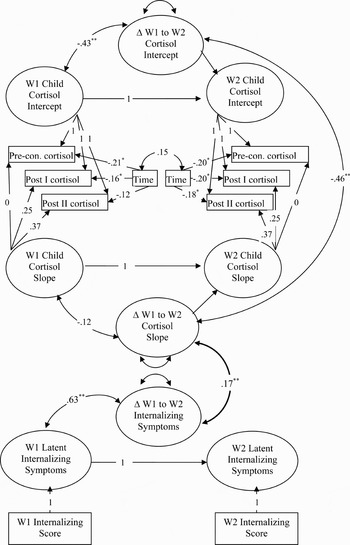
To follow up on developmental implications of the moderator model, we further explored whether change in children's cortisol reactivity was a meaningful indicator of allostatic load by examining its associations with concurrent changes in their internalizing, ADHD, and aggressive difficulties. Therefore, we conducted three cross-domain LDS models that expanded on the baseline LDS model by estimating correlations between the latent mean difference between the cortisol slope with latent mean difference scores of each specific dimension of maladjustment indexing across the two measurement occasions. By way of illustration, Figure 3 depicts the LDS model specifications for experimenter reports of children's internalizing symptoms. The model fit the data well, χ2 (30, N = 201) = 41.03, p = .09, RMSEA = 0.04, CFI = 0.99, TLI = 0.98, and χ2/df ratio = 1.37. Underscoring the primary analysis in the model, the bolded correlational pathway indicated that increases in children's cortisol reactivity were associated with comparable increases in their internalizing symptoms across the two measurement occasions (r = .20, p < .01). Successive LDS models were also conducted for children's aggressive and ADHD difficulties with the same model specifications in Figure 3. Each of the models provided a satisfactory representation of the data: χ2 (30, N = 201) = 53.26, p = .01, RMSEA = 0.06, CFI = 0.98, TLI = 0.96, and χ2/df ratio = 1.78 for aggressive problems; and, χ2 (30, N = 201) = 42.31, p = .07, RMSEA = 0.05, CFI = 0.99, TLI = 0.98, and χ2/df ratio = 1.41 for ADHD difficulties. Dampening of cortisol reactivity over time was unrelated to concurrent changes in children's aggressive problems (r = .03), but it was associated with greater ADHD difficulties across the two waves (r = −0.14, p < .05).
Cross-domain latent difference score analysis examining the association between concomitant changes in children's cortisol reactivity to interparental conflict and their internalizing symptoms over the course of 1 year. *p < .05. **p < .01.

Discussion
As a first foray into resolving the inconsistent and complex pattern of associations between interparental discord and children's adrenocortical functioning (Cummings & Davies, Reference Cummings and Davies2010), one of our primary objectives was to test the hypothesis that temperament may account for some of the heterogeneity in cortisol reactivity experienced by children in aggressive homes. Using an evolutionary framework of allostatic load as a conceptual blueprint for testing the role of temperament (Korte et al., Reference Korte, Koolhaas, Wingfield and McEwen2005; also Ellis et al., Reference Ellis, Jackson and Boyce2006), we employed a multimethod, multi-informant measurement design to examine whether pathways between interparental aggression and subsequent changes in children's cortisol reactivity to interparental conflict varied as a function of differences between children in their bold and inhibited temperamental characteristics. Results from analyses synthesizing LGC and LDS analyses within a larger structural equations model indicated that temperament moderated the associations between interparental conflict and children's cortisol reactivity to interparental conflict in a pattern predicted by evolutionary theory. Moreover, in accord with allostatic load formulations, changes in children's cortisol reactivity over the 1-year period were associated with concomitant changes in their psychological patterns of adjustment in ways predicted by evolutionary theory.
Our findings offer compelling support for increasing precision of temperament conceptualizations within family process models of allostatic load. Several prevailing conceptualizations of organism–environment interactions propose that difficult temperament constructs encompassing multiple forms of negative behavior (e.g., anger, irritability, inhibition, fearfulness) provide a sufficient behavioral proxy for children's susceptibility to environmental influences (Belsky & Pleuss, 2009). However, our findings raise questions about the applicability of this conclusion to understanding allostatic load processes as children progress into the toddler and preschool years. Although the principal components analysis of children's temperament dimensions yielded support for a single factor solution, inspection of the loadings indicated that approach and dominant negative affect (i.e., negative loadings) fell on the opposite pole from inhibition and vulnerable negative affect on the single temperament continuum. Thus, in accordance with the evolutionary model of allostatic load (Korte et al., Reference Korte, Koolhaas, Wingfield and McEwen2005), high scores on the temperament variable reflected cautious, submissive dispositions characteristic of a Dove profile. Conversely, children falling with the lower spectrum of the temperament composite can be interpreted as exhibiting a Hawk pattern evidenced by relatively greater expressions of dominant negative affect and approach behaviors in the face of novel challenges.
Further illustrating the value of distinguishing between different dimensions of negative temperament, a central hypothesis of the theory is that histories of exposure to stress will produce distinct patterns of adrenocortical reactivity over time for children with Hawk and Dove temperamental profiles. For children who exhibited Dove responses to environmental novelty and challenge, experiences with high levels of adversity are theorized to further sensitize their highly reactive HPA systems. Consistent with this hypothesis, our findings indicated that growing up in an adverse home marked by interparental aggression was a significant predictor of increases in children's cortisol reactivity to interparental conflict over a period of a year. Despite some important differences in the conceptualization and methodology, our results bear a striking resemblance to previous research identifying inhibited and anxious patterns of internalizing symptoms as potentiating factors in associations between maltreatment and the hyperactivity of the HPA axis (Cicchetti & Rogosch, Reference Cicchetti and Rogosch2001; Cicchetti et al., Reference Cicchetti, Rogosch, Gunnar and Toth2010; Heim, Meinischmidt, & Nemeroff, Reference Heim, Meinischmidt and Nemeroff2003).
Additional follow-up tests to clarify the nature of the moderating role of temperament generated partial support for the hypothesis that Hawks are more susceptible to experiencing dampened cortisol reactivity in the context of aggression between parents. Evidence for such a bold temperament hypothesis would require that the positive significant association between interparental aggression and cortisol reactivity identified for children falling in the high, Dove spectrum of temperament would reverse direction for children who fall within the lower, Hawk range of the temperament continuum. In keeping with this component of the model, interparental aggression was associated with decreases in cortisol reactivity to interparental conflict for children who were rated as exhibiting more dominant, approach behaviors in the context of novel challenges. However, it is important to note that this negative relationship only approached statistical significance at the extremes of the temperament spectrum (i.e., 2 SD above the mean). Therefore, authoritative conclusions regarding the Hawk profile hinge on replication with a larger sample that is better powered test the parameters of the proposed crossover interaction.
Nevertheless, the substantial correspondence between our findings and the hypotheses derived from the allostatic load model raises the question of why temperament moderates the prospective association between interparental aggression and children's cortisol reactivity. According to the evolutionary model of allostatic load (Korte et al., Reference Korte, Koolhaas, Wingfield and McEwen2005), the Dove and Hawk bands on the temperament continuum reflect individual differences in the constitutional calibration of stress-sensitive neurobiological systems. Thus, at one end of the continuum, the reticent, inhibited behaviors of the Dove profile can be interpreted as a behavioral manifestation of an HPA system that is highly attuned to variation in environmental threat cues. Consistent with this notion, the biologically sensitivity to context theory posits that children evidencing greater neurobiological plasticity may exhibit progressively heightened responsiveness within extraordinary socialization contexts, including, at one extreme, exposure to high levels of family adversity (Boyce & Ellis, Reference Boyce and Ellis2005; Obradovic, Bush, Stamperdahl, Adler, & Boyce, Reference Obradovic, Bush, Stamperdahl, Adler and Boyce2010). In further translating the evolutionary approaches to the study of interparental acrimony, a primary assumption of the reformulated emotional security theory is that the aggression between parents is particularly likely to sensitize subsequent responses to conflict for children who exhibit high levels of temperamental inhibition and perceptual sensitivity (Davies & Sturge-Apple, Reference Davies and Sturge-Apple2007).
At the other end of the continuum, the trend for children with Hawk tendencies to experience dampened cortisol reactivity in the wake of parental violence suggests that their HPA system is becoming less sensitive to exposure to threat. In accordance with emotional security theory (Davies & Sturge-Apple, Reference Davies and Sturge-Apple2007), one explanation is that this pattern of conditional hypocortisolism may signify some inhibition of the psychological experience of threat. Blunting of psychological experiences and its corresponding reduction in cortisol reactivity may provide a temporary means of attaining a perceived sense of security in stressful contexts (Davies & Forman, Reference Davies and Forman2002; Gunnar & Vazquez, Reference Gunnar and Vazquez2001; Lopez, Vazquez, & Olson, Reference Lopez, Vazquez and Olson2004). In drawing from the attenuation hypothesis (Susman, Reference Susman2006), a complementary interpretation is that children with constitutional impairments in processing and responding to fear-relevant stimuli (e.g., limbic system perturbations) may be susceptible to developing increasingly higher adrenocortical response thresholds to interpersonal threat in the context of violent home environments. Thus, in the context our findings, the early aggressive and bold dispositions of the Hawk profile may be a phenotypical marker of an HPA system that is calibrated to progressively down regulate following exposure to chaotic and violent socialization contexts (Ellis et al., Reference Ellis, Jackson and Boyce2006; Korte et al., Reference Korte, Koolhaas, Wingfield and McEwen2005).
If the patterns of conditional hyper- and hypocortisolism are part of an allostatic load process, changes in children's cortisol reactivity to interparental conflict should correspond concurrently with temporal variations in their psychological problems. Underscoring the developmental value of individual differences in cortisol reactivity, the results of the cross-domain LDS analyses revealed that individual differences in cortisol reactivity over time were related to patterns of children's psychological difficulties in theoretically predicted ways. Rather than supporting the common notion that high and low levels of cortisol uniformly reflect maladaptation, the results support the evolutionary hypothesis that each extreme in cortisol reactivity is associated with its own constellation of developmental advantages and costs (Ellis et al., Reference Ellis, Jackson and Boyce2006; Korte et al., Reference Korte, Koolhaas, Wingfield and McEwen2005). Reflecting the hypothesized response of Doves to high conflict homes, the psychological trade-off of greater cortisol reactivity was a relatively better ability to process and organize environmental stimuli (i.e., lower attention difficulties) at the cost of heightened vulnerability for greater internalizing symptoms over time. Likewise, when the findings are interpreted within the Hawk spectrum, dampened cortisol reactivity was part of larger allostatic load process characterized by rises in risky behaviors (i.e., attention and hyperactivity difficulties) that were counterbalanced by the developmental advantage of decreasing internalizing symptoms.
Although the findings on the developmental interplay between cortisol reactivity and psychological problems were largely consistent with the evolutionary model of allostatic load (Korte et al., Reference Korte, Koolhaas, Wingfield and McEwen2005), the analyses did not yield support for the hypothesized linkage between dampened cortisol reactivity and child aggression. However, at this early stage of research, it is premature to draw conclusions regarding the nature of the relationship between cortisol reactivity and aggression. As noted in a comprehensive view of the literatures, research on the adrenocortical functioning of children with aggressive problems has predominantly utilized concurrent assessments of basal cortisol levels (van Goozen er al., 2007). Therefore, empirical documentation of associations between aggression and hypocortisolism may not necessarily generalize to developmental models examining dynamic change in cortisol reactivity to family discord. Likewise, including both reactive (e.g., overreactions to minor frustrations) and proactive (e.g., takes advantages of others) characteristics in the aggression assessment may have diminished the sensitivity to identify underlying associations with cortisol reactivity. For example, research with older children has shown that the impetuous, hot-headed characteristics of reactive aggression are associated with hypercortisolism, whereas hypocortisolism is a more common correlate of callous, unemotional forms of aggression (Hawes, Brennan, & Dadds, Reference Hawes, Brennan and Dadds2009; Loney et al., Reference Loney, Butler, Lima, Counts and Eckel2006; Lopez-Duran, Olson, Hajal, Felt, & Vazquez, Reference Lopez-Duran, Hajal, Olson, Felt and Vazquez2009). Thus, these two developmental pathways may not emerge until later in development as the underlying architects of the trajectories likely hinge on children's success in resolving stage-salient tasks of developing empathetic concern and social perspective taking abilities (Cicchetti, Cummings, Greenberg, & Marvin, Reference Cicchetti, Cummings, Greenberg, Marvin, Greenberg, Cicchetti and Cummings1990; Cummings & Davies, Reference Cummings and Davies2010; Hastings, Zahn-Waxler, Robinson, Usher, & Bridges, Reference Hastings, Zahn-Waxler, Robinson, Usher and Bridges2000).
Several limitations of this study also warrant discussion for a comprehensive interpretation of the results. First, although our objective in this paper was to test primary hypotheses derived from the evolutionary model of allostatic load (Korte et al., Reference Korte, Koolhaas, Wingfield and McEwen2005), our findings do not reduce the plausibility of other psychobiological conceptualizations of family process. For example, a main assumption of the biological sensitivity to context theory is that children's heightened HPA axis functioning may serve as a marker of heightened susceptibility to family influences and, as a result, may moderate associations between family conflict and children's psychological adjustment (Boyce & Ellis, Reference Boyce and Ellis2005). Thus, complementary sets of intriguing hypotheses on the interplay between organismic and environmental characteristics in other evolutionary conceptualizations merit inquiry in future research (e.g., Belsky & Pluess, Reference Belsky and Pluess2009; Ellis et al., Reference Ellis, Jackson and Boyce2006). Second, expanding temperament assessments to incorporate more behavioral parameters for distinguishing between Hawk and Dove strategies may increase the power to test allostatic load hypotheses. For example, although our temperament battery was designed to identify individual differences in approach, inhibition, and dominant and vigilant forms of negative affect, it did not directly measure other defining features of the strategies (e.g., thorough vs. superficial exploration). Third, our test of allostatic load predictions were limited to charting the functioning of a sample of young children who experienced elevated levels of interparental aggression over two annual measurement occasions. Therefore, more definitive conclusions about the generalizability of our findings will hinge on testing these pathways with children from different backgrounds over longer developmental spans.
Despite these limitations, this study represents a seminal attempt to systematically test the primary assumptions of the evolutionary model of allostatic load with a sample of young children (Korte et al., Reference Korte, Koolhaas, Wingfield and McEwen2005), a developmental period characterized by considerable plasticity in neurobiological systems (Cicchetti & Walker, Reference Cicchetti and Walker2001). Consistent with the theoretically generated hypotheses, multivariate latent growth analyses of the multimethod data identified two distinct pathways linking interparental aggression with children's cortisol reactivity. Whereas interparental aggression was associated with subsequent increases in cortisol reactivity to conflict for children with submissive, cautious temperamental characteristics (i.e., Doves), children exhibiting bold, aggressive behaviors (i.e., Hawks) trended toward experiencing decreases cortisol reactivity in the wake of aggression between parent. Changes in cortisol reactivity, in turn, were associated in substantively meaningful ways with corresponding changes in children's psychological functioning. Collectively, these findings highlight the potential value of translating the study of evolutionary models of allostatic load to understanding children's adaptation in the face of interparental discord (Davies & Sturge-Apple, Reference Davies and Sturge-Apple2007).