

Introduction and Founding Vision
One hundred years ago, the few academic organizations that existed in Canada represented a very narrow range of elites in Canadian society. In particular, indigenous, racial and ethnic minorities and women were underrepresented within the professoriate and within academic associations, if represented at all. Over the past century, while academic associations multiplied, some disciplines became more representative of Canadian society. Here, we explore how the CPSA's organizational practices shaped issues of representation in its founding decades. Who were the CPSA founders? How did they draw members into the association? Exploring these questions deepens our understanding of how the CPSA attracted members who, in turn, shaped analysis of public policy (Gagnon, Reference Gagnon, Brooks and Gagnon1990). From the outset, the CPSA acted as an intellectual gatekeeper by validating particular kinds of intellectual knowledge, framing which research was important to champion and whose voices were worth heeding. This is especially important given the influential role of leading CPSA members during the foundational years in the development of the modern Canadian state. It also has implications for the CPSA's touted neutrality in fostering academic debates on public policy during that period.
The records of the CPSA deposited at Library and Archives Canada (LAC) include minutes of annual meetings, correspondence, membership lists for 1913 and 1930 to 1936, and published papers and conference proceedings. This article analyses these published and archival records over the founding years up to 1939 for information on the regional, academic, employment and gender composition of the executive and membership. The membership lists vary in the information they reveal. The 1913 membership list of 251 members included only last name with initials (obscuring gender), city and in some cases a professional title, which allows identification of occupations. City names reveal the provincial distribution of members (CPSA, 1913: 5–8). The seven lists from 1930 to 1936 (LAC, v. 1, membership list, 1930; v. 7, membership lists file), in contrast include first names and frequently an employer's name as well, thus allowing analysis of the employment profile of members. Many members listed their business address instead of a home address, which also allowed classification of occupations. Sometimes titles (Miss or Mrs.) helped identify gender. Where possible, university archives, the Dictionary of Canadian Biography and the Canadian Encyclopedia supplement the membership list data, revealing department or academic specialty for professors. Politicians' ridings and political affiliation enrich the partisan and regional breakdown. These eight complete lists, consisting of 3,151 members, constitute a sizeable population from which to analyse CPSA membership. The letters and minutes of the executive meetings provide richer detail on the executive members. Together these data provides a profile of the 249 executive members from 1913 to 1939.
The Founding Meetings of the CPSA
The member of parliament and the administrative chief, the manufacturer and the skilled mechanic, the employer of labour and the officer of the trade union, the banker and the trustee, the corporation manager and the railroad official, the broker and the tax commissioner, the journalist and the lawyer, the clergyman and the social worker, these and scores of other typical citizens, on whom much depends for the successful working of our Canadian democracy, are invited to avail themselves of this common meeting ground for the study of the interests which they have in common. (Adam Shortt, CPSA, 1913: 18)
We cannot know how many of the founding members at the inaugural meeting of the CPSA shared this inspiring vision of the “typical citizen” who would join the CPSA. Eight Canadian political scientists, attending the meeting of the American Economic Association in Boston, conceived the CPSA in 1912. Gathered at lunch, they planned the first Canadian meeting for the following year in Ottawa (Taylor, Reference Taylor1967: 581). Political science in Canada was still in its infancy, with the lines blurred between the disciplines we recognize in the contemporary context. The University of Toronto established the first Department of Political Economy and Constitutional History in 1888, followed by Queen's Department of Political and Economic Science in 1889, McGill's Department of Political Science in 1899, “McMaster in 1904, the Université de Montréal in 1907, Manitoba in 1909, and Dalhousie and Acadia in 1912” (581–82). The Canadian Economics Association did not form until 1967; Sociology and Anthropology were chapters of the CPSA until 1966.
The inaugural meeting, held in Ottawa in 1913, welcomed 240 founding members, including two women. At this prestigious event, Prime Minister Borden spoke briefly of Canada's challenges. He lamented that, unlike England, Canada did not enjoy the luxury of a “large leisure class” who had the time to study politics. Canada needed the CPSA to address the challenges facing it. Among these, he highlighted immigration and assimilation. Borden also identified other priorities: economic development, political integration, reconciling tensions between consumers and producers, and securing “the equality of men before the law” and “as far as possible, equality of opportunity” (CPSA, 1913: 8).
Adam Shortt, the CPSA's first president (1913), was the founding chair at Queen's Department of Political and Economic Science but left in 1908 to become the first head of the Civil Service Commission, mandated to reform the Canadian public service (Ferguson, Reference Ferguson1993: ch. 5). He remained a leading figure in the CPSA until his death in 1931 (Gordon, Reference Gordon2008). In the inaugural presidential address, he cast the inspired vision of how the CPSA might broadly engage typical citizens. He also warned of partisan bias, where experts could lack an “impartial manner” or a “single eye to the public good” (16). Partisanship could not provide satisfactory answers to public questions.
There are, however, few atmospheres in which the broader and more progressive phases of these questions can be systematically discussed or cultivated by both special students and men of affairs; where discussion may be free and unsuspect, where the presentation and criticism of ideas can take place without the constant side glances at political parties and policies, particular men and private interests [emphasis added]. (17)
The CPSA brought together mostly elite men from a narrow spectrum of Canadian society for objective, scientific consideration of the pressing issues of the day, suited to the Canadian context (18–19). In this, they shared the goals of like-minded secular reformers of the era who wished to shift from philosophical and moral reform to secular reform based on professional expertise in the social sciences (Owram, Reference Owram1986). These educated men, more learned than the democratic masses and without partisan or private biases, would lead discussions in a detached, scholarly and scientific manner, providing analysis and recommendations for government and public policy. Despite the rhetoric about the “typical citizens” who would participate in the CPSA, from the outset the organization was premised on an elitist, if not anti-democratic, foundation.
Shortt (Reference Shortt1913) spoke to the rationale for establishing such an organization in Canada, noting the precedent of similar associations in “more civilized countries” including “the Statistical Society, the Royal Economic Society, and the American Economic and the American Political Science Associations” (9). Many of his peers on the founding executive were active members in these organizations. He emphatically distinguished the importance of the work of scholars from that of mere political practitioners, or worse yet, common citizens.
One does not attempt fine work through the instrumentality of a mob …. This raises a further pertinent question as to how far the people… can be said to have any intelligent opinions on quite a number of very important questions which call for political action, but which require for their proper understanding a more highly specialized knowledge along certain lines, than even the wisest citizen, not especially interested in that line, may have had either the time or opportunity to acquire. (10, 13)
Without knowledge and training in political science, ordinary people could not hope to make reasoned judgments about political matters. The first CPSA president had little faith in the democratic ideals of an active citizenry taking an interest in politics and making informed decisions about public policy.
The cost and terms of membership were exclusive. When five cents bought a loaf of bread, the $2 membership fee was prohibitive for many; few could afford the $50 life membership. Current members nominated new members; these nominations required further approval by the executive committee (CPSA, 1913: 152). This suggests a desire to draw in selected members, which perpetuated the privileging of some to the exclusion of others.
The inaugural meeting solicited exchange on the distribution of powers, international relations, social issues, economic problems, public policy, legislation, administration, laws, efficiency of government and the extension of the franchise. The papers presented were narrower in scope. Two papers dealt with agriculture, one with immigrant housing, one was on city government, one on the role of the middleman, and one on the perennially pressing Canadian issue: the constitution. Notably, they dropped suffrage. These proceedings were published and the CPSA planned to meet on an annual basis but the First World War intervened and they did not meet again until 1929.
Patterns of representation in the CPSA in 1913 were starkly narrower than Shortt anticipated in his opening address. The need to distinguish the credibility of political science, to raise it above the common order of folks discussing politics, the desire to distance the organization from partisan politics and the struggle to define the discipline in a Canadian context helped frame who could and would participate. Founding members were far from typical citizens. They represented an elite group of corporate executives, professionals, academics, civil servants and politicians, and were dominated by urbanites, with limited representation from Quebec. All the papers presented were in English. There was no mention of accommodating francophone members. Despite the two women present, the inaugural speeches explicitly assumed a male membership (Newton, Reference Newton2008).
After disbanding with the onset of the First World War, the executive struggled to resume operations. Executive members met again in 1922 during the meetings of the Royal Society. Adam Shortt was joined on the executive by Professors James Mavor (vice president) and R.M. MacIvor of the University of Toronto, O.D. Skelton of Queen's University, and S.A. Cudmore, a University of Toronto professor who joined the Dominion Bureau of Statistics in 1919. Dr. Robert Hamilton Coats also was present. He had worked as editor of the Labour Gazette from 1902 to 1915 when he became the first Dominion Statistician, Controller of the Census, and helped establish the Dominion Bureau of Statistics in 1918 (Ontario, 2008). Coats, however, resigned his position as secretary-treasurer because of his workload. Their plan to rekindle the CPSA and hold a membership meeting for the following year never materialized (LAC, CPSA, 1922 Minutes Executive Council Members). The following year, H. Marshall from the Dominion Bureau of Statistics joined the executive ranks, as did F.J. Horning and three MPs: A.R. McMaster, Liberal MP for Brome, Quebec, J.S. Woodsworth, Independent Labour Party, Winnipeg North, and William Irving, Dominion Labour Party, Calgary East. Despite agreeing to reorganize, plan a subsequent meeting in Montreal, and raise the fees to $3.00, they did not reconvene until the winter of 1929 when Coats invited the old executive, including Shortt and Skelton plus S.J. MacLean, Board of Railway Commissioners, and N. McL. Rogers, Queen's University. They discussed restarting the organization and transferring funds to a new association. D.A. McGibbon, University of Alberta, organized a subsequent business meeting in the Ottawa's Chateau Laurier Hotel, gathering economists from the National Conference of Canadian Universities (CPSA, 1930, Foreward: 1). They constituted a new executive, including three vice presidents, a secretary, treasurer and a ten-member executive committee.
Solid Footing: The CPSA Membership of the 1930s
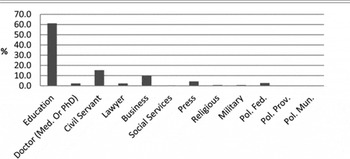
However cautious the CPSA executive was initially to avoid political partisanship, it was eager to solicit members from business and the civil service into the executive (Table 1). In addition to high-ranking civil servants like Shortt and Coats, other executive members were prominent members of Canada's corporate elite, including Simon J. McLean, of Toronto who had a PhD from Stanford and worked with the Board of Railway Commissioners; C.E. Neill of Montreal, Royal Bank of Canada, W.E. Rundle of Toronto, National Trust Co., and James Richardson of Winnipeg, whose family business owned 250 grain elevators across the prairies in the 1930s (Siamandas, Reference Siamandas2007). J.W. Dafoe, editor of the Winnipeg Free Press, also served on the executive. In welcoming these five members into the executive, the leadership was untroubled by the business and media representation embedded in their ranks (CPSA, 1930, Minutes, May 23, 1929: 123–24). Notably, only 13 new members joined in May 1929. Despite their wealth and status, some of the incoming executive still owed their membership fees (CPSA, 1930, Treasurer's Report: 127).
Executive Career Indicators, 1930–1939

Membership Career Indicators, 1930–1936

As of May 1930, annual meetings successfully reconvened with a programme that included business trends and forecasting, immigration and settlement, Canada's international position, inter-imperial trade, pacific relations, the royal prerogative, central banks, and the curricula of commerce courses in Canada (CPSA, 1930: 2–3). Fifty-two men attended (LAC, CPSA, v. 1, signatures on CNR stationery). Only men presented papers. They were from universities across Canada: University of British Columbia, University of Manitoba, University of Toronto and Queen's University. The only Quebec university represented was McGill. Francophone representation was thin. The one identifiable francophone, A.J. Pelletier, presented a paper on “Canadian Census of the Seventeenth Century,” though the historian A.R.M. Lower presented a paper on “The Growth of the French Population of Canada.” None of the presenters came from east of Montreal. Two men presented on business trends: W.W. Goforth, a Montreal executive, and D.M. Marvin of the Royal Bank of Canada. Several civil servants presented, including President Adam Shortt, and Presiding Officer O.D. Skelton. (CPSA, 1930: 2–3).
The 1930 business meeting elected a new executive, with O.D. Skelton as president. The executive solicited new membership, organized and promoted the annual meetings and oversaw the publication of their annual proceedings, which eventually became the Canadian Journal of Economics and Political Science in 1935. Several issues arose that reflected their desire to accommodate particular kinds of representation. First, Cudmore with the Dominion Bureau of Statistics (DBS) chose editors for the Proceedings from the two leading universities in the country: C.A. Curtis from Queen's and H.H. Kemp from the University of Toronto. Second, in deciding when to hold the next meetings, the Western colleagues vetoed a proposal to meet at Easter, since they would be unable to attend. They toyed with the idea of meeting with the Royal Society and the Canadian Historical Society, and they asked Coats to investigate the possibility of finding a patron. The final decision on where to hold the next meeting settled on Ottawa yet again (CPSA, 1930, Minutes, May 20: 125–26).
This brief overview hints at some of the major representational patterns of these formative decades. A few key universities and professors dominated; members were mostly from Ontario. High-ranking civil servants and corporate elites also joined and served on the executive. Women, Francophones and other non-elites were scarce.
As noted, membership in 1913 required nomination by a member and agreement of the executive (CPSA, 1913: 151). The 1930 Constitution made membership more restrictive, requiring executive approval of a nominee from two members (CPSA, 1930: 128). With no record of the discussion leading to this change, one wonders whom they wanted to exclude. Was this an attempt to restrict political partisanship? Did they wish to exclude the two female members from 1913? Whatever the reason, this increased restriction for approving membership solidified exclusive nature of the organization.
Inevitably, this restriction of membership collided with financial need. To build membership, Knox, Curtis and Mackintosh (Grant, Reference Grant2015), all from Queen's University, drew up a list of names of people to invite (LAC, v. 1, correspondence, Mackintosh to Cudmore, Jan. 23, 1931). The fifty-two people identified in their “List of Prospects for the CPSA” is fascinating. Their recommendations would reinforce regional imbalance in favour of Ontario: nine new members from the University of Toronto, three from Queen's and two from the University of Western Ontario. They also suggest four new members from the West and five from McGill, but only one member from east of Montreal: W.R. Maxwell of Dalhousie University. The emerging focus on economic development in Quebec “picked up by French-Canadian educators and by such groups as the Société d’économie sociale” was not accommodated (Goodwin, Reference Goodwin1961: 51). They also suggested thirteen new members from the business community, including two women, from the firm of Cockfield Brown and Co. in Montreal, Dorothy McEvoy and Mary Rowland, who never joined, but W.W. Goforth from the firm did become a continuing member. They also recommended four members of the press, one American and six civil servants from the federal departments of Agriculture, Trade and Commerce, Finance and the Secretary of State. Finally, they recommended MP R. Gardiner of the United Farmers of Alberta, and R. Deachman of the Consumer's League of Canada (LAC, v. 1, Minutes and Correspondence). Notably, they did not recommend any representatives of labour, women's groups or other social organizations. Only one letter exists in the archival records of other members actually nominating a person. Prof. H.F. Angus of UBC and L.J. Ladner of Vancouver wrote to nominate Mrs. Annabelle Maud Gosse of Vancouver and her membership was accepted (LAC, v. 1, Angus to Cudmore, Jan. 9, 1931). Politically active with Vancouver women's groups, she joined for four years.
From 1930 to 1936 the membership had a surprisingly broad geographic base, with at least one member from each of the nine provinces, none from the north, and a significant number of representatives from outside Canada, mostly the United States and England. With only 33 per cent of the Canadian population, Ontario disproportionately dominated the membership at 57.9 per cent. Saskatchewan and Manitoba had roughly proportional representation at 8.6 and 5.9 per cent of the membership. The eastern provinces were significantly underrepresented, especially considering the long history of Dalhousie and the University of New Brunswick compared to some of the more recently established universities in the rest of Canada. Only 16.2 per cent of the membership was from Quebec compared to its 27.7 percentage of the population, and they were virtually all Anglophone. Membership in the executive up to 1939 showed similar patterns (Canada, 2009, for population data). The vast majority of the members also came from large urban centres like Montreal, Toronto, Ottawa or Winnipeg, leaving rural Canada underrepresented.
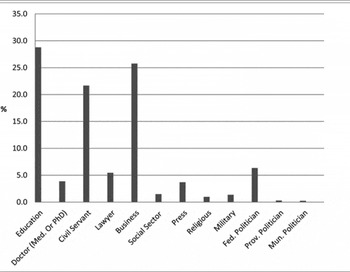
Available information for 62 per cent of the members produced 2,553 discrete indicators of careers. Most were in the education sector, mainly universities, but some were from school boards, high schools, private schools and colleges. Those in education were only slightly more represented than those in business and the civil service. In contrast, over 65 per cent of the executive were from academia (Table 1). Economists and political economists dominated, but history, law, philosophy, commerce, engineering, agriculturalists, psychology, accounting, and a few other disciplines were represented, accompanied by a few members from elite foreign universities like Oxford and Harvard.
The University of Toronto massively dominated the membership with 164 members, followed by 74 from Queen's and 49 from McGill. Dalhousie University brought the most (12) members from the east; the University of Manitoba (39) and the University of British Columbia (23) brought the most members from the west. Not all universities were equally welcomed. H.A. Logan, Head of the Political Economy department at the University of Western Ontario complained to Cudmore that their faculty members could not attend because the CPSA scheduled meetings for May 22–23, during their exams. He requested alternate dates (LAC, v. 2. Correspondence, May 22, 1933). Cudmore responded that the current date overlapped with the meetings of the Royal Society, and that “it suits the convenience of university professors who can drop off at Ottawa on their way to England or the Continent. However, I am sure that the incoming Committee will give its earnest consideration to your representations which correspond with what we hear from certain Western universities” (LAC, v. 2, Correspondence, Cudmore to Logan, June 1, 1933). Their earnest consideration resulted in no change. The meetings held in Montreal on May 21–23, 1934, and in Ottawa, May 25–26, 1935, made it impossible for western faculty members to participate. Indeed the timing of the meetings remained the same up to 1939.
The focus on federal politics and the weak tradition of teaching political economy in Quebec (Goodwin, Reference Goodwin1961) cannot fully explain the dearth of francophone representatives from Quebec universities. With 49 of the 79 Quebec academics from McGill, francophone underrepresentation from that province was dramatic. Some evidence suggests that the executive was aware of the need for representation from Quebec but not French Quebec. Stephen Leacock, chair of the economics department at McGill, had turned down the presidency of the CPSA twice before1933, but Cudmore did not want to lose representation from McGill (LAC, v. 2, Correspondence, Cudmore to Bladen, May 9, 1933). Two Anglophones from Quebec became presidents in the 1930s: Leacock (1933) and J.C. Hemmeon (1934), both from McGill. Neither Dr. H. Laureys, Dean of École des hautes études commerciales, or Édouard Montpetit of the Université Laval de Montréal served as CPSA president, despite their positions as founder and head of their francophone departments in Quebec.
Almost equalling the academic members, executives representing the corporate elites of Canada joined the CPSA, often with multiple members from a head office and with heavy representation from the banks (Figure 1). This was by design. In 1933, Mackintosh sought “some big guns from the banking world to give papers on a Central Bank” (LAC, v. 2, Corrrespondence, Mackintosh to Cudmore, April 27). Elite connections offered other benefits. The Canadian Passenger Association arranged reduced fare for rail travel to the CPSA conference if they could guarantee one hundred passengers (LAC, v. 2, Correspondence). O.D. Skelton “took a position very strongly two or three years ago that we should not be under any obligation to any government for free meeting room accommodation.” Curiously, to avoid an increase in rent for rooms in the Chateau Laurier, these scruples vanished when they leapt at the offer of free meeting rooms from the Convention and Tourism Bureau of the C.N.R. in Montreal (LAC, v. 3, Correspondence, Cudmore to Urwick, Dec. 10, 1932).
Corporate Representation in the CPSA

Civil service employees joined the CPSA in almost equal numbers to business. These were high-ranking federal officials: Deputy ministers or heads of units represented almost all of the federal departments. In addition to Coats and Shortt, for example, Dr. James Bonar, a trained economist on the 1913 executive was appointed first Deputy Master of the Royal Canadian Mint in 1907, a position he held until he retired in 1919 (MacG., Reference MacG.1941: 283). Thirty of the civil servants prefaced their names with Dr., six were lawyers, including the Clerk of the House of Commons. DBS, the Department of Labour, and External Affairs, had the largest number of members, with the DBS dominating. This is not surprising, given who was on the executive and how they solicited members. They had considerable influence within the bureaucracy. Passionate about the need for reliable statistics, for example, Coats tried to steer the CPSA in that direction on more than one occasion. “With regard to possible financial support, Mr. Coats referred to a proposition submitted to him for the establishment of a Canadian Statistical Association which stated that financial support for such an organization would be forthcoming” (LAC, v.1, Minutes Executive Council Meeting, 1922). At the 1929 meeting, Coats successfully persuaded the CPSA to establish a link with the International Union for the Scientific Study of Population Problems (CPSA, 1930, 1929 Business Meeting Minutes: 126). When Coats resigned his position as secretary Treasurer in 1922, he asked S.A. Cudmore, also from DBS, to take over. Cudmore remained active on the executive, serving from 1932 to 1934. He used the resources of the DBS to help with administrative tasks for the CPSA. For example, he informed C.A. Curtis that “I am having a circular struck off in the Bureau to go out to the members and shall also send a card with blanks for suggested members, so that we may get good value for postage” (LAC, v. 2, Cudmore to Curtis, May 9, 1993).
Interest in the CPSA extended further. The United Empire Club, modestly described as a “small discussion group,” which met regularly to discuss “matters of an economic nature relating to the development of the empire” requested copies of the programme. All 14 members were “responsible officials of the Government Service” and 13 had university degrees. Only two of this club's members actually joined the CPSA (LAC, v. 2, Correspondence, Booth to Cudmore, 13 May 1933). J.F. Booth of the Department of Agriculture asked if the national association of Technical Agriculturalists, with about one hundred fifty members, most “in government service” and all with university degrees, could have copies of the CPSA programme and attend the sessions on agriculture (LAC, v. 2, Correpsondence, Booth to Cudmore, 13 May 1933). Caution about political partisanship and government influence did not extend to caution over the role of civil servants within the CPSA.
A respectable number of elected politicians joined the CPSA in these early years but fewer joined the executive. Most were federal politicians representing a range of political parties. Conservatives participated, including Charles P. Beaubien, Senator from Montarville, Quebec, H.H. Stevens from Kooteney BC and R.B. Bennett who joined while he was Prime Minister. Liberal MP C.R. Mackintosh from North Battlefield, Saskatchewan joined, as did Liberal Senator A. Packenham from Ontario. CCF MPs Angus MacInnis (Vancouver South) and J.S. Woodsworth (Winnipeg North), Labour MP H. Mitchell (Hamilton South), and United Farmers H.E. Spencer (Battle River, Alberta) also joined. Though the membership was multipartisan, the executive was bipartisan. The 1913 executive included one Liberal and one Conservative politician as vice president. The political executive members after this time included two Liberals, one Labour, two CCF, and one politician who shifted his allegiance from CCF to Liberal. None was Conservative, perhaps reflecting their reluctance to collaborate with the reform-minded CPSA.
Few members worked in other professions; some were lawyers or military men. The CPSA aggressively sought out members from professional organizations like the Engineering Institute of Canada (LAC, v. 2, Burley to Cudmore, 15 May 1933). Few clergymen were invited to join, signalling the growing a concern to move the CPSA's agenda in a more “scientific” direction away from clerical and moral reform. They also eagerly sought good press coverage, providing précis of papers to the press (LAC, v. 2, Correspondence, Letter by Cudmore, May 16, 1933). The CPSA programme, which was distributed to the four “Toronto dailies, the Financial Post, Saturday Night, Monetary Times and Farmer's Sun” (LAC, v. 2, Correspondence, Bladen to Cudmore, May 13, 1933), often found its way into print. Cudmore personally met with the Canadian Press in 1933 to ensure adequate press coverage of the CPSA meeting (LAC, v. 2, Correspondence, Cudmore to Bladen, May 15, 1933). J.W. Dafoe of the Manitoba Free Press (later the Winnipeg Free Press), B.K. Sandwell of Saturday Night and Floyd Chalmers of the Financial Post all served on the executive. At least one press member was present from 1929–1934. Dafoe even became president in 1938.
Who is missing?
How do we interpret the absences or exclusions evident from these archival records? Aside from a few notable people on the executive, it is striking that so few from the labour movement, farmers, health or social service were members. Excluding the politicians, Gordon Bates, General Secretary of the Social Hygiene Council in Toronto, and W.T. Burford, Secretary Treasurer of the All Canadian Congress of Labour, were the only two identifiable members who represented the social/labour sector. Prof. H.M. Cassidy, Director of Research of the Unemployment Research Committee of Ontario, presented a paper at the CPSA conference in 1932 on “Relief Works as a Remedy for Unemployment in Light of Ontario Experience.” Of the 27 members of his committee, only one was a woman. In contrast, Leonard Marsh, representing the Montreal Council of Social Agencies, was to submit a paper for the same 1932 conference. Of the 18 members of this Council, 11 were women (Queen's University Archives, CPSA Fonds, c. 2168). We do not know why, but he did not present his paper at the conference.
Racism of that era took many forms. The anxiety over immigration reflected a concern over the influx of non-northern Europeans who would outnumber the original settlers. Prime Minister Borden identified this as the most pressing issue of the day in his inaugural address to the CPSA:
No country has ever been called upon to face so relatively great a task of assimilation as is imposed upon Canada by the large accessions to her population. If these came from the two or three original stocks which settled this country [emphasis added], the problem would not be so great; it is intensified by the fact that they are being in part drawn from other sources, very desirable indeed, but at the same time differing among themselves and from us in their ideals and methods of government. (Borden, Reference Borden1913: 7–8)
This framing of race and the immigration problem is troubling. First, racial anxiety about the assimilation of primarily white Eastern European immigrants casts them as problematic relative to the founding white-settler cultures. Second, the ambiguity of the reference to the “two or three original stocks” of settlers is telling. Does this reference the French/English settlers, or the distinctions made at the time between the French, English and Irish “races”? The CPSA executive echoed similar concerns in recommending a focus on census results in 1923 and asking that, “papers might be prepared on the racial constitution of the Canadian people” (CPSA Fonds, Minutes, Executive Council Members, 1923). Founding President Shortt (Reference Shorttn.d.) voiced anxiety over the quality of immigrants from the British Isles in a paper, “The Importation of Defective Classes.” His study of the prison and asylum records of Toronto, circa 1906–1907, noted that immigrants suffered from a range of problems that warranted their deportation, including insanity, alcoholism, degeneracy, sexual perversion and vagrancy. Ever precise, Shortt made particular note of their countries of origin, mostly England, Ireland and Scotland and urged changing the laws to allow deportation to their countries of origin (17). Their concerns about the quality of immigrants coincided with restrictive immigration policies and illegal deportation practices during these decades (Roberts, Reference Roberts1988). Further, we must note his total elision of the role of indigenous peoples in the founding of Canada. At a time when indigenous communities were subject to the genocidal policies of the Canadian state, Borden's framing of Canada's “most pressing problem” underscores his profound indifference, typical of this era, to the impact of immigration and resettlement policies for indigenous peoples (Daschuk, Reference Daschuk2013).
O.D. Skelton, the first secretary-treasurer for the CPSA, studied classics at Queen's, earned a doctorate in political economy at Chicago and then returned to Queen's as a professor of political science and economics from 1909 to 1925. He published extensively in economic history and current affairs. Like many of his cohort on the CPSA executive, he also had significant political ties, with close links to Wilfrid Laurier, having worked for him in the 1911 election, but also becoming a consultant to both Liberal and Conservative governments under Mackenzie King and R.B. Bennett. A top civil servant and advisor on domestic and foreign policy, he was the “the founder of the modern Department of Foreign Affairs and International Trade” (Hillmer, Reference Hillmer2008). In that capacity, he played a significant role in Canada's infamous policy to prevent any Jews from escaping Nazi Germany by emigrating to Canada (Abella and Troper, Reference Abella and Troper1983). Even the CPSA's common practice of holding meetings and lodging in private clubs underscores their legacy of exclusion. As was customary at the time, many private clubs barred women, non-whites and Jews from entering their doors. While the membership lists and the archival record seem silent on race, given the names, careers and social practices outlined above, the CPSA represented a narrow range of Canadian society: overwhelmingly elite, white, the English-speaking, and male.
Though the suffrage movement mobilized significant numbers of women into social services across the country, Mrs. A.M. Heustis and Gertrude Tate were the only identifiable female members present at the inaugural meeting. Both were typical women activists of that era: Heustis through the Women's Institutes and suffrage and Tate, through an Anglican Church group, the Crèche Child and Family Centre, which she co-founded in 1909 (Child Development Institute, 2008; Newton, Reference Newton2008). Women also flocked to paid employment during the war and to universities in the 1920s, at a rate unmatched until the 1960s. At Dalhousie, the University of New Brunswick, Queen's University and the University of Toronto, women students were studying the discipline. Despite this, women represented less than 2 per cent of the CPSA membership up to 1939. Only four of the twenty-nine female members were married, twenty-one were single, and intriguingly three did not use either Mrs or Miss. Most were from Toronto, with a cluster joining in 1935–1936. Some of the women used business addresses, suggesting they worked for banks or the civil service. For example, Miss Margaret Mackintosh, the Department of Labour Librarian, joined the CPSA. She “was W.A. Mackintosh's older sister, also a student of Skelton's at Queen's. Largely seen as the brains behind the Department of Labour for many years, but given innocuous titles like ‘Librarian,’ she was Canada's leading authority on labour relations and ‘if not for her gender, likely would have become deputy minister’” (Cox, as cited by Grant, Reference Grant2009: 32). The Dean of Women from Queen's University, Miss Winnifrid Kydd also joined for several years, as did Mrs. Phyllis Burns, of the Maritime School of Social Work at Dalhousie (PEI. Archives, 1947–1975). Miss Helen L. Babe paid dues in 1935 and 1936, and appears to be the first woman on a CPSA programme prior to 1939. She commented on Stephen Leacock and J.L. McDougall's papers in the section on economic theory in 1933 (CPSA, 1933, Table of Contents). Leacock, a well-known anti-feminist (Strong-Boag, Reference Strong-Boag1996), must have bridled at a women commenting on his paper; we wonder how Leacock received her comments. She lived in Annesley Hall, at Victoria University, University of Toronto, the first women's dormitory built in Canada (Victoria University, 2009). Miss Irene M. Biss, University of Toronto, joined from 1930–1936. Born in South Africa in 1907, she studied in England at the London School of Economics and at Cambridge. She joined the University of Toronto in 1929 and taught political economy, working closely with Harold Innis. In 1938 she married Graham Spry, had two children and did not resume her career again until 1967, first at the University of Saskatchewan and then at the University of Ottawa. She died in 1998 after completing a twenty-year project on nineteenth-century western Canadian history (Cameron, Reference Cameron1999). Women brought experience from the social sector, but their small numbers limited the CPSA's expertise in these areas.
Some women showed a particular interest in political economy. Miss Helen D. Chataway submitted an article, “Capitalism Reconstructed,” to Cudmore for consideration at the 1932 conference. Acknowledging the paper was too long, she asked “whatever the verdict, you will give me, however briefly, your advice and criticisms?” (LAC, v. 3, Correspondence, Chattaway to Cudmore, April 7, 1932). Cudmore replied that the programme was too full to include her paper but she was welcome to attend the roundtable on a planned economy and “present your views.” He also sent comments on the article and expressed his reservations about basing “currency and its expansion or contraction on such foundations as you suggest” (LAC, v.3, Cudmore to Chataway, April 28, 1932). Chataway persevered and eventually published her book, Economics and Life (Chattaway, Reference Chattaway1948). In her Preface, she thanked a number of leading members of the CPSA, including Coats and Innis. Goodwin's history (1961) of economic thought in Canada, however, entirely ignored her work. Significantly, though women were present from the outset in the CPSA, and produced scholarship in the discipline, none presented papers or served in executive positions between its founding and 1939.
Conclusion
The founding of the CPSA by leading academics, politicians, civil servants and corporate leaders embedded the CPSA deeply in the elite structure of Canadian society. While some challenged the CPSA to allow greater regional representation, the executive made ongoing decisions that favoured the three main universities: University of Toronto, Queen's and McGill. While they cared about Quebec representation, francophone Quebec representation was negligible. Despite its claim that the CPSA was open to “all persons interested in the objects it seeks to promote” (CPSA, 1934: 4), the participation of labour, women, Francophones, racial minorities and indigenous peoples were muted or absent.
This record of the evolving membership deeply challenges the fantasy that the CPSA was creating “scientific,” neutral and non-partisan scholarship on public policy, leading us to reflect on the challenges of developing truly independent scholarship on public issues. We could dismiss these problems as inevitable issues from a bygone era. However, archives may “also entail a voyage through the words of today, with the perhaps somewhat unreasonable conviction that we write history not just to tell it, but to anchor a departed past to our words and bring about an ‘exchange among the living’” (Farge, Reference Farge2013: 124). What might be our exchange with this legacy? Having long abandoned the vision of an association that would draw together a wide yet elite spectrum of Canadian society to discuss policy issues, like other academic associations, the CPSA now narrowly functions as an association that serves the interests of political science faculty members. While we claim non-partisanship and demand rigorous scholarship, the elitism of academia prevails. An association of tenured faculty members and an underclass of aspiring scholars who hope to make it into their ranks has replaced the earlier vision of an association that would debate issues with a wide spectrum of Canadian society. The CPSA clearly now serves the interests of those with tenure, among the most secure and well-paid members of Canadian society, and those aspiring to be tenured, many of whom struggle as part-time faculty on pittance wages, often also distinguished by their gender and race. In pursuing academic self-interest, are we not blind to the inequities within our ranks? An historical understanding of how the CPSA evolved may help us to reflect on how our discipline might lead in representing the rich diversity of Canadian society in our scholarly endeavours. The “typical citizens” envisioned by Shortt at the CPSA's birth would still be unwelcomed today. Having long lost sight of that vision, of the role that the CPSA could play in engaging a wide range of citizens in policy issues, should we not remedy this loss?