Many governments have adopted stockpiling strategies of antiviral agents to ensure a rapid response and infection control in case of pandemics, especially in healthcare settings.Reference Carrasco, Lee, Chen, Matchar, Thompson and Cook1 Although annual influenza immunization, personal protective equipment (PPE), and hand hygiene are recommended for all healthcare workers (HCWs) in healthcare settings, antiviral prophylaxis may be considered in addition to these strategies to mitigate nonoptimal compliance with PPE and hand hygiene and suboptimal influenza vaccine uptake and/or its reduced effectiveness, thus improving outbreak control in healthcare facilities.Reference Hota and McGeer2 To our knowledge, no systematic review has assessed the use of neuraminidase inhibitors (NAIs) to protect HCWs in healthcare settings. Thus, in the context of a pandemic stockpiling strategy in Canada and in aiming to optimize recommendations and guide policies for antiviral use in HCWs, the Canadian Pandemic Influenza Preparedness Task Group (CPIP TG) requested a systematic review to guide policy. The main objective was to evaluate the effectiveness of NAIs in reducing the incidence of influenza in HCWs and to determine optimal strategies for NAI use in the prevention and/or control of influenza transmission in healthcare settings. Secondarily, we aimed to evaluate the reduction of severity and duration of influenza symptoms after treatment of HCWs with NAIs and the ability of NAIs to reduce health service disruption.
Methods
A study protocol was developed in conjunction with the CPIP TG. A search strategy was developed in collaboration with a research librarian. The full search strategy is shown in Appendix 1 (online). The detailed methodology is presented in Appendix 2 (online).
Results
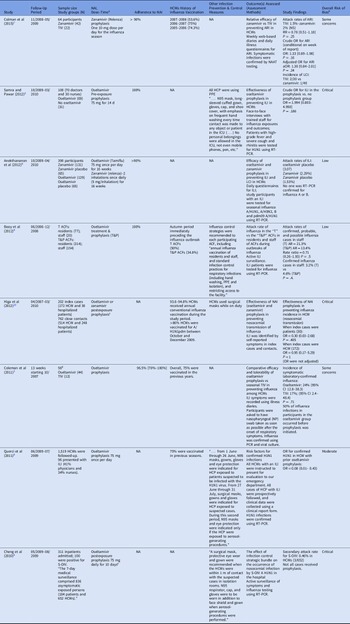
We searched 5 electronic databases for published observational and experimental studies: PubMed, EMBASE, Web of Science, CINAHL, and ClinicalTrials.gov. Overall, 7,541 citations were retrieved; among them, 2,285 duplicates were removed, leaving 5,256 unique records that were screened by title and/or abstract. Altogether, 5,126 were excluded based on the intervention used, study design, population, and/or outcomes assessed. Subsequently, the remaining 130 articles were screened at the full-text level. Finally, 8 studies were included in the systematic review. Manual searching did not reveal any additional records (Appendix 3 online). Study characteristics and a summary of key findings are shown in Tables 1 and 2, respectively. A narrative study description is available in Appendix 4 (online).
Characteristics of Studies Included in the Systematic Review

Note. ACF, aged care facility; ARI, acute respiratory illness; HCW, healthcare worker; HCP, healthcare professional; ICU, intensive care unit; NAI, neuraminidase inhibitor; RCT, randomized-controlled trial; S-OIV, swine-origin influenza virus; T&P, treatment & prophylaxis; T, treatment; TIV, trivalent inactivated vaccine.
a Some studies did not specify whether prophylaxis was initiated before or after exposure to influenza virus.
b Oseltamivir was replaced by Zanamivir in 23 close contacts between January and February 2009.
c 4 participants (7%) were not HCWs.
d The main intervention was an infection control bundle during 2009 influenza pandemic in the healthcare setting.
Summary of Findings and Quality Assessment

Note. ACF, aged care facility; AR, attack rate; ARI, acute respiratory illness; CI, confidence interval; HCP, healthcare professional; HCW, healthcare worker; ICT, immunochromatographic test; ICU, intensive care unit; LCI, laboratory-confirmed infection; NAAT, nucleic acid amplification test; NAI, neuraminidase inhibitor; OR, odds ratio; PPE, personal protective equipment; S-OIV, swine-origin influenza virus; T&P, treatment & prophylaxis; T, treatment; TIV, trivalent inactivated vaccine.
a Some studies did not specify whether prophylaxis was initiated before or after exposure to influenza virus. Information regarding time of NAI administration and/or dose was not available for all studies.
b Risk of bias assessed according to outcomes of interest only.
c Oseltamivir was replaced by zanamivir in 23 close contacts between January and February 2009.
d 4 participants (7%) were not HCWs.
e The main intervention was an infection control bundle during 2009 influenza pandemic in the healthcare setting.
Discussion
HCWs are likely at increased risk of exposure to influenza, given their frequent contact with potentially infected patients. Maintaining healthcare services is essential during pandemics; thus, it is important to implement effective mitigation strategies to reduce the burden of influenza pandemics in healthcare facilities.
In this systematic review, we aimed to summarize the current published evidence on NAI use in HCWs. Overall, studies have mainly assessed NAIs used as pre- and post-exposure prophylaxes to reduce influenza incidence among HCWs. Prophylaxis seems to provide some limited protection against influenza in HCWs; however, no clear conclusions could be drawn from the available evidence. Most studies were underpowered to detect any significant effect. Compliance with NAI prophylaxis was high in 62.5% of studies, and very few HCWs discontinued the intervention because of adverse events. This finding indicates that NAIs can be well tolerated in this group.Reference Coleman, Boggild, Drews, Li, Low and McGeer3–Reference Coleman, Fadel, Drews, Hatchette and McGeer7 Studies in which NAIs were compared to a placebo or to no intervention showed that NAIs are effective in preventing influenza,Reference Anekthananon, Pukritayakamee and Ratanasuwan6,Reference Querci, Stryjewski and Herrera8,Reference Cheng, Tai and Wong9 although most of these findings did not reach statistical significance. Altogether, these findings suggest that NAIs could reduce the burden of an influenza pandemic in healthcare settings while waiting for a vaccine to become available. Importantly, however, in many healthcare settings, HCWs were required to use PPE and to practice hand hygiene in addition to annual vaccination, which may have helped in reducing influenza in this group. Secondary transmission was assessed in 1 study and postexposure prophylaxis did not significantly reduce nosocomial transmission in the study setting. However, evidence on the effectiveness of NAIs for treatment is lacking, and data on healthcare service disruption were not available.
This review has several limitations. Data on antiviral use in HCWs are lacking and a limited number of studies were eligible for inclusion in this report. The few eligible publications were either underpowered or at substantial risk of bias. Influenza assessment was mostly based on self-reported symptoms, and testing was performed only for symptomatic HCWs. This factor can cause substantial outcome measurement errors and bias the estimation of NAIs effectiveness. Also, data were not available for all outcomes assessed in this review, such as the effect of antiviral treatment in reducing influenza severity and the effect of NAIs in preventing healthcare service disruption. Finally, influenza vaccination and compliance with PPE and hand hygiene were recommended in most settings, which might have influenced the real effectiveness imputed to NAI use.
In conclusion, NAI prophylaxis seems to have limited effectiveness in preventing influenza in HCWs. The paucity of data and the risk of bias associated with the included studies prevents clear conclusions regarding NAI use in HCWs. More concrete data from experimental and observational studies are needed.
Acknowledgments
We thank the Canadian Pandemic Influenza Preparedness Task Group (CPIP TG) of the Pan-Canadian Public Health Network for their helpful feedback regarding the protocol and manuscript. We also thank Marc-Olivier Croteau and Cynthia Gagné for their assistance with the literature search strategy.
Financial support
This study was funded by the Public Health Agency of Canada.
Conflicts of interest
All authors report no conflicts of interest relevant to this article.
Supplementary material
To view supplementary material for this article, please visit https://doi.org/10.1017/ice.2021.79