Introduction
The genus Mandevilla Lindl. (Apocynaceae – Apocynoideae) belongs to the tribe Mesechiteae (Endress et al., Reference Endress, Liede-Schumann and Meve2007) and comprises around 170 species distributed from Mexico and the Antilles to northern Argentina (Morales, Reference Morales2005, Reference Morales2007). It is the largest neotropical genus of Apocynoideae and is characterised by foliar and calycinal colleters, racemose inflorescences and an umbraculiform, pentacostate style-head (Sales, Reference Sales1993). Woodson (Reference Woodson1933) divided Mandevilla into two subgenera: Mandevilla subgenus Mandevilla, in which the adaxial side of the leaves usually has colleters restricted to the base of the central vein, the adaxial side of the calyx has colleters alternate to the sepals or uniformly distributed at the base, and the corolla is radial; and Mandevilla subgenus Exothostemon (G.Don) Woodson, in which the adaxial side of the leaves usually has colleters distributed along the entire length of the central vein, the adaxial side of the calyx has small colleters opposite the sepals, and the corolla is slightly bilateral (for a discussion about infrageneric relationships in Mandevilla, see Simões et al., Reference Simões, Endress, Niet, Kinoshita and Conti2006).
The Brazilian members of the subgenus Mandevilla were revised by Sales (Reference Sales1993), who recognised 40 species, including eight new ones (Sales et al., Reference Sales, Kinoshita and Simões2006). Among them, Mandevilla dardanoi M.F.Sales, Kin-Gouv. & A.O.Simões was described from the State of Pernambuco, but has also been found in the State of Paraíba. A survey of Apocynaceae from the Brazilian semi-arid region (Souza-Silva & Rapini, in prep.) included 29 native species of Mandevilla. In this region Mandevilla is the most diverse Apocynoideae genus, and seven species are endemic. They occur mainly in the caatinga, a seasonally dry vegetation at lower altitudes in the semi-arid region. While preparing the survey of Apocynaceae, a new species of the subgenus Mandevilla was identified. Mandevilla catimbauensis Souza-Silva, Rapini & J.F.Morales is here described and illustrated. It is a twining plant with elliptic, glabrous leaves and hypocrateriform, purple flowers. It is known only from the Vale do Catimbau National Park, in Buíque, State of Pernambuco. The Park is 62,000 ha in area and is noted for its diverse and unique vegetation on the western slopes of the Borborema Plateau. It shares several floristic elements with the campos rupestres of Chapada Diamantina, in the State of Bahia (Andrade et al., Reference Andrade, Rodal, Lucena and Gomes2004), an open vegetation on quartzite soils over 900 m, which is also known for its high level of plant endemism.
Species Description
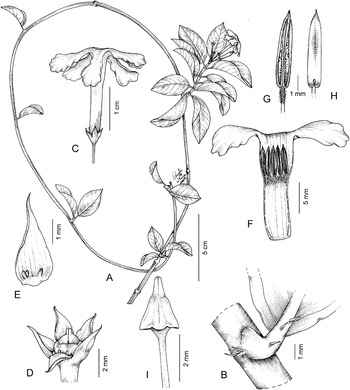
Mandevilla catimbauensis Souza-Silva, Rapini & J.F.Morales, sp. nov.Fig. 1.
Mandevilla dardanoi M.F.Sales, Kin-Gouv. & A.O.Simões similis, a qua corolla hypocrateriformi (vs. infundibuliformi) differt; M. leptophylla (A.DC.) etiam K.Schum. affinis, foliis ellipticis (vs. anguste lanceolatis vel linearibus) et glabris (vs. pubescentibus) differt. – Type: Brazil, State of Pernambuco, Buíque, Vale do Catimbau National Park, Serra de Jerusalém, caatinga, 08°34′57″S, 37°14′24″W, 910 m, 10 xi 2003, E.B. Miranda, E. Souza, A. Conceição, M. Arcanjo & L. Ramos 576 (holo HUEFS).
Mandevilla catimbauensis Souza-Silva, Rapini & J.F.Morales. A, habit with inflorescence; B, detail of the petiole, showing colleters; C, flower; D, calyx, showing axillary colleters, nectary and ovary; E, lobe of calyx, adaxial view, showing axillary colleters; F, corolla open, showing stamens; G, stamen, adaxial view; H, stamen, abaxial view; I, style-head. From Miranda et al. 576 (holotype, HUEFS).

Suffrutescent vine. Stem sparsely minutely scabrous when young, soon glabrous, with a papery cortex; interpetiolar colleters c.1 mm long, finger-like, inconspicuous. Leaves opposite; coriaceous; petiole 3–4 mm long; blade 3.5–4 × 2.1–2.2 cm, elliptic, almost conduplicate, apex acute, base cuneate, glabrous, with 2 or 3 colleters adaxially at the base of the midrib, the margin not revolute, not bullate. Inflorescences axillary, umbelliform, c.5 flowers at one time; glabrous; peduncle c.3 mm long; bracts triangular to lanceolate, 1–1.5 mm long, glabrous, narrowly ovate, scarious, the colleters irregularly distributed; pedicels c.8 mm long. Calyx green; sepals lanceolate, c.3 × 1.5 mm, short and relatively inconspicuous, the apex acute to inconspicuously and shortly acuminate, with 1 or 2 colleters adaxially alternate with the sepals. Corolla hypocrateriform, the tube green, purplish towards the lobes, the mouth yellow, glabrous outside, barbulate c.3 mm below the anthers within, tube cylindrical, c.1.9 × 0.2 cm, lobes obliquely obovate, 9–11 × 7–8 mm. Stamens inserted near the corolla mouth, anthers oblong, subsessile, c.6 mm long, the apex apiculate, the base auriculate, the auricles oblong and parallel to each other, glabrous. Nectary 5-lobed, lobes c.1 mm long. Ovary c.1.5 mm long, ovoid, glabrous; style c.1.1 cm long; style-head umbraculiform, c.2.5 mm long, the apex bilobate. Fruits not seen.
Distribution. Known only from Serra de Jerusalém, in the Vale do Catimbau National Park, Buíque, State of Pernambuco, Brazil.
Habitat. In caatinga, a seasonally dry vegetation, at 910 m.
Proposed IUCN conservation status. Data Deficient (DD). Although Mandevilla catimbauensis is known by only a single collection, it is premature to consider that it is endangered under IUCN guidelines (IUCN, 2001; IUCN Standards and Petitions Working Group, 2008), especially as it occurs in a protected area.
This species can be recognised by the twining habit, elliptic and conduplicate leaves, and flowers with a purplish, hypocrateriform corolla. The colour and shape of the corolla are similar to that of Mandevilla leptophylla (A.DC.) K.Schum., a species that occurs in northern Minas Gerais, Bahia and Ceará, whereas the leaves are similar to those of M. dardanoi, a species that occurs in Pernambuco and Paraíba. Mandevilla catimbauensis can be easily distinguished from the former by its glabrous leaves which are elliptic and almost conduplicate, and with a non-revolute margin (vs. densely pubescent, lanceolate to almost linear and revolute), and from the latter by the purple and hypocrateriform flowers (vs. pinkish and infundibuliform).
Acknowledgements
This paper is part of a project on Apocynaceae diversity funded by Fundação de Amparo à Pesquisa do Estado da Bahia (FAPESB). Programa de Pesquisa em Biodiversidade (PPBio) do Semi-árido supported the fieldwork for the first author. We thank M. Lúcia Kawasaki for assistance with the English in an earlier version. We also thank the curators of the herbaria which have provided material for our study. The first author is supported by a DTI-3 fellowship of the Conselho Nacional de Desenvolvimento Científico e Tecnológico (CNPq) and the second author by a Pq2 grant (CNPq).