Introduction
Life expectancy has increased considerably all over the world; however, increased life expectancy does not necessarily indicate a healthier life. The increase in quality of life at advanced ages is more important than the increase in overall life expectancy (Crimmins, Hayward, & Saito, Reference Crimmins, Hayward and Saito1996; Jagger et al., Reference Jagger, Gillies, Moscone, Cambois, Oyen and Nusselder2008; Robine & Ritchie, Reference Robine and Ritchie1991). Advancing age may be associated with a higher likelihood of disability, but the processes leading to a decline in health may be reversible. Studies on health dynamics, for example, cite significant evidence of recovery from disability among older people in developed countries. For instance, in Japan, approximately 30 per cent of older people who were in a state of disability in 1987 regained their functional ability during the subsequent three years (Liu, Liang, Muramatsu, & Sugisawa, Reference Liu, Liang, Muramatsu and Sugisawa1995). As well, 20 per cent of older Americans reported recovery from a disability during a two-year period (Rogers, Rogers, & Belanger, Reference Rogers, Rogers and Belanger1990). No clear picture, however, exists with regard to recovery in developing countries.
Other studies also indicate that a number of socioeconomic and environmental factors explain health recovery. These factors include age, education, participation in organizational activities, social support, and self-rated health. In particular, younger age and better self-rated health may influence health status by reducing the risk of becoming disabled or dying and by facilitating recovery. For example, Liu et al. (Reference Liu, Liang, Muramatsu and Sugisawa1995) showed that having less education, being unmarried, and smoking may increase the risk of disability, although these factors do not have a negative effect on recovery. In addition, health transition analysis (Cruz, Saito, & Natividad, Reference Cruz, Saito and Natividad2007) has indicated that a significant proportion of older Filipino people experience recovery; although age, sex, place of residence, and health status and behavior indicators (including self-assessed health, drinking, and exercise) displayed a significant influence on future health and mortality trajectories, surprisingly, education did not show any significant effect. Several studies, however, have included education as a factor influencing active life expectancy (Crimmins et al., Reference Crimmins, Hayward and Saito1996; Crimmins, Reynolds, & Saito, Reference Crimmins, Reynolds and Saito1999; Yong & Saito, Reference Yong and Saito2012). Additionally, in some Latin American and Caribbean countries, aging has been found to be associated with disability or poor quality of health, particularly in individuals with diabetes and obesity (Palloni & McEniry, Reference Palloni and McEniry2007; Wong & Palloni, Reference Wong, Palloni and Uhlenberg2009).
According to Ruffing-Rahal (Reference Ruffing-Rahal1991), a fundamental goal of health promotion is to facilitate the well-being of older adults on an ongoing basis. Although older adults may suffer from chronic diseases, cognitive impairment, and functional limitations, the adoption of a health-promoting lifestyle can minimize health problems and lead to enhanced health outcomes (Ruffing-Rahal). Self-care has been described as a strategy for coping with life events and stressors (Chen, Chang, & Li, Reference Chen, Chang and Li2002; McLaughlin & Zeeberg, Reference McLaughlin and Zeeberg1993) and for enhancing quality of life during the aging process (Boyle & Counts, Reference Boyle and Counts1988), thereby promoting independence and healthy aging.
Healthy life expectancy – or disability-free life expectancy (DFLE), a quality of life measure – estimates how many of the remaining years of life an individual can expect to live in a healthy state or without any disability. One way to increase healthy life expectancy or DFLE might be by engaging in active aging activities. According to the World Health Organization, “active aging is the process of optimizing opportunities for health, participation, and security in order to enhance quality of life as people age” (World Health Organization [WHO], 2002, p. 12). With regard to older people in Bangladesh, however, little is known about the levels of active aging, as its differentials vary across socioeconomic levels, demographic settings, and functional health transition patterns.
Active aging can be applied to both individuals and population groups. It allows people to realize their potential for physical, social, and mental well-being throughout their lives and to participate in society according to their needs, desires, and capacities, while providing them with adequate protection, security, and care when they require assistance (WHO, 2002). According to WHO, if aging is to be a positive experience, longer life must be accompanied by continuing opportunities for health, community participation, and security. Older people who retire from work and those who are ill or live with disabilities can remain active contributors to their families, peers, communities, and nations. Active aging aims to extend DFLE and quality of life for all people as they age, including those who are frail, disabled, and in need of care (WHO), yet up until now there has been no study about the relationship between active aging and DFLE, an area in need of critical inquiry.
Background
DFLE takes into account mortality and morbidity or disability and is increasingly emphasized as an indicator of a population’s health. Estimates of healthy life expectancy have been published for about 191 countries (Mathers et al., Reference Mathers, Murray, Lopez, Salomon, Sadana and Tandon2001; Mathers, McCallum, & Robine, Reference Mathers, McCallum and Robine1994; Robine, Mathers, Bone, & Romieu, Reference Robine, Mathers, Bone and Romieu1993; Robine & Ritchie, Reference Robine and Ritchie1991). In addition, health policies that focus on healthy life expectancy have increased, particularly in developed countries characterized by an aging population, because a longer life and a healthier life are not necessarily synonymous (Brønnum-Hansen, Andersen, Kjøller, & Rasmussen, Reference Brønnum-Hansen, Andersen, Kjøller and Rasmussen2004).
In Bangladesh, average life expectancy at birth increased from about 53 years in 1975 to 69 years in 2010. However, we do not know whether the increase in life expectancy in Bangladesh has been accompanied by an increase in healthy life expectancy or a longer life with disability. Compared with developed countries, developing countries’ pace of aging is much faster; therefore, they will have less time to adjust to the consequences of aging which take place at much lower socioeconomic levels compared with those of developed countries (United Nations Population Division [UNPD], 2008a). Moreover, the current and emerging effects of population aging will affect several major aspects of life: social, economic, and political (UNPD).
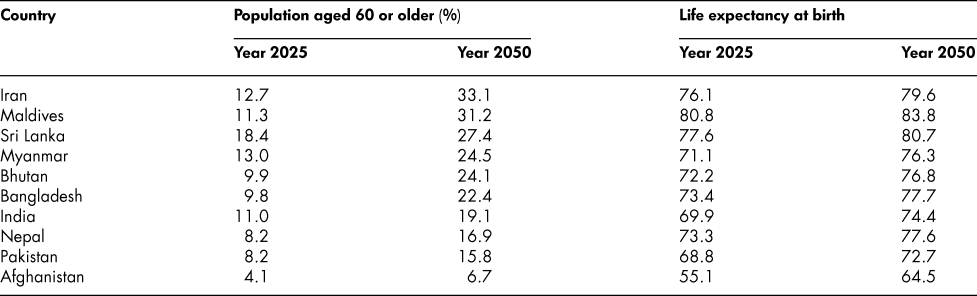
Healthy aging is a critical problem in developing countries, especially in Bangladesh where many older people live with low incomes. According to the World Population Prospects, there were 164.4 million people living in Bangladesh in 2010 (UNPD, 2008b), and 6.2 per cent or 10.1 million of them were age 60 or older. At present, Bangladesh has not entered into the category of an aging society, but it will reach this level soon, and once it does, it will face challenges because it has the world’s third largest number of poor older people (HelpAge International [HAI], 2006). Presently, India has the most, followed by China. By 2025, all countries of Southern Asia, except Afghanistan, Nepal, and Pakistan, will have aging populations (see Table 1). The aging process in Bangladesh is much faster than that of its neighbor India. In Bangladesh, it is projected that the proportion of the population age 60 and older will increase from 9.8 per cent in 2025 to 22.4 per cent (or 43.6 million) in 2050, while in India it will increase from 11 per cent in 2025 to 19.1 per cent in 2050 (UNPD, 2008b). In 2050, Bangladesh will rank sixth in terms of the per cent of the population aged 60 and older. Iran will rank first followed by the Maldives, Sri Lanka, Myanmar, and Bhutan. India will rank seventh followed by Nepal and Pakistan. Life expectancy is projected to increase from 69 years in 2010 to 77.7 years in 2050 for Bangladesh (see Table 1). Very soon, Bangladesh will face challenging issues associated with aging, particularly with regard to health services.
Percentage of population aged 60 or older and their life expectancy, ranked by per cent at age 60 or older in 2050

Source: United Nations Population Division (UNPD, 2008b). World population prospects: The 2008 revised population database. UNPD. Retrieved September 2010 from http://esa.un.org/unpd/wpp/unpp/panel_indicators.htm
The main goal of this study was to quantify the relationship between increased life expectancy and DFLE by examining the relationships between the Active Aging Index (AAI) and DFLE. To accomplish this, we used the Sullivan (Reference Sullivan1971) method to compute the DFLE and constructed an AAI based on the World Health Organization’s determinant of active aging and additional indicators as recommended by the Active Aging Task Force (2003) of the Western Australian Government. We collected data from 896 older residents aged 60 and older from the Rajshahi District of Bangladesh. We then applied these methods, and examined the relationship between the AAI and DFLE. If a positive relationship between the AAI and DFLE was identified, this active aging concept might be taken as a good step towards suppressing morbidity while allowing individuals to enjoy more disability-free years of life. Policy of such a relationship could promote changes in health, social participation, and security that could keep older adults healthy to enjoy a more disability-free life as they age. Additionally, it could help older adults and the nation to reduce medical costs associated with disability. To the best of our knowledge, there has not been a similar study examining the relationship between active aging and DFLE in Bangladesh or any other developed or developing countries. The study described here is thus unique because it represents the first attempt to examine the relationships between an AAI and DFLE in Bangladesh.
Data and Methods
We used a number of research methods and sources to obtain the data necessary for this study. The primary data used for the study were collected during April 2009 and came from a research project titled “Socio-Demographic Status of the Aged Population and Elderly Abuse: A Study on Rural-Urban Differentials in the Rajshahi District, Bangladesh.” The objectives, sampling design, and methodologies of the research project are described in detail elsewhere (Tareque, Reference Tareque2009). In brief, the 2009 project was a socioeconomic as well as a demographic study of the aged (60 years and older) population of the Rajshahi District, Bangladesh.
Bangladesh is divided administratively (from large to small) into divisions, districts (zilas), and sub-districts (upazilas and thanas). In rural areas, each thana is divided into several union councils, and each union council consists of multiple Mouzas. A Mouza is a type of administrative unit corresponding to a specific land area within which there may be one or more settlements. Today, a Mouza has become mostly synonymous with a gram or village. In urban areas, thanas are divided into several wards, and each ward is further divided into multiple mahallas. In this study, two rural Mouzas of Yusufpur Union (two villages, namely Baduria and Sahapur) and one urban ward (ward number 5) were selected as sample areas using the probability proportion to size (in terms of households) sampling technique. All households in the selected Mouzas and ward were enumerated and all older individuals residing in the households were enumerated in 2009. Thus, the total sample included 896 respondents, with 477 from rural areas and the remainder from urban areas.
To reach the goals of the 2009 project, a questionnaire was prepared and pre-tested by a pilot survey. Field investigators then went to each house and a trained surveyor posed the survey questions to the respondents and recorded the answers on questionnaires. To reach the required response rate, repeated visits were made. A structured interview schedule containing closed-ended questions was utilized to collect information on (a) the respondents’ identification, (b) details about family members, (c) health conditions, (d) daily activities, (e) economic activities (except for income information), (f) living conditions, and (g) abuse. For more accurate data collection, a Bengali version of the questionnaire was prepared for the convenience of interviewees and field investigators. Responses were then converted to English for data entry.
Measures
Construction of the AAI
Active aging depends on a variety of “influences” or “determinants” that surround individuals, families, and nations (WHO, 2002). Although WHO tried to accumulate the determinants of active aging under three pillars (see Figure 1), it confirmed that more research was needed to clarify and specify the role of each determinant, as well as the interaction between determinants, in the active aging process (WHO).
The determinants of active aging according to the World Health Organization (WHO, 2002, p. 45)
To address these concerns, this study included additional indicators for constructing an AAI as recommended by the Active Aging Taskforce of the Western Australian Government (2003). Specifically, we included 15 indicators used by Thanakwang and Soonthorndhada (Reference Thanakwang and Soonthorndhada2006) which also fall among the determinants of active aging used by WHO (2002). These indicators represent three core or primary dimensions: six indicators for health (three indicators for health and wellness and three indicators for physical activities), three indicators for community participation, and six indicators for security (three indicators for physical security and three indicators for financial security). Composite indices for health, community participation, and security were constructed first. Then, the AAI was constructed by combining these three indices. These indicators are illustrated in the Active Aging Framework shown in Figure 2.
Conceptual framework of Active Aging Index
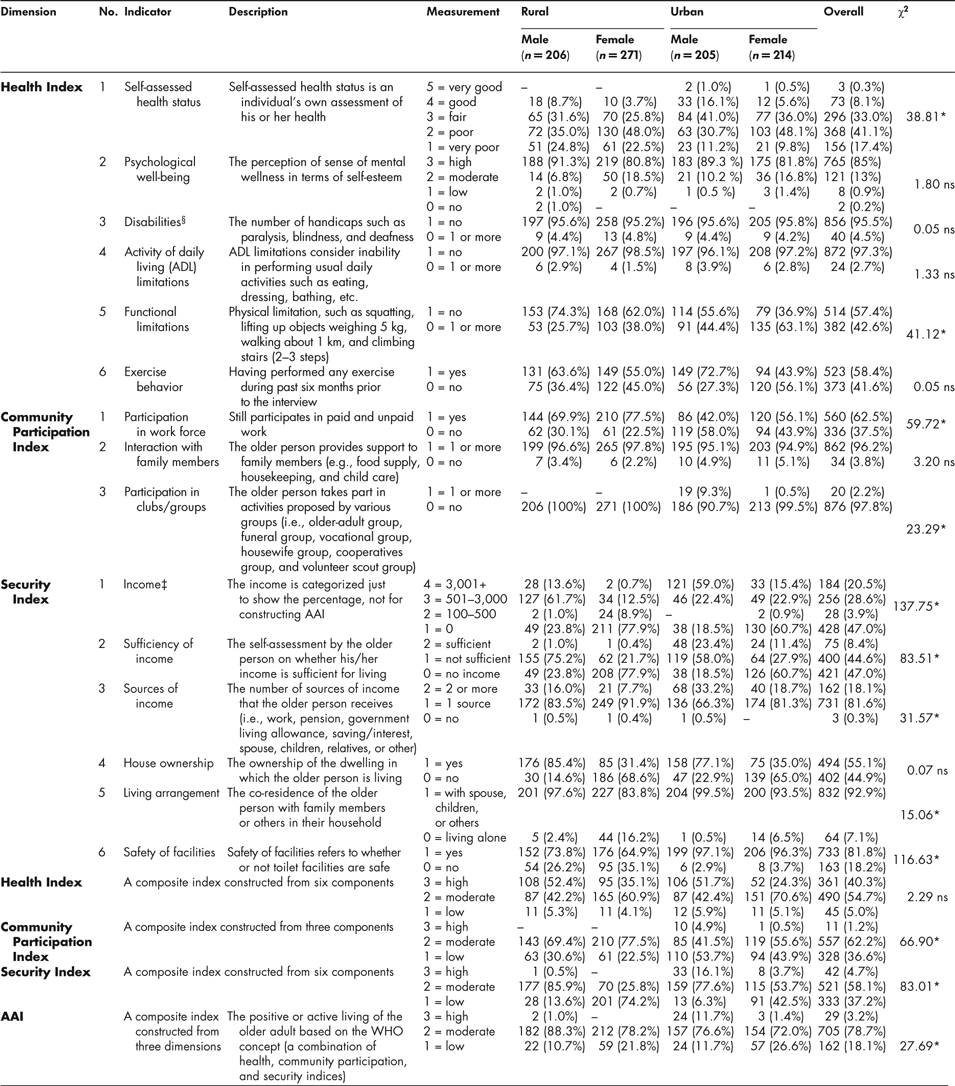
A detailed description of these three dimensions with their relevant indicators is provided in Table 2. For each dimension, a weighted score for each of the indicators was calculated. Each composite score is the sum of responses to several indicators within each dimension. However, since there was variability in the range of possible responses to the questions within each composite, a simple summation of answers would not have ensured an equal contribution of all questions to the composite score. To address this issue, we applied a method to adjust each composite for the range of responses to each indicator and for the total number of indicators in the composite measure (Haque, Tareque, & Mostofa, Reference Haque, Tareque and Mostofa2010; McGahan, Griffith, Parente, & McLellan, Reference McGahan, Griffith, Parente and McLellan1986; Thanakwang & Soonthorndhada, Reference Thanakwang and Soonthorndhada2006). For example, the composite score on the health dimension is composed of six indicators (H1 – H6). The actual score of each dimension is calculated by summing the positive responses of the respondents in favor of their activeness as shown in the following equation:
Measurement of Active Aging Index by dimension types
* p < .05
AAI = Active Aging Index
§ Indicator number 3 (disability) under health index is measured in a different way than that of disability prevalence for calculating DFLE
‡ Respondent’s personal monthly income in Bangladeshi currency – BDT
ns = not statistically significant; two-tailed test for difference between rural and urban areas
Composite score = H1/M1 × T + H2/M2 × T + H3/M3 × T + H4/M4 × T + H5/M5 × T + H6/M6 × T
where H = the score of each indicator, M = the maximum answer value of each indicator, and T = the total number of indicators of a dimension.
Then we created an index for each dimension following the Human Development Index (HDI) constructed by the United Nations Development Programme (UNDP, 2006) using the following equation:
 $$Dimension\;Index = {{Actual\;score{\rm{ }} - {\rm{ }}Minimum\;score} \over {Maximum\;score{\rm{ }}\, - \,{\rm{ }}Minimum\;score}}\,$$
The maximum and minimum score of each dimension is measured by the performance in each dimension, expressed by 1 or 0 in accordance with the construction method of the HDI, and 1 minus the indices value measures the gaps of activeness.
According to WHO’s concept of active aging, the elements of health, community participation, and security are inextricably linked. Therefore, the AAI is computed in a straightforward manner by simply taking an average of these three indices. Based on the UNDP criteria for levels of human development, we classified each index into three levels, which constitute an indicator of the quality of life, as follows: (1) an index value less than 0.5 is low; (2) an index value between 0.5 and 0.79 is moderate; and (3) an index value equal to or higher than 0.8 is high.
As noted, we used six indicators to measure health: (a) self-assessed health status, (b) psychological well-being, and (c) disabilities/impairments were used as indicators of health and wellness; and (d) activities of daily living, (e) functional limitations, and (f) exercise behavior were used to assess physical activities. Self-assessed health is a global measure of health assessment (Mantzavinis, Trikalinos, Dimoliatis, & Ioannidis, Reference Mantzavinis, Trikalinos, Dimoliatis and Ioannidis2006) and is a multidimensional concept (Shooshtari, Menec, & Tate, Reference Shooshtari, Menec and Tate2007). Self-assessed health is the most informative measure of human health status as well as a unique, valuable, and widely used single measure of human health status (Jylhä, Reference Jylhä2009).
Despite variation in the wording of the question “How would you describe your state of health …”, there is extensive evidence that self-assessed health is an important predictor of future survival/mortality and morbidity (Bailis, Segall, & Chipperfield, Reference Bailis, Segall and Chipperfield2003; Idler & Benyamini, Reference Idler and Benyamini1997), functional decline (Idler, Hudson, & Leventhal, Reference Idler, Hudson and Leventhal1999), and disability and utilization of health care (Bailis et al., Reference Bailis, Segall and Chipperfield2003; Goldman, Glei, & Chang, Reference Goldman, Glei and Chang2004). In our study, we measured it on the basis of responses to the individual question, “How would you describe your state of health these days? Would you say it is... (a) very good; (b) good; (c) fair; (d) poor; (e) very poor?” Psychological well-being, or the perception of a sense of mental wellness in terms of self-esteem, was assessed with the question, “Are you mentally healthy?” with response categories of (a) high, (b) moderate, (c) low, and (d) no. Disabilities or impairments such as paralysis, blindness, and deafness were measured with a value of 1 (having no disability) and 0 (having one or more disabilities).
Activities of daily living (ADL) limitations were assessed on the basis of four items: the ability to perform (a) dressing; (b) eating; (c) bathing, and using the toilet; and (d) walking. Responses were coded as 1 (can easily do all the activities) or 0 (have trouble with one or more activities). Functional or physical limitations (squatting, lifting up objects weighing 5 kilograms, walking about 1 kilometer, and climbing stairs of 2–3 steps) were categorized as 1 (with no physical limitation) or 0 (with one or more physical limitations). Finally, exercise engaged in at least once a week in the six months prior to the survey was coded as 1 if the respondent performed any exercise or 0 if he or she did not.
Community participation was assessed based on participation in the workforce, participation in the family, and participation in clubs/groups (see Table 2). Participation in the workforce was coded as 0 if the respondent did not work or 1 if he or she worked in a paid or unpaid position. If a respondent reported providing one or more forms of support (e.g., food, housekeeping, child care) to family members, he or she was given a value of 1 (0 if otherwise). Finally, respondents were asked whether they were active members of any of six types of voluntary groups (i.e., seniors groups, professional groups, vocational groups, housewives’ groups, co-operative groups, and/or voluntary groups). A value of 1 was assigned if the respondent was affiliated with one or more voluntary groups or a value of 0 if they were not.
To address the security dimension, we included financial and physical security measures in our data. Financial security was assessed using three indicators. Sources of income (e.g., work, pension, government living allowance, saving/interest, family members, relatives, or others) were categorized into three groups: no sources, only one source, and two or more sources. Sufficiency of income was assessed with the following question, “Is your income sufficient for living?” with response categories as (a) no income, (b) not sufficient, or (c) sufficient. Finally, respondents’ monthly incomes were categorized into four groups (no income, from 100 to 500 Bangladeshi currency Taka [BDT], from 501 to 3,000 BDT, and ≥ 3001 BDT).
Physical security was also assessed using three indicators. Home ownership was measured with the question, “Do you own the house you live in?” Responses were dichotomous (no or yes). Living arrangements were measured on the basis of responses to the question, “Whom do you live with?” Five options were coded: (a) alone, (b) spouse, (c) unmarried son/daughter, (d) married son/daughter, or (e) others. Two response categories were used: lived alone versus lived with others. Finally, respondents were asked whether or not they had sanitary toilets and safe materials such as handrails, no water on the toilet floor, toilet slippers, and so forth. Response categories were no or yes.
Five age categories were created (60–64, 65–69, 70–74, 75–79, and 80 and older) for describing the study population and DFLE calculations (see Table 3). Three religious categories were created (Muslim, Hindu, and others) with “others” including Buddhists, Christians, and others. Three educational categories were created (no education; 1–5 years, as primary education; and 6 years and above, as secondary education and above). Two marital status categories were created (married and other) with “other” including single individuals, widows, or others. Finally, two types of family (nuclear, joint) were created.
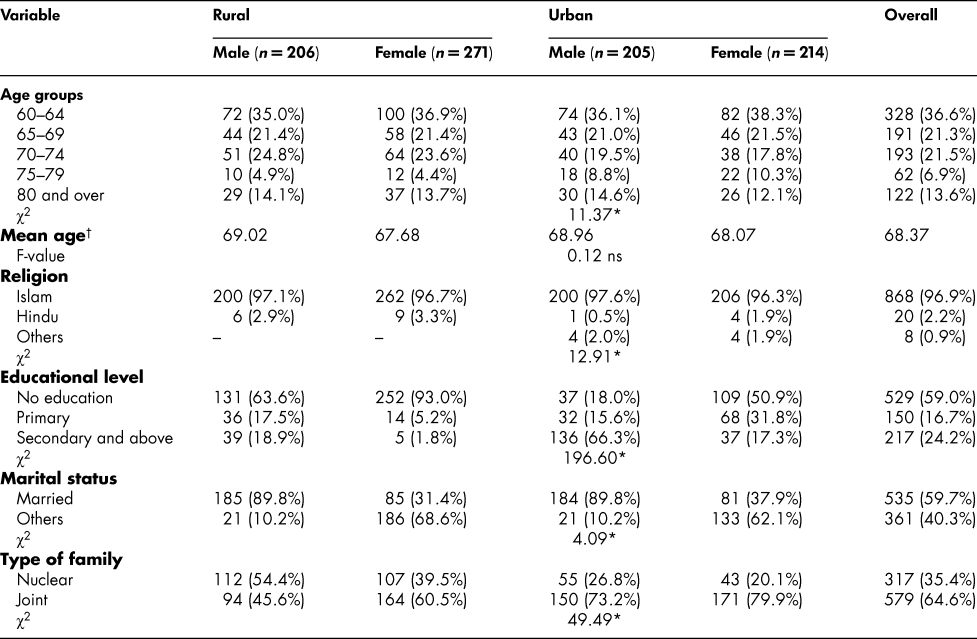
Demographic and socioeconomic characteristics of the respondents
* p < .05
† indicates average age is calculated for the total population by sex and residence; 45.9 and 54.1 per cent of older adults are male and female respectively
ns = not statistically significant; two-tailed test for difference between rural and urban areas
Computation of the DFLE
The DFLE was computed using the method devised by Sullivan (Reference Sullivan1971). This method partitions total life expectancy into DFLE and life expectancy with disability based on the prevalence data on disability within a representative sample at a single point in time. Using the UNPD (2008b) projected populations for 2005 and 2010, we first estimated the 2008 and 2009 age- and sex-specific population for Bangladesh based on the exponential growth rate from 2005 to 2010. These estimates for Bangladesh were then proportioned for the Rajshahi District using the 2001 Bangladesh Population Census data to produce 2008 and 2009 population estimates for the district by age and sex for the total as well as for rural-urban areas. Preston and Bennett’s (Reference Preston and Bennett1983) method was then applied to those age distributions to compute five life tables for total and rural-urban areas by sex for 2009. By combining the computed life expectancies with age- and sex-specific disability prevalence rates obtained from the survey, we calculated the DFLE for our study population. For more details on the computation of health expectancy using the Sullivan method, see Jagger, Cox, Le Roy, and European Health Expectancy Monitoring Unit (2006). It should be noted that disability was assessed with the following question, “Are you restricted in daily activities as a result of longstanding illness(es), condition(s), or handicap(s)?” The answers “all the time” and “now and then” were defined as having disability and “seldom” or “no” answers as having no disability.
In this study, the AAI was constructed using the framework of Figure 2 and the DFLE using the Sullivan (Reference Sullivan1971) method. Univariate classification analysis was performed in order to determine the percentage of active aging attributes of the older-adult population. Mean distribution has been presented to show the differences among study participants for the AAI and DFLE. Finally, cross-tabulation analyses as well as Pearson’s correlational analyses were completed to determine the relationship between the AAI and DFLE including tests of differences between the correlations.
Results
As can be seen from the Health Index (see Table 2), almost 96 per cent of older-adult respondents reported no disability while about 59 per cent reported either poor or very poor health status. Nevertheless, about 85 per cent of respondents indicated a high level of psychological well-being. About 43 per cent of these respondents had some functional limitations. More urban females had one or more limitation(s) than rural females or urban or rural males. However, based on self-assessments of their health, urban individuals were found to be in better health than their rural counterparts, both male and female. Almost all respondents (97.3%) could perform their activities of daily living (ADL) successfully. About 6 out of 10 respondents participated in some exercise during the six months prior to the survey, and males were more active than females in both rural and urban areas.
An overwhelming majority of the respondents (96.2%) reported that they supported their families by providing food, housekeeping, or child care. Very few (2.2%) respondents stated that they participated in any clubs or group activities. Particularly in rural areas, no one participated in any groups or clubs; it may be that such resources are not available in rural areas. About 78 and 61 per cent of older rural and urban females, respectively, had no personal income; 99 per cent of rural respondents were not satisfied with their incomes. Comparatively, the urban adults had higher incomes than their rural counterparts. About 93 per cent of study respondents lived with their spouse, children, or others, while 16.2 per cent of rural females reported living alone. The most striking finding was that about 35.1 per cent of rural females had no safe toilets. In fact, they had no toilets at all.
Using the composite indices, about 40 per cent of the adults in our study were classified as highly active and in good health, with the males being more active than their female counterparts in both rural and urban areas. In the community participation and security dimensions, most older adults were moderately active, with females more active in community participation and males having higher levels of security. Based on the AAI, about 79 per cent of the older adults were moderately active, with males more active than females in both rural and urban areas.
Table 3 provides the distribution of characteristics for the respondents of the present study. As Table 3 shows, the mean age of the respondents was 68.4 years. Over one half (57.9%) were young-old (i.e., 60–69 years), 21.5 per cent were between ages 70–74, and 20.5 per cent were age 75 and older. Overall, 59 per cent of the respondents did not have any education. In rural areas, 93 per cent of women did not have any education compared with 63.6 per cent of men. In urban areas, almost 51 per cent of women did not have any education compared with 18 per cent of men. In rural areas, only 1.8 per cent of the female respondents had a secondary or higher level of education, while almost 19 per cent of the male respondents had a secondary or higher education. In urban areas, 17.3 per cent of the female respondents had a secondary or above education compared to 66.3 per cent of the male respondents. In rural Bangladesh, the female literacy rate is very low, a well-known phenomenon (Rahman, Tareque, Rahman, & Islam, Reference Rahman, Tareque, Rahman and Islam2007). About 97 per cent of the respondents were Muslim; about 60 per cent of the respondents were married. Also of interest, more than 70 per cent of urban respondents lived in joint families, and a little over 20 per cent lived in nuclear families.
Levels of the AAI and DFLE
Tables 4 and 5 provide core findings of the DFLE, life expectancy (“LE” in the table), proportion of life expectancy without disability, and mean values of the AAI, indicating the level of activeness at ages 60, 65, 70, 75, and 80 and older by sex with rural-urban differentials. As expected, level of activeness, the DFLE, and proportion of life expectation without disability all decrease as age increases. For example, overall, persons aged 60 are expected to live 5.85 years without disability, while persons aged 65 are expected to live 3.98 years without disability. Persons at age 70 are expected to live 3.01 years without disability whereas those at age 75 are expected to live 1.46 years without disability; those aged 80 years and above are expected to live only 0.57 years without disability (see Table 4). Older males are expected to enjoy more disability-free life compared with older females in both rural and urban areas, except for those aged 80 and above in urban areas where females are expected to enjoy more disability-free life than males, 0.78 and 0.32 years respectively (see Table 4).
Disability-free life expectancy and life expectancy by age, sex, and place of residence
CI = confidence interval
DFLE = disability-free life expectancy
LE = life expectancy
Mean values of active aging index and proportion of life expectancy without disability by age, sex, and place of residence with correlation between AAI and DFLE
* indicates statistically significant at p < .05
AAI = Active Aging Index
CI = confidence interval
DFLE = disability-free life expectancy
PLEWOD = proportion of life expectancy without disability
r indicates the Pearson’s correlation between AAI and DFLE
Compared with those in older age categories, 60- and 65-year-old persons are more active and have proportionally longer life expectancy without disability. For example, overall, persons who are aged 60 can expect to enjoy 37.21 per cent of their remaining life without disability, whereas those aged 80 and older can expect to enjoy only 11.50 per cent of their remaining years without any disability (see Table 5). Older males are more active and can expect a longer DFLE compared to older females in both rural and urban areas. However, urban males have a much higher proportion of expected life without disability, with the exception of those aged 80 and older. The urban elder population demonstrates a higher DFLE compared to rural elders, although some urban older adults are found to be less active than their rural counterparts. In addition, if we compare the AAI of urban 60-year-old females to rural females aged 60 and 65, note that the same level of activeness cannot ensure the same DFLE for all. These AAI effects might reflect the effects of morbidity, declining health as age increases, environment, lifestyle, and health services.
Differences between the Life Expectancy and DFLE
Life expectancy has frequently been used as an indicator of public health. However, another indicator, DFLE, was introduced in the 1970s. Whereas life expectancy at birth measures overall quality of life, DFLE estimates how many years of remaining life one can expect to live without disability.
As Figure 3 shows, there are large differences between life expectancy and DFLE by age (i.e., life expectancy with disability that one would experience in later life). Overall, there is a mean difference of 7.26 years (with 95% confidence interval [CI], 4.39–10.13; p < .002) between life expectancy and DFLE. Thus, the older-adult population is expected to live 7.26 years with disability. In the rural older-adult population, males are expected to live 7.46 years of their remaining life with disability, while females are expected to live 8.18 years with disability (with a 95% CI of 4.26–10.65; p < .003 for males and 4.41–11.96; p < .004 for females). In the urban older-adult population, males are expected to live 6.31 years of their remaining life with disability, while females are expected to live 6.97 years with disability (with a 95% CI of 4.50–8.13; p < .001 for males and 4.20–9.73; p < .002 for females). Older males, particularly those from urban areas, have a less disabled life in comparison with females in both areas. These results might be an indication of the positive effect of active participation in every sector of life for older males. This may also indicate a lack of comparable resources for older females in both urban and rural areas.
Differences between LE (life expectancy) and DFLE (disability-free life expectancy) by age, sex, and place of residence
In summary, Figure 3 suggests that starting at age 70, rural females are expected to live longer compared with males in both urban and rural areas. However, rural females expect lower DFLE compared with all other older adults, except those in the oldest age group. There is a clear difference between the life expectancy and DFLE by age group, sex, and place of residence except at age 80 and above. The difference may be due to the fact that the survival rate at age 80 is very low and that there may not be that much population at this age group.
Relationship between the AAI and DFLE
Table 5 suggests that the respondents with higher mean values on the AAI also have a higher proportion of life without disability. Therefore, Pearson’s correlation coefficients were computed to assess relationships between the AAI and DFLE for urban males and females, for rural males and females, and also for the overall sample. The results show a very strong and significant positive relationship, almost a perfect correlation, between the AAI and DFLE for urban males and females, rural males and females, and also for the overall sample. Overall, the correlation between the AAI and DFLE for the sample is .977 (significant at p < .05). For rural males, the correlation is .974, and for rural females it is .960 (both significant at p < .05). The correlation between the AAI and DFLE for urban males is .971 and for urban females is .950 (again, both are significant at p < .05). At issue is whether the correlations for males are significantly higher than for females in both rural and urban areas. Thus, a test of differences between correlations was performed that revealed Z values of .15 and .26 for rural and urban areas respectively (not significant at p < .05).
Discussion
Traditionally and religiously, the older adults of Bangladesh have been respected both within their families and their communities. They have long been considered the key to family ties and symbols of family identity, since time immemorial being treated as guardians of ancestral values as well as venerable counselors.
For these reasons, older adults are highly respected, and the younger generations try to take very good care of their older relatives. However, due to various socioeconomic changes, traditional values and customs are eroding, and traditional joint family living arrangements are breaking down into nuclear family systems (UNESCO, 1992). Increased landlessness and poverty are assumed to weaken the relationship between elder members and other members of the family (Hassan, Reference Hassan2007). Because of rural poverty, many adults move to urban areas in search of employment. Women are also joining the urban workforce in increasing numbers, resulting in their having less time to take care of older family members than in the past (Hassan, Reference Hassan2007). It is unclear how long the society will be able to maintain the tradition of young family members taking care of the older adults in their family. Thus, in this study we have tried to introduce the concept of self-care (i.e., active aging) by examining the socio-demographic status of older adults through the dimensions of the AAI as well as the relationship between the DFLE and AAI.
The analysis of 15 indicators of the AAI showed that urban older adults had more income, more education, and led better lives than their rural counterparts. At the same time, almost all older adults were dissatisfied with their incomes regardless of whether the financial support came from the family or other sources. Many older females had no personal income, and it was difficult to understand how they support themselves. However, in Bangladeshi culture, older adults typically receive support from their own children as well as other extended family members. Adult children, particularly sons, are considered to be the main source of security and economic support for their parents, particularly in times of disaster, sickness, and in old age (Cain, Reference Cain1986).
We also found that about 93 per cent of older respondents lived with family members, but of the family types observed, 45.9 per cent were nuclear and 54.1 per cent were joint families in rural areas. In contrast, 23.4 per cent were nuclear and 76.6 per cent were joint families in urban areas. Financial support from the family might have been reduced in our study sample because of the decline in family size.
In addition, most of the study respondents were not active in any clubs or groups. Therefore, respondents were asked a multiple choice question, “How do you pass leisure time?” Almost all of the rural older adults (99%) reported passing their leisure time by gossiping, followed by caring for grandchildren, and religious work, while urban older adults (96%) reported passing time by gossiping, followed by caring for grandchildren, religious work, and reading books or newspapers. In Bangladeshi culture, older adults usually have few responsibilities or obligations, except taking care of grandchildren. Older adults often hand over their business or properties to their children and become inactive in their daily lives. Our findings on the DFLE measure indicate that the older Bangladeshi population could benefit from exposure to the concepts of active aging and an understanding of the significance of adopting an active aging lifestyle. Daily activities could be successfully performed by 97.3 per cent of respondents, and these ADL abilities could perhaps motivate them to remain active in every sector of daily life. Older males were also found to be more active and enjoy more disability-free life compared with older females.
Our analysis supports earlier research by Barford, Dorling, Smith, and Shaw (Reference Barford, Dorling, Smith and Shaw2006) which indicated that even in the poorest countries, women can expect to outlive men. In Bangladesh, we found increased levels of disability with advancing age as well as clear gender differences showing that while females outlive males, they are more likely to live a greater part of their remaining lives with disability. Still, the very strong positive correlation between AAI scores and DFLE, meaning high activeness in AAI increases DFLE, could be a turning point for older females as well as for all older adults to be more active for an improved quality of life.
This study drew on cross-sectional data; consequently, no direct conclusions can be drawn regarding time trends in DFLE. The analysis also has a few other limitations. First, only the 15 indicators (under three pillars) suggested by the Active Aging Taskforce of the Western Australian Government (Active Aging Taskforce, 2003) were utilized for constructing the AAI, following the parameters established by Thanakwang and Soonthorndhada (Reference Thanakwang and Soonthorndhada2006). Since the study was based on the WHO concept, more indicators, such as habits related to use of alcohol, smoking, and coping strategies might have been included to construct the AAI. Further analysis is also needed to better understand the pathways that explain how these broad aging and lifestyle determinants actually affect health and well-being.
A second limitation is that some priority measures, such as types and duration of physical exercise, were not addressed here because of financial and time constraints. Third, this study utilized the Preston and Bennett (Reference Preston and Bennett1983) estimation method for a post-childhood-life table. Since we did not have any persons of 100+ years of age for 2005 and 2010, we assumed l85+ = (5L80 + 15L85)/20 (i.e., the maximum age as 100 years for 15L85 to compute age- and sex-specific life tables). Usually, the Sullivan (Reference Sullivan1971) method is used with same-period mortality, but these data are unavailable for Bangladesh. Therefore, the Preston and Bennett (Reference Preston and Bennett1983) method was used, yielded estimates that are not as sensitive to age-misreporting (UN, 1983).
The fourth study limitation is that the institutionalized population was not considered because of the unavailability of associated data. If individuals living in institutions have more disabilities than individuals residing in the community, not considering the institutionalized population might overestimate the DFLE, especially at older ages (Yong & Saito, Reference Yong and Saito2009). In this study, we assumed the number of older individuals living in institutions to be negligible and that they exhibited the same distribution of health conditions and disability as older adults living in the community at large. Addressing these limitations in detail in future research will be critical to understanding and enhancing a healthy aged society.
Conclusions
Although Bangladesh will face population aging after 2025, it is much more notable that this older-adult population faces challenges in respect to health and socioeconomic issues. People with more education and/or higher incomes have been shown to live longer and experience fewer adverse health events (Crimmins & Saito, Reference Crimmins and Saito2001). Our study showed that urban older adults as well as older males in general are more educated, active in all aspects of life, and have longer DFLE than others. These findings indicate that steps should be taken to provide lifelong learning as well as education to motivate the elderly to be active in every aspect of life. Opportunities for positive community participation as well as for achieving health and security should also be made available in later life. Urban amenities such as parks and recreational facilities should also be provided in rural areas. Strengthening family support systems through advocacy and counseling could encourage family members to be more responsible towards older members. Moreover, many elders can take care of themselves if physical exercise and income sources are available. These opportunities should be promoted through mass media (e.g., newspaper, television, radio) in a comprehensible manner. Indeed, physical activity plays a central role in the prevention and management of chronic disease (Cyarto, Moorhead, & Brown, Reference Cyarto, Moorhead and Brown2004) as well as in maintaining bone density and preventing osteoporosis (McCulloch, Reference McCulloch1996), while physical inactivity is identified as a leading cause of disability among older adults (Buchner, Reference Buchner1997).
We should bear in mind that the future health of older adults will be influenced by a range of factors, so it cannot be assumed that DFLE will remain at current levels. Yong and Saito (Reference Yong and Saito2009) concluded that improvements in medical technologies could contribute to longer Japanese healthy life expectancy in the future. Since the Alma-Ata Declaration in 1978, Bangladesh has made important gains in providing primary health care. All health indicators show a steady gain, and the health status of the population has improved (WHO, 2010). As a result, Bangladeshi DFLE could be increased. At the same time, positive correlations between the AAI and DFLE suggest that older adults could enjoy more DFLE by becoming more involved in all dimensions of the AAI. Therefore, we suggest introducing the active aging concept properly not only to older adults but to all people, so that they can change their lifestyles and enjoy more disability-free years in later life. Finally, more research on this emerging issue should be done with close monitoring, and the resulting information needs to be scientifically utilized in developing suitable programs to address the needs of poor older residents of the Rajshahi District as well as all older adults of Bangladesh and other developing countries.