We know little about the use of aseptic insertion technique for indwelling urinary catheters and catheter insertion practices in real-world clinical settings. Aseptic insertion technique is strongly recommendedReference Gould, Umscheid, Agarwal, Kuntz and Pegues 1 because bacteria ascending after catheter insertion come from the patient’s own flora or the hands of healthcare providersReference Tambyah, Halvorson and Maki 2 and can lead to significant bacteriuria.Reference Felix, Bellush and Bor 3 The emergency department (ED), as a primary source of hospital admissionsReference Liang, Theodoro, Schuur and Marschall 4 and common location for urinary catheter placement,Reference Fakih, Pena and Shemes 5 is the ideal site to explore adherence to aseptic insertion practices. We sought (1) to determine how frequently major breaks in aseptic insertion technique occur, (2) to identify barriers or facilitators to aseptic insertion, and (3) to identify the number of patients who developed bacteriuria after catheter placement in the ED.
We prospectively observed patients who had indwelling urinary catheters inserted from January 29 through June 30, 2014, in the ED of a level 1 trauma center within an academic medical center. Our protocol was deemed “not regulated” by our institutional review board.
The primary outcome was an observed major break in aseptic technique. We synthesized published guidelinesReference Gould, Umscheid, Agarwal, Kuntz and Pegues 1 to place major breaks into categories: contamination of sterile field, contamination of catheter, and breach of sterile barrier. During observed catheter insertions research assistants completed an assessment tool. The preinsertion section asked questions about the inserter (nurse vs other); the insertion section contained quantitative, validated checklists Reference Gould, Umscheid, Agarwal, Kuntz and Pegues 1 , Reference Ortega, Ng, Sekhar and Song 6 , Reference Thomsen and Setnik 7 and space for descriptive field notes; and the postinsertion section asked questions about patient characteristics. During catheter insertion one research assistant filled out the checklist while the other focused on barriers and facilitators to aseptic insertion. Research assistants also reviewed medical records of observed patients.
Two authors (M.M. and S.L.K.) conducted independent content analysis of field notes to determine the number of insertion attempts with a major break in aseptic insertion technique, the frequency of breaks, and what type of break occurred. We assessed the association between inserter or patient characteristics and a major break in aseptic insertion technique using t test and χ2 statistics.
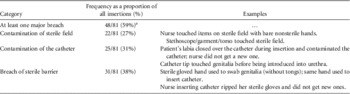
A total of 81 insertion attempts among 65 patients were observed. Registered nurses attempted to insert 77 catheters (95%); a helper assisted with 64 (79%) of these 81 attempts. Major breaks in aseptic insertion technique occurred in 48 (59%) of 81 insertion attempts. Some insertions included more than one category of break (Table 1). There was no association between inserter or patient characteristics and major breaks in technique. Barriers to aseptic insertion included inconsistent or inconvenient locations for hand sanitizers and limited room to set up sterile fields. Nurses commonly donned sterile gloves over clean gloves without cleaning their hands before or after catheter insertion. We identified 7 patients with bacteriuria after insertion; 5 of these had experienced a major break in technique.
Categories and Frequencies of Major Breaks of Sterility

a Many of the observed insertions involved multiple breaks of sterility.
Aspects of the ED environment coupled with certain common ED practices may have contributed to breaks in aseptic insertion technique in more than half of the cases. Possible improvement strategies should target equipment and social domains; although very common, insertion of urinary catheters is a complex multistep task. In the equipment domain, the following human factors principles could be applied: standardization (eg, consistent and convenient placement of hand sanitizers), education and surveillance (eg, annually assessing competence during insertion), and product redesign (eg, trays that incorporate human factors principles to ensure proper technique).Reference Anderson, Gosbee, Bessesen and Williams 8 In the social domain, the unique ED culture may have contributed to our findings. Infection prevention can be overlooked in the fast-paced environment of an ED where life-threatening conditions take priority.Reference Liang, Theodoro, Schuur and Marschall 4 Applying principles of mindfulness at the bedside, recently described for preventing catheter-associated urinary tract infection,Reference Kiyoshi-Teo, Krein and Saint 9 is a potentially promising solution.
Although our investigation was conducted in 1 site, an overall lack of adherence to aseptic insertion technique was found in an observational study conducted in 5 nursing homes.Reference DuBeau, Lemay, Field, Mazor and Gurwitz 10 Our small sample limits the capacity to evaluate outcomes; the nature of the single center limits our ability to generalize results. However, possible reasons for observed breaks provide insight into how to overcome identified barriers. Without attending to complexities found in actual clinical practice, meaningful improvements are less likely to be realized.
ACKNOWLEDGMENTS
We acknowledge the assistance of Ashley Tupper MS, RN, Hayley Hekker, RN, and Audrey Cialek RN, in data collection.
Financial support. Agency for Healthcare Research and Quality (HHSA290201000025I and HHSA29032001T to S.S.; 1K08HS019767 to J.M.); 2009-2015 National Institutes of Health Clinical Loan Repayment Program (to J.M.).
Potential conflicts of interest. S.S. reports that he has received personal fees from his work on advisory boards of Doximity and Jvion; J.M. reports that she has receiving honoraria from hospitals and professional societies devoted to complication prevention for lectures and teaching related to prevention and value-based purchasing policies involving catheter-associated urinary tract infection and hospital-acquired pressure ulcers. All other authors report no conflicts of interest relevant to this article.