Clonorchiasis is mainly prevalent in Asian countries and regions, including South Korea, China, northern Vietnam and far-eastern Russia (Lun et al., Reference Lun, Gasser, Lai, Li, Zhu, Yu and Fang2005; Furst et al., Reference Furst, Keiser and Utzinger2012; Qian et al., Reference Qian, Utzinger, Keiser and Zhou2016). China has the largest population of infected people, which is estimated at 13 million (Qian et al., Reference Qian, Chen, Liang, Yang and Zhou2012, Reference Qian, Utzinger, Keiser and Zhou2016). The high infection rate of clonorchiasis is mainly attributed to the habit of consuming raw or inadequately cooked freshwater fish from ponds and lakes contaminated with sewage (Lo et al., Reference Lo, Chang, Lee and Kuo2013). Patients with Clonorchis sinensis infection are often asymptomatic or have unspecific symptoms, which may easily lead to missed diagnosis or misdiagnosis (Lun et al., Reference Lun, Gasser, Lai, Li, Zhu, Yu and Fang2005). Chronic clonorchiasis caused by C. sinensis infection results in various complications in the liver and biliary systems, mainly including cholelithiasis, cholangitis, cholecystitis and biliary tract obstruction (Lai et al., Reference Lai, Chin, Chung, Liu, Hwang and Lin2007). Stool examination by the Kato–Katz (KK) method is non-invasive and inexpensive for the convenient detection of C. sinensis eggs (Hong & Fang, Reference Hong and Fang2012; Tang et al., Reference Tang, Huang and Yu2016). It has been demonstrated that the KK method is sensitive and reliable for diagnosing clonorchiasis (Hong et al., Reference Hong, Choi, Kim, Chung and Ji2003).
Cholelithiasis is one of the most frequent complications of C. sinensis infection (Tang et al., Reference Tang, Huang and Yu2016). Cholelithiasis includes intrahepatic stones (IHSs), common bile duct (CBD) stones and gallstones. Cholelithiasis has become a major health problem because it can lead to cholecystitis, cholangitis, pancreatitis and even cholangiocarcinoma (Lai et al., Reference Lai, Chin, Chung, Liu, Hwang and Lin2007). The presence of gallstones in clonorchiasis has been documented and the patients with calcium carbonate gallbladder stones have been reported to have higher infection rate of C. sinensis (Ma et al., Reference Ma, Qiao, Luo, Luo, Zheng and Yang2015). Furthermore, accumulating studies have shown that cholelithiasis is closely associated with chronic C. sinensis infection (Choi et al., Reference Choi, Lim and Lee2008; Chen et al., Reference Chen, Lin, Hsu and Kao2019).
The relationship between chronic C. sinensis infection and cholelithiasis has been reported in several studies (Choi et al., Reference Choi, Lim and Lee2008, Reference Qiao, Ma, Luo, Luo and Zheng2012; Qiao et al., Reference Qiao, Ma, Luo, Yang, Luo and Zheng2014; Chen et al., Reference Chen, Lin, Hsu and Kao2019), though other investigations have found no significant relationship between cholelithiasis and clonorchiasis (Hou et al., Reference Hou, Ker, Sheen and Chen1989; Kim et al., Reference Kim, Han and Kim2009). In most of these prior studies, there were insufficient samples of patients infected with C. sinensis. Therefore, the relationship between C. sinensis infection and cholelithiasis is not yet well understood. The eosinophil count (EOS) is a stable, readily available and inexpensive marker of parasitic infection, which is also an important predictor of asthma, drug hypersensitivity reactions, neoplasm, connective-tissue disorders, primary hypereosinophilic syndromes and transplant rejection (Hogan et al., Reference Hogan, Rosenberg, Moqbel, Phipps, Foster, Lacy, Kay and Rothenberg2008; Liao et al., Reference Liao, Long, Chang and Lu2016). To our knowledge, there is no literature on the association between eosinophil count and cholelithiasis among people with C. sinensis infection. Therefore, we conducted a single-centre cross-sectional study in Chinese population to investigate the associations among cholelithiasis, eosinophil count and C. sinensis infection.
Material and methods
Study population
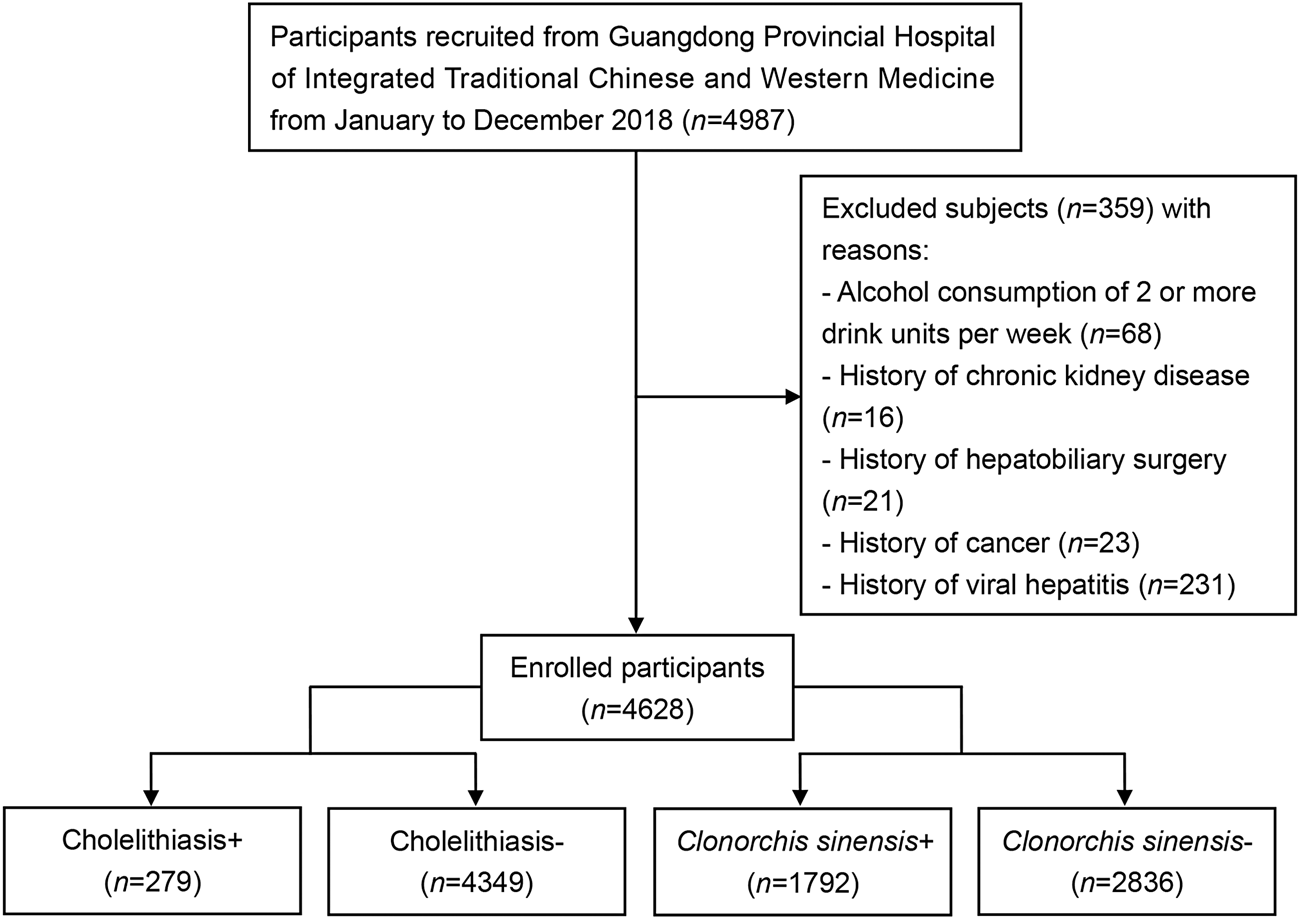
A total of 4987 participants were recruited from the Health Examination Centre of Guangdong Integrated Hospital of Traditional Chinese and Western Medicine, Foshan City, Guangdong Province, China, from January 2018 to December 2018. All participants underwent stool examination for C. sinensis infection, ultrasonography for non-alcoholic fatty liver disease (NAFLD) and cholelithiasis, as well as blood test for eosinophil count and metabolic parameters. Trained medical staff used a questionnaire to collect participants' information and medical history, including age, gender, smoking status, alcohol intake, history of gallstone surgery, history of chronic kidney disease, history of hepatobiliary surgery, history of cancer and history of viral hepatitis. Participants with any of the following characteristics were excluded from the study: (1) alcohol consumption of 2 or more drink units per week; (2) history of chronic kidney disease; (3) history of hepatobiliary surgery; (4) history of cancer; (5) history of viral hepatitis. The study was reviewed and approved by the ethics committee of Guangdong Provincial Hospital of Integrated Traditional Chinese and Western Medicine. All participants signed informed consent before the examinations.
Data collection
The blood pressure of participants was measured after at least 15 min of seated rest. Body weight and standing height were measured without shoes and outerwear. Body mass index (BMI) was defined as weight divided by height squared (kg/m2). Venous blood samples were collected after an overnight fast of 8 h. Alanine aminotransferase (ALT), aspartate aminotransferase (AST), alkaline phosphatase (ALP), γ-glutamyltranspeptidase (γ-GT), triglyceride (TG), total cholesterol (TC), fasting plasma glucose (FPG), high-density lipoprotein cholesterol (HDL-C), low-density lipoprotein cholesterol (LDL-C), creatinine (CRE), blood urea nitrogen (BUN) and uric acid (UA) levels were measured using an Olympus AU-640 autoanalyser (Olympus, Japan). Eosinophil count was measured using Sysmex 2100 whole blood cell analyser (Sysmex, Japan). NAFLD and cholelithiasis were determined by abdominal ultrasonography with ACUSON X150 ultrasound system (Siemens, Japan). Stool examination was performed with the KK method for diagnosis of C. sinensis infection in each participant. For stool examination, triplicate Kato-Katz thick smears were prepared using standard 41.7 mg templates, and the number of C. sinensis eggs was counted and recorded under a microscope by experienced technicians (Qian et al., Reference Qian, Yap and Yang2013). The intensity of C. sinensis infection was expressed by eggs per gram of faeces (EPG) and classified into three categories according to World Health Organization (World, 2012): light (1–1999 EPG), moderate (2000–3999 EPG) and heavy (≥4000 EPG). All the test results were obtained from the laboratory of Guangdong Provincial Hospital of Integrated Traditional Chinese and Western Medicine.
Statistical analysis
Normal distribution data were described as mean ± standard deviation (SD), and the t-test was used to compare the groups. Median (interquartile range) was used to describe the data with skewed distribution, and the groups were compared with Wilcoxon's rank-sum test. Qualitative data are expressed in frequency (percentage) and compared with the chi-square test. In addition, the data were further divided into four groups according to the quartiles of EOS: G1, EOS# < 0.05 × 10⁹/l; G2, 0.05 × 10⁹/l ≤ EOS# < 0.1 × 10⁹/l; G3, 0.1 × 10⁹/l ≤ EOS# < 0.5 × 10⁹/l; G4, EOS# ≥ 0.5 × 10⁹/l. The Kruskal–Wallis test was used to compare different quartiles of eosinophil count. Spearman's rank correlation was performed to assess the association between eosinophil counts and C. sinensis egg counts. In addition, we used forward stepwise multiple logistic regression models to estimate the associations between C. sinensis infection, eosinophil count and cholelithiasis. The association between the intensity of C. sinensis infection and cholelithiasis was analysed using a multiple logistic regression model. Multivariable models were adjusted as follows: Model 1 was adjusted for age and gender; Model 2 was adjusted for Model 1 + BMI, smoking status, systolic blood pressure and diastolic blood pressure; Model 3 was adjusted for Model 2 + ALT, AST, ALP, γ-GT, TC, TG, FPG, HDL-C, LDL-C, CRE, BUN, UA and NAFLD. All data analyses were conducted using SPSS Statistics 22.0 (IBM, USA). A two-tailed test was used with a significance level of 0.05.
Results
Clinical and demographic characteristics of the study participants
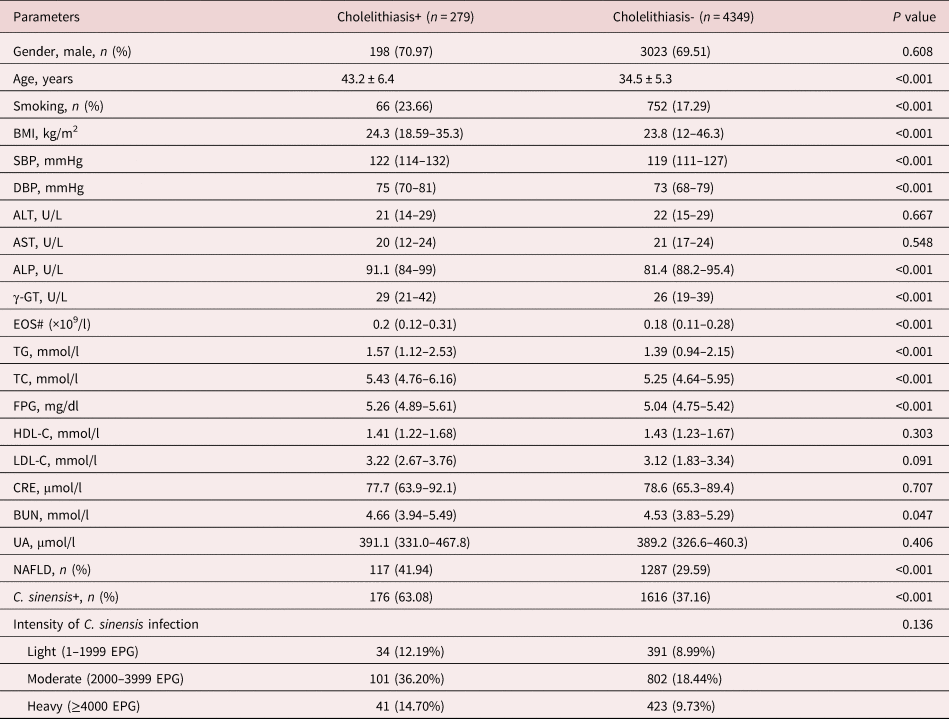
Overall, 4628 Chinese participants (3221 males and 1407 females) were enrolled (fig. 1). The clinical and demographic data are shown in table 1. Clonorchis sinensis infection was present in 38.72% (1792/4628) of the participants. Cholelithiasis was present in 6.03% (279/4628) of the participants, 63.08% (176/279) of whom were infected with C. sinensis. The average ages of the cholelithiasis group and non-cholelithiasis group were 43.2 ± 6.4 years and 34.5 ± 5.3 years, respectively (P < 0.001). The infection rate of C. sinensis in cholelithiasis group was significantly higher than that in non-cholelithiasis group (63.08% vs. 37.16%, P < 0.001). Moreover, the prevalence of cholelithiasis was higher in participants with light, moderate and heavy intensities of C. sinensis infection compared with non-cholelithiasis group (12.19% vs. 8.99%, 36.20% vs. 18.44%, and 14.70% vs. 9.73%, respectively), although the difference was not significant. In addition, eosinophil count in participants with cholelithiasis was significantly higher than that in those without cholelithiasis (P < 0.001). There were no differences between participants with and without cholelithiasis in terms of gender, ALT, AST, HDL-C, LDL-C, CRE and UA (all P > 0.05).
Flow chart of participant selection.

Characteristics of the study participants with and without cholelithiasis.

BMI, body mass index; SBP, systolic blood pressure; DBP, diastolic blood pressure; ALT, alanine aminotransferase; AST, aspartate aminotransferase; ALP, alkaline phosphatase; γ-GT, γ-glutamyltranspeptidase; EOS#, eosinophil count; TG, triglyceride; TC, total cholesterol; FPG, fasting plasma glucose; HDL-C, high-density lipoprotein cholesterol; LDL-C, low-density lipoprotein cholesterol; CRE, creatinine; BUN, blood urea nitrogen; UA, uric acid; NAFLD, non-alcoholic fatty liver disease; C. sinensis, Clonorchis sinensis; EPG, eggs per gram of faeces.
Characteristics of the study participants according to eosinophil count quartile
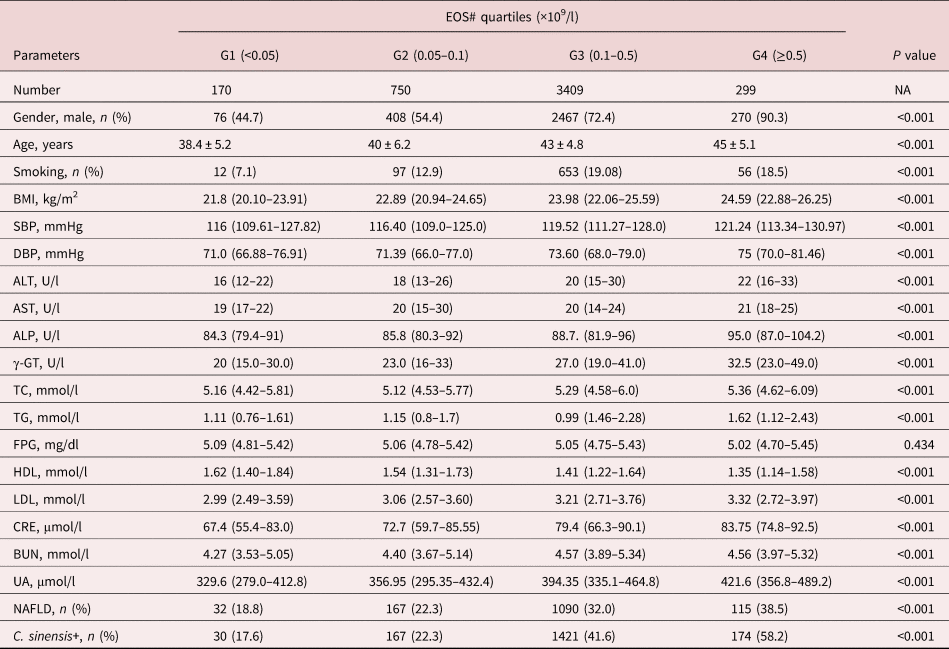
The data were subdivided into four groups according to the quartiles of eosinophil count (table 2). There were significant differences among various eosinophil count quartiles for gender, age, smoking status, BMI, DBP, SBP, ALT, AST, ALP, γ-GT, TC, TG, HDL, LDL, CRE, BUN, UA and NAFLD (all P < 0.001). Moreover, there was a significant difference among various eosinophil count quartiles for C. sinensis infection (P < 0.001).
Characteristics of the study participants according to eosinophil count quartile.

EOS#, eosinophil count; NA, not applicable; BMI, body mass index; SBP, systolic blood pressure; DBP, diastolic blood pressure; ALT, alanine aminotransferase; AST, aspartate aminotransferase; ALP, alkaline phosphatase; γ-GT, γ-glutamyltranspeptidase; TG, triglyceride; TC, total cholesterol; FPG, fasting plasma glucose; HDL-C, high-density lipoprotein cholesterol; LDL-C, low-density lipoprotein cholesterol; CRE, creatinine; BUN, blood urea nitrogen; UA, uric acid; NAFLD, non-alcoholic fatty liver disease; C. sinensis, Clonorchis sinensis.
Association between eosinophil count and Clonorchis sinensis infection
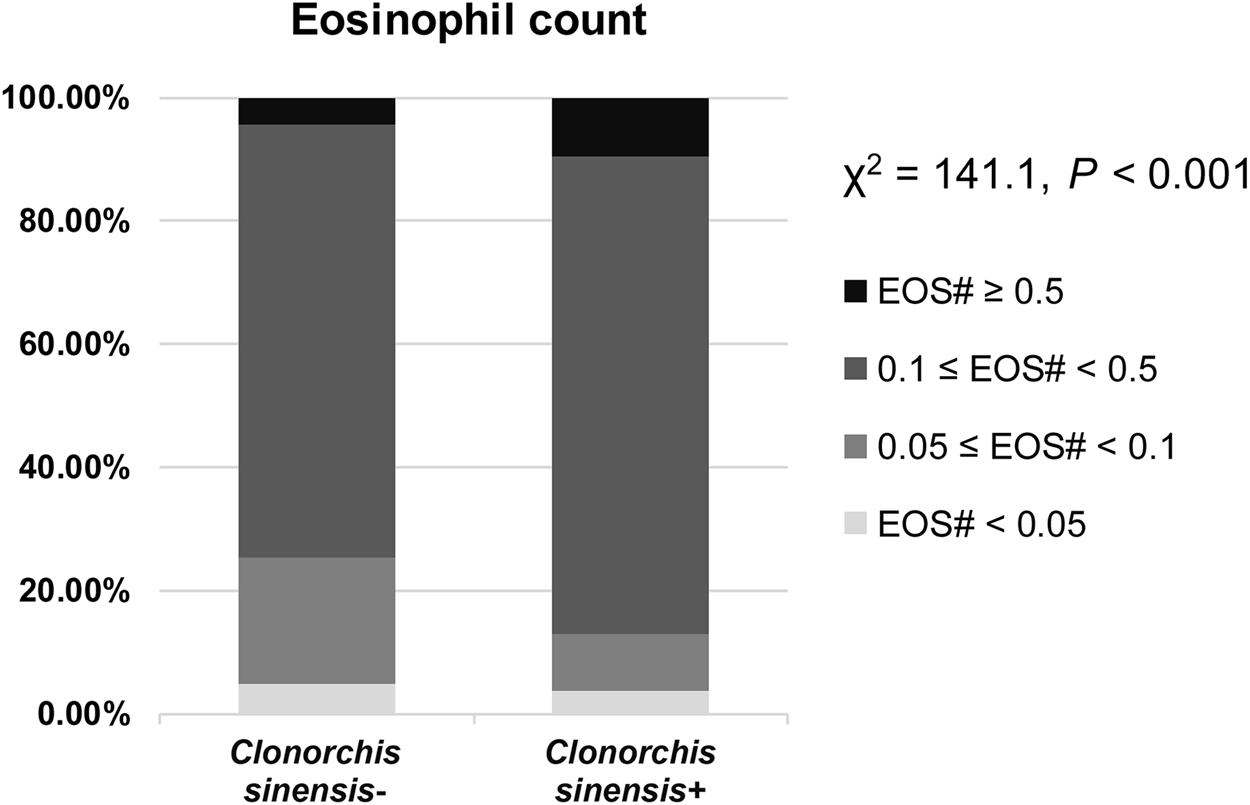
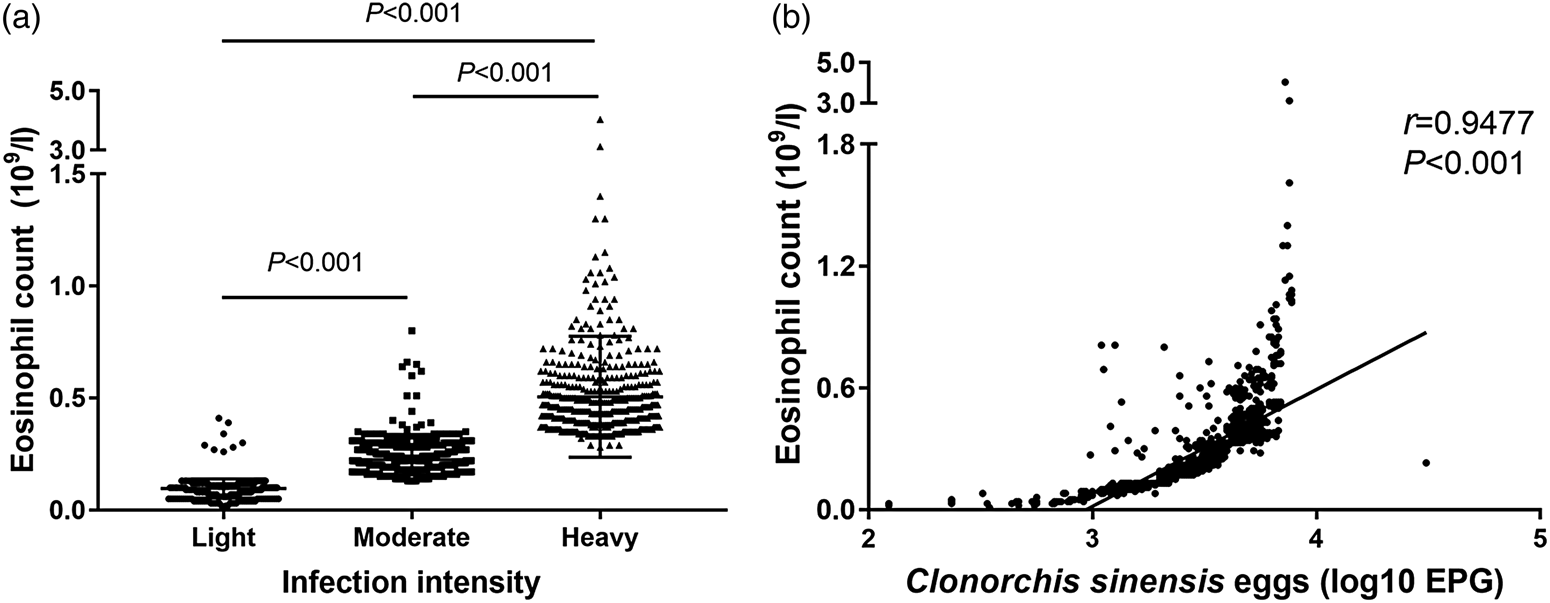
To further investigate the association between C. sinensis infection and eosinophil count levels, participants from the C. sinensis positive group and negative group were subdivided into four grades according to eosinophil count quartiles, and the percentages of each grade in the two groups are shown in fig. 2. In the C. sinensis negative group, the percentages of G1, G2, G3 and G4 were 4.89%, 20.51%, 70.14% and 4.47%, respectively. In the C. sinensis positive group, the percentages of G1, G2, G3 and G4 were 3.64%, 9.36%, 77.35% and 9.64%, respectively. There was a significant difference between the two groups for the percentages of eosinophil count quartiles (χ2 = 141.1, P < 0.001). As shown in fig. 3a, the differences among the eosinophil counts of light, moderate and heavy intensities of C. sinensis infection were significant (P < 0.001). In addition, a significant positive correlation was found between log-transformed C. sinensis egg counts and eosinophil counts (r = 0.9477, P < 0.001, fig. 3b).
The percentages of eosinophil count quartiles in Clonorchis sinensis positive and negative group. The data were divided into four groups according to the quartiles of eosinophil count. In the C. sinensis negative group, the percentages of G1, G2, G3 and G4 were 4.89%, 20.51%, 70.14% and 4.47%, respectively. In the C. sinensis positive group, the percentages of G1, G2, G3 and G4 were 3.64%, 9.36%, 77.35% and 9.64%, respectively.

The association between eosinophil count and Clonorchis sinensis infection. (a) Comparison of eosinophil counts from participants with different intensities of C. sinensis infection. (b) Correlation between C. sinensis egg counts and eosinophil counts. r = Spearman's rank correlation coefficient, EPG = eggs per gram of faeces.

Association between the intensity of Clonorchiasis sinensis infection and cholelithiasis
We established a multiple logistic regression to evaluate the association between the intensity of C. sinensis infection and cholelithiasis. As shown in table 3, the light and moderate intensities of C. sinensis infection were significantly associated with higher risk of cholelithiasis (β = 1.90, 95% CI = 1.26–2.85, P = 0.002; β = 3.13, 95%CI = 2.34–4.18, P < 0.001) in Model 1. And further adjustment for BMI, smoking status, SBP and DBP (Model 2), and additional adjustment for other clinical variables (Model 3), the light and moderate intensities of C. sinensis infection were still significantly associated with cholelithiasis. However, there was no association between cholelithiasis and the heavy intensity of C. sinensis infection.
Multiple logistic regression analysis of different intensity of Clonorchiasis sinensis infection as risk factors of cholelithiasis.

Model 1 was adjusted for age and gender.
Model 2 was adjusted for Model 1 + body mass index, smoking status, systolic blood pressure, diastolic blood pressure.
Model 3 was adjusted for Model 2 + alanine aminotransferase, aspartate aminotransferase, alkaline phosphatase, γ-glutamyltranspeptidase, triglyceride, total cholesterol, fasting blood glucose, high-density lipoprotein cholesterol, low-density lipoprotein cholesterol, creatinine, blood urea nitrogen, uric acid, non-alcoholic fatty liver disease.
Abbreviations: β, odds ratio; CI, confidence interval; NA, not applicable; EPG, eggs per gram of faeces.
Association between C. sinensis infection, eosinophil count and cholelithiasis
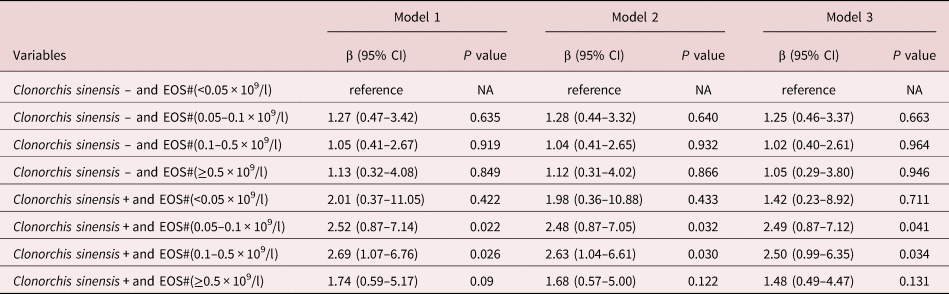
We further established a multiple logistic regression to evaluate the association between C. sinensis infection, eosinophil count and cholelithiasis. As shown in table 4, multiple logistic regression analysis revealed that there was no association between eosinophil count and cholelithiasis in the participants without C. sinensis infection. But C. sinensis infection with eosinophil count at G2 level (0.05–0.1 × 10⁹/l) was significantly associated with cholelithiasis after adjusting for pertinent clinical variables, and the β values of Model 1, Model 2 and Model 3 were 2.52, 2.48 and 2.49 (95% CI: 0.87–7.14; 0.87–7.05; 0.87–7.12, all P < 0.05), respectively. C. sinensis infection with eosinophil count at the G3 level (0.1–0.5 × 10⁹/l) was significantly associated with cholelithiasis after adjusting for pertinent clinical variables, and the β values of Model 1, Model 2 and Model 3 were 2.687, 2.63 and 2.50 (95% CI: 1.07–6.76; 1.04–6.61; 0.99–6.35, all P < 0.05), respectively. However, there was no association between cholelithiasis and C. sinensis infection with eosinophil count at G1 or G4 levels (<0.05 × 10⁹/l, ≥0.5 × 10⁹/l, respectively).
Multiple logistic regression analysis of a combination of Clonorchiasis sinensis infection and eosinophil count as risk factors of cholelithiasis.

Model 1 was adjusted for age and gender.
Model 2 was adjusted for Model 1 + body mass index, smoking status, systolic blood pressure, diastolic blood pressure.
Model 3 was adjusted for Model 2 + alanine aminotransferase, aspartate aminotransferase, alkaline phosphatase, γ-glutamyltranspeptidase, triglyceride, total cholesterol, fasting blood glucose, high-density lipoprotein cholesterol, low-density lipoprotein cholesterol, creatinine, blood urea nitrogen, uric acid, non-alcoholic fatty liver disease.
Abbreviations: EOS#, eosinophil count; β, odds ratio; CI, confidence interval; NA, not applicable.
Discussion
Clonorchis sinensis is mainly prevalent in Asian countries and regions, including South Korea, China, northern Vietnam and far-eastern Russia, and 200 million people worldwide are at risk of C. sinensis infection (Hong & Fang, Reference Hong and Fang2012; Qian et al., Reference Qian, Utzinger, Keiser and Zhou2016). It has been reported that more than 15 million people are infected with C. sinensis, of which 1.5 million to 2 million have clinical symptoms or complications (Hong & Fang, Reference Hong and Fang2012). Among them, approximately 13 million people in China were infected with C. sinensis (Furst et al., Reference Furst, Keiser and Utzinger2012). In China, Guangdong Province is the most infected province, followed by Guangxi, Heilongjiang and Jilin Province (Chen et al., Reference Chen, Zhou and Xu2012). Foshan, as the third largest city in the Pearl River Delta of Guangdong Province, is a severe epidemic area of C. sinensis (Yuan et al., Reference Yuan, Huang, Zhang and Ruan2018).
In our study, we found that patients with cholelithiasis were generally older than non-cholelithiasis patients (43.2 ± 6.4 years vs. 34.5 ± 5.3 years, P < 0.001). Moreover, cholelithiasis was more prevalent in patients who smoked (23.66% vs. 17.29%, P < 0.01) and had higher BMI (24.3 kg/m2 vs. 23.8 kg/m2, P < 0.001). In addition, compared with non-cholelithiasis patients, cholelithiasis patients had higher SBP (122 mmHg vs. 119 mmHg, P < 0.001) and DBP (75 mmHg vs. 73 mmHg, P < 0.001). These findings reflect that cholelithiasis may be closely associated with metabolic disorders or cardiovascular diseases (Zamani et al., Reference Zamani, Sohrabi and Alipour2014).
Studies on the relationship between C. sinensis infection and cholelithiasis are inconsistent and controversial. Some studies have shown that no significant relationship between cholelithiasis and clonorchiasis (Hou et al., Reference Hou, Ker, Sheen and Chen1989; Kim et al., Reference Kim, Han and Kim2009). But other studies have shown that C. sinensis infection is closely related to cholelithiasis (Choi et al., Reference Choi, Lim and Lee2008; Tang et al., Reference Tang, Huang and Yu2016). Ascaris lumbricoides and C. sinensis have been occasionally identified in the biliary tracts or the gallbladder in Asians, and it has been reported that C. sinensis can provide the dead bodies or the eggs as the nidus for stone formation in the bile ducts or the gallbladder (Qiao et al., Reference Qiao, Ma, Zhang, Feng, Wang and Wang2009; Ma et al., Reference Ma, Qiao, Luo, Luo, Zheng and Yang2015). It is believed that adult C. sinensis can migrate to biliary tree, including gallbladder, intrahepatic and extrahepatic bile ducts, after being ingested in duodenum. In addition, it has been proposed that C. sinensis can cause severe adenomatous hyperplasia of the biliary epithelium, mucin hypersecretion, inflammation and fibrosis around the duct, and deposit body or eggs in the biliary stent, thus contributing to the development of cholelithiasis (Hong & Fang, Reference Hong and Fang2012). Therefore, it is necessary to further explore the association between the C. sinensis infection and cholelithiasis.
In our study, the results showed that the infection rate of C. sinensis in patients with cholelithiasis was significantly higher than that in patients without cholelithiasis (63.08% vs. 37.16%, P < 0.001). In addition, multiple logistic regression analysis indicated that the light and moderate intensities of C. sinensis infection were significantly associated with cholelithiasis (P < 0.01 and P < 0.001, respectively). Therefore, our data suggest that C. sinensis infection, especially light and moderate intensities of the infection, is associated with cholelithiasis. This finding may be related to the characteristics of liver fluke infection. It has been proposed that early infection of liver fluke has an initially higher rate of egg production, which will reduce over time (Walker et al., Reference Walker, Hoey, Fletcher, Brennan, Fairweather and Trudgett2006; Valero et al., Reference Valero, Panova, Perez-Crespo, Khoubbane and Mas-Coma2011). Therefore, it is possible that patients with more C. sinensis eggs in faeces may be at an early stage of infection and have not yet developed cholelithiasis.
It has been widely recognized that C. sinensis and other parasitic infections can lead to elevated eosinophils (O'Connell & Nutman, Reference O'Connell and Nutman2015; Kovalszki & Weller, Reference Kovalszki and Weller2016). Eosinophils exert a range of biological effects against helminth parasites, leading to inflammation and damage of affected tissues. Eosinophilia in helminth infections is typically associated with a pronounced T helper 2 (Th2) immune response including the production of interleukin-4 (IL-4), interleukin-5(IL-5) and interleukin-13 (IL-13), as well as immunoglobulin E and the expansion and mobilisation of other specific effector cells, such as mast cells and basophils (Maizels et al., Reference Maizels, Balic, Gomez-Escobar, Nair, Taylor and Allen2004). Until recently, eosinophil has been mainly considered as the end-stage effector cell with cytotoxic activities consequent upon release of the toxic cationic proteins stored in their secondary granules. These non-specific killing abilities are thought to have evolved as a host defence mechanism against large non-phagocytosable parasites (Ueki et al., Reference Ueki, Tokunaga, Fujieda, Honda, Hirokawa, Spencer and Weller2016). Our results also indicated that the participants infected with C. sinensis had higher percentages of G3 and G4 levels of eosinophil count when compared with normal participants. In addition, Spearman's rank correlation analysis showed that C. sinensis egg count was positively associated with eosinophil count (r = 0.9477, P < 0.001). However, there are few studies concerning the associations among C. sinensis, eosinophil count and cholelithiasis.
The pathological study of gallbladder infected by C. sinensis showed that eosinophils and lymphocytes could infiltrate the gallbladder wall, but the proliferation of epithelial cells was not obvious. Clonorchis sinensis multiplies in a large number of intrahepatic bile ducts, blocking the bile duct lumen, resulting in obstructed bile excretion and abnormal bacterial reproduction. Clonorchis sinensis eggs, dead worms, exfoliated biliary epithelia, bacteria and other synergistic action promote the formation of gallstones (Qiao et al., Reference Qiao, Ma, Luo, Luo and Zheng2012; Urdaneta & Casadesus, Reference Urdaneta and Casadesus2017). Eosinophils are multipotent white blood cells with many functions, such as initiating inflammation and regulating immune response. Hypereosinophilia is a common phenomenon which has a protective effect in the process of parasitic infection. It can lead to inflammation and damage of affected biliary tree and promote the development of cholelithiasis (Chen et al., Reference Chen, Lin, Hsu and Kao2019). This also indicates that C. sinensis infection may be closely related to eosinophil count and cholelithiasis.
In our study, the KK method was used to examine C. sinensis eggs for the diagnosis of C. sinensis infection, and ultrasonography was used for the diagnosis of cholelithiasis. Our results suggest that Cl. sinensis infection and eosinophil count are associated with cholelithiasis after adjusting the pertinent clinical variables, including age, gender, BMI, smoking status, SBP, DBP, ALT, AST, ALP, γ-GT, TC, TG, FPG, HDL-C, LDL-C, CRE, BUN, UA and NAFLD. However, there was no association between eosinophil count and cholelithiasis when C. sinensis infection was negative. Similarly, when C. sinensis infection was positive and eosinophil count was less than 0.05 × 10⁹/l or more than 0.5 × 10⁹/l, there was no association between eosinophil count and cholelithiasis. Interestingly, C. sinensis infection with eosinophil count in 0.05–0.1 × 10⁹/l or 0.1–0.5 × 10⁹/l level was significantly associated with cholelithiasis. This result suggest that the clonorchiasis patients with eosinophil count ranging from 0.05–0.5 × 10⁹/l may be at higher risk of cholelithiasis.
We have to note that there are some limitations in our research. (1) Subjects were recruited from the physical education centre of our hospital. Most of the participants were examined by enterprises and institutions as a group. This part of the population has a high level of economic income, which may not represent the general population. (2) In this study, the KK method was used to detect faecal eggs under a microscope. There was a certain rate of missed detection and false negatives of C. sinensis, especially when the number of C. sinensis eggs was very low (Hong et al., Reference Hong, Choi, Kim, Chung and Ji2003). (3) This is a cross-sectional study which could only investigate the relationship between C. sinensis infection and cholelithiasis.
In conclusion, our data show that the participants infected with C. sinensis are more likely to develop cholelithiasis. The light and moderate intensities of C. sinensis infection with eosinophil count ranging from 0.05 to 0.5 × 10⁹/l may be associated with a higher risk of cholelithiasis, suggesting that early detection of eosinophil count may be useful for the assessment of potential cholelithiasis risk in patients infected with C. sinensis. But future studies are needed to clarify the causal relationship between C. sinensis infection and cholelithiasis. In addition, biochemical studies are needed to better understand the pathophysiology behind the role of C. sinensis infection in cholelithiasis.
Acknowledgements
We would like to thank the participants in this study for their cooperation. We also thank the academic and non-academic staff of Guangdong Provincial Hospital of Integrated Traditional Chinese and Western Medicine for their help.
Financial support
This study received no specific grant from any funding agency, commercial or not-for-profit sectors.
Conflicts of interest
None.
Ethical standards
This study was approved by the Ethics Committee of Guangdong Provincial Hospital of Integrated Traditional Chinese and Western Medicine. All participants were informed regarding voluntary participation and they were advised that they could withdraw from the study at any time. All data were kept confidential.