Introduction
Devonian (Eifelian–Givetian) crinoids from Germany have been studied since the middle of the nineteenth century. These faunas are well known as iconic Devonian crinoids, which include several genera with unique morphologies. The early writing on these crinoids occurs primarily in literature that may be difficult to borrow, which has hampered understanding the details of these taxa. Further, the recent history of names applied to many of these crinoids, including the Cupressocrinidae treated herein, has been confused (e.g., Bohatý, Reference Bohatý2005a, Reference Bohatý2006; Bohatý and Herbig, Reference Bohatý and Herbig2010), as discussed in the following in detail.
In the present study, two cupressocrinitids from the famous crinoid collection of Dr. Philosophy Ludwig Johann Theodor Schultze are revised. The specimens are from the Middle Devonian of the Eifel Synclines (Rhenish Massif, Germany) and were originally described in the classic monograph “Monographie der Echinodermen des Eifler Kalkes” by Schultze (Reference Schultze1866). Schultze's collections are curated in the Invertebrate Paleontology Collection of the Museum of Comparative Zoology at Harvard University in Cambridge (Massachusetts, USA) (Bohatý, Reference Bohatý2021).
From the Devonian crinoid collection of Schultze, two cupressocrinitids (Crinoidea, Eucladida) are revised in the present study: Cupressocrinites hybridus (Schultze, Reference Schultze1866) n. comb. and Halocrinites minor (Schultze, Reference Schultze1866) n. comb. Whereas the rare C. hybridus is regionally and stratigraphically limited to the Ahbach Formation of the Eifelian/Givetian boundary beds of the Hillesheim Syncline (Eifel, Rhenish Massif, Germany), the more common H. minor occurs supraregionally in Germany, Poland, Belgium, Spain, Morocco, and China, from the middle Eifelian (Middle Devonian) to the upper Frasnian (Upper Devonian). C. hybridus was originally described as Cupressocrinus abbriviatus var. hybrida Schultze, Reference Schultze1866 and has been incorrectly synonymized with Cupressocrinites elongatus Goldfuß, Reference Goldfuß1839. The junior synonym Halocrinites sampelayoi Almela and Revilla, Reference Almela and Revilla1950 was previously used for H. minor. Both cupressocrinitids are revised on the basis of the type material in the Museum of Comparative Zoology (MCZ).
From the Ahbach and Loogh formations of the Eifelian–Givetian boundary beds and the lowermost Givetian of the Prüm and Hillesheim synclines (Eifel, Rhenish Massif, Germany), the rare Halocrinites heinorum n. sp. is erected herein. Similar to C. hybridus, H. heinorum has a restricted occurrence.
Due to the characteristic morphology of the cups and arms as well as the ornamentation of the monolamellar exoplacoid layer, which are related to Robustocrinites scaber (Schultze, Reference Schultze1866), Cupressocrinites townsendi (König, Reference König1825) (née Encrinus townsendi König, Reference König1825, p. 4, pl. 8, fig. 97) is questionably assigned to the genus Robustocrinites: R.(?) townsendi (König, Reference König1825) n. comb.
Crinoid studies by Ludwig Johann Theodor Schultze
Since publication of the separate from 1866 and the journal article of the same name, “Monographie der Echinodermen des Eifler Kalkes” (1867), Dr. phil. Ludwig Johann Theodor Schultze has been well known among paleontologists and, especially, among echinoderm researchers. This fame applies mainly to upper to middle Eifelian and lower Givetian crinoids from the Rhenish Massif, for which there is almost no German-language treatise without citations from the Schultze monograph (see Bohatý, Reference Bohatý2005a, Reference Bohatýb, Reference Bohatý2006, Reference Bohatý2009; Bohatý and Herbig, Reference Bohatý and Herbig2010, and literature cited therein).
As stated in the detailed biographies of Schultze (see Bohatý, Reference Bohatý2021; Bohatý and Sander, Reference Bohatý and Sanderin press), Schultze was born in Rostock on 1 April 1835. Schultze was initially enrolled as a law student at the University of Rostock, the Rheinische Friedrich-Wilhelms-Universität Bonn, and the Georg-August-Universität Göttingen, but he changed his major and studied geology and paleontology, first in Breslau and finally in Bonn. He pursued this course in a rather unconventional manner, more as a passionate collector with excellent contacts with the leading natural scientists of his time. He was constantly on the move rather than a student attending lectures in the halls of universities. According to his own statements, he spent 10 years in search of fossils between 1855 and 1865 (Schultze, Reference Schultze1866, p. 3, Reference Schultze1867, p. 115). As a result, he was deregistered during the winter semester of 1859/1860 due to nonattendance. However, because of his excellent contacts, this did not have any negative impact on the remainder of his short-lived paleontological career and especially not on his doctorate degree. Schultze received his doctorate on 30 November 1861 at the Justus Liebig University in Giessen. According to the register of matriculations and inscription books of the University of Giessen summer semester 1851 to winter semester 1900/1901 (approx. 1978), Schultze was not enrolled in Giessen (personal communication, L. Trautmann, 2021). Due to his significant paleontological work on the echinoderms from the Eifel Synclines, he received his doctorate “in absentia.” It is very likely that his “in absentia” recognized the inaugural dissertation as the crinoid treatise later published as his famous monograph, which was already handwritten at the beginning of the 1860s and included specially made drawings. After completion of his monograph, he lost interest in further purchases and collections of paleontological objects and attempted to sell his collection, which was stored in Bonn at that time. The sources passed down by letter indicate that Schultze initially tried to sell his extensive fossil collection to a German university or research institution. In a letter dated 15 April 1869 (stored in the Bavarian State Library, Munich, signature: Liebigiana II.B), Schultze wrote from Gotha to the Darmstadt chemist and president of the Bavarian Academy of Sciences, Prof. Dr. Justus Freiherr von Liebig (1803–1873), in Munich and offered his collection to the Paleontological Museum, which was in the “Alte Akademie” at Neuhauser Street at that time. He asked the price of 5,000 Vereinsthaler for his collection. Schultze failed in selling his collection to the Paleontological Museum in Munich, as evidenced by a letter written 21 months later. In this document from 20 January 1871 (location: Freiburg University Library, signature = Archive of the Geological Association No. 9971), he wrote to Prof. Dr. Carl Justus Andrae in Bonn: “Dear Mr. Andrae. Because of the complete abandonment of my paleontological studies, I take the liberty of notifying you of my resignation from the Natural History Association of Rhineland and Westphalia. After trying for a long time to save my collection for the fatherland and ultimately for Germany and also always making many sacrifices to patriotism, I recently sold it to America and it will soon be swimming towards its new destination …” This destination was the MCZ at Harvard University in Cambridge, Massachusetts. The MCZ purchased the collection in 1871. In addition, a small part of the collection (mainly a few crinoids) was deposited in today's Goldfuß Museum of the Rheinische Friedrich-Wilhelms-Universität Bonn and in the United States National Museum, Washington, D.C. (today: Springer Echinoderm Collection, Department of Paleobiology, U.S. National History Museum, Smithsonian Institution). After selling his collection in 1871 and until his death on 26 March 1913 in Hamburg, Schulze was no longer interested in geological or paleontological objects. Instead, he collected coins and banknotes, which he also traded commercially. From today's perspective, the sale of the collection to the MCZ was of enormous benefit to paleontology: the collection was spared the destruction of the World Wars, a fate suffered by many scientific collections.
Geological setting
The cupressocrinitids discussed in this work originate mainly from somewhat biostromal-dominated limestone–marl interbedded strata of the Middle Devonian deposits of the Eifel Synclines (Rhenish Massif, Germany).
Knowledge about the Devonian of the Eifel is recorded in an unmanageable number of paleontological, stratigraphic, and regional geological publications. Regarding stratigraphy and regional geology, the monograph of Meyer (Reference Meyer1986) is the indispensable standard work.
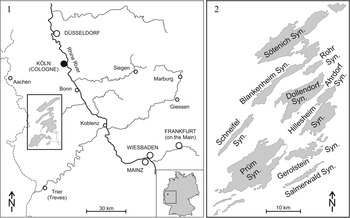
The carbonate Middle Devonian of the Eifel is preserved only within the “Eifel Limestone Synclinorium” (Fig. 1) because it can be interpreted as a north–south trending axial depression of the Rheno-Ardennic Massif. A paleogeographic-facies interpretation is difficult to make because enough outcrops are not available for a complete facies assessment. In general, the sedimentary input occurred from northern directions, respectively from the Old Red Continent. The input accumulated from the Lower to the Upper Devonian with a retreating coastline toward the north. Struve (Reference Struve1961, Reference Struve1963) proposed the first paleogeographic reconstruction of the Eifel Middle Devonian and considered the depositional region as an isolated north–south trending basin surrounded by landmasses, which he denoted as “Eifel Sea Street.” Winter (in Meyer et al., Reference Meyer, Stoltidis and Winter1977, p. 327; also see Meyer, Reference Meyer1986, fig. 37) and Faber (Reference Faber1980) modified the actual paleogeographic view (compare with Meyer, Reference Meyer1986); in particular, the isolated paleogeographic position of the depositional basin as well as the accentuation of distinctively developed boundaries in the form of barriers and islands was reinterpreted differently.
(1) Geographical overview of the Rhenish Massif (modified from Korn, Reference Korn2008, after Walter, Reference Walter1995). (2) Detailed view of the Eifel Limestone Synclinorium (modified after Struve, Reference Struve1996a).

Winter (in Meyer et al., Reference Meyer, Stoltidis and Winter1977) defined three characteristic facies realms (facies types A–C), which are of considerable importance for the faunal distribution and associations. Facies type A, distinguished by clastic sediments, was developed within the northern Eifel Limestone Synclinorium. Carbonates are proportionally rare. In the northern part of the synclinorium, these oceanic sediments were not deposited under normal marine conditions. Normal marine conditions occurred toward the south. Southward, the changeover to facies type C occurred. Type C is characterized by limestones and marls. Clastic components are sparse. Toward the south, the clay content increases, and type C facies passes into the clay-rich facies of the Moselle Trough (= “Wissenbach Slate”). The third facies type (type B) was developed within the eastern part of the Eifel Limestone Synclinorium. It is characterized by pure, commonly biostromal limestones; marly as well as silty sediments are secondary. This facies characterizes a shallow-water realm and was positioned close to a shallow-marine barrier at the northeast Eifel (“Mid-Eifelian High” sensu Winter in Meyer et al., Reference Meyer, Stoltidis and Winter1977). For the lower Eifelian, Faber (Reference Faber1980, p. 1122) characterized this shallow-marine realm as a two-phase carbonate platform that was temporarily interrupted during regressive conditions. Toward the west, he interpreted a relatively undifferentiated open shelf, which is characterized by southwest–northeast trending facies belts.
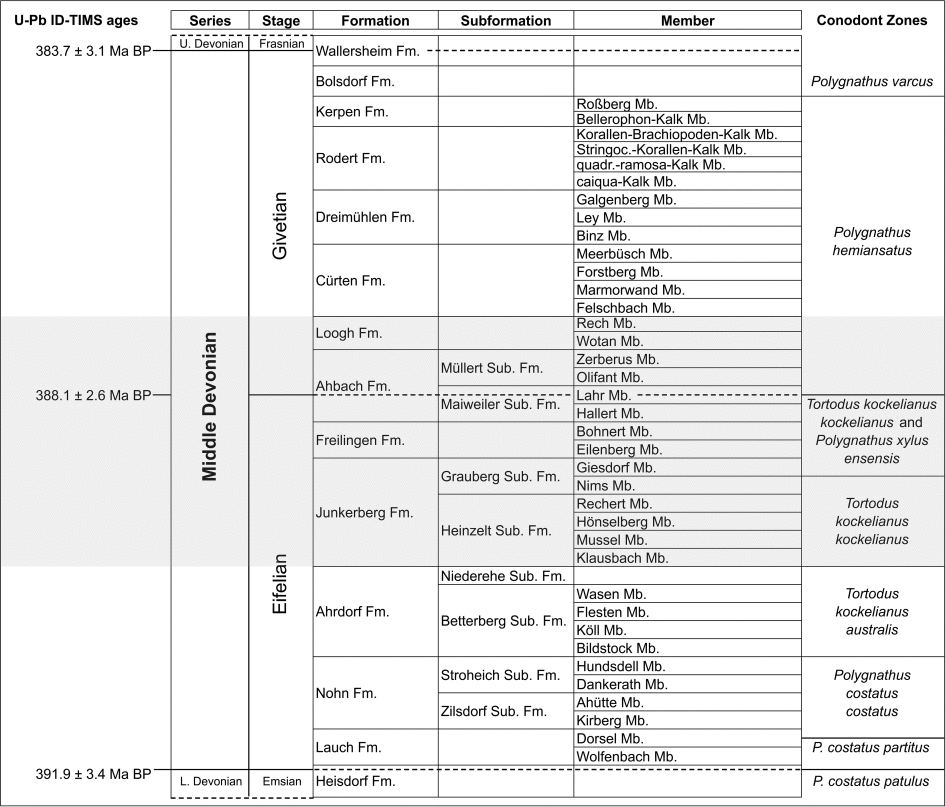
This basic division of the facies types A–C applies at least to the upper Eifelian (Junkerberg Formation; see Table 1), but because of transgressive or regressive phases within some time slices, it was modified by lateral facies displacement or even termination of the facies boundaries. During the upper Eifelian, with the beginning of the Freilingen Formation (Table 1), the facies differences become indistinct; facies type C was established all over the depositional area. During the Givetian, stromatoporoid coral biostromes extended all over the Eifel Sea. Accordingly, Krebs (Reference Krebs1974) characterized the whole Eifel as a shelf lagoon, bordered by a southern barrier.
Biostratigraphy of the Eifel (after Struve, Reference Struve1996b); U-Pb ID-TIMS ages after Kaufmann (Reference Kaufmann2006). The stratigraphic range of the discussed cupressocrinitids from the Middle Devonian of the Eifel Limestone Synclinorium highlighted in gray.

Paproth and Struve (Reference Paproth and Struve1982, fig. 4) distinguished between north-, west- and south-Eifel faunas on the basis of faunal criteria; the Spinocyrtia ostiolata brachiopod facies includes the west-Eifel and part of the south-Eifel fauna. The justifications of these faunal regions were based on a long-ranging thrust fault. The fauna of the north-Eifel correlates with facies type A; the collectivity of the west- and south-Eifel faunas is coeval with facies types B and C, which is best approximated with the boundary of the ostiolata facies.
The most classic fossil localities of Gerolstein, Gees, Niederehe, and Büdesheim are situated within the fossil-rich deposits of the Middle Devonian facies type C of the middle and southern part of the Eifel. Consequently, the deposits within the Hillesheim Syncline were chosen as “Type Eifelian,” a reference profile for all synclines, by Struve (Reference Struve1982). This lithostratigraphic standard division (Hotz et al., Reference Hotz, Kräusel and Struve1955) had to be correlated with the other synclines; because of numerous bio- and lithofacies differences, this is nearly an unsolvable challenge that blocks further studies concerning this matter, especially within the northern and southernmost Eifel. The erection of regionally valid members reflects the complexity of the depositional realm but leads to a bemusing number of, in part, uncorrelated formations, subformations, and members (sensu Struve, Reference Struve1961, Reference Struve1992; not sensu Steininger and Piller, Reference Steininger and Piller1999; compare to Bohatý, Reference Bohatý2005b, p. 388). Therefore, for example, Struve tried to correlate the Middle Devonian sequences by using the biostratigraphic value of brachiopods (see compendium in Struve, Reference Struve1996c). A summary of the valid lithostratigraphic units is given in Struve (Reference Struve1996b).
Materials and methods
In addition to a detailed analysis of previously published data and original material, this study focuses on skeletal features, mainly observed in recently discovered crinoids. They were dissected using micro sand-streaming methods as well as fine pneumatic probes and studied with binocular and DVM6 digital microscopes. Photographs of NH4Cl-whitened crinoids were arranged using digital image editing software. The characterization of anatomical features of the cupressocrinitids follows Bohatý (Reference Bohatý2005a), and the classification and differentiation follow Bohatý and Herbig (Reference Bohatý and Herbig2010). In the present work, species established on the basis of isolated columnals are not considered.
Repositories and institutional abbreviations
Type specimens are deposited in the Invertebrate Paleontology Collection of the Museum of Comparative Zoology (MCZ) at Harvard University in Cambridge, Massachusetts, USA (MCZ-102972 to MCZ -102975, MCZ-IPCR-1907, MCZIP-198679 to MCZIP -198680, MCZIP -198682 to MCZIP -198683). Additional material is stored in the Natural History Museum Mainz (Germany)/State Collection of Natural History of Rhineland-Palatinate (NHMMZ PWL 2021/6001-LS and NHMMZ PWL 2021/6002-LS).
Systematic paleontology
The classification scheme used here follows the recent phylogenetic definitions of higher taxa within the Crinoidea (Ausich et al., Reference Ausich, Kammer, Rhenberg and Wright2015; Cole, Reference Cole2017, Reference Cole2019; Wright, Reference Wright2017a, Reference Wrightb; Wright et al., Reference Wright, Ausich, Cole, Peter and Rhenberg2017). Morphological terminology follows Ubaghs (Reference Ubaghs, Moore and Teichert1978), Bohatý (Reference Bohatý2005a), Webster and Maples (Reference Webster, Maples, Ausich and Webster2008), Ausich et al. (Reference Ausich, Wright, Cole and Sevastopulo2020), and Donovan (Reference Donovan2021). Open nomenclature style follows Matthews (Reference Matthews1973). The consolidating apparatus (“Consolidirapparat” sensu Schultze, Reference Schultze1866, p. 16, Reference Schultze1867, p. 128) refers to the five, highly modified, unfused oral plates that form a ring-like structure that is present in the Cupressocrinitidae (see Roemer, Reference Roemer1845, p. 291–296, pl. 3, fig. B.1–B.3). Each oral plate has two abaxial, leaf-shaped extensions separated by a groove. The groove in the CD oral plate is pronounced, whereas on the other orals it is shallow. The articular plate (“Articularia” sensu Schultze, Reference Schultze1866, p. 15, Reference Schultze1867, p. 127) refers to a modified, nonpinnulate first primibrachial. In cupressocrinitids, this is a very short plate.
Class Crinoidea Miller, Reference Miller1821
Subclass Pentacrinoidea Jaekel, Reference Jaekel1918
Parvclass Cladida Moore and Laudon, Reference Moore and Laudon1943
Infraclass Inadunata Wachsmuth and Springer, Reference Wachsmuth and Springer1885
Magnorder Eucladida Wright, Reference Wright2017a
Superfamily Gasterocomoidea Roemer, Reference Roemer1854
Family Cupressocrinitidae Roemer, Reference Roemer1854
Included subfamilies
Cupressocrininae Bohatý, Reference Bohatý2006 and Rhopalocrininae Bohatý, Reference Bohatý2006 (for both, see Bohatý, Reference Bohatý2006, p. 154–156).
Diagnosis
See Bohatý (Reference Bohatý2009, p. 46).
Occurrence
See Bohatý (Reference Bohatý2006, p. 154).
Remarks
Primarily on the basis of the recognition of a new anatomical structure, the “exoplacoid layer,” a second endoskeleton layer that was developed either mono- or multilamellarly, cupressocrinitids were taxonomically revised by Bohatý (Reference Bohatý2005a). In this connection, the family Cupressocrinitidae Roemer, Reference Roemer1854 was subdivided into three genera: Cupressocrinites Goldfuß, Reference Goldfuß1831 (type species C. crassus Goldfuß, Reference Goldfuß1831 [p. 212]); Abbreviatocrinites Bohatý, Reference Bohatý2005a (type species C. abbreviatus Goldfuß, Reference Goldfuß1839 [p. 333]; now junior synonym of Halocrinites Steininger, Reference Steininger1831); and Robustocrinites Bohatý, Reference Bohatý2005a (type species C. scaber Schultze, Reference Schultze1866 [p. 25–26]). These three genera were assigned to the subfamily Cupressocrininae by Bohatý (Reference Bohatý2006), who recognized two subfamilies within the Cupressocrinitidae. Because Rhopalocrinus Wachsmuth and Springer, Reference Wachsmuth and Springer1880 (previously included in the Cupressocrinitidae) clearly differs from the Cupressocrininae, the genus was designated the type of the subfamily Rhopalocrininae Bohatý, Reference Bohatý2006.
Further study has indicated Cupressocrinites gracilis Goldfuß, Reference Goldfuß1831 belongs to a separate genus (see Bohatý, Reference Bohatý2005a, p. 213, Reference Bohatý2006, p. 161), whereby Procupressocrinus Jaekel, Reference Jaekel1918 has priority. Procupressocrinus gracilis (Goldfuß, Reference Goldfuß1831) and possibly P.(?) magnus (Milicina, Reference Milicina1977) are assigned to Jaekel's genus. Finally, Bohatý and Herbig (Reference Bohatý and Herbig2010) transferred all species formerly included in the genus Abbreviatocrinites to Halocrinites, which has priority. Therefore, Abbreviatocrinites was regarded as an objective junior synonym. Further, the species A. abbreviatus Goldfuß, Reference Goldfuß1839 and the nominotypic subspecies A. abbreviatus abbreviatus (Goldfuß, Reference Goldfuß1839) and the subspecies A. abbreviatus granulosus Schultze, Reference Schultze1866, respectively, are transferred to species H. schlotheimii Steininger, Reference Steininger1831; H. schlotheimii schlotheimii Steininger, Reference Steininger1831; and schlotheimii granulosus (Schultze, Reference Schultze1866), respectively (personal communication, G.D. Webster, 2009). In addition to the changes made by Bohatý and Herbig (Reference Bohatý and Herbig2010), the rare Cupressocrinites hybridus n. comb. is revised. Within Halocrinites, H. minor n. comb. and the new H. heinorum n. sp. are described, and Cupressocrinites townsendi (König, Reference König1825, p. 4, pl. 8, fig. 97) is questionably assigned to Robustocrinites: R.(?) townsendi (König, Reference König1825) n. comb.
Subfamily Cupressocrininae Bohatý, Reference Bohatý2006
Included genera and type species
Cupressocrinites (C. crassus Goldfuß, Reference Goldfuß1831), Halocrinites (H. schlotheimii Steininger, Reference Steininger1831), Procupressocrinus (C. gracilis Goldfuß, Reference Goldfuß1831) and Robustocrinites (C. scaber Schultze, Reference Schultze1866).
Diagnosis
See Bohatý (Reference Bohatý2009, p. 46–48).
Genus Robustocrinites Bohatý, Reference Bohatý2005a
Type species
Cupressocrinus scaber Schultze (Reference Schultze1866, p. 25–26, pl. 1, fig. 4, 4a, b).
Other species
R. cataphractus Bohatý, Reference Bohatý2009; R. galeatus (Hauser, Reference Hauser2001); and R.(?) townsendi (König, Reference König1825) n. comb.
Diagnosis
See Bohatý (Reference Bohatý2009, p. 51).
Remarks
Due to the characteristic morphology of the aboral cups and brachials as well as the similar ossicular ornamentation of the monolamellar exoplacoid layer, which has fine and meander-like sculpturing related to R. scaber, Cupressocrinites townsendi is questionably assigned to genus Robustocrinites: R.(?) townsendi n. comb. Until the morphology of the infrabasals and the consolidating apparatus are known, this species is paced in Robustocrinites (?).
Cupressocrinites taluxaiensis Hauser, Reference Hauser2015a is a subjective junior synonym of Robustocrinites: R.(?) townsendi (König, Reference König1825) n. comb. Note also that C. taluxaiensis was misspelled twice by Hauser (Reference Hauser2015a): “C. taluxaensis” (sic) Hauser, Reference Hauser2015a and “C. taluxiensis” (sic) Hauser, Reference Hauser2015a. All these names are nomina nuda because they were published exclusively on a private website that renders them unavailable according to the International Code of Zoological Nomenclature (ICZN, 1999).
Genus Procupressocrinus Jaekel, Reference Jaekel1918
Type species
Cupressocrinites gracilis Goldfuß (Reference Goldfuß1831, p. 213, pl. 64, fig. 5).
Other species
Procupressocrinus(?) magnus (Milicina, Reference Milicina1977).
Diagnosis
See Bohatý (Reference Bohatý2009, p. 48).
Remarks
Dachsbergcrinites rotundatus Hauser, Reference Hauser2006a, was described in a website publication that does not meet the standard needed to be an available name (ICZN, 1999). This genus and species must be regarded as nomina nuda. Furthermore, the specimen(s) on which Dachsbergcrinites rotundatus was erected was based on an unusual morphotype of Procupressocrinites gracilis, as defined by Bohatý (Reference Bohatý2009). Therefore, Dachsbergcrinites (nomen nudum) must be regarded as a junior synonym of Procupressocrinites, and D. rotundatus (nomen nudum) is a junior synonym of P. gracilis.
Genus Halocrinites Steininger, Reference Steininger1831
Type species
Halocrinites schlotheimii Steininger, Reference Steininger1831.
Other species
H. altus (Schultze, Reference Schultze1866); H. assimilis (Dubatolova, Reference Dubatolova1964); H. geminatus (Bohatý, Reference Bohatý2005a); H. gibber (Bather, Reference Bather1919); H. heinorum n. sp.; H. inflatus inflatus (Schultze, Reference Schultze1866); H. inflatus convexus (Hauser, Reference Hauser2001); H. inflatus cuneatus (Bohatý, Reference Bohatý2006); H. inflatus depressus (Hauser, Reference Hauser2001); H. minor (Schultze, Reference Schultze1866) n. comb.; H. nodosus (Sandberger and Sandberger, Reference Sandberger, Sandberger, Sandberger and Sandberger1856); H. rectangularis (Schmidt, Reference Schmidt1941); H. schlotheimii schlotheimii Steininger, Reference Steininger1831; H. schlotheimii granulosus (Schultze, Reference Schultze1866); H. schreueri (Bohatý, Reference Bohatý2006); H. tesserula (Hauser, Reference Hauser1997); and H. urogalli (Roemer, Reference Roemer1850).
Diagnosis
See Bohatý and Herbig (Reference Bohatý and Herbig2010, p. 382).
Remarks
As presently understood, Halocrinites Steininger, Reference Steininger1831 is the senior synonym of Aviadocrinus Almela and Revilla, Reference Almela and Revilla1950 and Abbreviatocrinites Bohatý, Reference Bohatý2005a. Explained in more detail later, the following cupressocrinitids are currently assigned to species in Halocrinites: described by Hauser or Hauser and Landeta as Cupressocrinites hibrida (sic) Hauser and Landeta, Reference Hauser and Landeta2012; C. inflatus concentricus Hauser, Reference Hauser2001; C. inusitatus Hauser, Reference Hauser2016a; C. landetae Hauser, Reference Hauser2019a; C. schwartzkopffi Hauser, Reference Hauser2010a; C. sebastianhauseri Hauser, Reference Hauser2010b; C. speciosus Hauser, Reference Hauser2017; and C. wotanicus Hauser, Reference Hauser2017.
Cupressocrinites hibrida (sic) in Hauser and Landeta (Reference Hauser and Landeta2012, p. 7–12, text-figs. 2, 4, pl. 1, figs. 1–6) (= Halocrinites hibridus [sic] in Hauser and Landeta, Reference Hauser and Landeta2012) included different species (e.g., H. inflatus ssp. and H. sampelayoi [consistently misspelled as Cupressocrinites sampeloyi {sic} or C. samelayoi {sic} by Hauser, Reference Hauser2008, p. 2–3, 20; Hauser and Landeta, Reference Hauser and Landeta2012, p. 11; Hauser, Reference Hauser2015b, p. 3, 11, Reference Hauser2016a, p. 7]). According to the description (Hauser and Landeta, Reference Hauser and Landeta2012, p. 9–10), the crown should be a hybrid of unsculptured cups and brachials covered by “concentric ornaments.” There is no concentric ornamentation in cupressocrinitids. The figured material has a pseudo-edge-parallel ornamentation that is nothing more than the multilamellar exoplacoid layer of genus Halocrinites. The “unsculptured” cup has missing or weathered multilamellar exoplacoid layers, which are visible in the isolated and seemingly “unsculptured” radials figured by Hauser (Reference Hauser2015b, p. 11, text-fig. 16a–c). These unsculptured specimens were described as C. hibrida (sic) but are isolated radials of H. sampelayoi (= H. minor n. comb.) with missing multilamellar exoplacoid layers. However, as the holotype of C. hibrida (sic) (Hauser and Landeta, Reference Hauser and Landeta2012, p. 9, text-fig. 2, p. 12, pl. 1, fig. 2) is a typical H. inflatus ssp., the species is herein declared a subjective junior synonym. (Note that various spellings of the same crinoid were first introduced on a private webpage by Hauser and Landeta, Reference Hauser and Landeta2011, which does not meet ICZN regulations for acceptable taxonomic names; they therefore are considered nomina nuda.)
Hauser (Reference Hauser2001, p. 112–115, fig. 96, pl. 20, fig. 6) described a typical Halocrinites inflatus inflatus as Cupressocrinites inflatus concentricus Hauser, Reference Hauser2001 (= Halocrinites inflatus concentricus [Hauser, Reference Hauser2001]). The species was said to differ from other inflatus subspecies due to “clearly nested, concentric stripes on the crown plates.” Besides the fact that there is no concentric ornamentation in cupressocrinitids (see the preceding), the figured material has a pseudo-edge-parallel ornamentation that is simply the multilamellar exoplacoid layer of the genus Halocrinites. This subspecies is declared herein a subjective younger synonym of H. inflatus inflatus.
Cupressocrinites inusitatus Hauser, Reference Hauser2016a (p. 6–8, text-figs. 1, 3a–c, non text-fig. 4), also figured in Hauser (Reference Hauser2017, p. 14, text-fig. 24a–c, non text-fig. 25), is from the Junkerberg Formation (middle Eifelian) of the Eifel (Rhenish Massif, Germany). It was based on a holotype deposited in a private collection and is a subjective younger synonym of H. geminatus. In addition, this new species created by Hauser (Reference Hauser2016a) was listed in the same work with different spellings: C. inusitatus (sic) Hauser, Reference Hauser2016a and C. inusiatus (sic) Hauser, Reference Hauser2016a. The same crinoid was introduced by Hauser (Reference Hauser2016b) on a private webpage, which does not meet ICZN (1999) regulations for acceptable taxonomic names and, therefore, is considered nomina nuda. Moreover, the paratype of C. inusitatus (see Hauser, Reference Hauser2016a, p. 8, text-fig. 4, Reference Hauser2017, p. 14, text-fig. 25) is from the Ahbach Formation (uppermost Eifelian) of the Eifel and clearly differs from the holotype in its larger calyx dimensions; indented and clearly formed infrabasal plate; broad, bowl-shaped calyx shape; and finer multilamellar exoplacoid layer. Therefore, this specimen is considered herein to belong to H. heinorum n. sp. (see the following).
The poorly preserved holotype, deposited in a private collection, of Cupressocrinites landetae Hauser, Reference Hauser2019a (p. 34–36, text-figs. 1, 4 [= Halocrinites landetae Hauser, Reference Hauser2019a]) is declared herein a subjective younger synonym of H. geminatus. (Note that the same crinoid was introduced on a private webpage by Hauser, Reference Hauser2019b, which does not meet ICZN regulations for acceptable taxonomic names; it therefore is considered nomen nudum).
Cupressocrinites schwartzkopffi Hauser, Reference Hauser2010a (p. 14–15, text-fig. 24a, b, pl. 5, figs. 1–1a, 2–2a (= Halocrinites schwartzkopffi Hauser, Reference Hauser2010a)] is a weathered cup with lost (lost during a taphonomic process not known to us, of which there are numerous) multilamellar exoplacoid layers. It is declared a subjective younger synonym of H. tesserula Hauser, Reference Hauser1997. The holotype of H. schwartzkopffi is deposited in a private collection. Note that the author frequently intermixed his own species H. tesserula (Hauser, Reference Hauser1997) with R. galeatus (Hauser, Reference Hauser2001) (compare, e.g., Hauser, Reference Hauser1997, pl. 27, fig. 1 [= H. tesserula] with pl. 27, fig. 2 and with Hauser, Reference Hauser2016a, p. 9, text-fig. 7a, b [= R. galeatus]). The differentiation of both species, belonging to different genera, is given in Bohatý (Reference Bohatý2006, p. 162; compare p. 181, pl. 7, figs. 1, 2a, b [= R. galeatus] with p. 183, pl. 8, fig. 10a, b [= H. tesserula]).
Hauser (Reference Hauser2010b) described a juvenile cup of H. urogalli as Cupressocrinites sebastianhauseri Hauser, Reference Hauser2010b (= Halocrinites sebastianhauseri [Hauser, Reference Hauser2010b]). The species was described on a website with a “holotype” deposited on a private collection. Therefore, it is considered herein a nomen nudum.
Cupressocrinites speciosus Hauser, Reference Hauser2017 [p. 13–14, text-fig. 23, pl. 1, fig. 1, 1a, pl. 19, fig. 4 (= “Halocrinites speciosus (Hauser, Reference Hauser2017)] is a well-preserved crown of H. schlotheimii schlotheimii Steininger, Reference Steininger1831 and is deposited in a private collection. It has well-preserved multilamellar exoplacoid layers and is declared herein a subjective younger synonym. The specimen was previously figured and described by Bohatý (Reference Bohatý2006, p. 170, 171, pl. 2, fig. 1a, b).
The crinoid cups described as Cupressocrinites wotanicus Hauser, Reference Hauser2017 (p. 14–15, text-fig. 27, pl. 16, figs. 1–4, pl. 17, fig. 2, (?)4–(?)6 [= “Halocrinites wotanicus Hauser, Reference Hauser2017]) belong to H. geminatus. The specimens are deposited in a private collection and are declared subjective junior synonyms. Note that the author not only frequently intermixed H. geminatus with C. wotanicus, C. inusitatus, and C. landetae (see the preceding) but also failed to distinguish the species from H. nodosus, which he also confused with H. altus (e.g., Hauser, Reference Hauser2010a, p. 27, pl. 1, fig. 1) and with C. ornamentus Bohatý, Reference Bohatý2006 (e.g., Hauser, Reference Hauser2010a, p. 27, pl. 1, fig. 2). The type material and characteristic morphotypes of H. nodosus and H. altus are figured in Bohatý (Reference Bohatý2009, p. 47, fig 2). A typical crown of H. geminatus is given in Bohatý (Reference Bohatý2006, p. 175, pl. 4, fig. 10).
Halocrinites heinorum new species
Figure 2
- Reference Hauser1997
Cupressocrinites abbreviatus aff. granulosa; Hauser, pl. 8, fig. 4.
- Reference Bohatý2006
Abbreviatocrinites abbreviatus abbreviatus; Bohatý, p. 170, pl. 2, fig. 9.
- Reference Hauser2016a
Cupressocrinites inusitatus Hauser, p. 8, text-fig. 4.
- Reference Hauser2017
Cupressocrinites inusitatus; Hauser, p. 14, text-fig. 25.
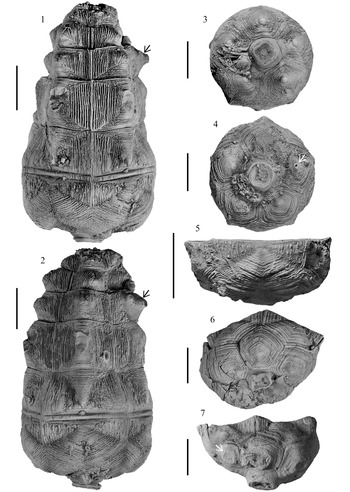
Halocrinites heinorum n. sp. from the Eifel (Rhenish Massif, Rhineland-Palatinate, Germany). (1–3) Paratype, cast of isolated crown (NHMMZ PWL 2021/6002-LS) from the Ahbach Formation (Eifelian/Givetian boundary beds) of the locus typicus (northern industrial area of Weinsheim, Prüm Syncline, 50°13′47.65″N, 6°29′02.68″E): (1, 2) lateral view; (3) aboral view. The multilamellar exobrachial layer of one brachial is postmortem infested by a trepostome bryozoan holdfast (?Leioclema sp.), see arrows in (1, 2). (4, 5) Holotype, isolated aboral cup (NHMMZ PWL 2021/6001-LS): (4) aboral view; (5) lateral view. One basal is postmortem infested by a trepostome bryozoan holdfast, see white arrow in (4) (locality and stratigraphy, see [1–3]). (6) Lateral-aboral view of a slightly compressed aboral cup from the Olifant Member of the Ahbach Formation (lowermost lower Givetian, hemiansatus Conodont Zone) of the abandoned “Müllertchen Quarry,” Üxheim-Ahütte (Hillesheim Syncline, 50°20′05.41″N, 6°46′16.81″E). (7) Lateral view of an anomalous aboral cup from the lowermost Loogh Formation (lower Givetian) of the southwestern industrial area of Weinsheim (Prüm Syncline, 50°13′33.88″N, 6°28′41.91″E) with one additional basal plate (arrow). Scale bars = 1 cm.

Diagnosis
A Halocrinites distinguished by a medium-high crown; plates covered by a thin succession of the multilamellar exoplacoid layer; surfaces of plates very fine and densely faceted at the exoplacoid margins; very low, bowl-shaped aboral cup; succession of multilamellar exobasal layer forming low central nodes, protruding proximally; radials with three linear depressions that radiate from the proximal and lateral edges of the radials and lead to aborally protruding plate centers and lateral plate edges; the succession of the multilamellar exobrachial layer tapers toward the lateral exterior, forming moderately developed nodes in uppermost brachials.
Occurrence
This new species is restricted to the Ahbach Formation (stratum typicum) and Loogh Formation (Eifelian–Givetian boundary beds to lowermost lower Givetian, Middle Devonian) of four localities within the Eifel (Rhenish Massif, Germany): (1) Ahbach Formation (Eifelian–Givetian boundary beds) of the northern industrial area of Weinsheim (Prüm Syncline), 50°13′47.65″N, 6°29′02.68″E (locus typicus); (2) strata exposed during roadwork for an extension of federal road “B51,” south of Brühlborn, northeast of Rommersheim (Prüm Syncline), 50°12′27.14″N, 6°27′37.45″E; (3) Loogh Formation (lower Givetian) of the southwestern industrial area of Weinsheim, 50°13′33.88″N, 6°28′41.91″E; (4) Olifant Member of the Ahbach Formation (lowermost Givetian, Polygnathus hemiansatus Conodont Zone) of the abandoned “Müllertchen Quarry,” Üxheim-Ahütte (Hillesheim Syncline), 50°20′05.41″N, 6°46′16.81″E.
Description
The single known crown (Fig. 2.1–2.3) is medium height and has a tapering ovate outline. The crown is 1.7 times higher than wide, with a maximum observed length/width of 57.0/33.0 mm. The aboral cup has a very low bowl shape (approximately 2.0 times wider than high); two uncompressed aboral cups have maximum height/width proportions of 14.0/28.0 mm and 16.0/33.0 mm. The diameters of the stem impressions of the two uncompressed specimens are 5.5 mm and 6.5 mm, infrabasals fused to a single plate, and the maximum widths of the infrabasal circlets are 11.0 mm and 8.0 mm, respectively. Three specimens have the following maximal length/width proportions of basal plates, which are slightly wider than high: 11.0/11.5 mm, 14.5/15.0 mm, and 15.5/16.5 mm; they have the following maximal length/width proportions of radial plates, which are 1.7 to 2.0 times wider than high: 9.5/17.5 mm, 11.0/19.0 mm, and 11.5/23.5 mm. The maximum height/width proportions of the articular plate (= first primibrachial), present in one specimen, is 1.0/19.5 mm, and the height/width of its five atomous arms, which are nearly 2.2 times higher than wide, is 42.5/19.5 mm. The seven primibrachials above the articular plate in the complete specimen range in dimension from 1.3 to 1.9 times wider than high (maximum height/width proportions: 10.0/19.5 mm, 11.5/14.5 mm, 7.0/12.5 mm, 6.5/10.5 mm, 5.0/8.5 mm, 3.0/4.5 mm, and 1.5/2.0 mm). All crown ossicles are covered by a well-developed, thin succession of the multilamellar exoplacoid layer that leads to plate surfaces with a very fine and densely faceted outline at the margins of the exoplacoid layers. The very low bowl-shaped aboral cup has a succession of the multilamellar exobasal layers. Each basal plate has one low and centrally positioned node that projects proximally and slightly toward the medium-wide stem impression in the center of the fused, pentagonal infrabasal circlet that is penetrated by one central and four peripheral axial canals. The five basal plates each have five depressions radiating in a straight line from each plate corner toward the plate center, which, in contrast to similar structures in the radial plates, is much less pronounced. Between these depressions, the dense succession of the multilamellar exobasal layer bulges very slightly outward. The five radials are also characterized by a dense succession of the multilamellar exoradial layer, and each is characterized by three linear depressions; two depressions radiate from the lateral margin toward the upper center of a radial plate below the articular plate, and one depression radiates vertically from the proximal edge of the radials in the oral direction, toward the upper center of the radials. This results in slightly aborally protruding plate centers and slightly aborally protruding lateral plate edges. The lowermost brachials above the articular plates are laterally flattened and have a pointed upside-down triangle formed by the multilamellar exobrachial layer, extending from the distal to proximal direction and protruding laterally. The facets of the exobrachial layer of this triangle run strictly horizontally and are angularly surrounded by those of the lateral and aboral facets. The succession of the multilamellar exobrachial layers of all higher brachials tapers toward the lateral exterior, forming moderately developed nodes formed of four triangular facets that are separated by burrs arranged in an X shape, running from the brachial edges toward the plate centers. The triangular facets of the second and third primibrachials are arranged strictly horizontally and vertically, whereas the laterally arranged facets of the uppermost brachials are inclined aborally toward one another, successively closing the uppermost aboral facets. The centers of the distal-most brachials have a small spine-like extension at the central top of the outermost exobrachial lamina. The column is medium wide, rounded quadrangular, and penetrated by one central and four peripheral axial canals.
Etymology
Named after Uwe Hein (Solingen) and Hans-Peter Hein (Wermelskirchen), the discoverers of the new species, who donated the type material to the NHMMZ.
Other materials
Isolated crown (Fig. 2.1–2.3), NHMMZ PWL 2021/6002-LS (cast), isolated aboral cups (Fig. 2.6, 2.7).
Remarks
Isolated aboral cups of H. heinorum n. sp. have been known for as many as 25 years and were first illustrated by Hauser (Reference Hauser1997, pl. 8, fig. 4) as Cupressocrinites abbreviatus aff. C. granulosa and by Bohatý (Reference Bohatý2006, p. 171, pl. 2, fig. 9) as Abbreviatocrinites abbreviatus. After the discovery of the first complete crown in 2020, it is possible to identify those isolated aboral cups on the basis of their characteristic combination of skeletal features. H. heinorum can be diagnosed from closely related species, including H. altus, H. geminatus, H. nodosus, and H. schlotheimii. Halocrinites altus (Schultze, Reference Schultze1866; see Bohatý, Reference Bohatý2009, p. 49; p. 47, figs. 2.9–11) has a similar fine and densely developed multilamellar exoplacoid layer that is even finer in H. heinorum. Schultze's species developed a much longer elongate and ovate crown with a spearhead-like shape of closed distal arms composed of more-numerous brachials than in the new species. The radials of H. altus have triangular radial facets, which are mirror images of the proximal facet of the first primibrachials above. This feature is not developed in H. heinorum. Although H. geminatus has similarly developed exobrachial spines, H. heinorum clearly differs by the development of a pentagonal infrabasal plate, which is strongly reduced in H. geminatus (compare Bohatý, Reference Bohatý2006, p. 175, pl. 4, figs. 1a, b, 2, 7a, 8, 13a, 13b, 14a, 14b), and has more coarsely developed exobasal nodes and longer exobrachial spines. H. nodosus (Sandberger and Sandberger, Reference Sandberger, Sandberger, Sandberger and Sandberger1856; see Bohatý, Reference Bohatý2009, p. 49; p. 47, figs. 2.1–2.2, 2.5–2.8) has a similar morphology of the crown and arms. However, the crown of H. nodosus is elongated and more ovate shaped than that in H. heinorum. The aboral cup of H. nodosus is higher and cone shaped (rarely high bowl shaped) with a small insertion for the stem, instead of a flattened bowl-shaped aboral cup with a medium to wide stem impression. The new species has centrally positioned nodes, which are not developed in the Sandbergers’ species. Although the distalmost skeletal layer of the multilamellar exobrachial laminae of H. nodosus has a similar central spine, the arms of H. heinorum differ by the development of the succession of the multilamellar exobrachial layer, tapering stronger toward the lateral exterior, forming moderately developed nodes formed of four triangular facets that are separated by burrs arranged in an X shape, which are not developed in H. nodosus. The multilamellar exoplacoid layer of the new species is much finer and denser compared with the Sandbergers’ type. Halocrinites schlotheimii schlotheimii (see Bohatý, Reference Bohatý2006, pl. 1, figs. 1–6, pl. 2, figs. 1–8, 10) has a coarser-developed multilamellar exoplacoid layer compared with H. heinorum. In addition, the central spine on the distalmost skeletal layer of the multilamellar exobrachial laminae of the new species is not developed in H. schlotheimii schlotheimii.
The multilamellar exobrachial layer of one brachial of the paratype (NHMMZ PWL 2021/6002-LS [cast]) was infested postmortem by a trepostome bryozoan holdfast (?Leioclema sp.; see arrows in Fig. 2.1, 2.2). The multilamellar exobasal layer of one basal of the holotype (NHMMZ PWL 2021/6001-LS) was also infested postmortem by a trepostome bryozoan holdfast (see white arrow in Fig. 2.4). Figure. 2.7 shows an anomalous aboral cup with one additional basal plate (see white arrow). This kind of growth anomaly was classified as “growth anomaly without classifiable causes—without indications of external influences” by Bohatý (Reference Bohatý2009, p. 53).
Halocrinites minor (Schultze, Reference Schultze1866) new combination
Figure 3
- Reference Schultze1866
Cupressocrinus abbreviatus var. minor Schultze, p. 12, 16, pl. 2, fig. 12a–f.
- Reference Schultze1867
Cupressocrinus abbreviatus var. minor Schultze, p. 128, 133, pl. 2, fig. 12a–f.
- Reference Bather1919
Cupressocrinus schlotheimi var. minor; Bather, p. 132.
- Reference Schmidt1941
Cupressocrinites schlotheimi var. minor; Schmidt, p. 7, 104.
- Reference Bassler and Moodey1943
Cupressocrinus abbreviatus var. minor; Bassler and Moodey, p. 384.
- Reference Bassler and Moodey1943
Cupressocrinites abbreviatus minor; Bassler and Moodey, p. 384.
- Reference Almela and Revilla1950
Aviadocrinus sampelayoi Almela and Revilla, p. 51, 55; pl. 3, figs. 1a–d, 2a, b, 3.
- Reference Sieverts-Doreck1953
Aviadocrinus sampelayoi; Sieverts-Doreck, p. 85, pl. 4, fig. 11.
- Reference Breimer1962
Cupressocrinites sampelayoi; Breimer, p. 160, fig. 38, pl. 16, figs. 4, 5.
- Reference Miesen1971
Cupressocrinites abbreviatus var. minor; Miesen, p. 14, pl. 2, fig. 5e.
- Reference Webster1973
Aviadocrinus sampelayoi; Webster, p. 91.
- Reference Webster1973
Cupressocrinites sampelayoi; Webster, p. 91.
- Reference Moore, Lane, Strimple, Moore and Teichert1978
Aviadocrinus sampelayoi; Moore, Lane, and Strimple, p. T658.
- Reference Głuchowski1993
Cupressocrinites sampelayoi; Głuchowski, p. 44, fig. 7A–F.
- Reference Chen and Yao1993
Cupressocrinites deltoides Chen and Yao, p. 65, pl. 6, fig. 3a, b.
- Reference Hauser1997
Cupressocrinites abbreviatus var. minor; Hauser, p. 63.
- Reference Hauser1997
Cupressocrinites schlotheimi var. minor; Hauser, p. 63.
- Reference Hauser1997
Cupressocrinites abbreviatus minor; Hauser, p. 65.
- Reference Hauser1997
Cupressocrinites inflatus; Hauser, pl. 23, fig. 6, pl. 25, fig. 2.
- Reference Hauser2001
Cupressocrinites sampelayoi; Hauser, p. 149, pl. 24, figs. 2, 3.
- Reference Bohatý2005a
Abbreviatocrinites sampelayoi; Bohatý, p. 203, 206, 208, 217, 220.
- Reference Bohatý2005a
?Cupressocrinites deltoides; Bohatý, p. 218, 220.
- Reference Bohatý2006
Abbreviatocrinites sampelayoi; Bohatý, p. 153, 162, 165, 177, pl. 5, figs. 4, 5.
- Reference Bohatý2006
?Cupressocrinites deltoides; Bohatý, p. 162.
- Reference Hauser and Landeta2007
Cupressocrinites sampeloyi (sic); Hauser and Landeta, p. 74, pl. 1, fig. 7.
- Reference Hauser2008
Cupressocrinites sampeloyi (sic); Hauser, p. 2, 20, text-fig. 32, p. 61, pl. 9, fig. 6.
- Reference Hauser and Landeta2009
Cupressocrinites sampeloyi (sic); Hauser and Landeta, p. 49, table 1, fig. 7.
- Reference Bohatý2009
Abbreviatocrinites sampelayoi; Bohatý, p. 46, 48, 59.
- Reference Webster, Waters and Chen2009
?Cupressocrinites deltoides; Webster, Waters, and Chen, p. 123, 125, 152, fig. 10a–c, 153, 157.
- Reference Bohatý and Herbig2010
Halocrinites sampelayoi; Bohatý and Herbig, p. 372, 381.
- Reference Hauser and Landeta2012
Cupressocrinites samelayoi (sic); Hauser and Landeta, p. 11.
- Reference Hauser2013
Cupressocrinites inflatus inflatus; Hauser, p. 10, text-fig. 24.
- Reference Hauser2013
Cupressocrinites aff. inflatus inflatus; Hauser, p. 32, pl. 4, fig. 6a, b.
- Reference Hauser2015b
Cupressocrinites sampeloyi (sic); Hauser, p. 3, 11, text-fig. 17, p. 42, pl. 5. figs. 1–3.
- Reference Hauser2015b
pars Cupressocrinites hibrida; Hauser, p. 11, text-fig. 16a–c; p. 42, pl. 5, figs. 12–14.
- Reference Lin and Fürsich2015
Cupressocrinites deltoides; Lin and Fürsich, p. 383, 386, fig. 2C–E.
- Reference Lin and Fürsich2015
Halocrinites sampelayoi; Lin and Fürsich, p. 386, fig. 2C–E.
- Reference Hauser2016a
Cupressocrinites sampeloyi (sic); Hauser, p. 7.
- Reference Hauser2021
Cupressocrinites sampeloyi (sic); Hauser, p. 24, text-fig. 4e.
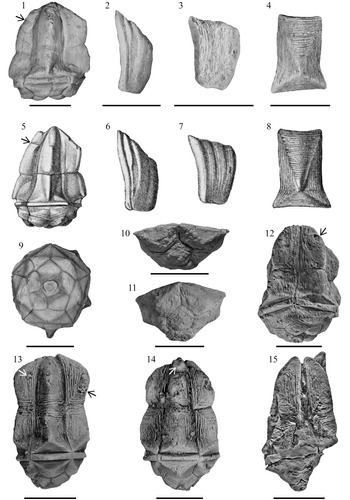
Halocrinites minor (Schultze, 1866) n. comb. (1, 5) holotype (MCZ-102972), photo (1) and original lithograph (5) of Schultze [1866 (1867), pl. 2, fig. 12] of an isolated crown from the Freilingen or Ahbach Formation (uppermost Eifelian or Eifelian/Givetian boundary beds, Middle Devonian) of Kerpen (Hillesheim Syncline, Eifel, Rhenish Massif, Rhineland-Palatinate, Germany) in lateral views. The anomalous specimen shows an additional brachial plate (arrows). (2, 6) paratype I (MCZ-102973), photo (2) and original lithograph (6) of Schultze [1866 (1867), pl. 2, figs. 12a -b] of an isolated brachial in lateral view (locality and stratigraphy, see figs. 1, 5). (3, 7) paratype II (MCZ-102974), photo (3) and original lithograph (7) of Schultze [1866 (1867), pl. 2, figs. 12c -d] of an isolated brachial in lateral view (locality and stratigraphy, see figs. 1, 5. (4, 8) paratype III (MCZ-102975), photo (4) and original lithograph (8) of Schultze [1866 (1867), pl. 2, figs. 12e–f] of an isolated brachial in lateral view (locality and stratigraphy, see figs. 1, 5). (9) holotype (MCZ-102972) in aboral view. (10–11) isolated aboral cups from the Upper Devonian (Neuville Formation, upper Frasnian) of the southern slope of the quarry 1.5 km WSW of the commune Villers-le-Gambon (Walloon city and municipality Philippeville, province of Namur, Belgium, UTM 50°11′06.72″N / 4°35′17.35″E). (12) aboral-lateral view of an isolated crown with a flattened low aboral cup from the Olifant Member of the Ahbach Formation (lowermost lower Givetian, hemiansatus Conodont Zone, Middle Devonian) of the abandoned “Müllertchen Quarry”, Üxheim-Ahütte (Hillesheim Syncline, Eifel, Rhenish Massif, Rhineland-Palatinate, Germany, UTM 50°20′05.41″N / 6°46′16.81″E). The multilamellar exobrachial layer of one brachial is postmortem infested by a trepostome bryozoan holdfast (arrow). (13–14) isolated crowns with typical bowl-shaped aboral cups from the Laskowa Gora Beds (Middle to upper Givetian, Middle Devonian) of the Holy Cross Mountains, Poland. Specimen no. 13 is postmortem infested by a microconchid valve (white arrow) and by the holdfast of a fenestrate bryozoan (black arrow). The anomalous specimen no. 14 shows an additional brachial plate (white arrow). (15) lateral view of an isolated crown with a funnel-shaped and long aboral cup from the Bohnert Member of the Freilingen Formation (upper Eifelian, Middle Devonian) of the locality “Auf den Eichen”, northeast of Nollenbach (Hillesheim Syncline, Eifel, Rhenish Massif, Rhineland-Palatinate, Germany). Scale bars = 1 cm.

Types
Holotype: isolated crown, MCZ-102972 (Fig. 3.1, 3.5, 3.9), original of Schultze (Reference Schultze1866, pl. 2, fig. 12, 1877, pl. 2, fig. 12]; paratype: isolated brachials, MCZ-109273 (paratype I, Fig. 3.2, 3.6), MCZ-102974 (paratype II, Fig. 3.3, 3.7), MCZ-102975 (paratype III, Fig. 3.4, 3.8).
Diagnosis
A Halocrinites distinguished by only two brachials above the articular plates; uppermost brachials higher than wide and taper toward the tip; strongly protruding laterally; oral view of closed arm crown rounded star shaped; maximum observed dimensions of adult crown (from the Eifelian of Morocco): height 46 mm/width 33 mm; aboral cup variable in shape (Fig. 3.12–3.15) from very low bowl (see Bohatý, Reference Bohatý2006, pl. 5, fig. 5a–b) to cone shape (Bohatý, Reference Bohatý2006, pl. 5, fig. 4); radials with triangular facet below the articular plates that is a mirror image on the brachials above the articular plates; column medium wide, proximal columnals rounded triangular, distal columnals nearly circular in cross section, with a central and three peripheral axial canals; distal columnals longer with few radice scars bearing short radices; proximal columnals short, without radices; holdfast distinguished by substrate-controlled variability in form ranging from an attachment disc to a variously formed holdfast composed of radiating radices; endoskeleton covered by a well-developed multilamellar exoplacoid layer; surfaces of plates faceted at the exoplacoid margins.
Occurrence
Eifelian of Jebel Issimour, west-southwest of Bou Dib, in the northern Maider, Anti Atlas, Morocco; Junkerberg, Freilingen, and Ahbach formations, middle to upper Eifelian and Eifelian–Givetian boundary beds, Middle Devonian of the Hillesheim, Prüm, Gerolstein, and Blankenheim synclines, Eifel, Rhenish Massif, Germany; Portilla Formation, Givetian, Middle Devonian of the Province of León, Spain; Devonian strata of the Yunnan Province southwestern People's Republic of China (Lin and Fürsich, Reference Lin and Fürsich2015); Laskowa Gora Beds, middle to upper Givetian, Middle Devonian of the Holy Cross Mountains, Poland; Neuville Formation, upper Frasnian, Upper Devonian of the southern slope of the quarry 1.5 km west-southwest of the commune Villers-le-Gambon, Walloon city and municipality Philippeville, province of Namur, Belgium; 50°11′06.72″N, 4°35′17.35″E.
Remarks
Halocrinites sampelayoi is herein declared a subjective junior synonym of Cupressocrinus abbreviatus var. minor. Halocrinites minor occurs supraregionally from the Eifelian (Middle Devonian) to the Frasnian (Upper Devonian). The species can be clearly distinguished from other species of Halocrinites with three peripheral axial canals in the column (H. inflatus and H. gibber, compare Bohatý, Reference Bohatý2006, pl. 5, figs. 1–3) as well as by characteristics of the crown. Isolated aboral cups can also be separated from calyxes of both mentioned species by the well-developed triangular facets on the radials. Due to the continuous range of aboral cup shapes, from very low bowl to cone shaped and long (see Bohatý, Reference Bohatý2006, pl. 5, figs. 4, 5a, b), it is not possible to separate the variable-shaped H. minor on the subspecies level.
The multilamellar exobrachial layer of one brachial of an isolated crown was infested postmortem by a trepostome bryozoan holdfast (see arrow in Fig. 3.12). A fenestrate bryozoan (black arrow in Fig. 3.13) and a microconchid valve (see white arrow in Fig. 3.13) infested an additional specimen. The anomalous holotype (MCZ-102972) has an additional brachial plate (see arrows in Fig. 3.1, 3.5). In addition, Fig. 3.14 shows an anomalous additional brachial plate (see white arrow). This anomaly can be interpreted either as a “growth anomaly without classifiable causes, without indications of external influences” or as a “premortem ossicular anomaly as a reaction of external interference, a wound healing and skeletal regeneration of brachial injuries” (Bohatý, Reference Bohatý2009, p. 53; also see Amemiya and Oji, Reference Amemiya and Oji1992; Meyer and Oji, Reference Meyer and Oji1993; Weissmüller, Reference Weissmüller1998; Gahn and Baumiller, Reference Gahn and Baumiller2005; Mozzi et al., Reference Mozzi, Dolmatov, Bonasoro and Carnevali2006).
Genus Cupressocrinites Goldfuß, Reference Goldfuß1831
Type species
Cupressocrinites crassus Goldfuß (Reference Goldfuß1831, p. 212, pl. 64, fig. 4a–i, k–m).
Other species
C. ahuettensis Bohatý, Reference Bohatý2009; C. dohmi Hauser, Reference Hauser1997; C. elongatus Goldfuß, Reference Goldfuß1839; C. hieroglyphicus (Schultze, Reference Schultze1866); C. hybridus (Schultze, Reference Schultze1866) n. comb.; C. longibrachialis Polyarnaya, Reference Polyarnaya1973; C. ornamentus Bohatý, Reference Bohatý2006; and C. steiningeri Bohatý, Reference Bohatý2006.
Diagnosis
See Bohatý (Reference Bohatý2009, p. 50).
Remarks
The following cupressocrinitids described by Hauser as Cupressocrinites goldfussi Hauser, Reference Hauser2007 and C.(?) wanneri Hauser, Reference Hauser1999 are herein excluded from the list of included species. (1) The isolated cup with a lost exoplacoid layer, described by Hauser (Reference Hauser2007, p. 59–62, text-fig. 3) as C. goldfussi is a junior synonym of C. ornamentus, which the author also intermixed with C. altus (= H. nodosus) (see Hauser, Reference Hauser2010a, p. 27, pl. 1, fig. 2, Reference Hauser2016a, p. 13, text-fig. 4, fig. 2). Therefore, the species, with a holotype deposited in a private collection, is not listed within the included species of the genus. (Note that the same crinoid was introduced by Hauser, Reference Hauser2006b on a private webpage, which does not meet ICZN regulations for acceptable taxonomic names; it therefore is considered nomen nudum.) (2) Cupressocrinites(?) wanneri (Hauser, Reference Hauser1999, p. 108–109, pl. 28, fig. 8) does not belong to family Cupressocrinitidae.
Cupressocrinites hybridus (Schultze, Reference Schultze1866) new combination
Figures 4, 5
- Reference Schultze1866
Cupressocrinus abbreviatus var. hybrida Schultze, p. 21, pl. 3, fig. 3.
- Reference Schultze1867
Cupressocrinus abbreviatus var. hybrida Schultze, p. 133, pl. 3, fig. 3.
- Reference Bassler and Moodey1943
Cupressocrinites abbreviatus hybridus; Bassler and Moody, p. 384.
- Reference Bassler and Moodey1943
Cupressocrinus abbreviatus var. hybrida; Bassler and Moody, p. 384.
- Reference Breimer1962
Cupressocrinites schlotheimi var. hybridus; Breimer, p. 167.
- Reference Miesen1971
Cupressocrinites hybrida; Miesen, p. 5.
- Reference Miesen1971
Cupressocrinites abbreviatus, var. hybrida; Miesen, p. 16, pl. 3, fig. 8.
- Reference Miesen1974
Cupressocrinites abbreviatus, var. hybrida; Miesen, p. 76, fig. 3.
- Reference Hauser1997
Cupressocrinites abbreviatus hybrida; Hauser, p. 12, 64.
- Reference Hauser2001
Cupressocrinites abbreviatus hybridus; Hauser, p. 10, fig. 3.
- Reference Hauser2001
Cupressocrinites elongatus; Hauser, p. 10, fig. 3.
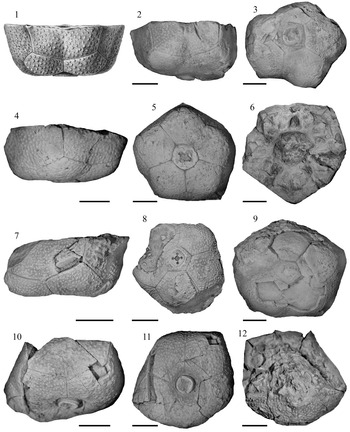
Cupressocrinites hybridus (Schultze, Reference Schultze1866) n. comb. from the Ahbach Formation (Eifelian/Givetian threshold, Middle Devonian) of an unknown fossil locality northwest of Kerpen, northeast of Berndorf (Hillesheim Syncline, Eifel, Rhenish Massif, Rhineland-Palatinate, Germany). (1) Original lithograph of Schultze (Reference Schultze1866, pl. 3, fig. 3, 1867, pl. 3, fig. 3) and (2, 3) photos of the holotype (MCZ-IPCR-1907): (1, 2) lateral view; (3) aboral view. (4–6) MCZIP-198680 (paratype II): (4) lateral view; (5) aboral view; (6) oral view. (7, 8) MCZIP-198683 (paratype IV): (7) lateral view; (8) oral view. (9) MCZIP-198679 (paratype I) in aboral view. (10–12) MCZIP-198682 (paratype III): (10) lateral-aboral view; (11) aboral view; (12) oral view. Scale bars = 1 cm.

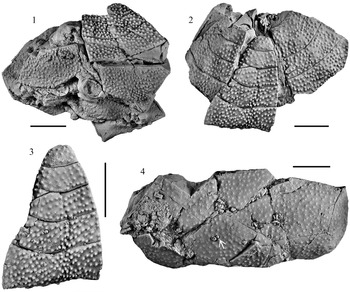
Cupressocrinites hybridus (Schultze, Reference Schultze1866) n. comb. from the Ahbach Formation (Eifelian/Givetian boundary beds, Middle Devonian) of the former western slope of the “Rauheck Quarry” (Syn. “Rauhheck”), northeast of Berndorf (Hillesheim Syncline, Eifel, Rhenish Massif, Rhineland-Palatinate, Germany, 50°18′37.95″N, 6°42′33.04″E). (1–3) Disarticulated crown: (1, 2) lateral views; (3) detail view of brachia. (4) Lateral view of a compressed aboral cup. The specimen is postmortem infested by microconchid valves (white arrow). Scale bars = 1 cm.

Types
Holotype: isolated aboral cup, MCZ-IPCR-1907 (Fig. 4.1–4.3); paratypes: isolated aboral cups, MCZIP-198679 (paratype I, Fig. 4.9), MCZIP-198680 (paratype II, Fig. 4.4–4.6), MCZIP-198682 (paratype III, Fig. 4.10–4.12), and MCZIP-198683 (paratype IV, Fig. 4.7, 4.8).
Diagnosis
A Cupressocrinites characterized by the development of conical, coarse nodes across aboral cup plates on the monolamellar exoplacoid layer of all crown plates; very low bowl-shaped, aboral cup with a well-developed, pentagonal infrabasal circlet that is fused into a single plate and penetrated by one central and four peripheral axial canals; basal plates moderately convex; each radial plate of adult specimens with one slightly developed, vertically radiating, and centrally positioned depression, leading to slightly aborally protruding lateral radial edges; based on the reconstruction of a disarticulated specimen (maximum length/width of radials: 11.5/19.5 mm; of arms: 19.5/27.5 mm). The juvenile crown is short and ovate, with an assumed height/width ratio of approximately 1/3 and a slight increase in height in the adult state; atomous arms known in single specimen, 1.4 times higher than wide, articular plates low and wide, without pinnules, higher brachials pinnule-bearing, with a strongly flattened W-shaped cross section.
Occurrence
Cupressocrinites hybridus n. comb. is restricted to the Ahbach Formation (stratum typicum) at the Eifelian–Givetian boundary in the Hillesheim Syncline (Eifel, Rhenish Massif, Germany) and occurs between the municipality of Kerpen (Schultze, Reference Schultze1866, p. 21, Reference Schultze1867, p. 133) in the east and the municipality of Berndorf in the west. The only verified site is the former western slope of the Rauheck Quarry (Syn. Rauhheck), northeast of Berndorf, which is now buried by a quarry road and by dump material; 50°18′37.95″N, 6°42′33.04″E.
Remarks
Schultze (Reference Schultze1866, p. 21, Reference Schultze1867, p. 133) suspected that C. hybridus n. comb. was a hybrid of C. elongatus and H. schlotheimii schlotheimii. Despite intensive site surveys within the Eifel region, it took more than 150 years to recover additional material on the basis of which it is now possible to demonstrate the autonomy of C. hybridus at the species level. The most decisive new discovery in this context was a disarticulated crown, by means of which the arm morphology could be recognized. Even if the overall morphology of the crown is similar to that of H. schlotheimii schlotheimii (see Bohatý, Reference Bohatý2006, pl. 1, figs. 1–6, pl. 2, figs. 1–8, 10), the two species clearly differ in the multilamellar exoplacoid layer of H. schlotheimii schlotheimii and the monolamellar exoplacoid layer of C. hybridus. The arms of C. hybridus have very flattened, W-shaped cross sections, whereas in H. schlotheimii schlotheimii they are V shaped. C. elongatus differs from C. hybridus by the long and cylindrical crown (see Bohatý, Reference Bohatý2006, pl. 10, figs. 1–3), the significantly longer arms, the higher number of brachials, the considerably smaller consolidating apparatus that is nestled against the radial plate edges, and the plate ornamentation that consists of pustules, tubercles, and/or coalesced ridges and/or tubercles. In contrast to C. hybridus, C. elongatus has an infrabasal plate that is clearly reduced to the stem insertion (compare Bohatý, Reference Bohatý2006, pl. 10, figs. 5b, 6). Both genera and all three species mentioned occur together in the Rauheck Quarry. The cups of C. hybridus also have certain similarities with those of C. ornamentus (see Bohatý, Reference Bohatý2006, pl. 11, figs. 1–5). The long and cylindrical crown, the more W-shaped brachials, and the fine and net-shaped ornamentation of the lateral brachials clearly distinguish the species from C. hybridus.
Figure 5.4 shows a compressed aboral cup that was infested postmortem by microconchid valves (see white arrow), one of the most common encrusting organisms on cupressocrinitid skeletons. Microconchids with unstructured or ornamented valves encrusted the ossicles of nearly 40% of the cupressocrinitids studied from the Rhenish Massif (Bohatý, Reference Bohatý2009, p. 57). It is remarkable that larger microconchoid individuals are rare and isolated (compare Bohatý, Reference Bohatý2006, pl. 5, fig. 14c), whereas numerous smaller microconchids encrusted the crinoids (see Bohatý, Reference Bohatý2009, p. 47, fig. 2.6, p. 58, fig. 11.7, 11.8). Presumably, the colonization occurred immediately postmortem, before shearing of the exoplacoid layers and ossicle disarticulation. The single species of encrusting microconchids on the columnals of Tantalocrinus scutellus Le Menn, Reference Le Menn1985 and Schyschcatocrinus creber Dubatolova, Reference Dubatolova1975 represent additional settlement examples (Głuchowski, Reference Głuchowski2005, p. 323, fig. 5I–L).
Discussion
The history of nomenclature of the Cupressocrinidae was long and confused until it was finally sorted (see Bohatý, Reference Bohatý2005a, Reference Bohatý2006, Reference Bohatý2009; Bohatý and Herbig, Reference Bohatý and Herbig2010). A part of this confusion has been the publications of J. Hauser (see reference list), including publication of private websites and privately published monographs. The Hauser website publications do not satisfy the provisions in the ICZN; thus, all names proposed on these websites are unavailable for nomenclatural purposes (they are all nomina nuda). Many of these names became available subsequently in the privately published books of Hauser (see reference list), which meet the minimum standards for publication as specified by the ICZN. These books contain numerous misspellings, which would have been greatly reduced if the books had been peer reviewed. Further, although only recommended in the code, type material should be deposited in a recognized museum, and specimen numbers should be clearly identified in the systematic chapters. We strongly recommend placing type specimens in recognized museum collections and entering new taxonomic names in ZooBank, all of which are necessary for continued stability of nomenclature.
Acknowledgments
The present work is dedicated to one of the leading researchers in Paleozoic crinoids, Dr. Gary Dean Webster (15 February 1934–21 January 2021), Professor Emeritus at Washington State University.
We thank J.D. Cundiff, collection manager of the Paleontological Invertebrate Collection; M.D. Renczkowski, curatorial assistant of the Paleontological Invertebrate Collection; A.J. Baldinger, collection manager of the Zoological and Malacological Invertebrate Collection; and R.S. Young, librarian of the Special Collections and M. Sears, head of Public Service Reference of the Ernst Mayr Library (all Museum of Comparative Zoology [MCZ] of Harvard University in Cambridge, Massachusetts, USA) for their research work in the MCZ databases, archives, and collection and for taking photos of the crinoid originals from the Schultze collection. We thank H. Römer (Walsdorf), U. Hein (Solingen), and H.-P. Hein (Wermelskirchen) for the discovery and the donation of several studied crinoids as well as for numerous important comments. We thank N. Jung (preparator at the Steinmann Institute of Geology, Mineralogy, and Paleontology of the Rhenish Friedrich-Wilhelm-University of Bonn, Germany) for making professional casts. Additional gratitude is extended to P. Zell (Department of Paleontology) for arranging the blackboard pages, to B. Steinbring (head of Inventarisation, both Hessian State Office for the Preservation of Historic Monuments and Sites, Wiesbaden, Germany) for helping with the photo work, and to M.J. Poschmann (General Direction for Cultural Heritage of Rhineland-Palatinate, Koblenz, Germany). F.T. Fürsich (GeoCenter North Bavaria, Friedrich-Alexander-University Erlangen-Nuremberg) and D. Weyer (Museum of Natural History, Leibniz Institute at the Humboldt University of Berlin, both Germany) helped with the literature research. Finally, we thank R.L. Pyle (ZooBank) for his advice on nomenclatural matters. The present article is intended to supplement the revision of cupressocrinitids by Bohatý (Reference Bohatý2005a, Reference Bohatý2006, Reference Bohatý2009) and Bohatý and Herbig (Reference Bohatý and Herbig2010), funded by the German Research Foundation (Deutsche Forschungsgemeinschaft, DFG; projects He 1610/16-1 and -2). D.L. Meyer (professor emeritus at the University of Cincinnati) and D.F. Wright (Smithsonian National Museum of Natural History) made important improvements to the final manuscript. We thank J. Jin (editor, Journal of Paleontology) and S. Zamora (associate editor, Journal of Paleontology) for their work as editors for this manuscript.