INTRODUCTION
Since the 1980s, the incidence of acute radiation enteritis appears to have increased, most likely because more than 50% of patients with cancer receive radiotherapy as a component of their treatment.Reference Bismar and Sinicrope1 Radical radiation therapy (RT) to pelvic cancers carries a risk of complications to normal tissues around the tumour. Acute complications affecting the gastrointestinal tract occur in ∼80% of patients, but they are usually mild and only rarely affect planned treatment.Reference Resbeut, Marteau and Cowen2,Reference Andreyev3 Symptoms tend to start during the second week of treatment (when histological change is probably at its maximum) and peak by the fourth to fifth week (when histological changes are stable or improving). The retrospective study by Gami et al.Reference Gami, Harrington, Blake, Dearnaley, Tait, Davies, Norman and Andreyev5 suggests that the quality of life is affected in approximately every second patient after radiotherapy by diarrhoea or constipation, in every tenth patient by pain and in every twentieth patient by rectal bleeding.
Post-radiation enteritis and colitis accompanied mainly by diarrhoea is the most serious complication of gastrointestinal symptoms in cancer patients and results from morphological and functional modifications of the intestinal epithelium after radiation. As diarrhoea often worsens the quality of life of irradiated patients, the general goal of anti-diarrhoeal therapy is to reduce fluid loss in the stool by inhibiting intestinal secretion, promoting absorption, and decreasing intestinal motility.Reference Donner4 The most commonly used agents for non-specific symptomatic treatment of radiotherapy-induced diarrhoea include opiate agonists such as loperamide and diphenoxylate.
In the last few years, the preventive use of probiotics appears to be one of the most promising strategies to lower undesirable acute gastrointestinal symptoms.Reference Urbancsek, Kazar and Mezes6–Reference Fuccio, Guido, Eusebi, Laterza, Grilli, Cennamo, Ceroni, Barbieri and Bazzoli8 Both experimental and clinical studies have shown that probiotic preparations can effectively modulate intestinal inflammation through altering the composition and the metabolic and functional properties of gut indigenous flora.Reference Famularo, De Simone and Matteuzzi9,Reference Fotiadis, Stoidis, Spyropoulos and Zografos10 Probiotics represent preparations containing viable and defined microorganisms in certain numbers which upon ingestion bring health benefits, e.g. probiotics increase concentrations of beneficial bacteria such as lactobacillus and bifidobacteria, and reduce the levels of pathogenic microorganisms.Reference Geier, Butler and Howarth11
VSL#3 was effective in reducing chemotherapy (CHT)-induced diarrhoea in rats.Reference Bowen, Stringer, Gibson, Yeoh, Hannam and Keefe12 Osterlund et al.Reference Osterlund, Ruotsalainen, Korpela, Saxelin, Ollus, Valta, Kouri, Elomaa and Joensuu13 conducted a randomised, controlled trial to examine the effect of lactobacillus and fibber supplementation in 5-fluorouracil (5-FU) CHT patients. The authors found that patients who received lactobacillus had less grade 3 or 4 diarrhoea, reported less abdominal discomfort, needed less hospital care and had fewer CHT dose reductions due to bowel toxicity compared with the control group. The benefits of probiotic therapy with VSL#3 have also been recorded in 490 patients during adjuvant radiotherapy after surgery for abdominal and pelvic cancer in a double-blind, placebo-controlled trial.Reference Delia, Sansotta and Donato14 The mean daily number of bowel movements for patients with radiation-induced diarrhoea was 12.3 ± 4 and 4.6 ± 2 among placebo and VSL#3 recipients, respectively. Similarly, a randomised studyReference Salminen, Elomaa and Minkkinen15 has demonstrated a decrease in the mean number of bowel movements (p < 0.05) and a decrease in the incidence of diarrhoea (p < 0.01) in patients ingesting Lactobacillus acidophilus. Another multi-centre, randomised, placebo-controlled nutrition trial reported that yogurt containing Lactobacillus casei DN-114 001 significantly improved the consistency of stool, without reducing the incidence of radiation-induced diarrhoea.Reference Giralt, Regadera, Verges, Romero, de la Fuente, Biete, Villoria, Cobo and Guarner16 Conclusions from meta-analyses and systematic reviews should be interpreted with caution, because in these studies different types of probiotics are used to examine the effects on state of disease.Reference Minocha17 Literature searches identified three randomised, controlled for prevention and one for the treatment of radiation-induced diarrhoea. These studies did not provide definitive conclusions that probiotic supplementation may be effective.Reference Fuccio, Guido, Eusebi, Laterza, Grilli, Cennamo, Ceroni, Barbieri and Bazzoli18
Oncologists in our hospital have been using Hylak preparation for the revitalisation of the ecosystem of the gut during and after radiotherapy. Their experience with the use of probiotics has been limited until now.
The aim of our study has been to evaluate and compare the clinical effects of preventive administration of the preparation “5” Strain Dophilus and Hylak in patients during radiotherapy with a closer focus on the amount and severity of the diarrhoea.
METHODS
The study design was that of a randomised parallel-group non-placebo-controlled trial in which 42 oncology patients underwent adjuvant post-operative RT in the abdominal and pelvic region. Patients who received RT with CHT were included, too. All study subjects did not suffer from gastrointestinal disorders. The patients were randomly selected when they were admitted to hospital from June 2005 till March 2006. They were subdivided into two groups: the first group was administered “5” Strain Dophilus (L-Group) and the second group was administered Hylak (H-Group). The treatment arms were not balanced with gender and primary tumour site.
With regard to acute gastrointestinal symptoms influencing the quality of life of the patients during RT, we monitored the daily number of bowel movements, their consistency (solid, semi-solid, liquid), the presence of bleeding, abdominal pain, and the use of anti-diarrhoeal medication (diphenoxylate) or antibiotics. All patients received a paper form in which they recorded monitored parameters on a daily basis during RT. The patients were instructed to report on every complaint or symptom.
Exclusion criteria were: previous radiation treatments, current antibiotics therapy, the use of antibiotics during the previous 2 weeks, established gastrointestinal disease (chronic diarrhoea, Crohn’s disease, ulcerative colitis). Any patient whose medical condition required antibiotic therapy during RT was excluded from the group.
Each patient was advised about the treatment, and a note indicating that informed consent to participate had been given was inserted in his/her medical record.
The design of this study was approved on April 28, 2005 by the Ethics Committee at the Central Military Hospital Ruzomberok. Participants signed a written informed consent form, according to the Helsinski Declaration.
Study participants in L-Group were administered the probiotic preparation “5” Strain Dophilus with an enteric coating and containing five probiotic cultures (55% Lactobacillus rhamnosus, 20% Bifidobacterium adolescentis, 5% L. acidophilus, 5% Bifidobacterium longum, 15% Enterococcus faecium) with a count of 6 billion active bacteria/capsule at a daily dosage of 2 × 1 capsule.
Patients in H-Group were administered the Hylak Tropfen Forte preparation, i.e., cell-free fermentation products of Lactobacillus helveticus and gut symbionts (100 ml containing: 24.95 g Escherichia coli metabolita, 12.5 g Streptococci faecalis metabolita, 12.5 g Lactobacilli acidophili metabolita, 49.9 g Lactobacilli helvetici metabolita) in doses of 40 drops, three times per day.
Radiation was delivered by a Cobalt-60 unit by using the four-field box technique. The doses were divided into 2 Gy per day over 5–7 weeks to give the total cumulative dose of 50 Gy (2 Gy/day). High-risk patients (e.g. patients with prostate cancer), received dosage 65–67 Gy (2 Gy/day).
Data were analyzed statistically. The significance of differences between the groups was evaluated by the Student’s t-test (Microsoft Excel, version 2002).
RESULTS
The median age of the 22 patients from L-Group was 62 years (range, 34–82 years); 10 patients were diagnosed with colorectal cancer, 4 with rectosigmoid junction cancer, 3 with uterine cancer, 3 with urinary bladder cancer, 1 with cervical cancer and 1 with sigmoid colon cancer. The gender ratio (male/female) was 12/10. Ten patients had normal body weight [body mass index (BMI) < 25], 10 were overweight (BMI < 30), and 2 suffered severe obesity (BMI > 30).
The median age of the 20 patients from H-Group was 67 years (range, 43–83 years); 3 patients were diagnosed with colorectal cancer, 6 with rectosigmoid junction cancer, 1 with uterine cancer, 1 with anus and anal canal tumour, 8 with prostate tumour and 1 with urinary bladder cancer. The gender ratio (male/female) was 16/4. Seven patients had normal body weight (BMI < 25), 10 were overweight (BMI < 30), and 3 suffered severe obesity (BMI > 30).
At the same time, 55% of the patients in L-Group and 50% in H-Group received CHT, viz., 500 mg 5-FU i.v. lx/week together with RT.
The mean daily number of bowel movements for patients in L-Group was 4.16 (1.2–9.7) and 2.52 (0.7–5.3) in H-Group. A 62.5% of patients in L-Group and 81% of patients in H-Group had the mean daily number of bowel movements ≤4 bowel movements/day.
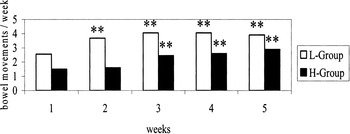
The mean weekly numbers of bowel movements in L-Group were significantly higher from second week onward (p < 0.01). The number of bowel movements did not rise until the third week in H-Group (p < 0.01) (Figure 1).
Comparison of mean weekly numbers of bowel movements during RT (*p < 0.05, **p < 0.01).

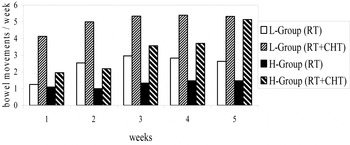
Marked differences could be observed when comparing the mean numbers of bowel movements in patients receiving only radiotherapy and patients undergoing a combination of radiotherapy and CHT (Figure 2).
Comparison of mean weekly numbers of bowel movements during only RT or during RT+CHT.

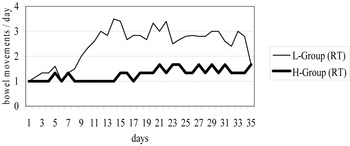
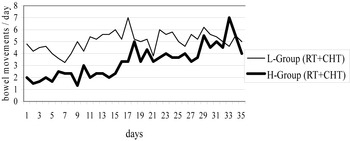
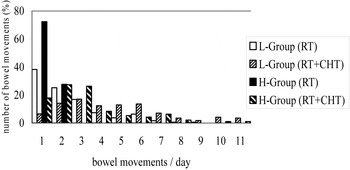
The mean weekly numbers in L-Group with RT varied from 1.3 to 2.8, compared with 4.1–5.3 in the same group but with RT+CHT. The mean weekly numbers in H-Group with RT varied from 1 to 1.5, compared with 2–5.1 in the same group but with RT+CHT. These differences between patients with only RT or with RT+CHT can been seen in Figures 3–5, which also demonstrate that the increase in the number of bowel movements occurred in the second week of receiving pelvic radiation.
Comparison of mean numbers of bowel movements per day during only RT.

Comparison of mean numbers of bowel movements per day during RT+CHT.

Frequency distribution of mean daily bowel movement throughout treatment period.

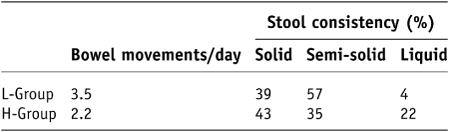
During RT, 27% of patients in L-Group required diphenoxylate treatment compared with 55% in H-Group, and 9% needed administration of antibiotics compared with 25% in H-Group. As we could not estimate the way in which these treatments influenced the composition of intestinal bacterial flora, these patients were excluded from our comparisons. In terms of the stool consistency, the L-Group produced 39% solid, 57% semi-solid and 4% liquid stools, whereas the H-Group produced 43%, 35% and 22%, respectively (Table 1).
Comparison of the stool consistency during RT

Abdominal pain was reported by 25% of L-Group patients and by 22% of H-Group patients. All these patients were being treated with pelvic radiotherapy with CHT, except for one patient of L-Group. CHT thus seemed to result in increased toxicity.
Blood in the bowel movement was reported by one patient of H-Group (9 days).
None of the patients discontinued treatment for gastrointestinal toxicity. Based on the paper forms of patients, compliance regarding consumption of the preparations was 95%.
DISCUSSION
Our results demonstrate that the probiotics used improve the quality of life of radiated patients by positively influencing the incidence of diarrhoea. The mean daily number of bowel movements in both L-Group and H-Group (4.16 vs. 2.52) is comparable to the Figure 5.1 ± 3, which Delia et al.,Reference Delia, Sansotta and Donato19 mention in their study with VSL#3. The higher values in L-Group could be related to probiotic administration, which causes an increase of bacterial mass volume by the higher creation of short-chain fatty acids, lower pH, and increased osmolarity.Reference Cummings20 When analyzing average daily numbers of bowel movements within the groups in more detail, we observed that higher average daily number of bowel movements occurred in patients who had received both pelvic radiotherapy with CHT (5-FU), but the number did not reach the values presented by Delia et al.,Reference Delia, Sansotta and Donato19 in the placebo group (14.7 ± 6). A comparison of the consistency of the stools showed fewer liquid stools in L-Group than in H-Group (4% vs. 22%).
Administration of anti-diarrhoeal agents (diphenoxylate) was required by 27% of patients from L-Group and 55% of patients from H-Group. The result in L-Group was more favourable than the results of the study by Kollmorgen et al.,Reference Kollmorgen, Meagher and Wolff21 who recorded a 58% use of Imodium or Lomotil in the group with chemoradiotherapy, compared with 5% in a group without radiotherapy.
Analogous to study by Gami et al.,Reference Gami, Harrington, Blake, Dearnaley, Tait, Davies, Norman and Andreyev5 we concluded that abdominal pain and rectal bleeding are a significantly less-frequent complication of pelvic irradiation than diarrhoea.
Malnutrition per se is an independent adverse prognostic factor in many cancers. It may occur due to physiological, metabolic, psychological or iatrogenic processes, which exist as a result of malignancy.Reference Bozzetti22 Immediately before the start of pelvic radiotherapy treatment, the incidence of malnutrition varied by 11–33% and about 83% of patients lost weight during treatment.Reference McGough, Baldwin and Frost23 Despite the patients in our groups not having been on an identical diet, we observed no significant changes in the body weights of the patients when we compared their average BMI values before and after radiotherapy.
A number of radiotherapy techniques are used to treat cancers within the pelvis. These may influence the dose that is delivered to the tumour and surrounding structures. Acute radiation injury reflects direct damage to the epithelium resulting in direct injury to the cell nucleus with cell death. Radiation enteritis is a summary of inflammatory and degenerative processes affecting all parts of gastrointestinal tract that develop following a radiation dose of 8 Gy and higher approximately after 5–8 days after exposureReference Blanarova, Galovicova and Petrasova24 Acute symptoms include diarrhoea, abdominal pain, tenesmus or nausea that usually start during the second or the third week of a radical radiotherapy course and resolve within 2 weeks after radiotherapy completion. Micrometastasis or subclinical disease within the pelvic tissues should respond to 50 Gy; however, gross or bulky disease requires higher doses.Reference Abe, Takahashi, Yabumoto, Adachi, Yoshii and Mori25 The fact that radiation-caused damage of the gastrointestinal tract area limits the effectiveness of abdominal radiotherapy treatment is well known from clinical and experimental studies. Our results support the notion of Delia et al. that bacteria therapy by means of a probiotic preparation can protect patients from the risk of radiation-caused diarrhoea, a side-effect that can lead to the interruption of RT or the lowering of the radiation dose.Reference Delia, Sansotta and Donato14 Thus, the administration of probiotics during RT could ultimately allow patients to receive a greater cumulative radiation tumour dose, thereby increasing the effectiveness of radiotherapy on tumours.
Although a higher average number of bowel movements was seen in L-Group compared to H-Group, the probiotic preparation seemed to be more favourable than the Hylak preparation with respect to other monitored parameters. In spite of our observations that both preparations improve the quality of life of radiated patients in terms of the occurrence and severity of diarrhoea, these effects should be verified on more extensive groups of patients.
In our study, the supplemented preparations were well accepted and did not reveal any adverse effects.
CONCLUSION
This study has demonstrated the benefits of probiotic therapy with “5” Strain Dophilus for the prevention and/or reduction of both the incidence and severity of radiation-induced diarrhoea associated with adjuvant radiation treatment after surgery for abdominal cancer.
Results from our study also indicate that probiotics can be of value in the prevention of radiation-induced diarrhoea. Further studies are needed for confirmation of this suggestion.
Acknowledgements
This research received no specific grant from any funding agency in the public, commercial or not-for-profit sectors. There are no conflicts of interest.