Socio-political battles over abortion have marked American society for several decades. Second-wave feminists in the late 1960s pushed for greater access to safe abortions and by 1973 the U.S. Supreme Court legalized the right to abortion at a federal level (Roe versus Wade Supreme Court decision). In the subsequent years, women have routinely relied upon this right in their reproductive lives, as nearly 25% of all pregnancies end in abortion (Jones and Kooistra Reference Jones and Kooistra2011) and almost one-third of all American women will have an abortion by age 45 (Finer and Henshaw Reference Finer and Henshaw2006).
This expansion of abortion rights and services has generated much debate, relief, and anguish to different sections of the U.S. population. Social movement organizations have mobilized around the idea of either protecting or dismantling the right to an abortion. At one end of the continuum, liberal pro-choice and reproductive justice organizations oppose most legal restrictions on abortion; at the other end, reactionary pro-life movement activists condemn abortion under any circumstances, often equating it with inflammatory acts like “murder.”
Abortion opponents have created a network of advocacy groups that seek to diminish or outlaw abortions. By creating a two-level attack, pro-life groups want to shrink the “demand side” by enacting laws that mandate parental consent for minors or impose waiting periods before women can have abortions (Joffe Reference Joffe2018). When focusing on the “supply side,” pro-life organizations also push for policies that undermine the existence of abortion facilities. While the abortion legislative process is influenced by many players, the voting, lobbying, and protest actions of pro-life organizations have made it more difficult to have an abortion in the United States (Medoff Reference Medoff2012; Htun and Weldon Reference Htun and Weldon2015). Although the pro-life movement has altered federal laws and policies, its biggest impact has been in state politics (this might change if the Supreme Court rules against Roe versus Wade with the recent addition of the anti-abortion members Neil Gorsuch and Brett Kavanaugh). By 2017, 42 states let hospitals refuse to do abortions while another 32 states disallowed governmental funding of abortions and 10 states require viewing of an ultrasound of the pregnancy before the patient could secure an abortion (Guttmacher Institute 2017). In addition to their legislative “successes,” the pro-life movement has shaped media coverage of abortion (Rohlinger Reference Rohlinger2014), created recent protests in Washington DC (Heaney Reference Heaney2018), shamed people going into abortion clinics, and formed an extensive web of “pregnancy crisis” centers that try to persuade pregnant women against the use of elective abortions (Hussey Reference Hussey2014; McVeigh, Crubaugh, and Estep Reference McVeigh, Crubaugh and Estep2017). Moreover, the more violent wings of the movement has harassed/murdered abortion providers and vandalized/bombed abortion clinics (Doan Reference Doan2009) and the hostile protests of local pro-life groups has at times resulted in the traumatization of women seeking abortions (Foster et al. Reference Foster, Kimport, Gould, Roberts and Weitz2013), problems of recruitment and retention of staff in medical facilities (Fitzpatrick and Wilson Reference Fitzpatrick and Wilson1999), and eventual closures of abortion clinics (Medoff Reference Medoff2012).
Social movements try to recruit and retain members to survive but the proportion of people who politically act on their abortion attitudes is remarkably small. For example, one study found that only 2.4% of college students who strongly opposed abortion ever volunteered at a Crisis Pregnancy Center (Firmin, Hwang, and Wood Reference Firmin, Hwang and Wood2007). To understand why some people become pro-life activists, this study explored the contextual and social-psychological antecedents to anti-choice or “pro-life” activism. Variable selection in this study was guided by the “resource-model” of political participation (Brady, Verba, and Schlozman Reference Brady, Verba and Schlozman1995) as well as empirical studies on pro-life activists (e.g., Granberg Reference Granberg1982a; Maxwell and Jelen Reference Maxwell and Jelen1996; Kaysen and Stake Reference Kaysen and Stake2001; Swank and Fahs Reference Swank and Fahs2016). Even though the empirical literature on abortion attitudes is vast and well established (Elder and Greene Reference Elder and Greene2016; Kelly and Gauchat Reference Kelly and Gauchat2016), studies on the motivations of pro-life protests are much rarer, older, and mostly descriptive (Luker Reference Luker1984). Moreover, these older samples generally lack comparison groups of people who did not attend pro-life events (Granberg Reference Granberg1982a; Wilcox and Gomez Reference Wilcox and Gomez1990; Gross Reference Gross1995; Maxwell and Jelen Reference Maxwell and Jelen1996) and newer studies are limited to samples of current college students (Swank and Fahs Reference Swank and Fahs2016), middle-aged women who graduated from college (Blankenship et al. Reference Blankenship, Frederick, Savaş, Stewart and Montgomery2017), Amazon Mechanical Turk Employees (Allen, McCright, and Dietz Reference Allen, McCright and Dietz2017), volunteers in pro-life pregnancy centers (Hussey Reference Hussey2014) or people who attended the March for Life in 2017 (Heaney Reference Heaney2018; Reference HeaneyHeaney forthcoming).
This study expands upon prior research in four ways. First, the analysis employs data from the 2010 to 2012 Evaluations of Government and Society Study American National Election Surveys (ANES) project. Previous explanatory studies mostly use 1980s data that may not totally reflect the dynamics of more recent manifestations of pro-life activism (Granberg Reference Granberg1982a; Wilcox and Gomez Reference Wilcox and Gomez1990; Gross Reference Gross1995; Maxwell and Jelen Reference Maxwell and Jelen1996). The socio-political climate and the organizing practices of the pro-life movement has slightly changed over the last several decades (Liss-Schultz Reference Liss-Schultz2018) and there is some evidence the proportion of people who call themselves “pro-life” have been slowly growing since 1995 (Gallup Reference Gallup2019). Second, the random selection of ANES participants has less selection biases than all of the pro-life activism studies with convenience or snowball samples (Wilcox and Gomez Reference Wilcox and Gomez1990; Swank and Fahs Reference Swank and Fahs2016; Blankenship et al. Reference Blankenship, Frederick, Savaş, Stewart and Montgomery2017). Third, the sample includes a large number of people who have and have not engaged in pro-life activism. Most studies only explore the worldviews of activists (i.e., Gross Reference Gross1995; Kaysen and Stake Reference Kaysen and Stake2001; Hussey Reference Hussey2014; Heaney Reference Heaney2018; Reference HeaneyHeaney forthcoming) but this study has a comparative mode that examines how activists differ from non-activists. Lastly, the ANES data traces a wide range of possible antecedents to pro-life activism. Earlier quantitative studies often limit themselves to only a few educational, religious, or gendered sources of pro-life activism while this study is more comprehensive in the selection of independent variables.
LITERATURE REVIEW
To explore the sources of pro-life activism the researcher turned to studies on pro-life political behaviors and the “political resource model” of political participation (Brady, Verba, and Schlozman Reference Brady, Verba and Schlozman1995). The resource model argues that people stay out of politics because “they can't, they don't want to, or nobody asked” (Brady, Verba, and Schlozman Reference Brady, Verba and Schlozman1995). The notion of “they can't” suggests a dearth of necessary resources to be political. While there are many crucial resources behind political activism, the resource model emphasizes the role of financial situations, educational attainment, free time, and civic skills. The claim of “they don't want to” deals with a lack of interest in politics. Indifference to politics is sometimes seen as apathy or political ignorance, but the resource model assumes that lack of participation is connected to the approval of the status quo, a lower sense of political efficacy, and greater levels of individualism. The “nobody asked” idea implies that people are isolated from the recruitment networks that mobilize citizens into action.
“They can't”: Income, Educational, and Marital Matters
The “resource model” assumes that upper and middle-class individuals possess the educational and economic resources that make activism easier. Increased educational attainment seems to lessen pro-life sentiments (Bolzendahl and Myers Reference Bolzendahl and Myers2004; Osborne and Davies Reference Osborne and Davies2012; Norrander Reference Norrander2014; Elder and Greene Reference Elder and Greene2016; Kelly and Gauchat Reference Kelly and Gauchat2016; Clark Reference Clark2017; Stout, Kretschmer, and Ruppanner Reference Stout, Kretschmer and Ruppanner2017; Adamczyk and Valdimarsdóttir Reference Adamczyk and Valdimarsdóttir2018), but access to education may have different effects for pro-life activism. Several studies claim that education increases the support of right to life groups among conservatives (Olson Reference Olson2016) and pro-life activists have greater educational attainment than most Americans (Granberg Reference Granberg1982a; Maxwell and Jelen Reference Maxwell and Jelen1995; Norrander and Raymond Reference Norrander and Raymond1998; Kaysen and Stake Reference Kaysen and Stake2001). Conversely, other studies found that greater educational attainment lessened pro-life advocacy (Wilcox and Gomez Reference Wilcox and Gomez1990; Gross Reference Gross1995; Munson Reference Munson2009; Swank and Fahs Reference Swank and Fahs2016; Allen, McCright, and Dietz Reference Allen, McCright and Dietz2017) or that education is unrelated to pro-life activism (Maxwell and Jelen Reference Maxwell and Jelen1996).
The role of income in pro-life activism probably counters the resource model. Three studies suggest that income failed to predict pro-life activism (Gross Reference Gross1995; Norrander Reference Norrander2014; Swank and Fahs Reference Swank and Fahs2016) while three others claimed that pro-life sympathizers and activists are poorer than most conservative Christians (Olson Reference Olson2016) or the general population (Allen, McCright, and Dietz Reference Allen, McCright and Dietz2017).
Household income, abortion attitudes, and political engagements can be related to a person's current marital status. Traditionally women have been advised to find an affluent husband, birth multiple children, and forego the paid workforce in lieu of staying at home (Burns, Schlozman, and Verba Reference Burns, Schlozman and Verba2001). Fathers are supposed to prioritize work commitments over day-to-day family obligations and become the primary income makers for their nuclear family. The creation of the conventional family structure often lessens the political participation of women (Plutzer and McBurnett Reference Plutzer and McBurnett1991), but it can have an opposite effect on pro-life activism. Several studies have shown that married women, as compared to single or divorced women, often endorse more conservative attitudes on abortion (Kayson and Stake Reference Kaysen and Stake2001; Bolzendahl and Myers Reference Bolzendahl and Myers2004; Jelen Reference Jelen2015; Elder and Greene Reference Elder and Greene2016; Clark Reference Clark2017; Mohamed Reference Mohamed2018) and feminist politics (Stout, Kretschmer, and Ruppanner Reference Stout, Kretschmer and Ruppanner2017). Marriage and becoming parents can also translate into political behaviors as pro-life women were more likely to be married and have more children than women in the general populace (Kaysen and Stake Reference Kaysen and Stake2001; Hussey Reference Hussey2014; Norrander Reference Norrander2014; Swank and Fahs Reference Swank and Fahs2016).
“They don't want to”: Framing Gender and Abortion Grievances
Competing social movement organizations generally frame abortion as either a “moral injustice” or a “right” (Ferree et al. Reference Ferree, Gamson, Rucht and Gerhards2002). Pro-life groups traditionally frame abortion as an issue of moral purity, “traditional family values,” and “protecting the unborn” (Merola and McGlone Reference Merola and McGlone2011). In the last decade, some pro-life groups discuss the presumed trauma of having abortions (Doan, Candal, and Sylvester Reference Doan, Candal and Sylvester2018; Kelly Reference Kelly2014), but this message is not emphasized in most pro-life organizations (Trumpy Reference Trumpy2014). The extent to which an individual likes and accepts pro-life messages depends on the perceived credibility and salience of the frames voiced by pro-life organizations and activists (Tarrow Reference Tarrow2011). Because collective action frames are multidimensional (Benford and Snow Reference Benford and Snow2000), and pro-life organizations lack a unified master frame (Munson Reference Munson2009), my goal was to identify which frames resonated the most with pro-life activists.
Perceptions of Gender Injustice and the Moral Legitimacy of Abortion
Abortion attitudes often connect to an individual's stance on proper gender roles, women's control over their reproductive decisions, and religious dictates. Studies show that the endorsement of traditional gender roles is associated with abortion opposition (Petterson and Sutton Reference Petterson and Sutton2018) and some multivariate studies found that benevolent and hostile sexism were the strongest predictors of pro-life sentiments (Osborne and Davies Reference Osborne and Davies2012; Begun and Walls Reference Begun and Walls2015; Petterson and Sutton Reference Petterson and Sutton2018). The worldview of pro-life activists also seems full of conservative gender expectations. Studies suggest that pro-lifers are alarmed about premarital sex, think men should determine women's reproduction decisions, reject divorce for women, are upset when “boys act like girls,” want men to be protectors of women, demean homosexuality, think women are inferior political leaders, and object to women in the workforce (Granberg Reference Granberg1982a; Luker Reference Luker1984; Munson Reference Munson2009; Begun and Walls Reference Begun and Walls2015; Swank and Fahs Reference Swank and Fahs2016; Petterson and Sutton Reference Petterson and Sutton2018). Finally, pro-life activists also downplay the extent of contemporary discrimination against women of color and lesbians (Reference HeaneyHeaney forthcoming) and think the practices of widespread biases against women is of the past (Blankenship et al. Reference Blankenship, Frederick, Savaş, Stewart and Montgomery2017).
While gender conservatism may precede pro-life activism, so might panic over a “feminist-secularization” of the United States. In pro-life circles, religious convictions seem vital to the direct action protests against abortion providers (Maxwell and Jelen Reference Maxwell and Jelen1995; Adamczyk and Valdimarsdóttir Reference Adamczyk and Valdimarsdóttir2018). Anti-abortion politicking might spring from religious doctrines that combine condemnations of abortion with a belief that government should regulate the “baser” drives of humans. Religious tenets can also offer a rationale for being a devout activist who disobeys secular laws in order to “please God” and get a better afterlife (Olson Reference Olson2016). Accordingly, some studies contend that pro-life activism is driven by vague imperatives to “preserve basic morals” (Gross Reference Gross1995), bring back “God's laws,” or save the nation from moral decline (Maxwell and Jelen Reference Maxwell and Jelen1995). Moreover, people who attended pro-life events often say their religion guides their daily routines (Begun and Walls Reference Begun and Walls2015; Mohamed Reference Mohamed2018) and call themselves religious fundamentalists (Wilcox and Gomez Reference Wilcox and Gomez1990; Kelly and Gauchat Reference Kelly and Gauchat2016; Clark Reference Clark2017; Adamczyk and Valdimarsdóttir Reference Adamczyk and Valdimarsdóttir2018).
“Nobody asked”: Social Networks and Mobilizing Structures
Social networks, which represent webs of recurring interactions between people and groups, always convey some sort of beliefs, values, norms, and identities. Messages in the media or the internet can shape abortion attitudes (Detenber et al. Reference Detenber, Gotlieb, McLeod and Malinkina2007) but many scholars argue that face-to-face conversations with others are more fundamental to political engagements (Schussman and Soule Reference Schussman and Soule2005). Ziad Munson, in the Making of Pro-Life Activists, suggests that pro-life activism generally evolves through a set of gradual and mundane social interactions (Munson Reference Munson2009). In going through a face-to-face socialization process, political bystanders often become budding activists when someone invites them to a pro-life event. If a neophyte accepts this request, they often join some “anti-abortion activities, not so much out of preconceived commitment to the cause, but because of simple curiosity, solidarity with a friend, or a promise to go with a neighbor to an anti-abortion meeting” (Munson Reference Munson2016, 1). After that initial meeting, uncommitted novices turn into full-fledged activists if they consistently return to these pro-life organizations and friendship circles.
Several quantitative studies agree that pro-life activists often converse with friends and family who urge them to be politically active (Olson Reference Olson2016) and disdain abortions (Gross Reference Gross1995; Norrander and Raymond Reference Norrander and Raymond1998; Hussey Reference Hussey2014). Others studies highlight the centrality of pro-life peers as they found that most pro-life activists have befriended someone who accepts a pro-life label (Kaysen and Stake Reference Kaysen and Stake2001; Swank and Fahs Reference Swank and Fahs2016).
Religious settings can provide opportunities to hear anti-choice discourse and meet anti-abortion activists (Djupe and Gilbert Reference Djupe and Gilbert2009). Prayers and sermons by Protestant clergy often tell their members to be politically engaged and offer information about elected officials and political events (Brewer, Kersh, and Petersen Reference Brewer, Kersh and Petersen2003) while priests-newsletters in Catholic Churches often tell congregants to be against abortions and how to vote on morality amendments and political candidates (Scheitle and Cornell Reference Scheitle and Cornell2015; Holman and Shockley Reference Holman and Shockley2017). People who are highly religious often seek an end to legal abortions (Bolzendahl and Myers Reference Bolzendahl and Myers2004; Elder and Greene Reference Elder and Greene2016) as do people who regularly attend religious services (Begun and Walls Reference Begun and Walls2015; Allen, McCright, and Dietz Reference Allen, McCright and Dietz2017). Immersion in fundamentalist and conservative religions often diminishes the general political activism of women (Cassese and Holman Reference Cassese and Holman2016) but membership in religious groups can spurn higher levels of pro-life activism (Swank and Fahs Reference Swank and Fahs2016). Similarly, pro-life activism is especially common among people who are employed by religious institutions (Calfano, Oldmixon, and Gray Reference Calfano, Oldmixon and Gray2014) or have joined groups that praise activism (Olson Reference Olson2016) and call themselves pro-life organizations (Granberg Reference Granberg1982b; Maxwell and Jelen Reference Maxwell and Jelen1995; Norrander and Raymond Reference Norrander and Raymond1998; Munson Reference Munson2009; Swank and Fahs Reference Swank and Fahs2016; Husain and Kelly Reference Husain and Kelly2017). This link of religiosity to pro-life activism is probably due to the fact that members of conservative churches often ground their political commitments in the recommendations of their clergy or conservative political advocacy groups (McVeigh and Sikkink Reference McVeigh and Sikkink2001; Calfano, Oldmixon, and Gray Reference Calfano, Oldmixon and Gray2014).
Research Aims
This research explores the role of resources, political frames, and social networks in the participation of pro-life social movements. To synthesize earlier studies on pro-life sentiments and actions, several hypotheses were generated. First, income and education may or may not alter pro-life activism but being married will encourage pro-life activism among men and women. Second, people who think that abortion is a sin and value traditional gender scripts are more likely to be pro-life activists than people who spurn such viewpoints. Third, people who belong to organizations that encourage political participation and pro-life prescriptions are more likely to be pro-life activists than people who lack such social ties.
MATERIALS AND METHODS
Sampling
Data for this study came from different parts of the 2012 American National Election Study (ANES). Access to this data can be found on the ANES web-page (https://electionstudies.org). Longitudinal ANES data was preferred but only the 2010–12 iteration has items on pro-life activism. As a multisplit research design, ANES constantly modified its survey items and data gathering modes throughout the 2010–12 election cycle (face-to-face interviews and web-based collection methods). Although information from the entire ANES 2012 survey was sought, the questions on social movement engagement were limited to the web version of the ANES “Evaluations of Government and Society Study” (n = 3,860).
The web version of ANES draws upon Knowledge Networks (KN) for respondents. KN created and maintains a panel of people who have previously agreed to complete online surveys. When building a list of 40,000 U.S. households, KN recruited people through random-digit dialing and address-based approaches. Although issues of race, gender, and education selection biases are discovered in KN samples, their selection biases seem no worse than random telephone surveys (Weinberg, Freese, and McElhattan Reference Weinberg, Freese and McElhattan2014).
Most of the demographic composition mirrors the general U.S. populace. Along race lines, 66% of the sample was Euro-American, 14% African-American, 14% Latino(a), 2% Asian-American, and 0.7% Native-American. Fifty-five percent of the sample was currently married, 7% were cohabiting with a partner, 18% were single-never married, and the rest divorced or widowed. The modal educational level was “some college” and the most common income range was $40,000–50,000 a year per family.
Issues of over-sampling seem present in gender and age matters. The sampled skewed male as 50.8% of respondents were men and it disproportionally drew upon older constituents. The mean age was 51.6 years since only 13.5% of the respondents were adults under 30 years old while 23.2% of the sample was 65 years or older.
Measures
ANES provided 15 useable variables. Variables addressed participation in pro-life political campaigns as well as resource, political frames, and social context constructs. The format for the items varied throughout the survey but the answer for each item was close-ended (a Likert scale or nominal categories for each prompt).
Pro-Life Activism. People join pro-life movements through lobbying, making financial contributions, attending marches or demonstrations, blocking abortion clinics, assaulting-killing abortion providers, working at pregnancy centers, etc. Although people join movements through many actions, ANES simply asked if people “were active” in the “right to life movement.” This item traced lifetime participation and did not address the ways nor the frequency in which a person was active in the right to life movement (participation in a lifetime = 1, no participation = 0). Even with such a broad question, only 2.7% of the sample indicated that have ever been active in the right to life movement (n = 105).
Demographics and Resources. Household incomes and educational level serve as resource variables. Responses to the question “What is your current household income” were ranked in 19 intervals that started with less than $5,000 a year and ended with more than $175,000 annually. Educational attainment was recorded through a person's highest level of schooling. Responses of less than a 1st grade to doctoral degree were collapsed into seven categories (high school degree or less = 1 to professional or Ph.D. degree = 7).
A person's gender and marital status were also obtained. Gender was a dichotomous close-ended question that asked: “Are you male or female?” (female = 1, male = 0). Marital status was revealed by the question: “Are you currently—married, widowed, divorced, separated, or have you never been married?” Being married often correlates with pro-life activism so the researcher coded this variable (1 = currently married, 0 = all others).
Political Frames and Grievances Activist motivations focused on the morality of abortion, religion, and traditional gender roles norms. Pro-life activists often unequivocally reject abortions (Norrander Reference Norrander2014; Petterson and Sutton Reference Petterson and Sutton2018) so this study included an absolutist assertion: “by law abortion should never be permitted” (strongly agree = 1, all others = 0). This staunch and inflexible stance forbids exceptions to abortion bans and ignores issues of possible health risks for women and sexual violence during conception.
Two variables trace the acceptance and recognition of gender inequities. One item praised the traditional division of labor within families: “It is better when a man works and a woman takes care of home” (much better = 7 and much worse = 1). Another item dealt with perceived gender biases against women: “How much discrimination is there against women?” (no gender discrimination = 1, minor or serious discrimination = 0).
ANES provided two variables on the content and relevance of religious beliefs. Christian conservativism was ascertained through biblical literalism. In addressing biblical authorship and the idea of inerrant truths, ANES asked: “Is the Bible the word of God or men?” Participants who checked the answer “The Bible is the actual word of God and is to be taken literally word for word” were coded as strict literalists, while other answers were coded as non-literalists (1 = literalists, 0 = other). Religious salience, or the claiming of religion as a steady perpetual moral compass, was measured via the item of “Religion provides guidance in day-to-day living” (a great deal = 1, all others = 0).
Mobilizing Structures. Exposure to politicized social networks came through group memberships and access to political discussions. Religious embeddedness was identified by the question: “How often do you attend religious services?” (every week = 2, once or twice a month or few times a year = 1, never = 0). Religious attendance may not sufficiently energize abortion opponents so a question focused on political conversations in Christian settings: “how often do you talk politics in church?” (a lot = 3, some = 2, hardly ever = 1, never = 0). Political exchanges with emotional confidants were ascertained through questions on the frequency of talking politics with family members and friends (a lot = 3, some = 2, hardly ever = 1, never = 0). Belonging to explicitly political organizations was tracked through membership in an “issue-oriented political group” (yes = 1, no = 0). All of these items dealt with exposure to political messages but they did not contain information on the content of these messages (could be pro-life or something else).
RESULTS
Bivariate Analysis
Bivariate differences between activists and non-activists were identified through a “one-way univariate analysis of variance” (ANOVA). The F-ratios for the resource variables of income, educational attainment, gender, and marital status never reached statistical significance (see Table 1). This suggests that pro-life activism is not patterned along with gender identities, social classes, or marital cleavages, and the antecedents to pro-life engagement lay elsewhere.
Comparison of means for pro-life activists and others

***p < .001; **p < .01; *p < .05.
Certain framing practices were more adept at differentiating activists from non-activists. Almost half of all pro-life activists thought that abortion should be outlawed under all circumstances while less than one-tenth of everybody else took such a stand (F = 168.7, p < 0.001). Gender conservatism was more common among pro-life activists as they were more supportive of mothers staying out of the workforce (F = 21.90, p < 0.001) and saw less gender discrimination than other people (F = 4.08, p < 0.05). Along religious lines, pro-life activists were almost twice as likely as non-activists to consider religion a salient force in their life (F = 50.43, p < 0.001) and biblical literalism was much higher among pro-life advocates (F = 33.81, p < 0.001).
The daily routines and social networks of activists were also distinct for activists. Pro-life activists took part in religious services more than their non-activist counterparts (F = 122.89, p < 0.001) and their religious institutions had higher levels of political conversations as well (F = 81.58, p < 0.001). Pro-life activists also tended to talk politics more with their family and friends than others (F = 32.64 and 19.75, p < 0.001) and were nine times more likely to join political groups (F = 97.26, p < 0.001).
Multivariate Analysis
I turned to a series of binary logistic regressions to test the simultaneous connections between pro-life activism and every resource, mobilizing, and framing factor. Similar to ordinary least squares (OLS) regressions, the odds ratios (OR) in binary logistic regressions isolates the strength of a relationship between a specific independent and dependent variable when the effects of covariates are held constant. Unlike OLS regressions, logistic regressions work best with dichotomous dependent variables and have little worries about normal distributions and problems of homoscedasticity. Finally, a Nagelkerke's r-squared offers a rough approximation of the OLS r-squared and multicollinearity diagnostics offered variance inflation factors (VIF) scores below 1.36 for every independent variable.
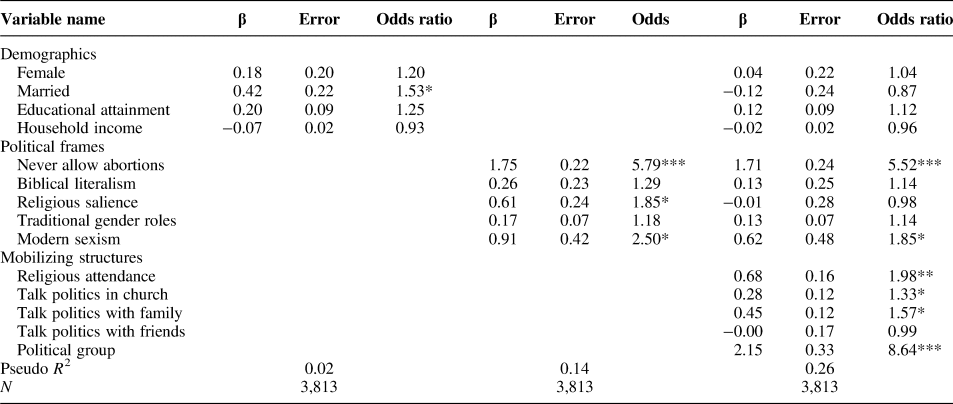
Table 2 displays the results of three regressions. The first regression is limited to resource and demographic factors, the second regression focuses on political frames, and the third regression includes all of the predictor variables. The “resource” variables mostly failed to predict pro-life tendencies (column 2 of Table 2). Being married augmented the chance of becoming a pro-life activist but this boost was small in stature (OR = 1.53, p < 0.05). Marital status was not significant in the bivariate calculations so one can assume that the importance of legal marriages is contingent upon the gender and social class of a person. Gender, educational attainment, and family income were not significantly connected to pro-life activism. Thus, pro-life activism drew equally from all genders or social classes and the combined effects of these resource factors created a tiny pseudo R2 of 0.02.
Binary logistic regression estimates of pro-life activism in a lifetime

***p < .001; **p < .01; *p < .05.
The framing variables provided better predictors of activist outcomes. When restricting the analysis to framing variables, three of the five frames attained statistical significance and the pseudo R2 increased to 0.14. Net of other framing factors, the absolutist belief of eliminating abortions under all circumstances enhanced the chance of pro-life activism by 5.79 times (p < 0.001). While fervent abortion positions significantly linked to pro-life activism, so did a few of the religious and gender precepts. Men and women who downplayed contemporary gender discrimination were more involved in pro-life activism than individuals who saw more systematic forms of sexism (OR = 2.50, p < 0.05). Participants who expressed greater religious salience were more likely to become pro-life activists (OR = 1.85, p < 0.05). Finally, traditional gender prescriptions and seeing the Bible as inerrant did not directly link to pro-life advocacy when considering the role of abortion attitudes and perceptions of rampant sexism (they were significant in the bivariate ANOVAs).
The last regression combined resource, framing, and contextual variables. The pseudo R2 jumped to 0.26 and six variables displayed significant relationships. Mobilizing factors yielded four significant factors in the full model. Regardless of a person's resources, abortion stances, and gender beliefs, the act of joining a political group increase pro-life activism by 8.64 times (p < 0.001). This strong relationship suggests that belonging to a political group probably moves some people into pro-life activism regardless of their gendered outlooks. Regularly attending religions ceremonies promoted pro-life activism (OR = 1.98, p < 0.01) and conversing about politics in religious and family contexts mildly elevated pro-life activism (OR = 1.57 and 1.33, p < 0.05). Thus being around religious settings, and having political conversations among religious devotees and family members, seem to precede or reinforce the abortion and gender attitudes connected to pro-life activism.
The presence of mobilizing factors altered some of the relationships between pro-life activism and the other independent variables. In the final regression, none of the resource factors reached statistical significance. The loss of direct link to marriage suggests that being married did not intrinsically connect to greater pro-life activism but rather that married life alters a person's conversational sources, group memberships, and gendered views of the world. The mobilizing factors also washed out the significant link of religious salience to pro-life activism. This suggests religious adherents who value religion are probably spending more time in religious institutions and political groups than people who are indifferent or offended by religion. Similarly, attending politicized religious services might be more consequential to pro-life activism than simply finding religion important. Lastly, the mobilizing factors did not erase the vital role of adamantly rejecting abortions and denying male privilege in pro-life activism (OR = 5.52 and 1.85, p < 0.001 and p < 0.05). Thus, pro-life activism is grounded in a person's exposure to religious institutions and political conversations as well as an unflinching opposition to abortion and the belief that society is no longer sexist against women.
DISCUSSION
This study explored the reasons and structures behind pro-life activism in a recent sample of Americans. It offers a novel understanding of current abortion politics and improves upon earlier studies in several ways. First, this work explores pro-life political engagements rather than the more common analysis of pro-life sentiments (i.e., Norrander and Raymond Reference Norrander and Raymond1998) and attitudes (i.e., Olson Reference Olson2016). Although studies of pro-life sentiments offer insights into perceptual matters, the predictors of pro-life thoughts and pro-life activism are not always the same. Second, this study compared the qualities of activists and non-activists. Earlier studies on pro-life activism reported the qualities of pro-life activists but did not see if these qualities were distinct and different from people who abstained from pro-life activism (Granberg Reference Granberg1982a; Wilcox and Gomez Reference Wilcox and Gomez1990; Gross Reference Gross1995; Maxwell and Jelen Reference Maxwell and Jelen1996). Third, this study uses data from 2012 while most studies on pro-life activism uses data that is several decades old. Fourth, analyzing a national random sample of adults has less selection biases than the newer studies that rely on convenience samples of college students (Swank and Fahs Reference Swank and Fahs2016), people in pro-life organizations (Hussey Reference Hussey2014), or individuals who are paid by Amazon Mechanical Turk (Allen, McCright, and Dietz Reference Allen, McCright and Dietz2017). Finally, the combination of variables in this study is more comprehensive and complete than earlier studies on pro-life activism. Studies of pro-life studies often limit their analysis to only a few predictive variables, such as a study that ran t-tests on the role of abortion attitudes and gender norms on the tendency to join the group Citizen's For Life (Granberg Reference Granberg1982a). Other multivariate studies explore the role of education, income, and group membership in pro-life activism but ignored the role of gender and religious beliefs in activism (Gross Reference Gross1995; Kaysen and Stake Reference Kaysen and Stake2001; Hussey Reference Hussey2014). Omissions of key factors can lead problems of model misspecifications, so it is hoped that the integration of religious factors with the resource, social network, and gender attitudes can lessen the occurrence of extraneous or spurious relationships in this analysis.
This study found 2.7% of respondents were ever “active” in the “right to life movement.” With pro-life sentiments being much higher, few pro-life sympathizers actually admit to joining the movement any period of their life. Thus, it was the task of this study to determine which factors beyond abortion attitudes are associated with joining a pro-life social movement.
While my measure for pro-life activism rightly focuses on behaviors over thoughts, it does not trace the type of activities done. Munson (Reference Munson2009) suggests that pro-life activism comes through traditional political action, direct action to abortion clinics, working at pro-life pregnancy clinics, and public education. Having a measure with greater specificity on pro-life behaviors could alter the findings somewhat since the predictors of high-risk versus low-risk activism might vary (Hussey Reference Hussey2014). Additionally, the dichotomized variable of activist behaviors did not indicate when a person joined the pro-life movement, how long people stayed in the movement, or how often a person did political activities against abortion. This imprecision is unfortunate since it can lead to temporal ordering problems (i.e., people may join political groups after their first pro-life protest or abortion attitudes can become more certain after befriending pro-life comrades at pro-life events).
This study employed the “political resource” theories to identify the economic, attitudinal, and contextual factors behind pro-life activism (Brady, Verba, and Schlozman Reference Brady, Verba and Schlozman1995; Kaysen and Stake Reference Kaysen and Stake2001; Norrander Reference Norrander2014; Swank and Fahs Reference Swank and Fahs2016). While women carry more of the health and social burdens of unwanted pregnancies, the data provides no signs of women being more or less involved in pro-life activism than men. The lack of a gender gap parallels some studies on pro-life activism (Gross Reference Gross1995; Maxwell and Jelen Reference Maxwell and Jelen1996; Norrander and Raymond Reference Norrander and Raymond1998; Swank and Fahs Reference Swank and Fahs2016; Heaney Reference Heaney2018; Petterson and Sutton Reference Petterson and Sutton2018) but it does not mean that gender is trivial to abortion politics. The way people do and see gender shapes pro-life activism in the form of collective action frames (more on this later).
People often experience and live gender norms within their family. Getting and being married is often related to greater gender conservativism (Bolzendahl and Myers Reference Bolzendahl and Myers2004; Jelen Reference Jelen2015; Clark Reference Clark2017; Stout, Kretschmer, and Ruppanner Reference Stout, Kretschmer and Ruppanner2017) and this analysis suggests that marriage bolsters pro-life activism (Kaysen and Stake Reference Kaysen and Stake2001; Hussey Reference Hussey2014; Norrander Reference Norrander2014; Swank and Fahs Reference Swank and Fahs2016). However, marriage may not inherently drive pro-life activism because this factor lost statistical significance when measures of modern sexism, religiosity, and group memberships were entered into the regressions (Adamczyk and Valdimarsdóttir Reference Adamczyk and Valdimarsdóttir2018). This suggests that marriage offers or reinforces gender outlooks and social milieus that feed into greater pro-life activism. Clearly, future pro-life studies should see how certain gender inequities in families translates into greater pro-life activism for wives and husbands.
The classic resource argument insists that topics of affluence and activism are related (Brady, Verba, and Schlozman Reference Brady, Verba and Schlozman1995). Even though resource-based arguments seem plausible, the ANOVAs and regressions suggest otherwise. Pro-life activism was impervious to issues of family income (Norrander Reference Norrander2014; Swank and Fahs Reference Swank and Fahs2016). Educational attainment was also extraneous to pro-life activism. The irrelevance of years in schooling echoed the findings of a few studies (Maxwell and Jelen Reference Maxwell and Jelen1996) but bucked some older works that found greater educational attainment among pro-life activists (Granberg Reference Granberg1982a; Maxwell and Jelen Reference Maxwell and Jelen1995; Norrander and Raymond Reference Norrander and Raymond1998; Kaysen and Stake Reference Kaysen and Stake2001). With newer samples also finding smaller educational effects on pro-life activism (Munson Reference Munson2009; Swank and Fahs Reference Swank and Fahs2016; Allen, McCright, and Dietz Reference Allen, McCright and Dietz2017) it is possible that historical trends have altered the impact of schooling on pro-life activism. Finally, a college atmosphere might have larger effects if one studied specific dimensions of the collegiate experience, such as being exposed to feminist classrooms (Kaysen and Stake Reference Kaysen and Stake2001) or attending secular universities (Adamczyk Reference Adamczyk2009).
Even as gender identities and resources failed to predict pro-life activism, the perceptions of abortions, religion, and contemporary gender arrangements were crucial antecedents. Every measure of abortion attitudes, gender judgements, and religious beliefs was associated with pro-life engagement in the bivariate analysis. In the final regression, two of the five framing factors had significant direct links to pro-life activism when attending to the role of every independent variable in this study.
A strident and unequivocal desire to end all abortions had a significant link to pro-life activism (Norrander Reference Norrander2014). Only 12% of the sample rejected abortions even when the pregnancy was due to rape or when it presented great health risks to the pregnant woman. However, such an adamant rejection of abortion was found among 49% of the abortion opponents who had joined the pro-life movement. Although many pro-life activists denounced abortion under all circumstances, other types of abortion attitudes could also motivate pro-life activism. Some pro-life groups claim their efforts compassionately serve the psychological and medical needs of women (Kelly Reference Kelly2014; Trumpy Reference Trumpy2014; Doan, Candal, and Sylvester Reference Doan, Candal and Sylvester2018), so studies should determine to if pro-life activists are really doing their activism for the well-being of women. Pro-life groups also talk about “fetal personhood” so it seems wise to see if activists when compared to non-activists, view fetuses as little people.
Objections to abortions were not the only factor behind pro-life activism. Opponents of abortion were also generally pleased with traditional gender scripts (Granberg Reference Granberg1982a; Swank and Fahs Reference Swank and Fahs2016). The idealization of women as stay-at-home mothers and the minimization of institutionalization sexism increased pro-life activism in the initial stages of this study. However, only the denial of current day sexism remained significant in every regression. People who downplayed sexism joined pro-life movements more often than people who saw widespread patterns of male privilege. Conversely, the praise of male breadwinners and maternal narratives did not predict pro-life activism in the subsequent regressions.
The study identifies an association between the denial of sexism and pro-life activism but it does not explain the reasons behind this phenomena. People who minimize gender biases might miss or accept the ways that anti-abortion laws undermine female self-determination (Petterson and Sutton Reference Petterson and Sutton2018). Conversely, people who recognize gender inequities might see how abortion laws only regulate the actions of women and how these actions constitute a backlash against liberalizing gender roles (Kelly and Gauchat Reference Kelly and Gauchat2016).
Religious attitudes had a conditional connection to pro-life activism. People who valued religiosity and saw the Bible literally were significantly more pro-life during the bivariate analysis. However, the significant link of pro-life activism to religious salience and biblical literalism disappeared when controlling for abortion attitudes, modern sexism, and people's social networks. This suggests that biblical literalism might inspire greater pro-life activism because Christian fundamentalists downplay the extent of sexual biases in society and have stronger rejections of abortion than people who are not of the same religious camps (mainline Christians, people of other religions, and secularists).
It is possible that other religious beliefs could have netted stronger associations with pro-life activism. Preliminary analysis showed insignificant ties of religious affiliation and frequency of prayer to pro-life activism, but it is plausible that the fear of secularization, support of religious-based laws, and the approval of religious proselytizing could have stronger connections to pro-life activism.
The study clearly confirms the consequences of social networks to abortion activism (Gross Reference Gross1995; Kaysen and Stake Reference Kaysen and Stake2001). Pro-life activists were more likely to belong to families and religions that routinely spoke about politics (Gross Reference Gross1995; Munson Reference Munson2009; Scheitle and Cornell Reference Scheitle and Cornell2015). Favorable conversations about pro-life activism could have attained even stronger connections to activism but the mere presence of political discussions seems to boost and sustain pro-life activism. Regular involvement in religious services also increased pro-life activism (Begun and Walls Reference Begun and Walls2015; Allen, McCright, and Dietz Reference Allen, McCright and Dietz2017). Pro-life activists might acquire or harden their anti-abortion attitudes in religious contexts and the messages by religious leaders can spurn pro-life activism among the uncertain (McVeigh and Sikkink Reference McVeigh and Sikkink2001). Finally, joining any sort of political group increases pro-life activism. It seems safe to assume that pro-life activists are more likely to join conservative political groups than liberal ones (Merola and McGlone Reference Merola and McGlone2011), but ANES offers no information about whether a person joined antiabortion organizations like Focus on the Family, the National Right to Life Committee, or the Susan B. Anthony List. Accordingly, this study probably underestimates the role of politicized social networks since pro-life activism is often at its highest when people belong to social groups that push pro-life agendas (Gross Reference Gross1995) and offer anti-abortion social services to pregnant women (Hussey Reference Hussey2014).
In the end, this study suggests that adamant opposition to abortion is only one factor behind pro-life activism. Pro-life activism was more common among people who often attended religious services, joined political groups, talked politics in churches-families, and minimized the extent of sexism in current society. The importance of these religious factors might be especially interesting to readers of this journal but this study also reveals the wisdom of integrating gender and religious factors into studies of abortion politics. In recent years, studies of pro-life activists have fallen out of fashion and the author hopes this work addresses this oversight. This research may be especially poignant because the pro-life movement itself is growing again. Even though crowd size estimates for the annual “March for Life” are hard to find, the conservative New Republic estimated the crowd at 50,000 participants (Shafer Reference Shafer2018). Moreover, the advocacy group Life Chain claims that over 2,200 cities had small pro-life vigils in 2017 (this estimate comes from unverified emails from pro-life organizers). Pro-life organizations have also upped their spending on elections and professional lobbyists. Since 2012 pro-life groups have donated over 2 million dollars per year to political candidates and added another 1.1 million dollars to lobbying expenses (Open Secrets 2018 Reports from the National Abortion Federation (Liss-Schultz Reference Liss-Schultz2018) also suggests that the number of pro-life protests at abortion clinics have jumped dramatically (eight cases of protesters blocking access to abortion centers in 2007 and 102 such incidents in 2017). Moreover, the current political climate is conducive to changes in abortion laws and policies (Rohlinger and Grace Reference Rohlinger, Grace and Reger2019). President Donald Trump is known for uttering and tweeting sexist and anti-feminist appeals in public and private settings. In a substantive way, President Donald Trump has shown his pro-life loyalties by praising attendees at the “March for Life” rallies and trying to undercut abortion access through different means. As of the Fall of 2018 Trump has tried to dismantle insurance plans that pay for birth control devices (Obama's Affordable Care Act), supported bills to limit the timeframe to have an abortion (i.e., Pain-Capable Unborn Child Protection Act), proposed a “gag rule” that disallows abortion discussion in medical settings that receive federal funding (Title X reforms), and is loading the federal court system with pro-life judges.
Thus, it seems wise to start a new round of studies that address the causes of pro-life and pro-choice activism during the Trump presidency (Beyerlein et al. Reference Beyerlein, Ryan, Abu-Hazeem and Pauley2018; Heaney Reference Heaneyforthcoming). It is hoped that scholars will use my theoretical model and add some variables that ANES left out. It would be interesting to see if pro-life activists respect and admire other pro-life activists more than the general population (Swank and Fahs Reference Swank and Fahs2016). It also would be wise to see if pro-life activism is piqued by living in communities with pro-life advocacy groups (Meyer and Staggenborg Reference Meyer and Staggenborg2008) or many religious conservatives (Adamczyk and Valdimarsdóttir Reference Adamczyk and Valdimarsdóttir2018). Some studies have found that sexual identities and attitudes toward sexual identities can impact pro-life sentiments (Grollman Reference Grollman2017) but others contest that finding (Swank Reference Swank2018). Finally, scholars might see how the predictors of pro-life and pro-choice activism correspond. Studies on feminist mobilizations during the Trump era are in the early stage but 23% of the 4 million people who attended the 2017 Women Marches were there for “reproductive justice” (Fisher, Dow, and Ray Reference Fisher, Dow and Ray2017).