Iodine is an essential constituent in the synthesis of thyroid hormones triiodothyronine (T3) and thyroxine (T4) which regulate cellular metabolic processes, playing a vital role in organ development including the brain (Zimmermann, Reference Zimmermann2011). Consequently, any dietary deficiency of this microelement is a public health problem (WHO, 2004). Newborns are more at risk (Nazeri et al., Reference Nazeri, Mirmiran, Shiva, Mehrabi and Azizi2015) and since breast milk is the only source of iodine for them, the maternal deficiency of this element in the postpartum period could affect the neonatal neuro-psycho-intellectual development (Chan et al., Reference Chan, Harms, Wiley, Wilcken and McElduff2004).
The adult human body contains 10–20 mg of iodine, mainly in organic form, the steady state of which derives from dietary intake. Iodine is easily absorbed in the small intestine and transported, in iodide form, to tissues, mainly the thyroid gland. The recommended daily intake of this micronutrient is 150 μg for adolescents and adults and 250 μg for pregnant and lactating mothers (Koukkou et al., Reference Koukkou, Roupas and Markou2017). Iodine is differently distributed in the soil and therefore in foods. In many areas, especially mountainous regions, the ingestion levels of this trace element are not sufficient to prevent signs of deficiency in the population. In addition, the consumption of particular diets (including a vegetarian diet) can lead to deficiencies of iodine, even in areas where fishery products normally account for the recommended daily intake of this element (Katagiri et al., Reference Katagiri, Asakura, Uechi, Masayasu and Sasaki2015; Trøan et al., Reference Trøan, Dahl, Metzler, Abel, Indahl, Haug and Prestløkken2015; Elorinne et al., Reference Elorinne, Alfthan, Erlund, Kivimäki, Paju, Salminen, Turpeinen, Voutilanen and Laakso2016).
Seafood, together with milk and dairy products, account for 80% of the daily requirement of iodine and the dairy contribution reaches an average 55–70% of the daily iodine intake particularly in inland areas in which the consumption of fish products is often lower (Trøan et al., Reference Trøan, Dahl, Metzler, Abel, Indahl, Haug and Prestløkken2015). This high percentage derives also from the possibility to reinforce cattle feed with iodide that exhibits a high transfer from the diet to the milk. The milk iodine content is influenced by various factors, primarily iodine intake by the animal (Franke et al., Reference Franke, Meyer, Wagner and Flachowsky2009) but seasonality, lactation stage and milk yield as well as post-harvest milk processing all play an important role (Norouzian, Reference Norouzian2011; Flachowsky et al., Reference Flachowsky, Franke, Meyer, Leiterer and Schöne2014).
Although not as well studied as in humans, iodine deficiency is also dangerous for animal health and welfare (Hetzel and Mano, Reference Hetzel and Mano1989) impairing their reproductive performance and affecting perinatal mortality of offspring (Ferri et al., Reference Ferri, Ulisse, Aghini-Lombardi, Graziano, Di Mattia, Russo, Arizzi, Baldini, Trimboli, Attanasio, Fumarola, Pinchera and D'Armiento2003). Sheep have been used for extensive studies on iodine deficiency because they are convenient models for the study of maternal−fetal function (Ferri et al., Reference Ferri, Ulisse, Aghini-Lombardi, Graziano, Di Mattia, Russo, Arizzi, Baldini, Trimboli, Attanasio, Fumarola, Pinchera and D'Armiento2003) and, as reported by Potter et al. (Reference Potter, Mano, Belling, McIntosh, Hua, Cragg, Marshall, Wellby and Hetzel1982), iodine deficiency in sheep feed affects the development of the sheep fetus. The first estimate of the amount of iodine required for farm animals dates back to 1937. This work served as the basis for the study published by Underwood and Shuttle (Reference Underwood and Suttle1999), which defined the minimum quantity of iodine, in food dry matter, for feeding farm animals. For pigs, poultry and sheep the daily requirement of this element is between 0.05 and 0.10 mg per kg of body weight. Iodine enrichment of animal feed represents a method successfully tested in Scandinavia for both animal and human prevention of iodine deficiency (Hetzel and Welby, Reference Hetzel, Welby, O'Dell and Sunde1997).
The aim of the present study was to ascertain whether the feeding of lactating ewes with an iodine enriched diet would modify the chemical and biochemical composition of milk and/or dairy products, and in particular their protein profile. We conducted a two-month study on two flocks of ewes. The first received a traditional feed while the second a diet enriched of iodine. During the experimental period the pooled milks were tested. Then we analyzed the compositional evolution during ripening of a hard typical ewe cheese called Canestrato d'Abruzzo derived from both groups. We investigated the diet effect on iron content and on the antibacterial protein lactoferrin in the ewes and finally we studied the casein proteolysis process in fresh and ripening cheeses.
Materials and methods
Animals and diets
The experiment plan followed EU Directives for animal experimentation. A flock of fifty four ewes homogeneous for age, days in milk and weight was randomly divided into 2 groups of 27 animals named control group (Ctr) and iodine group (I). The ewes were housed for the entire trial period in two separate areas of free housing with access to identical feeding areas and free access to clean drinking water. The study was conducted for a period of 30 d, in which all animals received total mixed rations (TMR) whose composition is reported in a previous study (Iannaccone et al., Reference Iannaccone, Elgendy, Ianni, Martino, Palazzo, Giantin, Grotta, Dacasto and Martino2020) with the only modification regarding iodine content. Both the control group (Ctr) and the iodine group (I) received a basal diet supplemented with an iodine concentration of 2.0 mg/kg of complete feed (on a dry matter (DM) basis), in order to guarantee the daily iodine requirement for each animal. Then, the iodine group was fed for 4 weeks with a custom-formulated concentrate supplement with additional iodine (6.5 mg/kg of complete feed (on a DM basis), to obtain a total intake of about 8.5 mg/day. At that time the iodine supplementation was established by law not to exceed the maximum level of 10 mg/kg of complete feed.
In both groups, milk was collected daily for milk yield, fatty acid analysis, iodine measurement and chemical analysis. Periodically the milk was also used for Canestrato cheese making.
Canestrato d'Abruzzo cheese making
We produced the cheese following the manufacturing protocol reported below using milk collected from both groups. To the bulk milk, heated at 37°C ± 1°C, liquid rennet lamb (1: 18 000 strength) was added (26 ml/100 l). The curd was subsequently cut into small pieces approximately the size of hazelnuts, portioned in aliquots of about 1 kg, transferred into a traditional wicker basket, and repeatedly inverted for 2 h. Then, a 20% NaCl water solution was used to salt the cheese in brine and the salted fresh cheese was stored in the ripening room at a controlled temperature of 10°C ± 0.5 and a relative humidity of 85%. Cheese samples, collected after 1, 15, 30 and 60 d of ripening were tested.
Chemical analysis of milk and cheese
In milk we determined the chemical composition, as well as somatic and bacterial cell count by MilkoScan FT 6000 (Foss Integrator IMT; Foss, Hillerød, Denmark), Fossomatic TM FC and the BactoScan FC (Foss, Hillerød, Denmark), respectively. We measured in cheese the moisture content, total protein and ash by AOAC International (2000), while the total lipid content was measured according to the procedure described by Ianni et al. (Reference Ianni, Di Domenico, Bennato, Peserico, Martino, Rinaldi and Martino2020a).
We obtained water-soluble nitrogen extracted by homogenizing cheese and water. The homogenate, treated with a cadmium-ninhydrin solution, was read at 507 nm. A calibration curve was made by using a standard solution of L-Leucine. The total nitrogen content expressed as mg of Standard Leucine per g of cheese. WSN and TCA-SN were determined according to Kuchroo and Fox (Reference Kuchroo and Fox1982) and Polychroniadou et al. (Reference Polychroniadou, Michaelidou and Paschaloudis1999), respectively.
Iodine determination in milk and cheese
We measured the iodine content in the milk (after 0 and 30 d of diet) and in cheese (after 30 d of ripening), according to Fecher et al. (Reference Fecher, Goldmann and Nagengast1998) with minor modifications. We created a standard calibration curve using six standard points (from 0 to 100 mg/l) of tetra-methyl-ammonium hydroxide. For the carrier and gas formation, argon gas used at flow rates of 1.05 and 0.2 l/min, respectively. The iodine content was determined by an inductively coupled plasma mass spectrometer Agilent 7500ce ICP-MS (Agilent Technologies, Palo Alto, CA, USA) at m/z = 127 and a total acquisition time of 21 s.
Fatty acid profile in milk and cheese
We extracted the fatty fraction in milk and cheese by the AOAC official method (2000) and chloroform/methanol method described by Domagala et al. (Reference Domagała, Sady, Grega, Pustkowiak and Florkiewicz2010), respectively. For fatty acid analysis, total fat was trans-methylated at room temperature into methyl esters (FAMEs) by KOH 2 M in methanol. FAME composition was determined by gas chromatography using Focus GC Thermo Scientific (Milan, Italy) with flame ionization detection (FID) equipped with a VARIAN column CP-SIL 88 of 100 m (Milan, Italy), the carrier gas was hydrogen. Fatty acid identification was carried out with standard mixture and fatty acid values were expressed in percentage.
Oxidative stability in cheese
The susceptibility of cheese to oxidation was determined by using the test of thiobarbituric acid reactive substances (TBARS-Test), following the procedure reported by Tarladgis et al. (Reference Tarlagidis, Watts, Younathan and Dugan1960) with minor modifications. Briefly, cheese was weighted (5.0 g), added with butylated hydroxytoluene (BHT) in order to block the sample oxidation, homogenized (Ultra-Turrax T25) with 50 ml of trichloroacetic acid (TCA) 7% and distilled. Two ml of distilled sample were mixed with 2 ml of 0.02 M TBA solution in acetic acid 90%. We measured, in triplicate, the absorbance at 534 nm using a UV/vis Spectrophotometer. The amount of malondialdehyde (MDA) of each sample was calculated using a calibration curve, results were expressed in μg of MDA per g of cheese.
Casein extraction from cheese
Aliquots of 10 g of (commuted) ewe's cheese weighted out and 1 M sodium acetate buffer, pH 4.6, was added. The mixture homogenized using a Teflon pestle, left at 4°C for 30 min and then centrifuged at 4500 rpm. The lipid fraction remaining in the casein precipitate was then removed by washing with dichloromethane-acetate buffer (1:1, v:v). The precipitate washed with acetone and left to dry in a speedvac at 30°C. Finally, the casein comminuted to the smallest possible grain size. The dried powdered casein was stored at −20°C until analysis (Izco et al., Reference Izco, Ordonez, Torre and Barcina1999).
Sample preparation and electrophoresis
We prepared the casein solution by dissolving 1 g of casein extract in 100 ml of 0.1 M Tris-HCl buffer (pH 8.0) and heating in a boiling bath for 20 min. The solution was filtrated without cooling and stored until analysis at 4°C. Aliquots of 20 μg of proteins were diluted in the sample buffer containing 0.0625 M Tris (pH 6.8) 2% sodium dodecyl sulfate (SDS), 10% glycerol, 5% β-mercaptoethanol, and traces of bromophenol blue (0.0002%), boiled for 3 min and loaded onto 12.5% polyacrylamide gel electrophoresis (SDS PAGE).
We performed the electrophoretic migration in a mini-protean III dual slab cell (Bio-Rad Laboratories, Wartford, UK) at 30 mA constant amperage. Immediately after ending of the run, gels were placed, for 1 h, in a fixative solution containing 50% methanol and 10% acetic acid and then stained with a solution containing 10% acetic acid and 0.1% Coomassie Brillant Blue R-250 in which the gels remained 1 h at room temperature. Finally, the gels were destained by several washings in distilled water (containing 20% methanol and 7% acetic acid). We obtained the densitometry analyses of bands by ImageJ gel system.
ELISA (enzyme-linked immunosorbent assay) detection of lactoferrin
We diluted the post-cheese whey samples in carbonate buffer to a final protein concentration of 2 μg/ml. The samples, left overnight at room temperature in a 96 wells titration plate, after removal of the buffer and washings, were treated 1 h with blocking buffer (TBS-T + 2% BSA), then washed again with TBS-T and incubated 2 h with anti-lactoferrin antibody (5 μg/ml in TBS-T containing 1% BSA). The samples were then incubated with a secondary anti-rabbit antibody-HRP. After further washing, we added to each well 100 μl of 0.4 mg/ml of O-Phenylenediamine in 0.1 M citrate buffer containing 0.15% (v/v) of H2O2, (pH 5.5). The reaction was stopped by addition of 100 μl of 4 M H2SO4 and the absorbance at 490 nm read on a Microplate Bio-Rad, model 550 (Milan, Italy).
Iron assay
The iron content was determined using a Sigma-Aldrich (St. Louis MO, USA) specific assay kit, by following the protocol indicated by the manufacturer.
Statistical analysis
Quantitative data derived from independent experiments were expressed as the mean ± standard deviation (sd). The statistical analysis was performed using One Way Anova followed by Tukey test with PRISM Software (GraphPad, San Diego CA). Probability values of P < 0.05 were considered statistically significant.
Results
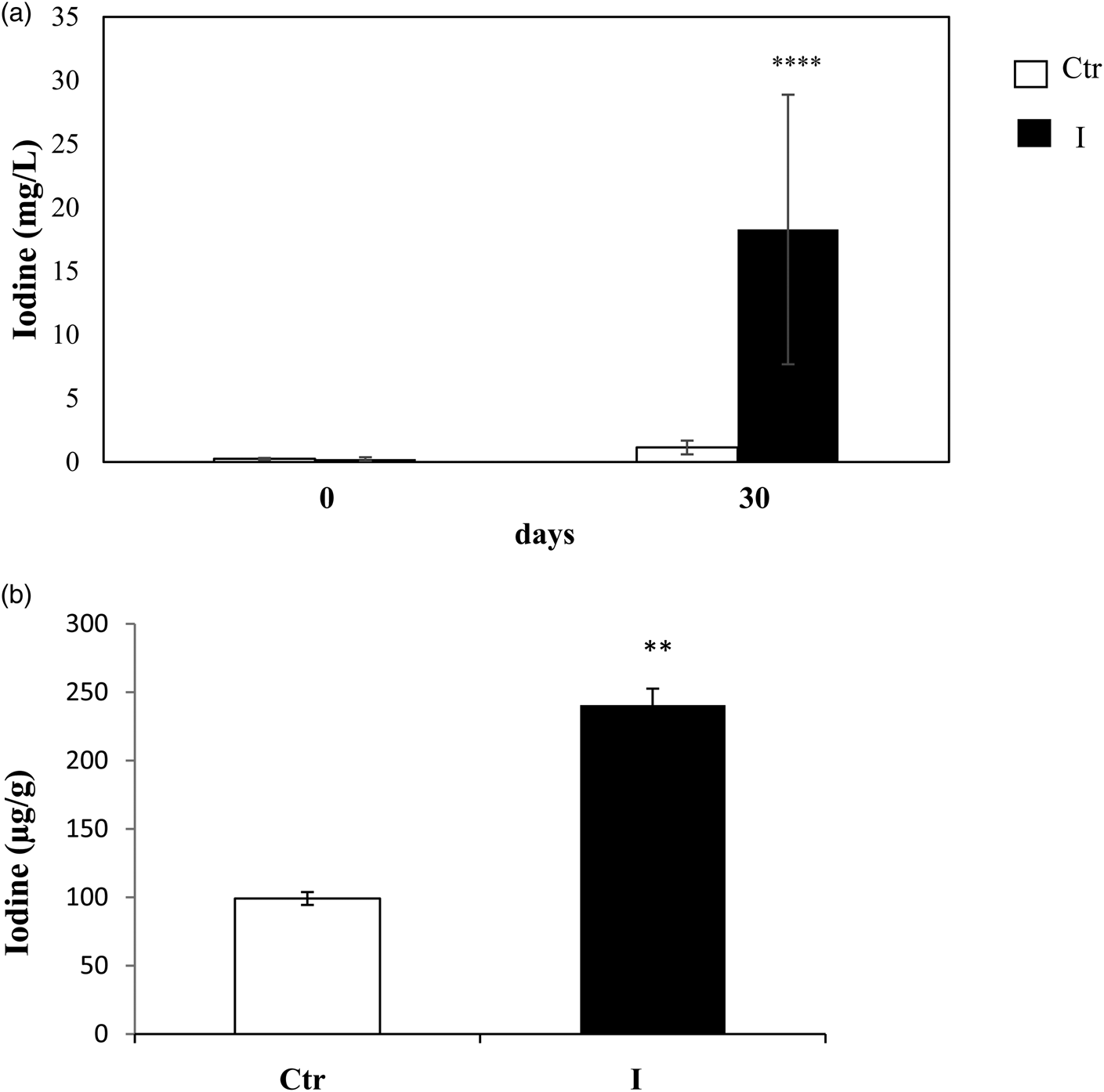
The iodine content in the milk of sheep fed with the enriched diet increased about ten times over four weeks and it remained constant throughout the trial (Fig. 1). The milk macro components content, the daily milk yield, the pH and the total bacterial count were not modified in the milk of ewes fed with bio-fortified diet (online Supplementary Table S1). An interesting finding was obtained on the iron-binding protein, lactoferrin. In the whey derived from the milk of the iodine group, lactoferrin level was 0.15 ± 0.08 mg/100 ml, while in the control group it was 0.03 ± 0.01 mg/100 ml. The milk derived from these ewes possess a greater amount of iron than the control group, 4.60 ± 0.22 and 3.28 ± 0.03 nmol/100 μg of total proteins, respectively. We also found higher bound iron concentrations in the iodine group than in the control group (data not shown).
Iodine levels in ewes control group (Ctr) and iodine group (I) in: milk samples collected at 0 and 30 d of iodine supplemented diet (A); cheese samples obtained after 30 d of ripening (B). The level of statistical significance between Ctr and I after 30 d is indicated as follows: ****P < 0.0001; **P < 0.01.

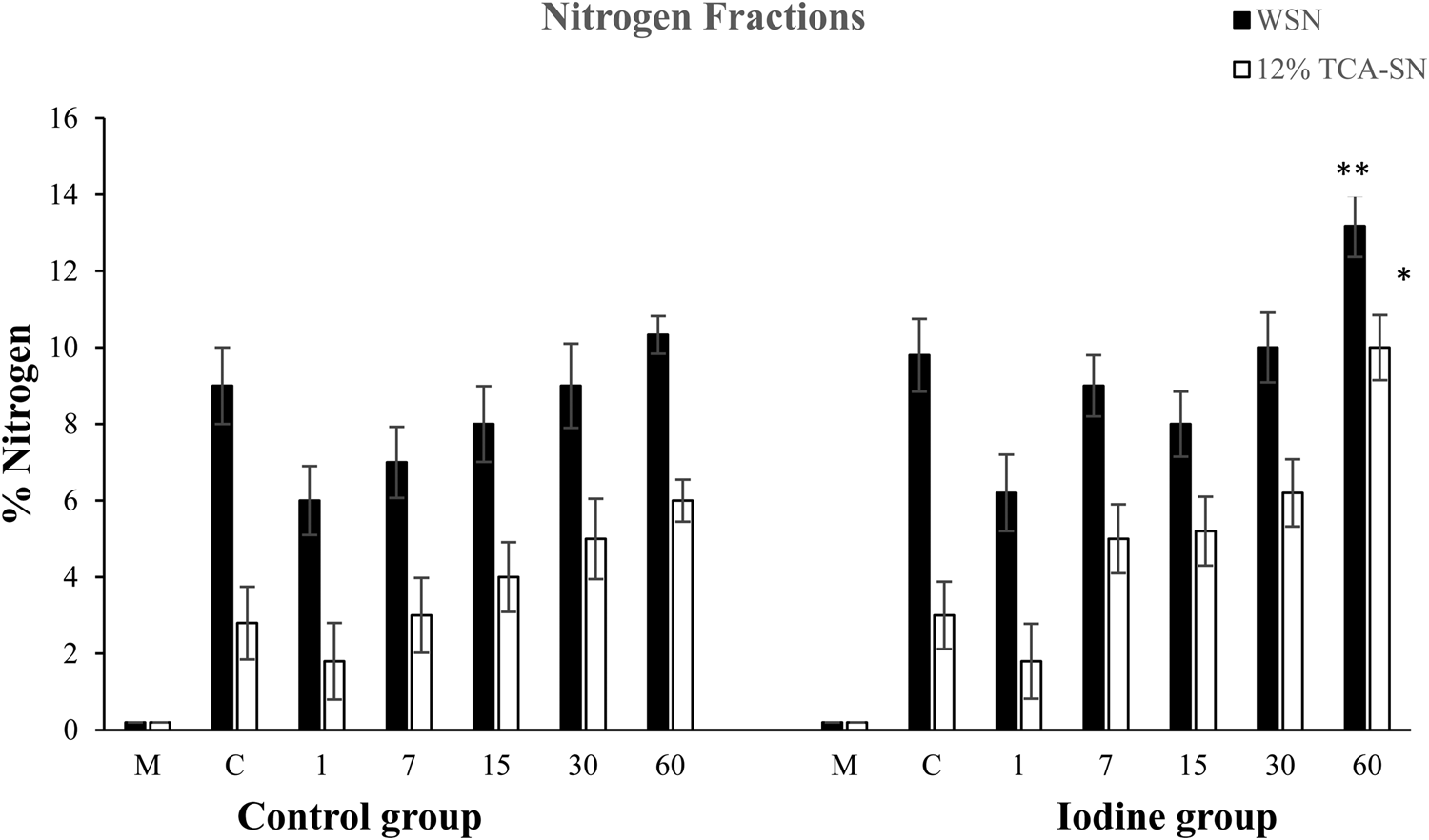
After carrying out these experiments in the milk, the study was extended to cheese. Figure 1B shows that the cheese derived from the milk of the iodine group was enriched in this micronutrient compared to the control group. After 30 d of ripening, the cheeses obtained from the supplemented ewes had a gross chemical compostion that was not different to control values (online Supplementary Table S2). Then we checked, during the two months of ripening, the parameters related to the evolution of this product. We found some modifications in the WSN (water-soluble nitrogen) and TCA-SN (non-protein nitrogen fraction soluble in TCA) nitrogen fractions during ripening as shown in Figure 2. Both fractions increased to a greater extent in cheese from the supplemented group such that a significant difference was evident at 60 d (WSN: 10.3 ± 0.5% vs. 13.2 ± 0.8%, TCA-SN almost twice as high).
Water-soluble and 12% TCA-SN nitrogen in milk (M), curd (C) and cheese in control (Ctr) and iodine group (I) at indicated times (days). The level of statistical significance between Ctr and I after 60 d is indicated as follows: **P < 0.01 (WSN); * P < 0.05 (TCA-SN).

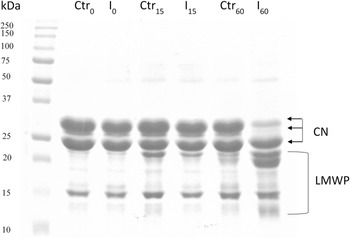
Figure 3 shows the SDS-PAGE of the caseins extracted from 0 (i.e curd), 15 and 60 d ripened cheese. After 60-days ripening, the band intensity corresponding to caseins (CN) of cheese derived from iodine fed animals decreased to 40% with respect to controls. At the same time, a parallel emergence of many proteolytic products derived from proteolysis (LMWP) was evident in the iodine samples, with an overall intensity increase of about 80%. The pattern indicates that proteolysis was accelerated during the ripening.
SDS-PAGE of the protein patterns extracted from cheeses at different ripening times (0, 15, 60 d) obtained from the milk of ewes fed with normal diet (Ctr) and with iodine enriched diet (I). CN are caseins, LMWP are low molecular weights peptides.

We also studied the lipid fractions in terms of fatty acid profiles both in milk and in cheese. In the milk (online Supplementary Table S3, columns 1 and 2), a decrease of both stearic (C18:0) and of oleic (C18:1cis9) acids was revealed in the iodine fed group. As far as fresh or 60 d aged cheese was concerned, a numerical but non-significant decrease of short chain fatty acids in the supplemented group was evident. The lipid oxidative products in the cheese, measured as TBARS, showed, as expected, an increase after 60 d ripening in both control and iodine supplemented groups. It is important to note that the iodine diet did not affect the TBARS levels (online Supplementary Table S3).
Discussion
Mother-newborn transmission of nutrients through milk is a characteristic of mammals, such that milk represents the only source of iodine and other elements for lambs. The idea behind this study was that feeding sheep with bio-fortified food would give rise to milk enriched in this micronutrient, and this was the case. Such milk would be expected to be a better nutrient source for lambs and, once turned into cheese, an excellent vehicle of iodine for human consumers. The increased iodine content seen here is agreement with other studies, and specifically with the values reported by Iannaccone et al. (Reference Iannaccone, Ianni, Elgendy, Martino, Giantin, Cerretani, Dacasto and Martino2019).
The cheese obtained from milk of iodine group had greater iodine content relative to that of the control group. The evidence for an iodine enrichment of Canestrato cheese is even more relevant than that on milk because it represents a direct way to enrich human nutrition in microelements (Zimmermann, Reference Zimmermann2011). Probably due to the different animal species studied, this iodine enrichment was even higher than that obtained in cheese derived from iodine fed cows (Moschini et al., Reference Moschini, Battaglia, Beone, Piva and Masoero2010; Ianni et al., Reference Ianni, Bennato, Martino, Grotta, Franceschini and Martino2020b). Importantly, the increase in iodine did not result in a quantitative modification of other substances examined in milk and cheese. Our data confirm earlier studies showing unchanged gross composition in both sheep products (Schirone et al., Reference Schirone, Tofalo, Perpetuini, Manetta, Di Gianvito, Tittarelli, Battistelli, Corsetti, Suzzi and Martino2018; Iannaccone et al., Reference Iannaccone, Elgendy, Ianni, Martino, Palazzo, Giantin, Grotta, Dacasto and Martino2020) and cattle products (Iannaccone et al., Reference Iannaccone, Ianni, Elgendy, Martino, Giantin, Cerretani, Dacasto and Martino2019).
Among the set of innate and multi-functional molecules that provide protection against infection in newborns, lactoferrin, an iron-binding glycoprotein, is one of the most abundant in milk (Ballard and Morrow, Reference Ballard and Morrow2013). This protein is known for its bactericidal and bacteriostatic effects (Lizzi et al., Reference Lizzi, Carnicelli, Clarkson, Di Giulio and Oratore2009; Ellison et al., Reference Ellison, LaForce, Giehl, Boose and Dunn1990) as well as for its immune modulatory properties (Bhat et al., Reference Bhat, Ahmad, Ibeagha-Awemu, Mobashir, Dar, Mumtaz, Shah, Dar, Shabir, Bhat and Ganai2020). Although there are few studies on these proteins in ewe milk, we checked the possible diet dependence of this iron-carrying protein. From our results, it is evident that the iodine-enriched diet caused an increase of both iron and lactoferrin levels in the sheep milk (measured in whey). Therefore, milk and whey become particularly valuable foods capable of improving the health and homeostasis of lambs (and potentially the quality of the meat obtained from them). However, due to the high percentage of fats and a rather strong taste, sheep milk itself is not usually consumed as a human food, and the whey associated with cheeses such as feta is normally discarded. there is a potential indirect benefit to consumners, namely an increased capacity of the milk-derived product (eg cheese) to act as a vehicle of bioavailable iron. The capacity of an iodine rich diet to act as a positive effector of iron-carrying protein synthesis was demonstrated in humans. In iron-deficient adolescent subjects, dietary supplementation with iodine for three months induced an increase of both transferrin and ferritin expressions (Eftekhari et al., Reference Eftekhari, Simondon, Jalali, Keshavarz, Elguero, Eshraghian and Saadat2006). The biochemical correlations between thyroid function, iron and iodine levels are complicated but iron is an essential element for iodine utilization and thyroid hormone synthesis (Zimmermann, Reference Zimmermann2006; Luo et al., Reference Luo, Hendryx, Dinh and He2017). There has been only limited study of the relationships between caseins and lactoferrin in the casein micelles (Anema and de Kruif, Reference Anema and de Kruif2013) and we suggest that more detailed studies are needed to better understand the interactions between these two milk proteins.
As far as the fatty acid profiles are concerned, our data do not show substantial differences between the control and supplemented groups in either milk or cheese. The only differences were identified in milk in which we found a reduction of stearic and oleic acids in the supplemented group. These fatty acids are generally susceptible to variation in the presence of changes in the feeding protocol. However, the addition of iodine did not change the profile of the other fatty acids, therefore, the observed variations could be attributed to an effect of iodine in influencing animal metabolism, presumably at the rumen level where the various bio-hydrogenation processes take place. In any case, this statement should be adequately investigated and the biochemical mechanisms involved duly characterized. These differences are lost following the cheese-making process, since both freshly prepared and ripened cheeses showed a similar fatty acid profile between the two experimental groups. In the literature there is only scant reference to studies aimed at the evaluation of fatty acids of dairy products obtained from ruminants fed with an iodine supplement. One of the few references concerns the work of Lopez et al. (Reference Lopez Chavez, Serio, Rossi, Mazzarino, Marchetti, Castellani, Grotta, Fiorentino, Paparella and Martino2016), who performed a study based on the addition of Ascophillum nodosun, a seaweed rich in iodine, to the sheep's diet. In that case, the analysis of the acidic profile of the milk did not reveal significant variations.
Lipid oxidative products in the cheese were measured as TBARS and were unaffected by supplementation, indicating that iodine does not have antioxidant capacity during the maturation of dairy products. This has also been shown for other trace elements such as zinc (Ianni et al., Reference Ianni, Innosa, Martino, Grotta, Bennato and Martino2019a) and selenium (Ianni et al., Reference Ianni, Bennato, Martino, Innosa, Grotta and Martino2019b). Proteolysis (along with lipolysis) is the biochemical event that most affects the sensory qualities of cheeses, influencing the aroma, flavor and texture of the product. This process starts in the milk and continues in the cheese during the ripening (Park, Reference Park2001). It is possible to state that cheese is ‘ripe’ when caseins reach the correct degree of proteolysis, although the ripening time varies depending on the variety of cheese. The proteolytic agents are of several origins, either milk proteins or rennet enzymes but also those produced by starter and nonstarter bacteria (Fox, Reference Fox1989). In our experimental conditions it is too speculative to indicate the way in which iodine affects the proteolytic event, indeed, in our electrophoretic conditions it is difficult to identify which of the casein families was most affected. Nevertheless, the protein composition of the cheese was certainly influenced by the diet: the bands revealed by SDS PAGE in fresh, 15 and 60 d ripened cheese demonstrated that proteolysis was accelerated. The molecular weights and the electrophoretic mobility of the bands are in agreement with those reported in literature (Costa et al., Reference Costa, Vasconcelos Paiva Brito, Moreira Furtado, Martins, de Oliveira, de Castro Barra, Amigo Garrido and de Oliveira dos Santos2014) and the increased presence of water-soluble nitrogen fraction in the aged cheese confirmed this effect. An increased proteolysis can be regarded as an enhanced ripening yielding peptides that affect the organoleptic characters of the cheese, potentially making the product more digestible and therefore a better vehicle of iodine for those who do not digest cheese easily (primarily children and the elderly).
In conclusion, the milk derived from ewes fed with an iodine-fortified diet was enriched in bioactive compounds (iodine and iron) that would be beneficial for growth of the lambs. Furthermore, the cheese produced from this milk was similarly enriched in iodine and was also believed to be more digestible, thus possessing beneficial properties for human consumers.
Supplementary material
The supplementary material for this article can be found at https://doi.org/10.1017/S0022029921000741
Acknowledgments
The present work was supported by the project ‘Caratterizzazione e miglioramento degli indici salutistici e sicurezza alimentare delle produzioni ovine tipiche abruzzesi a marchio di origine’, PSR 2007/2013 Regione Abruzzo. Project manager: Prof. Giuseppe Martino Faculty of Bioscience and Technology for Food, Agriculture and Environment, University of Teramo, Teramo (TE) 64100, Italy gmartino@unite.it