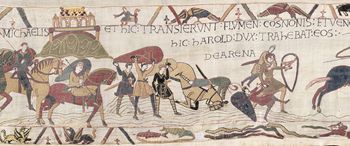
A scene in the Bayeux Tapestry (c. 1072–7 ce) shows Earl Harold ‘Godwinson’ of Wessex (c. 1022–66), future king of the English (r. 1066), rescuing two Normans from drowning in the quicksand of the River Couesnon as they cross into Brittany on military campaign (see figure 1; Bayeux Tapestry Scene 17Footnote 1). Harold (Bayeux Tapestry Figure 152Footnote 2) is depicted standing more or less upright, upon embroidered lines that represent the waters of the Couesnon. As is typical for the representation of Anglo-Saxons in this, the earlier part of the embroidery, he has a ‘pudding-bowl’ haircut and is moustached.Footnote 3 These features distinguish Harold from the Normans he saves, who have the backs of their heads shaven and are without facial hair. Harold carries one of the men ‘piggyback’ and drags the other, who has almost fallen on his back, up by his right hand. The Latin inscription above this scene is brief, but nonetheless tells us most of what we need to know to understand the imagery beneath: hIC VVILLEM DVX ET EXERCITVS EIVS VENERVNT AD MONTE[M] MIChAELIS ET hIC TRANSIERVNT FLVMEN COSNONIS. hIC hARLOLD DVX TRAhEBAT EOS DE ARENA (‘Here Duke William and his army came to Mont St Michel, and here they crossed the River Couesnon. Here Duke Harold pulled them out of the sand’).Footnote 4
Earl Harold of Wessex rescues two Normans from the quicksand of the River Couesnon. Detail from the Bayeux Tapestry, eleventh century (with special permission from the City of Bayeux).

This is an intriguing scene, showing Harold aiding Normans in an heroic act,Footnote 5 an act that is not mentioned by any other extant contemporary account.Footnote 6 However, this article will argue that it is of interest for an additional reason: namely that it appears to parallel one of the most well-known scenes of Virgil's Aeneid, in which Aeneas flees the city of Troy carrying his father, Anchises, on his back, while pulling his son Ascanius/Iulus by the hand:
These are some of the most famous lines of the epic, as they encapsulate one of its main themes – Aeneas’ pietas to the gods, his homeland, and his family – a theme which also paralleled the political and social concerns of the emperor Augustus. The popularity of Virgil's epic was immediate and this continued into the early medieval and medieval periods; whereas Homer was little known in the medieval West, the Aeneid formed a crucial part of the learning curriculum, particularly in major ecclesiastical centres on both sides of the English Channel into the tenth and eleventh centuries and beyond.Footnote 8 This is also the environment in which it is most likely that the Bayeux Tapestry was made.Footnote 9
It is against this background of cultural influences on the Tapestry, which include not only classical texts in Anglo-Saxon and Norman education, but also a tradition in these societies of illustrating manuscripts of such texts, that the following discussion will examine the interrelationship of the two scenes. It will consider that, by visually echoing lines from the Aeneid, the rescue scene (and others where the Aeneid's influence can be discerned) plays on, and with, the knowledge of the Aeneid that viewers brought with them to the Tapestry – thus consequently stressing the epic as a source for its design. In particular, it will be argued that the knowledge of Aeneas’ character, embodied in the lines above and the poem as a whole, would have informed responses to Harold in the embroidery. Furthermore, these responses to Harold-as-Aeneas would have likely been positive as a result, only changing (perhaps) when the characterization of Aeneas as a traitor to Troy, found in Dares Phrygius and Dictys Cretensis, overtook Virgil's version in medieval culture, sometime after the immediate events of the Norman Conquest. The rescue scene, therefore, plays an important role in creating and reinforcing a pious and courageous depiction of Harold which is reflected elsewhere within the textile, and as a result adds especial consequence to the interpretation (by some) that the Bayeux Tapestry is a work of art supporting a Norman world-view of the Conquest of England.Footnote 10
In order to do this, the discussion will first briefly set the rescue scene within the wider context of the Bayeux Tapestry, before moving on to consider knowledge of the Aeneid within Anglo-Saxon and Norman society. It will then examine scenes from the embroidery which have been earlier identified as containing references to the epic by previous modern scholarship, in order to emphasize that the scene of Harold saving the Normans from the Couesnon is not an isolated echo within the work. Discussion of the rescue scene itself and its implications for the depiction of Harold within the Tapestry will follow. As a final point, the concluding section will reflect on the effect that Dares and Dictys’ popular depiction of Aeneas as a traitor to Troy may have had on the Tapestry's characterization of Harold-as-Aeneas for viewers of the work.Footnote 11
Setting the scene
It will be useful to begin the discussion by setting the rescue of the Normans by Harold within the wider context of the Bayeux Tapestry's narrative, particularly the Breton campaign. This is because both Harold's actions within the scene and the events of this campaign more generally have resounding implications for the Norman Conquest and the characterization of Harold within the Tapestry, and therefore the influence of the Aeneid on the depiction of the rescue has wide-ranging significance. Furthermore, as will be argued below, the narrative of the Breton war resonates with other echoes from the Aeneid beyond the rescue scene.
The rescue is part of a long sequence in the embroidery where an army of Duke William of Normandy (c. 1028–87) makes its way into Brittany to deal with Count Conan II of Rennes. The Bayeux Tapestry begins its depiction of the Breton campaign (from Scene 16) with William (presumably Figure 143) and his army, riding out from the ducal palace at Rouen.Footnote 12 Here, the Norman duke had been entertaining an unexpected guest, Earl Harold of Wessex, who, having apparently become shipwrecked or blown off course,Footnote 13 ended up in the lands of Count Guy of Ponthieu, where he was subsequently apprehended. It is not certain whether Harold had intended this Channel crossing or not, and (if so) whether he was seeking to travel to Normandy anyway. Contemporary chroniclers variably record that Harold might have journeyed abroad to retrieve family members given as hostage as part of a treaty that was no longer current, or that he was there to confirm William as successor to Edward ‘the Confessor’. However, by 1064, the likely date of the Breton war, it is almost certain that Edgar ‘the Ætheling’, grandson of King Edmund ‘Ironside’ (r. 1016) and great-grandson of King Æthelred II (r. 978–1016), was viewed by King Edward and his closest followers as his heir – a choice much more palatable to the English aristocracy. Whatever his intentions, within the Bayeux Tapestry narrative Harold is shown landing in Ponthieu and the result was that Guy (a vassal of the Norman duke) handed him over to William: the Virgilian echoes in the scene of Harold's crossing to Normandy will be discussed in due course.
Upon leaving William's palace at Rouen to campaign against Count Conan, the Norman army (with Harold) is shown riding past Mont-Saint-Michel, which was an important monastic foundation in Normandy during this period and on the frontier with Brittany.Footnote 14 The army then embark on their crossing of the Couesnon. Men on horseback, beneath Mont-Saint-Michel, cautiously enter the waters. There disaster strikes. Not only is the water deep, but the quicksand causes horses and men to be lost; in the Tapestry a horse is shown falling forwards and its rider is unseated (Figure 150). It is immediately after this that Harold is depicted undertaking his feat of epic bravery: with great strength he drags two Normans out of the quicksand. After this, the Norman army attempts to engage Conan at Dol (Scene 18). When Conan manages to flee the town by sliding down a rope,Footnote 15 they pursue him past Rennes, finally engaging the enemy troops at Dinan (Scene 19), where Conan surrenders (Scene 20). The Breton campaign, which according to the Bayeux Tapestry William won comprehensively,Footnote 16 ends with the Norman Duke conferring arms upon Harold (Scene 21): hIC WILLELM DEDIT HAROLDO ARMA (‘Here William gave arms to Harold’). Soon after, in the scene next but one (23), which is of fundamental importance in the Tapestry's account, is VBI hAROLD SACRAMENTVM FECIT VVILLELMO DVCI (‘Where Harold swore a sacred oath to Duke William’). Although the exact nature of this oath is unknown, and much debated, it is generally thought that Harold thereby promised to help William become King of the English upon the death of Edward ‘the Confessor’.
The Bayeux Tapestry dedicates almost 10 per cent (6.38 metres) of its 68.28-metre length to the Breton war: an astonishing amount of needlework, given that William's campaign into Brittany might be regarded a sideshow in its broader narrative of the Norman Conquest. However, the importance of the campaign in the context of the embroidery is that it shows Harold's involvement in a war headed by Duke William, and that, as a result of his actions, which include the rescue of two Norman soldiers from the quicksand, Harold is ‘granted arms’ and also ‘swore a sacred oath to William’.Footnote 17 It has been claimed that this ‘gift or arms…put the English Earl in a position of vassalage’.Footnote 18 Others have suggested that the implications of his fealty were less binding,Footnote 19 arguing that instead ‘the context points rather to a recognition by William of the military prowess displayed by Harold during the Breton expedition’.Footnote 20 Whatever the exact nature of these events, and whether or not Harold felt any obligation to them afterwards, this promise was to become a fundamental part of the Norman claim to the English throne by 1066. A version of this was also accepted to some extent by chroniclers more sympathetic to the ‘English view’, namely that Harold was coerced into supporting William's bid to be king.
As Edward dies (Scene 27) he appears to proclaim Harold as protector of the kingdom, closely following the account in the Vita Ædwardi Regis (which was probably commissioned by Queen Edith, Harold Godwinson's sister and the widow of Edward): ‘Edward said a few words of comfort to Edith, who was at his feet. After which, he stretched forth his hand towards Harold to entrust him with Edith and the kingdom.’Footnote 21 Directly following this (Scene 29), Harold is shown being elected king by the council of nobles, known as the Witan, and then he is crowned (Scene 30). The Tapestry's inscription over this scene is unambiguous: hIC RESIDET hAROLD REX ANGLORVM (‘Here sits [enthroned] Harold, King of the English’) – Harold therefore appears in the Tapestry as the legitimate king. His coronation prompts Duke William's preparation for the invasion of England (Scenes 35–40). Once the Norman fleet has crossed the Channel, William and his men enjoy a feast (Scene 43), before the narrative moves to the Battle of Hastings itself, in which Harold appears to have a ‘double-death’: he is slashed in the thigh by a mounted knight after seeming to receive the ‘famous’ arrow in his eye (Scene 57).Footnote 22 Both these scenes will be explored further below.
The Aeneid, the Anglo-Saxons, and the Normans
As will be discussed in the next section, modern scholars have previously suggested that the Bayeux Tapestry appears to reference Virgil's Aeneid in several scenes, a feature paralleled in other contemporaneous texts. This is perhaps unsurprising when we consider that knowledge of the Aeneid was part of the cultural environment of Anglo-Saxon and Norman society; the popularity of the epic was immediate in the Roman period and it remained a school text after the end of the Western Roman Empire into the tenth and eleventh centuries and beyond.Footnote 23 As well as late antique Church Fathers, such as Augustine, and Christian authors, including Prudentius, medieval schooling encompassed classical works by Cicero, Ovid, Horace, Juvenal, and, of course, Virgil. Latin language knowledge created a commonality of culture among the educated elite with the expectation that it would enable those who learnt it to better serve both State and Church.Footnote 24 Surprisingly, in light of this, there are few surviving manuscripts of Virgil's text from Anglo-Saxon England, and much of what survives is extant only in fragments.Footnote 25 However, rather than suggesting that Virgil was relatively unknown to the clergy who were the main consumers of Latin texts, the fragmentary nature and low survival rates instead indicate that the Virgil manuscripts were ‘so heavily used that they eventually fell apart’.Footnote 26 Indeed, extant book lists from Anglo-Saxon libraries suggest that copies of the Aeneid were widely distributed in England,Footnote 27 and, although small in number, existing Anglo-Saxon manuscripts of Virgil outnumber those of other classical authors.Footnote 28
The influence of the Aeneid has also been detected implicitly and explicitly in literature from or commissioned by those in Anglo-Saxon England, indicating that some at least knew the text well enough to directly reference it or subconsciously echo it in their writing.Footnote 29 Its influence on Bede, Aldhelm, Alcuin, and the writer of Beowulf is well attested.Footnote 30 This knowledge did not necessarily come directly from Virgil's epic: the Aeneas story could have been known by members of the clergy and the lay elite through verbal transmission and/or commentaries on the text, particularly that by Servius which was known in Anglo-Saxon educated circles.Footnote 31 Whatever the means, it is clear that by the Norman Conquest the Aeneid was present in the cultural consciousness of the educated Anglo-Saxon clergy and elite.
Furthermore, it appears that the original Roman concerns of the Aeneid – to create a foundation myth and to defend and comment upon the political ambitions of prominent members of the elite – would have been well understood by contemporary audiences both within and outside Anglo-Saxon England. Trojan heroes had been claimed as ancestors of the Merovingian Frankish, Carolingian, and Welsh ruling dynasties. Following these, Norman ancestry had recently been traced back to the Trojan Antenor by Dudo of Saint-Quentin in his Historia Normannorum (History of the Normans, written in 996–1015).Footnote 32 The influence of the Aeneid as the paradigm of a founding narrative can be seen in this choice of the Normans’ ancestor, who may have been selected based on his appearance in Virgil's narrative;Footnote 33 Antenor is mentioned by Venus in Aen. 1.240–9 as escaping the fall of Troy to eventually found Padua, and Dudo quotes part of these lines from the epic in his text.Footnote 34 Homer was unknown to western Europe until Latin translations of the Iliad appeared in the fourteenth century. Familiarity with Troy and the Trojan heroes therefore came via direct or indirect knowledge of texts by Virgil, the Ilias Latina, and, at a slightly later date, Dares Phyrgius and Dictys Cretensis (both discussed further below), as well as through references in other popular classical authors who were studied, such as Cicero and Ovid.Footnote 35 This Trojan ancestry was then further developed during the reign of William ‘the Conqueror’ by William of Jumièges in the Gesta Normannorum Ducum (Deeds of the Norman Dukes, written 1050s–1070s),Footnote 36 who dedicated this work to the Norman duke (and king) and appears to have known the Dares and Dictys version of Antenor as a traitor to Troy;Footnote 37 the significance of this to the reading of Harold-as-Aeneas in the Bayeux Tapestry will be discussed in the final section of the article. Asserting descent from a Trojan hero claimed the majesty of Rome and the gravitas of antiquity for those to whom it was applied, which was particularly useful for the Normans (from Norse-men), who were newcomers to more southerly parts of Europe.Footnote 38
The Aeneid and the Aeneas story were not only employed to provide genealogical distinction within, and a foundation myth for, the courts of the late eleventh century, but were also utilized to comment upon contemporary politics and political players. Allusions to the Aeneid appear to function in this way in the Encomium Emmae Reginae (commissioned in the early 1040s) within the context of an Anglo-Danish court by Queen Emma, widow of both Æthelred II ‘the Unready’ and Cnut ‘the Great’. They also appear in the Vita Ædwardi Regis (dating from around the mid-1060s), made for Emma's daughter-in-law, Queen Edith. Although both works are considered to have been written by Flemish monks, they show ‘the remarkable control the laity could exert over classical learning. The Trojan foundation of Rome…became a tool for negotiating the way intermarriage and conquests made the ruling dynasties of Normandy, Denmark, Wales and Wessex rivals in the English court.’Footnote 39 Both works contain multiple references to Aeneas and the Aeneid. Footnote 40 For example, in the Encomium Emmae Reginae, a text designed to protect Emma's interests within a factionalized court, her late husband Cnut is depicted as ‘a second Aeneas, destined to found an enduring empire’.Footnote 41 Additionally, Emma's father-in-law, Sweyn ‘Forkbeard’ (960–1014), who directed the Danish conquest of England but died before this was achieved, is fittingly cast as Anchises through, among other things, verbal references to the Aeneid boat race in Book 5 which marks the anniversary of Anchises’ death.Footnote 42 In the Vita Ædwardi Regis, Aeneid references form part of a text similarly designed to protect its patron, this time amid the succession crisis precipitated by the childlessness of King Edward and Edith's marriage. Allusions to the epic glorify Edward by constructing him as both Aeneas and Octavian in his ownership of a golden ship with purple sails, evoking Octavian's fleet on the Shield of Aeneas (Vita Ædwardi Regis, 20–1; Aen. 8.671–84),Footnote 43 while enemies are undermined and belittled with Virgilian insults and parallels.Footnote 44 Thus, significantly, the Aeneid was being employed to tell the tale of both the royal court in England and other members from Harold's own family just prior to the commissioning of the Bayeux Tapestry.
Yet the Anglo-Danish and Anglo-Saxon courts were not the only employers of the Aeneas story as a ‘powerful political discourse’ in the eleventh century.Footnote 45 For William of Poitiers, for example, Aeneas and episodes from the Aeneid serve to highlight the brilliance of William the Conqueror in comparison within the Gesta Guillelmi (the Deeds of William, written c. 1074–7).Footnote 46 Poitiers suggests that poets like Virgil would praise Duke William as the equal of Aeneas (and Achilles) (Gesta Guillelmi, 134–7 [ii.22]),Footnote 47 while allusions to the Aeneid accompany Duke William's sea journey to England and mid-Channel feast (Gesta Guillelmi, 112–3 [ii.7]; Aen. 1.82–222; 7.107–47) and are designed to contrast Aeneas’ experience with William's voyage, which is calm and consequently divinely favoured.Footnote 48 Furthermore, when Poitiers relates William's contemplation of engaging in single combat with Harold, the author casts the English earl as Turnus to William's Aeneas (Gesta Guillelmi 122–3 [ii.12, 13]; 134–7 [ii.22]; Aen. 12.707–952).Footnote 49 It is of significance that some of these references to the Aeneid in William of Poitiers’ work have parallel echoes in the Bayeux Tapestry: the feast held by the Normans on arrival in England in the Tapestry (Scene 43) parallels the feast held by Aeneas and his follows upon reaching Italy (Aen. 7.107–47), while the wounding of Turnus (Aen. 12.950) and/or the wounding of Aeneas in the thigh (Aen. 12.746–8) is detectable in the Tapestry scene depicting the death of Harold (Scene 57).Footnote 50 These will be discussed further below. That Aeneid allusions also appear in the Encomium Emmae Reginae and the Vita Ædwardi Regis suggests at the very least a common cultural milieu; it is clear, therefore, that the Aeneas story was familiar to those on both sides of the Channel, including to Harold's own family. It is thus within this historical and intellectual context, ripe with Aeneid allusions, that we also find the designer of the Bayeux Tapestry playing with the Aeneas story.
Aeneas in the Bayeux Tapestry
Modern scholars have previously recognized parallels to the Aeneid in several scenes in the Bayeux Tapestry. Sandy Heslop has provided a number of examples, arguing that these are intentional parallels which present the viewer with additional information about the narrative.Footnote 51 Some of his suggestions are explored and expanded upon below, as they emphasize that the rescue scene is not isolated in its allusion to the Aeneid within the Tapestry.
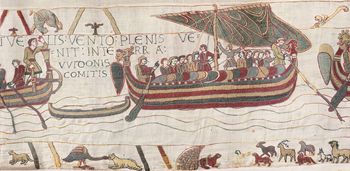
The scene which has primarily drawn attention from scholars regarding Aeneid allusions is that depicting Harold's journey across the Channel (Scene 4–6; see figure 2), partly because its inscription is unusual in being one of only two rhetorical flourishes employed in the Tapestry inscriptions: ET VELIS VENTO PLENIS VENIT IN TERRA VVIDONIS COMITIS (‘and with the wind full in his sails [Harold] came to the land of Count Guy’).Footnote 52 As Gale Owen-Crocker has noted, there is a ‘pleasing alliteration’ of velus and ventus which gave rise to variations of velis vento plenis becoming a favourite among classical authors. Similar wording can be identified in Horace, Lucan, Lucretius, and Virgil, as well as in later writings, such as Beowulf and work by Bede.Footnote 53 She concludes, without further comment, that Ovid, Metamorphoses 15.176–7 is the closest verbal parallel: Et quoniam magno feror aequore plenaque ventis / vela dedi: nihil est toto, quod perstet, in orbe (‘And since I am carried upon the great sea and have surrendered full sails to the winds: there is nothing in all the world which endures’). However, Ovid was another well-known classical author in the medieval period, and if this was the source of inspiration for the Tapestry designer then it is perhaps notable within the context of the embroidery's portrayal of Harold that these lines come from the long speech about change, essentially a meta-Metamorphosis, by Pythagoras to Numa. This is not only because Numa was considered a wise and pious king, responsible for encouraging religious practice among the early Romans,Footnote 54 and as we will see, piety is a trait which is attached particularly to Harold in the Bayeux Tapestry. It is also curious because Pythagoras’ speech ends with a reference to the prophecy of Helenus about Rome's founding from the Aeneid,Footnote 55 and a variation of velis vento (omitting plenis) occurs within the Aeneid during this episode (Aen. 3.473–2: interea classem velis aptare iubebat / Anchises, fieret vento mora ne qua ferentis [‘Meanwhile Anchises ordered us to fit out the ships with sails, so that the favouring wind would meet no delay’]). Regarding the Tapestry, the potential allusion's significance is that the favouring wind that Anchises is preparing for will speed him to his death, while also setting in motion the journey towards the foundation of the Roman Empire, and this may have been considered an apt parallel to Harold by the Tapestry designer.
‘With the wind full in his sails’, Earl Harold of Wessex crosses the English Channel by ship. Detail from the Bayeux Tapestry, eleventh century (with special permission from the City of Bayeux).

Yet this is not the only time that a variation of velis vento plenis can be found in the Aeneid; indeed, the parallel between the Tapestry inscription and Aen. 5.281 (vela facit tamen et plenis subit ostia velis [‘nevertheless, he hoists the sail and under full sail makes it to harbour’]) was noticed by Bernard Bachrach and has been further expanded upon by Heslop.Footnote 56 Heslop drew a connection between Sergetus’ reckless and disastrous manoeuvre during Book 5's boat race and Harold's actions in landing himself in Guy of Ponthieu's hands: ‘The reference is thus to one who made a foolish decision and ended up a laughing stock. With the benefit of hindsight, it was an apposite comparison to make with Harold's action [in ending up at the wrong place].’Footnote 57 The point is strengthened further, however, if we consider something that Heslop does not comment upon: that just prior to this Virgil had emphasized Sergestus’ connection to the Sergian family, who counted Catiline as a recent (to Virgil) member (Aen. 5.121). Sergestus’ impetuous actions drive himself and his crew onto the rocks in a way that foreshadows the behaviour of his descendant,Footnote 58 but for the viewers of the Bayeux Tapestry this would also foreshadow Harold's deeds, suggesting that he was not simply a fool, but a man whose poor decisions would inevitably lead to self-destruction.
Additionally, this Tapestry scene has allusions to the Aeneid more generally, if we take the inscription to suggest that Harold was heading for Normandy but was blown off course, as William of Malmesbury (c. 1090–c. 1142) recounts.Footnote 59 Viewers of the Bayeux Tapestry may have recalled a similar circumstance affecting Aeneas and the remaining Trojans in Book 1, when the goddess Juno, angered that some Trojans still survive, orders Aeolus, god of the winds, to send a storm to destroy their ships, driving them off course (Aen. 1.34–123).
It is perhaps overmuch to suggest that the narrative in these early sections, which include the rescue scene, follows Aeneid 1 (and 4) closely. However, there are broad parallels between both Harold's and Aeneas’ stories in the early parts of the Tapestry and the epic, beyond landing in an unintended destination, and these seem to cast Harold as Aeneas or place Harold in familiar Aeneid situations but as a ‘reverse’ or ‘negative’ Aeneas. The latter instance is suggested by Tapestry Scene 9. Both Aeneas and Harold approach a ruler (Dido/Guy of Poitiers) as a supplicant and as the result of difficulties, but, whereas Aeneas’ identity as the son of a goddess and as a noble prince of Troy is enhanced as he steps out of a divinely conjured cloud to the awe of Dido (Aen. 1.586–95), Harold in contrast arrives as a prisoner, carrying his sword – the identity marker of his noble, masculine, and military status – sheathed in its belt, effectively impotent.
More commonly, however, the Tapestry depicts Harold as Aeneas; the rescue scene is one specific instance, and will be discussed in detail below, but we might also consider more generally that both Harold and Aeneas can be (and were) viewed as oath-breakers, even though their texts, the Tapestry and the Aeneid, seem to suggest otherwise: as indicated previously, the nature of Harold's oath in Scene 23 is not certain, while Aeneas defends himself to Dido upon his departure by claiming that he made no marriage contract with her (Aen. 4.337–9).Footnote 60 Furthermore, as will be returned to in due course, both Harold and Aeneas seem to be driven by a destiny over which they have no control. For Harold this is strongly implied by his accidental landing in Ponthieu (Scenes 4–5), which seems to reflect Aeneas’ claim Italiam non sponte sequor (‘It is not by my wish that I make for Italy’, Aen. 4.361) that is echoed throughout the events in the Aeneid. Additionally, the Tapestry's depiction of a comet (Scenes 32–3) further emphasizes Harold's inability to escape his fate and his similarities with Aeneas, as it has been considered a parallel to the Shield of Aeneas and Aen. 1.712 in its prophesying of future events,Footnote 61 events which are set in motion by the actions of the narratives’ protagonists. The early part of the Tapestry, therefore, appears to allude to the early books of the Aeneid, placing Harold in the Aeneas role.
Similarly, echoes to later parts of the Aeneid appear in later parts of the Bayeux Tapestry: Harold's death scene (57) again suggested an Aeneid allusion to Heslop, who argued that the wound Harold receives in the thigh references that given to Turnus (Aen. 12.919–26).Footnote 62 However, the parallels are not exact: Harold is struck by a sword in the Bayeux Tapestry,Footnote 63 not a spear (telum) – which is the weapon that wounds Turnus.Footnote 64 It is attractive to contemplate that Harold, who seems to have been cast as Aeneas in the early part of the Tapestry, has now taken on the role of Turnus at his death – especially when we consider that William of Poitiers similarly makes this connection to Turnus in order to denigrate Harold. However, it is perhaps significant that Aeneas is also wounded in the thigh in the fighting just prior to his killing of Turnus (Aen. 12.746–8). Again, the parallels are not exact (Aeneas is struck by an arrow and of course does not die), but Harold may be appearing as a ‘reverse’ Aeneas here, just as he did in the earlier sections of the Tapestry, indicating that the designer still views Harold as Aeneas, even to the last.
A further Aeneid reference in the Bayeux Tapestry was identified by Heslop in the scene depicting a Norman feast, over which Odo presides and which takes place after Duke William's army have landed in England (Scene 43; Aen. 7.107–47).Footnote 65 It may be that this is the Tapestry's version of the mid-Channel feast of which William of Poitiers talks and which the latter intersperses with Aeneid references (Gesta Guillelmi, 112–13 [ii.7]; Aen. 1.82–222, 7.107–47; see above).Footnote 66 If this is the case, it is noteworthy that both the Tapestry and William of Poitiers allude to the feast which signifies that Aeneas has at last reached his destined land, one that will eventually give birth to a mighty empire. The significance for both Tapestry and Poitiers seems clear, and it appears that, in the embroidery, Duke William or perhaps Odo (as the central figure in the scene) has displaced Harold as Aeneas.
Anglo-Saxon manuscript illumination, classical texts, and other possible artistic influences on the rescue scene in the Bayeux Tapestry
However, this feast scene also has strong visual parallels to the manuscript illustration of the Last Supper in a late sixth-century Italian illuminated gospel book (known to be in the library of St Augustine's Abbey, Canterbury by the eleventh century) thought to have been brought to England by St Augustine himself in c. 597, or thereafter.Footnote 67 Indeed, the extent to which the Bayeux Tapestry designer borrows from illuminations produced or known from manuscripts kept at Canterbury, especially of late Anglo-Saxon artistry, is well documented.Footnote 68 In brief, the style of the Tapestry – though accounting for the differences in creating a design in embroidery versus vellum – matches well with what we find in Anglo-Saxon manuscripts of the late tenth and early to mid-eleventh century. Frances Wormald highlighted the fact that parts of the Tapestry's design ‘retains a great deal of the spirit of English drawing’, including ‘extraordinary vigour of facial expression’.Footnote 69 Notable in this respect is the Harley 603 Psalter (made at Canterbury, Christ Church from c. 1010, with later additionsFootnote 70), which is a copy of the Carolingian Utrecht Psalter (produced at Hautvillers Abbey, near Rheims, c. 820–35Footnote 71), and was to have a profound impact on Anglo-Saxon art thereafter.Footnote 72 Similar influences can be found across an array of late Anglo-Saxon manuscripts, not only those produced in Canterbury, but further afield also, including in France, where there was a ‘close dependence of Norman illumination upon English eleventh-century manuscript decoration’.Footnote 73 The Tapestry designer was particularly influenced by the imagery of the Old English Hexateuch (probably made at St Augustine's Abbey, Canterbury in the second quarter of the eleventh centuryFootnote 74), and numerous parallels between the Bayeux Tapestry and the Hexateuch have been identified.Footnote 75
There are no parallels in the Old English Hexateuch for the scene where Harold rescues two Normans from the sands of the Couesnon. However, possible models have been identified for the border of this scene (17) where two fish are fighting over an eel from an illustrated Aratea – a Greek astronomical poem translated into Latin by Cicero.Footnote 76 It is possible that other aspects of this scene of Harold's bravery were borrowed from manuscripts that are now lost; we know that what survives of Anglo-Saxon manuscript art is only a small percentage of what once existed.Footnote 77 The Anglo-Saxon manuscript illustration cycle of the Psychomachia by Prudentius has also been identified as influential to the imagery of the Bayeux Tapestry in a number of ways.Footnote 78 This includes the horse shown falling forwards with its rider unseated (Figure 150) immediately prior to the rescue scene, which has some similarities with the illustration of Superbia falling into a pit with her horse in the British Library manuscript Cotton Cleopatra C.viii (fol. 16r).Footnote 79 The suggestion that this refers back to an earlier horse of Harold's and thus foreshadows the Battle of Hastings, which includes a horse in a similar position, is interesting.Footnote 80 However, it is difficult to accept that the falling horse immediately prior to the rescue scene indicates that the latter should be read alongside another, earlier, border image (of a horse dragging a plough underneath the scene [10], where William learns of Harold's capture), as signifying that ‘Harold [in rescuing the Normans] is sowing the seeds of the relationship with William’ or that here Harold's action is ‘likened to that of a horse who both carries and pulls’.Footnote 81 Regardless of the exact influences from illuminated manuscripts on the rescue scene, there is a clear tradition of illuminating Latin texts from the classical and late antique world during the eleventh and twelfth centuries and these images were used by the Bayeux Tapestry designer for artistic inspiration.
Images from Latin texts were therefore a direct and indirect influence on the Tapestry; however, some scholars have also proposed that Roman artworks were not unknown to its designer. The columns of Trajan and Marcus Aurelius, which similarly commemorate contemporary military campaigns, have been suggested as the source for a number of the scenes, such as that depicting shipbuilding (Scene 37) and one of a woman fleeing a house with her child (Scene 47), along with several more.Footnote 82 Included with these is the rescue scene, which has been connected to one on Trajan's column showing Dacian soldiers drowning.Footnote 83 However, here no Dacian soldier is being carried ‘piggyback’, and as such it is missing a crucial element of the Bayeux Tapestry rescue scene – indeed it is partly this element which makes its parallel with the Aeneid so compelling, as will be discussed below. Even if the Tapestry designer visited Rome to see this monument, which is by no means certain or even likely, the positioning of this scene almost halfway up the column would have made it difficult to view.Footnote 84 The suggestion that instead these images might have been transmitted into Anglo-Saxon art indirectly is difficult to confirm either way, but, as has been noted above and will be discussed below, there are more clear-cut forerunners to the Tapestry imagery here.Footnote 85
Harold-as-Aeneas: the rescue scene
For the rescue scene, we have suggested throughout that the inspiration is the Aeneid and it seems likely that the visual composition of the figures is a reference to the text of Aen. 2.707–24 rather than to a surviving piece of Roman artwork. This is because of the positioning of the Norman on Harold's back. Although in earlier Greco-Roman art Anchises was depicted on Aeneas’ back, in similar manner to the Norman in the Bayeux Tapestry,Footnote 86 after the first century ce he is instead represented as sitting on the left shoulder of Aeneas, as if he was in a chair.Footnote 87 This appears to be in imitation of the composition of figures which made up the statue group in the Forum of Augustus. Images of Aeneas and Anchises fleeing Troy were present in Greek and Roman art before Virgil – for example, on Greek archaic vases and coins of the Roman Republic – but it was Virgil's version of the story, which now included Ascanius, that became the ultimate source for artistic representations of this group from the first century ce and beyond.Footnote 88 This was largely thanks to the emperor Augustus, whose forum, dedicated at Rome in 2 bce, included a prominent statue group of Aeneas, Anchises, and Ascanius. The presence of Ascanius strongly suggests that Virgil's text was the main inspiration for this work, as this son of Aeneas was rarely included in earlier depictions.Footnote 89 While the original sculpture no longer survives, the number of copies from the first century ce onwards in different media, such as reliefs, frescoes, gems, and terracotta statues, attest to both what it looked like and its popularity.Footnote 90 Moreover, these copies were not simply (or only) bought and/or commissioned to show that the owner was a follower of art trends or loyal to the Augustan regime;Footnote 91 they also developed a deeper significance. By the Flavian period, seventy years later, the Aeneas group was being utilized on the tombstones of men and women to honour the deceased along with the dedicator of the grave, ‘[assimilating] the moral content of this originally political image…to express pietas’.Footnote 92
Virgil's lines, then, become ‘the text for perhaps the most famous single image associated with the Aeneid’.Footnote 93 However, these lines also indicate that Anchises is carried on Aeneas’ neck and shoulders (ergo age, care pater, cervici imponere nostrae; / ipse subibo umeris; Aen. 2.707–8), and this is similar to how the rescued Norman in the Bayeux Tapestry is positioned. Importantly, the scene is additionally not referencing pre-Virgilian artistic representations of the Aeneas group, as these rarely (if at all) depicted Ascanius; indeed, Ascanius’ prominent position within the Aeneid, as Aeneas’ only son, appears to have been Virgil's invention – he is not mentioned by Homer, for example.Footnote 94 Furthermore, as noted above, it seems unlikely that the designer of the Bayeux Tapestry would have had knowledge of these earlier artworks.
These lines were a favourite with Roman artists and consumers of art because they vividly capture the idea of Aeneas as pius Aeneas, a hero who is religiously pious, as well as one who knows his duty to his homeland and family. Considering that Aeneas is a hero, indeed the hero of the Aeneid, it is striking that Harold is the one who gets to ‘play’ Aeneas on the Bayeux Tapestry. If the Tapestry is a pro-Norman work, as some have suggested,Footnote 95 the visual reference to these lines in the embroidery's depiction of Harold rescuing the Normans is perhaps unexpected. Although Harold is acting the hero within this scene, for any Normans viewing the Tapestry, his overall actions in its narrative and especially in the wider historical context embody instead the exact opposite qualities of those which the original Aeneid lines imply. This is because, according to the Norman sources, Harold is a perjurer, who has impiously broken a sworn oath, gone against the wishes of his kinsman Edward ‘the Confessor’ in proclaiming himself king, and plunged his homeland into war as a result. Taking this view, the visual identification of Harold here with pius Aeneas would make his later oath-breaking all the more remarkable (perhaps even comedic?) for Norman audiences, as the distance between the two characters could not be greater. We might rather expect Duke William to be cast in the Aeneas role, especially as contemporary texts written about the Norman Conquest (such as that of William of Poitiers) praise William through allusions to Aeneas and the Aeneas story, as noted above.Footnote 96 After all, Aeneas is not only a hero, but a founding ancestor of a great empire.
However, although she does not make the connection, Emily Winkler's identification of Aeneas as a man buffeted by fate,Footnote 97 compared to the portrayal of William ‘the Conqueror’ as ‘a hero…with greater control of his situation and destiny’ because of his Christian-God-approved (and therefore superior) enterprise in William of Poitiers’ work, may hold the key to this mystery. In the Bayeux Tapestry, Harold seldom appears to be in control of his fortune.Footnote 98 His presence in Duke William's retinue (leading to the scene of the rescue) is a result of a series of unfortunate events, beginning with being accidentally being blown off course or wrecked on the coast of Ponthieu. As noted earlier, he could therefore be understood by contemporary viewers as Aeneas in this section of the Bayeux Tapestry, in the epic hero's role as a man driven by, rather than in control of, the winds of divine fate. This characterization is signalled initially by the Virgilian inscription in Scenes 4–5 (velis vento plenis – very apt in light of future events), reinforced by Harold-as-Aeneas in the rescue scene, and then further confirmed by the foreshadowing of doom heralded by the comet and ‘phantom fleet’ which frame Harold's coronation scene.Footnote 99
Such a portrayal does not, however, need to imply that the Bayeux Tapestry is pro-Norman and, indeed, it is probably not so.Footnote 100 It is striking how much of the Tapestry focuses on Harold, rather than William – which would be the expectation if its narrative was unambiguously pro-Norman.Footnote 101 Instead the Tapestry presents Harold as a flawed figure, but one who is generally courageous and, significantly, pious. Furthermore, the comparisons to Aeneas, created by allusions to Virgil's epic in the Tapestry, add further depth to this characterization. Indeed, the Bayeux Tapestry seems to emphasize Harold's piety, rather than his perjury: in Scene 3, for example, the English earl is shown visiting Bosham church with a companion, presumably to pray before he embarks for Normandy. Furthermore, no other character in the Bayeux Tapestry is as pious as Harold; Duke William, perhaps surprisingly, is ‘never seen at church or at prayer or in any posture of piety’, despite other sources indicating that he sought papal approval before moving against Harold.Footnote 102 Additionally, in contrast to contemporary Norman sources, the embroidery recognizes Harold as a legitimate king with its unambiguous inscription above the scene of his coronation (Scene 30): hIC RESIDET hAROLD REX ANGLORVM (‘Here sits [enthroned] Harold, King of the English’). The Tapestry inscription, moreover, continues to call Harold rex throughout, even in his death scene.Footnote 103 As Pierre Bouet and François Neveux have commented:
if this were not the case [that the Tapestry considers Harold as a legitimate king], then it would have been easy for the patron or the designer of the Tapestry to add to the inscription the words ‘perirus’, ‘periuratus’, ‘uesanus’, ‘sceleratus’, ‘iniustus’, every single time Harold was depicted – the terms that we find in the Norman chronicles after 1070.Footnote 104
The rescue scene further reinforces this characterization of pious Harold, while adding another layer to the depiction of Harold-as-Aeneas present in the Bayeux Tapestry within the various scenes discussed above. Those of the clergy and lay elite (and possibly others) who viewed the Bayeux Tapestry would have known the Aeneid and other classical texts through their education and work or leisure, whether English or Norman. When they looked at the Tapestry they would have brought their knowledge of the epic and the Aeneas story to the work, viewing it within this context (as well as others).Footnote 105 The inclusion of the rescue scene, not mentioned by any other contemporary source and with its allusion to Aeneas at his most pious, suggests that Harold would have been understood as a similarly pious and courageous figure – if somewhat unfortunate.
Harold as Aeneas the traitor
It makes it all the more intriguing, then, that for medieval viewers of the Bayeux Tapestry from the late eleventh or early twelfth century, but perhaps as early as the 1050s ce for the Normans, this scene may have taken on another meaning which was perhaps not intended by the original designer, but nevertheless suited the characterization of Harold as an oath-breaker and traitor found in the contemporary Norman accounts. During this period, two Latin texts about the Trojan War became very popular and widely circulated: the de excidio Troiae by Dares Phyrgius and the Ephemeris de bello Troiano by Dictys Cretensis.Footnote 106 Although they were probably written in about the first century ce in Greek, they were transmitted to the medieval world via Latin translations made around the fourth century (for Dares’ work) and the sixth century (for Dictys’). Both texts claimed, however, to be ‘eye-witness’ accounts from participants in the Trojan War (Dares on the Trojan side, Dictys on the Greek), and as a result gained a ‘success out of all proportion to their literary merit, not only during the Middle Ages, but even beyond’, as Hugo Buchthal notes.Footnote 107 In contrast to Virgil's Aeneid, which was recognized as a fabula, a fictional narrative, within this period,Footnote 108 the texts of Dares and Dictys were believed to be historically accurate because of these claims, and were often included in manuscripts with Virgil's text, in order to present another, ‘factual’ view of the Trojan War.Footnote 109
These texts were designed to refute much of Homer's account of the Trojan WarFootnote 110 but, as Homer was mostly unknown in western Europe during the early medieval period, their significance for Harold-as-Aeneas in the Bayeux Tapestry lies in their presentation of Aeneas. In direct opposition to Virgil's Aeneid, Dares and Dictys present the epic hero as a traitor who, along with Antenor, conspires with the Greeks to ensure the defeat of Troy.Footnote 111 Thus, unlike Virgil's Aeneas, who goes back to defend his city and only leaves Troy on divine orders, the Aeneas of Dares and Dictys is a coward whose flight from the city is a result of his own treachery. Although it appears that these versions were not in circulation in England before the end of the eleventh century,Footnote 112 on the Continent their diffusion was limited but broad geographically.Footnote 113 This alternative legend was therefore perhaps known to the Normans by the 1050s, but at least by the late 1070s; the unequivocal treachery of Antenor in William of Jumièges’ Gesta Normannorum Ducum suggests that this is so, as this characterization of Antenor is found primarily in the Dares’ and Dictys’ narratives, and does not appear in the Aeneid (as noted above).Footnote 114
Although knowledge of the Aeneid lines would still have been necessary for understanding the allusion in the Bayeux Tapestry scene, as neither Dares nor Dictys have corresponding verbal imagery, awareness of this ‘counter-tradition’ to the Aeneid Footnote 115 would have added a further layer to the representation of Harold-as-Aeneas in the rescue scene. This additional understanding did not present a disjunction between pius Aeneas and the perjurer Harold, but instead could have been read straightforwardly as Harold in the role of Aeneas, the betrayer of his homeland. The Tapestry then (even if unintentionally) accommodates a changing Anglo-Saxon and Norman world-view of the circumstances and events that led to the Norman Conquest of England in 1066.
Conclusion
The depiction of Harold rescuing two Normans during the Breton campaign is one of several possible allusions to the Aeneid in the Bayeux Tapestry. Although he is presented in this scene as heroic, the visual reference to lines of Virgil's Aeneid, which portray Aeneas at peak pietas, signals that there is more to be understood here. The imagery of the rescue scene, combined with the inscription velis vento plenis (Scenes 4–5), implies that Harold was to be understood as an Aeneas-figure, courageous and apparently pious but at the mercy of divine forces greater than himself. By depicting Harold as Aeneas, the Tapestry sets up a narrative tension between the expectation created by this characterization – that Harold's destiny is to found a mighty dynasty in a society made up of an amalgamation of different peoples – and the outcome of the Battle of Hastings. For Norman and Anglo-Saxon viewers, their education in classical texts would allow them to ‘read’ the Tapestry through their knowledge of the Aeneid and the Aeneas story. Here, however, the readings diverge. For the Normans, Harold's oath-breaking and treachery make it clear that Harold will not be the originator of this dynasty; he is not the pius Aeneas of Virgil and has therefore forfeited his claim to this mantle. For them, and for future medieval viewers of the Bayeux Tapestry, Harold may have been Virgil's Aeneas, but he was also an Aeneas who was overlaid with the narratives of Dares Phyrgius (and Dictys Cretensis) that showed the hero as a traitor to Troy. For the Anglo-Saxons, however, and those who did not know of this alternative portrayal, the presence of Harold-as-Aeneas accommodates and resonates with their accounts of the Conquest. By emphasizing the piety and courage of Harold, it shows him to be a tragic but heroic figure – pius Harold.