1. Introduction
Emissions trading, a cap-and-trade system, is a market-based policy for controlling nationwide pollution emissions. This policy instrument has been used to manage air pollution, water resources, land, fisheries and many other natural resources (Tietenberg, Reference Tietenberg1985). Trading in the domestic market occurs among sectors between the holders of emissions permits. Examples of this policy can be found in studies by Cramton and Kerr (Reference Cramton and Kerr2002), Dinan and Rogers (Reference Dinan and Rogers2002), Klepper and Peterson (Reference Klepper and Peterson2004), Parry (Reference Parry2004), Kuik (Reference Kuik2003) and Pizer et al. (Reference Pizer, Burtraw, Harrington, Newell and Sanchirico2006). Many studies have found that the economy-wide results of such a policy are more efficient than the sector-based results, as the marginal cost of the policy is equalized across the entire economy.
The emissions trading mechanism is also one of the instruments proposed in the Kyoto Protocol for the reduction of CO2 emissions (UNFCCC 2007). It is generally believed that emissions trading can move beyond the boundary of a specific nation and take place at the global level, which would in turn enhance the efficiency of the policy. Thus, minimizing the negative impact of CO2 emissions reductions on economic growth is not only a prudent concern for individual nations, but also a significant challenge for all nations globally. In this context, the most debated question is as follows: how can initial rights be equitably allocated to individual nations as trading base endowments, which are in turn used by these nations to determine their national-level emissions reductions?
Although current emissions reductions under the Kyoto Protocol framework take the form of a single-type commitment, an emissions trading mechanism has not fully been put into practice. Specifically, it is only at the stage of an agreement to reduce total emissions by a certain percentage of the selected base year. Such a framework not only determines the responsibility of each nation to reduce emissions, but also implies an allocation of initial emission rights. As a result, it has been argued that not all nations are taking up their responsibility to reduce emissions and that the Kyoto criteria for emissions reduction are too simple to reflect the complicated status of each nation (Ott, Reference Ott1998; Haites and Yamin, Reference Haites and Yamin2000; Shogren and Toman, Reference Shogren, Toman, Portney and Stavins2000; Victor, Reference Victor2001).
Various types of equitable initial rights of emissions allocation have been developed. Some have emphasized the principle of equity (Ringius et al., Reference Ringius, Torvanger and Underdal2002; Höhne et al., Reference Höhne, Galleguillos, Harnisch and Phylipsen2003), and others have focused on more pragmatic concerns related to equity (Rose et al., Reference Rose, Stevens, Edmonds and Wise1998; Miketa and Schrattenholzer, Reference Miketa and Schrattenholzer2006). If an equity consensus is reached through an operational initial right of emissions allocations, then the amount that a nation can emit or buy and sell in the trading market will be determined once the emissions trading mechanism is implemented. Many nations, including China, India and the United States, have challenged and/or dismissed the equity criterion as an important factor in deciding whether or not to join an emissions reduction arrangement. This was the attitude of these nations before the Kyoto Protocol, and it will continue to be so into the future (Tonn, Reference Tonn2003).
Thus, the attraction of joining in commitments to CO2 emissions reductions or searching for cooperation for these nations and many others relies on resolving the potential conflict regarding the allocation of initial rights among nations while the new policy of emissions trading is implemented and enforced. Emissions trading is expected to decrease the total abatement cost of reducing a certain amount of CO2 emissions. The criterion of initial rights for emissions from a group of nations' viewpoint or individual national viewpoint occurs at the greatest total abatement cost saving associated with the enforcement of the emissions trading scheme.
It is, however, known that, in a successful implementation of the emissions trading mechanism, the allocation of initial rights typically plays a critical role. Since each individual polluter normally wants as many rights as he or she can get in the initial rights allocation, this first step of allocation turns out to be one of the potential sources of controversy. It is then not only important but also essential to investigate the results of the allocation of initial rights under different equity concerns. The breaking through and mastering of the possible disputes among polluters regarding the equity concerns surrounding the allocation of initial rights definitely constitute a crucial mission for the accomplishment of an emissions trading scheme. Under such a foundation, the related discussion on the effectiveness of such a mechanism and the continuous implementation of missions to go forward to the outcome of the trading arrangement and the process by which the allocation and trading of rights take place will thus be both meaningful and feasible.
To the best of our knowledge, while there are few studies involving a conceptual discussion of equitable initial rights, there are far fewer studies that actually compute the total abatement cost under any initial rights allocation (Rose and Stevens, Reference Rose and Stevens1993; Rose et al., Reference Rose, Stevens, Edmonds and Wise1998; Berk and den Elzen Reference Berk and den Elzen2001; Ringius et al., Reference Ringius, Torvanger and Underdal2002; Höhne et al., Reference Höhne, Galleguillos, Harnisch and Phylipsen2003; Baer et al., Reference Baer, Athanasiou, Kartha and Kemp-Benedict2008). Nonetheless, no study has comprehensively provided the economic cost information from a global viewpoint and the viewpoint of a group of nations at a certain level of economic development, or even from the viewpoint of any individual nation when a particular equitable emissions trading mechanism is introduced.
As a result, the purpose of this study is to construct emissions allocation models based on operational equitable initial rights, as part of an attempt to realize the possible causes of disagreement among nations for either not ratifying the Protocol or being committed to the CO2 emissions reduction. To achieve such goals, this paper constructs operational models for the allocation of initial rights by solving and computing the total abatement cost for CO2 emissions reduction, using panel data for 57 nations from 1990 to 2005. Such data include those most favored by analysts and experts, based on discussions or equity criteria related to egalitarianism, sovereignty, the polluter pays principle, the ability to payFootnote 1 and various scenarios of the Greenhouse Development Rights framework (GDRs) designed by EcoEquity and the Stockholm Environment Institute (2009). The results acquired from this study are able to provide complete information with reference to groups of countries as a whole and specific countries regarding their possible performances under different equity initial rights emissions allocation criteria when the emissions trading mechanism is implemented.
With these criteria, it is then necessary to compare, in terms of the greatest total abatement cost saving before and after the emissions trading has been enforced, whether different groups of nations or individual nations will be inclined to prefer different equity criteria. Furthermore, it will be necessary to observe whether there is an initial right of emissions allocations criteria that generates an incentive for the three nations with the highest CO2 emissions, i.e., China, India and the United States, to ratify or to commit emissions reduction arrangements or obligated amounts of emissions reductions. These three countries account for about 30 per cent of cumulative CO2 emissions over 1950–2005. The results will then supply information for dealing with the potential issues regarding the agreements, cooperation and/or conflicts among countries seeking to join the trading system.
2. The equity principle
Many of the nations that did not ratify the emissions reductions requirements in the Kyoto Protocol have raised different viewpoints related to equity with respect to the initial rights of emissions allocations. The United States, for instance, has noted that not all nations at present have committed to a certain percentage of CO2 emissions reductions. As such, this is unfair for those who commit to doing so. For developing nations, such as China and India, their refusal to commit to emissions reductions betrays the view that the cause of global warming is the responsibility of the developed nations that have consumed huge amounts of fossil fuels in the course of economic development (Höhne et al., Reference Höhne, Galleguillos, Harnisch and Phylipsen2003; Tonn, Reference Tonn2003). It is thus unjust for developing nations to share the responsibility for issues generated by developed nations. Moreover, given the importance of economic development to developing nations, these nations have further hesitated to make commitments to emissions reductions due to tradeoffs between CO2 emissions and economic development.
Although different nations have different concerns regarding the initial rights of emissions allocations, the trade negotiations among nations, together with pressures from nations that have ratified the Kyoto Protocol, will change the incentives of nations that have not ratified the agreement. The willingness of the latter nations to join the emissions reduction agreement critically depends upon whether there exists an equitable initial right of emissions allocations (Yohe et al., Reference Yohe, Montgomery and Balistreri2000; Fletcher, Reference Fletcher2001; Agarwal and Narain, Reference Agarwal and Narain2002).
The current literature on the equitable initial rights of emissions allocations can be classified into two groups. In the first group, studies use current emissions trading policies as a benchmark and propose some modifications. For instance, the historical emissions of each nation are included as one – but not the only – factor in initial rights of emissions allocations. For example, some studies suggest that gross domestic product (GDP) and population should also be factors taken into account in developing an equitable initial emission rights allocation (Rose and Stevens, Reference Rose and Stevens1993; Larsen and Shah, Reference Larsen and Shah1994; Edmonds et al., Reference Edmonds, Caputi, Moran, Fletcher, Morita, Secor, Dean and Campana1995; Cramton and Kerr, Reference Cramton and Kerr2002). However, there is still no consensus as to which factors should be included.
The other type of literature is related to the studies that focus on the substance of equity. Egalitarianism, sovereignty, the ability to pay and the polluter pays principle along with GDRs framework are five typical ways of understanding equity (Ringius et al., Reference Ringius, Torvanger and Underdal2002; Höhne et al., Reference Höhne, Galleguillos, Harnisch and Phylipsen2003; Baer et al., Reference Baer, Athanasiou, Kartha and Kemp-Benedict2008). Among these, egalitarianism and sovereignty are rights-based notions of equity. The principle of egalitarianism emphasizes that every person has an equal right to emissions. The sovereignty principle is essentially a grandfathering approach to allocation, as a nation that has had higher cumulative emissions over a specific time span is allocated more rights to emit.
By contrast, the ability to pay and polluter pays principles are founded in duty-based notions of equity (Berk and den Elzen, Reference Berk and den Elzen2001; Höhne et al., Reference Höhne, Galleguillos, Harnisch and Phylipsen2003; Finkbeiner and Neugebauer, Reference Finkbeiner and Neugebauer2013). The ability to pay implies that nations with higher incomes, more natural resources or technological advantages have better adaptive abilities, thereby implying greater potential for emissions reduction. The polluter pays principle emphasizes the harmfulness of each nation's cumulative emissions to the environment in allocating emission rights.
The GDRs framework developed by Baer et al. (Reference Baer, Athanasiou, Kartha and Kemp-Benedict2008) defines the national obligation based on adaptation and mitigation. GDRs seek to look after both sides of human development and climate protection, i.e., developmental justice. Such an approach will rely on the principles of responsibility and the capacity to develop operational equity criteria for allocating emissions reductions to each nation. An operational tool, namely, the responsibility and capacity indicator (RCI), which is based on these two principles is derived under this framework.
In either of the above two strands in the past literature, however, it is observed that no operational criterion has been constructed from such a framework to guide the initial rights of emissions allocations. Moreover, there is no empirical research that comprehensively compares different notions of initial rights of emissions allocations of equity criteria under the emissions trading scheme, i.e., to compare egalitarianism, sovereignty, the ability to pay, polluter pays and the GDRs framework. Appropriately, pragmatic criteria can be determined from changes in incentives achieved through savings in the total abatement cost by groups of countries or by individual countries following the enforcement of emissions trading. This paper seeks to provide specific results for initial rights of emissions allocations under various equity criteria at both a concrete and a pragmatic level.
3. Total abatement cost under emissions trading
3.1. Solving the marginal abatement cost without emissions trading
To simulate total abatement costs under different allocation models, it is essential to solve the marginal abatement cost (MAC) in terms of the change in the GDP for each nation. This study adopts the shadow pricing model in combination with the directional distance function developed by Färe et al. (Reference Färe, Grosskopf and Noh2005) to estimate the MAC of each nation. The idea of a combination of the directional distance function and the shadow pricing model has been adopted by Maradan and Vassiliev (Reference Maradan and Vassiliev2005) and Marklund and Samakovlis (Reference Marklund and Samakovlis2007) to compute the MAC in terms of the change in GDP for each nation.
According to the procedure proposed by Färe et al. (Reference Färe, Grosskopf and Noh2005), the minimization problem and solution of the parameters for the MAC curve is a two-stage procedure. In this framework, the first stage is the selection of directional function form and the second stage is to minimize this functional form and solve the related parameters. Adoption of mathematical programming to solve the parameters of directional distance function can not only avoid the violation of the fundamental properties of directional distance function but also guarantee the solutions are consistent with the production economic theory proved by Färe et al. (Reference Färe, Grosskopf and Noh2005).
Further analysis results in a set of decision-making units (DMU) that are engaged in production activities with a desired GDP output y and undesired CO2 output b. The MAC, which is the shadow price of CO2, is denoted by q and is shown as (1) below:
 $${MAC} = q = - p \left({\partial {\mathop{\rm D}\limits^{\rightarrow}}_0 \left(x\comma \; y\comma \; b\semicolon \; \hbox{g} \right)/\partial b \over \partial {\mathop{\rm D}\limits^{\rightarrow}}_0 \left(x\comma \; y\comma \; b\semicolon \; \hbox{g} \right)/\partial y} \right)= -p {{\mathop{\rm D}\limits^{\rightarrow}}_b \over {\mathop{\rm D}\limits^{\rightarrow}}_y}\comma \; \quad j = 1\comma \; \ldots\comma \; J.$$
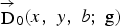
In equation (1),
 ${\mathop{\rm D}\limits^{\rightarrow}}_0 \lpar x\comma \; y\comma \; b\semicolon \; {\rm g}\rpar $
is the directional distance function with input x, desired GDP output y, undesired CO2 output b, and the price of desired output p. Furthermore, g = (1, − 1) is the directional vector representing the substitution relation between the desired GDP output and the undesired CO2 output given a certain production technology (Chung et al., Reference Chung, Färe and Grosskopf1997; Färe et al., Reference Färe, Grosskopf and Noh2005, Reference Färe, Grosslopf and Weber2006).
The most popularly and commonly used quadratic approximation functionFootnote 2 suggested by Färe et al. Reference Färe, Grosskopf and Noh2005, Reference Färe, Grosslopf and Weber2006) which is adopted to solve the related parameters, is:
 $$\eqalign{{\mathop{\rm D}\limits^{\rightarrow}}_0 \left(x\comma \; y\comma \; b\semicolon \; g \right)&= a_0 + \sum_{n = 1}^3 a_n x_n + \beta_1 y + \gamma_1 b + 1/2\sum_{n = 1}^3 \sum_{n^{\prime} = 1}^3 a_{n\comma n^{\prime}} x_n x_{n^{\prime}} \cr &\quad + 1/2 \beta _2 y^2 +1/2\gamma_2 b^2 + \sum_{n = 1}^3 \nu_n x_n b + \mu yb + \sum_{n = 1}^3 \delta_n x_n y.}$$
All of the following constraints on the parameters in each equation must be fulfilled to maintain the translation properties:
 $$\beta_1 - \gamma_1 = -1\comma \; \quad \beta_2 = \gamma_2 = \mu\comma \; \quad \delta_n -\nu_n = 0\comma \; \quad \alpha_{n\comma n^{\prime}} = \alpha_{n^{\prime}\comma n}\comma \; \quad n\comma \; n^{\prime} = 1\comma \; 2\comma \; 3.$$
We assume that there are k = 1, …, K DMUs and that α, β, γ, ν, μ and δ are the parameters to be solved by the minimization problem specified as (4) and proposed by Färe et al. (Reference Färe, Grosskopf and Noh2005, Reference Färe, Grosslopf and Weber2006) as stated below:
 $$\eqalign{\min \quad &\sum_{k = 1}^K \left({\mathop{\rm D}\limits^{\rightarrow}}_0 \lpar x^k\comma \; y^k\comma \; b^k\semicolon \; 1\comma \; -1\rpar -0 \right)\cr s.t. \quad &\lpar 1\rpar {\mathop{\rm D}\limits^{\rightarrow}}_0 \lpar x^k\comma \; y^k\comma \; b^k\semicolon \; 1\comma \; -1\rpar \ge 0\comma \; k = 1 \ldots K\comma \; \cr &\lpar 2\rpar {\mathop{\rm D}\limits^{\rightarrow}}_0 \lpar x^k\comma \; y^k\comma \; b^k\semicolon \; 1\comma \; -1\rpar /\partial b\ge 0\comma \; k = 1 \ldots K\comma \; \cr &\lpar 3\rpar {\mathop{\rm D}\limits^{\rightarrow}}_0 \lpar x^k\comma \; y^k\comma \; b^k\semicolon \; 1\comma \; -1\rpar /\partial y\le 0\comma \; k = 1 \ldots K.}$$
All the constraints exhibit the monotonicity condition to ensure the fulfilment of the characteristics of the directional distance function.Footnote 3
Following the setting suggested by Eyckmans et al. (Reference Eyckmans, Cornillie and Regemorter2002), the MAC curve for nations, designated as MAC k in the undesired output CO2, can be written as:
 $$MAC^k = \xi_k \left(CO_2 \right)^k = \left({-\partial \lpar {\mathop{\rm D}\limits^{\rightarrow}}_b /{\mathop{\rm D}\limits^{\rightarrow}}_y \rpar ^{\ast} p \over \partial b} \right)\left(CO_2 \right)^k$$
where (CO 2) k is the amount of the CO2 emissions reduction for nation k, and ξ k is the slope of the MAC curve for each nation. The computation of MAC for each nation from the results stated in equation (5) can be explained as the economic cost to each nation of joining the emissions trading mechanism. Technically, the total abatement cost of the emissions reduction is the integration of the MAC curve. This implies that, for a country with a higher level of economic development, i.e., a higher GDP, a higher total abatement cost will be incurred due to the emissions reductions.Footnote 4
3.2. Solving the total abatement cost with emissions trading
With the introduction of the emissions trading mechanism, the total abatement cost results not only from the emissions reduction technology that the country possesses, but also from the gains and losses that the emissions trading mechanism implies. The gains and losses from emissions trading mainly depend on the initial rights allocated to each nation under different allocation models.
According to Dales (Reference Dales1968), from a global standpoint, it is rational to set a minimum total abatement cost as an objective:
 $$Min \quad TC = \sum_{k = 1}^K C_k + p\left(ER_k - ER_k^{\ast} \right)$$
 $$s.t. \quad \quad \sum_{k = 1}^K ER_k = \sum_{k = 1}^K ER_k^{\ast}$$
where C k is the total cost that nation k pays beyond emissions trading, and p is the equilibrium price from the emissions trading market. ER k and ER k * are the initial amount of CO2 emissions reductions and the final amount of CO2 emissions reduction, respectively.
If ideal conditions exist to reach the global minimum total abatement cost, then the equilibrium holds as follows:
 $$MAC_1 = MAC_2 = MAC_3 = \cdots = MAC_k = p$$
 $$s.t. \quad \sum_{k = 1}^K ER_k = \sum_{k = 1}^K ER_k^{\ast}.$$
If a nation has an amount of final equilibrium emissions reduction ER k * that is higher than its initially allocated emissions reduction rights ER k , then that nation will be a seller in the trading market. In the opposite situation, the nation will be a buyer.
3.3. Construction of initial rights of emissions allocation models
Different equity criteria will generate different initial emissions allocations. Similarly, different equity criteria will assign different amounts of emissions reductions to each nation. The higher the total allowable global emissions (TAE), the lower the total global emissions reductions (TER) will be, and vice versa. Two notions of equity criteria have essentially different focuses in terms of determining the amount of the total allowable emissions or the total amount of emissions reductions. One notion emphasizes the total allowable emissions, i.e., the total initial rights of the emissions allocations. There are four equity criteria under this notion including the equity criteria of egalitarianism, sovereignty, the ability to pay and the polluter pays principle. The total allowable emissions for country k, which is designated as AE k , can then be determined. The other notion places an emphasis on the amount of emissions reductions based on the equity criterion for GDRs. The relationship between these two notions is that the higher the initial emissions allocations that a nation has, the more advantages a nation will potentially enjoy once the emissions trading mechanism is implemented.
Under a single type of emissions reduction, a top-down approach to TER can reduce emissions by a certain percentage relative to emissions from a specified year, as with the Kyoto Protocol. According to that agreement, all committed nations agree to reduce emissions to an average of 5.2 per cent less than the 1990 levels by the end of 2012. The estimated amount of total global emissions in 2007 was 7,913 million tons (IEA, 2007). The amount of emissions in 2010, set as emissions in the trajectory of business as usual (BAU), is the earliest estimate in the first commitment period. The International Energy Agency estimates BAU every five years. The total emissions in 1990 amounted to 5,561 million tons. This implies that the TER is 7,913-5,561*(1–5.2 per cent) = 2,641 million tons. That is, to achieve such an amount of emissions reductions, the TAE will be 5,561*(1–5.2 per cent) = 5,272 million tons by 2010.
3.3.1. Initial rights under the egalitarian allocation model
Under the egalitarian allocation model, every person has an equal right to emit. That is, once total global emissions are determined, the amount of emissions allocated to each nation is based on the population of each nation. As such, the egalitarian allocation model allocates emissions according to the following formula:
 $$AE_k =TAE \times {{\rm population\, of\, nation}\, k \over {\rm population\, in\, the\, world}}.$$
3.3.2. Initial rights under the sovereignty allocation model
The notion of sovereign equity is based on the idea that the emissions allocated to a specific nation should be in proportion to the cumulative amount of emissions that the nation has historically emitted. That is, under this equity allocation model, a nation with a relatively large cumulative amount of emissions is assigned a correspondingly high initial right to emit. As such, this is a grandfathering allocation model (Miketa and Schrattenholzer, Reference Miketa and Schrattenholzer2006). Using a specific period to compute cumulative emissions, the amount that each nation is allocated under this model is as follows:
 $$AE_k = TAE \times {{\rm cumulative\, amount\, of\, emissions\, of\, nation} k \over {\rm world\, total\, cumulative\, emissions\, in\, specific\, period}}.$$
3.3.3. Initial rights under the ability to pay allocation model
The ability to pay allocation model recognizes that a nation with a strong capacity to reduce emissions should take more significant steps to do so. The GDP per capita is a useful basis for emissions allocation under this capacity principle. According to the interpretation suggested by Ringius et al. (Reference Ringius, Torvanger and Underdal2002) and without the complication of the assignment of initial rights allocation, a nation's initial rights allocation is in linear proportions.Footnote 5 That is, a country with a higher GDP per capita is reasonably assigned lower initial rights for emissions allocations. The relation can be specified as follows:
 $$AE_k = TAE \times {\matrix{{\rm 1-\lpar GDP\, per\, capita\, of\, nation\, }k/\cr {\rm sum\, of\, GDP\, per\, capita\, of\, the\, world\rpar }} \over \matrix{\sum_{i = 1}^K \lsqb {\rm 1 - \lpar GDP\, per\, capita\, of\, nation\, }k/\cr {\rm sum\, of\, GDP\, per\, capita\, of\, the\, world\rpar }\rsqb _i}}.$$
3.3.4. Initial rights under the polluter pays allocation model
As the most intuitive criterion in terms of the creation of pollution, the polluter pays criterion is also applicable to global CO2 emissions allocations. This allocation model requires low emissions for a nation with a relatively high amount of emissions over a specific period. In contrast to the sovereignty allocation model, a nation with a large amount of cumulative emissions will be allocated lower initial rights amounts than other nations. To be comparable to the relation proposed for the equity model of the ability to pay, a linear proportion for the polluter pays allocation is specified as follows:
 $$AE_k =TAE \times {\matrix{{\rm 1 - \lpar cumulative\, emission\, of\, nation\, }k/\cr {\rm total\, world\, cumulative\, emission\rpar }} \over \matrix{\sum_{i = 1}^K \lsqb {\rm 1 - \lpar cumulative\, emission\, of\, nation\, }k/\cr {\rm total\, world\, cumulative\, emission\rpar }\rsqb _i}}.$$
The amount of emissions that each nation must reduce according to any of the above four equity allocation models is the difference between the allowable amount of emissions and the emissions amount of BAU. In addition, the amount of the emissions reduction for a specific nation can also be either simulated or computed directly using the GDRs allocation model discussed below.
3.3.5. Initial rights under the GDRs allocation model
Under the GDRs allocation model, the RCI is constructed based on the principles of capacity and responsibility. This indicator is used as the criterion to determine the national obligation, i.e., the amount of emissions that needs to be reduced by each nation. In practical terms, GDP per capita, excluding the annual income level below a ‘development threshold’ of US$7,500, is adopted under the capacity principle. In the GDRs framework, an annual income threshold of US$7,500 per capita is proposed as the standard for assessing the subsistence needs and sustainable development of each person. Emissions reductions will not be required until the per capita income is greater than this level. Specifically, indicator C is the per capita world share of GDP for each nation. The indicator of responsibility, R, is the per capita cumulative CO2 emissions share excluding ‘subsistence emissions’ (i.e., emissions corresponding to consumption below the development threshold). That is, only populations with an annual income above the development threshold of US$7,500 will be accounted for while both indicators R and C are computed.
Accordingly, the RCI is then defined specifically as:
 $$RCI = aR + bC.$$
Note that R and C are indicators that reflect the principles of responsibility and capacity as indicated above. The parameters a and b are the weights used to derive the RCI, and their sum is equal to 1. As weight a is larger than weight b, the RCI mainly depends on the nation-level responsibility principle. Nevertheless, the RCI is also determined by the nation-level capacity principle. Based on (12), the required emissions reductions for nation k are determined by
 $$ER_k = RCI_k \times TER.$$
Since there is no consensus for determining weights a and b in (12) in the calculation prepared by EcoEquity and the Stockholm Environment Institute (2009), the total abatement cost can be computed by simulating various combinations of a and b. The initial weight combination is a = 0 and b = 1; each weight can then be modified by 0.1 to result in nine additional combinations. The resulting 10 RCIs can then be used for 10 total abatement cost simulations. The total abatement costs based on these 10 RCIs vs. the other equity criteria discussed above can thus be compared.
4. Data preparation and allocation analysis
4.1. Selection of nations
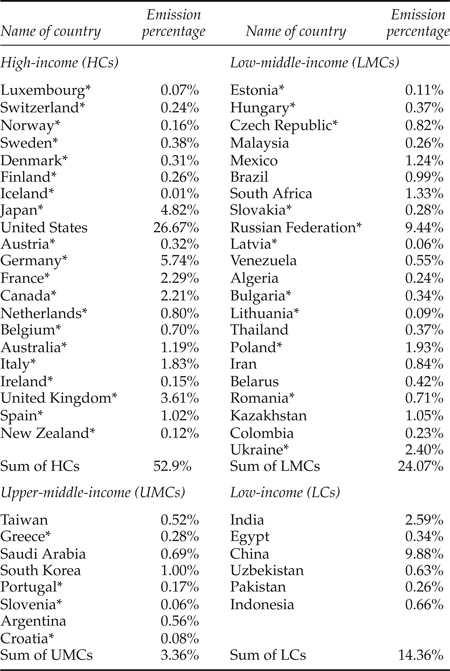
The nations selected for this study include not only the nations in Annex B of the Kyoto Protocol but also those nations with the 50 highest cumulative total CO2 emissions from 1950 to 2005. By considering the most complete and consistent data results in the inclusion of 57 nations from 1990 to 2005, these nations and their emissions percentages are listed in table 1; together, they produced 94.69 per cent of the world's total CO2 emissions between 1950 and 2005. Thus, the analyzed sample is comprised of 912 observations.
Sample countries and their cumulative total CO2 emission percentages, 1950–2005

Notes: Countries are listed in descending order of per capita GDP in 2005. *Annex B nations as per the Kyoto Protocol.
Source: WRI (2008), rearranged by this study.
4.2. Selection of variables
There are two groups of variables required for all subsequent analyses. The first group includes the input and output variables required to estimate the MAC of each nation using the directional distance function. The second group includes the indicator variables used to simulate each equity allocation model discussed above.
The input items required for the directional distance function include labor, real capital formation, energy use, the desired real GDP and the undesired emissions of CO2 output. Aside from the addition of population, the second group of variables is basically the same as the first group. The computation of the RCI involves the use of the Greenhouse Development Rights Online Calculator prepared by EcoEquity and the Stockholm Environment Institute (2009). The requirements for the computation of the RCI are well documented by EcoEquity and the Stockholm Environment Institute. As such, there is no other requirement to collect extra variables for the allocation models, except for population.
Due to the cross-country CO2 emissions data used in the analysis, a relatively complete data bank based on the Climate Analysis Indicator Tool (CAIT), which includes all climate indicators collected by the World Resources Institute (WRI), is used. This data bank contains the cumulative emissions of all greenhouse gases since 1950 and their annual CO2 emissions, energy density and various socio-economic variables such as health status, education level, and so on. A set of complete data is demanded for all variables required for the analyses stated above. Data on real capital formation, the labor input, energy use and population are taken from the World Development Indicators (WDI; World Bank, 2008). The variables for real capital formation and real GDP are deflated by the 1990 price level based on the UN Statistics Division (2008) to eliminate the price effect.
The CAIT data bank contains CO2 emissions for all 57 selected nations. The WDI data bank contains data on all other variables for all other nations except Taiwan; as a result, required data were collected from the relevant agencies in Taiwan. These data required some preparation to make them comparable to the corresponding data collected from other sources. Data on real capital formation, the labor input, population and real GDP were collected from the Directorate-General of Budget, Accounting, and Statistics of Taiwan (2009). Data on energy use were obtained from the Bureau of Energy of the Ministry of Economic Affairs of Taiwan (2009).
5. Results and analyses
5.1. Saving of total abatement cost under the allocation models
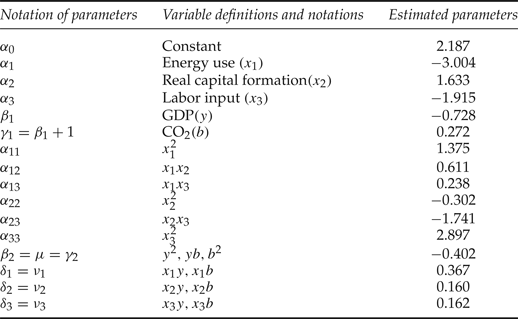
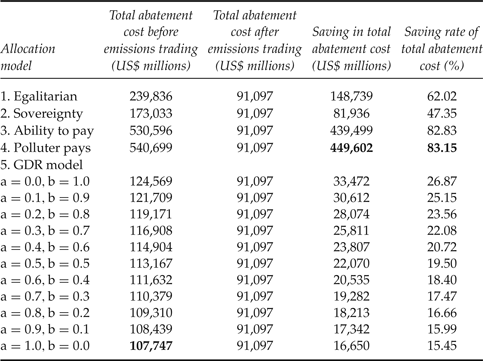
The results obtained from equation (2) along with the parameter constraints in (3) are used to compute the total abatement cost for all of the scenarios listed in table 2. The worldwide total abatement cost under different equity allocation models both with and without the participation of the emissions trading system are then computed and shown in table 3. Under different allocation criteria, the total abatement cost without emissions trading ranges from US$107,747 million to US$540,699 million for all nations in the analysis. The lowest total abatement cost without emissions trading occurs when the responsibility criterion dominates the RCI, i.e., the weight allocation is a = 1.0 and b = 0.0. By contrast, the highest total abatement cost without emissions trading occurs under the polluter pays allocation model. If most high-income nations take responsibility for emissions reductions, their high MAC will in turn increase the worldwide abatement cost to the highest level.
Results of parameters solved from the directional distance function

Source: Compiled and calculated by the authors.
Comparison of the total abatement cost for all nations with and without the participation in emissions trading under different equity allocation models

Source: Compiled and calculated by the authors.
As expected, under certain conditions, the total abatement costs with emissions trading are the same regardless of the assignments of initial rights. Once emissions trading is implemented, the total abatement cost is US$91,097 million globally for all allocation criteria. This total abatement cost is lower than the total abatement cost when the amounts of allowable emissions or amounts of emissions reductions are assigned to nations with different levels of economic development before the implementation of emissions trading. However, once emissions trading is fully implemented, the polluter pays criterion implies the greatest total abatement cost savings at the global level.
To sum up, the overall saving of total abatement cost indicates that the equity allocation model under the polluter pays criterion generates the most and highest saving in terms of the total abatement cost when the emissions trading mechanism is introduced. Since the saving in the total abatement cost is computed from MAC via the sacrifice of GDP for each country, then a country with a high income will tend to have a high MAC. Moreover, the polluter pays equity principle is at the core of one of the duty-based allocation models. While high income countries either voluntarily or by compulsion take on the responsibility to reduce emissions, i.e., they are allocated fewer initial rights for emissions reductions when an emissions trading scheme is in place, under the polluter pays principle the saving in total abatement cost will be correspondingly high.
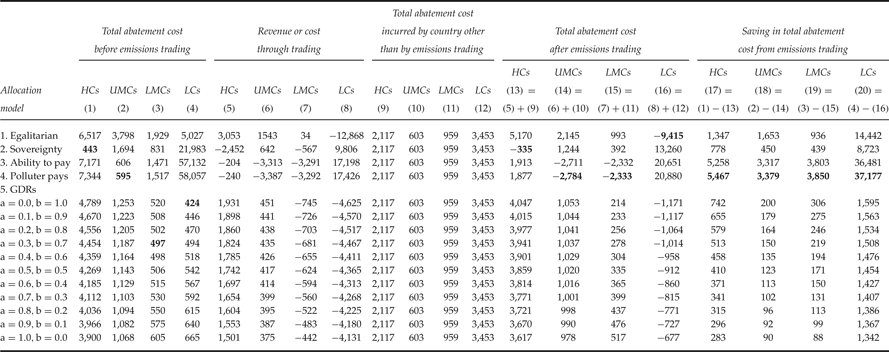
Turning to the total abatement cost analyses for nations with different levels of economic development, four groups of nations are categorized according to income level. According to the classification of the World Bank (2008), these four groups are divided into low-income nations (LCs), low-middle-income nations (LMCs), upper-middle-income nations (UMCs) and high-income nations (HCs), according to average annual per capita incomes of US$935 and below, US$936–3,705, US$3,706–11,455 and US$11,456 and above, respectively. The results are presented in table 4.Footnote 6
Table 4 indicates that, without emissions trading, the lowest total abatement cost of US$443 million (column 1 of table 4) for each nation in the group of HCs occurs under the sovereignty model. Meanwhile, the highest total abatement cost of US$7,344 million for each nation appears under the polluter pays allocation model. These nations (HCs) will be allocated more initial emission rights under the sovereignty, the ability to pay and polluter pays models, and thus they will tend to be sellers in the emissions trading market after emissions trading is implemented. Emissions trading should thus generate revenue for these nations.
Comparison of saving of total abatement cost of each country at different levels of economic development under different equity allocation models

Notes: All the numbers are in US$ millions and all magnitudes are averaged for different levels of economic development. Negative numbers in columns (5), (6), (7) and (8) indicate that the countries are sellers, i.e., with revenue, and positive numbers that they are the buyers, i.e., with cost, in the trading market. HCs, high-income countries; UMCs, upper-middle-income countries; LMCs, low-middle-income countries; LCs, low-income countries.
Source: Compiled and calculated by the authors.
However, under each allocation criterion, HCs must pay certain costs to fulfil their emissions reduction obligations based on the total abatement cost and the revenues from the emissions trading market. The lowest total abatement cost through emissions trading still indicates that the sovereignty model is preferable to the HCs. That is, these nations should find allocation based on the sovereignty principle to be advantageous if an initial emissions reduction is required under the emissions trading scheme, because this would cost them the least (−US$335 million for each nation in the group of HCs, as shown in column 13 of table 4).
With the UMCs, the lowest total abatement cost and the highest abatement cost with emissions trading take place under the polluter pays and egalitarian models, respectively, at a cost of US$595 million and US$3,798 million for each nation (see column 2 of table 4). The UMCS with only cumulative emissions of 3.36 per cent in 1950–2005 only have to meet the low total abatement cost if the polluter pays principle applies. UMCs will thus be allocated more initial emission rights under the polluter pays and the ability to pay criteria, and revenues will be generated for these nations from selling emission rights in the emissions trading market. By contrast, under other allocation models, UMCs are buyers in the emissions trading market and thus must pay for emission rights. Finally, the total abatement cost with emissions trading for this group is −US$ 2,784 million for each nation, as shown in column 14 of table 4.
On average, for LMCs, various weighted versions of the GDRs allocation model without emissions trading result in relatively low total abatement costs, as shown in column 3 of table 4. The lowest occurs with weights a = 0.3 and b = 0.7 without emissions trading. The implementation of emissions trading should result in LMCs acting as sellers in the market. The total abatement cost will be reduced by collecting revenues from the sale of emission rights. In sum, the emissions trading mechanism does generate total abatement cost savings, and the lowest abatement cost achieved at the nation level is −US$2,333 million for each nation (column 15 of table 4) under the polluter pays model.
Similar to LMCs, for the LCs the lowest total abatement cost is achieved under the GDRs equity allocation, i.e., with a = 0.0 and b = 1.0, without emissions trading. However, under the egalitarian model, this group of nations can expect emissions trading to bring a net benefit of −US$9,415 million for each nation, as shown in column 16 of table 4. The lowest total abatement cost computed from the GDRs equity allocation for LCs occurs at the full weight of capacity, i.e., b = 1 and a = 0, while the total abatement cost for LMCs moves toward weights with higher cumulative emissions, i.e., b = 0.7 and a = 0.3. This is because all LCs have low capacity, i.e., they have the least income to reduce any amount of emissions that are allocated among them all. On the other hand, the LMCs have accumulated about 24 per cent of emissions in 1950–2005. Thus this group of nations certainly has more responsibility to reduce the emissions. That is why the lowest total abatement cost occurs at a = 0.3 and b = 0.7.
Note that the effectiveness of the total abatement costs with emissions trading is determined by the sum of the total abatement cost for each nation rather than by emissions trading and the cost or revenue generated through trading (if any). According to this construct, the polluter pays equity allocation model generates the highest cost savings with emissions trading for any nation, regardless of economic development (columns 17, 18, 19 and 20 in table 4). This is consistent with the general intuition that those who pollute should bear the cost of polluting further.
However, for nations with different levels of economic development, the most attractive emissions trading policy is the one that generates the lowest total abatement cost at the national level, without regard to the benefit to other nations. As for the HCs, the lowest total abatement cost of −US$335 million for each nation occurs with emissions trading and sovereignty allocation. This is consistent with the notion that this group of nations should be allocated more emission rights given their large levels of cumulative emissions. For the LCs, the most attractive allocation model is under egalitarian allocation, which generates the lowest total abatement cost of −US$9,415 million for each nation participating in the emissions trading.
The other two groups of nations, UMCs and LMCs, which have middle incomes and median CO2 emissions accumulations, have preferences for allocating initial emission rights, as the greatest total abatement cost savings occur under polluter pays allocations with emissions trading. It can be concluded that if each group of nations insists on its own preferred allocation, it is realistically not possible for all nations to be sellers in the emissions trading market.
5.2. Total abatement cost for China, India and the United States
The United States, China and India are the three nations with the highest total CO2 emissions. The cumulative total CO2 emissions for the United States from 1950 to 2005 accounted for 26.67 per cent of the world's total emissions. China and India contributed 9.88 and 2.59 per cent of the world's total emissions, respectively, in the same period. It is expected that high CO2 emissions from China and India will accompany their recent rapid economic development. Since these three nations have not yet ratified any commitment to CO2 emissions reductions, and the ability to reach the global emissions reduction target will mainly depend on whether these nations make such a commitment, then a similar idea to that above can be applied to these three nations to observe the conflict or consistency among nations.
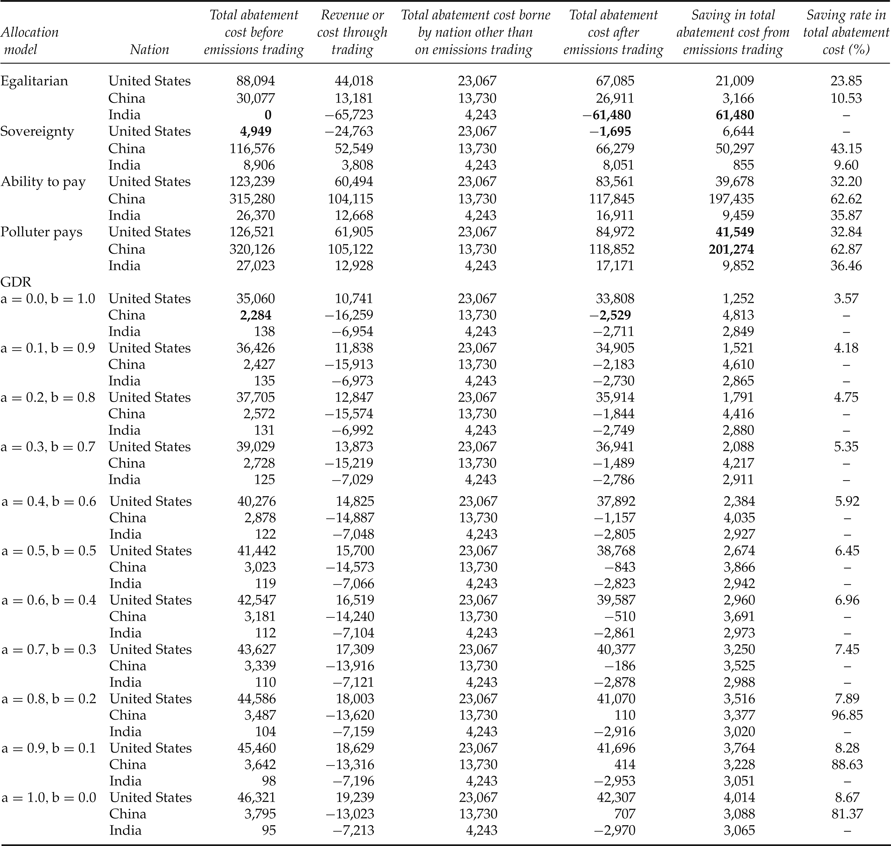
Table 5 presents a summary of the total abatement costs for these three nations under different allocation models. Nations with different economic development levels prefer different allocation models. The United States, as a high-income nation, will significantly benefit from the sovereignty model, as it results in the lowest total abatement cost without emissions trading. India will prefer the egalitarian allocation model, and China will prefer the GDRs model based on the full capacity principle; these schemes will generate the lowest total abatement costs for India and China of US$0 and US$2,284 million, respectively, without emissions trading.
Comparison of total abatement costs for the United States, China and India under different equity allocation models

Note: All the numbers are in US$ millions. Negative numbers in the column ‘Revenue or cost through trading’ refer to countries that are the sellers and positive numbers are the buyers in the trading market. As such, cost saving rate only presents for the buyers in the emissions trading market.
Source: Compiled and calculated by the authors.
With emissions trading, the lowest total abatement costs for all three nations are achieved with the same allocation criteria as referred to above (i.e., the sovereignty model for the United States, the egalitarian model for India and the full capacity GDRs model for China). As a result, emissions trading implies net benefits of US$1,695, US$61,480 and US$2,529 million to the United States, India and China, respectively.
6. Concluding remarks
This study attempts to simulate various initial rights of emissions allocations and emissions reduction models based on various equity principles. The directional distance function and shadow pricing model are applied to estimate the MAC in order to compute the total abatement cost. Various equity allocation models (i.e., the egalitarian, sovereignty, the ability to pay, polluter pays and weighted GDRs models) are constructed for the computation of the total abatement cost with and without the emissions trading mechanism and further for the saving in the total abatement cost when this mechanism is employed.
The results show that the equity of the polluter pays allocation generates the greatest total abatement cost savings with emissions trading implemented at the global level. The HCs and LCs prefer the equity of sovereignty and egalitarianism, respectively. The LMCs and the UMCs are both inclined to prefer the allocation equity of the polluter pays principle.
The dissonance is most pronounced for the United States, China and India, which are the three largest nations in terms of total cumulative emissions. For China, the lowest total abatement cost with emissions trading occurs under the full capacity GDRs model; for India, the lowest total abatement cost occurs under the egalitarian allocation; and for the United States, it occurs under the sovereignty allocation. This is to say, there are conflicts among the benefits of GDR allocation (from China's standpoint), egalitarian allocation (from India's standpoint) and sovereignty allocation (from the standpoint of the United States). To make the trading market function effectively by including high-emission nations such as China, India and the United States, these nations must realize that the real economic cost is the cost difference between the implementation of the emissions trading (or any policy tool) and the cost without the policy. That is, the economic cost is not the cost of employing the policy per se.
This study has analyzed and provided the saving in the total abatement cost and the designation of the economic cost for implementing certain CO2 emissions reductions, at the global level, for different groups of nations or for individual nations with and without introducing the emissions trading mechanism. Such outcomes are certainly not based on one plus a hundred existing studies. The information produced in this study is not only comprehensive but also constructive for groups of nations and individual nations as to the decision of whether or not to engage in certain forms of emissions trading policy with various equitable initial rights allocation designs. When this full picture comes into the view of any relevant interest group, it will then indicate where there exists possible cooperation or potential resistance should the policy be promoted.