Through the windows of the English Grill in Radio City we can see the ice skaters milling about on the rink, inexplicably avoiding collision with one another.Footnote 1
This appropriately anxious imagery opens Leonard Bernstein's essay “A Nice Gershwin Tune” (1955), in which he aimed to separate two men whose lives and careers are frequently located on the same plane. Both Gershwin and Bernstein came from Jewish immigrant families, were remarkable pianists from an early age, and got their professional start in the sheet-music publishing houses of New York City.Footnote 2 They both ultimately composed for Broadway and the concert hall, merging popular music with classical traditions. Bernstein was born after Gershwin, enjoyed a longer life span, and therefore had to deal with these comparisons on his own as he rose to fame in the years following Gershwin's death. To this end, “A Nice Gershwin Tune” confronts Bernstein's connection to Gershwin at an important juncture in his own career.Footnote 3 Although Bernstein uses this public forum to justify his comparative lack of success on Broadway, a more important feature here is the disclosure of his intense connection to Gershwin's music.
Bernstein's essay presents an “imaginary dialogue” between himself and his Professional Manager (P.M.) that demonstrates the complexity of this relationship. Later appearing under the more derisive title “Why Don't You Run Upstairs and Write a Nice Gershwin Tune?” the essay shows Bernstein's attempts to maintain independence from his musical predecessor by calling Gershwin's compositional abilities into question.Footnote 4 Professional Manager argues that Gershwin was “every inch a serious composer,” offering Rhapsody in Blue (Reference Gershwin1924) as proof.Footnote 5 Interrupting, Bernstein responds with a passage that has since become infamous: “Now, P.M., you know as well as I do that the Rhapsody is not a composition at all. It's a string of separate paragraphs stuck together—with a thin paste of flour and water. Composing is a very different thing from writing tunes, after all.”Footnote 6 Their conversation, which was already on thin ice, immediately plunges into deep waters. Bernstein continues by articulating what he believes are additional inherent flaws of the composition. Despite all of its problems, however, Bernstein admits that he adores the piece. Professional Manager challenges this assertion by asking, “How can you adore something you riddle with holes?” Bernstein retorts, “Each man kills the thing he loves.”Footnote 7
This ambivalent declaration was not made in haste; it resulted from Bernstein's multidecade relationship with Rhapsody in Blue, which he first encountered growing up in Boston. From an early age, Bernstein had a fervent attraction to the music of Gershwin. He purchased Gershwin's scores, staged his musicals with friends, and attended performances of his concert works given by the Boston Pops at Symphony Hall. After seeing the 1935 pre-Broadway production of Porgy and Bess when he was seventeen years old, Bernstein permanently checked out the score from the Newton Public Library. “I admit freely, peccavi, I stole it,” he confessed in an unpublished interview. “But it was mine, it had torn pages where I'd turned too fast, and it was my copy. I'd written things in the margins and I marked it up.”Footnote 8 The only Gershwin composition that Bernstein felt more possession of than Porgy and Bess was Rhapsody in Blue—whose consistent influence on Bernstein throughout his youth has remained unconsidered until now.
The present study explores Bernstein's formative relationship with the Rhapsody through the examination of two recently discovered documents. The first is Bernstein's personal copy of the published solo-piano sheet music that he acquired in 1932 at the age of thirteen. Like his long overdue library item, this score is also thoroughly annotated. The second document is an arrangement of the Rhapsody prepared by Bernstein for an ensemble of teenagers at a Jewish summer camp in the Berkshires in western Massachusetts in 1937. These items, coupled with a series of unpublished interviews, illuminate his adolescent experiences with the composition and allow us to begin untangling the paradoxical perspective located in “A Nice Gershwin Tune.” I propose that from an early age Bernstein not only had a particular vision of how the Rhapsody should operate, but that he also identified deeply with it. These findings provide important new insights into Bernstein's later, more polemical interpretations of the work both in recordings and in the concert hall—interpretations that have had profound implications on the reception of the Rhapsody on the global stage.
A Boston Boy Meets Rhapsody in Blue
We do not know precisely when Leonard Bernstein first heard Rhapsody in Blue, but it was definitely “in the air” following its celebrated premiere at Paul Whiteman's “Experiment in Modern Music” in New York City in February 1924. Whiteman repeatedly toured with the piece in the years following the Rhapsody's composition, and his two recordings of the Rhapsody featuring Gershwin at the piano (1924 and 1927) led to even wider dissemination of the work.Footnote 9 Bernstein's first acquaintance with the piece would have occurred either through these recordings (via phonograph or radio) or through performances by the Boston Pops. By the early 1930s, when Bernstein was a teenager, the Pops regularly programmed Gershwin's songs from his Broadway shows as well as his growing collection of orchestral works. Over the course of this decade, they presented Rhapsody in Blue a total of fifty-three times.Footnote 10 Bernstein was a regular concertgoer and, as will be discussed below, reveled in experiencing the Rhapsody live at Symphony Hall.
In May 1932 Bernstein and his father Sam attended their first Pops concert. The Rhapsody did not appear on this particular program; however, both father and son were particularly taken with the performance of Ravel's Bolero that concluded the concert. Bernstein later recalled that Sam “thought it was the most wonderful thing he had ever heard. The tune reminded him [Sam] of Hebrew chants and Arabic melisma. That shed a ray of light into my otherwise dark, despairing life because I was in a state of rebellion against him.”Footnote 11 The experience might have softened the elder Bernstein's well-documented reservations about his son's musical ambitions.Footnote 12 Coincidentally or not, Sam soon after increased his financial support of Leonard's musical education and contributed to the cost of his piano lessons and sheet music.
Lifelong friend and colleague Sid Ramin was with the thirteen-year-old Lenny the day that Sam gave the boys two dollars to purchase the score for Rhapsody in Blue. Footnote 13 “We went back to Lenny's place,” recalled Ramin, “and he opened it, and at sight he started to play it. Because he was, as you know, a prodigious sight-reader. He could read anything immediately. Then he got to a certain part and he said, ‘You know? I wonder why Gershwin wrote in this key.’ And he started to play it in another key!”Footnote 14 Bernstein had an acutely attentive musical ear by this early age, as well as remarkable fluency at the keyboard. Ramin also noted that when playing through large scores, “What [Lenny] couldn't play he would sing, and what he couldn't play and sing he would stamp.”Footnote 15
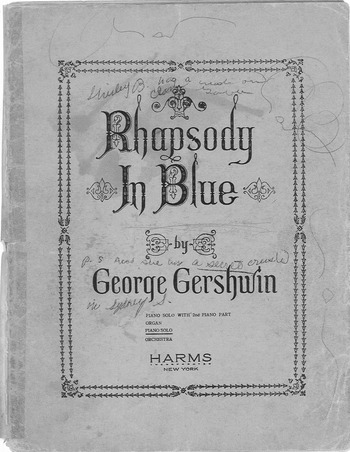
Lenny purchased a solo-piano arrangement of Rhapsody in Blue that was first published by Harms of New York in 1927.Footnote 16 Remarkably, Bernstein's own copy of this sheet music survives in the New York Philharmonic archives (Fig. 1). The score shows signs of frequent use through its Scotch tape binding repairs and smudged corners from repeated page turning. Taunting remarks about Bernstein's sister are scrawled at the top of the front cover, “Shirley B. has a crush on Clark Gable.” Further down, an addendum announces, “P.S. Also she has a secret crush on Sydney S.”Footnote 17 Although such markings remind us that this document is a product of adolescence, annotations within the sheet music itself reveal that Bernstein's approach to the Rhapsody was anything but juvenile.
Cover of 1927 solo-piano sheet music of Rhapsody in Blue purchased by Leonard Bernstein in 1932 (image digitally enhanced). Image courtesy of the New York Philharmonic Archives. Rhapsody in Blue, by George Gershwin. ©1924 (Renewed) WB Music Corp. All Rights Reserved. Used by Permission of Alfred Publishing Co., Inc.

Bernstein himself said of that first experience with the sheet music: “We went home and played it with tears till dawn. The excitement! We made our own sort of arrangement so we could do it four hands and try to sound like an orchestra.”Footnote 18 Although Ramin recalls no such formal arrangement, pencil markings throughout this score record one such possibility; most prominent are sets of brackets that set off particular passages. The first of these sections begins with the opening glissando and concludes at the close of m. 18 (R. 2 + 2).Footnote 19 It is followed shortly thereafter by another set enclosing the pick-ups to m. 21 through m. 23 (R. 3 to R. 4). Perfectly following the ubiquitous Whiteman recordings, these two demarcated passages articulate orchestral passages without the soloist. The unbracketed measures that follow each of these sections correspond to solo piano portions. The twelve sets of brackets found throughout the score begin to give shape to a four-hand arrangement.
Bernstein also altered his copy of the score to suit his own performance preferences by indicating obbligato passages. Abbreviated as “obbl.,” each of the five such occurrences found here specifies a section where the piano and orchestra (meaning both pianists in four-hand performance) play together. One particularly interesting example accompanies Bernstein's treatment of the famous andantino “love” theme.Footnote 20 Following the key change to E major at m. 244 (R. 28), a bracket indicates performance by the orchestra throughout the first presentation of this twenty-two-measure theme. The closing bracket does not appear until the end of m. 267 (R. 30 + 1), two measures into the second presentation of Gershwin's “love” motif. This bracket is followed by an “obbl.” designation indicating the addition of the piano, which plays the countermelody while the orchestra sustains the whole notes of the main melody. This pattern is repeated throughout the remainder of this passage, with the piano joining the orchestra only when the countermelody is present. In combination, the brackets and obbligato markings suggest a procedure by which Bernstein and Ramin might actually play together and “sound like an orchestra.”
Significantly, the solo-piano version acquired by the boys contains a pair of unique cuts that do not appear in either previous or subsequent publications of the sheet music. This 1927 score, at 451 measures, is nearly sixty measures shorter than the more common (certainly today) two-piano arrangement published by Harms in 1925.Footnote 21 The first change occurs at m. 138 (R. 14), where the “shuffle” theme is replaced by a jump to a piano cadenza that appears thirty-nine measures later in other scores (R. 18 + 5). This modification is understandable when considered in conjunction with Whiteman's recordings of the time. Because of the nature of the 78 rpm technology, at this point—four minutes and thirty seconds into the performance—it is necessary to flip over the record. Side 1 ends at m. 137 (R. 14 − 1) with the crash of a cymbal, and side 2 begins with the piano cadenza at m. 138 (R. 17 + 4). Such a cut in Bernstein's copy of the score aligns with these recordings and represents an editorial choice made to appeal to those familiar with Whiteman's rendition—namely, the sheet-music consumer.Footnote 22 Even though Bernstein may have known less-edited performances of the Rhapsody, when he first learned to play this composition on the piano, it was with this cut in place.
Evidence that Bernstein was indeed familiar with versions of the Rhapsody other than Whiteman's occurs at the point where the second cut in the 1927 solo-piano score is located. At the end of m. 187 (R. 22 − 2), a twenty-measure passage is omitted—an embellished presentation of the ritornello played by the piano alone. Bernstein has written the word “cadenza” above the measure where this cut occurs. Unlike the edit considered above, the portion of the score from which these measures are removed (R. 22 − 2 to R. 24 + 3) is absent from the Whiteman recordings.Footnote 23 Therefore, another source is necessary to clarify both the missing measures and Bernstein's annotation. In July 1935, under the direction of Arthur Fiedler, the Boston Pops made the first complete recording of Rhapsody in Blue. Footnote 24 This recording not only includes this twenty-measure passage, but at its conclusion, Jesús María Sanromá—official pianist of the Pops from 1924 to 1943—introduces his own elaborate cadenza. It is unclear when Bernstein added the cadenza indication to his copy of the 1927 score, but the connection of this annotation to performances of the work by the Pops suggests a familiarity with Sanromá's virtuosity as well as an openness to alternative interpretations of the Rhapsody during his time in Boston.
In a recent interview, Sid Ramin recalled attending a Pops performance featuring Sanromá at a time after he and Bernstein acquired the sheet music: “In the Rhapsody in Blue there's a chord that's [an E-flat] pregnant ninth—whatever you want to call it. Lenny and I were in the balcony.. . . We got closer and closer to that chord—we were both waiting for it. Sanromá played it and Lenny grabbed my thighs and squeezed them during that chord! I couldn't walk afterwards!”Footnote 25 The 1935 recording of Sanromá's performance captures the enthusiasm and excitement Bernstein located in Rhapsody in Blue during his adolescent years. At times it sacrifices accuracy for intensity, and as a result, Sanromá's playing unlocks the raw power bound up in the composition itself. As suggested by the annotations in his solo-piano score, the young Bernstein also found ways to realize the energy he clearly located in this piece. As Bernstein transitioned from adolescence to young adulthood, he took his early experiences of the Rhapsody—through recordings, sheet music, and concerts—and applied them to his first public interpretations of the piece.
“We got the things we came here for”: Bernstein's Camp Onota Arrangement
During the summer of 1937, instead of spending time at the family's lake house in Sharon, Massachusetts, the eighteen-year-old Bernstein took a job at Camp Onota, a recently established all-boys Jewish camp in the Berkshires. Bernstein was in charge of a cabin of campers from New York and served as swimming counselor. Not surprisingly, he also organized all musical activities, staging productions of Gilbert and Sullivan's Pirates of Penzance and Gershwin's Of Thee I Sing, forming small musical ensembles, and even writing camp songs.Footnote 26 The text of one surviving example reads:
Onota Camp, the end is near
And soon we'll have to say goodbye to you, we fear.
Our hearts are sad, our eyes are damp,
Because we have to part with you Onota Camp.
Adon, adieu, and au revoir,
Better time we never saw;
We got the things we came here for—
So adon, adieu, auf wiedersehen
And au revoir!Footnote 27
Bernstein's light-hearted ditty takes on a more poignant tone, however, when considered in the context of George Gershwin's sudden death that summer.
Gershwin died following emergency surgery on an undiagnosed brain tumor on 11 July 1937. The event had a profound and permanent effect on the young Bernstein. During the same midlife interview about Gershwin cited above, he divulged, “The great tragedy for me, the musical tragedy of my life, was I never met him.”Footnote 28 The Sunday of Gershwin's passing coincided with parents’ visiting day at Camp Onota. As amply recounted in the literature, during lunch that day Bernstein played Gershwin's Second Prelude as a musical tribute.Footnote 29 He requested that there be no applause at the conclusion of the performance. Instead, he rose from the piano bench and left the room in silence. “I discovered a lot of things that day,” recalled Bernstein. “I discovered the essence of tragedy; I didn't know anything about that. And I discovered the power of music.”Footnote 30
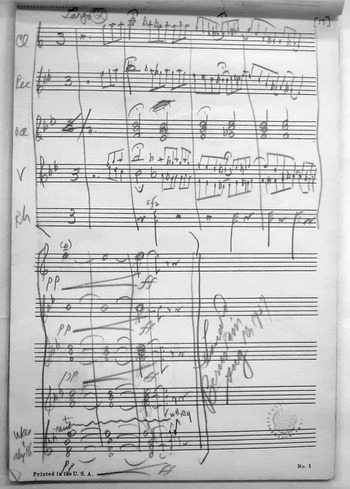
Gershwin's death provoked Bernstein both emotionally and musically. In what appears to be a tribute to his music idol, Bernstein created a unique arrangement of Rhapsody in Blue. He completed it on 10 August 1937, almost one month to the day after Gershwin's death (Fig. 2). I recently discovered this arrangement in his Schirmer's Harmony Tablet—a staff-paper music notebook intended for student use—located in the Leonard Bernstein Collection at the Library of Congress.Footnote 31 It stands as an important new document in understanding Bernstein's ongoing relationship with the piece and records the evolution of his own conception of the Rhapsody up to that point in his life.
Final manuscript page of Bernstein's arrangement of Rhapsody in Blue, completed 10 August 1937. By permission of The Leonard Bernstein Office, Inc. Rhapsody in Blue, by George Gershwin. ©1924 (Renewed) WB Music Corp. All Rights Reserved. Used by Permission of Alfred Publishing Co., Inc.

The manuscript itself is more of a draft for performance than a finished score.Footnote 32 It fills the first seventeen pages of the notebook and is written entirely in pencil. At times his notation is careful and measured, but in other portions his work appears hurried. Cross-outs and erasures appear throughout the manuscript, which make it nearly impossible for a group of musicians, let alone a group of teenaged campers, to perform from this score. Furthermore, much in the same way that Ferde Grofé's original 1924 orchestration for the Rhapsody leaves much of the piano part unnotated, Bernstein omits large portions of the solo part—at times simply writing “Piano Cadenza.” If the work ever received a performance at camp, parts must have been copied.
The whimsical orchestration of this arrangement defies all expectations of those familiar with the Rhapsody. Beyond the traditional piano and clarinet, this score requires recorder, accordion, three male voices (which also must whistle), two ukuleles, and a percussion ensemble labeled “Rhythm Band.” Although no official record documents a performance of this arrangement, evidence suggests that it was written with Camp Onota performers in mind. On the back cover of the Schirmer's Harmony Tablet appear the camp-song lyrics quoted above, and included inside are other original compositions by Bernstein that call for some of the same camp instruments, including two movements of a recorder sonata. Furthermore, rehearsal letters were added to the Rhapsody arrangement after the score was completed.Footnote 33 Their inclusion suggests the need to communicate specific spots in the score to performers.
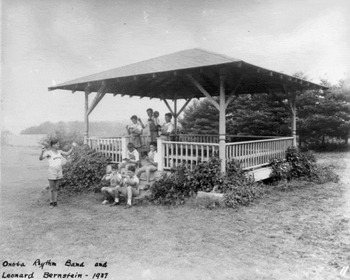
An additional indicator that this arrangement was intended for his campers is a photograph taken at camp that summer, the first known image of Bernstein conducting (Fig. 3).Footnote 34 Bernstein, in his Camp Onota tank top, directs a group of seven young musicians who are playing a battery of percussion instruments, including two triangles, claves, chimes, cymbals, a tambourine, and even a kalimba.Footnote 35 The caption for this photograph reads “Onota Rhythm Band and Leonard Bernstein—1937,” the same name given to the percussion line of Bernstein's camp arrangement of the Rhapsody. Based on the instruments required by the score, it is entirely possible that the boys seen here with the tambourine, cymbal, and claves took part in a performance of this arrangement.Footnote 36
Leonard Bernstein conducting the Camp Onota “Rhythm Band,” summer 1937. Reprinted with permission of The Berkshire Eagle.

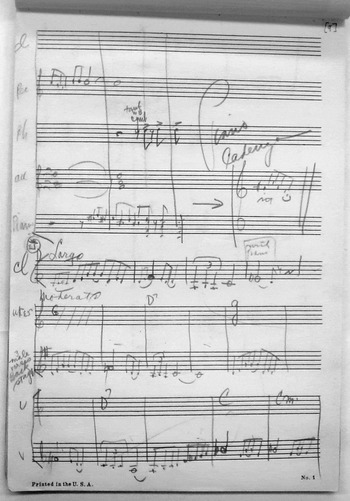
A consideration of manuscript pages 9–12, representative of the arrangement as a whole, reveals particularly salient aspects of Bernstein's musical and performative approaches to the Rhapsody in 1937, decisions that would come to influence his later interpretations of the work. The beginning of the passage is shown in Figure 4.Footnote 37 This excerpt begins at rehearsal letter “I” (R. 17 + 4), which corresponds to the point in Whiteman's recordings where side 2 commences. Here Bernstein has written “Piano Cadenza” followed by an arrow pointing to the four notes (F-sharp4, A4, F-sharp4, and D4) found in m. 183 (R. 21 + 7), indicating the conclusion of this solo passage. At this point the arrangement jumps to m. 197 (R. 25 − 4), where the “shuffle” theme is introduced for the first time—appearing at letter “J” as a largo clarinet solo.Footnote 38 Instead of proceeding with the clarinet or returning to the traditionally expected piano solo, Bernstein completely recasts the theme by assigning it to “3 male voices backstage” accompanied by two ukuleles. The orchestration changes again sixteen measures later, where Gershwin repeats the shuffle theme, now dramatically modulating up a minor third every two measures. Here, at rehearsal letter “K” (R. 26), Bernstein has the clarinet play the melody with the support of accordion and percussion.Footnote 39 The piano and recorder join in at “M” (R. 26 + 12) with the continuation of the upward minor third sequence. The ensemble makes a gradual crescendo to m. 238 (R. 27), where Bernstein indicates the start of another extended piano solo by again writing “Piano Cadenza.” This point marks the end of page 12 of the manuscript, just before the entrance of the “love” theme at rehearsal “N” (R. 28). A recording of this excerpt, from the live performance at Harvard on 12 October 2006, is available online at http://stream.fas.harvard.edu/ramgen/permanent/bernsteinproject/LB_ArrRiB.mp3.
Page 9 of Bernstein's arrangement of Rhapsody in Blue. By permission of The Leonard Bernstein Office, Inc. Rhapsody in Blue, by George Gershwin. ©1924 (Renewed) WB Music Corp. All Rights Reserved. Used by Permission of Alfred Publishing Co., Inc.

It is important to remember that Bernstein's instrumentation of this passage replaces what would otherwise be an extended piano solo passage. I suggest that the choices made here, free from the influences of existing renditions of the Rhapsody, reflect Bernstein's emerging theatricality. The drama of the largo clarinet solo sets up the playful reinterpretation of the standard campfire sing-along, which is offered by the disembodied, textless voices and ukuleles. In addition, the introduction of imitative color combinations, such as the substitution of the accordion for sixteenth-note tremolos in the piano at rehearsal “K” (R. 26), makes the performance more interesting and intensifies the dramatic arch of Gershwin's modulating melody. This energy continues to build as the cycle of minor thirds returns the shuffle theme to the tonic key at the top of page 12 (R. 27 − 4), an arrival that Bernstein celebrates with the addition of a triumphant and newly composed clarinet solo. Such decisions foreshadow the centrality of showmanship in Bernstein's future performances of the Rhapsody.
Much in the same way as the annotated brackets function in Bernstein's 1927 solo-piano score, this excerpt from the Camp Onota arrangement demonstrates Bernstein's continued conceptual compartmentalization of Gershwin's themes. The orchestration alone suggests four distinct passages: piano solo, clarinet solo, voices with ukuleles, and full ensemble. The physical layout of this passage in the manuscript itself, where each section receives its own clearly defined system of staves, makes such thematic segregation explicit. Passages throughout the arrangement are clearly demarcated through the use of fermatas, grand pauses, and dramatic shifts in dynamics or instrumentation.
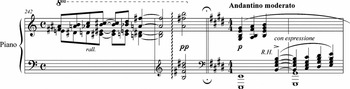
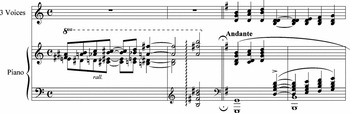
In one particularly striking instance the themes are demarcated by the introduction of a transposition. This modification occurs at rehearsal “N” (R. 28), with the entrance of the “love” theme. In Gershwin's original composition, this theme is preceded by a piano cadenza that culminates with a B dominant seventh chord that sets up a V7 to I modulation to the key of E major (Example 1a). When Bernstein's arrangement reaches this same transition, instead of moving to E major, he begins the passage a third higher, in the key of G major (Example 1b). This transposition continues throughout the twenty-two-measure theme and returns to the original key only when the theme is repeated at rehearsal “O” (R. 30).
Gershwin's original transition into the “love” theme. Rhapsody in Blue, by George Gershwin. ©1924 (Renewed) WB Music Corp.. All Rights Reserved. Used by Permission of Alfred Publishing Co., Inc.

Bernstein's transposition of the transition into the “love” theme. By permission of The Leonard Bernstein Office, Inc. Rhapsody in Blue, by George Gershwin. ©1924 (Renewed) WB Music Corp. All Rights Reserved. Used by Permission of Alfred Publishing Co., Inc.

Why might Bernstein have made this transposition? Such a move is very much a Broadway show-tune-style modulation, the kind that further heightens the dramatic effect of the melody. It also continues the motivic transposition by thirds, which precedes this passage and allows for a similar modulation to take place when the arrangement returns to the original key (rehearsal “O” [R. 30]).Footnote 40 In addition, such transpositions allow the melody to begin on the same pitch with which the preceding cadence concluded. Looking forward, this mode of modulation is employed throughout the score of West Side Story.Footnote 41
Looking backward, however, it is important to recall Sid Ramin's statement regarding Bernstein's first read-through of the solo-piano sheet music. At a specific point Bernstein paused, questioned Gershwin's choice of key, and then proceeded to transpose the subsequent passage. The transposition in the camp arrangement clearly reflects that initial impulse. That it is scored for male voices echoes another of Ramin's observations about Bernstein's sight-reading practices. The widely spaced intervals within the chords found at this point in the score may have proved difficult for the thirteen-year-old pianist. Since Bernstein had a tendency to “sing what he couldn't play,” it is possible that his voice was required to render this passage. Such a scenario becomes all the more likely since the chordal texture thickens on the repetition of the theme.
For Bernstein, over the course of his adolescent years, the Rhapsody became a musical space in which the budding musician could explore aspects of compositional process. To this end, the Camp Onota arrangement reveals Bernstein's facility with Rhapsody in Blue. Even with an instrumentally limited ensemble, he clearly articulates Gershwin's various themes, presents an unexpected and entertaining interpretation of the work, and makes room to showcase his pianistic abilities while assuming the role of conductor. These qualities set the stage for performances of the work throughout his career and reveal an increasing sense of control and ownership over the composition.
Bernstein's Rhapsody in Blue
Regardless of whether or not Bernstein ever performed the Camp Onota arrangement, records do survive that document his involvement in more conventional performances of the Rhapsody during his youth in Boston. The first instance occurred in February 1936, before the creation of his Camp Onota arrangement, during his freshman year at Harvard. According to the student newspaper The Harvard Crimson, Bernstein took part in an “Amateur Musicale” sponsored by the Union Committee. He served as master of ceremonies in addition to performing “selections” from the Rhapsody. Footnote 42 The article provides no details regarding which selections were played, but one could imagine such a performance given Bernstein's demonstrated partition of Gershwin's themes in his own copy of the sheet music.
Bernstein's first performance of the complete work with full orchestra took place on 2 January 1938 at Harvard's Sanders Theatre, the winter following his time at Camp Onota. The concert, sponsored by the Works Progress Administration's Federal Music Project, featured the State Symphony Orchestra.Footnote 43 The program, highlighting music by American composers, included Rhapsody in Blue as a memorial to the late George Gershwin. The Leonard Bernstein scrapbooks, dutifully compiled by Bernstein's childhood piano teacher and lifelong assistant Helen Coates, preserve memorabilia from this event in addition to several reviews from the local press.Footnote 44 The Boston Herald reported that, “although the performance was not as finished as could be hoped for, it did have a good amount of spirit. Mr. Bernstein's playing was adequate for the performance, and he was recalled several times to acknowledge the enthusiasm of the audience.”Footnote 45 However, a review from the Boston Post critiqued Bernstein's performance as “hardly up to those we are in the habit of hearing at the Pop Concerts, and the music suffered accordingly.”Footnote 46
Despite such a mixed response, during his years in Boston Bernstein continued to perform the Rhapsody with the State Symphony Orchestra. One such appearance took place during the summer of 1938, for which he received $150.Footnote 47 A press release from the scrapbooks announces a similar engagement one year later: “Youth will be the keynote of this concert, for the soloist of the evening is young Leonard Bernstein, brilliant pianist, just barely into his twenties and a senior at Harvard. He will play his own colorful interpretation of the beloved George Gershwin's ‘Rhapsody in Blue.'”Footnote 48 What is meant by “his own colorful interpretation”? The State Symphony Orchestra had neither ukuleles nor an accordion, so it is unlikely that his Camp Onota arrangement was heard that evening. Instead, the “colorful interpretation” remark foreshadows later performances by the mature Bernstein wherein his experiences with the Rhapsody as a teenager continued to exert their influence.
Although Bernstein occasionally performed the Rhapsody with various ensembles throughout his twenties and thirties, following his appointment as music director of the New York Philharmonic in 1958, the composition reemerged for him in several ways. During that first season the Rhapsody appeared on a set of December subscription concerts, Bernstein's nationally televised “Young People's Concerts,” and nineteen of the twenty-five concerts he conducted during the orchestra's summer tour of Europe and the Soviet Union. Perhaps most significantly, however, in June 1959, Bernstein recorded the Rhapsody with the Columbia Symphony Orchestra.Footnote 49 Howard Pollack recently dubbed this recording “perhaps the best-known performance of the piece in the later twentieth century.”Footnote 50 Given its continued overriding popularity, it might easily be said this version by Bernstein has become the interpretation of Rhapsody in Blue.
Still, Bernstein's 1959 recording has not been without critique, particularly with respect to the conductor/pianist's tempo and editorial decisions. David Schiff notes that the “biggest departure from previous practice comes with the solo at rehearsal 25 which Bernstein plays as a slow and drunken blues.”Footnote 51 He compares this first presentation of the “shuffle” theme to Bernstein's blues “Big Stuff” from the opening of his 1944 ballet Fancy Free.Footnote 52 Although a similarity undoubtedly exists between this recording and the song written fifteen years earlier, an even earlier model is found in the documents that survive from Bernstein's formative experiences with the Rhapsody.
Returning to Bernstein's copy of the 1927 solo-piano score, evidence supports Bernstein's preference for performing this passage slowly. At m. 197 (R. 25 − 4), four bars before the shuffle-theme piano solo begins, Bernstein penciled in a “4/4” time signature. Additionally, the measure itself is subdivided by the annotation “1 + | 2 + | 3 + | 4 + |,” in which the vertical lines divide the eighth-note melody into distinct beats. Bernstein made the decision to draw out the theme here even though these measures should be a tempo as originally published and performed. This retardation persists in his Camp Onota arrangement (rehearsal “J”), where, as previously discussed, the clarinet melody receives a largo designation. Four bars later the shuffle theme (sung by three males accompanied by ukuleles) saunters in with a moderato indication. Bernstein's recording follows these early tempo assignments to the letter.
Another critique often leveled at Bernstein's interpretation of the Rhapsody has to do with his editorial decisions, namely, the excision of a statement of the ritornello and the fox-trot.Footnote 53 Here, too, such choices have deeper roots, as a 1986 interview reveals: “I have to confess to you and, even if this is a public confession, that is the way I have always played it, so that when I do play it with orchestras, and I have played it with many orchestras, I have to re-do the score to fit the way I learned it because that is the way I love it. That is the way I know it and I think it works better.”Footnote 54 As I have demonstrated above, the 1927 solo-piano sheet music of Rhapsody in Blue that he learned contains a unique pair of cuts. Bernstein is true to his word, and, with the exception of two measures, his 1959 recording adheres to this 1927 score note for note.Footnote 55 With respect to both tempo and form, Bernstein's lifelong interpretations of the Rhapsody resulted from his teenage experiences with the work.
More than Just a “Nice Gershwin Tune”
As the work of recent Gershwin scholars has demonstrated, the interpretation offered by Bernstein's recordings “arguably undermined the work's structural integrity.”Footnote 56 However, using “A Nice Gershwin Tune” as an example, it is clear that Bernstein saw the structural flexibility of the work as one of its great strengths. Bernstein states that with Rhapsody in Blue: “You can cut out parts of it without affecting the whole in any way except to make it shorter. You can remove any of these stuck-together sections and the piece still goes on as bravely as before. You can even interchange these sections with one another and no harm done. You can make cuts within a section, or add new cadenzas, or play it with any combination of instruments or on the piano alone; it can be a five-minute piece or a six-minute piece or a twelve-minute piece. And in fact all these things are being done to it every day. It's still the Rhapsody in Blue.”Footnote 57
The considerations advanced in this 1955 essay were not recent revelations to Bernstein. Rather, he formed these observations while growing up and documented them in both his copy of the 1927 solo-piano sheet music and the 1937 Camp Onota arrangement. The latter makes various cuts, connects separate sections, and alters the orchestration. It even goes so far as to change the key of one of the work's most famous themes—something Bernstein discovered was a possibility at the age of thirteen. As the instantly recognizable recording of this arrangement demonstrates, Bernstein's later remarks hold true: regardless of the alterations made to the piece, it remains the Rhapsody in Blue.
Unlike the ice skaters precariously positioned at the outset of “A Nice Gershwin Tune,” Bernstein and Gershwin continue to collide. Whenever reception of the Rhapsody is considered, the essay seems to rear its ugly head. As Larry Starr points out, such considerations typically “function as a kind of ‘received wisdom’ or even ‘party line’ on Gershwin in academic and critical circles.”Footnote 58 Gershwin scholars are quick to point out Bernstein's subsequent influence on the reception of Rhapsody in Blue; they suggest that his words and performances sullied the reputation of the work within academic circles.Footnote 59 However, such a position implies a certain degree of disregard on the part of Bernstein. Upholding this doctrine ignores the more complex relationship that ultimately existed between Bernstein and Gershwin's music. Bernstein responds to Professional Manager's inquiry about admiring a flawed composition by dramatically declaring, “Each man kills the thing he loves.” While his quotation of Oscar Wilde's The Ballad of Reading Gaol has its own implications with respect to its homoerotic subtext, for the purposes of the present article it is important to focus on the more direct confessional at hand. Bernstein continues by saying, “Yes, I guess you can love a bad composition. For noncompositional reasons. Sentiment. Association. Inner meaning. Spirit.”Footnote 60 Bernstein's early association with Rhapsody in Blue provides considerable insight into each of these rationales and offers a necessary foundation for the paradoxical stance of his essay.
The present exploration of the Rhapsody reveals a multifaceted understanding of Bernstein's significant ties to Gershwin—a connection established much earlier than scholars previously have realized. The composition became a permanent fixture in Bernstein's career and allowed him to form musical connections both locally and cross-culturally.Footnote 61 Clearly, Bernstein's relationship with Rhapsody in Blue was a complicated one. Understanding its place in his formative years allows us to reconsider his approaches to the composition as a mature conductor, performer, and critic. After all, if we take anything away from our exploration of Leonard Bernstein's youth, it is an understanding that his Boston experiences resonated throughout his life—an observation that certainly holds true for Rhapsody in Blue.