

THE LATE NEOLITHIC SETTLEMENT OF BARNHOUSE
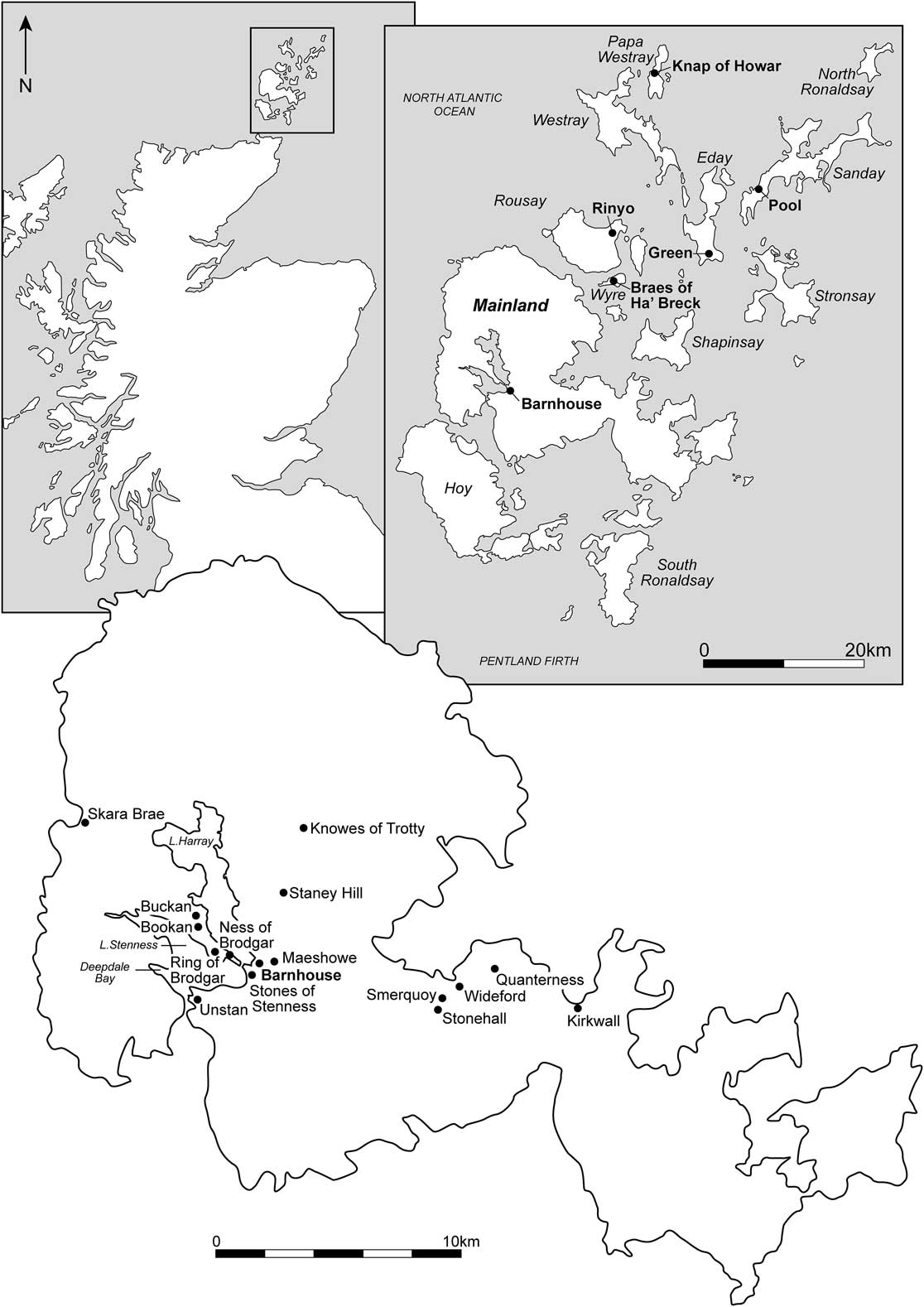
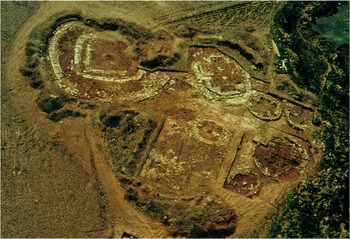
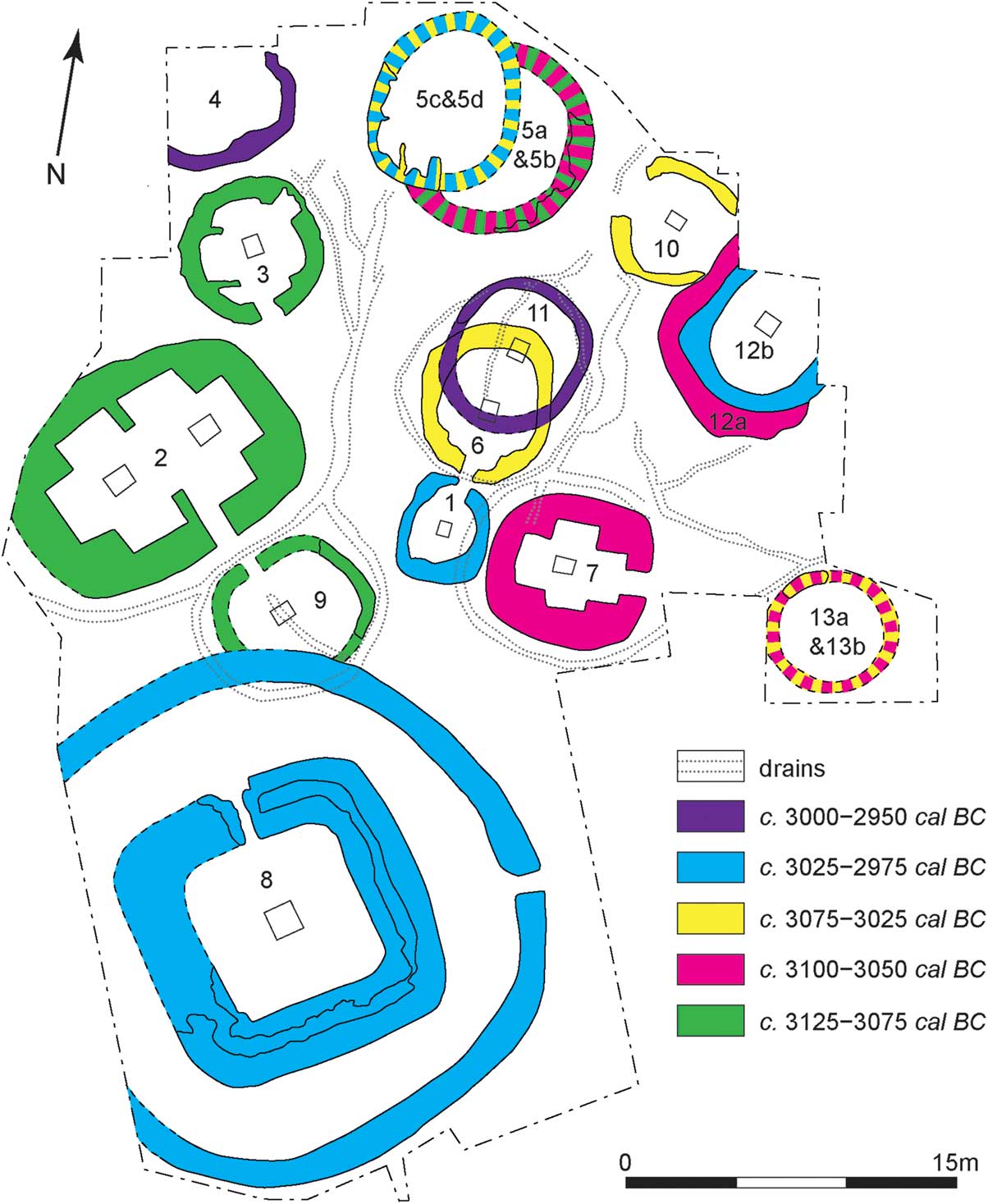
Barnhouse lies adjacent to the Loch of Harray, surrounded by other monuments and sites including the Stones of Stenness nearby, Maeshowe to the east, and Ness of Brodgar, the Ring of Brodgar, and Bookan to the north (Richards Reference Richards2013; Fig. 1). Excavations in 1985–91 revealed that a large proportion of the settlement remained intact and the shallow stratigraphy allowed a considerable area of Barnhouse to be examined (Richards Reference Richards2005a). Thirteen structures, together with their associated deposits of refuse and the areas between the structures, were excavated (Figs 2 & 12). Occupation was thought to have begun with a group of at least nine concentrically organised houses which partly surrounded an open area, which was interpreted as a communal working area (Jones & Richards Reference Jones and Richards2005, 49–52, fig. 3.31; Downes & Richards Reference Downes and Richards2005). The subsequent, complicated sequence of developments, outlined below, included various acts of refurbishment, abandonment, and rebuilding, with the penultimate phase of activity involving the construction of a large, monumental structure, surrounded by a clay platform (Structure 8). It was suspected that a second large structure with a platform, similar to Structure 8, had existed beyond the excavated area, to the south-east. Ceramic finds included around 6000 sherds of Grooved Ware pottery (Jones Reference Jones2005) and the lithic finds included four maceheads (A. Clarke Reference Clarke2005) and several pieces of Arran pitchstone (Richards Reference Richards2005a, 44–5).
Location map

Aerial photo of the site

Twelve radiocarbon measurements were obtained on single fragments of short-lived charred plant material during the original post-excavation programme, placing the use of the site within the period c. 3500–c. 2900 cal bc (Ashmore Reference Ashmore2005, fig. 21.4) and thereby suggesting that Barnhouse stood at, or near, the beginning of the Grooved Ware ceramic tradition.
The importance of this site to our understanding of developments in late 4th and early 3rd millennium cal bc Orkney made it an obvious candidate for a programme of fresh radiocarbon dating in 2013–15, undertaken as part of an European Research Council-funded research project, The Times of their Lives (ToTL: see acknowledgements), focusing on the development of Late Neolithic settlement and of Grooved Ware in Orkney. Sixty-two new radiocarbon results are reported here, along with a Bayesian chronological model which combines 70 of the 74 dates now available with the site stratigraphy. The revised structural and ceramic sequences that have emerged as a result of this new chronology are presented. The principal implications of these new data are outlined in the discussion below; future publications will deal more fully with wider issues of respectively Late Neolithic society on Orkney and the position of Barnhouse in the emergence and development of Grooved Ware.
THE ORGANISATION & DEVELOPMENT OF BARNHOUSE: THE PICTURE IN 2005
It was proposed in 2005 that the settlement had an overall spatial arrangement featuring concentric ‘rings’, represented by arcs of structures within the excavated area, surrounding a central area. Determining the sequence of construction was undertaken not only with the aid of the then-available radiocarbon dates, but also by considering spatial location, stratigraphy, and the layout of the network of drains that served the various structures (Jones & Richards Reference Jones and Richards2005, fig. 3.7). Of the ‘inner arc’ of houses, relationships based upon the sequence of drains revealed Houses 7, 12a, and 13a to be earlier than Houses 6 and 10. Houses displayed discrete structural histories, with varying trajectories of refurbishment, abandonment, and rebuilding.
It is difficult to relate the inner and outer arcs of houses with confidence (for example, see the section between Houses 6 and 2: Jones & Richards Reference Jones and Richards2005, fig. 3.9). During excavation it was thought that the outer arc of Houses 9, 2, 3, and 5a (see Fig. 12 below) could have been later than the inner arc of houses, but in the absence of conclusive stratigraphic evidence (as all were erected on the glacial till) it was difficult to discern a temporal-spatial sequence of construction, and when all the available evidence was synthesised into the site phasing plans (Jones & Richards Reference Jones and Richards2005, figs 3.8 & 3.11), no clear sequence from inner to outer emerged.
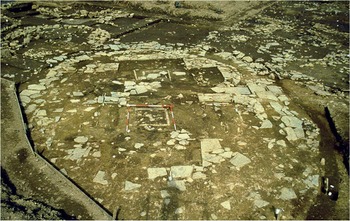
The outstanding building of the outer arc was House 2 (Richards Reference Richards2005b; Fig. 3), which was twice the size of the other structures (excepting the monumental Structure 8) and which displayed a quality of masonry only observed within structures at the Ness of Brodgar and passage graves such as Maeshowe and Howe. The parallel with structures at Ness of Brodgar extends to the use of a piered internal architecture and to the presence of two hearths (Towers et al. Reference Towers, Card and Edmonds2015). Internally, House 2 was a place of manufacturing and depositing fine objects such as maceheads and axes, and it also contained a slab-covered cist with scraps of bone, which may be either human or animal remains (Richards Reference Richards2005b, 137).
House 2

Regardless of the temporal sequence of house construction, the central area between Houses 1, 6, 12, and 13 seems consistently to have provided a focal point, as a communal meeting place and a context for craft activities (namely the manufacture of pottery and artefacts of bone and possibly wood, together with hide processing; Jones Reference Jones2000; Reference Jones2002, 125). With a degree of spatial integrity, dumps of ash and debris from these activities built up directly on the ground surface (Jones & Richards Reference Jones and Richards2005, 34–8). The work area was maintained through time, and grew to encompass the area over the demolished House 7, where evidence for Grooved Ware manufacture was also present (Jones & Richards Reference Jones and Richards2005, 35–6).
A distinctive change in the occupation of Barnhouse is represented by the building of the monumental Structure 8, which partially overlay the levelled remains of House 9. Not only was this building of greater magnitude than earlier buildings, but it presented a different form of architecture. Essentially, Structure 8 is a large square house with rounded corners, architecturally similar to the later houses at Skara Brae (Childe Reference Childe1931) and on a scale commensurate with larger structures at the Ness of Brodgar, with a massive outer wall of c. 3 m, surrounded by a clay platform which is enclosed by a 1.3 m thick outer wall. A number of features – stone hearths, boxes, pits, and spreads of ash – provided evidence for the outer clay platform having been the context of a range of activities including cooking and food preparation (Hill & Richards Reference Hill and Richards2005, 160, fig. 6.10). The central fireplace, which provided the focal point within the inner building, had a biography stretching back to a pre-Structure 8 existence as an open-area hearth on the periphery of the settlement (Hill & Richards Reference Hill and Richards2005, 160–3).
Apart from being a monumental building, the construction of Structure 8 marked a departure from an architecture that relied on interior furniture being physically recessed into the wall. Instead, furniture now projected from the inner wall-face. Interestingly, this change maintains the relationships between the hearth, the ‘beds’, the entranceway and the rear ‘dresser’ whilst increasing the internal dimensions of the house.
THE GROOVED WARE POTTERY
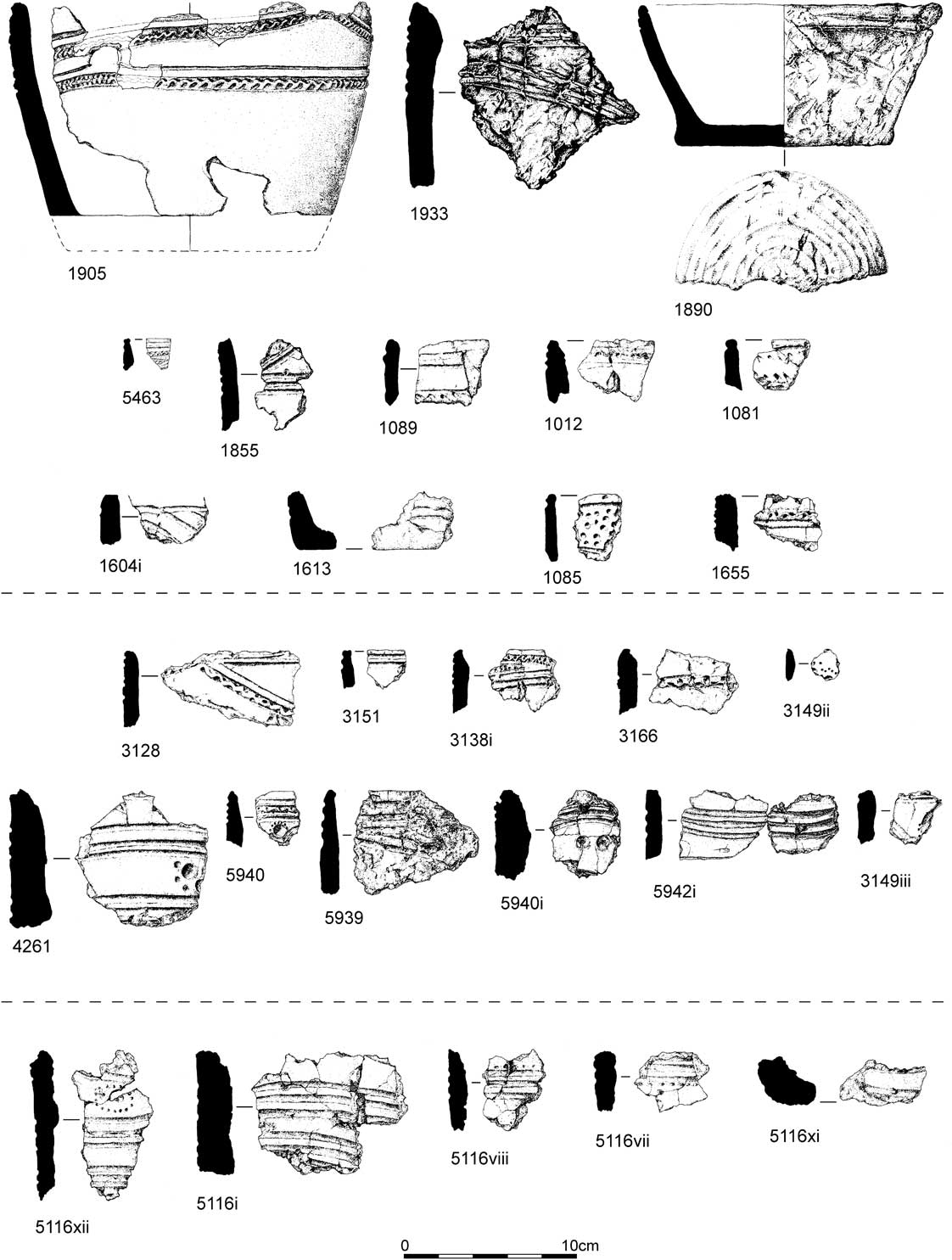
With the exception of one Beaker rim (from an upper deposit beneath the topsoil), the ceramic assemblage from Barnhouse belongs to the Grooved Ware tradition. Details of this pottery, and of the various analyses undertaken to determine the source of the raw materials and the use of the pots, are presented in the 2005 publication (Jones Reference Jones2005; Jones et al. Reference Jones, Cole and Jones2005). (See also Hurcombe Reference Hurcombe2014, 156 and pl. 58.1, for further information on the basketry matting impression on the base of one pot from House 3 (Fig. 4, SF 1890); the spiral-coil matting had been old and ‘quite tattered’ when used.)
Grooved Ware pottery from Barnhouse: vessels ostensibly relating to the early use of the site (plus some associated with the later use of Houses 2 & 3). Top: from House 2 (SF 1089, 1012, 1181, 1604i, 1613, 1185, & 1655), House 3 (SF 1905, 1933, 1890, & 1852), & House 9 (SF 5463). Middle: from House 5a/5b (SF 3128, 3151, 3138i, 3166, 3149ii and iii), from occupation material pre-dating the erection of Structure 8 (SF 5939, 5940, 5940i, 5942i), & from early occupation activity (SF 4261). Bottom: from House 12a & early occupation/refuse spread beneath House 12b. Most of these sherds probably date to the 31st century cal bc (Fig. 14)
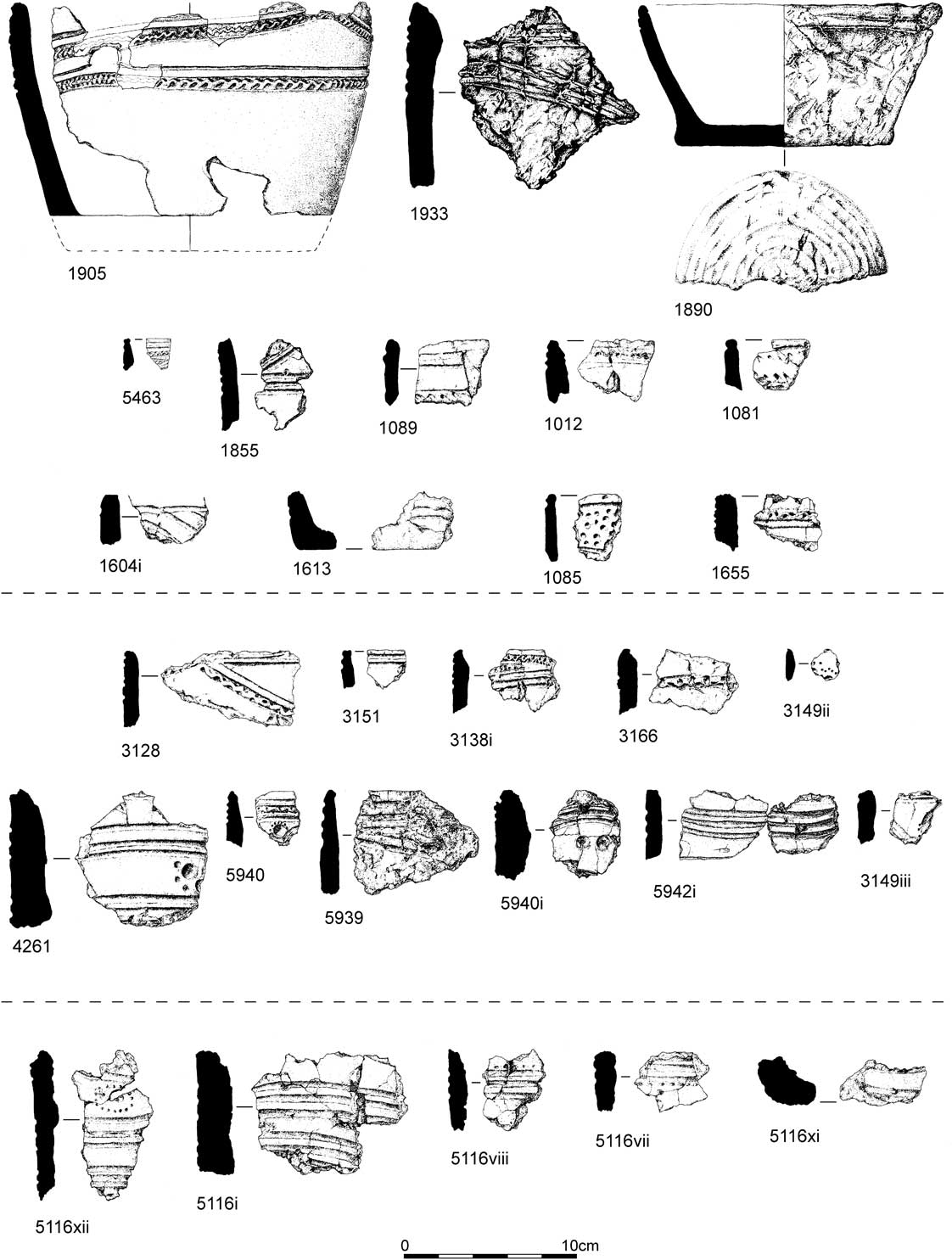
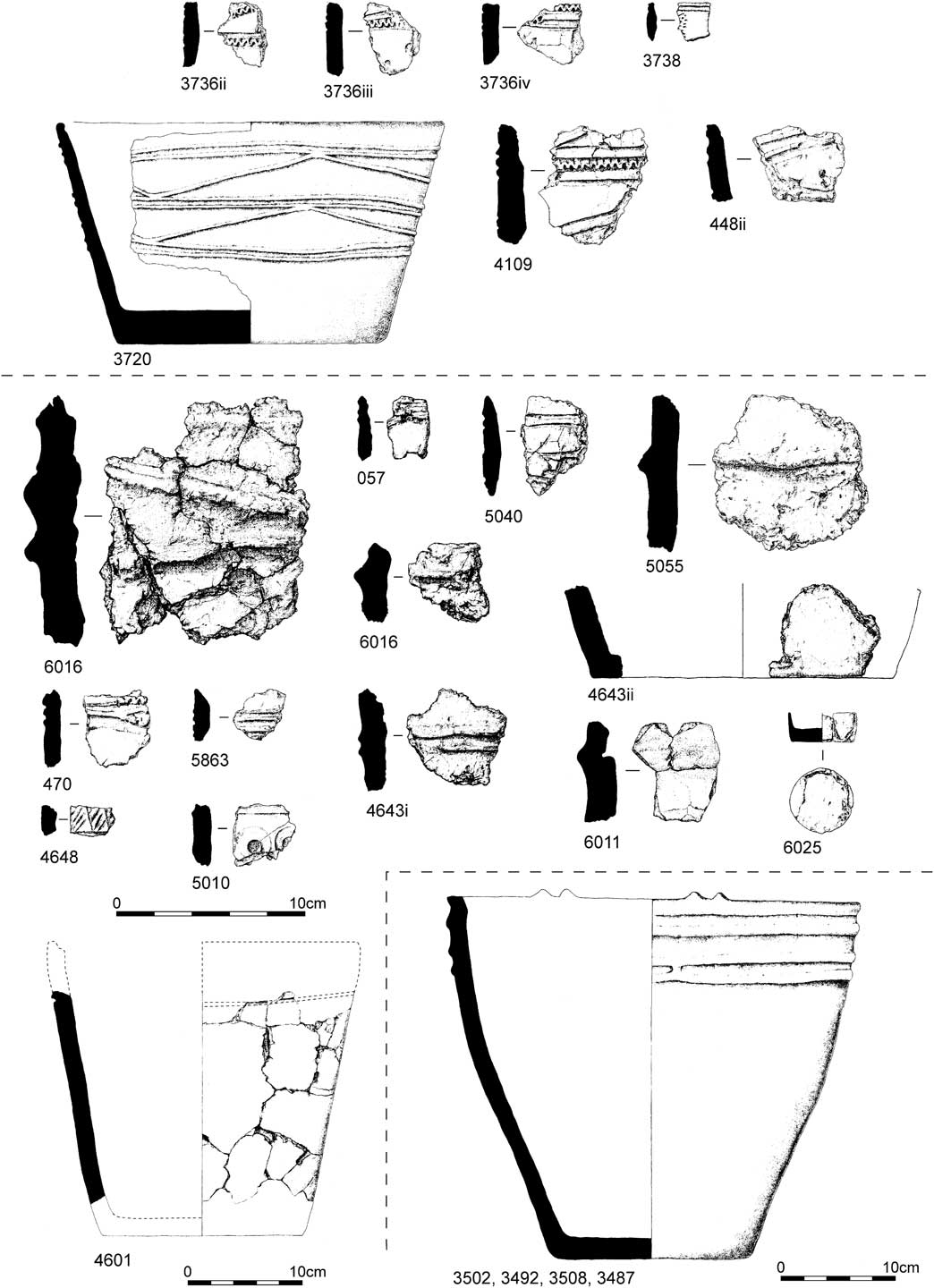
The majority of the c. 6000 sherds (which may represent 200–300 pots: Jones Reference Jones2005, 39) were found either outside the structures – in some cases, among material that appeared to have been cleared out from individual houses – or else in secondary contexts within the houses, relating to their re-occupation; relatively few were found among primary deposits on the original house floors. One exceptional find was a near-complete large pot (Fig. 5, SF 4601) found set into the clay floor inside Structure 8; only its uppermost, decorated part had stood proud of the floor.
Grooved Ware pottery from Barnhouse: vessels mostly or all relating to the middle & later use of the site. Top: from Houses 6 & 10; middle & bottom left: from Structure 8, House 1, & House 12b. Note: the pot at bottom right, from the old land surface north of House 3, pre-dates the erection of House 4. Most of these sherds probably date to the 30th century cal bc (Fig. 14)
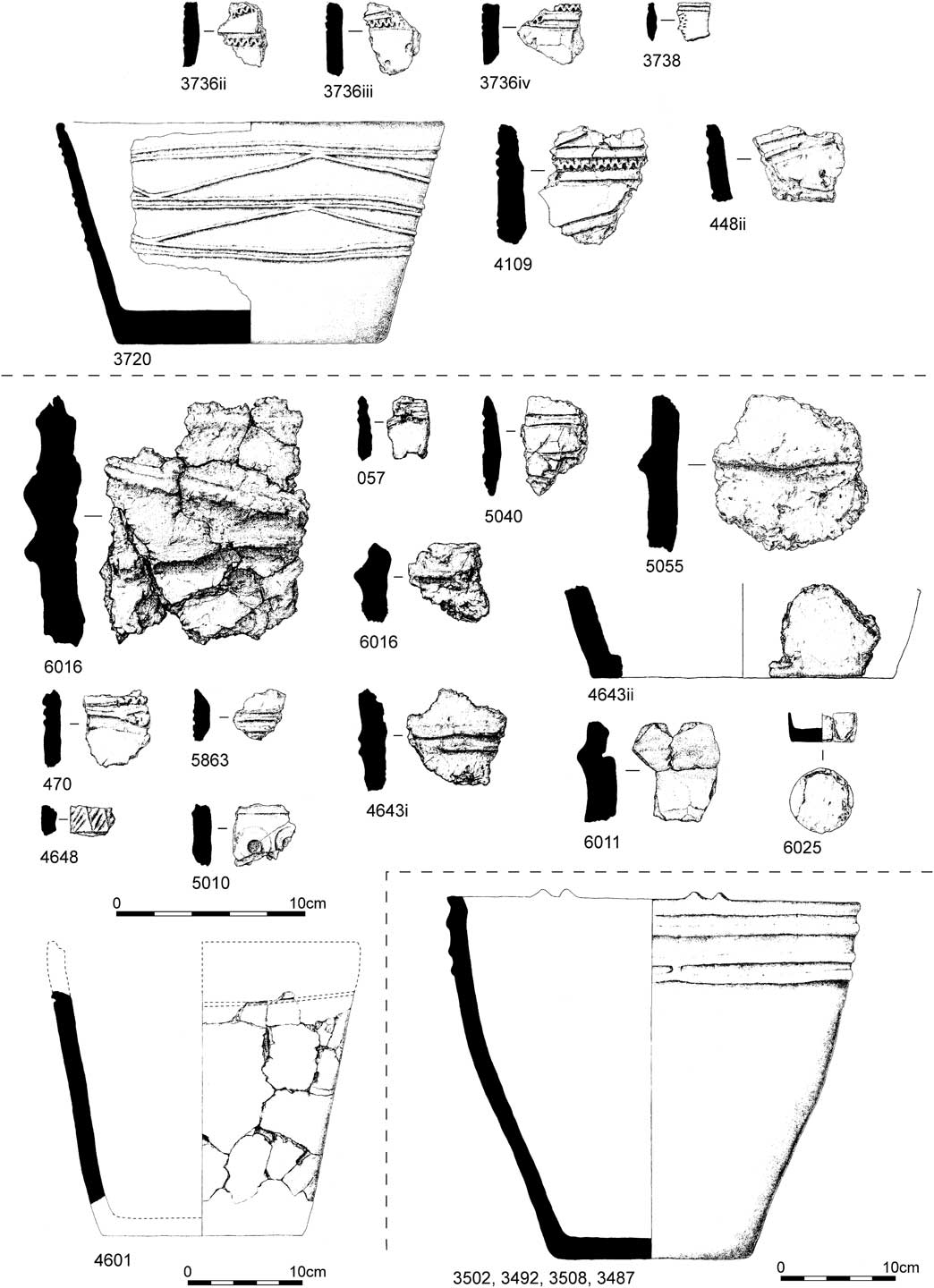
The overwhelming majority of vessels are tub- or bucket-shaped, with roughly vertical and slightly splaying walls respectively (eg, Fig. 4, SF 1905 & Fig. 5, SF 3502/3492/3508/3487), but there are also examples of shallow bowl-like vessels with splaying walls (eg, Fig. 4, SF 1890 & Fig. 5, SF 3720) and, in the drain for Structure 8, a tiny pinch-pot was found (Fig. 5, SF 6025). That pot resembles the small ochre-mortars found elsewhere in Late Neolithic Orkney; an example in stone is also known from Barnhouse (Hill & Richards Reference Hill and Richards2005, fig. 6.44). Excepting the tiny pot, three size classes were defined in the original report – small (rim diameters ranging between 140 mm and 210 mm), medium (rim diameters 211–280 mm) and large (rim diameters 281–420 mm) – with wall thicknesses generally increasing with vessel size (Jones Reference Jones2005, 261–82).
Where pottery could be associated with specific structures, examples representing more than one size category (and sometimes all three) were present in each (Jones Reference Jones2005, fig. 11.12), although large pots were noticeably the dominant size of pot on the Structure 8 platform (Jones Reference Jones2005, 271). In many cases, the large vessels showed less careful surface smoothing than the medium-sized and small pots. The rim forms (Jones Reference Jones2005, fig. 11.6) include one example with paired projecting applied pellets from a deposit behind House 3 (Fig. 5, SF 3502/3492/3508/3487); in addition to being a distinctive decorative feature, this could have been a device to prevent the pot’s contents from boiling over when used with a lid.
Decoration, where present, is by incision, impression and the application of cordons and pellets, with incised linear designs predominating (Figs 4–5; Jones Reference Jones2005, 264). Pre-eminent among the incised designs, present on 73% of all decorated sherds, are bands featuring three parallel wavy lines forming a serpentine design, often found in association with bands of horizontal lines (Fig. 4, SF 1933; Jones & Richards Reference Jones and Richards2005, 200). A distinction can be drawn between relatively narrow, fine cordons, which are found on vessels with carefully-finished surfaces and are either applied (eg, Fig. 5, SF 3720) or created in false relief (eg, Fig. 4, SF 1905), and thicker cordons, which are found on coarser vessels with relatively uneven surfaces and are invariably applied (eg, Fig. 5, SF 6016). Also of note is the recurrent use of a linear false-relief ‘cordon’ motif in which a wavy line has been created by making alternating depressions (eg, Fig. 4, SF 1905; Fig. 5, SF 4109), and the fairly common use of stab impressions, some arranged as rosettes (Fig. 4, SF3149ii, 5940, 4261, 5116xii), others as fringes for incised lines (Fig. 4, SF 5116vii & viii) and a few as fillers for what had probably been triangular and/or lozenge motifs (Fig. 4, SF 5463, 1085, 3138i); one exceptional sherd from the inner building of Structure 8 features incised cross-hatching used to fill the spaces between diagonal incised lines (Fig. 5, SF 4648). Where much or all of a pot is present or reconstructable, the decoration does not extend over the whole of the exterior, and this is particularly the case with the large vessels, where only the area immediately below the rim is usually decorated (Jones Reference Jones2005, 265). The condition of the assemblage was such that it was not possible to determine how many pots had been wholly undecorated. The degree of variability in decorative schemes among the pottery from the different structures is discussed by Jones (Reference Jones2005, figs 11.16–26).
Six fabric groups (A, B, B1, C, D, & E) were identified by Jones on the basis of the type and amount of material (crushed stone and/or shell) that had been added to the clay as a filler; of these, the last two have no deliberately added material, with fabric D containing only naturally-present rounded quartz grains (Jones Reference Jones2005, 261). Some correlation between fabric and pot size (and wall thickness) was noted. Small pots – with wall thicknesses between 5 mm and 9 mm – have either no deliberately-added material (ie, fabrics D & E) or else a moderate amount of shell (attested by voids where the shell had leached out); medium-sized pots (9–15 mm thick) have a moderate amount of either stone (fabric A) or shell (fabric C); and large pots (16–30 mm thick) have either a moderate amount of stone (fabric A) or else a large amount of stone (fabric B), in some cases with a little shell as well (fabric B1).
Furthermore, some spatial patterning in the choice of filler was evident. Sherds containing shell tended to concentrate in the ‘midden’ deposits in the east-central part of the site, and evidence suggesting a manufacturing area for such pottery was found on the site of the levelled House 7 (Jones & Richards Reference Jones and Richards2005, 35–7). Regarding the use of stone as a filler, petrological analysis revealed that each house in the western part of the site employed its own distinctive ‘recipe’ of stone types, while the pottery found in Structure 8 contained the full range of stone types, with the stone coming from various sources around and near the Lochs of Harray and Stenness, all within a 10 km radius of the site (Jones Reference Jones2002; Reference Jones2005; see Jones Reference Jones2005, 279–281 on the probable source of ‘Dyke X’ rock).
AIMS OF THE DATING PROJECT AT BARNHOUSE
In considering the chronology of Grooved Ware in Scotland, Patrick Ashmore (Reference Ashmore1998, 142–5) asserted that there was limited potential for refining the dating of its first occurrence, as the shape of the radiocarbon calibration curve means that results on short-lived samples actually dating to between 3300 bc and 3100 bc would calibrate to ‘somewhere in the period 3400 to 3000 (or even 2900) cal bc.’ Furthermore, he suggested that Bayesian ‘analysis of the kind carried out for Skara Brae’ (by Buck et al. Reference Buck, Kenworthy, Litton and Smith1991) is impossible for Barnhouse, ‘since its direct stratigraphic relationships are few’.
Two decades later, we consider that technical developments in both radiocarbon dating and the statistical modelling of dates make it possible to revisit this assessment. Not only has the error on radiocarbon measurements approximately halved in the intervening period (Table 1), but it has become possible to date calcined bone (Lanting et al. Reference Lanting, Aerts-Bijma and Plicht2001), and the potential for Bayesian statistics to provide refined chronologies on a routine basis has become clearly apparent (Bayliss Reference Bayliss2009). The increased precision which is currently available means that what in the 1990s was a undifferentiated plateau in the calibration curve for the late 4th millennium cal bc now comes into focus as a series of micro-wiggles which can be employed as the basis for much more constrained chronologies (Reimer et al. Reference Reimer, Bard, Bayliss, Beck, Blackwell, Bronk Ramsey, Buck, Cheng, Edwards, Friedrich, Grootes, Guilderson, Haflidason, Hajdas, Hatté, Heaton, Hoffmann, Hogg, Hughen, Kaiser, Kromer, Manning, Niu, Reimer, Richards, Scott, Southon, Staff, Turney and Plicht2013). So, one general aim of this dating programme was to explore the potential for the construction of such constrained chronologies in this period.
Radiocarbon Ages and Stable Isotopic Measurements From Barnhouse

The statistical consistency of replicate measurements has been assessed using the method of Ward & Wilson (Reference Ward and Wilson1978; T’(5%)=3.8; T’(1%)=6.0; ν=1 for all). Reported δ13C values are those measured by Isotope Ratio Mass Spectrometry (IRMS) on sub-samples of the carbon dioxide combusted for dating. These values have been used in the calculation of the reported conventional radiocarbon age, except for UBA- where the fractionation correction has been made using the values measured in the AMS
A number of specific objectives relating to the site sequence at Barnhouse were identified:
-
∙ to provide formal estimates of the date and duration of occupation at Barnhouse,
-
∙ to determine the duration of use of the houses and Structure 8,
-
∙ to determine the date of different pottery forms, fabrics and decorative schemes.
RADIOCARBON DATING AND CHRONOLOGICAL MODELLING
The new radiocarbon dating programme for Barnhouse was conceived within the framework of Bayesian chronological modelling (Buck et al. Reference Buck, Cavanagh and Litton1996). This allows the combination of calibrated radiocarbon dates with archaeological prior information using a formal statistical methodology. At Barnhouse a number of stratigraphic relationships between stone structures and the surrounding midden layers were available to constrain the radiocarbon dates, even though the archaeological deposits were shallow (0.6–0.7 m at most).
Material suitable for radiocarbon dating was scarce. Unburnt bone did not survive, and charred plant remains were rare. All the pottery was scanned for the presence of carbonised residues which might represent charred food. Fragments of calcined bone were available from hand-collection. A complete inventory of the available datable material was produced and annotated on the site matrix. Rarely was there choice of material for sampling. For a number of houses (eg, Houses 6 & 10), no datable material at all could be located. For others, material was severely limited and only a few samples could be dated (eg, Houses 7 & 11). Only in the case of Structure 8 did multiple contexts produce material suitable for dating. None of the samples was articulated or refitting, and so all have the potential to be residual in the context from which they were recovered. Some have a plausible functional relationship with their parent contexts (e.g. OxA-2734), but in other cases the taphonomy of the dated material is much more uncertain (e.g. OxA-2736).
Radiocarbon results
A total of 74 radiocarbon measurements are now available from Barnhouse (Table 1). All are conventional radiocarbon ages, corrected for fractionation (Stuiver & Polach Reference Stuiver and Polach1977).
Radiocarbon samples of charred plant remains dated as part of the original post-excavation programme were measured by Accelerator Mass Spectrometry (AMS) at the Oxford Radiocarbon Accelerator Unit using methods outlined in Gillespie et al. (Reference Gillespie, Hedges and White1983), Hedges (Reference Hedges1981), and Bronk and Hedges (Reference Bronk and Hedges1990). Samples of charred plant material and charred residues at the Scottish Universities Environmental Research Centre were pre-treated as described by Mook and Waterbolk (Reference Mook and Waterbolk1985); samples of calcined bone were pre-treated as described by Lanting et al. (Reference Lanting, Aerts-Bijma and Plicht2001). All samples were combusted to carbon dioxide (Vandeputte et al. Reference Vandeputte, Moens and Dams1996), graphitised (Slota et al. Reference Slota, Jull, Linick and Toolin1987), and dated by AMS (Freeman et al. Reference Freeman, Cook, Dougans, Naysmith, Wilcken and Xu2010). Pre-treatment, combustion, graphitisation, and measurement by AMS at the 14CHRONO Centre, Queen’s University, Belfast, are detailed in Reimer et al. (Reference Reimer, Hoper, McDonald, Reimer, Svyatko and Thompson2015).Footnote 1 Here, charred residues were pre-treated using an acid wash; charred plant remains were prepared using an acid-base-acid protocol; samples of calcined bone were pre-treated as described by Lanting et al. (Reference Lanting, Aerts-Bijma and Plicht2001). Samples were reduced to graphite using zinc reduction (Slota et al. Reference Slota, Jull, Linick and Toolin1987), except for UBA-28539, UBA-22549, UBA-22554–7, UBA-22561–2, and UBA-22594–5 for which hydrogen reduction was employed (Vogel et al. Reference Vogel, Southon, Nelson and Brown1984).
Ten pairs of replicate measurements are available on samples that were divided and submitted for dating to both laboratories. Nine of these pairs are on single fragments of calcined bone. In six cases the results are statistically consistent at 95% confidence; in one case the results are statistically inconsistent at 95% confidence but consistent at 99% confidence; and in two cases the results are statistically inconsistent at 99% confidence. A pair of measurements on a single fragment of birch charcoal are statistically inconsistent at 95% confidence but consistent at 99% confidence (Table 1; Ward & Wilson Reference Ward and Wilson1978).
Although this reproducibility is less than would be expected on statistical grounds, we have taken weighted means of the pairs of measurements which are statistically consistent at 99% confidence. In the other two cases, both measurements were initially included in the model and a judgement made on which was more likely to accurately represent the age of the sample, based on its individual index of agreement in relation to the stratigraphy and other dates in the model.
Bayesian modelling
The chronological modelling described in this section has been undertaken using OxCal 4.2 (Bronk Ramsey Reference Bronk Ramsey1995; Reference Bronk Ramsey2009a; Reference Bronk Ramsey2009b), and the internationally agreed calibration curve of the northern hemisphere (IntCal13; Reimer et al. Reference Reimer, Bard, Bayliss, Beck, Blackwell, Bronk Ramsey, Buck, Cheng, Edwards, Friedrich, Grootes, Guilderson, Haflidason, Hajdas, Hatté, Heaton, Hoffmann, Hogg, Hughen, Kaiser, Kromer, Manning, Niu, Reimer, Richards, Scott, Southon, Staff, Turney and Plicht2013). The models are defined by the OxCal CQL2 keywords and by the brackets on the left-hand side of Figures 6–8. In the diagrams, calibrated radiocarbon dates are shown in outline and the posterior density estimates produced by the chronological modelling are shown in solid black. The Highest Posterior Density intervals which describe the posterior distributions are given in italics.
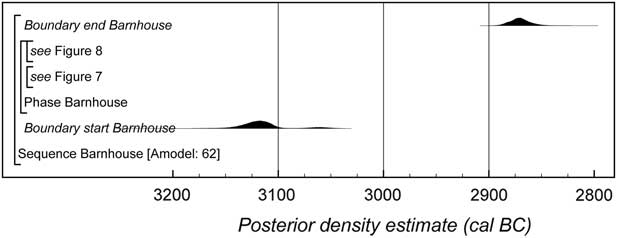
Overall structure of chronological model for Neolithic occupation at Barnhouse. The component sections of this model are shown in detail in Figs 7–8. Each distribution represents the relative probability that an event occurs at a particular time. For each of the dates two distributions have been plotted: one in outline, which is the result of simple radiocarbon calibration, & a solid one, based on the chronological model used. Distributions other than those relating to particular samples correspond to aspects of the model. For example, the distribution ‘start Barnhouse’ is the estimated date when activity associated with the late Neolithic village at Barnhouse began. The large square brackets down the left-hand side of Figs 6–8 along with the OxCal keywords define the overall model exactly

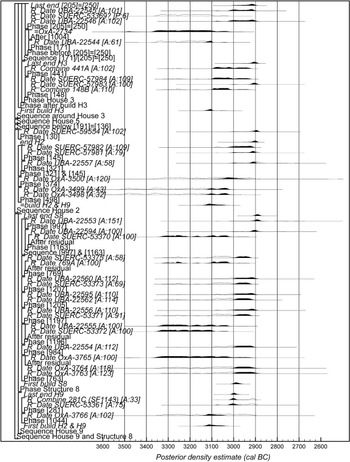
Probability distributions of dates from House 2, House 3 and related deposits in the work area, House 9, and Structure 8. The format is identical to that of Fig. 6, which shows the overall structure of this model. The large square brackets down the left-hand side of Figs 6–8, along with the OxCal keywords, define the overall model exactly

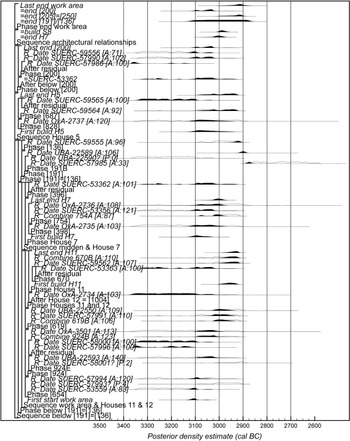
Probability distributions of dates from Houses 5, 7, 11, & 12 and from the work area. The format is identical to that of Fig. 6, which shows the overall structure of this model. The large square brackets down the left-hand side of Figs 6–8, along with the OxCal keywords, define the overall model exactly

A stratigraphic model
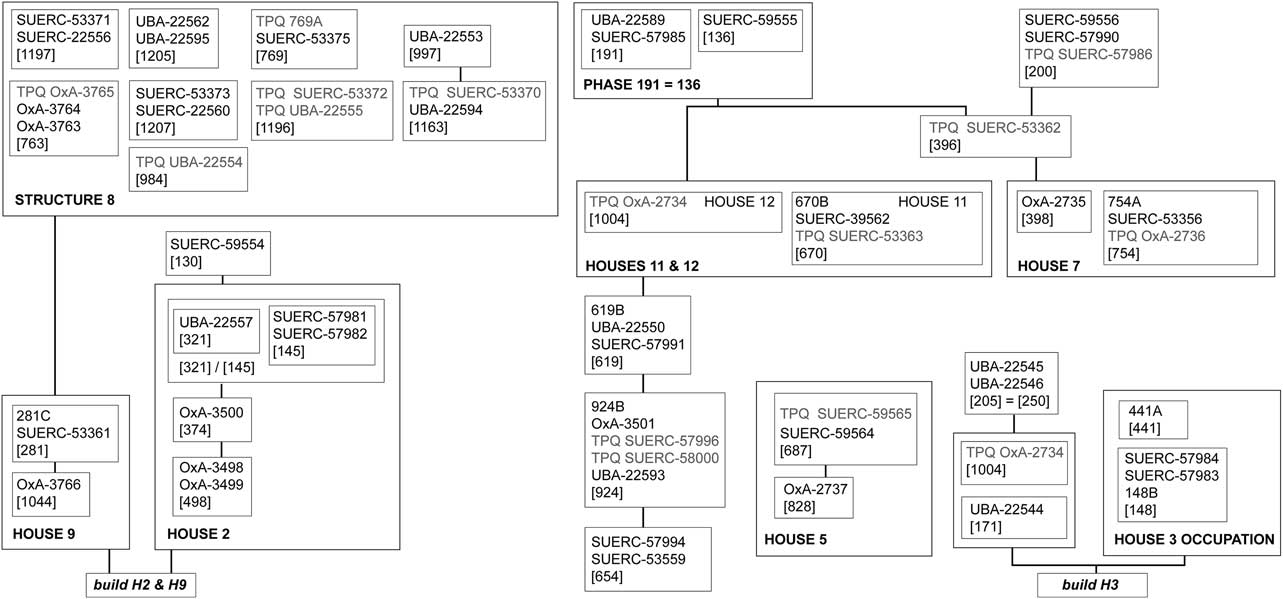
The chronological model for Barnhouse is defined in Figures 6–8, and Highest Posteror Density intervals for key parameters are given in Table 2. This is based on the stratigraphic sequence revealed through excavation. The relationships that are included in the model are summarised in Figure 9. This model has good overall agreement (Amodel: 62; Fig. 6).

Highest Posterior Density Intervals from Key Parameters from Barnhouse, Taken From the Model Defined in Figs 6–8

Three samples have been dated from the occupation of House 9. These are earlier than the construction of the overlying Structure 8. Seventeen samples of single-entity short-lived charred plant remains have been dated from deposits associated with the use of this building, of which we judge five samples to be residual on the basis of their dates in relation to those from the underlying House 9 (OxA-3765; UBA-22555, & SUERC-53372; 769A; & SUERC-53370). These results are incorporated as termini post quos in the model (Fig. 7).
House 2 and House 9 share the same drain, and have opposed entrances, which suggest they were a single unit of construction. The model incorporates this interpretation by estimating a single construction date for both buildings. Six samples have been dated from the sequence of occupation in House 2. UBA-22557 provides a direct date on a charred residue from SF 1680, an undecorated sherd. One sample has been dated from [130], the infill following the disuse of the building (Fig. 7).
Three samples have been dated from the lower midden underlying House 12. One of the samples from this deposit appears to be intrusive (SUERC-57993) and has been excluded from the model. Five samples have been dated from the overlying midden, [924]. One of these has divergent replicate measurements and, on the basis of the other dates from this sequence, we believe that UBA-22593 provides a more accurate indication of the date of this sample. SUERC-58001 seems to be slightly late and has been excluded from the model. SUERC-58000 and SUERC-57996 are probably residual and have been included in the model as termini post quos. Overlying this layer there is more midden ([619]) from which three samples have been dated, one of which (UBA-22550) was a charred residue on SF 6322 (Fig. 8).
Above this, a sample from a hearth in House 12 appears to be residual (OxA-2734) and is incorporated in the model as a terminus post quem. One of three samples from the floor of House 11 (SUERC-53363) is similarly residual and used as a terminus post quem. The dating of a building on the basis of two samples from one context is obviously not ideal. Four samples have been dated from the use of House 7. Above this, SUERC-53362 from [396], a layer associated with the ceramic firing zone, appears to be residual and provides a terminus post quem for overlying deposits. Houses 7, 11, and 12 were overlain by the upper midden ([191]=[136]). Three samples have been dated from these contexts. On the basis of the stratigraphy, we think that SUERC-57985 provides a more accurate indication of the age of sample 191B than UBA-22590, which appears to be anomalously old and has been excluded from the model. An equivalent layer, [200], ran across the central area and covered House 7 and produced three samples, one of which (SUERC-57986) must be residual and provides a terminus post quem for the end of the use of the Barnhouse central midden area (Fig. 8).
Four samples have been dated from the occupation of House 3. A fifth sample, from an ash-heap that accumulated against its north-eastern wall, also post-dates the construction of this building (Jones & Richards Reference Jones and Richards2005, figs 3.32 & 3.33). This sample, and deposits within House 12 (see above), are earlier than the uppermost ash-spread ([205]=[250]). Three measurements have been made on charred residues from groups of sherds from the three vessels from the upper ash-spread (Fig. 8). SUERC-53369 (SF 1852) is anomalously early and probably does not provide an accurate date for this pot. It has been excluded from the model. UBA-22545 dates an undecorated vessel containing stone filler (SF 1818; not illustrated), and UBA-22546 dates a vessel with parallel grooved decoration and stone filler (SF 1841; not illustrated).
Three samples have been dated from House 5b, the second of four superimposed buildings on the same footprint. One of these, SUERC-59565, appears to be residual and has been modelled as a terminus post quem (Fig. 8).
Of the 74 radiocarbon measurements from Barnhouse, three are excluded from the analysis because they are considered to be inaccurate. Two are inconsistent with true replicates, and one is a charred residue on a vessel represented by nine sherds. One result is excluded from the model as the sample is thought to be intrusive. So, 70 measurements on 62 samples are included in the model. Twelve of these are interpreted as residual and so have been modelled as termini post quos for overlying deposits, because of the relationships between their dates and those from associated and stratigraphically related contexts. The remaining 50 samples are thought to date accurately the deposits from which they were recovered.
We must consider the number of dated samples available from different parts of Barnhouse in assessing the reliability of this model. Structure 8 has 17 dated samples (of which five are regarded as residual); the houses in the outer arc have 16 dated samples (of which one is residual); the midden has 21 dated samples (of which four are considered residual); but the houses of the inner arc have only eight dated samples (of which two are considered residual). All the houses have fewer samples than is ideal and our sample from the inner arc is clearly inadequate. It is particularly regrettable that no samples could be found from House 6, which is clearly inter-stratified between Houses 7 and 11.
A second consideration relating to the reliability of this model is our reliance on samples of calcined bone (31 of the 62 samples included in the modelling). Experimental evidence suggests that the carbon in calcined bone apatite may derive not only from the dated individual, but from the fuel used in the cremation process, and the atmosphere during the time of cremation (Snoeck et al. Reference Snoeck, Brock and Schulting2014). This can lead to offsets in dates on calcined bone (Olsen et al. Reference Olsen, Heinemeier, Hornstrup, Bennike and Thrane2013). We believe that this is not a significant issue at Barnhouse. First, the dates on calcined bone and charred plant remains are comparable. Secondly, the wood charcoal from Barnhouse is dominated by heather, hazel, and birch, with only minor components of driftwood, oak, and ash (Cartwright Reference Cartwright2005). The presence of cramp across the site, however, probably indicates the use of seaweed in fuel (Stapleton & Bowman Reference Stapleton and Bowman2005), although we do not have evidence that this has imparted a marine offset to the dated calcined bone at this site.
A structural narrative
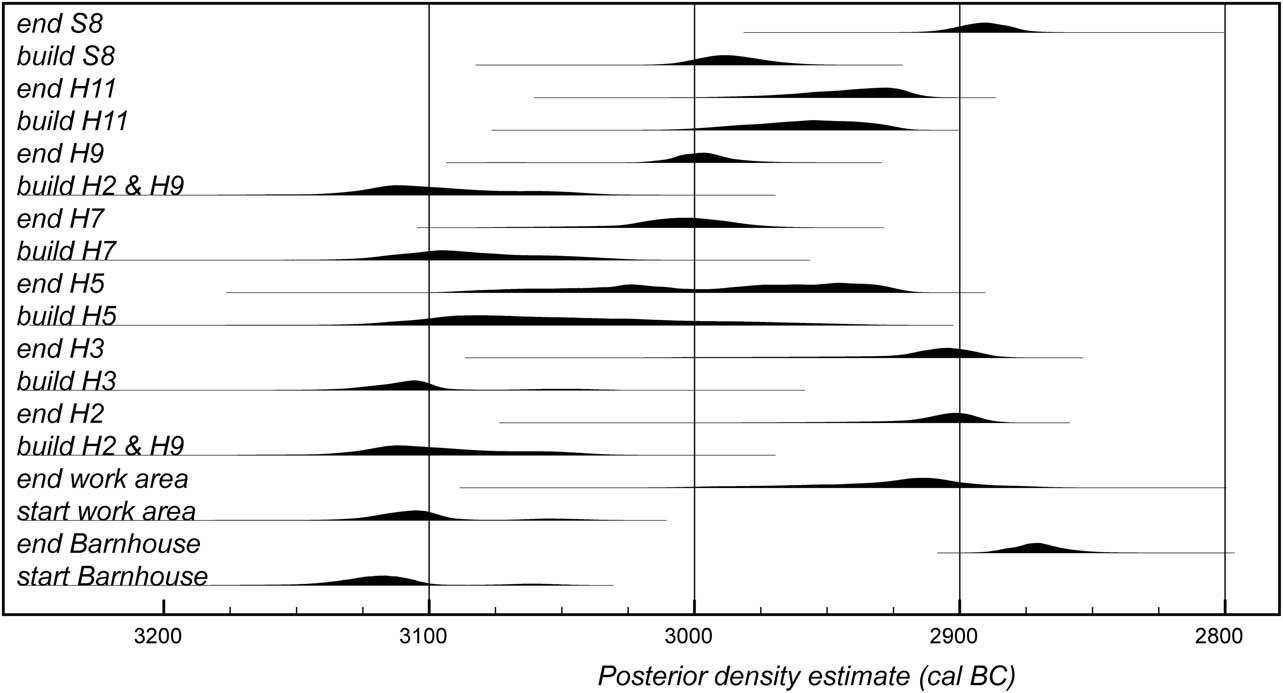
The model shown in Figures 6–8 and summarised schematically in Figure 9, suggests that habitation at Barnhouse began in 3160–3090 cal bc (86% probability; start Barnhouse; Fig. 6) or 3080–3045 cal bc (9% probability), probably in 3135–3100 cal bc (68% probability). The first houses to be built were Houses 2 and 9, in 3140–3035 cal bc (95% probability; build H2 & H9; Fig. 10), probably in 3130–3070 cal bc (68% probability). The model incorporates the interpretation that these two buildings were contemporary constructions. House 3 was also constructed at this time, being built in 3145–3080 cal bc (83% probability; build H3; Fig. 10) or 3070–3030 cal bc (12% probability), probably in 3125–3095 cal bc (68% probability). At this time, the first residues from craft activities began to accumulate in the work area, in 3140–3080 cal bc (84% probability; start work area; Fig. 10) or 3070–3035 (11% probability), probably in 3125–3090 cal bc (68% probability).

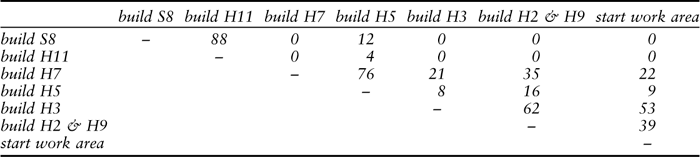
It is not possible to determine the relative order of the appearance of these elements of the settlement (Table 3). For example, on the basis of the dating, it is 53% probable that House 3 precedes the start of the work area and 47% probable that the converse applies. The first, undated, phase of House 5 (5a) almost certainly also falls in this initial period of construction, as its second phase began in 3125–2955 cal bc (95% probability; build H5; Fig. 10), probably in 3105–3015 cal bc (68% probability). This estimate is imprecise, since it relies on only three dates.
Probabilities of the Order of Key Construction Events at Barnhouse

The table gives the probability that the parameter down the left-hand column is earlier than the parameter along the top row. For example, the probability that build S8 is earlier than build H11 is 88%
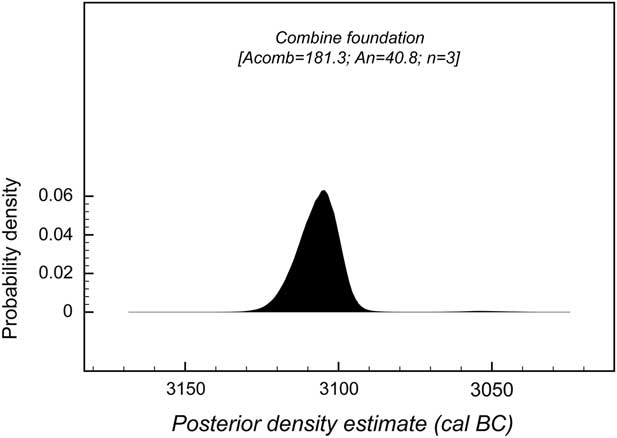
The fact that Houses 2, 9, and 3 are structurally linked, and a single drainage network serving these houses conjoins with House 5a (Jones & Richards Reference Jones and Richards2005, fig. 3.7), encourages the view that these elements were built as a single unit. Of these, Houses 3 and 9 are intimately linked to the larger House 2. If we combine the date estimates for these early elements of the settlement, suggesting they were part of a unified foundation, the model has good overall agreement (Acomb: 181.3; An=40.8; n=3). In this reading the foundation of Barnhouse occurred in 3125–3090 cal bc (95% probability; foundation; Fig. 11), probably in 3115–3095 cal bc (68% probability). This could best be described as a well-choreographed constructional event.
Combined probability distribution estimating the construction date of all the early structures at Barnhouse, if these are interpreted as representing a single planned construction

Probably slightly later than this initial construction (Table 3) came the building of House 7, in 3130–3025 cal bc (95% probability; build H7; Fig. 10), probably in 3120–3060 cal bc (68% probability).Footnote 2 House 6 was constructed further north, some time after the building of House 7, as its drain cuts that of House 7. House 1 represents an addition to House 6 while it was standing and still in use, but is similarly without radiocarbon dates. Both Houses 6 and 1 must have gone out of use before the stratigraphically later House 11. House 11 was constructed in 3000–2920 cal bc (95% probability; build H11; Fig. 10), probably in 2975–2930 cal bc (68% probability).
Houses 4, 10, and 12 do not have formal date estimates from the model. Only House 12 has a single radiocarbon date, and that is probably on a residual sample (OxA-2734). As with so many of the houses at Barnhouse, House 12 had been rebuilt at least once. The primary construction was directly on the natural till. The second building was slightly offset and partially covered midden deposits. The first House 12a preceded the building of the adjacent House 10 (which was never remodelled). The construction of House 10 was probably sandwiched between those of House 12a and 12. That House 12a was erected directly on the natural till suggests that it may not have been much different in construction date to Houses 7 and 6. House 4 was constructed late in the sequence, lying on top of deposits that had accumulated during the use of House 3. To the south-east, a small section of walling from House 13 was present, being built directly on the natural till, and may have been in contemporary use with House 7, as the drain running around the latter respects the outer wall of the former (see Jones & Richards Reference Jones and Richards2005, fig. 3.7). The house wall of the overlying House 13b shared constructional similarities with Houses 10 and 6.
Structure 8 was constructed in 3010–2955 cal bc (95% probability; build S8; Fig. 10), probably in 3000–2975 cal bc (68% probability). It was clearly built after all of the dated domestic structures at Barnhouse had been constructed, with the exception of House 11, which is probably later (88% probable; Table 3). Structure 8 was built 60–180 years (95% probability; start Barnhouse – build S8; distribution not shown), probably 110–155 years (68% probability) after the foundation of the settlement. The overall sequence of construction inferred from the chronological modelling and archaeological evidence is summarised in Figure 12.

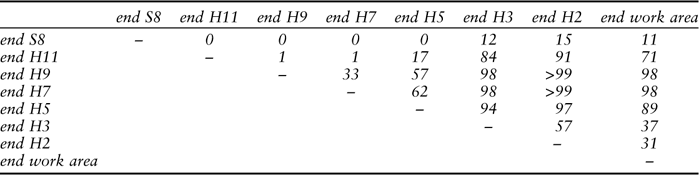
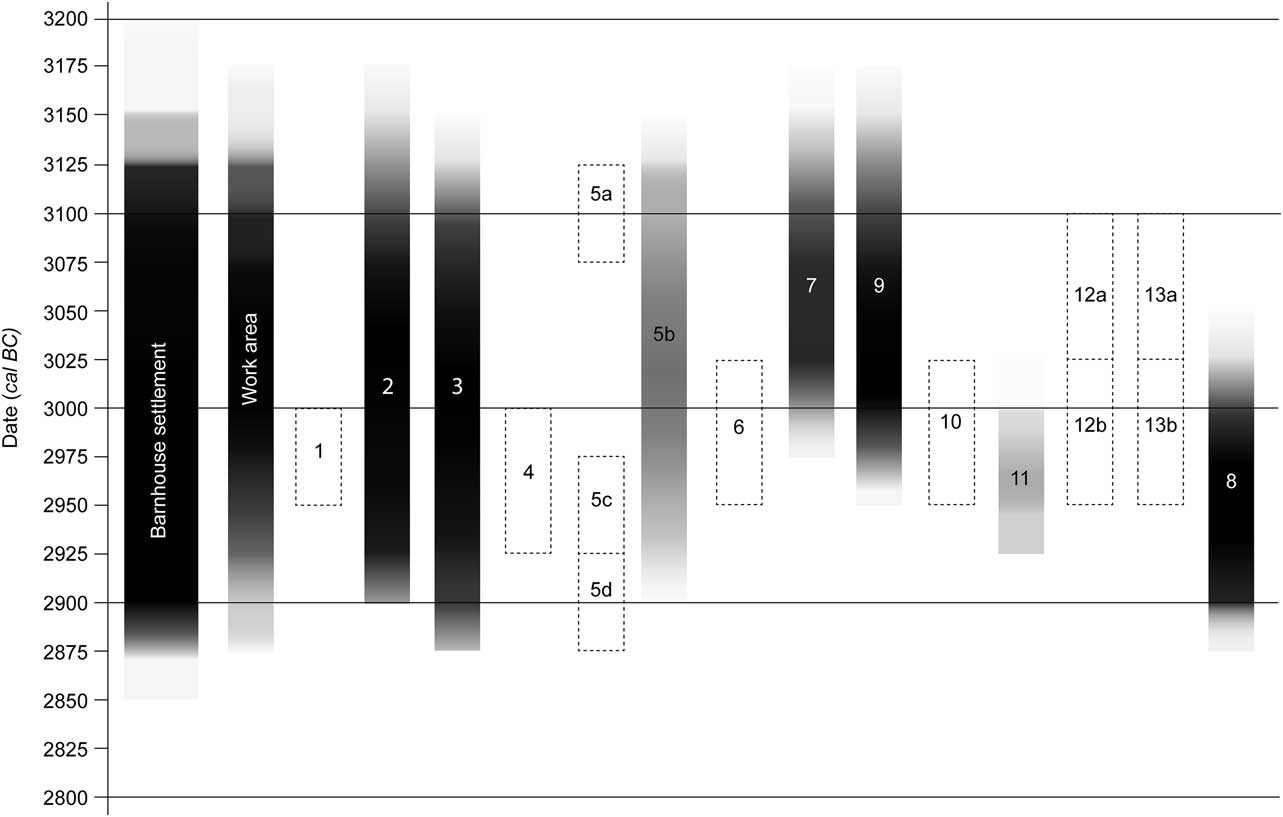
It is important not to confuse the sequence of construction with the period when particular buildings were occupied. A number of buildings were reconstructed on several occasions (for example, House 5, which was rebuilt on four occasions in almost precisely the same position). In contrast, House 3 does not seem to have been rebuilt, but rather was refurbished and the floor renewed at least twice. It is clear (Table 4) that Houses 2 and 3, and the work area were maintained into the final decades of the 30th century cal bc (Fig. 10). House 2 may not have been in use right to the end of the settlement, as it appears to be sealed by a layer of dark soil [130], rich in material culture. The interpretation of this deposit is difficult and it is not impossible that this in fact represents the final use of the building. In this reading, House 2 would have continued in use until the very end of the settlement. House 5 may similarly continue in use into the late 30th century cal bc. Our estimate for its ending (Fig. 10; Table 2) in fact only relates to the end of House 5b.
Probabilities of the Order of Key Endings at Barnhouse

The table gives the probability that the parameter down the left-hand column is earlier than the parameter along the top row. For example, the probability that end S8 is earlier than end H3 is 12%
Some houses did not endure for as long. House 9 goes out of use in 3020–2970 cal bc (95% probability; end H9; Fig. 10), probably in 3010–2985 cal bc (68% probability); and House 7 was last used in 3060–2965 cal bc (95% probability; end H7; Fig. 10), probably in 3020–2985 cal bc (68% probability). It is probable that House 9 was demolished to make way for Structure 8, its walling being robbed for use in that construction, and, since House 7 also went out of use at this time, perhaps its demise was also related to changes in the settlement layout arising from the decision to build Structure 8. This idea is supported by the fact that the masonry of House 7 was also completely robbed.
House 11, the latest dated construction at Barnhouse, went out of use in 2980–2910 cal bc (95% probability; end H11; Fig. 10), probably in 2955–2915 cal bc (68% probability). Structure 8 was probably the last element of Barnhouse to be abandoned (66% probable), in 2915–2870 cal bc (95% probability; end S8; Fig. 10), probably in 2905–2880 cal bc (68% probability). Overall, final activity occurred in 2890–2845 cal bc (95% probability; end Barnhouse; Fig. 6), probably in 2885–2860 cal bc (68% probability).
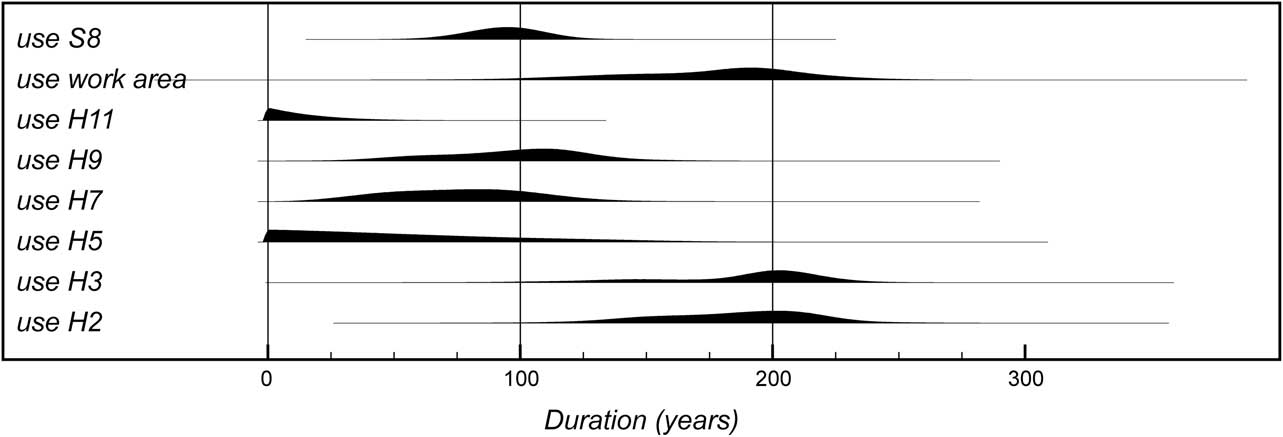
By comparing the date estimates for the start and end of occupation at Barnhouse, we can calculate the duration of its use. It was occupied for 165–205 years (9% probability; use Barnhouse; Table 2) or 210–295 years (86% probability), probably for 225–275 years (68% probability). A few of the original houses endured for the entire lifespan of the settlement (Houses 3, 5, and possibly 2) (Fig. 13). The occupation of House 9 was curtailed by the decision to build Structure 8; as a result, it was in use for a period of 35–155 years (95% probability; use H9; Fig. 13), probably for 70–135 years (68% probability). House 7, whose demise may have been linked to the same event, likewise was in use for 20–135 years (95% probability; use H7; Fig. 13), probably for 45–110 years (68% probability). The use of House 11 may have been even shorter, for 1–50 years (95% probability; use H11; Fig. 13), probably for 1–20 years (68% probability). On the basis of these durations, it seems likely that the other houses which were constructed during the lifetime of the settlement were occupied for significant periods on the scale of human experience, but that they did not last for as long as the founder buildings (Fig. 14). The formal modelling has enabled a contrast to emerge, therefore, between the original row or line of founder houses and the subsequent accretion of other buildings in the area to its east, partly infilling the original work area in the process. Some houses remained rooted to the spot, as it were, being rebuilt or refurbished on exactly the same footprint. In other cases, rebuilding might have involved very slight shifts in location. House 5 could be contrasted with the complex of House 7, House 6, House 1, and House 11 from this perspective.


On the same basis, the duration of Structure 8 can be estimated as 60–130 years (95% probability; use S8; Fig. 13), probably 80–115 years (68% probability).
A ceramic narrative
Given that the modelled dating indicates a duration of occupation at Barnhouse spanning more than two centuries (use Barnhouse; Table 2), can any chronological patterning in the ceramic record be discerned?
Perhaps surprisingly, there appears to be a considerable degree of consistency in ceramic design and manufacture over the life of the site. The use of small, medium-sized, and large vessels in the repertoire appears to have been recurrent; incised and impressed decoration (including the distinctive false-relief wavy-line ‘cordon’ motif: eg, Fig. 4, SF 1905) seems to be present from the earliest period of activity to the latest, with applied decoration being present from at least the earlier 30th century cal bc (as shown by the splayed-sided vessel from House 6, Fig. 5, SF 3720); and both shell and stone were used as a filler through the entire life of the site. The only clear trend appears to be that the large, coarse vessels with uneven surfaces and thick applied cordons (eg, Fig. 5, SF 6016) seem to relate to the later activity at the site (30th century cal bc), being found in the upper levels of midden deposits and in and around Structure 8. Other changes appear to be a cessation of the use of the impressed ‘rosette’ motif (eg, Fig. 4, SF 4261) by the time Structure 8 was built, and the appearance – in House 12b – of applied dimpled circular pellets (Fig. 5, SF 5010).
Other differences in pot manufacture and decoration could relate to factors other than chronological change, such as relative importance or specific activities. For example, there are certain specific decorative schemes that are only found in House 2, which was in use for more or less the entire span of the settlement (Fig. 14).
One thing that has become clear as a result of the re-dating of the site, however, is that the previous argument (Jones Reference Jones2002, 126–9; Reference Jones2005, 282), to the effect that a shift had taken place from the use of distinctive ‘recipes’ of clay fillers in individual houses to the use of all types of rock as fillers in Structure 8 pottery, and that this indicated a social change to communal pottery production, can now be abandoned. It is clear that several houses were still in use when Structure 8 was built, and it may be that pots made in those houses ended up being deposited in Structure 8. Nevertheless, the use of different kinds of rock filler in different houses still needs to be explained. Perhaps differing fillers were used for pots made to be used in different contexts, for different functions and in different social arenas. This would arguably account for the exclusive use of shell as filler in Houses 6 and 7, and the mixture of fillers used in Structure 8.
DISCUSSION
The foundation of new settlements
The model presented above (Figs 6–8) shows that Barnhouse began in the last decades of the 32nd century cal bc. It is striking that this is a new site, built on fresh ground, without any sign of previous occupation. The further estimate given in Figure 11 allows – but does not prove – that Barnhouse could have been a planned foundation, rather than having just emerged building by building. In such a scenario, the life of the site would have begun with the building of Houses 2, 9, 3, and perhaps 5a, and the initiation of the work area, forming an initial cluster of buildings with an adjacent work and midden area (Fig. 12).
From the outset, therefore, the Barnhouse settlement could represent ‘planned’ agglomerated occupation, which expanded through its lifespan by the addition of further buildings. Quite apart from the range of other innovations accompanying the emergence of Grooved Ware in Orkney, this represents a significant change in the nature of Orcadian Neolithic settlement. The earliest Neolithic occupations had consisted of clustered timber-framed buildings, which at a later date were superseded by stone-walled buildings (Richards et al. Reference Richards, Downes, Gee and Carter2016). This transformation from timber to stone house construction might date, though there is still much uncertainty about the precise chronology, to the century or two immediately preceding the start of Barnhouse (Griffiths Reference Griffiths2016). At Knap of Howar, in Westray, Green in Eday, Knowes of Trotty, Stonehall Meadow, Mainland, and probably Wideford Hill, single houses were enlarged into double house units, whereas at Braes of Ha’Breck, Wyre (Thomas & Lee Reference Thomas and Lee2012), and Brae of Smerquoy, Mainland (Gee et al. Reference Gee, Richards and Robertson2016), individual houses were elongated. Importantly, Braes of Ha’Breck and Stonehall also reveal the beginnings of conglomeration, with the stone-built houses at the latter being placed some 50–100 m apart (Richards et al. Reference Richards, Downes, Gee and Carter2016).
The context for the foundation of Barnhouse is also potentially significant. The Mainland sites just mentioned are mostly grouped in the long occupied area of the Bay of Firth. Though Barnhouse is a component of a clustering of settlements and monuments centrally placed within the large natural bowl of western Mainland, the majority of these are of slightly later date. What else was already there in the local landscape?
Curiously, apart from the north coast, western Mainland Orkney is notable for the absence of Early Neolithic chambered cairns of stalled architecture. The majority of chambered cairns in this area are later passage graves of one form or another and many of these cluster around the Stenness–Brodgar area. On the south-east shore of the Loch of Stenness is the presumably older chambered cairn of Unstan, and the long horned cairn of Staneyhill lies to the north, though this could be of 3rd millennium cal bc date (Downes et al. Reference Downes, Richards, Brown, Cresswell, Ellen, Davies, Hall, McCulloch, Sanderson and Simpson2013). In short, earlier monuments within the immediate area are not abundant. Where we do possess detailed information such as from Deepdale Bay to the south-west of the Loch of Stenness, a picture of closely situated, seemingly short-lived, small-scale settlements dating back to the late Mesolithic emerges (Richards Reference Richards2005a, 11–16). Accepting the absence of total survey in the Stenness–Brodgar area, the recent discovery of round-based bowl pottery from lower deposits at the Ness of Brodgar (Nick Card, pers. comm.) suggests that people had been or were residing nearby when Barnhouse was founded, and the inter-relation of these communities will be discussed below. Nonetheless, with the discovery and location of a substantial late Neolithic settlement at Bookan (Chris Gee, pers. comm.), we can begin to recognise a pattern of expansion of Late Neolithic settlement focussed on the Stenness–Brodgar–Bookan landscape. Barnhouse fits rather well into this process and the intake of heavier soils in the interior of Mainland (Sharples Reference Sharples1992), and we can now see that this happened in the case of Barnhouse early within the Grooved Ware sequence in Orkney (and see further below). The new foundation was part of a series of other changes, not least that it is this very landscape which becomes increasingly ‘monumentalised’ through the early–mid-3rd millennium cal bc.
In an island context such as Orkney, where agriculture and Neolithic practices inevitably involved a degree of sea transportation and colonisation from elsewhere, a founder-focused set of core beliefs could well have prevailed. Under such circumstances, the notion of origins would be of great significance, as would the idea and vitality of ‘founders’. Within such a proposition, individual and family position may be defined in terms of genealogical proximity to a founder, which in turn may translate into the spatial organisation of settlements and their histories; residence situation and house proximity would provide spatial parameters for the construction of social identities and relatedness. In hypothetical subsequent developments, the fissioning of groups leading to the founding of further new settlements could have been a social strategy in the circumvention of ascription of rank. Basically, a section of a residence group or ‘house’ splits away and forms a new settlement in a new place. Obviously depending on the degree of charisma, wealth and resources, when a new settlement is founded, the ‘founder’ soon severs genealogical links with the previous regime and claims an alternative and more direct relationship with ancestral entities and deities. This not only effects an elevation in the status of the ‘founder’, but restructures and enhances relations between all members of the newly forged social group. Such relationships may well rely heavily on the layout and physical appearance of houses to materialise abstract concepts of genealogical relationships and social identities.
In this scenario, founding a ‘new’ settlement such as Barnhouse is extremely ambitious, because it necessarily involved establishing alternative social identities without recourse to the material legitimacy gained by appropriating an old site and claiming physical links to previous generations. Identities at Barnhouse may well have been constructed with reference to claimed genealogical descent but may have been more complex and ambitious by looking beyond Orcadian shores to mythical places of origin. It is in this context that the presence at Barnhouse of externally derived materials such as Arran pitchstone and ‘megalithic’ motifs on Grooved Ware (and see below) should be reconsidered.
Duration and discontinuity
At 25 years per generation, the inhabitation of Barnhouse represents a continuous tenure of place probably over ten generations or so. Stone walls might have needed little repair other than routine maintenance, but presumably roofs demanded much more attention and renewal. There need have been no pre-determined future projection when buildings were first constructed. The decision to repair in order to maintain the same footprint, rather than to rebuild elsewhere, was a social one. This can be seen being repeated on at least four major occasions through the occupancy of House 5 (Downes & Richards Reference Downes and Richards2005, 69–82): given the overall span of this building, at intervals of roughly 50 years or every two generations.
We should not take duration for granted. Persistence takes effort and commitment. In the case of Barnhouse, the commitment to a new foundation proved in the end to be matched by a continuation over many generations. That in turn can be contrasted with discontinuities elsewhere, for example at Pool, Sanday (Hunter Reference Hunter, with Bond and Smith2007, 27; MacSween et al. Reference MacSween, Hunter, Sheridan, Bond, Bronk Ramsey, Reimer, Bayliss, Griffiths and Whittle2015), Rinyo, Rousay (Childe & Grant Reference Childe and Grant1939, 20–1; 1947, 36–9) or Skara Brae (Childe Reference Childe1931, 61–95; D. Clarke Reference Clarke1976). The early Neolithic settlements of Knowes of Ha’Breck, Wyre (Thomas & Lee Reference Thomas and Lee2012), Green, Eday (Coles & Miles Reference Coles and Miles2013), and Smerquoy, Mainland (Gee et al. Reference Gee, Richards and Robertson2016), also reveal longer discontinuities as each possesses evidence for later Neolithic re-occupation. Numerous discontinuities – the foil to duration – are an under-estimated characteristic of Orcadian Neolithic settlements. Even if we are dealing with relatively small spatial shifts, the social processes underlying the foundation, occupation, and abandonment of a particular place require further comment. We suggest that rather than a catalogue of catastrophic events, the punctuated nature of Neolithic settlement in Orkney is best understood as a consequence of specific social strategies.
The character of habitation
There seems little doubt that the Barnhouse houses, with the possible exceptions of House 2 and Structure 8, were dwellings. Even these substantially larger buildings have hearths, internal stone furniture, and an array of finds and refuse, consistent with domestic use, though they may have held pre-eminent roles within the settlement. The layouts of the Early Neolithic stone-walled houses mentioned above had themselves begun to shift, as exemplified by the sequence on Stonehall Knoll, from an earlier emphasis on heavily-defined stalled interior space to a more open, slightly recessed internal architecture (Richards & Jones Reference Richards and Jones2016). The architecture of the Barnhouse buildings could be characterised as a continuation of this process (see Richards et al. Reference Richards, Downes, Gee and Carter2016) with the important incorporation and formalisation of cruciform principles of spatial order that were not really present in the older ‘stalled’ houses.
There are interesting distinctions in the construction and condition of the two groupings of houses at Barnhouse. The houses of the west–north arc (9, 2, 3, & 5a) all share a common drainage system. They were also built in a similar manner with well constructed outer and inner walls, facing a mixed clay and midden wall core. Apart from House 9, which was almost certainly totally demolished when Structure 8 was erected, in each case portions of the lower courses of masonry remained intact. This contrasts with the dwellings of the inner arc (Houses 7, 6, 10, 12a, & 13a), all of which on excavation were represented by sub-circular spreads of yellow clay wall core material. None had the masonry of outer- and inner facing-walls. The inner group of dwellings seem therefore to have been built differently, for instance with turf walls with lower clay cores. The difference could be between initial foundations and subsequent infilling (Fig. 14). Alternatively, the masonry of the eastern group of buildings could have been systematically robbed for some reason.
The building of Structure 8 is of great consequence, because of a range of characteristics including its large scale, spatial shift in habitation and change in architecture. The architectural change involves bigger, square-shaped structures with rounded corners, with stone furniture projecting from the inner wall-face as opposed to being recessed into the wall. It is also a tradition that is continued elsewhere, for instance in the final structural phases of Skara Brae. For Barnhouse, it perhaps marks the single change that could be described as a monumental shift in the biography of the site, even though other buildings (probably 1–6, 10, 11, 12b, & 13b: Fig. 14) continued in use after its construction.
The significance of the Barnhouse Grooved Ware pottery
The Grooved Ware assemblage from Barnhouse is important for two reasons that extend far beyond the site. First, the associated dates are indeed among the earliest currently available for this ceramic tradition anywhere in its extensive area of distribution, raising the question of how and where the tradition came about; and secondly, some of the Barnhouse designs have been found on Grooved Ware elsewhere in Britain and Ireland, as far away as southern England (where it has been characterised as ‘Woodlands style’ Grooved Ware: Wainwright & Longworth Reference Wainwright and with Longworth1971), raising the question of how and why the use of Grooved Ware spread. These questions will be considered at greater length in future synthesis of the results of the ToTL dating programme for Orcadian Grooved Ware; here, a few key observations are offered.
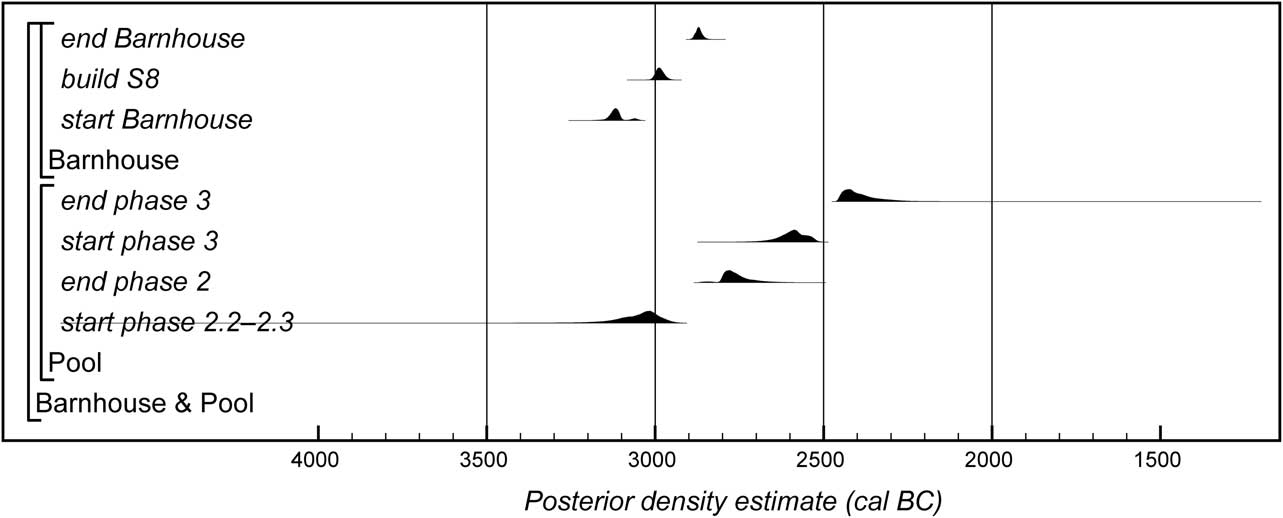
The results here have indicated that the Barnhouse Grooved Ware assemblage dates to between 3160 and 3090 cal bc (86% probability; start Barnhouse; Fig. 6) or 3080–3045 cal bc (9% probability) and 2890–2845 cal bc (95% probability; end Barnhouse; Fig. 6). This means that there was a considerable period of overlap with the use of the earliest Grooved Ware at Pool on Sanday (Fig. 15). The ToTL programme has shown that the initial phase of Grooved Ware use there, characterised by the use of incised and impressed decoration, with shell used as a filler, dates to between 3210–2935 cal bc (95% probability; start Phase 2.2–2.3; MacSween et al. Reference MacSween, Hunter, Sheridan, Bond, Bronk Ramsey, Reimer, Bayliss, Griffiths and Whittle2015, fig. 9) and 2860–2830 cal bc (2% probability; end Phase 2; MacSween et al. Reference MacSween, Hunter, Sheridan, Bond, Bronk Ramsey, Reimer, Bayliss, Griffiths and Whittle2015, fig. 9) or 2815–2650 cal bc (93% probability). The stratigraphically later (Phase 3) Grooved Ware at Pool, with its heavy, applied decoration, post-dates the latest Barnhouse Grooved Ware, dating to between 2680–2515 cal bc (95% probability; start Phase 3; MacSween et al. Reference MacSween, Hunter, Sheridan, Bond, Bronk Ramsey, Reimer, Bayliss, Griffiths and Whittle2015, fig. 9) and 2460–2280 cal bc (95% probability; end Phase 3; MacSween et al. Reference MacSween, Hunter, Sheridan, Bond, Bronk Ramsey, Reimer, Bayliss, Griffiths and Whittle2015, fig. 9). There are other Grooved Ware assemblages, both on Orkney and beyond, that seem to have been in broadly contemporary use with the Barnhouse pottery. These include the pottery from the Stones of Stenness (Ritchie Reference Ritchie1976): here, Bayesian modelling of the dates indicates a commencement of activities around 3020–2890 cal bc (95% probability; start; Schulting et al. Reference Schulting, Sheridan, Crozier and Murphy2010, illus. 23) or 2940–2900 cal bc (68% probability); from Quanterness passage tomb (Schulting et al. Reference Schulting, Sheridan, Crozier and Murphy2010, 13–19 & illus. 10); almost certainly from the Ness of Brodgar (the results of whose dating will be presented in a future publication); Balfarg Riding School, Fife (Henshall Reference Henshall1993); Balbirnie stone circle, Fife (Gibson Reference Gibson2010, tables 2–3; Ritchie Reference Ritchie1974), and Knowth passage tomb 6, Co. Meath, Ireland (Schulting et al. Reference Schulting, Sheridan, Crozier and Murphy2010, 40).
Probability distributions of radiocarbon dates from Barnhouse (produced in Figs 6–8) and Pool (MacSween et al. Reference MacSween, Hunter, Sheridan, Bond, Bronk Ramsey, Reimer, Bayliss, Griffiths and Whittle2015, fig. 6)

While there are some strikingly close parallels between some pots, motifs, and design schemes found at Barnhouse and some of the pots from these other sites – with the comparison between Vessel 16 from the Stones of Stenness and the low, splayed-side bowl from Barnhouse House 6 being a well known example (Jones Reference Jones2005, 266; see Schulting et al. Reference Schulting, Sheridan, Crozier and Murphy2010, illus. 20 for others) – nevertheless there are some differences between the Barnhouse Grooved Ware and the earliest Grooved Ware from Pool. In particular, the latter lacks the false-relief decoration and the use of applied cordons that characterise some of the Barnhouse pottery, and vessel shapes also differ, with the slender, narrow-based and bulbous-walled forms of Pool not being represented at Barnhouse. Nevertheless, some decorative motifs, such as the use of impressed dots or jabs fringing or infilling incised designs (MacSween Reference MacSween2007, illus. 8.1.9), are indeed shared between the two assemblages. This raises the question of whether the kind of Grooved Ware seen at Barnhouse represents an elaboration of practices visible at Pool (where new elements of grooved decoration were incorporated into the existing tradition of pottery making on the site: MacSween et al. Reference MacSween, Hunter, Sheridan, Bond, Bronk Ramsey, Reimer, Bayliss, Griffiths and Whittle2015), or whether there are multiple origins within Orkney for the Grooved Ware tradition, with the makers of the Pool pottery adopting some decorative traits that had originated elsewhere. It is increasingly evident that we are dealing with a deliberately created, novel tradition, whose invention was bound up with the strategies of social differentiation and competitive conspicuous consumption that have been outlined elsewhere (Richards Reference Richards2013; Schulting et al. Reference Schulting, Sheridan, Crozier and Murphy2010; Sheridan Reference Sheridan2014).
The fact that widespread and close comparanda for elements of the Barnhouse assemblage can be found beyond Orkney informs us about the extent and nature of the networks of contacts that must have existed around the turn of the 3rd millennium cal bc. Within Orkney, it has been argued that the similarity between some pots from Barnhouse and from the Stones of Stenness and Quanterness (Henshall Reference Henshall1979, fig. 33, pot 2; Schulting et al. Reference Schulting, Sheridan, Crozier and Murphy2010, illus. 20) is not merely stylistic, but is due to the pots in question actually having been made at Barnhouse, as the lithic inclusions suggest (Jones Reference Jones2005, 280–1). This indicates that the inhabitants of Barnhouse and the material culture they produced participated in broader spheres of social relations and networks of exchange. Monument building was also a component within such social strategies which necessarily combined shifting identities with status renegotiation (Richards Reference Richards2013, 276–80). The further-flung comparanda of Grooved Ware in areas to the south of Orkney demonstrate networks extending well beyond the archipelago. One of these strands – namely the adoption of Grooved Ware and of the use of timber and stone circles along a western arc from Orkney to the Boyne Valley – has been documented elsewhere (Sheridan Reference Sheridan2004), and this ties in with the fact that Arran pitchstone was found at Barnhouse, indicating some reciprocal movement (Jones & Richards Reference Jones and Richards2005, 45). Equally, the distribution of carved stone balls and the radiocarbon dates for the building of Balbirnie stone circle in Fife (Gibson Reference Gibson2010, tables 2–3) demonstrate eastern strands of interconnectivity. This evidence for the long-distance movement of ideas, objects, and practices (and indeed of a few people) may well relate to the forging of new local identities (in these areas to the south of Orkney) with reference to distant communities, either real or imagined (Thomas Reference Thomas2010).
CONCLUSION
Spanning more than 200 years, the foundation, occupation, and abandonment of Barnhouse highlight the duration of a Late Neolithic settlement. However, this settlement was not erected over the abandoned remains of earlier occupation. Neither would it become the site of later 3rd millennium cal bc re-occupation. Living at Barnhouse involved sequential or organic building episodes embracing several generations. Barnhouse also displayed a high degree of internal organisation where proximity and the physical appearances of dwellings were clearly strategic in constructing social identities. Perhaps of greatest import is that at Barnhouse we see the initiation of ‘big houses’ (House 2) and their monumental development (Structure 8). This can be recognised as a generative strategy that would lead to the building of the Stones of Stenness and ultimately the great Ring of Brodgar. Just where the monumental structures of the Ness of Brodgar fit into this narrative of settlement foundations, continuities and discontinuities, and monumentality, remains to be seen. And finally, the results presented here provide not just formal date estimates for the development of Grooved Ware pottery, but a more nuanced sense of the social contexts to which it belonged.
Acknowledgments
Grateful thanks go to Sheila Garson and Janette Parks of Tankerness House Museum, Kirkwall, for all their help and patience with the sampling process; Peter Marshall and Alison Turner-Rugg for help with sampling; and Kirsty Harding for invaluable help with the figures. Dating and modelling have been supported by a European Research Council Advanced Investigator Grant (295412), The Times of Their Lives (www.totl.eu), led by Alasdair Whittle and Alex Bayliss. Further dating and modelling of Grooved Ware sites in Orkney are being carried out within the ToTL project, at the Links of Notland, Ness of Brodgar, and Skara Brae.