A little more than four decades ago, Gambia joined the General Agreement on Tariffs and Trade (GATT) in a process that took a mere five days from application to the granting of membership. Around that same time Egypt also joined the GATT, but only after a much more comprehensive eight-year process of accession. As part of their respective accessions in the 1990s, Panama cut its average applied tariff rate by more than 40 percent whereas Ecuador dropped its rate by less than 1 percent. More recently, Vietnam engaged in seventeen rounds of questioning by current members during its accession to the GATT's successor, the World Trade Organization (WTO), while fellow Asian joiners Taiwan and Mongolia completed only three such rounds during their similarly timed accessions. Clearly, the accession experiences of WTO members have varied considerably, with some being asked to undertake greater trade reform than others. Therefore, one would not expect all members of international organizations (IOs) like the WTO to benefit equally from their membership.
Our central theoretical claim is that the more rigorous a state's accession to an international organization, and thus the greater the policy change required, the greater the benefits it will receive from membership in the organization. To fully understand the effects of IO membership on states, one must examine what a state is required to do to become a member. Accession is a crucial period when IOs hold considerable influence over states, often requiring applicants to change various domestic policies to conform to the organization's mission. In the trade context, states that face greater scrutiny from the WTO and thus engage in greater trade liberalization as part of the WTO accession process should experience greater trade on joining compared to those who face little scrutiny and engage in little if any liberalization.
The WTO is an ideal empirical case for investigating the impact of variation in IO accession requirements because its 153 members have experienced markedly different requirements for joining—even those who joined at the same time. Across the duration of the GATT/WTO regime,Footnote 1 many member states engaged in comprehensive, rigorous processes of accession that required making widespread tariff and nontariff commitments. These states, particularly those that engaged in the greatest amount of trade reform and liberalization, should experience significant trade increases from their membership. In sharp contrast, dozens of other members have joined the organization without making new commitments to reduce trade barriers. For them, there is little reason to expect this effortless membership to boost trade beyond the previous status quo.
By shining the theoretical spotlight on IO accession, we reconcile a fundamental disagreement in the WTO literature in a manner that has widespread theoretical and policy implications. A prominent strand of research claims that members of the WTO have not experienced greater trade as a result of their membership, leveling a potentially damning blow to the perception of the WTO as perhaps the most successful of all IOs. In reaction, other scholarship uncovers evidence that WTO membership is in fact associated with greater trade among members. One shortcoming of the extant literature is the lack of differentiation among the ways in which states joined the IO—that is, a member is a member, regardless of what trade policy changes were required for membership. Yet when studying the effects of IO membership, pooling states that joined under different terms muddles the impact of divergent member-state experiences within the organization. In contrast, classifying WTO members by their respective type of accession, and by how much liberalization was asked of them, reconciles this seeming discrepancy in past research. We find that the subset of members that completed rigorous accessions and engaged in greater liberalization experience notable trade gains from WTO membership, whereas the subset that joined without any meaningful liberalization do not.
Our unique theoretical perspective responds to the call from Martin and Simmons to demonstrate not just whether IOs matter but also how they matter.Footnote 2 Neoliberal institutionalism puts IOs at center stage as important actors in the global arena, while realists challenge this alleged importance, claiming that any success attributed to an IO merely captures what states would have done in its absence or reflects the preferences of powerful states within the IO.Footnote 3 We demonstrate empirically that the WTO does have an independent positive impact on many states, both by compelling them to change a range of trade policies and providing sizeable trade gains for those that do. More precisely, we identify accession as the causal mechanism through which IOs such as the WTO can have these effects. The important but overlooked period of IO accession is a highly consequential time when IOs exert considerable influence over states and can spark domestic political changes in the applicant state, thus laying the foundation for the state to benefit from IO membership. An important implication is that the often demanding requirements of IO accession can be politically beneficial for political leaders by giving them “political cover” for undertaking otherwise difficult tariff reductions and nontariff liberalization.Footnote 4 Moreover, since each state's accession to the IO is unique, we demonstrate that it is imperative to unpack state membership in IOs to reveal the otherwise obscured, and potentially divergent, effects that IOs can have on states.
These conclusions and implications emerge from a series of theoretically motivated empirical tests that utilize unique original data on WTO accession. We first reclassify WTO membership based on type of accession, and then compile rich data on several aspects of the WTO accession process for each member, such as the length of time, number of working party members, number of rounds of questions, and tariff and nontariff commitments. Four distinct yet logically related findings emerge. First, those members that accede through automatic procedures, which require no new trade liberalization, do not experience trade gains from their membership. By direct contrast, a second finding is that those states that undergo rigorous accession consistently experience greater trade postmembership than nonmembers and those who join automatically. Third, among these “rigorous” joiners, those states that complete the most rigorous accession processes—and thus engage in the most liberalization—experience even greater trade gains. Finally, accession-driven trade gains are greatest in the years right after joining but decline over time, thus lending further support to our central logic. All of these highly robust findings demonstrate that accession determines how much a state that joins an IO benefits from its membership and that IOs like the WTO can have a significant effect on state behavior through the accession process.
Does the GATT/WTO Benefit Its Members?
The WTO has long been viewed by scholars and policymakers as a model of IO success. Interdisciplinary scholarship across political science, economics, and law has chronicled the accomplishments of the organization and pointed to the WTO as an example of how IOs can foster meaningful multilateral cooperation and effectively enforce global rules.Footnote 5 In fact, prominent political voices such as current World Bank President Robert Zoellick and former WTO Director-General Supachai Panitchpakdi have proclaimed the WTO to be “the most important organization created in the last 50 years.”Footnote 6
Such praise can be attributed to the organization's perceived role in boosting trade in the post–World War II era and its expanding membership over that period. Global trade grew by more than 6 percent annually between 1950 and 2005, and the GATT/WTO is perceived as a major engine of this trade expansion.Footnote 7 In the GATT era, members' average tariff rates on industrial goods were slashed from between 30 to 40 percent down to below 5 percent, and under the WTO, trade-distorting quantitative restrictions and various subsidies have been banned.Footnote 8 Additionally, the organization has successfully admitted a wide-ranging group of 153 states, including 30 during the recent WTO era.
This is why recent scholarship by Rose, which paints a strikingly skeptical picture of the WTO's record, has caused a stir in both academic and policy circles.Footnote 9 Using the well-known gravity model of trade, Rose conducted dozens of quantitative analyses of bilateral trade flows between countries around the globe from 1948 to 1999 and found no evidence that trade between a pair of countries was greater when either or both was a member of the GATT/WTO. He reaffirmed this null effect through a series of sensitivity analyses in which he considered alternative estimators and explored the effects of single or dual membership across time and across regions.Footnote 10
Rose's findings have potentially widespread implications. His conclusion that the WTO has not generated increased trade for its members calls into question the rationale for trying to continue the slow-moving Doha round of WTO negotiations. It also suggests that Russia and the twenty-nine other countries in the midst of accession should not bend over backward to join the global trade organization. Rose's skeptical results also provide powerful and unexpected fodder to international relations realists, who long have been skeptical of neoliberal claims about the efficacy of IOs.Footnote 11 As Goldstein, Rivers, and Tomz point out: “this null result not only challenges our understanding of the most heralded commercial agreement in history, but also casts doubt on the institutionalist literature that regards the GATT/WTO as its beau ideal.”Footnote 12 Indeed, if the seemingly exemplary WTO is revealed to be largely ineffective, then general theoretical arguments about the role of IOs that use the WTO as an illustrative case must be reconsidered.
Other scholars have responded to Rose by uncovering evidence that the GATT/WTO has boosted trade. For instance, Subramanian and Wei put forward data showing that the GATT/WTO has increased trade over a long period of time, but only for the regime's developed-country members.Footnote 13 Similarly, Gowa and Kim find that the GATT generated greater trade among a small number of industrial-country members.Footnote 14 Finally, Engelbrecht and Pearce find that the GATT/WTO has promoted greater trade, albeit only in capital-intensive commodities.Footnote 15
The collective findings to date suggest that the GATT/WTO has failed to stimulate trade among developing countries, with a possible explanation being that developing countries under the GATT engaged in little trade liberalization when joining the organization.Footnote 16 Although this conclusion applies to a subset of developing countries—as we demonstrate later—it is an oversimplification that obscures the diversity of developing countries' experiences within the regime. Many developing countries, in fact, have completed laborious accession processes during both the GATT and WTO eras in which they undertook significant trade liberalization. China and Saudi Arabia, whose accessions spanned multiple decades and required significant trade policy changes, stand as prominent illustrations of this fact. Yet several developing countries that acceded under the GATT (for example, Honduras, Tunisia, and Venezuela) also faced long accessions, and observers have singled out accessions of smaller states such as Cambodia, Nepal, and Vanuatu as being highly demanding in terms of the trade liberalization required.Footnote 17 The fact that many developing countries have undertaken significant liberalization to join the GATT/WTO suggests that simple empirical distinctions should be cast aside in favor of more rigorous theorizing about why some states should be more likely to benefit from IO membership than others.
This discussion suggests that the accession period should play a central role in shaping how much a state benefits from joining an IO. Yet accession to the GATT/WTO, in terms of how it works and how it varies across prospective members, is largely absent from previous studies of the WTO and its effects. One can find insightful case studies of individual countries' accessions,Footnote 18 careful cross-country investigations of selected accessions under the GATT or WTO,Footnote 19 as well as discussions of the alleged heightened stringency of the WTO accession process;Footnote 20 but no systematic effort has been made to compare each country's accession experiences across the regime's lifetime.Footnote 21 More importantly, no attempt has been made to theorize whether differences in accession requirements might explain variation in the gains received from membership.
In shifting the focus to accession, our theoretical account contributes to an increasing awareness among international relations (IR) scholars that becoming a member of an IO can have myriad effects on both domestic and international politics.Footnote 22 Accession is a multiyear endeavor in which prospective members undertake important domestic reforms in hopes of being integrated into an existing IO such as the European Union or the North Atlantic Treaty Organization.Footnote 23 Past research demonstrates that the positive effects of these IO-driven reform efforts can be observed in both the domesticFootnote 24 and internationalFootnote 25 spheres. Therefore, in this research we investigate the different accession experiences of GATT/WTO members and consider how varying amounts of scrutiny and reform during accession affect the trade gains they receive postmembership.
Accession to the GATT/WTO
To begin our investigation into the effects of IO accession on trade, we classify the current members of the GATT/WTO into three groups according to how each state joined. The starting point is the early members—the approximately three dozen countries that joined the GATT at its outset and in the years immediately following. A second group is comprised of the automatic joiners; that is, countries that joined effortlessly after receiving their independence from an existing GATT member. The final group, and the one most worthy of deeper examination, is the large collection of rigorous acceders that joined after a comprehensive, multiyear process of scrutiny and commitment making.
Early Accession
Although attempts by a large group of states to establish the International Trade Organization (ITO) failed in the years right after World War II, a smaller subset of states, led by the United States and including both developed and developing countries, successfully negotiated a multilateral trade treaty in Geneva in 1947. The culminating document, the aptly named General Agreement on Tariffs and Trade, became the basis for the modern trade regime. The twenty signers of this original agreement, along with another thirteen members who signed on soon thereafter, constitute the early members of the GATT, which serves as our first membership category.Footnote 26
For these countries, “accession” to the GATT consisted of the group's initial, landmark efforts to foster mutual tariff concessions through the original treaty as well as a series of follow-up negotiating rounds. States that participated in the initial 1947 GATT negotiations signed a treaty that included a large number of tariff bindings, entailed notable tariff reductions, and established reciprocal concession-making and most-favored-nation (MFN) status as linchpins of the regime.Footnote 27 Thirteen additional members were integrated soon after the initial Geneva agreement was signed, with most becoming members between 1950 and 1951.Footnote 28 Because these new entrants received the previous MFN tariff concessions made by the existing members at Geneva, they had to pay an “entrance fee” in the form of tariff concessions for joining the institution.Footnote 29 During the subsequent decade, all of these early members completed four additional multilateral rounds, each of which continued to emphasize further tariff concessions.
Automatic Accession
The second group joined the GATT through what we term automatic accession, a popular and surprisingly easy means of entry for more than sixty current members of the organization. This means of joining is based on Article 26:5(c) of the General Agreement, which held that a newly independent territory could obtain membership in the GATT based on the earlier membership of, and consent by, its former colonial power.Footnote 30 Effectively, after independence states could join the GATT simply by professing their intent to become a member and thus continuing the status quo established by their former colonizer.
A surprisingly diverse sixty-five states acceded under Article 26:5(c) during the forty-five-year period in which it was allowed (from 1950 to 1994).Footnote 31 Three former British colonies, Indonesia, Ghana, and Malaysia, joined in this way as early as the 1950s. An additional twenty-seven countries invoked the same article to join between 1960 and 1967, after the largest period of European decolonization. Another surge occurred near the end of the GATT, with twenty-two countries joining between 1990 and 1994 before the option ended with the establishment of the WTO in 1995. Although a majority of Article 26:5(c) joiners have been developing countries, more developed states such as Brunei, Liechtenstein, Qatar, and Singapore, also have joined in this way.
For our purposes, the primary distinguishing feature of automatic accession is its ease. In contrast to the other types of accession, the logic of granting de facto admission based on the colonizer's existing membership means that automatic-joiner states did not go through a true screening process. They did not participate in multilateral rounds of talks, as the early joiners did, nor were they asked by existing members to make specific tariff commitments, as in the case of the rigorous acceders. Instead, automatic accession was easy and required no new trade commitments, since it entailed “essentially sending a notification to the GATT without having to promise reforms.”Footnote 32
Rigorous Accession
The final category of membership consists of the numerous countries that have joined through the process we term rigorous accession. This is the richest and most interesting category, and despite the name, is best thought of as the standard method of joining the trade regime since the 1950s.Footnote 33 For the rigorous joiners, the time between application and admission is a systematic, multiyear process that entails scrutiny by existing members and making various commitments to liberalization. Fifty members have acceded in this way during the past half century, and thirty more are in the midst of this process. Israel applied to join in this manner in 1959, followed by a steady stream of accessions in the 1960s (for example, Egypt, Ireland), 1970s (for example, Colombia, Philippines), and 1980s (for example, Thailand, Mexico, Morocco). More recently, all states that acceded in the WTO era, from Cambodia to China to Croatia, joined in this fashion. Each of these accessions is unique in terms of duration, the composition of the applicant's working party, and the types of tariff and nontariff liberalization required.
Nevertheless, the rigorous accession process has long been characterized by a consistent series of steps. As Martin notes, “a well-defined set of operating procedures has been defined under GATT and WTO to allow accession applications to be considered with some degree of consistency despite the absence of formal rules.”Footnote 34 We single out four stages of greatest importance, which illustrate the progression from information provision to scrutiny to final liberalization commitments.Footnote 35
The first step is the (1) preparation of a memorandum by the applicant country, which includes a detailed description of its current trade policies and institutions. This “can be a very demanding task,” according to Michalopoulos, “because of the range of issues that the memorandum has to address and the degree of detail required.”Footnote 36 The memorandum greatly increases transparency in terms of the applicant's current trade regime. It also provides the working party, the specially constituted group of member states that oversees a given state's accession, with an informational baseline for the rest of the process.
The process next enters a second phase in which members of the working party ask questions of the applicant—based on the memorandum and additional evidence they gather otherwise. For many applicants this (2) question-and-answer stage can be the most time-consuming phase.Footnote 37 There may be multiple iterations, taking months or even years, and hundreds, or in some cases thousands, of questions may be asked. The questions submitted by the working party members are often designed to gain additional insights into the trade regime beyond what was detailed in the memorandum. Working party members often enquire further about proposed modifications to the tariff schedule,Footnote 38 the status of various nontariff barriers,Footnote 39 and domestic laws and institutions that govern trade.Footnote 40
Simultaneous to the question-and-answer phase, a period of (3) negotiations begins. At this point the applicant engages in repeated exchanges with the entire working party regarding its future tariff schedules as well as other nontariff commitments. This can be a complex process, and the schedules and commitments often go through numerous revisions. Additionally, the applicant may enter into a series of bilateral negotiations with individual members of the working party, in which it makes additional pledges on areas of concerns to respective members.
The previous two steps culminate in the preparation of a detailed (4) working party report, a central component of which is the commitment paragraphs that outline the specific liberalization efforts each applicant state pledges to complete. The categories for the commitment paragraphs are fairly standard across all applicants and typically include: broader macroeconomic policies, frameworks for making and enforcing policies, policies affecting trade in goods and services, import and export regulation, transparency, and trade agreements. Nevertheless, all applicant states make their own unique commitments within these general categories. Morocco, for instance, had relatively few commitment paragraphs, most of which focused narrowly on its customs stamp duty, phytosanitary regulations, and eliminating special treatment on products of European origin.Footnote 41 Mexico, on the other hand, had almost three times the number of commitment paragraphs, which addressed broader areas such as agricultural liberalization, a plan for rural development, rules on state-owned enterprises, and changes to bring antidumping and countervailing duty laws into conformity with multilateral rules.Footnote 42
The Effects of Different Types of Accession
The process of joining IOs can be long and at times painful, but for many GATT/WTO members the trade policy changes made as part of accession should translate directly into trade benefits.Footnote 43 For the rigorous and also early acceders, who made notable liberalization commitments in exchange for membership, we expect to see substantial trade increases from GATT/WTO membership. Furthermore, among those states that acceded rigorously, those who had the most rigorous accessions should experience the greatest trade gains. In sharp contrast, the automatic joiners are not expected to see increased trade because they made no new commitments or other changes to the status quo in order to join.
The Positive Effects of Rigorous Accession
When an applicant state joins via rigorous accession, the GATT/WTO scrutinizes its existing trade policies and requires the acceding government to liberalize and reform, which in turn generates incentives for greater international trade. A foundational assumption of our approach is that a substantial portion of the trade boost from GATT/WTO membership can be attributed to a state's own accession-based trade reforms and liberalization, compared to other potential benefits of membership such as the conferring of MFN status or greater market access. As others have noted, most acceding countries already enjoy preferential access to nearly all foreign markets, since WTO members extend MFN status freely to nonmembers.Footnote 44 Furthermore, case studies and simulations demonstrate that countries do not anticipate significantly expanded market access from joining the GATT/WTO, nor do they expect that whatever access they obtain will boost trade significantly.Footnote 45 Thus, the trade liberalization that results from rigorous accession is the largest driving force behind whatever increased trade a country might experience after joining the GATT/WTO.
Trade liberalization during rigorous accession occurs in several forms, the most notable being tariff commitments. Data from case studies, existing tariff data sources, and our data collection efforts reveal that states that join in this manner bind a substantial number of tariff lines and lower their tariffs significantly during the period from application to postmembership.Footnote 46 They make these commitments with the clear expectation that such moves will generate sizeable increases in trade.Footnote 47 In terms of reduction levels, the average drop in simple, nonagricultural tariff rates for states acceding during the WTO period has been reported at 25 percent.Footnote 48 Data we carefully compile on applied ad valorem tariff reductions for GATT-era rigorous accessions exhibit similar overall patterns, with an average drop of 21 percent. Even in sensitive areas like agriculture, recent rigorous WTO joiners have cut average agricultural tariffs by nearly 15 percent.Footnote 49
States that accede through rigorous procedures also make nontariff trade liberalization commitments, which often are articulated in the commitment paragraphs. Among the nontariff barriers these joiners address are quotas, subsidies, procurement, health and safety standards, services, customs procedures, intellectual property, and state trading enterprises.Footnote 50 For instance, as part of its accession commitments in the 1980s, Paraguay implemented several new pieces of legislation on issues such as services, regulatory standards, taxation, and phytosanitary measures.Footnote 51 Similarly, Honduras passed a widespread animal and plant health bill, which it presented to the GATT in the middle of its accession in 1993.Footnote 52 More recently, Saudi Arabia enacted a total of seventy new trade-related laws as part of its WTO accession.Footnote 53
Finally, all of these trade-increasing reforms are easier to implement because they occur due to a mandate from a powerful international institution. Trade liberalization produces domestic losers and entails adjustment costs; thus it is easier to pursue under the “cover” of a desirable international organization.Footnote 54 WTO accession also can serve as an “anchor” for broader policy reforms.Footnote 55 Furthermore, pursuing membership in the WTO helps market-friendly governments stave off opposition from antireform domestic groups.Footnote 56 These various advantages of accession-based liberalization therefore provide a solid foundation for future trade growth.
For all of these reasons, we expect rigorous WTO accession, which involves multiple commitments to trade liberalization, to stimulate greater trade.
H1: GATT/WTO members who join via rigorous accession procedures should experience increased trade, particularly compared to nonmembers and those who join via automatic accession.
A rigorous accession variable is coded with a value of 1 for all states that joined the GATT/WTO after 1953 under Article 33 of the GATT or Article 12 of the WTO.Footnote 57 These rigorous accession states are easy to identify because their accessions, unlike those of early or automatic acceders, are accompanied by numerous GATT and WTO documents that chronicle their experiences with the various steps of the accession process (for example, memoranda, questions and answers, and working party reports).
Comparisons Among Rigorous Acceders
Although rigorous acceders in general should benefit from their GATT/WTO membership, the level of trade gains received by states in this group should differ because the number and degree of liberalization commitments made varies from one state to the next. Therefore, drawing on the same logic articulated in the preceding pages, we argue that:
H2: Among those who joined the GATT/WTO via rigorous accession procedures, those who had the most rigorous accessions should experience greater trade increases.
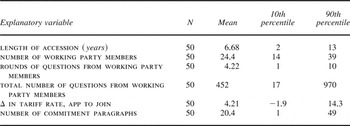
This second hypothesis constitutes a direct test of our logic by utilizing highly unique, original data on the level of scrutiny each acceding state faced and the extent of tariff and nontariff liberalization made by each. The WTO Secretariat produces numerous documents about each state's experiences at all stages of the accession process, which we identify using two online resources: the GATT Digital Library and the WTO Accession Gateway.Footnote 58 Information from these original documents is then integrated, along with tariff and commitment data from other sources, into an original data set on the terms of accession for the fifty rigorous joiners. From this data set, six unique variables, which are summarized in Table 1 are generated and then used one at a time to test H2.
Descriptive statistics on rigorous accession

Four of these variables capture the relative degree of scrutiny faced during the accession process in terms of the time it takes and the number of issues and actors that stand in the way of membership—with the premise being that greater scrutiny leads to greater reform and liberalization by the acceding state. The first and simplest variable captures the number of years each state's accession lasted.Footnote 59 Length of time thus serves as a general but useful proxy for the level of scrutiny faced. The average length of rigorous accession is seven years (see Table 1), with one year being the shortest period and sixteen years representing the longest accession. The next trio of variables reflects the number of scrutinizing hurdles each rigorously acceding state must clear on the path to membership. Thus, a second variable captures the number of existing GATT/WTO member states on the acceding state's working party. As the number of working party members increases, the acceding state faces greater scrutiny and must satisfy more actors before the working party report can be adopted. Moreover, a larger working party on average will require the acceding state to make a broader range of commitments across sectors and issues. The minimum number of working party members is twelve, as in the case of Colombia, and the average working party contains just under twenty-five members, which was the number for Honduras, Bulgaria, Latvia, and Cambodia (see Table 1). Countries with notably larger working parties include Panama (35), Vietnam (43), Ukraine (48), and China (62).
The third and fourth variables are related in that they capture the demands of the question-and-answer stage, which Michalopoulous calls the “most protracted” and “most time consuming” part of this rigorous accession process.Footnote 60 One way to capture the rigors of this stage is to count the number of rounds of questions that transpire. There may be multiple waves of questions, particularly if previous answers given and steps taken have been insufficient; thus more rounds mean greater scrutiny, which brings about greater liberalization. Croatia, for instance, went through an extensive eleven rounds of questions. This contrasts with Slovenia, which went through only one, and most other postcommunist joiners, who typically completed between three and six rounds. Another indicator captures the total number of questions asked during all rounds of questioning. This serves as a summary measure of the number of trade barriers that the applicant must satisfactorily address during the course of its accession. On average states respond to 450 questions from working party members throughout their rigorous accessions, but the number varies from dozens of questions in some cases to thousands in others (see Table 1).
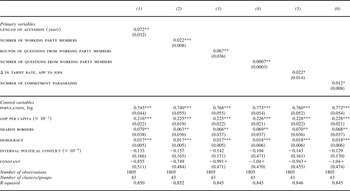
The final two variables on tariff and other commitments are challenging to collect, yet are important to include because they most directly capture the actual trade policy changes each rigorous acceder makes. A first measure compares the difference in the average applied tariff rate for each rigorous joiner from the year of application to the WTO to the year after accession.Footnote 61 This comparison of pre- and post-tariff rates is perhaps the best summary measure of the overall amount of liberalization each country made. Across all rigorous accession countries in our data set, the mean drop in average tariff rates is nearly four points, or a 19 percent reduction in the average rate (Table 1). Significant variation exists, however, with some acceding states reducing their average applied rates by 50 percent or more.Footnote 62 The number of explicit commitment paragraphs in each state's final accession protocol serves as a final direct measure of policy change, since it summarizes the state's pledges on nontariff barriers. These commitments are a consistent feature of accession protocols throughout the GATT and WTO.Footnote 63 Although the general trend is toward an increase in commitment paragraphs, there remains a good deal of variation among rigorous joiners even in the WTO era. For example, Mongolia was bound to only seventeen paragraphs, the Kyrgyz Republic was bound to twenty-nine, and Vietnam and China top the list with seventy and eighty-two paragraphs, respectively.
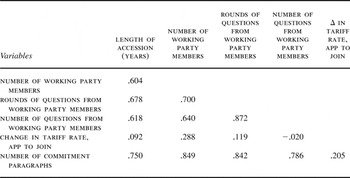
Collectively, Tables 1 and 2 summarize the distribution of and relationship among these six newly coded variables. Table 1 demonstrates that, on average, rigorous joiners face multiple rounds of questioning, answer hundreds of questions, reduce average tariffs by one-fifth, and agree to twenty commitment paragraphs. As expected, the six indicators of rigorousness are positively correlated, as shown in Table 2. Fourteen of the fifteen bivariate correlations among the six indicators are positive, and ten are above .5. Yet all of these indicators reflect distinct aspects of rigorous accession, and only three of the bivariate correlations are above .75.Footnote 64 Thus, each of these six indicators is worth exploring separately.
Bivariate correlations among indicators of accession rigor

The Noneffects of Automatic Accession
In sharp contrast to the rigorous acceders, there is no reason to expect automatic acceders to experience increased trade from GATT/WTO membership. Membership was largely inconsequential for these automatic joiners, since they were neither scrutinized by the organization nor asked to make any changes to the status quo that had been arranged for them earlier by the colonial power. This lack of a prolonged, rigorous accession process effectively removed the means by which liberalization might have occurred.
Many automatic joiners in the GATT's first four decades were allowed to maintain or even raise already-high tariff rates well after joining.Footnote 65 In fact, Martin notes the sharp contrast between the trade barriers of the automatic, Article 26:5(c) joiners and the early and rigorous joiners—as well as the lasting impact of those differences. “These special arrangements,” he notes, referring to Article 26:5(c), “contributed to a situation where many members have higher trade barriers and lower coverage of GATT bindings than the original members of the WTO and, in particular, fewer constraints than the countries that joined the WTO after 1995.”Footnote 66 Because of the lack of new commitments and these high trade barriers that continue postmembership, automatic accession states are not expected to see greater trade from GATT/WTO membership. To explore H3 in the multivariate tests, an automatic accession variable is coded with a 1 for all countries that accede according to the provisions of Article 26:5(c) and 0 otherwise.
H3: In contrast to those who join via rigorous or early accession, GATT/WTO members who join via automatic accession should not experience increased trade.
The Positive Effects of Early Accession
The early joiners to the GATT capped and significantly reduced tariffs on joining the organization, thus leading one also to expect increased trade for them postmembership. The initial Geneva treaty entailed significant tariff limits for those who signed on—a total of 45,000 commitments were made affecting one-third of global trade, or $10 billion worth of exchange.Footnote 67 The United States, for instance, agreed to reduce tariffs on 54 percent of dutiable imports, cutting those tariffs by an average of 35 percent.Footnote 68 During the second round in Annecy, the United States once again cut tariffs by 35 percent on those lines where it made new reductions, and in turn others such as Canada, France, Italy, and the Benelux Customs Union also made important new commitments.Footnote 69 All told, at the second (Annecy, 1949) and third (Torquay, 1950–51) rounds, GATT members made an additional 13,700 concessions.Footnote 70 The thirteen members that joined between 1950 and 1953 also took similar liberalizing steps in order to join the organization and receive the original members' tariff commitments; West Germany, for instance, cut its tariffs by more than half as its price of membership.Footnote 71 At the next two early rounds (Geneva II and Dillon), the now thirty-three members made further commitments on an additional $7.4 billion in current trade.Footnote 72
Writing in 1970, Dam commented that the early rounds of tariff negotiations “have resulted in the reduction of world tariff levels to a degree that probably would have surprised the most sanguine proponents of the ITO.”Footnote 73 These notable initial tariff commitments, then, should have resulted in increased trade for those who joined early, since they made notable reductions at the very outset of their membership:
H4: Early acceders to the GATT/WTO should experience increases in trade, particularly compared to nonmembers and those who join via automatic accession.
To test H4, an early accession variable is created and coded with a 1 for all states who signed the original GATT Treaty in 1947 or joined between 1947 and 1953.Footnote 74 In turn, all other states are given a 0.
Diminishing Gains from Early and Rigorous Accession over Time
A final hypothesis explores expected variation in trade gains over time. Our primary expectation, as reflected by H1 and H4, is that rigorous and early joiners should receive trade benefits from GATT/WTO membership because of the liberalizing trade-policy commitments they make as part of the accession process. Although the implementation period for these commitments varies from country to country and from commitment to commitment, we expect liberalization to be most pronounced in the years immediately following membership.Footnote 75 In turn, any subsequent trade increases should be observed most clearly in the period relatively soon after accession as this ongoing liberalization “kicks in.” On the other hand, this accession-driven boost in trade flows should begin to dissipate over time. Therefore, although rigorous and early joiners should benefit from membership, we expect those benefits to be most pronounced in the years after accession and to fade over time.
H5: Trade increases experienced by early and rigorous acceders should be greatest right after membership and should decline over time.
Three over-time interaction terms are created to test H5—one for each accession type—in which the original dummy variable for the type of accession (used to test H1, H3, and H4) is multiplied by a “counter” variable that reflects the number of years since the state joined in that way.Footnote 76 We expect the interaction terms for years since early accession and years since rigorous accession to be negatively signed, to reflect that trade increases from those two types of accession are likely to be greatest in the years after membership but to fall off over time.
Cases, Data, and Estimation
Because our causal logic emphasizes the trade-liberalizing policies each acceding state is or is not asked to make, we conduct empirical tests using the country (country-year) as our unit of analysis. Most studies of the effects of WTO membership on trade, which are distinct from but related to this research, use a gravity model to examine bilateral trade flows between a pair of states—either or both of which may be GATT/WTO members. Gravity-based, dyadic studies of GATT/WTO membership make an important contribution, yet this type of design presents an imperfect match for our central logic. As Rose says in calling for more studies at the country level, “Man does not live by the gravity model alone.”Footnote 77 Indeed, the country level provides the best conceptual fit for testing our primary hypotheses. Each acceding country has its own terms of accession and proceeds through various stages in which it must disclose, discuss, and modify its national trade policies. Furthermore, comparatively little of the accession process is specific to the acceding country's bilateral trading relationships with each of the hundreds of current WTO members.
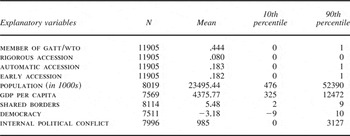
We include several control variables in our country-level quantitative tests, all of which should predict national trade volumes. Descriptive statistics for these, as well as the accession-type variables, are shown in Table 2. An initial group of controls is inspired by gravity-based models of trade but are measured at the country level. The first is a control for country size, a very common predictor in models of both trade policies and trade flows.Footnote 78 We utilize a measure of population to capture country size, since geographic area typically does not vary over time.Footnote 79 Our second control variable is the level of development within the country, another common positive predictor within many trade models, which we capture with gdp per capita.Footnote 80 Countries at a higher level of development are likely to have more specialized economies that depend on trade, as well as more extensive infrastructure to facilitate trade. Our third control considers the country's geographic position by identifying its location compared to other states. We insert a count of the number of countries with whom the country shares a contiguous border.Footnote 81 We predict this shared borders variable to be positive, since countries should trade more when they are more proximate to other countries and thus face lower transportation costs.
Descriptive statistics for all observations (country-year)

A second set of controls emphasizes a country's political situation as an important determinant of trade flows. We include the well-known Polity measure of a country's level of democracy.Footnote 82 Several studies have found that democracies either trade moreFootnote 83 or have lower trade barriers.Footnote 84 A measure of the amount of internal political conflict within the country, taken from Banks, is also included.Footnote 85 The logic is that countries experiencing significant domestic unrest are likely to suffer from reduced trade flows because they are more prone to stoppage, delays, or other problems with trade.Footnote 86
For our dependent variable we utilize data on country-level trade flows for all countries in the world from 1950 to 2006 and employ total national trade (imports and exports) as our primary dependent variable measure. The data are taken from the Correlates of War (COW) Trade Data Set (2.0), which are drawn primarily from the International Monetary Fund's Direction of Trade data.Footnote 87 The COW data are particularly useful for our purposes since they cover a complete cross-section of countries over a wide time period, stretching from the early GATT period to more recent years under the WTO.
Several components of our estimation strategy are worth noting. We lag all explanatory variables by one year to address possible concerns with endogeneity. Our default approach to estimation is to use ordinary-least-squares (OLS) regression with fixed effects for time (years) and standard errors clustered by country. We choose this approach because it is important to incorporate the cross-sectional variation in our data, which we lose if we add fixed country effects. Nevertheless, we also estimate all primary models using fixed country effects to check for robustness of findings.
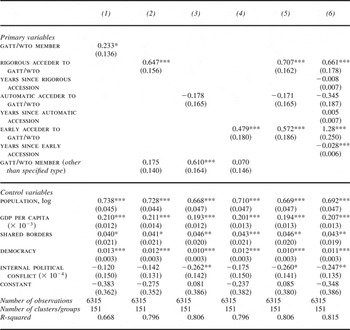
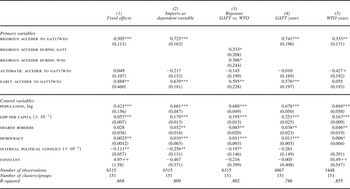
We first test the general impact of different types of accession on trade (H1, H3, and H4) through a series of pooled regressions, which are presented in Table 4. We begin with a simple model in which we include all of the control variables, along with a simple indicator variable for undifferentiated GATT/WTO membership (Table 4, column 1). In the next three columns (columns 2 to 4) we compare membership arising from each type of accession to nonmembership, controlling for other membership types. Column (5) of Table 4 simultaneously includes variables for each accession type (rigorous, automatic, early) and thus presents the most complete comparison among membership types. This model constitutes the most comprehensive test and also serves as the baseline for testing the over-time logic of H5, which concludes the tests in Table 4 (column 6). Table 5 contains results for H2, which explores variation among the rigorous joiners based on six ways of measuring how rigorous each state's accession process is in terms of scrutiny as well as amount of trade liberalization. Finally, in Table 6 we present several sensitivity checks for the primary findings by examining relationships over the different time periods and considering sensitivity to changes in estimation and measurement.
The effect of different types of GATT/WTO accession on trade flows

Notes: Standard errors clustered by country. Time dummies estimated but not reported.
* p < .10;
** p < .05;
*** p < .01 (one-tailed).
The effect of the rigorousness of the GATT/WTO accession process on trade flows: Comparisons among rigorous acceders

Notes: Standard errors clustered by country. Time dummies estimated but not reported.
* p < .10;
** p < .05;
*** p < .01 (one-tailed).
+ p < .10 (two-tailed).
The effect of different types of GATT/WTO accession on trade flows: Sensitivity checks

Notes: Standard errors clustered by country, except for (1). Time dummies estimated but not reported.
* p < .10;
** p < .05;
*** p < .01 (one-tailed).
+ p < .10;
++ p < .05;
+++ p < .01 (two-tailed).
Empirical Findings
All five hypotheses receive clear and consistent support across the primary estimations presented in Tables 4 and 5, as well as the sensitivity checks presented in Table 6. Collectively these findings demonstrate that the IO-driven, liberalizing steps a member takes during accession are strongly associated with increased trade for that member. Those states that join via the rigorous accession process receive significant trade gains postmembership (H1), and this is particularly true for those that had the most rigorous accessions and that engaged in the greatest commitments to further liberalization (H2). Similarly, the early joiners, which made significant tariff reductions in their own right, also experience greater trade volumes (H4), particularly in the years relatively soon after joining (H5). In contrast, there is no evidence that automatic acceders, who joined without pledging any liberalization, experience increased trade (H3). Thus the evidence, which we now discuss in greater detail, clarifies some of the divergent patterns seen in previous research and provides a strong, accession-based theoretical underpinning for the benefits of GATT/WTO membership specifically and IO membership more generally.
Comparisons Across Accession Types
Column (1) in Table 4 presents estimated results from an initial model when GATT/WTO membership is undifferentiated by type of accession. The relationship between GATT/WTO membership and trade is positive, but only at the relatively low 90 percent level of confidence and with a coefficient of comparatively modest magnitude. This is broadly consistent with patterns in the existing literature, which commonly produces positive but qualified findings for the impact of the WTO on trade. However, as we will demonstrate, this undifferentiated estimate is picking up and conflating the positive effects for states that liberalize during accession and the noneffects for states that join automatically and do not liberalize.
In fact, the rigorous joiners, once they are uncoupled from other types, consistently are associated with large, statistically significant trade gains. Indeed, when compared to nonmembers (column 2) and to automatic joiners (column 5), members who join the regime through rigorous accession appear to benefit greatly from their membership, in support of H1. Across the columns in Table 4 the coefficient estimates for the rigorous accession variable are consistently positive and statistically significant at the 99 percent level of confidence. Clearly, pooling members who acceded in very different ways obscures the distinct accession experiences of each group. In this case, distinguishing between states based on how they joined reveals that rigorous accession is directly and strongly associated with increased trade, which is both a powerful and important finding. It suggests that future members, all of whom will complete rigorous accession and undertake some degree of liberalization and reform, should similarly expect to experience increased trade on joining.
The findings for states that joined the GATT/WTO through automatic accession present a dramatic contrast. The evidence in Table 4 clearly suggests that states that did little to join do not experience greater trade, which supports H3. The results in column (3) show that automatic joiners do not experience greater trade than nonmembers, controlling for other types of membership and factors such as development, political unrest, and democracy. Furthermore, when all three types of accession (automatic, rigorous, and early) are singled out individually (column 5), automatic accession is the only type of membership that is not associated with trade increases postmembership.
The lack of a positive relationship between members who joined via automatic accession and future trade flows has several implications. For one, the fact that more than two-fifths of the current membership joined in this way could be contributing to Rose's overall negative finding.Footnote 88 Second, automatic accession is likely the true driving force behind the conventional wisdom that the WTO does not increase trade among developing countries, since developing countries make up a majority of this automatic accession group. Our findings demonstrate more precisely that the type of accession, and the lack of any liberalization commitments from automatic joiners, is the reason many (but not all) developing countries have not benefited from WTO membership. Therefore, an accession-based explanation provides a more theoretically informed and empirically accurate account of the varying trade benefits different GATT/WTO members have received.
The evidence in Table 4 also shows that early joiners have benefited from their membership, as predicted by H4. The results in columns (5) and (6) illustrate that early membership in the GATT also has a positive and statistically significant effect on trade flows—compared to nonmembers and automatic joiners—even after controlling for time-period effects and control variables such as country size and development. This finding also conforms to our overall theoretical logic. These early joiners made significant tariff concessions, thus setting them down a path of trade liberalization and generating greater incentives to trade.
Extending this logic further is the final result depicted in column (6) in Table 4, which shows that the trade gains early members receive are concentrated in the initial years of membership but fade over time, in support of H5. Keep in mind that the early joiners received significant trade benefits overall—these benefits are also depicted in column (6) by the positive coefficient on the early acceder to gatt/wto variable. However, the accompanying variable for years since early accession is negative and statistically significant, which shows that the trade gains for these states were greatest in the years immediately after membership. This reinforces our central logic that thorough methods of joining require trade liberalization and lead to near-term trade gains, but these gains may dissipate over time. The similarly hypothesized result for rigorous accession exhibits a similar pattern, as shown in column (6) in Table 4, yet the confidence in this finding is lower. The years since rigorous accession variable is negative, as predicted, but falls short of conventional levels of statistical significance. In contrast, the lack of any over-time relationship for automatic accession is unsurprising, since automatic accession has no general effect on trade flows. In sum, H5 receives partial support, and the overall pattern of results supports our accession-driven logic for the effects of GATT/WTO membership.
The findings thus far clarify patterns unearthed in previous scholarship and provide stronger theoretical underpinnings for many observed relationships. A consistent but often overlooked finding from other studies is that the GATT/WTO was associated with greater trade among selected members in the regime's first few decades.Footnote 89 We believe these findings are picking up the liberalization efforts of the early joiners (H4), who we show to have committed to significant liberalization at the regime's outset and experienced trade gains accordingly. Moreover, other studies tend to find that the organization's effects on trade are weaker in the 1960s, 1970s, and 1980s.Footnote 90 We suggest this is due in part to the waning trade benefits for early members (H5). This time period also reflects the wave of membership by automatic joiners, who on the whole did not experience trade gains from membership (H3). Our findings also provide theoretical clarity to studies that find that GATT/WTO has boosted trade for capital-intensive and developed countries—most of whom are in the rigorous (H1) or early (H2) categories—both of which we reveal to have experienced trade gains.Footnote 91 Although some noncapital-intensive and developing countries joined early or rigorously and benefited similarly, many joined automatically and thus did not see trade gains, which we have linked directly to their lack of mandated trade policy changes.
Comparisons Among Rigorous Acceders
A second, novel empirical test entails a set of comparisons among the GATT/WTO members that completed rigorous accessions, which on average benefit from their membership. Using unique data that captures precisely what was required of each rigorous acceder, we uncover strong, consistent support for H2. That is, those who face the greatest scrutiny during accession, and who make the greatest commitments to liberalization, ultimately experience the greatest trade benefits from their membership. The six indicators capture slightly different aspects of what states had to do to join, and all six produce positive coefficients that are statistically significant at conventional levels. The first and most general finding in Table 5 is that states with the longest accessions experience greater future trade increases (column 1). In this case, length of accession serves as a general proxy for the level of scrutiny during accession and is a useful departure point for exploring the results when using more specific measures.
The next three indicators reported in Table 5 confirm that among the rigorous joiners, those who navigate more roadblocks on the path to membership experience greater trade on joining. Those who face a greater number of working party members end up benefiting more from GATT/WTO membership (column 2), as do acceding states who go through more rounds of questioning (column 3) and respond to more questions overall (column 4). All three relevant coefficients for these three indicators are positively related to trade at the 95 percent level of confidence or greater.
Findings in Table 5 for the next two indicators, which capture actual tariff and nontariff commitments made as part of accession, exhibit a similarly positive relationship. Governments that lower their tariffs the most from application to membership experience greater subsequent trade (column 5). Similarly, those rigorous joiners that curtail nontariff barriers the most, as captured by the number of commitment paragraphs, also experience greater trade gains from membership (column 6). This last result is particularly notable because the commitment paragraphs deal with the entire spectrum of trade-policy changes that are to be made and thus capture liberalization efforts across a range of nontariff barriers. The fact that all six indicators of accession rigor are positively related to trade gains is striking, and provides further support for the logical relationship between accession-based trade policy changes and subsequent trade benefits that anchors this study.
Control Variables and Sensitivity Checks
All of the conclusions for the three types of accession hold even after controlling for a range of other factors that strongly predict trade levels. All five of the control variables in the bottom half of Tables 4 and 5 predict national trade flows in the hypothesized manner, and the majority of these relationships are highly robust. Both population and GDP per capita, indicators of country size and development, respectively, exhibit positive relationships at the 99 percent level of confidence. The positive association between development and trade is particularly important because it helps to disentangle the effects of development on trade from those of the accession process. Shared borders also lead to greater trade, albeit at lower levels of statistical significance. Democracy also has a strong, positive effect on trade flows, which is consistent with much previous research. Finally, at least some of the evidence in Tables 4 and 5 suggests that internal political conflict inhibits trade. Controlling for internal conflict is important because many automatic acceders, in particular, experienced domestic power struggles during stretches of their membership.
The predictive power of the included control variables increases our confidence in the uncovered relationships between accession type and trade gains, as do the many sensitivity checks that confirm the robustness of findings. We conduct sensitivity checks for all hypotheses using the model presented in Table 4 (column 5), which is the single most comprehensive comparison across accession types. A first sensitivity check is to reconsider the comparisons across accession types when adding fixed country effects. Column (1) in Table 6 reveals that all of the major findings are robust to this change. Both rigorous and early accession remain positive predictors of trade flows, whereas automatic accession has no effect on trade. The consistency of findings when using fixed effects is important given the attention this debate has received in related scholarship. As a second sensitivity check we also substitute imports as the dependent variable in place of total trade, which is sensible given the emphasis during accession on the liberalization of import barriers. The resulting findings (Table 6, column 2) once again remain unchanged from those originally estimated in Table 4 (column 5).
Another important check is to confirm that our results are consistent across both the GATT and WTO eras. Although the WTO is a continuation of the earlier GATT, accession to the WTO is often portrayed as more exhaustive than accession to the GATT.Footnote 92 However, our conclusions hold consistently across both the GATT and WTO. We first split our rigorous accession variable by era and include separate terms for rigorous accession in each era. Column (3) of Table 6 shows that both rigorous accession during the GATT and rigorous accession during the WTO have a positive and statistically significant effect on members' trade patterns. The conclusion for rigorous GATT accession is particularly novel. Earlier we made an important theoretical contribution by showing that accession under the GATT was rigorous for many states and followed a process similar to that under the WTO. This finding in column (3) demonstrates conclusively that rigorous accession under the allegedly weaker GATT also generated trade benefits, and that the aggregate finding for the impact of rigorous accession on trade is not driven by any heightened requirements for acceding under the WTO.
For the most part our overall findings are also consistent across time periods. Building on the previous finding, we examine all primary relationships for just the GATT years (1950–94) and then for just the WTO years (1995 onward). The positive findings for rigorous and early accession hold over the duration of the GATT period (Table 6, column 4). Rigorous acceders also continue to experience greater trade across the WTO period (Table 6, column 5). The only notable change seen in column (5) is that early joiners no longer experience unique trade gains in the years after 1995. This logical finding is consistent with the previously reported findings for H5, which demonstrated that the trade benefits of early accession fade over time.
Conclusion and Implications
Our unique theoretical perspective and novel findings contribute to an ongoing discussion about the effects of the WTO on trade as well as broader theoretical debates about the efficacy of IOs. Our central argument is that the trade gains from WTO membership are contingent on the way in which each state joined the organization. Those that went through a rigorous accession process and made numerous trade liberalization commitments benefit much more than those who joined automatically and made few commitments to liberalization. This dynamic is shown empirically in comparisons across all states (Table 4) as well as among those who joined rigorously (Table 5), and all findings are highly robust (Table 6).
Our emphasis on IO accession fills an important void in the analytical scholarship on the WTO. We use a theoretically informed, three-part typology to classify member states based on the type of accession they underwent. Original data on pre- and postmembership tariff reductions and nontariff liberalization reveal that accession requirements vary considerably from member to member. Systematic analyses of these accession data demonstrate a strong link between the liberalization efforts during accession and future trade volumes as members of the organization. Therefore, this research presents a more nuanced, theoretically informed account of countries' different experiences within the global trade organization, and our findings help to reconcile previously incomplete findings about which states are most likely to benefit from GATT/WTO membership.
Several policy-relevant implications emerge from this research. One general implication is that continued multilateral cooperation is perhaps more desirable than is realized. The WTO's future relevance has been called into question due to difficulties in completing the Doha Round and the recent increase in alternative bilateral and regional preferential trade agreements (PTAs). Our research shows that the WTO has generated trade benefits for many of its members and is likely to continue to do so as long as future accessions and future multilateral rounds include meaningful trade liberalization. Another important conclusion is that the thirty current WTO applicants should push forward with their accessions, even in the face of heavy scrutiny or demands that they make major trade policy reforms. All currently acceding states are undergoing what we have labeled “rigorous” accession, with some ongoing accessions, such as Russia's, being particularly noteworthy for the demands made by working party members. Our research suggests that although these accessions can be controversial and potentially costly for applicant states, the potential reward in the form of trade increases is likely to justify the costs of accession.
Another important conclusion from our research is that the effects of IOs may be more nuanced than the extant literature suggests. In quantitative research the prevailing approach has been to treat membership in an IO as a dummy variable; states are either members of an IO or joint signatories of a treaty or they are not. In many situations, however, such simplistic conceptualizations produce an incomplete or even incorrect assessment of the effect of membership in IOs. To understand whether and how IOs benefit their members, we must be more careful to account for differences across types of members or different design features of the IO themselves. For instance, some recent research on PTAs and bilateral investment treaties (BITs) has concluded, not unlike the WTO case, that such treaties do not increase trade and investment, respectively.Footnote 93 Yet scholars have begun to identify very different design features among both types of agreements, and, as our research suggests, we should expect “stronger” PTAs and BITs to be more likely to produce the desired effects than weaker versions of both agreements.Footnote 94 Similarly, the effects of an IO may be observed at only certain points in time, such as during the immediate years after accession or once an agreement has been fully ratified.Footnote 95 Likewise, some IO effects may be seen earlier than is realizedFootnote 96 or may linger longer than expected.Footnote 97 Therefore, we call on IO scholars to theorize more carefully about variation in IO membership and to devise more thoughtful measurement strategies that capture nuanced IO effects on states.
Moving forward, other interesting accession dynamics, within the WTO as well as other IOs, could be explored further. In the trade context, a more in-depth focus on the WTO's working-party dynamics would be valuable and could include explaining when member states are most likely to join working parties and when they are likely to make the greatest demands of applicants.Footnote 98 A related question is whether the accession process actually reduces future trade conflict; that is, are recent joiners less likely to have formal WTO disputes with members of its working party, having preemptively resolved possible conflicts during the accession process? WTO accession might impact other, nontrade areas, too. During or right after WTO accession, states may participate in more PTAs, sign more investment agreements, or perhaps receive more inward investment. Indeed, related research on EU accession, NATO accession, and IO membership suggests other institutional settings in which our arguments might apply.Footnote 99 Finally, accession to the WTO and other IOs might have broader indirect effects—such as on domestic political institutions within joiners—perhaps by reducing corruption or increasing transparency. The general lesson is that accession to IOs is important but often overlooked, and a greater focus on the different ways that states join IOs provides important clarity on existing questions and reveals new lines of enquiry.