Introduction
Female day labourers were continually employed during both the spring and summer on capitalist farms in Flanders throughout the eighteenth century. Contrary to servants, day labourers were not hired on long-term contracts and they did not board with their employers. Instead, these women were hired on a short-term basis, by the day or piece, often exclusively for traditionally female tasks. One such example is Anna Pinkele, who weeded, sowed beans and assisted threshers during the summer harvest on a capitalist farm in Knokke in 1788–9. Some of her female colleagues were more involved in the harvest. Celia Claes, for instance, not only weeded and bound sheaves of rye but also was responsible for the harvesting of one-and-a-half hectares (ha) of barley.Footnote 1
These two Knokke women were not alone, women’s participation as day labourers in the Flemish agriculture persisted throughout the eighteenth century. In the first Belgian agricultural survey of 1846, almost 40 per cent out of the approximately 15 million cumulative workdays of day labourers were still attributed to women.Footnote 2 The continued presence of female day labourers in the accounts of capitalist farms in eighteenth-century Flanders challenges the dominant position on the labour market participation of female day labourers in areas characterised by agrarian capitalism, which is that it was marginalised throughout the eighteenth and nineteenth centuries.
The marginalisation of women’s market labour throughout the period of industrialisation has been established as the dominant position among historians of western Europe.Footnote 3 English working-class household budgets show an increasing dependence on male earnings relative to those of women and children throughout eighteenth and nineteenth centuries.Footnote 4 In addition to women’s employment opportunities, women’s casual wages also fell during the period of industrialisation. A wage series for unskilled English women workers from 1260 to 1850, compiled by Humphries and Weisdorf, shows that women’s casual wages started a long-run decline after 1750.Footnote 5
The transition away from the pre-industrial family economy to the male breadwinner family system was enabled by rising male wages and increased pressure from the norm of domesticity for women. Recent research has, however, shown that such supply-side factors were secondary to the local demand for female labour in shaping women’s participation. The timing and causes of the marginalisation of female market labour were determined by local labour market structures. Local or regional and industry-specific studies, with attention to different groups of women, are therefore essential to thoroughly understand women’s work in its social and economic context. Enlarging the empirical basis of discussion around women’s labour in this way has enabled a more nuanced comprehension of the position of women in the labour market and the local technological, institutional and cultural factors that determined their role.Footnote 6
For female day labourers in agriculture, this research has been done almost exclusively based on English case studies. The development of agrarian capitalism is cited as the main catalyst for the decrease in female employment opportunities and wages in England.Footnote 7 On the one hand, in areas where smaller family farms continued to dominate the landscape, like northern and western England, both men and women continued to enjoy more year-round employment opportunities into the nineteenth century.Footnote 8 In southeast England, on the other hand, female employment was relatively lower. This part of the country is considered an agrarian capitalist society, because of the preponderance of capitalist farms over peasant and family farms. Compared to these two latter types of holdings, capitalist farms are large and therefore rely more heavily on market labour than on family labour but, at least in the case of southeast England, they offered less employment opportunities to female day labourers.Footnote 9
Allen found quantitative evidence that women and children were less likely to find employment on larger farms in Arthur Young’s extensive descriptions of his travels through England in the late 1760s.Footnote 10 Additional evidence suggests that a lower demand for female day labourers was induced by changing production methods to increase productivity. At a pastoral farm near Sheffield studied by Burnette, employment opportunities for women declined between the 1770s and 1830s. Following enclosure, the increased importance of stallfeeding and a shift from cattle to sheep caused many traditionally female tasks in pastoral farming such as milking cows, dairying and haymaking to become less common.Footnote 11
In arable agriculture, the cultivation of cereals was increasingly extensified to facilitate the grain harvest on increasingly large farms concentrating on market production. First, the use of the scythe was extended from fodder crops to cereal, in order to shorten the harvest period and benefit from the pre-harvest peak of grain prices. While scythes allowed for the harvest to be brought in more quickly than sickles, they were also heavier tools that were not operated by women. The adoption of the scythe thus directly excluded female day labourers from working as harvesters from the middle of the eighteenth century onwards.Footnote 12 Second, the extensification of grain production lowered the overall demand for labour. Especially in the context of population growth in eighteenth-century England, the lower labour demand of extensive farming methods caused structural unemployment among agricultural labourers. This decrease in labour demand disproportionally affected female day labourers, because farmers favoured hiring men to temper rising household dependency on poor rates.Footnote 13
Snell situated the marginalisation of female day labour on the capitalist farms of southeast England in the eighteenth century. His argument was based on the seasonal patterns of unemployment revealed by a collection of settlement examinations from rural, southeastern counties between 1690 and 1860. From the middle of the eighteenth century onwards, the female pattern diverged from the traditional seasonal pattern in agriculture that remained representative for men. Rather than during the summer harvest, women’s labour became concentrated in the spring. Though Snell’s sources contain no direct evidence of the size of the female labour force, this seasonal shift to a period of lower labour demand likely implied a decline in the labour participation of women in agriculture. Snell sees further proof for the marginalisation of female day labour in the continuous drop of yearly female wages after 1760, simultaneously with the seasonal shift in female employment patterns.Footnote 14
The marginalisation of female day labour on capitalist farms in eighteenth-century England remains to foremost account on the topic, though subsequent English research has added important nuances to Snell’s description of women’s labour participation, wages and the underlying social and economic constellations that shaped them. Overall, this research has illustrated the overriding importance of regional and even local variations in farming methods over their capitalist orientation. These findings also call into question the representativeness of Snell’s account of marginalisation for other European regions. While it has been suggested that female farm work was more common in other European countries, we know little about the employment opportunities and wages of female day labourers outside of England.Footnote 15
Agrarian change in eighteenth-century Flanders
Flanders is a particularly compelling case for comparison with England, because the region also developed features of an agrarian capitalist society in the eighteenth century. In both regions, there was a growing number of farms that were large farms not operable by family labour alone. Depending on their location, however, these capitalist farms operated within two different social agrosystems. In Flanders, the coastal and inland subregions were characterised by different soil conditions, land distribution and property and labour relations.Footnote 16
Capitalist farms of more than 20 ha and operated primarily by wage labourers were particularly predominant in coastal Flanders. Nevertheless, the majority of the population inhabiting the coastal clay and polder soils were smallholders. These cottagers controlled less than 0.5 ha of land and therefore had to substitute their income with agricultural wage labour on neighbouring capitalist farms. This social polarisation was exacerbated throughout the eighteenth century as large farmers continuously expanded their properties, while population growth aggravated holding fragmentation among peasants.Footnote 17
Capitalist farms that relied heavily on market labour also existed in inland Flanders, but the contrast between large farmers and smallholders was less pronounced. First, in its sandy and sandy loam soils, family farms were more widespread. These holdings of between 5 and 20 ha largely could be cultivated by the resident family alone and therefore operated independently from labour markets. Second, inland smallholders were not solely dependent on agricultural wage labour to substitute their income, because by-employment in proto-industries was prevalent in the area. The number of looms and spinning wheels in Flemish households increased even further in the eighteenth century.Footnote 18 Prior research has accordingly shown that the labour organisation and wages in agriculture evolved differently in coastal and inland Flanders through the agrarian changes that characterised the eighteenth-century countryside, though the place of female day labourers remains unknown.Footnote 19
Importantly, even on the large capitalist farms specialising in arable agriculture, cereal cultivation was not extensified in Flanders to the same extent as in southeast England. On the contrary, the Flemish husbandry was famed for its high land productivity, achieved through labour-intensive farming methods. Farmers paid increased attention to tillage and weeding and extended the cultivation of particularly labour-intensive crops such as flax, potatoes and legumes.Footnote 20 Such improved methods of cultivation and novel crops ensured continued employment opportunities for female day labourers on a number of farms in northern and western England, further highlighting the need for a regional perspective.Footnote 21 This article, therefore, aims to secure a picture of the participation of female day labourers in the Flemish agriculture throughout the eighteenth century in order to understand their persistent employment on the capitalist farms that increasingly dominated the countryside.
Day labour in Flemish farm accounts
A collection of hitherto unexplored Flemish farm accounts from the eighteenth century elucidates various aspects of women’s labour participation and wages. The underused nature of these archival sources in Flanders has been linked to archival policy. Unlike in some neighbouring countries, there was no concerted effort to systematically trace and conserve farm accounts.Footnote 22 The selected accounts cover the following parishes and periods: Bottelare (1782–96),Footnote 23 Denderleeuw (1755–74),Footnote 24 Drongen (1750–69),Footnote 25 Elsegem (1749–70),Footnote 26 Knokke (1788–9),Footnote 27 Lissewege (1765–6, 1790–6),Footnote 28 Maldegem (1712–17, 1791–3),Footnote 29 Oostkamp (1710–11, 1716–24, 1735–42, 1775–85)Footnote 30 and Oostrozebeke (1765–6).Footnote 31 These nine farms can each be designated as capitalist farms, because their accounts reveal they relied heavily on wage labour.
Even though female day labourers regularly feature in these accounts kept by capitalist Flemish farmers, we know little about their employment opportunities and remuneration. A gendered perspective was still largely absent from labour history in the Low Countries during 1980s and 1990s, when many of the influential English studies on female day labour in agriculture were written.Footnote 32 In the following three decades, women’s work has received increasing attention from historians in the Low Countries, but there is a lasting backlog compared to England. Moreover, authors who have integrated the history of women and economic history have often focused on the modern period and/or on women in urban centres and industries.Footnote 33 Van Molle proposed that rural historians were slow to adopt a gendered perspective, in part because ‘rural history has often been understood as agricultural history sensu stricto, dissociated from its broader social and gendered context.’Footnote 34
The lack of attention for working women in the pre-industrial countryside was also recognised by Vervaet and van Cruyningen, whose own research into women’s labour in agriculture has started to fill this gap in our knowledge for the Low Countries. Vervaet broached the subject for coastal Flanders during the late middle ages, in the aftermath of the Black Death. Van Cruyningen’s focus was on the eighteenth century, but he studied Zealand in the northern Netherlands. Early modern Flanders has thus not been the topic of any comprehensive studies regarding women’s day labour in agriculture, which stands in stark contrast with the existing amount of research into another group of wage labourers in the Flemish countryside, namely servants.Footnote 35
Agricultural day labour was characterised by its irregularity and seasonality, but this was especially the case for women. Women were not among the minority of day labourers who enjoyed year-round employment. Instead, they were part of the casual workforce hired to supplement those regular labourers at times of peak demand. With the exception of harvest labourers, who were likely young and mobile, day labourers were usually recruited locally. Furthermore, female day labour is associated with married women, while servants were generally young and unmarried. For example, women in eighteenth-century Zealand Flanders became day labourers as they aged out of service upon marriage at about twenty-five to thirty years old.Footnote 36
Female day labourers were often hired through their husbands or other male relatives, who were more regularly employed on the farm, to absorb seasonal peaks in the labour demand.Footnote 37 The importance of male relatives to secure employment can also be observed in the Flemish farm accounts, as female day labourers were often identified as the daughters, wives and widows of male labourers employed at the same farm, rather than by their own name. While this kind of identification is not exceptional for early modern sources, it denotes the importance of the household context in which women’s agricultural employment took place. In the accounts from Bottelare, for example, all female day labourers were wives of male labourers. Even at farms where female day labourers were not explicitly identified as daughters, wives or widows, like in Knokke, the women often carried the same family names as male labourers. The research of Delanghe into survival strategies of single women in the countryside around Bruges confirms that only a small minority of single women were hired as day labourers in agriculture in the eighteenth century.Footnote 38
Farm accounts are a particularly valuable source in Flanders, because alternative sources like contemporary descriptions or census records are not readily available for the eighteenth century. Moreover, the English historiography has illustrated the value of farm accounts to study the topic of female day labour in agriculture. In contrast to official publications, census records and contemporary writing, farm accounts are largely free from upper-class biases against working women. Farm accounts are considered scrupulous records of a wide variety of factors of the employment opportunities and remuneration of labourers, as summarised by Verdon in the following list: ‘continuity and changes in the utilization of female day labourers on farms over time and space; the agricultural sexual division of labour and how this functioned; wage rates and the male-female wage gap; family labour and familial relationships among the farm workforce.’Footnote 39
Despite the demonstrated potential of farm accounts to study female day labour, they are not a problem-free source. The limitations that English historians have encountered also apply to the Flemish farm accounts. Firstly, labourers were possibly employed on more than one farm throughout the year. Secondly, women were disproportionally affected by the lack of detail on individual labourers in some farm accounts. Traditionally female tasks were less likely to be elaborated on because this work made up a less significant share of overall labour expenses. The labour of female day labourers could also be concealed because they were hired in groups, as part of a team for piece-rate work or through male relatives.Footnote 40 Farm accounts thus cannot inform us with certainty about the complete work patterns of individual women or the total number of female workers.
Nevertheless, the sources allow an exploration of female labour participation on capitalist farms in eighteenth-century Flanders through other avenues. In particular, they inform us of gendered seasonal employment patterns and the sexual division of labour, on the one hand, and the wages of female day labourers, on the other. While not every account in the sample contains detailed information on every aspect, together they provide new and unique insights into the labour participation of female day labourers in eighteenth-century Flanders.
Female employment patterns and the sexual division of labour
Women’s employment opportunities in agriculture were dependent on the sexual division of labour. English research has shown this division varied regionally and locally, as well as over time. The account of a farm in the coastal village of Knokke can serve as an introduction into the labour participation of female day labourers in eighteenth-century Flanders, because it provides an exceptionally detailed look into the gendered work pattern on this polder farm near the end of the eighteenth century. Knokke is situated in northern coastal Flanders, an area dominated by large and commercially orientated farms specialising in arable agriculture, of which the farm in question is a textbook example. It was part of a newly enclosed sea polder, consisting of about 146 ha of land and it was primarily focused on arable farming.Footnote 41 Its steward meticulously recorded wage payments and other expenses relevant to the cultivation of the farm in a memorandum book on a weekly basis.
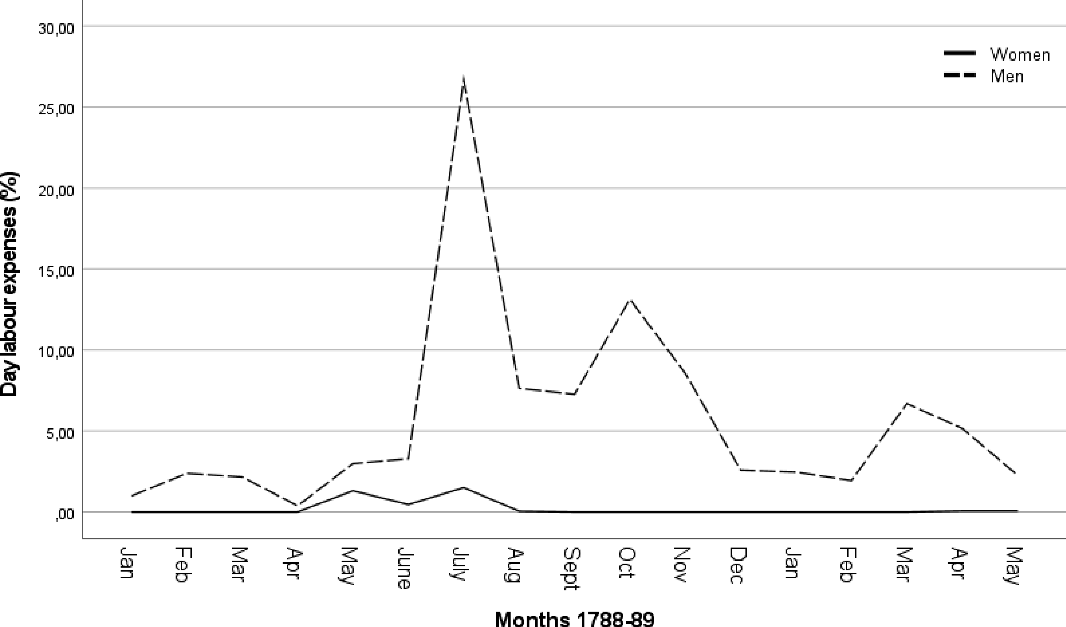
The level of detail in this account allows for the reconstruction of the seasonal distribution of payments made to male and female day labourers between January 1788 and May 1789 (Figure 1). Snell posed that by then the employment opportunities of female day labourers on capitalist farms in southeast England were shifting away from the summer harvest to spring weeding, but this shift had not taken place on the Knokke farm. Instead, Figure 1 shows two seasonal peaks in the labour participation of female day labourers at the polder farm: one during spring and another at the time of the summer harvest. The first peak, in May and June 1788, was caused entirely by women employed to weed in preparation of the harvest. In April 1789, one of the female day labourers also spent seven days sowing beans alongside three male labourers. Two women continued to weed carrots in July and August, but the barley harvest was predominantly responsible for the summer peak in female employment during the summer. Even towards the end of the eighteenth century at a large, arable and capitalist farm, the summer harvest thus remained a greater source of employment for women than spring weeding.
Seasonal employment patterns of male and female day labourers in Knokke (1788–9).
Source: State Archive Bruges, Family Archive Lippens, p. 20.

Even though the Knokke accounts thus illustrates that female day labour had not been marginalised in eighteenth-century Flanders, Figure 1 does also illustrate that women had markedly fewer employment opportunities than their male colleagues. Throughout the one-and-a-half-year period, only fifteen female day labourers worked at the farm compared to over 120 men. These women performed less than one-tenth of the 1,318 workdays paid at daily rates on the farm. In Knokke, day labourers of both sexes could moreover be employed by the day as well as by the piece. Female labourers received an even smaller percentage of piece rates though, so that less than 3.5 per cent of day labour expenses at the polder farm were attributed to women, as depicted in Figure 1. While male labourers were not exempt from the seasonal peaks and troughs in the labour demand in agriculture, they enjoyed more employment opportunities year-round. Male day labourers in Knokke worked a variety of additional jobs throughout the year from which women were excluded, related to tillage, manuring, transport, forestry and working with the horses.
These gendered work patterns were not a novel phenomenon in second half of the eighteenth century, they were instead a longstanding characteristic of the agricultural labour market, in England as in Flanders.Footnote 42 Vervaet observed a changing sexual division of labour in Flanders as early as the fifteenth century.Footnote 43 The accounts of Ter Munck, a property of the Dunes Abbey, reflect gendered work patterns in the first half of the eighteenth century as well. Yearly accounts from throughout the eighteenth century that include labour payments at this farm in Oostkamp have been preserved. The sexual division of labour apparent in these accounts further substantiates the argument that employment opportunities of Flemish women were always seasonal, but not further marginalised throughout the eighteenth century. If anything, the number of jobs attributed to women seems to expand throughout the century, even though it is unclear whether this reflects a change in sexual division of labour or can simply be attributed to an increasing level of detail in the sources themselves.
In the 1710–11 and 1716–24 accounts, female day labourers were exclusively listed under the category of weeders. The 1735–42 accounts are more extensive than the previous ones: all labourers are named, and their workload, tasks and wages are described more meticulously. In 1735–42, these women performed on average 30 per cent of 316 labour days per year. They weeded, but also assisted during the harvest by binding crops, were involved in haymaking, the scutching of flax and performed domestic tasks. With the exception of the wife of Olivier De Pree, who agreed to weed a certain acreage of grains for an agreed upon price once in 1741 and 1742, female day labourers were not paid at piece rates in this period. Male labourers, on the other hand, performed a vast share of work at piece rates so that women on average earned only 1.19 per cent of all wages rewarded to day labourers between 1735 and 1742.
Between the 1740s and 1770s, the labour demand of the Oostkamp farm expanded substantially, but female labour participation was relatively lower in the 1770s than it had been forty years earlier. In 1775–81, women averaged 22.54 per cent of 2,677 labour days per year. Female day labourers were listed under the categories of weeders and the tasks they actually performed were once again described in less detail. On occasion though, women were specified to wash and assist during the harvest, for example by binding sheaves. Female day labourers did not perform piecework in Oostkamp in this later period, reducing their share of total labour expenses in 1775–81 to 4.5 per cent.
It is unlikely, however, that women in the 1710s–1720s and 1770s–1780s did not perform some of the tasks that were explicated in the 1730s–1740s accounts. Tasks like haymaking and assisting during the harvest were not only no longer attributed to women, they disappeared from the accounts completely. Women likely continued to be involved in the harvest and haymaking, but this work was concealed because female workers were identified as weedsters regardless of the variety of tasks they actually performed. The long-run series of Oostkamp accounts from throughout the eighteenth century, therefore, illustrate that a sexual division of labour had existed on the Flemish countryside in the early eighteenth century and persisted without major changes until the end of the century, even though the limitations of the accounts do not allow us to demonstrate this continuity with quantitative data. The labour of women is recorded in less detail than that of men, it was at times synonymous with weeding and women and children likely worked alongside male harvest labourers without being remunerated separately.
Accounts from the abbey in Drongen (1754–69) further illustrate how the extent and variety of women’s labour, particularly during the harvest, was concealed by their frequent identification as weedsters. Until 1763, a large share of the weeding in Drongen was done by groups of female weeders, denominated in the accounts as ‘weedsters’. Even though they were labelled as such in the sources, these women did not exclusively weed. Weeding was routinely combined with haymaking and other assisting work during the harvest, such as gathering and binding sheaves. This corroborates that the extent of women’s labour participation was obscured by their unconditioned identification as weeders.
From 1764 onwards, the denomination of these groups in the Drongen accounts changes. Instead of ‘weedsters’, ‘womenfolk’ and ‘weeders’ appear in the accounts. Since the changing denominations coincide with a change in handwriting, it does not necessarily signify a drastic change in the composition of the weeding workforce in the 1760s but more likely reflects the different designations used by a new record-keeper. Whatever the reason for the varying denominations, they complicate a calculation of female participation rates in Drongen. If all labourers in these groups of weedsters, weeders and womenfolk were indeed female, then 14 per cent of labour days were executed by female day labourers.
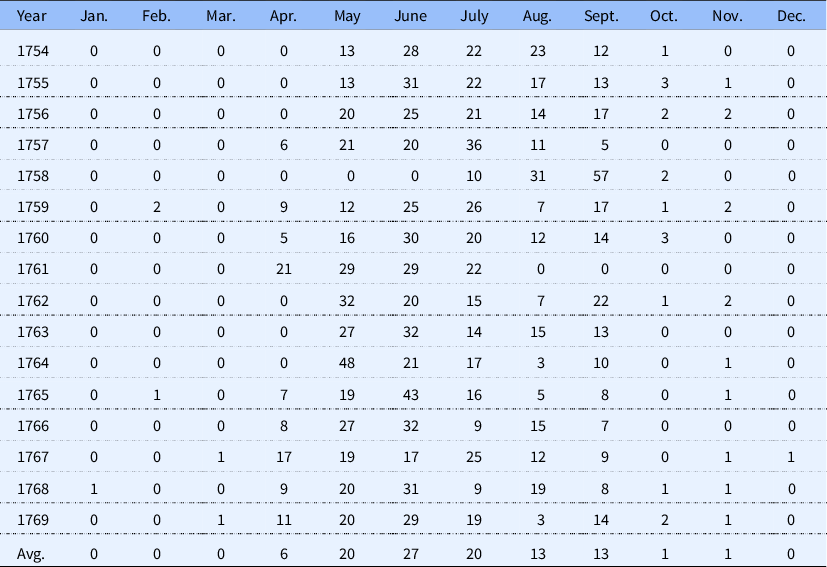
Table 1 shows how their work was spread throughout the year, by listing the percentages of labour payments per month between 1754 and 1769. Like in Knokke and Oostkamp, women’s employment in Drongen was concentrated in the spring and, importantly, in the summer. The bulk of female day labour took place from April until September. Individual women could occasionally find additional work in the autumn and winter by cleaning and weeding but, as Table 1 shows, these employment opportunities were limited.
Seasonal distribution of payments made to female day labourers in Drongen (1754–69)

Source: State Archives Ghent, Abdij van Drongen, p. 125.
The sexual division of labour and seasonal employment patterns that emerge from the Drongen accounts are similar to those on other Flemish farms. From April onwards, female labourers started weeding more extensively, causing a rise in employment opportunities in spring. Female labour participation peaked in June, when women assisted during the harvest, in addition to weeding. In July and August, female participation rates declined steadily but at the same time a more diverse range of tasks was introduced. Women made hay and assisted in the harvest until the late summer. In addition to these traditional tasks, female day labourers were involved in the buckwheat harvest in September and they harvested potatoes throughout October and November. By October, though, female participation rates were again limited compared to the overall labour expenses of the farm and to the peak in female employment during the spring and summer months.
Even though female day labourers were thus routinely identified as weedsters, this did not reflect a concentration of their employment in spring weeding. Accounts from Knokke, Oostkamp and Drongen do not point to a shift in the seasonal basis of women’s employment away from the summer harvest. Snell’s argument for the loss of employment for women during the harvest period was centred on a change in harvest tools, from the sickle to the scythe. While it is true that women on some Flemish farms were relegated to supportive tasks while male labourers harvested, this was not universal across eighteenth-century Flanders and cannot be attributed solely to changes in harvest technology. A variety of Flemish accounts that contain information on the role of women during the harvest provide further insight into the continued involvement of female day labourers in the harvest as both assistants and harvesters.
The scythe was traditionally only used to harvest fodder crops, barley, oats, peas and beans, but by the eighteenth century it had become the dominant harvest tool across Flanders. The sickle was initially preferred to harvest grains because it was more precise. Stalks are cut more delicately and further up from the ground, gathering fewer weeds and losing less corn. By the middle of the sixteenth century, however, the prospect of reducing labour costs incentivised employers to extend the use of the scythe to include grains like wheat and rye. Harvesting with a scythe is approximately one-and-a-half times quicker than reaping with a sickle. Piece rates for mowers were accordingly lower than those for reapers. The use of a pick hook also reduced the need for supportive labourers to gather the harvest into sheaves, further suppressing labour costs. Lastly, scythes had the additional advantage of being able to cut corn that was weighty, flattened or jumbled.Footnote 44
At some Flemish farms, the scythe was indeed the only harvest tool in use by the eighteenth century. At Burkel in Maldegem, another property of the Dunes Abbey, for example, male labourers harvested all crops with a scythe while women assisted them by gathering the crops, tying them together and stacking the sheaves. With one exception to confirm this rule, the Flemish farm accounts corroborate that women did not usually operate the scythe. One female day labourer in Oostrozebeke was hired to harvest with a scythe in the summer of 1765. Maryanna Verschelde was the widow of a deceased labourer and mowed with a scythe for five days alongside five men, who together mowed during seventy days. This is exceptional but, as Gielgud also contented, ‘individual women could and did use a scythe, but it was too heavy an implement for them to use all day, keeping level with the other mowers, as was essential at harvest.’Footnote 45
The preference for male mowers is usually attributed to the greater physical strength and stature required to handle scythes, which were heavier than sickles, although the idea that mowing was considered inappropriate for women is also cited. Even Maryanna Verschelde operated a Hainault scythe, known as a pick in Flanders, which was lighter and more flexible than a traditional scythe.Footnote 46 Nevertheless, she was the only woman that was recorded to have used even this lighter scythe in the accounts. The dominance of the scythe as a harvest tool thus effectively restricted women to assisting jobs such as gathering and binding sheaves.
However, the restricted labour participation of women during the harvest cannot be attributed to the spread of the scythe alone. The sickle remained in use on various Flemish farms up to the early nineteenth century, as farmers might prefer the sickle for barley, beans and small acreages of wheat.Footnote 47 This translated to only limited employment opportunities for women, because male harvesters still outnumbered them. In the accounts of Ter Doest, a mixed farm in Lissewege of about 143 ha in ownership of the Dunes Abbey, three women were named as harvesters in the summer of 1766. Isabelle Maeyers, Rosa de Bedts and Goddelive van Houte each reaped 2 ha of summer barley and wheat with a sickle. While only these three women handled a sickle in Lissewege, the majority of the harvest was mowed by men. During the same summer, male labourers were hired to harvest more than 33 ha with scythes.
Other farmers evidently preferred male over female harvest workers, regardless of the harvest tool used. With the above-mentioned exception of Maryanne Verschelde, the reaping and mowing in Oostrozebeke was executed by male labourers. The same was true in Drongen, where women were relegated to supportive tasks while male labourers were hired to harvest with scythes and sickles. In Knokke, female day labourers were employed to harvest winter barley with sickles but out of sixty-seven groups of harvesters only four were headed by women. Smaller acreages of beans, summer barley and wheat were also harvested with a sickle at the polder farm, but only men are named in the respective entries in the account. Lastly, rye, oats and some beans were all harvested by male labourers with scythes.
This preference for male harvest workers is explained in the literature through their greater physical strength and speed, which allowed them to complete the harvest more quickly. English estimates for the early nineteenth century are that male labourers could reap three-quarters of an acre in the same timespan as women harvested half an acre.Footnote 48 Though the accounts do not inform us of how long the harvesters worked, women in Knokke did on average harvest smaller acreages than men during the 1788 barley harvest. Harvesters of both sexes worked in groups, but the size or composition of these groups is not recorded in the accounts. Four female foremen were in charge of groups that reaped between 0.60 and 1.64 ha each for an average of 1.17 ha. For male foremen, the harvested acreage was on average 1.57 ha and ranged from 0.11 to 10.89 ha. The male average was thus substantially higher, though among them major differences also existed.
Women in Zealand Flanders similarly continued to reap using sickles throughout the eighteenth century. It is even suspected that the use of this harvest tool was sustained there in order to ensure employment opportunities for women. This was not the case for the Flemish farms considered here, since male harvesters were generally preferred whether they reaped with a sickle or mowed with a scythe. Van Cruyningen also explained that farmers in western Zealand Flanders might prefer sickles because the longer stubbles could increase the fertility of the soil when they were ploughed in after the harvest. Such heightened attention to tillage was characteristic of the labour-intensive Flemish husbandry.Footnote 49 It is thus more likely that the female harvesters in Lissewege and Knokke could profit from the continued use of the sickle for certain crops, rather than that these tools continued to be used specifically to ensure their employment.
Aside from weeding and the harvest, the cultivation of labour-intensive crops could provide employment opportunities for female day labourers throughout the year. It is rarely possible to quantify the work for women created through their cultivation, but we can give an overview of the crops that are featured in the accounts. Flax is mentioned in a number of them throughout the century. An account from Maldegem (1793) shows that women attended to the harvesting of flax. This harvest labour was described in the account as ‘slijten’, which meant that the flax was pulled out manually rather than with the help of a tool, which is very labour-intensive. In Markegem (1746–79), flax cultivation was also a source of employment for female day labourers. Women were heavily involved in the labour-intensive flax harvest, from pulling and binding the crops, to gathering and spreading the harvested flax.Footnote 50 However, this crop was not the exclusive domain of women. In Drongen and Oostrozebeke, the harvesting and scutching of flax was attributed to male labourers.
Secondly, the potato harvest provided employment for female day labourers in Drongen, Maldegem and Bottelare. In Maldegem (1791–3) women additionally planted the potatoes that they later harvested. Thirdly, the Knokke account discloses that beans were sown and harvested by female labourers. Legumes such as beans were sown by hand and in rows in Flanders, which was particularly labour-intensive.Footnote 51 In the account of the farm in Maldegem (1793) a long yet non-exhaustive list was given for the tasks undertaken by women, which included the cultivation of a number of vegetables such as turnips and carrots. Hops are a final example of a crop that was associated with labour-intensive cultivation and, therefore, female employment.Footnote 52 At a monastery in Elsegem, hops created additional employment opportunities for women as female day labourers took down hop bines and picked hops alongside men.
Lack of detail in the Flemish sources regarding the cultivation of these crops conceals the full extent of women’s employment, but more detailed English sources have illustrated that labour-intensive crops like flax, potatoes, beans, turnips, hops and other root crops and vegetables could substantially increase the local demand for female day labour. Gielgud showed that in northern England female day labourers were increasingly regularly employed in the 1830s and 1840s because of expanded cultivation of root crops such as potatoes, turnips and carrots.Footnote 53 For western England, Speechley traced the increase in women’s year-round employment back to the late eighteenth century. Between the 1720s and 1790s, the percentage of workdays performed by women on a certain Somerset farm rose from 17 to 42 per cent. Female labour days decreased again after the 1790s, but in the 1840s their proportion was still around 30 per cent. The sustained female participation rates in western England were partly attributed to the cultivation of flax, beans and root crops.Footnote 54
At a farm in East Yorkshire, Verdon found that women constituted a substantial part of the agricultural workforce well into the nineteenth century. Female day labourers performed 38 per cent of total workdays in 1820, which almost equals the 41 per cent of labour days attributed to adult men. In the months of May, June, July and November, women even worked more days than their male counterparts. Aside from weeding, hoeing and haymaking from May to July, women’s high labour participation at the farm can be ascribed to flax pulling in August and September and potato planting and harvesting in November and December.Footnote 55 Finally, Sharpe characterised the cultivation of hops as a labour-intensive operation that ensured ‘an intermittent amount of work for women which lasted from March through to late September’ in sixteenth- and seventeenth-century Essex. She also affirmed the employment opportunities for women in planting, cleaning and harvesting vegetables and fruits.Footnote 56 English research has thus shown that the cultivation of the labour-intensive crops that appear in the Flemish accounts could provide substantial employment opportunities for women.
Lambrecht and Van Cruyningen also suspected that the cultivation of labour-intensive crops like potatoes, flax and beans throughout the eighteenth and nineteenth centuries was responsible for a significant part of women’s labour participation on Flemish farms. Lambrecht even pointed to the extended cultivation of such labour-intensive crops as a possible cause for the increasing employment of female day labourers at a farm in Markegem. As a result, the share of labour days performed by women doubled from 15 to 33 per cent between 1754–72 and 1846.Footnote 57 Some suspected that women were preferred for this kind of unskilled work because they constituted a relatively cheap labour supply. Others argued that women were uniquely qualified to perform such jobs because of their adroitness, greater agility and flexibility.Footnote 58 Regardless of the reasoning behind the association of women with labour-intensive work, it likely promoted women’s continued employment opportunities in eighteenth-century Flanders, as it did on a number of English farms.
Even though the wide variety and full extent of women’s work was concealed by a lack of detail in the farm accounts, women were excluded from a wide array of jobs in eighteenth-century agriculture. Across time and space, tillage and work with horses has often been considered to be men’s work.Footnote 59 Exclusively male tasks on the Flemish farms largely fall under those categories: they were jobs related to tillage, manuring, transport, working with the horses, digging, forestry and peat digging. Much has been written about whether the sexual division of labour was caused by moral objections to women working outside of traditional roles or whether it was a natural consequence of differences in strength and stature between the sexes. Cultural norms are not a blanket explanation for the sexual division of labour, because farm work was not rigidly divided by gender. Male and female agricultural day labourers were to a certain extent substitutable. Regional and local differences existed and the gender-specificity of employment evolved over time, in Flanders and in England.Footnote 60
Much of the work that was exclusively or predominantly performed by men in Flanders did include heavy manual labour, so it is not inconceivable that differences in physical strength between the sexes played a role in limiting women’s labour participation. Burnette established that on average a man could lift twice as much as a woman. This greater upper-body strength is favourable for jobs that include the lifting of external objects like carting, carrying, ploughing, manuring, hedging and ditching.Footnote 61 Yet, others have cited examples of pre-industrial women who performed heavy manual labour to stress the role that custom and cultural ideas about the suitability of certain work for women played in limiting women’s labour participation.Footnote 62
Due to the lack of contemporary written commentary, it is not possible here to further evaluate the role played by customs and social expectations in limiting Flemish women’s labour participation. What is certain is that women’s exclusion from these tasks significantly curtailed their employment opportunities, particularly since these included most of the work that took place in the autumn and winter. Consequently, the accounts of smaller farms, which required only a few core labourers throughout the year, do not mention any female day labourers. This was the case in Denderleeuw and Lissewege (1790–6), where one to four male core labourers were hired year-round. Exclusively male tasks were not only distributed more evenly throughout the year. In many cases, they were also rewarded at higher rates than the work available to women in the spring and summer, which brings us to the issue of women’s wages.
Women’s wages
Women’s nominal agricultural wages were remarkably stable throughout the eighteenth century. While average daily rates could be subject to small yearly variations, the rates at which certain tasks were paid did not substantially change. For example, a female day labourer in Oostkamp named Marie Van Werdende was paid four stuiver (hereafter st.) per day to weed as early as 1718. At the same farm almost seventy years later, in 1785, the wife of Henderick Meeuws was employed to weed at the same rate. This stability does not correspond with the English situation as described by Snell, who argued that female wages declined from 1760 onwards. However, Snell’s wage data have been criticised on the basis that they refer to servants rather than day labourers. Other authors have instead highlighted the remarkable stability of daily wages on English farms.Footnote 63
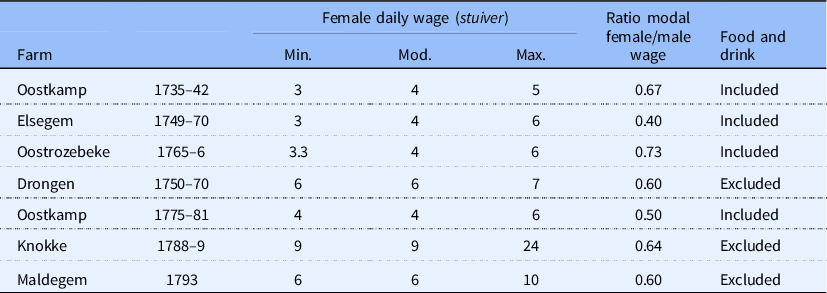
While day wages were stable throughout the eighteenth century, Table 2 shows that there were differences in wage rates between farms. Part of these variations can be explained by the inclusion or exclusion of meals in the daily wage. In many eighteenth-century Flemish villages, it was still customary for a farmer to provide his labourers with food and drink during the workday. This was presumably the case in Oostkamp, Oostrozebeke and Elsegem. Food and drink were valued at four st./day in accounts from Oostkamp and Markegem and, therefore, could amount to as much as 50 per cent of the modal female wage.Footnote 64 The inclusion of food and drink in wages illustrates that day labour was not always remunerated fully in cash. Labourers’ remuneration regularly included payments in kind, especially in inland Flanders, where agricultural day labour was part of a system of reciprocal exchange. Large farmers and their employees exchanged labour, goods and services throughout the year. Their mutual debts were settled in cash only once or a few times per year.Footnote 65 On the contrary, labourers in coastal Flanders were paid more regularly and possibly remunerated more in cash, because labour relations were more impersonal.Footnote 66
Female daily wage rates at Flemish farms

Sources: Rekeningen van Uitgaven van het Klooster Elsegem bij Oudenaarde, 1749–71; Grootseminarie Bruges, Archives Abbey of the Dunes, pp. 89, 90, 98; State Archives Bruges, Family Archive Lippens, p. 20; State Archives Courtrai, Family Archive Descantons de Montblanc (de Plotho), 9612; State Archives Ghent, Abdij van Drongen, p. 125.
In addition to the inclusion or exclusion of food and drink, day wages could vary regionally. The modal female day wage was almost twice as high in Knokke than at the other farms, which were all situated in inland Flanders (Table 2). Higher coastal wages were not exclusive to female day labourers. Previous research has established that agricultural wages were substantially higher in coastal villages than in inland Flanders. Due to the high labour demand of the large capitalist farms in the sea polders, the local labour supply in the relatively thinly populated coastal villages fell short. Coastal farmers offered high wages to attract migrant labourers, for example from the more densely populated villages in inland Flanders. The higher wages in the polder villages are also assumed to include a kind of health risk premium. Agricultural work in the polders posed a health risk for migrant workers because of the continued presence of malaria.Footnote 67
Regardless of regional variation in wages, Table 2 illustrates that the modal female daily wage was consistently lower than the male. Depending on the farm, the ratio of female to male daily wages varied from 0.40 to 0.73. The wage gap on Flemish farms was about a quarter smaller than it was in England, where women’s daily wages generally ranged between one-third to one-half of male wages. English historians have debated whether the gender pay gap is the result of wage discrimination or simply a product of wage differentiation. While some see lower female wages as proof that they were determined by custom, others cite productivity differences to explain the wage gap through market mechanisms.Footnote 68 On this topic, Lane recently concluded that ‘we need to know much more about the work and wages of women in the eighteenth and early nineteenth centuries before we can form any real opinion on the mechanisms that affected wages in regional and local labour markets.’Footnote 69
Proponents of the market wage identified two facets of women’s work that limited their wages. First, women were largely relegated to lower-paid work. Second, women’s household duties limited the length of their workday. According to Burnette’s calculations, these two factors together add up to a female-male productivity ratio of about 0.6, which is not dissimilar to the ratio of female to male daily wages on Flemish farms in the eighteenth century.Footnote 70 The Flemish farm accounts contain indications regarding both aspects of women’s work, but they don’t confirm that women regularly worked shorter hours.
The first above-mentioned factor, the sexual division of labour, has emerged as the main determining factor limiting the level of women’s wages. The gendered employment pattern prevalent on Flemish farms played to the disadvantage of women, because it commonly relegated them to low-paid work that was executed during only part of the year. The accounts confirm that female day labourers were predominantly employed during the spring and summer months to weed and assist male harvest workers, and that these were the lowest-paid tasks. In Maldegem and Drongen, for example, weeding was rewarded at six st./day. In Oostkamp, day rates of three or four st. were custom throughout the century. Even though wages were exceptionally high in Knokke, weeding was still rewarded at the minimal wage of nine st.
During the harvest, women who were relegated to supporting roles could earn substantially less than male harvesters who profited from high wages offered to reapers and mowers. In Drongen and Maldegem, for instance, female day labourers were employed to assist during the summer, earning them six st./day. Male harvesters were rewarded at ten to twelve st./day, meaning they could earn twice as much as their female counterparts in a single day. The discrepancy between male and female harvest wages was even larger in Oostkamp. Male harvest labourers earned around twelve st./day while the women that assisted them were compensated at a daily rate of only four or five st. When women were relegated to assisting during the harvest on Flemish farms, they could thus only earn about half as much as the male harvesters per day.
Women were limited to lower-paid and supporting tasks on a number of farms, but female day labourers on other farms were hired to do harvest work proper. In Lissewege, for example, three female reapers were rewarded at rates of 136 to 190 st./ha depending on the crop. During the same summer harvest, male day labourers were hired to harvest with a scythe for 61 to 75 st./ha, which is substantially lower than the rate paid to female women reapers. However, by using a scythe, the harvest could be done quicker than with a sickle.Footnote 71 During the summer of 1766, the women in Lissewege harvested about 2 ha per person in comparison with 8 ha per male mower. Consequently, the men collected over five Flemish pounds each while the women earned less than three pounds per person. It was rather exceptional that women in eighteenth-century Flanders were hired to harvest and even then, they earned less than male harvesters. Because women could only partake in the harvest with sickles of smaller acreages of wheat, beans and barley, their earning potential was lower than that of men who could reap and mow.
The introduction and spread of labour-intensive crops on Flemish farms not only positively impacted the employment opportunities of female day labourers, but also their wages and earning potential. Tasks related to these crops could earn women some of their highest wages. Women in Maldegem (1793) earned their maximal daily wage of eight st. to harvest flax. This mirrors the situation in Markegem, where the highest wage paid to women of five st./day was also attributed to their work in the cultivation of flax.Footnote 72 Additionally, because some of this work was available outside of the busiest months in spring and summer, the cultivation of labour-intensive crops was advantageous for women’s yearly earnings.
Male day labourers had access to a much wider variety of tasks that were paid well and executed year-round, such as ditching, manuring, ploughing, harvesting, threshing and forestry-related activities. In Maldegem (1793), for example, the modal daily wage among men was ten st., compared to six st. for the women. Many male tasks were even rewarded at twelve st., including threshing, spreading manure and working with the horses. To mow, men could earn up to twenty st. per day. As a result, Flemish men, performing a larger array of tasks, could regularly earn twice as much as women per day.
A second factor that contributed to the gender wage gap, according to proponents of the market wage, is differences in the length of workdays of male and female labourers. Because they dedicated their mornings to household duties, English women commonly worked shorter days than their male counterparts, which negatively influenced their wages.Footnote 73 According to Burnette’s calculations, the average workday for women lasted 9.66 hours, compared to twelve hours for men. Consequently, Burnette wrote that ‘we should increase women’s daily wages by 24 per cent to compare them with men’s daily wages’, which would considerably decrease the gender wage gap.Footnote 74 One Flemish farm account contains specific indications that women worked shorter hours than their male colleagues and that this negatively influenced their day wages. The first examples are four Maldegem women who were hired in 1793 to work for thirty days at a rather high rate of eight st./day. Their tasks were not specified in the account but the recordkeeper did explicitly mention that these women started in the morning, suggesting that they started exceptionally early compared to other female labourers who were remunerated at lower rates. The same 1793 account specifies that female weeders in Maldegem only worked three dayparts per day. An average workday consisted of four dayparts, so that these weedsters worked a quarter less than was conventional. Nevertheless, they were rewarded at the usual female rate of six st./day for this short day’s work.
However, these two examples do not confute the abundant evidence that men and women were generally rewarded at equivalent rates for similar work on Flemish farms. In Knokke, for example, both men and women weeded, sowed beans, threshed and harvested barley. Male and female weeders both earned nine st./day. Sowing beans was rewarded at ten st./day for both sexes. For a day of threshing, men and women both received twenty-four st. Lastly, day labourers of both sexes earned 203 st./ha to cut barley. The account from Knokke aptly illustrates that men and women generally received equal day and piece rates for identical tasks. At best, the farm accounts are thus not sufficiently detailed to allow for definitive statements on the influence of the length of the workday on women’s wages. That male and female day labourers in eighteenth-century Flanders were paid at the same rate for the same task does further illustrate that the discrepancy between modal male and female wages evident in Table 2 was largely caused by the sexual division of labour.
Conclusion
The Flemish farm accounts confirm the overriding importance of regional and local farming practices and labour market structures in shaping women’s labour market participation over the capitalist orientation of farms. On the one hand, women’s labour participation was limited compared to that of men, namely by the sexual division of labour. Women’s work was generally relegated to labour-intensive work and times of peak demand in agriculture: spring weeding, the summer harvest and the cultivation of specific crops like flax, potatoes and other root crops. Moreover, women were commonly excluded from a wide array of jobs, including tilling and manuring the soil, transporting all kinds of goods, working with the horses and jobs related to forestry and peat digging.
On the other hand, the Flemish farm accounts illustrate that female day labour was not marginalised in eighteenth-century Flanders. The sexual division of labour did not crystallise around the middle of the eighteenth century in spite of the growing dominance of capitalist farms. Agricultural work was likely always segregated by gender to some degree, though, in Flanders and in England, this division was subject to local and regional variations. Women regularly appear in the accounts of Flemish farmers throughout the century for roughly the same tasks and during the same seasons. There was no shift in the seasonal basis of women’s employment away the summer harvest, even though the full extent of women’s involvement in the harvest might be obscured by their frequent identification as weeders and by the inclusion of their work in the wage payments to male household heads.
The persistence of female day labour was ensured by labour-intensive nature of Flemish farming methods. Flemish farmers increased the productivity of their land by weeding and tilling the soil more extensively and by expanding the cultivation of labour-intensive crops, most notably flax, potatoes and legumes. The Flemish evidence confirms that marginalisation of female day labour observed in southeast England was caused not merely by the spread of agrarian capitalism or by the accompanying expansion of grain cultivation. The extensification of grain production on capitalist farms decreased women’s employment opportunities in southeast England, while labour-intensive farming methods ensured their continued labour participation in Flanders and other English regions.
Next to these regional variations, the labour participation of female day labourers was also determined by more local factors. Female day labourers were still hired to reap with sickles on some Flemish farms in the late eighteenth century. Farmers continued to alternate between sickles and scythes, likely dependent on the preponderance of speed or care in harvesting. The adoption of the scythe, which excluded women from harvest work in southeast England, was thus not completed in eighteenth-century Flanders. Even though farmers generally preferred hiring male harvesters, the particularly high labour demand on two large polder farms in Lissewege and Knokke allowed women to access harvest jobs that their counterparts on other farms were excluded from. At least during the harvest, Flemish women thus had more employment opportunities on larger farms specialising in arable farming. These were more common in the coastal region, as compared to inland Flanders, but more empirical evidence is needed to ascertain if women’s continued employment as harvesters was an exclusive feature of coastal Flanders.
The continuity in Flemish women’s employment opportunities in weeding, the harvest and the cultivation of labour-intensive crops can partly explain the remarkable stability of their wages in the region, since the level of wages was closely tied to the task performed. Weeding was among the lowest paid jobs at Flemish farms, so a relegation to this work would negatively influence women’s wages, as described by Snell for southeast England. Instead, the continued participation of Flemish women in the harvest and the cultivation of labour-intensive crops deterred an increase of the gender wage gap, as women earned their highest wages for the jobs. Nevertheless, there was a significant wage gap of 27 to 60 per cent between male and female day labourers in eighteenth-century Flanders. Women’s exclusion from the highest-paid jobs negatively impacted their earning potential. Next to the sexual division of labour, women’s wages were possibly limited because they worked shorter days, but there is no substantial evidence for this in the analysed farm accounts. By and large, men and women who executed the same task received equal pay for a day’s work, suggesting female day labourers did not habitually work shorter days.
Aside from their persistent employment opportunities on capitalist farms in Flanders, female agricultural wages were influenced by the local levels of labour demand and supply in other sectors of the economy. In coastal villages, farmers commonly offered higher wages to both male and female labourers to attract sufficient manpower to cultivate their large and wage labour dependent holdings in the unhealthy and relatively sparely populated polders.
In inland Flanders, as in England, employers were generally not incentivised to offer higher wages because of the high levels of population growth that marked the eighteenth century. Because of the ensuing fragmentation of holdings, more and more rural residents no longer had sufficient work on their own plots and had to look for additional income through wage labour. Employers in inland Flanders were therefore assured an ample labour supply, which left labourers in no position to demand higher wages.Footnote 75
Yet, female agricultural wages in inland Flanders also stayed on par throughout the eighteenth century. Unlike English women, female day labourers in this region continually had access to alternative employment opportunities. The disappearance of the commons and collapse of spinning made English women increasingly dependent on agricultural wage labour.Footnote 76 Flemish peasant households could fend off dependency on agricultural wage labour because they combined it with the cultivation of their own plots of land with proto-industrial activities.
Women’s employment opportunities and wages as day labourers in agriculture were thus sustained throughout the eighteenth century because of the remarkable combination of labour-intensive agriculture, alternative employment opportunities in the densely populated area of inland Flanders and the high labour demand of particularly large farms in the unhealthy and relatively sparsely populated coastal area. While agrarian capitalism marginalised female day labour in southeast England, its development actually preserved employment opportunities for women in the Flemish agriculture. In line with the international historiography, these findings highlight the importance of a regional and local perspective in studying women’s labour participation and wages.
Lastly, these farm accounts illustrate the vast and untapped potential of these archival sources to study female day labour in Flanders. If additional accounts become available, differences in women’s labour participation and wages between the two Flemish agrosystems can be explored more rigorously. While it is not uncommon for the work of women to be described in less detail than that of men, these kinds of silences in the sources are informative in and of itself. Furthermore, a comprehensive sample of accounts can compensate for differences in the level of details in individual accounts and shed light on many aspects of women’s work and remuneration: the importance of familial relationships for women’s employment opportunities, the seasonal pattern of women’s work, the sexual division of labour, women’s wages, the gender wage gap and the length of women’s workday.
Acknowledgments
Earlier versions of this article were presented at the annual conference organised by the N. W. Posthumus Institute and at the research group ECC at Ghent University. The author would like to thank the organisers and participants for their valuable comments and suggestions.