1. INTRODUCTION
It is sometimes possible for me to be completely immersed in music and to feel as if my whole state of consciousness has been temporarily altered.
Music sometimes helps me ‘step outside’ my usual self and experience an entirely different state of being.
When listening to music I can lose all sense of time.
The above statements are taken from the Absorption in Music Scale questionnaire (Sandstrom and Russo Reference Sandstrom and Russo2013: 227–8), an index used to assess listeners’ propensities for musical absorption. The statements demonstrate a link between music, absorption and the experience of time, a link that will no doubt be familiar to many readers. Across musical styles, cultures and historical periods, music’s amazing power to alter or even suspend the listener’s sense of time is well documented. The sensation of the ‘eternal now moment’ (Hasty Reference Hasty1997) in music, while often profound and personally important, is not especially rare. In her book Deep Listeners: Music, Emotion, and Trancing, Judith Becker opines that ‘most of us have experienced “near trance”, or at least some of the characteristics of trance at certain times in our lives, especially in relation to musical listening or musical performance …. Deep listening or performing music may induce the feeling of time stopping altogether’ (Becker Reference Becker2004: 131–3).
Paraphrases of this kind of experience pervade the literature on twentieth- and twenty-first-century Western music. Titles such as The Time of Music (Kramer Reference Kramer1988), On Repeat: How Music Plays the Mind (Margulis Reference Margulis2013) and Being Time: Case Studies in Musical Temporality (Glover, Gottschalk and Harrison Reference Glover, Gottschalk and Harrison2019), as well as myriad statements from composers about ‘a vertical cut, as it were, across horizontal time perception’ (Stockhausen Reference Stockhausen and Schnebel1963, quoted in Heikenheimo Reference Heikenheimo1972: 120–1), ‘music as frozen time’ (Ligeti Reference Ligeti1988, quoted in Bauer Reference Bauer and Ashby2004: 129), ‘temporal suspension’ (Grisey, Reference Grisey1987: 249, original emphasis) and so forth, all speak to widespread fascination with special relationships between music and temporal experience. While some have argued that experiences of altered time or timelessness are not deterministically related to definable musical properties (Rouget Reference Rouget1985, quoted in Becker Reference Becker2004: 25–6), certain types of music appear more frequently in discussions of musical timelessness than others. In particular, two seemingly opposite types of music, defined by a strong and regular pulse on the one hand and the prolonged absence of pulse on the other (Mountain Reference Mountain, Kopiez, Lehmann, Wolther and Wolf2003: 672), are frequently invoked; J. T. Fraser describes these as ‘the ecstasy of the dance’ and the ‘ecstasy of the forest’, respectively (Fraser Reference Fraser1975: 305–6).
Non-Western musics such as African drumming, Javanese gamelan and Japanese gagaku are often cited as musics that invoke non-normative experiences or conceptions of time according to Western standards, especially those of time as ‘cyclical, reversible, recurrent, connected to the cycles of nature and the activities they control’ (Monelle Reference Monelle2000: 86). Non-Western musics have also been important sources of inspiration for Western composers seeking to express ideas of altered time and timelessness. Olivier Messiaen, whose titles famously invoke ideas of eternity, immortality and the end of time, was inspired by the ‘static’ quality he perceived in Japanese noh and gagaku, and the affinity he felt it had with ‘the invisible and the beyond’ (Messiaen, quoted in Eppstein Reference Eppstein2007: 212). According to Martin Scherzinger, Ligeti’s engagement with African music was the basis of the ‘static tension and temporal transcendence’ that characterised his aesthetic ambitions after 1980 (Scherzinger Reference Scherzinger2006: 236–7 ).
Another influence that continues to exert a profound influence on Western thinking about musical time and timelessness comes in a non-human form: electronic technologies, which make possible electroacoustic musics. Such technologies are obviously invented by humans, but they are non-human to the extent that they enable the production of ‘superhuman’ musics: producing sound events of durations so vastly protracted or contracted, achieving tempos so unattainably fast or slow, exhibiting degrees of almost unimaginable rhythmic complexity with such microscopic precision, executing groupings and superpositions of layers in proportions so far outside our capacity for perceptual differentiation, that they confront us with the limits of our ability to process information or embody musical sound, and point (potentially very far) beyond them. In short, electroacoustics present us with the possibility of disembodied music, of music whose production cannot even theoretically be conceived in terms of embodied cognition.
In Noble (Reference Noble2018), it is argued that certain time scales and threshold values define human auditory perception (e.g., the beat zone, the perceptual present), and that music – through its temporal organisation – presents a sort of temporal fiction that may conform closely to those human scales and values or may depart from them to varying degrees. For instance, to take the example of the beat zone: humans can entrain to a beat or pulse within a tempo range of roughly 30 to 300 beats per minute (bpm), corresponding to an inter-onset interval (IOI) of roughly 0.2s to 2s. Within this range, some tempi tend to be perceived as fast, some slow and some in the ‘indifference zone’, corresponding to about 100 bpm (0.6s IOI), which tends to be perceived as neither fast nor slow. If a musician wants the beat of their music to be readily performable, comprehensible and actionable (e.g., by dancing), this finite range defines the limits within which that is possible for humans. Indeed, the vast majority of Western musics have adopted pulses in this range, with the ‘indifferent’ tempo of 100 bpm being right in the middle of the average tempo range (London Reference London2004: 109–10; Parncutt Reference Parncutt1994: 437). So long as human performers are the only means of musical production, this point is basically moot, as naturally only performable tempi will be performed: the actionable tempi afforded by human kinesthetics and cognition set limits within which musical tempi must abide. But when electronic production makes it possible to set any tempo however fast or slow, the practical significance of the limitations of ‘human time’ becomes much more palpable.
The hypothesis of Noble (Reference Noble2018), supported with numerous examples from twentieth- and twenty-first-century repertoire, is that music whose temporal organisation optimises human information processing and embodiment expresses human time, and music whose temporal organisation subverts or exceeds human information processing and embodiment points outside of human time, to timelessness. Due to space limitations, the present article cannot revisit all of the constraints of human auditory information processing and embodiment, and the connections that these may have with human music making and music perception, that are presented in Noble (Reference Noble2018). For a full discussion of these topics, please see that earlier article, which we take to articulate the theoretical basis of the present project. Here, we elaborate on links between many temporally subversive or excessive compositional techniques and the temporal thinking associated with electronic media. In short, we believe that non-human means of production facilitate the expression of non-human temporalities. We believe not only that composers have used time scales and structures accessed through electronic means to engender musical timelessness, but also that listeners presented with such scales and structures are likely to interpret them as expressing musical timelessness. We put this hypothesis to the test with a perceptual experiment conducted at McGill University’s Music Perception and Cognition Lab, detailed in the following.
2. HUMAN PERCEPTION, SUPERHUMAN PRODUCTION
Traditional Western music has unsurprisingly gravitated towards the scales and structures of human time, as it is written by human composers and played by human performers. But the situation is quite different when non-human means of production remove human barriers. While technological emancipation of musical potential may be most characteristically associated with electronics, it has some interesting historical antecedents. For example, the organ’s superhuman ability to sustain sounds indefinitely has long been aligned with ‘religious ideas of the infinite’ (Widor Reference Widor1887: Avant-propos); less flatteringly, it prompted Stravinsky to describe the instrument as a ‘monster [that] never breathes’ (Stravinsky and Craft Reference Stravinsky and Craft1982: 46). More recently, organist Tom Jenkinson, who is interested in the ‘otherworldly sonic aspects’ of the organ, remarked that he finds writing for organ ‘comparable to writing music for electronics …. Sounds may be accessed by the touch of a button, such that sonic variety is achieved by mechanical means as much as it is by the performer’s skill’ (quoted in Bruce-Jones Reference Bruce-Jones2019). This capacity for indefinite sustain allows for a temporal extensity of musical events far beyond human limits of segmentation, demonstrated most dramatically in the longest ongoing organ concert in history: John Cage’s Organ2/ASLSP in Halberstadt, Germany, which began on 5 September 1991, is scheduled to continue for a total of 639 years. The piece’s title originated from Cage’s piano work As SLow aS Possible, and the extraordinary length of the performance – spanning several human lifetimes – followed from organist Hans-Ola Ericsson’s observation that a piece played as slow as possible on this instrument could last for ‘the full lifetime of an organ’ (quoted in Luchese, Reference Luchese2010: 70). The notes of the four-page score are held down with sandbags, and each sonority change draws tourists from around the world (ibid.).
The nineteenth century witnessed another milestone in mechanical sound production, in the form of the player piano: an early version of this machine was produced by Jean-Louis Napoléon Fourneaux in 1863 (Johnson Reference Johnson2013). Music for the player piano attained superhuman heights of complexity in the hands of Conlon Nancarrow, for whom time was ‘the last frontier of music’ (Nancarrow, quoted in Garland Reference Garland1982: 185). The precision of the player piano allowed Nancarrow to write canons with extremely complex or irrational tempo proportions, such as 60:61 or e:π (Thomas Reference Thomas2000: 108), realised with perfect accuracy. György Ligeti was also attracted to mechanical instruments and produced a number of works for player piano and barrel organ including adaptations of his famous Continuum für Cembalo (1968), a piece whose extremely rapid deployment of very short sound events has invited comparisons to the later electroacoustic technique of granular synthesis (Cambouropoulos and Tsougras Reference Cambouropoulos and Tsougras2009: 123).
With the dawn of recording technologies and the electroacoustic revolution in the twentieth century, the possibilities of superhuman sound production have become permanent and prolific fixtures in the contemporary musical vocabulary. The introduction and popularisation of electronic and computational means of sound (re)production allow today’s musics to be deployed with any duration, however short or long; any sequential relation, however proximal or distal; any pulse, however fast or slow. Music may employ any metrical pattern or combination of patterns, however complex, however protracted; any grouping structure, however diffuse or monolithic; any amount or variety of repetition with any prescribed degree of exactness or variation. These possibilities are now so commonplace as to seem unremarkable, but their aesthetic consequences have been enormous. These consequences may be seen not only in electroacoustic music itself, but also in the ways electroacoustic thinking crossed back over to affect later instrumental music, which may perhaps be considered ‘post-electronic’. For example, Ligeti’s Atmosphères (1961) has been described as a piece of elektronische Musik (Iverson Reference Iverson2009: 79–143), and Reich’s phase canon pieces such as Piano Phase recreate the aesthetic of asynchronous tape loops with acoustic instruments (Griffiths Reference Griffiths2001). And yet, the auditory systems that receive these superhuman (and superhuman-inspired) stimuli continue to be defined by the same old human boundaries. While producers of musics harnessing electroacoustic means and the ideas they have revealed may be virtually unbounded in the temporal scales and structures that they may deploy, these musicians must still decide to what extent those scales and structures will conform to the limitations of human time.
3. TIME, TIMELESSNESS AND PERCEPTUAL PRINCIPLES
The principles of auditory scene analysis (ASA) describe the perceptual processes by which acoustic components of a musical stimulus are grouped (fused and segregated) into coherent auditory units in the mind of the listener (see Bregman Reference Bregman1990: 47–212). ASA involves the consolidation of concurrent and subsequent acoustic events into various distinct sound objects and auditory streams that the listener can perceive, delimited within certain ranges of duration. That is, there are perceptual thresholds according to which human listeners can make sense of acoustic stimuli with which they are presented. The perceptual principles by which ASA proceeds have important implications for the composition and perception of musical sound, and consequently for experiences of musical time and timelessness.
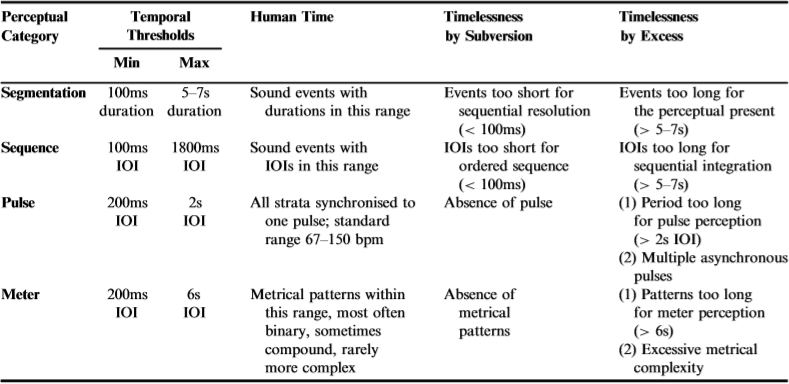
Table 1, simplified from Noble (Reference Noble2018), summarises the temporal ranges and threshold values posited as defining ‘human time’, the timescales that optimise human embodiment and information processing. Segmentation refers to the range of durations that can be easily processed as perceptual units. Sequence refers to the range of IOIs that allow sounds to be differentiated as events but integrated into an auditory stream (this is incorporated into the discussion of grouping, which involves proportions of the overall durations of sequences as well as the durations of IOIs). Pulse refers to the beat zone described previously. Meter refers to the range of durations for recurring accent patterns within a pulse stream that can provide a simplifying framework for more complex surface rhythms.Footnote 1 The values listed in Table 1, gleaned from empirical research documented in the literature on music perception and cognition, give guidelines for the temporal organisation of music that expresses human time, and by extension, for music that points outside of it, to timelessness.
Ranges and threshold values of human time.

Additionally, a fifth factor, repetition, is central to the experience of musical temporality. Repetition is such a pervasive feature of music that the idea of music with no repetition almost seems like a contradiction in terms, and it may occur at many different levels of musical organisation. It is difficult to identify specific limits for repetition, since its associated psychological thresholds may vary with the content or extent of the musical patterns that are repeated. For our purposes, we are concerned with proximal or immediate repetition, as opposed to distal repetition in which repeated figures are separated by intervening material (Margulis Reference Margulis2013). Proximal repetition is particularly relevant in the context of electroacoustic music, as will become evident in the results of the experiment reported below.
Noble (Reference Noble2018) theorised that each of these five perceptual principles – segmentation, grouping, pulse, metre and repetition – establish boundary conditions on the human experience of time that may be exceeded or subverted in musical temporal organisation. Doing so was predicted to elicit experiences of timelessness, in which the listener’s sense of time recedes from their subjective experience. We review the conditions under which each of these five principles may be subverted or exceeded in the following.
3.1. Segmentation
Human capacity for segmentation may be subverted if sound events are shorter than the shortest perceptual units, that is, >100ms (Repp Reference Repp2005: 971), which corresponds with the shortest units that can function as individual elements of a musical rhythm (ibid.: 972). Segmentation may be exceeded if sound events are much longer than the longest durations that can be contained within the perceptual present, usually 3–5s (Snyder Reference Snyder2000: 50).
3.2. Grouping
Human capacity for grouping may be subverted if the IOI between subsequent events is greater than the maximum separation that allows for stream integration, c. >1.8s (Repp Reference Repp2005: 971). Grouping may be exceeded if phrase lengths exceeded the limit of the threshold between short-term and long-term memory, which Snyder identifies as 8–16s (Reference Snyder2000: 193).
3.3. Pulse
Pulse perception may be subverted with periodic patterns slower than 30 bpm or exceeded with patterns faster than 300 bpm. In complex musical textures, there are other ways as well: pulse may be subverted either by presenting sound with no cues for pulse entrainment, or by presenting conflicting, confusing or irrational patterns that are difficult or impossible to resolve into a pulse. Pulse perception may be exceeded by presenting multiple simultaneous patterns with competing pulses, such that none of the available pulses presents as an organising principle.
3.4. Metre
Metre, which logically requires pulse, can naturally be subverted by pulse’s absence, but it can also be subverted by the absence or dissolution of accent patterns within a pulse stream. Metre can be exceeded by recurring accent patterns that are too long and/or complex to provide a simplifying cognitive framework for surface rhythms, or by overly complex polymetric superpositions (though there is some controversy about the psychological reality of polymeter; see London Reference London2004: 49–50).
3.5. Repetition
Repetition organises our sense of time through facilitating the development of expectations. If a music were to avoid repetition altogether, it would subvert our capacity to form expectations, and therefore to structure the flow of time in terms of anticipated events. At the other extreme, music that employs repetition excessively can cause us to adopt different, non-linear listening strategies, diminishing our senses of retention and protention (Husserl Reference Husserl[1928] 1964), resulting in ‘a satisfying pull toward the present moment’ (Margulis Reference Margulis2013: 18).
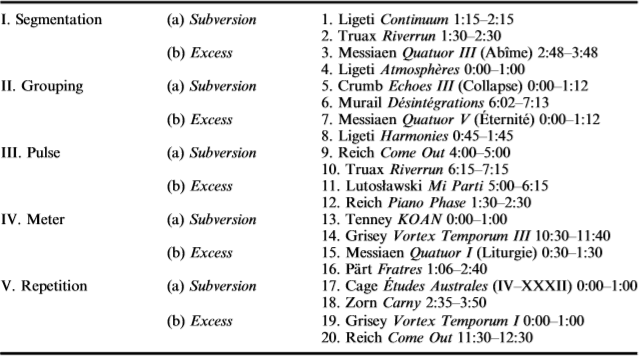
Each of these principles has been exploited frequently in twentieth- and twenty-first-century music concerned with alternate temporalities and timelessness. Two examples from the repertoire are provided for each principle in Table 2. While excerpts in this table are chosen as exemplars of the indicated particular perceptual, this by no means implies that those principles are mutually exclusive: they frequently operate in tandem with each other. Let us note also that many authors on this subject posit that multiple temporalities may be concurrently present in the same music; for example, Grisey described musical time as ‘a place of exchange and coincidence between an infinite number of different times’ (Reference Grisey1987: 274). While the prospect of multiple alternate temporalities is of immense interest, a thorough discussion of this subject is beyond the scope of this article. We have chosen to adopt a simple opposition of time and timelessness, following Fraser’s observation that by ‘time’, ‘we usually mean something (whatever it may be) as experienced by people in full awareness of themselves’, while ‘[m]ost other experiences to which temporality may relate directly or indirectly, are lumped together under “timelessness”’ (Reference Fraser1975: 305). We suspect that subtler distinctions of temporalities, including concurrent temporalities, are also germane to electroacoustic music, and we hope that future studies will pursue such distinctions in detail.
Excerpts used as stimuli in our experiment.
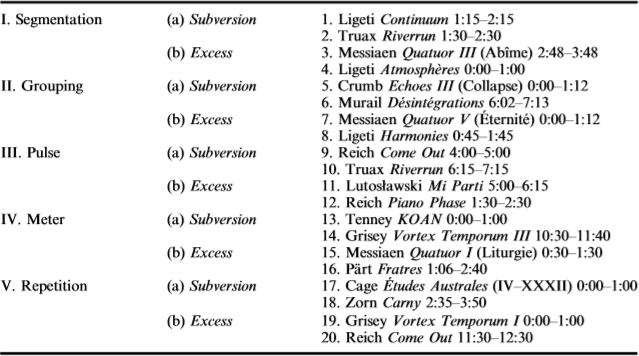
Note: Time ranges indicate the position of the excerpt in the original recordings (see Discography).
To the best of our knowledge, in spite of abundant scholarship on many of the pieces listed here (and others that exploit similar principles), no empirical studies have evaluated subjective experiences of time and timelessness in relation to temporal organisation in this music. This is a primary aim of the present study.
4. EXPERIMENT: TIME AND TIMELESSNESS IN CONTEMPORARY MUSIC
We test the prediction of Noble (Reference Noble2018) that musics subverting or exceeding the typical boundaries of human time scales may be associated with subjective experiences of timelessness. We also investigate the psychophysical association between particular musical parameters (e.g., amplitude, spectral centroid, spectral variation) and the listeners’ experience of musical time and timelessness. This study was certified by the McGill University Research Ethics Board II.
4.1. Stimuli
All 20 excerpts presented in Table 2 were used as stimuli in the psychological experiment described in the following. For the purposes of this article, only the five electroacoustic excerpts will be discussed in detail. These were selected from Barry Truax’s Riverrun (2, 10), Tristan Murail’s Désintégrations (6), and Steve Reich’s Come Out (9, 20).
4.2. Listening panel
ListenersFootnote 2 were members of the McGill University community, recruited using social media. They all provided informed consent.
4.3. Procedure
This experiment was conducted in the context of a larger research programme. We report the entire procedure for the sake of completeness, although two procedural factors described in the following were not analysed in the context of the present experiment: (a) the assignment of listeners to a perception or induction group, and (b) the relation between listeners’ Absorption in Music Scale scores (Sandstrom and Russo Reference Sandstrom and Russo2013) and the experience of musical time and timelessness. Listeners were divided into two subject populations according to the perception-induction distinction familiar to musical emotion research (Juslin and Laukka Reference Juslin and Laukka2004): half of the listeners were asked to rate the sense of time and timelessness expressed by the musical excerpts they were listening to, while the other half were asked to rate the sense of time and timelessness induced in them by the musical excerpt.Footnote 3 Juslin and Laukka (Reference Juslin and Laukka2004) indicate that it is one thing for a listener to perceive an emotion expressed by a particular song and another for the song to induce that same feeling in the listener. We wondered if a similar situation may obtain with respect to the senses of musical time and timelessness. These group differences will be evaluated in a future report with a larger sample size.
The first group of listeners was given the following instructions:
You will hear a series of excerpts of contemporary music, each of which is about a minute long.
-
While you listen, you will be holding a joystick. On top of the joystick is a button. Pressing this button will begin the listening trial, and you will see a small grey crosshair in the centre of the screen. If the music you are hearing expresses ‘normal’ time (i.e., the musical time being expressed is similar to your normal experiences of time), leave the joystick in a central position. If the music expresses time speeding up, move the joystick forward. If the music expresses time slowing down, move the joystick backward. The amount you move the joystick should reflect the amount the time expressed by the music is altered. You may continuously change the position of the joystick throughout each excerpt.
If the music expresses a state of timelessness – that is, a suspended or annihilated sense of time – release the top button. The crosshair will disappear from the middle of the screen. You may depress the button again if the music expresses that time has begun flowing again; the crosshair will return on the screen.
Following each excerpt, you will be presented with a response form and asked to describe how strongly the excerpt expressed time and/or timelessness.
The second group was given the same instructions except they were asked to respond to what the music ‘makes you feel’ instead of what the music ‘expresses’. On each trial of the experiment, listeners engaged the joystick trigger to begin the playback of a musical excerpt randomly selected from Table 2. Releasing the trigger did not stop the playback of the musical excerpt or the recording of the joystick data; that is, musical time and musical timelessness were independently recorded as unique variables. Following each excerpt, listeners indicated on two 5-point Likert scales (a) the strength of their overall sense of time throughout the previous excerpt (1 = a weak sense of time; 5 = a strong sense of time), and (b) the strength of their overall sense of timelessness throughout the previous excerpt (1 = a weak sense of timelessness; 5 = a strong sense of timelessness). Once the Likert responses were recorded, the listener advanced to the next experimental trial.
Following the conclusion of all experimental trials, listeners completed the Absorption in Music Scale questionnaire (Sandstrom and Russo Reference Sandstrom and Russo2013). These data were collected in the context of a larger-scale investigation of the relation between self-reported propensity for absorption in music and the experiences of musical time and timelessness.
4.4. Results
For each of the five electroacoustic excerpts of the experiment, we present: (a) a combined waveform and spectrogram (range 0 Hz–20 kHz) of each sound; (b) the real-time ratings of experienced pace of time throughout the excerpt, indicated by averaged joystick data; and (c) the real-time ratings of timelessness throughout the excerpt, indicated by averaged trigger data. We summarise these results in the context of salient perceptual features for each excerpt. Additionally, we report the average overall ‘sense of time’ and the average overall ‘sense of timelessness’ reported by each listener for each excerpt.
4.4.1. Barry Truax, Riverrun (1986) (1)
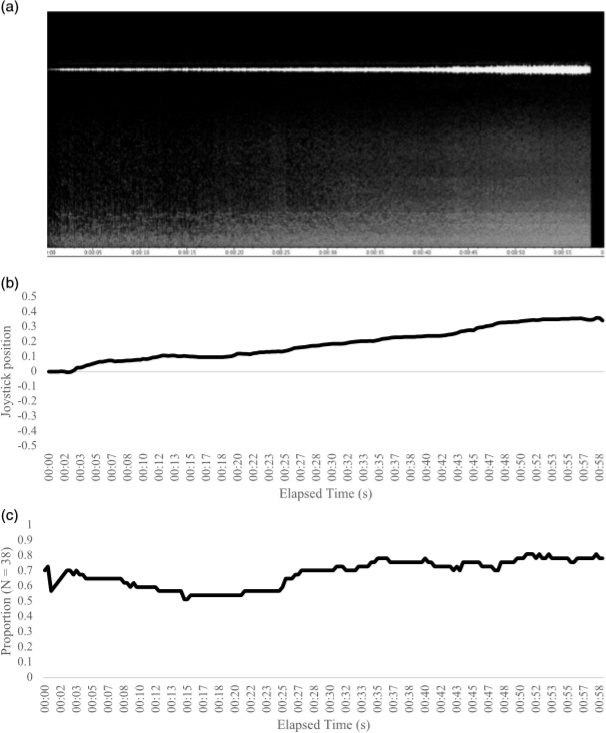
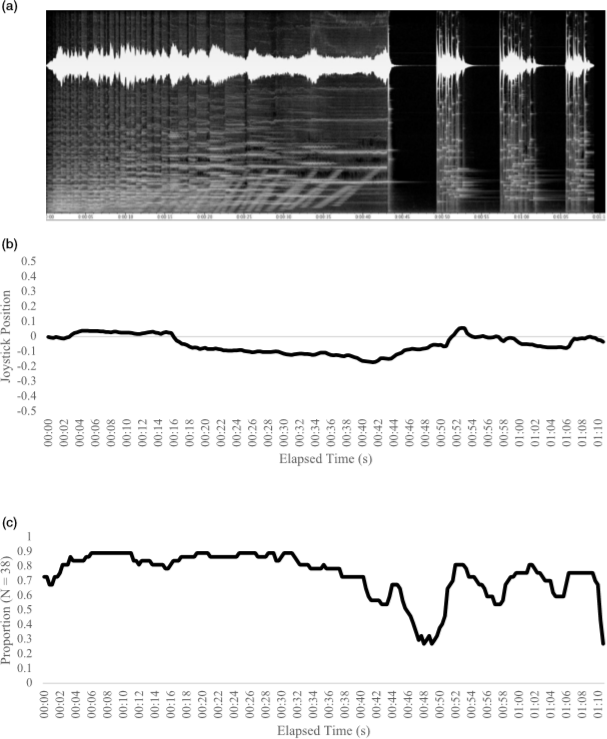
Riverrun was created entirely with real-time granular synthesis. Brief ‘grains’ of sound (sine tones or frequency-modulated sine tones) as short as 8ms (Helmuth Reference Helmuth and Simoni2006: 190–1) are deployed in varying densities to produce distinct musical textures. The grains are distributed according to geometrical ‘tendency masks’ (Truax Reference Truax1990). In this excerpt, Riverrun (1), the grains are distributed over a wide frequency range, at first sparsely and then becoming progressively denser in distribution (Figure 1a).
(a) Spectrograph with waveform, (b) mean joystick ratings, and (c) proportion of trigger depressions for Riverrun (1).

This progressive densification of grains corresponds with a progressive dynamic crescendo. There is no conventional metre or rhythm, but the global activity of the timbre-texture follows a clearly ‘ascending’ trajectory. Listeners’ joystick responses indicate a corresponding steady increase in the pace of time (Figure 1b). Engaged trigger proportion (Figure 1c) initially descends, indicating that nearly half of our listeners experienced a sense of timelessness, but after 0:20 this proportion increases to ~0.8, in parallel with simultaneous changes in several other domains: the perceived speed of time according to the joystick data (Figure 1b), the dynamic crescendo and spectral variation of the excerpt.
4.4.2. Riverrun (2)
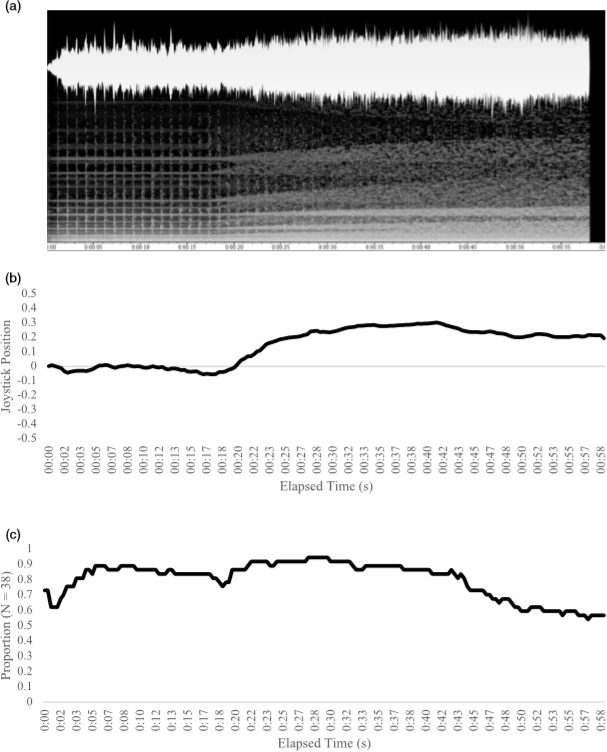
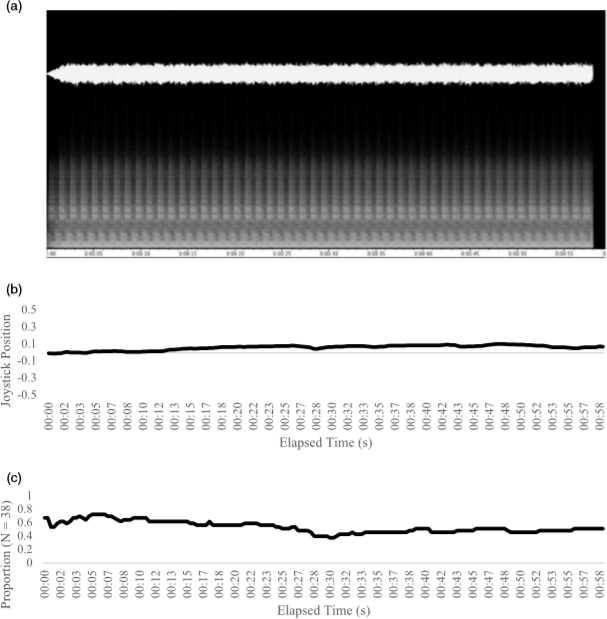
In this later section of Riverrun, grains are initially deployed in relatively tight time windows at 60 bpm with a very clear and perfectly regular pulse (see vertical bars in spectrogram; Figure 2a). Over the course of the excerpt, the time windows widen progressively as the spectral variation increases, diminishing the clarity of attack and diffusing the sense of pulse until it disappears.
(a) Spectrograph with waveform, (b) mean joystick ratings, and (c) proportion of trigger depressions for Riverrun (2).
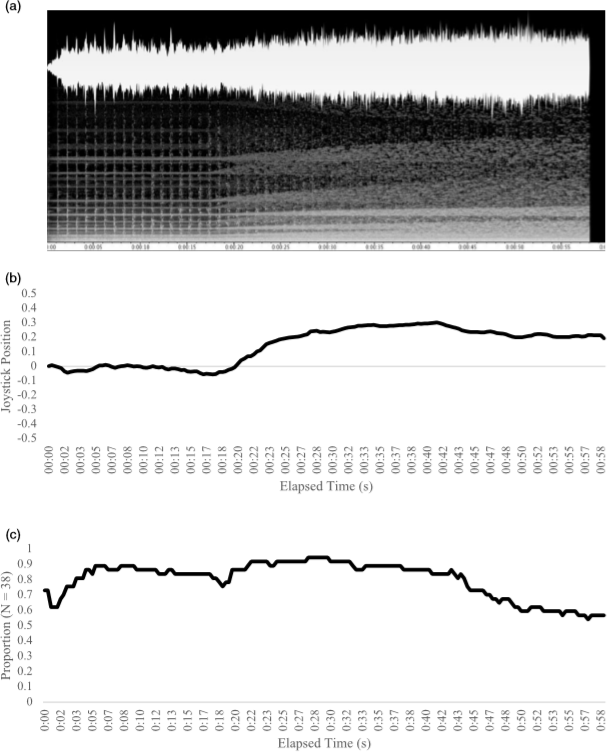
The very clear pulse and harmonic pitch at the beginning of this excerpt correspond with consensus ratings of normative pace of time (Figure 2b) and the music being in time (Figure 2c). At ~0:18, the simultaneous commencement of several process – the pulse-diffusing lengthening of the attack, the pitch-diffusing upward spread of frequencies and the overall increase in amplitude – corresponds with a fairly dramatic increase in the experienced pace of time (Figure 2b) and a subtle increase in trigger depression (Figure 2c). But after the pulse and pitch have dissolved entirely around 0:35, the reported pace of time remains significantly accelerated (Figure 2b), while timelessness ratings increase progressively to the end of the excerpt (Figure 2c).
4.4.3. Tristan Murail, Désintégrations (1983)
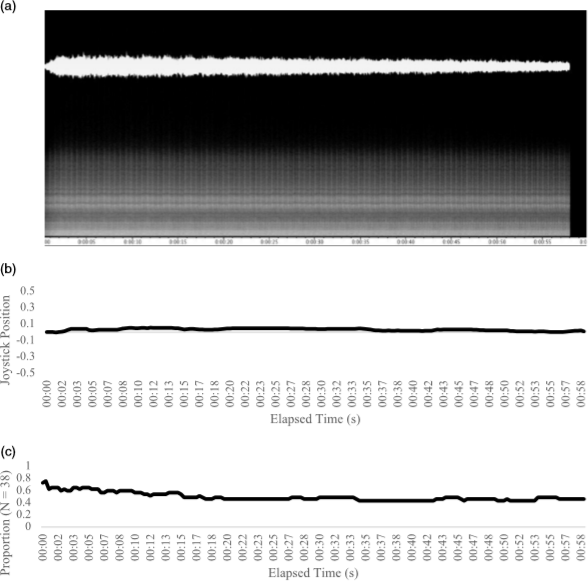
Following an initial build-up with dramatically decelerating rhythm, ascent in register and modulation of instrumental and synthetic timbres, this excerpt features long pauses of about 4–7s separating clusters of high, computer-generated, bell-like sounds, derived electroacoustically from the ‘disintegrated’ spectra of the ensemble instruments (Anderson Reference Anderson1996).
The first ~43s of this excerpt feature a hybrid instrumental-electroacoustic soundworld with progressively decelerating temporal processes coupled with progressively ascending pitch, both of which appear clearly in the spectrograph (Figure 3a). The reported pace of time is unaltered until these processes really take hold around 0:15, at which point there is a significant decrease (Figure 3b). Trigger data present a similar contour during this section: consensus that the music is in time for the first ~30s is followed by a gradual increase in timelessness ratings (Figure 3c). During the resonant pause and silence following the bell-like hit around 0:43, timelessness indications dramatically increase, while the joystick ratings return to a normative range, where they roughly remain for the rest of the excerpt. After ~0:48, clusters of bell-like sounds correspond with lower timelessness ratings while the pauses that follow them correspond with higher frequencies of timelessness indications.
(a) Spectrograph with waveform, (b) mean joystick ratings, and (c) proportion of trigger depressions for Désintégrations.

4.4.4. Steve Reich, Come Out (1966) (1)
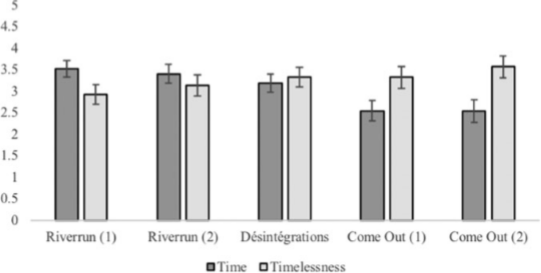
Come Out is an example of Reich’s phasing technique, achieved by playing multiple tapes of the same sound (in this case, short segments of speech) looping at minutely different speeds (Griffiths Reference Griffiths2001). Subtly shifting phase relationships make it difficult to locate a clear pulse in spite of the obvious repetition visible in the spectrograph. Musical parameters such as timbre and dynamics remain fairly stable over the course of this excerpt (Figure 4a), and the mean joystick values seem to reflect that, slightly increasing but never deviating far from the resting position (Figure 4b). Trigger releases, indicating a listeners’ sense of timelessness, are rare in the beginning of the excerpt but increase to ~0.5, indicating that half of the listeners report timelessness towards the end of the excerpt (Figure 4c). The increasing indications of timelessness do not correspond with any clear changes in the music, but rather with prolonged duration of a repetitive texture: this effect appears to stabilise or slightly reverse after ~30 seconds, coincident with the phrasing of the vocal sample.
(a) Spectrograph with waveform, (b) mean joystick ratings, and (c) proportion of trigger depressions for Come Out (1).

4.4.5. Come Out (2)
In this excerpt, only very short fragments of the original speech sample remain, and the ubiquitous repetition is perhaps the most salient feature: as Margulis describes it, such small repeating units create an ‘intense impression, as if the music were bombarding you again and again from close proximity’ (Margulis Reference Margulis2013: 44). The looped fragment is so short that the words are unlikely to be understood, though phonetic and vocal qualities may still be recognised. An overall dynamic decrescendo occurs over the course of the excerpt (Figure 5a), while other musical parameters appear to remain constant. In listener results, there is even less movement in the reported pace of time (Figure 5b), but a fairly steady, progressive increase in indications of timelessness (Figure 5c).
(a) Spectrograph with waveform, (b) mean joystick ratings, and (c) proportion of trigger depressions for Come Out (2).

4.4.6 Post-trial questionnaire responses
Figure 6 presents the mean overall strength of the sense of time and timelessness reported by all listeners after completing the real-time joystick trials. An omnibus repeated-measures analysis of variance examined changes in the difference score between listeners’ judgements of their experience of time and timelessness across the five excerpts. The difference in relative strength between listeners’ impressions of time and timelessness depend on the specific musical excerpt in question, and listeners’ subjective reports vary significantly between excerpts (F(37) = 11.87; p = 0.001). Note, for example, that the sense of time is stronger than the sense of timelessness in the Riverrun excerpts, while the reverse effect is true in the Come Out excerpts, in which listeners experienced a greater overall sense of timelessness than of time.
Means for overall strength of sense of time and timelessness for each excerpt.

5. DISCUSSION
The strong consistencies between listeners in their ratings leave little doubt that temporality and timelessness are, or at least can be, indexed to specific musical properties. But the musical properties that are linked with temporality and timelessness appear to be context-dependent: our observations do not reveal a single musical parameter that corresponds with the pace of time or with timelessness. This may run counter to intuition: it may seem tempting to assume, for example, that tempo would be the pre-eminent indicator of the pace of time. Our findings suggest that while this may sometimes be the case, as the decelerando in Désintégrations did indeed correspond with a reduction in the reported pace of time, the pace of time may also be driven by other musical or sonic parameters, such as textural density as seen in Riverrun (1), where the reported pace of time increased steadily in spite of the absence of tempo per se, or spectral distribution and/or sound intensity as seen in Riverrun (2), where the pace of time increased even as the tempo remained constant, and stayed high even after the cues for tempo disappeared altogether. For timelessness, stasis or homogeneity may seem like the most intuitive correlates, but these are abstract concepts that are difficult to define clearly in acoustical terms, and not all instances of musical timelessness appear to be characterised by them anyway. In the examples from Come Out, which are relatively texturally homogeneous throughout, there was indeed a progressive increase in timelessness ratings over the course of the excerpt, and likewise with the end of Riverrun (2) after a homogeneous texture had been established. But the most dramatic increases of timelessness indications in these excerpts appear after the bell-like tones in Désintégrations and were apparently related to the stark, heterogeneous contrast between the musical sound and its absence in the long intervening pauses.
Another important observation is that the responses for the pace of time (joystick) and the experience of timelessness (trigger) follow clearly different contours, indicating that the one is not just an extreme example of the other, but that they are separate, decoupled phenomenologies. Our observations suggest that it is not the case that time slows down, down, down and eventually stops: in both examples from Come Out, there is little displacement of the pace of time from its normative position, but the frequencies of timelessness ratings (indicated by trigger releases) progressively increase, with roughly half of listeners indicating an experience of timelessness by the end of each excerpt. At the end of Riverrun (2), the pace of time is indicated as significantly accelerated, and yet timelessness ratings are very high.
Further evidence that experiences of timelessness are linked to definable musical properties comes from the Likert ratings of the overall strengths of senses of time and timelessness, which show that for the Come Out excerpts the sense of timelessness is significantly higher, for Riverrun (1) the sense of time is significantly higher, and for Riverrun (2) and Désintégrations the differences are marginal. Exactly what is driving the differences seems to vary with the musical context of each excerpt and may also be affected by subjective listening behaviours. Indeed, these interpretations were conveyed intuitively and succinctly by our listeners. Following the ratings portion of the experiment, they were invited to describe what in the music they thought they were responding to in their assessments of time and timelessness. Their responses would seem to corroborate many of our hypotheses. For example:
Not sure if what I think is ‘timelessness’ is what you conceived it to be, but to me, when the music was static, not changing, especially in pitches, or when a few pitches were repeating over and over, I thought that expressed ‘timelessness’.
A pulse helps to keep track of time, but dynamics also influence the flow of time.
Mostly tempo and rhythmic value, but also repetitiveness and harmonies.
On the one hand, there were too many events to keep track of; on the other hand, there could have just been one continuous note and I didn’t know how long it would go on for.
When the rhythm or loudness of the music is rapidly changing, I can feel the flow of time. When the tempo of music doesn’t change so much, even timbre changes, I feel timelessness.
Responses such as these clearly suggest that the listeners’ responses are not whimsical or arbitrary, but nor are they unanimously linked with the same musical properties. There is an element of subjective interpretation, but the interpretation is guided non-arbitrarily by the objective properties of the musical stimulus.
A study of this nature has several limitations. Although stimuli are excerpts from music and are chosen for their temporal properties, they are fairly short (58–94s) and are excised from their original musical context. An experimental setting in a laboratory may not be conducive to, and may in fact detract from, the experiences of musical absorption, time, and timelessness that we mean to study. Therefore, this study presents at most a piece of the puzzle; further research will be required to gain an ecologically valid perspective.
6. CONCLUSION
In his landmark study of the many manifestations of the trance state, Gilbert Rouget said ‘relations between music and trance … are extremely varied, such that from one case to another it often happens that they contradict one another and that it is extremely difficult to formulate a rule about them without a counter-example coming to falsify it’ (Reference Rouget1980: 429). Considerations such as this led Judith Becker to conclude that ‘[t]here is nothing intrinsic to the music that can cause trancing. The relationship between music and trance is not causal or deterministic … given the right cultural expectations, any kind of music, vocal or instrumental, can be associated with trance’ (Becker Reference Becker2004: 25–6). We agree that when complicating factors such as social expectations, ritual, personal histories and subjective propensities are introduced into the equation, the types of music that can be associated with altered experiences of time extend far beyond the relatively circumscribed range of musics discussed in this article. But if it is oversimplifying to think that there may be a direct causal relationship between musical properties and the trance state, our findings suggest that it may also be oversimplifying to think that there is no determinate connection whatsoever between musical properties and subjective experiences of time and timelessness, especially if we are considering the time or timelessness that music may express as opposed to altered states of mind that music may induce (such as the trance state). If musical properties and subjective experiences of time and timelessness were truly unconnected (or connected only haphazardly), we would expect all of our excerpts to be rated equally for strength of senses of time and timelessness, and for the joystick and trigger data to be randomly dispersed with no meaningful connection to the musical stimuli. This is not at all what we observe: there are unquestionably consistent and meaningful connections between the music we have studied and the temporal (or atemporal) experiences reported by our listeners. However, the musical properties that appear to drive these connections vary considerably from excerpt to excerpt. We can certainly agree with Rouget when he says that ‘one thing is certain … these relations are not simple’ (Rouget Reference Rouget1980: 429).
Contextually variable though our findings may be, we observe some general tendencies that support our suggestion that musical timelessness does relate to the excessive and subversive possibilities of temporal organisation offered by electroacoustic media. Prolonged duration – whether of fused sound events or complex musical textures such as those made possible with looping or granular synthesis – does appear to correlate with an increased sense of timelessness. The same appears to be true of resonant pauses or silences (as also demonstrated in Knowles Reference Knowles2016), but context may be as important as a relative absence of sound; for example, both the beginning of Riverrun (1) and the resonant pauses following the bell-like hits in Désintégrations are spectrally rather empty, but the stark contrast between presence and absence in Désintégrations appears to considerably augment the impression of timelessness it is reported to convey.
The perceived pace of time does seem to follow a general up–down metaphor with respect to musical parameters (Lakoff and Johnson Reference Lakoff and Johnson1980: 14–21): an increase in some parameter or another appears to correlate with an increase in the reported pace of time. However, our observations do not suggest a simple one-to-one correspondence with any particular parameter: in these excerpts we observe contextual correlations between the pace of time and tempo, textural density, sound intensity and spectral distribution. Perhaps other parameters still may correlate with the pace of time in other musical contexts. But in spite of this plurality of possible mappings, the connections are not arbitrary: as detailed above, reported states and changes in the pace of time are qualitatively coherent between listeners, and map onto properties that are objectively present in the musical stimuli. Listeners’ verbal descriptions of the properties of the music to which they were responding, while referencing a variety of different parameters, also corroborate the emphasis on excess and subversion that is at the core of our theory of musical temporality.
We thus conclude that there is evidence to support our notion that the subversive and excessive temporal scales and structures made accessible through non-human sound production – notably, electroacoustic music – do relate meaningfully to musical timelessness, though the complex many-to-many mapping by which such interpretations proceed may be expected to yield considerable intersubjective variation. Much more research is needed to fully explicate this subject, but we believe the findings reported here to be potentially illuminating for this fascinating phenomenon of music perception and cognition.
Acknowledgements
The authors wish to thank the anonymous reviewers for valuable comments on the manuscript, as well as Bennett K. Smith for programming the listening experiments, Behrad Madahi for running subjects, and the members of the Music Perception and Cognition Lab at McGill University for valuable feedback. This work was supported by Social Sciences and Humanities Research Council of Canada (RGPIN 312774) and the Fonds de recherche du Québec—Société et culture (2017-SE-205667), as well as a Canada Research Chair (950-223484) awarded to Stephen McAdams, a Vanier Canada Graduate Scholarship (770-2012-0129) awarded to Jason Noble, and a NSERC CGS-D Fellowship (489788-2016) awarded to Tanor Bonin.
APPENDIX: EXPERIMENTAL APPARATUS
Listeners were seated in an IAC model 120act-3 double-walled audiometric booth (IAC Acoustics, Bronx, NY). The experimental program was written in PsiExp (Smith Reference Smith1995) and run on a Mac Pro 5 computer running OS 10.6.8 (Apple Computer, Inc., Cupertino, CA), with Dynaudio BM6a loudspeakers (Dynaudio International GmbH, Rosengarten, Germany) arranged at ~ ±60° facing the listener at a distance of 1.5m and powered by a Grace Design m904 monitor (Grace Digital Audio, San Diego, CA). Following the paradigm of Knowles (Reference Knowles2016), listeners used a joystick to report the speed of time as they listened, moving the joystick forward to indicate time speeding up (max value = +0.5), backward to indicate time slowing down (min value = –0.5) and leaving it in a central position to indicate relative temporal normativity (value = 0). Additionally, they used a trigger on the joystick to indicate whether the music was in time or timeless – an engaged trigger indicated that the listener was experiencing the music in time, while a disengaged trigger indicated that they were experiencing timelessness. Thus if all listeners had the trigger engaged at a given moment in the piece, they would all be experiencing the music as in time at that moment (proportion 1.0), whereas if they all had the trigger disengaged at a given moment in the piece, they would all be experiencing the music as timeless at that moment (proportion 0). Before completing the experiment, listeners passed a pure-tone audiometric test at octave-spaced frequencies from 125 Hz to 8 kHz (Martin and Champlin Reference Martin and Champlin2000; ISO 389–8, 2004) and were required to have thresholds at or below 20 dB HL to proceed to the experiment.