The growing prevalence and associated societal and economic burdens of non-communicable diseases (NCDs) including obesity, diabetes and allergic diseases is a global public health concern.Reference Gouda, Charlson and Sorsdahl1 As a primary cause of disability and mortality worldwide, NCDs have contributed to approximately 60% of deaths throughout the world, and these numbers are expected to follow a steady increase.2 Some of the most common NCDs to emerge in early life include asthma and atopic diseases.Reference Ogoina and Onyemelukwe3 These NCDs are chronic, multi-factorial conditions that are affected by both genetic and environmental factors.Reference Ober and Yao4,Reference Temelkova-Kurktschiev and Stefanov5 In the last decade, the microbiome has been postulated to contribute to the development of these chronic diseases.Reference Kho and Lal6 Obese people had more Firmicutes and less Bacteroidetes in their gut microbiome as compared to lean controls, and the abundance of Bacteroidetes increased over time during a 52 weeks fat or carbohydrate restricted diet.Reference Ley, Turnbaugh, Klein and Gordon7 The increase in Bacteroidetes abundance was strongly correlated with percentage weight loss in the obese individuals.Reference Ley, Turnbaugh, Klein and Gordon7 Adults with type 2 diabetes (T2D) were found to have higher Lactobacillus and lower Bifidobactrium compared to non-diabetic adults, and there were no significant differences in age and body mass index (BMI) between the groups.Reference Sedighi, Razavi and Navab-Moghadam8 Children with atopic dermatitis (AD) were shown to have significantly less diverse skin microbiome as compared to controls,Reference Kong, Oh and Deming9 and the culturable Gram-negative bacteria from skin of healthy controls was able to alleviate dermatitis in an AD mouse model.Reference Myles, Williams and Reckhow10 Since the genetic component of these diseases cannot be altered, the ability to manipulate the microbiome holds great promise for design of novel therapies in the prevention and treatment of chronic NCDs. Given that environmental interactions are integral in the development of human microbiome, it is vital to identify environmental factors that alter its development and maintenance, to aid attainment of a healthy microbiome, and to determine preventive strategies for public health.
The Developmental Origins of Health and Disease (DOHaD) concept proposes that exposure to environmental stimuli in early life may result in short- and long-term health consequences.Reference Godfrey, Costello and Lillycrop11 Evidence from some studies in the field suggest that exposure to a diverse microbial environment within this window in early life, pregnancy and postnatally, is key in determining allergy predisposition/risk.Reference von Mutius12–Reference Ege, Mayer and Normand15 In a study by George et al., higher environmental exposure to cockroach, mouse, and cat allergens in the first 3 years of life was associated with reduced risk of asthma at 7 years of age, emphasizing the importance of environment during early postnatal period on the subsequent development of allergic diseases.Reference O’Connor, Lynch and Bloomberg16 The influence of environmental factors on health and disease development was also proposed in the hygiene hypothesis, which states that early childhood exposure to the microbial environment regulates immune development and protects against allergic diseases.Reference Strachan17 However, with the advancement of human microbiome research, an extension of the hygiene hypothesis known as the microbial hypothesis has been proposed. The microbial hypothesis proposes that early life exposure to environmental stimuli will alter the development and composition of the human microbiome, resulting in differential regulation of immune system.Reference Shreiner, Huffnagle and Noverr18 Recent studies have indicated that the environment we are exposed to in early life starting from in utero is instrumental in shaping robust immune development, possibly through modulation of the human microbiome (skin, airway, and gut).Reference Gensollen and Blumberg19 In a Chinese cohort, prenatal exposures of 42 women to a farm environment were observed to reduce the risk of allergic outcomes in infants through the upregulation of regulatory T cells.Reference Yu, Liu and Li20 Similarly, in the Prevention of Allergy Risk factors for Sensitization In children related to Farming and Anthroposophic Lifestyle (PARSIFAL) study involving 2509 farming families, Douwes et al. found that prenatal exposures to animals, hay, and grain products were associated with reduction in eczema and asthma in the offspring.Reference Douwes, Cheng and Travier21 Likely, the environmental microbiome that surrounds an individual in early life has a profound impact in determining our human microbial communities. Despite much research into human microbiomes, the origin of their constituent microbiota remains unclear. Environmental factors such as mode of delivery,Reference Dogra, Sakwinska and Soh22 use of antibiotics,Reference Hagan, Cortese and Rouphael23 and dietary patternsReference Akagawa, Tsuji and Onuma24 are reported to play a role in shaping the human microbiome. Dust is a key determinant of poor air quality in modern urban environments.Reference Crinnion25 It is made of fine particles of solid matter, and these solid particles are known as particulate matter (PM).Reference Inyang and Bae26 According to the United States Environmental and Protection Agency, PM is categorized by particle size. PM10 refers to coarse particles that are between 2.5 and 10 µm in diameter, while PM2.5 refers to fine particles that are generally below 2.5 µm in diameter.27 When these particles are suspended in air, they are known as suspended PM (SPM). PM is also a major component in air pollution, e.g., ambient air pollution,Reference Hime, Marks and Cowie28 household air pollution,Reference Apte and Salvi29 and traffic-related air pollution (TRAP).Reference Kheirbek, Haney, Douglas, Ito and Matte30 Dust (also known as PM) is ubiquitous and also serves as a major source and reservoir of microbial communities which modulates the human microbiome, contributing to health and disease.Reference Shan, Wu, Fan, Haahtela and Zhang31 Moreover, dust can be introduced into our bodies via dermal, inhalation, and ingestion.32 The impact of environmental PM exposure on pregnancy and early life health are in line with the DOHaD hypothesis. Environmental PM exposure in pregnancy has been found to affect both maternal health and child’s health. Gestational weight gain was increased in pregnant women with increased exposure to PM2.5 during pregnancy.Reference Liao, Yu and Xia33 In another Korean study, women exposed to greater than 70 µg/m3 PM10 during pregnancy were found to have significantly more preterm births than women exposed to lower levels of PM10.Reference Kim, Song and Kim34 Exposure to TRAP during pregnancy was also associated with increased risk of allergic rhinitis in the offspring.Reference Deng, Lu, Yu, Li, Sundell and Norbäck35
Hence, there is now growing interest in studying the dust microbiome and its impact on human health. In this review, we will present evidence linking environmental dust and NCDs, and focus on the impact of dust exposure in shaping the different sites of human microbiome including skin, airway, and gut, which may in turn contribute to the development of NCDs. We will also discuss the possible mechanistic links between dust, human microbiome, and NCDs.
Environmental dust and NCDs
The Urban Environment and Childhood Asthma (URECA) birth cohort examined a high risk cohort (n = 560) from the cities Baltimore, Boston, New York City, and St. Louis and found that reduced richness and diversity in house dust bacteria during the first year may be associated with atopy and its recurrent risk at age of 3 years.Reference Lynch, Wood and Boushey36 Higher exposure to specific Bacteroidetes and Firmicutes was protective against atopy and recurrent wheezing, and these bacterial taxa were correlated with the levels of allergens. Longer follow-up of this cohort also showed the distinct differences between the early life household microbiota of participants that subsequently develop asthma at 7 years of age and those that did not. Abundance of specific taxa including Staphylococcus, Haemophilus (Pasturellaceae), Corynebacterium, and some Sphingomonas members were elevated in houses of children who subsequently developed asthma.Reference O’Connor, Lynch and Bloomberg16 Additionally, low microbial richness of household dust was correlated with high wheeze and high atopy phenotypes, while high microbial richness of household dust was correlated with transient wheeze and low atopy phenotypes.Reference Bacharier, Beigelman and Calatroni37 Taken together, these findings suggest that concomitant exposure to higher amount of allergen and house dust bacterial content may protect against and potentially alleviate atopy and recurrent wheezing.Reference Lynch, Wood and Boushey36 Similarly, based on the findings from the Growing Up in Singapore Towards healthy Outcomes (GUSTO) birth cohort study, our group has reported that there were differential microbiota and allergen profiles in house dust collected from homes of allergic participants compared to healthy controls.Reference Loo, Chew and Zulkifli38 Houses of allergic participants had higher levels of Bacteroidaceae, Anaplasmataceae, and Leptospiraceae, all of which are gram negative.Reference Loo, Chew and Zulkifli38 Endotoxins which are associated with gram negative bacteria have also been shown to potentially increase risk of wheezing in children from a Boston study.Reference Park, Gold, Spiegelman, Burge and Milton39 Besides this, abundance of Bacteroidaceae was higher in gut microbiota of allergic Japanese subjects at 1 and 2 months of age, as compared to the non-allergic subjects which also suggests a possible link between environmental and gut microbiota.Reference Songjinda, Nakayama and Tateyama40 As part of the Karelian Allergy Study, dust samples from Finnish and Russian Karelia homes were analyzed;Reference Pakarinen, Hyvarinen and Salkinoja-Salonen41 although the Finnish and Russian Karelia children are genetically similar, they had contrasting prevalence of atopy and marked differences in household dust microbial composition. In the Russian Karelian homes, atopy risk was low and Staphylococcaceae followed by Actinobacteria and Firmicutes were the most abundant bacteria in dust. In contrast, the Finnish Karelian homes had a high atopy risk associated with a higher prevalence of Proteobacteria, and lower abundance of Staphylococci and Corynebacterium. The data suggested that the microbial composition of house dust may be closely associated with allergic outcomes.
To our knowledge, there are currently no studies that have examined the direct relationships between the dust microbiome and metabolic conditions such as obesity and diabetes. However, there are observational studies that have reported associations between air pollution and metabolic diseases. Ambient air pollution refers to a vast array of pollutants including PM2.5, PM10, and TRAP.Reference Metzger, Tolbert and Klein42 TRAP comprises of nitrogen oxides, PM, carbon dioxide, hydrocarbons, and carbon monoxide, and also other emissions unrelated to combustion such as tyre wear.Reference Matz, Egyed, Hocking, Seenundun, Charman and Edmonds43 Diesel exhaust is also one of the major components of TRAP and contributes extensively to PM2.5.Reference Costa, Cole, Coburn, Chang, Dao and Roqué44 Emergency department visits for cardiovascular diseases was found to be correlated with pollutants present in ambient air pollution,Reference Metzger, Tolbert and Klein42 and a higher exposure to TRAP was shown to be associated with a higher rate of asthma readmission in white children compared to African American.Reference Newman, Ryan, Huang, Beck, Sauers and Kahn45 In a longitudinal prospective cohort of 4550 Southern California children who were aged 5–7 years, exposure to TRAP was positively correlated with increase in BMI after adjustment for parental education, language, measures of green cover in a 500 m radius of the home, and recreational activities in a 5 km radius of the home.Reference Jerrett, McConnell and Wolch46 Another study in New York reported that children of mothers with higher prenatal exposure to polycyclic aromatic hydrocarbon as assessed with a personal ambient air monitor had higher BMI and greater obesity risk at 5 and 7 years of age.Reference Rundle, Hoepner and Hassoun47 Exposure to ambient air pollution and TRAP was associated with parameters of glucose homeostasis and insulin resistance, e.g., higher fasting glucose, higher fasting insulin, and higher HOMA-IR in children and adolescents.Reference Toledo-Corral, Alderete and Habre48 Reduced insulin sensitivity and higher BMI were also observed in a longitudinal cohort of children who were exposed to ambient air pollution with increased PM.Reference Alderete, Habre and Toledo-Corral49 Thiering et al. examined the association between long-term exposure to TRAP and insulin resistance in 10-year-old children who were part of two separate birth cohort studies.Reference Thiering, Cyrys and Kratzsch50 The group reported that exposure to higher levels of TRAP including PM10 over a period of 10 years caused increased risk of insulin resistance in children.Reference Thiering, Cyrys and Kratzsch50 Findings from the Heinz Nixdorf Recall study also reported that traffic-related PM exposure was associated with a higher incidence of T2D in the general population.Reference Weinmayr, Hennig and Fuks51 Taken together, the evaluation of dust bacterial content may allow us to delineate the relationship between air pollution and metabolic diseases. The study demographics, pollutant types, and effect of air pollution on human health are summarized in Table 1.
Summary and comparison of studies involving air pollutants and related health outcomes

PM, particulate matter; NOx, nitrogen oxide; NO2, nitrogen dioxide; CO, carbon monoxide; TRAP, traffic-relation air pollution; BMI, body mass index; RR, relative risk or risk ratio.
Dust and skin microbiome
The skin is the primary interface with the external environment and is significantly influenced by the biodiversity of the external environment. Skin microbiota not only play a pivotal role in the growth, homeostatic regulation, and development of keratinocytes but also influence host immunity.Reference Prescott, Larcombe and Logan52 Hence, factors that affect the composition of the skin microbiome may influence not only the risk of cutaneous disease but also other inflammatory NCDs.
Hanski et al. showed that environmental biodiversity around the surroundings of homes including forests, agricultural land, and species richness of rare native flowering plants was associated with the composition of skin microbiome.Reference Hanski, von Hertzen and Fyhrquist53 Atopic 14- to 18-year-old school children from Finland had less environmental biodiversity around the surroundings of their homes, and this was accompanied by lower generic diversity of Gammaproteobacteria on their skin.Reference Hanski, von Hertzen and Fyhrquist53 After assessment of the peripheral blood mononuclear cells by real-time quantitative PCR analysis, positive correlation between Gammaproteobacteria and IL-10, an anti-inflammatory cytokine was also found in healthy subjects.Reference Hanski, von Hertzen and Fyhrquist53 Hence, the results suggest that environmental factors may impact the skin microbiome and subsequent immune responses, which may play a role in the development of atopic conditions. However, there is a paucity of studies that have examined and compared the association between environmental dust and skin microbiome. Tang et al. reported the presence of commensal human skin bacteria in house dust samples.Reference Tang, Chang, Srinivasan, Mathaba, Harnett and Stewart54 Similarly, Hanson et al. found that Firmicutes and Actinobacteria made up the dominant phyla in indoor dust.Reference Hanson, Zhou and Bautista55 These bacteria were also found in resident skin flora,Reference Hanson, Zhou and Bautista55–Reference Lange-Asschenfeldt, Marenbach and Lang57 pointing to interactions between the dust and skin microbiome.
The development of allergic diseases has been linked to urbanization that caused loss of critical house dust microbes commonly found in the farm setting.Reference Robinson, Baumann and Romero58,Reference Rodriguez, Vaca and Oviedo59 Kirjavainen et al. reported a distinct microbiota profile in dust samples collected from 399 rural farm homes with livestock compared to 298 rural non-farm homes in Finland.Reference Kirjavainen, Karvonen and Adams60 The farm home dust microbiome was enriched with members of Bacteroidales, Clostridiales, and Lactobacillales orders, and rumen-associated archaea of the Methanobrevibacter genus but had lower abundance of human-associated bacteria, including members of the Streptococcaceae family and Staphylococcus genus. The authors then studied the house dust microbiome in an independent group of 1031 children and found that children living in non-farm homes with house dust microbiota similar to that of rural farm homes had lower risk of asthma.Reference Kirjavainen, Karvonen and Adams60 The prevalence of T2D was also lower in individuals living on farm from rural Saskatchewan, Canada compared to individuals living on non-farm locations, and non-farm dwelling remains a risk predictor for diabetes after correcting for known diabetic risk factors e.g. BMI and family history of diabetes.Reference Dyck, Karunanayake and Pahwa61 These findings suggest that changes in human microbiome associated with farm and non-farm environments may result from differences in environmental dust microbial profiles, which may have an effect on the development of NCDs.
In a study of 275 Finnish children aged 2 months to 14 years, the differences in skin microbiome between those living in rural and urban area were analyzed.Reference Karkman, Lehtimaki and Ruokolainen62 The authors found that the skin microbiome of children living in urban areas had higher levels of Microlunatus, Humibacillus, Nocardioides, and Friedmaniella, which were associated with a higher prevalence of rhinitis symptoms. Additionally, the authors also reported a higher prevalence of sensitization to inhalant allergens in children from the rural regions.Reference Karkman, Lehtimaki and Ruokolainen62
Skin microbiome dysbiosis was observed in a group of T2D patients who showed higher abundance of Staphylococcus epidermidis compared to controls.Reference Thimmappaiah Jagadeesh, Prakash, Karthik Rao and Ramya63 Gardiner et al. found that the skin microbial communities were different between T2D and non-T2D adults, with the skin microbiome of diabetics being less diverse compared to controls.Reference Gardiner, Vicaretti and Sparks64 The foot skin microbiome was also found to be predictive of diabetic status.Reference Gardiner, Vicaretti and Sparks64 However, the diabetic adults were older and had higher BMI, and these may influence the differential microbiome profile between the diabetic and non-diabetic adults. Obese pregnant women were found to have a different skin microbiome profile as compared to non-obese pregnant women, and the higher pre-operative bacterial biomass on the skin of obese mothers may confer an increased risk of surgical site infection following caesarean delivery.Reference Rood, Buhimschi and Jurcisek65
The effect of environmental exposure on skin microbiome and the dysbiosis of skin microbiome in people with NCDs support a possible role for environmental dust in modulating skin microbiome profiles that are associated with the development of NCDs.
Dust and airway microbiome
The airway microbiome comprises bacteria in the oral, nasal, nasopharyngeal, and lung cavities, with breathing providing an avenue for dust to enter and co-colonize the respiratory tract.Reference Dinwiddie, Denson and Kennedy66 Dust inhaled into the airway may then influence and alter the airway microbiome. Mariani et al. reported that PM was inversely correlated with the α-diversity indices of nasal microbiome in a group of 51 healthy subjects exposed to different levels of PM.Reference Mariani, Favero and Spinazze67 Birzele et al. analyzed dust samples from the mattresses of 86 European children and compared these with their respective nasal samples.Reference Birzele, Depner and Ege68 The authors found that similar bacteria richness was present in both mattress dust and nasal samples with Proteobacteria, Actinobacteria, Firmicutes, and Bacteroidetes being the dominant phyla in both dust and nasal samples, highlighting the potential link between dust and airway microbiome.Reference Birzele, Depner and Ege68 Firmicutes and Bacteroidetes have previously been found to be associated with reduced risk of atopic wheeze in the URECA cohort, with reduced abundances of these bacteria in house dust of subjects who did not develop atopy or recurrent wheeze.Reference Lynch, Wood and Boushey36 In another study from Sweden, stool samples of 20 infants with atopic eczema were compared to those from 20 healthy infants.Reference Abrahamsson, Jakobsson, Andersson, Björkstén, Engstrand and Jenmalm69 The authors found lower levels of Bacteroidetes and Proteobacteria to be significantly associated with atopic outcomes during the first 2 years of life.Reference Abrahamsson, Jakobsson, Andersson, Björkstén, Engstrand and Jenmalm69 It was reported that pig farms harbored higher levels of airborne dust as compared to cow farms, and the nasal microbiota of pig farmers was found to be enriched with the greatest bacterial diversity, followed by that of cow farmers, with non-farmers having the lowest diversity.Reference Kraemer, Ramette, Aebi, Oppliger and Hilty70 This distinct microbial fingerprint is speculated to have arisen from the unique environmental exposure.Reference Kraemer, Ramette, Aebi, Oppliger and Hilty70 Another study by Shukla et al. comparing 21 dairy farm workers and 18 non-farm office workers revealed that a farming environment was associated with higher bacteria species richness in the nasal microbiome as well as elevated levels of Bacteroidetes.Reference Shukla, Ye, Sandberg, Reyes, Fritsche and Keifer71 Interestingly, exposure to a dairy farm environment comprising of hay, livestock, and compost, as opposed to an urban office environment, was associated with a decreased burden of Staphylococcus in the nasal microbiome, which may confer protection against subsequent pathogenesis of acute and chronic diseases.Reference Shukla, Ye, Sandberg, Reyes, Fritsche and Keifer71 Direct evidence from an animal study showed that rats exposed to mixture of PM1, PM2.5, and PM10 (30 g per exposure) for 4 h, five times weekly, over 4 weeks, had alteration in the composition and diversity of their lung microbiome profiles.Reference Li, He, Liao, Zhou, Li and Ran72 The PM exposure also induced higher number of alveolar macrophages with increased phagocytic capacity, higher levels of IgA, and lower levels of IgG, which may in turn affect the adaptive immune response of the lungs towards infection.Reference Li, He, Liao, Zhou, Li and Ran72
In the Copenhagen Prospective Study on Asthma in Children (COPSAC) birth cohort, Andersen et al. investigated the effects of air pollution on occurrences of wheezing in 205 children during the first 3 years of life.Reference Andersen, Loft and Ketzel73 They found detrimental effects of air pollution comprising PM10, NO2, and CO on wheezing symptoms in children. Likewise, in the Prevention and Incidence of Asthma and Mite Allergy (PIAMA) birth cohort study conducted in the Netherlands, Brauer et al. also demonstrated positive associations between air pollution and development of wheezing and asthma in the first 4 years of life.Reference Brauer, Hoek and Smit74
As part of the airway system, the oral mucosa is often the initial site of contact between barrier immunity and the majority of foreign antigens or commensal microbes, prior to entry into the respiratory and gastrointestinal tracts.Reference Moutsopoulos and Konkel75 Infants often ingest dust in greater amounts as compared to adults due to the frequent hand-to-mouth or object-to-mouth transfer.Reference Wilson, Jones-Otazo and Petrovic76–Reference Moya and Phillips78 Dust particles function as a vehicle for microorganisms which settle in the oral cavity and saliva during mouth-breathing.Reference Morman, Plumlee, Knippertz and Stuut79 The abundance of immunological cells in the oral cavity allows for potent immunological responses to be triggered by the dust-oral microbiome interactions, which may be crucial in the development of NCDs.
Although there is no evidence to support a direct association between dust and the oral microbiome, oral bacteria has been shown to translocate from mouth to gut;Reference Olsen and Yamazaki80,Reference Li, Ge and Cheng81 hence an effect of dust on gut microbiome could be mediated by the oral microbiome, itself influenced by the microbial communities present in the dust.
Obese individuals were found to have a lower prevalence of probiotic bacterial taxa including Bifidobacterium and Lactobacillus and a higher prevalence of common bacterial taxa including Firmicutes in their oral cavity as compared to non-obese individuals.Reference Yang, Cai and Zheng82 Obese girls showed greater diversity and decreased richness in their oral microbiome profile as compared to non-obese girls.Reference Mervish, Hu and Hagan83 Oral microbiome dysbiosis was also reported between age-matched T2D and normal weight non-diabetic men and women.Reference Long, Cai and Steinwandel84 Actinobacteria was less abundant in both T2D and obese non-diabetic individuals as compared to normal weight controls, suggesting that oral microbiome may play a role in the etiology of obesity and diabetes.Reference Long, Cai and Steinwandel84 The oral microbiome of elderly people with T2D were found to be enriched with potential disease-associated bacterial genera, including Leptotrichia, Staphylococcus, Catonella, and Bulleidia.Reference Wang, Xu and Ji85 In a longitudinal study of 188 infants who were followed through the first 7 years of their lives, children who developed allergic diseases or asthma had lower oral bacterial diversity compared to healthy children.Reference Dzidic, Abrahamsson, Artacho, Collado, Mira and Jenmalm86 Saliva samples were obtained at 3, 6, 12, 24 months, and 7 years timepoints from 47 allergic children and 33 healthy children. The oral microbial profiles differed between children with allergic diseases or asthma and healthy children throughout the 7 years of follow-up. Oral bacteria including Gemella haemolysans, Prevotella sp., and Streptococcus lactarius were associated with allergy development specifically at the age 7 years timepoint.Reference Dzidic, Abrahamsson, Artacho, Collado, Mira and Jenmalm86 These findings suggest a possible role of the oral microbiome in the development of NCDs, with the oral microbiome potentially being influenced by environmental dust.
Dust and gut microbiome
The gut microbiota is host to over 1014 microorganisms that influence health and disease susceptibility.Reference Ley, Peterson and Gordon87 There has been growing evidence implicating gut microbiota dysbiosis in the development of chronic inflammatory disorders such as obesity, diabetes, and allergy.Reference Kinross, Darzi and Nicholson88 Hence, understanding the factors that affect gut microbiota composition may provide insights into the pathogenesis of these diseases. A Chinese population-based epidemiological study by Liu et al. reported that exposure to dust particles, PM2.5 and PM10, was associated with increased risk of T2D and impaired fasting glucose.Reference Liu, Chen and Xu89 Dust particles were associated with a reduction in gut microbiota diversity and mediation analysis showed that gut microbiota may partially mediate the association between dust exposure and T2D.Reference Liu, Chen and Xu89 TRAP recorded from road traffic sources were shown to correlate with decreased Bacteroidaceae and increased Coriobacteriaceae in the gut microbiome of overweight and obese adolescents, and these gut bacteria also correlated with fasting glucose levels.Reference Alderete, Jones and Chen90 Although the study did not compare the effect of TRAP on gut microbiome between obese and non-obese individuals,Reference Alderete, Jones and Chen90 TRAP was shown to reduce the abundance of Bacteroidaceae, elsewhere reported to be lower in obese children compared to non-obese children.Reference Riva, Borgo and Lassandro91
In another study by Konya et al., fecal samples were collected from a subset of 20 infants aged 3–4 months recruited under the Canadian Healthy Infant Longitudinal Development (CHILD) study and house dust was also collected from the household of participants.Reference Konya, Koster and Maughan92 The collected dust showed a more diversified microbiome as compared to stool microbiome but there was a significant co-occurrence of 14 bacterial operational taxonomic units (OTUs) including Actinobacteria (3), Bacilli (3), Clostridia (6), and Gammaproteobacteria (2) between paired house dust and fecal samples.Reference Konya, Koster and Maughan92 Of these, the three OTUs from Actinobacteria comprised of Bifidobacterium spp, which have been previously shown to play an important role in the prevention of atopic outcomes.Reference Björkstén, Sepp, Julge, Voor and Mikelsaar93–Reference Zheng, Liang and Wang95
The findings from human studies suggest that house dust may be a determinant of the gut microbiome in early life, raising the possibility that effects of dust on human health may be modulated through the gut microbiome. However, longitudinal follow-up studies are required to further evaluate the impact of dust exposure on gut microbiome.
Although the existing human studies mainly reported associations between dust and the gut microbiome, studies in animal models have demonstrated a more direct effect of dust on the gut microbiome. Eight- to twelve-week old mice inhaled PM2.5 that was concentrated from Chicago’s ambient air which contains several extensive sources of pollution including coal power plants, various industrial factories, and vehicle emissions.Reference Mutlu, Comba and Cho96 After being exposed to the concentrated PM2.5 for 8 hours per day, 5 days per week for 3 weeks, the PM2.5 exposed mice showed alterations in gut microbiome profile in the small intestine, colon, and feces as compared to filter air-exposed mice.Reference Mutlu, Comba and Cho96 Fujimura et al. collected house dust from households with (D) or without dogs (NP), and studied the gut microbiota of mice that were exposed to the dust by oral gavage.Reference Fujimura, Demoor and Rauch97 Interestingly, mice exposed to D dust exhibited a reduced pro-inflammatory response to cockroach allergen challenge as compared to NP dust-exposed mice. The D dust-exposed mice also showed a distinct gut microbiota profile compared with NP dust-exposed mice, and the bacterium, Lactobacillus Johnsonii (L. Johnsonii) was found to be enriched in the gut microbiome of D dust-exposed mice.Reference Fujimura, Demoor and Rauch97 In addition, L. Johnsonii-treated mice showed an overall reduction in the number of activated immune cells and airway Th2 cytokine expression.Reference Fujimura, Demoor and Rauch97
Similarly, Kish et al. reported that mice gavaged with PM2.5 and PM10 had an altered gut microbiome and enhanced pro-inflammatory cytokine secretion in the small intestine.Reference Kish, Hotte and Kaplan98 Moreover, the mice exhibited increased intestinal permeability and altered concentrations of microbiota-derived metabolites and short-chain fatty acids.Reference Kish, Hotte and Kaplan98 In another study, 4-week-old mice that were subjected to 46 weeks of chronic PM exposure via versatile aerosol concentration enrichment system were shown to have a reduction in glucose and insulin tolerance, and this was accompanied by a significant reduction in richness of gut bacteria in mice.Reference Wang, Zhou and Chen99 Further analysis revealed significant correlations between PM exposure-induced gut microbiota alterations and abnormalities in glucose metabolism.Reference Wang, Zhou and Chen99 As compared to assessing associations between dust inhalation and gut microbiome in human studies,Reference Liu, Chen and Xu89,Reference Alderete, Jones and Chen90 oral gavage of dust in animals may allow us to study the direct effects of dust on the gut microbiome.Reference Fujimura, Demoor and Rauch97,Reference Kish, Hotte and Kaplan98 Collectively, the animal studies demonstrate that dust can directly alter gut microbiome and a dust-induced alteration in gut microbiota may partially explain the effect of dust on inflammation, gut permeability, and metabolism. The animal studies that examined the effect of dust exposure on microbiome and subsequent outcomes are summarized in Table 2.
Summary and comparison of animal studies involving air pollutants and subsequent outcomes

PM, particulate matter; BALF, bronchoalveolar lavage fluid; BMF, biomass fuel; MVE, motor vehicle exhaust; IL, interleukin; Ig, immunoglobin; TNF, tumor necrosis factor; CAP, concentrated ambient PM2.5.
Mechanistic links between dust, human microbiome, and diseases
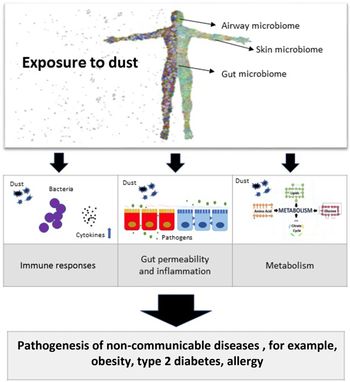
The human microbiome is known to contribute to an array of metabolic and immune processes through host–microbial exchange of metabolites, and to aid the maintenance of gut membrane integrity.Reference Postler and Ghosh100 Similarly, dust in the form of air pollutant or PM also affects immune responses,Reference Castaneda, Vogel, Bein, Hughes, Smiley-Jewell and Pinkerton101,Reference Miller and Peden102 systemic inflammation,Reference Pope, Bhatnagar, McCracken, Abplanalp, Conklin and O’Toole103,Reference Li, Dorans and Wilker104 gut permeability, and host metabolism.Reference Salim, Kaplan and Madsen105,Reference Mutlu, Engen and Soberanes106 Moreover, previous studies showed that dust is associated with a variety of human health disorders,Reference Shan, Wu, Fan, Haahtela and Zhang31 with the association perhaps mediated by modification of human microbiome.Reference Valles and Francino107 Taken together, dust may negatively impact health through alterations in the composition and functions (in terms of immune response, gut permeability, and metabolism) of human microbiome that will eventually contribute to the pathogenesis of NCDs (Fig. 1).
Mechanistic links between dust exposure and pathogenesis of non-communicable diseases.

Immune regulation
Mechanistic studies have shown that PM and SPM in the environment may result in inflammatory and allergic responses and consequently respiratory-related diseases. One-week-old neonatal mice subjected to early PM2.5 exposure (1.13 g/m3, 60 min each time, once per day) for 8 days showed a reduced programmed death-ligand 1 expression, which subsequently leads to allergic airway inflammation due to interference with the establishment of immune tolerance.Reference Yan, Gong and Ying108 Smeekens et al. have demonstrated an adjuvant effect of house dust, which enhanced peanut sensitization and ensuing peanut allergy in mice.Reference Smeekens, Immormino, Balogh, Randell, Kulis and Moran109 A study by Ormstad et al. demonstrated that indoor SPM, particularly those less than 2.5 μm in diameter, acts as an allergen carrier and adjuvant capable of modulating local lymph node inflammatory responses.Reference Ormstad110 It was suggested that the fine particles (PM2.5 fraction) were able to penetrate deeply into the airways, inducing epithelial irritability and increased sensitivity to environmental allergens, which subsequently affect respiratory health and induce the chronic airway inflammation characteristic of asthma. Exposure of PM has been found to not only disrupt skin barrier but also result in oxidative stress, increasing the levels of reactive oxygen species and proinflammatory cytokines, aggravating skin diseases such as AD.Reference Kim, Cho and Park111 PM also induced up-regulation of cyclooxygenase-2, decreased filaggrin expression, and promoted skin inflammation.Reference Lee, Lin and Hu112
Microbial associated endotoxins in house dust have been proposed to play a pivotal role in influencing the proportions, phenotypes, and functions of innate immune cells. In a study of 7–14-year old Amish and Hutterite children with similar genetic makeup and lifestyles, Amish children had a 4-fold lower prevalence of asthma and 6-fold lower rates of allergic sensitization as compared to Hutterite children.Reference Stein, Hrusch and Gozdz113 This has been attributed to the higher mean endotoxin levels in house dust of Amish children, which was more than six times higher than that of the Hutterites. Multiple innate immune genes were also found to be upregulated in the Amish children. Importantly, Amish house dust extract was administered intranasally to mice and was found to significantly inhibit ovalbumin-induced airway hyperresponsiveness and eosinophilia. This contrasts with Hutterite house dust, which was shown to exacerbate airway hyperresponsiveness. However, the inhibitory effects of the Amish house dust extract were not observed in mice that were deficient of the MyD88 and Trif genes, indicating that house dust may regulate innate immune response involved in the pathogenesis of allergic diseases.Reference Stein, Hrusch and Gozdz113
Studies involving large animals also showed the effect of dust exposure on immune development.Reference Clifton, Moss and Wooldridge114,Reference Wooldridge, Clifton and Moss115 Maternal allergic asthma in sheep was established by house dust mite (HDM) allergen sensitization before pregnancy and subsequent HDM challenges throughout pregnancy. HDM-induced maternal allergic asthma caused lung resistance and influx of eosinophils in the maternal lung tissues,Reference Clifton, Moss and Wooldridge114 and it also caused a decrease in gene expression of surfactant protein BReference Clifton, Moss and Wooldridge114 and the number of type II alveolar epithelial cellsReference Wooldridge, Clifton and Moss115 responsible for producing surfactant in the fetal lung tissue in late gestation. These findings are significant as they suggest that exposure to house dust in sheep may affect lung maturation at both the molecular and structural levels, and this may increase the risk of experiencing respiratory complications after birth.Reference Mendola, Mannisto, Leishear, Reddy, Chen and Laughon116
Gut permeability and inflammation
The human microbiome is known to play an important role in maintaining gut membrane integrity.Reference Postler and Ghosh100 Similarly, dust in the form of air pollutant or PM was also found to affect microbiome diversity, increasing inflammation and permeability of epithelial and endothelial surfaces and increasing susceptibility to allergen exposure and metabolic dysregulation.Reference Pope, Bhatnagar, McCracken, Abplanalp, Conklin and O’Toole103,Reference Salim, Kaplan and Madsen105,Reference Mutlu, Engen and Soberanes106
Mutlu et al. showed that PM induced mitochondrial reactive oxygen species generation, which caused oxidant dependent NF-kB activation and increased cell death of Caco-2 cells in the gut of mice. This leads to disruption of tight junctions and increased gut permeability.Reference Mutlu, Engen and Soberanes106 Multiple studies have also shown that dust which is rich in Der P 1 antigen decreased sinonasal epithelium tight junction protein expression, leading to increased epithelial permeability.Reference Henriquez, Den Beste, Hoddeson, Parkos, Nusrat and Wise117–Reference Tulic, Vivinus-Nebot and Rekima120 Another study reported that dust mites interact with eosinophils to disrupt tight junctions in the oesophagus.Reference Hinz121 These data suggest that increased permeability of epithelial and endothelial linings via disruption of tight junctions may be a key mechanism through which dust increases inflammation and susceptibility to allergy and other NCDs.
Metabolism
Metabolomic analysis has revealed distinct metabolomic profiles in human lung epithelial cells exposed to PM. Exposure to PM2.5 was found to alter the abundance of cellular metabolites and expression of metabolic genes involved in major metabolic pathways, including the citrate cycle, amino acid biosynthesis and metabolism, and glutathione metabolism.Reference Huang, Zhang and Luo122 Serum metabolome and levels of circulating circadian rhythm biomarkers were altered in mice subjected to chronic exposure of PM for 10 months compared to mice exposed to filtered air, and the altered metabolites were found to impact amino acid and lipid metabolism pathways.Reference Xu, Wang and Zhou123 Li et al. also reported that human participants exposed to PM2.5 showed a change in serum metabolites involved in glucose, amino acid, and lipid metabolism.Reference Li, Cai and Chen124 A recent study suggested that house dust may impair sphingolipid metabolism contributing to the development of an asthma phenotype.Reference Kowal, Zebrowska and Chabowski125 Kassotis et al. also discovered that house dust contains multiple endocrine-disrupting chemicals that exhibit adipogenic activity, leading to triglyceride accumulation which may contribute to the development of obesity.Reference Kassotis, Hoffman and Stapleton126 Since the microbiome plays a pivotal role in regulating host metabolism,Reference Turnbaugh, Ley, Mahowald, Magrini, Mardis and Gordon127–Reference Nieuwdorp, Gilijamse, Pai and Kaplan129 the perturbation of metabolic processes by environmental dust (PM) may be at least in part attributed to the effect of dust in modulating host microbiome.
Conclusions
In this review, we have summarized the findings demonstrating the likely impact of dust on NCDs. The evidence supports a role for dust in influencing human microbiomes at different body niches, which may then affect immune response, intestinal permeability, and metabolism, leading to the development of several NCDs. However, there is a lack of clinical studies that examine the associations between dust exposure, microbiome, and health outcomes in human individuals. The exact dust (PM) composition causing the change in microbiome profile and health outcomes, and the direct effects of these dust composition in altering microbiome and causing health consequences should be investigated. Further studies are also needed to elucidate the mechanisms underpinning microbiome transfer between the environment and different body niches, and pathways towards disease pathogenesis.
With the widespread forest fire and increasing air pollution in certain parts of the world, the levels and composition of PM will differ between countries.Reference Karagulian, Belis and Dora130 Hence, it is important to identify the sources of PM between different populations so as to devise appropriate strategies to mitigate the effect of PM exposure throughout the life course. One such strategy could be the use of appropriate cleaning products to prevent exposure to certain PM or microbes present in the PM that may affect microbiome profile and result in adverse health outcomes.Reference Tun, Tun and Mahoney131
In conclusion, dust is an environmental factor that we are in constant contact with. In-depth examination into the relationships between dust and human microbiomes may unravel modifiable environmental targets and strategies for microbiome manipulation that can aid in the early prevention and management of human microbiome-associated NCDs.
Acknowledgments
None.
Financial support
KMG is supported by the UK Medical Research Council (MC_UU_12011/4), the National Institute for Health Research (NIHR Senior Investigator (NF-SI-0515-10042), NIHR Southampton 1000DaysPlus Global Nutrition Research Group) and NIHR Southampton Biomedical Research Centre), the European Union (Erasmus+ Programme Early Nutrition eAcademy Southeast Asia-573651-EPP-1-2016-1-DE-EPPKA2-CBHE-JP), the US National Institute On Aging of the National Institutes of Health (Award No. U24AG047867), and the UK ESRC and BBSRC (Award No. ES/M00919X/1). Loo EX is supported by the Singapore National Medical Research Council (NMRC/OFYIRG/015/2016-00).
Conflicts of interest
The authors declare that there is no conflict of interest.
Ethical standards
None.