Introduction
The purpose of blood services is to provide patients with equitable access to medical benefits with safe blood components as needed and thus rely on donations of blood to keep their operations running for a long period. Considering the blood supplies for disaster relief, ‘the more the better’ appears to be the preliminary perception and active blood drives by which persons are aggressively requested to donate blood in response to a specific emergency or shortage have been issued for helping people during disasters. Reference Glynn, Busch and Schreiber1-Reference Abolghasemi, Radfar, Tabatabaee, Hosseini-Divkolayee and Burkle4 However, perishability associated with the transfusible blood represents an important but overlooked characteristic of supply management due to the complicatedness underlying their disposal policies. Unplanned discarding of qualified blood means turning the generous impulses of donors into medically and socially inefficient wastes, which may, in turn transform benevolent acts of blood donors into parsimonious thrift. If more and more potential donors decide to exercise thrift in giving blood, the supply will eventually face major shortages when confronting a similar crisis. On the other hand, widespread concern has been raised that the blood banking system would be discredited by prohibiting rife and excessive donations that could otherwise deplete the consumables, e.g., blood bags, and the overloaded burden further demoralization of the beleaguered blood banking professionals. Reference How5-Reference Klein and Anstee8 Thus, an ideal balance should exist to operate blood collection in accordance with needs for any disaster, dictated by the functional impact of an event on transportation and facilities around the site of incidence, the types of injury caused, and the landscape of potential donors.
Maintaining the equilibrium of supply and demand highlights considerable challenges in developing an effective (but not excessive) donor recruiting method, and suggests that new strategies targeting actual condition of transfusion need consideration. Therefore, it is important to evaluate the effect of inert recruitment, i.e., proactively clarify to the public when blood components are not needed without turning away the emerged donors as an approach to limit blood donations to the unsolicited donors only, during disasters.
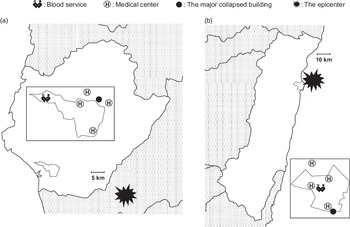
Being located on the Circum-Pacific seismic zone, Taiwan is 1 of the most earthquake-prone areas in the world, with earthquakes registered above ML7 occurring recently. Reference Yang9 According to the Central Weather Bureau’s earthquake monitoring information recorded between 1991 and 2004, the annual average number of earthquakes was 18649 (monthly mean to be around 1554), of which approximately 1047 were felt. Reference Wen, Wu, Huang, Chang, Liu and Wu10 The official analysis also indicates that there have been 96 catastrophic earthquakes since 1900. Reference Cheng11 Therefore, being an earthquake-experienced population, residents are generally well aware of and would follow the instructions on an emergency notification or similar announcements in form of breaking news in web, radio and television broadcasting as well as the short message service (SMS) of mobile device systems issued by the authorities. One day before the most important Chinese Lunar New Year holiday, which typically within the period when most serious seasonal shortages occur—February 6, 2016, at 3:57 AM local time (7:57 PM, February 5, Coordinated Universal Time)—an earthquake of ML magnitude 6.6 struck southern Taiwan (hereinafter referred to as the 6/2/16 earthquake; Figure 1). Tainan suffered the most damages, where 27 buildings were collapsed or nearly collapsed, whereas the total number of casualties was 117 deceased, 499 injured, and 501 hospitalized. Unfortunately, 17 people were killed and 295 injured in 4 toppled buildings when the magnitude 6.0 quake struck Hualien on the eastern coast of Taiwan at 23:50 local time exactly 2 years later, just a week before the Chinese Lunar New Year holiday (hereinafter referred to as the 6/2/18 earthquake; Figures 1 and 2). Figure 2 magnifies the spatial relationships of various activities associated with the corresponding earthquakes.
Five prefectures serviced by blood centers of TBSF.

The location of epicenters, blood services, collapsed buildings and primary medical centers taking care of casualities.

Temporary first-time donor upsurges following national disasters have been well documented. Reference Glynn, Busch and Schreiber1,Reference Liu, Huang and Wang3,Reference Abolghasemi, Radfar, Tabatabaee, Hosseini-Divkolayee and Burkle4 However, as expected, people actually responded to active and explicit blood drive messages in most cases. An immediate rise and a subsequent slump in donations were commonly found in these catastrophic events and consequently compromised the steady state of transfusion. Whether this observation applied to all disasters, especially in the incidence where a rather slack appeal or inert recruiting information was delivered to the public, is yet to be defined. In order to develop new recruiting and retaining approaches focusing on the transformation of the influx donors to regular ones, it is important to investigate the impact of inert recruiting during the 6/2 earthquakes on blood availability, safety, and usage, because attracting new donors is 1 of the key factors for relieving common blood shortages. As being in line with this notion, profiling the corresponding donor landscapes between the date of seismic impact and the benchmark date 1 year earlier may help to develop possible recruiting approaches suitable for people with enthusiastic signatures. Therefore, in addition to characterizing the donor profile, we also evaluated the return pattern of post-earthquake first-time donors and first-time donors in comparable periods, and then assessed the donation careers associated with donation behavior in times of disaster under this particular recruiting scheme.
Methods
Dataset Retrieval
The Taiwan Blood Services Foundation (TBSF), established as a health and medical care institution, has been responsible for voluntary non-remunerated blood donations and supplies in Taiwan since 1974 (Supplementary materials). To compare blood donation activities within the affected areas, i.e., the Tainan Blood Center and Hualien Blood Station, TBSF, before and after the 6/2 earthquakes, dataset retrieval was made according to the protocol approved by the IRB of TBSF (PM-105-TN-162). We searched the donor databases to determine the number of allogeneic donations collected, donor demographics, and the ratio of first-time donors during the 6/2 earthquakes and in a comparable period 1 year earlier. For the consideration of between-group differences, i.e., with or without seismic impacts, the very small number of repeated donors appeared in both occasions (less than 0.1%) was eliminated from the comparisons. In an attempt to identify the effect of a natural disaster on the safety of blood supply with the influx of non-directed donors after the severe earthquake, we analyzed screening results between the date of the earthquake and the comparable date 1 year earlier. To evaluate donor return rates before and after the 6/2 impacts and to characterize lapsed or infrequent repeat donation behavior in times of disaster, we compared the donor careers between pre-earthquake and post-earthquake periods to address these questions.
Statistical Methods
As the studied samples consisting of hundreds and thousands of observations, this particular large enough sample sizes rendered the sampling distribution to be normal, regardless of the shape of the data. Therefore, descriptive results of continuous variables are expressed as mean (±SD) and were subjected to hypothesis tests by using a t-test. For categorical and dichotomous (whether to donate blood or not) variables, hypothesis testing was performed through chi square test [n (%)]). A probability value (P value) less than 0.05 indicates strong evidence against the null hypothesis and thus is statistically significant. Furthermore, multiple logistic regressions were applied to assess the association of interests (Supplementary Tables). The year of blood donation was the outcome (earthquake vs. non-earthquake) while the demographic (age, gender, city, and occupation) and donation information (first, amount, and blood type) were the independent variables. Additionally, the population density of urban Tainan City and rural Hualien Count was 860.6 p/km2 and 71.5 p/km2, respectively. With this difference in mind, we further separated the data for each City/County and re-assess the association of interests, this was analyzed by using SAS 9.4 v (SAS Institute Inc, NC, USA).
Results
Unwavering Support of Blood Donation after Earthquakes
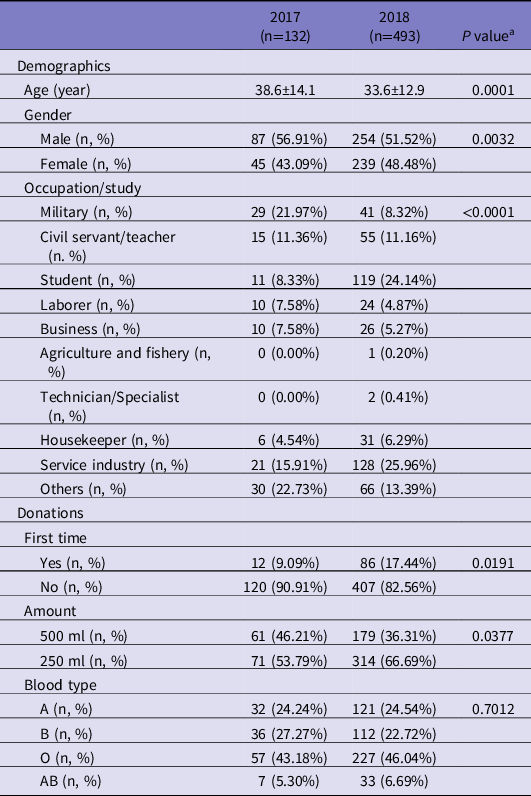
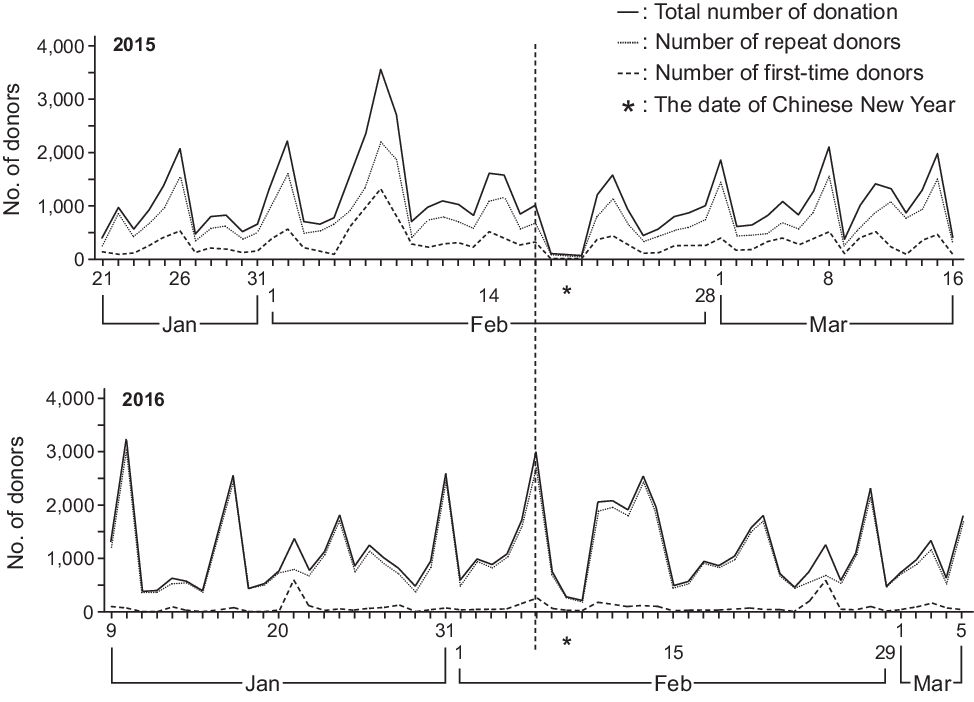
There were 2145 blood donations after the 2016 Tainan earthquake. As shown in Table 1, compared to the same period of time in 2015 for blood donation, we found that age (P < 0.0001), occupation (P < 0.0001), and first-time blood donation (P = 0.0007) were significantly increased after the earthquake (earthquake, 2016 vs. non-earthquake, 2015). Similarly, there were 493 blood donations immediately after the 2018 Hualien earthquake, compared to the same period of time in 2017 for blood donation, we found that age (P = 0.0001), gender (P = 0.0032), occupation (P < 0.0001), first-time blood donation (P = 0.0191, Table 2) and blood amount (P = 0.0377, Table 2) were significantly associated with the appearance of earthquake (earthquake, 2018 vs. non-earthquake, 2017). This 3- to 4-fold increase in donors helped in keeping a high level of blood product during the Chinese New Year celebrations when a lack of donors is evident (Figure 3, Tables 1 and 2). As observed in 2016 Tainan earthquake, the regular donors did not respond to the ‘stay-put’ appeal and were then lost for the ensuing 9 days (Figure 3). The net effect is a negligible increase in donations and a ‘burnout’ of regular donors as indicated by less than 980 units, which represents an average amount of daily supply, collected per day in the Tainan Blood Center.
Between-year analyses of demographic and donation information in 6/2/16 Tainan earthquake

a Continuous variable was assessed by t-test: categorical variable was assessed by using Chi-square test.
Between-year analyses of demographic and donation information in 6/2/18 Hualien earthquake

a Continuous variable was assessed by t-test: categorical variable was assessed by using Chi-square test.
Number of donors at the Tainan Blood Center during a comparable period in 2015 and 2016.

Donor Demographics
To estimate the actual size/impact of the effect, we combined earthquake blood donation information of both cities to assess the association of interests (Supplementary Table 1). After the adjustment for gender and blood type, we found that age (OR = 0.970, 95% C.L. = 0.961, 0.978), city (Hualien vs. Tainan; OR = 1.339, 95% C.L. = 1.076, 1.666), fist-time donated blood (yes vs. no; OR = 1.617, 95% C.L. = 1.201, 2.177), and individual occupation (in which other cumulative occupations vs. student also positively correlated; OR = 1.776, 95% C.L. = 1.307, 2.443) were significant statistics associated with the blood donation during the earthquake years. With 1 year increasing in age, the subject was 0.97 times as likely to denote the blood; that is, younger subjects had more blood donations than older subjects during the earthquake years. Hualien County had 1.34 times higher blood donation after the earthquake than that of the people in Tainan City. After the earthquake, people in both city/county had 1.62 times higher first-time blood donation than that of the non-first-time donators. In addition, compared to the students, the following occupations had higher blood donation after the earthquakes, including civil servant/teacher (OR = 1.679, 95% C.L. =1.172, 2.406), laborer (OR = 1.695, 95% C.L. = 1.268, 2.267), business (OR = 2.169, 95% C.L. = 1.489, 3.160), technician/specialist (OR = 6.037, 95% C.L. = 1.806, 20.313), housekeeper (OR = 1.676, 95% C.L. = 1.098, 2.559), service industry (OR = 1.795, 95% C.L. = 1.306, 2.370), and others (OR = 1.795, 95% C.L. = 1.324, 2.433).
Re-analyses of the separate specific areas confirm the combined OR estimations, as presented in supplementary Table 1; that age, first-time donation, and occupation are correlated with donation after the earthquakes. Nevertheless, a minor behavioral gap between urban and rural locations does exist. Supplementary Table 2 and 3 denote that the female population in Hualien County (OR = 1.195, 95% C.L. = 1.002, 1.425) appear to be more motivated by the corresponding earthquake than its counterpart in Tainan City.
Screening Reactive Rates, the Amount Distributed in the Hospitals and one year Donor Return Rate
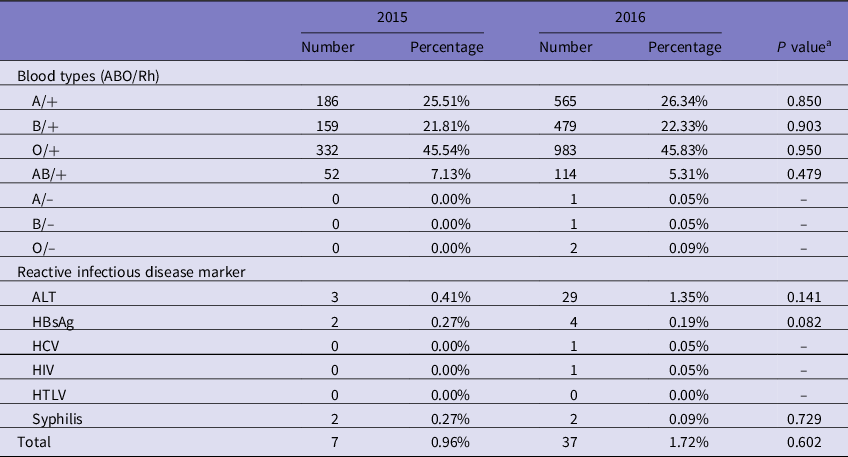
As presented in Table 3, overall, there was a slight increase in the Rh– in the post-earthquake donations. Moreover, infectious disease marker rates did not show any significant increase on post-earthquake periods than on comparable pre-earthquake periods in the preceding year. As indicated in Figure 4, the preparation and supply of components other than RBC remained the same as the control period. Although there was a large increase in the number of blood donations by the public during the disasters, the 6/2 earthquakes showed no increase, but a slight decrease in the blood demands.
Between-year comparison of donor screening in 6/2/16 Tainan earthquake

a P values for comparisons between subgroups were computed using the Chi-square test with one degree of freedom.
Number of blood components supplied to and transfused by the medical centers during the 6/2 earthquakes and the precedent contol year.

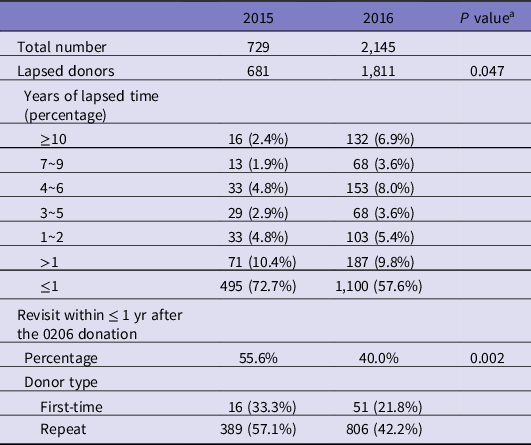
Table 4 indicates a tendency that experienced, lapsed donors were easier to motivate to donate blood after a major disaster than first-time donors (P = 0.047). Additionally, although first-time donors have been seen to give blood in larger numbers after major disasters or national emergencies as shown here, unfortunately, a large proportion of the novice donors who presented following the earthquakes have not appeared willing to commit to regular or even to repeat donations within a year (P = 0.002).
The donor careers of 6/2/16 enthusiastic donors and the comparable 2015 regular ones

a P values for comparisons between subgroups were computed using the Chi-square test with one degree of freedom.
Discussion
In contrast to other modern calamities like the terrorist attacks on September 11, 20011 or the Great East Japan Earthquake of March 11, 2011, Reference Nollet, Ohto, Yasuda and Hasegawa2 non-fatal traumatic injury prevailed in the 6/2 earthquakes and thus victims have survived long enough to need transfusion. However, as blood is a perishable product together with the fact that transportation, medical facilities and transfusion services were mostly unaffected by the intensity of the seismic impact, thus access by road to the areas were unimpeded and transfusible blood components were brought in from neighboring blood centers (Figure 1); the TBSF immediately issued an island-wide announcement asking people to stay put and not rush to the donation units to donate blood on a regular basis till at least after 3 days into the holiday. However, people still queued up for donations; 2145 and 494 volunteer donors responded at the end of the day in Tainan and Hualien respectively. Consequently, a 3- to 4-fold increase from the usual comparable dates was observed, however, our experience presented here confirms the theories that donating more blood immediately after disasters will not expand the provision of emergency care and all the blood needed for the victims is already available in the inventory of blood collection agencies. Reference Schmidt12
Routine deficiencies of blood supply have seriously plagued the transfusion society as the population ages and as more and more stringent criteria are applied to ban certain donors from giving blood. Blood shortages are also common in Taiwan, with special blood drives routinely issued especially in summer months, the winter holidays and especially over the period of the Chinese New Year. But every now and again, volunteers swarm as a massive outpouring of donors that actively seek to give blood to the victims of natural disasters or man-made calamities. As blood donation is a highly regulated and sensitive practice around the world, so too is the disposal of overdue transfusible products. If left unchecked, this action may threaten donors to lapse into apathy or lose sight of the long-term blood needs which can cause vastly negative consequences at all levels. While Taiwan has a long and devastating history of natural disasters such earthquakes and typhoons, 1 of the key challenges faced by blood collection agencies has been the uncertain nature of the balance between emergency medical needs and facing a glut. The present study may therefore be helpful in allowing managers to focus in on a smaller enthusiastic population in contemplation of donor recruitment. Indeed, the existing literature supports an immediate appearance of a massive influx of altruistic blood donors in response to an institutional plea or a governmental appeal for transfusion shortages during catastrophic events. Reference Glynn, Busch and Schreiber1-Reference Abolghasemi, Radfar, Tabatabaee, Hosseini-Divkolayee and Burkle4,Reference Perisse, Pouget, Ragot, Bouzard and Sailliol13 If such donations were strictly rational, the announcement of a sufficient supply, through the general public address system to the experienced population might lead people to give less to the cause; they might figure their blood is no longer needed as much. Nevertheless, the effect of a passive institutional plea in blood donation is less clear. In the cases of 6/2 earthquakes, TBSF determined that based on the scale of damage, local hospitals would unlikely warrant a blood bank response beyond routine; the institution’s emergency protocol to call for additional donation was thus not activated. Instead, TBSF inquired donors to donate blood later after 3 days of holiday, still, a large number of donors came forward willingly. To the best of our knowledge, similar situations without actively conducting blood drives have not been studied in the community of blood collection agencies yet. Our results from the reactive rates of infectious disease markers indicate that blood collected from the surged donors immediately after the disaster did not lead to worse blood quality. Furthermore, a large proportion of the donors who presented themselves for blood donation following a disaster have not appeared willing to commit to regularly or to even repeat donations within a year (Table 4), clearly signifies a challenge to blood collection agencies to treat and strategically market to these novice donors to encourage them to return as soon as possible after their initial donation and to keep them returning within a certain period of time.
Although altruism may be a reason why some donors give their precious blood to strangers, donating should have to be perceived as inherently worthwhile or satisfying to induce many people to volunteer, even under a flexible discouraged condition i.e., the lack of being specifically asked to give blood, and even though the donors do not see who they are helping or the immediate results from their generosity. During the normal period of time, altruism has been identified as the most critical motivation and belief for blood donation Reference Ferguson, Atsma, de Kort and Veldhuizen14 ; however, are there any motivational forces other than pure altruism at work, especially within the disaster recovery phase? This is an intriguing question that has implications on our efforts to encourage volunteerism for blood donations. Our observations that donors present themselves to donate blood in the wake of earthquakes even when they were specifically asked not to may be strongly reconciled with the behavior implicated by the ‘warm glow’ theory– one feels for being the kind of person who is helping the world in some way and people may not be giving merely because a program’s mission aligns with their values. Reference Andreoni15 Accordingly, the internal motivation for giving is not the demand for the product (blood), but rather the personal gain from giving (donation).
While enthusiastic donations could be partially explained by ‘warm glow’a, there may remain other possible, non-mutually exclusive factors beyond it to explain the reasons behind why people find blood donation valuable in such a context. Firstly, as measured by a questionnaire, the population of donors who donate after an emergency is different from those who donate in non-emergency times. Reference Fung, Balderama and Chen16 Consequently, traditional standard approaches for communicating with donors may be not effective with this particular population. On the other hand, how natural or man-made disasters can impact on the individuals or even an entire country is obvious, as ignorance or being unaware of the need or option for blood donation has been constantly identified as a negative factor in potential donor decision making, Reference Bartel, Stelzner and Higgins17,Reference Moore18 an increase in concern and awareness by the impact of a disastrous event may lead to all sorts of elevated motivation for donating. Finally, although the prevalence rate varied widely, posttraumatic stress disorder (PTSD) has been identified as the most commonly occurring mental health condition among earthquake survivors. Reference Farooqui, Quadri and Suriya19-Reference Chang, Connor, Lai, Lee and Davidson21 Similarly, other natural disasters such as a typhoon have been reported to cause relatively large psychological problems to the disaster victims by reducing serotonin levels in PTSD patients. Reference Guo, Tian and Wang22 Although predicting the precise contribution of PTSD in the genetically heterogeneous human population is a difficult if not a fundamentally impossible task in the present work, it seems logical that serotonin levels, which loom large in emotional control and behavior Reference Crockett, Clark, Hauser and Robbins23-Reference Terbeck, Kahane and McTavish25 and are critical for translating aversive Pavlovian cues into behavioral inhibition, Reference Crockett, Clark, Hauser and Robbins23 naturally drop among some individuals in the disaster area. It remains possible that in these particular individuals, the theoretical social preference profiles have been shifted toward a pro-social preference, Reference Siegel and Crockett26 and personal emotional or affective reactions may outweigh the overall cognitive evaluations in determining their intention to donate blood. From an evolutionary perspective, our instinct is to seize the reward at hand, and thus blood donation may represent the easy way out of a hormonal drive. However, first-time PTSD donors in the affected area suffered the initial distress, anxiety and negative feelings associated with blood donation even more than regular ones and thus become reluctant to donate blood again. In line with this theory, first-time donors, in particular, would need to be encouraged for good measure to overcome the hurdles and to reach the point of elation after donation and, as a result, become scheduled donors.
No matter what is the major motivator for donating after a disaster, it is the routine shortages of blood supply that plague us as the population ages and as more and more risk groups are banned from giving blood, a situation that will only get worse. However, as we pointed out in this study, blood collection agencies must recognize that natural disasters or modern calamities can cause a very high emotional willingness to donate among existing donor and non-donor populations. This may represent an opportunity in the aftermath of a disaster to expand the current donor pool, building better and stronger donor communities than before. With the modernization of many societies worldwide and the changes industrial activities have brought to the environment, many natural disasters have gained in both frequency and intensity. Although this translates to increased global impact of natural disasters at all levels, opportunities for expanding the donor pool present themselves following a disaster. Increasingly, the serendipity responsible for stimulating a surge of blood donation may give way to systematic blood drives for candidates. Finally, does present knowledge allow any generalizations to be made that will be useful in suggesting the donors’ malleable nature in giving blood? Although the present results are not derived from a mix-method of longitudinal studies, judging from the experience during other earthquakes without dissuasion for blood donation or even with positive appeals, donors came in droves for 4 days and weeks, Reference Liu, Huang and Wang3,Reference Abolghasemi, Radfar, Tabatabaee, Hosseini-Divkolayee and Burkle4,Reference Sönmezoglu, Kocak and Oncul27 respectively. Contrary to expectation, the upsurge had not lasted for more than 1 day in the present survey; thus the answer would appear to be yes. In our opinion, new approaches, which are not discussed in this work, for engaging, qualifying, retaining, and converting these emerging donors that represent a vast untapped resource into the mainstream donor population are required.
Limitations
This study examined data derived from pre-existing donor databases which were subjected to selection bias, in which lack of information for all variables might affect the study outcome. Also, including a questionnaire survey may have provided more information about the effectiveness of the inert recruiting.
Conclusions
From an operational point of view, this study proposed a protocol to minimize excessive blood donations while ensuring that disaster-affected areas receive essential transfusion resources, using an inert recruiting approach. The result suggests that such an approach was ineffective to limit donor upsurge during the initial emergency response; however, the duration of upsurge was found to be controlled. The indications from this study will not only help disaster risk management in Taiwan but also help in preparedness planning in other earthquake-prone regions of the world.
Supplementary material
To view supplementary material for this article, please visit https://doi.org/10.1017/dmp.2020.385
Acknowledgments
This work was supported in part by a grant from the Tainan Blood Center, Taiwan Blood Services Foundation (PM-106-E0-06).
Conflict of Interest
None of the authors have a conflict of interest which impacts the findings of this study.