

1. INTRODUCTION
The French subjunctive has been the object of much recent research in both formal and variationist sociolinguistics, with the latter body of work focussing primarily on North American varieties, in particular Québec French and its offshoots. The present study is part of a large program of research which systematically investigates the relative effects of dialect contact on Acadian French communities in Atlantic Canada. Here we show that a broad range of historical facts related to type and degree of dialect contact and to the emergence of local prestige norms are essential to understanding variation in mood (and, to some extent, tense) which obtains across this diaspora.
The article is organized as follows. We first outline how the subjunctive mood is used in French. We then present the relevant linguistic information regarding the verbal domain in Acadian French along with an overview of the sociolinguistic histories of the five Acadian communities under investigation. The methodology of the present analysis is discussed: the data sources on which our analysis is based are presented, as are the contexts in which subjunctive vs. indicative usage is variable, and the relationship between mood choice and an intervening variable, tense parallelism, is described. We present individual results for each community and then present an account of intercommunity variation. This account emphasizes the importance of the social evaluation of language use in the formation of contact varieties, specifically in the establishment of community norms.
2. BACKGROUND
2.1 The Subjunctive Mood in French
The French subjunctive is primarily an embedded-clause phenomenon which may express a broad spectrum of meanings related to attitudes, emotions, opinions, evidentiality, possibility, necessity, volition, non-assertion, doubt, etc. It is governed by verbal matrices such as vouloir ‘to want’, craindre ‘to fear’, souhaiter ‘to hope’ along with non-verbal matrices such as pour que ‘so that’, sans que ‘without’, de peur que ‘for fear that’. There has been considerable debate as to whether or not the French subjunctive has a productive semantic reading (e.g. Abouda Reference Abouda2002; Posner Reference Posner1997; Rowlett Reference Rowlett2007; Poplack et al Reference Poplack, Lealess and Dion2013); for instance, Brunot (Reference Brunot1922) argues that the French subjunctive is simply a marker of subordination.Footnote 1 In fact, such debate goes back to the 17th century when grammarians began to prescribe obligatory subjunctive selection in certain contexts (see e.g. Nyrop Reference Nyrop1930 and Posner Reference Posner1997 for discussion). We will not enter into this debate but concentrate instead on variable selection of the subjunctive (vs. the indicative) mood. While there has been a certain amount of variation in the set of subjunctive-selecting contexts throughout the recorded history of the language (Fournier Reference Fournier1998; Goosse Reference Goosse2000), some contexts are uniformly cited across time. Such is the case with the impersonal matrix verb falloir ‘to be necessary’, the primary focus of the present study. Falloir has all of the semantic and structural features that promote use of the subjunctive: it has an impersonal subject, it takes a subordinate clause as complement, and it is a verb of necessity, obligation, etc. Further, polarity does not affect tense and mood selection.
Moreover, variationist studies for several varieties of Canadian French (e.g. Auger Reference Auger1988, Reference Auger1990; Comeau Reference Comeau2011; Poplack et al Reference Poplack, Lealess and Dion2013; Grimm Reference Grimm2015) have shown that falloir is the most frequently occurring context for subjunctive selection found in sociolinguistic corpora. It is illustrated in 1 with the 1st person singular present subjunctive form of aller ‘to go’ and in 2 with the 2nd person singular present subjunctive form of lire ‘to read’:Footnote 2
1 Il faut que je m’en aille . (GC-06)
‘I have to leave.’
2 Il faut que tu lises la leçon. (SL-30)
‘You had to read the lesson.’
Further, all of these studies found very high rates of the (present) subjunctive (vs. indicative) usage in this context (e.g. Gatineau, Québec, 94% n= 498/530, Poplack et al Reference Poplack, Lealess and Dion2013; Hawkesbury, Ontario, 96% n=278/291, Grimm Reference Grimm2015), to the point of categoriality in Comeau’s study of mood choice in Grosses Coques, Nova Scotia Acadian French (n=249/249). The analysis presented below will be based on results for this verbal matrix.Footnote 3
2.2 Acadian French
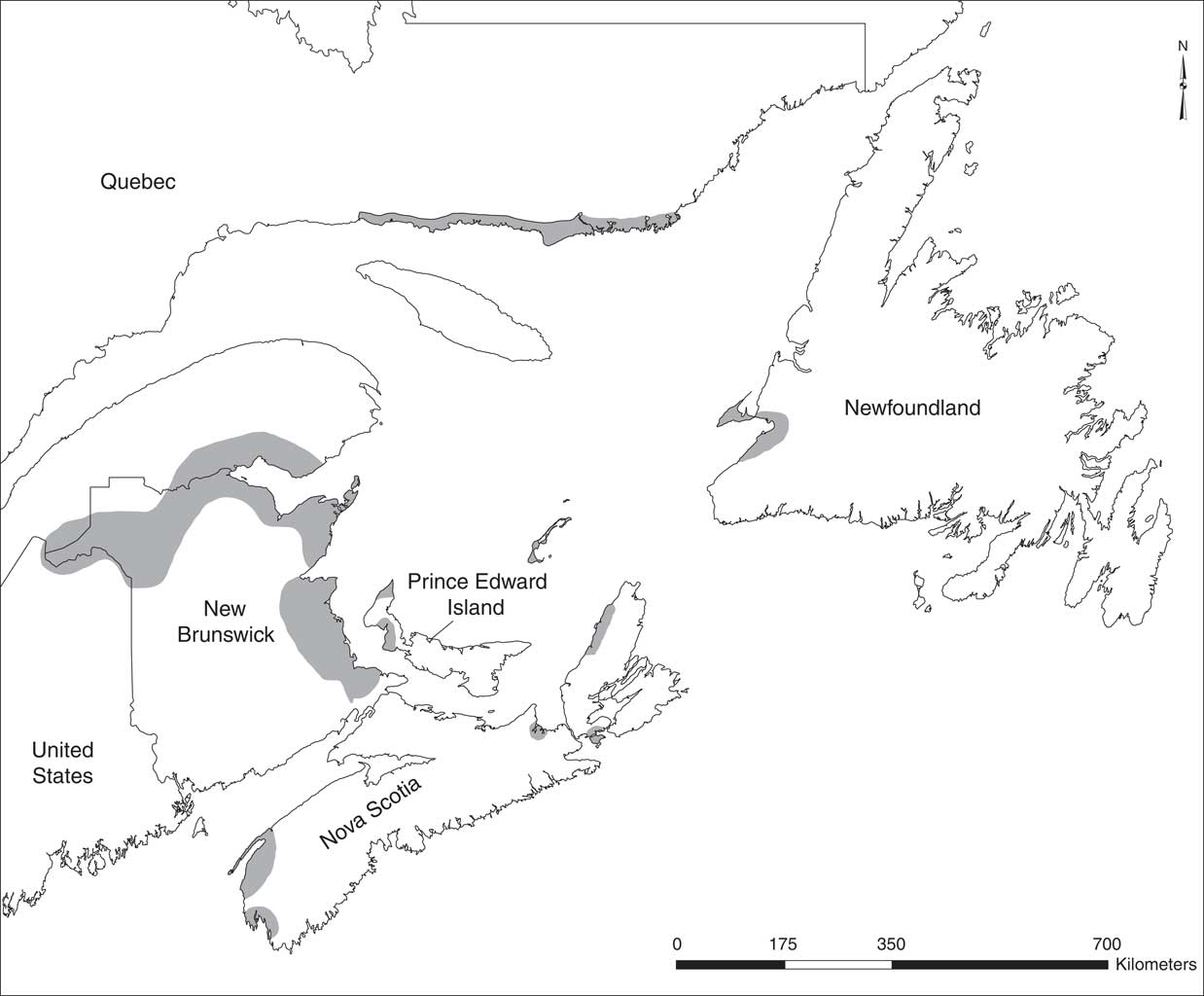
Acadian French refers to varieties of French spoken in Canada’s four Atlantic Provinces and in parts of eastern Québec (Map 1); a close relative, Cajun French, is spoken in Louisiana in the United States. The Acadian presence in North America dates from the early 17th century, with settlers largely from the centre-west of France, who were mainly of rural background and members of the lower class (Massignon Reference Massignon1962). By contrast, settlers of New France (latterly Québec) were of more mixed origins, both geographically (Charbonneau & Guillemette Reference Charbonneau and Guillemette1994) and socially (Choquette Reference Choquette1997). Flikeid (Reference Flikeid1997) has argued that even more important than geographical origins for the distinctiveness of Acadian (vs. Québec) French are the relatively low levels of normative pressure which have obtained over the course of more than three centuries in Acadia, leading to the retention of vernacular forms moribund or entirely lost elsewhere in la francophonie, along with the emergence of a number of linguistic innovations (King Reference King2013). We would add that type and degree of dialect contact since initial settlement are also important factors in explaining both the unity and diversity found across the Acadian diaspora, contact which we investigate systematically with regard to mood choice in the present study.
Acadian regions of Atlantic Canada (in grey).

The example in 1 is taken from the 1990 Butler sociolinguistic corpus for the Acadian community of Grosses Coques in south-west Nova Scotia, also the source of Comeau’s (Reference Comeau2011) data. In the example in 3, taken from the same corpus, imperfect falloir triggers the imperfect subjunctive of faire ‘to make/do’ in the embedded clause while the simple past fallut triggers the past subjunctive:
3 Il fallait qu’elle fit de la confesse. (GC-27)
‘She had to make a confession.’
4 Fallut qu’il ait resorti dehors.Footnote 4 (GC-13)
‘He had to go outside again.’
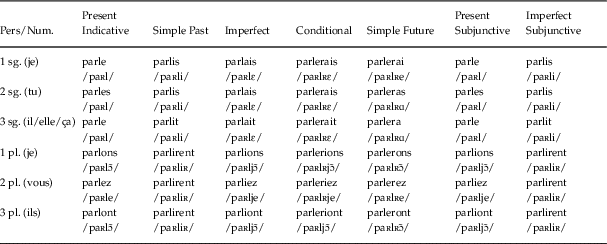
Varieties like Grosses Coques Acadian French exhibit relatively rich verbal morphology, given that they retain a number of inflectional endings now obsolete in most other contemporary spoken French varieties. For example, we see in Table 1 overt 1st and 3rd person plural marking in the form of a regularized –ons/ont suffix (/ɔ̃/).Footnote 5 The present indicative and the present subjunctive forms are distinct in 3rd person plural contexts, unlike in most other varieties of French where they are homophonous (i.e. Standard French orthographic –ent is phonetically null). This absence of homophony means that the amount of unambiguous mood choice data one can extract from an Acadian corpus is typically larger than would be the case for French varieties with less rich morphology. We return to Acadian verbal morphology in more detail below.
Acadian French Simple Tenses (Conservative Varieties)

3. METHODOLOGY
3.1 The Communities
In line with some earlier comparative research on Acadian French, we take the south-west region of Nova Scotia, where the Acadian colony had taken hold by the late 17th century, as a baseline variety for measuring retention of vernacular forms (e.g. Flikeid Reference Flikeid1994; Comeau, King & LeBlanc Reference Comeau, King and LeBlanc2016). As noted above, an important source of variation in Acadian French is degree of contact with supralocal varieties of French over the centuries, which first stemmed from the forced removal of the Acadian people from their lands during the British Expulsion of 1755-1758. The post-Expulsion dispersal of the Acadian people and subsequent years in exile involved dialect (and language) contact of various sorts, with the return from exile beginning in the 1760s and lasting for several decades. Ross & Deveau (Reference Ross and Deveau1992) document the fact that south-west Nova Scotia saw the early return of a significant proportion of former inhabitants of the original Acadian colony at Port-Royal along with a few other pre-Expulsion settlements, making this area the most homogenous of Acadian regions to this day.
On the other hand, Acadian settlement of New Brunswick, Prince Edward Island, eastern Nova Scotia, Newfoundland, and eastern Québec (including the Iles de la Madeleine in the Gulf of St. Lawrence), all involved complex immigration patterns and population movements. For instance, settlement of Chéticamp on Cape Breton Island (formerly known as Ile Royale) in present-day Nova Scotia involved a mix of Acadians who had been returned to France at the time of the Expulsion, others from Prince Edward Island (formerly known as Ile St-Jean), and still others who had spent time on the French islands of St-Pierre and Miquelon off the south coast of Newfoundland. While Acadian settlement of Prince Edward Island began in earnest in 1720, involving secondary settlement on the part of Acadians from modern-day Nova Scotia, the Expulsion resulted in some of the island’s settlers being returned to France, others escaping to what is now north-east New Brunswick and eastern Québec, and still others exiled to present-day Louisiana. The return from exile involved the establishment of new communities, since the Acadians’ original lands had become the property of English absentee landlords (Arsenault Reference Arsenault1986).
Beginning in 1765, the previously uninhabited Iles de la Madeleine became a place of refuge for Acadians who had gone into hiding during the Expulsion. They were followed by a small group of Metropolitan French and a relatively large contingent of Acadians who had previously found refuge on the French island of Miquelon, after having been returned to France (Fortin & Larocque Reference Fortin and Larocque2003). In the 1800s, these Iles de la Madeleine settlers were joined by other small groups of deportees who had settled in the Chéticamp and Ile-Madame areas of Nova Scotia as well as in Prince Edward Island subsequent to the Expulsion (Carbonneau Reference Carbonneau2009). Throughout the 19th century, individuals (sailors, fishermen, priests, teachers, deserters from French military service) from France and Québec also settled on the Iles de la Madeleine.
As noted above, south-west Nova Scotia has been found to better preserve traditional vernacular variants than any other Acadian variety yet studied, due to its homogeneous settlement pattern and relative isolation from supralocal varieties of French. Below we will report Comeau’s (Reference Comeau2011) results for mood choice for Baie Sainte-Marie in the south-west. The present research involves investigating mood choice in two Acadian communities in Prince Edward Island, Saint-Louis and Abram-Village. Both Saint-Louis and Abram-Village are located in French enclaves in an otherwise almost entirely anglophone province. They are distinguished by the fact that Abram-Village has had, in recent years, increased contact with supralocal varieties of French, while Saint-Louis has remained much more isolated (King Reference King2000). For instance, Abram-Village is a francophone tourist destination and essential services – education, church, banking, a food co-operative – have been provided in French for several decades. By contrast, Saint-Louis has had access to French-medium education since only the early 21st century. We also examine mood choice for the Iles de la Madeleine, also an isolated enclave within eastern Canada, which is now part of the province of Québec. As we have just seen, from the onset of settlement, the population of the Iles de la Madeleine was diverse, comprising a majority of Acadians, but also some Québécois and some Metropolitan French settlers. In contrast to many Acadian communities, a portion of the population had had access to French language education in Miquelon in the 18th century and locally from the late 19th century on, provided in part by teachers and members of the clergy from France, mainland Québec and other areas of Acadia (Hubert 1926/Reference Hubert1979; Gaudet Reference Gaudet1979). In addition, there was substantial contact with Québec French speakers during seasonal work in the province’s lumber industry for most of the 20th century.
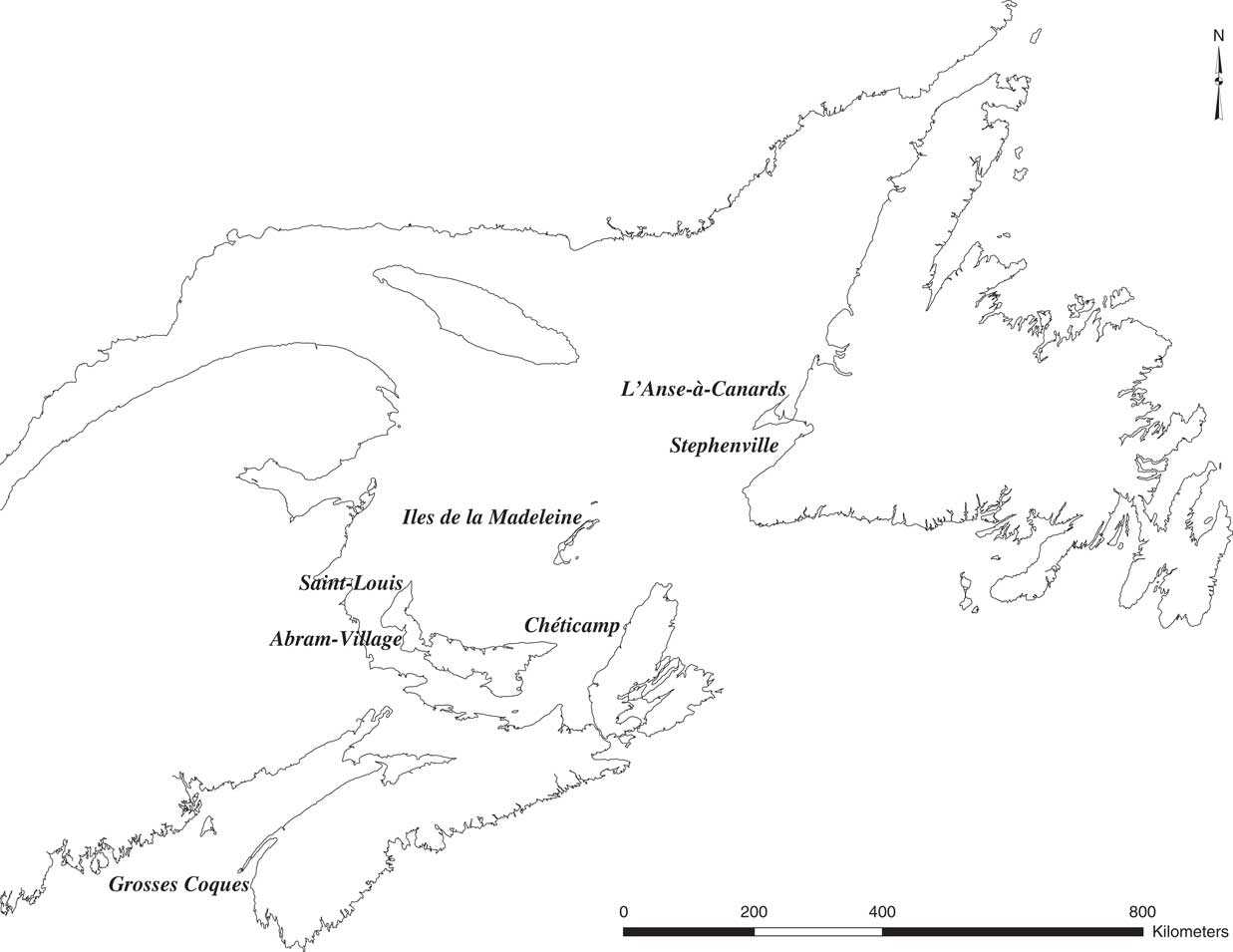
From the early 18th century, Acadians had also fled to the largely uninhabited Baie Saint-Georges area of western Newfoundland, with small waves of immigration from the Chéticamp area in particular continuing until the mid-1870s (Brosnan Reference Brosnan1948; Mannion Reference Mannion1977). In the mid-19th century, Acadian immigration to Newfoundland included several families from the Iles de la Madeleine (Hubert 1926/Reference Hubert1979). In addition, some parts of Baie Saint-Georges also saw significant late 19th century settlement by Metropolitan French from Brittany and Normandy, creating a dialect contact situation not found elsewhere in Atlantic Canada (Biays Reference Biays1952; La Morandière Reference Morandière1962; Butler Reference Butler1994). Our final community is L’Anse-à-Canards, part of the small present-day French enclave in western Newfoundland. The community itself was settled relatively late, starting in the 1870s with Acadians who had already been established in Newfoundland for some time, having moved from Chéticamp and the Iles de la Madeleine to the Baie Saint-Georges area. The Acadian settlers were joined in the late 19th century by new settlers directly from France and from France by way of the French islands of St-Pierre and Miquelon. The community’s access to French language education was only at the level of the individual speaker (with some residents having been taught to read and write French by their Metropolitan French parents) until the late 20th century. We will return in more detail to this community’s early history below. Our research sites are indicated on Map 2.
Acadian community research sites.

3.2 The Data
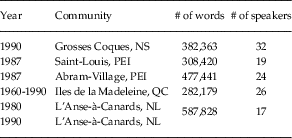
The details for the corpora on which this study is based are shown in Table 2. As noted above, we will compare our own results with those of Comeau, which were based on data from the 1990 Grosses Coques corpus. Native speaker residents of the community conducted semi-structured interviews with their friends and neighbours who were between 20 and 84 years of age. At the time of corpus construction, the population of Grosses Coques numbered just over 350 residents (Comeau Reference Comeau2011). The King 1987-1988 Prince Edward Island corpora were constructed using the same methodology as was used for Grosses Coques. The age range for Abram-Village consultants was between 18 and 81 years and between 26 to 79 years for Saint-Louis consultants at the time of corpus construction. The populations of Abram-Village and Saint-Louis numbered 350 and 150 respectively. The L’Anse-à-Canards corpus, constructed at two points in time, 1980 and 1990, involved multiple interviews with several speakers: the age range for consultants in 1980 was between 25 and 80, many of whom participated in additional interviews in 1990.Footnote 6 The community’s population was approximately 250 during the 1980s. All corpora included near equal numbers of male and female speakers. Given that no comparable sociolinguistic corpus exists for the Iles de la Madeleine, we constructed a corpus from archival recordings with older speakers recorded by Acadian folklorists either from the area or from elsewhere in Acadia. All of the Iles de la Madeleine speakers selected are descendants of the Acadians who settled in different villages on two of the islands (Ile aux Loups and Ile du Cap aux Meules). At the time of the interviews, the population of these villages involved a minimum of 50 but fewer than 500 residents. While the age distributions across the corpora overlap considerably, it should be noted that the Iles de la Madeleine corpus has a larger portion of speakers born near the turn of the 20th century.
Corpora breakdown by year, community, size and number of speakers

3.3 Variable Usage
In our corpora, subjunctive selection as shown in 1 (repeated as 5 below) is in variation with selection of the indicative mood, shown in 6 for the present tense:
5 Il faut que je m’en aille . (GC-06)
‘I have to leave.’
6 Il dit : « Faut que je le fais pour un, faut que je le fais pour deux ». (AC-07-80)‘He says, “I have to do it for one, I have to do it for two”.’
All occurrences of the matrix verb falloir were extracted where mood choice in the embedded clause was unambiguous. A number of tokens were excluded from the analysis due to absence of a morphological or phonological contrast between the present indicative and present subjunctive, as in 7, along with tokens in which falloir is followed by the infinitival form of the embedded verb, as in 8:Footnote 7
7 Faut que l’homme aide aussi. (AV-05)
‘The husband has to help out, too.’
8 Elle a dit : « Faut se lever de bon matin ». (IM-08)
‘She said, “You have to get up early in the morning.”’
From the data for the five communities examined, we extracted a total of 1,205 tokens with the impersonal verb of necessity falloir, all of which were analyzed quantitatively.
3.4 Tense Parallelism
When investigating mood choice in French, it is important to consider the potential inhibiting effect of tense parallelism on subjunctive selection in informal speech. The phenomenon is illustrated in 9, in which conditional falloir triggers a conditional rather than a subjunctive form of the verb être ‘to be’ in the embedded clause.
9 Faudrait que ça serait dans l’automne. (AV-17)
‘It would have to be in the fall.’
Such tense parallelism is widely discussed in the relevant literature on Metropolitan French (e.g. Brunot Reference Brunot1922; Cohen Reference Cohen1965; Grevisse & Goosse Reference Grevisse and Goosse2008). It has also been attested in several studies of North American French, in the case of use of the conditional in the embedded clause instead of the subjunctive. For instance, Seutin (Reference Seutin1975) found the phenomenon to be widespread in Ile-aux-Coudres, Québec, a small island in the St. Lawrence River roughly 100 km. east of Québec City. Reporting on matrix falloir, Auger (Reference Auger1990) noted that when this verb is in the conditional, it selects the conditional or the subjunctive at near-equal rates in Québec City French. Likewise, in Poplack’s (Reference Poplack1992) study of French in Ottawa-Hull, the subjunctive is strongly disfavoured when falloir is in the conditional. Tense parallelism in Acadian French has a wider distribution, such as with the imperfect indicative shown in 10, where imperfect falloir triggers imperfect être in the embedded clause.
10 Fallait que c’ était deux ou trois jours avant que j’étais née. (AC-01-80)
‘It had to be two or three days before I was born.’
In the results presented below, we consider this phenomenon and its effect on mood choice.
4. RESULTS
4.1 Intercommunity Results
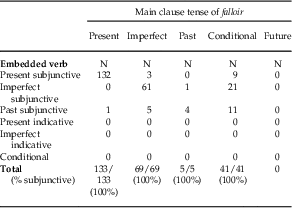
We begin with the results of Comeau’s (Reference Comeau2011) examination of subjunctive use in Grosses Coques (Table 3), for which he reports categorical use of the subjunctive with falloir. Although there is tense parallelism between matrix falloir and the embedded verb for the present, imperfect and past tenses, in no way does this phenomenon inhibit selection of the subjunctive mood. Further, even when falloir is in the conditional, it still selects the subjunctive (the imperfect subjunctive for the most part) and never the conditional.
Results for Grosses Coques, Nova Scotia (Comeau Reference Comeau2011)

Subjunctive selection rate: 100% (n=248)
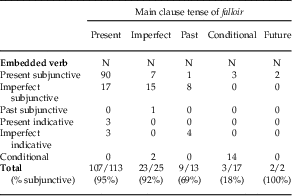
This study investigates usage for the two Prince Edward Island villages mentioned above. In Saint-Louis, the community which until quite recently had little contact with normative French or with Québec or other Acadian varieties, use of the subjunctive with falloir is quite high, at 85% of total occurrences (Table 4), including both the present and the imperfect subjunctive, the latter shown in 11 (as well as in 3 above).
11 Il fallait que tu restis là des fois pour des heures. (SL-29)
‘You used to have to stay there sometimes for hours.’
However, in contrast with Grosses Coques, there is more variability in the embedded clause with regards to tense parallelism: Table 4 shows that matrix falloir selects the subjunctive, with the tense of the embedded clause matching that of the matrix clause. However, unlike in the data for Grosses Coques, tense parallelism is strong when falloir is in the conditional, in that the conditional rather than the subjunctive is selected in the embedded clause for 14 of the 17 tokens, illustrated in 12.
12 Il faudrait que je me mettrais à penser. (SL-33)
‘I’d have to think about it.’
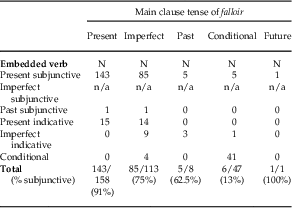
As for Abram-Village, the PEI community with a history of contact with supralocal spoken French varieties as well as the standard language, use of the subjunctive with falloir in Table 5 is at a rate of 73%, showing more mood variablity in the embedded clause than in Saint-Louis. Indeed, although the present subjunctive is selected in most instances in the embedded clause, the present or imperfect indicative may also be used. With regard to tense parallelism, this phenomenon is weakened by the absence of the imperfect subjunctive in the data for this variety, resulting in all clauses embedded under imperfect and past falloir defaulting to present subjunctive of faire ‘to do’, as in 13. (Note that while Standard French would have fassent here, faisent is the Acadian subjunctive form for this verb.)
13 Fallait qu’ils faisent le tour de la Point-de-l’Est. (IM-03)
‘They had to go around East Point.’
Finally, the effect of tense parallelism when falloir is in the conditional is as strong as in Saint-Louis since the results show that 41 of 47 tokens in the embedded clauses are in the conditional.
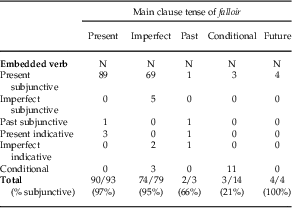
With a subjunctive selection rate of 90%, the overall results for Iles de la Madeleine (Table 6) are second only to those for Grosses Coques. We see that the present subjunctive is the dominant variant in all embedded clauses with the exception of tokens when matrix falloir is in the conditional. However, in contrast to Grosses Coques and Saint-Louis, there are very few occurrences of the imperfect subjunctive in the data. We must keep in mind that since the corpus from which the Iles de la Madeleine data are taken is weighted more heavily towards older speakers than are our other corpora, these results could be a reflection of older speech patterns. Therefore, we may hypothesize that a comparable corpus to those for the other communities might well show no evidence at all of the imperfect subjunctive.
We may conclude, then, that Grosses Coques, Saint-Louis, Abram-Village, and Iles de la Madeleine all show high rates of subjunctive usage with falloir, in line with the results of variationist studies conducted elsewhere. With regard to tense parallelism, only in Grosses Coques does use of the conditional in the matrix clause not inhibit subjunctive selection in the embedded clause, understandable given the considerable “strength” of the subjunctive mood in this variety and the absence of variation in the embedded clause. Intercommunity differences with regard to degree of exposure to the standard language and to contact with Québec French and other spoken French varieties are correlated with low rates (Iles de la Madeleine) and absence (Abram-Village) of the imperfect subjunctive. On the other hand, the village of Saint-Louis, being both geographically isolated and lacking institutional contact with the standard, has retained much of the rich morphology found in Grosses Coques, our baseline community.
The decline of the imperfect subjunctive in some Acadian varieties may be understood in terms of its perceptual salience, which makes it a target for social evaluation in communities with more outside contact (e.g. Kerswill & Williams Reference Kerswill and Williams2002). Unlike in Standard French, as Table 1 illustrates, the simple past and the imperfect subjunctive are homophonous in Acadian varieties, as has also been attested for a number of European vernaculars (Dauzat Reference Dauzat1927). In addition, the original <a> and <i> conjugations of the simple past have fallen together whereas the <u> conjugation for verbs with a –re infinitival ending remains intact (e.g. il but ‘he drank’). The imperfect subjunctive is also regularized based on the <i> and <u> simple past in Acadian varieties (see e.g. Svenson Reference Svenson1959; Rézeau Reference Rézeau1976; Gachignard Reference Gachignard1983 for similarities in 20th century centre-west varieties). In Standard French, 1st, 2nd and 3rd person plural are morphologically distinct for all three conjugation groups, i.e. <a>, <i> and <u>.
Although the forms are homophonous in Acadian varieties, there is a difference in relative frequency between the imperfect subjunctive and the simple past since the former is found in past subjunctive selecting contexts exclusively and thus less frequently occurring than the latter, which is used to convey past temporal reference (for punctual events in particular). Flikeid & Péronnet’s (Reference Flikeid and Péronnet1989) comparative study of the language use of older informants for five Nova Scotia Acadian communities and for south-east New Brunswick provides indirect evidence for the saliency of the dialectal forms. While both the imperfect subjunctive and the simple past tense had been lost from north-east New Brunswick Acadian varieties from the late 19th century (Geddes Reference Geddes1908: 274), these homophonous forms were still attested for the south-east by Flikeid & Péronnet in the speech of 5 of their 7 elderly consultants in subjunctive selecting contexts, evidence against an interpretation of the forms as being simple pasts. However, both the imperfect subjunctive and the simple past were found for the five Nova Scotia communities they studied.Footnote 8 For the Nova Scotia speakers, the authors comment that the forms of the simple past tense appeared to be avoided by the most educated members of the sample. Even if these speakers were unaware of the standard forms, they would have known that non-Acadian French varieties to which they were exposed do not use -irent and -urent forms. Other French varieties rely principally on the passé composé (e.g. j’ai parlé “I spoke’) and the imperfect (je parlais ‘I was speaking’) for past temporal reference. Although Flikeid & Péronnet do not report comparable avoidance for the imperfect subjunctive, the fact that it is homophonous with the Acadian simple past and distinct from Standard French and most spoken varieties might also have led to avoidance. The failure to find a reportable pattern for the imperfect subjunctive may be a function of the amount of data Flikeid & Péronnet analyzed, with only eight speakers for each Nova Scotia community.
The use of the Acadian imperfect subjunctive is to a certain extent reminiscent of another highly salient variant for the history of French (including that of Acadian varieties), i.e. the use of 1st person je used in combination with an -ons inflectional ending with plural reference (e.g. je parlons ‘we are speaking’). As King, Martineau & Mougeon (Reference King, Martineau and Mougeon2011) show, je+-ons was stigmatized by European French grammarians from the 16th century on and was in rapid decline from higher class speech by the 17th century and from lower class speech by the early 19th century. As for Acadian varieties, the situation is more complex but, in general, the greater the exposure to supralocal French, the more 1st person plural definite on is likely to dominate or entirely replace je+-ons (King Reference King2013).Footnote 9 Interestingly, when asked what it meant to “speak well” (bien parler), Flikeid & Péronnet’s Nova Scotia consultants singled out avoidance of 1st person plural pronoun je to the same degree as avoidance of words of English origin. The pronominal variants je vs. on used with 1st person plural definite reference are illustrated in 14 and 15:
14 Je descendions en bas à la boutique. (AC-02-90)
‘We used to go down to the shop.’
15 Si tu veux venir on va y aller. (IM-01)
‘If you want to come we’ll go together.’
Results for Saint-Louis, PEI

Subjunctive selection rate: 85% (n=144/170)
Results for Abram-Village, PEI

Subjunctive selection rate: 73% (n=240/327)
Results for Iles de la Madeleine, QC

Subjunctive selection rate: 90% (n=173/193)
Our own corpora for the five communities under study show the following continuum in terms of proportion of je+-ons (vs 1st person plural definite on usage): L’Anse-à-Canards (1980 corpus: 97%, total n=470/488; 1990 corpus: 98%, total n=1499/1530), Grosses Coques (93%, total n=1216/1308), Saint-Louis (70%, total n=1541/2201), Abram-Village (34%, total n=777/2286) and Iles de la Madeleine (1%, total n=5/498). On the basis of our earlier discussion of the history of these communities, the results for the latter four are as we would expect. With regard to L’Anse-à-Canards, these results are likewise to be expected given that all of the varieties in contact at the time of the establishment of the community had je+-ons, including the Metropolitan contact variety (Gilliéron & Edmont Reference Gilliéron and Édmont1902–1910; see relevant Atlas linguistique de la France maps cited by Flikeid & Péronnet Reference Flikeid and Péronnet1989). In addition, it must be noted that until the late 20th century L’Anse-à-Canards had little contact with supralocal varieties (Butler Reference Butler1994). All in all, where there is substantial contact with supralocal French at the level of the community or at the level of the individual (the latter typically in terms of exposure through education), the imperfect subjunctive (and the simple past) behave like the je+-ons variant: they undergo decline, in some cases to the point of obsolescence.Footnote 10
Before presenting the findings for mood choice for L’Anse-à-Canards, we note that this particular variety had already been the object of a substantial amount of variationist research. To date, seven morphosyntactic variables and two pragmatic variables have been investigated for this community (see King & Butler Reference King and Butler2005 and King Reference King2013 for overviews). Previous studies have concluded that traditional vernacular patterns are strongly preserved in L’Anse-à-Canards French; in other words, the community generally aligns with the four Acadian communities discussed thus far. Indeed, the community leads in the retention of je+-ons in the results shown above. Only one exception to this conservative pattern has been documented for the nine variables: L’Anse-à-Canards appears to have completely lost one variant in the expression of past temporal reference, the simple past. In this regard, the results are, at least superficially, not unlike our results for the Iles de la Madeleine, where only remnants of the simple past are attested in our corpus.
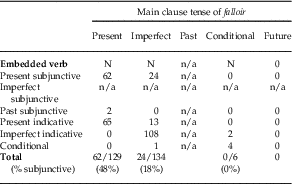
As can be seen in Table 7, in comparison to the results presented above for the four other communities, our findings for mood choice are very different for L’Anse-à-Canards. The overall rate of use of the subjunctive is startlingly low, at 32%, and the imperfect subjunctive is entirely absent. In fact, the rate of use of the subjunctive is the lowest reported in the literature for a variety of French in Canada. When falloir is in the present tense, the present subjunctive and present indicative are used in almost equal measure: there are 62 tokens of the present subjunctive and 65 for the present indicative, out of a total of 129 occurrences. When falloir is in the imperfect, the subjunctive is marginal at best as it occurs in only 24 of a total of 134 tokens, a selection rate of 18%, since the imperfect indicative is the preferred variant. There are insufficient data to evaluate the effect of tense parallelism with the conditional since there are only 6 such tokens in the 1980 and 1990 corpora combined. The hypothesis that the low rates of the subjunctive might be due to frequent use of falloir followed by the infinitive (as a possible avoidance strategy; see example 6) is not supported: the proportion of infinitival usage in the embedded clause is more or less equal across all five communities. For L’Anse-à-Canards, then, presence of the subjunctive is marginal with falloir. A preliminary inspection of other subjunctive-selecting contexts which also have a high rate of subjunctive selection in other French varieties, such as vouloir ‘to want’ and aimer ‘to like’, reveals that subjunctive usage is quite low in this variety more generally. In order to explain this divergence from the other four communities, we turn to the sociolinguistic history of the community and its particular patterns of dialect contact.
Results for L’Anse-à-Canards, NL

Subjunctive selection rate: 32% (n=86/267)
4.2 Explaining the L’Anse-à-Canards Puzzle
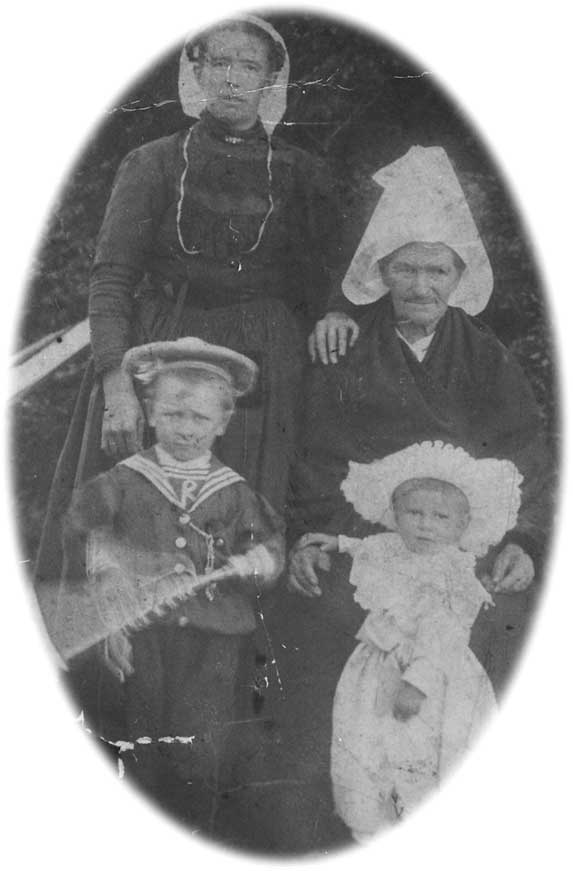
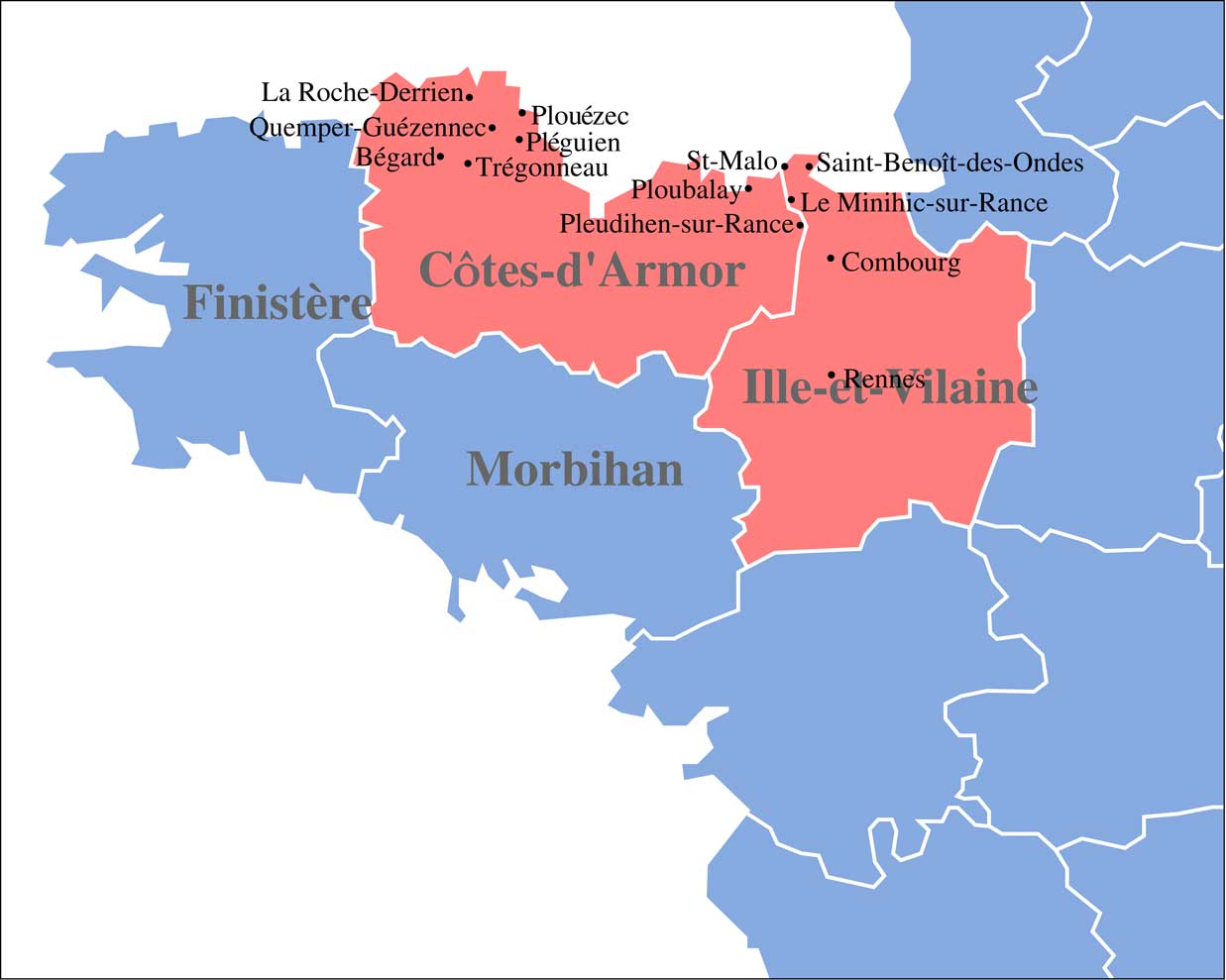
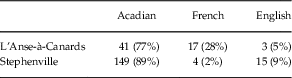
As noted above, an Acadian presence in the Baie Saint-Georges area of western Newfoundland dates from the mid-18th century, with small waves of immigration continuing up to the mid-19th century. In addition, some parts of Baie Saint-Georges, especially the two other coastal francophone communities of the Port-au-Port peninsula where L’Anse-à-Canards is located (Cap Saint-Georges and La Grand’Terre), also saw significant late 19th century settlement by Metropolitan French from Brittany and Normandy. Sociodemographic data drawn from nominal censuses, cadastral maps and parish registers for L’Anse-à-Canards and for the nearby almost entirely Acadian community of Stephenville for the period around 1900 allow us to reconstruct the proportion of families by community and by settlement group, shown in Table 8. In striking contrast to Stephenville, we see that over one-quarter of L’Anse-à-Canards residents arrived direct from France, or from France by way of the islands of St-Pierre and Miquelon. The majority of French settlers of L’Anse-à-Canards were men who had deserted compulsory French military service on fishing boats along this part of Newfoundland’s west coast, but also included whole families, such as the Le Roy family shown in Figure 1. The father, François Le Roy, arrived in 1901 and the mother, Marie Louise Nichol, and their two sons, arrived a year later. In the photo, taken just before the family left Plouézec in northern Brittany, the family’s traditional dress identifies them as of Breton origin. Oral history tells us that the parents were bilingual in French and Breton. In fact, the historical record suggests that all of the late arrivals to L’Anse-à-Canards came from Brittany, more specifically, from the present-day departments of Côtes-d’Armor and Ille-et-Vilaine. On the basis of oral history and family genealogies, most of these families have been traced to their places of origin in Brittany, shown on Map 3 (Butler Reference Butler1995; Bennett Reference Bennett2002).
Metropolitan French settlers of L’Anse-à-Canards, 1900.

Places of origin of Metropolitan French settlers to L’Anse-à-Canards, Newfoundland in the French departments of Côtes-d’Armor and Ille-et-Villaine in northern Brittany.

Ethnolinguistic Origins for Two Newfoundland Communities, Early 1900s

In an excerpt from the 1980 L’Anse-à-Canards sociolinguistic interview corpus, a son tells of his Breton father’s home village.
GB: et vous avez dit l’autre jour que votre père votre père était né à=
and you said the other day that your father your father was born at
JB: =oh il est né à Quemper-Guézennec [gIlnεk]
oh he was born at Quemper-Guézennec
GB: Quemper-Guézennec?
JB: Yeah en Bretagne
GB: Qu’est-ce que ça veut dire « Guézennec »? What does Guézennec mean?
JB: C’est c’est le (.) c’est le nom de la de la (.) petite paroisseIt’s it’s it’s the name of the of the little parish
GB: ah bon
ok
Given such relatively late settlement from France, we turn to sources in the form of French grammars and dictionaries from the period which might inform us as to mood choice in northern Brittany. For instance, the LeCompte Reference LeCompte1910 grammar for a village near Saint-Malo, located in Ille-et-Villaine and a major point of departure for the French fishing fleets, mentions that the indicative often replaces the subjunctive in this community:
Souvent ce temps est remplacé par l’indicatif : Je veux qu’il va [ind] pour qu’il aille [subj] (p. 25)
‘Often this tense is replaced by the indicative…’
Similarly, the Dottin & Langouët Reference Dottin and Langouët1899 glossary for Pléchâtel, a village also located in Ille-et-Vilaine, suggests the same:
Le présent [du subjonctif] est souvent remplacé par le présent de l’indicatif… (§ 221)
‘The present subjunctive is often replaced by the present indicative.’
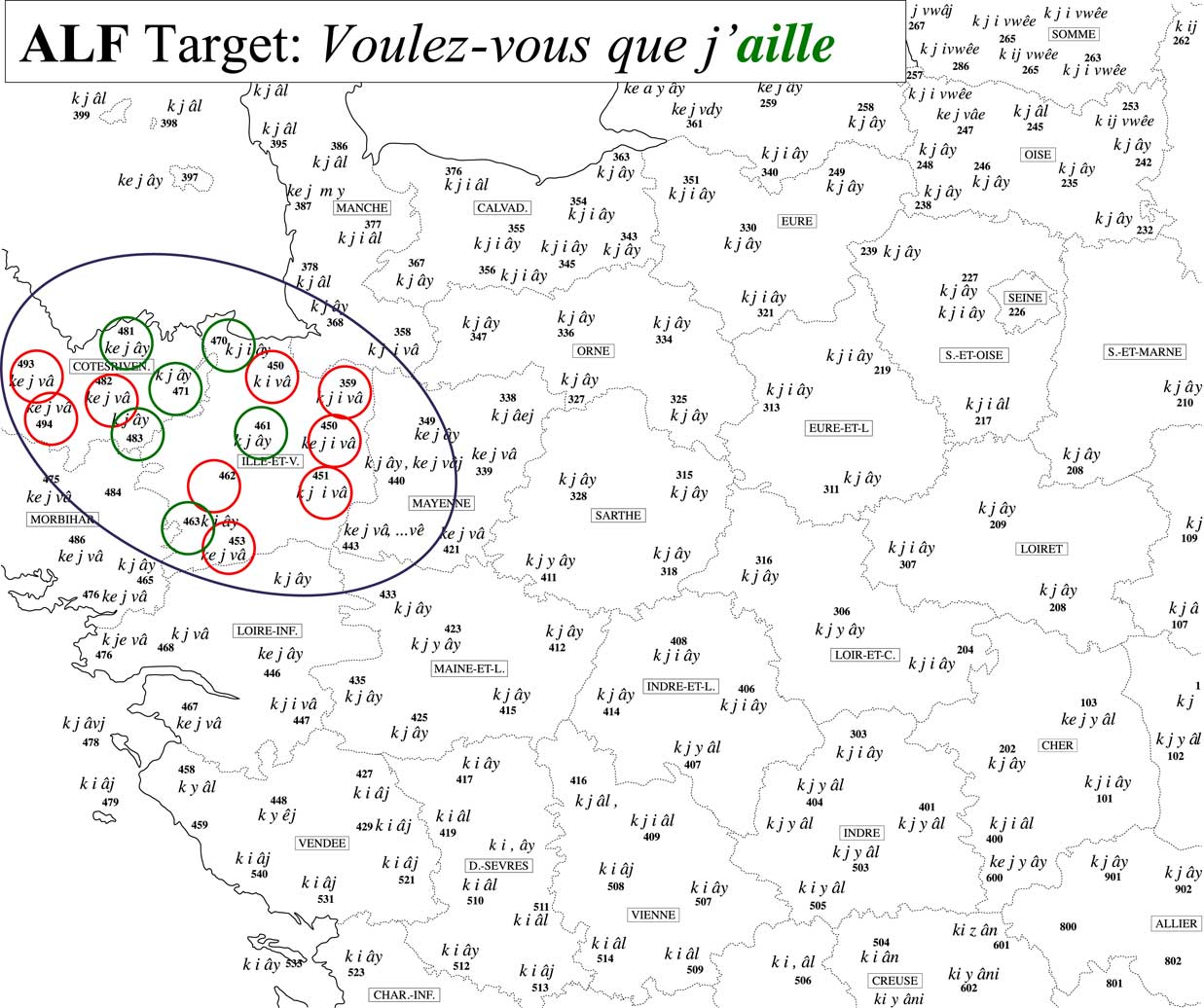
While the commentary found in such sources suggests general tendencies, more concrete evidence is found in Gilliéron & Edmont’s Atlas linguistique de la France, published between 1902 and 1910 and based on responses to an elaborate questionnaire which included a number of grammatical variables. When we look at data for Côtes-d’Armor and for Ille-et-Vilaine, we see results such as shown in Map 4 (ALF Map 1417), where the target sentence is Voulez-vous que j’aille? ‘Do you want me to go?’ for which consultants provided an equivalent in the local patois (Gilliéron & Edmont’s term, commonly used in French to refer to ‘local variety’).Footnote 11 Note that we are obliged to report results for a map for matrix vouloir ‘to want’, another frequent governor which normally has a high subjunctive selection rate, because the published falloir ALF maps do not include data for Brittany. In Map 4, we find an almost equal number of indicative (forms in [va]), indicated by red circles, and subjunctive forms (forms in [aj]) of aller ‘to go’ in the embedded clause for the Brittany survey points, indicated by green circles.
ALF Map 1417 for Brittany with subjunctive (green) and indicative (red) variants.

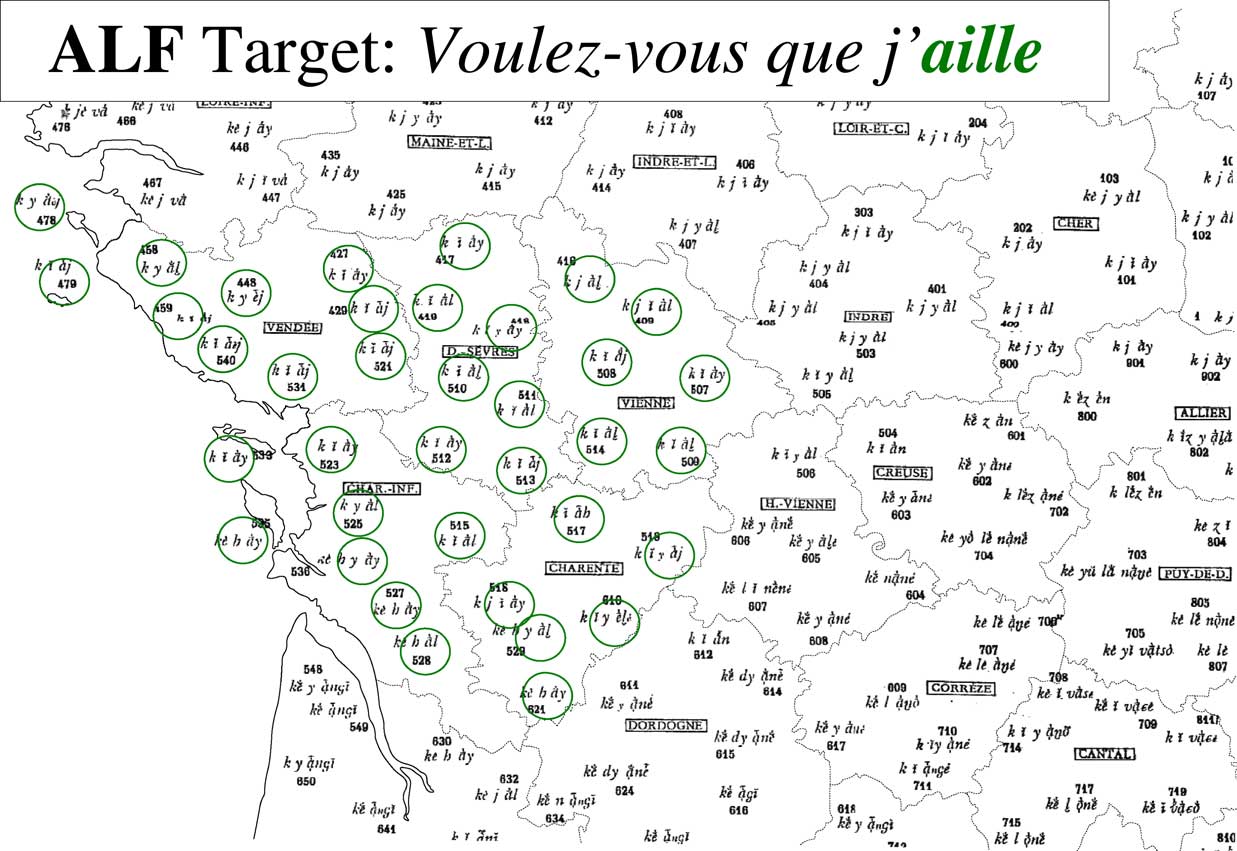
Even more interesting is the fact that Brittany is surrounded by a virtual sea of subjunctive usage in the ALF. For example, moving further south, to the centre-ouest, source area for Acadian settlement in North America, all of the data indicated on Map 5 are in the subjunctive for the same target sentence. We may conclude, then, that the documentation for northern Brittany at the turn of the 20th century looks quite a lot like our results for L’Anse-à-Canards in the late 20th century, as both display highly variable mood choice.
ALF Map 1417 for the Centre-West with only subjunctive variants (green).

Why might the northern Brittany pattern have won out in L’Anse-à-Canards, despite the fact that the community had a higher proportion of Acadian than Metropolitan settlers? Dialect contact literature such as Trudgill’s (Reference Trudgill1986) landmark Dialects in Contact would not predict such an outcome, since the group with the larger number of speakers would be expected to provide the model for dialect convergence. In other words, all other things being equal, the pattern found for the other four communities should have won out in L’Anse-à-Canards as well.
Trudgill (Reference Trudgill2008) has argued that local identity construction in face-to-face interaction does not play a critical role in the formation of (at least) colonial varieties; instead, he takes accommodation (and dialect mixture) in cases of dialect contact to be “quasi-automatic”. However, we suggest that in the present case speakers do orient their language use in the direction of particular varieties for reasons beyond the demographics of settlement patterns. We suggest that the answer to the L’Anse-à-Canards puzzle lies in the relative level of prestige attached to the Acadian and Metropolitan varieties in contact.
We base our interpretation on data from interviews conducted in the 1970s and 1980s for L’Anse-à-Canards and to some extent for the two nearby francophone communities which also saw a significant influx of Metropolitan settlers, Cap Saint-Georges and La Grand’Terre. As the folklorist Ronald Labelle (Reference Labelle2002: 167; see also Butler Reference Butler1995) succinctly puts it, for many older residents of communities like L’Anse-à-Canards (Labelle’s fieldwork was based in La Grand’Terre) “…on se sentait encore loin de l’Acadie, loin des Maritimes et même loin du Canada” (‘…people felt far from Acadia, far from the Maritimes and even far from Canada’, our translation). Similarly, Gary Butler (p.c.) notes that even the terms Acadie and acadien were rarely uttered by his L’Anse-à-Canards consultants in the 1980s: they might have occasionally spoken of some of their ancestors having come from Chéticamp in eastern Nova Scotia, but their sense of history and community culture was oriented towards their French ancestors, les Français de France.Footnote 12 Further, while Butler’s (Reference Butler1995) overview of L’Anse-à-Canards community culture in the 1980s details traditions of daily living – fishing techniques, marriage customs, etc. – closely aligned with Acadian life in our other communities, its verbal arts – the story-telling tradition and traditional song – are vibrant echoes of the French ancestors. We suggest that this latter group, smaller in number than their Acadian counterparts, also played a larger role in the formation of the L’Anse-à-Canards language variety.
There is additional evidence in support for this scenario in the form of language use in Stephenville, a nearby francophone community which underwent assimilation to English beginning in the early 1940s, to the point that only nine fluent speakers, all of them elderly, could be recorded during fieldwork in 1980 by Gary Butler and Ruth King. The 1980 recordings, coupled with two recordings made by the linguist John Hewson in 1964, constitute the only available sound recordings for this once-vibrant Acadian community. King & Ryan’s (Reference King and Ryan1991) comparative study of nasal vowel patterns in Chéticamp, Stephenville, and L’Anse-à-Canards found that the latter community lacks the typical Acadian realizations of these vowels while Stephenville closely aligns with the Nova Scotia Acadian community of Chéticamp.Footnote 13 In other words, the small number of Metropolitan French settlers in Stephenville (see Table 8) did not affect Stephenville phonology while the higher number of such settlers in L’Anse-à-Canards played an inhibiting role on retention of the Acadian phonological pattern.
With regard to mood choice, although the number of falloir tokens is low in the Stephenville recordings, we do find 32 of 39 tokens for the present subjunctive (vs indicative). Further, two interviews contain an example of unambiguous imperfect subjunctive usage, as in 16:
16 Fallait que tu mettis une barre. (ST-01)
‘You had to put a bar (on it)’
A few such tokens might arguably be discounted if it were not for the fact that no linguistic or folklore publication has ever attested such usage for L’Anse-à-Canards, La Grand’Terre, or Cap Saint-Georges, the three communities with significant proportions of Northern Brittany settlers (cf. Thomas Reference Thomas1983; Brasseur Reference Brasseur2001). Although the Stephenville data for mood choice are limited, this information, coupled with the results of the earlier study of phonological variation, provides indirect support for the characterization of L’Anse-à-Canards usage presented here.
An unanswered question is why in fact (northern) Brittany might have exhibited much lower selection rates of the subjunctive than neighbouring areas. It is tempting to suggest a language contact explanation since the Breton subjunctive grammaticalized into a future marker early in the history of the language (Zair Reference Zair2012). However, the historical record is insufficient to provide direct evidence for Breton’s influence on the decline of the L’Anse-à-Canards subjunctive.
5. Conclusion
The present study of mood choice for Atlantic Canada Acadian communities which vary considerably in terms of type and degree of dialect contact shows a range of outcomes for the high-frequency subjunctive-selecting context, the matrix verb of necessity, falloir. Since these varieties all retain to some degree the rich morphology we associate with vernacular lower-class French spoken in Europe up until the turn of the 19th century, we find a higher proportion of unambiguous verbal forms than do quantitative studies of other North American or European varieties.
Taking Comeau’s (Reference Comeau2011) results for the highly conservative community of Grosses Coques, Nova Scotia as a baseline (subjunctive selection with falloir was found to be categorical), we compared these results with our own four communities with complex patterns of dialect contact, dating from the 18th century and, in some cases, continuing up to the present day. With regard to use of the imperfect subjunctive, which has disappeared from most spoken varieties of French, this usage is robust only in our most isolated community, Saint-Louis (along, of course, with Grosses Coques). In the case of Abram-Village and the Iles de la Madeleine, we may attribute loss or low frequency of the imperfect subjunctive to contact with speakers of Québec French, a variety with considerable overt prestige. Such prestige is also attached to the standard language, which has traditionally been supported by local institutions such as the school and the church.
With regard to use of the present subjunctive, the results for four of the communities are in line with those of prior quantitative research on non-Acadian varieties: subjunctive selection rates with falloir are high, even when we factor in the potential inhibiting effect of tense parallelism. This is not the case for L’Anse-à-Canards, however, which stands apart due to a low rate of usage of the present subjunctive (the imperfect subjunctive was entirely absent from the corpus). In order to explain these results, we pursued two complementary lines of research, one involving documentation regarding a late 19th century northern Brittany settler group which figured significantly in the establishment of the village of L’Anse-à-Canards, and a second involving language use in a corpus for Stephenville, another francophone community in the same area which did not have such an influx of settlers from Brittany. We have shown that L’Anse-à-Canards language use does not align with Stephenville corpus data but rather with early 20th-century documentation for Côtes d’Armor and Ille-et-Vilaine in Northern Brittany.
Based on the results of ethnographic research and on consultants’ metalinguistic commentary, we argue that the language use of the late-arriving settlers from Brittany soon became the local prestige variety in L’Anse-à-Canards, setting the stage for relatively low use of the subjunctive early in the 20th century in the community. We suggest that theories of new variety formation such as those put forward by Trudgill must at least in cases such as described here appeal to social, as well as purely demographic, factors in understanding the establishment of community norms.Footnote 14 Finally, this research strongly supports the necessity of taking heterogeneity as a starting point in the study of Acadian French varieties and the importance of exploring their sociolinguistic histories of dialect contact.
Acknowledgements
We thank the Social Sciences and Humanities Council of Canada for financial support for this research in the form of an Insight Grant (#435-2012-1195). We thank the following archives for access to sound recordings which provide some of our linguistic data: Centre d'études acadiennes Anselme Chiasson (Université de Moncton), Centre d'archives régionales des Iles et Musée de la mer (Iles de la Madeleine) and the Archives de folklore et d'ethnologie (Université Laval). We also thank Gary R. Butler for access to his Grosses Coques, Nova Scotia and L’Anse-à-Canards, Newfoundland sociolinguistic interview corpora. In addition, we have benefitted from discussion of earlier versions of this paper with audience members at NWAV-44 (Toronto, November 2015) and the annual meeting of the Linguistic Society of America (Austin, TX, January 2017) as well as from written comments by this journal’s two anonymous reviewers. All errors are our own.