Enterobacteriaceae are recognized as a part of the natural microbiota of many cheeses, in particular artisanal cheeses made from raw milk and natural starter cultures obtained from milk or whey (Parente & Cogan, Reference Parente, Cogan and Fox2004). Their presence in cheeses is usually considered indicative of poor microbiological quality, although cheese contamination during manufacturing is probably frequent. The highest counts of Enterobacteriaceae are generally found during the first week of ripening, prior to the combined effects of low pH and other stress factors that include increase in salt concentration, decrease in a w, etc. (Gaya et al. Reference Gaya, Medina and Nunez1983; Dahl et al. Reference Dahl, Tavaria and Malcata2000). However, high bacterial counts have been reported as late as 30 d into ripening in different cheeses made from cows', ewes' and goats' milk, where they can be responsible for the accumulation of undesirable compounds, such as biogenic amines (Kongo et al. Reference Kongo, Gomes and Malcata2008; Innocente et al. Reference Innocente, Marino, Marchesini and Biasutti2009). High counts of Enterobacteriaceae have been correlated with high concentrations of cadaverine in cheese, suggesting that this biogenic amine could be used as a quality index for hygienic cheesemaking (Marino et al. Reference Marino, Maifreni, Moret and Rondinini2000). Large variation has been observed within each cheese variety, especially in raw milk cheeses. For example, the amount of cadaverine varied between 48·6 and 239·6 mg/kg dry matter in Terrincho cheese (Pintado et al. Reference Pintado, Pinho, Ferreira, Pintado, Gomes and Malcata2008), and between 0·9 and 368·5 mg/kg wet extract in hard-ripened cheese from raw goat milk (Novella-Rodríguez et al. Reference Novella-Rodríguez, Veciana-Nogués, Izquierdo-Pulido and Vidal-Carou2003).
In Montasio cheese, a traditional Protected Denomination of Origin (PDO) cheese produced in north-eastern Italy from raw or thermized cow's milk, Enterobacteriaceae can be present at concentrations of 104 CFU/g after 60 d of ripening and can still be detected after 4 months (Marino et al. Reference Marino, Maifreni, Bartolomeoli and Rondinini2008). The presence of high amounts of cadaverine and putrescine in Montasio cheese has been linked to the development of anomalous fermentations by Enterobacteriaceae during ripening (Innocente & D'Agostin, Reference Innocente and D'Agostin2002). The main sources of this microbial group in Montasio cheese are represented by raw milk and natural milk starter culture (Carraro et al. Reference Carraro, Maifreni, Bartolomeoli, Martino, Novelli, Frigo, Marino and Cardazzo2011). At the present time, information on the bacterial species present in Montasio cheese is not available. Thus, the aim of this study was to identify the Enterobacteriaceae species present in Montasio cheese during ripening and to assess their potential to produce biogenic amines.
Material and methods
Microbiological and physico-chemical analyses
Six batches of Montasio cheese (A-F) made in six different manufacturing establishments approved by the Regulatory Board of the Appellation of Origin for Montasio cheese were investigated. Cheesemakings was performed using thermized milk (67 °C for 20 s) and natural milk starter culture (0·15% w/w) according to the traditional practice (Innocente & D'Agostin Reference Innocente and D'Agostin2002). Natural milk starter culture was produced by incubating thermized milk (i.e., milk treated at 62 °C for 15 s) at 44 °C for 6 to 8 h, which results in a culture composed mainly by thermophilic and thermoduric LAB species (Carraro et al. Reference Carraro, Maifreni, Bartolomeoli, Martino, Novelli, Frigo, Marino and Cardazzo2011). Briefly, the milk was heated to 32–34 °C and inoculated with natural milk starter culture. Liquid calf rennet was used to give coagulation in 15–20 min. The coagulum was cut into hazelnut-sized pieces and then cooked at 45–46 °C for 20 min. The curd was packed into 7–8 kg circular moulds and pressed for 24 h. After salting in brine for 24 h at 11 °C, the cheese was ripened at 8 °C during 120 d. Samples (25 ml or g) of milk, natural milk starter culture, curd, and cheese (after 5, 10, 20, 30, 60, 90 and 120 d of ripening) were aseptically obtained from each batch and microbiologically analysed. Before plating, 225 ml of a 2% (w/v) solution of sodium citrate (Sigma, Milan, Italy) were added to each of the curd and cheese samples, which were then homogenized for 2 min in a Stomacher Lab-Blender 400 (PBI International, Milan, Italy) and subsequently diluted in saline solution. Milk and natural milk starter culture samples were serially diluted in sterile saline solution. Dilutions were plated on Violet Red Bile Glucose (VRBG) agar (for Enterobacteriaceae count) incubated at 37 °C for 48 h, on MRS agar pH 5·5 (for lactic rods count) incubated at 30 °C for 48 h under anaerobic conditions, and on M17 agar with 10% w/v lactose (for lactic cocci count) incubated at 45 °C for 48 h. All culture media were from Oxoid (Milan, Italy). After incubation, between three and five typical colonies for each sample on VRBG agar were isolated and purified on Brain Heart Infusion agar, (BHI; Oxoid, Milan, Italy) and then stored at −80 °C in BHI supplemented with 30% (w/v) glycerol while awaiting further characterization. All isolates were tested for their Gram stain reaction and for catalase and oxidase reaction. Gram-negative, catalase-positive and oxidase-negative strains were assigned to the Enterobacteriaceae group.
The pH of milk, curd and cheese were measured using a pH meter with a glass electrode (Crison, Modena, Italy). NaCl% in cheese during ripening was evaluated by FIL-IDF Standard 17A (1972), while a w was monitored using an AquaLab System (Decagon Devices, Pullman, WA).
Molecular identification of isolates
The identification of isolates was performed using Enterobacterial Repetitive Intergenic Consensus (ERIC)-PCR and 16S rRNA gene amplification. ERIC-PCR is a fingerprinting method based on the PCR amplification of naturally occurring, highly conserved, repetitive DNA sequences, present in multiple copies in the genomes of most Gram-negative and several Gram-positive bacteria (Hulton et al. Reference Hulton, Higgins and Sharp1991). Genomic DNA was extracted from single colonies grown on BHI agar using the InstaGene Matrix (Bio-Rad, Hercules, CA, USA). The DNA concentration was spectrophotometrically determined (A260) and adjusted to 50 ng/μl using sterile distilled water. DNA templates were amplified using the primers ERIC1R (5′-ATG TAA GCT CCT GGG GAT TCA C-3′) and ERIC2 (5′-AAG TAA GTG ACT GGG GTG AGC G-3′) (Versalovic et al. Reference Versalovic, Koeuth and Lupski1991). PCRs were conducted in 25-μl reactions containing 50 ng DNA template, 2 U of Taq DNA polymerase (Applied Biosystems), 200 μm of each dNTP, 1·5 mm MgCl2 and 1 mm of each primer. Samples were amplified on a OneGradient thermal cycler (Euroclone, Milan, Italy) as follows: initial denaturation at 96 °C for 5 min, 30 cycles of 95 °C for 60 s, 52 °C for 60 s and 72 °C for 7 min, and final extension at 72 °C for 10 s. After the amplifications, 5 μl of each reaction was electrophoresed on a 2% (w/v) agarose gel (GellyPhor LE, EuroClone, Milan, Italy) stained with ethidium bromide in 0·5X TBE buffer (Sigma, Milan, Italy). Strains showing differences of one or more bands were considered to be different ERIC types, i.e. isolates with a different amplification profile (Dalla-Costa et al. Reference Dalla-Costa, Irino, Rodrigues, Rivera and Trabulsi1998). At least one strain for each ERIC type was subjected to partial 16S rRNA gene amplification using the following primers: P1V1 (5′-GCG GCG TGC CTA ATA CAT GC-3′) and P4V3 (5′-ATC TCA GCA TTT CAC CGC TAC-3′). The PCR products were sequenced by MWG Biotech (Ebersberg, Germany). In order to determine the closest known relatives of the isolates, these sequences were aligned with the contents of GenBank using the Blast algorithm (Altschul et al. Reference Altschul, Madden, Schäffer, Zhang, Zhang, Miller and Lipman1997).
Amino acid decarboxylase activity and biogenic amine production
The potential decarboxylation ability of strains was qualitatively assessed in ‘BA-test’ medium as reported by Bover-Cid & Holzapfel (Reference Bover-Cid and Holzapfel1999). To promote induction of the enzyme, strains were subcultured five times in Nutrient broth (Oxoid, Milan, Italy) containing 0·1% of each amino acid precursor (tyrosine-free base, histidine monohydrochloride, ornithine monohydrochloride, lysine monohydrochloride), in addition to supplementation with 0·005% (w/v) of pyridoxal-5-phosphate (Sigma, Milan, Italy). After that, the strains were streaked in duplicate on the differential decarboxylase plates containing 1% (w/v) of each aminoacid. The aminoacids were tested one at a time. The plates were incubated at 37 °C for 48–72 h.
The production of biogenic amine was quantitatively detected in a liquid medium containing histidine, tyrosine, lysine and ornithine according to Marino et al. (Reference Marino, Maifreni, Moret and Rondinini2000). After incubation, the derivatization and HPLC detection were performed in a Varian Model 230 Pro Star (Varian Inc, Palo Alto, CA, USA) and Rheodyne Model 7725i injector (Rheodyne, Cotati, CA, USA) with a 10 μl loop according to the procedure of Innocente et al. (Reference Innocente, Biasutti, Padovese and Moret2007).
Results and discussion
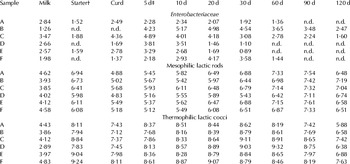
The aim of this work was to identify the Enterobacteriaceae species present in Montasio cheese during the cheesemaking and ripening process and to investigate their possible role in biogenic amine production. Enterobacteriaceae were present in raw milk at levels ranging from 1·26 to 3·47 log CFU/ml (Table 1), similar to data reported for other Italian artisanal cheeses and significantly lower than those reported for cheeses from other countries (Kongo et al. Reference Kongo, Gomes and Malcata2008; Franciosi et al. Reference Franciosi, De Sabbata, Gardini, Cavazza and Poznanski2011). The presence of Enterobacteriaceae in raw milk is unavoidable, due to the possibility of contamination during the milking process. However, the application of proper cleaning and disinfection procedures during milking, coupled with the shortening of times between milk collection and delivery and appropriate refrigeration, could significantly decrease the loads of these bacteria in milk. The presence of Enterobacteriaceae was also detected in three out of six natural milk starter cultures. Natural milk starter culture for Montasio cheese is made from thermally treated milk (67 °C for 20 s) incubated at 44 °C for 6 to 8 h. In such conditions, it is likely that some thermoduric enterobacteria overcome the thermal treatment and grow to reach high microbial loads.
Microbial counts (log CFU/ml or CFU/g) during Montasio cheesemaking and ripening

† Starter = Natural milk starter culture
n.d. = <1 UFC/ml (in natural milk starter culture) or <10 UFC/g (in curd and cheese)
‡ d, days of ripening
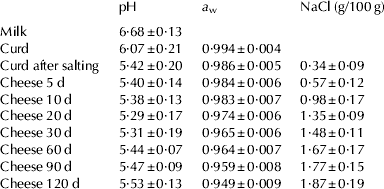
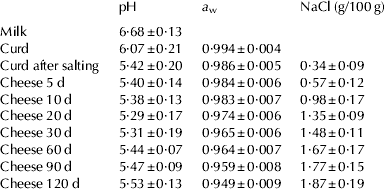
Except for batch B, Enterobacteriaceae were present in curd samples, and in most cases, their counts generally increased during the first 20 d cheese ripening. After this point, Enterobacteriaceae gradually declined over the course of ripening in all of the batches. They were however detected in two out of six cheese samples at the end of ripening at levels of 1·60 and 2·47 log CFU/g, although the LAB growth kinetics were consistent with a regular lactose catabolism during cheesemaking and ripening (Marino et al. Reference Marino, Maifreni, Breccia and Rondinini2004; Carraro et al. Reference Carraro, Maifreni, Bartolomeoli, Martino, Novelli, Frigo, Marino and Cardazzo2011). The presence of detectable levels of Enterobacteriaceae in ripened Montasio cheese might be related to the non-limiting values of pH, NaCl% and a w during ripening (Table 2). The lowest pH (5·29) detected at 20 d ripening was not sufficient to inactivate Enterobacteriaceae in cheese. In fact, it has been suggested that this microflora may be inhibited by pH values below 5·2. Neither NaCl% and a w should have been an obstacle to Enterobacteriaceae. In fact these parameters were for the whole ripening period in a non-inhibiting range, as reported by Nuñez et al. (Reference Nuñez, Gaya and Medina1985).
Physico-chemical parameters in Montasio cheese during manufacturing and ripening Values are means±sd for n = 3
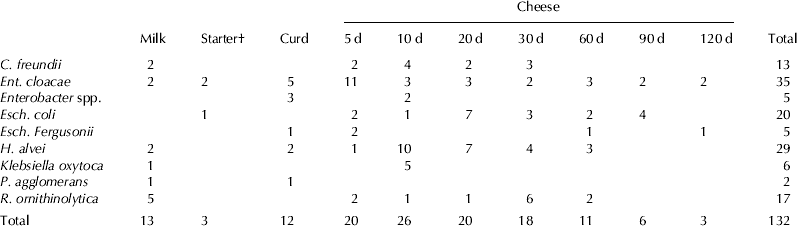
From a total of 223 isolates from VRBG plates, 132 strains were selected (one for each unique ERIC profile and two for profiles containing more than one isolate) for 16S rRNA sequencing. Enterobacter cloacae, Hafnia alvei and Escherichia coli were the most commonly isolated species, followed by Raoultella ornithinolytica and Citrobacter freundii. Ent. cloacae was present during the whole ripening period, whereas Esch. coli and H. alvei were only detected until 60 and 90 d ripening, respectively (Table 3). The persistence of Esch. coli and H. alvei in ripened cheese is probably related to the stress-tolerant character of these two species (Tornadijo et al. Reference Tornadijo, García, Fresno and Carballo2001). As for Ent. cloacae, its presence in ripened Montasio cheese could be related to initially high counts in raw milk or to its particular capability for surviving under adverse and stressful environmental conditions. It should be noted that Ent. cloacae, together with Esch. coli, were the only enterobacterial species found in natural milk starter culture, which is produced by incubating thermized milk at 44 °C until a pH of approximately 4 is reached. It is likely that these species, being capable of surviving the thermal treatment and the acidification process, could also overcome the physical and chemical stresses during cheese ripening. It should be highlighted that in recent years, Ent. cloacae has emerged as an important nosocomial pathogen, and its presence in foods has been related to poor food processing practices (Haryani et al. Reference Haryani, Tunung, Chai, Lee, Tang and Son2008).
Evolution of the Enterobacteriaceae strains isolated from Montasio cheese during manufacture and ripening
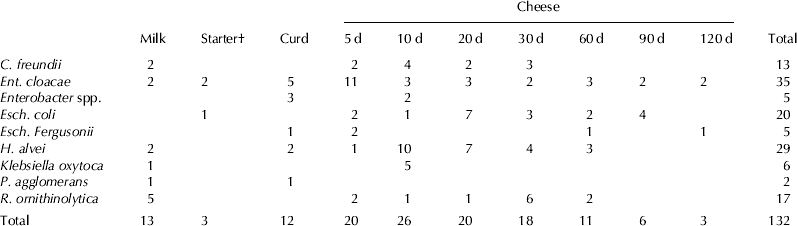
† Starter = Natural milk starter culture
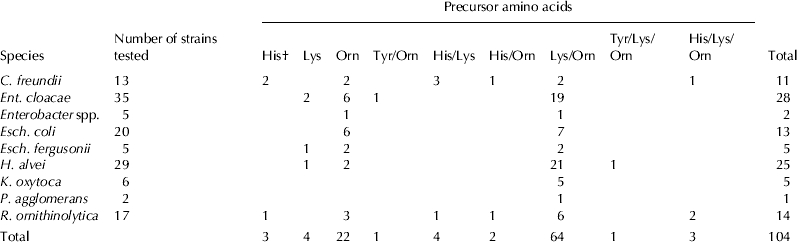
The strains were tested for their ability to decarboxylate amino acids using both a qualitative and a quantitative assay. In the qualitative assay (‘BA-test’) the ability to decarboxylate amino acids was tested against one amino acid at a time, while in the quantitative test the microbial cultures were grown in a broth containing all the four amino acids tested. The results of the qualitative test showed that potential decarboxylase activities were present in 79% of strains isolated from all stages of cheesemaking and ripening (Table 4). The ability to decarboxylate both lysine and ornithine was present in all Enterobacteriaceae species, while only few strains of the species C. freundii and R. ornithinolytica decarboxylated histidine, and only two strains (one Ent. cloacae and one H. alvei) were potential tyramine-producers. Few strains decarboxylated three amino acids, namely tyrosine, lysine and ornithine (one H. alvei strain) or histidine, lysine and ornithine (one C. freundii and two R. ornithinolytica strains). These data confirmed previous findings, and also provided new information regarding the decarboxylase activity of some Enterobacteriaceae species, including Pantoea agglomerans, Escherichia fergusonii and R. ornithinolytica.
Decarboxylase activity of Enterobacteriaceae strains isolated from Montasio cheese (n. of positive strains)
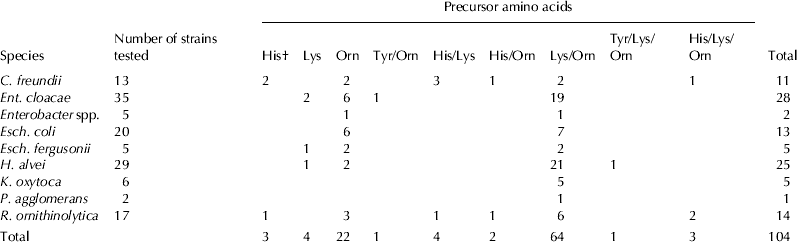
† His: histidine; Tyr: tyrosine; Lys: lysine; Orn: ornithine
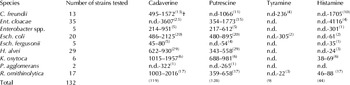
The quantitative test was performed in a liquid medium containing all the four amino acids tested at a time, in order to better simulate the environmental conditions of the cheese during ripening. Cadaverine and putrescine were the amines produced in higher amounts by almost all strains, the mean values being 1149 and 680 ppm for cadaverine and putrescine, respectively (Table 5). The ability to decarboxylate ornithine and lysine was widespread within Enterobacteriaceae, indicating that the presence of high amounts of putrescine and cadaverine in cheese can be linked to the presence of high counts of Enterobacteriaceae. Ent. cloacae was the species able to produce the highest amounts of these amines. This is an important safety concern, considering the high incidence of this microbial species in cheese (Tornadijo et al. Reference Tornadijo, García, Fresno and Carballo2001; Morales et al. Reference Morales, Fernández-García and Nuñez2003).
Biogenic amine production (ppm range) by Enterobacteriaceae isolated from Montasio cheese

† Numbers between parentheses are the strains with capacity to produce the biogenic amine
n.d., not detected
If tested only qualitatively (‘BA-test’), only a few strains were able to decarboxylate histidine and tyrosine, these enzymatic activities being mainly present in the lactic acid bacteria group (Bover-Cid et al. Reference Bover-Cid, Hugas, Izquierdo-Pulido and Vidal-Carou2001). The results based on HPLC analysis revealed instead a higher incidence of strains having these enzymatic activities. For example, as for histidine decarboxylation, according to the qualitative test this enzymatic activity was present in only 5 out of 17 strains of R. ornithinolytica, unlike HPLC data that have evidenced the production of histamine by all strains of this species, as reported by other authors (Kanki et al. Reference Kanki, Yoda, Tsukamoto and Shibata2002; Wauters et al. Reference Wauters, Avesani, Charlier, Janssens and Delmée2004). Most of the 44 strains that decarboxylated histidine produced low amounts of histamine (<300 ppm), and only four strains (two C. freundii and two Ent. cloacae) produced more than 1000 ppm of this amine. One Ent. cloacae strain was a strong histamine-producer in a liquid medium, forming over 4000 ppm of this amine. Only 9 strains, belonging to the species C. freundii, Esch. coli and R. ornithinolytica, showed production of tyramine (27 ppm mean value). According to the above results it can be stressed that the use of a screening test for the qualitative decarboxylation of amino acids can lead to underestimate the actual number of strains that are potential producers of biogenic amines, and therefore failure to properly evaluate the risk connected with the presence of Enterobacteriaceae in cheeses.
In conclusion, the presence of Enterobacteriaceae in Montasio cheese could be detected, albeit at low concentrations, until 120 d ripening. Most strains were shown to have the ability to decarboxylate mainly lysine and ornithine, which can cause cadaverine and putrescine build-up. This feature, along with their public health significance, is of great concern in ripened cheese. Use of raw material of high quality and free of amine-producing microrganisms, as well as good hygienic conditions during manufacture of Montasio cheese would strongly reduce the risk of the presence of biogenic amines in this cheese, in which the physico-chemical conditions (pH, NaCl% and a w) during ripening do not inhibit the growth of Enterobacteriaceae.