Abandoned asbestos mines represent potential sources of airborne mineral fibres with adverse effects on human health, and thus are considered hazardous environmental sites (Lee et al. Reference Lee, Strohmeier, Bunker and Van Orden2008). Re-vegetation of asbestos-bearing mine spoils has been suggested as a potential tool to reduce their negative impact by providing surface cover and limiting the dispersion of fibres in the air (Favero-Longo et al. Reference Favero-Longo, Matteucci and Siniscalco2009a; O'Dell & Claassen Reference O'Dell and Claassen2009). Higher plants, however, are generally poor at colonizing and covering the vertical rock walls which also characterize asbestos open-pit mines.
Saxicolous lichens are able to colonize asbestos-rich surfaces, including asbestos-cement tiles and asbestos-bearing serpentinite rocks (Favero-Longo et al. Reference Favero-Longo, Turci, Tomatis, Castelli, Bonfante, Hochella, Piervittori and Fubini2005). Lichen cover limits the dispersion of fibres in the air and lichen metabolites determine dissolution processes associated with a significant reduction in the toxicity-relevant surface reactivity of asbestos (Turci et al. Reference Turci, Favero-Longo, Tomatis, Martra, Castelli, Piervittori and Fubini2007; Favero-Longo et al. Reference Favero-Longo, Castelli, Fubini and Piervittori2009b). However, the rates of lichen colonization and growth are much slower than those of higher plants, limiting their role as agents of spontaneous bioremediation. The mine walls of the most important asbestos mine in Western Europe (chrysotile mine of Balangero, NW Italy), which were abandoned 20 to 55 years ago, still show only a scattered and poor lichen colonization, while natural outcrops of analogous serpentinite rocks in the surrounding area show an average lichen cover of over 75% (Favero-Longo et al. Reference Favero-Longo, Siniscalco and Piervittori2006).
Here we report the results of some attempts to increase the lichen colonization process on the Balangero mine walls by cultivating isidia and transplanting adult thalli of Xanthoparmelia tinctina (Maheu & Gilet) Hale. This foliose species is common on natural serpentinite outcrops outside the mining basin, but only a few young thalli occur on the mine walls abandoned 40–55 years ago (Favero-Longo et al. Reference Favero-Longo, Siniscalco and Piervittori2006).
The Balangero asbestos mine is located on the Balangero serpentinite mass, a portion of the Ultramafic Lanzo Massif occurring in the Central Western Alps (Compagnoni et al. Reference Compagnoni, Sandrone and Zucchetti1980). The climate is transitional between a temperate-continental and a pre-alpine climate, with high precipitation. Mean annual temperature is 10·3°C and rainfall is 1160 mm (Favero-Longo et al. Reference Favero-Longo, Matteucci and Siniscalco2009a). In November 2003, four 1–2 m2 experimental plots were established on a wall of the mining basin located at 680 m a.s.l. and representative of the geostructural features of the whole basin walls, with a slope of 60–70°, high fracturing degree and consequent instability (Compagnoni et al. Reference Compagnoni, Sandrone and Zucchetti1980). No lichens occurred in the plots, which were scanned with a hand lens, or within at least 50 m, while some small mosses occurred along crevices. The closest thalli of Xanthoparmelia tinctina occurred farther than 300 m from the plots.
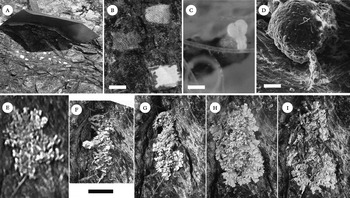
Cultivation and transplantation experiments were conducted using similar protocols to those described by Ott & Jahns (Reference Ott, Jahns, Kranner, Beckett and Varma2002). Adult thalli of X. tinctina were collected from natural serpentinite outcrops close to the mine and their isidia were gathered under a stereomicroscope by scraping their surfaces, preparing aliquots of about 100 isidia. In three plots, the isidia were sown directly on asbestos-rich serpentinite surfaces and covered with 20 cm2 nets of 1) a synthetic tissue for plant protection (OrtoVelo ®, Zoogarden s.r.l.; pore size 100×100 µm), 2) a sterile gauze (Cutisoft ©, Beiersdorf; p.s. 200×200 µm), and 3) a cotton fabric (p.s. 500×500 µm) (Fig. 1A & B). Each net contained an aliquot of isidia. Three replicates for each net material were prepared in each plot. Small metal covers were positioned over the plots to protect the propagules from being washed off by rain. After 8 and 14 months (August 2004 and January 2005), some isidia were collected with swabs from randomly selected nets (three per plot) and their survival was analyzed by evaluating the chlorophyll epifluorescence of photobionts using confocal laser scanning microscopy (Olympus-Fluoview CLSM; λ excitation/emission=514/610 nm). Their development was also examined under a light microscope (Leitz Orthoplan). In the fourth plot, five adult, isidiate thalli of X. tinctina, detached from their original substratum, were glued with a silicone adhesive (Wacker Silicone, Munich, Germany) onto asbestos rich surfaces. An additional five thalli were moved to the experimental plot, but left on fragments of their original substratum. These were glued in place using silicone adhesive so that the marginal thalline lobes were close to the fibre-rich surfaces of the transplanting area. Their growth was monitored 10, 40, 88 and 100 months after the transplantation, from November 2003 to March 2012, by measuring, sketching and photographing their external morphology.
Cultivation of isidia and transplantation of adult thalli of Xanthoparmelia tinctina on the walls of the asbestos mine (A–C, E–I) and on rock fragments in the laboratory (D). A, sowing plot protected with a metal cover; B, from top to bottom, nets of gauze, synthetic tissue and cotton; C, germinated isidium 14 months after the sowing; D, isidium anchoring to an asbestos bundle; E–I, growth of a thallus 0 (low resolution image), 10, 40, 88, 100 months after the transplantation. Scales: B=2·5 cm; C=40 μm; D=30 μm; E–I=1·6 cm.

Some isidia were also sown in the laboratory directly on 15 asbestos-bearing serpentinite fragments (surface c. 1 cm2; c. 50 isidia per fragment) glued onto SEM stubs. Propagules were maintained at 15°C under low irradiation and sprayed gently once a week with deionized water. After three months, propagule survival was monitored by CLSM, while initial developmental stages were examined using scanning electron microscopy (SEM Stereoscan S360 Cambridge Electron Microscope) on three randomly selected fragments coated with gold.
Eight and 14 months after sowing, the nets of synthetic tissue were still intact and had retained the isidia on the asbestos-rich surface. The recovered isidia maintained their original greenish colour and showed a vivid red chlorophyll epifluorescence, typical of healthy photobionts (Holopainen & Kauppi Reference Holopainen and Kauppi1989) and suggesting the survival of the propagules. However, only two out of c. 60 of the isidia recovered and observed displayed the early development of new lobes (length<0·1 mm) from their surface (Fig. 1C). In comparison, most of the other nets made of different materials were strongly damaged and had not retained the sown isidia, indicating that the metal covers had been insufficient to protect them from the effects of water and debris transport.
Three months after sowing, several isidia cultivated in the laboratory had assumed a rusty shade which was likely related to a metal mobilization from the mineral surface. This agrees with the fact that chrysotile asbestos fibres colonized by X. tinctina are modified in their chemical composition due to metabolite release (Favero-Longo et al. Reference Favero-Longo, Turci, Tomatis, Castelli, Bonfante, Hochella, Piervittori and Fubini2005; Turci et al. Reference Turci, Favero-Longo, Tomatis, Martra, Castelli, Piervittori and Fubini2007). Nevertheless, the isidia showed a vivid red chlorophyll epifluorescence of photobionts and many of them displayed outgrowing hyphae anchoring themselves to the fibre-rich surface (Fig. 1D). Over the following 18 months, however, the propagules failed to develop any germination lobes.
In the field, the nets of synthetic tissue progressively decayed after the second year after sowing, and even the metal covers were damaged and destroyed by snow and falling rocks during the winters of 2005 and 2006. It is possible that anchoring hyphae may have developed from the isidia, as usually observed in field studies 6–12 months after sowing (Ott & Jahns Reference Ott, Jahns, Kranner, Beckett and Varma2002) and seen in the laboratory assay, but no traces of the propagules sown were recovered in May 2006 and thereafter near the net remains and throughout the three experimental plots.
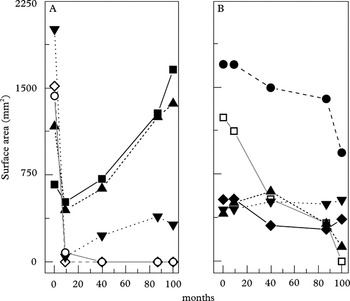
In the fourth plot, seven out of the ten thalli transplanted survived 100 months after the transplantation, but their total area was only 47% of that initially measured in November 2003 (Fig. 2A), and no isidia remained on their surface. The five glued individuals barely suffered from contact with the silicon adhesive; a few lobes turned to orange-brown. Nevertheless, a rapid decay generally characterized all the thalli during the first year after transplantation, 84% of the whole thalline surface being lost by the physical forces. However, three individuals survived 40 months after the transplantation and thereafter progressively overgrew the decayed areas and expanded on the fibre-rich surface (Fig. 1E–I). An areal variation of +29%, +10% and −8% for the three individuals was recorded in the last year of monitoring, the loss of some parts of these thalli highlighting the continuous effect of eroding forces on the mine walls (see Fig. 1H & I). It is worth noting that lobes of Xanthoparmelia conspersa showed a higher mean annual increase of their area (+57%) after their transplantation on a chemically suitable substratum, such as granite, but completely decayed on less suitable calciferous substrata (Armstrong Reference Armstrong1993).
Areal growth of the thalli of Xanthoparmelia tinctina transplanted on the mine walls. A, thalli glued to the rock-surface with a silicone adhesive; B, thalli transplanted on fragments of their original rock substratum. Each set of symbols represents a single lichen thallus over time.

The five individuals transplanted on fragments of original substratum did not decay as rapidly after the transplantation as thalli glued directly onto new substrata. Nevertheless, during the 100 months of monitoring, the thalli progressively turned (in part or in total) to a brownish white colour, their growth was generally poor and, in three out of the five cases, erosion processes prevailed (Fig. 2B). Only one out of the five thalli developed a single lobe extending over the borders of its original rock substratum on the adjacent fibre-rich surface. It has been suggested (Ott & Jahns Reference Ott, Jahns, Kranner, Beckett and Varma2002) that thalli transplantated on fragments of their original substratum are easily exposed to an altered microclimate, particularly in terms of water regime.
In the fourth plot, two new thalli of X. tinctina were also observed adjacent to the transplanted thalli, after 87 and 100 months, respectively. These thalli only measured 112 and 13 mm2 and grew 7 and 17 cm from where a thallus had been transplanted on its original substratum and a thallus had been glued on the rock, respectively.
In conclusion, lichen cultivation, which is generally considered a difficult matter on any substratum (Ott & Jahns Reference Ott, Jahns, Kranner, Beckett and Varma2002), proved to be poor on the steep walls of the Balangero asbestos mine. Lichens are generally less affected by the serpentine edaphic factors (Favero-Longo et al. Reference Favero-Longo, Isocrono and Piervittori2004) which are known to hamper re-vegetation of asbestos mines by higher plants (O'Dell & Claassen Reference O'Dell and Claassen2009). For this reason, the adult thalli of X. tinctina, transplanted from the natural serpentinite outcrops of the surroundings, found on the mine walls suitable conditions for their growth. However, the asbestos-rich surfaces are extremely unstable and exposed to erosion by running water and debris which prevented the establishment of the propagules sown and partially affected the growth of the thalli transplanted. The stability of rock walls on a micro- and macro-scale thus appears the most important factor to be considered when attempting to improve lichen colonization on abandoned mines. Nevertheless, in the case of asbestos-rich rocks not exposed to strong erosion processes, the transplantation of whole thalli of X. tinctina seems a feasible solution to cover fibre-rich surfaces when the use of a natural approach is preferable to that of sealing with synthetic products.
This research has been carried out with the financial support of Regione Piemonte “Direzione regionale 22”. The authors are grateful to Dr Massimo Bergamini and to the whole staff of RSA s.r.l. for admission to the Balangero mine and for assistance during fieldwork. The authors are also grateful to Dr A. Genre (University of Torino) for CLSM observations and to Dr M. R. Worland (British Antarctic Survey) for help with English expression.